Vi använder cookies för att ge dig bästa möjliga upplevelse. Välj vilka cookies du tillåter.
Läs mer i vår integritetspolicy
Jörgen Thornberg
Utan titel, 2025
Digital
70 x 50 cm
3 200 kr
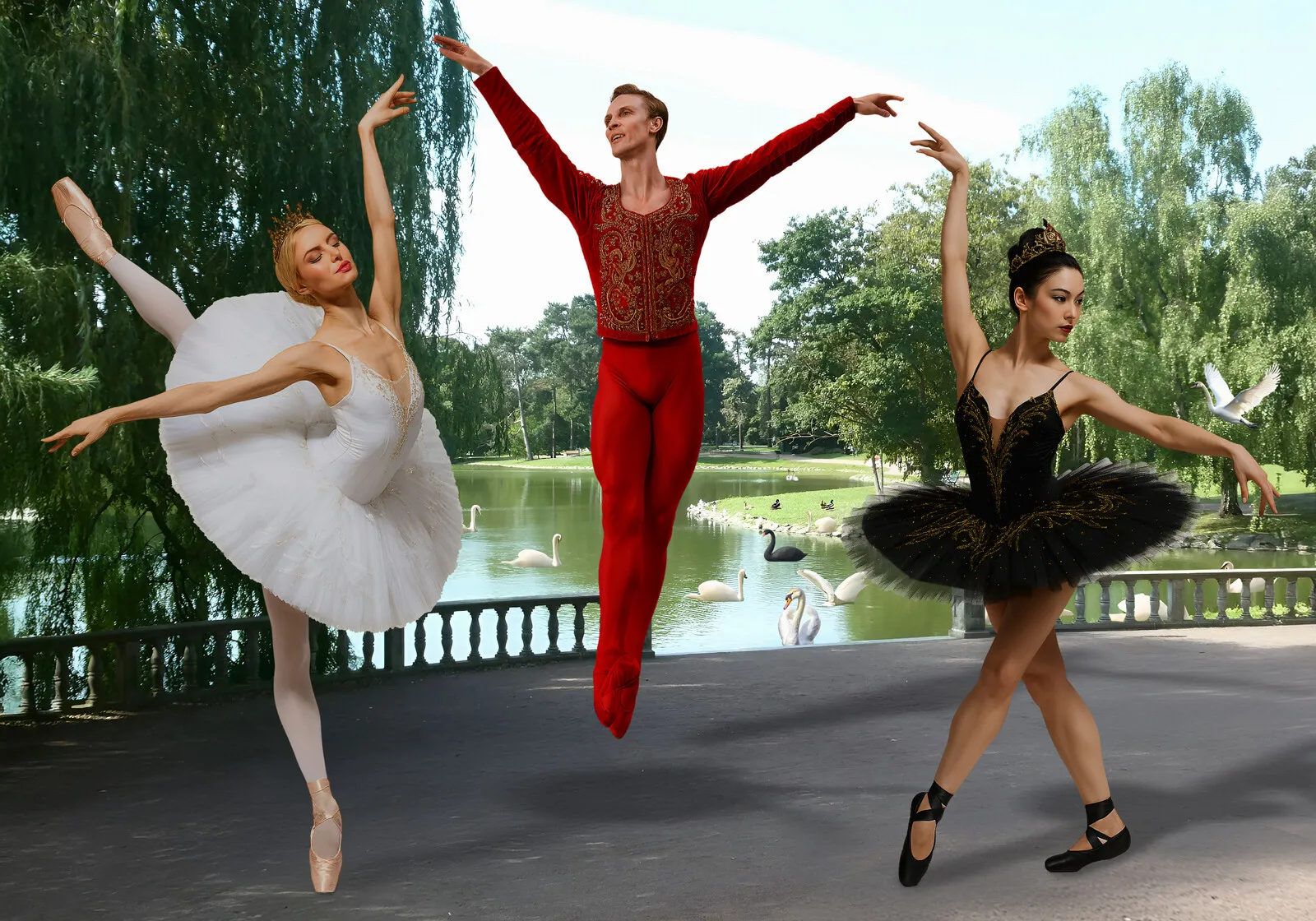
Black and White and some Red
These colours, often used symbolically in literature and art, play a significant role in the narrative of Swan Lake. The title 'Black and White and some Red' refers to the contrasting themes of good and evil, purity and corruption, and love and betrayal symbolised by these colours in the ballet, adding a layer of intrigue to the story.
Swan Lake—composed by Pyotr Ilyich Tchaikovsky in 1875–76—has never been confined to a single interpretation. Its surface narrative follows Prince Siegfried, Odette, and the sorcerer Rothbart. However, the ballet’s more profound significance lies in its changing endings and the symbolic dialogue of light, darkness, purity, and temptation. This essay examines Swan Lake as both a Romantic artefact and a living myth, anchoring readers to its enduring cultural importance and appeal, fostering a sense of connection and appreciation.
Building on this, the essay traces the motif through stage, opera, cinema, and literature, showcasing the masterful use of light and shadow as a language of revelation and concealment. For instance, the use of light to highlight Odette's purity and the use of shadow to depict Rothbart's malevolence. This exploration sheds light on the artistic language of Swan Lake, impressing the audience with the artists' mastery and enhancing our understanding of its enduring appeal and cultural significance.
“From Olympus to Ica
When Love Redeems the Swan”
When moonlight fades and dawn begins to rise,
The spell of night dissolves before her eyes.
No chains remain where hearts have dared to stay,
For love hath burned the darkest curse away.
His vow was not of breath but soul and fire,
A truth no storm of shadow could expire.
He took her hand, and the swan became the bride,
And morning crowned what midnight had denied.
The lake grew still, the wings were white as flame,
The wind itself forgot the word for shame.
Two hearts, once lost, now beat in one accord—
No spell survives the mercy of the Lord.
So let them dance where sunlight meets the stream,
Their love is the bridge between world and dream.
For every tear the stars in silence wept,
The dawn remembered — and the promise kept.”
Malmö. October 2025
Black and White and some Red
"Odette — I see you now, not as the swan nor the shadow, but as the soul that both light and darkness have shaped. No spell can bind what love has learned to know. I vow before heaven and the silent lake: You are my truth, my dawn, my eternal heart. If my love must be the price, let it break the curse — for I would rather die free by your side than live a thousand nights without your light."
Swan Lake, a ballet composed by Pyotr Ilyich Tchaikovsky in 1875-76, has been subject to various interpretations over the years. In the original narrative, Prince Siegfried falls in love with Odette, a princess transformed into a white swan by the evil sorcerer Rothbart. The princess can regain her human form only for a few hours each night and remains a swan until an everlasting declaration of love breaks the spell. Siegfried vows his love to Odette but is deceived by Rothbart into pledging himself instead to the sorcerer’s daughter, the black swan, Odile. The ballet's creation during the Romantic era, a period fascinated with the supernatural and the struggle between good and evil, adds depth to its cultural and symbolic significance.
One of Swan Lake's most intriguing features is the uncertainty about its ending. The ending has never been fixed and has changed over the years, reflecting each period’s views on love, reconciliation, and death.
In Tchaikovsky’s original 1877 score, both Odette and Siegfried die. They throw themselves into the lake to break Rothbart’s curse, and their souls, a testament to their enduring love, are united beyond life. It is a tragic yet spiritual ending—love does not triumph in this world but in eternity. This version is often seen as a myth of redemption, where death becomes the route to freedom and true love.
When the ballet was restaged towards the end of the nineteenth century, especially in the renowned 1895 production by Lev Ivanov and Marius Petipa, audiences started to yearn for something different: a happy ending. In that version, Siegfried overcomes Rothbart, the curse is lifted, and the lovers are reunited in life. The tragic death is softened, and the work concludes with a romantic climax.
Since then, each generation has adopted its own interpretation, contributing to the ballet's rich cultural history. In some productions, both lovers die, but the swans ascend to the heavens in a transcendent glow. In others, evil is defeated and love prevails, reminiscent of a classic Disney-style catharsis. Several modern interpretations—such as Matthew Bourne’s—introduce an ironic or psychological twist, where everything turns out to be a dream, a memory, or a reflection. The audience is left to decide.
This variety of endings is itself symbolic, inviting you, the audience, to actively engage with the deeper meanings of Swan Lake. The ballet tells the story of an enchanted couple and humanity’s constant oscillation between illusion and truth, hope and resignation.
Today, we prefer the version where love triumphs, the curse is broken, and light returns. This version reflects our age’s longing for comfort and meaning—a way of saying that goodness, after all, can prevail. Yet in Tchaikovsky’s music, the other ending persists—the undertone of sorrow whispering that every reconciliation comes at a cost.
On the surface, Swan Lake appears to be a conflict between good and evil. However, its story is much more complex. It offers an intellectually stimulating exploration of the soul’s struggle between light and darkness, spiritual purity and earthly desire, and the arduous journey towards insight, freedom, and understanding of love's true nature. The ballet delves into the complexities of human nature, the allure of temptation, and the transformative power of love.
The story is rooted in ancient European folklore, where the transformation between human and animal forms symbolises the soul’s captivity in the material world. The woman as a swan—Odette—is a spiritual being, a soul bound to nature, while Rothbart embodies the destructive power that keeps her captive in illusion and control. With their graceful and ethereal presence, the swans symbolise the human soul's yearning for freedom and transcendence. At the same time, their transformation represents the struggle to break free from the constraints of the material world.
The prince embodies the human side—the searcher for love who is also tempted and deceived. His error, allowing himself to be fooled by the black swan Odile, is not only a betrayal of Odette but also a moral and existential test of humanity’s tendency to be charmed by appearances, surface, and desire. His journey reflects the human struggle to discern between true love and deceptive allure.
Odette and Odile – Two Complex Aspects of the Same Soul, Their Names Symbolising Their Roles
In many interpretations, particularly the more symbolic ones, Odette and Odile are not just characters, but two aspects of the same woman or soul. They represent the pure and the seductive, the light and the dark. This interpretation transforms Swan Lake into a story of internal conflict, self-awareness, and inner healing. For love to be genuine, Siegfried must learn to see through illusion and embrace wholeness—loving both the light and the shadow.
The Spiritual Dimension
On a profound spiritual level, Swan Lake is not just a ballet but a testament to the transformative power of love. It is a story about liberating the soul from ignorance, illusion, and ego. Odette symbolises the soul yearning for redemption through true love—not the love of romance, but the awakening of the spirit, the understanding that love cannot be owned or controlled. When she and Siegfried finally unite in death, it is not a defeat but a form of transcendence: love conquers evil not through conflict, but through sacrifice and truth.
Swan Lake is indeed about good and evil, but not in a straightforward way. It delves into the tension between light and darkness, illusion and truth, desire and purity, captivity and freedom. It's a soul's journey towards wholeness, which is not always straightforward.
Some might argue that Swan Lake is not just a love story—it is a myth about the inner transformation of the human soul and how pure white ultimately prevails over darkness. This transformation is intricately linked to the themes of light and darkness, as the characters navigate their inner shadows and light to understand themselves and their world better.
White and black. Night and day. Two worlds that, since ancient times, have symbolised good and evil, purity and temptation. In Western tradition, humanity has long associated light with truth and divinity, darkness with danger and sin. This inheritance echoes the Bible’s opening words: “Let there be light.” From that initial separation—creation from chaos, light from darkness—grew a worldview where night came to represent the irrational, the dreamlike, and the dangerous; a shadowy realm extending through medieval art and into the Enlightenment’s faith in “the light of reason.”
Yet in other traditions, the night holds an entirely different significance. In ancient Egypt, darkness is not seen as a threat but as a vital phase in the cosmic cycle: the sun god Ra travels through the underworld’s darkness each night to be reborn at dawn—darkness serving as the foundation for life’s renewal. In Indian and Buddhist philosophies, darkness is connected with stillness, meditation, and insight. Night becomes a time for inner illumination, when the soul perceives what the eye cannot see. Among Native American peoples and Norse mythology, night often symbolises the maternal principle—the womb, the dream, intuition. It is not evil, only concealed. Darkness transforms into the encompassing world, where everything rests, allowing new beginnings to emerge.
Even in the West, this rigid dualism began to break apart. The Romantics sensed that night was not only a time of danger but also of the soul and love. In the shadows, humanity could glimpse what daylight concealed. Nietzsche gave the modern myth its voice: one must have “chaos within” to give birth to a dancing star—darkness as a creative force.
Humans have often—but not always—linked light with good and darkness with evil. It varies depending on the culture that frames the story and its purpose. In Western thought, darkness was demonised; elsewhere, it was seen as an essential part of wholeness. When Swan Lake has the white and black swans represent goodness and evil, the ballet reflects a Western dualism and a more profound mythic truth: that light and dark need each other—that true love and understanding encompass both.
But darkness has another side. Beneath its cover, most crimes are committed. The night hides, protects, and muffles those who do not wish to be seen. While light reveals everything, darkness allows movement without witnesses. The night becomes an accomplice—a silent pact between guilt and shadow.
The black night functions like a mask, a costume for the masquerade. We move within its anonymity, among silhouettes and half-seen contours, and for a moment the world belongs to our secrets. It is an old realisation: darkness does not reveal, but it enables. It shelters both crime and dreams, both desire and fear. This reflection on the role of darkness in enabling human behaviour is intriguing and thought-provoking, inviting us to delve deeper into its complexities.
Daylight, by contrast, is relentless. It unveils every crack, lie, and mask for what it truly is—a mask. In the light, illusion loses its influence. Therefore, night has always held a dual significance: it is both emancipation and concealment, safeguard and peril. Light exposes the truth, and this revelation in the light makes us feel enlightened and aware. But darkness reveals human beings as they are when no one is observing.
All of this circles back to Swan Lake, where light and shadow are not just mood or stagecraft but the very foundation of the soul. Odette belongs to dawn—the clear, delicate light that seeks truth. Odile emerges from the shadow, from the hall of mirrors where reflections deceive and illusions come to life. She is the daughter of darkness, yet also its seduction: she demonstrates how easily we are bewitched when desire disguises itself as love.
When Siegfried mistakes Odile for Odette, it is not just an act of betrayal but also a result of moral blindness—he fails to distinguish the real from the reflected, the soul from its outward appearance. Darkness has turned his gaze into a mirror of his own longing. He only perceives the truth when the light returns, but the spell can be broken through loss.
Thus, Swan Lake becomes more than a story of love and deception: it is an allegory of humanity’s timeless struggle between truth and illusion, between the night’s mask and the day’s light. In the end, only one truth remains: that light cannot exist without shadow, and that the test of love always plays out between the two.
Perhaps that is why we need both. Without darkness, there is no dream; without light, no awakening. The night provides anonymity, rest, and reflection—a space to meet our shadows without judgment. Conversely, daylight demands responsibility, clarity, and the courage to stand in one’s own light. One without the other creates an imbalance: those who live solely in sunlight risk blindness, while those who dwell in darkness risk losing their way. The delicate balance between the two leads to proper understanding and growth, creating a sense of harmony and completeness in life.
In art, as in life, beauty often emerges at twilight—at the crossing between night and day, illusion and understanding. There, Odette and Odile meet, Siegfried pauses, and we recognise ourselves most clearly. Swan Lake teaches that light does not conquer darkness by destroying it but by comprehending it. In that moment, the opposition vanishes, and the world becomes whole.
On stage, this primal conflict has always been as much about lighting design as about drama. In Greek tragedy, the torches speak: the shadow falls when truth approaches. In Oedipus Rex, the motif is doubled—the seeing man who is blind, the blind man who sees—a reversal where light reveals and destroys. Shakespeare continues this theme in Macbeth: night is the domain of crime and the chamber of guilt. “Fair is foul, and foul is fair”—fog and twilight make morality fluid. In Romantic theatre, darkness becomes the symbol of passion; modern psychology is born in the faint glow of footlights. However, it's important to note that the audience's interpretation of these symbols is crucial in understanding the deeper meaning of the performance.
Opera integrates the same dichotomy into architecture. The Magic Flute contrasts the Queen of the Night with Sarastro: dazzling coloratura against priestly daylight. However, the world is not simply black and white—Mozart allows appearances to deceive. Sarastro’s “light” may be the coldness of authority, and the Queen’s “darkness” a wounded mother’s fury. The actual initiation occurs in Tamino and Pamina’s journey through fire and darkness—a test that requires courage and clarity. In Wagner, the pattern becomes cosmic—Parsifal combines temptation’s dusk with the dawn of grace; in The Flying Dutchman, the night at sea is the veil of the curse, and dawn hints at redemption. It's essential to consider the artist's intention in creating these dichotomies, as it can significantly influence the interpretation of the work.
Cinema tells the same story through shadows. German Expressionism—Nosferatu, Metropolis—shapes light into geometric forms; civilisation’s shiny facades cast shadows as sharp as its monsters. Film noir makes it personal: Venetian blinds over half-truths, faces split by beams of light; night as the mask of desire and guilt. Bergman’s The Seventh Seal turns grey light into the space of existence itself, where meaning is tested. Today, the myth reappears openly in popular culture—Star Wars shows the “light” and “dark” sides as spiritual energies. Meanwhile, Black Swan transforms Odette and Odile into a psychological self-portrait: the white and the black living within the same body. In all these instances, understanding and accepting the interplay between light and darkness leads to a sense of wholeness, where the 'world becomes whole'.
In literature, the same thread runs like an undercurrent. Midway in “The journey of life,” Dante loses his way in the dark wood—first through the night, then towards the paradisal light. Milton depicts a cosmology of opposites; Goethe’s Faust pursues the flame of Enlightenment and is accompanied by shadows. The Gothic novel transforms night into an active stage—Dracula navigates the boundary between desire and forbidden knowledge—while the Romantics make twilight the soul’s workshop. Modernism inverts the order: sometimes it is daylight that blinds—the factory’s neon, the office’s fluorescence—so that truth is only visible when the light goes out and the dream begins to speak.
The point is not that “light is good and darkness evil,” but that art uses them as a language: revelation versus concealment, witness versus mask, courtroom versus confessional. The stage, the canvas, the page pose the same question: what can be seen, and what must be hidden for truth to surface? That is why the dialectic of Swan Lake appears everywhere. Odile is not simply “the black one”—she is a staged illusion, the perfected deceit. Odette is not just “the white one”—she embodies vulnerability’s light, demanding the courage to look. And the audience, as always, sits in twilight between them.
The title of my image, “Black and White and Some Red,” reflects the central conflict. Red is not just an accent but part of the core itself: the prince reaches out to both women, uniting white and black in a rhythm of life between Odette and Odile. In ballet language, where everything is conveyed through movement and colour, red signifies desire, blood, life, guilt, and the fierce intensity of love.
My composition interprets a white, red, and black triangle as innocence, passion, and illusion. The white swan signifies purity and spiritual desire; the black swan, the allure of shadow and the danger of the mirror image. The prince’s red costume represents the human side: the heart, drawn to both, whose love unites and destroys.
The light in the background—the swans on the lake and the water reflections—enhances the symbolism. The scene becomes an icon of balance between life and death, day and night, reality and dream. With this image, I aim to translate the story’s psychological and spiritual layers into a still, frozen choreography: a moment where passion lingers in the air, suspended between flight and fall. The castle park’s pond, filled with swans, appears treacherously idyllic—like the ballet itself, and the old folktale behind it, which has had many endings before the modern, conveniently happy one. For such is real life: the struggle between light and darkness, between good and evil, does not always conclude as the romantic heart would wish.
If Swan Lake were spoken rather than danced, and the ending joyful, the prince and Odette would tell with relief and humility—as if they had just risen from darkness, freshly aware of the transformative power of their love. Their words would echo with the promise of a new beginning, a testament to the resilience of the human spirit and the enduring power of love.
Here is that imagined scene, written in a poetic tone, yet meant for the stage:
[Pale dawn over the castle park’s lake. Mist rises as the swans’ wings gleam like silver. Odette stands by the shore. Siegfried approaches slowly, his eyes still shadowed with guilt.]
Siegfried:
I saw you, yet I did not truly see you. I mistook the shadow for you and betrayed the truth for its reflection. Forgive me, Odette.
Odette:
You did not betray me, my prince. You betrayed yourself, but you found your way back. No love is genuine until it has been tested by darkness. Your courage, resilience, and unwavering commitment to love have brought us here. Your journey is a beacon of hope for us all, a reminder that, when tested, love can emerge stronger and more beautiful than ever.
Siegfried:
Darkness taught me to see. The light blinded me for too long, but I heard your heart like a faint beat beneath the ice when I thought all was lost.
Odette:
It was not ice, Siegfried. It was frozen time. It had to melt slowly so that we could understand.
Siegfried:
And now? Is the curse truly broken?
Odette:
Yes—but not by magic. It broke when you dared to see both the light and the shadow in me and yourself.
Siegfried:
Then there is hope for us and all who live between night and day.
Odette:
As long as someone dares to love without wanting to possess, as long as someone dares to see without judging, there will always be a morning after the night.
[She takes his hand. The swans on the lake rise slowly and fly towards the growing light. The music’s theme returns, now in a significant key, a musical term that signifies a change in the emotional tone of the piece, often indicating resolution or transformation.]
Siegfried:
Look— they are not leaving. They are showing the way.
Odette:
Yes— to the world where love no longer needs wings.
[Light floods the stage. The lake glimmers like crystal. They remain, hand in hand, in the dawn.]
White and black stand like two portals at the start of the pathway of colour. They come before the spectrum yet define it: white as total presence, black as total absence. Physics is as simple as poetry. Sunlight carries all wavelengths within an invisible rainbow. When white light hits a surface and reflects all wavelengths, the surface appears white. Nothing is reflected when light strikes a surface that absorbs the wavelengths, resulting in black appearing. Therefore, the saying that white and black are not “colours” but states: the sum of everything versus the absence of everything. Culturally, however, they function as fundamental colours: beginning and end, presence and void, revealing and concealing. We live within their interaction—between illumination and shadow, acknowledgement and masking—which explains why they consistently surface in language, ritual, clothing, and stagecraft.
Goethe's insight into the moral and emotional significance of colours enriches our understanding of their cultural and psychological roles. They influence our idioms: someone 'sees red,' a newcomer appears 'green,' and 'blue' signifies truth. These colours evoke instincts established long before marketing: the red warning of blood, the blue reassurance of the sky, the green promise of vegetation. We then layer these with our own symbols—religion, politics, class, taste—so that the same colour can carry different meanings across eras and cultures. Yet, despite these variations, the universal appeal of colours unites us in a shared understanding, fostering a sense of connection and commonality that transcends cultural and geographical boundaries.
Therefore—after white and black—we begin with blue.
Blue is this story's first “real” hue because it signifies the sky and sea. A blue sky suggests clean air, stable weather, and good visibility. A blue sea indicates drinkable water somewhere ahead—at least once upon a time—before algal blooms and pollutants became common words. When water turns green, we are warned; when the sky turns grey, we suspect smog—hence blue calms us, soothing and relaxing. Heart rate decreases, breathing slows. This subtle approach to urban design has been woven into the city’s night: in multiple locations, blue streetlights have been used to deter vandalism and violence. In our civic iconography, blue becomes a mark of trustworthiness: the logos of banks and insurers, official emblems, and the label on a water bottle. Conversely, blue appears infrequently in food (except for blueberries). We avoid blue foods because they imply decay.
At the same time, light blue is one of the easiest shades to discern, even for those with red–green colourblindness (a condition where individuals have difficulty distinguishing between certain hues, particularly red and green). That's why links on the web are often blue—an old, practical convention with ongoing legibility advantages. Blue influences how we perceive time: in blue environments, waiting seems shorter, flows smoothly, and increases patience. The influence of colours on our perception of time is a subtle yet significant aspect of our daily lives, making us more aware of the power of colours in shaping our experiences.
In art, blue oscillates between two poles: Mary’s ultramarine in icon painting—precious, profound, heavenly—and Yves Klein’s IKB, where blue becomes a state of existence rather than merely a colour. In Rothko, blue fields vibrate against darkness as if light were breathing; in the Japanese artist Hokusai, blue waves crash against eternity; in Tarkovsky, a blue hue hangs like the toll of a slow bell. Blue creates space—not just a motif—and opens this chapter.
Red is the warning system, the hearth’s glow, the movement of life: blood, fire, ripe fruit: the triangle of evolution that sharpens the senses. We react faster, our hearts beat quicker, and decisions tend towards impulse. Therefore, red becomes modernity’s signalling colour: STOP at traffic lights, warning signs, fire extinguishers and engines. In shops, red signifies SALE — not because it is the prettiest, but because it is the hardest to ignore. Red alters our perception of time: stress makes minutes seem longer. In rituals and politics, red represents sacrifice and revolution, wedding joy in China, martyrdom elsewhere. Red can bless and burn; precisely in that duality lies its power to evoke strong emotions, making the audience feel the intensity and impact of this hue in a way that few other colours can.
Red becomes a focal point on stage and in film: a single red garment can carry an entire act. In my image “Black and White and some Red,” the prince’s red stitches together the white and black poles—the colour of love, blood, and decision.
Yellow is the sun’s reflection within us: energy, playfulness, awakening. Yellow sharpens focus and creativity, but excess can become intrusive, almost shrill to the inner ear. Muted yellows may appear sickly. Yellow shortens the path from intention to action; therefore, it is used in fast food branding, the toy aisle’s call, and Ferrari’s shield, where speed becomes an aesthetic. In practice, yellow also acts as a catalyst for blue: when placed beside blue, yellow deepens and clarifies the blue, making it seem fresher. This means that yellow can enhance the perception of blue, making it more vibrant and appealing.
Orange combines red’s warmth and yellow’s cheerfulness. It symbolises social warmth, appetite, and invitation. As an accent, orange draws the eye: buttons, arrows, calls to action. In safety contexts, orange signals caution rather than stop—cones, life vests, flares—visible without the harshness of alarm. In dining areas, orange stimulates the neural pathways of appetite: the carrot’s colour in the mind, the orange’s scent in memory. Used sparingly, it brings a smile to the room.
Green is as fine-grained as foliage and as expansive as a plain. It represents oxygen, rest, and regrowth. The first shoots after winter profoundly affect us: time still progresses in the right direction. Living near green spaces is often associated with better health — both body and mind respond positively. Therefore, green frequently signals health and sustainability in logos and packaging. Dark green can also signify wealth, which explains its frequent use in finance. Visually, in daylight, green offers a distinct advantage: enhanced legibility over long distances. This is one reason traffic signals are green and why the eye prefers green walls for resting. Green is also the complement of red: together, they increase contrast — Christmas is no coincidence.
In iconography, green signifies a hint of paradise; in Islam, it holds sacredness; in ecological politics, it becomes a policy. But green can also be poisoned—algal blooms, the glass of toxins—reminding us that no colour is “good in itself,” only interpretable in context.
Purple is a blend that has become its own nature. Historically, Tyrian purple was expensive and difficult to produce; hence, royalty and priesthood were associated with violet. Even today, purple signifies authority, luxury, and drama—especially in beauty. However, purple also represents concentration: red’s creative energy combines with blue’s mental calm. It fits nicely in a music room, a library, and evening tasks that require imagination and discipline. No wonder education relies on purple; Swedish institutions let the colour symbolise knowledge.
In art, purple serves as a border colour: in Turner, it reveals the edge of dusk; in Matisse, it is the surprising note that allows a bouquet to breathe; for Prince, purple—Purple Rain—was an entire universe.
The chapter could end here, yet whites and blacks demand a return from the psychological rather than the physical side.
White signifies peace, purity, and innocence. The white dove, the white flag, the white flower on Remembrance Day: the globalisation of symbols has turned white into a language of peace. White also represents beginnings—the blank page. In interiors, white is a neutral backdrop that allows other colours to stand out. However, in excess, white can feel sterile; the white walls of a hospital can drain a room of personality. Therefore, white requires materiality—surface, shadow, texture—to prevent it from becoming purely abstract.
Black symbolises mourning, power, and elegance. We wear black to mourn, yet we buy luxury items in black packaging. Language reflects its shade: black humour, blacklist, black market, black sheep. Black can be haunting yet also convey authority and significance. In communication, a dark palette imparts gravity—climate, poverty, guilt. Aesthetically, black acts as a frame that allows colour to flourish.
In many cultures, roles are reversed: white can be the colour of mourning (parts of Asia), and black can represent protection and dignity. The main point is that colours function as a language, and languages have dialects.
Finally, gold and silver are not spectral colours but symbols of power. Gold signifies success, quality, and victory: the medal, crown, and frame. It elevates the pulse without shouting. Silver represents elegance, modernity, and superb purity — the metal of the technological dream. On screens, gold shifts towards yellow, and silver towards grey; in print, a truly metallic sheen can be achieved. Combined with other hues, they produce mother-of-pearl and iridescent effects — a subtle luxury that allows even quiet motifs to breathe.
Between these colours, a series of quiet laws govern experience.
Additive vs. subtractive: RGB creates white light on screens by adding colour. CMYK produces darkness in ink (print, paint) by subtracting light. Therefore, two pure colours mix to brown in watercolour but towards white on a theatre stage.
Metamerism & colour constancy: Two surfaces may appear identical under one light but different under another. The brain normalises (colour constancy), which aids survival but can be misleading in design. For instance, a red object may appear the same under both natural and artificial light, but in reality, it may look different. This is a crucial consideration in design, as it can affect the perceived consistency of a product or environment.
Simultaneous contrast: A colour changes due to its neighbour; red beside green appears more intense, blue beside yellow appears more layered. This phenomenon, known as simultaneous contrast, is a key principle in colour theory. It explains how the perception of a colour can be influenced by the colours surrounding it. Understanding this can help artists and designers create visually striking compositions.
Afterimages: Stare at red, then white; green haunts your vision. The eye seeks equilibrium.
Warm versus incredible: Red, orange, and yellow advance; blue and green recede. On stage, we illustrate time and space with this simple scale.
Circadian light: Blue light affects wakefulness. A lovely screen at night can cause poor sleep. The concept of circadian light, which refers to the natural light cycle that regulates our sleep-wake patterns, is an essential aspect of colour theory. It explains how different colours of light can affect our physiological responses, influencing our behaviour and health.
Accessibility: The contrast between text and background is for clarity, not preference. Some pairings work well in theory but may not in practice.
Colours also influence behaviours and preferences. Cross-cultural surveys frequently rank blue as the favourite hue; white scores lower, possibly because it serves as the background for all colours rather than having a distinct voice. In development, infants first perceive red—around two weeks old—while reliable colour differentiation typically develops by about five months. Red can create a sense of slow time (stress), whereas blue promotes a feeling of speed (calm). In traffic, the forest, or the stadium—green is easy to notice from a distance; consequently, it signals permission to go.
All of this relates to stage and canvas. In Swan Lake, white and black represent the core themes: purity, temptation, revelation, and disguise. Blue symbolises the lake’s breath and the room’s calm; red signifies the human connection— the colour of love, guilt, and blood. Yellow and orange energise the dance’s progression; green offers a moment of reconciliation; purple unites passion with thought. White signifies beginnings, black deepens the mood, while gold and silver form an iconic border around the scene.
This colour theory transforms into choreography within my image—black, white, and a touch of red. The white ballerina embodies the soul’s longing; the black signifies the danger of the mirror; the red prince becomes the bridge of the heart between them. The blue–green lake in the background allows the scene to breathe; the swans’ whiteness is both innocence and judgment: what daylight reveals must be upheld. One hears a simple truth in the park’s treacherous idyll: colours do not lie, but we can misinterpret them.
Perhaps that is why we turn to colours when words run out. They are older than our theories, closer to our instincts, harder to deceive. White can conceal more than black if we are dazzled; blue can comfort without promising; red can alert and awaken; green can ease the eye’s fatigue. Purple can lend dignity to the vulnerable; gold and silver can elevate without raising the voice. And when all has been said, optics still hum like a low bass beneath the text: white reflects everything, black absorbs everything, and between them the world vibrates.
The chapter on colour needs its full length—not to repeat clichés, but to let each hue serve its purpose: to open, warn, soothe, direct, unite, and deepen. Twilight often gives us the courage to see in art, as in life, but colour teaches us what we observe.
Jörgen Thornberg
Utan titel, 2025
Digital
70 x 50 cm
3 200 kr
Black and White and some Red
These colours, often used symbolically in literature and art, play a significant role in the narrative of Swan Lake. The title 'Black and White and some Red' refers to the contrasting themes of good and evil, purity and corruption, and love and betrayal symbolised by these colours in the ballet, adding a layer of intrigue to the story.
Swan Lake—composed by Pyotr Ilyich Tchaikovsky in 1875–76—has never been confined to a single interpretation. Its surface narrative follows Prince Siegfried, Odette, and the sorcerer Rothbart. However, the ballet’s more profound significance lies in its changing endings and the symbolic dialogue of light, darkness, purity, and temptation. This essay examines Swan Lake as both a Romantic artefact and a living myth, anchoring readers to its enduring cultural importance and appeal, fostering a sense of connection and appreciation.
Building on this, the essay traces the motif through stage, opera, cinema, and literature, showcasing the masterful use of light and shadow as a language of revelation and concealment. For instance, the use of light to highlight Odette's purity and the use of shadow to depict Rothbart's malevolence. This exploration sheds light on the artistic language of Swan Lake, impressing the audience with the artists' mastery and enhancing our understanding of its enduring appeal and cultural significance.
“From Olympus to Ica
When Love Redeems the Swan”
When moonlight fades and dawn begins to rise,
The spell of night dissolves before her eyes.
No chains remain where hearts have dared to stay,
For love hath burned the darkest curse away.
His vow was not of breath but soul and fire,
A truth no storm of shadow could expire.
He took her hand, and the swan became the bride,
And morning crowned what midnight had denied.
The lake grew still, the wings were white as flame,
The wind itself forgot the word for shame.
Two hearts, once lost, now beat in one accord—
No spell survives the mercy of the Lord.
So let them dance where sunlight meets the stream,
Their love is the bridge between world and dream.
For every tear the stars in silence wept,
The dawn remembered — and the promise kept.”
Malmö. October 2025
Black and White and some Red
"Odette — I see you now, not as the swan nor the shadow, but as the soul that both light and darkness have shaped. No spell can bind what love has learned to know. I vow before heaven and the silent lake: You are my truth, my dawn, my eternal heart. If my love must be the price, let it break the curse — for I would rather die free by your side than live a thousand nights without your light."
Swan Lake, a ballet composed by Pyotr Ilyich Tchaikovsky in 1875-76, has been subject to various interpretations over the years. In the original narrative, Prince Siegfried falls in love with Odette, a princess transformed into a white swan by the evil sorcerer Rothbart. The princess can regain her human form only for a few hours each night and remains a swan until an everlasting declaration of love breaks the spell. Siegfried vows his love to Odette but is deceived by Rothbart into pledging himself instead to the sorcerer’s daughter, the black swan, Odile. The ballet's creation during the Romantic era, a period fascinated with the supernatural and the struggle between good and evil, adds depth to its cultural and symbolic significance.
One of Swan Lake's most intriguing features is the uncertainty about its ending. The ending has never been fixed and has changed over the years, reflecting each period’s views on love, reconciliation, and death.
In Tchaikovsky’s original 1877 score, both Odette and Siegfried die. They throw themselves into the lake to break Rothbart’s curse, and their souls, a testament to their enduring love, are united beyond life. It is a tragic yet spiritual ending—love does not triumph in this world but in eternity. This version is often seen as a myth of redemption, where death becomes the route to freedom and true love.
When the ballet was restaged towards the end of the nineteenth century, especially in the renowned 1895 production by Lev Ivanov and Marius Petipa, audiences started to yearn for something different: a happy ending. In that version, Siegfried overcomes Rothbart, the curse is lifted, and the lovers are reunited in life. The tragic death is softened, and the work concludes with a romantic climax.
Since then, each generation has adopted its own interpretation, contributing to the ballet's rich cultural history. In some productions, both lovers die, but the swans ascend to the heavens in a transcendent glow. In others, evil is defeated and love prevails, reminiscent of a classic Disney-style catharsis. Several modern interpretations—such as Matthew Bourne’s—introduce an ironic or psychological twist, where everything turns out to be a dream, a memory, or a reflection. The audience is left to decide.
This variety of endings is itself symbolic, inviting you, the audience, to actively engage with the deeper meanings of Swan Lake. The ballet tells the story of an enchanted couple and humanity’s constant oscillation between illusion and truth, hope and resignation.
Today, we prefer the version where love triumphs, the curse is broken, and light returns. This version reflects our age’s longing for comfort and meaning—a way of saying that goodness, after all, can prevail. Yet in Tchaikovsky’s music, the other ending persists—the undertone of sorrow whispering that every reconciliation comes at a cost.
On the surface, Swan Lake appears to be a conflict between good and evil. However, its story is much more complex. It offers an intellectually stimulating exploration of the soul’s struggle between light and darkness, spiritual purity and earthly desire, and the arduous journey towards insight, freedom, and understanding of love's true nature. The ballet delves into the complexities of human nature, the allure of temptation, and the transformative power of love.
The story is rooted in ancient European folklore, where the transformation between human and animal forms symbolises the soul’s captivity in the material world. The woman as a swan—Odette—is a spiritual being, a soul bound to nature, while Rothbart embodies the destructive power that keeps her captive in illusion and control. With their graceful and ethereal presence, the swans symbolise the human soul's yearning for freedom and transcendence. At the same time, their transformation represents the struggle to break free from the constraints of the material world.
The prince embodies the human side—the searcher for love who is also tempted and deceived. His error, allowing himself to be fooled by the black swan Odile, is not only a betrayal of Odette but also a moral and existential test of humanity’s tendency to be charmed by appearances, surface, and desire. His journey reflects the human struggle to discern between true love and deceptive allure.
Odette and Odile – Two Complex Aspects of the Same Soul, Their Names Symbolising Their Roles
In many interpretations, particularly the more symbolic ones, Odette and Odile are not just characters, but two aspects of the same woman or soul. They represent the pure and the seductive, the light and the dark. This interpretation transforms Swan Lake into a story of internal conflict, self-awareness, and inner healing. For love to be genuine, Siegfried must learn to see through illusion and embrace wholeness—loving both the light and the shadow.
The Spiritual Dimension
On a profound spiritual level, Swan Lake is not just a ballet but a testament to the transformative power of love. It is a story about liberating the soul from ignorance, illusion, and ego. Odette symbolises the soul yearning for redemption through true love—not the love of romance, but the awakening of the spirit, the understanding that love cannot be owned or controlled. When she and Siegfried finally unite in death, it is not a defeat but a form of transcendence: love conquers evil not through conflict, but through sacrifice and truth.
Swan Lake is indeed about good and evil, but not in a straightforward way. It delves into the tension between light and darkness, illusion and truth, desire and purity, captivity and freedom. It's a soul's journey towards wholeness, which is not always straightforward.
Some might argue that Swan Lake is not just a love story—it is a myth about the inner transformation of the human soul and how pure white ultimately prevails over darkness. This transformation is intricately linked to the themes of light and darkness, as the characters navigate their inner shadows and light to understand themselves and their world better.
White and black. Night and day. Two worlds that, since ancient times, have symbolised good and evil, purity and temptation. In Western tradition, humanity has long associated light with truth and divinity, darkness with danger and sin. This inheritance echoes the Bible’s opening words: “Let there be light.” From that initial separation—creation from chaos, light from darkness—grew a worldview where night came to represent the irrational, the dreamlike, and the dangerous; a shadowy realm extending through medieval art and into the Enlightenment’s faith in “the light of reason.”
Yet in other traditions, the night holds an entirely different significance. In ancient Egypt, darkness is not seen as a threat but as a vital phase in the cosmic cycle: the sun god Ra travels through the underworld’s darkness each night to be reborn at dawn—darkness serving as the foundation for life’s renewal. In Indian and Buddhist philosophies, darkness is connected with stillness, meditation, and insight. Night becomes a time for inner illumination, when the soul perceives what the eye cannot see. Among Native American peoples and Norse mythology, night often symbolises the maternal principle—the womb, the dream, intuition. It is not evil, only concealed. Darkness transforms into the encompassing world, where everything rests, allowing new beginnings to emerge.
Even in the West, this rigid dualism began to break apart. The Romantics sensed that night was not only a time of danger but also of the soul and love. In the shadows, humanity could glimpse what daylight concealed. Nietzsche gave the modern myth its voice: one must have “chaos within” to give birth to a dancing star—darkness as a creative force.
Humans have often—but not always—linked light with good and darkness with evil. It varies depending on the culture that frames the story and its purpose. In Western thought, darkness was demonised; elsewhere, it was seen as an essential part of wholeness. When Swan Lake has the white and black swans represent goodness and evil, the ballet reflects a Western dualism and a more profound mythic truth: that light and dark need each other—that true love and understanding encompass both.
But darkness has another side. Beneath its cover, most crimes are committed. The night hides, protects, and muffles those who do not wish to be seen. While light reveals everything, darkness allows movement without witnesses. The night becomes an accomplice—a silent pact between guilt and shadow.
The black night functions like a mask, a costume for the masquerade. We move within its anonymity, among silhouettes and half-seen contours, and for a moment the world belongs to our secrets. It is an old realisation: darkness does not reveal, but it enables. It shelters both crime and dreams, both desire and fear. This reflection on the role of darkness in enabling human behaviour is intriguing and thought-provoking, inviting us to delve deeper into its complexities.
Daylight, by contrast, is relentless. It unveils every crack, lie, and mask for what it truly is—a mask. In the light, illusion loses its influence. Therefore, night has always held a dual significance: it is both emancipation and concealment, safeguard and peril. Light exposes the truth, and this revelation in the light makes us feel enlightened and aware. But darkness reveals human beings as they are when no one is observing.
All of this circles back to Swan Lake, where light and shadow are not just mood or stagecraft but the very foundation of the soul. Odette belongs to dawn—the clear, delicate light that seeks truth. Odile emerges from the shadow, from the hall of mirrors where reflections deceive and illusions come to life. She is the daughter of darkness, yet also its seduction: she demonstrates how easily we are bewitched when desire disguises itself as love.
When Siegfried mistakes Odile for Odette, it is not just an act of betrayal but also a result of moral blindness—he fails to distinguish the real from the reflected, the soul from its outward appearance. Darkness has turned his gaze into a mirror of his own longing. He only perceives the truth when the light returns, but the spell can be broken through loss.
Thus, Swan Lake becomes more than a story of love and deception: it is an allegory of humanity’s timeless struggle between truth and illusion, between the night’s mask and the day’s light. In the end, only one truth remains: that light cannot exist without shadow, and that the test of love always plays out between the two.
Perhaps that is why we need both. Without darkness, there is no dream; without light, no awakening. The night provides anonymity, rest, and reflection—a space to meet our shadows without judgment. Conversely, daylight demands responsibility, clarity, and the courage to stand in one’s own light. One without the other creates an imbalance: those who live solely in sunlight risk blindness, while those who dwell in darkness risk losing their way. The delicate balance between the two leads to proper understanding and growth, creating a sense of harmony and completeness in life.
In art, as in life, beauty often emerges at twilight—at the crossing between night and day, illusion and understanding. There, Odette and Odile meet, Siegfried pauses, and we recognise ourselves most clearly. Swan Lake teaches that light does not conquer darkness by destroying it but by comprehending it. In that moment, the opposition vanishes, and the world becomes whole.
On stage, this primal conflict has always been as much about lighting design as about drama. In Greek tragedy, the torches speak: the shadow falls when truth approaches. In Oedipus Rex, the motif is doubled—the seeing man who is blind, the blind man who sees—a reversal where light reveals and destroys. Shakespeare continues this theme in Macbeth: night is the domain of crime and the chamber of guilt. “Fair is foul, and foul is fair”—fog and twilight make morality fluid. In Romantic theatre, darkness becomes the symbol of passion; modern psychology is born in the faint glow of footlights. However, it's important to note that the audience's interpretation of these symbols is crucial in understanding the deeper meaning of the performance.
Opera integrates the same dichotomy into architecture. The Magic Flute contrasts the Queen of the Night with Sarastro: dazzling coloratura against priestly daylight. However, the world is not simply black and white—Mozart allows appearances to deceive. Sarastro’s “light” may be the coldness of authority, and the Queen’s “darkness” a wounded mother’s fury. The actual initiation occurs in Tamino and Pamina’s journey through fire and darkness—a test that requires courage and clarity. In Wagner, the pattern becomes cosmic—Parsifal combines temptation’s dusk with the dawn of grace; in The Flying Dutchman, the night at sea is the veil of the curse, and dawn hints at redemption. It's essential to consider the artist's intention in creating these dichotomies, as it can significantly influence the interpretation of the work.
Cinema tells the same story through shadows. German Expressionism—Nosferatu, Metropolis—shapes light into geometric forms; civilisation’s shiny facades cast shadows as sharp as its monsters. Film noir makes it personal: Venetian blinds over half-truths, faces split by beams of light; night as the mask of desire and guilt. Bergman’s The Seventh Seal turns grey light into the space of existence itself, where meaning is tested. Today, the myth reappears openly in popular culture—Star Wars shows the “light” and “dark” sides as spiritual energies. Meanwhile, Black Swan transforms Odette and Odile into a psychological self-portrait: the white and the black living within the same body. In all these instances, understanding and accepting the interplay between light and darkness leads to a sense of wholeness, where the 'world becomes whole'.
In literature, the same thread runs like an undercurrent. Midway in “The journey of life,” Dante loses his way in the dark wood—first through the night, then towards the paradisal light. Milton depicts a cosmology of opposites; Goethe’s Faust pursues the flame of Enlightenment and is accompanied by shadows. The Gothic novel transforms night into an active stage—Dracula navigates the boundary between desire and forbidden knowledge—while the Romantics make twilight the soul’s workshop. Modernism inverts the order: sometimes it is daylight that blinds—the factory’s neon, the office’s fluorescence—so that truth is only visible when the light goes out and the dream begins to speak.
The point is not that “light is good and darkness evil,” but that art uses them as a language: revelation versus concealment, witness versus mask, courtroom versus confessional. The stage, the canvas, the page pose the same question: what can be seen, and what must be hidden for truth to surface? That is why the dialectic of Swan Lake appears everywhere. Odile is not simply “the black one”—she is a staged illusion, the perfected deceit. Odette is not just “the white one”—she embodies vulnerability’s light, demanding the courage to look. And the audience, as always, sits in twilight between them.
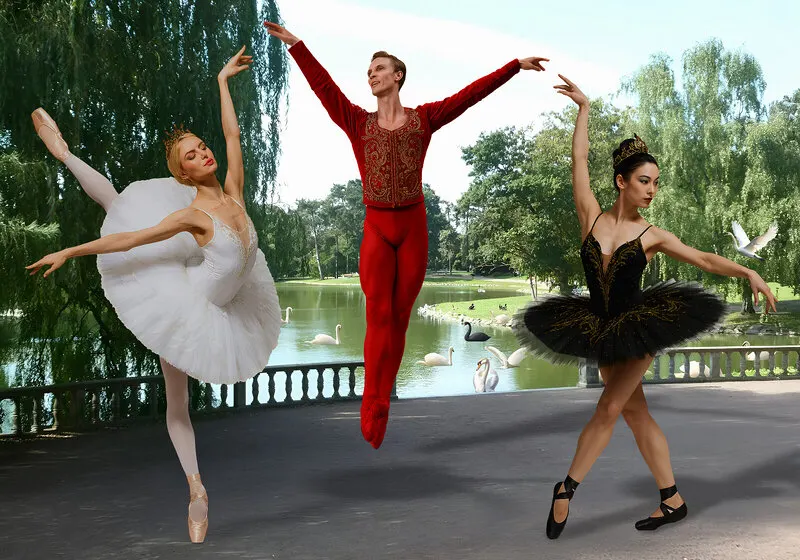
The title of my image, “Black and White and Some Red,” reflects the central conflict. Red is not just an accent but part of the core itself: the prince reaches out to both women, uniting white and black in a rhythm of life between Odette and Odile. In ballet language, where everything is conveyed through movement and colour, red signifies desire, blood, life, guilt, and the fierce intensity of love.
My composition interprets a white, red, and black triangle as innocence, passion, and illusion. The white swan signifies purity and spiritual desire; the black swan, the allure of shadow and the danger of the mirror image. The prince’s red costume represents the human side: the heart, drawn to both, whose love unites and destroys.
The light in the background—the swans on the lake and the water reflections—enhances the symbolism. The scene becomes an icon of balance between life and death, day and night, reality and dream. With this image, I aim to translate the story’s psychological and spiritual layers into a still, frozen choreography: a moment where passion lingers in the air, suspended between flight and fall. The castle park’s pond, filled with swans, appears treacherously idyllic—like the ballet itself, and the old folktale behind it, which has had many endings before the modern, conveniently happy one. For such is real life: the struggle between light and darkness, between good and evil, does not always conclude as the romantic heart would wish.
If Swan Lake were spoken rather than danced, and the ending joyful, the prince and Odette would tell with relief and humility—as if they had just risen from darkness, freshly aware of the transformative power of their love. Their words would echo with the promise of a new beginning, a testament to the resilience of the human spirit and the enduring power of love.
Here is that imagined scene, written in a poetic tone, yet meant for the stage:
[Pale dawn over the castle park’s lake. Mist rises as the swans’ wings gleam like silver. Odette stands by the shore. Siegfried approaches slowly, his eyes still shadowed with guilt.]
Siegfried:
I saw you, yet I did not truly see you. I mistook the shadow for you and betrayed the truth for its reflection. Forgive me, Odette.
Odette:
You did not betray me, my prince. You betrayed yourself, but you found your way back. No love is genuine until it has been tested by darkness. Your courage, resilience, and unwavering commitment to love have brought us here. Your journey is a beacon of hope for us all, a reminder that, when tested, love can emerge stronger and more beautiful than ever.
Siegfried:
Darkness taught me to see. The light blinded me for too long, but I heard your heart like a faint beat beneath the ice when I thought all was lost.
Odette:
It was not ice, Siegfried. It was frozen time. It had to melt slowly so that we could understand.
Siegfried:
And now? Is the curse truly broken?
Odette:
Yes—but not by magic. It broke when you dared to see both the light and the shadow in me and yourself.
Siegfried:
Then there is hope for us and all who live between night and day.
Odette:
As long as someone dares to love without wanting to possess, as long as someone dares to see without judging, there will always be a morning after the night.
[She takes his hand. The swans on the lake rise slowly and fly towards the growing light. The music’s theme returns, now in a significant key, a musical term that signifies a change in the emotional tone of the piece, often indicating resolution or transformation.]
Siegfried:
Look— they are not leaving. They are showing the way.
Odette:
Yes— to the world where love no longer needs wings.
[Light floods the stage. The lake glimmers like crystal. They remain, hand in hand, in the dawn.]
White and black stand like two portals at the start of the pathway of colour. They come before the spectrum yet define it: white as total presence, black as total absence. Physics is as simple as poetry. Sunlight carries all wavelengths within an invisible rainbow. When white light hits a surface and reflects all wavelengths, the surface appears white. Nothing is reflected when light strikes a surface that absorbs the wavelengths, resulting in black appearing. Therefore, the saying that white and black are not “colours” but states: the sum of everything versus the absence of everything. Culturally, however, they function as fundamental colours: beginning and end, presence and void, revealing and concealing. We live within their interaction—between illumination and shadow, acknowledgement and masking—which explains why they consistently surface in language, ritual, clothing, and stagecraft.
Goethe's insight into the moral and emotional significance of colours enriches our understanding of their cultural and psychological roles. They influence our idioms: someone 'sees red,' a newcomer appears 'green,' and 'blue' signifies truth. These colours evoke instincts established long before marketing: the red warning of blood, the blue reassurance of the sky, the green promise of vegetation. We then layer these with our own symbols—religion, politics, class, taste—so that the same colour can carry different meanings across eras and cultures. Yet, despite these variations, the universal appeal of colours unites us in a shared understanding, fostering a sense of connection and commonality that transcends cultural and geographical boundaries.
Therefore—after white and black—we begin with blue.
Blue is this story's first “real” hue because it signifies the sky and sea. A blue sky suggests clean air, stable weather, and good visibility. A blue sea indicates drinkable water somewhere ahead—at least once upon a time—before algal blooms and pollutants became common words. When water turns green, we are warned; when the sky turns grey, we suspect smog—hence blue calms us, soothing and relaxing. Heart rate decreases, breathing slows. This subtle approach to urban design has been woven into the city’s night: in multiple locations, blue streetlights have been used to deter vandalism and violence. In our civic iconography, blue becomes a mark of trustworthiness: the logos of banks and insurers, official emblems, and the label on a water bottle. Conversely, blue appears infrequently in food (except for blueberries). We avoid blue foods because they imply decay.
At the same time, light blue is one of the easiest shades to discern, even for those with red–green colourblindness (a condition where individuals have difficulty distinguishing between certain hues, particularly red and green). That's why links on the web are often blue—an old, practical convention with ongoing legibility advantages. Blue influences how we perceive time: in blue environments, waiting seems shorter, flows smoothly, and increases patience. The influence of colours on our perception of time is a subtle yet significant aspect of our daily lives, making us more aware of the power of colours in shaping our experiences.
In art, blue oscillates between two poles: Mary’s ultramarine in icon painting—precious, profound, heavenly—and Yves Klein’s IKB, where blue becomes a state of existence rather than merely a colour. In Rothko, blue fields vibrate against darkness as if light were breathing; in the Japanese artist Hokusai, blue waves crash against eternity; in Tarkovsky, a blue hue hangs like the toll of a slow bell. Blue creates space—not just a motif—and opens this chapter.
Red is the warning system, the hearth’s glow, the movement of life: blood, fire, ripe fruit: the triangle of evolution that sharpens the senses. We react faster, our hearts beat quicker, and decisions tend towards impulse. Therefore, red becomes modernity’s signalling colour: STOP at traffic lights, warning signs, fire extinguishers and engines. In shops, red signifies SALE — not because it is the prettiest, but because it is the hardest to ignore. Red alters our perception of time: stress makes minutes seem longer. In rituals and politics, red represents sacrifice and revolution, wedding joy in China, martyrdom elsewhere. Red can bless and burn; precisely in that duality lies its power to evoke strong emotions, making the audience feel the intensity and impact of this hue in a way that few other colours can.
Red becomes a focal point on stage and in film: a single red garment can carry an entire act. In my image “Black and White and some Red,” the prince’s red stitches together the white and black poles—the colour of love, blood, and decision.
Yellow is the sun’s reflection within us: energy, playfulness, awakening. Yellow sharpens focus and creativity, but excess can become intrusive, almost shrill to the inner ear. Muted yellows may appear sickly. Yellow shortens the path from intention to action; therefore, it is used in fast food branding, the toy aisle’s call, and Ferrari’s shield, where speed becomes an aesthetic. In practice, yellow also acts as a catalyst for blue: when placed beside blue, yellow deepens and clarifies the blue, making it seem fresher. This means that yellow can enhance the perception of blue, making it more vibrant and appealing.
Orange combines red’s warmth and yellow’s cheerfulness. It symbolises social warmth, appetite, and invitation. As an accent, orange draws the eye: buttons, arrows, calls to action. In safety contexts, orange signals caution rather than stop—cones, life vests, flares—visible without the harshness of alarm. In dining areas, orange stimulates the neural pathways of appetite: the carrot’s colour in the mind, the orange’s scent in memory. Used sparingly, it brings a smile to the room.
Green is as fine-grained as foliage and as expansive as a plain. It represents oxygen, rest, and regrowth. The first shoots after winter profoundly affect us: time still progresses in the right direction. Living near green spaces is often associated with better health — both body and mind respond positively. Therefore, green frequently signals health and sustainability in logos and packaging. Dark green can also signify wealth, which explains its frequent use in finance. Visually, in daylight, green offers a distinct advantage: enhanced legibility over long distances. This is one reason traffic signals are green and why the eye prefers green walls for resting. Green is also the complement of red: together, they increase contrast — Christmas is no coincidence.
In iconography, green signifies a hint of paradise; in Islam, it holds sacredness; in ecological politics, it becomes a policy. But green can also be poisoned—algal blooms, the glass of toxins—reminding us that no colour is “good in itself,” only interpretable in context.
Purple is a blend that has become its own nature. Historically, Tyrian purple was expensive and difficult to produce; hence, royalty and priesthood were associated with violet. Even today, purple signifies authority, luxury, and drama—especially in beauty. However, purple also represents concentration: red’s creative energy combines with blue’s mental calm. It fits nicely in a music room, a library, and evening tasks that require imagination and discipline. No wonder education relies on purple; Swedish institutions let the colour symbolise knowledge.
In art, purple serves as a border colour: in Turner, it reveals the edge of dusk; in Matisse, it is the surprising note that allows a bouquet to breathe; for Prince, purple—Purple Rain—was an entire universe.
The chapter could end here, yet whites and blacks demand a return from the psychological rather than the physical side.
White signifies peace, purity, and innocence. The white dove, the white flag, the white flower on Remembrance Day: the globalisation of symbols has turned white into a language of peace. White also represents beginnings—the blank page. In interiors, white is a neutral backdrop that allows other colours to stand out. However, in excess, white can feel sterile; the white walls of a hospital can drain a room of personality. Therefore, white requires materiality—surface, shadow, texture—to prevent it from becoming purely abstract.
Black symbolises mourning, power, and elegance. We wear black to mourn, yet we buy luxury items in black packaging. Language reflects its shade: black humour, blacklist, black market, black sheep. Black can be haunting yet also convey authority and significance. In communication, a dark palette imparts gravity—climate, poverty, guilt. Aesthetically, black acts as a frame that allows colour to flourish.
In many cultures, roles are reversed: white can be the colour of mourning (parts of Asia), and black can represent protection and dignity. The main point is that colours function as a language, and languages have dialects.
Finally, gold and silver are not spectral colours but symbols of power. Gold signifies success, quality, and victory: the medal, crown, and frame. It elevates the pulse without shouting. Silver represents elegance, modernity, and superb purity — the metal of the technological dream. On screens, gold shifts towards yellow, and silver towards grey; in print, a truly metallic sheen can be achieved. Combined with other hues, they produce mother-of-pearl and iridescent effects — a subtle luxury that allows even quiet motifs to breathe.
Between these colours, a series of quiet laws govern experience.
Additive vs. subtractive: RGB creates white light on screens by adding colour. CMYK produces darkness in ink (print, paint) by subtracting light. Therefore, two pure colours mix to brown in watercolour but towards white on a theatre stage.
Metamerism & colour constancy: Two surfaces may appear identical under one light but different under another. The brain normalises (colour constancy), which aids survival but can be misleading in design. For instance, a red object may appear the same under both natural and artificial light, but in reality, it may look different. This is a crucial consideration in design, as it can affect the perceived consistency of a product or environment.
Simultaneous contrast: A colour changes due to its neighbour; red beside green appears more intense, blue beside yellow appears more layered. This phenomenon, known as simultaneous contrast, is a key principle in colour theory. It explains how the perception of a colour can be influenced by the colours surrounding it. Understanding this can help artists and designers create visually striking compositions.
Afterimages: Stare at red, then white; green haunts your vision. The eye seeks equilibrium.
Warm versus incredible: Red, orange, and yellow advance; blue and green recede. On stage, we illustrate time and space with this simple scale.
Circadian light: Blue light affects wakefulness. A lovely screen at night can cause poor sleep. The concept of circadian light, which refers to the natural light cycle that regulates our sleep-wake patterns, is an essential aspect of colour theory. It explains how different colours of light can affect our physiological responses, influencing our behaviour and health.
Accessibility: The contrast between text and background is for clarity, not preference. Some pairings work well in theory but may not in practice.
Colours also influence behaviours and preferences. Cross-cultural surveys frequently rank blue as the favourite hue; white scores lower, possibly because it serves as the background for all colours rather than having a distinct voice. In development, infants first perceive red—around two weeks old—while reliable colour differentiation typically develops by about five months. Red can create a sense of slow time (stress), whereas blue promotes a feeling of speed (calm). In traffic, the forest, or the stadium—green is easy to notice from a distance; consequently, it signals permission to go.
All of this relates to stage and canvas. In Swan Lake, white and black represent the core themes: purity, temptation, revelation, and disguise. Blue symbolises the lake’s breath and the room’s calm; red signifies the human connection— the colour of love, guilt, and blood. Yellow and orange energise the dance’s progression; green offers a moment of reconciliation; purple unites passion with thought. White signifies beginnings, black deepens the mood, while gold and silver form an iconic border around the scene.
This colour theory transforms into choreography within my image—black, white, and a touch of red. The white ballerina embodies the soul’s longing; the black signifies the danger of the mirror; the red prince becomes the bridge of the heart between them. The blue–green lake in the background allows the scene to breathe; the swans’ whiteness is both innocence and judgment: what daylight reveals must be upheld. One hears a simple truth in the park’s treacherous idyll: colours do not lie, but we can misinterpret them.
Perhaps that is why we turn to colours when words run out. They are older than our theories, closer to our instincts, harder to deceive. White can conceal more than black if we are dazzled; blue can comfort without promising; red can alert and awaken; green can ease the eye’s fatigue. Purple can lend dignity to the vulnerable; gold and silver can elevate without raising the voice. And when all has been said, optics still hum like a low bass beneath the text: white reflects everything, black absorbs everything, and between them the world vibrates.
The chapter on colour needs its full length—not to repeat clichés, but to let each hue serve its purpose: to open, warn, soothe, direct, unite, and deepen. Twilight often gives us the courage to see in art, as in life, but colour teaches us what we observe.
3 200 kr

Jörgen Thornberg
Malmö
Lite om bilder och mig. Translation in English at the end.
Jag är en nyfiken person som ser allt i bilder, även det jag fäster i ord, gärna tillsammans för bakom alla mina bilder finns en berättelse. Till vissa bilder hör en kortare eller längre novell som följer med bilden.
Bilder berättar historier. Jag omges av naturlig skönhet, intressanta människor och historia var jag än går. Jag använder min kamera för att dokumentera världen och blanda det jag ser med vad jag känner för att fånga den dolda magin.
Mina bilder berättar mina historier. Genom mina bilder, tryck och berättelser. Jag bjuder in dig att ta del av dessa berättelser, in i ditt liv och hem och dela min mycket personliga syn på vår värld. Mer än vad ögat ser. Jag tänker i bilder, drömmer och skriver och pratar om dem; följaktligen måste jag också skapa bilder. De blir vad jag ser, inte nödvändigtvis begränsade till verkligheten. Det finns en bild runt varje hörn. Jag hoppas att du kommer att se vad jag såg och gilla det.
Jag är också en skrivande person och till många bilder hör en kortare eller längre essay. Den följer med tavlan, tryckt på fint papper och med en personlig hälsning från mig.
Flertalet bilder startar sin resa i min kamera. Enkelt förklarat beskriver jag bilden jag ser i mitt inre, upplevd eller fantiserad. Bilden uppstår inom mig redan innan jag fått okularet till ögat. På bråkdelen av ett ögonblick ser jag vad jag vill ha och vad som kan göras med bilden. Här skall jag stoppa in en giraff, stålmannen, Titanic eller vad det är min fantasi finner ut. Ännu märkligare är att jag kommer ihåg minnesbilden långt efteråt när det blir tid att skapa verket. Om jag lyckas eller inte, är upp till betraktaren, oftast präglat av en stråk av svart humor – meningen är att man skall bli underhållen. Mina bilder blir ofta en snackis där de hänger.
Jag föredrar bilder som förmedlar ett budskap i flera lager. Vid första anblicken fylld av feel-good, en vacker utsikt, fint väder, solen skiner, blommor på ängen eller vattnet som ligger förrädiskt spegelblankt. I en sådan bild kan jag gömma min egentliga berättelse, mitt förakt för förtryckare och våldsverkare, rasister och fördomsfulla människor - ett gärna återkommande motiv mer eller mindre dolt i det vackra motivet. Jag försöker förena dem i ett gemensamt narrativ.
Bild och formgivning har löpt som en röd tråd genom livet. Fotokonst känns som en värdig final som jag gärna delar med mig.
Min genre är vid som framgår av mina bilder, temat en blandning av pop- och gatukonst i kollage som kan bestå av hundratals lager. Vissa bilder kan ta veckor, andra någon dag innan det är dags att överlämna resultatet till printverkstaden. Fine Art Prints är digitala fotocollage. I dessa kollage sker rivandet, klippandet, pusslandet, målandet, ritandet och sprayningen digitalt. Det jag monterar in kan vara hundratals år gamla bilder som jag omsorgsfullt frilägger så att de ser ut att vara en del av tavlan men också bilder skapade av mig själv efter min egen fantasi. Därefter besöks printstudion och för vissa bilder numrera en limiterad upplaga (oftast 7 exemplar) och signera för hand. Vissa bilder kan köpas i olika format. Det är bara att fråga efter vilka. Gillar man en bild som är 70x100 men inte har plats på väggen, går den kanske att få i 50x70 cm istället. Frågan är fri.
Metoden Giclée eller Fine Art Print som det också kallas är det moderna sättet för framställning av grafisk konst. Villkoret för denna typ av utskrifter är att en högkvalitativ storformatskrivare används med åldersbeständigt färgpigment och konstnärspapper eller i förekommande fall på duk. Pappret som används möter de krav på livslängd som ställs av museer och gallerier. Normalt säljer jag mina bilder oinramade så att den nya ägaren själv kan bestämma hur de skall se ut, med eller utan passepartout färg på ram, med eller utan glas etc..
Under många år ställde jag bara ut på nätet, i valda grupper och på min egen Facebooksida - https://www.facebook.com/jorgen.thornberg.9
Jag finns också på en egen hemsida som tyvärr inte alltid är uppdaterad – https://www.jth.life/ Där kan du också läsa en del av de berättelser som följer med bilden.
UTSTÄLLNINGAR
Luftkastellet, oktober 2022
Konst i Lund, november 2022
Luftkastellet, mars 2023
Engleson Galleri Caroli, april 2023
Hydra, Greece June 2023
Engleson Galleri Caroli, oktober 2023
Toppen, Höllviken december 2023
Luftkastellet, mars 2024
Torups Galleri, mars 2024
Venice, May 2024
Luftkastellet, oktober 2024
Konst i Advent, December 2024
Galleri Engleson, Caroli December 2024
Jäger & Jansson Galleri, april 2025
A bit about pictures and me.
I'm a curious person who sees everything in pictures, even what I express in words, often combining them, for behind all my pictures lies a story. These narratives, some as short as a single image and others as long as a novel, are the heart and soul of my work.
Pictures tell stories. Wherever I go, I'm surrounded by natural beauty, exciting people, and history. I use my camera to document the world and blend what I see with what I feel to capture the hidden magic.
My images tell my stories. Through my pictures, prints, and narratives, I invite you to partake in these stories in your life and home and share my deeply personal perspective of our world. More than meets the eye. I think in pictures, dream, write, and talk about them; consequently, I must create images too. They become what I see, not necessarily confined to reality. There's a picture around every corner. I hope you'll see what I saw and enjoy it.
I'm also a writer, and many images come with a shorter or longer essay. It accompanies the painting, printed on fine paper with my personal greeting.
Many pictures start their journey on my camera. Simply put, I describe the image I see in my mind, experienced or imagined. The image arises within me even before I bring the eyepiece to my eye. In a fraction of a moment, I see what I want and what can be done with the picture. Here, I'll insert a giraffe, Superman, the Titanic, or whatever my imagination conjures up. Even stranger is that I remember the mental image long after it's time to create the work. Whether I succeed is up to the observer, often imbued with a streak of black humour – the aim is to entertain. My pictures usually become a talking point wherever they hang.
I prefer pictures that convey a message in multiple layers. At first glance, they're filled with feel-good vibes, a beautiful view, lovely weather, the sun shining, flowers in the meadow, or the water lying deceptively calm. But beneath this surface beauty, I often conceal a deeper story, a narrative that challenges societal norms or explores the human condition. I invite you to delve into these hidden narratives and discover the layers of meaning within my work.
Picture and design have been a thread running through my life. Photographic art feels like a fitting finale, and I'm happy to share it.
My genre is varied, as seen in my pictures; the theme is a blend of pop and street art in collages that can consist of hundreds of layers. Some images can take weeks, others just a day before it's time to hand over the result to the print workshop. Fine Art Prints are digital photo collages. In these collages, tearing, cutting, puzzling, painting, drawing, and spraying happen digitally. What I insert can be images hundreds of years old that I carefully extract so they appear to be part of the painting, but also images created by myself, now also generated from my imagination. Next, visit the print studio and, for certain images, number a limited edition (usually 7 copies) and sign them by hand. Some images may be available in other formats. Just ask which ones. If you like an image that's 70x100 but doesn't have space on the wall, you might be able to get it in 50x70 cm instead. The question is open.
The Giclée method, or Fine Art Print as it's also called, is the modern way of producing graphic art. This method ensures the highest quality and longevity of the artwork, using a high-quality large-format printer with archival pigment inks and artist paper or, in some cases, canvas. The paper used meets the longevity requirements set by museums and galleries. I sell my pictures unframed, allowing the new owner to personalise their artwork, confident in the lasting value and quality of the piece.
For many years, I only exhibited online, in selected groups, and on my Facebook page - https://www.facebook.com/jorgen.thornberg.9. I also have my website, which unfortunately is not constantly updated - https://www.jth.life/. You can also read some of the stories accompanying the pictures there.
EXHIBITIONS
Luftkastellet, October 2022
Art in Lund, November 2022
Luftkastellet, March 2023
Engleson Gallery Caroli, April 2023
Hydra, Greece June 2023
Engleson Gallery Caroli, October 2023
Toppen, Höllviken December 2023
Luftkastellet, March 2024
Torup Gallery, March 2024
Venice, May 2024
UTSTÄLLNINGAR
Luftkastellet, oktober 2022
Konst i Lund, november 2022
Luftkastellet, mars 2023
Engleson Galleri Caroli, april 2023
Hydra, Greece June 2023
Engleson Galleri Caroli, oktober 2023
Toppen, Höllviken december 2023
Luftkastellet, mars 2024
Torups Galleri, mars 2024
Venice, May 2024
Luftkastellet, October 2024
Konst i Advent, December 2024
Galleri Engleson, Caroli December 2024
Jäger & Jansson Galleri, April 2025
Utbildning
Autodidakt
Medlem i konstnärsförening
Öppna Sinnen
Med i konstrunda
Konstrundan i Skåne
Utställningar
Luftkastellet, October 2022
Art in Lund, November 2022
Luftkastellet, March 2023
Engleson Gallery Caroli, April 2023
Hydra, Greece June 2023
Engleson Gallery Caroli, October 2023
Toppen, Höllviken December 2023
Luftkastellet, March 2024
Torup Gallery, March 2024
Venice, May 2024