Vi använder cookies för att ge dig bästa möjliga upplevelse. Välj vilka cookies du tillåter.
Läs mer i vår integritetspolicy
Jörgen Thornberg
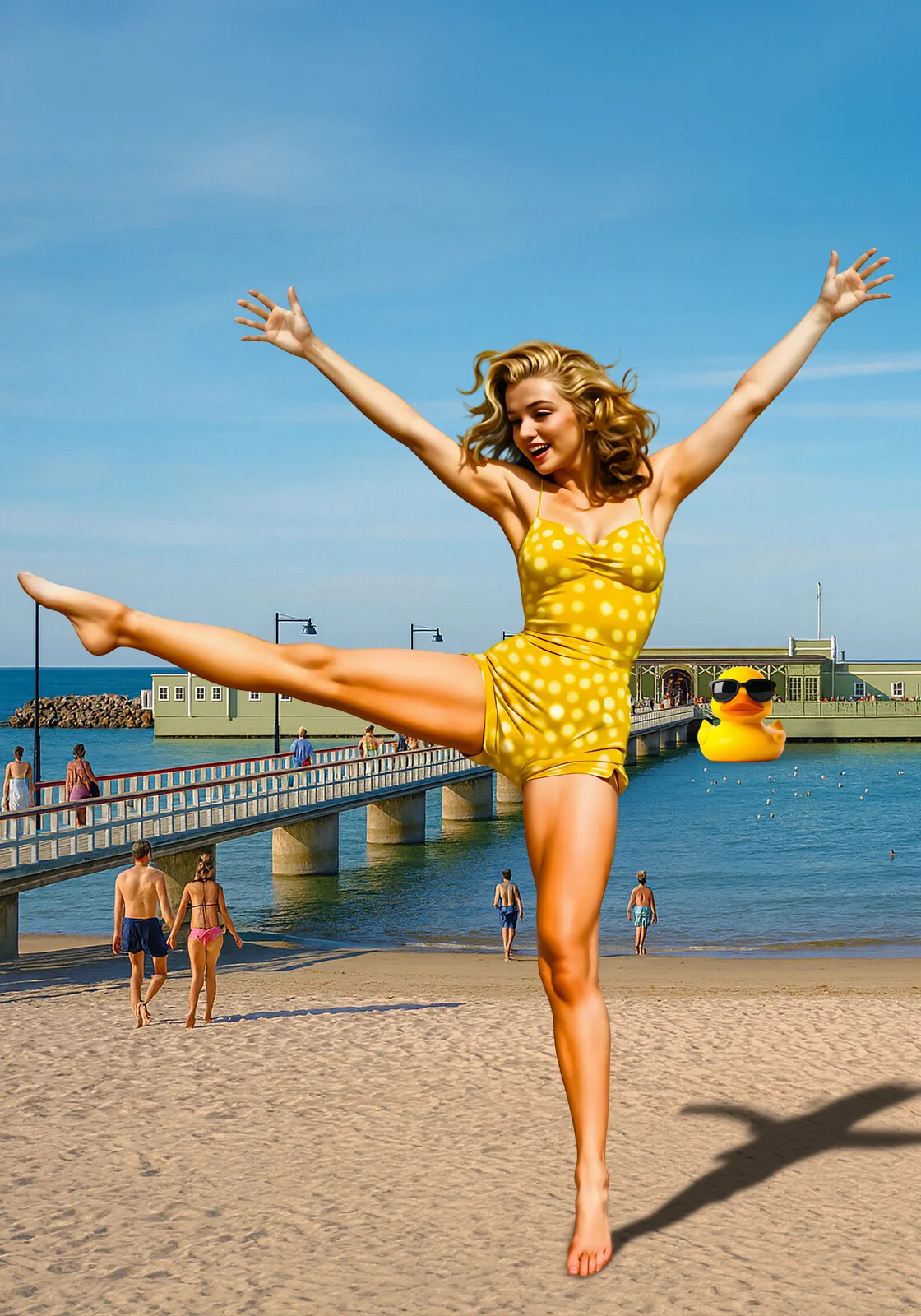
She laughs, she twirls, she glows – happy, but generally miserable., 2025
Digital
50 x 70 cm
3 200 kr
She laughs, she twirls, she glows – happy, but generally miserable.
There are moments when art, history, and the cosmos converge in an image that seems to embody something greater than itself.
The song promises joy, a sentiment echoed by the headlines, and one that the public believed — Happy Days Are Here Again, a message that resonates universally. But beneath the gloss of optimism lies the quiet pulse of denial. Every era creates its own anthem of reassurance, a melody spread by the media to drown out the dissonance of reality. Marilyn sang it, politicians repeated it, and we still hum along — perhaps because pretending happiness feels safer than confronting its absence. This is not just a narrative, but a societal issue that needs our attention.
This Picture and essay are not a lament but a mirror: a reminder that the world’s brightest smiles and the most seemingly happy and content individuals are often just a façade painted over the cracks of their true feelings and societal issues they face. The melody remains infectious, but the rhythm, if you listen closely, limps. It's a call for introspection, to look beyond the surface and understand the true nature of happiness.
Join me as we pass through the gateway of this essay to explore Marilyn Monroe’s luminous dance, deeply intertwined with themes of stardom, memory, and eternal light. This essay is not just a text, but a welcoming gateway designed to entertain and illuminate the symbolic connection between an earthly icon and her cosmic rebirth.
“Happy Days (A Refrain in Minor Key)
They say the happy days are here again,
but the smile has teeth and the tune pretends.
The trumpets shine, the banners wave,
over a crowd that laughs at what it craves.
The glass is raised, the lights are bright,
no one mentions the sleepless night.
We hum along, rehearsed and neat,
our joy is polished, discreetly incomplete.
The headlines sing of endless cheer,
but silence hums beneath the veneer.
The dance goes on — step, spin, grin —
a masquerade with sorrow’s skin.
If these are the happy days, my friend,
why do they always almost end?
The chorus swells, the curtain falls,
and echoes wander through the halls.
The record turns, the varnish gleams,
painted smiles conceal the seams.
The world applauds, the show must stay —
So let us laugh the pain away.”
Malmö. October 2025
She laughs, she twirls, she glows – happy, but generally miserable - Prologue: Turning the Telescope.
“So long, sad times, go long, bad times,
We are rid of you at last
Howdy gay times, cloudy grey times,
You are now a thing of the past
Happy days are here again,
The skies above are clear again
So, let us sing a song of cheer again,
Happy days are here again”
When Marilyn sang, her voice was a radiant beacon, resonating with a beauty that was truly her own.
When I first wrote about Marilyn’s departure, I envisioned her in the Marilyn Nebula, a comforting image of her finding her rightful place among the constellations, forever dancing to a song only she could hear.
But time has a way of flipping perspectives. One late summer night, as the air over Öresund grew still and the moon reddened like a fading rose, I looked not outward but homeward — toward Ribersborg. And there she was again. Marilyn, in full swing, dancing barefoot on the sand and singing at the top of her voice: “Happy Days Are Here Again.”
It was a sight of absurd beauty, Marilyn singing 'Happy Days Are Here Again' at Ribersborg, the melody drifting across the water like champagne, bold as survival.
That question — how joy survives sorrow — will return later in this essay. But before we reach the beach at Ribersborg, I must go back to the first vision, the one written years ago: the nebula, the dance beyond Andromeda, and the woman who became a constellation. For that is where her story — and mine — began. Let’s start with Marilyn’s paradox — “Happy but generally miserable.”
Marilyn Monroe and the Mirage of Happiness
Marilyn Monroe’s life was a performance of light, a dazzling spectacle that cast long shadows of darkness. She was the woman who made the world smile, yet her own laughter was often tinged with a quiet, personal sorrow. “If I’m generally anything," she once mused, "I guess I’m generally miserable.”
These words, seemingly casual and simple, reveal a profound truth that outlived her and still echoes in every image we see.
After relocating to New York in the mid-1950s, Marilyn experienced what many of her friends later described as her brief “season of genuine happiness.”
She had left Hollywood, her studio contract, and her marriage to Joe DiMaggio behind. For the first time, she could walk down a city street anonymously, study acting under Lee Strasberg, and read books without being mocked for it. In New York, she wasn’t just a star; she was a student, a thinker, a woman seeking authenticity in a world built on illusion.
Those who knew her then said she was radiant — not the studio kind of radiance, but a softer glow, as if she were finally lit from within.
Yet the light never lingered. The traumas of her childhood — the foster homes, the sense of abandonment, the mother lost to madness — had carved deep furrows in her soul. They remained like unhealed fractures beneath the glamour. Fame amplified both her beauty and her loneliness.
She yearned for love, but all she encountered were mirrors. Every marriage became a reflection of her own unease: DiMaggio’s jealousy, Miller’s disillusionment. Even on the set of The Misfits, written for her by the man who claimed to understand her best, she found herself collapsing between takes — exhausted, sedated, drained by insomnia and despair.
Despite her intelligence and discipline, Marilyn was trapped in a role she could not escape. The “dumb blonde” she once portrayed for irony became the only language the world allowed her to speak. She fought to be taken seriously, establishing her own production company and demanding creative control. Yet Hollywood was not built to reward sincerity. It adored her image but ignored her true self. The irony is cruel: the more she struggled to prove her depth, the more the culture demanded her surface. Marilyn's resilience and determination to be taken seriously in the film industry, despite the challenges she faced, is a testament to her strength and courage.
Her unhappiness was not theatrical. It was a steady, chronic issue, woven into her self-perception. In one of her last interviews, she said quietly, “I was never used to being happy, so it wasn’t something I ever took for granted.” That confession, spoken barely a few months before her death, transforms the image of Marilyn into something more than biography — a reflection of our own contradictions. She reminds us that joy can be genuine even when fleeting, and that laughter and pain can coexist within the same body.
Marilyn became a metaphor for modern life: the pursuit of happiness as a performance, the tiredness beneath the smile. She lived in the spotlight of lights that could never warm her. And yet, when we watch her dance — radiant, carefree, impossibly alive — we feel something that goes beyond pity. We feel recognition.
For who among us has not, at some point, felt the paradox of happiness coexisting with a general sense of misery? It's a shared human experience that often goes unspoken, yet it's a thread that connects us all.
The Mirror Turns – Personal Reflection
Marilyn’s line — “If I’m generally anything, I guess I’m generally miserable” — could, I suppose, also apply to me, at least after I turned fifty. Before that, my mood followed life’s ordinary tides: children growing up, work projects starting and finishing, quiet moments of joy with my wife. In essence, I’ve always been an incurable optimist, but time has a cruel sense of humour. The scales tip, and optimism takes on a darker hue. From that imbalance, my love for black humour and the need for satire grew — the laughter that keeps melancholy at bay.
Satire, to me, is not cynicism but survival. It’s a way of staying sane in a world that constantly insists on its own absurdity. I like to think my writing belongs to that tradition — political and social satire — though I admit the claim might flatter me. True satire, the kind mastered by Oscar Wilde or Jonathan Swift, is a rare gift. Most attempts fall short; the blade either dulls or cuts too deeply. Swift proposed, with perfect irony, that Irish infants should be eaten to solve poverty — a suggestion so grotesque it exposes the cruelty it mocks. I will never reach such heights of genius, but perhaps I can, as the saying goes, aim for the stars and at least hit the treetops.
The older I grow, the more I see satire as a form of moral balance — a space between laughter and lament. One must be sufficiently amused to cope with the world, but not so amused as to forgive it. Suppose Marilyn’s tragedy was that she could not reconcile her radiant smile with her private despair. In that case, mine may be the opposite: the inability to conceal disillusionment behind a convincing grin. My humour leaks out like light from a cracked lantern; it warms, but it also reveals the fracture.
There are times when I envy those who can uphold the “Happy Days” illusion — the belief that everything will somehow turn out all right if we stop worrying and switch on the television. This illusion, while comforting, can lead to complacency, which I see as the enemy of empathy. Feeling too little is just as dangerous as feeling too much. It's important to acknowledge the storms, to walk in the weather, perhaps a little soaked, but awake.
I have come to realise that both the persistently cheerful and the eternally bitter end up equally blind: one sees only sunshine, the other only storms. The key, I believe, is to find a balance, to walk in the weather between them — perhaps a little soaked, but awake and aware.
So I persist in writing, caught somewhere between Wilde’s laughter and Heller’s despair, between Molière’s mischief and Vonnegut’s weary smile. If Marilyn once danced to mask her loneliness, I write and create pictures to reveal mine — and perhaps, in doing so, to help others feel a little less alone.
For that, I suppose, is the silent purpose behind all satire and all art: to laugh not because life is funny, but because it is unbearable not to.
On Satire – The Art of Laughing at the Abyss
Satire, at its best, is the skill of balancing on the edge of the abyss and choosing to laugh instead of falling. It is not born out of cheerfulness but from discomfort — a refusal to accept the world’s nonsense as usual. This discomfort, however, is not a burden, but an intellectual stimulant that keeps us engaged.
Unlike ordinary humour, which seeks comfort, satire aims for clarity. It reveals pretence, pomposity, and power using the same tool: laughter sharpened into a blade.
I have frequently imagined a long continuum extending between two poles.
At one end, the light satirists — Molière, Mark Twain, Tage Danielsson — transform folly into music. Their laughter is generous and forgiving; it reminds us that our faults are shared and thus human.
At the other end stand the dark satirists — Joseph Heller, Kurt Vonnegut, perhaps Orwell — who peer into history’s furnace and discover irony glowing like a coal. Their humour is the kind that tastes of smoke: you laugh, but the laugh wounds.
Between these extremes lies a narrow path, and I attempt to walk it.
Lingering too long with light satirists risks triviality — enjoying wit without real consequence. But dwelling among the dark ones invites bitterness — laughter so sharp it erodes the heart that produces it. The challenge is to find a balance, to reach that “Golden Mean” where compassion and outrage coexist, creating a sense of order and control in the chaos of satire.
I have always admired how Twain could reveal hypocrisy without losing his affection for humanity. In The Adventures of Tom Sawyer, he satirises small-town morality, yet his fondness for its residents is apparent. Heller, by contrast, presents a world where reason itself becomes a bureaucratic trap. Catch-22 is not just humorous; it is frightening in its accuracy. People laugh because there is no other reaction available. Vonnegut echoes this logic, but with a strange tenderness. “So it goes,” he says, as if resignation alone were the only sincere prayer left for humanity.
Satire is a moral craft disguised as mischief.
It allows us to speak what would otherwise be unspeakable, to hold those in power to account without sermons or slogans. But it also reflects on the satirist, laying bare the fine line between mockery and contempt. To ridicule the world is simple; to do so with love still present is an act of grace, fostering a sense of empathy and connection in the audience.
That, I suspect, is why I keep writing and creating my pictures. The abyss isn’t going anywhere. But as long as there are words, there is a way to make it resonate with laughter — not the laughter of cruelty, but the laughter of recognition. This is the laughter that acknowledges the shared experience of human folly and the absurdity of life, creating a sense of community among those who 'get' the satire.
The kind of laughter that says: We have seen the darkness together, and for a moment, it blinked first.
The Satirist’s Dilemma – Between Cynicism and Naïveté
Every satirist eventually faces a crossroads: one route leads to cynicism, the other to naivety. Both are traps masked as convictions. The cynic believes too little; the naïve believes too easily. One freezes the heart, the other clouds the mind. And it's in this struggle, this delicate dance between the two extremes, that the true essence of satire is found.
I have strayed too close to both edges. There were times when my laughter became sharp, when I mistook scorn for insight. It begins innocently — you mock stupidity, corruption, hypocrisy — but soon you discover that your anger has personalised its targets. Policies become people, and people become enemies. Eventually, everyone seems absurd except you. At that point, satire turns into contempt, and the writer becomes what he despises: another preacher of certainty.
The opposite extreme is equally perilous. I have known sunny souls who emit positivity like a constant commercial break. They live by slogans — “Everything will be fine,” “Don’t worry, be happy.” Their serenity is admirable but strangely superficial, a smile stretched over indifference. They remind me of the “Happy Days” syndrome I see everywhere: the belief that optimism is a moral obligation, that recognising darkness makes one ungrateful. To them, Marilyn’s sorrow would be a branding issue, not a human tragedy. This excessive optimism can blind us to the harsh realities that satire often seeks to expose.
So I choose instead what the Greeks called metriotes — the Golden Mean. Moderation not in passion, but in judgement. I want to see clearly without losing compassion, to laugh without cruelty, to criticise without despair. This balanced perspective is not just a choice, but a necessity in the world of satire. It is a fragile balance, like walking a tightrope strung between faith in humanity and disbelief in its behaviour.
Politics tests this balance every day. I do not wish to hate all Conservatives, nor to sanctify all Labour supporters. The moral drama of good and evil rarely fits a party platform. As Socrates discovered — and paid for with his life — honesty and politics seldom share the same space. His declaration, “I was too honest a man to be a politician and live,” still rings painfully modern. Truth-tellers remain inconvenient guests at the banquet of power.
Perhaps satire’s true purpose is to maintain that honesty — to puncture certainty before it becomes dogma. The satirist’s role is not to provide solutions but to keep questions alive, to remind both the cynic and the optimist that the world is too complex to warrant either absolute despair or blind faith. This function of satire is not just a task, but a noble duty.
Ultimately, I believe all satire writers live like tightrope walkers over an audience that both admires and resents them. If you fall to one side, you become the fool; if you fall to the other, the prophet. The challenge is to keep moving forward, with a faint smile, knowing that both humour and seriousness are essential to survive.
Politics, Philosophy, and the Persistence of Folly
Politics, like fashion, never truly changes — it simply reappears in new hues. Every generation believes it is witnessing unprecedented foolishness, yet history shows otherwise. The names shift, slogans evolve, hairstyles differ, but the pattern remains the same: ambition disguised as virtue, ignorance sold as authenticity, and greed repackaged as pragmatism. Understanding the cyclical nature of political folly can enlighten us about historical patterns.
Sometimes I think Socrates would not have fared much better today than he did in Athens. He would have been “de-platformed” for corrupting the youth, trolled on social media, and turned into a meme. His crime was not heresy but honesty — a trait no political system, ancient or modern, has ever handled well. He questioned the comfort of certainty, and when threatened, certainty always reaches for the hemlock.
In theory, democracy should have matured by now. In reality, it remains a delicate compromise between idealism and incompetence. We vote for progress but get performance; we choose transparency yet receive spectacle. Our parliaments and congresses resemble reality shows, albeit with bigger production budgets. The only thing that seems bipartisan is denial. This 'delicate compromise' refers to the struggle between the idealistic vision of democracy, where the people's voice is paramount, and the practical incompetence that often leads to political gridlock and inefficiency.
The satirist, armed with a keen eye and a sharp wit, observes this endless cycle with a mixture of déjà vu and despair. One cannot help but marvel at humanity’s ability to repeat its mistakes with such confidence. We create gods, overthrow them, and replace them with ideologies, only to worship those instead. Each new age claims to be rational, enlightened, post-something — yet the same primal forces always pull us back: fear, vanity, envy, faith. The human condition shows remarkable continuity. Satire, as a tool of critique, empowers us with the ability to expose and ridicule this folly.
Still, I try not to lose hope. Recognising folly is not the same as surrendering to it. If satire has any moral value, it lies in its refusal to give up on reason — its stubborn belief that laughter can still illuminate. This belief is rooted in the understanding that humour has a unique power to reveal the absurdity of human actions and systems. Ridicule, in the right hands, is a form of mercy: it exposes absurdity before it turns lethal. Tyrants fear laughter more than dissent because laughter undermines authority without bloodshed.
I occasionally imagine a round table where Socrates, Voltaire, Mark Twain, and Kurt Vonnegut share a meal. The conversation would be lively, the wine abundant, and the consensus unanimous: that history, despite its supposed progress, remains the most excellent comedy ever written — only the audience changes.
Perhaps that is the philosopher’s consolation and the satirist’s curse: to understand that folly is eternal, yet to keep debating it anyway. The importance of reasoned debate in combating political folly should give us hope for a better future.
And if there is wisdom in that persistence, it is the same wisdom that kept Socrates smiling as he lifted the cup — an acceptance that truth may lose every election but still deserves our vote.
Happy Days? — A Satirical Coda
The title Happy Days Are Here Again? was never intended as a statement but as a question.
Everyone who delves into Marilyn’s story can't help but see the profound gap between appearance and reality, between the song we sing and the silence that follows. This gap, so starkly illustrated in her life, is not hers alone; it's a reflection of the human condition, a mirror to all of us.
I sometimes picture her as I once did through my telescope — dancing again, not in Hollywood’s artificial glow but under the gentle light of the cosmos. She turns slowly in her red sequined dress, surrounded by dust and starlight, her laughter inaudible but visible across the darkness. Somewhere in that celestial movement, I recognise the same paradox that defines the human condition: to shine outwardly while trembling inside.
We live in an era that expects optimism as if it proves moral integrity. This era, born out of the post-war boom and perpetuated by the digital age, demands a relentless positivity. To doubt, to question, even to mourn — these have become nearly rebellious acts. “Happy Days” has shifted from a song to a slogan, a rallying cry of consumer confidence: if we smile enough, perhaps the world will forget its problems. But history, as always, remains deaf to jingles.
Still, I am not ready to dismiss happiness altogether.
There are moments — absurd, fleeting, incandescent — when joy persists despite everything. Marilyn briefly found them in New York; I occasionally see them in writing, in satire, in laughter that escapes even when it shouldn’t. Perhaps happiness, like satire, is not a state but a form of rebellion: a way of defying despair by dancing on its edge.
The allure of nostalgia is strong — to believe that the “good old days” were truly better, cleaner, and simpler. But the past is a land where no one truly lived, at least not as they remember it. The only direction left is forward. The task is not to restore what was, but to redeem what remains.
So I keep the question mark. It is my punctuation of faith — the sign that doubt still lives, that thought still moves. Marilyn’s smile, like that question mark, lingers at the end of every sentence we write about her. It asks us not to believe in happy days but to keep inventing them — honestly, consciously, against all odds.
And perhaps that is the essence of satire after all: to recognise the tragedy, and still tell the joke. To look into the world’s weary eyes, raise a glass — or a telescope — and whisper, as Marilyn does somewhere out there among the stars:
“Happy Days Are Here Again.”
Epilogue – The Light That Stays
Ultimately, everything returns to light — sometimes gentle, sometimes blinding, always incomplete. Marilyn found hers beyond the atmosphere, or perhaps only in our perception of it. I discover mine on paper, in the tremor between laughter and lament. Both are ways of surviving the same gravity: the realisation that happiness, like starlight, is genuine precisely because it fades. But hope, like the light, endures.
The older I get, the more I suspect that the world will never outgrow its absurdities. Politics will repeat itself, ideologies will masquerade as salvation, and human beings will continue to stumble over their own brilliance. Yet even within that repetition, there are sparks — small, persistent acts of beauty, decency, and humour that keep the darkness from winning. These small acts, like stars in a dark sky, give us hope.
That, I believe, is where Marilyn still resides: not only in her nebula of sequins, nor in Hollywood’s endless reruns, but in the delicate persistence of joy itself. She reminds us that laughter and despair are not opposites but neighbours; that they coexist in the human experience. This understanding can be an act of love, and that to keep asking the question — are happy days really back again? — is a form of hope.
I have learned to live with that question. To write from it, to laugh through it, and to keep believing that even satire, in its crooked way, points toward the light.
For the light that flickers is still light — and sometimes that is enough..
At the end, some words about the composer who still spreads his joy. Jack Yellen, whose songs and lyrics ranged from Franklin D. Roosevelt’s first presidential campaign theme--the upbeat “Happy Days Are Here Again”-- to Sophie Tucker’s plaintive plea to her boyfriend, “Mr. Siegal, You Gotta Make It Legal,” has died in his Upstate New York home. His influence on American culture and politics through his music is a testament to his enduring legacy.
The son of a Polish pawnbroker who emigrated to the United States near the turn of the century was 98 when he died Wednesday in the Erie County community of Springville.
For over four decades, Jack Yellen was a prolific creator, contributing the words or music--or both--to over 130 popular songs. Many of these songs have stood the test of time, becoming enduring ballads in America’s musical history.
There also were smash scores--from the bluesy revue “Rain or Shine” to the “Ziegfeld Follies of 1943.”
His song “Yiddishe Momme” was not just performed by Al Jolson, but it also became a cultural touchstone. Similarly, his lyrics to “Ain’t She Sweet” didn't just become a Roaring ‘20s anthem, but they also captured the spirit of the era for much of the country.
Tucker provided both a song and an epitaph with “The Last of the Red Hot Mommas.”
His collaborations included some of the most legendary names of American music--Harold Arlen, Sammy Fain, Lew Pollack and others. These partnerships enriched his work and contributed to the depth of his musical legacy.
Yellen, the oldest of seven children, began his career in a completely different field, as a police reporter for the old Buffalo Courier in 1913. This early experience would later influence his songwriting, giving his lyrics a unique perspective that resonated with many.
He quit the newspaper business to write songs for a living and moved to New York City, where he promoted them in dance halls.
Some of them were “Mama Goes Where Papa Goes,” “I Wonder What’s Become of Sally,” “Are You Havin’ Any Fun”, and “Are You From Dixie?”
His other theatrical credits included the scores to “What’s in a Name” and “George White’s Scandals,” while his film scores ranged from “Road Show” to “The King of Jazz” and “Happy Landing.”
Yellen was one of the earliest members of the American Society of Composers, Authors and Publishers (1917) and served on its board of directors from 1951 to 1969. In 1976, he was named to the Songwriters Hall of Fame.
Yellen retired to his farm in the late 1940s, where he operated an egg business.
Happy Days was featured in the 1930 Metro-Goldwyn Pre-Code romantic musical film Chasing Rainbows, directed by Charles Reisner and starring Bessie Love, Charles King, Jack Benny, Marie Dressler, and Eddie Phillips.
“Happy Days Are Here Again” became the song that launched FDR’s Presidency. In 1929, just before the Great Crash of the New York Stock Market, Milton Ager and Jack Yellen recorded “Happy Days”. The song was an instant hit and would remain a popular refrain throughout the 1930s, as the theme of radio shows sponsored by Lucky Strike cigarettes.
In 1932, the song became closely associated with the presidential campaign of New York Democratic Governor Franklin Delano Roosevelt in his effort to unseat incumbent President Herbert Hoover. When Roosevelt arrived in Chicago to accept his party’s nomination for president, he entered the room to the sound of “Happy Days” The song and its cheerful lyrics matched Roosevelt’s upbeat tempo and stood in stark contrast to Hoover’s demeanour. In addition, the song resonated throughout the nation as most Americans were looking to Roosevelt in hopes that his pledge of “a new deal for the American people” would usher them safely through the Great Depression into a new era of economic prosperity. “Happy Days Are Here Again” has since been associated with the Democratic Party, and remains a sentimental favourite for its political leaders and supporters, such as singer and actress Barbara Streisand, who has recorded her own version of the song. “Happy Days Are Here Again” is listed as #47 on the Recording Industry Association of America's list of "Songs of the Century".
What can we do to help create a better world — not just for those close to us, but for everyone? What kind of person truly cares about others when the day is done?
These are difficult questions, because most of us place ourselves at the centre, surrounded by concentric circles — family, friends — while everyone else gradually fades into the distance.
Life is just beginning.
“Nothing brings me more happiness than trying to help the most vulnerable people in society. It is a goal and an essential part of my life – a kind of destiny. Whoever is in distress can call on me. I will come running wherever they are.” — Princess Diana.
Happy days are here again,
The skies above are clear again
So, let us sing a song of cheer again,
Happy times, happy nights, happy days are here again
Jörgen Thornberg
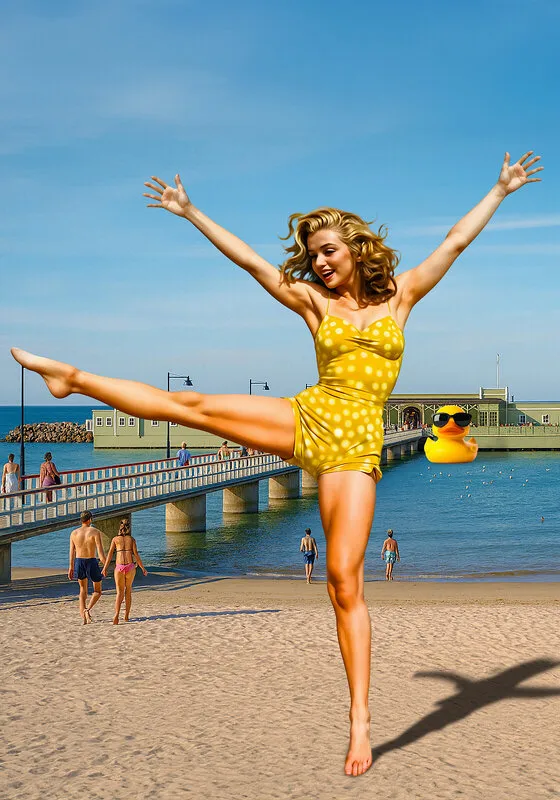
She laughs, she twirls, she glows – happy, but generally miserable., 2025
Digital
50 x 70 cm
3 200 kr
She laughs, she twirls, she glows – happy, but generally miserable.
There are moments when art, history, and the cosmos converge in an image that seems to embody something greater than itself.
The song promises joy, a sentiment echoed by the headlines, and one that the public believed — Happy Days Are Here Again, a message that resonates universally. But beneath the gloss of optimism lies the quiet pulse of denial. Every era creates its own anthem of reassurance, a melody spread by the media to drown out the dissonance of reality. Marilyn sang it, politicians repeated it, and we still hum along — perhaps because pretending happiness feels safer than confronting its absence. This is not just a narrative, but a societal issue that needs our attention.
This Picture and essay are not a lament but a mirror: a reminder that the world’s brightest smiles and the most seemingly happy and content individuals are often just a façade painted over the cracks of their true feelings and societal issues they face. The melody remains infectious, but the rhythm, if you listen closely, limps. It's a call for introspection, to look beyond the surface and understand the true nature of happiness.
Join me as we pass through the gateway of this essay to explore Marilyn Monroe’s luminous dance, deeply intertwined with themes of stardom, memory, and eternal light. This essay is not just a text, but a welcoming gateway designed to entertain and illuminate the symbolic connection between an earthly icon and her cosmic rebirth.
“Happy Days (A Refrain in Minor Key)
They say the happy days are here again,
but the smile has teeth and the tune pretends.
The trumpets shine, the banners wave,
over a crowd that laughs at what it craves.
The glass is raised, the lights are bright,
no one mentions the sleepless night.
We hum along, rehearsed and neat,
our joy is polished, discreetly incomplete.
The headlines sing of endless cheer,
but silence hums beneath the veneer.
The dance goes on — step, spin, grin —
a masquerade with sorrow’s skin.
If these are the happy days, my friend,
why do they always almost end?
The chorus swells, the curtain falls,
and echoes wander through the halls.
The record turns, the varnish gleams,
painted smiles conceal the seams.
The world applauds, the show must stay —
So let us laugh the pain away.”
Malmö. October 2025
She laughs, she twirls, she glows – happy, but generally miserable - Prologue: Turning the Telescope.
“So long, sad times, go long, bad times,
We are rid of you at last
Howdy gay times, cloudy grey times,
You are now a thing of the past
Happy days are here again,
The skies above are clear again
So, let us sing a song of cheer again,
Happy days are here again”
When Marilyn sang, her voice was a radiant beacon, resonating with a beauty that was truly her own.
When I first wrote about Marilyn’s departure, I envisioned her in the Marilyn Nebula, a comforting image of her finding her rightful place among the constellations, forever dancing to a song only she could hear.
But time has a way of flipping perspectives. One late summer night, as the air over Öresund grew still and the moon reddened like a fading rose, I looked not outward but homeward — toward Ribersborg. And there she was again. Marilyn, in full swing, dancing barefoot on the sand and singing at the top of her voice: “Happy Days Are Here Again.”
It was a sight of absurd beauty, Marilyn singing 'Happy Days Are Here Again' at Ribersborg, the melody drifting across the water like champagne, bold as survival.
That question — how joy survives sorrow — will return later in this essay. But before we reach the beach at Ribersborg, I must go back to the first vision, the one written years ago: the nebula, the dance beyond Andromeda, and the woman who became a constellation. For that is where her story — and mine — began. Let’s start with Marilyn’s paradox — “Happy but generally miserable.”
Marilyn Monroe and the Mirage of Happiness
Marilyn Monroe’s life was a performance of light, a dazzling spectacle that cast long shadows of darkness. She was the woman who made the world smile, yet her own laughter was often tinged with a quiet, personal sorrow. “If I’m generally anything," she once mused, "I guess I’m generally miserable.”
These words, seemingly casual and simple, reveal a profound truth that outlived her and still echoes in every image we see.
After relocating to New York in the mid-1950s, Marilyn experienced what many of her friends later described as her brief “season of genuine happiness.”
She had left Hollywood, her studio contract, and her marriage to Joe DiMaggio behind. For the first time, she could walk down a city street anonymously, study acting under Lee Strasberg, and read books without being mocked for it. In New York, she wasn’t just a star; she was a student, a thinker, a woman seeking authenticity in a world built on illusion.
Those who knew her then said she was radiant — not the studio kind of radiance, but a softer glow, as if she were finally lit from within.
Yet the light never lingered. The traumas of her childhood — the foster homes, the sense of abandonment, the mother lost to madness — had carved deep furrows in her soul. They remained like unhealed fractures beneath the glamour. Fame amplified both her beauty and her loneliness.
She yearned for love, but all she encountered were mirrors. Every marriage became a reflection of her own unease: DiMaggio’s jealousy, Miller’s disillusionment. Even on the set of The Misfits, written for her by the man who claimed to understand her best, she found herself collapsing between takes — exhausted, sedated, drained by insomnia and despair.
Despite her intelligence and discipline, Marilyn was trapped in a role she could not escape. The “dumb blonde” she once portrayed for irony became the only language the world allowed her to speak. She fought to be taken seriously, establishing her own production company and demanding creative control. Yet Hollywood was not built to reward sincerity. It adored her image but ignored her true self. The irony is cruel: the more she struggled to prove her depth, the more the culture demanded her surface. Marilyn's resilience and determination to be taken seriously in the film industry, despite the challenges she faced, is a testament to her strength and courage.
Her unhappiness was not theatrical. It was a steady, chronic issue, woven into her self-perception. In one of her last interviews, she said quietly, “I was never used to being happy, so it wasn’t something I ever took for granted.” That confession, spoken barely a few months before her death, transforms the image of Marilyn into something more than biography — a reflection of our own contradictions. She reminds us that joy can be genuine even when fleeting, and that laughter and pain can coexist within the same body.
Marilyn became a metaphor for modern life: the pursuit of happiness as a performance, the tiredness beneath the smile. She lived in the spotlight of lights that could never warm her. And yet, when we watch her dance — radiant, carefree, impossibly alive — we feel something that goes beyond pity. We feel recognition.
For who among us has not, at some point, felt the paradox of happiness coexisting with a general sense of misery? It's a shared human experience that often goes unspoken, yet it's a thread that connects us all.
The Mirror Turns – Personal Reflection
Marilyn’s line — “If I’m generally anything, I guess I’m generally miserable” — could, I suppose, also apply to me, at least after I turned fifty. Before that, my mood followed life’s ordinary tides: children growing up, work projects starting and finishing, quiet moments of joy with my wife. In essence, I’ve always been an incurable optimist, but time has a cruel sense of humour. The scales tip, and optimism takes on a darker hue. From that imbalance, my love for black humour and the need for satire grew — the laughter that keeps melancholy at bay.
Satire, to me, is not cynicism but survival. It’s a way of staying sane in a world that constantly insists on its own absurdity. I like to think my writing belongs to that tradition — political and social satire — though I admit the claim might flatter me. True satire, the kind mastered by Oscar Wilde or Jonathan Swift, is a rare gift. Most attempts fall short; the blade either dulls or cuts too deeply. Swift proposed, with perfect irony, that Irish infants should be eaten to solve poverty — a suggestion so grotesque it exposes the cruelty it mocks. I will never reach such heights of genius, but perhaps I can, as the saying goes, aim for the stars and at least hit the treetops.
The older I grow, the more I see satire as a form of moral balance — a space between laughter and lament. One must be sufficiently amused to cope with the world, but not so amused as to forgive it. Suppose Marilyn’s tragedy was that she could not reconcile her radiant smile with her private despair. In that case, mine may be the opposite: the inability to conceal disillusionment behind a convincing grin. My humour leaks out like light from a cracked lantern; it warms, but it also reveals the fracture.
There are times when I envy those who can uphold the “Happy Days” illusion — the belief that everything will somehow turn out all right if we stop worrying and switch on the television. This illusion, while comforting, can lead to complacency, which I see as the enemy of empathy. Feeling too little is just as dangerous as feeling too much. It's important to acknowledge the storms, to walk in the weather, perhaps a little soaked, but awake.
I have come to realise that both the persistently cheerful and the eternally bitter end up equally blind: one sees only sunshine, the other only storms. The key, I believe, is to find a balance, to walk in the weather between them — perhaps a little soaked, but awake and aware.
So I persist in writing, caught somewhere between Wilde’s laughter and Heller’s despair, between Molière’s mischief and Vonnegut’s weary smile. If Marilyn once danced to mask her loneliness, I write and create pictures to reveal mine — and perhaps, in doing so, to help others feel a little less alone.
For that, I suppose, is the silent purpose behind all satire and all art: to laugh not because life is funny, but because it is unbearable not to.
On Satire – The Art of Laughing at the Abyss
Satire, at its best, is the skill of balancing on the edge of the abyss and choosing to laugh instead of falling. It is not born out of cheerfulness but from discomfort — a refusal to accept the world’s nonsense as usual. This discomfort, however, is not a burden, but an intellectual stimulant that keeps us engaged.
Unlike ordinary humour, which seeks comfort, satire aims for clarity. It reveals pretence, pomposity, and power using the same tool: laughter sharpened into a blade.
I have frequently imagined a long continuum extending between two poles.
At one end, the light satirists — Molière, Mark Twain, Tage Danielsson — transform folly into music. Their laughter is generous and forgiving; it reminds us that our faults are shared and thus human.
At the other end stand the dark satirists — Joseph Heller, Kurt Vonnegut, perhaps Orwell — who peer into history’s furnace and discover irony glowing like a coal. Their humour is the kind that tastes of smoke: you laugh, but the laugh wounds.
Between these extremes lies a narrow path, and I attempt to walk it.
Lingering too long with light satirists risks triviality — enjoying wit without real consequence. But dwelling among the dark ones invites bitterness — laughter so sharp it erodes the heart that produces it. The challenge is to find a balance, to reach that “Golden Mean” where compassion and outrage coexist, creating a sense of order and control in the chaos of satire.
I have always admired how Twain could reveal hypocrisy without losing his affection for humanity. In The Adventures of Tom Sawyer, he satirises small-town morality, yet his fondness for its residents is apparent. Heller, by contrast, presents a world where reason itself becomes a bureaucratic trap. Catch-22 is not just humorous; it is frightening in its accuracy. People laugh because there is no other reaction available. Vonnegut echoes this logic, but with a strange tenderness. “So it goes,” he says, as if resignation alone were the only sincere prayer left for humanity.
Satire is a moral craft disguised as mischief.
It allows us to speak what would otherwise be unspeakable, to hold those in power to account without sermons or slogans. But it also reflects on the satirist, laying bare the fine line between mockery and contempt. To ridicule the world is simple; to do so with love still present is an act of grace, fostering a sense of empathy and connection in the audience.
That, I suspect, is why I keep writing and creating my pictures. The abyss isn’t going anywhere. But as long as there are words, there is a way to make it resonate with laughter — not the laughter of cruelty, but the laughter of recognition. This is the laughter that acknowledges the shared experience of human folly and the absurdity of life, creating a sense of community among those who 'get' the satire.
The kind of laughter that says: We have seen the darkness together, and for a moment, it blinked first.
The Satirist’s Dilemma – Between Cynicism and Naïveté
Every satirist eventually faces a crossroads: one route leads to cynicism, the other to naivety. Both are traps masked as convictions. The cynic believes too little; the naïve believes too easily. One freezes the heart, the other clouds the mind. And it's in this struggle, this delicate dance between the two extremes, that the true essence of satire is found.
I have strayed too close to both edges. There were times when my laughter became sharp, when I mistook scorn for insight. It begins innocently — you mock stupidity, corruption, hypocrisy — but soon you discover that your anger has personalised its targets. Policies become people, and people become enemies. Eventually, everyone seems absurd except you. At that point, satire turns into contempt, and the writer becomes what he despises: another preacher of certainty.
The opposite extreme is equally perilous. I have known sunny souls who emit positivity like a constant commercial break. They live by slogans — “Everything will be fine,” “Don’t worry, be happy.” Their serenity is admirable but strangely superficial, a smile stretched over indifference. They remind me of the “Happy Days” syndrome I see everywhere: the belief that optimism is a moral obligation, that recognising darkness makes one ungrateful. To them, Marilyn’s sorrow would be a branding issue, not a human tragedy. This excessive optimism can blind us to the harsh realities that satire often seeks to expose.
So I choose instead what the Greeks called metriotes — the Golden Mean. Moderation not in passion, but in judgement. I want to see clearly without losing compassion, to laugh without cruelty, to criticise without despair. This balanced perspective is not just a choice, but a necessity in the world of satire. It is a fragile balance, like walking a tightrope strung between faith in humanity and disbelief in its behaviour.
Politics tests this balance every day. I do not wish to hate all Conservatives, nor to sanctify all Labour supporters. The moral drama of good and evil rarely fits a party platform. As Socrates discovered — and paid for with his life — honesty and politics seldom share the same space. His declaration, “I was too honest a man to be a politician and live,” still rings painfully modern. Truth-tellers remain inconvenient guests at the banquet of power.
Perhaps satire’s true purpose is to maintain that honesty — to puncture certainty before it becomes dogma. The satirist’s role is not to provide solutions but to keep questions alive, to remind both the cynic and the optimist that the world is too complex to warrant either absolute despair or blind faith. This function of satire is not just a task, but a noble duty.
Ultimately, I believe all satire writers live like tightrope walkers over an audience that both admires and resents them. If you fall to one side, you become the fool; if you fall to the other, the prophet. The challenge is to keep moving forward, with a faint smile, knowing that both humour and seriousness are essential to survive.
Politics, Philosophy, and the Persistence of Folly
Politics, like fashion, never truly changes — it simply reappears in new hues. Every generation believes it is witnessing unprecedented foolishness, yet history shows otherwise. The names shift, slogans evolve, hairstyles differ, but the pattern remains the same: ambition disguised as virtue, ignorance sold as authenticity, and greed repackaged as pragmatism. Understanding the cyclical nature of political folly can enlighten us about historical patterns.
Sometimes I think Socrates would not have fared much better today than he did in Athens. He would have been “de-platformed” for corrupting the youth, trolled on social media, and turned into a meme. His crime was not heresy but honesty — a trait no political system, ancient or modern, has ever handled well. He questioned the comfort of certainty, and when threatened, certainty always reaches for the hemlock.
In theory, democracy should have matured by now. In reality, it remains a delicate compromise between idealism and incompetence. We vote for progress but get performance; we choose transparency yet receive spectacle. Our parliaments and congresses resemble reality shows, albeit with bigger production budgets. The only thing that seems bipartisan is denial. This 'delicate compromise' refers to the struggle between the idealistic vision of democracy, where the people's voice is paramount, and the practical incompetence that often leads to political gridlock and inefficiency.
The satirist, armed with a keen eye and a sharp wit, observes this endless cycle with a mixture of déjà vu and despair. One cannot help but marvel at humanity’s ability to repeat its mistakes with such confidence. We create gods, overthrow them, and replace them with ideologies, only to worship those instead. Each new age claims to be rational, enlightened, post-something — yet the same primal forces always pull us back: fear, vanity, envy, faith. The human condition shows remarkable continuity. Satire, as a tool of critique, empowers us with the ability to expose and ridicule this folly.
Still, I try not to lose hope. Recognising folly is not the same as surrendering to it. If satire has any moral value, it lies in its refusal to give up on reason — its stubborn belief that laughter can still illuminate. This belief is rooted in the understanding that humour has a unique power to reveal the absurdity of human actions and systems. Ridicule, in the right hands, is a form of mercy: it exposes absurdity before it turns lethal. Tyrants fear laughter more than dissent because laughter undermines authority without bloodshed.
I occasionally imagine a round table where Socrates, Voltaire, Mark Twain, and Kurt Vonnegut share a meal. The conversation would be lively, the wine abundant, and the consensus unanimous: that history, despite its supposed progress, remains the most excellent comedy ever written — only the audience changes.
Perhaps that is the philosopher’s consolation and the satirist’s curse: to understand that folly is eternal, yet to keep debating it anyway. The importance of reasoned debate in combating political folly should give us hope for a better future.
And if there is wisdom in that persistence, it is the same wisdom that kept Socrates smiling as he lifted the cup — an acceptance that truth may lose every election but still deserves our vote.
Happy Days? — A Satirical Coda
The title Happy Days Are Here Again? was never intended as a statement but as a question.
Everyone who delves into Marilyn’s story can't help but see the profound gap between appearance and reality, between the song we sing and the silence that follows. This gap, so starkly illustrated in her life, is not hers alone; it's a reflection of the human condition, a mirror to all of us.
I sometimes picture her as I once did through my telescope — dancing again, not in Hollywood’s artificial glow but under the gentle light of the cosmos. She turns slowly in her red sequined dress, surrounded by dust and starlight, her laughter inaudible but visible across the darkness. Somewhere in that celestial movement, I recognise the same paradox that defines the human condition: to shine outwardly while trembling inside.
We live in an era that expects optimism as if it proves moral integrity. This era, born out of the post-war boom and perpetuated by the digital age, demands a relentless positivity. To doubt, to question, even to mourn — these have become nearly rebellious acts. “Happy Days” has shifted from a song to a slogan, a rallying cry of consumer confidence: if we smile enough, perhaps the world will forget its problems. But history, as always, remains deaf to jingles.
Still, I am not ready to dismiss happiness altogether.
There are moments — absurd, fleeting, incandescent — when joy persists despite everything. Marilyn briefly found them in New York; I occasionally see them in writing, in satire, in laughter that escapes even when it shouldn’t. Perhaps happiness, like satire, is not a state but a form of rebellion: a way of defying despair by dancing on its edge.
The allure of nostalgia is strong — to believe that the “good old days” were truly better, cleaner, and simpler. But the past is a land where no one truly lived, at least not as they remember it. The only direction left is forward. The task is not to restore what was, but to redeem what remains.
So I keep the question mark. It is my punctuation of faith — the sign that doubt still lives, that thought still moves. Marilyn’s smile, like that question mark, lingers at the end of every sentence we write about her. It asks us not to believe in happy days but to keep inventing them — honestly, consciously, against all odds.
And perhaps that is the essence of satire after all: to recognise the tragedy, and still tell the joke. To look into the world’s weary eyes, raise a glass — or a telescope — and whisper, as Marilyn does somewhere out there among the stars:
“Happy Days Are Here Again.”
Epilogue – The Light That Stays
Ultimately, everything returns to light — sometimes gentle, sometimes blinding, always incomplete. Marilyn found hers beyond the atmosphere, or perhaps only in our perception of it. I discover mine on paper, in the tremor between laughter and lament. Both are ways of surviving the same gravity: the realisation that happiness, like starlight, is genuine precisely because it fades. But hope, like the light, endures.
The older I get, the more I suspect that the world will never outgrow its absurdities. Politics will repeat itself, ideologies will masquerade as salvation, and human beings will continue to stumble over their own brilliance. Yet even within that repetition, there are sparks — small, persistent acts of beauty, decency, and humour that keep the darkness from winning. These small acts, like stars in a dark sky, give us hope.
That, I believe, is where Marilyn still resides: not only in her nebula of sequins, nor in Hollywood’s endless reruns, but in the delicate persistence of joy itself. She reminds us that laughter and despair are not opposites but neighbours; that they coexist in the human experience. This understanding can be an act of love, and that to keep asking the question — are happy days really back again? — is a form of hope.
I have learned to live with that question. To write from it, to laugh through it, and to keep believing that even satire, in its crooked way, points toward the light.
For the light that flickers is still light — and sometimes that is enough..
At the end, some words about the composer who still spreads his joy. Jack Yellen, whose songs and lyrics ranged from Franklin D. Roosevelt’s first presidential campaign theme--the upbeat “Happy Days Are Here Again”-- to Sophie Tucker’s plaintive plea to her boyfriend, “Mr. Siegal, You Gotta Make It Legal,” has died in his Upstate New York home. His influence on American culture and politics through his music is a testament to his enduring legacy.
The son of a Polish pawnbroker who emigrated to the United States near the turn of the century was 98 when he died Wednesday in the Erie County community of Springville.
For over four decades, Jack Yellen was a prolific creator, contributing the words or music--or both--to over 130 popular songs. Many of these songs have stood the test of time, becoming enduring ballads in America’s musical history.
There also were smash scores--from the bluesy revue “Rain or Shine” to the “Ziegfeld Follies of 1943.”
His song “Yiddishe Momme” was not just performed by Al Jolson, but it also became a cultural touchstone. Similarly, his lyrics to “Ain’t She Sweet” didn't just become a Roaring ‘20s anthem, but they also captured the spirit of the era for much of the country.
Tucker provided both a song and an epitaph with “The Last of the Red Hot Mommas.”
His collaborations included some of the most legendary names of American music--Harold Arlen, Sammy Fain, Lew Pollack and others. These partnerships enriched his work and contributed to the depth of his musical legacy.
Yellen, the oldest of seven children, began his career in a completely different field, as a police reporter for the old Buffalo Courier in 1913. This early experience would later influence his songwriting, giving his lyrics a unique perspective that resonated with many.
He quit the newspaper business to write songs for a living and moved to New York City, where he promoted them in dance halls.
Some of them were “Mama Goes Where Papa Goes,” “I Wonder What’s Become of Sally,” “Are You Havin’ Any Fun”, and “Are You From Dixie?”
His other theatrical credits included the scores to “What’s in a Name” and “George White’s Scandals,” while his film scores ranged from “Road Show” to “The King of Jazz” and “Happy Landing.”
Yellen was one of the earliest members of the American Society of Composers, Authors and Publishers (1917) and served on its board of directors from 1951 to 1969. In 1976, he was named to the Songwriters Hall of Fame.
Yellen retired to his farm in the late 1940s, where he operated an egg business.
Happy Days was featured in the 1930 Metro-Goldwyn Pre-Code romantic musical film Chasing Rainbows, directed by Charles Reisner and starring Bessie Love, Charles King, Jack Benny, Marie Dressler, and Eddie Phillips.
“Happy Days Are Here Again” became the song that launched FDR’s Presidency. In 1929, just before the Great Crash of the New York Stock Market, Milton Ager and Jack Yellen recorded “Happy Days”. The song was an instant hit and would remain a popular refrain throughout the 1930s, as the theme of radio shows sponsored by Lucky Strike cigarettes.
In 1932, the song became closely associated with the presidential campaign of New York Democratic Governor Franklin Delano Roosevelt in his effort to unseat incumbent President Herbert Hoover. When Roosevelt arrived in Chicago to accept his party’s nomination for president, he entered the room to the sound of “Happy Days” The song and its cheerful lyrics matched Roosevelt’s upbeat tempo and stood in stark contrast to Hoover’s demeanour. In addition, the song resonated throughout the nation as most Americans were looking to Roosevelt in hopes that his pledge of “a new deal for the American people” would usher them safely through the Great Depression into a new era of economic prosperity. “Happy Days Are Here Again” has since been associated with the Democratic Party, and remains a sentimental favourite for its political leaders and supporters, such as singer and actress Barbara Streisand, who has recorded her own version of the song. “Happy Days Are Here Again” is listed as #47 on the Recording Industry Association of America's list of "Songs of the Century".
What can we do to help create a better world — not just for those close to us, but for everyone? What kind of person truly cares about others when the day is done?
These are difficult questions, because most of us place ourselves at the centre, surrounded by concentric circles — family, friends — while everyone else gradually fades into the distance.
Life is just beginning.
“Nothing brings me more happiness than trying to help the most vulnerable people in society. It is a goal and an essential part of my life – a kind of destiny. Whoever is in distress can call on me. I will come running wherever they are.” — Princess Diana.
Happy days are here again,
The skies above are clear again
So, let us sing a song of cheer again,
Happy times, happy nights, happy days are here again
3 200 kr

Jörgen Thornberg
Malmö
Lite om bilder och mig. Translation in English at the end.
Jag är en nyfiken person som ser allt i bilder, även det jag fäster i ord, gärna tillsammans för bakom alla mina bilder finns en berättelse. Till vissa bilder hör en kortare eller längre novell som följer med bilden.
Bilder berättar historier. Jag omges av naturlig skönhet, intressanta människor och historia var jag än går. Jag använder min kamera för att dokumentera världen och blanda det jag ser med vad jag känner för att fånga den dolda magin.
Mina bilder berättar mina historier. Genom mina bilder, tryck och berättelser. Jag bjuder in dig att ta del av dessa berättelser, in i ditt liv och hem och dela min mycket personliga syn på vår värld. Mer än vad ögat ser. Jag tänker i bilder, drömmer och skriver och pratar om dem; följaktligen måste jag också skapa bilder. De blir vad jag ser, inte nödvändigtvis begränsade till verkligheten. Det finns en bild runt varje hörn. Jag hoppas att du kommer att se vad jag såg och gilla det.
Jag är också en skrivande person och till många bilder hör en kortare eller längre essay. Den följer med tavlan, tryckt på fint papper och med en personlig hälsning från mig.
Flertalet bilder startar sin resa i min kamera. Enkelt förklarat beskriver jag bilden jag ser i mitt inre, upplevd eller fantiserad. Bilden uppstår inom mig redan innan jag fått okularet till ögat. På bråkdelen av ett ögonblick ser jag vad jag vill ha och vad som kan göras med bilden. Här skall jag stoppa in en giraff, stålmannen, Titanic eller vad det är min fantasi finner ut. Ännu märkligare är att jag kommer ihåg minnesbilden långt efteråt när det blir tid att skapa verket. Om jag lyckas eller inte, är upp till betraktaren, oftast präglat av en stråk av svart humor – meningen är att man skall bli underhållen. Mina bilder blir ofta en snackis där de hänger.
Jag föredrar bilder som förmedlar ett budskap i flera lager. Vid första anblicken fylld av feel-good, en vacker utsikt, fint väder, solen skiner, blommor på ängen eller vattnet som ligger förrädiskt spegelblankt. I en sådan bild kan jag gömma min egentliga berättelse, mitt förakt för förtryckare och våldsverkare, rasister och fördomsfulla människor - ett gärna återkommande motiv mer eller mindre dolt i det vackra motivet. Jag försöker förena dem i ett gemensamt narrativ.
Bild och formgivning har löpt som en röd tråd genom livet. Fotokonst känns som en värdig final som jag gärna delar med mig.
Min genre är vid som framgår av mina bilder, temat en blandning av pop- och gatukonst i kollage som kan bestå av hundratals lager. Vissa bilder kan ta veckor, andra någon dag innan det är dags att överlämna resultatet till printverkstaden. Fine Art Prints är digitala fotocollage. I dessa kollage sker rivandet, klippandet, pusslandet, målandet, ritandet och sprayningen digitalt. Det jag monterar in kan vara hundratals år gamla bilder som jag omsorgsfullt frilägger så att de ser ut att vara en del av tavlan men också bilder skapade av mig själv efter min egen fantasi. Därefter besöks printstudion och för vissa bilder numrera en limiterad upplaga (oftast 7 exemplar) och signera för hand. Vissa bilder kan köpas i olika format. Det är bara att fråga efter vilka. Gillar man en bild som är 70x100 men inte har plats på väggen, går den kanske att få i 50x70 cm istället. Frågan är fri.
Metoden Giclée eller Fine Art Print som det också kallas är det moderna sättet för framställning av grafisk konst. Villkoret för denna typ av utskrifter är att en högkvalitativ storformatskrivare används med åldersbeständigt färgpigment och konstnärspapper eller i förekommande fall på duk. Pappret som används möter de krav på livslängd som ställs av museer och gallerier. Normalt säljer jag mina bilder oinramade så att den nya ägaren själv kan bestämma hur de skall se ut, med eller utan passepartout färg på ram, med eller utan glas etc..
Under många år ställde jag bara ut på nätet, i valda grupper och på min egen Facebooksida - https://www.facebook.com/jorgen.thornberg.9
Jag finns också på en egen hemsida som tyvärr inte alltid är uppdaterad – https://www.jth.life/ Där kan du också läsa en del av de berättelser som följer med bilden.
UTSTÄLLNINGAR
Luftkastellet, oktober 2022
Konst i Lund, november 2022
Luftkastellet, mars 2023
Engleson Galleri Caroli, april 2023
Hydra, Greece June 2023
Engleson Galleri Caroli, oktober 2023
Toppen, Höllviken december 2023
Luftkastellet, mars 2024
Torups Galleri, mars 2024
Venice, May 2024
Luftkastellet, oktober 2024
Konst i Advent, December 2024
Galleri Engleson, Caroli December 2024
Jäger & Jansson Galleri, april 2025
A bit about pictures and me.
I'm a curious person who sees everything in pictures, even what I express in words, often combining them, for behind all my pictures lies a story. These narratives, some as short as a single image and others as long as a novel, are the heart and soul of my work.
Pictures tell stories. Wherever I go, I'm surrounded by natural beauty, exciting people, and history. I use my camera to document the world and blend what I see with what I feel to capture the hidden magic.
My images tell my stories. Through my pictures, prints, and narratives, I invite you to partake in these stories in your life and home and share my deeply personal perspective of our world. More than meets the eye. I think in pictures, dream, write, and talk about them; consequently, I must create images too. They become what I see, not necessarily confined to reality. There's a picture around every corner. I hope you'll see what I saw and enjoy it.
I'm also a writer, and many images come with a shorter or longer essay. It accompanies the painting, printed on fine paper with my personal greeting.
Many pictures start their journey on my camera. Simply put, I describe the image I see in my mind, experienced or imagined. The image arises within me even before I bring the eyepiece to my eye. In a fraction of a moment, I see what I want and what can be done with the picture. Here, I'll insert a giraffe, Superman, the Titanic, or whatever my imagination conjures up. Even stranger is that I remember the mental image long after it's time to create the work. Whether I succeed is up to the observer, often imbued with a streak of black humour – the aim is to entertain. My pictures usually become a talking point wherever they hang.
I prefer pictures that convey a message in multiple layers. At first glance, they're filled with feel-good vibes, a beautiful view, lovely weather, the sun shining, flowers in the meadow, or the water lying deceptively calm. But beneath this surface beauty, I often conceal a deeper story, a narrative that challenges societal norms or explores the human condition. I invite you to delve into these hidden narratives and discover the layers of meaning within my work.
Picture and design have been a thread running through my life. Photographic art feels like a fitting finale, and I'm happy to share it.
My genre is varied, as seen in my pictures; the theme is a blend of pop and street art in collages that can consist of hundreds of layers. Some images can take weeks, others just a day before it's time to hand over the result to the print workshop. Fine Art Prints are digital photo collages. In these collages, tearing, cutting, puzzling, painting, drawing, and spraying happen digitally. What I insert can be images hundreds of years old that I carefully extract so they appear to be part of the painting, but also images created by myself, now also generated from my imagination. Next, visit the print studio and, for certain images, number a limited edition (usually 7 copies) and sign them by hand. Some images may be available in other formats. Just ask which ones. If you like an image that's 70x100 but doesn't have space on the wall, you might be able to get it in 50x70 cm instead. The question is open.
The Giclée method, or Fine Art Print as it's also called, is the modern way of producing graphic art. This method ensures the highest quality and longevity of the artwork, using a high-quality large-format printer with archival pigment inks and artist paper or, in some cases, canvas. The paper used meets the longevity requirements set by museums and galleries. I sell my pictures unframed, allowing the new owner to personalise their artwork, confident in the lasting value and quality of the piece.
For many years, I only exhibited online, in selected groups, and on my Facebook page - https://www.facebook.com/jorgen.thornberg.9. I also have my website, which unfortunately is not constantly updated - https://www.jth.life/. You can also read some of the stories accompanying the pictures there.
EXHIBITIONS
Luftkastellet, October 2022
Art in Lund, November 2022
Luftkastellet, March 2023
Engleson Gallery Caroli, April 2023
Hydra, Greece June 2023
Engleson Gallery Caroli, October 2023
Toppen, Höllviken December 2023
Luftkastellet, March 2024
Torup Gallery, March 2024
Venice, May 2024
UTSTÄLLNINGAR
Luftkastellet, oktober 2022
Konst i Lund, november 2022
Luftkastellet, mars 2023
Engleson Galleri Caroli, april 2023
Hydra, Greece June 2023
Engleson Galleri Caroli, oktober 2023
Toppen, Höllviken december 2023
Luftkastellet, mars 2024
Torups Galleri, mars 2024
Venice, May 2024
Luftkastellet, October 2024
Konst i Advent, December 2024
Galleri Engleson, Caroli December 2024
Jäger & Jansson Galleri, April 2025
Utbildning
Autodidakt
Medlem i konstnärsförening
Öppna Sinnen
Med i konstrunda
Konstrundan i Skåne
Utställningar
Luftkastellet, October 2022
Art in Lund, November 2022
Luftkastellet, March 2023
Engleson Gallery Caroli, April 2023
Hydra, Greece June 2023
Engleson Gallery Caroli, October 2023
Toppen, Höllviken December 2023
Luftkastellet, March 2024
Torup Gallery, March 2024
Venice, May 2024