Vi använder cookies för att ge dig bästa möjliga upplevelse. Välj vilka cookies du tillåter.
Läs mer i vår integritetspolicy
Jörgen Thornberg
Home Delivery, 2025
Digital
70 x 50 cm
3 200 kr
Home Delivery
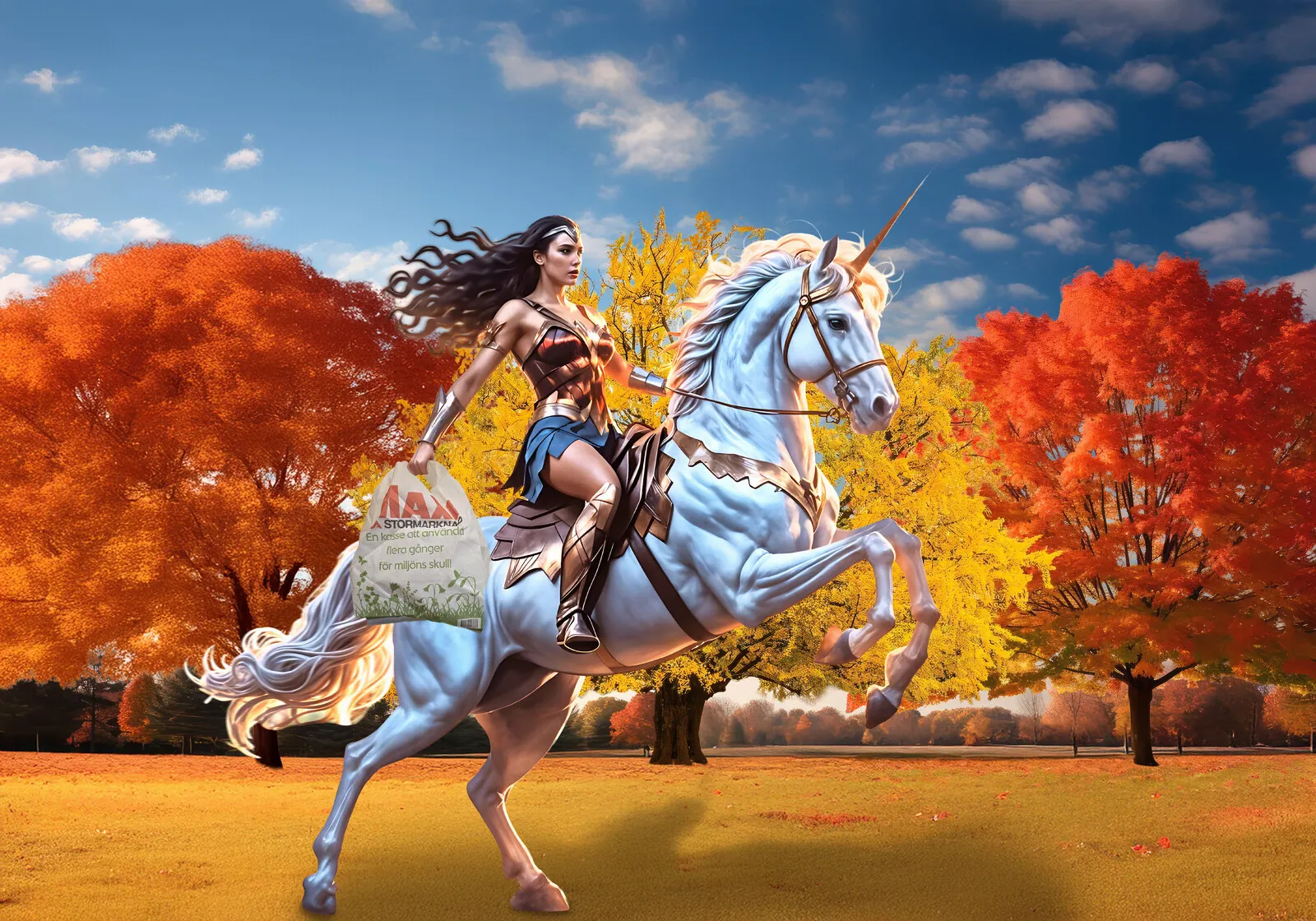
There are moments when myths, in a surprising turn of events, quietly step off the screen and into the world. One evening in early autumn, beneath the red maples and the golden ginkgo of Malmö’s Västra Hamnen, a familiar silhouette appeared: a woman in crimson and gold, no longer soaring through apocalyptic skies but walking home with a paper bag in her hand. It was a sight that would have startled even the most seasoned mythologist.
It was Wonder Woman — or perhaps her idea — taking a brief break from eternity. After centuries of battling gods, monsters, and men, she had come to Sweden for some rest. In the new Absolute Wonder Woman saga, she rides a reanimated Pegasus through a shattered world; here, she rides a unicorn through falling leaves. The stark contrast between her epic battles and her domestic peace, between myth and modern life, is a powerful reminder of the enduring relevance of myth in our everyday lives. She is a goddess with groceries, a warrior of sustainability, a sight that leaves us in awe.
The story that follows traces her descent from heaven to harbour, from Pegasus to unicorn, from legend to life. It is also a story about endurance — how myths, like Wonder Woman, not only survive but adapt to their own endings. They keep finding new shapes in a world that pretends to have outgrown them, reminding us of their enduring relevance in our modern lives.
“From Olympus to Ica
Once I grazed on clouds of silver,
a celestial steed of flame,
drinking dawnlight from the rivers
no mortal tongue could name.
Then the Vikings came with trading sails,
their longships full of lies,
they sold my horn for heaps of gold—
and called it Northern Skies.
A narwhal grinned beneath the ice,
and whispered, “Take the blame—
they’ll carve your myth in marble soon,
and I’ll retire in fame.”
Through cathedrals, courts, and kingdoms
my legend lost its mane;
I swapped my wings for tapestry,
my thunder for champagne.
But time rolls on like shopping carts—
and even gods must eat.
So here I stand in Västra Hamnen,
with carrots at my feet.
My horn still points to paradise,
though I’m parked by the recycling bin.
The bags say Use me many times —
for the good of Earth within.”
Malmö. October 2025
Home Delivery - Wonder Woman in Malmö, autumn 2025
After filming her scenes for Absolute Wonder Woman — the new DC storyline where Diana rides a reanimated Pegasus through a post-apocalyptic world — she needed a break. So here she is, in Malmö, renting a flat in Västra Hamnen and doing her own grocery shopping.
The unicorn, a symbol of purity and grace, has replaced the skeletal Pegasus in this new chapter of Wonder Woman's story. The battlefield has transformed into a serene park, and the sword has turned into a shopping bag. This juxtaposition of myth and modern life presents a heroine who is not burdened with the fate of humanity but with the responsibility of everyday tasks, sparking a new perspective on the unicorn's symbolism.
Home Delivery – Wonder Woman and the Winged Myth
In the latest ’Absolute Wonder Woman saga’, Diana makes her entrance astride a reanimated Pegasus — a creature once slain by Zeus and resurrected from divine decay. Its bones still echo with Medusa’s blood, from which the original Pegasus was born, and its wings beat through a scorched, post-apocalyptic sky. Here, Wonder Woman is no longer just the daughter of Themyscira but a survivor amid gods and ruins. The skeletal horse she rides symbolises both rebirth and a grim companion — a relic of the world that was, bound to a heroine who refuses to die with it.
Yet, the myth is never stagnant. It shifts, much like Diana herself, across time, continents, and interpretations from ancient Greece to the pages of DC Comics, and now to Malmö, where autumn blazes in gold and red. Between two maples and a ginkgo tree, she has dismounted from the undead Pegasus and borrowed a unicorn for the season, perpetuating the legacy of the myth.
In this quiet northern city, the Amazon warrior has exchanged her divine armour for a borrowed apartment in Västra Hamnen and carries a shopping bag instead of a shield. The inscription on the bag — “En kasse att använda flera gånger för miljöns skull” (“A bag meant to be used again — for the good of the Earth.”) — could just as well be a new Amazonian commandment: a gospel of sustainability in the Anthropocene.
The image is both comic and profound. The saviour of worlds, once soaring above ruins, now rides through a park scattered with fallen leaves. The warhorse has become a unicorn; the apocalypse, a domestic task.
But perhaps this is the truest continuation of the myth — that even gods must return home, that heroism may sometimes mean nothing more than carrying your own groceries through the changing seasons.
“Home Delivery” is not about convenience. It is about coming back.
The Mythical Origins of the Unicorn
Long before comic books, cinema, or capes, dreams of horses with wings or a single horn haunted human imagination. The unicorn is among the oldest and most mysterious of mythical creatures.
In Mesopotamian seals from 3000 BCE, we already see horse-like creatures with a single horn rising from their foreheads — symbols of power and purity. In the Indus Valley, similar figures appear in Sanskrit texts, connected to wisdom, chastity, and divine strength.
To the Greeks and Romans, the unicorn was not a creature of fantasy but an exotic animal said to dwell in distant lands: a wild ass with a single long, straight horn, described by Ctesias, Aristotle, and Pliny the Elder.
During the Middle Ages, the unicorn underwent a significant transformation in its symbolism. It lost its pagan wildness and became a symbol of Christian virtue. In illuminated manuscripts and cathedral frescoes, the pure white creature kneels before the Virgin Mary, its horn resting in her lap — a metaphor for divine incarnation. This transformation reflects the cultural shift from pagan beliefs, where the unicorn was associated with wildness and untamed nature, to Christian values, where the unicorn's purity and grace were now seen as a reflection of the Virgin Mary's divine nature.
In the magnificent French tapestries ’La Dame à la licorne’, woven around 1500, the creature signifies both sensual desire and spiritual transcendence — the eternal tension between body and soul.
Yet while theology tamed the unicorn in paint and silk, northern traders gave it a body made of bone.
The Viking Bluff – Narwhal Horns and the Birth of a Myth. This section explores the captivating historical link between the narwhal's spiralled teeth and the origins of the unicorn myth. It delves into how the Norse sailors' discovery of these 'unicorn horns' and their subsequent trade and marketing as such contributed to the perpetuation of the unicorn myth in European culture.
As early as the ninth century, Norse sailors brought back from Greenland and Iceland the long, spiralling teeth of the narwhal — Monodon monoceros. To those unfamiliar with Arctic waters, these ivory tusks resembled the legendary unicorn horns described in ancient stories.
The Vikings and later Nordic merchants started selling them as unicorn horns, alicorns, at astonishing prices. Venetian and Genoese traders carried them south, where Europe’s nobles and pontiffs valued them as symbols of purity and cures for poison.
Elizabeth I of England owned a piece said to be worth ten times its weight in gold. The Danish throne in Rosenborg Palace was literally made from narwhal tusks — a royal testament to how myth, commerce, and northern enterprise could intertwine.
When the Danish naturalist Ole Worm finally revealed in the seventeenth century that these horns did not come from divine beasts but from Arctic whales, the illusion should have ended. It did not. The myth persisted — not because people were naïve, but because they needed it. The unicorn embodied something science could not quantify: the yearning for the pure, the unattainable, the sacred element in nature itself, inspiring generations to come. This enduring appeal of the unicorn myth, despite its debunking by science, underscores the emotional and spiritual significance of myths in human culture. It shows that myths, even when proven false, can still hold deep meaning for people, serving as a source of inspiration and a reflection of our deepest desires and fears, highlighting the enduring power of storytelling in shaping human culture.
From Pegasus to Wonder Woman
The winged horse, Pegasus, was born from another ancient wound — emerging from Medusa’s blood as it spilt onto the earth. Where the unicorn symbolised chastity, Pegasus represented inspiration and flight: the poetic urge, the storm of divine creation. These universal themes in myths connect us to our shared humanity, reminding us of the enduring power of these ancient stories.
In the new Absolute Wonder Woman saga, this lineage takes a darker turn. Diana rides a reanimated Pegasus, a skeletal relic resurrected after being slain by Zeus — a creature half spirit, half ruin. Its bones shimmer like iron beneath a dying sun. Here, Wonder Woman becomes both goddess and ghost, manoeuvring through a broken world. The myth renews itself, showing its transformative power: purity transforms into endurance; transcendence into survival. The enduring relevance of myths can inspire us in our own lives.
But myths never remain confined to parchment or panels. They spread across continents, through time, and into the streets of our own world.
Home Delivery
After filming her apocalyptic scenes, Diana needed a break. So here she is — in Malmö, renting a flat in Västra Hamnen, the city’s glassy seaside district. She rides not the skeletal Pegasus but a gentle unicorn through an autumn display of colour: two red maples and one golden ginkgo.
In her hand, she carries a bag from a Swedish supermarket. Inside it: apples, bread, perhaps a bottle of milk. The goddess of war has become the woman next door. The inscription on the bag — “Använd flera gånger för miljöns skull” — feels like a new Amazonian creed: reuse, renew, respect the earth. This transformation of the goddess into an everyday woman, and the unicorn into a symbol of environmental consciousness, is a profound cultural reinterpretation that enlightens us about the unicorn's transition from myth to everyday life.
The image is both humorous and profound. A heroine who once saved humanity now carries her own shopping; the divine horse that once thundered through the sky now walks carefully over fallen leaves.
And yet, perhaps this is the most genuine form of heroism: the shift from myth to everyday life, from cosmic battle to simple routine—the moment when power shifts towards tenderness, and the immortal learns to live among mortals once more.
“Home Delivery” is not a service. It is a return to earth — a reminder that every myth, no matter how grand, eventually comes home.
The Afterlife of the Unicorn
The unicorn, a creature of adaptability, has never been confined to a single era. It re-emerges wherever imagination and desire meet — in scripture and bestiary, in theatre and cinema, in children’s tales and philosophical allegory. Each time, the creature takes on a different form, but its essence remains unchanged: it continues to symbolise what is rare, untamed, and nearly real.
In medieval Europe, the unicorn was hunted not with spears but with symbols. It represented purity and divine incarnation — a creature that could only be tamed by a virgin’s touch, and thus a figure for Christ himself. In the tapestries of La Dame à la licorne, woven around 1500, she kneels among flowers, both sensuous and sacred, bridging the gap between body and spirit.
Centuries later, Tennessee Williams placed a fragile glass unicorn on the shelf of a St. Louis flat. In The Glass Menagerie, it becomes the symbol of Laura’s delicate difference — a metaphor for all who live slightly outside the world’s grasp. Around the same time, Gian Carlo Menotti’s chamber ballet The Unicorn, the Gorgon, and the Manticore turned the creature into social satire: a protest against conformity disguised as a mythic pageant.
Cinema has revealed both the brightest and darkest moments of the unicorn. In Ridley Scott’s Legend (1985), their silver horns symbolise the balance between light and darkness; harming a unicorn is like harming the world. In Blade Runner (1982), another Scott film, a small origami unicorn glides through the story like a dream — a whisper suggesting that identity might be a fabrication, a memory planted by the gods of technology. These films present the unicorn as a symbol of purity and balance, and as a metaphor for the fragility of memory and identity. In Legend, the unicorn's purity and balance are contrasted with the darkness of the world. In contrast, in Blade Runner, the unicorn becomes a symbol of the fragility of memory and identity, hinting at the artificial nature of the protagonist's memories. Peter S. Beagle’s The Last Unicorn (1968) and its haunting 1982 animation retell the legend as a parable of extinction: the last of her kind searching for others, representing a beauty now forgotten by the modern world.
Even comics and children’s tales have depicted the horned beast. In Hergé’s The Secret of the Unicorn, the animal is no longer alive but reborn as heraldry: the carved figurehead of a ship bearing the moral load of honour and inheritance. When Spielberg reimagined the story in 2011, the Unicorn became a cinematic riddle, the vessel of lost treasure and memory — another form of myth hidden in modern disguise.
Over time, the unicorn has shifted from symbol to echo, from sacred to ironic. Yet it persists — not because we still believe, but because belief itself requires a form. The horn points upward, forever, towards the impossible, inspiring us with its persistence. This enduring power of ancient symbols in modern times is a testament to the unicorn's resilience.
And now, in a new century, the creature rides again — through Malmö’s autumn light. Wonder Woman has borrowed it for a while, trading her skeletal Pegasus for a living myth in exile. The red maples burn like embers, the golden ginkgo sheds its fan-shaped leaves, and the Amazon carries a paper bag that reads, “A bag meant to be used again — for the good of the Earth.”
The unicorn has transitioned from the realm of fantasy into everyday life. This transition symbolises the continuity of myth in modernity, the resilience of ancient symbols in the face of changing times, and the quiet heroism of ordinary existence. The same spirit once inspired medieval saints and cinematic dreamers. Its horn no longer purifies poisoned cups; instead, it pierces the boundaries between myth and modernity, between the divine and the domestic, accentuating the continuity of myth in our modern world.
And so the story concludes at home. From Mesopotamia to Themyscira, from the Arctic narwhal to Västra Hamnen, the unicorn remains what it has always been — a reminder that wonder, too, needs a body.
Jörgen Thornberg
Home Delivery, 2025
Digital
70 x 50 cm
3 200 kr
Home Delivery
There are moments when myths, in a surprising turn of events, quietly step off the screen and into the world. One evening in early autumn, beneath the red maples and the golden ginkgo of Malmö’s Västra Hamnen, a familiar silhouette appeared: a woman in crimson and gold, no longer soaring through apocalyptic skies but walking home with a paper bag in her hand. It was a sight that would have startled even the most seasoned mythologist.
It was Wonder Woman — or perhaps her idea — taking a brief break from eternity. After centuries of battling gods, monsters, and men, she had come to Sweden for some rest. In the new Absolute Wonder Woman saga, she rides a reanimated Pegasus through a shattered world; here, she rides a unicorn through falling leaves. The stark contrast between her epic battles and her domestic peace, between myth and modern life, is a powerful reminder of the enduring relevance of myth in our everyday lives. She is a goddess with groceries, a warrior of sustainability, a sight that leaves us in awe.
The story that follows traces her descent from heaven to harbour, from Pegasus to unicorn, from legend to life. It is also a story about endurance — how myths, like Wonder Woman, not only survive but adapt to their own endings. They keep finding new shapes in a world that pretends to have outgrown them, reminding us of their enduring relevance in our modern lives.
“From Olympus to Ica
Once I grazed on clouds of silver,
a celestial steed of flame,
drinking dawnlight from the rivers
no mortal tongue could name.
Then the Vikings came with trading sails,
their longships full of lies,
they sold my horn for heaps of gold—
and called it Northern Skies.
A narwhal grinned beneath the ice,
and whispered, “Take the blame—
they’ll carve your myth in marble soon,
and I’ll retire in fame.”
Through cathedrals, courts, and kingdoms
my legend lost its mane;
I swapped my wings for tapestry,
my thunder for champagne.
But time rolls on like shopping carts—
and even gods must eat.
So here I stand in Västra Hamnen,
with carrots at my feet.
My horn still points to paradise,
though I’m parked by the recycling bin.
The bags say Use me many times —
for the good of Earth within.”
Malmö. October 2025
Home Delivery - Wonder Woman in Malmö, autumn 2025
After filming her scenes for Absolute Wonder Woman — the new DC storyline where Diana rides a reanimated Pegasus through a post-apocalyptic world — she needed a break. So here she is, in Malmö, renting a flat in Västra Hamnen and doing her own grocery shopping.
The unicorn, a symbol of purity and grace, has replaced the skeletal Pegasus in this new chapter of Wonder Woman's story. The battlefield has transformed into a serene park, and the sword has turned into a shopping bag. This juxtaposition of myth and modern life presents a heroine who is not burdened with the fate of humanity but with the responsibility of everyday tasks, sparking a new perspective on the unicorn's symbolism.
Home Delivery – Wonder Woman and the Winged Myth
In the latest ’Absolute Wonder Woman saga’, Diana makes her entrance astride a reanimated Pegasus — a creature once slain by Zeus and resurrected from divine decay. Its bones still echo with Medusa’s blood, from which the original Pegasus was born, and its wings beat through a scorched, post-apocalyptic sky. Here, Wonder Woman is no longer just the daughter of Themyscira but a survivor amid gods and ruins. The skeletal horse she rides symbolises both rebirth and a grim companion — a relic of the world that was, bound to a heroine who refuses to die with it.
Yet, the myth is never stagnant. It shifts, much like Diana herself, across time, continents, and interpretations from ancient Greece to the pages of DC Comics, and now to Malmö, where autumn blazes in gold and red. Between two maples and a ginkgo tree, she has dismounted from the undead Pegasus and borrowed a unicorn for the season, perpetuating the legacy of the myth.
In this quiet northern city, the Amazon warrior has exchanged her divine armour for a borrowed apartment in Västra Hamnen and carries a shopping bag instead of a shield. The inscription on the bag — “En kasse att använda flera gånger för miljöns skull” (“A bag meant to be used again — for the good of the Earth.”) — could just as well be a new Amazonian commandment: a gospel of sustainability in the Anthropocene.
The image is both comic and profound. The saviour of worlds, once soaring above ruins, now rides through a park scattered with fallen leaves. The warhorse has become a unicorn; the apocalypse, a domestic task.
But perhaps this is the truest continuation of the myth — that even gods must return home, that heroism may sometimes mean nothing more than carrying your own groceries through the changing seasons.
“Home Delivery” is not about convenience. It is about coming back.
The Mythical Origins of the Unicorn
Long before comic books, cinema, or capes, dreams of horses with wings or a single horn haunted human imagination. The unicorn is among the oldest and most mysterious of mythical creatures.
In Mesopotamian seals from 3000 BCE, we already see horse-like creatures with a single horn rising from their foreheads — symbols of power and purity. In the Indus Valley, similar figures appear in Sanskrit texts, connected to wisdom, chastity, and divine strength.
To the Greeks and Romans, the unicorn was not a creature of fantasy but an exotic animal said to dwell in distant lands: a wild ass with a single long, straight horn, described by Ctesias, Aristotle, and Pliny the Elder.
During the Middle Ages, the unicorn underwent a significant transformation in its symbolism. It lost its pagan wildness and became a symbol of Christian virtue. In illuminated manuscripts and cathedral frescoes, the pure white creature kneels before the Virgin Mary, its horn resting in her lap — a metaphor for divine incarnation. This transformation reflects the cultural shift from pagan beliefs, where the unicorn was associated with wildness and untamed nature, to Christian values, where the unicorn's purity and grace were now seen as a reflection of the Virgin Mary's divine nature.
In the magnificent French tapestries ’La Dame à la licorne’, woven around 1500, the creature signifies both sensual desire and spiritual transcendence — the eternal tension between body and soul.
Yet while theology tamed the unicorn in paint and silk, northern traders gave it a body made of bone.
The Viking Bluff – Narwhal Horns and the Birth of a Myth. This section explores the captivating historical link between the narwhal's spiralled teeth and the origins of the unicorn myth. It delves into how the Norse sailors' discovery of these 'unicorn horns' and their subsequent trade and marketing as such contributed to the perpetuation of the unicorn myth in European culture.
As early as the ninth century, Norse sailors brought back from Greenland and Iceland the long, spiralling teeth of the narwhal — Monodon monoceros. To those unfamiliar with Arctic waters, these ivory tusks resembled the legendary unicorn horns described in ancient stories.
The Vikings and later Nordic merchants started selling them as unicorn horns, alicorns, at astonishing prices. Venetian and Genoese traders carried them south, where Europe’s nobles and pontiffs valued them as symbols of purity and cures for poison.
Elizabeth I of England owned a piece said to be worth ten times its weight in gold. The Danish throne in Rosenborg Palace was literally made from narwhal tusks — a royal testament to how myth, commerce, and northern enterprise could intertwine.
When the Danish naturalist Ole Worm finally revealed in the seventeenth century that these horns did not come from divine beasts but from Arctic whales, the illusion should have ended. It did not. The myth persisted — not because people were naïve, but because they needed it. The unicorn embodied something science could not quantify: the yearning for the pure, the unattainable, the sacred element in nature itself, inspiring generations to come. This enduring appeal of the unicorn myth, despite its debunking by science, underscores the emotional and spiritual significance of myths in human culture. It shows that myths, even when proven false, can still hold deep meaning for people, serving as a source of inspiration and a reflection of our deepest desires and fears, highlighting the enduring power of storytelling in shaping human culture.
From Pegasus to Wonder Woman
The winged horse, Pegasus, was born from another ancient wound — emerging from Medusa’s blood as it spilt onto the earth. Where the unicorn symbolised chastity, Pegasus represented inspiration and flight: the poetic urge, the storm of divine creation. These universal themes in myths connect us to our shared humanity, reminding us of the enduring power of these ancient stories.
In the new Absolute Wonder Woman saga, this lineage takes a darker turn. Diana rides a reanimated Pegasus, a skeletal relic resurrected after being slain by Zeus — a creature half spirit, half ruin. Its bones shimmer like iron beneath a dying sun. Here, Wonder Woman becomes both goddess and ghost, manoeuvring through a broken world. The myth renews itself, showing its transformative power: purity transforms into endurance; transcendence into survival. The enduring relevance of myths can inspire us in our own lives.
But myths never remain confined to parchment or panels. They spread across continents, through time, and into the streets of our own world.
Home Delivery
After filming her apocalyptic scenes, Diana needed a break. So here she is — in Malmö, renting a flat in Västra Hamnen, the city’s glassy seaside district. She rides not the skeletal Pegasus but a gentle unicorn through an autumn display of colour: two red maples and one golden ginkgo.
In her hand, she carries a bag from a Swedish supermarket. Inside it: apples, bread, perhaps a bottle of milk. The goddess of war has become the woman next door. The inscription on the bag — “Använd flera gånger för miljöns skull” — feels like a new Amazonian creed: reuse, renew, respect the earth. This transformation of the goddess into an everyday woman, and the unicorn into a symbol of environmental consciousness, is a profound cultural reinterpretation that enlightens us about the unicorn's transition from myth to everyday life.
The image is both humorous and profound. A heroine who once saved humanity now carries her own shopping; the divine horse that once thundered through the sky now walks carefully over fallen leaves.
And yet, perhaps this is the most genuine form of heroism: the shift from myth to everyday life, from cosmic battle to simple routine—the moment when power shifts towards tenderness, and the immortal learns to live among mortals once more.
“Home Delivery” is not a service. It is a return to earth — a reminder that every myth, no matter how grand, eventually comes home.
The Afterlife of the Unicorn
The unicorn, a creature of adaptability, has never been confined to a single era. It re-emerges wherever imagination and desire meet — in scripture and bestiary, in theatre and cinema, in children’s tales and philosophical allegory. Each time, the creature takes on a different form, but its essence remains unchanged: it continues to symbolise what is rare, untamed, and nearly real.
In medieval Europe, the unicorn was hunted not with spears but with symbols. It represented purity and divine incarnation — a creature that could only be tamed by a virgin’s touch, and thus a figure for Christ himself. In the tapestries of La Dame à la licorne, woven around 1500, she kneels among flowers, both sensuous and sacred, bridging the gap between body and spirit.
Centuries later, Tennessee Williams placed a fragile glass unicorn on the shelf of a St. Louis flat. In The Glass Menagerie, it becomes the symbol of Laura’s delicate difference — a metaphor for all who live slightly outside the world’s grasp. Around the same time, Gian Carlo Menotti’s chamber ballet The Unicorn, the Gorgon, and the Manticore turned the creature into social satire: a protest against conformity disguised as a mythic pageant.
Cinema has revealed both the brightest and darkest moments of the unicorn. In Ridley Scott’s Legend (1985), their silver horns symbolise the balance between light and darkness; harming a unicorn is like harming the world. In Blade Runner (1982), another Scott film, a small origami unicorn glides through the story like a dream — a whisper suggesting that identity might be a fabrication, a memory planted by the gods of technology. These films present the unicorn as a symbol of purity and balance, and as a metaphor for the fragility of memory and identity. In Legend, the unicorn's purity and balance are contrasted with the darkness of the world. In contrast, in Blade Runner, the unicorn becomes a symbol of the fragility of memory and identity, hinting at the artificial nature of the protagonist's memories. Peter S. Beagle’s The Last Unicorn (1968) and its haunting 1982 animation retell the legend as a parable of extinction: the last of her kind searching for others, representing a beauty now forgotten by the modern world.
Even comics and children’s tales have depicted the horned beast. In Hergé’s The Secret of the Unicorn, the animal is no longer alive but reborn as heraldry: the carved figurehead of a ship bearing the moral load of honour and inheritance. When Spielberg reimagined the story in 2011, the Unicorn became a cinematic riddle, the vessel of lost treasure and memory — another form of myth hidden in modern disguise.
Over time, the unicorn has shifted from symbol to echo, from sacred to ironic. Yet it persists — not because we still believe, but because belief itself requires a form. The horn points upward, forever, towards the impossible, inspiring us with its persistence. This enduring power of ancient symbols in modern times is a testament to the unicorn's resilience.
And now, in a new century, the creature rides again — through Malmö’s autumn light. Wonder Woman has borrowed it for a while, trading her skeletal Pegasus for a living myth in exile. The red maples burn like embers, the golden ginkgo sheds its fan-shaped leaves, and the Amazon carries a paper bag that reads, “A bag meant to be used again — for the good of the Earth.”
The unicorn has transitioned from the realm of fantasy into everyday life. This transition symbolises the continuity of myth in modernity, the resilience of ancient symbols in the face of changing times, and the quiet heroism of ordinary existence. The same spirit once inspired medieval saints and cinematic dreamers. Its horn no longer purifies poisoned cups; instead, it pierces the boundaries between myth and modernity, between the divine and the domestic, accentuating the continuity of myth in our modern world.
And so the story concludes at home. From Mesopotamia to Themyscira, from the Arctic narwhal to Västra Hamnen, the unicorn remains what it has always been — a reminder that wonder, too, needs a body.
3 200 kr

Jörgen Thornberg
Malmö
Lite om bilder och mig. Translation in English at the end.
Jag är en nyfiken person som ser allt i bilder, även det jag fäster i ord, gärna tillsammans för bakom alla mina bilder finns en berättelse. Till vissa bilder hör en kortare eller längre novell som följer med bilden.
Bilder berättar historier. Jag omges av naturlig skönhet, intressanta människor och historia var jag än går. Jag använder min kamera för att dokumentera världen och blanda det jag ser med vad jag känner för att fånga den dolda magin.
Mina bilder berättar mina historier. Genom mina bilder, tryck och berättelser. Jag bjuder in dig att ta del av dessa berättelser, in i ditt liv och hem och dela min mycket personliga syn på vår värld. Mer än vad ögat ser. Jag tänker i bilder, drömmer och skriver och pratar om dem; följaktligen måste jag också skapa bilder. De blir vad jag ser, inte nödvändigtvis begränsade till verkligheten. Det finns en bild runt varje hörn. Jag hoppas att du kommer att se vad jag såg och gilla det.
Jag är också en skrivande person och till många bilder hör en kortare eller längre essay. Den följer med tavlan, tryckt på fint papper och med en personlig hälsning från mig.
Flertalet bilder startar sin resa i min kamera. Enkelt förklarat beskriver jag bilden jag ser i mitt inre, upplevd eller fantiserad. Bilden uppstår inom mig redan innan jag fått okularet till ögat. På bråkdelen av ett ögonblick ser jag vad jag vill ha och vad som kan göras med bilden. Här skall jag stoppa in en giraff, stålmannen, Titanic eller vad det är min fantasi finner ut. Ännu märkligare är att jag kommer ihåg minnesbilden långt efteråt när det blir tid att skapa verket. Om jag lyckas eller inte, är upp till betraktaren, oftast präglat av en stråk av svart humor – meningen är att man skall bli underhållen. Mina bilder blir ofta en snackis där de hänger.
Jag föredrar bilder som förmedlar ett budskap i flera lager. Vid första anblicken fylld av feel-good, en vacker utsikt, fint väder, solen skiner, blommor på ängen eller vattnet som ligger förrädiskt spegelblankt. I en sådan bild kan jag gömma min egentliga berättelse, mitt förakt för förtryckare och våldsverkare, rasister och fördomsfulla människor - ett gärna återkommande motiv mer eller mindre dolt i det vackra motivet. Jag försöker förena dem i ett gemensamt narrativ.
Bild och formgivning har löpt som en röd tråd genom livet. Fotokonst känns som en värdig final som jag gärna delar med mig.
Min genre är vid som framgår av mina bilder, temat en blandning av pop- och gatukonst i kollage som kan bestå av hundratals lager. Vissa bilder kan ta veckor, andra någon dag innan det är dags att överlämna resultatet till printverkstaden. Fine Art Prints är digitala fotocollage. I dessa kollage sker rivandet, klippandet, pusslandet, målandet, ritandet och sprayningen digitalt. Det jag monterar in kan vara hundratals år gamla bilder som jag omsorgsfullt frilägger så att de ser ut att vara en del av tavlan men också bilder skapade av mig själv efter min egen fantasi. Därefter besöks printstudion och för vissa bilder numrera en limiterad upplaga (oftast 7 exemplar) och signera för hand. Vissa bilder kan köpas i olika format. Det är bara att fråga efter vilka. Gillar man en bild som är 70x100 men inte har plats på väggen, går den kanske att få i 50x70 cm istället. Frågan är fri.
Metoden Giclée eller Fine Art Print som det också kallas är det moderna sättet för framställning av grafisk konst. Villkoret för denna typ av utskrifter är att en högkvalitativ storformatskrivare används med åldersbeständigt färgpigment och konstnärspapper eller i förekommande fall på duk. Pappret som används möter de krav på livslängd som ställs av museer och gallerier. Normalt säljer jag mina bilder oinramade så att den nya ägaren själv kan bestämma hur de skall se ut, med eller utan passepartout färg på ram, med eller utan glas etc..
Under många år ställde jag bara ut på nätet, i valda grupper och på min egen Facebooksida - https://www.facebook.com/jorgen.thornberg.9
Jag finns också på en egen hemsida som tyvärr inte alltid är uppdaterad – https://www.jth.life/ Där kan du också läsa en del av de berättelser som följer med bilden.
UTSTÄLLNINGAR
Luftkastellet, oktober 2022
Konst i Lund, november 2022
Luftkastellet, mars 2023
Engleson Galleri Caroli, april 2023
Hydra, Greece June 2023
Engleson Galleri Caroli, oktober 2023
Toppen, Höllviken december 2023
Luftkastellet, mars 2024
Torups Galleri, mars 2024
Venice, May 2024
Luftkastellet, oktober 2024
Konst i Advent, December 2024
Galleri Engleson, Caroli December 2024
Jäger & Jansson Galleri, april 2025
A bit about pictures and me.
I'm a curious person who sees everything in pictures, even what I express in words, often combining them, for behind all my pictures lies a story. These narratives, some as short as a single image and others as long as a novel, are the heart and soul of my work.
Pictures tell stories. Wherever I go, I'm surrounded by natural beauty, exciting people, and history. I use my camera to document the world and blend what I see with what I feel to capture the hidden magic.
My images tell my stories. Through my pictures, prints, and narratives, I invite you to partake in these stories in your life and home and share my deeply personal perspective of our world. More than meets the eye. I think in pictures, dream, write, and talk about them; consequently, I must create images too. They become what I see, not necessarily confined to reality. There's a picture around every corner. I hope you'll see what I saw and enjoy it.
I'm also a writer, and many images come with a shorter or longer essay. It accompanies the painting, printed on fine paper with my personal greeting.
Many pictures start their journey on my camera. Simply put, I describe the image I see in my mind, experienced or imagined. The image arises within me even before I bring the eyepiece to my eye. In a fraction of a moment, I see what I want and what can be done with the picture. Here, I'll insert a giraffe, Superman, the Titanic, or whatever my imagination conjures up. Even stranger is that I remember the mental image long after it's time to create the work. Whether I succeed is up to the observer, often imbued with a streak of black humour – the aim is to entertain. My pictures usually become a talking point wherever they hang.
I prefer pictures that convey a message in multiple layers. At first glance, they're filled with feel-good vibes, a beautiful view, lovely weather, the sun shining, flowers in the meadow, or the water lying deceptively calm. But beneath this surface beauty, I often conceal a deeper story, a narrative that challenges societal norms or explores the human condition. I invite you to delve into these hidden narratives and discover the layers of meaning within my work.
Picture and design have been a thread running through my life. Photographic art feels like a fitting finale, and I'm happy to share it.
My genre is varied, as seen in my pictures; the theme is a blend of pop and street art in collages that can consist of hundreds of layers. Some images can take weeks, others just a day before it's time to hand over the result to the print workshop. Fine Art Prints are digital photo collages. In these collages, tearing, cutting, puzzling, painting, drawing, and spraying happen digitally. What I insert can be images hundreds of years old that I carefully extract so they appear to be part of the painting, but also images created by myself, now also generated from my imagination. Next, visit the print studio and, for certain images, number a limited edition (usually 7 copies) and sign them by hand. Some images may be available in other formats. Just ask which ones. If you like an image that's 70x100 but doesn't have space on the wall, you might be able to get it in 50x70 cm instead. The question is open.
The Giclée method, or Fine Art Print as it's also called, is the modern way of producing graphic art. This method ensures the highest quality and longevity of the artwork, using a high-quality large-format printer with archival pigment inks and artist paper or, in some cases, canvas. The paper used meets the longevity requirements set by museums and galleries. I sell my pictures unframed, allowing the new owner to personalise their artwork, confident in the lasting value and quality of the piece.
For many years, I only exhibited online, in selected groups, and on my Facebook page - https://www.facebook.com/jorgen.thornberg.9. I also have my website, which unfortunately is not constantly updated - https://www.jth.life/. You can also read some of the stories accompanying the pictures there.
EXHIBITIONS
Luftkastellet, October 2022
Art in Lund, November 2022
Luftkastellet, March 2023
Engleson Gallery Caroli, April 2023
Hydra, Greece June 2023
Engleson Gallery Caroli, October 2023
Toppen, Höllviken December 2023
Luftkastellet, March 2024
Torup Gallery, March 2024
Venice, May 2024
UTSTÄLLNINGAR
Luftkastellet, oktober 2022
Konst i Lund, november 2022
Luftkastellet, mars 2023
Engleson Galleri Caroli, april 2023
Hydra, Greece June 2023
Engleson Galleri Caroli, oktober 2023
Toppen, Höllviken december 2023
Luftkastellet, mars 2024
Torups Galleri, mars 2024
Venice, May 2024
Luftkastellet, October 2024
Konst i Advent, December 2024
Galleri Engleson, Caroli December 2024
Jäger & Jansson Galleri, April 2025
Utbildning
Autodidakt
Medlem i konstnärsförening
Öppna Sinnen
Med i konstrunda
Konstrundan i Skåne
Utställningar
Luftkastellet, October 2022
Art in Lund, November 2022
Luftkastellet, March 2023
Engleson Gallery Caroli, April 2023
Hydra, Greece June 2023
Engleson Gallery Caroli, October 2023
Toppen, Höllviken December 2023
Luftkastellet, March 2024
Torup Gallery, March 2024
Venice, May 2024