Vi använder cookies för att ge dig bästa möjliga upplevelse. Välj vilka cookies du tillåter.
Läs mer i vår integritetspolicy
Jörgen Thornberg
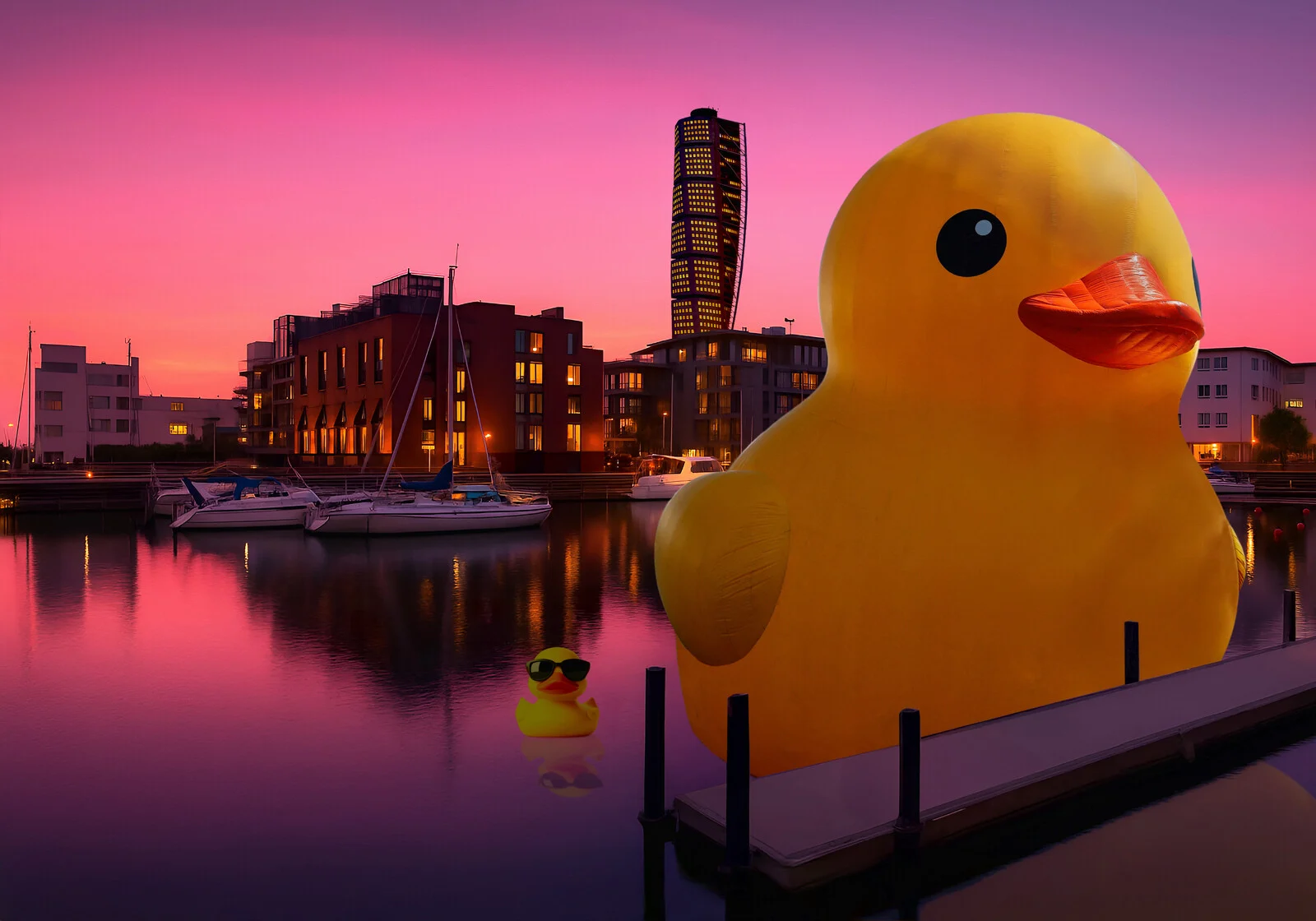
Yellow Visitor – Rubber Realities, 2025
Digital
70 x 50 cm
3 200 kr
Yellow Visitor – Rubber Realities
The little girl and her rubber duck once taught us something about proportion. The sea, seen from the edge of a bathtub, can feel as vast as an ocean. Yet here in Malmö’s Västra Hamnen, the scale has shifted once more. Beneath the sleek skyline of glass and steel, a giant yellow visitor has appeared — bright as a canary, smiling as if nothing in the world could sink. This oversized rubber duck, a stark contrast to the urban landscape, challenges our perception of scale and space, inviting us to reconsider our relationship with the environment.
The duck, known as Putte, unexpectedly drifted into Turbinhamnen, a tranquil stretch between the old Kockums shipyard and the beaches of Ribersborg. Here, swimmers and pedestrians share the same horizon. To some, Putte was a spectacle; to others, a provocation. But for most, he was simply a delightful surprise — a cheerful absurdity amidst the modern architecture’s lines, a sudden burst of joy in an otherwise ordinary day.
There is a long history of strange vessels visiting Malmö. However, perhaps none since the meeting of the three kings here in 1914 — when they discussed the end of a war — has carried such an unexpected message. This time, the mission was not peace, but play: a powerful reminder that even in an anxious age, joy persists, embodied in the form of a giant, smiling rubber duck.
And so began the story of Yellow Visitor – Rubber Realities — part comedy, part reflection, where a smiling rubber duck drifts into the realm of art, memory, and environmental paradox, quietly asking what it means to take up space, to stay afloat, and to make the world a little lighter, one smile at a time.
“The Ballad of the Blown-Around Ducks
They set off from Sydney one windy night,
All yellow and smiling, absurdly bright.
They drifted through harbours, both famous and small,
Each duck on a mission — to cheer up us all.
They floated past Hong Kong, then Seoul, in a stream,
A rubbery armada, a pop-culture dream.
Through rainbows and smog, they continued their quest,
Proving that laughter can float with the best.
They weathered typhoons with a wobble and grin,
Deflated in Taipei, puffed up again in Berlin.
For air may escape, but the spirit holds true —
A puncture’s no tragedy when joy seeps through.
And now they have landed where shipyards once rang,
Where welders and cranes made the old city clang.
In Malmö, they bob by the Turning Torso’s side,
A quacking salute to industrial pride.
They don’t mind borders, a passport or a plan,
Just wind and good humour — that’s how they began.
So if you see one drifting, bright as the sun,
Smile and remember: the journey’s the fun.”
Malmö. October 2025
Yellow Visitor – Rubber Realities
Pictures never lie, one said, even if such a statement might be questioned today. Yet, this was probably the strangest visitor since three kings met in Malmö in December 1914. At that time, the goal was to prevent the outbreak of the First World War. Today, the visitor had a far more modest, yet equally important goal: to bring a little joy to a troubled world. Even Putin and Trump, needless to say, showed no interest in ducks.
The colossal creation, Putte, a rubber duck, occupied four berths along the quay. It stood as tall as a 70-foot luxury yacht with a flybridge, its canary-yellow hue and perpetually smiling red beak making it a sight to behold. The slightly comical tilt to its tail added to its charm. It was not just a physical presence, but a mental one as well, evoking a sense of pure joy and innocence. The message it conveyed, along with its sunglasses-wearing tenderness, resonated with the onlookers, evoking a sense of nostalgia and warmth. This symbol of happiness and innocence, towering over the quay, brought a sense of optimism and lightness to the environment, uplifting and inspiring all who beheld it.
Those who complained about a giant rubber duck occupying valuable mooring space could at least find some solace in the fact that it wasn’t Putte’s cousin Nicolaus visiting. At thirty-five metres tall, Nicko would have filled the harbour and blocked the view of the houses behind — none taller than half that height. In reality, the cousin would have reached roughly the tenth floor of Turning Torso.
Either way, one of Hofman’s ducks had drifted into the reality of Västra Hamnen. But what propels a giant duck, apart from the internal fan that keeps its shape and pressure steady? The wind, of course, for rubber ducks requires no sails. Their lightness makes them swift travellers, though somewhat difficult to steer, tending to go wherever the breeze blows. And with the steady south-westerly wind, Putte made it from Travemünde nearly as quickly as the ferry.
Between Art and Ego – The Floating Balance
The question of what genuinely drives Florentijn Hofman’s giant ducks is both intricate and simple. Are they artworks in the purest sense — or floating signs of an artist’s ego? The answer resides somewhere in between, amidst the tension between artistic intent and public self-presentation. This boundary zone makes the Rubber Duck projects both intriguing and controversial. Some critics argue that the ducks are more about Hofman's self-promotion than about art, while others see them as a refreshing approach to public art. This controversy adds depth to the discussion, making it a thought-provoking examination of the role of art in society.
Hofman himself has consistently described his creations as bringers of joy — “spreading joy, connecting people, and bringing a sense of childhood back into the adult world.” But beneath the playful surface, several deeper currents flow.
The Artistic Intention – Universal Innocence
Hofman regards the duck as a universal symbol that crosses borders and language differences.
“The Rubber Duck knows no frontiers, it doesn’t discriminate and has no political connotation.” He has said — with a kind of defiant simplicity.
Hofman's ambition is to craft universal public art — art that requires no catalogue texts or art-historical education. The yellow duck is a democratic sculpture: monumental yet harmless, pop-cultural yet existential. It belongs as much to the street as to the gallery — or to the small harbour — inviting everyone, regardless of their background or location, to share in its joy and innocence. This inclusivity of Hofman's art makes the audience feel part of a global community, fostering a sense of belonging and unity, and ensuring that no one is left out of the joy and wonder it brings.
In an era when art often risks losing connection with its audience, Hofman strives to refocus on the child — to the pure sense of wonder — beyond theory and boundaries.
The Psychological Layer – Nostalgia and Play as Seriousness
Despite its cheerful appearance, the duck also reflects our desire for safety. It evokes a simpler world, but in a grotesquely exaggerated form — making it both amusing and deeply nostalgic. The bathtub companion has become a floating monument, a symbol of our collective childhoods and the innocence we often long to return to. This psychological layer of the artwork taps into our collective nostalgia and our need for comfort, making the duck not just a playful sculpture but a profound reflection of our human condition, inviting viewers to delve into their own introspection and contemplation.
The duck serves as a symbol of reassurance during uncertain times, while also commenting on the inflation of symbols within consumer culture — on how we magnify the ordinary into the extraordinary. It exemplifies a paradox of art: the duck is both a source of comfort and a mirror for reflection, encouraging viewers to contemplate the deeper meanings behind the artwork. It asserts, “Look — even our nostalgia has become a global project.”
The Egocentric Element – The Artist as Brand
One cannot deny that Hofman’s ducks also serve as powerful PR tools. Each installation demands cooperation, sponsorship, transport logistics, and engagement with local politics. They have transformed Hofman into a globe-trotting artist in rubber, whose work is as much an event as a sculpture.
Critics have described him more as an entrepreneur than an artist, a creator of a “global franchise of happiness” — more of a brand than a vision. But perhaps that is precisely where Hofman operates intentionally: where the very act of wide dissemination becomes part of the artwork itself.
He reflects the media systems of our era — like a modern Warhol or Jeff Koons — yet he replaces glamour’s metal with the humour of plastic, the factory product with the fleeting nature of air.
Play as Resistance and Strategy
Perhaps it is this dual nature that makes Hofman’s work compelling. Rubber Duck is both genuine and self-aware, both playful and ambitious. The artist employs joy as a tactic, not as a mask. He demonstrates that even a smiling giant duck can make a serious statement, igniting a discussion about meaning, community, and globalisation. This playfulness and ambition in Hofman's work encourage us to look beyond appearances and reflect on the more profound significance of his work in today's world, engaging the audience in a thoughtful exploration of art and society.
“Friendly monsters that show us that even the simplest ideas can make the world a little lighter,” Hofman once described his ducks.
They are friendly monsters, but also mirrors — reflections of our human need for recognition, for perspective, for glimpsing something grander than ourselves quietly swaying on the horizon.
Environment and Paradox
In recent years, Hofman’s ducks have also become entangled in a web of environmental politics. In several harbours, organisers have chosen to associate the installations with campaigns against plastic pollution in the oceans and with recycling initiatives. The duck thus becomes both scapegoat and symbol — a bright yellow reminder of how human imagination and industry are inseparably linked. This environmental paradox, where a symbol of innocence is also a product of ecological harm, raises essential questions about the role of art in addressing pressing global issues, inviting us to delve into its intriguing complexities.
The PVC material, the fans, and the transport logistics all leave their marks. Yet Hofman himself insists that the message outweighs the medium — that playfulness can convey awareness. Here, another layer is added to the story: can an inflatable icon, made of plastic, also inspire reflection on the future of plastic itself? This paradox, where a symbol of environmental awareness is made of the very material it seeks to critique, adds a complex layer to the artwork's cultural impact.
Perhaps the answer is yes, precisely because the contradiction is so apparent. Hofman’s ducks are children of their era — products of consumer culture that both critique and embody it. They rest on its surface, yet unearth its depths. The ducks, as symbols of childhood innocence and joy, also serve as a reflection of the consumer culture that often commodifies such emotions.
Florentijn Hofman was born in 1977 in Delft, the Netherlands, and studied at the art academies in Kampen and Vienna. From early on, he worked on large-scale, humorous projects that blurred the boundaries between public art and childlike play. His declared aim has always been to create joyful connections — to bring people together through wonder.
When Hofman launched his first Rubber Duck in Saint-Nazaire, France, in 2007, an inflatable sculpture about sixteen metres tall, the idea was as simple as it was brilliant: to bring a universal childhood object into the harbours and cities of adult life — a symbol of innocence and global unity.
“The Rubber Duck knows no frontiers,” he explained. “It doesn’t discriminate — it has no political agenda.”
Since then, the duck has embarked on a global journey in increasingly grand versions — sometimes ten metres tall, sometimes over twenty-five. It has floated through Amsterdam, Sydney, Hong Kong, Los Angeles, Kaohsiung, and Osaka, sparking the same mix of laughter, media interest, and philosophical debate wherever it appears. Is it art or kitsch? A peace dove or a marketing device? This global journey not only invites us to be part of a larger cultural dialogue but also makes us feel connected to a shared human experience.
When the 16.5-metre version arrived in Hong Kong in 2013, Victoria Harbour was filled with thousands of mobile phones capturing its every move. The installation itself was temporary, but the image became permanent — a global meme, a rubber icon. That same year, an 18-metre version was displayed in Taiwan, where locals affectionately called it the Happy Duck. Children drew it on walls, notebooks, and even cakes.
Hofman describes the duck as a healing creature — a symbol of childhood safety, of a floating happiness that needs no explanation. He also views it as a floating sculpture that radiates a positive vibe, literally brightening up the world. This emphasis on the duck's ability to bring joy and provoke reflection reminds us of the power of art to uplift and inspire, leaving us with a sense of optimism and wonder.
But behind the childish exterior lies a deeply adult seriousness. Rubber Duck is a play on scale, perception, and consumer culture. It transforms a small bath toy into a monumental icon — an inflatable version of the Statue of Liberty, but without the message. Or perhaps with exactly that as its message: the smile in a time of anxiety.
The work has also proven notably elastic, quite literally. On several occasions, the duck has been punctured, blown away, or exploded — in Kaohsiung in 2014, it was said to have “imploded under the weight of its own fame.” Hofman responded with humour.
“It’s an inflatable — it’s meant to deflate and come back.”
It is this cyclical playfulness that makes Hofman’s giant duck so captivating: both real and unreal, both present and fleeting. It appears, spreads joy, vanishes — yet leaves behind reflections on culture’s surface, mass psychology, and the fragile balance between art and entertainment.
In this context, Putte and his smaller, sunglassed companion become an ironic paraphrase of Hofman’s world tour. Here, in the soft evening light of Malmö, Rubber Realities meets the local: Turning Torso rises in the background behind a floating pop icon — a yellow comet on the waters of the Øresund.
A duck that occupies space — both physical and mental — reminds us that even the most playful ideas can carry deeper poetry.
Behind Every Smile
Behind every smiling duck lies a feat of engineering. Florentijn Hofman’s giant creatures are not simple inflatable figures, but meticulously crafted sculptures made of rubber-coated PVC, stitched together from more than two hundred individual pieces. Every seam is planned to follow the duck’s rounded anatomy, allowing light to softly glide across its surface as if it were cast from a single golden cloud.
Yet despite its size, the duck is not a solid mass. It is an airborne creature, a kind of breathing sculpture. Inside, a fan continually circulates air — like a heartbeat. If the power fails, it gradually begins to collapse — not fall, but wither. It is a poetic reminder that even the grandest of symbols relies on something as fleeting as air. This poetic design of the ducks is a source of wonder and admiration, inviting us to appreciate the beauty in their fragility.
Staying in place on the water requires a different kind of balance. Each duck is anchored to a custom-built pontoon, often weighing up to six tonnes, with counterweights that stabilise the body against wind and waves. Therefore, it can majestically sway in harbours and rivers without drifting away — a paradox in itself: a work of art so light and playful, yet so technically grounded in reality.
This blend of playfulness and precision, of childlike symbolism and adult craftsmanship, lies at the core of Hofman’s art. His ducks are not just sculptures; they are floating entities that exist in a constant dance between the real and the exaggerated — between the laws of physics and the imagination that challenges them.
When the wind flows through the harbours of Sydney, Los Angeles, or Malmö and caresses the duck’s rubber skin, it feels as if the creature itself is breathing with the city. Hofman’s work reminds us that even the most playful ideas require care, construction, and a steady flow of air beneath their wings — quite literally.
The Birth of the Duck
Long before Florentijn Hofman’s giant ducks sailed into the world’s harbours, the story began on a much smaller scale — in the bathtub. The rubber duck was born from one of the Industrial Revolution’s most elastic offspring: rubber itself.
In the mid-1800s, Charles Goodyear's development of vulcanisation, which made rubber malleable, durable, and waterproof, opened up a new world of toys.
The first rubber ducks were heavy and silent, more moulded than inflatable. They could not float — they were meant more for chewing than for bathing. But around the turn of the twentieth century, manufacturers began experimenting with lighter rubber, and the floating duck took shape. It was simple, inexpensive, and universally understandable — a small, smiling creature that could accompany a child in the water and calm those still learning to swim.
By the 1940s and 50s, the rubber duck had become a global phenomenon, especially in the United States, where plastic mass production took off. The yellow colour, the round eyes, and the smiling red beak became standard — a visual symbol of childhood innocence. In the optimistic post-war years, it stood for the simplest form of happiness: clean water, bathtime, safety.
Then came television. In the 1970s, the duck found its most unforgettable role on Sesame Street, where Ernie sang “Rubber Duckie, you’re the one.” The song reached the Billboard charts and transformed the duck from a toy into a cultural archetype. The yellow figure became a soft emblem of the child’s inner world — as natural as the teddy bear or the rocking horse. This transformation of the duck into a cultural archetype is a source of connection and familiarity, reminding us of our shared experiences and memories.
That Hofman chose this very form more than a century later was no coincidence. His gigantic ducks are enlarged memories, archaeological finds from the collective childhood, inflated into monumentality. They play with proportion — but also with time. The small duck in the bathtub and the sixteen-metre sculpture in the harbour basin express the same impulse: the human need to create comfort from what is fluid, to hold on to something cheerful amid the unpredictable waters of life.
In Hofman’s hands, the duck becomes more than an inflatable curiosity — it turns into a symbol of nostalgia’s extended breath. An echo of childhood that, like the fan within its body, continues to blow life into our longing for simplicity, warmth, and a smile that needs no translation.
Malmö and the Mirror
In Malmö, the story takes a new turn. Here, in the dusk over Västra Hamnen, Putte has moored — four berths wide and as self-assured as a summer storm. His round body mirrors the glass façades of the modern buildings, while Turning Torso rises in the background — a stiff, twisted relative to the irresistibly soft form of the rubber duck.
Beside him floats the smaller sunglassed duck, Putte’s tender, a wink to both Hofman’s humour and to the modern world’s obsession with self-reflection. The smaller duck is self-aware — an influencer at water level — ready to pose in the last pink glow of sunset. Together, they form a pair that both challenges and confirms our time: the grand and the trivial, the symbol and the meme, the monumental and the mundane.
Here, Rubber Realities meet in every sense. Putte is both a local sculpture and a global comment — a Malmö version of Hofman’s world tour, anchored in Nordic evening light and Skåne humour. He carries an international spirit but reflects it through a Swedish lens: pragmatic, ironic, yet deeply human in its relationship to space, scale, and meaning.
Some laugh at the absurdity of a giant duck occupying coveted moorings. But in the laughter lies an acknowledgement: that the most genuine symbols of our time are often those that do not take themselves too seriously. Putte is a mirror — in every sense. He shows us how art, like the childhood bath toy, can float between worlds: between reality and dream, plastic and poetry.
In his inflated, smiling form, he carries something unexpectedly serious — a quiet defiance against the cynicism of the present. A proof that even rubber can have a soul, and that sometimes it takes an oversized duck to remind us that the world can still smile.
The Floating Conscience – Rubber, Joy, and Ecology
In many places, environmental questions have been linked to — and sometimes raised against — Hofman’s giant ducks. It is a paradox as evident as the artwork itself: an inflatable symbol of happiness made from the very material our age is trying to cleanse from the seas.
When the duck sails into a new harbour, it becomes not only a tourist attraction but also a mirror of our ecological awareness. Many organisers have included Hofman’s yellow giant in campaigns against ocean plastic, in shoreline clean-ups, and in educational programmes about microplastics. It has become a pedagogical symbol, a friendly giant that draws crowds into discussions about the future of water.
In several cities, it has also served as a magnet for environmental exhibitions and workshops — a playful entry point into topics like water quality, recycling, and biodiversity. Children come for the duck, but leave with a different kind of understanding. And the duck itself, in all its monumentality, often returns to the next port patched, repaired, and reused, rather than newly built.
Yet there are objections. The rubber-coated PVC is durable but problematic, requiring special recycling processes, and every duck is essentially a floating PVC shell kept alive by a constant fan. The air that gives it form also leaves a carbon footprint. Add to that the shipping, pontoons, support boats, and all that is required to keep the buoyant symbol under control.
In storms or punctures, pieces can break loose, and organisers must be prepared to prevent the artwork from becoming litter itself. Most harbours therefore enforce safety lines, distance zones, and night-time lighting rules to avoid disturbing birds or wildlife. Each port requires its own environmental and safety review — from ballast to sound levels.
Hofman’s duck thus becomes more than a work of art: it becomes a floating environmental negotiation. Both warning and vision, both problem and possibility. A symbol of plastic’s double nature — the material that once liberated humankind from weight and limitation, but now burdens the planet with its immortality.
At best, the duck serves as a reminder of our own ambivalence: that we love what we also fear, that joy is never entirely innocent, and that even the smile of a giant duck can carry traces of guilt. Perhaps that is precisely its true strength — that it forces us to see our contradictions reflected in the water—a yellow mirror, filled with air and gravity.
Putte and the Planet
When evening falls over Turbinhamnen and the water lies like glass beneath Turning Torso, Putte is still there — smiling, serene, majestic. His yellow body reflects the last pink clouds, while the small duck beside him gently sways, as if she understands something the rest of us only sense.
It's easy to dismiss an inflatable giant duck as a mere spectacle, a fleeting Instagram opportunity, or a passing fancy in the city’s events. Yet, within Putte’s rotund figure lies the same paradox that characterises Hofman’s art: the idea that childlike play can carry profound adult truths.
He is made of plastic, yet reminds us of the sea’s fragility. He is driven by air, yet lifts a weight of questions. Questions about our impact on the environment, about the balance between joy and responsibility, and about the role of art in our society. And while the fan in his belly hums like a mechanical heart, people keep stopping at the quay — to photograph, to laugh, to think.
Perhaps the true power of art, when it truly succeeds, is in its ability to merge laughter with introspection, surface with depth. Putte is Malmö’s unique interpretation of Hofman’s vision — a buoyant representation of our era, where joy and guilt, play and climate anxiety, tourism and faith, all coexist on the same glistening surface.
When darkness finally settles over the harbour, Turning Torso stands as a white, rigid witness to this soft yellow arrival. Putte remains, secure in his role as an unexpected prophet — a friendly visitor with a message written in his smile:
That the world still floats, that there is hope even in rubber, and that even the lightest thought can leave a trace in the deep.
Jörgen Thornberg
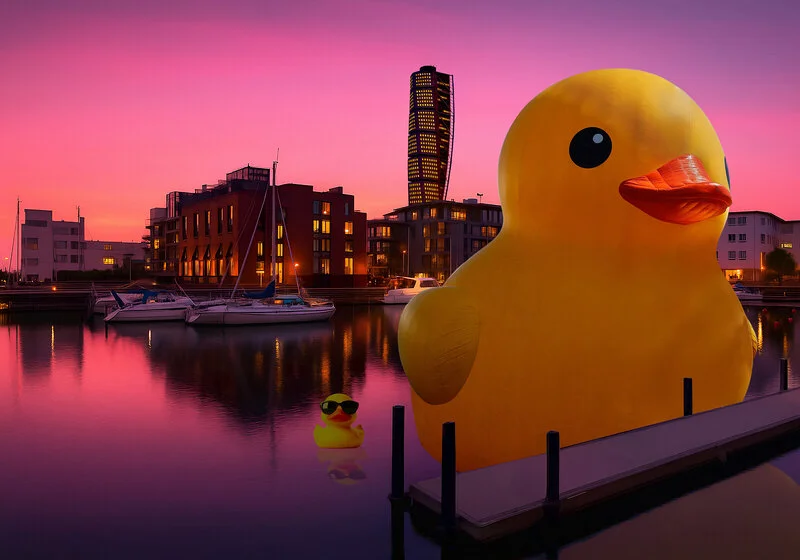
Yellow Visitor – Rubber Realities, 2025
Digital
70 x 50 cm
3 200 kr
Yellow Visitor – Rubber Realities
The little girl and her rubber duck once taught us something about proportion. The sea, seen from the edge of a bathtub, can feel as vast as an ocean. Yet here in Malmö’s Västra Hamnen, the scale has shifted once more. Beneath the sleek skyline of glass and steel, a giant yellow visitor has appeared — bright as a canary, smiling as if nothing in the world could sink. This oversized rubber duck, a stark contrast to the urban landscape, challenges our perception of scale and space, inviting us to reconsider our relationship with the environment.
The duck, known as Putte, unexpectedly drifted into Turbinhamnen, a tranquil stretch between the old Kockums shipyard and the beaches of Ribersborg. Here, swimmers and pedestrians share the same horizon. To some, Putte was a spectacle; to others, a provocation. But for most, he was simply a delightful surprise — a cheerful absurdity amidst the modern architecture’s lines, a sudden burst of joy in an otherwise ordinary day.
There is a long history of strange vessels visiting Malmö. However, perhaps none since the meeting of the three kings here in 1914 — when they discussed the end of a war — has carried such an unexpected message. This time, the mission was not peace, but play: a powerful reminder that even in an anxious age, joy persists, embodied in the form of a giant, smiling rubber duck.
And so began the story of Yellow Visitor – Rubber Realities — part comedy, part reflection, where a smiling rubber duck drifts into the realm of art, memory, and environmental paradox, quietly asking what it means to take up space, to stay afloat, and to make the world a little lighter, one smile at a time.
“The Ballad of the Blown-Around Ducks
They set off from Sydney one windy night,
All yellow and smiling, absurdly bright.
They drifted through harbours, both famous and small,
Each duck on a mission — to cheer up us all.
They floated past Hong Kong, then Seoul, in a stream,
A rubbery armada, a pop-culture dream.
Through rainbows and smog, they continued their quest,
Proving that laughter can float with the best.
They weathered typhoons with a wobble and grin,
Deflated in Taipei, puffed up again in Berlin.
For air may escape, but the spirit holds true —
A puncture’s no tragedy when joy seeps through.
And now they have landed where shipyards once rang,
Where welders and cranes made the old city clang.
In Malmö, they bob by the Turning Torso’s side,
A quacking salute to industrial pride.
They don’t mind borders, a passport or a plan,
Just wind and good humour — that’s how they began.
So if you see one drifting, bright as the sun,
Smile and remember: the journey’s the fun.”
Malmö. October 2025
Yellow Visitor – Rubber Realities
Pictures never lie, one said, even if such a statement might be questioned today. Yet, this was probably the strangest visitor since three kings met in Malmö in December 1914. At that time, the goal was to prevent the outbreak of the First World War. Today, the visitor had a far more modest, yet equally important goal: to bring a little joy to a troubled world. Even Putin and Trump, needless to say, showed no interest in ducks.
The colossal creation, Putte, a rubber duck, occupied four berths along the quay. It stood as tall as a 70-foot luxury yacht with a flybridge, its canary-yellow hue and perpetually smiling red beak making it a sight to behold. The slightly comical tilt to its tail added to its charm. It was not just a physical presence, but a mental one as well, evoking a sense of pure joy and innocence. The message it conveyed, along with its sunglasses-wearing tenderness, resonated with the onlookers, evoking a sense of nostalgia and warmth. This symbol of happiness and innocence, towering over the quay, brought a sense of optimism and lightness to the environment, uplifting and inspiring all who beheld it.
Those who complained about a giant rubber duck occupying valuable mooring space could at least find some solace in the fact that it wasn’t Putte’s cousin Nicolaus visiting. At thirty-five metres tall, Nicko would have filled the harbour and blocked the view of the houses behind — none taller than half that height. In reality, the cousin would have reached roughly the tenth floor of Turning Torso.
Either way, one of Hofman’s ducks had drifted into the reality of Västra Hamnen. But what propels a giant duck, apart from the internal fan that keeps its shape and pressure steady? The wind, of course, for rubber ducks requires no sails. Their lightness makes them swift travellers, though somewhat difficult to steer, tending to go wherever the breeze blows. And with the steady south-westerly wind, Putte made it from Travemünde nearly as quickly as the ferry.
Between Art and Ego – The Floating Balance
The question of what genuinely drives Florentijn Hofman’s giant ducks is both intricate and simple. Are they artworks in the purest sense — or floating signs of an artist’s ego? The answer resides somewhere in between, amidst the tension between artistic intent and public self-presentation. This boundary zone makes the Rubber Duck projects both intriguing and controversial. Some critics argue that the ducks are more about Hofman's self-promotion than about art, while others see them as a refreshing approach to public art. This controversy adds depth to the discussion, making it a thought-provoking examination of the role of art in society.
Hofman himself has consistently described his creations as bringers of joy — “spreading joy, connecting people, and bringing a sense of childhood back into the adult world.” But beneath the playful surface, several deeper currents flow.
The Artistic Intention – Universal Innocence
Hofman regards the duck as a universal symbol that crosses borders and language differences.
“The Rubber Duck knows no frontiers, it doesn’t discriminate and has no political connotation.” He has said — with a kind of defiant simplicity.
Hofman's ambition is to craft universal public art — art that requires no catalogue texts or art-historical education. The yellow duck is a democratic sculpture: monumental yet harmless, pop-cultural yet existential. It belongs as much to the street as to the gallery — or to the small harbour — inviting everyone, regardless of their background or location, to share in its joy and innocence. This inclusivity of Hofman's art makes the audience feel part of a global community, fostering a sense of belonging and unity, and ensuring that no one is left out of the joy and wonder it brings.
In an era when art often risks losing connection with its audience, Hofman strives to refocus on the child — to the pure sense of wonder — beyond theory and boundaries.
The Psychological Layer – Nostalgia and Play as Seriousness
Despite its cheerful appearance, the duck also reflects our desire for safety. It evokes a simpler world, but in a grotesquely exaggerated form — making it both amusing and deeply nostalgic. The bathtub companion has become a floating monument, a symbol of our collective childhoods and the innocence we often long to return to. This psychological layer of the artwork taps into our collective nostalgia and our need for comfort, making the duck not just a playful sculpture but a profound reflection of our human condition, inviting viewers to delve into their own introspection and contemplation.
The duck serves as a symbol of reassurance during uncertain times, while also commenting on the inflation of symbols within consumer culture — on how we magnify the ordinary into the extraordinary. It exemplifies a paradox of art: the duck is both a source of comfort and a mirror for reflection, encouraging viewers to contemplate the deeper meanings behind the artwork. It asserts, “Look — even our nostalgia has become a global project.”
The Egocentric Element – The Artist as Brand
One cannot deny that Hofman’s ducks also serve as powerful PR tools. Each installation demands cooperation, sponsorship, transport logistics, and engagement with local politics. They have transformed Hofman into a globe-trotting artist in rubber, whose work is as much an event as a sculpture.
Critics have described him more as an entrepreneur than an artist, a creator of a “global franchise of happiness” — more of a brand than a vision. But perhaps that is precisely where Hofman operates intentionally: where the very act of wide dissemination becomes part of the artwork itself.
He reflects the media systems of our era — like a modern Warhol or Jeff Koons — yet he replaces glamour’s metal with the humour of plastic, the factory product with the fleeting nature of air.
Play as Resistance and Strategy
Perhaps it is this dual nature that makes Hofman’s work compelling. Rubber Duck is both genuine and self-aware, both playful and ambitious. The artist employs joy as a tactic, not as a mask. He demonstrates that even a smiling giant duck can make a serious statement, igniting a discussion about meaning, community, and globalisation. This playfulness and ambition in Hofman's work encourage us to look beyond appearances and reflect on the more profound significance of his work in today's world, engaging the audience in a thoughtful exploration of art and society.
“Friendly monsters that show us that even the simplest ideas can make the world a little lighter,” Hofman once described his ducks.
They are friendly monsters, but also mirrors — reflections of our human need for recognition, for perspective, for glimpsing something grander than ourselves quietly swaying on the horizon.
Environment and Paradox
In recent years, Hofman’s ducks have also become entangled in a web of environmental politics. In several harbours, organisers have chosen to associate the installations with campaigns against plastic pollution in the oceans and with recycling initiatives. The duck thus becomes both scapegoat and symbol — a bright yellow reminder of how human imagination and industry are inseparably linked. This environmental paradox, where a symbol of innocence is also a product of ecological harm, raises essential questions about the role of art in addressing pressing global issues, inviting us to delve into its intriguing complexities.
The PVC material, the fans, and the transport logistics all leave their marks. Yet Hofman himself insists that the message outweighs the medium — that playfulness can convey awareness. Here, another layer is added to the story: can an inflatable icon, made of plastic, also inspire reflection on the future of plastic itself? This paradox, where a symbol of environmental awareness is made of the very material it seeks to critique, adds a complex layer to the artwork's cultural impact.
Perhaps the answer is yes, precisely because the contradiction is so apparent. Hofman’s ducks are children of their era — products of consumer culture that both critique and embody it. They rest on its surface, yet unearth its depths. The ducks, as symbols of childhood innocence and joy, also serve as a reflection of the consumer culture that often commodifies such emotions.
Florentijn Hofman was born in 1977 in Delft, the Netherlands, and studied at the art academies in Kampen and Vienna. From early on, he worked on large-scale, humorous projects that blurred the boundaries between public art and childlike play. His declared aim has always been to create joyful connections — to bring people together through wonder.
When Hofman launched his first Rubber Duck in Saint-Nazaire, France, in 2007, an inflatable sculpture about sixteen metres tall, the idea was as simple as it was brilliant: to bring a universal childhood object into the harbours and cities of adult life — a symbol of innocence and global unity.
“The Rubber Duck knows no frontiers,” he explained. “It doesn’t discriminate — it has no political agenda.”
Since then, the duck has embarked on a global journey in increasingly grand versions — sometimes ten metres tall, sometimes over twenty-five. It has floated through Amsterdam, Sydney, Hong Kong, Los Angeles, Kaohsiung, and Osaka, sparking the same mix of laughter, media interest, and philosophical debate wherever it appears. Is it art or kitsch? A peace dove or a marketing device? This global journey not only invites us to be part of a larger cultural dialogue but also makes us feel connected to a shared human experience.
When the 16.5-metre version arrived in Hong Kong in 2013, Victoria Harbour was filled with thousands of mobile phones capturing its every move. The installation itself was temporary, but the image became permanent — a global meme, a rubber icon. That same year, an 18-metre version was displayed in Taiwan, where locals affectionately called it the Happy Duck. Children drew it on walls, notebooks, and even cakes.
Hofman describes the duck as a healing creature — a symbol of childhood safety, of a floating happiness that needs no explanation. He also views it as a floating sculpture that radiates a positive vibe, literally brightening up the world. This emphasis on the duck's ability to bring joy and provoke reflection reminds us of the power of art to uplift and inspire, leaving us with a sense of optimism and wonder.
But behind the childish exterior lies a deeply adult seriousness. Rubber Duck is a play on scale, perception, and consumer culture. It transforms a small bath toy into a monumental icon — an inflatable version of the Statue of Liberty, but without the message. Or perhaps with exactly that as its message: the smile in a time of anxiety.
The work has also proven notably elastic, quite literally. On several occasions, the duck has been punctured, blown away, or exploded — in Kaohsiung in 2014, it was said to have “imploded under the weight of its own fame.” Hofman responded with humour.
“It’s an inflatable — it’s meant to deflate and come back.”
It is this cyclical playfulness that makes Hofman’s giant duck so captivating: both real and unreal, both present and fleeting. It appears, spreads joy, vanishes — yet leaves behind reflections on culture’s surface, mass psychology, and the fragile balance between art and entertainment.
In this context, Putte and his smaller, sunglassed companion become an ironic paraphrase of Hofman’s world tour. Here, in the soft evening light of Malmö, Rubber Realities meets the local: Turning Torso rises in the background behind a floating pop icon — a yellow comet on the waters of the Øresund.
A duck that occupies space — both physical and mental — reminds us that even the most playful ideas can carry deeper poetry.
Behind Every Smile
Behind every smiling duck lies a feat of engineering. Florentijn Hofman’s giant creatures are not simple inflatable figures, but meticulously crafted sculptures made of rubber-coated PVC, stitched together from more than two hundred individual pieces. Every seam is planned to follow the duck’s rounded anatomy, allowing light to softly glide across its surface as if it were cast from a single golden cloud.
Yet despite its size, the duck is not a solid mass. It is an airborne creature, a kind of breathing sculpture. Inside, a fan continually circulates air — like a heartbeat. If the power fails, it gradually begins to collapse — not fall, but wither. It is a poetic reminder that even the grandest of symbols relies on something as fleeting as air. This poetic design of the ducks is a source of wonder and admiration, inviting us to appreciate the beauty in their fragility.
Staying in place on the water requires a different kind of balance. Each duck is anchored to a custom-built pontoon, often weighing up to six tonnes, with counterweights that stabilise the body against wind and waves. Therefore, it can majestically sway in harbours and rivers without drifting away — a paradox in itself: a work of art so light and playful, yet so technically grounded in reality.
This blend of playfulness and precision, of childlike symbolism and adult craftsmanship, lies at the core of Hofman’s art. His ducks are not just sculptures; they are floating entities that exist in a constant dance between the real and the exaggerated — between the laws of physics and the imagination that challenges them.
When the wind flows through the harbours of Sydney, Los Angeles, or Malmö and caresses the duck’s rubber skin, it feels as if the creature itself is breathing with the city. Hofman’s work reminds us that even the most playful ideas require care, construction, and a steady flow of air beneath their wings — quite literally.
The Birth of the Duck
Long before Florentijn Hofman’s giant ducks sailed into the world’s harbours, the story began on a much smaller scale — in the bathtub. The rubber duck was born from one of the Industrial Revolution’s most elastic offspring: rubber itself.
In the mid-1800s, Charles Goodyear's development of vulcanisation, which made rubber malleable, durable, and waterproof, opened up a new world of toys.
The first rubber ducks were heavy and silent, more moulded than inflatable. They could not float — they were meant more for chewing than for bathing. But around the turn of the twentieth century, manufacturers began experimenting with lighter rubber, and the floating duck took shape. It was simple, inexpensive, and universally understandable — a small, smiling creature that could accompany a child in the water and calm those still learning to swim.
By the 1940s and 50s, the rubber duck had become a global phenomenon, especially in the United States, where plastic mass production took off. The yellow colour, the round eyes, and the smiling red beak became standard — a visual symbol of childhood innocence. In the optimistic post-war years, it stood for the simplest form of happiness: clean water, bathtime, safety.
Then came television. In the 1970s, the duck found its most unforgettable role on Sesame Street, where Ernie sang “Rubber Duckie, you’re the one.” The song reached the Billboard charts and transformed the duck from a toy into a cultural archetype. The yellow figure became a soft emblem of the child’s inner world — as natural as the teddy bear or the rocking horse. This transformation of the duck into a cultural archetype is a source of connection and familiarity, reminding us of our shared experiences and memories.
That Hofman chose this very form more than a century later was no coincidence. His gigantic ducks are enlarged memories, archaeological finds from the collective childhood, inflated into monumentality. They play with proportion — but also with time. The small duck in the bathtub and the sixteen-metre sculpture in the harbour basin express the same impulse: the human need to create comfort from what is fluid, to hold on to something cheerful amid the unpredictable waters of life.
In Hofman’s hands, the duck becomes more than an inflatable curiosity — it turns into a symbol of nostalgia’s extended breath. An echo of childhood that, like the fan within its body, continues to blow life into our longing for simplicity, warmth, and a smile that needs no translation.
Malmö and the Mirror
In Malmö, the story takes a new turn. Here, in the dusk over Västra Hamnen, Putte has moored — four berths wide and as self-assured as a summer storm. His round body mirrors the glass façades of the modern buildings, while Turning Torso rises in the background — a stiff, twisted relative to the irresistibly soft form of the rubber duck.
Beside him floats the smaller sunglassed duck, Putte’s tender, a wink to both Hofman’s humour and to the modern world’s obsession with self-reflection. The smaller duck is self-aware — an influencer at water level — ready to pose in the last pink glow of sunset. Together, they form a pair that both challenges and confirms our time: the grand and the trivial, the symbol and the meme, the monumental and the mundane.
Here, Rubber Realities meet in every sense. Putte is both a local sculpture and a global comment — a Malmö version of Hofman’s world tour, anchored in Nordic evening light and Skåne humour. He carries an international spirit but reflects it through a Swedish lens: pragmatic, ironic, yet deeply human in its relationship to space, scale, and meaning.
Some laugh at the absurdity of a giant duck occupying coveted moorings. But in the laughter lies an acknowledgement: that the most genuine symbols of our time are often those that do not take themselves too seriously. Putte is a mirror — in every sense. He shows us how art, like the childhood bath toy, can float between worlds: between reality and dream, plastic and poetry.
In his inflated, smiling form, he carries something unexpectedly serious — a quiet defiance against the cynicism of the present. A proof that even rubber can have a soul, and that sometimes it takes an oversized duck to remind us that the world can still smile.
The Floating Conscience – Rubber, Joy, and Ecology
In many places, environmental questions have been linked to — and sometimes raised against — Hofman’s giant ducks. It is a paradox as evident as the artwork itself: an inflatable symbol of happiness made from the very material our age is trying to cleanse from the seas.
When the duck sails into a new harbour, it becomes not only a tourist attraction but also a mirror of our ecological awareness. Many organisers have included Hofman’s yellow giant in campaigns against ocean plastic, in shoreline clean-ups, and in educational programmes about microplastics. It has become a pedagogical symbol, a friendly giant that draws crowds into discussions about the future of water.
In several cities, it has also served as a magnet for environmental exhibitions and workshops — a playful entry point into topics like water quality, recycling, and biodiversity. Children come for the duck, but leave with a different kind of understanding. And the duck itself, in all its monumentality, often returns to the next port patched, repaired, and reused, rather than newly built.
Yet there are objections. The rubber-coated PVC is durable but problematic, requiring special recycling processes, and every duck is essentially a floating PVC shell kept alive by a constant fan. The air that gives it form also leaves a carbon footprint. Add to that the shipping, pontoons, support boats, and all that is required to keep the buoyant symbol under control.
In storms or punctures, pieces can break loose, and organisers must be prepared to prevent the artwork from becoming litter itself. Most harbours therefore enforce safety lines, distance zones, and night-time lighting rules to avoid disturbing birds or wildlife. Each port requires its own environmental and safety review — from ballast to sound levels.
Hofman’s duck thus becomes more than a work of art: it becomes a floating environmental negotiation. Both warning and vision, both problem and possibility. A symbol of plastic’s double nature — the material that once liberated humankind from weight and limitation, but now burdens the planet with its immortality.
At best, the duck serves as a reminder of our own ambivalence: that we love what we also fear, that joy is never entirely innocent, and that even the smile of a giant duck can carry traces of guilt. Perhaps that is precisely its true strength — that it forces us to see our contradictions reflected in the water—a yellow mirror, filled with air and gravity.
Putte and the Planet
When evening falls over Turbinhamnen and the water lies like glass beneath Turning Torso, Putte is still there — smiling, serene, majestic. His yellow body reflects the last pink clouds, while the small duck beside him gently sways, as if she understands something the rest of us only sense.
It's easy to dismiss an inflatable giant duck as a mere spectacle, a fleeting Instagram opportunity, or a passing fancy in the city’s events. Yet, within Putte’s rotund figure lies the same paradox that characterises Hofman’s art: the idea that childlike play can carry profound adult truths.
He is made of plastic, yet reminds us of the sea’s fragility. He is driven by air, yet lifts a weight of questions. Questions about our impact on the environment, about the balance between joy and responsibility, and about the role of art in our society. And while the fan in his belly hums like a mechanical heart, people keep stopping at the quay — to photograph, to laugh, to think.
Perhaps the true power of art, when it truly succeeds, is in its ability to merge laughter with introspection, surface with depth. Putte is Malmö’s unique interpretation of Hofman’s vision — a buoyant representation of our era, where joy and guilt, play and climate anxiety, tourism and faith, all coexist on the same glistening surface.
When darkness finally settles over the harbour, Turning Torso stands as a white, rigid witness to this soft yellow arrival. Putte remains, secure in his role as an unexpected prophet — a friendly visitor with a message written in his smile:
That the world still floats, that there is hope even in rubber, and that even the lightest thought can leave a trace in the deep.
3 200 kr

Jörgen Thornberg
Malmö
Lite om bilder och mig. Translation in English at the end.
Jag är en nyfiken person som ser allt i bilder, även det jag fäster i ord, gärna tillsammans för bakom alla mina bilder finns en berättelse. Till vissa bilder hör en kortare eller längre novell som följer med bilden.
Bilder berättar historier. Jag omges av naturlig skönhet, intressanta människor och historia var jag än går. Jag använder min kamera för att dokumentera världen och blanda det jag ser med vad jag känner för att fånga den dolda magin.
Mina bilder berättar mina historier. Genom mina bilder, tryck och berättelser. Jag bjuder in dig att ta del av dessa berättelser, in i ditt liv och hem och dela min mycket personliga syn på vår värld. Mer än vad ögat ser. Jag tänker i bilder, drömmer och skriver och pratar om dem; följaktligen måste jag också skapa bilder. De blir vad jag ser, inte nödvändigtvis begränsade till verkligheten. Det finns en bild runt varje hörn. Jag hoppas att du kommer att se vad jag såg och gilla det.
Jag är också en skrivande person och till många bilder hör en kortare eller längre essay. Den följer med tavlan, tryckt på fint papper och med en personlig hälsning från mig.
Flertalet bilder startar sin resa i min kamera. Enkelt förklarat beskriver jag bilden jag ser i mitt inre, upplevd eller fantiserad. Bilden uppstår inom mig redan innan jag fått okularet till ögat. På bråkdelen av ett ögonblick ser jag vad jag vill ha och vad som kan göras med bilden. Här skall jag stoppa in en giraff, stålmannen, Titanic eller vad det är min fantasi finner ut. Ännu märkligare är att jag kommer ihåg minnesbilden långt efteråt när det blir tid att skapa verket. Om jag lyckas eller inte, är upp till betraktaren, oftast präglat av en stråk av svart humor – meningen är att man skall bli underhållen. Mina bilder blir ofta en snackis där de hänger.
Jag föredrar bilder som förmedlar ett budskap i flera lager. Vid första anblicken fylld av feel-good, en vacker utsikt, fint väder, solen skiner, blommor på ängen eller vattnet som ligger förrädiskt spegelblankt. I en sådan bild kan jag gömma min egentliga berättelse, mitt förakt för förtryckare och våldsverkare, rasister och fördomsfulla människor - ett gärna återkommande motiv mer eller mindre dolt i det vackra motivet. Jag försöker förena dem i ett gemensamt narrativ.
Bild och formgivning har löpt som en röd tråd genom livet. Fotokonst känns som en värdig final som jag gärna delar med mig.
Min genre är vid som framgår av mina bilder, temat en blandning av pop- och gatukonst i kollage som kan bestå av hundratals lager. Vissa bilder kan ta veckor, andra någon dag innan det är dags att överlämna resultatet till printverkstaden. Fine Art Prints är digitala fotocollage. I dessa kollage sker rivandet, klippandet, pusslandet, målandet, ritandet och sprayningen digitalt. Det jag monterar in kan vara hundratals år gamla bilder som jag omsorgsfullt frilägger så att de ser ut att vara en del av tavlan men också bilder skapade av mig själv efter min egen fantasi. Därefter besöks printstudion och för vissa bilder numrera en limiterad upplaga (oftast 7 exemplar) och signera för hand. Vissa bilder kan köpas i olika format. Det är bara att fråga efter vilka. Gillar man en bild som är 70x100 men inte har plats på väggen, går den kanske att få i 50x70 cm istället. Frågan är fri.
Metoden Giclée eller Fine Art Print som det också kallas är det moderna sättet för framställning av grafisk konst. Villkoret för denna typ av utskrifter är att en högkvalitativ storformatskrivare används med åldersbeständigt färgpigment och konstnärspapper eller i förekommande fall på duk. Pappret som används möter de krav på livslängd som ställs av museer och gallerier. Normalt säljer jag mina bilder oinramade så att den nya ägaren själv kan bestämma hur de skall se ut, med eller utan passepartout färg på ram, med eller utan glas etc..
Under många år ställde jag bara ut på nätet, i valda grupper och på min egen Facebooksida - https://www.facebook.com/jorgen.thornberg.9
Jag finns också på en egen hemsida som tyvärr inte alltid är uppdaterad – https://www.jth.life/ Där kan du också läsa en del av de berättelser som följer med bilden.
UTSTÄLLNINGAR
Luftkastellet, oktober 2022
Konst i Lund, november 2022
Luftkastellet, mars 2023
Engleson Galleri Caroli, april 2023
Hydra, Greece June 2023
Engleson Galleri Caroli, oktober 2023
Toppen, Höllviken december 2023
Luftkastellet, mars 2024
Torups Galleri, mars 2024
Venice, May 2024
Luftkastellet, oktober 2024
Konst i Advent, December 2024
Galleri Engleson, Caroli December 2024
Jäger & Jansson Galleri, april 2025
A bit about pictures and me.
I'm a curious person who sees everything in pictures, even what I express in words, often combining them, for behind all my pictures lies a story. These narratives, some as short as a single image and others as long as a novel, are the heart and soul of my work.
Pictures tell stories. Wherever I go, I'm surrounded by natural beauty, exciting people, and history. I use my camera to document the world and blend what I see with what I feel to capture the hidden magic.
My images tell my stories. Through my pictures, prints, and narratives, I invite you to partake in these stories in your life and home and share my deeply personal perspective of our world. More than meets the eye. I think in pictures, dream, write, and talk about them; consequently, I must create images too. They become what I see, not necessarily confined to reality. There's a picture around every corner. I hope you'll see what I saw and enjoy it.
I'm also a writer, and many images come with a shorter or longer essay. It accompanies the painting, printed on fine paper with my personal greeting.
Many pictures start their journey on my camera. Simply put, I describe the image I see in my mind, experienced or imagined. The image arises within me even before I bring the eyepiece to my eye. In a fraction of a moment, I see what I want and what can be done with the picture. Here, I'll insert a giraffe, Superman, the Titanic, or whatever my imagination conjures up. Even stranger is that I remember the mental image long after it's time to create the work. Whether I succeed is up to the observer, often imbued with a streak of black humour – the aim is to entertain. My pictures usually become a talking point wherever they hang.
I prefer pictures that convey a message in multiple layers. At first glance, they're filled with feel-good vibes, a beautiful view, lovely weather, the sun shining, flowers in the meadow, or the water lying deceptively calm. But beneath this surface beauty, I often conceal a deeper story, a narrative that challenges societal norms or explores the human condition. I invite you to delve into these hidden narratives and discover the layers of meaning within my work.
Picture and design have been a thread running through my life. Photographic art feels like a fitting finale, and I'm happy to share it.
My genre is varied, as seen in my pictures; the theme is a blend of pop and street art in collages that can consist of hundreds of layers. Some images can take weeks, others just a day before it's time to hand over the result to the print workshop. Fine Art Prints are digital photo collages. In these collages, tearing, cutting, puzzling, painting, drawing, and spraying happen digitally. What I insert can be images hundreds of years old that I carefully extract so they appear to be part of the painting, but also images created by myself, now also generated from my imagination. Next, visit the print studio and, for certain images, number a limited edition (usually 7 copies) and sign them by hand. Some images may be available in other formats. Just ask which ones. If you like an image that's 70x100 but doesn't have space on the wall, you might be able to get it in 50x70 cm instead. The question is open.
The Giclée method, or Fine Art Print as it's also called, is the modern way of producing graphic art. This method ensures the highest quality and longevity of the artwork, using a high-quality large-format printer with archival pigment inks and artist paper or, in some cases, canvas. The paper used meets the longevity requirements set by museums and galleries. I sell my pictures unframed, allowing the new owner to personalise their artwork, confident in the lasting value and quality of the piece.
For many years, I only exhibited online, in selected groups, and on my Facebook page - https://www.facebook.com/jorgen.thornberg.9. I also have my website, which unfortunately is not constantly updated - https://www.jth.life/. You can also read some of the stories accompanying the pictures there.
EXHIBITIONS
Luftkastellet, October 2022
Art in Lund, November 2022
Luftkastellet, March 2023
Engleson Gallery Caroli, April 2023
Hydra, Greece June 2023
Engleson Gallery Caroli, October 2023
Toppen, Höllviken December 2023
Luftkastellet, March 2024
Torup Gallery, March 2024
Venice, May 2024
UTSTÄLLNINGAR
Luftkastellet, oktober 2022
Konst i Lund, november 2022
Luftkastellet, mars 2023
Engleson Galleri Caroli, april 2023
Hydra, Greece June 2023
Engleson Galleri Caroli, oktober 2023
Toppen, Höllviken december 2023
Luftkastellet, mars 2024
Torups Galleri, mars 2024
Venice, May 2024
Luftkastellet, October 2024
Konst i Advent, December 2024
Galleri Engleson, Caroli December 2024
Jäger & Jansson Galleri, April 2025
Utbildning
Autodidakt
Medlem i konstnärsförening
Öppna Sinnen
Med i konstrunda
Konstrundan i Skåne
Utställningar
Luftkastellet, October 2022
Art in Lund, November 2022
Luftkastellet, March 2023
Engleson Gallery Caroli, April 2023
Hydra, Greece June 2023
Engleson Gallery Caroli, October 2023
Toppen, Höllviken December 2023
Luftkastellet, March 2024
Torup Gallery, March 2024
Venice, May 2024