Vi använder cookies för att ge dig bästa möjliga upplevelse. Välj vilka cookies du tillåter.
Läs mer i vår integritetspolicy
Jörgen Thornberg
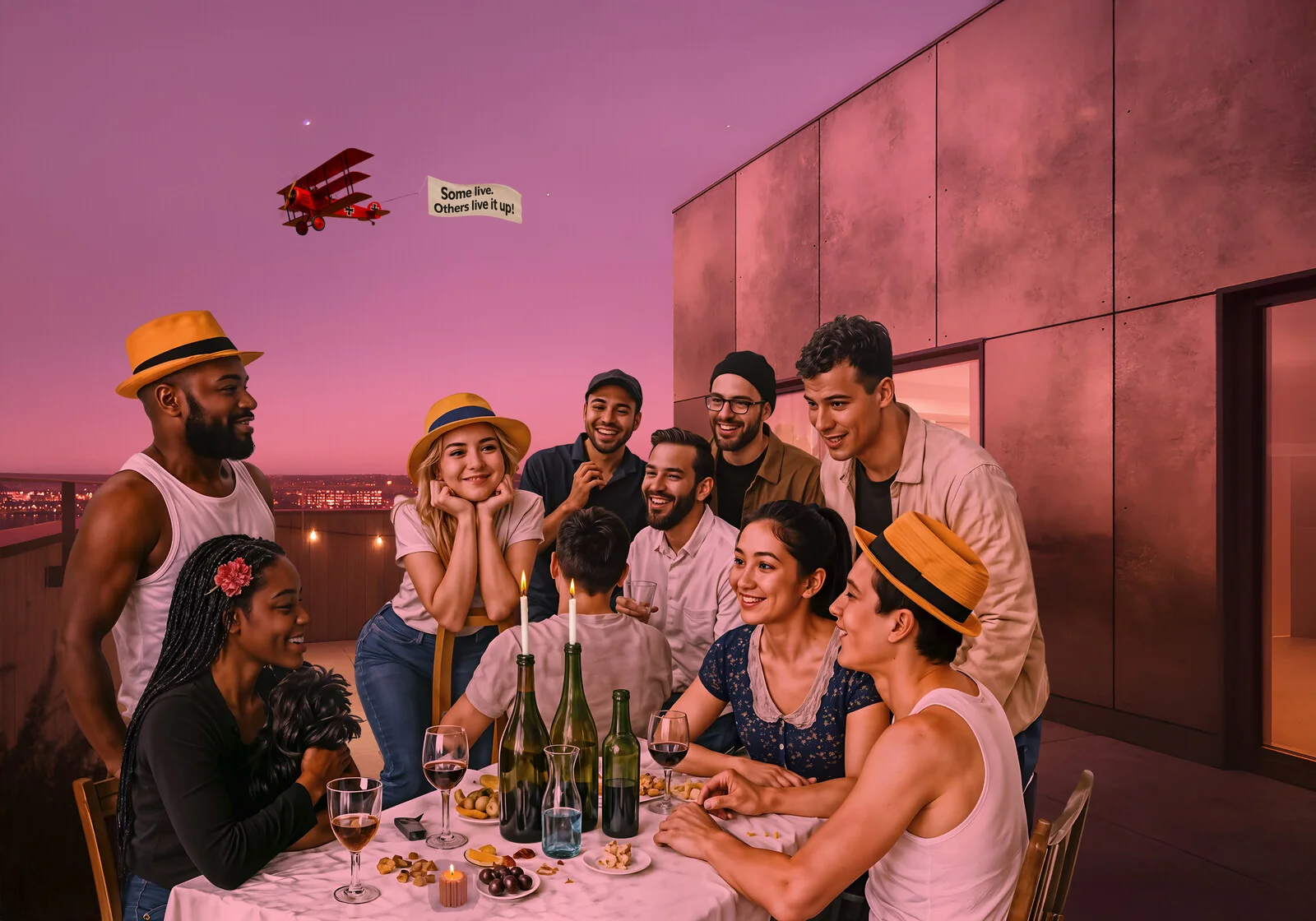
Some live. Others live it up! - Vissa lever vanligt, andra lever upp!”, 2025
Digital
70 x 50 cm
3 200 kr
Some live. Others live it up!
It begins as a slogan, a banner in the evening sky, playful as champagne bubbles yet weighty as a question of life itself. At first glance, it appears nothing more than a phrase—short, rhythmic, easy to remember. Yet it unfolds like a trapdoor into language, culture, and history, revealing its paradoxical and multifaceted nature. To “live up” is never simply one thing: it can mean to rise, to flourish, to meet a standard, or to squander what has been given. This phrase, with its deep cultural and historical roots, connects us to our past and shapes our present. In Malmö, perched high above the flatlands of Skåne, it becomes a promise of height and horizon. But in Latin, in Rome, in the songs of Nero, it becomes something altogether different—a philosophy written in wine, fire, and stone.
“Feast Above, Feast Below
High on the terrace, the glasses all gleam,
wine like a river, a sparkling dream.
Low in the courtyard, the laughter will flow,
music unites us, both high and low.
Rich with their togas, poor with their shoes,
everyone’s welcome, no one can lose.
Stars in the rafters, candles below,
joy is a ladder where all may go.
High is the rooftop, low is the ground,
yet in the circle, the same song is found.
Raise your glasses, let everyone know:
Some live, some rise, but we all live it up so.”
Malmö. October 2025
Some live. Others live it up.
In the eternal gathering on the twenty-fourth floor, Baron von Richthofen’s old red Fokker buzzed past, towing a banner with a striking message: “Vissa lever vanligt, andra lever upp!” In English: “Some live. Others live it up!” Against the darkening pink sky, the city lights stretched out beneath.
It is a slogan, not a literal translation. Short, rhythmic, with the kind of double meaning that works in both languages — but in different ways. Att leva upp in Swedish is richer than any single English verb can express. It means to brighten, to flourish, to come alive. Yet, it also signifies rising, reaching a higher level, or fulfilling something expected. And there’s another twist: to use up, to consume, even to squander. All of these shades shimmer in the phrase, depending on how the light hits them.
Perched on a Malmö high-rise, the slogan resonates not only with the joy of living but also with the physical act of rising above a flat landscape. The sheer joy of living high up, with the city lights twinkling below, is an experience that elevates the spirit. It's a feeling of being on top of the world, with nothing but the vast sky above and the twinkling city lights below. Aside from a few glacial ridges and two or three tall buildings, nothing in Skåne breaks the horizon. To live twenty-four storeys above the ground is already to live differently.
Let us consider the English version: “Some live. Others live it up.”
The phrase “live it up” exudes a sense of indulgence. It signifies celebrating, taking pleasure in oneself, and casting aside inhibitions. It feels like bubbles of champagne, the rhythm of jazz, and the glint of neon lights. It is playful, nearly decadent.
By contrast, “Some live. Others rise” would sound more solemn, almost biblical, as if hinting at a transcendent reality. This contrast between living and rising is a powerful reflection of the human experience, where we are constantly balancing the weight of expectation with the potential for transcendence. It's a reminder that life is not just about meeting expectations, but also about surpassing them, about rising to the occasion and meeting life's demands with grace and courage. That too is part of “att leva upp” in Swedish: to rise to the occasion, to surpass oneself, to meet a demand.
Thus, a single small phrase in one language can expand in many directions. A banner pulled by an old triplane suddenly transforms into a tiny philosophy of life.
On the ground, “att leva upp till” is often burdensome. It signifies living up to the expectations of parents, teachers, employers, and society as a whole. It implies a standard, an external measure that you must meet or fail to meet. It is an obligation rather than a source of joy.
How different, then, from the effortless “leva upp” when a friend cracks a joke and the whole table bursts into laughter. Then one “lives up” in another sense: the face brightens, the body lifts, the spirit blossoms—no demands, no burden—only release.
Here lies one of the great paradoxes of language: the precise verb phrase can convey both duty and delight, both the burden of expectation and the ease of joy. This paradox is a testament to the complexity and richness of human expression, where a single phrase can hold multiple layers of meaning. It's a reminder that language, like life, is full of paradoxes and complexities, and that the true beauty of both lies in their ability to hold multiple meanings and interpretations.
And then there is the darker side: ”att leva upp sina tillgångar”. To spend everything, to deplete one's resources. The gambler at the roulette wheel, the heir who squanders an inheritance, the spendthrift who burns through resources as if tomorrow will never arrive. In this sense, to “live it up” is perilously close to ruin.
There is also a kind of tragic grandeur in this meaning. To consume what has been given, to burn one’s candle at both ends, to live passionately until nothing remains. Is this not also part of what we admire in certain artists and legendary figures? Vincent van Gogh, who painted as if each stroke might be his last. Edith Piaf, whose voice embodied every ounce of her life’s sorrow and joy.
So: to live up can mean to rise, to blossom, to fulfil — but also to spend, to exhaust, to squander.
Placed within the context of architecture and housing, this wordplay gains added resonance.
Living high up in a building like Docks already embodies one meaning: to ascend. To look out over Malmö, across Öresund towards Denmark, is to live among the clouds compared to the streets below. It is to be elevated, to be granted a new horizon.
But to live also means to bring joy into a space. A dinner on a terrace, laughter echoing against the evening sky, music drifting from an open window — the apartment is not just inhabited, it is animated. It has been brought to life.
And yes, there is always the risk of excess. Champagne bottles poured too quickly, resources exhausted, the fleeting sparkle of a lifestyle that cannot endure. That too is part of the phrase: to live up to one’s fortune.
Thus, a winding banner in the evening sky becomes a reflection on language, life, and architecture.
“Some live. Others live it up.” It's not just a slogan; it's a profound question. Do we merely exist, or do we rise, rejoice, fulfil, and perhaps even squander? Do we live under expectations, or do we live beyond them?
Ultimately, the phrase embodies the essence of the human condition. We all strive to rise above, to justify something greater, to bloom with joy, and sometimes, to spend recklessly what we have been given.
Living up to something is not just one thing; it encompasses many. Perhaps the most genuine life is one that dares to embrace all these meanings simultaneously.
How might the old reveller Nero have expressed himself on this magical evening, when twenty-four floors of Malmö rise into the dark pink sky? Perhaps with a mixture of delight and vertigo. For even he, accustomed to splendour, excess, and scandal, had never reached such heights.
In his era, the Pantheon in Rome, a grand structure finished in the early third century CE, held the record as the tallest interior in the city. Its dome, a staggering 43.45 metres from floor to oculus—the open circle to the sky—was an ancient marvel. This height was not just a physical attribute, but a symbol of the divine connection it facilitated. In this space, the gods came down to the people, a testament to human ingenuity and sacred connection.
Probably the tallest building in the Roman Empire, regardless of category, was Hadrian’s mausoleum, later known as Castel Sant’Angelo, at forty-eight metres. A determined soul could climb it, gaze out over the Tiber, the Colosseum, and the endless sea of rooftops, a view that seemed to stretch to infinity, but never higher.
Nero himself, who once sang from the heights of the Palatine while the city burned, would surely have felt dizzy at the thought of sitting on a terrace seventy-nine metres above ground, drinking wine beneath the stars. The irony of his past actions, where he was accused of fiddling while Rome burned, and his potential present actions would have been intriguing. He might have called it superbia—height, pride, hubris—and still let the music flow. And who knows? Perhaps he, with a laugh as red as his toga, would have found the words:
“Alii vivunt. Alii superbe vivunt.”
(Some live. Others live it up.)
There are, in fact, several Latin expressions that are similar in meaning, although none capture all the nuances of the Swedish “leva upp” (to blossom, to fulfil, to consume). However, each of these Latin expressions encompasses different aspects of 'leva upp', contributing to the full understanding of the concept. Here are a few examples, each with its own unique shade of meaning that contributes to the full knowledge of 'leva upp':
For “leva upp” as blossoming, shining, rejoicing:
“Florere” – to flourish, to be in full bloom.
“Vivere alacriter” – to live cheerfully, brightly, vividly.
“Animari” – to be enlivened, to kindle, to become spirited.
For “leva upp till” as fulfilling, meeting expectations:
“Exspectationi respondere” – to answer to an expectation.
“Officium explore” – to carry out a duty.
“Ad altiora niti” – to strive for higher things.
For “leva upp” as using up, squandering:
“Consumere” – to consume, to use up, to waste.
“Dissipare” – to scatter, to squander.
“Luxuriose vivere” – to live in extravagance, to live lavishly.
And, of course, the most timeless phrase of all, nearly covering the entire spectrum, is Horace’s “Carpe diem”—“seize the day.” It captures not just joy and fleetingness, but also the reckless intensity of life, reminding us of the urgency to live fully in every moment.
Therefore, one might say that Swedish “leva upp” would, in Latin, require a whole range of words: florere, explere, consumere—to flourish, to accomplish, to consume.
And then, just as the laughter echoed across the terrace of the grand villa —a monument of opulence where Malmö's elite had gathered for a lavish evening —the red Fokker banner fluttered in the twilight sky. One of the guests rose. His toga, which had gone unnoticed as an eccentric costume, caught the lantern light. With a mischievous smile, he raised his glass of wine and began to speak, half toast, half confession.
You think this is just another party high above Malmö, but you do not realise what kind of Time-traveller you have welcomed into your company. I, who have sung while Rome burned, I, who have drunk from golden cups, I, who have seen the gods descend through the oculus of the Pantheon. Yet even I have never lived so high above the ground.
In my native tongue, we had a multitude of expressions for what you would call ‘living life to the fullest.’ We spoke of florere—to bloom like the blossoms of spring. We talked of exspectationi respondere—to meet the standards set by emperors and gods. We spoke of consumere—to use up everything, to live life as if it were coins in a purse.
And I, Nero, have embodied all of these ideals. I have flourished. I have met expectations. I have squandered. I have lived a life of excess, of danger, of indulgence.
Salutem! So, drink, friends! Tonight, we shall soar higher than any Roman dome, higher than Hadrian’s tomb, higher even than my own pride—Alii vivunt. Alii superbe vivunt. Some live. Others indulge.
He laughed—a laugh as red as his gown—and the company, half-dazed by the revelation, half-dazed by the wine, laughed with him.
Jörgen Thornberg
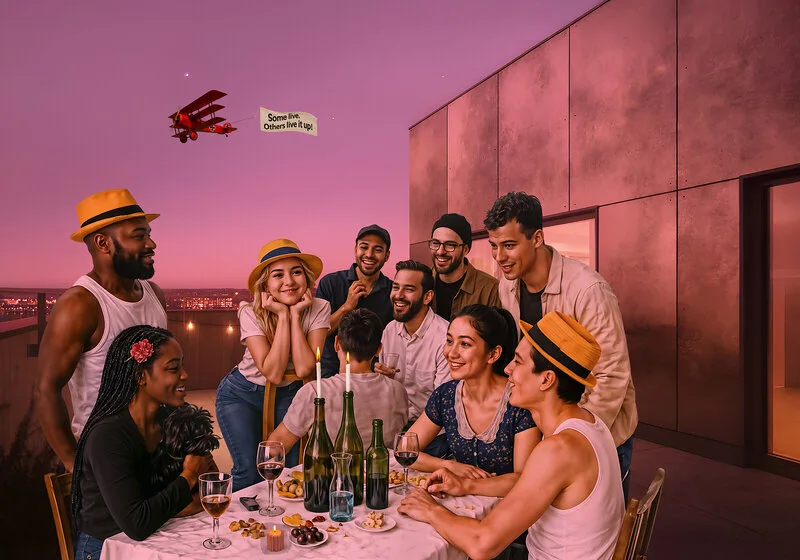
Some live. Others live it up! - Vissa lever vanligt, andra lever upp!”, 2025
Digital
70 x 50 cm
3 200 kr
Some live. Others live it up!
It begins as a slogan, a banner in the evening sky, playful as champagne bubbles yet weighty as a question of life itself. At first glance, it appears nothing more than a phrase—short, rhythmic, easy to remember. Yet it unfolds like a trapdoor into language, culture, and history, revealing its paradoxical and multifaceted nature. To “live up” is never simply one thing: it can mean to rise, to flourish, to meet a standard, or to squander what has been given. This phrase, with its deep cultural and historical roots, connects us to our past and shapes our present. In Malmö, perched high above the flatlands of Skåne, it becomes a promise of height and horizon. But in Latin, in Rome, in the songs of Nero, it becomes something altogether different—a philosophy written in wine, fire, and stone.
“Feast Above, Feast Below
High on the terrace, the glasses all gleam,
wine like a river, a sparkling dream.
Low in the courtyard, the laughter will flow,
music unites us, both high and low.
Rich with their togas, poor with their shoes,
everyone’s welcome, no one can lose.
Stars in the rafters, candles below,
joy is a ladder where all may go.
High is the rooftop, low is the ground,
yet in the circle, the same song is found.
Raise your glasses, let everyone know:
Some live, some rise, but we all live it up so.”
Malmö. October 2025
Some live. Others live it up.
In the eternal gathering on the twenty-fourth floor, Baron von Richthofen’s old red Fokker buzzed past, towing a banner with a striking message: “Vissa lever vanligt, andra lever upp!” In English: “Some live. Others live it up!” Against the darkening pink sky, the city lights stretched out beneath.
It is a slogan, not a literal translation. Short, rhythmic, with the kind of double meaning that works in both languages — but in different ways. Att leva upp in Swedish is richer than any single English verb can express. It means to brighten, to flourish, to come alive. Yet, it also signifies rising, reaching a higher level, or fulfilling something expected. And there’s another twist: to use up, to consume, even to squander. All of these shades shimmer in the phrase, depending on how the light hits them.
Perched on a Malmö high-rise, the slogan resonates not only with the joy of living but also with the physical act of rising above a flat landscape. The sheer joy of living high up, with the city lights twinkling below, is an experience that elevates the spirit. It's a feeling of being on top of the world, with nothing but the vast sky above and the twinkling city lights below. Aside from a few glacial ridges and two or three tall buildings, nothing in Skåne breaks the horizon. To live twenty-four storeys above the ground is already to live differently.
Let us consider the English version: “Some live. Others live it up.”
The phrase “live it up” exudes a sense of indulgence. It signifies celebrating, taking pleasure in oneself, and casting aside inhibitions. It feels like bubbles of champagne, the rhythm of jazz, and the glint of neon lights. It is playful, nearly decadent.
By contrast, “Some live. Others rise” would sound more solemn, almost biblical, as if hinting at a transcendent reality. This contrast between living and rising is a powerful reflection of the human experience, where we are constantly balancing the weight of expectation with the potential for transcendence. It's a reminder that life is not just about meeting expectations, but also about surpassing them, about rising to the occasion and meeting life's demands with grace and courage. That too is part of “att leva upp” in Swedish: to rise to the occasion, to surpass oneself, to meet a demand.
Thus, a single small phrase in one language can expand in many directions. A banner pulled by an old triplane suddenly transforms into a tiny philosophy of life.
On the ground, “att leva upp till” is often burdensome. It signifies living up to the expectations of parents, teachers, employers, and society as a whole. It implies a standard, an external measure that you must meet or fail to meet. It is an obligation rather than a source of joy.
How different, then, from the effortless “leva upp” when a friend cracks a joke and the whole table bursts into laughter. Then one “lives up” in another sense: the face brightens, the body lifts, the spirit blossoms—no demands, no burden—only release.
Here lies one of the great paradoxes of language: the precise verb phrase can convey both duty and delight, both the burden of expectation and the ease of joy. This paradox is a testament to the complexity and richness of human expression, where a single phrase can hold multiple layers of meaning. It's a reminder that language, like life, is full of paradoxes and complexities, and that the true beauty of both lies in their ability to hold multiple meanings and interpretations.
And then there is the darker side: ”att leva upp sina tillgångar”. To spend everything, to deplete one's resources. The gambler at the roulette wheel, the heir who squanders an inheritance, the spendthrift who burns through resources as if tomorrow will never arrive. In this sense, to “live it up” is perilously close to ruin.
There is also a kind of tragic grandeur in this meaning. To consume what has been given, to burn one’s candle at both ends, to live passionately until nothing remains. Is this not also part of what we admire in certain artists and legendary figures? Vincent van Gogh, who painted as if each stroke might be his last. Edith Piaf, whose voice embodied every ounce of her life’s sorrow and joy.
So: to live up can mean to rise, to blossom, to fulfil — but also to spend, to exhaust, to squander.
Placed within the context of architecture and housing, this wordplay gains added resonance.
Living high up in a building like Docks already embodies one meaning: to ascend. To look out over Malmö, across Öresund towards Denmark, is to live among the clouds compared to the streets below. It is to be elevated, to be granted a new horizon.
But to live also means to bring joy into a space. A dinner on a terrace, laughter echoing against the evening sky, music drifting from an open window — the apartment is not just inhabited, it is animated. It has been brought to life.
And yes, there is always the risk of excess. Champagne bottles poured too quickly, resources exhausted, the fleeting sparkle of a lifestyle that cannot endure. That too is part of the phrase: to live up to one’s fortune.
Thus, a winding banner in the evening sky becomes a reflection on language, life, and architecture.
“Some live. Others live it up.” It's not just a slogan; it's a profound question. Do we merely exist, or do we rise, rejoice, fulfil, and perhaps even squander? Do we live under expectations, or do we live beyond them?
Ultimately, the phrase embodies the essence of the human condition. We all strive to rise above, to justify something greater, to bloom with joy, and sometimes, to spend recklessly what we have been given.
Living up to something is not just one thing; it encompasses many. Perhaps the most genuine life is one that dares to embrace all these meanings simultaneously.
How might the old reveller Nero have expressed himself on this magical evening, when twenty-four floors of Malmö rise into the dark pink sky? Perhaps with a mixture of delight and vertigo. For even he, accustomed to splendour, excess, and scandal, had never reached such heights.
In his era, the Pantheon in Rome, a grand structure finished in the early third century CE, held the record as the tallest interior in the city. Its dome, a staggering 43.45 metres from floor to oculus—the open circle to the sky—was an ancient marvel. This height was not just a physical attribute, but a symbol of the divine connection it facilitated. In this space, the gods came down to the people, a testament to human ingenuity and sacred connection.
Probably the tallest building in the Roman Empire, regardless of category, was Hadrian’s mausoleum, later known as Castel Sant’Angelo, at forty-eight metres. A determined soul could climb it, gaze out over the Tiber, the Colosseum, and the endless sea of rooftops, a view that seemed to stretch to infinity, but never higher.
Nero himself, who once sang from the heights of the Palatine while the city burned, would surely have felt dizzy at the thought of sitting on a terrace seventy-nine metres above ground, drinking wine beneath the stars. The irony of his past actions, where he was accused of fiddling while Rome burned, and his potential present actions would have been intriguing. He might have called it superbia—height, pride, hubris—and still let the music flow. And who knows? Perhaps he, with a laugh as red as his toga, would have found the words:
“Alii vivunt. Alii superbe vivunt.”
(Some live. Others live it up.)
There are, in fact, several Latin expressions that are similar in meaning, although none capture all the nuances of the Swedish “leva upp” (to blossom, to fulfil, to consume). However, each of these Latin expressions encompasses different aspects of 'leva upp', contributing to the full understanding of the concept. Here are a few examples, each with its own unique shade of meaning that contributes to the full knowledge of 'leva upp':
For “leva upp” as blossoming, shining, rejoicing:
“Florere” – to flourish, to be in full bloom.
“Vivere alacriter” – to live cheerfully, brightly, vividly.
“Animari” – to be enlivened, to kindle, to become spirited.
For “leva upp till” as fulfilling, meeting expectations:
“Exspectationi respondere” – to answer to an expectation.
“Officium explore” – to carry out a duty.
“Ad altiora niti” – to strive for higher things.
For “leva upp” as using up, squandering:
“Consumere” – to consume, to use up, to waste.
“Dissipare” – to scatter, to squander.
“Luxuriose vivere” – to live in extravagance, to live lavishly.
And, of course, the most timeless phrase of all, nearly covering the entire spectrum, is Horace’s “Carpe diem”—“seize the day.” It captures not just joy and fleetingness, but also the reckless intensity of life, reminding us of the urgency to live fully in every moment.
Therefore, one might say that Swedish “leva upp” would, in Latin, require a whole range of words: florere, explere, consumere—to flourish, to accomplish, to consume.
And then, just as the laughter echoed across the terrace of the grand villa —a monument of opulence where Malmö's elite had gathered for a lavish evening —the red Fokker banner fluttered in the twilight sky. One of the guests rose. His toga, which had gone unnoticed as an eccentric costume, caught the lantern light. With a mischievous smile, he raised his glass of wine and began to speak, half toast, half confession.
You think this is just another party high above Malmö, but you do not realise what kind of Time-traveller you have welcomed into your company. I, who have sung while Rome burned, I, who have drunk from golden cups, I, who have seen the gods descend through the oculus of the Pantheon. Yet even I have never lived so high above the ground.
In my native tongue, we had a multitude of expressions for what you would call ‘living life to the fullest.’ We spoke of florere—to bloom like the blossoms of spring. We talked of exspectationi respondere—to meet the standards set by emperors and gods. We spoke of consumere—to use up everything, to live life as if it were coins in a purse.
And I, Nero, have embodied all of these ideals. I have flourished. I have met expectations. I have squandered. I have lived a life of excess, of danger, of indulgence.
Salutem! So, drink, friends! Tonight, we shall soar higher than any Roman dome, higher than Hadrian’s tomb, higher even than my own pride—Alii vivunt. Alii superbe vivunt. Some live. Others indulge.
He laughed—a laugh as red as his gown—and the company, half-dazed by the revelation, half-dazed by the wine, laughed with him.
3 200 kr

Jörgen Thornberg
Malmö
Lite om bilder och mig. Translation in English at the end.
Jag är en nyfiken person som ser allt i bilder, även det jag fäster i ord, gärna tillsammans för bakom alla mina bilder finns en berättelse. Till vissa bilder hör en kortare eller längre novell som följer med bilden.
Bilder berättar historier. Jag omges av naturlig skönhet, intressanta människor och historia var jag än går. Jag använder min kamera för att dokumentera världen och blanda det jag ser med vad jag känner för att fånga den dolda magin.
Mina bilder berättar mina historier. Genom mina bilder, tryck och berättelser. Jag bjuder in dig att ta del av dessa berättelser, in i ditt liv och hem och dela min mycket personliga syn på vår värld. Mer än vad ögat ser. Jag tänker i bilder, drömmer och skriver och pratar om dem; följaktligen måste jag också skapa bilder. De blir vad jag ser, inte nödvändigtvis begränsade till verkligheten. Det finns en bild runt varje hörn. Jag hoppas att du kommer att se vad jag såg och gilla det.
Jag är också en skrivande person och till många bilder hör en kortare eller längre essay. Den följer med tavlan, tryckt på fint papper och med en personlig hälsning från mig.
Flertalet bilder startar sin resa i min kamera. Enkelt förklarat beskriver jag bilden jag ser i mitt inre, upplevd eller fantiserad. Bilden uppstår inom mig redan innan jag fått okularet till ögat. På bråkdelen av ett ögonblick ser jag vad jag vill ha och vad som kan göras med bilden. Här skall jag stoppa in en giraff, stålmannen, Titanic eller vad det är min fantasi finner ut. Ännu märkligare är att jag kommer ihåg minnesbilden långt efteråt när det blir tid att skapa verket. Om jag lyckas eller inte, är upp till betraktaren, oftast präglat av en stråk av svart humor – meningen är att man skall bli underhållen. Mina bilder blir ofta en snackis där de hänger.
Jag föredrar bilder som förmedlar ett budskap i flera lager. Vid första anblicken fylld av feel-good, en vacker utsikt, fint väder, solen skiner, blommor på ängen eller vattnet som ligger förrädiskt spegelblankt. I en sådan bild kan jag gömma min egentliga berättelse, mitt förakt för förtryckare och våldsverkare, rasister och fördomsfulla människor - ett gärna återkommande motiv mer eller mindre dolt i det vackra motivet. Jag försöker förena dem i ett gemensamt narrativ.
Bild och formgivning har löpt som en röd tråd genom livet. Fotokonst känns som en värdig final som jag gärna delar med mig.
Min genre är vid som framgår av mina bilder, temat en blandning av pop- och gatukonst i kollage som kan bestå av hundratals lager. Vissa bilder kan ta veckor, andra någon dag innan det är dags att överlämna resultatet till printverkstaden. Fine Art Prints är digitala fotocollage. I dessa kollage sker rivandet, klippandet, pusslandet, målandet, ritandet och sprayningen digitalt. Det jag monterar in kan vara hundratals år gamla bilder som jag omsorgsfullt frilägger så att de ser ut att vara en del av tavlan men också bilder skapade av mig själv efter min egen fantasi. Därefter besöks printstudion och för vissa bilder numrera en limiterad upplaga (oftast 7 exemplar) och signera för hand. Vissa bilder kan köpas i olika format. Det är bara att fråga efter vilka. Gillar man en bild som är 70x100 men inte har plats på väggen, går den kanske att få i 50x70 cm istället. Frågan är fri.
Metoden Giclée eller Fine Art Print som det också kallas är det moderna sättet för framställning av grafisk konst. Villkoret för denna typ av utskrifter är att en högkvalitativ storformatskrivare används med åldersbeständigt färgpigment och konstnärspapper eller i förekommande fall på duk. Pappret som används möter de krav på livslängd som ställs av museer och gallerier. Normalt säljer jag mina bilder oinramade så att den nya ägaren själv kan bestämma hur de skall se ut, med eller utan passepartout färg på ram, med eller utan glas etc..
Under många år ställde jag bara ut på nätet, i valda grupper och på min egen Facebooksida - https://www.facebook.com/jorgen.thornberg.9
Jag finns också på en egen hemsida som tyvärr inte alltid är uppdaterad – https://www.jth.life/ Där kan du också läsa en del av de berättelser som följer med bilden.
UTSTÄLLNINGAR
Luftkastellet, oktober 2022
Konst i Lund, november 2022
Luftkastellet, mars 2023
Engleson Galleri Caroli, april 2023
Hydra, Greece June 2023
Engleson Galleri Caroli, oktober 2023
Toppen, Höllviken december 2023
Luftkastellet, mars 2024
Torups Galleri, mars 2024
Venice, May 2024
Luftkastellet, oktober 2024
Konst i Advent, December 2024
Galleri Engleson, Caroli December 2024
Jäger & Jansson Galleri, april 2025
A bit about pictures and me.
I'm a curious person who sees everything in pictures, even what I express in words, often combining them, for behind all my pictures lies a story. These narratives, some as short as a single image and others as long as a novel, are the heart and soul of my work.
Pictures tell stories. Wherever I go, I'm surrounded by natural beauty, exciting people, and history. I use my camera to document the world and blend what I see with what I feel to capture the hidden magic.
My images tell my stories. Through my pictures, prints, and narratives, I invite you to partake in these stories in your life and home and share my deeply personal perspective of our world. More than meets the eye. I think in pictures, dream, write, and talk about them; consequently, I must create images too. They become what I see, not necessarily confined to reality. There's a picture around every corner. I hope you'll see what I saw and enjoy it.
I'm also a writer, and many images come with a shorter or longer essay. It accompanies the painting, printed on fine paper with my personal greeting.
Many pictures start their journey on my camera. Simply put, I describe the image I see in my mind, experienced or imagined. The image arises within me even before I bring the eyepiece to my eye. In a fraction of a moment, I see what I want and what can be done with the picture. Here, I'll insert a giraffe, Superman, the Titanic, or whatever my imagination conjures up. Even stranger is that I remember the mental image long after it's time to create the work. Whether I succeed is up to the observer, often imbued with a streak of black humour – the aim is to entertain. My pictures usually become a talking point wherever they hang.
I prefer pictures that convey a message in multiple layers. At first glance, they're filled with feel-good vibes, a beautiful view, lovely weather, the sun shining, flowers in the meadow, or the water lying deceptively calm. But beneath this surface beauty, I often conceal a deeper story, a narrative that challenges societal norms or explores the human condition. I invite you to delve into these hidden narratives and discover the layers of meaning within my work.
Picture and design have been a thread running through my life. Photographic art feels like a fitting finale, and I'm happy to share it.
My genre is varied, as seen in my pictures; the theme is a blend of pop and street art in collages that can consist of hundreds of layers. Some images can take weeks, others just a day before it's time to hand over the result to the print workshop. Fine Art Prints are digital photo collages. In these collages, tearing, cutting, puzzling, painting, drawing, and spraying happen digitally. What I insert can be images hundreds of years old that I carefully extract so they appear to be part of the painting, but also images created by myself, now also generated from my imagination. Next, visit the print studio and, for certain images, number a limited edition (usually 7 copies) and sign them by hand. Some images may be available in other formats. Just ask which ones. If you like an image that's 70x100 but doesn't have space on the wall, you might be able to get it in 50x70 cm instead. The question is open.
The Giclée method, or Fine Art Print as it's also called, is the modern way of producing graphic art. This method ensures the highest quality and longevity of the artwork, using a high-quality large-format printer with archival pigment inks and artist paper or, in some cases, canvas. The paper used meets the longevity requirements set by museums and galleries. I sell my pictures unframed, allowing the new owner to personalise their artwork, confident in the lasting value and quality of the piece.
For many years, I only exhibited online, in selected groups, and on my Facebook page - https://www.facebook.com/jorgen.thornberg.9. I also have my website, which unfortunately is not constantly updated - https://www.jth.life/. You can also read some of the stories accompanying the pictures there.
EXHIBITIONS
Luftkastellet, October 2022
Art in Lund, November 2022
Luftkastellet, March 2023
Engleson Gallery Caroli, April 2023
Hydra, Greece June 2023
Engleson Gallery Caroli, October 2023
Toppen, Höllviken December 2023
Luftkastellet, March 2024
Torup Gallery, March 2024
Venice, May 2024
UTSTÄLLNINGAR
Luftkastellet, oktober 2022
Konst i Lund, november 2022
Luftkastellet, mars 2023
Engleson Galleri Caroli, april 2023
Hydra, Greece June 2023
Engleson Galleri Caroli, oktober 2023
Toppen, Höllviken december 2023
Luftkastellet, mars 2024
Torups Galleri, mars 2024
Venice, May 2024
Luftkastellet, October 2024
Konst i Advent, December 2024
Galleri Engleson, Caroli December 2024
Jäger & Jansson Galleri, April 2025
Utbildning
Autodidakt
Medlem i konstnärsförening
Öppna Sinnen
Med i konstrunda
Konstrundan i Skåne
Utställningar
Luftkastellet, October 2022
Art in Lund, November 2022
Luftkastellet, March 2023
Engleson Gallery Caroli, April 2023
Hydra, Greece June 2023
Engleson Gallery Caroli, October 2023
Toppen, Höllviken December 2023
Luftkastellet, March 2024
Torup Gallery, March 2024
Venice, May 2024