Vi använder cookies för att ge dig bästa möjliga upplevelse. Välj vilka cookies du tillåter.
Läs mer i vår integritetspolicy
Jörgen Thornberg
Graffiti Grand Cru, 2025
Digital
50 x 70 cm
3 200 kr
Graffiti Grand Cru
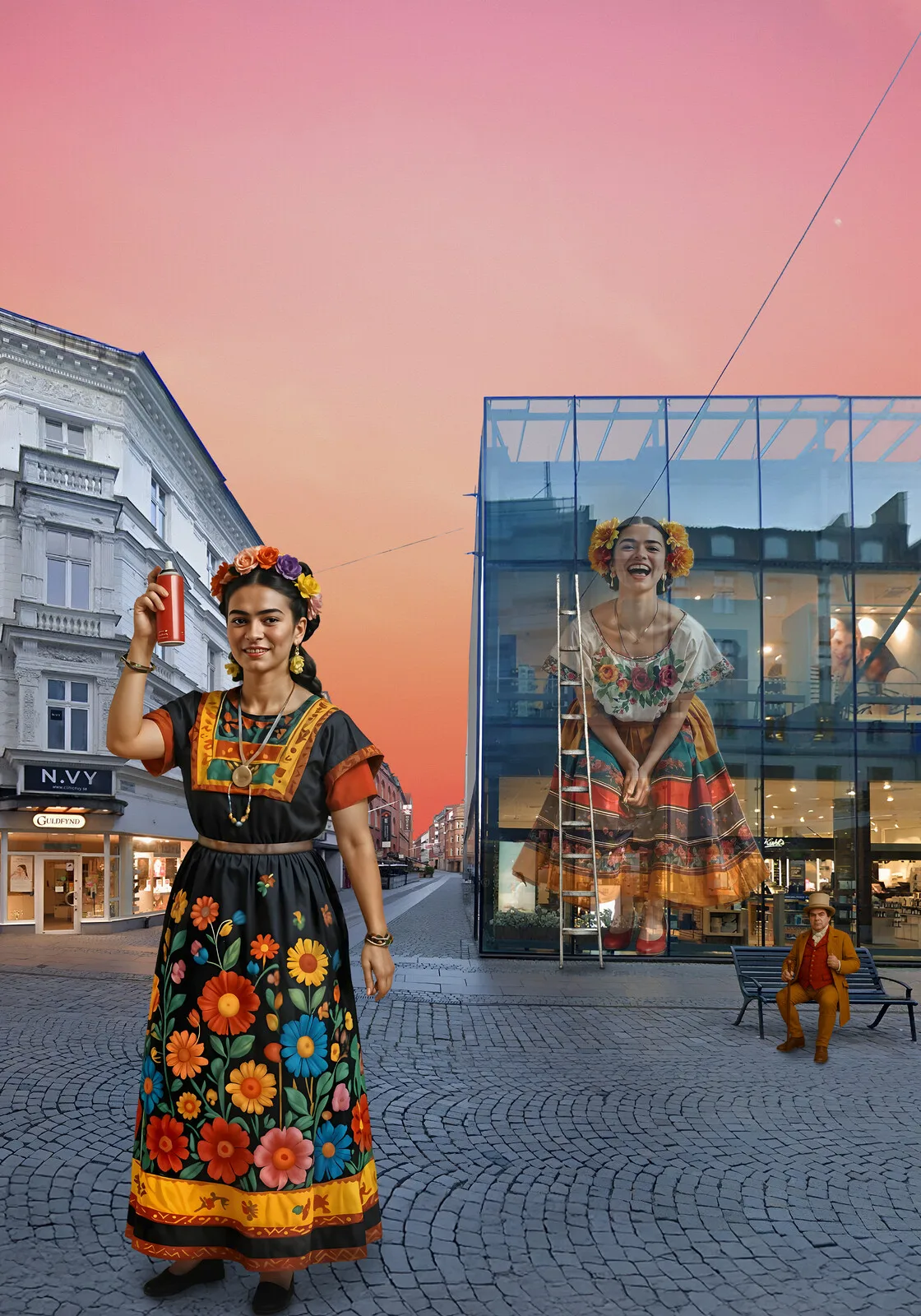
It all began with a laugh etched on glass. One early summer morning, Frida Kahlo stepped out of time and onto the Åhléns façade, holding up a mirror to Malmö—reflecting what we tore down, what we built instead, and what still calls to be loved. The city had just debated about beauty and disgrace, counting winners and losers in brick and concrete, when a giant self-portrait appeared on Södergatan and transformed a criticised wall into a stage—a powerful testament to the transformative power of art.
But façades are only the opening act. Behind every surface lies an older story: the code of the walls, the unwritten laws that connect writers and painters from Pompeii’s scratched taunts to today’s neon burners. Calling someone a toy doesn’t insult their hand— you question their respect for the enduring lineage. And rivalry, that stubborn twin of creation, keeps the lineage alive, enduring through the ages: Apelles and Protogenes trading lines as thin as breath; Leonardo and Michelangelo duelling with battles they never finished; Degas and Manet, Van Gogh and Gauguin, Matisse and Picasso—each pair sharpening the other like flint.
This is a walk through those quarrels and codes—Malmö’s contested streets, Rome’s marble arenas, Parisian salons, New York lofts, London bars—and the ash that still remembers names. Read on. The walls are speaking, and it is up to us, the integral audience, to listen and interpret their stories.
“Brushstrokes and Bust-Ups
In marble halls and city streets,
where brush and chisel always meet,
the quarrels start, the tempers rise,
each artist is certain, each artist is wise.
Apelles drew a perfect line,
Protogenes replied in kind.
Zeuxis fooled the hungry bird,
till Parrhasius had the final word.
Leonardo planned with subtle grace,
Michelangelo scowled, face to face.
Each claimed the other far too weak,
yet neither finished what they’d seek.
Degas gave Manet wife and frame,
but found her face cut, all the same.
“Here are your plums,” he briskly wrote,
a sour fruit with a bitter note.
Van Gogh and Gauguin shared a roof,
their letters warm, their tempers proof.
One night, a razor, blood, and fear,
and Vincent’s ear was left right here.
Matisse with colours bright and free,
Picasso growled: “You look at me!”
Yet both admitted, near the end,
a rival can become a friend.
Pollock’s splashes, drunk and wild,
met de Kooning’s strokes more styled.
Even death could not erase
their tangled love-and-hate embrace.
Bacon, Freud, in London’s mist,
painted, quarrelled, drank, and kissed.
From studio smoke to Sotheby’s floor,
their battles sell for millions more.
Graffiti wars by canal walls,
where Banksy sprays and Robbo brawls.
A toy’s disgrace, a writer’s fame,
the oldest story, still the same.
So art goes on with brush and word,
each controversy is well observed.
For quarrels feed the painter’s fire,
and rivals sharpen pure desire.”
Malmö. October 2025
Graffiti Grand Cru
That Frida Kahlo, on an early summer morning, chose to decorate the glass façade of Åhléns, marking all the beautiful old houses that had been lost and what had risen in their place. As the photo makes clear, it is not the building itself that you notice, but a gigantic self-portrait of it. Unsigned, but who could fail to recognise the laughing giant from Mexico?
What are Malmö’s ugliest buildings through the years? In 2020, the movement Arkitekturupproret voted for Sweden’s ugliest building. In the regional heats, they also voted for Malmö’s ugliest. It is worth noting that they also crowned Malmö’s most beautiful building. That competition was won, after fierce rivalry, by the apothecary Lejonet on Stortorget. Second came the Town Hall, and third the Faxeska house on Lilla Torg — all of them a balm for the soul, before we unleash the façade that Frida Kahlo considered worthy of embellishment—more about her graffiti, Grand Cru, further down.
Arkitekturupproret (The Architect Uprising), with nearly 50,000 members in its primary group, also has 22 local Facebook chapters. Malmö’s group nominated 52 buildings. Sadly, over the past sixty years, the city has permitted the demolition of many of its most beautiful houses, replacing them with some truly appalling examples. The worst — or lowest-ranked — was Caroli City, with the Åhléns building close behind, both serving as clear examples of poor taste and the destruction of unique historical environments.
The latter is, of course, the building that time-traveller Frida Kahlo, during her stay in Malmö, chose to embellish with her monumental graffiti: a giant portrait of herself, sprayed directly onto the glass façade facing Södergatan. Strictly speaking, that part of the building is not the very worst of the half block, but she thought her work would stand out more prominently there. The concrete wall along Per Weijersgatan would, in truth, have needed Frida’s self-portrait more urgently. Once upon a time, that side street was one of Malmö’s loveliest — reminiscent of Visby, with its row of tall, elegant old warehouses.
Frida’s contribution to Malmö’s beautification was, of course, carried out without the slightest permission from either property owners or authorities. In doing so, she joined the esteemed company of a global circle of graffiti artists — most famously, the ever-active Banksy, whose works were highlighted a few years ago in a major exhibition at the Tate Modern. As is often the case with street art, the lifespan was short, and the work disappeared almost before anyone had a chance to see it properly. Fortunately, my photograph remains.
The Code of the Walls
In graffiti culture, few words cut deeper than 'toy'. Being called one means losing face, marking you as someone who doesn’t belong. However, everyone starts as a beginner; everyone fumbles with their first line of paint. Picking up a can doesn’t make you a toy. What truly defines you is not just skill, but respect — for the wall, for the history, for the culture that came before. This respect forms the foundation of our discipline, fostering a sense of commitment and reverence. The 'Code of the Walls' is a set of unwritten rules that govern our culture, emphasising the importance of respect, knowledge, control, originality, and silence.
Graffiti is more than just a splash of colour on concrete. It embodies knowledge, discipline, and memory. The evidence is in Pompeii: tens of thousands of scratched messages, names, insults, and declarations of love preserved under ash for nearly two thousand years. There, we observe that graffiti has always functioned as a code, a living record. The principles that writers continue to follow resonate through the ages, linking us to a rich and inspiring heritage. This profound connection to history and culture fosters a deep sense of respect and unity within our community, making each one of us feel valued and integral to the larger narrative.
Never Snitch
The first law of graffiti remains unchanged. In Pompeii as in Brooklyn: silence is sacred. If you are caught, you take the blame alone. To name names, to point fingers, is to betray the code. Those who snitched in ancient taverns were scorned; those who snitch today are erased from memory. This principle of individual responsibility is a cornerstone of our culture, emphasising the importance of personal integrity and loyalty.
Show Respect
Walls are shared space. In Pompeii, one hand would carve a joke, and another might add a reply beside it — rarely cutting through the first line. The same is true now. Never paint over a piece you cannot outdo. Respect the legends of your city. Without that, even your cleanest 'burner', a term used to describe a high-quality piece of graffiti, reads as empty.
Know Your History
Pompeii stands as a potent reminder: graffiti did not originate in the 1970s. From Latin slogans to medieval pilgrim carvings, the act of leaving one’s mark is as old as civilisation itself. To create today without recognising this heritage is to stand without roots. A true artist studies those who came before — from the legendary Zeuxis to the modern-day heroes of Style Wars. This focus on learning from history is a vital aspect of graffiti culture, inspiring us and linking artists to a rich legacy that spans centuries.
Learn Control
From scratched stylus to spray can, control has always separated the amateur from the writer: straight lines, clean fills, balance in every gesture. A sharp simplicity is more potent than a careless masterpiece. Just like in Pompeii, where some hands etched with finesse and others clumsily hacked the wall, skill demonstrates respect.
Don’t Bite
Copying has never been admired. In Pompeii, each hand has its own voice: bold, delicate, mocking, erotic. The same holds today. Inspiration is natural; theft is contemptible. Your line, your style, your rhythm — that is what commands respect.
Respect the Hierarchy
Graffiti develops through stages: tags, throw-ups, straights, burners, and productions. Each stage reflects a level of skill and experience within the graffiti hierarchy. This hierarchy is not about power or control, but about acknowledging and respecting each writer's skill and experience. It's about earning your reputation through your ability and dedication to the craft. Just as the Romans understood hierarchy—citizens, slaves, patricians—so too do we in graffiti. Respect is the cornerstone of this hierarchy. Earn your reputation, and your name lasts.
Earn Spots, Keep Them Quiet
A good wall is never given. Pompeii’s walls bore private jokes, names of gladiators, hidden insults — secret places known only to those who operate in the shadows. Even today, a true writer protects their locations. Don’t boast, don’t post, don’t reveal. The wall remains sacred only as long as it stays discreet.
Keep Your Sketchbook Tight
The ancient writer rehearsed lines on wax tablets before carving them in plaster. Today, it is the black book. Toys freestyle badly on walls; writers refine their ideas on paper. The book is where style is born, where letters find their weight. Strong sketches build strong walls.
Don’t Brag Online
The tavern walls of Pompeii were covered with boasts — “I screwed the barmaid,” “I am the best gladiator.” They have survived, but they sound hollow. True fame is not shouted; it is earned quietly, in recognition. In our era, online influence has become a new form of bragging. Resist it. Let the streets speak for you.
Pick Your Spots Wisely
Even in Pompeii, there were boundaries not to cross: no one carved into the temples of the gods. Respect the sacred. Don’t bomb schools, churches, homes, or graves. Nature deserves the same reverence. Cities are filled with tunnels, trains, rooftops, and walls that beg for paint. Choose wisely, and your name will live where it belongs.
Epilogue: The Eternal Wall
From the scratched hearts of Pompeii to the neon burners of New York, the principles endure. Graffiti is not merely vandalism or art; it is a dialogue spanning centuries, conveyed by those who understand the code. To follow it is to become part of a brotherhood and lineage that dates back to the moment someone first picked up a sharp stone, leaned against a wall, and left their mark.
Unwritten rules have often led to disputes among artists, a phenomenon that has existed as long as the history of art itself. Even in the dramatic setting of Stone Age caves, artists painted over their rivals, though we do not know their names. Here, I have compiled some of the most famous enemies in the world of art, whose rivalries often fueled artistic innovation and left a lasting legacy that will surely inspire and make you appreciate the impact of these conflicts.
The Echo of Antiquity – Greece and Rome
It would be strange if Western art, so often characterised by struggle and prestige, had not already harboured rivalries in antiquity. We can sense the tensions between Greek sculptors, whose works competed to be the most lifelike, the most divine, the most immortal. Pliny the Elder tells of Apelles and Protogenes – painters who set their lines against one another on a single panel in a silent duel over who best commanded the hand.
In Rome, emperors allowed artists to compete in mosaics and frescoes, and in classical sculpture, it was common for one master’s work to be replaced by another’s. Even if their names have not always endured, the rivalry itself remains like an echo in the texts. This echoes the belief that art was born from competition, which in turn gave rise to the first legendary quarrels, shaping the course of art history.
Leonardo da Vinci vs. Michelangelo
Renaissance Florence was a city constructed from marble, patronage, and prestige. Here, two of history’s greatest geniuses met – Leonardo da Vinci, the universal mind, and Michelangelo Buonarroti, the divinely talented sculptor and painter. Their paths had intersected before, but it was in 1504 that the rivalry turned into an open feud. Both were commissioned to decorate the great hall of the Palazzo Vecchio, the Hall of the Five Hundred, with monumental wall paintings: Leonardo’s The Battle of Anghiari and Michelangelo’s The Battle of Cascina.
A contempt grew between them that was as personal as it was artistic. Leonardo regarded Michelangelo as coarse and brutal; Michelangelo, in turn, saw Leonardo as weak, often leaving works unfinished. The outcome? Both paintings remained incomplete, yet their story of hostility persisted and became one of the Renaissance’s most dramatic episodes, a tale of two geniuses locked in a bitter artistic struggle.
Édouard Manet vs. Edgar Degas
Paris, the centre of the 19th century. Two titanic names: Édouard Manet and Edgar Degas. Degas – the self-proclaimed “realist,” yet recognised by the world as the father of Impressionism, famed for his ballerinas in pastel. Manet – both an outsider and a central figure, who refused to be confined by the label “Impressionist.”
Their friendship was close, but it ended so tragically that it became legend. Degas painted a portrait as a gift: Manet and his wife, Suzanne. Later, when Degas entered Manet’s studio, he found the picture mutilated – Suzanne’s face slashed with a knife. The personal nature of their rivalry was intense. Manet did not explain. Shaken, Degas reclaimed the painting and returned Manet’s gift, a still life of plums, with a terse note.
“Monsieur, I am returning your plums.”
What truly lies behind this act remains unknown. However, the anecdote explains why their relationship developed into a complex blend of rivalry and respect, a contest between two men who together shaped modern painting.
Vincent van Gogh vs. Paul Gauguin
When Van Gogh and Gauguin met in Paris in 1887, it marked the beginning of a brief yet intense friendship. They exchanged letters and paintings – Van Gogh even sent Gauguin his renowned sunflower studies – and soon Van Gogh invited him to the Yellow House in Arles. There, he envisioned an artists’ colony, a sanctuary for creation.
But two strong temperaments under one roof were destined for disaster. Van Gogh: burning, feverish, with almost religious intensity. Gauguin: worldly, free, and ruthless. In the autumn of 1888, they lived together for nine weeks. Then everything exploded into a tragic end.
According to Gauguin, Van Gogh chased him with a razor. According to others, it was Gauguin who first raised the blade. Whatever the truth, the night ended in blood: Van Gogh with a severed ear, Gauguin fleeing, never to return to Arles. Two years later, Van Gogh took his life. Their feud became one of art history’s most legendary tragedies.
Henri Matisse vs. Pablo Picasso
In the early 20th century, two new names appeared on the Paris scene: Henri Matisse and Pablo Picasso. They became both reflections and competitors. Matisse, with his luminous palette, opened windows to light and harmony. Picasso, restless and intense in expression, distorted forms until they almost broke.
They frequently met at Gertrude Stein’s salon on Rue de Fleurus, where their works hung alongside each other. The rivalry was constant — but also a source of nourishment for both. At the end of his life, Picasso himself acknowledged:
“No one has ever scrutinised Matisse’s painting more closely than I have, and no one has examined mine more thoroughly than he.”
Enemies? Friends? Perhaps both. But without the other, neither would be the artist we know today.
Willem de Kooning vs. Jackson Pollock
Postwar New York: here, a new universal language of art was to be forged – Abstract Expressionism. Two names dominated: Jackson Pollock, with his wild drips and splatters, and Willem de Kooning, more structured but equally uncompromising. Their rivalry was both artistic and deeply personal.
Pollock's untimely death in a car crash in 1956, with his lover Ruth surviving and later becoming de Kooning’s partner, only served to reinforce the myth of their conflict. Even in death, their feud cast a long shadow over the art world, pitting Pollock’s chaos against de Kooning’s structure.
Francis Bacon vs. Lucian Freud
London in the 1950s and 60s was decadent, reckless, and brutal. Here, Francis Bacon and Lucian Freud lived — two painters whose friendship and hostility intertwined. They drank, quarrelled, laughed, and painted together, reflecting each other's spirits.
The sale of Bacon’s Study for Portrait of Lucian Freud (1967) for over £43 million at Sotheby’s in 2022 demonstrates the lasting fascination with their intense bond. Their tumultuous relationship, characterised by deep respect and equal parts irritation, continues to enthral the world.
Banksy vs. King Robbo
The underground world of graffiti experienced its most notorious feud in 1990s London. Banksy — the ironic, masked trickster — and King Robbo, a seasoned street artist, clashed after a meeting in a pub. A remark, a punch, and years of artistic revenge unfolded along the walls of Regent’s Canal.
When Robbo died in 2014, Banksy responded with a piece meant as a tribute. However, even this gesture was altered by Robbo’s friends. What began as a feud born in anger grew into something greater: a shared chapter in the history of street art, a testament to the unity and development in the Banksy-Robbo conflict.
David Hockney vs. Damien Hirst
Late 20th century: David Hockney, the colourist known for his Californian pools, and Damien Hirst, the enfant terrible of the YBA movement with his sharks in formaldehyde, seemed worlds apart. Hockney regarded Hirst’s conceptual gestures as empty, while Hirst showed little interest in Hockney’s painterly craft.
It's not precisely a bloody feud, more like a frozen gulf. Hockney said, “I don’t like his work.” Sometimes that is enough for an artistic rift to feel as vast as war.
Stuart Semple vs. Anish Kapoor
And finally, our own time, and a feud that nearly turned into a farce: Stuart Semple versus Anish Kapoor, in the battle over the colour black. Vantablack, the darkest pigment, absorbing almost all light, was exclusively licensed to Kapoor. It was as if one man had been granted ownership of the night itself.
Semple retaliated by creating new pigments and banning Kapoor from buying them: “Anyone except Kapoor.” Soon, the internet burst with memes, artworks, and satire. The conflict over black became a reminder that, even in our era, when colours can be patented and sold, the old urge persists: the desire to win, to provoke, never to let the rival have the final say.
Apelles vs. Protogenes (and Rivalries in Ancient Greece)
Long before the Renaissance masters or the modern art movements, the world of art was already ablaze with the fiery spirit of rivalry. In ancient Greek and Roman civilisations, the evaluation of art was not merely a matter of aesthetics but a passionate pursuit of precision and virtuosity. The stories of these legendary duels, such as the one between Apelles, the court painter to Alexander the Great, and Protogenes, the master of Rhodes, are a testament to the intense rivalry that shaped the history of art.
The story unfolds as follows: Apelles visited Protogenes’ studio while he was away and left his mark—a single, perfect line across a panel. When Protogenes returned, he recognised the hand and drew an even finer line on top. Apelles then came back once more and added a third, finer line between the two. The duel ended there. Neither could outdo the other. The outcome? A painting of three lines, preserved for centuries as a symbol of ultimate mastery — and of a rivalry that needed neither blood nor plums to carve itself into history.
Zeuxis vs. Parrhasius
But Apelles and Protogenes were not alone. Already in the 5th century BCE, Zeuxis and Parrhasius competed to see who could paint more convincingly. Zeuxis painted grapes so lifelike that birds flew down to peck at them. Victory seemed assured — until he asked Parrhasius to draw aside the curtain covering his painting. When Zeuxis attempted to pull it back, he realised the curtain itself was painted. Laughing, he admitted defeat: he had fooled birds, but Parrhasius had deceived a human — and an artist.
Roman Arenas of Art
Rome, a cultural sponge that absorbed not only Greece’s gods but also its passion for artistic rivalry, became a new arena for creative competition. Here, mosaicists and fresco painters vied for commissions, each hoping their work would decorate a patrician villa or their statue would stand in the Roman Forum. Rivalry could be lethal — a failed portrait of an emperor might mean exile, or worse. But it was in Rome that art first began to be judged against political power: the one who gained imperial favour earned not just fame, but immortality in marble.
The Walls of Pompeii – Rivalries in Ash
Long before Degas returned Manet’s plums or Banksy sparred with King Robbo, the fiercest battles of ego and wit were carved into plaster. Pompeii, sealed beneath Vesuvius’ ash in 79 CE, preserved not only villas and frescoes but more than ten thousand pieces of graffiti. These are the earliest art feuds we know — petty, comic, obscene, but deadly serious to those who carved them.
Here, the walls themselves became the arena. One hand engraved Marcus loves Julia, only for another to scrawl beneath: Julia loves no one, least of all Marcus. A gladiator’s name might be celebrated, then mocked a day later: Celadus the Thracian makes all the girls sigh, answered by Celadus, who is nothing but a toy with a sword. These are the ancient equivalent of side-busting: crossing a piece not with flair, but with contempt.
Some graffiti records political feuds—endorsements for candidates smeared overnight with rival slogans. Others boast of tavern conquests, only to be ridiculed by later hands. The exchanges form chains, back-and-forth dialogues etched into the city's skin.
Pompeii’s streets reveal that the desire to claim space, to mark presence, and to challenge others’ marks is timeless. Spray paint had not yet been invented, but the mindset was already there: don’t bite, don’t disrespect, and above all — leave your name sharper, wittier, stronger than the one before.
Two thousand years later, when a writer sprays fresh throw-up over a faded tag, they echo that same ancient rhythm. The walls remember, whether carved in Latin couplets or painted in wildstyle. Pompeii’s ash has become graffiti’s oldest black book — one where rivalries never fade, only lie in wait to be read. This enduring legacy of artistic rivalries connects us to the past and the present of art history, reminding us that the spirit of competition has always been a driving force in the evolution of art.
Frida Kahlo’s Antagonists?
Frida Kahlo never had a clearly defined nemesis on the “Picasso–Matisse” level. Her conflicts were more relational and ideological than a duel between two stars. The closest candidates:
Diego Rivera – not an enemy, but both partner and adversary. Their lifelong bond swung between admiration, jealousy, and struggle. Marriage (and remarriage), affairs (including with Frida’s sister), and the clash of artistic scales — his monumental murals versus her intimate self-portraits — created friction that often became fuel. In works like Diego y yo, Rivera is both muse and tormentor, the centre of her artistic conflict.
André Breton and the Surrealists – the “label feud.” Breton invited her to Paris in 1939 and promoted her as a Surrealist, but Frida hated both the chaos and the label. She insisted she was not a dreamer but a realist — only her reality was Mexican and painful. The cultural clashes and poorly managed exhibitions left her bitter, even as her works appeared in Surrealist contexts. This was the most intense “programmatic” conflict of her career.
Mexican Muralism disputes – more of Rivera’s battles than Frida’s. In Mexico, Rivera engaged in ideological and aesthetic conflicts with peers like David Alfaro Siqueiros. Frida was connected to the movement but remained distinct, her canvas being the body, identity, and symbol, not the wall of propaganda.
Her feuds were not sword fights in paint but struggles over identity, belonging, and definition. Unlike Pollock and de Kooning, Kahlo’s arena was not about who painted the strongest line — it was about who defined her, and whether she would allow them to.
Jörgen Thornberg
Graffiti Grand Cru, 2025
Digital
50 x 70 cm
3 200 kr
Graffiti Grand Cru
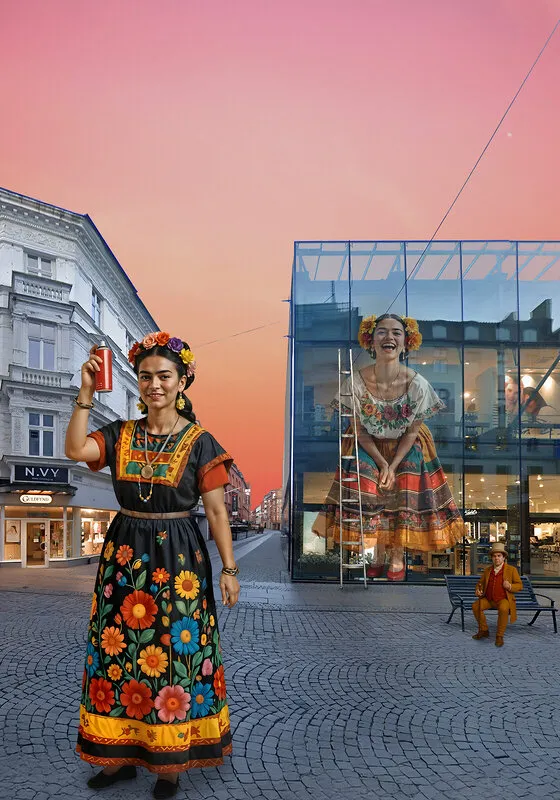
It all began with a laugh etched on glass. One early summer morning, Frida Kahlo stepped out of time and onto the Åhléns façade, holding up a mirror to Malmö—reflecting what we tore down, what we built instead, and what still calls to be loved. The city had just debated about beauty and disgrace, counting winners and losers in brick and concrete, when a giant self-portrait appeared on Södergatan and transformed a criticised wall into a stage—a powerful testament to the transformative power of art.
But façades are only the opening act. Behind every surface lies an older story: the code of the walls, the unwritten laws that connect writers and painters from Pompeii’s scratched taunts to today’s neon burners. Calling someone a toy doesn’t insult their hand— you question their respect for the enduring lineage. And rivalry, that stubborn twin of creation, keeps the lineage alive, enduring through the ages: Apelles and Protogenes trading lines as thin as breath; Leonardo and Michelangelo duelling with battles they never finished; Degas and Manet, Van Gogh and Gauguin, Matisse and Picasso—each pair sharpening the other like flint.
This is a walk through those quarrels and codes—Malmö’s contested streets, Rome’s marble arenas, Parisian salons, New York lofts, London bars—and the ash that still remembers names. Read on. The walls are speaking, and it is up to us, the integral audience, to listen and interpret their stories.
“Brushstrokes and Bust-Ups
In marble halls and city streets,
where brush and chisel always meet,
the quarrels start, the tempers rise,
each artist is certain, each artist is wise.
Apelles drew a perfect line,
Protogenes replied in kind.
Zeuxis fooled the hungry bird,
till Parrhasius had the final word.
Leonardo planned with subtle grace,
Michelangelo scowled, face to face.
Each claimed the other far too weak,
yet neither finished what they’d seek.
Degas gave Manet wife and frame,
but found her face cut, all the same.
“Here are your plums,” he briskly wrote,
a sour fruit with a bitter note.
Van Gogh and Gauguin shared a roof,
their letters warm, their tempers proof.
One night, a razor, blood, and fear,
and Vincent’s ear was left right here.
Matisse with colours bright and free,
Picasso growled: “You look at me!”
Yet both admitted, near the end,
a rival can become a friend.
Pollock’s splashes, drunk and wild,
met de Kooning’s strokes more styled.
Even death could not erase
their tangled love-and-hate embrace.
Bacon, Freud, in London’s mist,
painted, quarrelled, drank, and kissed.
From studio smoke to Sotheby’s floor,
their battles sell for millions more.
Graffiti wars by canal walls,
where Banksy sprays and Robbo brawls.
A toy’s disgrace, a writer’s fame,
the oldest story, still the same.
So art goes on with brush and word,
each controversy is well observed.
For quarrels feed the painter’s fire,
and rivals sharpen pure desire.”
Malmö. October 2025
Graffiti Grand Cru
That Frida Kahlo, on an early summer morning, chose to decorate the glass façade of Åhléns, marking all the beautiful old houses that had been lost and what had risen in their place. As the photo makes clear, it is not the building itself that you notice, but a gigantic self-portrait of it. Unsigned, but who could fail to recognise the laughing giant from Mexico?
What are Malmö’s ugliest buildings through the years? In 2020, the movement Arkitekturupproret voted for Sweden’s ugliest building. In the regional heats, they also voted for Malmö’s ugliest. It is worth noting that they also crowned Malmö’s most beautiful building. That competition was won, after fierce rivalry, by the apothecary Lejonet on Stortorget. Second came the Town Hall, and third the Faxeska house on Lilla Torg — all of them a balm for the soul, before we unleash the façade that Frida Kahlo considered worthy of embellishment—more about her graffiti, Grand Cru, further down.
Arkitekturupproret (The Architect Uprising), with nearly 50,000 members in its primary group, also has 22 local Facebook chapters. Malmö’s group nominated 52 buildings. Sadly, over the past sixty years, the city has permitted the demolition of many of its most beautiful houses, replacing them with some truly appalling examples. The worst — or lowest-ranked — was Caroli City, with the Åhléns building close behind, both serving as clear examples of poor taste and the destruction of unique historical environments.
The latter is, of course, the building that time-traveller Frida Kahlo, during her stay in Malmö, chose to embellish with her monumental graffiti: a giant portrait of herself, sprayed directly onto the glass façade facing Södergatan. Strictly speaking, that part of the building is not the very worst of the half block, but she thought her work would stand out more prominently there. The concrete wall along Per Weijersgatan would, in truth, have needed Frida’s self-portrait more urgently. Once upon a time, that side street was one of Malmö’s loveliest — reminiscent of Visby, with its row of tall, elegant old warehouses.
Frida’s contribution to Malmö’s beautification was, of course, carried out without the slightest permission from either property owners or authorities. In doing so, she joined the esteemed company of a global circle of graffiti artists — most famously, the ever-active Banksy, whose works were highlighted a few years ago in a major exhibition at the Tate Modern. As is often the case with street art, the lifespan was short, and the work disappeared almost before anyone had a chance to see it properly. Fortunately, my photograph remains.
The Code of the Walls
In graffiti culture, few words cut deeper than 'toy'. Being called one means losing face, marking you as someone who doesn’t belong. However, everyone starts as a beginner; everyone fumbles with their first line of paint. Picking up a can doesn’t make you a toy. What truly defines you is not just skill, but respect — for the wall, for the history, for the culture that came before. This respect forms the foundation of our discipline, fostering a sense of commitment and reverence. The 'Code of the Walls' is a set of unwritten rules that govern our culture, emphasising the importance of respect, knowledge, control, originality, and silence.
Graffiti is more than just a splash of colour on concrete. It embodies knowledge, discipline, and memory. The evidence is in Pompeii: tens of thousands of scratched messages, names, insults, and declarations of love preserved under ash for nearly two thousand years. There, we observe that graffiti has always functioned as a code, a living record. The principles that writers continue to follow resonate through the ages, linking us to a rich and inspiring heritage. This profound connection to history and culture fosters a deep sense of respect and unity within our community, making each one of us feel valued and integral to the larger narrative.
Never Snitch
The first law of graffiti remains unchanged. In Pompeii as in Brooklyn: silence is sacred. If you are caught, you take the blame alone. To name names, to point fingers, is to betray the code. Those who snitched in ancient taverns were scorned; those who snitch today are erased from memory. This principle of individual responsibility is a cornerstone of our culture, emphasising the importance of personal integrity and loyalty.
Show Respect
Walls are shared space. In Pompeii, one hand would carve a joke, and another might add a reply beside it — rarely cutting through the first line. The same is true now. Never paint over a piece you cannot outdo. Respect the legends of your city. Without that, even your cleanest 'burner', a term used to describe a high-quality piece of graffiti, reads as empty.
Know Your History
Pompeii stands as a potent reminder: graffiti did not originate in the 1970s. From Latin slogans to medieval pilgrim carvings, the act of leaving one’s mark is as old as civilisation itself. To create today without recognising this heritage is to stand without roots. A true artist studies those who came before — from the legendary Zeuxis to the modern-day heroes of Style Wars. This focus on learning from history is a vital aspect of graffiti culture, inspiring us and linking artists to a rich legacy that spans centuries.
Learn Control
From scratched stylus to spray can, control has always separated the amateur from the writer: straight lines, clean fills, balance in every gesture. A sharp simplicity is more potent than a careless masterpiece. Just like in Pompeii, where some hands etched with finesse and others clumsily hacked the wall, skill demonstrates respect.
Don’t Bite
Copying has never been admired. In Pompeii, each hand has its own voice: bold, delicate, mocking, erotic. The same holds today. Inspiration is natural; theft is contemptible. Your line, your style, your rhythm — that is what commands respect.
Respect the Hierarchy
Graffiti develops through stages: tags, throw-ups, straights, burners, and productions. Each stage reflects a level of skill and experience within the graffiti hierarchy. This hierarchy is not about power or control, but about acknowledging and respecting each writer's skill and experience. It's about earning your reputation through your ability and dedication to the craft. Just as the Romans understood hierarchy—citizens, slaves, patricians—so too do we in graffiti. Respect is the cornerstone of this hierarchy. Earn your reputation, and your name lasts.
Earn Spots, Keep Them Quiet
A good wall is never given. Pompeii’s walls bore private jokes, names of gladiators, hidden insults — secret places known only to those who operate in the shadows. Even today, a true writer protects their locations. Don’t boast, don’t post, don’t reveal. The wall remains sacred only as long as it stays discreet.
Keep Your Sketchbook Tight
The ancient writer rehearsed lines on wax tablets before carving them in plaster. Today, it is the black book. Toys freestyle badly on walls; writers refine their ideas on paper. The book is where style is born, where letters find their weight. Strong sketches build strong walls.
Don’t Brag Online
The tavern walls of Pompeii were covered with boasts — “I screwed the barmaid,” “I am the best gladiator.” They have survived, but they sound hollow. True fame is not shouted; it is earned quietly, in recognition. In our era, online influence has become a new form of bragging. Resist it. Let the streets speak for you.
Pick Your Spots Wisely
Even in Pompeii, there were boundaries not to cross: no one carved into the temples of the gods. Respect the sacred. Don’t bomb schools, churches, homes, or graves. Nature deserves the same reverence. Cities are filled with tunnels, trains, rooftops, and walls that beg for paint. Choose wisely, and your name will live where it belongs.
Epilogue: The Eternal Wall
From the scratched hearts of Pompeii to the neon burners of New York, the principles endure. Graffiti is not merely vandalism or art; it is a dialogue spanning centuries, conveyed by those who understand the code. To follow it is to become part of a brotherhood and lineage that dates back to the moment someone first picked up a sharp stone, leaned against a wall, and left their mark.
Unwritten rules have often led to disputes among artists, a phenomenon that has existed as long as the history of art itself. Even in the dramatic setting of Stone Age caves, artists painted over their rivals, though we do not know their names. Here, I have compiled some of the most famous enemies in the world of art, whose rivalries often fueled artistic innovation and left a lasting legacy that will surely inspire and make you appreciate the impact of these conflicts.
The Echo of Antiquity – Greece and Rome
It would be strange if Western art, so often characterised by struggle and prestige, had not already harboured rivalries in antiquity. We can sense the tensions between Greek sculptors, whose works competed to be the most lifelike, the most divine, the most immortal. Pliny the Elder tells of Apelles and Protogenes – painters who set their lines against one another on a single panel in a silent duel over who best commanded the hand.
In Rome, emperors allowed artists to compete in mosaics and frescoes, and in classical sculpture, it was common for one master’s work to be replaced by another’s. Even if their names have not always endured, the rivalry itself remains like an echo in the texts. This echoes the belief that art was born from competition, which in turn gave rise to the first legendary quarrels, shaping the course of art history.
Leonardo da Vinci vs. Michelangelo
Renaissance Florence was a city constructed from marble, patronage, and prestige. Here, two of history’s greatest geniuses met – Leonardo da Vinci, the universal mind, and Michelangelo Buonarroti, the divinely talented sculptor and painter. Their paths had intersected before, but it was in 1504 that the rivalry turned into an open feud. Both were commissioned to decorate the great hall of the Palazzo Vecchio, the Hall of the Five Hundred, with monumental wall paintings: Leonardo’s The Battle of Anghiari and Michelangelo’s The Battle of Cascina.
A contempt grew between them that was as personal as it was artistic. Leonardo regarded Michelangelo as coarse and brutal; Michelangelo, in turn, saw Leonardo as weak, often leaving works unfinished. The outcome? Both paintings remained incomplete, yet their story of hostility persisted and became one of the Renaissance’s most dramatic episodes, a tale of two geniuses locked in a bitter artistic struggle.
Édouard Manet vs. Edgar Degas
Paris, the centre of the 19th century. Two titanic names: Édouard Manet and Edgar Degas. Degas – the self-proclaimed “realist,” yet recognised by the world as the father of Impressionism, famed for his ballerinas in pastel. Manet – both an outsider and a central figure, who refused to be confined by the label “Impressionist.”
Their friendship was close, but it ended so tragically that it became legend. Degas painted a portrait as a gift: Manet and his wife, Suzanne. Later, when Degas entered Manet’s studio, he found the picture mutilated – Suzanne’s face slashed with a knife. The personal nature of their rivalry was intense. Manet did not explain. Shaken, Degas reclaimed the painting and returned Manet’s gift, a still life of plums, with a terse note.
“Monsieur, I am returning your plums.”
What truly lies behind this act remains unknown. However, the anecdote explains why their relationship developed into a complex blend of rivalry and respect, a contest between two men who together shaped modern painting.
Vincent van Gogh vs. Paul Gauguin
When Van Gogh and Gauguin met in Paris in 1887, it marked the beginning of a brief yet intense friendship. They exchanged letters and paintings – Van Gogh even sent Gauguin his renowned sunflower studies – and soon Van Gogh invited him to the Yellow House in Arles. There, he envisioned an artists’ colony, a sanctuary for creation.
But two strong temperaments under one roof were destined for disaster. Van Gogh: burning, feverish, with almost religious intensity. Gauguin: worldly, free, and ruthless. In the autumn of 1888, they lived together for nine weeks. Then everything exploded into a tragic end.
According to Gauguin, Van Gogh chased him with a razor. According to others, it was Gauguin who first raised the blade. Whatever the truth, the night ended in blood: Van Gogh with a severed ear, Gauguin fleeing, never to return to Arles. Two years later, Van Gogh took his life. Their feud became one of art history’s most legendary tragedies.
Henri Matisse vs. Pablo Picasso
In the early 20th century, two new names appeared on the Paris scene: Henri Matisse and Pablo Picasso. They became both reflections and competitors. Matisse, with his luminous palette, opened windows to light and harmony. Picasso, restless and intense in expression, distorted forms until they almost broke.
They frequently met at Gertrude Stein’s salon on Rue de Fleurus, where their works hung alongside each other. The rivalry was constant — but also a source of nourishment for both. At the end of his life, Picasso himself acknowledged:
“No one has ever scrutinised Matisse’s painting more closely than I have, and no one has examined mine more thoroughly than he.”
Enemies? Friends? Perhaps both. But without the other, neither would be the artist we know today.
Willem de Kooning vs. Jackson Pollock
Postwar New York: here, a new universal language of art was to be forged – Abstract Expressionism. Two names dominated: Jackson Pollock, with his wild drips and splatters, and Willem de Kooning, more structured but equally uncompromising. Their rivalry was both artistic and deeply personal.
Pollock's untimely death in a car crash in 1956, with his lover Ruth surviving and later becoming de Kooning’s partner, only served to reinforce the myth of their conflict. Even in death, their feud cast a long shadow over the art world, pitting Pollock’s chaos against de Kooning’s structure.
Francis Bacon vs. Lucian Freud
London in the 1950s and 60s was decadent, reckless, and brutal. Here, Francis Bacon and Lucian Freud lived — two painters whose friendship and hostility intertwined. They drank, quarrelled, laughed, and painted together, reflecting each other's spirits.
The sale of Bacon’s Study for Portrait of Lucian Freud (1967) for over £43 million at Sotheby’s in 2022 demonstrates the lasting fascination with their intense bond. Their tumultuous relationship, characterised by deep respect and equal parts irritation, continues to enthral the world.
Banksy vs. King Robbo
The underground world of graffiti experienced its most notorious feud in 1990s London. Banksy — the ironic, masked trickster — and King Robbo, a seasoned street artist, clashed after a meeting in a pub. A remark, a punch, and years of artistic revenge unfolded along the walls of Regent’s Canal.
When Robbo died in 2014, Banksy responded with a piece meant as a tribute. However, even this gesture was altered by Robbo’s friends. What began as a feud born in anger grew into something greater: a shared chapter in the history of street art, a testament to the unity and development in the Banksy-Robbo conflict.
David Hockney vs. Damien Hirst
Late 20th century: David Hockney, the colourist known for his Californian pools, and Damien Hirst, the enfant terrible of the YBA movement with his sharks in formaldehyde, seemed worlds apart. Hockney regarded Hirst’s conceptual gestures as empty, while Hirst showed little interest in Hockney’s painterly craft.
It's not precisely a bloody feud, more like a frozen gulf. Hockney said, “I don’t like his work.” Sometimes that is enough for an artistic rift to feel as vast as war.
Stuart Semple vs. Anish Kapoor
And finally, our own time, and a feud that nearly turned into a farce: Stuart Semple versus Anish Kapoor, in the battle over the colour black. Vantablack, the darkest pigment, absorbing almost all light, was exclusively licensed to Kapoor. It was as if one man had been granted ownership of the night itself.
Semple retaliated by creating new pigments and banning Kapoor from buying them: “Anyone except Kapoor.” Soon, the internet burst with memes, artworks, and satire. The conflict over black became a reminder that, even in our era, when colours can be patented and sold, the old urge persists: the desire to win, to provoke, never to let the rival have the final say.
Apelles vs. Protogenes (and Rivalries in Ancient Greece)
Long before the Renaissance masters or the modern art movements, the world of art was already ablaze with the fiery spirit of rivalry. In ancient Greek and Roman civilisations, the evaluation of art was not merely a matter of aesthetics but a passionate pursuit of precision and virtuosity. The stories of these legendary duels, such as the one between Apelles, the court painter to Alexander the Great, and Protogenes, the master of Rhodes, are a testament to the intense rivalry that shaped the history of art.
The story unfolds as follows: Apelles visited Protogenes’ studio while he was away and left his mark—a single, perfect line across a panel. When Protogenes returned, he recognised the hand and drew an even finer line on top. Apelles then came back once more and added a third, finer line between the two. The duel ended there. Neither could outdo the other. The outcome? A painting of three lines, preserved for centuries as a symbol of ultimate mastery — and of a rivalry that needed neither blood nor plums to carve itself into history.
Zeuxis vs. Parrhasius
But Apelles and Protogenes were not alone. Already in the 5th century BCE, Zeuxis and Parrhasius competed to see who could paint more convincingly. Zeuxis painted grapes so lifelike that birds flew down to peck at them. Victory seemed assured — until he asked Parrhasius to draw aside the curtain covering his painting. When Zeuxis attempted to pull it back, he realised the curtain itself was painted. Laughing, he admitted defeat: he had fooled birds, but Parrhasius had deceived a human — and an artist.
Roman Arenas of Art
Rome, a cultural sponge that absorbed not only Greece’s gods but also its passion for artistic rivalry, became a new arena for creative competition. Here, mosaicists and fresco painters vied for commissions, each hoping their work would decorate a patrician villa or their statue would stand in the Roman Forum. Rivalry could be lethal — a failed portrait of an emperor might mean exile, or worse. But it was in Rome that art first began to be judged against political power: the one who gained imperial favour earned not just fame, but immortality in marble.
The Walls of Pompeii – Rivalries in Ash
Long before Degas returned Manet’s plums or Banksy sparred with King Robbo, the fiercest battles of ego and wit were carved into plaster. Pompeii, sealed beneath Vesuvius’ ash in 79 CE, preserved not only villas and frescoes but more than ten thousand pieces of graffiti. These are the earliest art feuds we know — petty, comic, obscene, but deadly serious to those who carved them.
Here, the walls themselves became the arena. One hand engraved Marcus loves Julia, only for another to scrawl beneath: Julia loves no one, least of all Marcus. A gladiator’s name might be celebrated, then mocked a day later: Celadus the Thracian makes all the girls sigh, answered by Celadus, who is nothing but a toy with a sword. These are the ancient equivalent of side-busting: crossing a piece not with flair, but with contempt.
Some graffiti records political feuds—endorsements for candidates smeared overnight with rival slogans. Others boast of tavern conquests, only to be ridiculed by later hands. The exchanges form chains, back-and-forth dialogues etched into the city's skin.
Pompeii’s streets reveal that the desire to claim space, to mark presence, and to challenge others’ marks is timeless. Spray paint had not yet been invented, but the mindset was already there: don’t bite, don’t disrespect, and above all — leave your name sharper, wittier, stronger than the one before.
Two thousand years later, when a writer sprays fresh throw-up over a faded tag, they echo that same ancient rhythm. The walls remember, whether carved in Latin couplets or painted in wildstyle. Pompeii’s ash has become graffiti’s oldest black book — one where rivalries never fade, only lie in wait to be read. This enduring legacy of artistic rivalries connects us to the past and the present of art history, reminding us that the spirit of competition has always been a driving force in the evolution of art.
Frida Kahlo’s Antagonists?
Frida Kahlo never had a clearly defined nemesis on the “Picasso–Matisse” level. Her conflicts were more relational and ideological than a duel between two stars. The closest candidates:
Diego Rivera – not an enemy, but both partner and adversary. Their lifelong bond swung between admiration, jealousy, and struggle. Marriage (and remarriage), affairs (including with Frida’s sister), and the clash of artistic scales — his monumental murals versus her intimate self-portraits — created friction that often became fuel. In works like Diego y yo, Rivera is both muse and tormentor, the centre of her artistic conflict.
André Breton and the Surrealists – the “label feud.” Breton invited her to Paris in 1939 and promoted her as a Surrealist, but Frida hated both the chaos and the label. She insisted she was not a dreamer but a realist — only her reality was Mexican and painful. The cultural clashes and poorly managed exhibitions left her bitter, even as her works appeared in Surrealist contexts. This was the most intense “programmatic” conflict of her career.
Mexican Muralism disputes – more of Rivera’s battles than Frida’s. In Mexico, Rivera engaged in ideological and aesthetic conflicts with peers like David Alfaro Siqueiros. Frida was connected to the movement but remained distinct, her canvas being the body, identity, and symbol, not the wall of propaganda.
Her feuds were not sword fights in paint but struggles over identity, belonging, and definition. Unlike Pollock and de Kooning, Kahlo’s arena was not about who painted the strongest line — it was about who defined her, and whether she would allow them to.
3 200 kr

Jörgen Thornberg
Malmö
Lite om bilder och mig. Translation in English at the end.
Jag är en nyfiken person som ser allt i bilder, även det jag fäster i ord, gärna tillsammans för bakom alla mina bilder finns en berättelse. Till vissa bilder hör en kortare eller längre novell som följer med bilden.
Bilder berättar historier. Jag omges av naturlig skönhet, intressanta människor och historia var jag än går. Jag använder min kamera för att dokumentera världen och blanda det jag ser med vad jag känner för att fånga den dolda magin.
Mina bilder berättar mina historier. Genom mina bilder, tryck och berättelser. Jag bjuder in dig att ta del av dessa berättelser, in i ditt liv och hem och dela min mycket personliga syn på vår värld. Mer än vad ögat ser. Jag tänker i bilder, drömmer och skriver och pratar om dem; följaktligen måste jag också skapa bilder. De blir vad jag ser, inte nödvändigtvis begränsade till verkligheten. Det finns en bild runt varje hörn. Jag hoppas att du kommer att se vad jag såg och gilla det.
Jag är också en skrivande person och till många bilder hör en kortare eller längre essay. Den följer med tavlan, tryckt på fint papper och med en personlig hälsning från mig.
Flertalet bilder startar sin resa i min kamera. Enkelt förklarat beskriver jag bilden jag ser i mitt inre, upplevd eller fantiserad. Bilden uppstår inom mig redan innan jag fått okularet till ögat. På bråkdelen av ett ögonblick ser jag vad jag vill ha och vad som kan göras med bilden. Här skall jag stoppa in en giraff, stålmannen, Titanic eller vad det är min fantasi finner ut. Ännu märkligare är att jag kommer ihåg minnesbilden långt efteråt när det blir tid att skapa verket. Om jag lyckas eller inte, är upp till betraktaren, oftast präglat av en stråk av svart humor – meningen är att man skall bli underhållen. Mina bilder blir ofta en snackis där de hänger.
Jag föredrar bilder som förmedlar ett budskap i flera lager. Vid första anblicken fylld av feel-good, en vacker utsikt, fint väder, solen skiner, blommor på ängen eller vattnet som ligger förrädiskt spegelblankt. I en sådan bild kan jag gömma min egentliga berättelse, mitt förakt för förtryckare och våldsverkare, rasister och fördomsfulla människor - ett gärna återkommande motiv mer eller mindre dolt i det vackra motivet. Jag försöker förena dem i ett gemensamt narrativ.
Bild och formgivning har löpt som en röd tråd genom livet. Fotokonst känns som en värdig final som jag gärna delar med mig.
Min genre är vid som framgår av mina bilder, temat en blandning av pop- och gatukonst i kollage som kan bestå av hundratals lager. Vissa bilder kan ta veckor, andra någon dag innan det är dags att överlämna resultatet till printverkstaden. Fine Art Prints är digitala fotocollage. I dessa kollage sker rivandet, klippandet, pusslandet, målandet, ritandet och sprayningen digitalt. Det jag monterar in kan vara hundratals år gamla bilder som jag omsorgsfullt frilägger så att de ser ut att vara en del av tavlan men också bilder skapade av mig själv efter min egen fantasi. Därefter besöks printstudion och för vissa bilder numrera en limiterad upplaga (oftast 7 exemplar) och signera för hand. Vissa bilder kan köpas i olika format. Det är bara att fråga efter vilka. Gillar man en bild som är 70x100 men inte har plats på väggen, går den kanske att få i 50x70 cm istället. Frågan är fri.
Metoden Giclée eller Fine Art Print som det också kallas är det moderna sättet för framställning av grafisk konst. Villkoret för denna typ av utskrifter är att en högkvalitativ storformatskrivare används med åldersbeständigt färgpigment och konstnärspapper eller i förekommande fall på duk. Pappret som används möter de krav på livslängd som ställs av museer och gallerier. Normalt säljer jag mina bilder oinramade så att den nya ägaren själv kan bestämma hur de skall se ut, med eller utan passepartout färg på ram, med eller utan glas etc..
Under många år ställde jag bara ut på nätet, i valda grupper och på min egen Facebooksida - https://www.facebook.com/jorgen.thornberg.9
Jag finns också på en egen hemsida som tyvärr inte alltid är uppdaterad – https://www.jth.life/ Där kan du också läsa en del av de berättelser som följer med bilden.
UTSTÄLLNINGAR
Luftkastellet, oktober 2022
Konst i Lund, november 2022
Luftkastellet, mars 2023
Engleson Galleri Caroli, april 2023
Hydra, Greece June 2023
Engleson Galleri Caroli, oktober 2023
Toppen, Höllviken december 2023
Luftkastellet, mars 2024
Torups Galleri, mars 2024
Venice, May 2024
Luftkastellet, oktober 2024
Konst i Advent, December 2024
Galleri Engleson, Caroli December 2024
Jäger & Jansson Galleri, april 2025
A bit about pictures and me.
I'm a curious person who sees everything in pictures, even what I express in words, often combining them, for behind all my pictures lies a story. These narratives, some as short as a single image and others as long as a novel, are the heart and soul of my work.
Pictures tell stories. Wherever I go, I'm surrounded by natural beauty, exciting people, and history. I use my camera to document the world and blend what I see with what I feel to capture the hidden magic.
My images tell my stories. Through my pictures, prints, and narratives, I invite you to partake in these stories in your life and home and share my deeply personal perspective of our world. More than meets the eye. I think in pictures, dream, write, and talk about them; consequently, I must create images too. They become what I see, not necessarily confined to reality. There's a picture around every corner. I hope you'll see what I saw and enjoy it.
I'm also a writer, and many images come with a shorter or longer essay. It accompanies the painting, printed on fine paper with my personal greeting.
Many pictures start their journey on my camera. Simply put, I describe the image I see in my mind, experienced or imagined. The image arises within me even before I bring the eyepiece to my eye. In a fraction of a moment, I see what I want and what can be done with the picture. Here, I'll insert a giraffe, Superman, the Titanic, or whatever my imagination conjures up. Even stranger is that I remember the mental image long after it's time to create the work. Whether I succeed is up to the observer, often imbued with a streak of black humour – the aim is to entertain. My pictures usually become a talking point wherever they hang.
I prefer pictures that convey a message in multiple layers. At first glance, they're filled with feel-good vibes, a beautiful view, lovely weather, the sun shining, flowers in the meadow, or the water lying deceptively calm. But beneath this surface beauty, I often conceal a deeper story, a narrative that challenges societal norms or explores the human condition. I invite you to delve into these hidden narratives and discover the layers of meaning within my work.
Picture and design have been a thread running through my life. Photographic art feels like a fitting finale, and I'm happy to share it.
My genre is varied, as seen in my pictures; the theme is a blend of pop and street art in collages that can consist of hundreds of layers. Some images can take weeks, others just a day before it's time to hand over the result to the print workshop. Fine Art Prints are digital photo collages. In these collages, tearing, cutting, puzzling, painting, drawing, and spraying happen digitally. What I insert can be images hundreds of years old that I carefully extract so they appear to be part of the painting, but also images created by myself, now also generated from my imagination. Next, visit the print studio and, for certain images, number a limited edition (usually 7 copies) and sign them by hand. Some images may be available in other formats. Just ask which ones. If you like an image that's 70x100 but doesn't have space on the wall, you might be able to get it in 50x70 cm instead. The question is open.
The Giclée method, or Fine Art Print as it's also called, is the modern way of producing graphic art. This method ensures the highest quality and longevity of the artwork, using a high-quality large-format printer with archival pigment inks and artist paper or, in some cases, canvas. The paper used meets the longevity requirements set by museums and galleries. I sell my pictures unframed, allowing the new owner to personalise their artwork, confident in the lasting value and quality of the piece.
For many years, I only exhibited online, in selected groups, and on my Facebook page - https://www.facebook.com/jorgen.thornberg.9. I also have my website, which unfortunately is not constantly updated - https://www.jth.life/. You can also read some of the stories accompanying the pictures there.
EXHIBITIONS
Luftkastellet, October 2022
Art in Lund, November 2022
Luftkastellet, March 2023
Engleson Gallery Caroli, April 2023
Hydra, Greece June 2023
Engleson Gallery Caroli, October 2023
Toppen, Höllviken December 2023
Luftkastellet, March 2024
Torup Gallery, March 2024
Venice, May 2024
UTSTÄLLNINGAR
Luftkastellet, oktober 2022
Konst i Lund, november 2022
Luftkastellet, mars 2023
Engleson Galleri Caroli, april 2023
Hydra, Greece June 2023
Engleson Galleri Caroli, oktober 2023
Toppen, Höllviken december 2023
Luftkastellet, mars 2024
Torups Galleri, mars 2024
Venice, May 2024
Luftkastellet, October 2024
Konst i Advent, December 2024
Galleri Engleson, Caroli December 2024
Jäger & Jansson Galleri, April 2025
Utbildning
Autodidakt
Medlem i konstnärsförening
Öppna Sinnen
Med i konstrunda
Konstrundan i Skåne
Utställningar
Luftkastellet, October 2022
Art in Lund, November 2022
Luftkastellet, March 2023
Engleson Gallery Caroli, April 2023
Hydra, Greece June 2023
Engleson Gallery Caroli, October 2023
Toppen, Höllviken December 2023
Luftkastellet, March 2024
Torup Gallery, March 2024
Venice, May 2024