Vi använder cookies för att ge dig bästa möjliga upplevelse. Välj vilka cookies du tillåter.
Läs mer i vår integritetspolicy
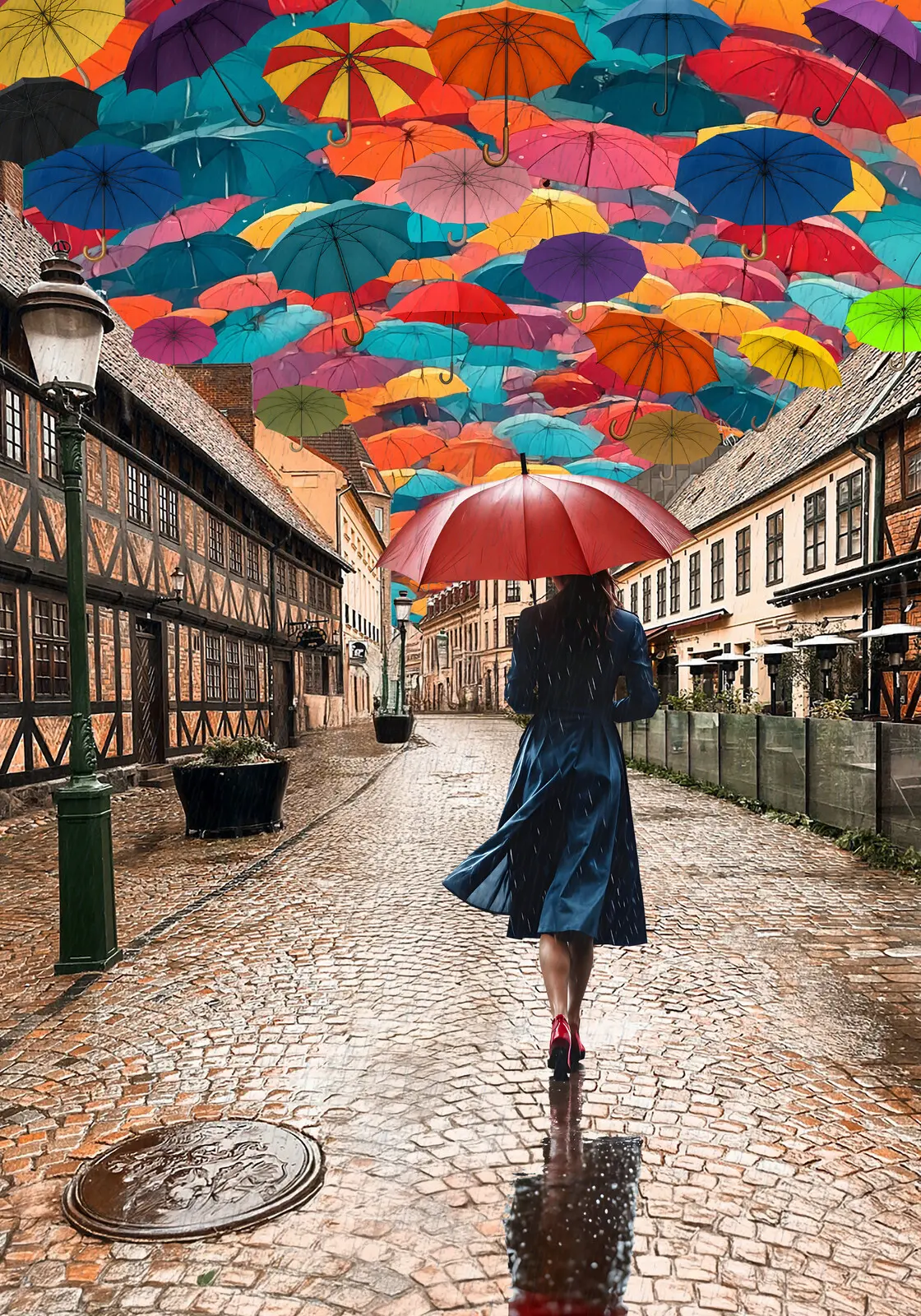
Jörgen Thornberg
It's raining umbrellas, 2025
Digital
50 x 70 cm
3 200 kr
It's raining umbrellas
Umbrellas, often unnoticed in their ubiquity, reveal a surprising beauty when it rains. Suddenly, they blossom like flowers on a grey street, their fabric domes and ribs transforming mundane pavements into vibrant displays of color and form. They are not just functional, but also strangely poetic: a portable roof, a miniature piece of architecture, a slice of the sky you can grasp.
Umbrellas do more than shield us from the elements. They offer a delicate promise of safety against the sun, the storm, and life's unexpected turns. But their true magic lies in their ability to foster intimacy, creating a small, shared world with a friend, a stranger, or a lover. The umbrella is a paradox—both solitary and communal, ordinary and magical, protective and sometimes perilous. It's this paradox that makes them so intriguing and worthy of contemplation.
From ancient empires to Parisian boulevards, from Mary Poppins to the Umbrella Revolution, this small object has traversed a vast arc through culture, history, and imagination. In literature, it has been used as a symbol of protection and comfort, as seen in the works of Charles Dickens and Jane Austen. In art, it has been a recurring motif, from the impressionist paintings of Paris to contemporary street art. In history, it has been a tool of protest and revolution, as seen in the Umbrella Movement in Hong Kong. To follow the umbrella’s story is to follow humanity’s ongoing effort to create meaning from necessity, to turn shelter into a symbol, and to find joy even amidst the storm. This historical journey of umbrellas is both enlightening and engaging, offering a new perspective on their cultural and symbolic significance.
“A Jolly Poem of Umbrellas
In Egypt’s heat, the pharaohs knew,
a shade of feathers overhead would do.
Attendants marched with pomp and pride,
a portable sky at the ruler’s side.
In Athens, maidens strolled with flair,
parasols twirling in summer air.
Aristophanes laughed in a comic play,
“Those little canopies save the day!”
In Rome, they called it umbella, shade,
bronze and wood by artisans made.
Pliny wrote with a scholar’s pen,
“Civilised folk need shade again.”
In Paris streets with silken glow,
umbrellas opened to steal the show.
A dandy twirled, a lady sighed,
the rain was beaten, the style supplied.
Then Mary Poppins flew away,
her parrot-head led the children’s play.
While Gene Kelly danced in puddles wide,
his umbrella swung like a joyful guide.
But beware the tale of Markov’s pain,
an umbrella’s tip delivered bane.
What shields from rain can also kill,
a paradox born of human will.
Yet mostly they bloom when skies are grey,
a chorus of colours in bright array.
Upside down or right side up, they say,
umbrellas bring laughter along the way.”
Malmö. October 2025
It's raining umbrellas.
The rain falls gently over Larochégatan, the cobblestones shimmering beneath a sky that cannot decide whether to bless or burden. Along the narrow street at Lilla Torg in Malmö, an umbrella unfurls like a secret universe. A delicate dome of fabric and ribs, yet sufficient to create intimacy—a private world within the storm. An umbrella is more than just shelter; it is a symbol of safety, of the warmth of human closeness, but also of life’s constant unpredictability. Just as clouds gather without warning, so too do moments of joy or sorrow arrive unannounced. Opening an umbrella is embracing uncertainty while still claiming a space of one’s own beneath the heavens.
Origin – A Roof in the Hand
The umbrella’s lineage, stretching deep into human history, predates the merchants of Malmö’s Lilla Torg and the busy streets of Paris or London. It traces back to a time when people carried something for protection, even before the development of fabric or steel ribs. These were bare acts of survival, reflecting the human instinct to create a portable shelter, a small refuge from the weather.
By the time of ancient Mesopotamia and Egypt, the umbrella had evolved into a symbol of power and status. It was no longer just a shelter; it became a sign and emblem. Pharaohs were shaded by grand parasols mounted on poles, carried by attendants as if the sky itself had been captured and fixed above their heads. In Mesopotamian reliefs, rulers stand beneath canopies decorated with feathers, an artificial firmament that proclaims their divine right.
The Greeks inherited this art of shelter. In Athens, women commonly used parasols, both to protect themselves from the harsh Mediterranean sunlight and as a symbol of elegance. Aristophanes makes jokes about them in his comedies; vase paintings depict maidens with slender parasols, carried as much for style as for shade. By the time the Romans expanded their empire, umbrellas—umbella, from umbra, shade—had become objects of refinement. Wealthy women carried them through the Forum, some collapsible, with ribs made from fine wood or bronze. Pliny the Elder even mentions them in his writings, as if to say: civilisation is not only roads and aqueducts, but also the luxury of walking under one’s own sky. This shift from a symbol of power to a symbol of elegance in Greece and Rome marks a significant change in the umbrella's cultural importance, encouraging us to explore its history and symbolism more deeply.
In China, long before Europe paid attention, umbrellas were refined with lacquered paper stretched over bamboo, some crafted to open and close using clever mechanisms. Here, they served more than just practical purposes: they were thoughtful gifts, tokens of respect, and symbols of status. The emperor’s yellow parasol was not merely a defence from the sun—it represented cosmic centrality, a reminder that the ruler was beneath Heaven’s mandate. This underscores the umbrella's role as a symbol of authority and divine protection across different cultures, a role that commands admiration and reverence. Similarly, in other societies, umbrellas have been used in religious and spiritual rites, further enhancing their symbolic importance.
Umbrellas have also played a significant role in literature and art, further strengthening their cultural and symbolic importance. From the iconic scene in Mary Poppins to the use of umbrellas as a metaphor in poetry, they have inspired many artists. This paradoxical nature of the umbrella, its ability to be both a simple tool and a symbol of status, makes it a unique and captivating object of study, sparking our curiosity about its multifaceted character.
Luxury and Status – When Umbrellas Were Jewels
By the seventeenth and eighteenth centuries in Europe, the umbrella had undergone a remarkable transformation. No longer a mere necessity, it had evolved into a coveted luxury item. The reed or feathered parasols of antiquity had given way to works of art: silk canopies dyed in rare hues, edged with lace, their ribs made from whalebone or ivory. Handles gleamed with silver filigree or even gold, carved into lions’ heads or topped with gemstones. Carrying such an item was not just about shielding oneself from the rain but about displaying refinement and asserting one’s status, not only above the weather but also above the crowd. This shift of the umbrella into a luxury item in Europe forms a captivating chapter in its history, capturing our interest in its cultural and symbolic significance.
In Paris, dandies strolled the boulevards with umbrellas so ornate they seemed more suitable for salons than streets. In London, the umbrella became a symbol of modernity. Jonas Hanway, a British philanthropist and traveller, is often credited with popularising the umbrella's use among men in the mid-1700s. Despite being initially ridiculed and jeered at as he walked beneath his canopy, his persistence and the practicality of the umbrella eventually won over the public. Yet within decades, the fashion spread—what was once eccentric became essential.
There are tales of royal umbrellas so lavish they verge on the absurd. In France, Louis XIV’s court had parasols embroidered with gold thread, carried by servants as a symbol of their privileged status. In Japan, the wagasa, lacquered in deep vermilion, was transported in processions with ceremonial dignity, its presence signalling the arrival of nobility. In India, the royal chatra—an umbrella of grand proportions—was so central to kingship that it appeared on coins and temple carvings, representing divine protection. The role of umbrellas in Japan and India, as symbols of nobility and divine guardianship, offers a fascinating global perspective on the cultural significance of the umbrella.
These were not objects to be forgotten, dripping in a café corner. They were heirlooms, artefacts of prestige. To lose one would be a scandal; to display one was to be crowned with invisible authority. Even today, some umbrellas retain this aura: the haute couture designs, the limited editions, the crafted pieces with handles of mahogany or silver. An umbrella can still whisper status as surely as a tailored suit or a jewelled watch, reminding us of the enduring allure of these luxurious items.
Despite their elegance, these jewelled umbrellas remind us of the fine line between necessity and decoration. What started as a shield against sun or rain became an expression of vanity, a display of wealth unfolding on every street. Yet, even in their extravagance, the ancient truth remains: to carry an umbrella is to bring a roof, a private sky, a portable sanctuary—sometimes simple, sometimes adorned with jewels.
On Film and in Stories – The Magical Instrument
If history cloaked the umbrella in silk and gold, it was the power of storytelling that gave it wings. Perhaps no image is more enduring than Mary Poppins, floating serenely above London rooftops, carried not by an aircraft or spell but by her parrot-headed umbrella. It is the perfect symbol of the ordinary turned extraordinary: a household object transformed into a key to freedom, wonder, and escape. Children saw in her umbrella the possibility that anything at hand might contain magic; adults recognised the comfort of protection that could also uplift.
Cinema has long celebrated umbrellas. In Jacques Demy’s “The Umbrellas of Cherbourg”, they are not just props but the very title, woven into every scene of heartbreak and longing. Rows of bright canopies become symbols of love’s fragility under the downpour of fate. In contrast, Hollywood’s most joyful rain scene features Gene Kelly in “Singin’ in the Rain”. Here, the umbrella becomes a dance partner, twirled and tilted, less a shield than an instrument of happiness. Rain is no longer something to fear; with an umbrella in hand, it becomes a rhythm, a source of laughter, and music.
Even beyond the cinema, the umbrella features in storybooks and folklore. In fairy tales, it often appears as a protector, shielding characters from the elements or from evil forces. In comics, it can be a quirky weapon, used for both defence and offence. In satire, it becomes a symbol of bourgeois pretentiousness, a tool used to mock the upper class's self-importance. Writers and artists revisit it repeatedly because it is both familiar and strange: an everyday object that, when opened, suddenly transforms into something architectural, theatrical, and dynamic.
The magical umbrella reveals a more profound truth—that protection can also set us free. The same canopy that shields us from rain can, in imagination, lift us into the sky or draw us into a love song's choreography. The umbrella reminds us that even the most ordinary tools in life may hold their own secret journeys.
In History – Shelter, Power, and Protest
The umbrella has always been more than fabric stretched over ribs; it has symbolised who belongs under its shadow. In colonial times, soldiers and administrators carried parasols through blazing sun, a silent emblem of authority imported from Europe into unfamiliar lands. A collapsible canopy was as much a mark of rank as the uniform itself. This object declared: I am protected, I command, I endure the elements with dignity while others labour beneath them.
Centuries later, the umbrella reemerges not as a symbol of empire but of resistance. In 2014, the streets of Hong Kong were filled with demonstrators who raised umbrellas not against rain, but against tear gas and pepper spray. The bright nylon shields bobbing above the crowd transformed overnight into the icon of a movement—the Umbrella Revolution. What began as defence became a declaration: fragile fabric against the machinery of the state, hope against suppression. The umbrella, in this context, symbolised the power of the people, their resilience, and their refusal to be silenced.
Even beyond such dramatic clashes, umbrellas have long been a form of political theatre. Leaders are photographed underneath them, and diplomats pass them to each other as gestures of courtesy or slight. A dignitary refusing an umbrella in the rain signals toughness; one accepting it displays humility or civility. The canopy becomes a silent language, part of the choreography of power.
And yet, the umbrella is not always in the hands of rulers or rebels. Sometimes, it simply represents the dignity of the ordinary person, their portable shelter in times of uncertainty. A worker trudging home in the rain, a mother holding her child close under the canopy—these images speak as powerfully of history as any procession or protest. In such moments, the umbrella reminds us that history is not only written in palaces or squares but also in small acts of endurance, shelter, and finding space beneath the storm. It is a symbol of everyday resilience, a tool that transcends its cultural and historical significance to provide practical comfort and protection.
In Art and Music – A Pattern in the World
The unique shape of the umbrella has long captivated artists. A closed umbrella, a mere stick with a promise, transforms into a circle of ribs and panels when opened, a portable mandala against the sky. Claude Monet's depictions of umbrellas as shimmering patches of colour in gardens and along beaches, their canopies mirroring the roundness of the sun they tried to resist, are a testament to this fascination. In addition to Monet, artists like René Magritte and his 'Golconda' painting, where umbrellas are used to create a surreal landscape, and Yayoi Kusama's 'Ascension of Polka Dots on the Trees' installation, where umbrellas are used to create a vibrant, polka-dotted environment, further illustrate the artistic appeal of umbrellas. In Japanese woodblock prints, the lacquered wagasa appears as both decoration and shield, a splash of vermilion or indigo set against rain-slicked streets.
In recent times, umbrellas have been transformed into installations, with hundreds hung over narrow streets in Portugal and Turkey, forming kaleidoscopic ceilings that turn alleys into festivals of light. Such works remind us that an umbrella is never solely solitary; it is part of a larger pattern, one canopy among many, creating rhythm and harmony when viewed together.
Music, too, has assumed the mantle. Jazz and blues bands have flocked through the streets of New Orleans, their musicians twirling umbrellas as an extension of the rhythm and swing. The parasol becomes percussion, a visual beat. In musicals, umbrellas are as much instruments as props: they open and close on cue, click in sync with the rhythm of tap shoes, and flare like wings in a chorus line. From Singin’ in the Rain to Mary Poppins, the umbrella dances as surely as any human body.
There is an intriguing poetry in this: the umbrella, intended for protection, becomes in art a symbol of expression. Instead of concealing us, it reveals us—our colours, our movements, our patterns in the world. Under its canopy, we are both sheltered and observable. This duality of the umbrella, as a symbol of both protection and expression, reflects the complexity of human experience. It serves as a reminder that even in our most vulnerable moments, we possess the capacity for creativity and self-expression.
Macabre Umbrella Stories
Despite its charm, the umbrella also casts a shadow. Few objects so seemingly harmless have been so skillfully turned into tools of harm. The most notorious story is that of Georgi Markov, the Bulgarian dissident murdered in London in 1978. On Waterloo Bridge, he felt the sharp prick of a tip pressed against his leg—an umbrella belonging to a stranger. Within hours, he was dead, poisoned by a tiny pellet of ricin delivered through what should have been a shield against the rain. An item meant for protection had become a weapon of cruel ingenuity.
But Markov’s case is not unique in illustrating the paradox of the umbrella. There are tales of duels fought with umbrellas, comic scuffles where they became canes, cudgels, or makeshift swords. Newspapers in the nineteenth century delighted in recounting skirmishes where umbrellas were wielded as much for dignity as for defence. A lady’s parasol, with its steel tip, could jab as sharply as a rapier; a gentleman’s black umbrella could fracture as many bones as a truncheon. This transformation of the umbrella from a symbol of elegance and protection to a tool of violence and intrigue reflects the changing social dynamics and power structures of the time.
Something is unsettling about this inversion. The umbrella, designed to shield us from the storms of nature, becomes a symbol of human turmoil—anger, violence, intrigue. Its ribs are the same, and its canopy remains unchanged; only its purpose shifts, transforming it from a haven into a threat. This ambiguity captures the essence of the umbrella’s symbolic power: it reminds us that even the most innocent object can conceal darkness, and that shelter and peril can sometimes be intertwined.
Umbrellas Spread Joy
Despite the shadows, umbrellas often bring joy. They brighten grey weather not just with their colours but with their very presence. A red canopy against a leaden sky is a statement: the day might be dull, but I am not. In a sudden shower, laughter erupts when two people share a single umbrella, bumping shoulders, pulling closer, discovering intimacy beneath the fabric’s dome. This joyous interaction, this dance of shared shelter, is a beautiful testament to the human spirit.
On city streets, rows of umbrellas form a living dance, bobbing and weaving to the rhythm of falling rain. They are accidental dancers, creating patterns of circles and arcs, like notes on a score written by the weather. Children twirl them for play, transforming rain into a performance; lovers kiss beneath them, shielded from the world yet drawn closer to one another.
Joy appears not only in the visual burst of vivid canopies but also in the rituals they prompt. To carry an umbrella is to be prepared, but to open it in sudden rain is to partake in a collective gesture. We look around and see others doing the same, and for a moment, the street becomes united—a single organism responding to the sky. That simple act—an umbrella blooming overhead—can turn drudgery into spectacle, loneliness into kinship. This shared experience, this sense of unity in the face of adversity, is a powerful reminder of our interconnectedness.
Umbrellas remind us that happiness isn't always found in sunshine; sometimes it resides in stepping out into the storm, raising a canopy, and noticing colour where the world has attempted to turn grey.
Heaven Falls, We Unfold
Ultimately, the umbrella is more than just an object; it serves as a metaphor for the human spirit. We cannot prevent the rain, storms, or the unpredictable skies of our lives. However, we can choose to open something delicate yet resilient, a canopy that turns chaos into closeness, fear into playfulness. Every umbrella reminds us that we are not powerless before the heavens; we carry within us the ability to create shelter, colour, even beauty amidst uncertainty. This resilience, this ability to find beauty in the midst of chaos, is a powerful reminder of our strength and adaptability.
On Larochégatan at Lilla Torg in Malmö, the rain often arrives, sudden and unwelcome. Yet with every opening canopy, a new world emerges: small domes of shelter, circles of light and laughter beneath the clouds. To walk that street when it rains is to see not only umbrellas but humanity itself—fragile, inventive, defiant, joyful.
And so, the umbrella becomes spiritual: a portable sky, a reminder that the storm does not have the last word. When heaven falls, we unfold.
Quotes about Umbrellas
“A banker is a fellow who lends you his umbrella when the sun is shining, but wants it back the minute it begins to rain.” – Mark Twain.
(Ironic yet accurate: a sharp comment on power and conditional generosity.)
“An umbrella is of no use unless it is open.” – proverb
(Simple but symbolic: protection and hope require action.)
“The mind is like an umbrella—it functions best when open.” – Walter Gropius.
(The architect and Bauhaus founder turned the umbrella into an image of openness and creativity.)
“Bring an umbrella. Judgement falls like rain.” – Margaret Atwood
(Poetic and ominous, classic Atwood, where the umbrella becomes protection against more than weather.)
“Life isn’t about waiting for the storm to pass. It’s about learning to dance in the rain.” – Vivian Greene.
(Often quoted; directly connected to Singin’ in the Rain and the joy of umbrellas.)
“The umbrella is the comfort of the rain, the shade of the sun, the shield of the crowd.” – anonymous proverb.
(A phrase that fits perfectly with the spiritual tone of the umbrella as both shelter and symbol.)
Jörgen Thornberg
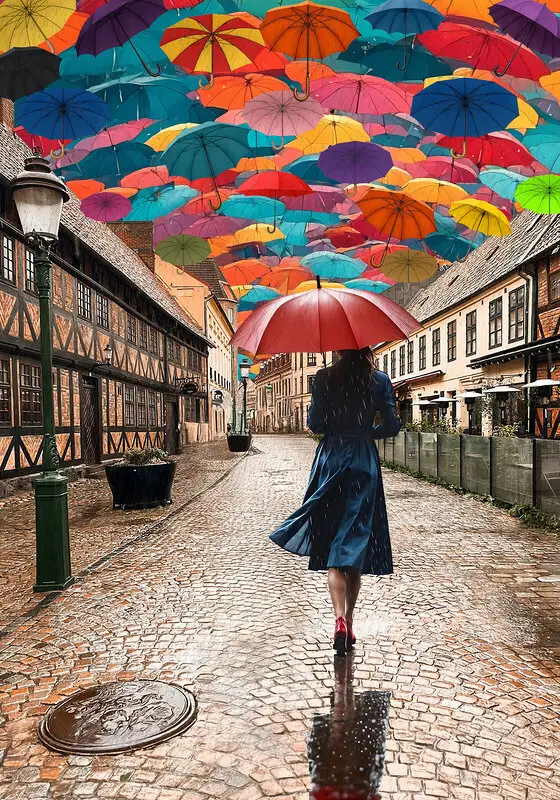
It's raining umbrellas, 2025
Digital
50 x 70 cm
3 200 kr
It's raining umbrellas
Umbrellas, often unnoticed in their ubiquity, reveal a surprising beauty when it rains. Suddenly, they blossom like flowers on a grey street, their fabric domes and ribs transforming mundane pavements into vibrant displays of color and form. They are not just functional, but also strangely poetic: a portable roof, a miniature piece of architecture, a slice of the sky you can grasp.
Umbrellas do more than shield us from the elements. They offer a delicate promise of safety against the sun, the storm, and life's unexpected turns. But their true magic lies in their ability to foster intimacy, creating a small, shared world with a friend, a stranger, or a lover. The umbrella is a paradox—both solitary and communal, ordinary and magical, protective and sometimes perilous. It's this paradox that makes them so intriguing and worthy of contemplation.
From ancient empires to Parisian boulevards, from Mary Poppins to the Umbrella Revolution, this small object has traversed a vast arc through culture, history, and imagination. In literature, it has been used as a symbol of protection and comfort, as seen in the works of Charles Dickens and Jane Austen. In art, it has been a recurring motif, from the impressionist paintings of Paris to contemporary street art. In history, it has been a tool of protest and revolution, as seen in the Umbrella Movement in Hong Kong. To follow the umbrella’s story is to follow humanity’s ongoing effort to create meaning from necessity, to turn shelter into a symbol, and to find joy even amidst the storm. This historical journey of umbrellas is both enlightening and engaging, offering a new perspective on their cultural and symbolic significance.
“A Jolly Poem of Umbrellas
In Egypt’s heat, the pharaohs knew,
a shade of feathers overhead would do.
Attendants marched with pomp and pride,
a portable sky at the ruler’s side.
In Athens, maidens strolled with flair,
parasols twirling in summer air.
Aristophanes laughed in a comic play,
“Those little canopies save the day!”
In Rome, they called it umbella, shade,
bronze and wood by artisans made.
Pliny wrote with a scholar’s pen,
“Civilised folk need shade again.”
In Paris streets with silken glow,
umbrellas opened to steal the show.
A dandy twirled, a lady sighed,
the rain was beaten, the style supplied.
Then Mary Poppins flew away,
her parrot-head led the children’s play.
While Gene Kelly danced in puddles wide,
his umbrella swung like a joyful guide.
But beware the tale of Markov’s pain,
an umbrella’s tip delivered bane.
What shields from rain can also kill,
a paradox born of human will.
Yet mostly they bloom when skies are grey,
a chorus of colours in bright array.
Upside down or right side up, they say,
umbrellas bring laughter along the way.”
Malmö. October 2025
It's raining umbrellas.
The rain falls gently over Larochégatan, the cobblestones shimmering beneath a sky that cannot decide whether to bless or burden. Along the narrow street at Lilla Torg in Malmö, an umbrella unfurls like a secret universe. A delicate dome of fabric and ribs, yet sufficient to create intimacy—a private world within the storm. An umbrella is more than just shelter; it is a symbol of safety, of the warmth of human closeness, but also of life’s constant unpredictability. Just as clouds gather without warning, so too do moments of joy or sorrow arrive unannounced. Opening an umbrella is embracing uncertainty while still claiming a space of one’s own beneath the heavens.
Origin – A Roof in the Hand
The umbrella’s lineage, stretching deep into human history, predates the merchants of Malmö’s Lilla Torg and the busy streets of Paris or London. It traces back to a time when people carried something for protection, even before the development of fabric or steel ribs. These were bare acts of survival, reflecting the human instinct to create a portable shelter, a small refuge from the weather.
By the time of ancient Mesopotamia and Egypt, the umbrella had evolved into a symbol of power and status. It was no longer just a shelter; it became a sign and emblem. Pharaohs were shaded by grand parasols mounted on poles, carried by attendants as if the sky itself had been captured and fixed above their heads. In Mesopotamian reliefs, rulers stand beneath canopies decorated with feathers, an artificial firmament that proclaims their divine right.
The Greeks inherited this art of shelter. In Athens, women commonly used parasols, both to protect themselves from the harsh Mediterranean sunlight and as a symbol of elegance. Aristophanes makes jokes about them in his comedies; vase paintings depict maidens with slender parasols, carried as much for style as for shade. By the time the Romans expanded their empire, umbrellas—umbella, from umbra, shade—had become objects of refinement. Wealthy women carried them through the Forum, some collapsible, with ribs made from fine wood or bronze. Pliny the Elder even mentions them in his writings, as if to say: civilisation is not only roads and aqueducts, but also the luxury of walking under one’s own sky. This shift from a symbol of power to a symbol of elegance in Greece and Rome marks a significant change in the umbrella's cultural importance, encouraging us to explore its history and symbolism more deeply.
In China, long before Europe paid attention, umbrellas were refined with lacquered paper stretched over bamboo, some crafted to open and close using clever mechanisms. Here, they served more than just practical purposes: they were thoughtful gifts, tokens of respect, and symbols of status. The emperor’s yellow parasol was not merely a defence from the sun—it represented cosmic centrality, a reminder that the ruler was beneath Heaven’s mandate. This underscores the umbrella's role as a symbol of authority and divine protection across different cultures, a role that commands admiration and reverence. Similarly, in other societies, umbrellas have been used in religious and spiritual rites, further enhancing their symbolic importance.
Umbrellas have also played a significant role in literature and art, further strengthening their cultural and symbolic importance. From the iconic scene in Mary Poppins to the use of umbrellas as a metaphor in poetry, they have inspired many artists. This paradoxical nature of the umbrella, its ability to be both a simple tool and a symbol of status, makes it a unique and captivating object of study, sparking our curiosity about its multifaceted character.
Luxury and Status – When Umbrellas Were Jewels
By the seventeenth and eighteenth centuries in Europe, the umbrella had undergone a remarkable transformation. No longer a mere necessity, it had evolved into a coveted luxury item. The reed or feathered parasols of antiquity had given way to works of art: silk canopies dyed in rare hues, edged with lace, their ribs made from whalebone or ivory. Handles gleamed with silver filigree or even gold, carved into lions’ heads or topped with gemstones. Carrying such an item was not just about shielding oneself from the rain but about displaying refinement and asserting one’s status, not only above the weather but also above the crowd. This shift of the umbrella into a luxury item in Europe forms a captivating chapter in its history, capturing our interest in its cultural and symbolic significance.
In Paris, dandies strolled the boulevards with umbrellas so ornate they seemed more suitable for salons than streets. In London, the umbrella became a symbol of modernity. Jonas Hanway, a British philanthropist and traveller, is often credited with popularising the umbrella's use among men in the mid-1700s. Despite being initially ridiculed and jeered at as he walked beneath his canopy, his persistence and the practicality of the umbrella eventually won over the public. Yet within decades, the fashion spread—what was once eccentric became essential.
There are tales of royal umbrellas so lavish they verge on the absurd. In France, Louis XIV’s court had parasols embroidered with gold thread, carried by servants as a symbol of their privileged status. In Japan, the wagasa, lacquered in deep vermilion, was transported in processions with ceremonial dignity, its presence signalling the arrival of nobility. In India, the royal chatra—an umbrella of grand proportions—was so central to kingship that it appeared on coins and temple carvings, representing divine protection. The role of umbrellas in Japan and India, as symbols of nobility and divine guardianship, offers a fascinating global perspective on the cultural significance of the umbrella.
These were not objects to be forgotten, dripping in a café corner. They were heirlooms, artefacts of prestige. To lose one would be a scandal; to display one was to be crowned with invisible authority. Even today, some umbrellas retain this aura: the haute couture designs, the limited editions, the crafted pieces with handles of mahogany or silver. An umbrella can still whisper status as surely as a tailored suit or a jewelled watch, reminding us of the enduring allure of these luxurious items.
Despite their elegance, these jewelled umbrellas remind us of the fine line between necessity and decoration. What started as a shield against sun or rain became an expression of vanity, a display of wealth unfolding on every street. Yet, even in their extravagance, the ancient truth remains: to carry an umbrella is to bring a roof, a private sky, a portable sanctuary—sometimes simple, sometimes adorned with jewels.
On Film and in Stories – The Magical Instrument
If history cloaked the umbrella in silk and gold, it was the power of storytelling that gave it wings. Perhaps no image is more enduring than Mary Poppins, floating serenely above London rooftops, carried not by an aircraft or spell but by her parrot-headed umbrella. It is the perfect symbol of the ordinary turned extraordinary: a household object transformed into a key to freedom, wonder, and escape. Children saw in her umbrella the possibility that anything at hand might contain magic; adults recognised the comfort of protection that could also uplift.
Cinema has long celebrated umbrellas. In Jacques Demy’s “The Umbrellas of Cherbourg”, they are not just props but the very title, woven into every scene of heartbreak and longing. Rows of bright canopies become symbols of love’s fragility under the downpour of fate. In contrast, Hollywood’s most joyful rain scene features Gene Kelly in “Singin’ in the Rain”. Here, the umbrella becomes a dance partner, twirled and tilted, less a shield than an instrument of happiness. Rain is no longer something to fear; with an umbrella in hand, it becomes a rhythm, a source of laughter, and music.
Even beyond the cinema, the umbrella features in storybooks and folklore. In fairy tales, it often appears as a protector, shielding characters from the elements or from evil forces. In comics, it can be a quirky weapon, used for both defence and offence. In satire, it becomes a symbol of bourgeois pretentiousness, a tool used to mock the upper class's self-importance. Writers and artists revisit it repeatedly because it is both familiar and strange: an everyday object that, when opened, suddenly transforms into something architectural, theatrical, and dynamic.
The magical umbrella reveals a more profound truth—that protection can also set us free. The same canopy that shields us from rain can, in imagination, lift us into the sky or draw us into a love song's choreography. The umbrella reminds us that even the most ordinary tools in life may hold their own secret journeys.
In History – Shelter, Power, and Protest
The umbrella has always been more than fabric stretched over ribs; it has symbolised who belongs under its shadow. In colonial times, soldiers and administrators carried parasols through blazing sun, a silent emblem of authority imported from Europe into unfamiliar lands. A collapsible canopy was as much a mark of rank as the uniform itself. This object declared: I am protected, I command, I endure the elements with dignity while others labour beneath them.
Centuries later, the umbrella reemerges not as a symbol of empire but of resistance. In 2014, the streets of Hong Kong were filled with demonstrators who raised umbrellas not against rain, but against tear gas and pepper spray. The bright nylon shields bobbing above the crowd transformed overnight into the icon of a movement—the Umbrella Revolution. What began as defence became a declaration: fragile fabric against the machinery of the state, hope against suppression. The umbrella, in this context, symbolised the power of the people, their resilience, and their refusal to be silenced.
Even beyond such dramatic clashes, umbrellas have long been a form of political theatre. Leaders are photographed underneath them, and diplomats pass them to each other as gestures of courtesy or slight. A dignitary refusing an umbrella in the rain signals toughness; one accepting it displays humility or civility. The canopy becomes a silent language, part of the choreography of power.
And yet, the umbrella is not always in the hands of rulers or rebels. Sometimes, it simply represents the dignity of the ordinary person, their portable shelter in times of uncertainty. A worker trudging home in the rain, a mother holding her child close under the canopy—these images speak as powerfully of history as any procession or protest. In such moments, the umbrella reminds us that history is not only written in palaces or squares but also in small acts of endurance, shelter, and finding space beneath the storm. It is a symbol of everyday resilience, a tool that transcends its cultural and historical significance to provide practical comfort and protection.
In Art and Music – A Pattern in the World
The unique shape of the umbrella has long captivated artists. A closed umbrella, a mere stick with a promise, transforms into a circle of ribs and panels when opened, a portable mandala against the sky. Claude Monet's depictions of umbrellas as shimmering patches of colour in gardens and along beaches, their canopies mirroring the roundness of the sun they tried to resist, are a testament to this fascination. In addition to Monet, artists like René Magritte and his 'Golconda' painting, where umbrellas are used to create a surreal landscape, and Yayoi Kusama's 'Ascension of Polka Dots on the Trees' installation, where umbrellas are used to create a vibrant, polka-dotted environment, further illustrate the artistic appeal of umbrellas. In Japanese woodblock prints, the lacquered wagasa appears as both decoration and shield, a splash of vermilion or indigo set against rain-slicked streets.
In recent times, umbrellas have been transformed into installations, with hundreds hung over narrow streets in Portugal and Turkey, forming kaleidoscopic ceilings that turn alleys into festivals of light. Such works remind us that an umbrella is never solely solitary; it is part of a larger pattern, one canopy among many, creating rhythm and harmony when viewed together.
Music, too, has assumed the mantle. Jazz and blues bands have flocked through the streets of New Orleans, their musicians twirling umbrellas as an extension of the rhythm and swing. The parasol becomes percussion, a visual beat. In musicals, umbrellas are as much instruments as props: they open and close on cue, click in sync with the rhythm of tap shoes, and flare like wings in a chorus line. From Singin’ in the Rain to Mary Poppins, the umbrella dances as surely as any human body.
There is an intriguing poetry in this: the umbrella, intended for protection, becomes in art a symbol of expression. Instead of concealing us, it reveals us—our colours, our movements, our patterns in the world. Under its canopy, we are both sheltered and observable. This duality of the umbrella, as a symbol of both protection and expression, reflects the complexity of human experience. It serves as a reminder that even in our most vulnerable moments, we possess the capacity for creativity and self-expression.
Macabre Umbrella Stories
Despite its charm, the umbrella also casts a shadow. Few objects so seemingly harmless have been so skillfully turned into tools of harm. The most notorious story is that of Georgi Markov, the Bulgarian dissident murdered in London in 1978. On Waterloo Bridge, he felt the sharp prick of a tip pressed against his leg—an umbrella belonging to a stranger. Within hours, he was dead, poisoned by a tiny pellet of ricin delivered through what should have been a shield against the rain. An item meant for protection had become a weapon of cruel ingenuity.
But Markov’s case is not unique in illustrating the paradox of the umbrella. There are tales of duels fought with umbrellas, comic scuffles where they became canes, cudgels, or makeshift swords. Newspapers in the nineteenth century delighted in recounting skirmishes where umbrellas were wielded as much for dignity as for defence. A lady’s parasol, with its steel tip, could jab as sharply as a rapier; a gentleman’s black umbrella could fracture as many bones as a truncheon. This transformation of the umbrella from a symbol of elegance and protection to a tool of violence and intrigue reflects the changing social dynamics and power structures of the time.
Something is unsettling about this inversion. The umbrella, designed to shield us from the storms of nature, becomes a symbol of human turmoil—anger, violence, intrigue. Its ribs are the same, and its canopy remains unchanged; only its purpose shifts, transforming it from a haven into a threat. This ambiguity captures the essence of the umbrella’s symbolic power: it reminds us that even the most innocent object can conceal darkness, and that shelter and peril can sometimes be intertwined.
Umbrellas Spread Joy
Despite the shadows, umbrellas often bring joy. They brighten grey weather not just with their colours but with their very presence. A red canopy against a leaden sky is a statement: the day might be dull, but I am not. In a sudden shower, laughter erupts when two people share a single umbrella, bumping shoulders, pulling closer, discovering intimacy beneath the fabric’s dome. This joyous interaction, this dance of shared shelter, is a beautiful testament to the human spirit.
On city streets, rows of umbrellas form a living dance, bobbing and weaving to the rhythm of falling rain. They are accidental dancers, creating patterns of circles and arcs, like notes on a score written by the weather. Children twirl them for play, transforming rain into a performance; lovers kiss beneath them, shielded from the world yet drawn closer to one another.
Joy appears not only in the visual burst of vivid canopies but also in the rituals they prompt. To carry an umbrella is to be prepared, but to open it in sudden rain is to partake in a collective gesture. We look around and see others doing the same, and for a moment, the street becomes united—a single organism responding to the sky. That simple act—an umbrella blooming overhead—can turn drudgery into spectacle, loneliness into kinship. This shared experience, this sense of unity in the face of adversity, is a powerful reminder of our interconnectedness.
Umbrellas remind us that happiness isn't always found in sunshine; sometimes it resides in stepping out into the storm, raising a canopy, and noticing colour where the world has attempted to turn grey.
Heaven Falls, We Unfold
Ultimately, the umbrella is more than just an object; it serves as a metaphor for the human spirit. We cannot prevent the rain, storms, or the unpredictable skies of our lives. However, we can choose to open something delicate yet resilient, a canopy that turns chaos into closeness, fear into playfulness. Every umbrella reminds us that we are not powerless before the heavens; we carry within us the ability to create shelter, colour, even beauty amidst uncertainty. This resilience, this ability to find beauty in the midst of chaos, is a powerful reminder of our strength and adaptability.
On Larochégatan at Lilla Torg in Malmö, the rain often arrives, sudden and unwelcome. Yet with every opening canopy, a new world emerges: small domes of shelter, circles of light and laughter beneath the clouds. To walk that street when it rains is to see not only umbrellas but humanity itself—fragile, inventive, defiant, joyful.
And so, the umbrella becomes spiritual: a portable sky, a reminder that the storm does not have the last word. When heaven falls, we unfold.
Quotes about Umbrellas
“A banker is a fellow who lends you his umbrella when the sun is shining, but wants it back the minute it begins to rain.” – Mark Twain.
(Ironic yet accurate: a sharp comment on power and conditional generosity.)
“An umbrella is of no use unless it is open.” – proverb
(Simple but symbolic: protection and hope require action.)
“The mind is like an umbrella—it functions best when open.” – Walter Gropius.
(The architect and Bauhaus founder turned the umbrella into an image of openness and creativity.)
“Bring an umbrella. Judgement falls like rain.” – Margaret Atwood
(Poetic and ominous, classic Atwood, where the umbrella becomes protection against more than weather.)
“Life isn’t about waiting for the storm to pass. It’s about learning to dance in the rain.” – Vivian Greene.
(Often quoted; directly connected to Singin’ in the Rain and the joy of umbrellas.)
“The umbrella is the comfort of the rain, the shade of the sun, the shield of the crowd.” – anonymous proverb.
(A phrase that fits perfectly with the spiritual tone of the umbrella as both shelter and symbol.)
3 200 kr

Jörgen Thornberg
Malmö
Lite om bilder och mig. Translation in English at the end.
Jag är en nyfiken person som ser allt i bilder, även det jag fäster i ord, gärna tillsammans för bakom alla mina bilder finns en berättelse. Till vissa bilder hör en kortare eller längre novell som följer med bilden.
Bilder berättar historier. Jag omges av naturlig skönhet, intressanta människor och historia var jag än går. Jag använder min kamera för att dokumentera världen och blanda det jag ser med vad jag känner för att fånga den dolda magin.
Mina bilder berättar mina historier. Genom mina bilder, tryck och berättelser. Jag bjuder in dig att ta del av dessa berättelser, in i ditt liv och hem och dela min mycket personliga syn på vår värld. Mer än vad ögat ser. Jag tänker i bilder, drömmer och skriver och pratar om dem; följaktligen måste jag också skapa bilder. De blir vad jag ser, inte nödvändigtvis begränsade till verkligheten. Det finns en bild runt varje hörn. Jag hoppas att du kommer att se vad jag såg och gilla det.
Jag är också en skrivande person och till många bilder hör en kortare eller längre essay. Den följer med tavlan, tryckt på fint papper och med en personlig hälsning från mig.
Flertalet bilder startar sin resa i min kamera. Enkelt förklarat beskriver jag bilden jag ser i mitt inre, upplevd eller fantiserad. Bilden uppstår inom mig redan innan jag fått okularet till ögat. På bråkdelen av ett ögonblick ser jag vad jag vill ha och vad som kan göras med bilden. Här skall jag stoppa in en giraff, stålmannen, Titanic eller vad det är min fantasi finner ut. Ännu märkligare är att jag kommer ihåg minnesbilden långt efteråt när det blir tid att skapa verket. Om jag lyckas eller inte, är upp till betraktaren, oftast präglat av en stråk av svart humor – meningen är att man skall bli underhållen. Mina bilder blir ofta en snackis där de hänger.
Jag föredrar bilder som förmedlar ett budskap i flera lager. Vid första anblicken fylld av feel-good, en vacker utsikt, fint väder, solen skiner, blommor på ängen eller vattnet som ligger förrädiskt spegelblankt. I en sådan bild kan jag gömma min egentliga berättelse, mitt förakt för förtryckare och våldsverkare, rasister och fördomsfulla människor - ett gärna återkommande motiv mer eller mindre dolt i det vackra motivet. Jag försöker förena dem i ett gemensamt narrativ.
Bild och formgivning har löpt som en röd tråd genom livet. Fotokonst känns som en värdig final som jag gärna delar med mig.
Min genre är vid som framgår av mina bilder, temat en blandning av pop- och gatukonst i kollage som kan bestå av hundratals lager. Vissa bilder kan ta veckor, andra någon dag innan det är dags att överlämna resultatet till printverkstaden. Fine Art Prints är digitala fotocollage. I dessa kollage sker rivandet, klippandet, pusslandet, målandet, ritandet och sprayningen digitalt. Det jag monterar in kan vara hundratals år gamla bilder som jag omsorgsfullt frilägger så att de ser ut att vara en del av tavlan men också bilder skapade av mig själv efter min egen fantasi. Därefter besöks printstudion och för vissa bilder numrera en limiterad upplaga (oftast 7 exemplar) och signera för hand. Vissa bilder kan köpas i olika format. Det är bara att fråga efter vilka. Gillar man en bild som är 70x100 men inte har plats på väggen, går den kanske att få i 50x70 cm istället. Frågan är fri.
Metoden Giclée eller Fine Art Print som det också kallas är det moderna sättet för framställning av grafisk konst. Villkoret för denna typ av utskrifter är att en högkvalitativ storformatskrivare används med åldersbeständigt färgpigment och konstnärspapper eller i förekommande fall på duk. Pappret som används möter de krav på livslängd som ställs av museer och gallerier. Normalt säljer jag mina bilder oinramade så att den nya ägaren själv kan bestämma hur de skall se ut, med eller utan passepartout färg på ram, med eller utan glas etc..
Under många år ställde jag bara ut på nätet, i valda grupper och på min egen Facebooksida - https://www.facebook.com/jorgen.thornberg.9
Jag finns också på en egen hemsida som tyvärr inte alltid är uppdaterad – https://www.jth.life/ Där kan du också läsa en del av de berättelser som följer med bilden.
UTSTÄLLNINGAR
Luftkastellet, oktober 2022
Konst i Lund, november 2022
Luftkastellet, mars 2023
Engleson Galleri Caroli, april 2023
Hydra, Greece June 2023
Engleson Galleri Caroli, oktober 2023
Toppen, Höllviken december 2023
Luftkastellet, mars 2024
Torups Galleri, mars 2024
Venice, May 2024
Luftkastellet, oktober 2024
Konst i Advent, December 2024
Galleri Engleson, Caroli December 2024
Jäger & Jansson Galleri, april 2025
A bit about pictures and me.
I'm a curious person who sees everything in pictures, even what I express in words, often combining them, for behind all my pictures lies a story. These narratives, some as short as a single image and others as long as a novel, are the heart and soul of my work.
Pictures tell stories. Wherever I go, I'm surrounded by natural beauty, exciting people, and history. I use my camera to document the world and blend what I see with what I feel to capture the hidden magic.
My images tell my stories. Through my pictures, prints, and narratives, I invite you to partake in these stories in your life and home and share my deeply personal perspective of our world. More than meets the eye. I think in pictures, dream, write, and talk about them; consequently, I must create images too. They become what I see, not necessarily confined to reality. There's a picture around every corner. I hope you'll see what I saw and enjoy it.
I'm also a writer, and many images come with a shorter or longer essay. It accompanies the painting, printed on fine paper with my personal greeting.
Many pictures start their journey on my camera. Simply put, I describe the image I see in my mind, experienced or imagined. The image arises within me even before I bring the eyepiece to my eye. In a fraction of a moment, I see what I want and what can be done with the picture. Here, I'll insert a giraffe, Superman, the Titanic, or whatever my imagination conjures up. Even stranger is that I remember the mental image long after it's time to create the work. Whether I succeed is up to the observer, often imbued with a streak of black humour – the aim is to entertain. My pictures usually become a talking point wherever they hang.
I prefer pictures that convey a message in multiple layers. At first glance, they're filled with feel-good vibes, a beautiful view, lovely weather, the sun shining, flowers in the meadow, or the water lying deceptively calm. But beneath this surface beauty, I often conceal a deeper story, a narrative that challenges societal norms or explores the human condition. I invite you to delve into these hidden narratives and discover the layers of meaning within my work.
Picture and design have been a thread running through my life. Photographic art feels like a fitting finale, and I'm happy to share it.
My genre is varied, as seen in my pictures; the theme is a blend of pop and street art in collages that can consist of hundreds of layers. Some images can take weeks, others just a day before it's time to hand over the result to the print workshop. Fine Art Prints are digital photo collages. In these collages, tearing, cutting, puzzling, painting, drawing, and spraying happen digitally. What I insert can be images hundreds of years old that I carefully extract so they appear to be part of the painting, but also images created by myself, now also generated from my imagination. Next, visit the print studio and, for certain images, number a limited edition (usually 7 copies) and sign them by hand. Some images may be available in other formats. Just ask which ones. If you like an image that's 70x100 but doesn't have space on the wall, you might be able to get it in 50x70 cm instead. The question is open.
The Giclée method, or Fine Art Print as it's also called, is the modern way of producing graphic art. This method ensures the highest quality and longevity of the artwork, using a high-quality large-format printer with archival pigment inks and artist paper or, in some cases, canvas. The paper used meets the longevity requirements set by museums and galleries. I sell my pictures unframed, allowing the new owner to personalise their artwork, confident in the lasting value and quality of the piece.
For many years, I only exhibited online, in selected groups, and on my Facebook page - https://www.facebook.com/jorgen.thornberg.9. I also have my website, which unfortunately is not constantly updated - https://www.jth.life/. You can also read some of the stories accompanying the pictures there.
EXHIBITIONS
Luftkastellet, October 2022
Art in Lund, November 2022
Luftkastellet, March 2023
Engleson Gallery Caroli, April 2023
Hydra, Greece June 2023
Engleson Gallery Caroli, October 2023
Toppen, Höllviken December 2023
Luftkastellet, March 2024
Torup Gallery, March 2024
Venice, May 2024
UTSTÄLLNINGAR
Luftkastellet, oktober 2022
Konst i Lund, november 2022
Luftkastellet, mars 2023
Engleson Galleri Caroli, april 2023
Hydra, Greece June 2023
Engleson Galleri Caroli, oktober 2023
Toppen, Höllviken december 2023
Luftkastellet, mars 2024
Torups Galleri, mars 2024
Venice, May 2024
Luftkastellet, October 2024
Konst i Advent, December 2024
Galleri Engleson, Caroli December 2024
Jäger & Jansson Galleri, April 2025
Utbildning
Autodidakt
Medlem i konstnärsförening
Öppna Sinnen
Med i konstrunda
Konstrundan i Skåne
Utställningar
Luftkastellet, October 2022
Art in Lund, November 2022
Luftkastellet, March 2023
Engleson Gallery Caroli, April 2023
Hydra, Greece June 2023
Engleson Gallery Caroli, October 2023
Toppen, Höllviken December 2023
Luftkastellet, March 2024
Torup Gallery, March 2024
Venice, May 2024