Vi använder cookies för att ge dig bästa möjliga upplevelse. Välj vilka cookies du tillåter.
Läs mer i vår integritetspolicy
Jörgen Thornberg
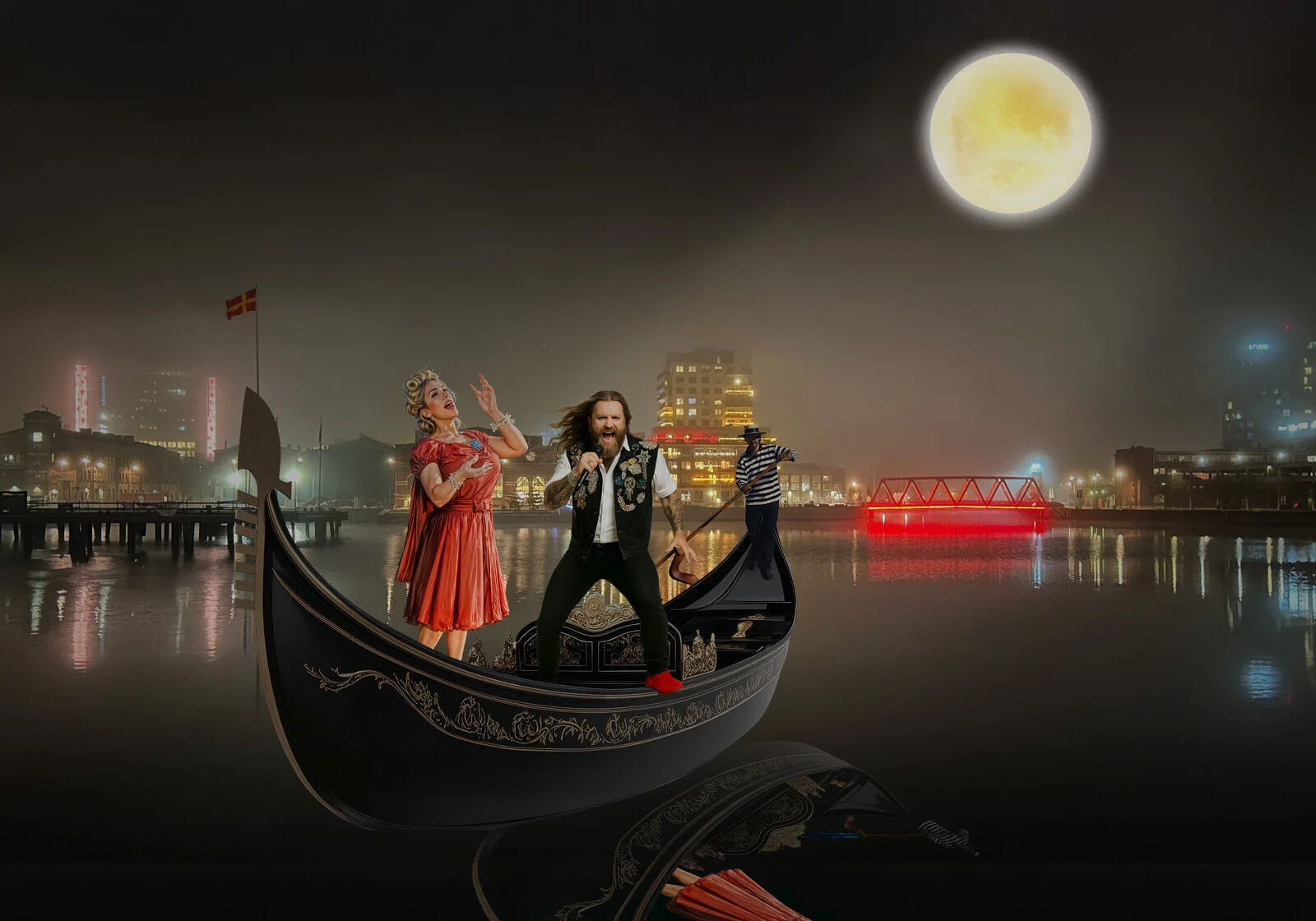
Pearls in the Basin - Rickard and Bianca Assoluta, 2025
Digital
70 x 50 cm
3 200 kr
Pearls in the Basin - Rickard and Bianca Assoluta
Everything begins by the sea. The movement of the waves, the force of the wind, the harbour’s sounds of labour and song. In the world of opera, the coast has often been the stage for love and fateful encounters – from Wagner’s ghost ship to Britten’s fishing villages. And at the heart of this tradition stands Bizet’s The Pearl Fishers, a tale born in 19th-century Paris yet carrying themes of love, loyalty, and reconciliation that are so timeless that they can be reborn wherever people gather by the water. This opera resonates with the universal human experience, making it a story that transcends time and place.
When Malmö hosts The Pearl Fishers in the dock basin of Varvsstaden, it is not a return to the exotic backdrops of the past, but an experience that reflects the city itself. Here, where the sparks of Kockums once lit up the sky and where more than fifty languages are spoken on the streets, the opera gains new significance, deeply rooted in the city's history. This reflection of Malmö's history fills us with a sense of local pride. Love, friendship, and betrayal resonate differently in a city shaped by migration, labour, and the aspiration for a better life.
It is a framing that appeals to both those who love opera’s grand emotions and those curious to see how a classic work can resonate today. In the encounter between Bizet’s music and Malmö’s diversity, a story emerges that is both familiar and fresh. The pearls at the bottom of the sea become symbols of longing, hope, and reconciliation – just as much now as in the 19th century. This contemporary relevance highlights issues of migration and community, making the opera a reflection of our modern world. The symbolic use of water and cityscape in staging creates an immersive and visually stunning experience for the audience.
“Pearls of Fire
Beneath the moon on waters wide,
Two friends once swore, side by side,
That love would never break their bond,
Yet fate was cruel, the vow undone.
For Leïla’s eyes, both hearts did yearn,
And friendship’s fire began to burn.
Zurga, torn by love and pride,
Judged his brother, stood aside.
But mercy came through memory’s flame,
Her chain revealed her saving name.
He lit the fire not to destroy,
But to grant the lovers joy.
So sails the tale from shore to shore,
Of jealous hearts and vows no more.
Yet in Malmö’s dock, beneath the stars,
It lives anew on gondolas.
Rickard’s voice, both fierce and clear,
With Bianca’s jewels rings sincere.
Opera’s past and present blend,
A tale of loss that learns to mend.”
Malmö. September 2025
Pearls in the Basin - Rickard and Bianca Assoluta
Imagine a gondola journey that seamlessly transitions from the elegance of opera to the raw energy of a rock concert, all under the enchanting glow of a full August moon. This is the extraordinary stage where the classical operatic diva Bianca Castafiori and tenor Rickard Söderberg share a gondola, breathing new life into Les pêcheurs de perles with a fusion of dramatic opera and hard rock. The gondolier, in his iconic striped shirt, sets the rhythm, while the remnants of Kockums' shipyard and the glowing red bridge form a backdrop where past and present collide in a luminous tension.
Rickard—as a radical tenor, beloved cultural figure, and queer icon—stands both in contrast to and as a reflection of Bianca’s exaggerated diva persona. A singer who relishes blending opera with activism, he intones “O Dieu Brahma” in the gondola alongside the fictional Bianca Castafiori—Tintin’s own operatic prima donna with her passion for the Jewel Song—here reimagined in Malmö’s Varvsstaden dock basin.
The dock basin itself, with its industrial echoes from the shipyard era, functions as a raw maritime stage where operatic drama unfolds. The full moon, the lights reflecting on the water, and the red bridge evoke both the romantic intimacy of Venetian barcarolles and the stormy seascapes of Wagner. Yet on this night, Bizet’s Les pêcheurs de perles was performed: a poignant story of friendship and love, a timeless tale of humanity’s eternal quest for happiness and meaning.
Rickard plays Nadir, one of the two pearl fishers whose close friendship with Zurga is tested when both fall in love with the same priestess, Leïla. Zurga, elected as the leader of his people, oversees a community that believes in the myth of a great pearl hidden on the seabed—possibly, in this staging, beneath the eelgrass of the dock basin itself. The opera is not just a series of arias but a fabric woven of duets and choruses, each vital to the development of the tense triangular relationship and the struggle for both love and honour.
The gondola, while not directly linked to the opera’s original theme, serves as a platform for a vibrant operatic spectacle. Les pêcheurs de perles was never meant to centre on pearls or Ceylon. The libretto, written by Michel Carré and Eugène Cormon for the Opéra-Comique in 1863, reflects the era’s fascination with the exotic and was initially imagined as a story set in Mexico among indigenous peoples, rather than in Sri Lanka among “Indians.” In today’s multicultural Malmö, it's easy to envisage alternative locations for such a drama. Modern productions have reinterpreted the story in contemporary settings, and now, why not—a gondola in the Varvsstaden basin, as a nod to Malmö's diverse cultural landscape? The gondola, in this context, symbolises the fluidity and adaptability of opera, capable of being reimagined in any setting without losing its essence.
Carré and Cormon combined familiar romantic tropes into their new intrigue: The priestess is committed to chastity, echoing Spontini’s La vestale and Bellini’s Norma.
The taboo of forbidden love, recalling Halévy’s La juive.
The exoticised temple dancer of Auber and Scribe’s Le dieu et la bayadère.
The oath of male friendship is broken by passion, a theme as old as Verdi’s Il trovatore. Thus, the opera’s core emerged: two men (Nadir and Zurga), one woman (Leïla), a broken vow, and a seacoast backdrop that promised the allure of “distant seas” to Paris audiences, invoking a sense of wonder and fascination.
One cannot help but recall the most powerful triangle in history: Cleopatra, Julius Caesar, and Mark Antony. Two men united by loyalty, yet later turned rivals in love and authority. Caesar and Antony belonged to the same political circle; eventually, Antony would form a triumvirate with Caesar and Octavian. Like Nadir and Zurga, they started as friends and colleagues, only to be torn apart by their passion for the same woman.
The woman is simultaneously an individual and a symbol. Leïla represents religious taboo; Cleopatra is both an object of desire and the ruler of Egypt. Both make love politically volatile.
There is also the issue of broken vows and their repercussions. Nadir breaches his sworn promise to renounce Leïla, just as Antony betrays Rome by siding with Cleopatra against Octavian—a political treachery as well as a personal one.
Exoticism is also a constant—Bizet’s Paris evoked fantasies of Mexico and Ceylon. Roman and later European images of Alexandria and Cleopatra depicted similar themes: distant, alluring, and dangerous.
The ceremonial life of the harbour city is central to both stories. In Les pêcheurs de perles, it revolves around the temple rituals; in Cleopatra’s case, it is the calculated splendour of her appearances. This is most evident in her legendary entry at Tarsus on the Cydnus (41 BCE) to meet Antony. Plutarch describes a barge turned into a floating theatre: sails of purple scented with incense, silver oars beating in time to music, Cleopatra reclining like Aphrodite beneath a golden canopy, surrounded by handmaids resembling nereids and little gods, while the perfume smoke drifted over the water.
The people of Tarsus abandoned Antony in the marketplace to rush to the riverside, to see “Aphrodite come ashore to meet Dionysus.” It was the archetypal marine entrance, love and politics staged as myth. A scene of sensuality, power, and theatre—reborn in Malmö’s Varvsbassäng with the same dramaturgy: water, procession, spectacle, authority. Zurga’s final self-sacrifice mirrors the ancient moral choice. Antony and Cleopatra choose each other and fall together; in Bizet’s opera, the lovers are freed, but only at the cost of Zurga’s honour and life, a moment of grandeur and drama.
Naturally, there are differences. Les pêcheurs de perles is an intimate tragedy focused on the theme of religious taboo. The ancient drama served as a public arena for empires and world history. However, as a mythic structure—featuring two bonded men, a fateful woman, and the harbour and sea as the stage—the comparison is clear, highlighting the depth and richness of the operatic tradition.
And above all: what voices!
The Finale of The Pearl Fishers
The finale of The Pearl Fishers is a tale of loyalty, betrayal, and reconciliation. Zurga, burdened with the responsibility of both leader and judge, faces the ultimate decision between his duty to his people and the love he once cherished when he realises that Leïla is not only the beloved of his rival but also the woman who once saved his life. His perspective shifts.
What initially appears to be a tale of jealousy and treachery turns into a story of forgiveness. Fire, which generally signifies punishment and purification, is transformed in Zurga’s hands into a tool of salvation. By setting the camp alight, he causes panic and chaos; yet, in reality, he paves a way to freedom for Leïla and Nadir.
Here, the opera’s central themes converge: the weight of duty, the power of love, the betrayal of friendship, and the possibility of forgiveness. Zurga undergoes a profound transformation, sacrificing his own honour, and perhaps his life, so that the lovers may live. His act transforms him from executioner to liberator, from rival to the one who ultimately secures love’s triumph.
It is a resolution echoing ancient tragedy, where the hero attains greatness only through sacrifice. Simultaneously, it exudes intense romanticism, reflecting the 19th century’s focus on the conflict between inner emotion and societal duty. In the glow of the flames, Zurga emerges as the true protagonist, whose inner journey concludes the story with a tone of both sorrow and reconciliation.
The Pearl Fishers in Malmö – An Opera in the Dock Basin
Malmö, a city by the sea, once illuminated by the sparks of its shipyards, and now a place where people from around the world gather, played a significant role in the performance of The Pearl Fishers. When the opera was staged in the dock basin of Varvsstaden, it was no longer an exotic fantasy from 19th-century Paris but a story for our own time—set in a city where more than half of its residents have roots in other countries. The town itself became a character in the opera, enhancing the cultural adaptation aspect.
The stage was the Varvsbassängen, framed by the old Kockums buildings and the red bridge rising in the background, with the orchestra seated beneath it. Bizet’s music was performed from gondolas and barges, while the chorus spread out along the quays and construction scaffolds, as though Malmö itself had entered the drama.
The costumes displayed a rich tapestry of influences from various cultures: Indian fabrics were fused with Somali patterns, while Balkan embroidery was combined with Swedish working-class attire. In Leïla’s figure, these traditions came together; she became the symbol of the city itself—multicoloured, composite, carrying both burden and hope.
In the Malmö adaptation of The Pearl Fishers, the tale of the great pearl at the ocean's depths was transformed into a symbol of the pursuit of a better life —a dream brought across seas and borders by generations of migrants. This unique interpretation added depth to the cultural adaptation aspect. When Zurga sets fire to the village in the finale, the flames become Malmö’s own transformation—a city in constant change, where destruction can lead to renewal.
The Pearl Fishers in Malmö is not just an opera about friendship, love, and betrayal, but above all about reconciliation. In the meeting between Bizet’s music and the city’s multicultural reality, something new arose: an opera in which Malmö itself was not just the stage, chorus, and protagonist, but the very heart and soul of the performance.
The Early History of The Pearl Fishers
Until rehearsals, the original version of The Pearl Fishers included several spoken dialogue scenes in the first two acts, following the tradition of the Opéra-Comique. The opera premiered on 30 September 1863, but its reception was mixed. Critics quickly divided their opinions on Bizet: some accused him of imitating Wagner, while others believed he wrote in the style of Verdi. A few dismissed the work altogether as a noisy spectacle. Only Berlioz appears to have recognised its true qualities.
Despite the initial mixed reception, Bizet, the composer of The Pearl Fishers, did not give up. He later referred to his own opera as his “brilliant failure.” In response to the criticism, he revised the work, trimmed the mass scenes and spectacle, and allowed the central conflicts of the protagonists to stand out more clearly. The opera was performed eighteen times during its first season, a significant achievement for a debut work, but then vanished from the repertoire. It did not return until 1886, when it was staged at La Scala in Milan.
Around this time, the music publisher Choudens began a series of revisions. The renowned duet between tenor and baritone in Act I lost its original triple-time allegro and returned to the slower andante of its opening. Benjamin Godard, a contemporary composer, composed an entirely new trio for Act III, “O lumière sainte.” The ending also changed: in one version, Zurga was burned at the stake, in another, he was stabbed in the back by an Indian.
The 1975 edition of The Pearl Fishers aimed to restore Bizet’s 1863 score, but since the original manuscript had been lost since the 1890s, Arthur Hammond was compelled to reorchestrate the missing passages. This was a significant undertaking, as it required a deep understanding of Bizet's style and intentions. Fortunately, a piano reduction from the year of the premiere was discovered, which enabled a reconstruction more faithful to Bizet’s orchestral intentions.
The opera gradually gained international recognition, extending beyond France. Its English premiere took place at Covent Garden in London on 22 April 1887, under the title Lëila. The Swedish premiere followed only on 5 November 1900, at the Royal Theatre in Stockholm. Yet, the dramaturgy of the Malmö dock basin overshadowed all of them.
Jörgen Thornberg
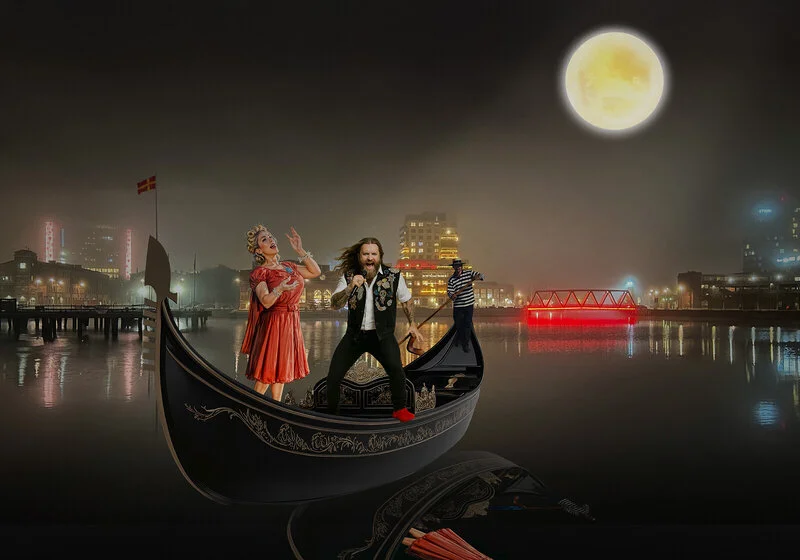
Pearls in the Basin - Rickard and Bianca Assoluta, 2025
Digital
70 x 50 cm
3 200 kr
Pearls in the Basin - Rickard and Bianca Assoluta
Everything begins by the sea. The movement of the waves, the force of the wind, the harbour’s sounds of labour and song. In the world of opera, the coast has often been the stage for love and fateful encounters – from Wagner’s ghost ship to Britten’s fishing villages. And at the heart of this tradition stands Bizet’s The Pearl Fishers, a tale born in 19th-century Paris yet carrying themes of love, loyalty, and reconciliation that are so timeless that they can be reborn wherever people gather by the water. This opera resonates with the universal human experience, making it a story that transcends time and place.
When Malmö hosts The Pearl Fishers in the dock basin of Varvsstaden, it is not a return to the exotic backdrops of the past, but an experience that reflects the city itself. Here, where the sparks of Kockums once lit up the sky and where more than fifty languages are spoken on the streets, the opera gains new significance, deeply rooted in the city's history. This reflection of Malmö's history fills us with a sense of local pride. Love, friendship, and betrayal resonate differently in a city shaped by migration, labour, and the aspiration for a better life.
It is a framing that appeals to both those who love opera’s grand emotions and those curious to see how a classic work can resonate today. In the encounter between Bizet’s music and Malmö’s diversity, a story emerges that is both familiar and fresh. The pearls at the bottom of the sea become symbols of longing, hope, and reconciliation – just as much now as in the 19th century. This contemporary relevance highlights issues of migration and community, making the opera a reflection of our modern world. The symbolic use of water and cityscape in staging creates an immersive and visually stunning experience for the audience.
“Pearls of Fire
Beneath the moon on waters wide,
Two friends once swore, side by side,
That love would never break their bond,
Yet fate was cruel, the vow undone.
For Leïla’s eyes, both hearts did yearn,
And friendship’s fire began to burn.
Zurga, torn by love and pride,
Judged his brother, stood aside.
But mercy came through memory’s flame,
Her chain revealed her saving name.
He lit the fire not to destroy,
But to grant the lovers joy.
So sails the tale from shore to shore,
Of jealous hearts and vows no more.
Yet in Malmö’s dock, beneath the stars,
It lives anew on gondolas.
Rickard’s voice, both fierce and clear,
With Bianca’s jewels rings sincere.
Opera’s past and present blend,
A tale of loss that learns to mend.”
Malmö. September 2025
Pearls in the Basin - Rickard and Bianca Assoluta
Imagine a gondola journey that seamlessly transitions from the elegance of opera to the raw energy of a rock concert, all under the enchanting glow of a full August moon. This is the extraordinary stage where the classical operatic diva Bianca Castafiori and tenor Rickard Söderberg share a gondola, breathing new life into Les pêcheurs de perles with a fusion of dramatic opera and hard rock. The gondolier, in his iconic striped shirt, sets the rhythm, while the remnants of Kockums' shipyard and the glowing red bridge form a backdrop where past and present collide in a luminous tension.
Rickard—as a radical tenor, beloved cultural figure, and queer icon—stands both in contrast to and as a reflection of Bianca’s exaggerated diva persona. A singer who relishes blending opera with activism, he intones “O Dieu Brahma” in the gondola alongside the fictional Bianca Castafiori—Tintin’s own operatic prima donna with her passion for the Jewel Song—here reimagined in Malmö’s Varvsstaden dock basin.
The dock basin itself, with its industrial echoes from the shipyard era, functions as a raw maritime stage where operatic drama unfolds. The full moon, the lights reflecting on the water, and the red bridge evoke both the romantic intimacy of Venetian barcarolles and the stormy seascapes of Wagner. Yet on this night, Bizet’s Les pêcheurs de perles was performed: a poignant story of friendship and love, a timeless tale of humanity’s eternal quest for happiness and meaning.
Rickard plays Nadir, one of the two pearl fishers whose close friendship with Zurga is tested when both fall in love with the same priestess, Leïla. Zurga, elected as the leader of his people, oversees a community that believes in the myth of a great pearl hidden on the seabed—possibly, in this staging, beneath the eelgrass of the dock basin itself. The opera is not just a series of arias but a fabric woven of duets and choruses, each vital to the development of the tense triangular relationship and the struggle for both love and honour.
The gondola, while not directly linked to the opera’s original theme, serves as a platform for a vibrant operatic spectacle. Les pêcheurs de perles was never meant to centre on pearls or Ceylon. The libretto, written by Michel Carré and Eugène Cormon for the Opéra-Comique in 1863, reflects the era’s fascination with the exotic and was initially imagined as a story set in Mexico among indigenous peoples, rather than in Sri Lanka among “Indians.” In today’s multicultural Malmö, it's easy to envisage alternative locations for such a drama. Modern productions have reinterpreted the story in contemporary settings, and now, why not—a gondola in the Varvsstaden basin, as a nod to Malmö's diverse cultural landscape? The gondola, in this context, symbolises the fluidity and adaptability of opera, capable of being reimagined in any setting without losing its essence.
Carré and Cormon combined familiar romantic tropes into their new intrigue: The priestess is committed to chastity, echoing Spontini’s La vestale and Bellini’s Norma.
The taboo of forbidden love, recalling Halévy’s La juive.
The exoticised temple dancer of Auber and Scribe’s Le dieu et la bayadère.
The oath of male friendship is broken by passion, a theme as old as Verdi’s Il trovatore. Thus, the opera’s core emerged: two men (Nadir and Zurga), one woman (Leïla), a broken vow, and a seacoast backdrop that promised the allure of “distant seas” to Paris audiences, invoking a sense of wonder and fascination.
One cannot help but recall the most powerful triangle in history: Cleopatra, Julius Caesar, and Mark Antony. Two men united by loyalty, yet later turned rivals in love and authority. Caesar and Antony belonged to the same political circle; eventually, Antony would form a triumvirate with Caesar and Octavian. Like Nadir and Zurga, they started as friends and colleagues, only to be torn apart by their passion for the same woman.
The woman is simultaneously an individual and a symbol. Leïla represents religious taboo; Cleopatra is both an object of desire and the ruler of Egypt. Both make love politically volatile.
There is also the issue of broken vows and their repercussions. Nadir breaches his sworn promise to renounce Leïla, just as Antony betrays Rome by siding with Cleopatra against Octavian—a political treachery as well as a personal one.
Exoticism is also a constant—Bizet’s Paris evoked fantasies of Mexico and Ceylon. Roman and later European images of Alexandria and Cleopatra depicted similar themes: distant, alluring, and dangerous.
The ceremonial life of the harbour city is central to both stories. In Les pêcheurs de perles, it revolves around the temple rituals; in Cleopatra’s case, it is the calculated splendour of her appearances. This is most evident in her legendary entry at Tarsus on the Cydnus (41 BCE) to meet Antony. Plutarch describes a barge turned into a floating theatre: sails of purple scented with incense, silver oars beating in time to music, Cleopatra reclining like Aphrodite beneath a golden canopy, surrounded by handmaids resembling nereids and little gods, while the perfume smoke drifted over the water.
The people of Tarsus abandoned Antony in the marketplace to rush to the riverside, to see “Aphrodite come ashore to meet Dionysus.” It was the archetypal marine entrance, love and politics staged as myth. A scene of sensuality, power, and theatre—reborn in Malmö’s Varvsbassäng with the same dramaturgy: water, procession, spectacle, authority. Zurga’s final self-sacrifice mirrors the ancient moral choice. Antony and Cleopatra choose each other and fall together; in Bizet’s opera, the lovers are freed, but only at the cost of Zurga’s honour and life, a moment of grandeur and drama.
Naturally, there are differences. Les pêcheurs de perles is an intimate tragedy focused on the theme of religious taboo. The ancient drama served as a public arena for empires and world history. However, as a mythic structure—featuring two bonded men, a fateful woman, and the harbour and sea as the stage—the comparison is clear, highlighting the depth and richness of the operatic tradition.
And above all: what voices!
The Finale of The Pearl Fishers
The finale of The Pearl Fishers is a tale of loyalty, betrayal, and reconciliation. Zurga, burdened with the responsibility of both leader and judge, faces the ultimate decision between his duty to his people and the love he once cherished when he realises that Leïla is not only the beloved of his rival but also the woman who once saved his life. His perspective shifts.
What initially appears to be a tale of jealousy and treachery turns into a story of forgiveness. Fire, which generally signifies punishment and purification, is transformed in Zurga’s hands into a tool of salvation. By setting the camp alight, he causes panic and chaos; yet, in reality, he paves a way to freedom for Leïla and Nadir.
Here, the opera’s central themes converge: the weight of duty, the power of love, the betrayal of friendship, and the possibility of forgiveness. Zurga undergoes a profound transformation, sacrificing his own honour, and perhaps his life, so that the lovers may live. His act transforms him from executioner to liberator, from rival to the one who ultimately secures love’s triumph.
It is a resolution echoing ancient tragedy, where the hero attains greatness only through sacrifice. Simultaneously, it exudes intense romanticism, reflecting the 19th century’s focus on the conflict between inner emotion and societal duty. In the glow of the flames, Zurga emerges as the true protagonist, whose inner journey concludes the story with a tone of both sorrow and reconciliation.
The Pearl Fishers in Malmö – An Opera in the Dock Basin
Malmö, a city by the sea, once illuminated by the sparks of its shipyards, and now a place where people from around the world gather, played a significant role in the performance of The Pearl Fishers. When the opera was staged in the dock basin of Varvsstaden, it was no longer an exotic fantasy from 19th-century Paris but a story for our own time—set in a city where more than half of its residents have roots in other countries. The town itself became a character in the opera, enhancing the cultural adaptation aspect.
The stage was the Varvsbassängen, framed by the old Kockums buildings and the red bridge rising in the background, with the orchestra seated beneath it. Bizet’s music was performed from gondolas and barges, while the chorus spread out along the quays and construction scaffolds, as though Malmö itself had entered the drama.
The costumes displayed a rich tapestry of influences from various cultures: Indian fabrics were fused with Somali patterns, while Balkan embroidery was combined with Swedish working-class attire. In Leïla’s figure, these traditions came together; she became the symbol of the city itself—multicoloured, composite, carrying both burden and hope.
In the Malmö adaptation of The Pearl Fishers, the tale of the great pearl at the ocean's depths was transformed into a symbol of the pursuit of a better life —a dream brought across seas and borders by generations of migrants. This unique interpretation added depth to the cultural adaptation aspect. When Zurga sets fire to the village in the finale, the flames become Malmö’s own transformation—a city in constant change, where destruction can lead to renewal.
The Pearl Fishers in Malmö is not just an opera about friendship, love, and betrayal, but above all about reconciliation. In the meeting between Bizet’s music and the city’s multicultural reality, something new arose: an opera in which Malmö itself was not just the stage, chorus, and protagonist, but the very heart and soul of the performance.
The Early History of The Pearl Fishers
Until rehearsals, the original version of The Pearl Fishers included several spoken dialogue scenes in the first two acts, following the tradition of the Opéra-Comique. The opera premiered on 30 September 1863, but its reception was mixed. Critics quickly divided their opinions on Bizet: some accused him of imitating Wagner, while others believed he wrote in the style of Verdi. A few dismissed the work altogether as a noisy spectacle. Only Berlioz appears to have recognised its true qualities.
Despite the initial mixed reception, Bizet, the composer of The Pearl Fishers, did not give up. He later referred to his own opera as his “brilliant failure.” In response to the criticism, he revised the work, trimmed the mass scenes and spectacle, and allowed the central conflicts of the protagonists to stand out more clearly. The opera was performed eighteen times during its first season, a significant achievement for a debut work, but then vanished from the repertoire. It did not return until 1886, when it was staged at La Scala in Milan.
Around this time, the music publisher Choudens began a series of revisions. The renowned duet between tenor and baritone in Act I lost its original triple-time allegro and returned to the slower andante of its opening. Benjamin Godard, a contemporary composer, composed an entirely new trio for Act III, “O lumière sainte.” The ending also changed: in one version, Zurga was burned at the stake, in another, he was stabbed in the back by an Indian.
The 1975 edition of The Pearl Fishers aimed to restore Bizet’s 1863 score, but since the original manuscript had been lost since the 1890s, Arthur Hammond was compelled to reorchestrate the missing passages. This was a significant undertaking, as it required a deep understanding of Bizet's style and intentions. Fortunately, a piano reduction from the year of the premiere was discovered, which enabled a reconstruction more faithful to Bizet’s orchestral intentions.
The opera gradually gained international recognition, extending beyond France. Its English premiere took place at Covent Garden in London on 22 April 1887, under the title Lëila. The Swedish premiere followed only on 5 November 1900, at the Royal Theatre in Stockholm. Yet, the dramaturgy of the Malmö dock basin overshadowed all of them.
3 200 kr

Jörgen Thornberg
Malmö
Lite om bilder och mig. Translation in English at the end.
Jag är en nyfiken person som ser allt i bilder, även det jag fäster i ord, gärna tillsammans för bakom alla mina bilder finns en berättelse. Till vissa bilder hör en kortare eller längre novell som följer med bilden.
Bilder berättar historier. Jag omges av naturlig skönhet, intressanta människor och historia var jag än går. Jag använder min kamera för att dokumentera världen och blanda det jag ser med vad jag känner för att fånga den dolda magin.
Mina bilder berättar mina historier. Genom mina bilder, tryck och berättelser. Jag bjuder in dig att ta del av dessa berättelser, in i ditt liv och hem och dela min mycket personliga syn på vår värld. Mer än vad ögat ser. Jag tänker i bilder, drömmer och skriver och pratar om dem; följaktligen måste jag också skapa bilder. De blir vad jag ser, inte nödvändigtvis begränsade till verkligheten. Det finns en bild runt varje hörn. Jag hoppas att du kommer att se vad jag såg och gilla det.
Jag är också en skrivande person och till många bilder hör en kortare eller längre essay. Den följer med tavlan, tryckt på fint papper och med en personlig hälsning från mig.
Flertalet bilder startar sin resa i min kamera. Enkelt förklarat beskriver jag bilden jag ser i mitt inre, upplevd eller fantiserad. Bilden uppstår inom mig redan innan jag fått okularet till ögat. På bråkdelen av ett ögonblick ser jag vad jag vill ha och vad som kan göras med bilden. Här skall jag stoppa in en giraff, stålmannen, Titanic eller vad det är min fantasi finner ut. Ännu märkligare är att jag kommer ihåg minnesbilden långt efteråt när det blir tid att skapa verket. Om jag lyckas eller inte, är upp till betraktaren, oftast präglat av en stråk av svart humor – meningen är att man skall bli underhållen. Mina bilder blir ofta en snackis där de hänger.
Jag föredrar bilder som förmedlar ett budskap i flera lager. Vid första anblicken fylld av feel-good, en vacker utsikt, fint väder, solen skiner, blommor på ängen eller vattnet som ligger förrädiskt spegelblankt. I en sådan bild kan jag gömma min egentliga berättelse, mitt förakt för förtryckare och våldsverkare, rasister och fördomsfulla människor - ett gärna återkommande motiv mer eller mindre dolt i det vackra motivet. Jag försöker förena dem i ett gemensamt narrativ.
Bild och formgivning har löpt som en röd tråd genom livet. Fotokonst känns som en värdig final som jag gärna delar med mig.
Min genre är vid som framgår av mina bilder, temat en blandning av pop- och gatukonst i kollage som kan bestå av hundratals lager. Vissa bilder kan ta veckor, andra någon dag innan det är dags att överlämna resultatet till printverkstaden. Fine Art Prints är digitala fotocollage. I dessa kollage sker rivandet, klippandet, pusslandet, målandet, ritandet och sprayningen digitalt. Det jag monterar in kan vara hundratals år gamla bilder som jag omsorgsfullt frilägger så att de ser ut att vara en del av tavlan men också bilder skapade av mig själv efter min egen fantasi. Därefter besöks printstudion och för vissa bilder numrera en limiterad upplaga (oftast 7 exemplar) och signera för hand. Vissa bilder kan köpas i olika format. Det är bara att fråga efter vilka. Gillar man en bild som är 70x100 men inte har plats på väggen, går den kanske att få i 50x70 cm istället. Frågan är fri.
Metoden Giclée eller Fine Art Print som det också kallas är det moderna sättet för framställning av grafisk konst. Villkoret för denna typ av utskrifter är att en högkvalitativ storformatskrivare används med åldersbeständigt färgpigment och konstnärspapper eller i förekommande fall på duk. Pappret som används möter de krav på livslängd som ställs av museer och gallerier. Normalt säljer jag mina bilder oinramade så att den nya ägaren själv kan bestämma hur de skall se ut, med eller utan passepartout färg på ram, med eller utan glas etc..
Under många år ställde jag bara ut på nätet, i valda grupper och på min egen Facebooksida - https://www.facebook.com/jorgen.thornberg.9
Jag finns också på en egen hemsida som tyvärr inte alltid är uppdaterad – https://www.jth.life/ Där kan du också läsa en del av de berättelser som följer med bilden.
UTSTÄLLNINGAR
Luftkastellet, oktober 2022
Konst i Lund, november 2022
Luftkastellet, mars 2023
Engleson Galleri Caroli, april 2023
Hydra, Greece June 2023
Engleson Galleri Caroli, oktober 2023
Toppen, Höllviken december 2023
Luftkastellet, mars 2024
Torups Galleri, mars 2024
Venice, May 2024
Luftkastellet, oktober 2024
Konst i Advent, December 2024
Galleri Engleson, Caroli December 2024
Jäger & Jansson Galleri, april 2025
A bit about pictures and me.
I'm a curious person who sees everything in pictures, even what I express in words, often combining them, for behind all my pictures lies a story. These narratives, some as short as a single image and others as long as a novel, are the heart and soul of my work.
Pictures tell stories. Wherever I go, I'm surrounded by natural beauty, exciting people, and history. I use my camera to document the world and blend what I see with what I feel to capture the hidden magic.
My images tell my stories. Through my pictures, prints, and narratives, I invite you to partake in these stories in your life and home and share my deeply personal perspective of our world. More than meets the eye. I think in pictures, dream, write, and talk about them; consequently, I must create images too. They become what I see, not necessarily confined to reality. There's a picture around every corner. I hope you'll see what I saw and enjoy it.
I'm also a writer, and many images come with a shorter or longer essay. It accompanies the painting, printed on fine paper with my personal greeting.
Many pictures start their journey on my camera. Simply put, I describe the image I see in my mind, experienced or imagined. The image arises within me even before I bring the eyepiece to my eye. In a fraction of a moment, I see what I want and what can be done with the picture. Here, I'll insert a giraffe, Superman, the Titanic, or whatever my imagination conjures up. Even stranger is that I remember the mental image long after it's time to create the work. Whether I succeed is up to the observer, often imbued with a streak of black humour – the aim is to entertain. My pictures usually become a talking point wherever they hang.
I prefer pictures that convey a message in multiple layers. At first glance, they're filled with feel-good vibes, a beautiful view, lovely weather, the sun shining, flowers in the meadow, or the water lying deceptively calm. But beneath this surface beauty, I often conceal a deeper story, a narrative that challenges societal norms or explores the human condition. I invite you to delve into these hidden narratives and discover the layers of meaning within my work.
Picture and design have been a thread running through my life. Photographic art feels like a fitting finale, and I'm happy to share it.
My genre is varied, as seen in my pictures; the theme is a blend of pop and street art in collages that can consist of hundreds of layers. Some images can take weeks, others just a day before it's time to hand over the result to the print workshop. Fine Art Prints are digital photo collages. In these collages, tearing, cutting, puzzling, painting, drawing, and spraying happen digitally. What I insert can be images hundreds of years old that I carefully extract so they appear to be part of the painting, but also images created by myself, now also generated from my imagination. Next, visit the print studio and, for certain images, number a limited edition (usually 7 copies) and sign them by hand. Some images may be available in other formats. Just ask which ones. If you like an image that's 70x100 but doesn't have space on the wall, you might be able to get it in 50x70 cm instead. The question is open.
The Giclée method, or Fine Art Print as it's also called, is the modern way of producing graphic art. This method ensures the highest quality and longevity of the artwork, using a high-quality large-format printer with archival pigment inks and artist paper or, in some cases, canvas. The paper used meets the longevity requirements set by museums and galleries. I sell my pictures unframed, allowing the new owner to personalise their artwork, confident in the lasting value and quality of the piece.
For many years, I only exhibited online, in selected groups, and on my Facebook page - https://www.facebook.com/jorgen.thornberg.9. I also have my website, which unfortunately is not constantly updated - https://www.jth.life/. You can also read some of the stories accompanying the pictures there.
EXHIBITIONS
Luftkastellet, October 2022
Art in Lund, November 2022
Luftkastellet, March 2023
Engleson Gallery Caroli, April 2023
Hydra, Greece June 2023
Engleson Gallery Caroli, October 2023
Toppen, Höllviken December 2023
Luftkastellet, March 2024
Torup Gallery, March 2024
Venice, May 2024
UTSTÄLLNINGAR
Luftkastellet, oktober 2022
Konst i Lund, november 2022
Luftkastellet, mars 2023
Engleson Galleri Caroli, april 2023
Hydra, Greece June 2023
Engleson Galleri Caroli, oktober 2023
Toppen, Höllviken december 2023
Luftkastellet, mars 2024
Torups Galleri, mars 2024
Venice, May 2024
Luftkastellet, October 2024
Konst i Advent, December 2024
Galleri Engleson, Caroli December 2024
Jäger & Jansson Galleri, April 2025
Utbildning
Autodidakt
Medlem i konstnärsförening
Öppna Sinnen
Med i konstrunda
Konstrundan i Skåne
Utställningar
Luftkastellet, October 2022
Art in Lund, November 2022
Luftkastellet, March 2023
Engleson Gallery Caroli, April 2023
Hydra, Greece June 2023
Engleson Gallery Caroli, October 2023
Toppen, Höllviken December 2023
Luftkastellet, March 2024
Torup Gallery, March 2024
Venice, May 2024