Vi använder cookies för att ge dig bästa möjliga upplevelse. Välj vilka cookies du tillåter.
Läs mer i vår integritetspolicy
Jörgen Thornberg
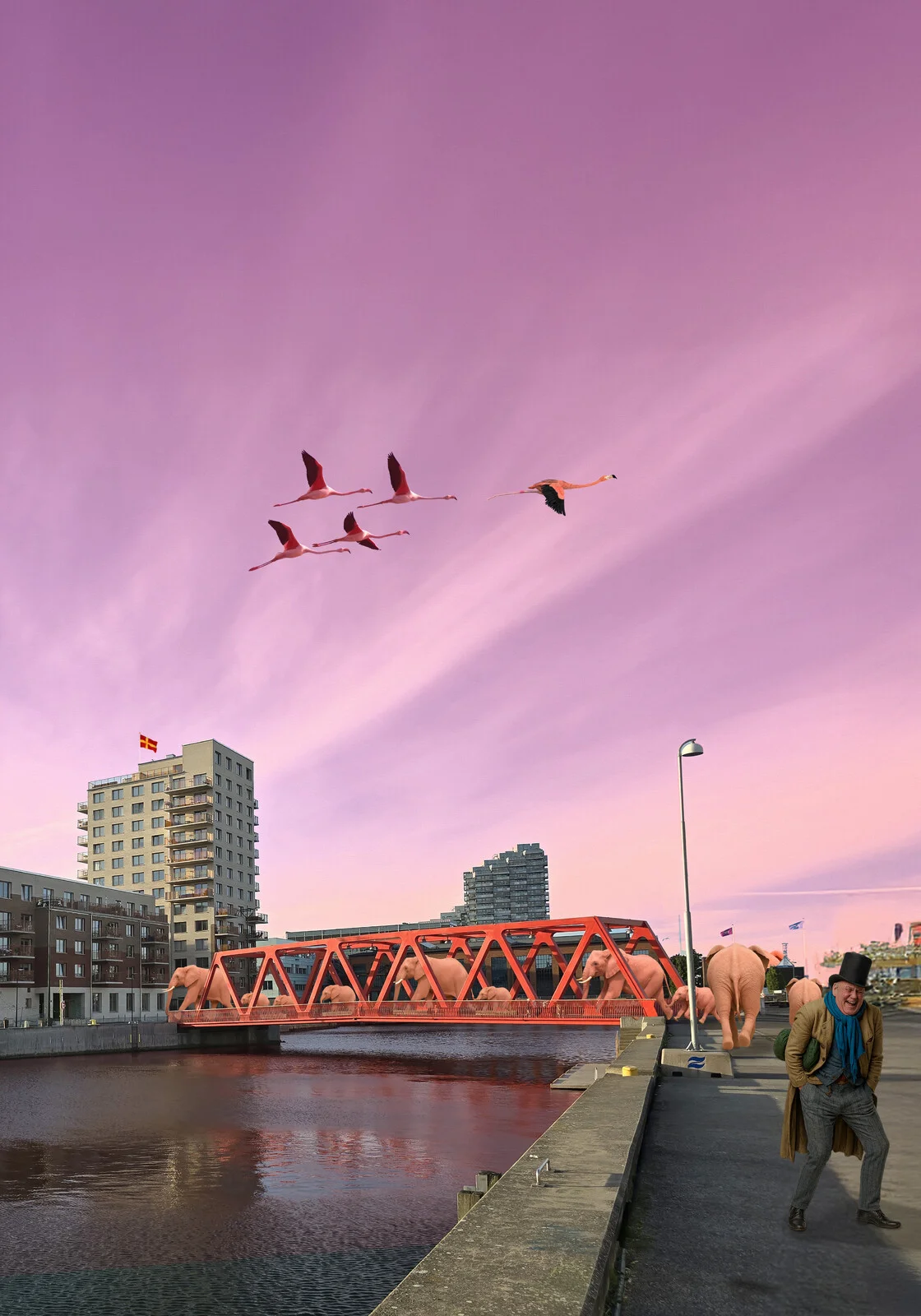
The Flamingo Quintet - The Pink Morning, 2025
Digital
50 x 70 cm
3 200 kr
The Flamingo Quintet - The Pink Morning
It starts with a bridge in Malmö, a city renowned for its distinctive mix of modernity and history, and a headache. A town where the surreal meets the contemporary, where the past and the present collide. The Pink Morning is a tale of five unique individuals, each with their own distinct charm and allure, much like the flamingos they are compared to.
A man, slightly intoxicated and newly in love, stumbles home at dawn after a summer party. Across Beijers Bridge, a surreal sight unfolds-a flock of pink elephants marches, while above him, a group of flamingos beats their wings like a storm. What follows is not just a hangover vision but a reflection on birds and beasts, on music and memory, on balance, beauty, and the absurd.
This is the story of The Flamingo Quintet, a Pink Sunday Morning—where dance halls meet shipyards, where science meets satire, and where flamingos and elephants reveal more about us than we dare to admit.
“The Pink Inside
Inside him beats a heart of rose,
not gentle blush but fever’s glow,
a drumline kept by thundering feet—
pink elephants across a bridge of steel.
His thoughts are rivers, red and raw,
memory’s tide from shipyard days,
yet now they flood with dizzy song,
with Flamingo quintet’s endless sway.
Above, the flamingos wheel and cry,
their wings a storm, their grace a jest,
and as they circle, one by one,
they bless the earth with rain of truth.
He laughs, though pain runs through his skull:
to live is messy, loud, absurd—
a man, an elephant, a bird,
all pink inside, all flawed, all free.”
Malmö. September 2025
The Flamingo Quintet - The Pink Morning
It was an early pink Sunday morning in Malmö, the kind of morning that shimmered between dream and daylight. Across Beijers Bridge in the old Varvsstaden district, a parade of pink elephants, a whimsical symbol of the night's revelry, thundered over the intensely red Beijer Bridge, their heavy steps echoing against the iron beams and rippling across the water below. This surreal sight was a prelude to the appearance of the flamingos, the true stars of the morning.
For the late-night wanderer – or, if one preferred, the early riser – the sound was impossible to ignore. It hammered in the head like the aftershock of a dance floor. Above, a quintet of flamingos swept across the sky, their wings slicing the rosy light with the force of a storm.
The man on the quay, still smiling despite his headache, laughed at the absurdity of it all. He had been dancing until dawn, twirling a newfound companion to the music of Flamingokvintetten, the Swedish dance orchestra whose tunes had carried him through decades. Their name now seemed almost prophetic, as if his night of revelry had conjured both flamingos and elephants into being.
The city around him – with its cranes, water, and steel – had transformed, but this morning it felt like a canvas for the imagination – a stage where dreams, animals, and memories blended into one improbable tableau, a testament to the beauty of change and the passage of time.
The Man and the Place
The man walked slowly along the quay, his steps heavy but his spirit oddly light. He was not just a relic from another era, but a living link to the city's history, a testament to the enduring spirit of Malmö. Once, he had been a chief engineer at Kockums, the mighty shipyard that had loomed here by the water, shaping the city's industrial past. His memories were intertwined with the city's industrial past, making the transformation of Varvsstaden all the more poignant.
Nowadays, Varvsstaden is a neighbourhood of flats, offices, and glass buildings. Yet in the shimmering morning haze, with pink elephants stomping across the iron bridge and flamingos wheeling above, it was as if the ghosts of the past had come back to dance with him.
He laughed again, despite his head aching. Memories of the night still lingered – the laughter, the dizziness, the unexpected joy of holding someone new in his arms as the orchestra played. His laughter, a testament to the enduring joy found in unexpected moments, echoed across the quay.
And yet, as he paused to look out over the water, another thought crossed his mind. Why does that strange bird stand on one leg? Is it a symbol of balance, or perhaps a metaphor for standing out in a crowd? The flamingo's unique stance could be seen as a metaphor for individuality, standing out from the crowd, and the balance one must strike in life.
The Nature of the Flamingo
The question lingered in his mind: why stand on one leg? The answer, though less whimsical than the vision before him, was no less remarkable. A flamingo’s one-legged stance was not a circus trick, but a marvel of physiology. By peculiarly locking its joints, the bird could rest its entire weight on a single leg without expending muscle energy. It was balance perfected, economy turned into elegance. The man marvelled at the bird's ability to turn a necessity into a graceful display, a lesson in efficiency and beauty.
And then there was the colour – that unlikely shade of undergarment pink, as if the birds had stepped out of a painter’s fantasy. But no, it did not come from whimsy, but from a diet rich in carotenoids: algae, brine shrimp, and other tiny creatures. They are what they eat, he thought, chuckling at the simplicity of it.
Even more peculiar, he thought, flamingos could change their hues according to circumstances. Parents raising young children often lose their vibrancy, paling as they devote their energy to nurturing their offspring. In the great colonies of Africa, such as Lake Nakuru, flamingos lived and bred in colourful masses, a “stand” when resting, a “flamboyance” when dancing. Same-sex pairs were also not uncommon—like Curtis and Arthur, two Chilean males who had successfully raised a chick from an abandoned egg. Nature, he mused, cares little for human categories.
They were social creatures, extravagant yet practical, delicate yet resilient. Their beauty was not a mere ornament but a necessity, a sign of health, of food well found, of life ongoing.
The man rubbed his temples and smiled. Perhaps he envied them: balanced, communal, unashamedly flamboyant. He couldn't help but admire the flamingos for their unique qualities and the way they embraced their individuality. His admiration for these creatures, so different from him yet so similar in their pursuit of life, filled him with a sense of wonder and appreciation.
The flamingo as a cultural symbol: a reflection of human desires and aspirations, symbolising balance, beauty, and boldness.
If nature had made flamingos extraordinary, culture had made them immortal. Their silhouettes had migrated far beyond the salt lakes of Africa or the lagoons of the Caribbean, into gardens, art galleries, living rooms, and dance halls.
A single pink flamingo placed on a suburban lawn could hold many meanings. For some, it represented nostalgia, a kitschy nod to the optimism of 1950s design. For others, it was a symbol of beauty, balance, and romance, quietly confirming the homeowner’s taste for elegance in plastic form. And in certain circles, he had heard, it was even a code—an invitation whispered in pastel feathers, a sign of openness to new encounters.
The flamingo, a long-standing muse in art and fashion, has been a symbol of extravagance and boldness. It has adorned dresses, added flair to paintings, and served as an emblem for those who dare to stand out. Its poise has even inspired motivational quotes: Stand tall. Stand out. Stand on one leg if you must.
Music, too, has been touched by the flamingo's influence. Flamingokvintetten, the beloved Swedish dance orchestra, has carried the bird’s name into dance halls across the country for over sixty years. Their songs, a part of countless romances, breakups, weddings, and summer nights, have made them not just a band, but a soundtrack to life itself.
The man thought: a bird this flamboyant could never be a bird. It had become a mirror of human longing—grace, glamour, and a touch of absurdity. Its flamboyance and vibrancy were not just a reflection of nature but a source of inspiration and energy.
To Be a Flamingo
“Always be yourself. Unless you can be a flamingo, then always be a flamingo.”
The phrase echoed in his mind like a riddle wrapped in laughter. At first, it sounded like nonsense, a playful twist on the old cliché of authenticity. But the longer he pondered it, the more it seemed to hold a kind of truth.
Being oneself was safe advice, the foundation of dignity. However, to be a flamingo—that was something entirely different. A flamingo was never timid, never dull, never hidden among the crowd. It was as vibrant as a sunrise, flamboyant as a carnival, and unashamed of its vibrancy. It balanced with ease, stood out, and turned the simple act of existing into a performance.
Perhaps that was the lesson: authenticity was good, but bold authenticity was better. Life, after all, was too brief to be lived only in neutral shades. Embracing the boldness of a flamingo, with its vibrant colours and unapologetic presence, could be a powerful way to live. It's a lesson that empowers and instils confidence.
He closed his eyes and saw it more clearly: the flamingo as a parable for courage, freedom, and beauty. To live like a flamingo was to dare to be singular, to risk being noticed, to lean into balance and grace even in awkwardness.
The man chuckled once more, even though his head ached. “Yes,” he thought, “always stay true to yourself. But if you can be a flamingo—why not?”
Satire and Play
His headache intensified into something almost comic. If he were a flamingo, he thought, he would know precisely where to relieve himself. There are so many scoundrels on earth that even a heavy summer rain cannot wash them all away. Perhaps, it is better to aim for the skies — a pink avenger with perfect balance and an unwavering sense of justice.
The image amused him: a flamingo swooping low over the city, elegant as ballet yet armed with the most undignified of weapons. He chuckled loudly, startling a gull that had perched on a nearby railing.
Satire, after all, has always been part of the flamingo’s charm. With its unlikely colour and outlandish proportions, the bird seems born for parody. Yet the parody often reveals the truth: how much pompous dignity there is to puncture, how much false grandeur to deflate. A flamingo is beautiful, yes—but it is also absurd. And in that absurdity lies its power, a power that can amuse and intrigue us, sparking a sense of amusement and intrigue.
He rubbed his temples again. The hangover was real, but so was the laughter. For a moment, he felt almost grateful for the headache: it sharpened his vision, stripped the world of its dullness, and let pink birds and pink elephants march right through the cracks of reason.
Flamingos in Literature
As he pondered the role of flamingos in art and society, the man’s thoughts naturally wandered to literature. Flamingos, he recalled, had long strutted across the pages of literature, sometimes portrayed as noble, sometimes as ridiculous.
He remembered Kate Atkinson’s Transcription—published overseas as Codename Flamingo—a novel about spies, secrets, and the surprising roles that words and symbols could serve. In that work, the flamingo became not a bird but a cypher, a code-name in the secret world of wartime espionage. The bird's characteristics of grace, elusiveness, and the impossibility of grasping them mirrored the complexities of the espionage world.
And then, of course, there was Lewis Carroll. In Alice’s Adventures in Wonderland, the Queen of Hearts had seized flamingos for croquet clubs, while hedgehogs scurried about as balls. In Carroll’s nonsense, it was a scene of comedy: birds bending the wrong way, refusing to stay straight, chaos unfolding with every swing. Yet, from today's perspective, it reads differently.
“Would such a tale be written today?” he wondered, massaging his forehead. Likely not. The evolution of our moral compass has made animal welfare a moral imperative. What Carroll’s readers once saw as whimsical absurdity, we now see as cruelty — a potent reminder of how humour and morality evolve, and how literature reflects these changes.
And yet, the image remained unforgettable. Flamingos as sporting equipment, simultaneously hilarious and grotesque, absurd and enduring. Literature had portrayed the flamingo not only as a bird but as a mirror of human folly—our games, our codes, our shifting ethics.
The Pink Walk Home
The city was waking now, though the man, a long-time resident, could not tell if it was he who had dreamed the night into morning, or the morning that had dreamed him. The bridge behind him still echoed with the thunder of invisible elephants, and above, the flamingos wheeled like banners of dawn.
His headache throbbed with each step along the quay, a testament to a life lived beyond the ordinary. He thought of Kockums, of ships that once arose from these waters, of lives forged on steel and labour. All of it gone, yet not forgotten. The city had shed its skin, just as flamingos changed their hues. But he, like the city, had adapted and transformed.
He paused and gazed into the still water. His reflection, a symbol of his past and present, drifted there, tired but smiling, shadowed by pink wings overhead. For a moment, he nearly believed that he, too, was part of the flamboyance. He accepted his past, his mistakes, and his growth.
“Be a flamingo,” he whispered to himself. Not just a man, not just a hangovered wanderer in a changing city, but something brighter, braver, more improbable. He was determined to embrace the change, to become something more.
And with that thought, he laughed once more, a laughter that echoed with the joy of acceptance and the pain of change. It was a laughter that acknowledged the absurdity of his situation, the weight of his past, and the uncertainty of his future. And yet, it was a laughter that embraced the transformation, the possibility of becoming something brighter, braver, more improbable. He continued walking, the morning colouring his path in rose.
Pink Elephants
If flamingos embody grace and flamboyance, then pink elephants embody folly. They are the creatures of late-night excess, born from too much drink and too little sleep. In English, to “see pink elephants” is to admit to drunken hallucinations, a carnival of absurd visions marching through the mind.
The man knew this well. His headache was living proof, and yet there they were: elephants marching across Beijers Bridge in broad daylight, their ears flapping, their trunks swinging, their enormous feet pounding against the steel. Hallucination or miracle? He could not decide, nor did he care.
In literature and cinema, pink elephants had long been both amusing and unsettling. He thought of Dumbo, with its surreal procession of trumpet-blowing pachyderms—half nightmare, half vaudeville. He recalled American slang, where the phrase had become a common saying as shorthand for drunken visions. Yet here, in Malmö, they seemed less a joke and more a chorus to the flamingos flying overhead.
Together, they embodied contradiction: the elephant heavy and earthbound, the flamingo light and aerial; the elephant awkward with excess, the flamingo graceful with balance. One spoke of human weakness, the other of human aspiration.
And so he smiled, despite the pain in his temples. If visions must haunt him, let them be these: elephants pink as laughter, flamingos pink as dawn. A whole city reborn in rose.
Jörgen Thornberg
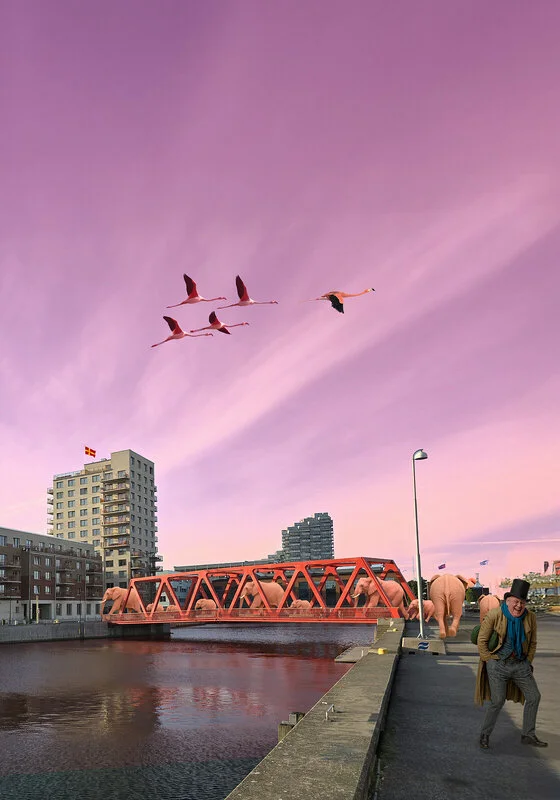
The Flamingo Quintet - The Pink Morning, 2025
Digital
50 x 70 cm
3 200 kr
The Flamingo Quintet - The Pink Morning
It starts with a bridge in Malmö, a city renowned for its distinctive mix of modernity and history, and a headache. A town where the surreal meets the contemporary, where the past and the present collide. The Pink Morning is a tale of five unique individuals, each with their own distinct charm and allure, much like the flamingos they are compared to.
A man, slightly intoxicated and newly in love, stumbles home at dawn after a summer party. Across Beijers Bridge, a surreal sight unfolds-a flock of pink elephants marches, while above him, a group of flamingos beats their wings like a storm. What follows is not just a hangover vision but a reflection on birds and beasts, on music and memory, on balance, beauty, and the absurd.
This is the story of The Flamingo Quintet, a Pink Sunday Morning—where dance halls meet shipyards, where science meets satire, and where flamingos and elephants reveal more about us than we dare to admit.
“The Pink Inside
Inside him beats a heart of rose,
not gentle blush but fever’s glow,
a drumline kept by thundering feet—
pink elephants across a bridge of steel.
His thoughts are rivers, red and raw,
memory’s tide from shipyard days,
yet now they flood with dizzy song,
with Flamingo quintet’s endless sway.
Above, the flamingos wheel and cry,
their wings a storm, their grace a jest,
and as they circle, one by one,
they bless the earth with rain of truth.
He laughs, though pain runs through his skull:
to live is messy, loud, absurd—
a man, an elephant, a bird,
all pink inside, all flawed, all free.”
Malmö. September 2025
The Flamingo Quintet - The Pink Morning
It was an early pink Sunday morning in Malmö, the kind of morning that shimmered between dream and daylight. Across Beijers Bridge in the old Varvsstaden district, a parade of pink elephants, a whimsical symbol of the night's revelry, thundered over the intensely red Beijer Bridge, their heavy steps echoing against the iron beams and rippling across the water below. This surreal sight was a prelude to the appearance of the flamingos, the true stars of the morning.
For the late-night wanderer – or, if one preferred, the early riser – the sound was impossible to ignore. It hammered in the head like the aftershock of a dance floor. Above, a quintet of flamingos swept across the sky, their wings slicing the rosy light with the force of a storm.
The man on the quay, still smiling despite his headache, laughed at the absurdity of it all. He had been dancing until dawn, twirling a newfound companion to the music of Flamingokvintetten, the Swedish dance orchestra whose tunes had carried him through decades. Their name now seemed almost prophetic, as if his night of revelry had conjured both flamingos and elephants into being.
The city around him – with its cranes, water, and steel – had transformed, but this morning it felt like a canvas for the imagination – a stage where dreams, animals, and memories blended into one improbable tableau, a testament to the beauty of change and the passage of time.
The Man and the Place
The man walked slowly along the quay, his steps heavy but his spirit oddly light. He was not just a relic from another era, but a living link to the city's history, a testament to the enduring spirit of Malmö. Once, he had been a chief engineer at Kockums, the mighty shipyard that had loomed here by the water, shaping the city's industrial past. His memories were intertwined with the city's industrial past, making the transformation of Varvsstaden all the more poignant.
Nowadays, Varvsstaden is a neighbourhood of flats, offices, and glass buildings. Yet in the shimmering morning haze, with pink elephants stomping across the iron bridge and flamingos wheeling above, it was as if the ghosts of the past had come back to dance with him.
He laughed again, despite his head aching. Memories of the night still lingered – the laughter, the dizziness, the unexpected joy of holding someone new in his arms as the orchestra played. His laughter, a testament to the enduring joy found in unexpected moments, echoed across the quay.
And yet, as he paused to look out over the water, another thought crossed his mind. Why does that strange bird stand on one leg? Is it a symbol of balance, or perhaps a metaphor for standing out in a crowd? The flamingo's unique stance could be seen as a metaphor for individuality, standing out from the crowd, and the balance one must strike in life.
The Nature of the Flamingo
The question lingered in his mind: why stand on one leg? The answer, though less whimsical than the vision before him, was no less remarkable. A flamingo’s one-legged stance was not a circus trick, but a marvel of physiology. By peculiarly locking its joints, the bird could rest its entire weight on a single leg without expending muscle energy. It was balance perfected, economy turned into elegance. The man marvelled at the bird's ability to turn a necessity into a graceful display, a lesson in efficiency and beauty.
And then there was the colour – that unlikely shade of undergarment pink, as if the birds had stepped out of a painter’s fantasy. But no, it did not come from whimsy, but from a diet rich in carotenoids: algae, brine shrimp, and other tiny creatures. They are what they eat, he thought, chuckling at the simplicity of it.
Even more peculiar, he thought, flamingos could change their hues according to circumstances. Parents raising young children often lose their vibrancy, paling as they devote their energy to nurturing their offspring. In the great colonies of Africa, such as Lake Nakuru, flamingos lived and bred in colourful masses, a “stand” when resting, a “flamboyance” when dancing. Same-sex pairs were also not uncommon—like Curtis and Arthur, two Chilean males who had successfully raised a chick from an abandoned egg. Nature, he mused, cares little for human categories.
They were social creatures, extravagant yet practical, delicate yet resilient. Their beauty was not a mere ornament but a necessity, a sign of health, of food well found, of life ongoing.
The man rubbed his temples and smiled. Perhaps he envied them: balanced, communal, unashamedly flamboyant. He couldn't help but admire the flamingos for their unique qualities and the way they embraced their individuality. His admiration for these creatures, so different from him yet so similar in their pursuit of life, filled him with a sense of wonder and appreciation.
The flamingo as a cultural symbol: a reflection of human desires and aspirations, symbolising balance, beauty, and boldness.
If nature had made flamingos extraordinary, culture had made them immortal. Their silhouettes had migrated far beyond the salt lakes of Africa or the lagoons of the Caribbean, into gardens, art galleries, living rooms, and dance halls.
A single pink flamingo placed on a suburban lawn could hold many meanings. For some, it represented nostalgia, a kitschy nod to the optimism of 1950s design. For others, it was a symbol of beauty, balance, and romance, quietly confirming the homeowner’s taste for elegance in plastic form. And in certain circles, he had heard, it was even a code—an invitation whispered in pastel feathers, a sign of openness to new encounters.
The flamingo, a long-standing muse in art and fashion, has been a symbol of extravagance and boldness. It has adorned dresses, added flair to paintings, and served as an emblem for those who dare to stand out. Its poise has even inspired motivational quotes: Stand tall. Stand out. Stand on one leg if you must.
Music, too, has been touched by the flamingo's influence. Flamingokvintetten, the beloved Swedish dance orchestra, has carried the bird’s name into dance halls across the country for over sixty years. Their songs, a part of countless romances, breakups, weddings, and summer nights, have made them not just a band, but a soundtrack to life itself.
The man thought: a bird this flamboyant could never be a bird. It had become a mirror of human longing—grace, glamour, and a touch of absurdity. Its flamboyance and vibrancy were not just a reflection of nature but a source of inspiration and energy.
To Be a Flamingo
“Always be yourself. Unless you can be a flamingo, then always be a flamingo.”
The phrase echoed in his mind like a riddle wrapped in laughter. At first, it sounded like nonsense, a playful twist on the old cliché of authenticity. But the longer he pondered it, the more it seemed to hold a kind of truth.
Being oneself was safe advice, the foundation of dignity. However, to be a flamingo—that was something entirely different. A flamingo was never timid, never dull, never hidden among the crowd. It was as vibrant as a sunrise, flamboyant as a carnival, and unashamed of its vibrancy. It balanced with ease, stood out, and turned the simple act of existing into a performance.
Perhaps that was the lesson: authenticity was good, but bold authenticity was better. Life, after all, was too brief to be lived only in neutral shades. Embracing the boldness of a flamingo, with its vibrant colours and unapologetic presence, could be a powerful way to live. It's a lesson that empowers and instils confidence.
He closed his eyes and saw it more clearly: the flamingo as a parable for courage, freedom, and beauty. To live like a flamingo was to dare to be singular, to risk being noticed, to lean into balance and grace even in awkwardness.
The man chuckled once more, even though his head ached. “Yes,” he thought, “always stay true to yourself. But if you can be a flamingo—why not?”
Satire and Play
His headache intensified into something almost comic. If he were a flamingo, he thought, he would know precisely where to relieve himself. There are so many scoundrels on earth that even a heavy summer rain cannot wash them all away. Perhaps, it is better to aim for the skies — a pink avenger with perfect balance and an unwavering sense of justice.
The image amused him: a flamingo swooping low over the city, elegant as ballet yet armed with the most undignified of weapons. He chuckled loudly, startling a gull that had perched on a nearby railing.
Satire, after all, has always been part of the flamingo’s charm. With its unlikely colour and outlandish proportions, the bird seems born for parody. Yet the parody often reveals the truth: how much pompous dignity there is to puncture, how much false grandeur to deflate. A flamingo is beautiful, yes—but it is also absurd. And in that absurdity lies its power, a power that can amuse and intrigue us, sparking a sense of amusement and intrigue.
He rubbed his temples again. The hangover was real, but so was the laughter. For a moment, he felt almost grateful for the headache: it sharpened his vision, stripped the world of its dullness, and let pink birds and pink elephants march right through the cracks of reason.
Flamingos in Literature
As he pondered the role of flamingos in art and society, the man’s thoughts naturally wandered to literature. Flamingos, he recalled, had long strutted across the pages of literature, sometimes portrayed as noble, sometimes as ridiculous.
He remembered Kate Atkinson’s Transcription—published overseas as Codename Flamingo—a novel about spies, secrets, and the surprising roles that words and symbols could serve. In that work, the flamingo became not a bird but a cypher, a code-name in the secret world of wartime espionage. The bird's characteristics of grace, elusiveness, and the impossibility of grasping them mirrored the complexities of the espionage world.
And then, of course, there was Lewis Carroll. In Alice’s Adventures in Wonderland, the Queen of Hearts had seized flamingos for croquet clubs, while hedgehogs scurried about as balls. In Carroll’s nonsense, it was a scene of comedy: birds bending the wrong way, refusing to stay straight, chaos unfolding with every swing. Yet, from today's perspective, it reads differently.
“Would such a tale be written today?” he wondered, massaging his forehead. Likely not. The evolution of our moral compass has made animal welfare a moral imperative. What Carroll’s readers once saw as whimsical absurdity, we now see as cruelty — a potent reminder of how humour and morality evolve, and how literature reflects these changes.
And yet, the image remained unforgettable. Flamingos as sporting equipment, simultaneously hilarious and grotesque, absurd and enduring. Literature had portrayed the flamingo not only as a bird but as a mirror of human folly—our games, our codes, our shifting ethics.
The Pink Walk Home
The city was waking now, though the man, a long-time resident, could not tell if it was he who had dreamed the night into morning, or the morning that had dreamed him. The bridge behind him still echoed with the thunder of invisible elephants, and above, the flamingos wheeled like banners of dawn.
His headache throbbed with each step along the quay, a testament to a life lived beyond the ordinary. He thought of Kockums, of ships that once arose from these waters, of lives forged on steel and labour. All of it gone, yet not forgotten. The city had shed its skin, just as flamingos changed their hues. But he, like the city, had adapted and transformed.
He paused and gazed into the still water. His reflection, a symbol of his past and present, drifted there, tired but smiling, shadowed by pink wings overhead. For a moment, he nearly believed that he, too, was part of the flamboyance. He accepted his past, his mistakes, and his growth.
“Be a flamingo,” he whispered to himself. Not just a man, not just a hangovered wanderer in a changing city, but something brighter, braver, more improbable. He was determined to embrace the change, to become something more.
And with that thought, he laughed once more, a laughter that echoed with the joy of acceptance and the pain of change. It was a laughter that acknowledged the absurdity of his situation, the weight of his past, and the uncertainty of his future. And yet, it was a laughter that embraced the transformation, the possibility of becoming something brighter, braver, more improbable. He continued walking, the morning colouring his path in rose.
Pink Elephants
If flamingos embody grace and flamboyance, then pink elephants embody folly. They are the creatures of late-night excess, born from too much drink and too little sleep. In English, to “see pink elephants” is to admit to drunken hallucinations, a carnival of absurd visions marching through the mind.
The man knew this well. His headache was living proof, and yet there they were: elephants marching across Beijers Bridge in broad daylight, their ears flapping, their trunks swinging, their enormous feet pounding against the steel. Hallucination or miracle? He could not decide, nor did he care.
In literature and cinema, pink elephants had long been both amusing and unsettling. He thought of Dumbo, with its surreal procession of trumpet-blowing pachyderms—half nightmare, half vaudeville. He recalled American slang, where the phrase had become a common saying as shorthand for drunken visions. Yet here, in Malmö, they seemed less a joke and more a chorus to the flamingos flying overhead.
Together, they embodied contradiction: the elephant heavy and earthbound, the flamingo light and aerial; the elephant awkward with excess, the flamingo graceful with balance. One spoke of human weakness, the other of human aspiration.
And so he smiled, despite the pain in his temples. If visions must haunt him, let them be these: elephants pink as laughter, flamingos pink as dawn. A whole city reborn in rose.
3 200 kr

Jörgen Thornberg
Malmö
Lite om bilder och mig. Translation in English at the end.
Jag är en nyfiken person som ser allt i bilder, även det jag fäster i ord, gärna tillsammans för bakom alla mina bilder finns en berättelse. Till vissa bilder hör en kortare eller längre novell som följer med bilden.
Bilder berättar historier. Jag omges av naturlig skönhet, intressanta människor och historia var jag än går. Jag använder min kamera för att dokumentera världen och blanda det jag ser med vad jag känner för att fånga den dolda magin.
Mina bilder berättar mina historier. Genom mina bilder, tryck och berättelser. Jag bjuder in dig att ta del av dessa berättelser, in i ditt liv och hem och dela min mycket personliga syn på vår värld. Mer än vad ögat ser. Jag tänker i bilder, drömmer och skriver och pratar om dem; följaktligen måste jag också skapa bilder. De blir vad jag ser, inte nödvändigtvis begränsade till verkligheten. Det finns en bild runt varje hörn. Jag hoppas att du kommer att se vad jag såg och gilla det.
Jag är också en skrivande person och till många bilder hör en kortare eller längre essay. Den följer med tavlan, tryckt på fint papper och med en personlig hälsning från mig.
Flertalet bilder startar sin resa i min kamera. Enkelt förklarat beskriver jag bilden jag ser i mitt inre, upplevd eller fantiserad. Bilden uppstår inom mig redan innan jag fått okularet till ögat. På bråkdelen av ett ögonblick ser jag vad jag vill ha och vad som kan göras med bilden. Här skall jag stoppa in en giraff, stålmannen, Titanic eller vad det är min fantasi finner ut. Ännu märkligare är att jag kommer ihåg minnesbilden långt efteråt när det blir tid att skapa verket. Om jag lyckas eller inte, är upp till betraktaren, oftast präglat av en stråk av svart humor – meningen är att man skall bli underhållen. Mina bilder blir ofta en snackis där de hänger.
Jag föredrar bilder som förmedlar ett budskap i flera lager. Vid första anblicken fylld av feel-good, en vacker utsikt, fint väder, solen skiner, blommor på ängen eller vattnet som ligger förrädiskt spegelblankt. I en sådan bild kan jag gömma min egentliga berättelse, mitt förakt för förtryckare och våldsverkare, rasister och fördomsfulla människor - ett gärna återkommande motiv mer eller mindre dolt i det vackra motivet. Jag försöker förena dem i ett gemensamt narrativ.
Bild och formgivning har löpt som en röd tråd genom livet. Fotokonst känns som en värdig final som jag gärna delar med mig.
Min genre är vid som framgår av mina bilder, temat en blandning av pop- och gatukonst i kollage som kan bestå av hundratals lager. Vissa bilder kan ta veckor, andra någon dag innan det är dags att överlämna resultatet till printverkstaden. Fine Art Prints är digitala fotocollage. I dessa kollage sker rivandet, klippandet, pusslandet, målandet, ritandet och sprayningen digitalt. Det jag monterar in kan vara hundratals år gamla bilder som jag omsorgsfullt frilägger så att de ser ut att vara en del av tavlan men också bilder skapade av mig själv efter min egen fantasi. Därefter besöks printstudion och för vissa bilder numrera en limiterad upplaga (oftast 7 exemplar) och signera för hand. Vissa bilder kan köpas i olika format. Det är bara att fråga efter vilka. Gillar man en bild som är 70x100 men inte har plats på väggen, går den kanske att få i 50x70 cm istället. Frågan är fri.
Metoden Giclée eller Fine Art Print som det också kallas är det moderna sättet för framställning av grafisk konst. Villkoret för denna typ av utskrifter är att en högkvalitativ storformatskrivare används med åldersbeständigt färgpigment och konstnärspapper eller i förekommande fall på duk. Pappret som används möter de krav på livslängd som ställs av museer och gallerier. Normalt säljer jag mina bilder oinramade så att den nya ägaren själv kan bestämma hur de skall se ut, med eller utan passepartout färg på ram, med eller utan glas etc..
Under många år ställde jag bara ut på nätet, i valda grupper och på min egen Facebooksida - https://www.facebook.com/jorgen.thornberg.9
Jag finns också på en egen hemsida som tyvärr inte alltid är uppdaterad – https://www.jth.life/ Där kan du också läsa en del av de berättelser som följer med bilden.
UTSTÄLLNINGAR
Luftkastellet, oktober 2022
Konst i Lund, november 2022
Luftkastellet, mars 2023
Engleson Galleri Caroli, april 2023
Hydra, Greece June 2023
Engleson Galleri Caroli, oktober 2023
Toppen, Höllviken december 2023
Luftkastellet, mars 2024
Torups Galleri, mars 2024
Venice, May 2024
Luftkastellet, oktober 2024
Konst i Advent, December 2024
Galleri Engleson, Caroli December 2024
Jäger & Jansson Galleri, april 2025
A bit about pictures and me.
I'm a curious person who sees everything in pictures, even what I express in words, often combining them, for behind all my pictures lies a story. These narratives, some as short as a single image and others as long as a novel, are the heart and soul of my work.
Pictures tell stories. Wherever I go, I'm surrounded by natural beauty, exciting people, and history. I use my camera to document the world and blend what I see with what I feel to capture the hidden magic.
My images tell my stories. Through my pictures, prints, and narratives, I invite you to partake in these stories in your life and home and share my deeply personal perspective of our world. More than meets the eye. I think in pictures, dream, write, and talk about them; consequently, I must create images too. They become what I see, not necessarily confined to reality. There's a picture around every corner. I hope you'll see what I saw and enjoy it.
I'm also a writer, and many images come with a shorter or longer essay. It accompanies the painting, printed on fine paper with my personal greeting.
Many pictures start their journey on my camera. Simply put, I describe the image I see in my mind, experienced or imagined. The image arises within me even before I bring the eyepiece to my eye. In a fraction of a moment, I see what I want and what can be done with the picture. Here, I'll insert a giraffe, Superman, the Titanic, or whatever my imagination conjures up. Even stranger is that I remember the mental image long after it's time to create the work. Whether I succeed is up to the observer, often imbued with a streak of black humour – the aim is to entertain. My pictures usually become a talking point wherever they hang.
I prefer pictures that convey a message in multiple layers. At first glance, they're filled with feel-good vibes, a beautiful view, lovely weather, the sun shining, flowers in the meadow, or the water lying deceptively calm. But beneath this surface beauty, I often conceal a deeper story, a narrative that challenges societal norms or explores the human condition. I invite you to delve into these hidden narratives and discover the layers of meaning within my work.
Picture and design have been a thread running through my life. Photographic art feels like a fitting finale, and I'm happy to share it.
My genre is varied, as seen in my pictures; the theme is a blend of pop and street art in collages that can consist of hundreds of layers. Some images can take weeks, others just a day before it's time to hand over the result to the print workshop. Fine Art Prints are digital photo collages. In these collages, tearing, cutting, puzzling, painting, drawing, and spraying happen digitally. What I insert can be images hundreds of years old that I carefully extract so they appear to be part of the painting, but also images created by myself, now also generated from my imagination. Next, visit the print studio and, for certain images, number a limited edition (usually 7 copies) and sign them by hand. Some images may be available in other formats. Just ask which ones. If you like an image that's 70x100 but doesn't have space on the wall, you might be able to get it in 50x70 cm instead. The question is open.
The Giclée method, or Fine Art Print as it's also called, is the modern way of producing graphic art. This method ensures the highest quality and longevity of the artwork, using a high-quality large-format printer with archival pigment inks and artist paper or, in some cases, canvas. The paper used meets the longevity requirements set by museums and galleries. I sell my pictures unframed, allowing the new owner to personalise their artwork, confident in the lasting value and quality of the piece.
For many years, I only exhibited online, in selected groups, and on my Facebook page - https://www.facebook.com/jorgen.thornberg.9. I also have my website, which unfortunately is not constantly updated - https://www.jth.life/. You can also read some of the stories accompanying the pictures there.
EXHIBITIONS
Luftkastellet, October 2022
Art in Lund, November 2022
Luftkastellet, March 2023
Engleson Gallery Caroli, April 2023
Hydra, Greece June 2023
Engleson Gallery Caroli, October 2023
Toppen, Höllviken December 2023
Luftkastellet, March 2024
Torup Gallery, March 2024
Venice, May 2024
UTSTÄLLNINGAR
Luftkastellet, oktober 2022
Konst i Lund, november 2022
Luftkastellet, mars 2023
Engleson Galleri Caroli, april 2023
Hydra, Greece June 2023
Engleson Galleri Caroli, oktober 2023
Toppen, Höllviken december 2023
Luftkastellet, mars 2024
Torups Galleri, mars 2024
Venice, May 2024
Luftkastellet, October 2024
Konst i Advent, December 2024
Galleri Engleson, Caroli December 2024
Jäger & Jansson Galleri, April 2025
Utbildning
Autodidakt
Medlem i konstnärsförening
Öppna Sinnen
Med i konstrunda
Konstrundan i Skåne
Utställningar
Luftkastellet, October 2022
Art in Lund, November 2022
Luftkastellet, March 2023
Engleson Gallery Caroli, April 2023
Hydra, Greece June 2023
Engleson Gallery Caroli, October 2023
Toppen, Höllviken December 2023
Luftkastellet, March 2024
Torup Gallery, March 2024
Venice, May 2024