Vi använder cookies för att ge dig bästa möjliga upplevelse. Välj vilka cookies du tillåter.
Läs mer i vår integritetspolicy
Jörgen Thornberg
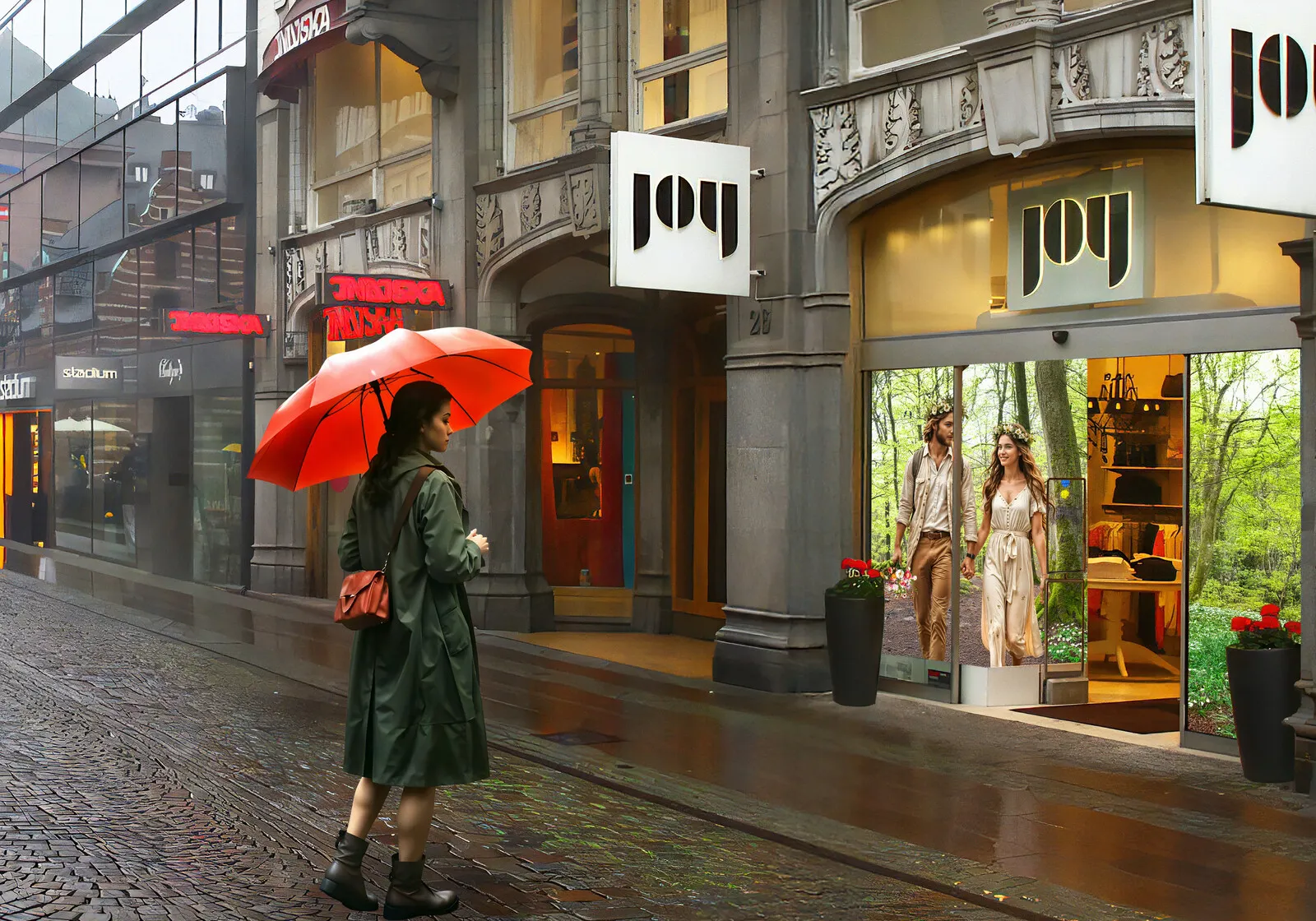
Spring is in the air, 2025
Digital
70 x 50 cm
3 200 kr
Spring is in the air
There are places in the city where the weather seems to cleave in two — outside, slush and grey sky; inside, a light that holds its breath. This story begins at one such window: a late-winter day on Södergatan, wet cobbles gleaming, a red umbrella, and a storefront that frames an impossible other season. In the glass’s glade a spring tastes of honey, and in that warmth stand two figures: he, with the violin’s cold promise — the Näcken — and she, the wood-nymph, barefoot and dangerous at once. Our protagonist, alone and betrayed, meets her own shadow in the pane and learns how easily one can lose oneself in the promise of heat. This is a story of a temptation that appears to be rescue, of what we are willing to leave on the shore, and of how a simple reflection can become a doorway. Come in — not for answers, but to feel the choice being made in the shimmer between two worlds, in this city scene that symbolises duality.
“The Glade’s Passage
In the shop-window mirror, a glade breathes slow,
light flowing like honey over mossy stone.
She stands—barefoot, crowned with leaves—
and watches another sky warm like a hand.
He sits at the river’s lip with violin held tight,
the bow draws out tones that both soothe and wound.
The water answers in echoes of peat and old leaves,
a rhythm that measures hearts and pulls them toward depth.
She thinks of betrayal, a stone lodged in the chest,
how days grew mute with empty promises and quiet dinners.
In the glass’s glow, the ache becomes a promise:
Heat, motion, a voice that swears nothing will crack.
His look invites with a chill like river-bottom cold,
words without words slide across the pane, loose as melting snow.
“Come in,” the violin plays. “Let the current teach your pulse.”
Weariness in her legs lightens like a feather.
They dance on slick stones to strings and breath,
she sheds the city’s tight patterns for wildness,
but each laugh slips a memory from her pockets,
and in the water her name ripples away.
He gives a season of spring, a forgetting that tastes of salt,
yet takes away pieces that never find their way back.
She tastes liberty and danger, and doubt roots in soft earth—
then hears her town’s clock through leaves: duty’s small bell.
She leaves the glade with one green leaf in hand,
a token fastened like a button to her coat.
He returns to his rapids; the violin’s song goes on as an echo,
and she walks home in the rain with more weight in her step.
Sometimes the choosing isn’t to save or to sink,
but to pocket a fragment of spring and carry it close,
to remember that once she danced at another shore,
and know the glade remains—for whoever dares look back.”
Malmö. September 2025
Wrong Time, Wrong Place –
The street smelled of cold iron and wet stone. A busker far down the avenue played an irritated tune on a battered trumpet; someone scolded a child for splashing. And then there was the window.
It was a tidy little thing—JOY, the sign proclaimed in confident letters, and beneath it the window showed a different weather. The shop’s interior glowed like melted honey: warm against the grey. The glass divided the world into two languages. On my side, the city sighed in soft, practical tones. On the other side, a glade breathed in a slower rhythm: green light filtered through leaves, a carpet of sunlit moss, a shallow stream catching flecks of gold. A woman stood in the light—barefoot, in a dress the colour of pale cream, a wreath of leaves tangled in her hair. And at the stream, a man leaned, chin resting on a violin, his bow coaxing sound from the water’s edge. It was a scene that whispered of a different life, a life of beauty and mystery, a life I longed to step into. It was a scene whispering of a different life—a life of beauty and mystery—a life I longed to step into.
“At least, that was how I interpreted the picture,” the young woman thought. The fact that the marketers had dressed him in Joy’s spring collection didn’t deceive her — he was clearly the Näcken, the Swedish water spirit, and beside him, just as undoubtedly, the skogsrå, the woodland nymph. “She could be me.”
He looked like a man from another world: sun-kissed skin, a casual shirt half-open at the neck, trousers scuffed as if he had stepped out of a different century’s dream. He was the wrong person to be there. He smiled without showing his teeth, as if the idea of a secret delighted him. Even from the rain-darkened pavement, I could feel the noise of his music before I could understand how that was possible—there was the faintest sense that glass, though solid, might be porous if you desired it enough.
They moved like an advert for some other life: the woman stepping into the light, the man watching her with a devotion that smelled of river spray. My nose pressed close to the window before I realised I had moved—the cold bit at my breath, fogging the glass in a small circle. My reflection overlapped their faces for a single absurd moment—my red umbrella, my wet hair, their sun. I felt a strange connection to them, as if their world was a reflection of my inner desires.
I have been betrayed. That’s all the world was allowed to know about it. The word sits heavy like a stone in my mouth; it is weighty and formless and offers no explanation that could satisfy another person. My mother once asked whether an argument or carelessness caused the hurt. She flinched when I responded with the simple, concise sentence: he betrayed me. No details. Not to anyone. I kept the hows and the whys like talismans of shame. They were personal and private, like a scar. The depth of my emotional turmoil was unfathomable, and the weight of my betrayal was a burden I bore alone. It was a betrayal that shattered my trust and left me questioning everything I believed in.
So I stood with my fingers cold on the glass and observed the glade, looking at it rather than entering it. I pretended to catalogue it with the flat, sound mind of someone who believes she is merely waiting: the dress is cream; the trees are beeches; the light is late spring. But beneath the catalogue, a countercurrent moved within me. The scene in the glass unravelled the parts of me that had been practical and small. It revealed what I had been denying: that I was tired of carrying the shape of my own life alone; that somewhere I had started to believe someone else’s warmth might fit me as if it were made to measure.
He then looked at me in a way that made the glass seem ridiculously thin. The violin paused for a moment. He raised his head and gave me a nod that carried the delicacy of an invitation yet the sharpness of a snare. I felt my cheeks flush with something like shame and something like hunger that refused to be named.
“Come in,” a voice said. It did not sound like his instrument. It sounded like the inside of my palm on the glass. The voice could have been a memory, or it could have been the shop’s speaker playing a recorded advertisement, or it could have been nothing. But the sound merged into the steam of my breath and into the water-slick cobbles, and I heard it as an answer I had been waiting for. His invitation was a temptation, a promise of escape from my loneliness and pain, but also a potential trap, a path into the unknown that could lead to further hurt or healing.
The first time he spoke plainly to me—if indeed he spoke at all—his words were like a thread slipping into a seam. They were not a narrative of rescue. He did not promise me forever, a marriage, or a clean forgetting. Instead, he offered a geography —a weighty and profound one.
“My glade is warm,” he said. “My water sings. Come and let the current show you what it keeps.”
There is a way that grief narrows a person’s field of vision until the horizon seems both very distant and very small. That week, I had lived within that narrowness: paperwork, grocery lists, and the same song of loneliness playing on loop. The man in the window bore no responsibility for my loneliness and had no answers for it, except that he was beautiful and he wanted me to cross the threshold. The glass was, in that way, the easiest of doors. I also later learned that it was the hardest.
I told myself I would not do it. Rationally, I could list reasons: the world is not a shop window; people do not step out of painted glass and live. He might have been an actor, a model, or a well-crafted photograph. It was winter. The glade, however, was not just a scene; it was an allure, a pull of the unknown that was strong. I found myself struggling with a decision that felt as weighty as the world itself.
Instead, I removed my glove and touched the cooler surface with my fingertips. The glass did not vibrate; it held firm. But beneath my palm, the world shifted: I heard the sound of falling water, and the movement of leaf-borne light. My breath fogged the area where my fingertips rested. The man—he who had created the music that lacked a piano—tilted his head in a way that made the damp street vanish. He seemed to understand that a body was out there, weighing a decision.
“Step closer,” he said.
It was less a command and more a melody that rearranged my bones. My feet moved independently, without consulting the rest of me. I remember thinking of my mother, how she depended on me—an ordinary, mundane thought that pierced through the more dreadful one: I had been betrayed. I was exhausted. My foot found the puddle with no bottom, and the water seized my heel. The city’s reflection shifted. For a moment, everything—a bus, a lamp, the hurried man with the briefcase—looked like the ripple of something else on a larger stream. I pressed my face against the glass as if closeness could be a promise.
If the glass had been a verbose thing, it might have said: No bargains here, only crossing. But it was not; the glass was polite and almost ceremonial, like a stage door. Then, ever so slight and sudden as a breath, the surface loosened beneath my hand. I felt the way one feels when a rope loosens, either by accident or by someone's deliberate release. The seam widened.
I do not recall thinking, 'Should I?' I remember thinking, 'I cannot feel the cold on my face any more.' The shop window’s light enveloped me like a small, very slow tide.
The first sensation inside the glade was the light. It tasted like lemon boiled in honey. The air was thick with sap, and the soft metallic ring of a violin held just beyond hearing. I staggered on moss that smelled of childhood and newness. The woman from the display watched me with the expression of someone greeting an old friend, and also with that slight distance that belongs to anyone at home somewhere entirely unlike their own world.
“You are late,” she said, and her voice resembled the sound of leaves curling inward.
“Late for what?” I heard my mouth answer, and it sounded as if my mouth belonged to someone else: polished, brighter. I wanted to laugh then, to listen to the absurdity of it. Instead, my knees wanted to steady in the leaf-strewn soil.
The man—the river-man, the one who had been a suggestion of danger in his casually rolled sleeves—bowed with a flourish that would have been theatrical in any other place. He placed his violin under his chin and played a phrase that tasted like cold water and something older.
“You came,” he said. It was not a question. He moved closer as if proximity was an invitation that had always awaited, and when he reached me, his hands were not those of a theatre-man. They faintly smelled of wild mint. I remember thinking how ordinary that was: danger, even dressed as myth, dwells in the habits of real bodies.
There is a folklore I read as a child about these beings: men of water who play for the living and make promises that gather like fish, only to be swallowed whole. They entice with music and ask for quarters of your life in exchange. They are handsome because everything designed to seduce must be attractive. They are merciful because you do not realise their measure until your fingers have been washed of the world.
I wasn't sure if he had asked for anything with words. Instead, he asked through a gesture. He extended his hand—no jewels, no binding, just skin—and the music curled around it like steam. At that moment, something inside me unlatched. It wasn't a logical act. It was a surrender, a yielding. I took his hand.
His fingers were cool. Coolness is a precise sensation after a winter spent sealed in small griefs. It felt like an apology that did not name itself. We moved towards the stream. He raised his bow, and the water responded in slurred notes that made the ferns shudder. I sensed a flicker of something else then—not dread, not yet, but a kinship with the wildness I had denied.
The glade was a place of mystery, not just an idyll. At the water's edge, shadows moved like unanswered questions. There were other things in the greenery—shapes that watched with a curious interest, wearing thistled crowns and smelling of old stories. Once, I caught a glimpse of a woman with hair the colour of old straw and eyes that had seen embers; she laughed without sound and vanished between the trunks. In that moment, it almost mattered whether I could return.
At some point, as we stood knee-deep in the brook while his music made the light bend like sea-glass, I felt the first honest pangs of my betrayal as a small, solid stone in my pocket. It had been with me all along, clinking against my life. He did not speak of it immediately. Instead, his music flowed deeper into the currents until it seemed the note reflected a mirror to memory. I saw, in that mirror, the practical things I had left undone: an unpaid bill, a call not returned, a mother who might have been waiting on a quiet chair.
He played the violin as if to unravel me. When the bow glided over the strings, memories drifted like leaves. They did not follow any rule of sympathy or cruelty; they loosened, and I watched them drift away with the current. A small, sharp voice within me whispered: he is stealing from you. Another voice responded that this was what I had come to exchange.
“What do you take?” I asked the river that now wore the man’s face. It was the smallest and bravest question I had learned to ask in a long time.
He paused. In the sudden silence, his face revealed only a man’s features, with shadows that were not kind and eyes as cautious as a fox's. “I take what you offer,” he said. “Pieces of a life that will not be missed by what you leave behind.”
I thought of my mother, of a kitchen with one chair and coffee cooling on the table. I thought of my own hands and how steady they had been in making small things stay. The glade did not offer peace, but pain. The glade offered transformation—some of it without a bargain, some with a cost.
I could have called them to be dismissed. I could have told him I would not bargain over the shape of my sorrow. But the glade is a clever thing; it offers you an answer before you even know what the question is. In the air after the silence, there was a song that seemed to say: be whole, or be safe; the two will not be the same.
Ultimately, my choice was not a simple one, not based on the harsh morals of fairy tales. I did not shout a decisive refusal, nor did I fade into the greenery. I did something more ordinary and more meaningful: I asked for time. “If I stay,” I said, “what happens to the woman who waits in the cold?”
“You can go,” he answered, surprising me with a kindness that was not truly kind. “You can go and wear your grief like a cloak, fold it into your daily life, and be very brave indeed. Or you can leave it on the bank and learn the river’s rhythm.”
The two choices were not simply about choosing life over death. They were about shaping the life I had remaining. My fingers closed around his, and I realised, as I had never understood before about bargaining, that there is a cost to being unmoored and a cost to staying still. Both are debts.
I thought about the bus that might be late, of the woman who could be waiting for the milk to boil. I thought of the small, stubborn parts of myself that had built a world: appointments kept, a friend visited, a mother called. I thought about being betrayed and what that had done to the structure of my days.
I chose the glade.
Initially, I believed I had, at least. I recall the sensation of water around my ankles like a startling confession. I remember his bow causing the air to tremble and the feeling that my muscles were not truly mine but belonged to something more primal. I remember laughter—mine? Someone else’s?—bubbling up like a spring that should not exist in February’s bones. The sunlight pierced through the leaves and cast a trust upon me that dangerously resembled forgetting.
And then—because the world is seldom content to keep things simple—I remembered my mother’s hands, the shape of our kitchen table, the small green mug she used for her tea on winter mornings. The memory came not as a stone but as a bell. It rang in my chest, preventing me from feeling completely broken. The glade held its breath, the violin paused, and I realised that the edge of the choice had an unexpected element: it was not only what I would lose by staying, but also what I would carry with me if I left.
I stepped away from the stream.
The man’s face softened into what seemed like disappointment—not because I had not given myself to him, but because I had come and gone as if I alone could reconcile two climes. He touched my palm as if to seal some unseen tally. “You may come again,” he said. “The door is never shut. But nothing will be the same.”
Back in the rain, the glass closed softly like a blink. The pavement was wet and unremarkable. The shopfront returned to its neat arrangement. The woman in the window stood in her dress, a living statue smiling as if sharing a joke only she understood. I felt the chill of the city return to my face like the scolding of a minor god.
The bus arrived. I got on and sat by the window; the city unfolded in its familiar gestures: trams, a child with a sticky nose, a man carrying a bag of bread that made the air smell yeasty. My phone rested in my coat pocket; my hands were full, but my palms throbbed as if I had touched something now absent. On my lap, where my fingers had been, lay a single green leaf—small, crisp at the edges, impossible an hour ago. It was a marker, a token that this exchange had been real.
When I arrived at my mother’s house, I handed her the leaf for reasons I couldn't explain. She tucked it between the pages of a book and smiled in a way that people do when they keep secrets they don't fully understand. I then thought that perhaps I had chosen a third thing: not staying entirely in the glade and not living wholly in the city, but carrying the memory of another weather inside me. Perhaps that was a kind of magic—less glamorous than a crown, but more enduring.
Sometimes, late at night when the house holds its breath, I think of the violin. I think of the man with water in his hair and how the stream lent his music the power to dissolve my edges. I think of the woman in the window, the skogsrå who knew the geography of both my desire and my danger. I do not tell these thoughts to my mother. We discuss more trivial matters, such as casseroles and the rise in the heating bill. I tuck the leaf back into the book when I think of it, and sometimes I take it out and press it to my lips, as if to recall the taste of a decision.
Once, months later, I walked past JOY in sunlight. The window’s display had changed; another season was framed inside the panes. For a brief instant, I thought I saw movement: a figure bending to pick a flower. Then the street rose, and the scene resolved into signage and shadow. People stepped around the puddles, and the city performed its modest miracles: tram bells, a woman with a dog, a child with a balloon.
I'm uncertain whether I acted foolishly. Sometimes I envy those who return home to untouched surroundings. Sometimes I envy those who give themselves entirely and call it bravery. I only know this: the glade exists like specific memories do—impossibly, yet persistently. It showed me that there are doors that are also images, and that a body can be both cautious and daring. It taught me that being betrayed is not the end of what you may choose to become.
And when I pass the window now, my reflection encounters a face I recognise with fresh tenderness. I sometimes press my palm briefly against the glass out of habit, and although the pane is cool and firm, a note from somewhere beneath it—somewhere like a river—traces the outline of my name and makes the leaves in my chest lift like a hand in a small, private greeting.
Jörgen Thornberg
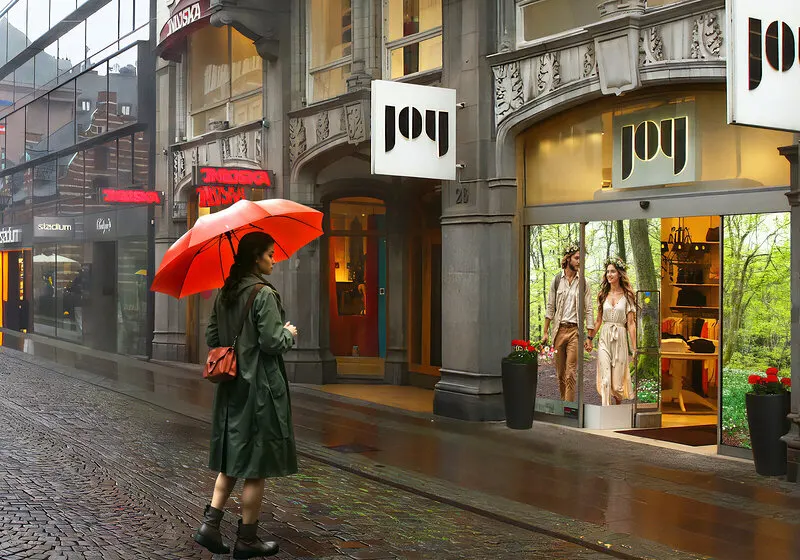
Spring is in the air, 2025
Digital
70 x 50 cm
3 200 kr
Spring is in the air
There are places in the city where the weather seems to cleave in two — outside, slush and grey sky; inside, a light that holds its breath. This story begins at one such window: a late-winter day on Södergatan, wet cobbles gleaming, a red umbrella, and a storefront that frames an impossible other season. In the glass’s glade a spring tastes of honey, and in that warmth stand two figures: he, with the violin’s cold promise — the Näcken — and she, the wood-nymph, barefoot and dangerous at once. Our protagonist, alone and betrayed, meets her own shadow in the pane and learns how easily one can lose oneself in the promise of heat. This is a story of a temptation that appears to be rescue, of what we are willing to leave on the shore, and of how a simple reflection can become a doorway. Come in — not for answers, but to feel the choice being made in the shimmer between two worlds, in this city scene that symbolises duality.
“The Glade’s Passage
In the shop-window mirror, a glade breathes slow,
light flowing like honey over mossy stone.
She stands—barefoot, crowned with leaves—
and watches another sky warm like a hand.
He sits at the river’s lip with violin held tight,
the bow draws out tones that both soothe and wound.
The water answers in echoes of peat and old leaves,
a rhythm that measures hearts and pulls them toward depth.
She thinks of betrayal, a stone lodged in the chest,
how days grew mute with empty promises and quiet dinners.
In the glass’s glow, the ache becomes a promise:
Heat, motion, a voice that swears nothing will crack.
His look invites with a chill like river-bottom cold,
words without words slide across the pane, loose as melting snow.
“Come in,” the violin plays. “Let the current teach your pulse.”
Weariness in her legs lightens like a feather.
They dance on slick stones to strings and breath,
she sheds the city’s tight patterns for wildness,
but each laugh slips a memory from her pockets,
and in the water her name ripples away.
He gives a season of spring, a forgetting that tastes of salt,
yet takes away pieces that never find their way back.
She tastes liberty and danger, and doubt roots in soft earth—
then hears her town’s clock through leaves: duty’s small bell.
She leaves the glade with one green leaf in hand,
a token fastened like a button to her coat.
He returns to his rapids; the violin’s song goes on as an echo,
and she walks home in the rain with more weight in her step.
Sometimes the choosing isn’t to save or to sink,
but to pocket a fragment of spring and carry it close,
to remember that once she danced at another shore,
and know the glade remains—for whoever dares look back.”
Malmö. September 2025
Wrong Time, Wrong Place –
The street smelled of cold iron and wet stone. A busker far down the avenue played an irritated tune on a battered trumpet; someone scolded a child for splashing. And then there was the window.
It was a tidy little thing—JOY, the sign proclaimed in confident letters, and beneath it the window showed a different weather. The shop’s interior glowed like melted honey: warm against the grey. The glass divided the world into two languages. On my side, the city sighed in soft, practical tones. On the other side, a glade breathed in a slower rhythm: green light filtered through leaves, a carpet of sunlit moss, a shallow stream catching flecks of gold. A woman stood in the light—barefoot, in a dress the colour of pale cream, a wreath of leaves tangled in her hair. And at the stream, a man leaned, chin resting on a violin, his bow coaxing sound from the water’s edge. It was a scene that whispered of a different life, a life of beauty and mystery, a life I longed to step into. It was a scene whispering of a different life—a life of beauty and mystery—a life I longed to step into.
“At least, that was how I interpreted the picture,” the young woman thought. The fact that the marketers had dressed him in Joy’s spring collection didn’t deceive her — he was clearly the Näcken, the Swedish water spirit, and beside him, just as undoubtedly, the skogsrå, the woodland nymph. “She could be me.”
He looked like a man from another world: sun-kissed skin, a casual shirt half-open at the neck, trousers scuffed as if he had stepped out of a different century’s dream. He was the wrong person to be there. He smiled without showing his teeth, as if the idea of a secret delighted him. Even from the rain-darkened pavement, I could feel the noise of his music before I could understand how that was possible—there was the faintest sense that glass, though solid, might be porous if you desired it enough.
They moved like an advert for some other life: the woman stepping into the light, the man watching her with a devotion that smelled of river spray. My nose pressed close to the window before I realised I had moved—the cold bit at my breath, fogging the glass in a small circle. My reflection overlapped their faces for a single absurd moment—my red umbrella, my wet hair, their sun. I felt a strange connection to them, as if their world was a reflection of my inner desires.
I have been betrayed. That’s all the world was allowed to know about it. The word sits heavy like a stone in my mouth; it is weighty and formless and offers no explanation that could satisfy another person. My mother once asked whether an argument or carelessness caused the hurt. She flinched when I responded with the simple, concise sentence: he betrayed me. No details. Not to anyone. I kept the hows and the whys like talismans of shame. They were personal and private, like a scar. The depth of my emotional turmoil was unfathomable, and the weight of my betrayal was a burden I bore alone. It was a betrayal that shattered my trust and left me questioning everything I believed in.
So I stood with my fingers cold on the glass and observed the glade, looking at it rather than entering it. I pretended to catalogue it with the flat, sound mind of someone who believes she is merely waiting: the dress is cream; the trees are beeches; the light is late spring. But beneath the catalogue, a countercurrent moved within me. The scene in the glass unravelled the parts of me that had been practical and small. It revealed what I had been denying: that I was tired of carrying the shape of my own life alone; that somewhere I had started to believe someone else’s warmth might fit me as if it were made to measure.
He then looked at me in a way that made the glass seem ridiculously thin. The violin paused for a moment. He raised his head and gave me a nod that carried the delicacy of an invitation yet the sharpness of a snare. I felt my cheeks flush with something like shame and something like hunger that refused to be named.
“Come in,” a voice said. It did not sound like his instrument. It sounded like the inside of my palm on the glass. The voice could have been a memory, or it could have been the shop’s speaker playing a recorded advertisement, or it could have been nothing. But the sound merged into the steam of my breath and into the water-slick cobbles, and I heard it as an answer I had been waiting for. His invitation was a temptation, a promise of escape from my loneliness and pain, but also a potential trap, a path into the unknown that could lead to further hurt or healing.
The first time he spoke plainly to me—if indeed he spoke at all—his words were like a thread slipping into a seam. They were not a narrative of rescue. He did not promise me forever, a marriage, or a clean forgetting. Instead, he offered a geography —a weighty and profound one.
“My glade is warm,” he said. “My water sings. Come and let the current show you what it keeps.”
There is a way that grief narrows a person’s field of vision until the horizon seems both very distant and very small. That week, I had lived within that narrowness: paperwork, grocery lists, and the same song of loneliness playing on loop. The man in the window bore no responsibility for my loneliness and had no answers for it, except that he was beautiful and he wanted me to cross the threshold. The glass was, in that way, the easiest of doors. I also later learned that it was the hardest.
I told myself I would not do it. Rationally, I could list reasons: the world is not a shop window; people do not step out of painted glass and live. He might have been an actor, a model, or a well-crafted photograph. It was winter. The glade, however, was not just a scene; it was an allure, a pull of the unknown that was strong. I found myself struggling with a decision that felt as weighty as the world itself.
Instead, I removed my glove and touched the cooler surface with my fingertips. The glass did not vibrate; it held firm. But beneath my palm, the world shifted: I heard the sound of falling water, and the movement of leaf-borne light. My breath fogged the area where my fingertips rested. The man—he who had created the music that lacked a piano—tilted his head in a way that made the damp street vanish. He seemed to understand that a body was out there, weighing a decision.
“Step closer,” he said.
It was less a command and more a melody that rearranged my bones. My feet moved independently, without consulting the rest of me. I remember thinking of my mother, how she depended on me—an ordinary, mundane thought that pierced through the more dreadful one: I had been betrayed. I was exhausted. My foot found the puddle with no bottom, and the water seized my heel. The city’s reflection shifted. For a moment, everything—a bus, a lamp, the hurried man with the briefcase—looked like the ripple of something else on a larger stream. I pressed my face against the glass as if closeness could be a promise.
If the glass had been a verbose thing, it might have said: No bargains here, only crossing. But it was not; the glass was polite and almost ceremonial, like a stage door. Then, ever so slight and sudden as a breath, the surface loosened beneath my hand. I felt the way one feels when a rope loosens, either by accident or by someone's deliberate release. The seam widened.
I do not recall thinking, 'Should I?' I remember thinking, 'I cannot feel the cold on my face any more.' The shop window’s light enveloped me like a small, very slow tide.
The first sensation inside the glade was the light. It tasted like lemon boiled in honey. The air was thick with sap, and the soft metallic ring of a violin held just beyond hearing. I staggered on moss that smelled of childhood and newness. The woman from the display watched me with the expression of someone greeting an old friend, and also with that slight distance that belongs to anyone at home somewhere entirely unlike their own world.
“You are late,” she said, and her voice resembled the sound of leaves curling inward.
“Late for what?” I heard my mouth answer, and it sounded as if my mouth belonged to someone else: polished, brighter. I wanted to laugh then, to listen to the absurdity of it. Instead, my knees wanted to steady in the leaf-strewn soil.
The man—the river-man, the one who had been a suggestion of danger in his casually rolled sleeves—bowed with a flourish that would have been theatrical in any other place. He placed his violin under his chin and played a phrase that tasted like cold water and something older.
“You came,” he said. It was not a question. He moved closer as if proximity was an invitation that had always awaited, and when he reached me, his hands were not those of a theatre-man. They faintly smelled of wild mint. I remember thinking how ordinary that was: danger, even dressed as myth, dwells in the habits of real bodies.
There is a folklore I read as a child about these beings: men of water who play for the living and make promises that gather like fish, only to be swallowed whole. They entice with music and ask for quarters of your life in exchange. They are handsome because everything designed to seduce must be attractive. They are merciful because you do not realise their measure until your fingers have been washed of the world.
I wasn't sure if he had asked for anything with words. Instead, he asked through a gesture. He extended his hand—no jewels, no binding, just skin—and the music curled around it like steam. At that moment, something inside me unlatched. It wasn't a logical act. It was a surrender, a yielding. I took his hand.
His fingers were cool. Coolness is a precise sensation after a winter spent sealed in small griefs. It felt like an apology that did not name itself. We moved towards the stream. He raised his bow, and the water responded in slurred notes that made the ferns shudder. I sensed a flicker of something else then—not dread, not yet, but a kinship with the wildness I had denied.
The glade was a place of mystery, not just an idyll. At the water's edge, shadows moved like unanswered questions. There were other things in the greenery—shapes that watched with a curious interest, wearing thistled crowns and smelling of old stories. Once, I caught a glimpse of a woman with hair the colour of old straw and eyes that had seen embers; she laughed without sound and vanished between the trunks. In that moment, it almost mattered whether I could return.
At some point, as we stood knee-deep in the brook while his music made the light bend like sea-glass, I felt the first honest pangs of my betrayal as a small, solid stone in my pocket. It had been with me all along, clinking against my life. He did not speak of it immediately. Instead, his music flowed deeper into the currents until it seemed the note reflected a mirror to memory. I saw, in that mirror, the practical things I had left undone: an unpaid bill, a call not returned, a mother who might have been waiting on a quiet chair.
He played the violin as if to unravel me. When the bow glided over the strings, memories drifted like leaves. They did not follow any rule of sympathy or cruelty; they loosened, and I watched them drift away with the current. A small, sharp voice within me whispered: he is stealing from you. Another voice responded that this was what I had come to exchange.
“What do you take?” I asked the river that now wore the man’s face. It was the smallest and bravest question I had learned to ask in a long time.
He paused. In the sudden silence, his face revealed only a man’s features, with shadows that were not kind and eyes as cautious as a fox's. “I take what you offer,” he said. “Pieces of a life that will not be missed by what you leave behind.”
I thought of my mother, of a kitchen with one chair and coffee cooling on the table. I thought of my own hands and how steady they had been in making small things stay. The glade did not offer peace, but pain. The glade offered transformation—some of it without a bargain, some with a cost.
I could have called them to be dismissed. I could have told him I would not bargain over the shape of my sorrow. But the glade is a clever thing; it offers you an answer before you even know what the question is. In the air after the silence, there was a song that seemed to say: be whole, or be safe; the two will not be the same.
Ultimately, my choice was not a simple one, not based on the harsh morals of fairy tales. I did not shout a decisive refusal, nor did I fade into the greenery. I did something more ordinary and more meaningful: I asked for time. “If I stay,” I said, “what happens to the woman who waits in the cold?”
“You can go,” he answered, surprising me with a kindness that was not truly kind. “You can go and wear your grief like a cloak, fold it into your daily life, and be very brave indeed. Or you can leave it on the bank and learn the river’s rhythm.”
The two choices were not simply about choosing life over death. They were about shaping the life I had remaining. My fingers closed around his, and I realised, as I had never understood before about bargaining, that there is a cost to being unmoored and a cost to staying still. Both are debts.
I thought about the bus that might be late, of the woman who could be waiting for the milk to boil. I thought of the small, stubborn parts of myself that had built a world: appointments kept, a friend visited, a mother called. I thought about being betrayed and what that had done to the structure of my days.
I chose the glade.
Initially, I believed I had, at least. I recall the sensation of water around my ankles like a startling confession. I remember his bow causing the air to tremble and the feeling that my muscles were not truly mine but belonged to something more primal. I remember laughter—mine? Someone else’s?—bubbling up like a spring that should not exist in February’s bones. The sunlight pierced through the leaves and cast a trust upon me that dangerously resembled forgetting.
And then—because the world is seldom content to keep things simple—I remembered my mother’s hands, the shape of our kitchen table, the small green mug she used for her tea on winter mornings. The memory came not as a stone but as a bell. It rang in my chest, preventing me from feeling completely broken. The glade held its breath, the violin paused, and I realised that the edge of the choice had an unexpected element: it was not only what I would lose by staying, but also what I would carry with me if I left.
I stepped away from the stream.
The man’s face softened into what seemed like disappointment—not because I had not given myself to him, but because I had come and gone as if I alone could reconcile two climes. He touched my palm as if to seal some unseen tally. “You may come again,” he said. “The door is never shut. But nothing will be the same.”
Back in the rain, the glass closed softly like a blink. The pavement was wet and unremarkable. The shopfront returned to its neat arrangement. The woman in the window stood in her dress, a living statue smiling as if sharing a joke only she understood. I felt the chill of the city return to my face like the scolding of a minor god.
The bus arrived. I got on and sat by the window; the city unfolded in its familiar gestures: trams, a child with a sticky nose, a man carrying a bag of bread that made the air smell yeasty. My phone rested in my coat pocket; my hands were full, but my palms throbbed as if I had touched something now absent. On my lap, where my fingers had been, lay a single green leaf—small, crisp at the edges, impossible an hour ago. It was a marker, a token that this exchange had been real.
When I arrived at my mother’s house, I handed her the leaf for reasons I couldn't explain. She tucked it between the pages of a book and smiled in a way that people do when they keep secrets they don't fully understand. I then thought that perhaps I had chosen a third thing: not staying entirely in the glade and not living wholly in the city, but carrying the memory of another weather inside me. Perhaps that was a kind of magic—less glamorous than a crown, but more enduring.
Sometimes, late at night when the house holds its breath, I think of the violin. I think of the man with water in his hair and how the stream lent his music the power to dissolve my edges. I think of the woman in the window, the skogsrå who knew the geography of both my desire and my danger. I do not tell these thoughts to my mother. We discuss more trivial matters, such as casseroles and the rise in the heating bill. I tuck the leaf back into the book when I think of it, and sometimes I take it out and press it to my lips, as if to recall the taste of a decision.
Once, months later, I walked past JOY in sunlight. The window’s display had changed; another season was framed inside the panes. For a brief instant, I thought I saw movement: a figure bending to pick a flower. Then the street rose, and the scene resolved into signage and shadow. People stepped around the puddles, and the city performed its modest miracles: tram bells, a woman with a dog, a child with a balloon.
I'm uncertain whether I acted foolishly. Sometimes I envy those who return home to untouched surroundings. Sometimes I envy those who give themselves entirely and call it bravery. I only know this: the glade exists like specific memories do—impossibly, yet persistently. It showed me that there are doors that are also images, and that a body can be both cautious and daring. It taught me that being betrayed is not the end of what you may choose to become.
And when I pass the window now, my reflection encounters a face I recognise with fresh tenderness. I sometimes press my palm briefly against the glass out of habit, and although the pane is cool and firm, a note from somewhere beneath it—somewhere like a river—traces the outline of my name and makes the leaves in my chest lift like a hand in a small, private greeting.
3 200 kr
Jörgen Thornberg
Malmö
Lite om bilder och mig. Translation in English at the end.
Jag är en nyfiken person som ser allt i bilder, även det jag fäster i ord, gärna tillsammans för bakom alla mina bilder finns en berättelse. Till vissa bilder hör en kortare eller längre novell som följer med bilden.
Bilder berättar historier. Jag omges av naturlig skönhet, intressanta människor och historia var jag än går. Jag använder min kamera för att dokumentera världen och blanda det jag ser med vad jag känner för att fånga den dolda magin.
Mina bilder berättar mina historier. Genom mina bilder, tryck och berättelser. Jag bjuder in dig att ta del av dessa berättelser, in i ditt liv och hem och dela min mycket personliga syn på vår värld. Mer än vad ögat ser. Jag tänker i bilder, drömmer och skriver och pratar om dem; följaktligen måste jag också skapa bilder. De blir vad jag ser, inte nödvändigtvis begränsade till verkligheten. Det finns en bild runt varje hörn. Jag hoppas att du kommer att se vad jag såg och gilla det.
Jag är också en skrivande person och till många bilder hör en kortare eller längre essay. Den följer med tavlan, tryckt på fint papper och med en personlig hälsning från mig.
Flertalet bilder startar sin resa i min kamera. Enkelt förklarat beskriver jag bilden jag ser i mitt inre, upplevd eller fantiserad. Bilden uppstår inom mig redan innan jag fått okularet till ögat. På bråkdelen av ett ögonblick ser jag vad jag vill ha och vad som kan göras med bilden. Här skall jag stoppa in en giraff, stålmannen, Titanic eller vad det är min fantasi finner ut. Ännu märkligare är att jag kommer ihåg minnesbilden långt efteråt när det blir tid att skapa verket. Om jag lyckas eller inte, är upp till betraktaren, oftast präglat av en stråk av svart humor – meningen är att man skall bli underhållen. Mina bilder blir ofta en snackis där de hänger.
Jag föredrar bilder som förmedlar ett budskap i flera lager. Vid första anblicken fylld av feel-good, en vacker utsikt, fint väder, solen skiner, blommor på ängen eller vattnet som ligger förrädiskt spegelblankt. I en sådan bild kan jag gömma min egentliga berättelse, mitt förakt för förtryckare och våldsverkare, rasister och fördomsfulla människor - ett gärna återkommande motiv mer eller mindre dolt i det vackra motivet. Jag försöker förena dem i ett gemensamt narrativ.
Bild och formgivning har löpt som en röd tråd genom livet. Fotokonst känns som en värdig final som jag gärna delar med mig.
Min genre är vid som framgår av mina bilder, temat en blandning av pop- och gatukonst i kollage som kan bestå av hundratals lager. Vissa bilder kan ta veckor, andra någon dag innan det är dags att överlämna resultatet till printverkstaden. Fine Art Prints är digitala fotocollage. I dessa kollage sker rivandet, klippandet, pusslandet, målandet, ritandet och sprayningen digitalt. Det jag monterar in kan vara hundratals år gamla bilder som jag omsorgsfullt frilägger så att de ser ut att vara en del av tavlan men också bilder skapade av mig själv efter min egen fantasi. Därefter besöks printstudion och för vissa bilder numrera en limiterad upplaga (oftast 7 exemplar) och signera för hand. Vissa bilder kan köpas i olika format. Det är bara att fråga efter vilka. Gillar man en bild som är 70x100 men inte har plats på väggen, går den kanske att få i 50x70 cm istället. Frågan är fri.
Metoden Giclée eller Fine Art Print som det också kallas är det moderna sättet för framställning av grafisk konst. Villkoret för denna typ av utskrifter är att en högkvalitativ storformatskrivare används med åldersbeständigt färgpigment och konstnärspapper eller i förekommande fall på duk. Pappret som används möter de krav på livslängd som ställs av museer och gallerier. Normalt säljer jag mina bilder oinramade så att den nya ägaren själv kan bestämma hur de skall se ut, med eller utan passepartout färg på ram, med eller utan glas etc..
Under många år ställde jag bara ut på nätet, i valda grupper och på min egen Facebooksida - https://www.facebook.com/jorgen.thornberg.9
Jag finns också på en egen hemsida som tyvärr inte alltid är uppdaterad – https://www.jth.life/ Där kan du också läsa en del av de berättelser som följer med bilden.
UTSTÄLLNINGAR
Luftkastellet, oktober 2022
Konst i Lund, november 2022
Luftkastellet, mars 2023
Engleson Galleri Caroli, april 2023
Hydra, Greece June 2023
Engleson Galleri Caroli, oktober 2023
Toppen, Höllviken december 2023
Luftkastellet, mars 2024
Torups Galleri, mars 2024
Venice, May 2024
Luftkastellet, oktober 2024
Konst i Advent, December 2024
Galleri Engleson, Caroli December 2024
Jäger & Jansson Galleri, april 2025
A bit about pictures and me.
I'm a curious person who sees everything in pictures, even what I express in words, often combining them, for behind all my pictures lies a story. These narratives, some as short as a single image and others as long as a novel, are the heart and soul of my work.
Pictures tell stories. Wherever I go, I'm surrounded by natural beauty, exciting people, and history. I use my camera to document the world and blend what I see with what I feel to capture the hidden magic.
My images tell my stories. Through my pictures, prints, and narratives, I invite you to partake in these stories in your life and home and share my deeply personal perspective of our world. More than meets the eye. I think in pictures, dream, write, and talk about them; consequently, I must create images too. They become what I see, not necessarily confined to reality. There's a picture around every corner. I hope you'll see what I saw and enjoy it.
I'm also a writer, and many images come with a shorter or longer essay. It accompanies the painting, printed on fine paper with my personal greeting.
Many pictures start their journey on my camera. Simply put, I describe the image I see in my mind, experienced or imagined. The image arises within me even before I bring the eyepiece to my eye. In a fraction of a moment, I see what I want and what can be done with the picture. Here, I'll insert a giraffe, Superman, the Titanic, or whatever my imagination conjures up. Even stranger is that I remember the mental image long after it's time to create the work. Whether I succeed is up to the observer, often imbued with a streak of black humour – the aim is to entertain. My pictures usually become a talking point wherever they hang.
I prefer pictures that convey a message in multiple layers. At first glance, they're filled with feel-good vibes, a beautiful view, lovely weather, the sun shining, flowers in the meadow, or the water lying deceptively calm. But beneath this surface beauty, I often conceal a deeper story, a narrative that challenges societal norms or explores the human condition. I invite you to delve into these hidden narratives and discover the layers of meaning within my work.
Picture and design have been a thread running through my life. Photographic art feels like a fitting finale, and I'm happy to share it.
My genre is varied, as seen in my pictures; the theme is a blend of pop and street art in collages that can consist of hundreds of layers. Some images can take weeks, others just a day before it's time to hand over the result to the print workshop. Fine Art Prints are digital photo collages. In these collages, tearing, cutting, puzzling, painting, drawing, and spraying happen digitally. What I insert can be images hundreds of years old that I carefully extract so they appear to be part of the painting, but also images created by myself, now also generated from my imagination. Next, visit the print studio and, for certain images, number a limited edition (usually 7 copies) and sign them by hand. Some images may be available in other formats. Just ask which ones. If you like an image that's 70x100 but doesn't have space on the wall, you might be able to get it in 50x70 cm instead. The question is open.
The Giclée method, or Fine Art Print as it's also called, is the modern way of producing graphic art. This method ensures the highest quality and longevity of the artwork, using a high-quality large-format printer with archival pigment inks and artist paper or, in some cases, canvas. The paper used meets the longevity requirements set by museums and galleries. I sell my pictures unframed, allowing the new owner to personalise their artwork, confident in the lasting value and quality of the piece.
For many years, I only exhibited online, in selected groups, and on my Facebook page - https://www.facebook.com/jorgen.thornberg.9. I also have my website, which unfortunately is not constantly updated - https://www.jth.life/. You can also read some of the stories accompanying the pictures there.
EXHIBITIONS
Luftkastellet, October 2022
Art in Lund, November 2022
Luftkastellet, March 2023
Engleson Gallery Caroli, April 2023
Hydra, Greece June 2023
Engleson Gallery Caroli, October 2023
Toppen, Höllviken December 2023
Luftkastellet, March 2024
Torup Gallery, March 2024
Venice, May 2024
UTSTÄLLNINGAR
Luftkastellet, oktober 2022
Konst i Lund, november 2022
Luftkastellet, mars 2023
Engleson Galleri Caroli, april 2023
Hydra, Greece June 2023
Engleson Galleri Caroli, oktober 2023
Toppen, Höllviken december 2023
Luftkastellet, mars 2024
Torups Galleri, mars 2024
Venice, May 2024
Luftkastellet, October 2024
Konst i Advent, December 2024
Galleri Engleson, Caroli December 2024
Jäger & Jansson Galleri, April 2025
Utbildning
Autodidakt
Medlem i konstnärsförening
Öppna Sinnen
Med i konstrunda
Konstrundan i Skåne
Utställningar
Luftkastellet, October 2022
Art in Lund, November 2022
Luftkastellet, March 2023
Engleson Gallery Caroli, April 2023
Hydra, Greece June 2023
Engleson Gallery Caroli, October 2023
Toppen, Höllviken December 2023
Luftkastellet, March 2024
Torup Gallery, March 2024
Venice, May 2024