Vi använder cookies för att ge dig bästa möjliga upplevelse. Välj vilka cookies du tillåter.
Läs mer i vår integritetspolicy
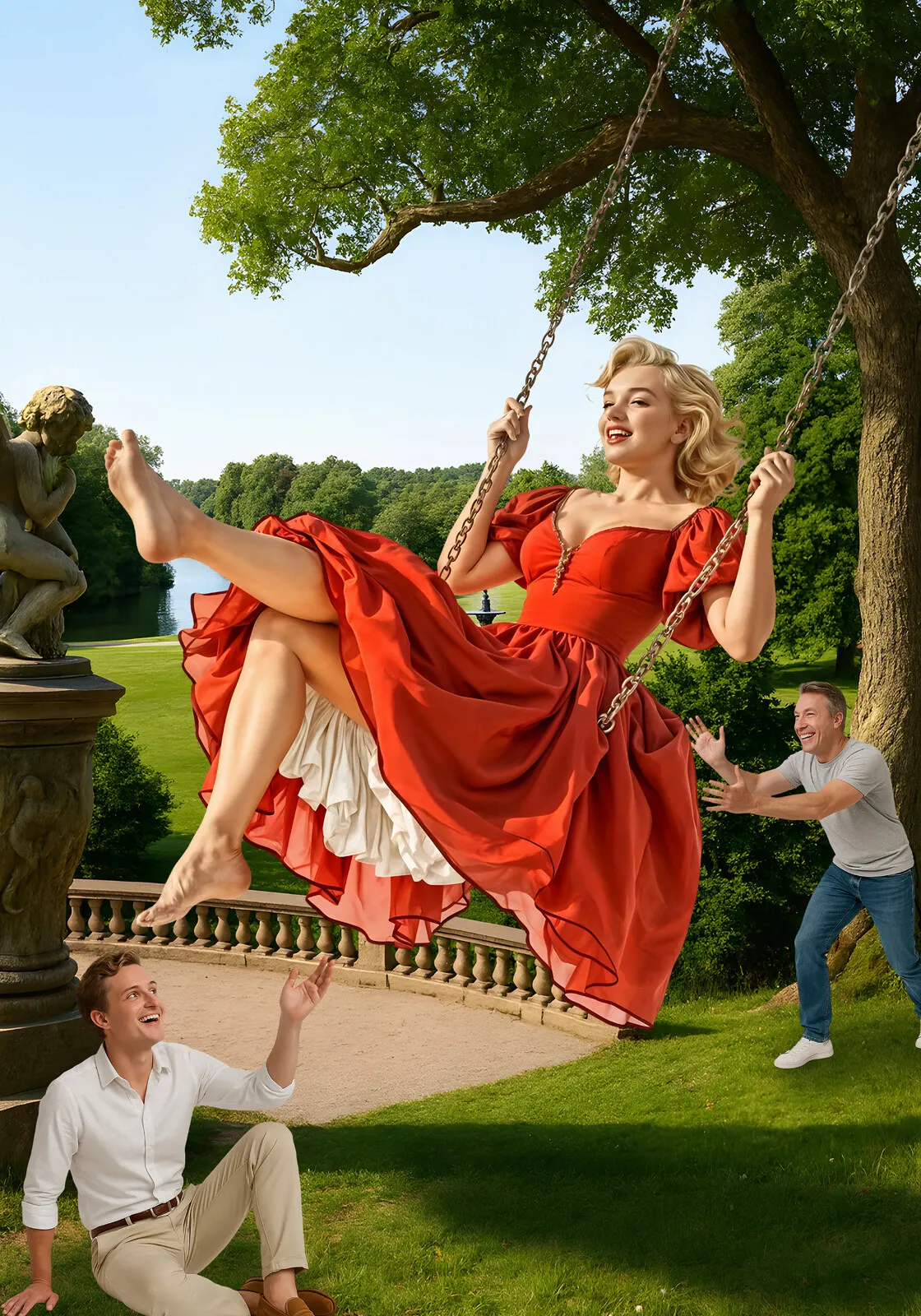
Jörgen Thornberg
A Push of Fate, 2025
Digital
50 x 70 cm
3 200 kr
A Push of Fate
Throughout history, specific images and ideas have borne a weight far greater than their surface charm. A woman on a swing, soaring in the dappled light of a garden, may at first appear nothing more than a fleeting scene of play. Yet, as we observe more closely, the moment broadens into a field of meanings.—erotic, social, and moral—where gestures, glances, and symbols reveal as much about their era as they do about ours. The image of Fragonard’s The Swing, a quintessential example of Rococo art, is not only a depiction of Rococo Paris but also a gateway into the hidden desires, hypocrisies, and freedoms of eighteenth-century society.
Join me, then, as we embark on a fascinating journey through the portal of this essay to explore not only the language of love and desire but also how art encodes passion, power, and play. This essay is not just a text but an invitation—to be entertained, provoked, and perhaps enlightened—by tracing the symbolic threads that connect romance, sexuality, and imagination across centuries. Together, we will explore their historical significance and cultural influence, and in doing so, uncover the timeless wonder of how human emotions are evoked, hinted at, and set in motion, much like the push of a swing.
“The Swing
Silk unfurls, a froth of air,
petals scatter everywhere.
Up she rises, pink in flight,
gown ablaze with stolen light.
A slipper arcs, a secret sign,
Cupid smiles — the plot is mine.
Roses part, his gaze is caught,
desire unveiled, though clothed in thought.
Back and forth, the rhythm plays,
a hidden dance in daylight’s haze.
Not skin, but gesture, slyly shown,
a nakedness that is not bone.
Two men tethered, one aware,
one deceived, yet still he stares.
She, suspended, holds the key,
a body swaying—liberty.
And in the thicket, whispers grow,
as if the leaves themselves should know.
A rustling stirs, half laugh, half moan,
the garden breathes what’s not its own.
Some will frown and purse their face,
call it sin, a fall from grace.
Yet others linger, eyes alight,
and feel new longings wake at night.”
Malmö. August 2025
A Push of Fate
The inspiration for my essay is not only Fragonard’s renowned ‘Swing’ but also a new image situated in Malmö’s Kungsparken. This vast park, a timeless sanctuary of love, has seen two centuries of couples strolling, stealing kisses, and sharing whispered confidences beneath its lush foliage. Here, amid fountains and trees, a swing has once again been conceived—an intentional echo of Fragonard’s famous painting. However, the scene is transposed in time and place, infused with contemporary questions about love, desire, and morality. These questions, which continue to shape our understanding of these complex emotions, are as relevant today as they were in the past. Into this vision, uninvited yet unavoidable, a statue of Cupid has slipped into the frame. In Roman mythology, Cupid is the god of love and desire, the counterpart of the Greek Eros. He is usually depicted as a winged boy, bow in hand, with arrows that can wound the heart and ignite passion. Over centuries, the figure has expanded into a symbol of longing itself—whether innocent or carnal, romantic or lustful. The evolution of the meaning of 'Cupid' in art, from a mere symbol of love to a representation of desire and passion, is evident in this Kungsparken tableau, where he presides once more, mischievous as ever, reminding us that the games of attraction remain timeless even as their circumstances and meanings change.
The word "cupid" also refers to any similar winged being symbolising love or, more broadly, the intense desire for love, lust, and sex — of course, for all kinds of beings, whether straight or LGBTQI.
In the secluded depths of a garden, a young woman rises into the air. She is wrapped in a froth of pink silk, her gown billowing as she leans back, caught mid-flight on a swing. This is no rustic contraption but a seat of crimson velvet with gilded trim, suspended by thick ropes tied to the gnarled branches of an ancient tree. To the right, an older man sits on a stone bench, tugging and releasing the cords that control her flight. With each pull, he generates momentum, and with each release, she arcs higher, her body swept forward with the abandon of play. As she extends her legs, a tiny pink slipper slips from her foot and takes flight, arcing towards the marble statue that stands at the far left. At the foot of this pedestal, tangled in roses, lies a young man. He pushes aside branches to look upwards, his eyes wide and feverish, as if bewitched by the sight revealed beneath her skirts.
This is Jean-Honoré Fragonard’s The Swing, painted in 1767–68, a daring and scandalous image of Rococo Paris. It is not just a shameful image, but a playful and theatrical narrative that has always carried an air of whispered rumours. According to a story first recounted by the dramatist Charles Collé, the painting did not originate as a spontaneous invention, but rather as a commission. A court gentleman, secluded in his pleasure pavilion with a mistress, summoned the painter Gabriel-François Doyen and requested a scene: his mistress on a swing, set in motion by a bishop. Meanwhile, he himself reclined below for the best vantage. Doyen recoiled at such a proposal, suggesting instead that a Cupid might catch the lady’s flying slipper. Unwilling to pursue such an indecorous subject, he declined and directed the patron to Fragonard. The young artist accepted—and in doing so, created one of the most memorable and scandalous images of the ancien régime.
But Fragonard did not strictly adhere to the request. Where the courtier had specified a bishop, Fragonard depicted a worldly gentleman: elegantly dressed, seated on a stone bench, his face lifted with longing, his hands gripping the ropes. This substitution altered the composition. It was no longer a crude caricature with a submissive priest as comic foil. Instead, it became an ambiguous triangle—husband or guardian, mistress, and suitor—each caught in their own role of complicity or oblivion. The older man appears trusting, the younger lover is transfixed, and between them arcs the woman, suspended in a fragile geometry of glances and gestures.
The swing was designed not for the grandeur of a salon but for the intimacy of private chambers. Its modest size (81 by 64 cm) suited the cabinets of pleasure houses and boudoirs, where laughter, flirtation, and secrecy flourished. Hung in such a chamber, the painting became part of the very theatre of libertine life. To those who viewed it privately, it was both delightful and daring: a miniature world where desire could overturn decorum. The viewer's interpretation of The Swing, influenced by their own experiences and societal norms, played a crucial role in its scandalous reputation. When the engraver Nicolas Delaunay published a print of the work in 1782, its fame grew, and the scandal it implied reached a broader elite audience eager for such jeux d’esprit.
Swings themselves evoked associations with desire. The act of soaring upwards, skirts flying, ankles showing, was seen as inherently erotic. Artists like Fragonard had already depicted this motif in paintings such as "The See-Saw" and "Blind Man’s Bluff," where play itself became a metaphor for temptation. The posture of the woman in The Swing, with arms lifted and legs extended, echoed this theme of playful indiscretion. In everyday life, such exposure would be shameful; in the garden-park of the elite, it became a ritualised thrill, a delicate balance between decorum and desire.
And the rhythm is not innocent. The arc of the swing—forward and back, forward and back—beats out a coital metre, a discreet choreography of in-and-out that eighteenth-century viewers could read without needing anything explicit. The ropes tense and slacken like reins; the older man sets the tempo; the lover below counts the beats with his gaze. The flying slipper punctuates the movement like a tiny climax, a pink exclamation in mid-air. In an age that delighted in vertiginous games, such coded kinetics could serve as polite pornography: a spectacle of motion that transmits what the brush cannot depict, a moving picture before moving pictures, ideally suited to the privacy of the cabinet.
The setting is also rich with meaning. Aristocratic garden parks served as venues for masquerades, where nobles played at rustic innocence. They wore straw hats, posed as shepherds or milkmaids, and pretended to break free from the strict etiquette of Versailles. Fragonard captures this contrast: the trellis and fountains that structure nature on the right, and the roses and moss that spread untamed in the foreground. In the fallen rake and the overgrown flowers, desire emerges as a force beyond control.
Symbols of passion are abundant. The pale, pointed slipper directs our gaze to Cupid, who presses a finger to his lips in silence. Fragonard based him on Falconet’s Menacing Cupid, sculpted for Madame de Pompadour, the king’s mistress. In the painting, this god of desire does not hurry to retrieve the shoe; instead, he keeps the secret, his silence a pact with the lovers. At the base of his pedestal, sculpted maenads twist and dance, recalling Bacchic revels and orgiastic abandon. The young man lying below reflects them in his own rapture, his body echoing the poses of Boucher’s painted courtesans, his gaze lost in the opening folds of the woman’s gown, like roses in bloom.
On the right, however, symbols of restraint push back. The ropes in the older man’s hands resemble reins, a reminder of the harness of marriage. The little white dog barks fiercely, a symbol of fidelity sounding the alarm, while the putti riding a dolphin above the fountain gaze with concern rather than complicity. The scene thus balances freedom and control, deception and duty: a pendulum of secrecy and revelation. The oscillation itself—its steady rhythm—becomes the painting’s secret engine: erotic motion contained by social form.
For contemporaries, such Rococo games were not merely trivial amusements. They served as puzzles of observation, imbued with double meanings and subtle innuendos. To observe The Swing is to engage: to let the eye flick from slipper to Cupid, from barking dog to oblivious husband, from rose to garter, from rake to lover. Each detail teases with layered significance. Like the woman herself, we are “suspended—liberated yet tethered—” by Fragonard’s art, actively participating in the unravelling of its secrets.
Recent scholarship has significantly enriched our understanding of this painting. The revelation that the 'man of the Court' may not have been a faceless libertine, but rather François-Marie Ménage de Pressigny, a fermier général of considerable wealth and questionable reputation, is a testament to the intrigue of archival discoveries. His likeness, possibly preserved in the young suitor peering from the roses, adds a layer of mystery to the narrative. The unease he might have felt with the satire Fragonard introduced, his mistress being turned into a public allegory of flirtation, with his own role perhaps being mocked, could explain why the painting vanished into silence for fifteen years. Unlike Boucher’s far more indecent nudes, which circulated freely, Fragonard’s Swing remained a secret, hidden away as if it carried too personal a sting.
When Delaunay engraved the painting in 1782, he subtly transformed its appearance, a testament to his artistry. The figures seem more conventional, and the triangle of desire was smoothed into a familiar love scene. Most notably, the print was implicitly paired with Fragonard’s The Good Mother. On one side, the flirtatious woman on her swing—the erotic pendulum; on the other, a mother with children in a sunlit garden—the moral counterbalance. Together, they created a didactic diptych, turning dangerous desire into respectable maternity. It’s as if Fragonard himself—or the owner—aimed to domesticate the painting’s libertine laughter by balancing it with virtue.
Thus, The Swing reveals its duality: simultaneously playful and subversive, intimate and satirical, cherished and suppressed. Its history recounts a commission that started as a scandal, an artist who turned it into an allegory, and a patron who perhaps regretted what he had unleashed. In its journey between secrecy and revelation, frivolity and critique, we find the core of Rococo art: to conceal and to reveal, to thrill and to warn, all within the same shimmering brushstroke.
The woman glides between two men, her slipper lost, her fate hanging in the balance. The painting itself mirrors her predicament, caught between concealment and revelation, indulgence and judgment, libertine pleasure and bourgeois morality. It is, in every sense, The Push of Fate—its motion a metronome of desire, its rhythm the most public secret of the eighteenth century.
Nudity in art is seldom literal. It can be just as effectively suggested by a movement, a glance, or a gesture as by a bare breast. In The Swing, the woman is fully clothed, yet the fleeting opening of her gown, the raised leg, and the slipper cast aside act as substitutes for nudity. It is precisely the hint, rather than the exposure, that energises the scene. In eighteenth-century Paris, where nymphs and odalisques already displayed more skin than society officially tolerated, the back-and-forth motion of the swing was almost more provocative than a naked body. Fragonard understood that nudity in art is not solely about the visibility of skin, but about the imagination that fills the gaps—about how a movement can reveal more than a bare breast.
While Fragonard’s woman on the swing suggests movement and rhythm, François Boucher takes a more literal approach. His odalisque bodies, such as Blonde Odalisque, openly display flesh, softly modelled in pastel tones, yet always framed by cushions, fabrics, and props that mark the setting as exotic or gallant rather than everyday. This contrast in their approaches highlights the diversity in artistic expression. Jean-Baptiste Greuze, on the other hand, favoured moralising nudity: the involuntarily bared shoulder, the young girl posed between innocence and danger, a body revealing more than she herself seemed to know. In this spectrum, The Swing is somewhere in between—not as explicit as Boucher, not as admonitory as Greuze, but equally playing on the border between propriety’s façade and the untamed body.
As the eighteenth century gave way to the nineteenth century, a significant shift in artistic trends occurred. Nudity appeared in a new guise: fully naked women were painted en masse but labelled as goddesses, nymphs, naiads, or ancient heroines. On grand canvases, artists could depict body after body in poses that initially resembled history painting but in reality served as decorative pornography for aristocratic homes. The irony was evident: the more women in salons were wrapped in fabric, including crinolines and corsets, the more naked they seemed in the painted world. In the same bourgeois homes where living women were laced up, dead goddesses gazed down from the walls—bodies unveiled, yet simultaneously hidden behind the thin mask of allegory.
When modernism emerged at the end of the nineteenth century and the start of the twentieth, black lost its disguise. Where it had once been concealed behind names like Venus, Diana, or the Naiad, it now appeared raw, direct, and often uncomfortable. Édouard Manet shocked Paris with Olympia (1865), in which a contemporary prostitute met the viewer’s gaze without apology and without the filter of myth. Gustave Courbet went even further with L’Origine du monde (1866), a work that reduced nudity to its most tabooed core, as clinical as it was erotic. Suddenly, it was no longer goddesses who were undressed, but ordinary women—their bodies painted with an honesty that felt brutally modern.
With the revolutionary works of Picasso, Schiele, and Modigliani, nudity was not just depicted, but transformed into a symbol of psychology, desire, and fragmented form. The body, once a mere subject of art, became a laboratory of inner states, an arena for anxiety, power, and longing. Schiele’s gaunt figures, stretched with angular hands and piercing gazes, served as much as self-portraits as erotic visions. Picasso shattered and reassembled the female body into Cubist fragments, a form dissolved in time and space. The once decorative nudity—painted to flatter, tease, or seduce—was replaced by nudity that revealed vulnerability, alienation, and desire all at once, inspiring a new way of perceiving and understanding the human form.
And here lies a historical irony. When eighteenth-century painters teased with glimpses of hems, and the nineteenth-century mass-produced goddesses disguised as mistresses, the twentieth century stripped away all masks. Nudity was no longer about adornment but about the truth of the body. It was not just skin, but a mirror of humanity.
In our era, nudity in art has evolved into more than just flesh and form—it has become political, conceptual, and digital. During the second half of the twentieth century, feminist artists such as Carolee Schneemann and VALIE EXPORT challenged the dominance of the male gaze by using their own bodies as both tools and battlegrounds. Schneemann’s Interior Scroll (1975), where she pulled a text from her vagina in front of an audience, transformed nudity into a manifesto and a bodily protest against centuries of objectification. Simultaneously, nudity became a way of questioning norms: of gender, sexuality, and power.
Queer artists pushed nudity further by making it fluid and ambiguous. Robert Mapplethorpe arranged bodies as sculptures, where homoeroticism and sadomasochism heightened questions of desire and taboo within a classical aesthetic. Cindy Sherman dressed and undressed her characters, demonstrating how nudity relates as much to costume and mask as to the body. With performance artists such as Marina Abramović, nudity became an experience, a test of endurance for both the body and the viewer’s limits.
In today’s digital era, this shift persists. Nudity appears in selfies, avatars, and AI-generated bodies—equally image and flesh, equally construction and reality. Contemporary art mirrors this dual existence: bodies projected on screens, filtered bodies, bodies dissolving into pixels, yet still stirring desire, disgust, laughter, or solidarity. Nudity has become a political space where questions of gender, identity, representation, and power intersect. The viewer's role in this context is crucial. The viewer is not a passive consumer but an active participant, shaping and being shaped by the art they engage with.
Thus, the cycle completes from Fragonard’s swing, where a fleeting twist of fabric could serve as pornography for an elite audience, to our current era, where nudity can be displayed fully but must still always be discussed, questioned, and contextualised. The swinging body of the eighteenth century demonstrated how much could be suggested with a single movement; today’s art shows how much remains at stake when the body is unveiled—whether on stage, in the museum, or in the endless mirror of the internet. And perhaps the swing itself is the best metaphor: a motion that constantly balances between freedom and restraint, between desire and censorship. The same pendulum set in motion in Fragonard’s garden still swings—but today, it is the woman herself who holds the ropes, and the audience who has the power to interpret and appreciate the art.
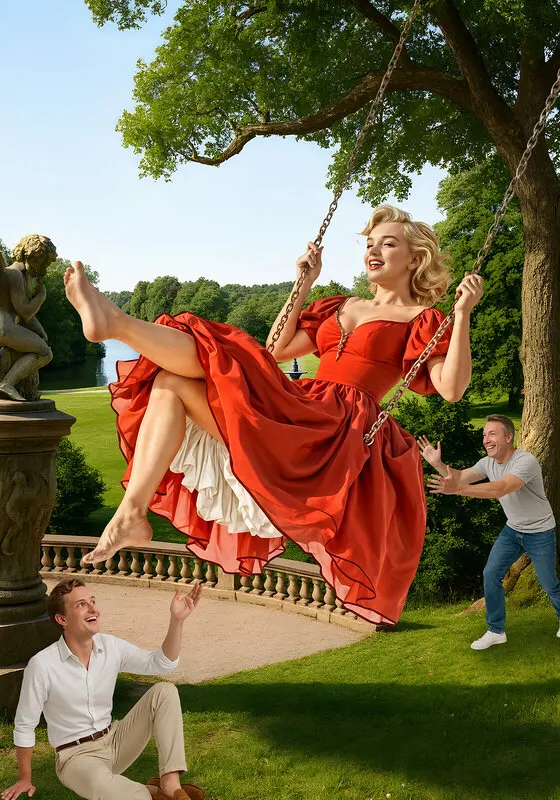
Jörgen Thornberg
A Push of Fate, 2025
Digital
50 x 70 cm
3 200 kr
A Push of Fate
Throughout history, specific images and ideas have borne a weight far greater than their surface charm. A woman on a swing, soaring in the dappled light of a garden, may at first appear nothing more than a fleeting scene of play. Yet, as we observe more closely, the moment broadens into a field of meanings.—erotic, social, and moral—where gestures, glances, and symbols reveal as much about their era as they do about ours. The image of Fragonard’s The Swing, a quintessential example of Rococo art, is not only a depiction of Rococo Paris but also a gateway into the hidden desires, hypocrisies, and freedoms of eighteenth-century society.
Join me, then, as we embark on a fascinating journey through the portal of this essay to explore not only the language of love and desire but also how art encodes passion, power, and play. This essay is not just a text but an invitation—to be entertained, provoked, and perhaps enlightened—by tracing the symbolic threads that connect romance, sexuality, and imagination across centuries. Together, we will explore their historical significance and cultural influence, and in doing so, uncover the timeless wonder of how human emotions are evoked, hinted at, and set in motion, much like the push of a swing.
“The Swing
Silk unfurls, a froth of air,
petals scatter everywhere.
Up she rises, pink in flight,
gown ablaze with stolen light.
A slipper arcs, a secret sign,
Cupid smiles — the plot is mine.
Roses part, his gaze is caught,
desire unveiled, though clothed in thought.
Back and forth, the rhythm plays,
a hidden dance in daylight’s haze.
Not skin, but gesture, slyly shown,
a nakedness that is not bone.
Two men tethered, one aware,
one deceived, yet still he stares.
She, suspended, holds the key,
a body swaying—liberty.
And in the thicket, whispers grow,
as if the leaves themselves should know.
A rustling stirs, half laugh, half moan,
the garden breathes what’s not its own.
Some will frown and purse their face,
call it sin, a fall from grace.
Yet others linger, eyes alight,
and feel new longings wake at night.”
Malmö. August 2025
A Push of Fate
The inspiration for my essay is not only Fragonard’s renowned ‘Swing’ but also a new image situated in Malmö’s Kungsparken. This vast park, a timeless sanctuary of love, has seen two centuries of couples strolling, stealing kisses, and sharing whispered confidences beneath its lush foliage. Here, amid fountains and trees, a swing has once again been conceived—an intentional echo of Fragonard’s famous painting. However, the scene is transposed in time and place, infused with contemporary questions about love, desire, and morality. These questions, which continue to shape our understanding of these complex emotions, are as relevant today as they were in the past. Into this vision, uninvited yet unavoidable, a statue of Cupid has slipped into the frame. In Roman mythology, Cupid is the god of love and desire, the counterpart of the Greek Eros. He is usually depicted as a winged boy, bow in hand, with arrows that can wound the heart and ignite passion. Over centuries, the figure has expanded into a symbol of longing itself—whether innocent or carnal, romantic or lustful. The evolution of the meaning of 'Cupid' in art, from a mere symbol of love to a representation of desire and passion, is evident in this Kungsparken tableau, where he presides once more, mischievous as ever, reminding us that the games of attraction remain timeless even as their circumstances and meanings change.
The word "cupid" also refers to any similar winged being symbolising love or, more broadly, the intense desire for love, lust, and sex — of course, for all kinds of beings, whether straight or LGBTQI.
In the secluded depths of a garden, a young woman rises into the air. She is wrapped in a froth of pink silk, her gown billowing as she leans back, caught mid-flight on a swing. This is no rustic contraption but a seat of crimson velvet with gilded trim, suspended by thick ropes tied to the gnarled branches of an ancient tree. To the right, an older man sits on a stone bench, tugging and releasing the cords that control her flight. With each pull, he generates momentum, and with each release, she arcs higher, her body swept forward with the abandon of play. As she extends her legs, a tiny pink slipper slips from her foot and takes flight, arcing towards the marble statue that stands at the far left. At the foot of this pedestal, tangled in roses, lies a young man. He pushes aside branches to look upwards, his eyes wide and feverish, as if bewitched by the sight revealed beneath her skirts.
This is Jean-Honoré Fragonard’s The Swing, painted in 1767–68, a daring and scandalous image of Rococo Paris. It is not just a shameful image, but a playful and theatrical narrative that has always carried an air of whispered rumours. According to a story first recounted by the dramatist Charles Collé, the painting did not originate as a spontaneous invention, but rather as a commission. A court gentleman, secluded in his pleasure pavilion with a mistress, summoned the painter Gabriel-François Doyen and requested a scene: his mistress on a swing, set in motion by a bishop. Meanwhile, he himself reclined below for the best vantage. Doyen recoiled at such a proposal, suggesting instead that a Cupid might catch the lady’s flying slipper. Unwilling to pursue such an indecorous subject, he declined and directed the patron to Fragonard. The young artist accepted—and in doing so, created one of the most memorable and scandalous images of the ancien régime.
But Fragonard did not strictly adhere to the request. Where the courtier had specified a bishop, Fragonard depicted a worldly gentleman: elegantly dressed, seated on a stone bench, his face lifted with longing, his hands gripping the ropes. This substitution altered the composition. It was no longer a crude caricature with a submissive priest as comic foil. Instead, it became an ambiguous triangle—husband or guardian, mistress, and suitor—each caught in their own role of complicity or oblivion. The older man appears trusting, the younger lover is transfixed, and between them arcs the woman, suspended in a fragile geometry of glances and gestures.
The swing was designed not for the grandeur of a salon but for the intimacy of private chambers. Its modest size (81 by 64 cm) suited the cabinets of pleasure houses and boudoirs, where laughter, flirtation, and secrecy flourished. Hung in such a chamber, the painting became part of the very theatre of libertine life. To those who viewed it privately, it was both delightful and daring: a miniature world where desire could overturn decorum. The viewer's interpretation of The Swing, influenced by their own experiences and societal norms, played a crucial role in its scandalous reputation. When the engraver Nicolas Delaunay published a print of the work in 1782, its fame grew, and the scandal it implied reached a broader elite audience eager for such jeux d’esprit.
Swings themselves evoked associations with desire. The act of soaring upwards, skirts flying, ankles showing, was seen as inherently erotic. Artists like Fragonard had already depicted this motif in paintings such as "The See-Saw" and "Blind Man’s Bluff," where play itself became a metaphor for temptation. The posture of the woman in The Swing, with arms lifted and legs extended, echoed this theme of playful indiscretion. In everyday life, such exposure would be shameful; in the garden-park of the elite, it became a ritualised thrill, a delicate balance between decorum and desire.
And the rhythm is not innocent. The arc of the swing—forward and back, forward and back—beats out a coital metre, a discreet choreography of in-and-out that eighteenth-century viewers could read without needing anything explicit. The ropes tense and slacken like reins; the older man sets the tempo; the lover below counts the beats with his gaze. The flying slipper punctuates the movement like a tiny climax, a pink exclamation in mid-air. In an age that delighted in vertiginous games, such coded kinetics could serve as polite pornography: a spectacle of motion that transmits what the brush cannot depict, a moving picture before moving pictures, ideally suited to the privacy of the cabinet.
The setting is also rich with meaning. Aristocratic garden parks served as venues for masquerades, where nobles played at rustic innocence. They wore straw hats, posed as shepherds or milkmaids, and pretended to break free from the strict etiquette of Versailles. Fragonard captures this contrast: the trellis and fountains that structure nature on the right, and the roses and moss that spread untamed in the foreground. In the fallen rake and the overgrown flowers, desire emerges as a force beyond control.
Symbols of passion are abundant. The pale, pointed slipper directs our gaze to Cupid, who presses a finger to his lips in silence. Fragonard based him on Falconet’s Menacing Cupid, sculpted for Madame de Pompadour, the king’s mistress. In the painting, this god of desire does not hurry to retrieve the shoe; instead, he keeps the secret, his silence a pact with the lovers. At the base of his pedestal, sculpted maenads twist and dance, recalling Bacchic revels and orgiastic abandon. The young man lying below reflects them in his own rapture, his body echoing the poses of Boucher’s painted courtesans, his gaze lost in the opening folds of the woman’s gown, like roses in bloom.
On the right, however, symbols of restraint push back. The ropes in the older man’s hands resemble reins, a reminder of the harness of marriage. The little white dog barks fiercely, a symbol of fidelity sounding the alarm, while the putti riding a dolphin above the fountain gaze with concern rather than complicity. The scene thus balances freedom and control, deception and duty: a pendulum of secrecy and revelation. The oscillation itself—its steady rhythm—becomes the painting’s secret engine: erotic motion contained by social form.
For contemporaries, such Rococo games were not merely trivial amusements. They served as puzzles of observation, imbued with double meanings and subtle innuendos. To observe The Swing is to engage: to let the eye flick from slipper to Cupid, from barking dog to oblivious husband, from rose to garter, from rake to lover. Each detail teases with layered significance. Like the woman herself, we are “suspended—liberated yet tethered—” by Fragonard’s art, actively participating in the unravelling of its secrets.
Recent scholarship has significantly enriched our understanding of this painting. The revelation that the 'man of the Court' may not have been a faceless libertine, but rather François-Marie Ménage de Pressigny, a fermier général of considerable wealth and questionable reputation, is a testament to the intrigue of archival discoveries. His likeness, possibly preserved in the young suitor peering from the roses, adds a layer of mystery to the narrative. The unease he might have felt with the satire Fragonard introduced, his mistress being turned into a public allegory of flirtation, with his own role perhaps being mocked, could explain why the painting vanished into silence for fifteen years. Unlike Boucher’s far more indecent nudes, which circulated freely, Fragonard’s Swing remained a secret, hidden away as if it carried too personal a sting.
When Delaunay engraved the painting in 1782, he subtly transformed its appearance, a testament to his artistry. The figures seem more conventional, and the triangle of desire was smoothed into a familiar love scene. Most notably, the print was implicitly paired with Fragonard’s The Good Mother. On one side, the flirtatious woman on her swing—the erotic pendulum; on the other, a mother with children in a sunlit garden—the moral counterbalance. Together, they created a didactic diptych, turning dangerous desire into respectable maternity. It’s as if Fragonard himself—or the owner—aimed to domesticate the painting’s libertine laughter by balancing it with virtue.
Thus, The Swing reveals its duality: simultaneously playful and subversive, intimate and satirical, cherished and suppressed. Its history recounts a commission that started as a scandal, an artist who turned it into an allegory, and a patron who perhaps regretted what he had unleashed. In its journey between secrecy and revelation, frivolity and critique, we find the core of Rococo art: to conceal and to reveal, to thrill and to warn, all within the same shimmering brushstroke.
The woman glides between two men, her slipper lost, her fate hanging in the balance. The painting itself mirrors her predicament, caught between concealment and revelation, indulgence and judgment, libertine pleasure and bourgeois morality. It is, in every sense, The Push of Fate—its motion a metronome of desire, its rhythm the most public secret of the eighteenth century.
Nudity in art is seldom literal. It can be just as effectively suggested by a movement, a glance, or a gesture as by a bare breast. In The Swing, the woman is fully clothed, yet the fleeting opening of her gown, the raised leg, and the slipper cast aside act as substitutes for nudity. It is precisely the hint, rather than the exposure, that energises the scene. In eighteenth-century Paris, where nymphs and odalisques already displayed more skin than society officially tolerated, the back-and-forth motion of the swing was almost more provocative than a naked body. Fragonard understood that nudity in art is not solely about the visibility of skin, but about the imagination that fills the gaps—about how a movement can reveal more than a bare breast.
While Fragonard’s woman on the swing suggests movement and rhythm, François Boucher takes a more literal approach. His odalisque bodies, such as Blonde Odalisque, openly display flesh, softly modelled in pastel tones, yet always framed by cushions, fabrics, and props that mark the setting as exotic or gallant rather than everyday. This contrast in their approaches highlights the diversity in artistic expression. Jean-Baptiste Greuze, on the other hand, favoured moralising nudity: the involuntarily bared shoulder, the young girl posed between innocence and danger, a body revealing more than she herself seemed to know. In this spectrum, The Swing is somewhere in between—not as explicit as Boucher, not as admonitory as Greuze, but equally playing on the border between propriety’s façade and the untamed body.
As the eighteenth century gave way to the nineteenth century, a significant shift in artistic trends occurred. Nudity appeared in a new guise: fully naked women were painted en masse but labelled as goddesses, nymphs, naiads, or ancient heroines. On grand canvases, artists could depict body after body in poses that initially resembled history painting but in reality served as decorative pornography for aristocratic homes. The irony was evident: the more women in salons were wrapped in fabric, including crinolines and corsets, the more naked they seemed in the painted world. In the same bourgeois homes where living women were laced up, dead goddesses gazed down from the walls—bodies unveiled, yet simultaneously hidden behind the thin mask of allegory.
When modernism emerged at the end of the nineteenth century and the start of the twentieth, black lost its disguise. Where it had once been concealed behind names like Venus, Diana, or the Naiad, it now appeared raw, direct, and often uncomfortable. Édouard Manet shocked Paris with Olympia (1865), in which a contemporary prostitute met the viewer’s gaze without apology and without the filter of myth. Gustave Courbet went even further with L’Origine du monde (1866), a work that reduced nudity to its most tabooed core, as clinical as it was erotic. Suddenly, it was no longer goddesses who were undressed, but ordinary women—their bodies painted with an honesty that felt brutally modern.
With the revolutionary works of Picasso, Schiele, and Modigliani, nudity was not just depicted, but transformed into a symbol of psychology, desire, and fragmented form. The body, once a mere subject of art, became a laboratory of inner states, an arena for anxiety, power, and longing. Schiele’s gaunt figures, stretched with angular hands and piercing gazes, served as much as self-portraits as erotic visions. Picasso shattered and reassembled the female body into Cubist fragments, a form dissolved in time and space. The once decorative nudity—painted to flatter, tease, or seduce—was replaced by nudity that revealed vulnerability, alienation, and desire all at once, inspiring a new way of perceiving and understanding the human form.
And here lies a historical irony. When eighteenth-century painters teased with glimpses of hems, and the nineteenth-century mass-produced goddesses disguised as mistresses, the twentieth century stripped away all masks. Nudity was no longer about adornment but about the truth of the body. It was not just skin, but a mirror of humanity.
In our era, nudity in art has evolved into more than just flesh and form—it has become political, conceptual, and digital. During the second half of the twentieth century, feminist artists such as Carolee Schneemann and VALIE EXPORT challenged the dominance of the male gaze by using their own bodies as both tools and battlegrounds. Schneemann’s Interior Scroll (1975), where she pulled a text from her vagina in front of an audience, transformed nudity into a manifesto and a bodily protest against centuries of objectification. Simultaneously, nudity became a way of questioning norms: of gender, sexuality, and power.
Queer artists pushed nudity further by making it fluid and ambiguous. Robert Mapplethorpe arranged bodies as sculptures, where homoeroticism and sadomasochism heightened questions of desire and taboo within a classical aesthetic. Cindy Sherman dressed and undressed her characters, demonstrating how nudity relates as much to costume and mask as to the body. With performance artists such as Marina Abramović, nudity became an experience, a test of endurance for both the body and the viewer’s limits.
In today’s digital era, this shift persists. Nudity appears in selfies, avatars, and AI-generated bodies—equally image and flesh, equally construction and reality. Contemporary art mirrors this dual existence: bodies projected on screens, filtered bodies, bodies dissolving into pixels, yet still stirring desire, disgust, laughter, or solidarity. Nudity has become a political space where questions of gender, identity, representation, and power intersect. The viewer's role in this context is crucial. The viewer is not a passive consumer but an active participant, shaping and being shaped by the art they engage with.
Thus, the cycle completes from Fragonard’s swing, where a fleeting twist of fabric could serve as pornography for an elite audience, to our current era, where nudity can be displayed fully but must still always be discussed, questioned, and contextualised. The swinging body of the eighteenth century demonstrated how much could be suggested with a single movement; today’s art shows how much remains at stake when the body is unveiled—whether on stage, in the museum, or in the endless mirror of the internet. And perhaps the swing itself is the best metaphor: a motion that constantly balances between freedom and restraint, between desire and censorship. The same pendulum set in motion in Fragonard’s garden still swings—but today, it is the woman herself who holds the ropes, and the audience who has the power to interpret and appreciate the art.
3 200 kr

Jörgen Thornberg
Malmö
Lite om bilder och mig. Translation in English at the end.
Jag är en nyfiken person som ser allt i bilder, även det jag fäster i ord, gärna tillsammans för bakom alla mina bilder finns en berättelse. Till vissa bilder hör en kortare eller längre novell som följer med bilden.
Bilder berättar historier. Jag omges av naturlig skönhet, intressanta människor och historia var jag än går. Jag använder min kamera för att dokumentera världen och blanda det jag ser med vad jag känner för att fånga den dolda magin.
Mina bilder berättar mina historier. Genom mina bilder, tryck och berättelser. Jag bjuder in dig att ta del av dessa berättelser, in i ditt liv och hem och dela min mycket personliga syn på vår värld. Mer än vad ögat ser. Jag tänker i bilder, drömmer och skriver och pratar om dem; följaktligen måste jag också skapa bilder. De blir vad jag ser, inte nödvändigtvis begränsade till verkligheten. Det finns en bild runt varje hörn. Jag hoppas att du kommer att se vad jag såg och gilla det.
Jag är också en skrivande person och till många bilder hör en kortare eller längre essay. Den följer med tavlan, tryckt på fint papper och med en personlig hälsning från mig.
Flertalet bilder startar sin resa i min kamera. Enkelt förklarat beskriver jag bilden jag ser i mitt inre, upplevd eller fantiserad. Bilden uppstår inom mig redan innan jag fått okularet till ögat. På bråkdelen av ett ögonblick ser jag vad jag vill ha och vad som kan göras med bilden. Här skall jag stoppa in en giraff, stålmannen, Titanic eller vad det är min fantasi finner ut. Ännu märkligare är att jag kommer ihåg minnesbilden långt efteråt när det blir tid att skapa verket. Om jag lyckas eller inte, är upp till betraktaren, oftast präglat av en stråk av svart humor – meningen är att man skall bli underhållen. Mina bilder blir ofta en snackis där de hänger.
Jag föredrar bilder som förmedlar ett budskap i flera lager. Vid första anblicken fylld av feel-good, en vacker utsikt, fint väder, solen skiner, blommor på ängen eller vattnet som ligger förrädiskt spegelblankt. I en sådan bild kan jag gömma min egentliga berättelse, mitt förakt för förtryckare och våldsverkare, rasister och fördomsfulla människor - ett gärna återkommande motiv mer eller mindre dolt i det vackra motivet. Jag försöker förena dem i ett gemensamt narrativ.
Bild och formgivning har löpt som en röd tråd genom livet. Fotokonst känns som en värdig final som jag gärna delar med mig.
Min genre är vid som framgår av mina bilder, temat en blandning av pop- och gatukonst i kollage som kan bestå av hundratals lager. Vissa bilder kan ta veckor, andra någon dag innan det är dags att överlämna resultatet till printverkstaden. Fine Art Prints är digitala fotocollage. I dessa kollage sker rivandet, klippandet, pusslandet, målandet, ritandet och sprayningen digitalt. Det jag monterar in kan vara hundratals år gamla bilder som jag omsorgsfullt frilägger så att de ser ut att vara en del av tavlan men också bilder skapade av mig själv efter min egen fantasi. Därefter besöks printstudion och för vissa bilder numrera en limiterad upplaga (oftast 7 exemplar) och signera för hand. Vissa bilder kan köpas i olika format. Det är bara att fråga efter vilka. Gillar man en bild som är 70x100 men inte har plats på väggen, går den kanske att få i 50x70 cm istället. Frågan är fri.
Metoden Giclée eller Fine Art Print som det också kallas är det moderna sättet för framställning av grafisk konst. Villkoret för denna typ av utskrifter är att en högkvalitativ storformatskrivare används med åldersbeständigt färgpigment och konstnärspapper eller i förekommande fall på duk. Pappret som används möter de krav på livslängd som ställs av museer och gallerier. Normalt säljer jag mina bilder oinramade så att den nya ägaren själv kan bestämma hur de skall se ut, med eller utan passepartout färg på ram, med eller utan glas etc..
Under många år ställde jag bara ut på nätet, i valda grupper och på min egen Facebooksida - https://www.facebook.com/jorgen.thornberg.9
Jag finns också på en egen hemsida som tyvärr inte alltid är uppdaterad – https://www.jth.life/ Där kan du också läsa en del av de berättelser som följer med bilden.
UTSTÄLLNINGAR
Luftkastellet, oktober 2022
Konst i Lund, november 2022
Luftkastellet, mars 2023
Engleson Galleri Caroli, april 2023
Hydra, Greece June 2023
Engleson Galleri Caroli, oktober 2023
Toppen, Höllviken december 2023
Luftkastellet, mars 2024
Torups Galleri, mars 2024
Venice, May 2024
Luftkastellet, oktober 2024
Konst i Advent, December 2024
Galleri Engleson, Caroli December 2024
Jäger & Jansson Galleri, april 2025
A bit about pictures and me.
I'm a curious person who sees everything in pictures, even what I express in words, often combining them, for behind all my pictures lies a story. These narratives, some as short as a single image and others as long as a novel, are the heart and soul of my work.
Pictures tell stories. Wherever I go, I'm surrounded by natural beauty, exciting people, and history. I use my camera to document the world and blend what I see with what I feel to capture the hidden magic.
My images tell my stories. Through my pictures, prints, and narratives, I invite you to partake in these stories in your life and home and share my deeply personal perspective of our world. More than meets the eye. I think in pictures, dream, write, and talk about them; consequently, I must create images too. They become what I see, not necessarily confined to reality. There's a picture around every corner. I hope you'll see what I saw and enjoy it.
I'm also a writer, and many images come with a shorter or longer essay. It accompanies the painting, printed on fine paper with my personal greeting.
Many pictures start their journey on my camera. Simply put, I describe the image I see in my mind, experienced or imagined. The image arises within me even before I bring the eyepiece to my eye. In a fraction of a moment, I see what I want and what can be done with the picture. Here, I'll insert a giraffe, Superman, the Titanic, or whatever my imagination conjures up. Even stranger is that I remember the mental image long after it's time to create the work. Whether I succeed is up to the observer, often imbued with a streak of black humour – the aim is to entertain. My pictures usually become a talking point wherever they hang.
I prefer pictures that convey a message in multiple layers. At first glance, they're filled with feel-good vibes, a beautiful view, lovely weather, the sun shining, flowers in the meadow, or the water lying deceptively calm. But beneath this surface beauty, I often conceal a deeper story, a narrative that challenges societal norms or explores the human condition. I invite you to delve into these hidden narratives and discover the layers of meaning within my work.
Picture and design have been a thread running through my life. Photographic art feels like a fitting finale, and I'm happy to share it.
My genre is varied, as seen in my pictures; the theme is a blend of pop and street art in collages that can consist of hundreds of layers. Some images can take weeks, others just a day before it's time to hand over the result to the print workshop. Fine Art Prints are digital photo collages. In these collages, tearing, cutting, puzzling, painting, drawing, and spraying happen digitally. What I insert can be images hundreds of years old that I carefully extract so they appear to be part of the painting, but also images created by myself, now also generated from my imagination. Next, visit the print studio and, for certain images, number a limited edition (usually 7 copies) and sign them by hand. Some images may be available in other formats. Just ask which ones. If you like an image that's 70x100 but doesn't have space on the wall, you might be able to get it in 50x70 cm instead. The question is open.
The Giclée method, or Fine Art Print as it's also called, is the modern way of producing graphic art. This method ensures the highest quality and longevity of the artwork, using a high-quality large-format printer with archival pigment inks and artist paper or, in some cases, canvas. The paper used meets the longevity requirements set by museums and galleries. I sell my pictures unframed, allowing the new owner to personalise their artwork, confident in the lasting value and quality of the piece.
For many years, I only exhibited online, in selected groups, and on my Facebook page - https://www.facebook.com/jorgen.thornberg.9. I also have my website, which unfortunately is not constantly updated - https://www.jth.life/. You can also read some of the stories accompanying the pictures there.
EXHIBITIONS
Luftkastellet, October 2022
Art in Lund, November 2022
Luftkastellet, March 2023
Engleson Gallery Caroli, April 2023
Hydra, Greece June 2023
Engleson Gallery Caroli, October 2023
Toppen, Höllviken December 2023
Luftkastellet, March 2024
Torup Gallery, March 2024
Venice, May 2024
UTSTÄLLNINGAR
Luftkastellet, oktober 2022
Konst i Lund, november 2022
Luftkastellet, mars 2023
Engleson Galleri Caroli, april 2023
Hydra, Greece June 2023
Engleson Galleri Caroli, oktober 2023
Toppen, Höllviken december 2023
Luftkastellet, mars 2024
Torups Galleri, mars 2024
Venice, May 2024
Luftkastellet, October 2024
Konst i Advent, December 2024
Galleri Engleson, Caroli December 2024
Jäger & Jansson Galleri, April 2025
Utbildning
Autodidakt
Medlem i konstnärsförening
Öppna Sinnen
Med i konstrunda
Konstrundan i Skåne
Utställningar
Luftkastellet, October 2022
Art in Lund, November 2022
Luftkastellet, March 2023
Engleson Gallery Caroli, April 2023
Hydra, Greece June 2023
Engleson Gallery Caroli, October 2023
Toppen, Höllviken December 2023
Luftkastellet, March 2024
Torup Gallery, March 2024
Venice, May 2024