Vi använder cookies för att ge dig bästa möjliga upplevelse. Välj vilka cookies du tillåter.
Läs mer i vår integritetspolicy
Jörgen Thornberg
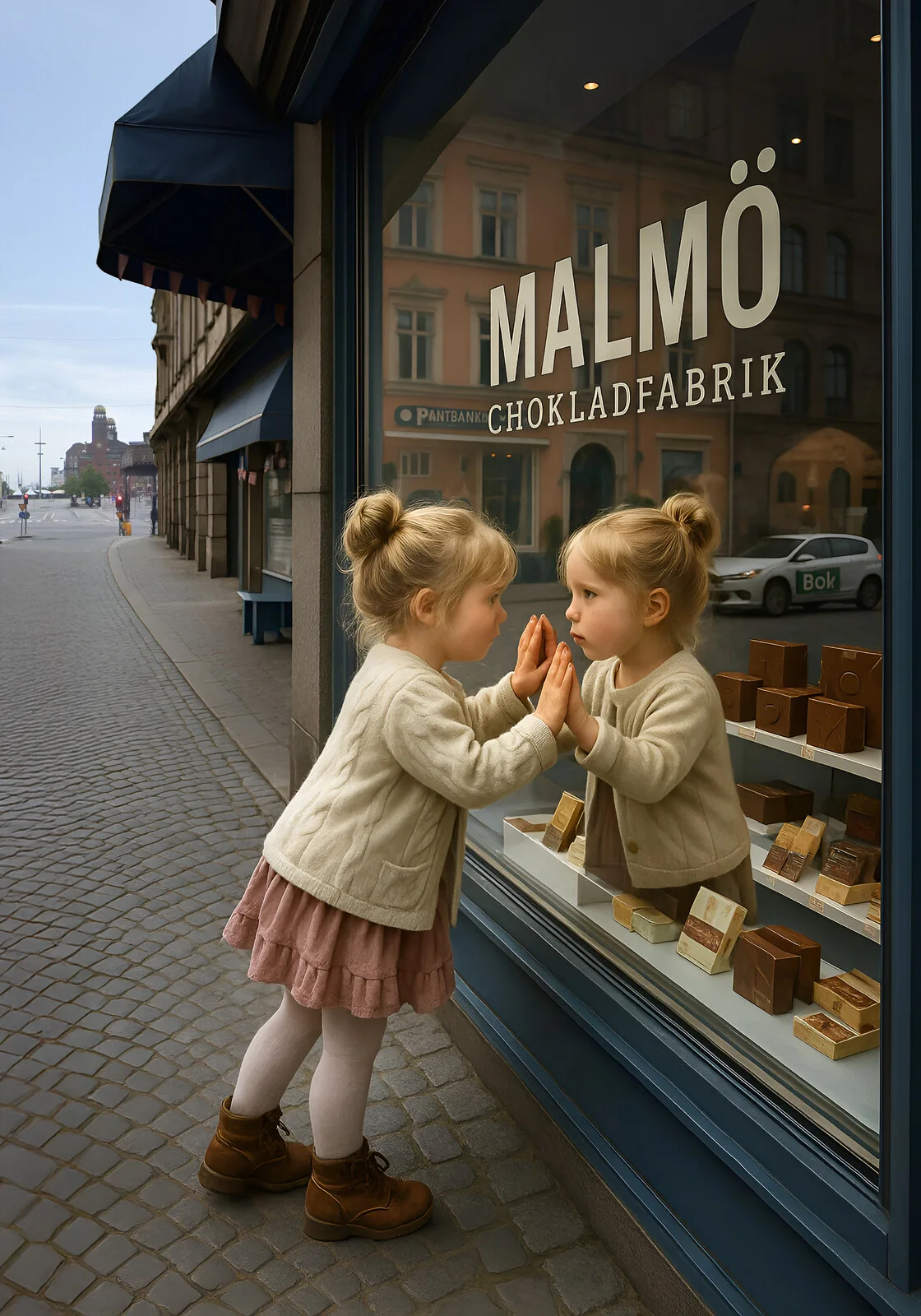
Elizabeth at the Chocolate Factory, 2025
Digital
50 x 70 cm
3 200 kr
Elizabeth at the Chocolate Factory
The image and the short story depict a small street in Malmö, as well as a reflection of it. Hamngatan is a brief yet significant pathway between the harbour and the city; on its paving stones, everyday rituals unfold, including arrivals and farewells. Amidst it all, a shop window serves as the stage for a conversation between two sisters. This shop window, with its reflective surface, symbolises the boundary between the living and the departed. It's a place where the two sisters can meet and converse, a liminal space that transcends the physical and allows for a connection that defies the boundaries of life and death.
It is a story about childhood games — the dollhouse, homemade dresses for the Barbies, and Paddington as the make-believe father — and about the bodily memory of having shared a mother’s womb before the outside world opened up brutally. It also explores the feeling of guilt: the quiet, absurd question that can haunt a survivor — why me and not you? How does one carry another person’s absence through one’s own life?
The story explores the memory of the body: the forceful kicks in the stomach, how two small hearts found their rhythm in each other's closeness, and how those rhythms later gave rise to play and conversations at a window. The city — Hamngatan, the Pawnshop’s orange-pink building, and the Post Office’s stern gaze in the distance — is not just a backdrop but an active participant; reflections in the glass blend with the façades across the street, transforming the place into a portal where presence and absence converge.
At the window, light chat shifts to more profound questions: about bravery and fear, about the silent weight of guilt and the comfort of everyday routines. Elizabeth sometimes assumes the role of the daring sister who raises her hand in class; Kerstin is the more cautious one, the tidy child who keeps her pen in hand. Together they craft an intimate, soul-searching dialogue — a conversation that is as much a game as it is a ritual to keep the dead twin alive, a dialogue that will resonate with the deepest parts of your soul.
The story does not conclude with a neat reconciliation but with a change in form: grief becomes something one can carry forward. This change in form is a transformation of grief from a burden to a companion, a part of life that can be embraced and carried forward. Elizabeth — a Time-traveller who moves timelessly between celestial bodies and the pavement of Hamngatan — can come and go; her star in the Milky Way becomes as real a comfort as the window’s chill against the palm. This change makes the story’s ending both earthly and expansive: it does not close everything off; it opens up.
Join me as we open the gate to this small tale about a street, a window, and two sisters — a meeting where the missing one finds a voice and where everyday’s small details become healing rituals. Let the scenes of the story carry you between the light of play and the shadow of grief, between Paddington’s jar of marmalade and the star’s quiet watchfulness, offering a journey of healing and hope.
Continue — in the next section, an essay broadens the perspective, featuring voices from other lone twins, reflections on how grief influences families and communities, and a closer look at how places like a shop window can act as bridges between worlds. Click the link below when you are ready to step through the gateway and follow the trail onwards, because your role in continuing this story is crucial and valued.
“The Twin in the Glass
She waits inside the window like a secret kept in light,
a quiet constellation folded into glass.
I press my palm where hers would be — cool, then warm —
and the city softens to the hush between our breaths.
We speak in the small language of shared beginnings:
the sharp kick, the slow barter of two hearts,
how we learned to answer each other before words.
You tell me of a dollhouse room we never built,
of a ribbon cut from Mother’s sleeve, a tiny red stain
That proves a skirt was ever sewn with courage.
Paddington is our father today; he leans and sleeps,
marmalade jars like promises on the table.
We plan a picnic in Kungsparken, choose a single praline each—
The world beyond the pane, full of tempting things, I refuse
because your reflection is my true sweet.
“Do you live in the window?” I ask, frightened of silence.
“No,” you say, smiling like a comet. “I live in you.
And sometimes on my star in the Milky Way, I visit both.”
You are a Time-traveller who moves between constellations and cobbles,
who keeps an appointment with my hand every week.
People pass and do not know this small theatre:
They see a child speaking to the glass, not the sister replying.
But I know the weight of your absence: it is an apron I wear,
a double stitch through which my life is threaded.
And when the streetlamps bloom, your voice becomes a lamp, too—
steady as the pawnshop’s orange wall, patient as the posthouse clocks.
We do not say goodbye. We say: come tomorrow, come when you must.
I fold our conversation into my pocket like a map,
a path that leads from the pavement to the star.
Between the chocolate and the city, we keep our ritual—
two girls, one window, a world that will not close us.”
Malmö. September 2025
Elizabeth at the Chocolate Factory
Chapter 1. Hamngatan
Hamngatan, one of Malmö’s shortest streets, is a microcosm of a larger journey. It forms a direct line between the water and the city, between the harbour and the Central Station with its platforms and tracks that extend out into the world, past the imposing Post Office that always seems ready to sternly lecture little girls about what they must not do—and on towards Stortorget, where traces of kings, market traders, and bicycle wheels blend into the same rhythm. The cobbles here, worn and grey like my grandmother’s hand, seem to absorb the sounds of the city, from rolling suitcases to echoing footsteps.
I almost always pass along Hamngatan as if I am heading somewhere else. Yet I stop here. Midway down the street sits Malmö Chocolate Factory, its generous shop window seeming like a small stage for the city. Inside, there are boxes of chocolates stacked like tiny apartment blocks, shiny wrappers that seem solemn, heavy cakes with cracks where the butter glistens. But that is not why I stop. It's not the chocolates or the cakes that draw me, but the presence of Elizabeth, my twin, waiting for me in the reflection from the street.
I stop because she is waiting for me there, in the reflection from the street: Elizabeth, my twin sister. She stands as still as I do. She rests her hand against the glass when I do. When passersby see her, they think she's talking to her echo. But I see my twin sister, my other half, my reflection in the glass. Her presence is a constant source of comfort, a reminder that I am never truly alone.
Our memories are not just recollections; they are an integral part of who we are. They originate from a time when the world was an open canvas of endless possibilities, when a heartbeat was both music and weather, when light filtered through everything. We embarked on our journey there—two small bodies in the same boat, two hearts seeking the same rhythm. Our bond, unbreakable even by death, is a testament to the enduring power of twinhood, a force that transcends the physical realm and continues to shape our lives.
“Do you remember?” Elizabeth asks sometimes when we meet at the window. Her voice is soft, but I hear it clearly, like a word whispered very close.
“I remember that you kicked,” I say. “Hard, as if you wanted to move the walls.”
“And you answered,” she says. “Push for push. We invented language before anyone could teach us it.”
I smile, though it hurts a little, too. Sometimes guilt comes like a shadow—even though I know the facts, how the doctors explained it, how chance wears faces but bears no responsibility. Still, I hear myself ask, the weight of guilt heavy in my voice:
“What if I pushed you too hard? What if it was me who—”
“Stop,” says Elizabeth. She places her palm on the glass, right where my hand rests. “It wasn’t you. It wasn’t me. It was the sea beneath the boat that shifted. It was the world splitting at a point we couldn’t reach.” Her words, a balm to my guilt, a reassurance that we share this grief, that it's not mine alone to bear. Our shared understanding of this loss unites us, comforting us in our moments of doubt and pain.
When I was small, I didn’t understand what I knew. I carried a silent secret. Mother said I slept fitfully, that I might wake with small hands clenched as if I had been holding onto something that suddenly disappeared. At kindergarten, I would sit for ages staring out of any window. I believed everyone had a shadow that was more than just a shadow.
Later, when I began to understand how the world explains things, I found words that made sense to me. “Twinless twin.” “One of two.” “Lone twin.” I tried them in my mouth, and they sounded like the name of a bird flying where the flock should have been. But the names only took me halfway. For even though I was alone, I was not alone. Elizabeth had never left me. She was standing on the other side of the glass.
I often think about what we would have done if everything had been different. We would have had our first dollhouse together. I see us bent over small rooms that smell of wood and paint, lying on a felt rug and a little kitchen table painted with a trembling hand. We would have argued about where the sofa should stand, bargained, laughed, and changed it again. Perhaps we would have sewn dresses for our Barbies, little skirts cut from an old curtain, a pink top leftover from Mother’s blouse. We would have learned to use needle and thread together; I would have pricked my finger, you would have blown on the wound and said it was all right, that one must leave a little blood in every project for it to be alive. The longing for these moments is a constant ache in my heart.
In our conversations, we still play the game of “mother, father, child.” I am often the mother—I don’t know if that means anything, perhaps only that I was the one who was allowed to continue. Elizabeth is the child who always knows first. And the father? He is Paddington, of course. Who else? That stubborn kindness in his face, that substantial weight that suggests someone can carry you. You, dear reader, are part of this game, part of our shared experience. You are the one we invite to our picnic, the one we share our hot chocolate and pralines with.
“Papa Paddington will take us on a picnic,” Elizabeth says. “He has sandwiches in his bag.”
“And hot chocolate in a thermos,” I say. “We’ll go to Kungsparken and feed the birds.”
“And on the way home, we’ll each choose a praline.”
Inside the Chocolate Factory, the boxes stand in rows or are piled high. But the only chocolate I truly long for is the one in our lines of dialogue. I did once go inside. The smell was almost ritualistic, like the first hymn in a small church. I watched a woman use tweezers: pistachio, nougat, dark with salt, a shell hiding a secret. I turned towards the window to wave at Elizabeth. She sat atop a stack of boxes and smiled apologetically.
“Come out for a walk in this lovely weather. You will love Slottsparken with all its birds,” I called.
“I cannot,” she said. “Not today. Not while the glass is here.”
In that moment, I realised I would never choose the pralines over her. The world may be full of treats, but it lacks presence. I chose presence. And that is why I stand here, outside, again and again, my hand against the glass. It is our ritual. Our way of saying: we are still two.
Hamngatan has shown me that a short street can hold an entire life. If you need proof, look across the road at the orange-pink building with the Pawnshop rising, its silent authority clear. Sometimes that very façade is reflected in the glass behind Elizabeth, making it seem as if she has a whole building behind her. I like to think that is how it is: she leans on a city that preserved her shape when the world let her go.
“Do you think we would have been the same?” I ask sometimes.
“Same in some ways,” she says. “Different in the best ways. That is the whole point.”
“You would have defended me,” I say. “When I went quiet at school, when I didn’t know what to say.”
—“And you me,” she says. “When I became too sure of myself and needed someone to make me laugh at the right moment.”
Occasionally, I pass by without pausing. Although it's not a frequent occurrence, it does happen. You can’t always control it; some days, you have to race against time. On those days, I carry our conversation like a comforting note in my pocket, one I don’t have the luxury to read but know is there. When I return, she is still standing. Not upset, not wounded. Time doesn't gnaw at her the way it does at me. She looks at me as if she always knew I would return.
“I get frightened sometimes,” I say. “That if I stop looking, you will disappear.”
“I know,” she says. “But I do not live in the window, Kerstin. I live in you. The window only helps you remember.”
Perhaps that is why I love this place. Between the station’s bustling life and Stortorget with its ugly statue, here where the Post Office keeps watch from a distance with its heavy eyes, there is a little tear in the fabric: a pane of glass that both separates and unites. I press my hand to the pane, feeling the cold first, then the warmth beneath. My face is reflected next to hers; our features merge into one. I think of how we began, in there, and how we parted—no ceremony, only a quiet interruption. Yet here we stand again, two girls on opposite sides of a world, with the same heartbeat, only a slightly different tempo.
When dusk falls and the streetlights are switched on, the Chocolate Factory’s window becomes a soft lamp over the pavement. People walk by. Someone smiles, someone hurries, and someone doesn’t look at all. Elizabeth and I speak quietly. We decide how to furnish the living room in the doll’s house, choose fabrics for Barbie's dresses, plan an unlikely trip with Paddington, where the weather looks set to be clear, and we get lost on purpose. And when I finally have to leave, she always says the same thing.
“We’ll see each other next week. Or tomorrow. Or when you must. I am already there.”
I nod. Hamngatan nudges me on, like a hand on my back. I know where I live. I know where she is. And between us, a pane of glass separates our worlds, keeping her inside and me outside.
Chapter 2. Games and Imaginary Life
When I was a child, I had a box beneath my bed. A plain cardboard box with worn edges, but to me, it was a treasure chest. It contained scraps of fabric, old buttons, broken doll limbs, and tiny boxes I had kept because they might become something. Elizabeth, my imaginary friend, and I used to take out the box and sit on the floor in my room. Of course, I was the only one sitting there for real, but in my world, we were always two.
“This will be the sofa,” she would say, holding up a scrap of cloth.
“And this is the table,” I replied, placing a matchbox on its end.
Thus, our first dollhouse was born: a house of cardboard and imagination.
We rearranged the furniture repeatedly. The sofa might sit under the window for a while, then be moved back to the wall. The table was turned, the lamps shifted, and each time we chuckled at how easily we changed our minds. I sometimes think it was our secret architecture course—learning rooms by never being satisfied with the first plan.
When I later received a Barbie doll, it became even clearer that I was not alone. Mother had kept small scraps of fabric from dresses she had sewn for herself. Elizabeth chose a floral piece and suggested that we sew a summer dress. I took a plain piece and attempted to make a skirt. The needle pricked my finger, and blood dropped onto the cloth. I feared I had ruined everything. This incident, however, taught me that creativity often comes with a price, and that even mistakes can add a touch of reality to our creations.
“That only means it’s alive now,” Elizabeth said calmly. “A little blood makes everything real.”
So we kept the stain, a secret mark, and no one else knew why the skirt always had a small rose-smudge near the hem.
But the most enjoyable game of all was “mother, father, child.” I remember the first time I placed Paddington the bear on the floor. He wore a blue coat and a hat that kept falling off his head. He was perfect as a father because he was both steady and a little clumsy. Elizabeth laughed out loud when he toppled into a chair and immediately began to snore. This game, with its simple yet profound role-playing, allowed us to step into the shoes of adults, giving us a glimpse of the future we could only imagine.
“Papa is tired,” she said, tucking him in with a handkerchief.
“He has been at the bank all day,” I added. “Or maybe driving a train.”
“No, he is busy with the marmalade,” Elizabeth objected, placing an imaginary jar in his paw.
So, Paddington became our father, once and for all. And we were his daughters, whom he carried on his shoulders when we went to the park. I could feel the rocking even though I sat still in my room.
It was strange how natural everything felt, as if I were not inventing but carrying on something that already existed. As if, together, we recreated what might have been. When Elizabeth spoke, her voice felt like my own but different—lighter, firmer, sometimes more mischievous.
“When we are older,” she used to say, “we’ll travel to Copenhagen by ourselves. We’ll take the train from the Central Station, peer at the boats from the bridge, and buy ice cream at Tivoli.”
I nodded. I was never the brave one. She invented the trips; I kept the map.
We also discussed the things we had never experienced. Like the birthday when we would have turned seven. “We would have had a shared party,” I said, “and everyone would have wondered who was who.”
“I would have worn a red dress,” Elizabeth answered, “and you a blue one. They would still have mixed us up.”
We chuckled at the thought, though there was also a sadness in it—an absence of a mirror image in the photographs.
Looking back, it sometimes feels as if childhood was one long conversation between us — a game that never ended. Perhaps that was why I managed to cope, despite being alone. I had her with me: in reflections, in toys, in all our make-believe. And I knew that as long as I clung to the game, I clung to her, our bond unbreakable even by the passage of time.
Chapter 3. The Chocolate Factory
There is something special about the smell of chocolate. It feels both everyday and ceremonial, as if each cake and praline carries a tiny secret celebration. When I walk along Hamngatan, I can catch its scent from afar, faint but unmistakable—a whisper that trails me to the large window.
For most passersby, Malmö Chocolate Factory is simply a shop, a place to buy gifts or indulge oneself on a grey Tuesday. But to me, it is a gate. This is where Elizabeth waits, behind the glass.
I remember the first time I dared to go inside. I must have been eight and had been saving my pocket money for weeks. This was no cheap pick-and-mix—these were delicacies that knew their value. The scent hit me like a warm wall, sweet and deep. Inside the shop, the boxes were piled in heaps, glossy and perfect, like tiny treasure chests. I watched a woman in a white coat use tweezers to place chocolates into a box with paper between each layer, as if they were precious jewels.
I turned to call Elizabeth in, but she did not come. She sat by the window, atop the vibrant boxes, her legs crossed and her hands resting in her lap. She smiled, but there was an apologetic curl to it.
“I cannot come in,” she said. “Next to the glass is my world. I can hear you, but I cannot pass through the pane.”
I stood with my coins in hand, puzzled. Why couldn’t she follow me? Why was her world so fixed behind the window? I almost wanted to shout at her to stand up, to walk straight through the glass. But she sat there, motionless, nearly transparent against the chocolates behind her.
I bought nothing that day. I returned to the pavement, where Elizabeth was immediately beside me. I put the coins into my pocket and felt it was the right thing to do. What were pralines worth if I could not share them with her? The ache of her absence was a weight I carried with me, a constant reminder of our separation.
After that, I realised that our meetings belonged to the street, the window, and the reflections. We could speak there, but not inside. It was as if the shop represented life, and the glass was the boundary she could not cross. I understood I would rather stand out in the cold with her than be inside in warmth without her. I had come to accept her presence in the window, finding a strange comfort in our shared space.
We talked about that often.
“It’s not the chocolate you want,” she would say. “It is me.”
“I want both,” I would answer.
“You cannot,” she said, but with a smile that softened the blow.
Sometimes we imagined that all the pralines belonged to us—that we had a key and could stay all night, sampling one of each kind and stacking the boxes like building blocks. But even in those fantasies, she remained in the window. I understood that this was where she belonged, on the other side of the glass, a shadow in the chocolate’s shine.
It was difficult to tell the other children why I stayed at the shop. They asked if I wanted sweets, and I would nod, but that wasn’t the truth. The chocolate was the distraction; the real treasure was Elizabeth.
The Chocolate Factory became our meeting spot. A place where life and death, presence and absence, stood side by side, divided only by a sheet of glass. I visited there when I was happy, when I was sad, or when I wanted to feel whole again. And each time, she stood there waiting, as if she had never left.
Chapter 4. Conversations at the window
—“And you, me,” she says. “When I grew too sure of myself and needed someone to make me laugh at the right moment.”
There are days when I walk past without stopping, the anticipation of our next meeting already building within me. The reality is that you can't always stop; some days, you must run to catch up with the clock. On those occasions, I carry our conversation like a note in my pocket, one I don’t have time to read but know is there. When I return, she is still standing. Not offended, not hurt. Time does not bite at her the way it bites at me. She looks at me as if she always knew I would come back.
“I am frightened sometimes,” I say. “That if I stop looking, you will disappear.”
“I know,” she says. “But I do not live in the window, Kerstin. I live in you. The pane only helps you to remember.”
Perhaps that is why I love this place. Between the station’s bustling life and Stortorget with its unappealing statue, here where the Post Office watches from a distance with its heavy eyes, there is a little tear in the fabric: a pane of glass that both separates and unites. I press my hand to the window, feeling the cold first, then the warmth beneath. My face is reflected beside hers; our features meld together. I think of how we began, inside, and how we parted—no ceremony, only a quiet interruption, a sudden silence that filled the space between us. And yet here we stand again, two girls on opposite sides of a world, sharing the same heartbeat, only with a slightly different tempo.
When dusk falls and the streetlights are turned on, the Chocolate Factory’s window becomes a gentle lamp over the pavement. People pass by. Someone smiles, someone hurries, and someone doesn’t look at all. Elizabeth and I speak softly. We decide how the living room in the dollhouse should be furnished, choose fabrics for Barbie's dresses, plan an unlikely outing with Paddington, where the weather promises clear skies, and we get lost on purpose. And when I finally have to leave, she always says the same thing.
We’ll see each other next week, or tomorrow, or whenever you must. I am already there.
I nod. Hamngatan nudges me forward, like a hand on my back. I know where I live. I know where she is. And between us, a pane of glass separates our worlds, keeping her inside and me outside.
Chapter 5. Turning point
One day, I walked by without stopping.
It wasn’t intentional. I was rushing for the train, the time had already run late, and my schoolbag felt heavy on my shoulder. I saw the shop window in the corner of my eye, but didn’t turn my head. One more step, I told myself—one more corner. And suddenly, I had passed the Chocolate Factory, a pang of regret and longing hitting me like a wave, aching in my chest.
All the way to the Central Station, my body felt wrong, as if something heavy had fallen out of my rucksack and left me off balance. I sat on the train and looked out of the window, but the glass was empty. No one returned my gaze.
When I returned to Hamngatan a few days later, I felt a sense of nervousness. I struggled to breathe. I stopped in front of the window and pressed my hand against the glass.
It was empty.
No smile, no words. Only the pralines, the boxes, the glossy wrappers. My own face was reflected at me, but without the twin beside it.
I stood there for a long time. People passed by—someone glanced, someone offered a crooked smile. I bit my lip until it tasted metallic. Maybe I had spoiled everything. Maybe Elizabeth was gone now because I had walked past without even noticing.
“I can’t manage on my own,” I whispered to the glass. “You mustn’t leave me.”
And then, very slowly, a shadow emerged in the reflection—first just a hint, a contour, then the full figure of her. Elizabeth stood there with her arms crossed, gazing at me with a look that blended love and reproach. A wave of relief washed over me, knowing she was still there.
“You didn’t think I would disappear that easily, did you?” she said.
“I was frightened,” I answered. “When I did not see you..."
“I am here,” she said. “But you must understand that I do not live in the window. I live in you. The pane only helps you remember.”
I felt tears burn, but I couldn't help smiling. It was like being given a second chance. I placed my hand against the glass, and her hand met mine. We stood there for a long time, without words, simply holding the quiet certainty that we were still two.
When I left that day, I realised I would never take her for granted again. Each visit to the window was more than just a habit; it was a ritual. A way to keep the bond alive. A reminder that even if a journey ends too soon, it can carry on in another form.
Chapter 6. Reconciliation
After that day, I started to see our meetings differently. I no longer feared that Elizabeth might disappear. I understood now that she was always with me, and yet the window on Hamngatan provided us with a place, a stage where we could meet as sisters. It was a profound realization that changed the way I saw our bond.
I went there not only to find her but also to remind myself of what we shared. Sometimes we discussed trivial things—what I had for lunch, which school subject was the hardest. Occasionally, the conversations became deeper: what it means to live when someone else could not, the burden of carrying two dreams upon the same shoulders.
“You mustn’t think you live for me, too,” Elizabeth said once when I sighed under the burden of everyone’s expectations. “You live for yourself. That is enough.”
“But I feel guilty,” I answered. “As if I owe you.”
“You are no IOU,” she said with a crooked smile. “You are my sister. I didn’t lend you anything. I gave you company.”
It became easier after that. Not easy, but easier. I could think of her without feeling that everything was my fault. I could remember our games, our talks about dollhouses, Barbie clothes and Paddington, and let it be joy. Not just grief.
One evening, when the streetlights had just been switched on and the window shimmered like a mirror of light, Elizabeth told me something I had never heard before. She smiled secretly, almost as if we were creating new roles for Paddington.
“Do you know where I live when I am not standing in the shop window?” she asked. I shook my head.
“On my star,” she said. “It sits in the middle of the Milky Way, centrally placed like a house on a square. From there, I can see everything—Earth, the seas, the people. And you.”
I stared at her, filled with a strange mixture of longing and comfort.
“May I ever come there?” I whispered.
“Of course,” she replied. “You are always welcome. But there is no rush. Your home is still here, on the street, among the people. One day, far off, you will come to my star. Until then, we will meet here.”
She blinked playfully. “And I am a time-traveller, you know. I can come back whenever I like. To Hamngatan, to you. I can stand in the window every week if you need me to. Time means nothing to me now. In eternity, no one is in a hurry. Time is endless.”
I felt the weight within me lift. She was not captive; she was free—free to travel between stars and a shop window, between the cosmos and my everyday life. It was as if her words carved a new security in me: that our bond did not only belong to the past but also to the future.
When I finally left that evening, I rested my hand on the glass one last time. Not in desperation, but as a greeting. A promise to keep meeting, and also an assurance that we did not need the pane to be sisters.
Hamngatan lay quiet behind me. The pawnshop’s orange-pink façade still glowed in the last light. And inside me, I knew I carried her, not only in reflections but in every step I took.
Elizabeth at the Chocolate Factory is not just a girl in a shop window. She is my other half, my twin, my missing yet ever-present sister. And our story is not finished. It has only changed form—and will continue as long as I exist, and beyond, until we are reunited on the star you have told me so much about.
Jörgen Thornberg
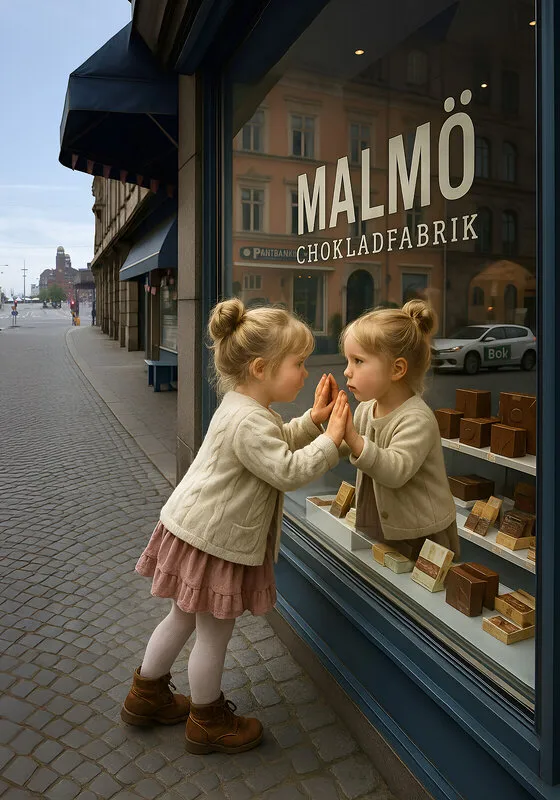
Elizabeth at the Chocolate Factory, 2025
Digital
50 x 70 cm
3 200 kr
Elizabeth at the Chocolate Factory
The image and the short story depict a small street in Malmö, as well as a reflection of it. Hamngatan is a brief yet significant pathway between the harbour and the city; on its paving stones, everyday rituals unfold, including arrivals and farewells. Amidst it all, a shop window serves as the stage for a conversation between two sisters. This shop window, with its reflective surface, symbolises the boundary between the living and the departed. It's a place where the two sisters can meet and converse, a liminal space that transcends the physical and allows for a connection that defies the boundaries of life and death.
It is a story about childhood games — the dollhouse, homemade dresses for the Barbies, and Paddington as the make-believe father — and about the bodily memory of having shared a mother’s womb before the outside world opened up brutally. It also explores the feeling of guilt: the quiet, absurd question that can haunt a survivor — why me and not you? How does one carry another person’s absence through one’s own life?
The story explores the memory of the body: the forceful kicks in the stomach, how two small hearts found their rhythm in each other's closeness, and how those rhythms later gave rise to play and conversations at a window. The city — Hamngatan, the Pawnshop’s orange-pink building, and the Post Office’s stern gaze in the distance — is not just a backdrop but an active participant; reflections in the glass blend with the façades across the street, transforming the place into a portal where presence and absence converge.
At the window, light chat shifts to more profound questions: about bravery and fear, about the silent weight of guilt and the comfort of everyday routines. Elizabeth sometimes assumes the role of the daring sister who raises her hand in class; Kerstin is the more cautious one, the tidy child who keeps her pen in hand. Together they craft an intimate, soul-searching dialogue — a conversation that is as much a game as it is a ritual to keep the dead twin alive, a dialogue that will resonate with the deepest parts of your soul.
The story does not conclude with a neat reconciliation but with a change in form: grief becomes something one can carry forward. This change in form is a transformation of grief from a burden to a companion, a part of life that can be embraced and carried forward. Elizabeth — a Time-traveller who moves timelessly between celestial bodies and the pavement of Hamngatan — can come and go; her star in the Milky Way becomes as real a comfort as the window’s chill against the palm. This change makes the story’s ending both earthly and expansive: it does not close everything off; it opens up.
Join me as we open the gate to this small tale about a street, a window, and two sisters — a meeting where the missing one finds a voice and where everyday’s small details become healing rituals. Let the scenes of the story carry you between the light of play and the shadow of grief, between Paddington’s jar of marmalade and the star’s quiet watchfulness, offering a journey of healing and hope.
Continue — in the next section, an essay broadens the perspective, featuring voices from other lone twins, reflections on how grief influences families and communities, and a closer look at how places like a shop window can act as bridges between worlds. Click the link below when you are ready to step through the gateway and follow the trail onwards, because your role in continuing this story is crucial and valued.
“The Twin in the Glass
She waits inside the window like a secret kept in light,
a quiet constellation folded into glass.
I press my palm where hers would be — cool, then warm —
and the city softens to the hush between our breaths.
We speak in the small language of shared beginnings:
the sharp kick, the slow barter of two hearts,
how we learned to answer each other before words.
You tell me of a dollhouse room we never built,
of a ribbon cut from Mother’s sleeve, a tiny red stain
That proves a skirt was ever sewn with courage.
Paddington is our father today; he leans and sleeps,
marmalade jars like promises on the table.
We plan a picnic in Kungsparken, choose a single praline each—
The world beyond the pane, full of tempting things, I refuse
because your reflection is my true sweet.
“Do you live in the window?” I ask, frightened of silence.
“No,” you say, smiling like a comet. “I live in you.
And sometimes on my star in the Milky Way, I visit both.”
You are a Time-traveller who moves between constellations and cobbles,
who keeps an appointment with my hand every week.
People pass and do not know this small theatre:
They see a child speaking to the glass, not the sister replying.
But I know the weight of your absence: it is an apron I wear,
a double stitch through which my life is threaded.
And when the streetlamps bloom, your voice becomes a lamp, too—
steady as the pawnshop’s orange wall, patient as the posthouse clocks.
We do not say goodbye. We say: come tomorrow, come when you must.
I fold our conversation into my pocket like a map,
a path that leads from the pavement to the star.
Between the chocolate and the city, we keep our ritual—
two girls, one window, a world that will not close us.”
Malmö. September 2025
Elizabeth at the Chocolate Factory
Chapter 1. Hamngatan
Hamngatan, one of Malmö’s shortest streets, is a microcosm of a larger journey. It forms a direct line between the water and the city, between the harbour and the Central Station with its platforms and tracks that extend out into the world, past the imposing Post Office that always seems ready to sternly lecture little girls about what they must not do—and on towards Stortorget, where traces of kings, market traders, and bicycle wheels blend into the same rhythm. The cobbles here, worn and grey like my grandmother’s hand, seem to absorb the sounds of the city, from rolling suitcases to echoing footsteps.
I almost always pass along Hamngatan as if I am heading somewhere else. Yet I stop here. Midway down the street sits Malmö Chocolate Factory, its generous shop window seeming like a small stage for the city. Inside, there are boxes of chocolates stacked like tiny apartment blocks, shiny wrappers that seem solemn, heavy cakes with cracks where the butter glistens. But that is not why I stop. It's not the chocolates or the cakes that draw me, but the presence of Elizabeth, my twin, waiting for me in the reflection from the street.
I stop because she is waiting for me there, in the reflection from the street: Elizabeth, my twin sister. She stands as still as I do. She rests her hand against the glass when I do. When passersby see her, they think she's talking to her echo. But I see my twin sister, my other half, my reflection in the glass. Her presence is a constant source of comfort, a reminder that I am never truly alone.
Our memories are not just recollections; they are an integral part of who we are. They originate from a time when the world was an open canvas of endless possibilities, when a heartbeat was both music and weather, when light filtered through everything. We embarked on our journey there—two small bodies in the same boat, two hearts seeking the same rhythm. Our bond, unbreakable even by death, is a testament to the enduring power of twinhood, a force that transcends the physical realm and continues to shape our lives.
“Do you remember?” Elizabeth asks sometimes when we meet at the window. Her voice is soft, but I hear it clearly, like a word whispered very close.
“I remember that you kicked,” I say. “Hard, as if you wanted to move the walls.”
“And you answered,” she says. “Push for push. We invented language before anyone could teach us it.”
I smile, though it hurts a little, too. Sometimes guilt comes like a shadow—even though I know the facts, how the doctors explained it, how chance wears faces but bears no responsibility. Still, I hear myself ask, the weight of guilt heavy in my voice:
“What if I pushed you too hard? What if it was me who—”
“Stop,” says Elizabeth. She places her palm on the glass, right where my hand rests. “It wasn’t you. It wasn’t me. It was the sea beneath the boat that shifted. It was the world splitting at a point we couldn’t reach.” Her words, a balm to my guilt, a reassurance that we share this grief, that it's not mine alone to bear. Our shared understanding of this loss unites us, comforting us in our moments of doubt and pain.
When I was small, I didn’t understand what I knew. I carried a silent secret. Mother said I slept fitfully, that I might wake with small hands clenched as if I had been holding onto something that suddenly disappeared. At kindergarten, I would sit for ages staring out of any window. I believed everyone had a shadow that was more than just a shadow.
Later, when I began to understand how the world explains things, I found words that made sense to me. “Twinless twin.” “One of two.” “Lone twin.” I tried them in my mouth, and they sounded like the name of a bird flying where the flock should have been. But the names only took me halfway. For even though I was alone, I was not alone. Elizabeth had never left me. She was standing on the other side of the glass.
I often think about what we would have done if everything had been different. We would have had our first dollhouse together. I see us bent over small rooms that smell of wood and paint, lying on a felt rug and a little kitchen table painted with a trembling hand. We would have argued about where the sofa should stand, bargained, laughed, and changed it again. Perhaps we would have sewn dresses for our Barbies, little skirts cut from an old curtain, a pink top leftover from Mother’s blouse. We would have learned to use needle and thread together; I would have pricked my finger, you would have blown on the wound and said it was all right, that one must leave a little blood in every project for it to be alive. The longing for these moments is a constant ache in my heart.
In our conversations, we still play the game of “mother, father, child.” I am often the mother—I don’t know if that means anything, perhaps only that I was the one who was allowed to continue. Elizabeth is the child who always knows first. And the father? He is Paddington, of course. Who else? That stubborn kindness in his face, that substantial weight that suggests someone can carry you. You, dear reader, are part of this game, part of our shared experience. You are the one we invite to our picnic, the one we share our hot chocolate and pralines with.
“Papa Paddington will take us on a picnic,” Elizabeth says. “He has sandwiches in his bag.”
“And hot chocolate in a thermos,” I say. “We’ll go to Kungsparken and feed the birds.”
“And on the way home, we’ll each choose a praline.”
Inside the Chocolate Factory, the boxes stand in rows or are piled high. But the only chocolate I truly long for is the one in our lines of dialogue. I did once go inside. The smell was almost ritualistic, like the first hymn in a small church. I watched a woman use tweezers: pistachio, nougat, dark with salt, a shell hiding a secret. I turned towards the window to wave at Elizabeth. She sat atop a stack of boxes and smiled apologetically.
“Come out for a walk in this lovely weather. You will love Slottsparken with all its birds,” I called.
“I cannot,” she said. “Not today. Not while the glass is here.”
In that moment, I realised I would never choose the pralines over her. The world may be full of treats, but it lacks presence. I chose presence. And that is why I stand here, outside, again and again, my hand against the glass. It is our ritual. Our way of saying: we are still two.
Hamngatan has shown me that a short street can hold an entire life. If you need proof, look across the road at the orange-pink building with the Pawnshop rising, its silent authority clear. Sometimes that very façade is reflected in the glass behind Elizabeth, making it seem as if she has a whole building behind her. I like to think that is how it is: she leans on a city that preserved her shape when the world let her go.
“Do you think we would have been the same?” I ask sometimes.
“Same in some ways,” she says. “Different in the best ways. That is the whole point.”
“You would have defended me,” I say. “When I went quiet at school, when I didn’t know what to say.”
—“And you me,” she says. “When I became too sure of myself and needed someone to make me laugh at the right moment.”
Occasionally, I pass by without pausing. Although it's not a frequent occurrence, it does happen. You can’t always control it; some days, you have to race against time. On those days, I carry our conversation like a comforting note in my pocket, one I don’t have the luxury to read but know is there. When I return, she is still standing. Not upset, not wounded. Time doesn't gnaw at her the way it does at me. She looks at me as if she always knew I would return.
“I get frightened sometimes,” I say. “That if I stop looking, you will disappear.”
“I know,” she says. “But I do not live in the window, Kerstin. I live in you. The window only helps you remember.”
Perhaps that is why I love this place. Between the station’s bustling life and Stortorget with its ugly statue, here where the Post Office keeps watch from a distance with its heavy eyes, there is a little tear in the fabric: a pane of glass that both separates and unites. I press my hand to the pane, feeling the cold first, then the warmth beneath. My face is reflected next to hers; our features merge into one. I think of how we began, in there, and how we parted—no ceremony, only a quiet interruption. Yet here we stand again, two girls on opposite sides of a world, with the same heartbeat, only a slightly different tempo.
When dusk falls and the streetlights are switched on, the Chocolate Factory’s window becomes a soft lamp over the pavement. People walk by. Someone smiles, someone hurries, and someone doesn’t look at all. Elizabeth and I speak quietly. We decide how to furnish the living room in the doll’s house, choose fabrics for Barbie's dresses, plan an unlikely trip with Paddington, where the weather looks set to be clear, and we get lost on purpose. And when I finally have to leave, she always says the same thing.
“We’ll see each other next week. Or tomorrow. Or when you must. I am already there.”
I nod. Hamngatan nudges me on, like a hand on my back. I know where I live. I know where she is. And between us, a pane of glass separates our worlds, keeping her inside and me outside.
Chapter 2. Games and Imaginary Life
When I was a child, I had a box beneath my bed. A plain cardboard box with worn edges, but to me, it was a treasure chest. It contained scraps of fabric, old buttons, broken doll limbs, and tiny boxes I had kept because they might become something. Elizabeth, my imaginary friend, and I used to take out the box and sit on the floor in my room. Of course, I was the only one sitting there for real, but in my world, we were always two.
“This will be the sofa,” she would say, holding up a scrap of cloth.
“And this is the table,” I replied, placing a matchbox on its end.
Thus, our first dollhouse was born: a house of cardboard and imagination.
We rearranged the furniture repeatedly. The sofa might sit under the window for a while, then be moved back to the wall. The table was turned, the lamps shifted, and each time we chuckled at how easily we changed our minds. I sometimes think it was our secret architecture course—learning rooms by never being satisfied with the first plan.
When I later received a Barbie doll, it became even clearer that I was not alone. Mother had kept small scraps of fabric from dresses she had sewn for herself. Elizabeth chose a floral piece and suggested that we sew a summer dress. I took a plain piece and attempted to make a skirt. The needle pricked my finger, and blood dropped onto the cloth. I feared I had ruined everything. This incident, however, taught me that creativity often comes with a price, and that even mistakes can add a touch of reality to our creations.
“That only means it’s alive now,” Elizabeth said calmly. “A little blood makes everything real.”
So we kept the stain, a secret mark, and no one else knew why the skirt always had a small rose-smudge near the hem.
But the most enjoyable game of all was “mother, father, child.” I remember the first time I placed Paddington the bear on the floor. He wore a blue coat and a hat that kept falling off his head. He was perfect as a father because he was both steady and a little clumsy. Elizabeth laughed out loud when he toppled into a chair and immediately began to snore. This game, with its simple yet profound role-playing, allowed us to step into the shoes of adults, giving us a glimpse of the future we could only imagine.
“Papa is tired,” she said, tucking him in with a handkerchief.
“He has been at the bank all day,” I added. “Or maybe driving a train.”
“No, he is busy with the marmalade,” Elizabeth objected, placing an imaginary jar in his paw.
So, Paddington became our father, once and for all. And we were his daughters, whom he carried on his shoulders when we went to the park. I could feel the rocking even though I sat still in my room.
It was strange how natural everything felt, as if I were not inventing but carrying on something that already existed. As if, together, we recreated what might have been. When Elizabeth spoke, her voice felt like my own but different—lighter, firmer, sometimes more mischievous.
“When we are older,” she used to say, “we’ll travel to Copenhagen by ourselves. We’ll take the train from the Central Station, peer at the boats from the bridge, and buy ice cream at Tivoli.”
I nodded. I was never the brave one. She invented the trips; I kept the map.
We also discussed the things we had never experienced. Like the birthday when we would have turned seven. “We would have had a shared party,” I said, “and everyone would have wondered who was who.”
“I would have worn a red dress,” Elizabeth answered, “and you a blue one. They would still have mixed us up.”
We chuckled at the thought, though there was also a sadness in it—an absence of a mirror image in the photographs.
Looking back, it sometimes feels as if childhood was one long conversation between us — a game that never ended. Perhaps that was why I managed to cope, despite being alone. I had her with me: in reflections, in toys, in all our make-believe. And I knew that as long as I clung to the game, I clung to her, our bond unbreakable even by the passage of time.
Chapter 3. The Chocolate Factory
There is something special about the smell of chocolate. It feels both everyday and ceremonial, as if each cake and praline carries a tiny secret celebration. When I walk along Hamngatan, I can catch its scent from afar, faint but unmistakable—a whisper that trails me to the large window.
For most passersby, Malmö Chocolate Factory is simply a shop, a place to buy gifts or indulge oneself on a grey Tuesday. But to me, it is a gate. This is where Elizabeth waits, behind the glass.
I remember the first time I dared to go inside. I must have been eight and had been saving my pocket money for weeks. This was no cheap pick-and-mix—these were delicacies that knew their value. The scent hit me like a warm wall, sweet and deep. Inside the shop, the boxes were piled in heaps, glossy and perfect, like tiny treasure chests. I watched a woman in a white coat use tweezers to place chocolates into a box with paper between each layer, as if they were precious jewels.
I turned to call Elizabeth in, but she did not come. She sat by the window, atop the vibrant boxes, her legs crossed and her hands resting in her lap. She smiled, but there was an apologetic curl to it.
“I cannot come in,” she said. “Next to the glass is my world. I can hear you, but I cannot pass through the pane.”
I stood with my coins in hand, puzzled. Why couldn’t she follow me? Why was her world so fixed behind the window? I almost wanted to shout at her to stand up, to walk straight through the glass. But she sat there, motionless, nearly transparent against the chocolates behind her.
I bought nothing that day. I returned to the pavement, where Elizabeth was immediately beside me. I put the coins into my pocket and felt it was the right thing to do. What were pralines worth if I could not share them with her? The ache of her absence was a weight I carried with me, a constant reminder of our separation.
After that, I realised that our meetings belonged to the street, the window, and the reflections. We could speak there, but not inside. It was as if the shop represented life, and the glass was the boundary she could not cross. I understood I would rather stand out in the cold with her than be inside in warmth without her. I had come to accept her presence in the window, finding a strange comfort in our shared space.
We talked about that often.
“It’s not the chocolate you want,” she would say. “It is me.”
“I want both,” I would answer.
“You cannot,” she said, but with a smile that softened the blow.
Sometimes we imagined that all the pralines belonged to us—that we had a key and could stay all night, sampling one of each kind and stacking the boxes like building blocks. But even in those fantasies, she remained in the window. I understood that this was where she belonged, on the other side of the glass, a shadow in the chocolate’s shine.
It was difficult to tell the other children why I stayed at the shop. They asked if I wanted sweets, and I would nod, but that wasn’t the truth. The chocolate was the distraction; the real treasure was Elizabeth.
The Chocolate Factory became our meeting spot. A place where life and death, presence and absence, stood side by side, divided only by a sheet of glass. I visited there when I was happy, when I was sad, or when I wanted to feel whole again. And each time, she stood there waiting, as if she had never left.
Chapter 4. Conversations at the window
—“And you, me,” she says. “When I grew too sure of myself and needed someone to make me laugh at the right moment.”
There are days when I walk past without stopping, the anticipation of our next meeting already building within me. The reality is that you can't always stop; some days, you must run to catch up with the clock. On those occasions, I carry our conversation like a note in my pocket, one I don’t have time to read but know is there. When I return, she is still standing. Not offended, not hurt. Time does not bite at her the way it bites at me. She looks at me as if she always knew I would come back.
“I am frightened sometimes,” I say. “That if I stop looking, you will disappear.”
“I know,” she says. “But I do not live in the window, Kerstin. I live in you. The pane only helps you to remember.”
Perhaps that is why I love this place. Between the station’s bustling life and Stortorget with its unappealing statue, here where the Post Office watches from a distance with its heavy eyes, there is a little tear in the fabric: a pane of glass that both separates and unites. I press my hand to the window, feeling the cold first, then the warmth beneath. My face is reflected beside hers; our features meld together. I think of how we began, inside, and how we parted—no ceremony, only a quiet interruption, a sudden silence that filled the space between us. And yet here we stand again, two girls on opposite sides of a world, sharing the same heartbeat, only with a slightly different tempo.
When dusk falls and the streetlights are turned on, the Chocolate Factory’s window becomes a gentle lamp over the pavement. People pass by. Someone smiles, someone hurries, and someone doesn’t look at all. Elizabeth and I speak softly. We decide how the living room in the dollhouse should be furnished, choose fabrics for Barbie's dresses, plan an unlikely outing with Paddington, where the weather promises clear skies, and we get lost on purpose. And when I finally have to leave, she always says the same thing.
We’ll see each other next week, or tomorrow, or whenever you must. I am already there.
I nod. Hamngatan nudges me forward, like a hand on my back. I know where I live. I know where she is. And between us, a pane of glass separates our worlds, keeping her inside and me outside.
Chapter 5. Turning point
One day, I walked by without stopping.
It wasn’t intentional. I was rushing for the train, the time had already run late, and my schoolbag felt heavy on my shoulder. I saw the shop window in the corner of my eye, but didn’t turn my head. One more step, I told myself—one more corner. And suddenly, I had passed the Chocolate Factory, a pang of regret and longing hitting me like a wave, aching in my chest.
All the way to the Central Station, my body felt wrong, as if something heavy had fallen out of my rucksack and left me off balance. I sat on the train and looked out of the window, but the glass was empty. No one returned my gaze.
When I returned to Hamngatan a few days later, I felt a sense of nervousness. I struggled to breathe. I stopped in front of the window and pressed my hand against the glass.
It was empty.
No smile, no words. Only the pralines, the boxes, the glossy wrappers. My own face was reflected at me, but without the twin beside it.
I stood there for a long time. People passed by—someone glanced, someone offered a crooked smile. I bit my lip until it tasted metallic. Maybe I had spoiled everything. Maybe Elizabeth was gone now because I had walked past without even noticing.
“I can’t manage on my own,” I whispered to the glass. “You mustn’t leave me.”
And then, very slowly, a shadow emerged in the reflection—first just a hint, a contour, then the full figure of her. Elizabeth stood there with her arms crossed, gazing at me with a look that blended love and reproach. A wave of relief washed over me, knowing she was still there.
“You didn’t think I would disappear that easily, did you?” she said.
“I was frightened,” I answered. “When I did not see you..."
“I am here,” she said. “But you must understand that I do not live in the window. I live in you. The pane only helps you remember.”
I felt tears burn, but I couldn't help smiling. It was like being given a second chance. I placed my hand against the glass, and her hand met mine. We stood there for a long time, without words, simply holding the quiet certainty that we were still two.
When I left that day, I realised I would never take her for granted again. Each visit to the window was more than just a habit; it was a ritual. A way to keep the bond alive. A reminder that even if a journey ends too soon, it can carry on in another form.
Chapter 6. Reconciliation
After that day, I started to see our meetings differently. I no longer feared that Elizabeth might disappear. I understood now that she was always with me, and yet the window on Hamngatan provided us with a place, a stage where we could meet as sisters. It was a profound realization that changed the way I saw our bond.
I went there not only to find her but also to remind myself of what we shared. Sometimes we discussed trivial things—what I had for lunch, which school subject was the hardest. Occasionally, the conversations became deeper: what it means to live when someone else could not, the burden of carrying two dreams upon the same shoulders.
“You mustn’t think you live for me, too,” Elizabeth said once when I sighed under the burden of everyone’s expectations. “You live for yourself. That is enough.”
“But I feel guilty,” I answered. “As if I owe you.”
“You are no IOU,” she said with a crooked smile. “You are my sister. I didn’t lend you anything. I gave you company.”
It became easier after that. Not easy, but easier. I could think of her without feeling that everything was my fault. I could remember our games, our talks about dollhouses, Barbie clothes and Paddington, and let it be joy. Not just grief.
One evening, when the streetlights had just been switched on and the window shimmered like a mirror of light, Elizabeth told me something I had never heard before. She smiled secretly, almost as if we were creating new roles for Paddington.
“Do you know where I live when I am not standing in the shop window?” she asked. I shook my head.
“On my star,” she said. “It sits in the middle of the Milky Way, centrally placed like a house on a square. From there, I can see everything—Earth, the seas, the people. And you.”
I stared at her, filled with a strange mixture of longing and comfort.
“May I ever come there?” I whispered.
“Of course,” she replied. “You are always welcome. But there is no rush. Your home is still here, on the street, among the people. One day, far off, you will come to my star. Until then, we will meet here.”
She blinked playfully. “And I am a time-traveller, you know. I can come back whenever I like. To Hamngatan, to you. I can stand in the window every week if you need me to. Time means nothing to me now. In eternity, no one is in a hurry. Time is endless.”
I felt the weight within me lift. She was not captive; she was free—free to travel between stars and a shop window, between the cosmos and my everyday life. It was as if her words carved a new security in me: that our bond did not only belong to the past but also to the future.
When I finally left that evening, I rested my hand on the glass one last time. Not in desperation, but as a greeting. A promise to keep meeting, and also an assurance that we did not need the pane to be sisters.
Hamngatan lay quiet behind me. The pawnshop’s orange-pink façade still glowed in the last light. And inside me, I knew I carried her, not only in reflections but in every step I took.
Elizabeth at the Chocolate Factory is not just a girl in a shop window. She is my other half, my twin, my missing yet ever-present sister. And our story is not finished. It has only changed form—and will continue as long as I exist, and beyond, until we are reunited on the star you have told me so much about.
3 200 kr

Jörgen Thornberg
Malmö
Lite om bilder och mig. Translation in English at the end.
Jag är en nyfiken person som ser allt i bilder, även det jag fäster i ord, gärna tillsammans för bakom alla mina bilder finns en berättelse. Till vissa bilder hör en kortare eller längre novell som följer med bilden.
Bilder berättar historier. Jag omges av naturlig skönhet, intressanta människor och historia var jag än går. Jag använder min kamera för att dokumentera världen och blanda det jag ser med vad jag känner för att fånga den dolda magin.
Mina bilder berättar mina historier. Genom mina bilder, tryck och berättelser. Jag bjuder in dig att ta del av dessa berättelser, in i ditt liv och hem och dela min mycket personliga syn på vår värld. Mer än vad ögat ser. Jag tänker i bilder, drömmer och skriver och pratar om dem; följaktligen måste jag också skapa bilder. De blir vad jag ser, inte nödvändigtvis begränsade till verkligheten. Det finns en bild runt varje hörn. Jag hoppas att du kommer att se vad jag såg och gilla det.
Jag är också en skrivande person och till många bilder hör en kortare eller längre essay. Den följer med tavlan, tryckt på fint papper och med en personlig hälsning från mig.
Flertalet bilder startar sin resa i min kamera. Enkelt förklarat beskriver jag bilden jag ser i mitt inre, upplevd eller fantiserad. Bilden uppstår inom mig redan innan jag fått okularet till ögat. På bråkdelen av ett ögonblick ser jag vad jag vill ha och vad som kan göras med bilden. Här skall jag stoppa in en giraff, stålmannen, Titanic eller vad det är min fantasi finner ut. Ännu märkligare är att jag kommer ihåg minnesbilden långt efteråt när det blir tid att skapa verket. Om jag lyckas eller inte, är upp till betraktaren, oftast präglat av en stråk av svart humor – meningen är att man skall bli underhållen. Mina bilder blir ofta en snackis där de hänger.
Jag föredrar bilder som förmedlar ett budskap i flera lager. Vid första anblicken fylld av feel-good, en vacker utsikt, fint väder, solen skiner, blommor på ängen eller vattnet som ligger förrädiskt spegelblankt. I en sådan bild kan jag gömma min egentliga berättelse, mitt förakt för förtryckare och våldsverkare, rasister och fördomsfulla människor - ett gärna återkommande motiv mer eller mindre dolt i det vackra motivet. Jag försöker förena dem i ett gemensamt narrativ.
Bild och formgivning har löpt som en röd tråd genom livet. Fotokonst känns som en värdig final som jag gärna delar med mig.
Min genre är vid som framgår av mina bilder, temat en blandning av pop- och gatukonst i kollage som kan bestå av hundratals lager. Vissa bilder kan ta veckor, andra någon dag innan det är dags att överlämna resultatet till printverkstaden. Fine Art Prints är digitala fotocollage. I dessa kollage sker rivandet, klippandet, pusslandet, målandet, ritandet och sprayningen digitalt. Det jag monterar in kan vara hundratals år gamla bilder som jag omsorgsfullt frilägger så att de ser ut att vara en del av tavlan men också bilder skapade av mig själv efter min egen fantasi. Därefter besöks printstudion och för vissa bilder numrera en limiterad upplaga (oftast 7 exemplar) och signera för hand. Vissa bilder kan köpas i olika format. Det är bara att fråga efter vilka. Gillar man en bild som är 70x100 men inte har plats på väggen, går den kanske att få i 50x70 cm istället. Frågan är fri.
Metoden Giclée eller Fine Art Print som det också kallas är det moderna sättet för framställning av grafisk konst. Villkoret för denna typ av utskrifter är att en högkvalitativ storformatskrivare används med åldersbeständigt färgpigment och konstnärspapper eller i förekommande fall på duk. Pappret som används möter de krav på livslängd som ställs av museer och gallerier. Normalt säljer jag mina bilder oinramade så att den nya ägaren själv kan bestämma hur de skall se ut, med eller utan passepartout färg på ram, med eller utan glas etc..
Under många år ställde jag bara ut på nätet, i valda grupper och på min egen Facebooksida - https://www.facebook.com/jorgen.thornberg.9
Jag finns också på en egen hemsida som tyvärr inte alltid är uppdaterad – https://www.jth.life/ Där kan du också läsa en del av de berättelser som följer med bilden.
UTSTÄLLNINGAR
Luftkastellet, oktober 2022
Konst i Lund, november 2022
Luftkastellet, mars 2023
Engleson Galleri Caroli, april 2023
Hydra, Greece June 2023
Engleson Galleri Caroli, oktober 2023
Toppen, Höllviken december 2023
Luftkastellet, mars 2024
Torups Galleri, mars 2024
Venice, May 2024
Luftkastellet, oktober 2024
Konst i Advent, December 2024
Galleri Engleson, Caroli December 2024
Jäger & Jansson Galleri, april 2025
A bit about pictures and me.
I'm a curious person who sees everything in pictures, even what I express in words, often combining them, for behind all my pictures lies a story. These narratives, some as short as a single image and others as long as a novel, are the heart and soul of my work.
Pictures tell stories. Wherever I go, I'm surrounded by natural beauty, exciting people, and history. I use my camera to document the world and blend what I see with what I feel to capture the hidden magic.
My images tell my stories. Through my pictures, prints, and narratives, I invite you to partake in these stories in your life and home and share my deeply personal perspective of our world. More than meets the eye. I think in pictures, dream, write, and talk about them; consequently, I must create images too. They become what I see, not necessarily confined to reality. There's a picture around every corner. I hope you'll see what I saw and enjoy it.
I'm also a writer, and many images come with a shorter or longer essay. It accompanies the painting, printed on fine paper with my personal greeting.
Many pictures start their journey on my camera. Simply put, I describe the image I see in my mind, experienced or imagined. The image arises within me even before I bring the eyepiece to my eye. In a fraction of a moment, I see what I want and what can be done with the picture. Here, I'll insert a giraffe, Superman, the Titanic, or whatever my imagination conjures up. Even stranger is that I remember the mental image long after it's time to create the work. Whether I succeed is up to the observer, often imbued with a streak of black humour – the aim is to entertain. My pictures usually become a talking point wherever they hang.
I prefer pictures that convey a message in multiple layers. At first glance, they're filled with feel-good vibes, a beautiful view, lovely weather, the sun shining, flowers in the meadow, or the water lying deceptively calm. But beneath this surface beauty, I often conceal a deeper story, a narrative that challenges societal norms or explores the human condition. I invite you to delve into these hidden narratives and discover the layers of meaning within my work.
Picture and design have been a thread running through my life. Photographic art feels like a fitting finale, and I'm happy to share it.
My genre is varied, as seen in my pictures; the theme is a blend of pop and street art in collages that can consist of hundreds of layers. Some images can take weeks, others just a day before it's time to hand over the result to the print workshop. Fine Art Prints are digital photo collages. In these collages, tearing, cutting, puzzling, painting, drawing, and spraying happen digitally. What I insert can be images hundreds of years old that I carefully extract so they appear to be part of the painting, but also images created by myself, now also generated from my imagination. Next, visit the print studio and, for certain images, number a limited edition (usually 7 copies) and sign them by hand. Some images may be available in other formats. Just ask which ones. If you like an image that's 70x100 but doesn't have space on the wall, you might be able to get it in 50x70 cm instead. The question is open.
The Giclée method, or Fine Art Print as it's also called, is the modern way of producing graphic art. This method ensures the highest quality and longevity of the artwork, using a high-quality large-format printer with archival pigment inks and artist paper or, in some cases, canvas. The paper used meets the longevity requirements set by museums and galleries. I sell my pictures unframed, allowing the new owner to personalise their artwork, confident in the lasting value and quality of the piece.
For many years, I only exhibited online, in selected groups, and on my Facebook page - https://www.facebook.com/jorgen.thornberg.9. I also have my website, which unfortunately is not constantly updated - https://www.jth.life/. You can also read some of the stories accompanying the pictures there.
EXHIBITIONS
Luftkastellet, October 2022
Art in Lund, November 2022
Luftkastellet, March 2023
Engleson Gallery Caroli, April 2023
Hydra, Greece June 2023
Engleson Gallery Caroli, October 2023
Toppen, Höllviken December 2023
Luftkastellet, March 2024
Torup Gallery, March 2024
Venice, May 2024
UTSTÄLLNINGAR
Luftkastellet, oktober 2022
Konst i Lund, november 2022
Luftkastellet, mars 2023
Engleson Galleri Caroli, april 2023
Hydra, Greece June 2023
Engleson Galleri Caroli, oktober 2023
Toppen, Höllviken december 2023
Luftkastellet, mars 2024
Torups Galleri, mars 2024
Venice, May 2024
Luftkastellet, October 2024
Konst i Advent, December 2024
Galleri Engleson, Caroli December 2024
Jäger & Jansson Galleri, April 2025
Utbildning
Autodidakt
Medlem i konstnärsförening
Öppna Sinnen
Med i konstrunda
Konstrundan i Skåne
Utställningar
Luftkastellet, October 2022
Art in Lund, November 2022
Luftkastellet, March 2023
Engleson Gallery Caroli, April 2023
Hydra, Greece June 2023
Engleson Gallery Caroli, October 2023
Toppen, Höllviken December 2023
Luftkastellet, March 2024
Torup Gallery, March 2024
Venice, May 2024