Vi använder cookies för att ge dig bästa möjliga upplevelse. Välj vilka cookies du tillåter.
Läs mer i vår integritetspolicy
Jörgen Thornberg
The Moment – In the Blink of an Eye - Ögonblicket, 2025
Digital
50 x 70 cm
3 200 kr
The Moment – In the Blink of an Eye - Ögonblicket:
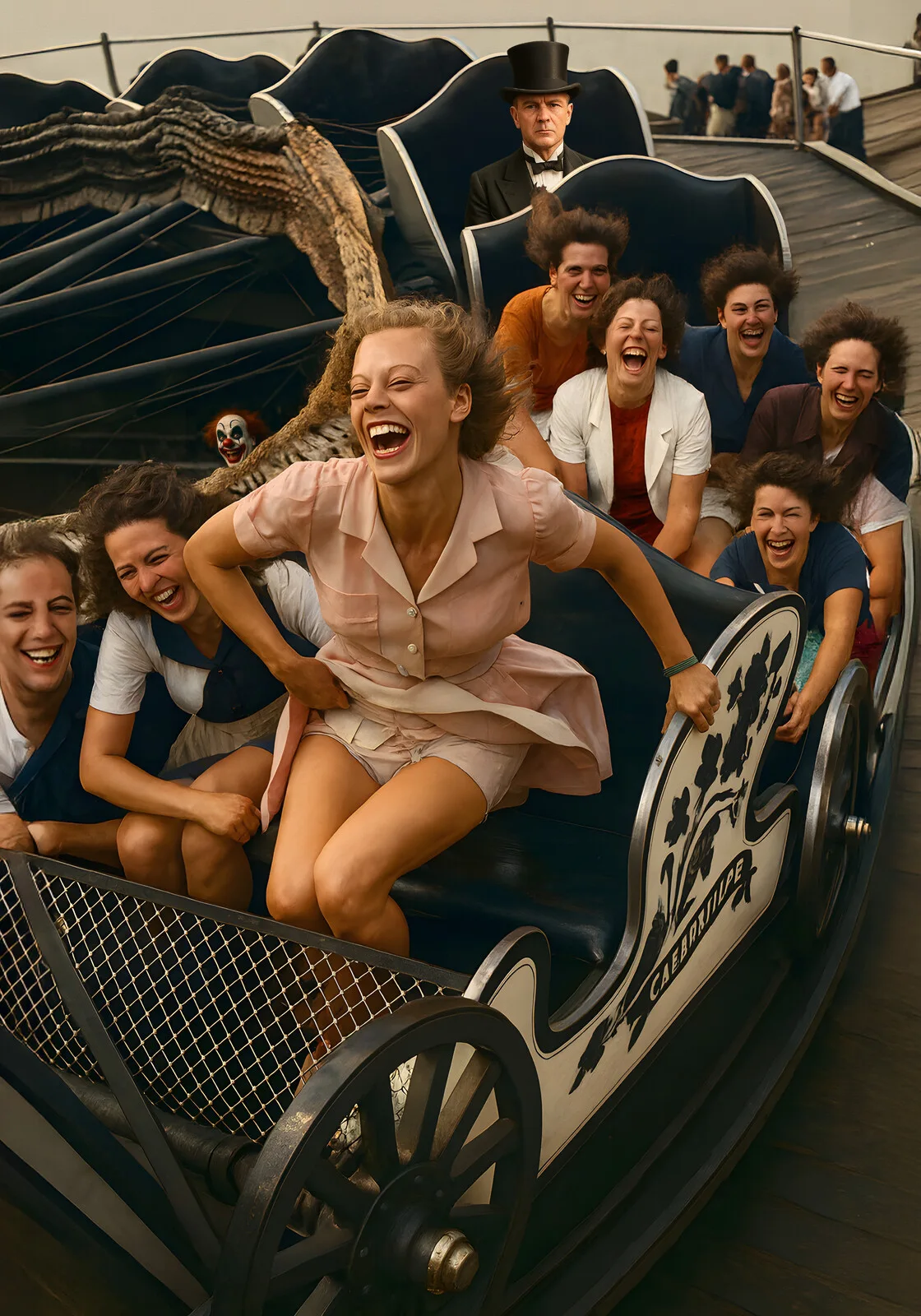
This title, 'The Moment-In the Blink of an Eye-Ögonblicket', encapsulates the core theme of the essay. It underscores the fleeting nature of moments and their profound impact on our lives. Every picture narrates a story, but some images encapsulate more than just a face or a place – they seize time itself. This photograph, taken one summer night on the Tivoli carousel in Copenhagen, freezes a single instant: a sudden gust of wind, a skirt caught in motion, and laughter bursting out before anyone had time to react. What might seem trivial becomes, in hindsight, a symbol – not only of joy, surprise, and youth, but of the very concept of the moment.
Moments, despite their brevity, possess a transformative power that shapes memory, history, and culture. From Marilyn Monroe’s iconic white dress to pivotal moments that altered the course of nations, fleeting instants often leave the deepest mark. This essay invites you to consider the depth of a moment and how such instances resonate far beyond their brief duration, inspiring us with their impact and prompting us to reflect on our own experiences.
Join me on a journey to explore the captivating world of youth and a changing society, where moments are not just fleeting instances but also markers of transformation. This essay, while intellectually engaging, also aims to entertain you with the story behind my picture. We will delve into the concept of time and its deep cultural significance in various societies, offering an engaging and enlightening journey into the history and cultural importance of a magical night.
“Moments
A moment is a blink,
a gust that lifts a skirt,
a laugh spilling out before thought can catch it.
A moment is a step,
a footprint pressed in lunar dust,
fragile yet forever.
A moment is a shot,
echoing through Sarajevo’s streets,
shaping a century in a heartbeat.
A moment is a cry—
“Eureka!” in a steaming bath,
a flash that lights the mind and alters the world.
Some moments vanish
like smoke in the wind.
Others stretch across time,
woven into memory,
carved into history.
And some—
a lover’s glance,
a wall collapsing,
a child’s first laugh—
become eternal,
seconds that refuse to die.
Moments:
short as a blink,
long as a lifetime,
endless as eternity.”
Malmö. August 2025
The Moment – In the Blink of an Eye - Ögonblicket
The picture captures a sudden and unexpected moment on a carousel at Copenhagen’s Tivoli. It took only an instant for a gust of wind to lift the young woman’s skirt, and not much longer for her friends to notice and burst into laughter. For a woman, revealing her underwear is a mixed situation, filled with many emotions. Think of the scene with Marilyn Monroe when her dress is blown up as she passes a subway grate. That too took only a moment, but on the cinema screen, it was stretched into several seconds for the audience’s enjoyment. Yet it took many moments to film the scene—repeatedly reshot to perfect it.
The iconic moment with the subway grate, immortalised in film, was not a spontaneous event. The initial shoot in New York took approximately five hours to complete, with fourteen takes attempted. A large crowd gathered to witness the scene, only for the footage to be deemed unusable. The scene was later recreated on a sound stage in California. This extended process, in stark contrast to the brief moment of laughter it aimed to capture, underscores the paradox of time. It shows that while a moment may be fleeting, the effort required to preserve it can be significant, often stretching far beyond the moment itself.
The filming of Marilyn Monroe’s famous scene with the white dress, therefore, took about five hours on a street in New York. During this time, director Billy Wilder shot fourteen takes before the scene was finally completed on a studio lot in California.
Laughter is contagious, and the clown below laughed without knowing why—because that is how laughter works if you are like most people. The man in the top hat was no jester and responded instead within just a few moments, irritated by the others’ disruptive joy. He was busy enough making sure his hat stayed in place. Had he seen what had happened, he would not have laughed at it but would have been somewhat scandalised by women who did not keep their attire in order.
The fact that the picture exists at all is pure chance, as it was taken with my old box camera in the 1950s, which is why it appears blurry. It had only one shutter speed—one thirtieth of a second—and you had to wind the film forward before taking the next shot. That process could take many moments, easily half a minute. Capturing the exact instant when everything happened was just luck, the kind that only the observant are blessed with. The photo was taken during a sharp turn where anything seemed possible—and indeed, it was.
How long is a moment?
In everyday life, we measure it in a blink—perhaps a tenth of a second, maybe two. Long enough to miss a smile but also long enough to capture an entire world in a picture. In the language of film, it takes only twenty-four frames per second for the eye to believe that life is moving. A moment is thus shorter than we imagine, yet long enough to contain everything.
In English, there is no single word as poetically charged as the Swedish ‘ögonblick’. One shifts between 'moment' (neutral), 'instant' (technical), and the idiomatic “in the blink of an eye” (poetic). The word 'ögonblick' carries a weight that transcends its literal meaning, encapsulating the depth and significance of a moment.
Fast processes – a few measures:
A blink: approx. 0.1–0.4 s.
Film: 24 fps (cinema), TV 25/30 fps, sports/gaming often 60/120 fps.
Screen refresh rate to avoid flicker: ~50–60 Hz.
Camera flash: as short as 1/10,000 s.
Sound: above 20 Hz perceived as a tone rather than individual pulses.
These frame rates, which determine how quickly images are displayed, remind us of how quickly moments slip by and the importance of capturing them.
Science pushes the boundaries even further. We speak of femtoseconds (10⁻¹⁵ s) and attoseconds (10⁻¹⁸ s), so brief that they capture the dance of electrons around the atomic nucleus. Even zeptoseconds (10⁻²¹ s) have been measured. And at the very edge of time’s most minor scale lies the Planck time—an interval so tiny that the universe barely has time to breathe: approximately 10⁻⁴³ seconds. Shorter than that, time ceases to exist, according to physics.
Thus, the moment stretches its bow between the human blink and the outermost edge of the cosmos. It bridges the ordinary and the unspeakable. Perhaps that is why the word carries such weight: because in the smallest unit resides both the speed of laughter, a fleeting human emotion, and the depth of eternity, a concept that transcends time and space.
“Eureka!” – the exclamation of a moment, a phrase famously linked to the ancient Greek scholar Archimedes. It represents the sudden insight or discovery that often happens in a fleeting instant, highlighting the profound and transformative effect of such occurrences.
Eureka— Archimedes’ cry when he discovered the principle of buoyancy in his bathtub—stands as one of history’s most renowned moments. It demonstrates how a brief moment can also encompass a sudden insight that transforms everything. In English, one sometimes refers to “a Eureka moment”—a moment of revelation or brilliant idea. These moments have the power to shape history and change the course of human understanding.
“Eureka!” is so brief it fits into a single shout, yet so transformative it changed humanity’s view of knowledge. Archimedes, in his bath, water sloshing over the edge, and in the same blink, an insight that opened the gates to the laws of physics. A moment where time and thought collapsed—where everyday life touched eternity.
We can see “the moment” on several levels:
Physically: a blink, a millisecond, a heartbeat of Planck time.
Humanly: the instant when love is sparked in a glance, or when laughter erupts.
Historically: Archimedes’ Eureka, Newton’s apple, Einstein’s relativity, Armstrong’s first step on the moon, and the fall of the Berlin Wall.
Eureka in Syracuse
A bathtub, a body sinking into warm water, waves spilling over the edge. So simple, so everyday. Yet in that brief instant, Archimedes saw something no one had understood before—the principle of buoyancy. “Eureka!”—(I have found it!), he cried. A moment, just a blink, yet it became the foundation of the language of physics.
Newton’s Apple
A fruit fell from a tree in a tranquil garden in seventeenth-century England. It might have been any fruit falling, but for Newton, it was a sign. In that moment, the concept of gravity was born—an unseen law governing both apples and planets. An everyday fall transformed into a cosmic revelation.
Einstein’s Train
A thought experiment so swift it fits into a single breath: what if one could travel at the speed of light itself? This question, posed by Albert Einstein, led to the birth of the special theory of relativity. It provided the world with a new perspective on reality, where time and space are not absolute but rather relative to the observer's frame of reference. A train rushing forward, a beam of light that never waits—and time stretching and compressing under these new rules.
Armstrong’s Step
On 20 July 1969, humanity took its first step onto another world. The footprint in the lunar dust was made in just a moment, yet it still bears the weight of all humankind – and the print will not change in a million years. “One small step for man, one giant leap for mankind.” A step that opened space for our neighbour.
The Shots in Sarajevo
On 28 June 1914, two shots were fired at Archduke Franz Ferdinand. The act itself lasted only seconds, but it had a lasting impact on the world. In that moment, Europe plunged into the First World War—an instant that turned into four years of fire and death, and a century of repercussions.
Hiroshima
On 6 August 1945, a bomb struck Hiroshima. In an instant, a city disintegrated, people were vaporised, and the world entered the atomic age. Never before had a moment been so devastating, so superhuman in its force. A moment when humanity realised it could annihilate itself.
The Fall of the Berlin Wall
A confused press conference, a hesitant border guard, a crowd daring to advance. Within a few hours on 9 November 1989, the wall that had divided the world fell. The fall of the Wall was, in truth, made up of countless moments—hammers, hands, jubilation—but they merged into one: the return of freedom in Europe.
Mandela’s Step
In 1990, the gates of Victor Verster Prison in South Africa opened. Nelson Mandela walked out, hand in hand with his wife Winnie. It was only a few steps, but they resonated across the world. The weight of his years in prison, the hope for a new beginning, the joy of freedom-all these emotions were encapsulated in those few steps. A moment when oppression turned into hope, and history shifted course.
Rosa Parks’ No
On December 1, 1955, Rosa Parks sat on a bus in Montgomery and refused to relinquish her seat. A “no” that lasted only a few seconds, but became the spark that ignited the civil rights movement. A moment of stillness that shook an entire system.
The Internet’s First Message
In 1969, the first message was sent via ARPANET, the precursor to the Internet. It was supposed to be the word LOGIN, but the system crashed after two letters: LO. Two characters, one moment—and the world entered a new era of communication.
9/11 – The Morning that Froze in a Moment
11 September 2001 began like any other morning until planes crashed into the Twin Towers. In just minutes, the world was changed forever. A moment became a global shock, a still image of smoke and steel etched into everyone's memory. Never before had the world felt so interconnected in its vulnerability.
The Nature of the Moment
From Archimedes in Syracuse to Marilyn’s white dress, from Newton’s apple to the fall of the Berlin Wall, from Armstrong’s step to the internet’s two letters—these are all moments. They last only a blink, but their effects span centuries. They have shaped our understanding of the world, our societies, and our lives in ways that continue to resonate today.
Physics tells us a moment can be as brief as Planck time, 10⁻⁴³ seconds—the shortest measure of time possible. But human moments are longer, filled with laughter, sorrow, light, and darkness. They are seconds that never end.
And perhaps that is why the picture from Tivoli carries such significance. It captured not only a gust of wind, a skirt, and a burst of laughter—it captured the very essence of what a moment is: so brief it almost seems to vanish, yet so rich it can never truly fade.
Ögonblicket
Bilden visar vad som hände helt plötsligt och oanat på en karusell på Köpenhamns Tivoli. Det tog ett ögonblick för en vindil att blåsa upp den unga kvinnans kjol och inte mycket längre för hennes väninnor att uppfatta situationen och börja skratta. Att visa underbyxorna är för en kvinna en blandad situation fylld av många känslor. Tänk på scenen med Marilyn Monroe där hennes klänning blåser upp när hon passerar tunnelbanans ventilationsutsläpp. Det tog också ett ögonblick, men på filmduken sträcktes det ut till några sekunder till publikens förtjusning. Däremot tog det många ögonblick att spela in scenen – om och om igen fick den tas om.
Det berömda ögonblicket med tunnelbanegaller fångades på en gata i New York.
Den första inspelningen i New York varade i cirka fem timmar. Det krävdes 14 tagningar för att få bilden, och en stor folkmassa samlades för att titta. Bildmaterialet från New York-platsen ansågs oanvändbart, och scenen filmades senare på en ljudscen i Kalifornien. Sammantaget blev ögonblicket många timmar.
Inspelningen av Marilyn Monroes berömda scen med den vita klänningen tog alltså ungefär fem timmar på en gata i New York. Under denna tid filmade regissören Billy Wilder fjorton tagningar innan scenen slutligen spelades in på en studiotomt i Kalifornien.
Skratt smittar av sig och clownen nedanför skrattade utan att veta varför, för det är så skratt fungerar om man är som folk. Mannen i hög hatt var ingen lustigkurre och reagerade tvärtom inom några få ögonblick, irriterad över andras störande glädje. Han hade fullt sjå med att se till att hatten stannade på plats. Hade han sett vad som skedde, skulle träbocken inte ha skrattat för det utan snarare förfasat sig över kvinnor som inte höll klädseln i ordning.
Att bilden finns är slumpens skördar eftersom den är tagen med min gamla lådkamera på 50-talet, därav oskärpan. Den hade en enda slutartid, en trettiondels sekund, och sedan var man tvungen att veva fram filmen innan man kunde ta nästa bild. Det tog många ögonblick, säkert en halv minut. Att fånga ögonblicket då allt hände var ren bondröta, en sådan som bara den uppmärksamme får chansen till. Bilden är tagen precis i en brant sväng där allt verkade kunna hända – och också gjorde det.
Hur långt är ett ögonblick?
I vardagen mäter vi det i en blinkning – en tiondels sekund, kanske två. Tillräckligt för att missa ett leende, men också nog för att fånga en hel värld på en bild. I filmens språk behövs bara tjugofyra bilder per sekund för att ögat ska tro att livet rör sig. Ett ögonblick är alltså kortare än vi anar, men ändå tillräckligt långt för att rymma allt.
Språknote (sv/eng): På engelska finns ingen lika poetiskt laddad singelterm som ”ögonblick”. Man växlar mellan moment (neutralt), instant (tekniskt), och det idiomatiska “in the blink of an eye” (poetiskt).
Snabba förlopp – några mått:
Blinkning: ca 0,1–0,4 s.
These frame rates, which determine the speed at which images are displayed, serve as a poignant reminder of how quickly moments pass and the importance of capturing them.
Skärmuppdatering för att undvika flimmer: ~50–60 Hz.
Kamerablixt: ned till 1/10 000 s.
Ljud: över 20 Hz upplevs som ton, inte enskilda pulser.
Vetenskapen pressar gränsen ännu längre. Man talar om femtosekunder (10⁻¹⁵ s) och attosekunder (10⁻¹⁸ s), så korta att de mäter elektronernas dans runt atomens kärna. Man har till och med mätt zeptosekunder (10⁻²¹ s). Och längst ned i tidens minsta spricka väntar Plancktiden – ett mått så litet att själva universum knappt hinner andas: ca 10⁻⁴³ sekunder. Kortare än så existerar inte tid, enligt fysiken.
Så spänner ögonblicket sin båge mellan människans blinkning och kosmos yttersta gräns. Mellan det vardagliga och det outsägliga. Kanske är det därför ordet bär på en sådan tyngd: för i det minsta ryms både skrattets hastighet och evighetens djup.
”Eureka!” – ögonblickets uppenbarelse
Eureka – Arkimedes rop när han insåg principen för vattnets lyftkraft i sitt badkar – är ett av historiens mest berömda ögonblick. Det visar hur ett ögonblick inte bara är tidsmässigt kort, utan kan bära en plötslig insikt som förändrar allt. På engelska talar man ibland om “a Eureka moment” – ett ögonblick av uppenbarelse eller genial idé.
”Eureka!” är så kort att det ryms i ett enda utrop, men samtidigt så omvälvande att det förändrade världens syn på kunskap. Arkimedes i badet, vatten som svallar över kanten, och i samma blinkning en insikt som öppnar porten till fysikens lagar. Ett ögonblick där tid och tanke kollapsar – från vardag till evighet.
Vi kan se ”ögonblicket” på flera plan:
Fysikaliskt: en blinkning, en millisekund, ett Plancktids pulsslag.
Mänskligt: stunden när kärlek tänds i en blick, eller när skrattet bryter ut.
Historiskt: Arkimedes’ Eureka, Newtons äpple, Einsteins relativitet, Armstrongs första steg på månen, Berlinmurens fall.
Eureka i Syrakusa
Ett badkar, en kropp som sjunker ner i varmt vatten, vågor som svallar över kanten. Så enkelt, så vardagligt. Men i den korta stunden såg Arkimedes något ingen tidigare förstått – principen för vattnets lyftkraft. ”Eureka!” – jag har funnit det! ropade han. Ett ögonblick, bara en blinkning, men det blev grunden för fysikens språk.
Newtons äpple
En frukt föll från ett träd i en stilla trädgård i 1600-talets England. Det kunde ha varit vilken fallande frukt som helst, men för Newton var det ett tecken. I det ögonblicket växte tanken om gravitation fram – en osynlig lag som binder både äpplen och planeter. Ett vardagligt fall blev en kosmisk insikt.
Einsteins tåg
Ett tankeexperiment, så snabbt att det ryms i ett andetag: tänk om man färdas med ljuset? Vad sker då med tid och rum? På ett ögonblick föddes den speciella relativitetsteorin, och världen fick ett nytt sätt att förstå själva verkligheten. Ett tåg som rusar, ett ljus som aldrig väntar – och tiden som sträcks och krymper efter nya regler.
Armstrongs steg
Den 20 juli 1969 tog en människa för första gången ett steg på en annan värld. Fotavtrycket i månstoftet tog bara ett ögonblick att sätta, men det bär fortfarande mänsklighetens tyngd. “One small step for man, one giant leap for mankind.” Ett steg som gjorde rymden till vår granne.
Skotten i Sarajevo
Den 28 juni 1914 avfyrades två skott mot ärkehertig Franz Ferdinand. Själva handlingen varade sekunder, men världen välvdes. På det ögonblicket gled Europa in i det första världskriget – ett ögonblick som blev fyra år av eld och död, och ett helt århundrade av följder.
Hiroshima
Den 6 augusti 1945 föll en bomb över Hiroshima. På bråkdelen av en sekund upplöstes en stad, människor förångades, och världen trädde in i atomåldern. Aldrig tidigare hade ögonblicket varit så förödande, så övermänskligt i sin kraft. Ett ögonblick där mänskligheten förstod att den kunde utplåna sig själv.
Berlinmurens fall
En förvirrad presskonferens, en gränsvakt som tvekade, en folkmassa som vågade ta steget. Under några timmar den 9 november 1989 revs en mur som hade delat en värld. Murens fall var egentligen tusentals ögonblick – hackor, händer, jubel – men allt smälte ihop till ett enda: frihetens återkomst i Europa.
Mandelas steg
1990 öppnades dörren till Victor Verster-fängelset i Sydafrika. Nelson Mandela gick ut, hand i hand med sin fru Winnie. Det var bara några steg, men det var steg som ekade över hela världen. Ett ögonblick då förtryck gav vika för hopp, och historien ändrade riktning.
Rosa Parks’ nej
Den 1 december 1955 satte sig Rosa Parks på en buss i Montgomery och vägrade resa sig. Ett nej som varade i några sekunder, men som blev startskottet för medborgarrättsrörelsen. Ett ögonblick av stillhet som skakade ett helt system.
Internetets första meddelande
1969 skickades det första meddelandet via ARPANET, föregångaren till internet. Det skulle ha varit ordet LOGIN, men systemet kraschade efter två bokstäver: LO. Två tecken, ett ögonblick – och världen gick in i en ny epok av kommunikation.
9/11 – Morgonen som stannade på ett ögonblick
Den 11 september 2001 var en morgon som alla andra, tills flygplanen kraschade in i tvillingtornen. På några minuter förändrades världen. Ett ögonblick blev till en global chock, en stillbild av rök och stål som etsade sig fast i allas minne. Aldrig tidigare hade världen känts så sammanlänkad i sin sårbarhet.
Ögonblickets natur
Från Arkimedes i Syrakusa till Marilyns vita klänning, från Newtons äpple till Berlinmurens fall, från Armstrongs steg till internetets två bokstäver – allt är ögonblick. De varar en blinkning, men deras konsekvenser sträcker sig över sekler.
Fysiken säger att ett ögonblick kan vara Plancktiden, 10⁻⁴³ sekunder – den kortaste tid som kan mätas. Men mänsklighetens ögonblick är längre, fyllda av skratt, sorg, ljus och mörker. De är sekunder som aldrig tar slut.
Och kanske är det just därför bilden från Tivoli bär på sin tyngd. Den fångade inte bara en vindil, en kjol och ett skratt – den fångade själva kärnan i vad ett ögonblick är: så kort att det nästan inte finns, men så rikt att det aldrig kan försvinna.
Jörgen Thornberg
The Moment – In the Blink of an Eye - Ögonblicket, 2025
Digital
50 x 70 cm
3 200 kr
The Moment – In the Blink of an Eye - Ögonblicket:
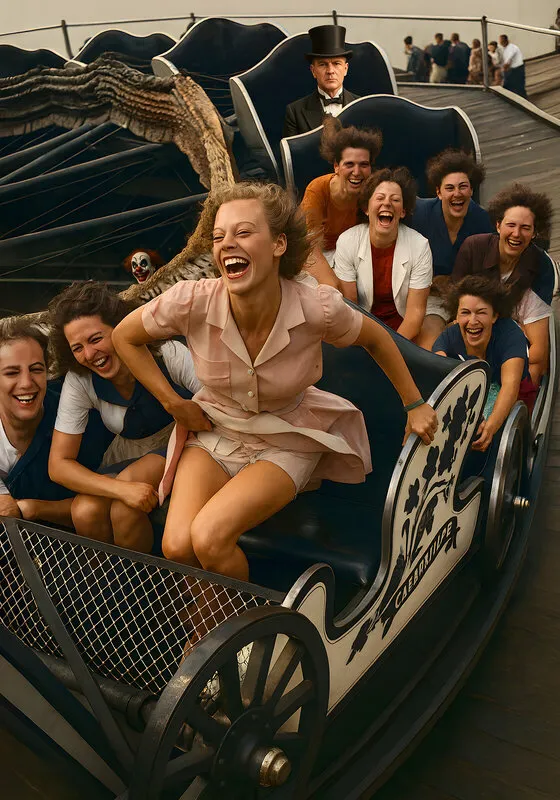
This title, 'The Moment-In the Blink of an Eye-Ögonblicket', encapsulates the core theme of the essay. It underscores the fleeting nature of moments and their profound impact on our lives. Every picture narrates a story, but some images encapsulate more than just a face or a place – they seize time itself. This photograph, taken one summer night on the Tivoli carousel in Copenhagen, freezes a single instant: a sudden gust of wind, a skirt caught in motion, and laughter bursting out before anyone had time to react. What might seem trivial becomes, in hindsight, a symbol – not only of joy, surprise, and youth, but of the very concept of the moment.
Moments, despite their brevity, possess a transformative power that shapes memory, history, and culture. From Marilyn Monroe’s iconic white dress to pivotal moments that altered the course of nations, fleeting instants often leave the deepest mark. This essay invites you to consider the depth of a moment and how such instances resonate far beyond their brief duration, inspiring us with their impact and prompting us to reflect on our own experiences.
Join me on a journey to explore the captivating world of youth and a changing society, where moments are not just fleeting instances but also markers of transformation. This essay, while intellectually engaging, also aims to entertain you with the story behind my picture. We will delve into the concept of time and its deep cultural significance in various societies, offering an engaging and enlightening journey into the history and cultural importance of a magical night.
“Moments
A moment is a blink,
a gust that lifts a skirt,
a laugh spilling out before thought can catch it.
A moment is a step,
a footprint pressed in lunar dust,
fragile yet forever.
A moment is a shot,
echoing through Sarajevo’s streets,
shaping a century in a heartbeat.
A moment is a cry—
“Eureka!” in a steaming bath,
a flash that lights the mind and alters the world.
Some moments vanish
like smoke in the wind.
Others stretch across time,
woven into memory,
carved into history.
And some—
a lover’s glance,
a wall collapsing,
a child’s first laugh—
become eternal,
seconds that refuse to die.
Moments:
short as a blink,
long as a lifetime,
endless as eternity.”
Malmö. August 2025
The Moment – In the Blink of an Eye - Ögonblicket
The picture captures a sudden and unexpected moment on a carousel at Copenhagen’s Tivoli. It took only an instant for a gust of wind to lift the young woman’s skirt, and not much longer for her friends to notice and burst into laughter. For a woman, revealing her underwear is a mixed situation, filled with many emotions. Think of the scene with Marilyn Monroe when her dress is blown up as she passes a subway grate. That too took only a moment, but on the cinema screen, it was stretched into several seconds for the audience’s enjoyment. Yet it took many moments to film the scene—repeatedly reshot to perfect it.
The iconic moment with the subway grate, immortalised in film, was not a spontaneous event. The initial shoot in New York took approximately five hours to complete, with fourteen takes attempted. A large crowd gathered to witness the scene, only for the footage to be deemed unusable. The scene was later recreated on a sound stage in California. This extended process, in stark contrast to the brief moment of laughter it aimed to capture, underscores the paradox of time. It shows that while a moment may be fleeting, the effort required to preserve it can be significant, often stretching far beyond the moment itself.
The filming of Marilyn Monroe’s famous scene with the white dress, therefore, took about five hours on a street in New York. During this time, director Billy Wilder shot fourteen takes before the scene was finally completed on a studio lot in California.
Laughter is contagious, and the clown below laughed without knowing why—because that is how laughter works if you are like most people. The man in the top hat was no jester and responded instead within just a few moments, irritated by the others’ disruptive joy. He was busy enough making sure his hat stayed in place. Had he seen what had happened, he would not have laughed at it but would have been somewhat scandalised by women who did not keep their attire in order.
The fact that the picture exists at all is pure chance, as it was taken with my old box camera in the 1950s, which is why it appears blurry. It had only one shutter speed—one thirtieth of a second—and you had to wind the film forward before taking the next shot. That process could take many moments, easily half a minute. Capturing the exact instant when everything happened was just luck, the kind that only the observant are blessed with. The photo was taken during a sharp turn where anything seemed possible—and indeed, it was.
How long is a moment?
In everyday life, we measure it in a blink—perhaps a tenth of a second, maybe two. Long enough to miss a smile but also long enough to capture an entire world in a picture. In the language of film, it takes only twenty-four frames per second for the eye to believe that life is moving. A moment is thus shorter than we imagine, yet long enough to contain everything.
In English, there is no single word as poetically charged as the Swedish ‘ögonblick’. One shifts between 'moment' (neutral), 'instant' (technical), and the idiomatic “in the blink of an eye” (poetic). The word 'ögonblick' carries a weight that transcends its literal meaning, encapsulating the depth and significance of a moment.
Fast processes – a few measures:
A blink: approx. 0.1–0.4 s.
Film: 24 fps (cinema), TV 25/30 fps, sports/gaming often 60/120 fps.
Screen refresh rate to avoid flicker: ~50–60 Hz.
Camera flash: as short as 1/10,000 s.
Sound: above 20 Hz perceived as a tone rather than individual pulses.
These frame rates, which determine how quickly images are displayed, remind us of how quickly moments slip by and the importance of capturing them.
Science pushes the boundaries even further. We speak of femtoseconds (10⁻¹⁵ s) and attoseconds (10⁻¹⁸ s), so brief that they capture the dance of electrons around the atomic nucleus. Even zeptoseconds (10⁻²¹ s) have been measured. And at the very edge of time’s most minor scale lies the Planck time—an interval so tiny that the universe barely has time to breathe: approximately 10⁻⁴³ seconds. Shorter than that, time ceases to exist, according to physics.
Thus, the moment stretches its bow between the human blink and the outermost edge of the cosmos. It bridges the ordinary and the unspeakable. Perhaps that is why the word carries such weight: because in the smallest unit resides both the speed of laughter, a fleeting human emotion, and the depth of eternity, a concept that transcends time and space.
“Eureka!” – the exclamation of a moment, a phrase famously linked to the ancient Greek scholar Archimedes. It represents the sudden insight or discovery that often happens in a fleeting instant, highlighting the profound and transformative effect of such occurrences.
Eureka— Archimedes’ cry when he discovered the principle of buoyancy in his bathtub—stands as one of history’s most renowned moments. It demonstrates how a brief moment can also encompass a sudden insight that transforms everything. In English, one sometimes refers to “a Eureka moment”—a moment of revelation or brilliant idea. These moments have the power to shape history and change the course of human understanding.
“Eureka!” is so brief it fits into a single shout, yet so transformative it changed humanity’s view of knowledge. Archimedes, in his bath, water sloshing over the edge, and in the same blink, an insight that opened the gates to the laws of physics. A moment where time and thought collapsed—where everyday life touched eternity.
We can see “the moment” on several levels:
Physically: a blink, a millisecond, a heartbeat of Planck time.
Humanly: the instant when love is sparked in a glance, or when laughter erupts.
Historically: Archimedes’ Eureka, Newton’s apple, Einstein’s relativity, Armstrong’s first step on the moon, and the fall of the Berlin Wall.
Eureka in Syracuse
A bathtub, a body sinking into warm water, waves spilling over the edge. So simple, so everyday. Yet in that brief instant, Archimedes saw something no one had understood before—the principle of buoyancy. “Eureka!”—(I have found it!), he cried. A moment, just a blink, yet it became the foundation of the language of physics.
Newton’s Apple
A fruit fell from a tree in a tranquil garden in seventeenth-century England. It might have been any fruit falling, but for Newton, it was a sign. In that moment, the concept of gravity was born—an unseen law governing both apples and planets. An everyday fall transformed into a cosmic revelation.
Einstein’s Train
A thought experiment so swift it fits into a single breath: what if one could travel at the speed of light itself? This question, posed by Albert Einstein, led to the birth of the special theory of relativity. It provided the world with a new perspective on reality, where time and space are not absolute but rather relative to the observer's frame of reference. A train rushing forward, a beam of light that never waits—and time stretching and compressing under these new rules.
Armstrong’s Step
On 20 July 1969, humanity took its first step onto another world. The footprint in the lunar dust was made in just a moment, yet it still bears the weight of all humankind – and the print will not change in a million years. “One small step for man, one giant leap for mankind.” A step that opened space for our neighbour.
The Shots in Sarajevo
On 28 June 1914, two shots were fired at Archduke Franz Ferdinand. The act itself lasted only seconds, but it had a lasting impact on the world. In that moment, Europe plunged into the First World War—an instant that turned into four years of fire and death, and a century of repercussions.
Hiroshima
On 6 August 1945, a bomb struck Hiroshima. In an instant, a city disintegrated, people were vaporised, and the world entered the atomic age. Never before had a moment been so devastating, so superhuman in its force. A moment when humanity realised it could annihilate itself.
The Fall of the Berlin Wall
A confused press conference, a hesitant border guard, a crowd daring to advance. Within a few hours on 9 November 1989, the wall that had divided the world fell. The fall of the Wall was, in truth, made up of countless moments—hammers, hands, jubilation—but they merged into one: the return of freedom in Europe.
Mandela’s Step
In 1990, the gates of Victor Verster Prison in South Africa opened. Nelson Mandela walked out, hand in hand with his wife Winnie. It was only a few steps, but they resonated across the world. The weight of his years in prison, the hope for a new beginning, the joy of freedom-all these emotions were encapsulated in those few steps. A moment when oppression turned into hope, and history shifted course.
Rosa Parks’ No
On December 1, 1955, Rosa Parks sat on a bus in Montgomery and refused to relinquish her seat. A “no” that lasted only a few seconds, but became the spark that ignited the civil rights movement. A moment of stillness that shook an entire system.
The Internet’s First Message
In 1969, the first message was sent via ARPANET, the precursor to the Internet. It was supposed to be the word LOGIN, but the system crashed after two letters: LO. Two characters, one moment—and the world entered a new era of communication.
9/11 – The Morning that Froze in a Moment
11 September 2001 began like any other morning until planes crashed into the Twin Towers. In just minutes, the world was changed forever. A moment became a global shock, a still image of smoke and steel etched into everyone's memory. Never before had the world felt so interconnected in its vulnerability.
The Nature of the Moment
From Archimedes in Syracuse to Marilyn’s white dress, from Newton’s apple to the fall of the Berlin Wall, from Armstrong’s step to the internet’s two letters—these are all moments. They last only a blink, but their effects span centuries. They have shaped our understanding of the world, our societies, and our lives in ways that continue to resonate today.
Physics tells us a moment can be as brief as Planck time, 10⁻⁴³ seconds—the shortest measure of time possible. But human moments are longer, filled with laughter, sorrow, light, and darkness. They are seconds that never end.
And perhaps that is why the picture from Tivoli carries such significance. It captured not only a gust of wind, a skirt, and a burst of laughter—it captured the very essence of what a moment is: so brief it almost seems to vanish, yet so rich it can never truly fade.
Ögonblicket
Bilden visar vad som hände helt plötsligt och oanat på en karusell på Köpenhamns Tivoli. Det tog ett ögonblick för en vindil att blåsa upp den unga kvinnans kjol och inte mycket längre för hennes väninnor att uppfatta situationen och börja skratta. Att visa underbyxorna är för en kvinna en blandad situation fylld av många känslor. Tänk på scenen med Marilyn Monroe där hennes klänning blåser upp när hon passerar tunnelbanans ventilationsutsläpp. Det tog också ett ögonblick, men på filmduken sträcktes det ut till några sekunder till publikens förtjusning. Däremot tog det många ögonblick att spela in scenen – om och om igen fick den tas om.
Det berömda ögonblicket med tunnelbanegaller fångades på en gata i New York.
Den första inspelningen i New York varade i cirka fem timmar. Det krävdes 14 tagningar för att få bilden, och en stor folkmassa samlades för att titta. Bildmaterialet från New York-platsen ansågs oanvändbart, och scenen filmades senare på en ljudscen i Kalifornien. Sammantaget blev ögonblicket många timmar.
Inspelningen av Marilyn Monroes berömda scen med den vita klänningen tog alltså ungefär fem timmar på en gata i New York. Under denna tid filmade regissören Billy Wilder fjorton tagningar innan scenen slutligen spelades in på en studiotomt i Kalifornien.
Skratt smittar av sig och clownen nedanför skrattade utan att veta varför, för det är så skratt fungerar om man är som folk. Mannen i hög hatt var ingen lustigkurre och reagerade tvärtom inom några få ögonblick, irriterad över andras störande glädje. Han hade fullt sjå med att se till att hatten stannade på plats. Hade han sett vad som skedde, skulle träbocken inte ha skrattat för det utan snarare förfasat sig över kvinnor som inte höll klädseln i ordning.
Att bilden finns är slumpens skördar eftersom den är tagen med min gamla lådkamera på 50-talet, därav oskärpan. Den hade en enda slutartid, en trettiondels sekund, och sedan var man tvungen att veva fram filmen innan man kunde ta nästa bild. Det tog många ögonblick, säkert en halv minut. Att fånga ögonblicket då allt hände var ren bondröta, en sådan som bara den uppmärksamme får chansen till. Bilden är tagen precis i en brant sväng där allt verkade kunna hända – och också gjorde det.
Hur långt är ett ögonblick?
I vardagen mäter vi det i en blinkning – en tiondels sekund, kanske två. Tillräckligt för att missa ett leende, men också nog för att fånga en hel värld på en bild. I filmens språk behövs bara tjugofyra bilder per sekund för att ögat ska tro att livet rör sig. Ett ögonblick är alltså kortare än vi anar, men ändå tillräckligt långt för att rymma allt.
Språknote (sv/eng): På engelska finns ingen lika poetiskt laddad singelterm som ”ögonblick”. Man växlar mellan moment (neutralt), instant (tekniskt), och det idiomatiska “in the blink of an eye” (poetiskt).
Snabba förlopp – några mått:
Blinkning: ca 0,1–0,4 s.
These frame rates, which determine the speed at which images are displayed, serve as a poignant reminder of how quickly moments pass and the importance of capturing them.
Skärmuppdatering för att undvika flimmer: ~50–60 Hz.
Kamerablixt: ned till 1/10 000 s.
Ljud: över 20 Hz upplevs som ton, inte enskilda pulser.
Vetenskapen pressar gränsen ännu längre. Man talar om femtosekunder (10⁻¹⁵ s) och attosekunder (10⁻¹⁸ s), så korta att de mäter elektronernas dans runt atomens kärna. Man har till och med mätt zeptosekunder (10⁻²¹ s). Och längst ned i tidens minsta spricka väntar Plancktiden – ett mått så litet att själva universum knappt hinner andas: ca 10⁻⁴³ sekunder. Kortare än så existerar inte tid, enligt fysiken.
Så spänner ögonblicket sin båge mellan människans blinkning och kosmos yttersta gräns. Mellan det vardagliga och det outsägliga. Kanske är det därför ordet bär på en sådan tyngd: för i det minsta ryms både skrattets hastighet och evighetens djup.
”Eureka!” – ögonblickets uppenbarelse
Eureka – Arkimedes rop när han insåg principen för vattnets lyftkraft i sitt badkar – är ett av historiens mest berömda ögonblick. Det visar hur ett ögonblick inte bara är tidsmässigt kort, utan kan bära en plötslig insikt som förändrar allt. På engelska talar man ibland om “a Eureka moment” – ett ögonblick av uppenbarelse eller genial idé.
”Eureka!” är så kort att det ryms i ett enda utrop, men samtidigt så omvälvande att det förändrade världens syn på kunskap. Arkimedes i badet, vatten som svallar över kanten, och i samma blinkning en insikt som öppnar porten till fysikens lagar. Ett ögonblick där tid och tanke kollapsar – från vardag till evighet.
Vi kan se ”ögonblicket” på flera plan:
Fysikaliskt: en blinkning, en millisekund, ett Plancktids pulsslag.
Mänskligt: stunden när kärlek tänds i en blick, eller när skrattet bryter ut.
Historiskt: Arkimedes’ Eureka, Newtons äpple, Einsteins relativitet, Armstrongs första steg på månen, Berlinmurens fall.
Eureka i Syrakusa
Ett badkar, en kropp som sjunker ner i varmt vatten, vågor som svallar över kanten. Så enkelt, så vardagligt. Men i den korta stunden såg Arkimedes något ingen tidigare förstått – principen för vattnets lyftkraft. ”Eureka!” – jag har funnit det! ropade han. Ett ögonblick, bara en blinkning, men det blev grunden för fysikens språk.
Newtons äpple
En frukt föll från ett träd i en stilla trädgård i 1600-talets England. Det kunde ha varit vilken fallande frukt som helst, men för Newton var det ett tecken. I det ögonblicket växte tanken om gravitation fram – en osynlig lag som binder både äpplen och planeter. Ett vardagligt fall blev en kosmisk insikt.
Einsteins tåg
Ett tankeexperiment, så snabbt att det ryms i ett andetag: tänk om man färdas med ljuset? Vad sker då med tid och rum? På ett ögonblick föddes den speciella relativitetsteorin, och världen fick ett nytt sätt att förstå själva verkligheten. Ett tåg som rusar, ett ljus som aldrig väntar – och tiden som sträcks och krymper efter nya regler.
Armstrongs steg
Den 20 juli 1969 tog en människa för första gången ett steg på en annan värld. Fotavtrycket i månstoftet tog bara ett ögonblick att sätta, men det bär fortfarande mänsklighetens tyngd. “One small step for man, one giant leap for mankind.” Ett steg som gjorde rymden till vår granne.
Skotten i Sarajevo
Den 28 juni 1914 avfyrades två skott mot ärkehertig Franz Ferdinand. Själva handlingen varade sekunder, men världen välvdes. På det ögonblicket gled Europa in i det första världskriget – ett ögonblick som blev fyra år av eld och död, och ett helt århundrade av följder.
Hiroshima
Den 6 augusti 1945 föll en bomb över Hiroshima. På bråkdelen av en sekund upplöstes en stad, människor förångades, och världen trädde in i atomåldern. Aldrig tidigare hade ögonblicket varit så förödande, så övermänskligt i sin kraft. Ett ögonblick där mänskligheten förstod att den kunde utplåna sig själv.
Berlinmurens fall
En förvirrad presskonferens, en gränsvakt som tvekade, en folkmassa som vågade ta steget. Under några timmar den 9 november 1989 revs en mur som hade delat en värld. Murens fall var egentligen tusentals ögonblick – hackor, händer, jubel – men allt smälte ihop till ett enda: frihetens återkomst i Europa.
Mandelas steg
1990 öppnades dörren till Victor Verster-fängelset i Sydafrika. Nelson Mandela gick ut, hand i hand med sin fru Winnie. Det var bara några steg, men det var steg som ekade över hela världen. Ett ögonblick då förtryck gav vika för hopp, och historien ändrade riktning.
Rosa Parks’ nej
Den 1 december 1955 satte sig Rosa Parks på en buss i Montgomery och vägrade resa sig. Ett nej som varade i några sekunder, men som blev startskottet för medborgarrättsrörelsen. Ett ögonblick av stillhet som skakade ett helt system.
Internetets första meddelande
1969 skickades det första meddelandet via ARPANET, föregångaren till internet. Det skulle ha varit ordet LOGIN, men systemet kraschade efter två bokstäver: LO. Två tecken, ett ögonblick – och världen gick in i en ny epok av kommunikation.
9/11 – Morgonen som stannade på ett ögonblick
Den 11 september 2001 var en morgon som alla andra, tills flygplanen kraschade in i tvillingtornen. På några minuter förändrades världen. Ett ögonblick blev till en global chock, en stillbild av rök och stål som etsade sig fast i allas minne. Aldrig tidigare hade världen känts så sammanlänkad i sin sårbarhet.
Ögonblickets natur
Från Arkimedes i Syrakusa till Marilyns vita klänning, från Newtons äpple till Berlinmurens fall, från Armstrongs steg till internetets två bokstäver – allt är ögonblick. De varar en blinkning, men deras konsekvenser sträcker sig över sekler.
Fysiken säger att ett ögonblick kan vara Plancktiden, 10⁻⁴³ sekunder – den kortaste tid som kan mätas. Men mänsklighetens ögonblick är längre, fyllda av skratt, sorg, ljus och mörker. De är sekunder som aldrig tar slut.
Och kanske är det just därför bilden från Tivoli bär på sin tyngd. Den fångade inte bara en vindil, en kjol och ett skratt – den fångade själva kärnan i vad ett ögonblick är: så kort att det nästan inte finns, men så rikt att det aldrig kan försvinna.
3 200 kr

Jörgen Thornberg
Malmö
Lite om bilder och mig. Translation in English at the end.
Jag är en nyfiken person som ser allt i bilder, även det jag fäster i ord, gärna tillsammans för bakom alla mina bilder finns en berättelse. Till vissa bilder hör en kortare eller längre novell som följer med bilden.
Bilder berättar historier. Jag omges av naturlig skönhet, intressanta människor och historia var jag än går. Jag använder min kamera för att dokumentera världen och blanda det jag ser med vad jag känner för att fånga den dolda magin.
Mina bilder berättar mina historier. Genom mina bilder, tryck och berättelser. Jag bjuder in dig att ta del av dessa berättelser, in i ditt liv och hem och dela min mycket personliga syn på vår värld. Mer än vad ögat ser. Jag tänker i bilder, drömmer och skriver och pratar om dem; följaktligen måste jag också skapa bilder. De blir vad jag ser, inte nödvändigtvis begränsade till verkligheten. Det finns en bild runt varje hörn. Jag hoppas att du kommer att se vad jag såg och gilla det.
Jag är också en skrivande person och till många bilder hör en kortare eller längre essay. Den följer med tavlan, tryckt på fint papper och med en personlig hälsning från mig.
Flertalet bilder startar sin resa i min kamera. Enkelt förklarat beskriver jag bilden jag ser i mitt inre, upplevd eller fantiserad. Bilden uppstår inom mig redan innan jag fått okularet till ögat. På bråkdelen av ett ögonblick ser jag vad jag vill ha och vad som kan göras med bilden. Här skall jag stoppa in en giraff, stålmannen, Titanic eller vad det är min fantasi finner ut. Ännu märkligare är att jag kommer ihåg minnesbilden långt efteråt när det blir tid att skapa verket. Om jag lyckas eller inte, är upp till betraktaren, oftast präglat av en stråk av svart humor – meningen är att man skall bli underhållen. Mina bilder blir ofta en snackis där de hänger.
Jag föredrar bilder som förmedlar ett budskap i flera lager. Vid första anblicken fylld av feel-good, en vacker utsikt, fint väder, solen skiner, blommor på ängen eller vattnet som ligger förrädiskt spegelblankt. I en sådan bild kan jag gömma min egentliga berättelse, mitt förakt för förtryckare och våldsverkare, rasister och fördomsfulla människor - ett gärna återkommande motiv mer eller mindre dolt i det vackra motivet. Jag försöker förena dem i ett gemensamt narrativ.
Bild och formgivning har löpt som en röd tråd genom livet. Fotokonst känns som en värdig final som jag gärna delar med mig.
Min genre är vid som framgår av mina bilder, temat en blandning av pop- och gatukonst i kollage som kan bestå av hundratals lager. Vissa bilder kan ta veckor, andra någon dag innan det är dags att överlämna resultatet till printverkstaden. Fine Art Prints är digitala fotocollage. I dessa kollage sker rivandet, klippandet, pusslandet, målandet, ritandet och sprayningen digitalt. Det jag monterar in kan vara hundratals år gamla bilder som jag omsorgsfullt frilägger så att de ser ut att vara en del av tavlan men också bilder skapade av mig själv efter min egen fantasi. Därefter besöks printstudion och för vissa bilder numrera en limiterad upplaga (oftast 7 exemplar) och signera för hand. Vissa bilder kan köpas i olika format. Det är bara att fråga efter vilka. Gillar man en bild som är 70x100 men inte har plats på väggen, går den kanske att få i 50x70 cm istället. Frågan är fri.
Metoden Giclée eller Fine Art Print som det också kallas är det moderna sättet för framställning av grafisk konst. Villkoret för denna typ av utskrifter är att en högkvalitativ storformatskrivare används med åldersbeständigt färgpigment och konstnärspapper eller i förekommande fall på duk. Pappret som används möter de krav på livslängd som ställs av museer och gallerier. Normalt säljer jag mina bilder oinramade så att den nya ägaren själv kan bestämma hur de skall se ut, med eller utan passepartout färg på ram, med eller utan glas etc..
Under många år ställde jag bara ut på nätet, i valda grupper och på min egen Facebooksida - https://www.facebook.com/jorgen.thornberg.9
Jag finns också på en egen hemsida som tyvärr inte alltid är uppdaterad – https://www.jth.life/ Där kan du också läsa en del av de berättelser som följer med bilden.
UTSTÄLLNINGAR
Luftkastellet, oktober 2022
Konst i Lund, november 2022
Luftkastellet, mars 2023
Engleson Galleri Caroli, april 2023
Hydra, Greece June 2023
Engleson Galleri Caroli, oktober 2023
Toppen, Höllviken december 2023
Luftkastellet, mars 2024
Torups Galleri, mars 2024
Venice, May 2024
Luftkastellet, oktober 2024
Konst i Advent, December 2024
Galleri Engleson, Caroli December 2024
Jäger & Jansson Galleri, april 2025
A bit about pictures and me.
I'm a curious person who sees everything in pictures, even what I express in words, often combining them, for behind all my pictures lies a story. These narratives, some as short as a single image and others as long as a novel, are the heart and soul of my work.
Pictures tell stories. Wherever I go, I'm surrounded by natural beauty, exciting people, and history. I use my camera to document the world and blend what I see with what I feel to capture the hidden magic.
My images tell my stories. Through my pictures, prints, and narratives, I invite you to partake in these stories in your life and home and share my deeply personal perspective of our world. More than meets the eye. I think in pictures, dream, write, and talk about them; consequently, I must create images too. They become what I see, not necessarily confined to reality. There's a picture around every corner. I hope you'll see what I saw and enjoy it.
I'm also a writer, and many images come with a shorter or longer essay. It accompanies the painting, printed on fine paper with my personal greeting.
Many pictures start their journey on my camera. Simply put, I describe the image I see in my mind, experienced or imagined. The image arises within me even before I bring the eyepiece to my eye. In a fraction of a moment, I see what I want and what can be done with the picture. Here, I'll insert a giraffe, Superman, the Titanic, or whatever my imagination conjures up. Even stranger is that I remember the mental image long after it's time to create the work. Whether I succeed is up to the observer, often imbued with a streak of black humour – the aim is to entertain. My pictures usually become a talking point wherever they hang.
I prefer pictures that convey a message in multiple layers. At first glance, they're filled with feel-good vibes, a beautiful view, lovely weather, the sun shining, flowers in the meadow, or the water lying deceptively calm. But beneath this surface beauty, I often conceal a deeper story, a narrative that challenges societal norms or explores the human condition. I invite you to delve into these hidden narratives and discover the layers of meaning within my work.
Picture and design have been a thread running through my life. Photographic art feels like a fitting finale, and I'm happy to share it.
My genre is varied, as seen in my pictures; the theme is a blend of pop and street art in collages that can consist of hundreds of layers. Some images can take weeks, others just a day before it's time to hand over the result to the print workshop. Fine Art Prints are digital photo collages. In these collages, tearing, cutting, puzzling, painting, drawing, and spraying happen digitally. What I insert can be images hundreds of years old that I carefully extract so they appear to be part of the painting, but also images created by myself, now also generated from my imagination. Next, visit the print studio and, for certain images, number a limited edition (usually 7 copies) and sign them by hand. Some images may be available in other formats. Just ask which ones. If you like an image that's 70x100 but doesn't have space on the wall, you might be able to get it in 50x70 cm instead. The question is open.
The Giclée method, or Fine Art Print as it's also called, is the modern way of producing graphic art. This method ensures the highest quality and longevity of the artwork, using a high-quality large-format printer with archival pigment inks and artist paper or, in some cases, canvas. The paper used meets the longevity requirements set by museums and galleries. I sell my pictures unframed, allowing the new owner to personalise their artwork, confident in the lasting value and quality of the piece.
For many years, I only exhibited online, in selected groups, and on my Facebook page - https://www.facebook.com/jorgen.thornberg.9. I also have my website, which unfortunately is not constantly updated - https://www.jth.life/. You can also read some of the stories accompanying the pictures there.
EXHIBITIONS
Luftkastellet, October 2022
Art in Lund, November 2022
Luftkastellet, March 2023
Engleson Gallery Caroli, April 2023
Hydra, Greece June 2023
Engleson Gallery Caroli, October 2023
Toppen, Höllviken December 2023
Luftkastellet, March 2024
Torup Gallery, March 2024
Venice, May 2024
UTSTÄLLNINGAR
Luftkastellet, oktober 2022
Konst i Lund, november 2022
Luftkastellet, mars 2023
Engleson Galleri Caroli, april 2023
Hydra, Greece June 2023
Engleson Galleri Caroli, oktober 2023
Toppen, Höllviken december 2023
Luftkastellet, mars 2024
Torups Galleri, mars 2024
Venice, May 2024
Luftkastellet, October 2024
Konst i Advent, December 2024
Galleri Engleson, Caroli December 2024
Jäger & Jansson Galleri, April 2025
Utbildning
Autodidakt
Medlem i konstnärsförening
Öppna Sinnen
Med i konstrunda
Konstrundan i Skåne
Utställningar
Luftkastellet, October 2022
Art in Lund, November 2022
Luftkastellet, March 2023
Engleson Gallery Caroli, April 2023
Hydra, Greece June 2023
Engleson Gallery Caroli, October 2023
Toppen, Höllviken December 2023
Luftkastellet, March 2024
Torup Gallery, March 2024
Venice, May 2024