Vi använder cookies för att ge dig bästa möjliga upplevelse. Välj vilka cookies du tillåter.
Läs mer i vår integritetspolicy
Jörgen Thornberg
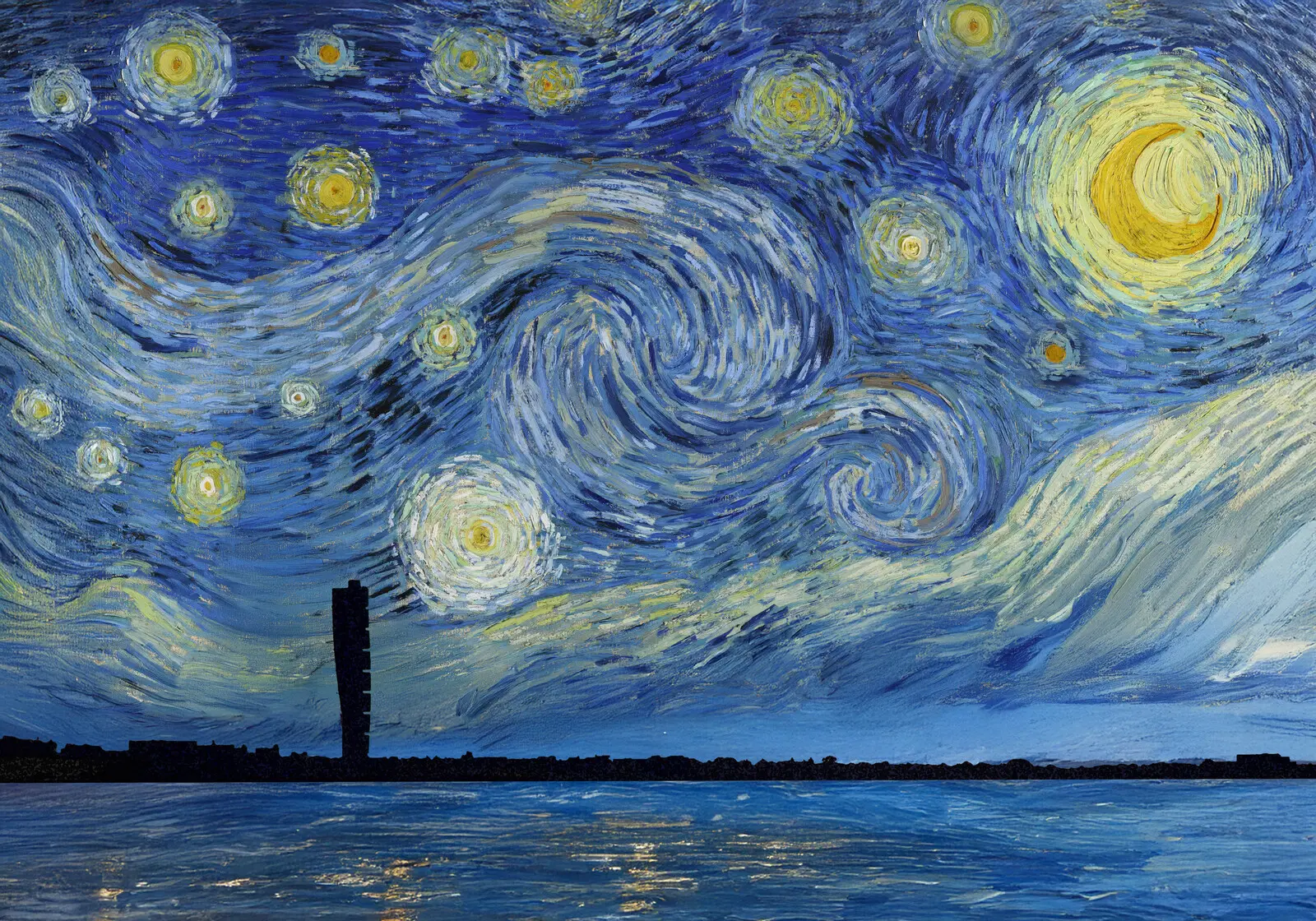
Starry Night Above Öresund, 2025
Digital
70 x 50 cm
3 200 kr
Starry Night Above Öresund
Standing by the sea on a summer night in August is to experience both eternity and one’s own heart. The sky above the Öresund is never still – waves, winds, and clouds blend in an endless dance. But when the stars ignite, when the moon rises, and the Turning Torso casts its silhouette against the sky, the horizon becomes more than just a landscape. It turns into a symbol, a window onto all the stories that people have woven around the lights of the sky for thousands of years.
The moon and the stars, beyond being astronomical phenomena, are deeply symbolic. They serve as nature’s earliest clocks, humanity’s first poetry, and companions of religion and myth. They mirror our anxieties and hopes, our solitudes and unities, our losses and transformations. Over millennia, they have been known by different names and carried various meanings, yet they always share the same power: to remind us that we are part of something timeless and greater.
Within this web of symbols, myths, and personal experiences, my own nightscape unfolds. Here, the waters of the Sound meet Malmö’s tower under a sky that gazes backwards toward Van Gogh and forward into our present. Here, history, folklore, art, and pressing questions of our era – from the climate crisis to war – all converge in the same glow. Perhaps it is in the night, when all else falls silent, that we can most clearly see the light.
Join me on a journey to explore the captivating world of stars. This essay seeks to both entertain and intellectually stimulate you about the story behind a picture. We will investigate the stars and their cultural importance in various societies. Get ready to be educated, inspired, and entertained as we delve into the history and cultural significance of a starry night.
“Starry Night
The sea at night is a mirror of time,
its waves inscribe secrets in silver lines.
Stars ignite like embers of thought,
burning suns in the ink of the sky,
not still, but alive, breathing, becoming.
The moon, August-born, a sentinel flame,
leans low above the restless tide.
Its light is a hand upon the heart,
a rhythm older than calendars,
a vow spoken in silence.
Turning Torso twists toward heaven,
not stone, not steel, but longing itself,
a shadow reaching into the cosmos,
joining the city and sea to the music of light.
Here, myth walks beside memory.
Máni rides his cart through the dark,
chased by wolves of destiny,
while the Seven Stars flicker above
like whispers of harvest and home.
And we, who stand on the shore,
are written into the same vast script:
an alphabet of fire,
a promise of return,
a reminder that even in darkness
the stars belong to us all.”
Malmö. August 2025
Starry Night Above Öresund
The night sky teems with movement, filled with swirling stars that burn like golden suns against the deep blue night. They shimmer, not as static points, but as living entities, swept into currents of light as if the wind itself were painting across the heavens. The August moon glows in its arc, warm and ever-present, the guardian of the night over everything moving below.
Beneath the vast sky lies the sea, the Sound in its nocturnal guise. The water reflects the dance of the stars, with the lines of the waves meeting streams of light. Between them stands a solitary figure in silhouette – a tower spiralling upward, defying gravity, reaching towards the cosmos, dark yet still part of the play of light. All is united in a single breath: sky, sea, and city blending into a vision of motion and stillness, eternity and fleeting moments. It is not that the night has fallen, but that the night has awakened.
The moon and stars, with their ancient and universal symbolism, have always held a special place in human history. When people looked at them, they found both comfort and a sense of mystery. The moon, in particular, has been connected to rhythm and cycles almost everywhere. The passage of time, femininity, fertility, and transformation—many cultures measured time by lunar months long before solar calendars became widespread. In mythology, moon goddesses are common, such as Selene and Artemis in Greece, Chandra in India, and Tsukuyomi in Japan. In the North, it was the god Máni who drove the moon’s chariot across the sky.
The stars served both as a map and an oracle. They arranged themselves into constellations that guided farming and seafaring, but also told stories: Orion, the Bear, the Pleiades. They acted as mythical reflections of human life, both fearsome and comforting. Moon and star cults existed across every continent. The Inca and Maya built temples aligned with the sun and moon, the Babylonians developed advanced astrology, and in Islam, the crescent moon remains a powerful symbol today.
Perhaps that is why the moon and stars continue to hold such poetic power in art, music, and literature. They remind us that we have always looked up at the same sky – regardless of time, language, or place. They encompass both the comfort of recurrence and the fear of the unknown, representing both the order of cycles and the chaos of the infinite. This timeless connection to the celestial bodies instils in us a sense of continuity and belonging.
In Swedish and Nordic mythology, the moon and stars play a significant yet often understated role – always linked to time, rhythm, and fate. In Norse mythology, the moon is personified as the god Máni, brother of Sól, the sun. According to Gylfaginning in Snorri’s Edda, Máni pulls the moon’s chariot across the sky, chased by the wolf Hati, who will ultimately devour him at Ragnarök. The children Bil and Hjúki follow him on his journey; they were taken from the earth while carrying a bucket of water, and their silhouettes were believed to be visible on the surface of the moon. Thus was created the Nordic version of the “man in the moon.”
The moon and stars were not just symbols but also practical guides in daily life. The farming community’s calendars and festivals followed the phases of the moon, and old Swedish sayings and customs were tied to the new moon – one might, for example, put coins in one’s pocket upon seeing the new moon for the first time, to ensure prosperity for the month ahead. This practical role of the celestial bodies instils in us a sense of reliance and connection to the natural world.
The stars were regarded as guardians and guides. The Milky Way was called Mjölkvägen or Asagatan, meaning "the path to the realm of the gods." It was also known as the Fimbulwinter Way, a grim omen of the world’s end. Constellations had their own folk names. The Big Dipper was known in Sweden by several names: Olof’s Wagon, Karl’s Wagon, or the Wagon Bridge. The Pleiades were often referred to as the Seven Sisters and held practical significance in farming, as their appearance in the sky marked the time for specific agricultural tasks.
The moon and stars were believed to profoundly influence humans, both physically and psychologically. Folk tradition believed that wounds healed, births occurred, and harvests flourished better under certain lunar phases. The stars were regarded as the spirits of the dead or as guides that light the way home. In both folklore and poetry, the moon and stars became symbols of longing and destiny. The August moon, in particular, signified the end of summer and carried special significance: a promise of harvest and a warning of darker days to come. The profound influence of celestial bodies on human life instils in us a sense of connection and influence.
The moon and stars have also appeared in world literature. Shakespeare depicted the moon shining over lovers in A Midsummer Night’s Dream, and Romeo pledged his love by its glow. In Goethe and Romantic poetry, the moon became a mirror of the soul, symbolising solitude and longing. In modern times, Leonard Cohen, in Sisters of Mercy, sang of stars falling over Montreal, as if the heavens themselves were sharing in the transient moment of love.
In music, they recur again and again: from Beethoven’s Moonlight Sonata, where the piano becomes a nocturnal sea, to jazz standards like Fly Me to the Moon and David Bowie’s Starman. The moon is both near and far – a body we can land on, but also a poetic symbol we never wish to demystify.
In art, stars have been scattered across medieval altarpieces, gleamed on Gothic church vaults, and shone over Romantic landscapes. The August moon in Swedish art features in the works of Prince Eugen and Carl Larsson, both of whom captured the stillness of night light. In our own time, it has become a canvas for everything from photography to installations – always the same, always transformed.
When we see the moon rise over the Sound in its nocturnal guise, we can feel that we are part of a long chain of gazes raised towards the same light. The rhythm of the heavens has been humanity’s primal calendar, but also our first poem. The stars burning in the blue are not merely celestial bodies – they are memories, symbols, and promises. And in their glow, the night is not darkness but a reminder that we are always part of something greater – a cosmic story where Malmö, the old gods of the North, and people of today are all woven into the same eternal fabric.
The attentive eye might recognise the night sky, for surely it is Van Gogh’s. Not quite, but clearly, I have drawn inspiration from his masterpiece. The landscape has disappeared, along with the dominant cypress and the small, imaginary village. In my picture, only a slender line of Malmö’s skyline to the southwest remains, with the Turning Torso rising like a phallus, separating a modified night sky shaped by what we see when gazing south across the Sound, its waves shimmering in the moonlight. My nightscape, too, is rooted in madness, but it may be worth examining my model more closely: the sky Van Gogh painted from his asylum in 1889. This connection, this shared experience of grappling with the night, is what binds our works.
The painting, like mine, blends anxiety during dark times with a message of hope for light and peace, symbolised by the shining stars. With war in Ukraine and Gaza, an ongoing climate crisis, and madmen like Putin and Trump in power, a great deal of starlight is needed to maintain faith in the future.
Vincent van Gogh painted the influential work Starry Night during the final year of his life, under extraordinary circumstances. In May 1889, he was admitted to the psychiatric clinic at Saint-Rémy-de-Provence. His mental health had deteriorated after months of turmoil, and only six months earlier, he had cut off part of his ear in a quarrel with Paul Gauguin. At the sanatorium of Saint-Paul-de-Mausole, he was provided with colours, canvases, and a studio, which became a vital refuge. There, he produced some of his most renowned works, including The Starry Night.
But what he painted was not a view in the literal sense. From his room, he could not see the landscape he depicted, nor was he initially permitted to leave the grounds. Scholars have therefore concluded that the painting is made from fragments of memory, combined with inner visions. His sky is not documentation, but composition.
Van Gogh dedicated more than two-thirds of the canvas to the heavens, depicting cloud formations, the moon, and stars. The swirls seem to move like storm-tossed waves, with colours glowing in circles of yellow, white, and orange. The short brushstrokes – his signature style – turn the night into something lively, charged, and in motion. He believed, as he mentioned in his letters, that colours appeared more intense at night than in daylight. In Starry Night, he let this belief take centre stage: not darkness, but the battle of light within darkness.
He also depicted the village beneath the sky, though not the real one outside the sanatorium. The church tower he painted seems more rooted in his Dutch homeland than in Provence. The houses are rearranged, and the landscape is constructed. Only the mountains on the right side correspond to reality. The cypress in the foreground, rising toward the heavens like a flame, belonged to the region – but in the painting, it takes on an enhanced, almost symbolic role.
What did Van Gogh intend to express? No one can say for sure. Some see in the swirls a reflection of his mental illness, while others see a cosmic hope. The contrast between the turbulent sky and the peaceful village may signify inner turmoil but also faith in the triumph of light. The moon, large and bright, has long been a symbol of transformation and hope in art history. The cypress, long associated with death, may also symbolise the link between heaven and earth, life and eternity.
Many have wanted to see 'Starry Night' as a reflection of Van Gogh’s soul, but art historians remind us that he did not always depict his emotions directly. Most of his works are vibrant and life-affirming, rather than solely dark. The interpretation, therefore, remains open. Perhaps that was his aim: to leave an image that speaks beyond any diagnosis or explanation. This open interpretation, this freedom to see what we need to see, is what makes his work so enduring and influential.
Today, "Starry Night" is more than just a painting; it is a cultural icon. It has inspired music – from Don McLean’s ‘Vincent’ to numerous interpretations in popular culture – and stands as a reflection of both mental fragility and creative power. Its enduring relevance, its ability to speak to each generation, is a testament to the power of art to transcend time and connect us to our shared humanity.
When I allow my sky to borrow from his, it is not to imitate but to sustain a dialogue. My night belongs to Malmö, to the Sound, and to our era. Van Gogh’s belonged to Saint-Rémy, to the nineteenth century, and to his internal struggle. Yet both are connected by the same longing: to see the stars not as cold points, but as living flames. To find hope within darkness.
And perhaps that is what makes Starry Night immortal – and what I wish to connect to through my painting. That each generation, each individual, can see their own anxiety, their own hope, reflected in the swirling heavens.
Att stå vid havet en natt i augusti är att möta både evigheten och sitt eget hjärta. Himlen över Öresund är aldrig stilla – vågor, vindar och moln smälter samman i ett ständigt skiftande spel. Men när stjärnorna tänds, när månen stiger och Turning Torso tecknar sin silhuett mot det blå, blir horisonten mer än bara ett landskap. Den blir en symbol, ett fönster mot alla de berättelser som människor i tusentals år har vävt kring himlens ljus.
Månen och stjärnorna är inte bara astronomiska fenomen. De är tidens uråldriga klockor, människans första dikt, religionens och mytens följeslagare. De är speglar för oro och hopp, för ensamhet och gemenskap, för förlust och förvandling. Genom årtusenden har de burit olika namn och betydelser – men alltid samma kraft: att påminna oss om att vi hör ihop med något större.
Det är i denna väv av symboler, myter och personliga erfarenheter som mitt eget nattlandskap tar form. Här möts Öresunds vatten, Malmös torn och en himmel som både blickar bakåt mot Van Gogh och framåt mot vår tid. Här samspelar historia, folktro, konst och samtidens mörka frågor – från klimatkris till krig – i samma sken. För kanske är det just i natten, när allt annat tystnar, som vi bäst kan se ljuset.
Natthimlen sjuder av rörelse, fylld av virvlande stjärnor som brinner som gyllene solar mot den djupblå natten. De skimrar, inte som stilla punkter, utan som levande väsen, svepta in i strömmar av ljus som om vinden själv målade på himlavalvet. Augustimånen lyser i sin båge, varm och närvarande, nattens väktare över allt som rör sig därnere.
Under den vidsträckta himlen breder havet ut sig, Öresund i nattens skepnad. Vattnet speglar stjärnornas dans, vågornas linjer möter ljusets stråk, och mellan dem står en ensam gestalt i silhuett – ett torn som skruvar sig uppåt trotsande gravitationen, sträckt mot kosmos, mörkt men ändå en del av ljusets spel. Allt förenas i ett enda andetag: himmel, hav och stad smälter samman i en vision av rörelse och stillhet, evighet och ögonblick. Det är inte natten som fallit, utan natten som vaknat.
Månen och stjärnorna hör till de äldsta och mest universella symbolerna i mänsklighetens historia. När människor lyfte blicken mot dem fann de både trygghet och mysterium. Månen har nästan överallt förknippats med rytm och cykler: tidens gång, kvinnlighet, fertilitet, förvandling. Många kulturer räknade tiden i månvarv långt innan solkalendrar slog igenom. Inom mytologin är mångudinnor vanliga – Selene och Artemis i Grekland, Chandra i Indien, Tsukuyomi i Japan. I Norden var det guden Máni som styrde månvagnen över himlen.
Stjärnorna blev både karta och orakel. De ordnade sig till stjärnbilder som vägledning för jordbruk och sjöfart, men också som berättelser: Orion, Björnen, Plejaderna. De fungerade som mytiska speglar av människans liv, både skräckinjagande och tröstande. Mån- och stjärnkult fanns i alla världsdelar. Inka och Maya byggde tempel inriktade mot måne och sol, babylonierna utvecklade avancerad astrologi, och i islam är halvmånen än idag en stark symbol.
Kanske är det just därför månen och stjärnorna fortfarande bär en sådan poetisk kraft i konst, musik och litteratur. De påminner oss om att vi alltid har lyft blicken mot samma himmel – oavsett tid, språk eller plats. De rymmer både trösten i det återkommande och rädslan för det okända, både ordningen i cyklerna och kaoset i det oändliga.
I svensk och nordisk mytologi spelar månen och stjärnorna en betydelsefull men ofta lite undanskymd roll – alltid kopplade till tid, rytm och öde. I den fornnordiska mytologin är månen personifierad som guden Máni, bror till Sól (solen). Enligt Gylfaginning i Snorres Edda kör Máni månvagnen över himlen, jagad av vargen Hati som vid Ragnarök kommer att sluka honom. Barnen Bil och Hjúki följer honom på färden; de togs upp från jorden när de bar en hink med vatten, och deras siluett ansågs kunna ses på månens yta. Här föddes den nordiska versionen av ”mannen i månen”.
Månen styrde också det praktiska livet. Bondesamhällets kalendrar och högtider följde månens faser. Gamla svenska uttryck och seder knöts till nymånen – man kunde till exempel lägga pengar i fickan när man såg nymånen första gången, för att försäkra sig om god ekonomi månaden ut.
Stjärnorna sågs som väktare och vägvisare. Vintergatan kallades Mjölkvägen eller Asagatan, vägen till gudarnas värld. Den kallades också Fimbulvintervägen, ett hotfullt omen om världens undergång. Stjärnbilder fick egna namn i folklig tradition. Karlavagnen var känd under flera benämningar: Olofs vagn, Karlas vagn eller Vagnsbryggan. Plejaderna kallades ofta för Sjustjärnorna, och deras synlighet markerade tidpunkten för vissa jordbrukssysslor.
Månen ansågs påverka människan fysiskt och psykiskt. Det finns folktro om att sårläkning, födslar och skörd blev bättre om de skedde vid vissa månfaser. Stjärnorna uppfattades som de dödas själar, eller som ljus som pekade vägen hem genom mörkret. I både folktro och poesi har månen och stjärnorna blivit symboler för längtan och öde. Augustimånen markerade slutet på sommaren och bar med sig en särskild laddning: både ett löfte om skörd och en föraning om mörkare tider.
Månen och stjärnorna har också följt oss in i världslitteraturen. Shakespeare lät månen lysa över förälskade älskare i En midsommarnattsdröm, och Romeo svor sin kärlek vid dess sken. I Goethe och romantikens diktning blev månen själens spegel, en symbol för ensamhet och längtan. I modern tid sjunger Leonard Cohen i Sisters of Mercy om stjärnor som faller över Montreal, som om himlen själv deltog i kärlekens flyktiga ögonblick.
I musiken återkommer de gång på gång: från Beethovens månskenssonat, där pianot blir ett nattligt hav, till jazzstandards som Fly Me to the Moon eller David Bowies Starman. Månen är både närhet och fjärran – en kropp vi kan landa på, men också en poetisk symbol vi aldrig vill avmystifiera.
I konsten har stjärnorna strösslats över medeltida altartavlor, lyst på gotiska kyrkvalv och glimmat över romantikens landskapsmålningar. Augustimånen i svensk konst finns hos Prins Eugen och Carl Larsson, som båda fångade nattljusets stillhet. I vår egen tid blir den en projektionsyta för allt från fotografi till installationer – alltid densamma, alltid föränderlig.
När vi ser månen stiga över Öresund i nattens skepnad kan vi känna att vi står i en lång kedja av blickar riktade mot samma ljus. Himlens rytm har varit mänsklighetens urkalender, men också vår första dikt. Stjärnorna som brinner i det blå är inte bara himlakroppar, de är minnen, symboler och löften. Och i deras sken blir natten inte ett mörker, utan en påminnelse om att vi alltid är en del av något större – en kosmisk berättelse där både Malmö, Nordens gamla gudar och dagens människor ingår i samma eviga väv.
Den uppmärksamme tycker sig känna igen natthimlen, för visst är den van Goghs. Inte riktigt, men alldeles klart har jag inspirerats av hans mästerverk. Borta är landskapet, den dominanta cypressen och den lilla fiktiva staden. Bara en smal linje med Malmös skyline åt sydväst, med Turning Torso som sticker upp som en fallos, skiljer en modifierad natthimmel för att passa vad vi ser blickande söderut över Öresunds böljor som glittrar i månskenet. Mitt nattlandskap är också baserat på galenskap, men det kan vara rätt att närmare analysera min förebild, himlen van Gogh avbildade från sitt dårhus 1889.
Målningen är liksom min en blandning av oro under mörka tider men uttrycker hopp om ljus och frid, genom de lysande stjärnorna. För med krig i Ukraina och Gaza, pågående klimatkris och med galningar som Putin och Trump vid makten behövs mycket stjärnljus för att våga tro på framtiden.
Vincent van Gogh målade det betydelsefulla konstverket ’Starry Night’ under sitt sista levnadsår, under särskilda omständigheter. I maj 1889 blev han inlagd på psykiatriska kliniken i Saint-Rémy-de-Provence. Hans mentala tillstånd hade försämrats avsevärt efter månader av oro, och bara sex månader tidigare hade han skurit av sig en del av sitt öra efter ett gräl med Paul Gauguin. På sanatoriet Saint-Paul-de-Mausole fick han tillgång till färger, dukar och en ateljé, vilket blev en livlina. Där skapade han några av sina mest kända verk, bland dem den stjärnklara natten.
Men det han målade var ingen utsikt i egentlig mening. Från sitt rum kunde han inte se landskapet som avbildas. I början fick han heller inte lämna klinikens lokaler. Därför har forskare dragit slutsatsen att målningen bygger på fragment av minnen, kombinerat med inre visioner. Hans himmel är alltså inte en dokumentation, utan en komposition.
Van Gogh ägnade över två tredjedelar av duken åt himlen: molnformationer, måne och stjärnor. Virvlarna tycks röra sig som stormande vågor, färgerna glöder i gula, vita och orangea cirklar. De korta penseldragen – hans signatur – förvandlar det nattliga mörkret till något levande, laddat, pågående. Han såg, som han själv skrev i sina brev, färgerna som mer intensiva på natten än på dagen. Och i Starry Night lät han just detta ta över: inte mörker, utan ljusets kamp i mörkret.
Han avbildade också byn under himlen, men inte den verkliga byn utanför sanatoriet. Kyrktornet han målade tillhör snarare hans holländska hemtrakter än Provence. Husen är omarrangerade, landskapet en konstruktion. Endast bergen på höger sida motsvarar verkligheten. Cypressen i förgrunden, som reser sig mot himlen som en flamma, hörde hemma i landskapet – men fick i målningen en förstärkt, nästan symbolisk roll.
Vad ville Van Gogh uttrycka? Ingen vet säkert. Vissa ser i virvlarna en återspegling av hans mentala sjukdom, andra ser ett kosmiskt hopp. Kontrasten mellan den turbulenta himlen och den fridfulla byn kan tolkas som hans inre oro, men också som en tro på ljusets seger. Månen, stor och klar, har i konsthistorien alltid stått för förvandling och hopp. Cypressen, ofta förbunden med döden, kan lika gärna symbolisera länken mellan himmel och jord, livet och evigheten.
Många vill läsa Starry Night som en spegel av van Goghs själ, men konsthistoriker påminner om att han inte alltid målade sina känslor direkt. Majoriteten av hans verk är färgsprakande och livsbejakande, snarare än enbart mörka. Därför förblir tolkningen öppen. Kanske var det just det han ville: att lämna en bild som talar mer än någon diagnos eller förklaring.
I dag är Starry Night inte bara ett konstverk utan ett kulturellt minne. Det har inspirerat musik – från Don McLeans Vincent till otaliga tolkningar i popkulturen – och blivit en symbol för både psykisk skörhet och skapandets kraft.
När jag låter min egen himmel låna drag av hans, gör jag det inte för att kopiera, utan för att fortsätta en dialog. Min natt är Malmös, Öresunds och vår tids. Van Goghs var Saint-Rémys, 1800-talets och hans inre kamp. Men båda förenas i samma längtan: att se stjärnorna inte som kalla punkter, utan som levande lågor. Att finna hopp i mörkret.
Och kanske är det just det som gör Starry Night odödlig – och som jag vill anknyta till med min målning. Att varje tid, varje människa, kan se sin egen oro, sitt eget hopp i den virvlande himlen.
Jörgen Thornberg
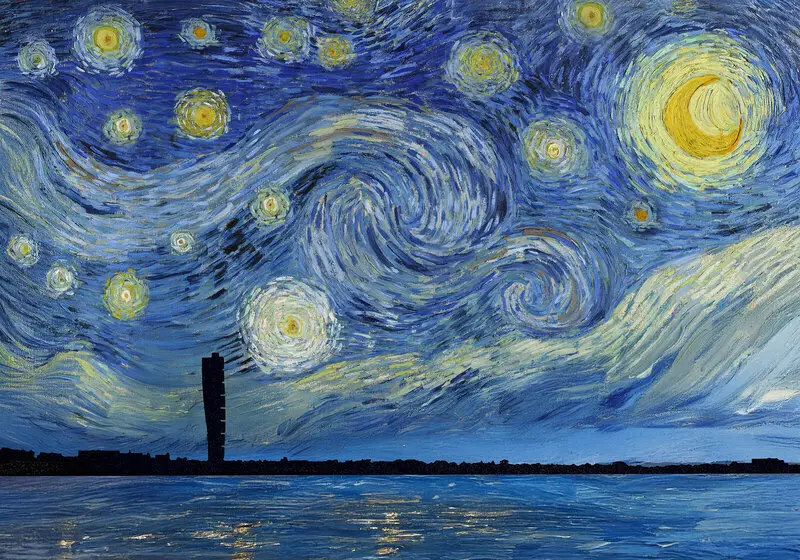
Starry Night Above Öresund, 2025
Digital
70 x 50 cm
3 200 kr
Starry Night Above Öresund
Standing by the sea on a summer night in August is to experience both eternity and one’s own heart. The sky above the Öresund is never still – waves, winds, and clouds blend in an endless dance. But when the stars ignite, when the moon rises, and the Turning Torso casts its silhouette against the sky, the horizon becomes more than just a landscape. It turns into a symbol, a window onto all the stories that people have woven around the lights of the sky for thousands of years.
The moon and the stars, beyond being astronomical phenomena, are deeply symbolic. They serve as nature’s earliest clocks, humanity’s first poetry, and companions of religion and myth. They mirror our anxieties and hopes, our solitudes and unities, our losses and transformations. Over millennia, they have been known by different names and carried various meanings, yet they always share the same power: to remind us that we are part of something timeless and greater.
Within this web of symbols, myths, and personal experiences, my own nightscape unfolds. Here, the waters of the Sound meet Malmö’s tower under a sky that gazes backwards toward Van Gogh and forward into our present. Here, history, folklore, art, and pressing questions of our era – from the climate crisis to war – all converge in the same glow. Perhaps it is in the night, when all else falls silent, that we can most clearly see the light.
Join me on a journey to explore the captivating world of stars. This essay seeks to both entertain and intellectually stimulate you about the story behind a picture. We will investigate the stars and their cultural importance in various societies. Get ready to be educated, inspired, and entertained as we delve into the history and cultural significance of a starry night.
“Starry Night
The sea at night is a mirror of time,
its waves inscribe secrets in silver lines.
Stars ignite like embers of thought,
burning suns in the ink of the sky,
not still, but alive, breathing, becoming.
The moon, August-born, a sentinel flame,
leans low above the restless tide.
Its light is a hand upon the heart,
a rhythm older than calendars,
a vow spoken in silence.
Turning Torso twists toward heaven,
not stone, not steel, but longing itself,
a shadow reaching into the cosmos,
joining the city and sea to the music of light.
Here, myth walks beside memory.
Máni rides his cart through the dark,
chased by wolves of destiny,
while the Seven Stars flicker above
like whispers of harvest and home.
And we, who stand on the shore,
are written into the same vast script:
an alphabet of fire,
a promise of return,
a reminder that even in darkness
the stars belong to us all.”
Malmö. August 2025
Starry Night Above Öresund
The night sky teems with movement, filled with swirling stars that burn like golden suns against the deep blue night. They shimmer, not as static points, but as living entities, swept into currents of light as if the wind itself were painting across the heavens. The August moon glows in its arc, warm and ever-present, the guardian of the night over everything moving below.
Beneath the vast sky lies the sea, the Sound in its nocturnal guise. The water reflects the dance of the stars, with the lines of the waves meeting streams of light. Between them stands a solitary figure in silhouette – a tower spiralling upward, defying gravity, reaching towards the cosmos, dark yet still part of the play of light. All is united in a single breath: sky, sea, and city blending into a vision of motion and stillness, eternity and fleeting moments. It is not that the night has fallen, but that the night has awakened.
The moon and stars, with their ancient and universal symbolism, have always held a special place in human history. When people looked at them, they found both comfort and a sense of mystery. The moon, in particular, has been connected to rhythm and cycles almost everywhere. The passage of time, femininity, fertility, and transformation—many cultures measured time by lunar months long before solar calendars became widespread. In mythology, moon goddesses are common, such as Selene and Artemis in Greece, Chandra in India, and Tsukuyomi in Japan. In the North, it was the god Máni who drove the moon’s chariot across the sky.
The stars served both as a map and an oracle. They arranged themselves into constellations that guided farming and seafaring, but also told stories: Orion, the Bear, the Pleiades. They acted as mythical reflections of human life, both fearsome and comforting. Moon and star cults existed across every continent. The Inca and Maya built temples aligned with the sun and moon, the Babylonians developed advanced astrology, and in Islam, the crescent moon remains a powerful symbol today.
Perhaps that is why the moon and stars continue to hold such poetic power in art, music, and literature. They remind us that we have always looked up at the same sky – regardless of time, language, or place. They encompass both the comfort of recurrence and the fear of the unknown, representing both the order of cycles and the chaos of the infinite. This timeless connection to the celestial bodies instils in us a sense of continuity and belonging.
In Swedish and Nordic mythology, the moon and stars play a significant yet often understated role – always linked to time, rhythm, and fate. In Norse mythology, the moon is personified as the god Máni, brother of Sól, the sun. According to Gylfaginning in Snorri’s Edda, Máni pulls the moon’s chariot across the sky, chased by the wolf Hati, who will ultimately devour him at Ragnarök. The children Bil and Hjúki follow him on his journey; they were taken from the earth while carrying a bucket of water, and their silhouettes were believed to be visible on the surface of the moon. Thus was created the Nordic version of the “man in the moon.”
The moon and stars were not just symbols but also practical guides in daily life. The farming community’s calendars and festivals followed the phases of the moon, and old Swedish sayings and customs were tied to the new moon – one might, for example, put coins in one’s pocket upon seeing the new moon for the first time, to ensure prosperity for the month ahead. This practical role of the celestial bodies instils in us a sense of reliance and connection to the natural world.
The stars were regarded as guardians and guides. The Milky Way was called Mjölkvägen or Asagatan, meaning "the path to the realm of the gods." It was also known as the Fimbulwinter Way, a grim omen of the world’s end. Constellations had their own folk names. The Big Dipper was known in Sweden by several names: Olof’s Wagon, Karl’s Wagon, or the Wagon Bridge. The Pleiades were often referred to as the Seven Sisters and held practical significance in farming, as their appearance in the sky marked the time for specific agricultural tasks.
The moon and stars were believed to profoundly influence humans, both physically and psychologically. Folk tradition believed that wounds healed, births occurred, and harvests flourished better under certain lunar phases. The stars were regarded as the spirits of the dead or as guides that light the way home. In both folklore and poetry, the moon and stars became symbols of longing and destiny. The August moon, in particular, signified the end of summer and carried special significance: a promise of harvest and a warning of darker days to come. The profound influence of celestial bodies on human life instils in us a sense of connection and influence.
The moon and stars have also appeared in world literature. Shakespeare depicted the moon shining over lovers in A Midsummer Night’s Dream, and Romeo pledged his love by its glow. In Goethe and Romantic poetry, the moon became a mirror of the soul, symbolising solitude and longing. In modern times, Leonard Cohen, in Sisters of Mercy, sang of stars falling over Montreal, as if the heavens themselves were sharing in the transient moment of love.
In music, they recur again and again: from Beethoven’s Moonlight Sonata, where the piano becomes a nocturnal sea, to jazz standards like Fly Me to the Moon and David Bowie’s Starman. The moon is both near and far – a body we can land on, but also a poetic symbol we never wish to demystify.
In art, stars have been scattered across medieval altarpieces, gleamed on Gothic church vaults, and shone over Romantic landscapes. The August moon in Swedish art features in the works of Prince Eugen and Carl Larsson, both of whom captured the stillness of night light. In our own time, it has become a canvas for everything from photography to installations – always the same, always transformed.
When we see the moon rise over the Sound in its nocturnal guise, we can feel that we are part of a long chain of gazes raised towards the same light. The rhythm of the heavens has been humanity’s primal calendar, but also our first poem. The stars burning in the blue are not merely celestial bodies – they are memories, symbols, and promises. And in their glow, the night is not darkness but a reminder that we are always part of something greater – a cosmic story where Malmö, the old gods of the North, and people of today are all woven into the same eternal fabric.
The attentive eye might recognise the night sky, for surely it is Van Gogh’s. Not quite, but clearly, I have drawn inspiration from his masterpiece. The landscape has disappeared, along with the dominant cypress and the small, imaginary village. In my picture, only a slender line of Malmö’s skyline to the southwest remains, with the Turning Torso rising like a phallus, separating a modified night sky shaped by what we see when gazing south across the Sound, its waves shimmering in the moonlight. My nightscape, too, is rooted in madness, but it may be worth examining my model more closely: the sky Van Gogh painted from his asylum in 1889. This connection, this shared experience of grappling with the night, is what binds our works.
The painting, like mine, blends anxiety during dark times with a message of hope for light and peace, symbolised by the shining stars. With war in Ukraine and Gaza, an ongoing climate crisis, and madmen like Putin and Trump in power, a great deal of starlight is needed to maintain faith in the future.
Vincent van Gogh painted the influential work Starry Night during the final year of his life, under extraordinary circumstances. In May 1889, he was admitted to the psychiatric clinic at Saint-Rémy-de-Provence. His mental health had deteriorated after months of turmoil, and only six months earlier, he had cut off part of his ear in a quarrel with Paul Gauguin. At the sanatorium of Saint-Paul-de-Mausole, he was provided with colours, canvases, and a studio, which became a vital refuge. There, he produced some of his most renowned works, including The Starry Night.
But what he painted was not a view in the literal sense. From his room, he could not see the landscape he depicted, nor was he initially permitted to leave the grounds. Scholars have therefore concluded that the painting is made from fragments of memory, combined with inner visions. His sky is not documentation, but composition.
Van Gogh dedicated more than two-thirds of the canvas to the heavens, depicting cloud formations, the moon, and stars. The swirls seem to move like storm-tossed waves, with colours glowing in circles of yellow, white, and orange. The short brushstrokes – his signature style – turn the night into something lively, charged, and in motion. He believed, as he mentioned in his letters, that colours appeared more intense at night than in daylight. In Starry Night, he let this belief take centre stage: not darkness, but the battle of light within darkness.
He also depicted the village beneath the sky, though not the real one outside the sanatorium. The church tower he painted seems more rooted in his Dutch homeland than in Provence. The houses are rearranged, and the landscape is constructed. Only the mountains on the right side correspond to reality. The cypress in the foreground, rising toward the heavens like a flame, belonged to the region – but in the painting, it takes on an enhanced, almost symbolic role.
What did Van Gogh intend to express? No one can say for sure. Some see in the swirls a reflection of his mental illness, while others see a cosmic hope. The contrast between the turbulent sky and the peaceful village may signify inner turmoil but also faith in the triumph of light. The moon, large and bright, has long been a symbol of transformation and hope in art history. The cypress, long associated with death, may also symbolise the link between heaven and earth, life and eternity.
Many have wanted to see 'Starry Night' as a reflection of Van Gogh’s soul, but art historians remind us that he did not always depict his emotions directly. Most of his works are vibrant and life-affirming, rather than solely dark. The interpretation, therefore, remains open. Perhaps that was his aim: to leave an image that speaks beyond any diagnosis or explanation. This open interpretation, this freedom to see what we need to see, is what makes his work so enduring and influential.
Today, "Starry Night" is more than just a painting; it is a cultural icon. It has inspired music – from Don McLean’s ‘Vincent’ to numerous interpretations in popular culture – and stands as a reflection of both mental fragility and creative power. Its enduring relevance, its ability to speak to each generation, is a testament to the power of art to transcend time and connect us to our shared humanity.
When I allow my sky to borrow from his, it is not to imitate but to sustain a dialogue. My night belongs to Malmö, to the Sound, and to our era. Van Gogh’s belonged to Saint-Rémy, to the nineteenth century, and to his internal struggle. Yet both are connected by the same longing: to see the stars not as cold points, but as living flames. To find hope within darkness.
And perhaps that is what makes Starry Night immortal – and what I wish to connect to through my painting. That each generation, each individual, can see their own anxiety, their own hope, reflected in the swirling heavens.
Att stå vid havet en natt i augusti är att möta både evigheten och sitt eget hjärta. Himlen över Öresund är aldrig stilla – vågor, vindar och moln smälter samman i ett ständigt skiftande spel. Men när stjärnorna tänds, när månen stiger och Turning Torso tecknar sin silhuett mot det blå, blir horisonten mer än bara ett landskap. Den blir en symbol, ett fönster mot alla de berättelser som människor i tusentals år har vävt kring himlens ljus.
Månen och stjärnorna är inte bara astronomiska fenomen. De är tidens uråldriga klockor, människans första dikt, religionens och mytens följeslagare. De är speglar för oro och hopp, för ensamhet och gemenskap, för förlust och förvandling. Genom årtusenden har de burit olika namn och betydelser – men alltid samma kraft: att påminna oss om att vi hör ihop med något större.
Det är i denna väv av symboler, myter och personliga erfarenheter som mitt eget nattlandskap tar form. Här möts Öresunds vatten, Malmös torn och en himmel som både blickar bakåt mot Van Gogh och framåt mot vår tid. Här samspelar historia, folktro, konst och samtidens mörka frågor – från klimatkris till krig – i samma sken. För kanske är det just i natten, när allt annat tystnar, som vi bäst kan se ljuset.
Natthimlen sjuder av rörelse, fylld av virvlande stjärnor som brinner som gyllene solar mot den djupblå natten. De skimrar, inte som stilla punkter, utan som levande väsen, svepta in i strömmar av ljus som om vinden själv målade på himlavalvet. Augustimånen lyser i sin båge, varm och närvarande, nattens väktare över allt som rör sig därnere.
Under den vidsträckta himlen breder havet ut sig, Öresund i nattens skepnad. Vattnet speglar stjärnornas dans, vågornas linjer möter ljusets stråk, och mellan dem står en ensam gestalt i silhuett – ett torn som skruvar sig uppåt trotsande gravitationen, sträckt mot kosmos, mörkt men ändå en del av ljusets spel. Allt förenas i ett enda andetag: himmel, hav och stad smälter samman i en vision av rörelse och stillhet, evighet och ögonblick. Det är inte natten som fallit, utan natten som vaknat.
Månen och stjärnorna hör till de äldsta och mest universella symbolerna i mänsklighetens historia. När människor lyfte blicken mot dem fann de både trygghet och mysterium. Månen har nästan överallt förknippats med rytm och cykler: tidens gång, kvinnlighet, fertilitet, förvandling. Många kulturer räknade tiden i månvarv långt innan solkalendrar slog igenom. Inom mytologin är mångudinnor vanliga – Selene och Artemis i Grekland, Chandra i Indien, Tsukuyomi i Japan. I Norden var det guden Máni som styrde månvagnen över himlen.
Stjärnorna blev både karta och orakel. De ordnade sig till stjärnbilder som vägledning för jordbruk och sjöfart, men också som berättelser: Orion, Björnen, Plejaderna. De fungerade som mytiska speglar av människans liv, både skräckinjagande och tröstande. Mån- och stjärnkult fanns i alla världsdelar. Inka och Maya byggde tempel inriktade mot måne och sol, babylonierna utvecklade avancerad astrologi, och i islam är halvmånen än idag en stark symbol.
Kanske är det just därför månen och stjärnorna fortfarande bär en sådan poetisk kraft i konst, musik och litteratur. De påminner oss om att vi alltid har lyft blicken mot samma himmel – oavsett tid, språk eller plats. De rymmer både trösten i det återkommande och rädslan för det okända, både ordningen i cyklerna och kaoset i det oändliga.
I svensk och nordisk mytologi spelar månen och stjärnorna en betydelsefull men ofta lite undanskymd roll – alltid kopplade till tid, rytm och öde. I den fornnordiska mytologin är månen personifierad som guden Máni, bror till Sól (solen). Enligt Gylfaginning i Snorres Edda kör Máni månvagnen över himlen, jagad av vargen Hati som vid Ragnarök kommer att sluka honom. Barnen Bil och Hjúki följer honom på färden; de togs upp från jorden när de bar en hink med vatten, och deras siluett ansågs kunna ses på månens yta. Här föddes den nordiska versionen av ”mannen i månen”.
Månen styrde också det praktiska livet. Bondesamhällets kalendrar och högtider följde månens faser. Gamla svenska uttryck och seder knöts till nymånen – man kunde till exempel lägga pengar i fickan när man såg nymånen första gången, för att försäkra sig om god ekonomi månaden ut.
Stjärnorna sågs som väktare och vägvisare. Vintergatan kallades Mjölkvägen eller Asagatan, vägen till gudarnas värld. Den kallades också Fimbulvintervägen, ett hotfullt omen om världens undergång. Stjärnbilder fick egna namn i folklig tradition. Karlavagnen var känd under flera benämningar: Olofs vagn, Karlas vagn eller Vagnsbryggan. Plejaderna kallades ofta för Sjustjärnorna, och deras synlighet markerade tidpunkten för vissa jordbrukssysslor.
Månen ansågs påverka människan fysiskt och psykiskt. Det finns folktro om att sårläkning, födslar och skörd blev bättre om de skedde vid vissa månfaser. Stjärnorna uppfattades som de dödas själar, eller som ljus som pekade vägen hem genom mörkret. I både folktro och poesi har månen och stjärnorna blivit symboler för längtan och öde. Augustimånen markerade slutet på sommaren och bar med sig en särskild laddning: både ett löfte om skörd och en föraning om mörkare tider.
Månen och stjärnorna har också följt oss in i världslitteraturen. Shakespeare lät månen lysa över förälskade älskare i En midsommarnattsdröm, och Romeo svor sin kärlek vid dess sken. I Goethe och romantikens diktning blev månen själens spegel, en symbol för ensamhet och längtan. I modern tid sjunger Leonard Cohen i Sisters of Mercy om stjärnor som faller över Montreal, som om himlen själv deltog i kärlekens flyktiga ögonblick.
I musiken återkommer de gång på gång: från Beethovens månskenssonat, där pianot blir ett nattligt hav, till jazzstandards som Fly Me to the Moon eller David Bowies Starman. Månen är både närhet och fjärran – en kropp vi kan landa på, men också en poetisk symbol vi aldrig vill avmystifiera.
I konsten har stjärnorna strösslats över medeltida altartavlor, lyst på gotiska kyrkvalv och glimmat över romantikens landskapsmålningar. Augustimånen i svensk konst finns hos Prins Eugen och Carl Larsson, som båda fångade nattljusets stillhet. I vår egen tid blir den en projektionsyta för allt från fotografi till installationer – alltid densamma, alltid föränderlig.
När vi ser månen stiga över Öresund i nattens skepnad kan vi känna att vi står i en lång kedja av blickar riktade mot samma ljus. Himlens rytm har varit mänsklighetens urkalender, men också vår första dikt. Stjärnorna som brinner i det blå är inte bara himlakroppar, de är minnen, symboler och löften. Och i deras sken blir natten inte ett mörker, utan en påminnelse om att vi alltid är en del av något större – en kosmisk berättelse där både Malmö, Nordens gamla gudar och dagens människor ingår i samma eviga väv.
Den uppmärksamme tycker sig känna igen natthimlen, för visst är den van Goghs. Inte riktigt, men alldeles klart har jag inspirerats av hans mästerverk. Borta är landskapet, den dominanta cypressen och den lilla fiktiva staden. Bara en smal linje med Malmös skyline åt sydväst, med Turning Torso som sticker upp som en fallos, skiljer en modifierad natthimmel för att passa vad vi ser blickande söderut över Öresunds böljor som glittrar i månskenet. Mitt nattlandskap är också baserat på galenskap, men det kan vara rätt att närmare analysera min förebild, himlen van Gogh avbildade från sitt dårhus 1889.
Målningen är liksom min en blandning av oro under mörka tider men uttrycker hopp om ljus och frid, genom de lysande stjärnorna. För med krig i Ukraina och Gaza, pågående klimatkris och med galningar som Putin och Trump vid makten behövs mycket stjärnljus för att våga tro på framtiden.
Vincent van Gogh målade det betydelsefulla konstverket ’Starry Night’ under sitt sista levnadsår, under särskilda omständigheter. I maj 1889 blev han inlagd på psykiatriska kliniken i Saint-Rémy-de-Provence. Hans mentala tillstånd hade försämrats avsevärt efter månader av oro, och bara sex månader tidigare hade han skurit av sig en del av sitt öra efter ett gräl med Paul Gauguin. På sanatoriet Saint-Paul-de-Mausole fick han tillgång till färger, dukar och en ateljé, vilket blev en livlina. Där skapade han några av sina mest kända verk, bland dem den stjärnklara natten.
Men det han målade var ingen utsikt i egentlig mening. Från sitt rum kunde han inte se landskapet som avbildas. I början fick han heller inte lämna klinikens lokaler. Därför har forskare dragit slutsatsen att målningen bygger på fragment av minnen, kombinerat med inre visioner. Hans himmel är alltså inte en dokumentation, utan en komposition.
Van Gogh ägnade över två tredjedelar av duken åt himlen: molnformationer, måne och stjärnor. Virvlarna tycks röra sig som stormande vågor, färgerna glöder i gula, vita och orangea cirklar. De korta penseldragen – hans signatur – förvandlar det nattliga mörkret till något levande, laddat, pågående. Han såg, som han själv skrev i sina brev, färgerna som mer intensiva på natten än på dagen. Och i Starry Night lät han just detta ta över: inte mörker, utan ljusets kamp i mörkret.
Han avbildade också byn under himlen, men inte den verkliga byn utanför sanatoriet. Kyrktornet han målade tillhör snarare hans holländska hemtrakter än Provence. Husen är omarrangerade, landskapet en konstruktion. Endast bergen på höger sida motsvarar verkligheten. Cypressen i förgrunden, som reser sig mot himlen som en flamma, hörde hemma i landskapet – men fick i målningen en förstärkt, nästan symbolisk roll.
Vad ville Van Gogh uttrycka? Ingen vet säkert. Vissa ser i virvlarna en återspegling av hans mentala sjukdom, andra ser ett kosmiskt hopp. Kontrasten mellan den turbulenta himlen och den fridfulla byn kan tolkas som hans inre oro, men också som en tro på ljusets seger. Månen, stor och klar, har i konsthistorien alltid stått för förvandling och hopp. Cypressen, ofta förbunden med döden, kan lika gärna symbolisera länken mellan himmel och jord, livet och evigheten.
Många vill läsa Starry Night som en spegel av van Goghs själ, men konsthistoriker påminner om att han inte alltid målade sina känslor direkt. Majoriteten av hans verk är färgsprakande och livsbejakande, snarare än enbart mörka. Därför förblir tolkningen öppen. Kanske var det just det han ville: att lämna en bild som talar mer än någon diagnos eller förklaring.
I dag är Starry Night inte bara ett konstverk utan ett kulturellt minne. Det har inspirerat musik – från Don McLeans Vincent till otaliga tolkningar i popkulturen – och blivit en symbol för både psykisk skörhet och skapandets kraft.
När jag låter min egen himmel låna drag av hans, gör jag det inte för att kopiera, utan för att fortsätta en dialog. Min natt är Malmös, Öresunds och vår tids. Van Goghs var Saint-Rémys, 1800-talets och hans inre kamp. Men båda förenas i samma längtan: att se stjärnorna inte som kalla punkter, utan som levande lågor. Att finna hopp i mörkret.
Och kanske är det just det som gör Starry Night odödlig – och som jag vill anknyta till med min målning. Att varje tid, varje människa, kan se sin egen oro, sitt eget hopp i den virvlande himlen.
3 200 kr

Jörgen Thornberg
Malmö
Lite om bilder och mig. Translation in English at the end.
Jag är en nyfiken person som ser allt i bilder, även det jag fäster i ord, gärna tillsammans för bakom alla mina bilder finns en berättelse. Till vissa bilder hör en kortare eller längre novell som följer med bilden.
Bilder berättar historier. Jag omges av naturlig skönhet, intressanta människor och historia var jag än går. Jag använder min kamera för att dokumentera världen och blanda det jag ser med vad jag känner för att fånga den dolda magin.
Mina bilder berättar mina historier. Genom mina bilder, tryck och berättelser. Jag bjuder in dig att ta del av dessa berättelser, in i ditt liv och hem och dela min mycket personliga syn på vår värld. Mer än vad ögat ser. Jag tänker i bilder, drömmer och skriver och pratar om dem; följaktligen måste jag också skapa bilder. De blir vad jag ser, inte nödvändigtvis begränsade till verkligheten. Det finns en bild runt varje hörn. Jag hoppas att du kommer att se vad jag såg och gilla det.
Jag är också en skrivande person och till många bilder hör en kortare eller längre essay. Den följer med tavlan, tryckt på fint papper och med en personlig hälsning från mig.
Flertalet bilder startar sin resa i min kamera. Enkelt förklarat beskriver jag bilden jag ser i mitt inre, upplevd eller fantiserad. Bilden uppstår inom mig redan innan jag fått okularet till ögat. På bråkdelen av ett ögonblick ser jag vad jag vill ha och vad som kan göras med bilden. Här skall jag stoppa in en giraff, stålmannen, Titanic eller vad det är min fantasi finner ut. Ännu märkligare är att jag kommer ihåg minnesbilden långt efteråt när det blir tid att skapa verket. Om jag lyckas eller inte, är upp till betraktaren, oftast präglat av en stråk av svart humor – meningen är att man skall bli underhållen. Mina bilder blir ofta en snackis där de hänger.
Jag föredrar bilder som förmedlar ett budskap i flera lager. Vid första anblicken fylld av feel-good, en vacker utsikt, fint väder, solen skiner, blommor på ängen eller vattnet som ligger förrädiskt spegelblankt. I en sådan bild kan jag gömma min egentliga berättelse, mitt förakt för förtryckare och våldsverkare, rasister och fördomsfulla människor - ett gärna återkommande motiv mer eller mindre dolt i det vackra motivet. Jag försöker förena dem i ett gemensamt narrativ.
Bild och formgivning har löpt som en röd tråd genom livet. Fotokonst känns som en värdig final som jag gärna delar med mig.
Min genre är vid som framgår av mina bilder, temat en blandning av pop- och gatukonst i kollage som kan bestå av hundratals lager. Vissa bilder kan ta veckor, andra någon dag innan det är dags att överlämna resultatet till printverkstaden. Fine Art Prints är digitala fotocollage. I dessa kollage sker rivandet, klippandet, pusslandet, målandet, ritandet och sprayningen digitalt. Det jag monterar in kan vara hundratals år gamla bilder som jag omsorgsfullt frilägger så att de ser ut att vara en del av tavlan men också bilder skapade av mig själv efter min egen fantasi. Därefter besöks printstudion och för vissa bilder numrera en limiterad upplaga (oftast 7 exemplar) och signera för hand. Vissa bilder kan köpas i olika format. Det är bara att fråga efter vilka. Gillar man en bild som är 70x100 men inte har plats på väggen, går den kanske att få i 50x70 cm istället. Frågan är fri.
Metoden Giclée eller Fine Art Print som det också kallas är det moderna sättet för framställning av grafisk konst. Villkoret för denna typ av utskrifter är att en högkvalitativ storformatskrivare används med åldersbeständigt färgpigment och konstnärspapper eller i förekommande fall på duk. Pappret som används möter de krav på livslängd som ställs av museer och gallerier. Normalt säljer jag mina bilder oinramade så att den nya ägaren själv kan bestämma hur de skall se ut, med eller utan passepartout färg på ram, med eller utan glas etc..
Under många år ställde jag bara ut på nätet, i valda grupper och på min egen Facebooksida - https://www.facebook.com/jorgen.thornberg.9
Jag finns också på en egen hemsida som tyvärr inte alltid är uppdaterad – https://www.jth.life/ Där kan du också läsa en del av de berättelser som följer med bilden.
UTSTÄLLNINGAR
Luftkastellet, oktober 2022
Konst i Lund, november 2022
Luftkastellet, mars 2023
Engleson Galleri Caroli, april 2023
Hydra, Greece June 2023
Engleson Galleri Caroli, oktober 2023
Toppen, Höllviken december 2023
Luftkastellet, mars 2024
Torups Galleri, mars 2024
Venice, May 2024
Luftkastellet, oktober 2024
Konst i Advent, December 2024
Galleri Engleson, Caroli December 2024
Jäger & Jansson Galleri, april 2025
A bit about pictures and me.
I'm a curious person who sees everything in pictures, even what I express in words, often combining them, for behind all my pictures lies a story. These narratives, some as short as a single image and others as long as a novel, are the heart and soul of my work.
Pictures tell stories. Wherever I go, I'm surrounded by natural beauty, exciting people, and history. I use my camera to document the world and blend what I see with what I feel to capture the hidden magic.
My images tell my stories. Through my pictures, prints, and narratives, I invite you to partake in these stories in your life and home and share my deeply personal perspective of our world. More than meets the eye. I think in pictures, dream, write, and talk about them; consequently, I must create images too. They become what I see, not necessarily confined to reality. There's a picture around every corner. I hope you'll see what I saw and enjoy it.
I'm also a writer, and many images come with a shorter or longer essay. It accompanies the painting, printed on fine paper with my personal greeting.
Many pictures start their journey on my camera. Simply put, I describe the image I see in my mind, experienced or imagined. The image arises within me even before I bring the eyepiece to my eye. In a fraction of a moment, I see what I want and what can be done with the picture. Here, I'll insert a giraffe, Superman, the Titanic, or whatever my imagination conjures up. Even stranger is that I remember the mental image long after it's time to create the work. Whether I succeed is up to the observer, often imbued with a streak of black humour – the aim is to entertain. My pictures usually become a talking point wherever they hang.
I prefer pictures that convey a message in multiple layers. At first glance, they're filled with feel-good vibes, a beautiful view, lovely weather, the sun shining, flowers in the meadow, or the water lying deceptively calm. But beneath this surface beauty, I often conceal a deeper story, a narrative that challenges societal norms or explores the human condition. I invite you to delve into these hidden narratives and discover the layers of meaning within my work.
Picture and design have been a thread running through my life. Photographic art feels like a fitting finale, and I'm happy to share it.
My genre is varied, as seen in my pictures; the theme is a blend of pop and street art in collages that can consist of hundreds of layers. Some images can take weeks, others just a day before it's time to hand over the result to the print workshop. Fine Art Prints are digital photo collages. In these collages, tearing, cutting, puzzling, painting, drawing, and spraying happen digitally. What I insert can be images hundreds of years old that I carefully extract so they appear to be part of the painting, but also images created by myself, now also generated from my imagination. Next, visit the print studio and, for certain images, number a limited edition (usually 7 copies) and sign them by hand. Some images may be available in other formats. Just ask which ones. If you like an image that's 70x100 but doesn't have space on the wall, you might be able to get it in 50x70 cm instead. The question is open.
The Giclée method, or Fine Art Print as it's also called, is the modern way of producing graphic art. This method ensures the highest quality and longevity of the artwork, using a high-quality large-format printer with archival pigment inks and artist paper or, in some cases, canvas. The paper used meets the longevity requirements set by museums and galleries. I sell my pictures unframed, allowing the new owner to personalise their artwork, confident in the lasting value and quality of the piece.
For many years, I only exhibited online, in selected groups, and on my Facebook page - https://www.facebook.com/jorgen.thornberg.9. I also have my website, which unfortunately is not constantly updated - https://www.jth.life/. You can also read some of the stories accompanying the pictures there.
EXHIBITIONS
Luftkastellet, October 2022
Art in Lund, November 2022
Luftkastellet, March 2023
Engleson Gallery Caroli, April 2023
Hydra, Greece June 2023
Engleson Gallery Caroli, October 2023
Toppen, Höllviken December 2023
Luftkastellet, March 2024
Torup Gallery, March 2024
Venice, May 2024
UTSTÄLLNINGAR
Luftkastellet, oktober 2022
Konst i Lund, november 2022
Luftkastellet, mars 2023
Engleson Galleri Caroli, april 2023
Hydra, Greece June 2023
Engleson Galleri Caroli, oktober 2023
Toppen, Höllviken december 2023
Luftkastellet, mars 2024
Torups Galleri, mars 2024
Venice, May 2024
Luftkastellet, October 2024
Konst i Advent, December 2024
Galleri Engleson, Caroli December 2024
Jäger & Jansson Galleri, April 2025
Utbildning
Autodidakt
Medlem i konstnärsförening
Öppna Sinnen
Med i konstrunda
Konstrundan i Skåne
Utställningar
Luftkastellet, October 2022
Art in Lund, November 2022
Luftkastellet, March 2023
Engleson Gallery Caroli, April 2023
Hydra, Greece June 2023
Engleson Gallery Caroli, October 2023
Toppen, Höllviken December 2023
Luftkastellet, March 2024
Torup Gallery, March 2024
Venice, May 2024