Vi använder cookies för att ge dig bästa möjliga upplevelse. Välj vilka cookies du tillåter.
Läs mer i vår integritetspolicy
Jörgen Thornberg
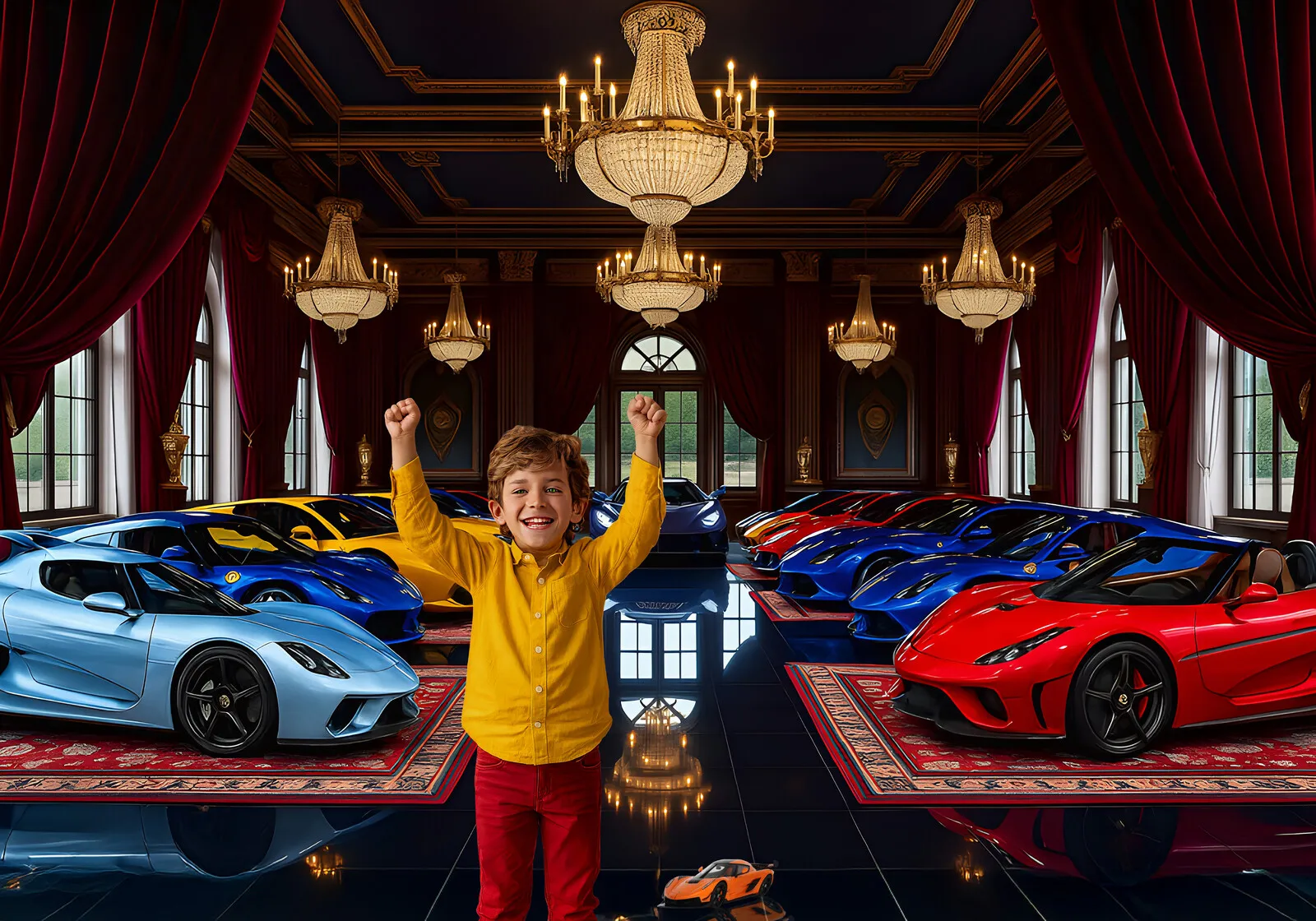
A Boy's Dream - En pojkes dröm, 2025
Digital
70 x 50 cm
3 200 kr
A Boy's Dream - En pojkes dröm
The boy in the picture cheers for the dream his father has sparked with the image he made for his son on his computer. On his eighth birthday, he does not receive a new bike or an iPad but a promise: his father will set aside five thousand kronor each month until the boy completes his academic degree. When he turns twenty-eight, a sum of 1.2 million kronor will be waiting for him—intended as the first investment in a hall filled with Koenigseggs, his absolute favourite car. The father, a car enthusiast himself, sees this as a way to instil a sense of responsibility and appreciation for craftsmanship in his son.
To emphasise the seriousness of this birthday promise, the boy also received a scale model of a Koenigsegg Jesko, which itself cost 3,500 kronor. That is about one ten-thousandth of the base price of the original. An astonishing figure for a boy who does not even own a piggy bank, for in the cashless society he is growing up in, none is needed. But he promised himself to keep the dream alive, do well in school, and one day build a museum in honour of his father and of Koenigsegg. His determination is truly inspiring.
The father, with unwavering belief in his son's potential, believes that the goal, no matter how far off, should become his car-enthusiast son’s motivation throughout his education. So he begins explaining to his son about other gadgets that grown-up boys across history have bought or commissioned solely for their own enjoyment. Many of these gadgets are now kept in museums or private collections—some of which are open to the public.
Join me on a journey to discover the fascinating world of toys. This essay aims to both entertain and inform you about toys for all ages. We will explore their historical use, their cultural importance in different societies, and some items of great value. Prepare to be educated, inspired, and entertained as we examine the history and cultural significance of toys.
“Toys for us
A stick in the sand, a ball made of hide,
a wooden horse children would proudly ride.
A doll with eyes painted, a rattle of bone,
a treasure for tiny hands to call their own.
Then princes with castles of silver and gold,
Fabergé wonders too precious to hold.
Clockwork swans gliding, a bird that could sing,
all just for pleasure, for play was the thing.
A teddy bear stitched with the softest of fur,
a train set of Märklin with engines that purr.
A Barbie with diamonds, a Star Wars figurine,
a rocket on Boba Fett’s back, never seen.
From pyramids’ dolls to Koenigsegg dreams,
from ivory toys to futuristic schemes—
toys are not objects, but mirrors, you see,
of time, of desire, of humanity.
So whether it’s plastic, or silver, or jade,
a toy is a promise, a memory made.
And grown-ups are children, despite all their noise:
The only real difference—far costlier toys”
Malmö. August 2025
A Boy's Dream
Son: Dad… why didn’t I get a bike, or at least an iPad, like the other kids in my class?
Father: Because you have something more lasting than that. A bike rusts, an iPad becomes outdated. But a dream… a dream can grow with you.
Son: A dream? But it’s merely an image of a car showroom on your computer.
Father: Not just a picture. It’s the start of a promise. I’ve promised to save five thousand kronor every month until you graduate. By the time you’re twenty-eight, it will have grown to 1.2 million—your own beginning—a hall filled with Koenigseggs. This means I'm committed to helping you achieve your dream, and it's also a lesson in responsibility. I'm showing you that if you want something, you have to work for it.
Son: A million two hundred thousand… (he whistles) …but Dad, that’s so far away!
Father: Exactly. The goal must be distant, like a lighthouse on the far side of the sea. That’s what keeps you rowing. Just like a lighthouse guides ships safely to shore, your distant goal guides you towards your dream. It's a constant reminder of where you're headed, and it keeps you from getting lost or distracted.
Son: But… what if I don’t even reach twenty-eight? Or what if I get tired of cars?
Father: Then at least you’ll have had something that made you fight, something that gave you direction. The dream is the engine. Without an engine, the car doesn’t move.
Son: So, the dream is my engine, like breakfast in the morning—like Mum always says?
Father: Exactly. Your mum is wise. And the Koenigsegg is just a symbol. The important thing is that you learn the way there: patience, willpower, the joy of watching something grow.
Son: But I cheered... I thought you had actually bought a real Jesko, and that it was waiting outside on the street!
Father (smiles): That day might come. But today you have something better: the start of your future.
Son: (holding up the model) But Dad, this car… It’s both real and not real at the same time. It’s so tiny!
Father: It’s a scale model of a Koenigsegg Jesko. It cost 3,500 kronor.
Son: 3,500?! For a toy car?!
Father: Yes. And you know what? That’s about one ten-thousandth of what a real Jesko costs.
Son: One ten-thousandth… so if I had ten thousand of these, I’d have a real one?
Father (laughs): In theory, yes. But then it wouldn’t be a car, just a mountain of Koenigseggs.
Son: But still… it almost feels like I own a real one.
Father: That’s the idea. The little Jesko is your reminder. When you see it, you’ll remember the promise—that one day you might stand in your own hall, with cars big enough to fill the room.
Son: But why are they so expensive to make? No one in my class can even say Koenigsegg correctly.
Father: Because some things aren’t meant to be driven. They’re meant to be dreamed about. The Koenigsegg is not just a car; it's a symbol of what you can achieve if you dream big and work hard.
Son: And now I’m supposed to dream?
Father: Yes. Your toy car is the starting gun—a symbol of what you can achieve if you stay on course.
Son: Then I’ll look after it. I won’t break it into pieces, and it’ll have its own drawer in the dresser.
Father: Exactly. It’s no ordinary toy. It’s a promise in miniature. It's a small, physical reminder of the big promise I made to you, and it represents the potential of your future.
Son: But Dad... did you also have a dream like that when you were eight?
Father: Not quite like yours. My biggest toy as an adult turned out to be a watch.
Son: A watch? But everyone has watches.
Father: Not like this one. It has so many functions that I still haven’t managed to read the whole manual. It measures pulse, blood pressure, steps, sleep, oxygen, calories... and even the time.
Son: (laughs) But all watches tell the time!
Father: Yes, but this one is my toy. I don’t need it to live, but I enjoy having it just like you want your Jesko.
Son: So adults have toys too?
Father: Absolutely, we do. When we're not building sandcastles or racing remote-control cars, we look for other things that bring us joy. Some of us buy watches, others guitars, or even strange machines we don’t really need.
Son: But your watch, Dad… is it like my Jesko?
Father: Yes, it's like your Jesko, but not as expensive. The feeling it gives me is the same as the one you get when you play with your Jesko. It's not just a timepiece, it's something that makes my heart beat a little faster.
Son: Then I understand. Adults are just children, too.
Father: Precisely. Only with more costly toys.
Son: Dad, what are actually the world’s most expensive toys? Is it Koenigsegg?
Father: Not exactly. If we look back through history, we find toys that were even more exclusive. For instance, in ancient Egypt, the children of pharaohs had dolls made from ivory and alabaster, with pearl wigs and painted faces.
Son: Dolls? Like the stuff girls have?
Father: Yes, but not just any dolls. They were status symbols, which means they were special toys that showed how important and wealthy the child's family was. They were meant to accompany the child into the afterlife. And the small wooden horses and crocodiles on wheels, pulled by strings, could be decorated with gemstones.
Son: Did they really get to play with them?
Father: Perhaps sometimes, but mostly they were symbols. And in Greece and Rome, it was the same. Girls might have ivory dolls with movable joints and tiny gold jewellery. Boys played with miniature chariots made of bronze or silver.
Son: Like toy soldiers made of metal?
Father: Exactly. And they also played with knucklebones—small bone pieces, somewhat like dice—but wealthy children could have them made of bronze, glass, or even gold.
Son: So their toys were really like jewellery?
Father: That’s right. In those times, toys were more about showing off how much money your family had, rather than getting worn out in the sandbox. If they even had such things back then.
Son: But were they fun?
Father: We’ll never know for sure, but it was surely just as exciting for them as your Jesko is for you. Imagine the joy of having a toy that's as special and beautiful as you feel when you get a new one.
Son: But Dad, did toys become even more expensive later?
Father: Yes, much more. During the Middle Ages and the Renaissance in Europe, princes and princesses received tiny works of art to play with. In Germany in the 1500s, for example, they made miniature carriages in silver.
Son: An entire carriage in silver? But you couldn’t play with that in the sand!
Father: No, it was probably just for show. And in 18th-century France, children at court received dollhouses and little castles, furnished with gold, ivory, and silk.
Son: Like real castles, only tiny?
Father: Exactly. But the most renowned is Queen Mary’s Doll’s House from the 1920s in England. It’s nine stories tall, with working plumbing, miniature wine bottles, and books written on a tiny scale by authors like Virginia Woolf and Conan Doyle. If Harry Potter had existed then, the entire series about him and Hogwarts would have been included.
Son: Books you can actually read? That small?
Father: Yes, but you needed a good magnifying glass. Imagine a whole universe in miniature.
Son: Then it’s almost like a real museum. Like my future one.
Father: Precisely. And that’s why it’s considered priceless.
Son: Dad, what happened after that? Did the toys become even fancier?
Father: Yes, in Russia at the tsar’s court, the luxury of toys reached its highest point. The jeweller Peter Carl Fabergé made tiny marvels for the tsar’s children.
Son: Like what?
Father: Imagine, small animals carved in jade and rock crystal with ruby eyes. Elephants with golden towers on their backs. Mechanical birds made of gold and enamel that can open their beaks and sing. These were not just toys; they were marvels of craftsmanship and imagination.
Son: A bird that sings even though it’s made of gold?
Father: Precisely. And tiny silver cannons that could actually fire small projectiles.
Son: But… did the children really get to play with them?
Father: A little, but mainly, they were designed to display wealth. The most famous example is the Coronation Egg from 1897. Inside was a small golden carriage—a working miniature, crafted with the same precision as a real one.
Son: An egg… with a carriage inside?!
Father: Yes. And that egg today could be worth over 20 million pounds.
Son: (lets out a whistle) That’s more than my whole car showroom.
Father: Exactly. So you see, your Koenigsegg dream is in good company. Adults have always loved toys that are far too expensive.
Son: But Dad, all that sounds like kings and princesses. What happened when ordinary children also got toys?
Father: Then came industrialisation in the 19th century. Suddenly, everyone could have dolls, tin soldiers, and mechanical animals. But the most expensive toys, the truly special ones, were still reserved for the elite.
Son: Like what?
Father: Steiff teddy bears, for example. Some rare specimens have sold for hundreds of thousands of pounds. And Märklin or Lionel train sets in silver or with special parts can fetch millions on today’s collectors’ market. These were not just any teddy bears or train sets; they were unique and extraordinary.
Son: A teddy bear worth millions?! I’d never dare sleep with it.
Father: No, neither would they. In the 20th century, Barbie dolls with diamonds appeared, and even modern dollhouses worth over eight million pounds were created.
Son: That’s insane. But… which is the most expensive toy of all?
Father: It's a plastic figure, actually—a prototype of Boba Fett from Star Wars, with a rocket on his back that can be fired. It was too risky to sell in stores, so only a few copies exist. One of them sold for over a million pounds.
Son: Wait... that ugly guy is worth more than a Ferrari?
Father: Yes. And that’s exactly why we can say: it’s not the material that makes a toy expensive, but the story.
Son: So… my Koenigsegg Jesko in plastic could one day be worth a million, too?
Father: Maybe. If you don’t play with it to pieces.
Son: Then I could sell it and buy a real one.
Father: Absolutely.
Son: But Dad, why do they make all those strange toys for adults? Couldn’t they just buy real things?
Father: Because adults need to play too. Kings and princes commissioned mechanical wonders just for fun. For example, the famous singing bird pistols from the 1800s, or the Jaquet-Droz automata, small figures that could write, draw, or play music. They looked almost alive.
Son: Pistols that sang? Are you kidding me?
Father: Not at all. When you pulled the trigger, a little mechanical bird would emerge from the barrel, flap its wings, and chirp. Completely useless as a weapon, but a sensation at a prince’s banquet. Two of those sold for nearly six million pounds.
Son: Six million! You could buy a whole car factory for that!
Father: Exactly. And in the 1700s, the Swiss watchmaker Jaquet-Droz created automata—small figures that could write, draw, or play music. They looked almost alive.
Son: Like robots?
Father: Yes, early robots. And even more astonishing: The Silver Swan, built in London in 1773. A life-sized silver swan, gliding on a stream of glass rods and catching fish. All designed to impress.
Son: That sounds like magic. Does it still exist?
Father: It does, in a museum in England. But if it were ever sold at auction today, which is a special event where people bid to buy things, the price would be 30–50 million dollars.
Son: (falls silent for a moment) Then my dream of a car showroom is quite modest.
Father: Exactly. Your dream is actually quite reasonable compared to the toys grown-ups have had throughout history.
Son: Dad, do you remember when we were in Athens last year and saw that strange device at the museum? The one still embedded in a lump of stone that you were so fascinated by. I remember how your eyes lit up when you saw it, and I couldn't help but be intrigued, too.
Father: Yes, the Antikythera mechanism. It's a fascinating piece of history, believed to be the world’s first computer. Discovered in a shipwreck off the coast of the Greek island of Antikythera, it's a testament to the advanced knowledge and skills of the ancient Greeks.
Son: It mostly looked like a broken bike chain. What did it actually do?
Father: It could calculate solar and lunar eclipses, and the movements of the planets—an entire cosmos in gears.
Son: That’s a lot of work when you can Google it. But if it was so advanced, why did they only make one? Why weren’t more built? Like your watch—you say it has more computing power than computers had the year I was born. And you can buy those everywhere, right?
Father: Exactly, and that’s the mystery. If it had had real practical use for sailors, farmers, or astrologers, it would have spread like the compass or paper. But there’s only one, and no successors.
Son: So, what was it then?
Father: Most likely a regal toy. It was en route to the Roman emperor when the ship sank. A prestigious object to showcase power and knowledge. Perhaps an educational tool to impress kings and philosophers. Or a temple artefact, where the gears with pointers—like on my watch—displayed the order of the cosmos. How all the stars appeared in the heavens.
Son: So basically, it's a super-expensive toy for adults?
Father: Yes, a cosmic toy. A luxury automaton far ahead of its time.
Son: So… like if they had built an iPad for the gods? Or like your watch, kind of.
Father: (laughs) Exactly. That’s why it now stands in a museum, a testament to human ingenuity, while everyone still ponders: was it useful—or just a wonder?
Son: I like the idea that it was a marvel like my Jesko. You don’t always need to use everything that rolls. It’s like you say about your old car — that it belongs in a museum — but Mum thinks it’s good enough for a bit longer.
Father: No, sometimes it’s enough that it makes us dream.
Son: Dad... all of this you’ve told me, from pharaohs and kings to Boba Fett—why did they make all those toys in the first place?
Father: Because toys are never merely objects. They are dreams in miniature, mirrors of their era. They are not just playthings, but vessels of imagination and aspiration. For the pharaoh’s child, the doll was a lifelong companion, a symbol of the future they envisioned. For the tsar’s children, Fabergé’s tiny masterpieces were sparks of magic within a golden court, a reflection of the opulence and grandeur they were born into. And for collectors today, a plastic figurine can encapsulate a whole world of nostalgia, a reminder of the dreams and fantasies of their youth. Each toy, from the ancient doll to the modern action figure, carries with it a fragment of history, a reflection of the society that produced it.
Son: So, my Jesko is a mirror too?
Father: Yes. It reflects your time, your longing, your joy. It’s more than plastic—it’s a promise of the future.
Son: (nods firmly) Then I’ll hold onto it.
Father: Do that. Because your dream is just as valuable as those of kings and emperors. In fact, it may be even more precious, because it's yours. It’s a reflection of your unique perspective and potential. So hold on to it, nurture it, and let it guide you. Your dream is the key to your future.
Son: Wiser than emperors?
Father: Yes. Because your dream moves you forward, not backwards. It’s a driving force, not a monument. Your dream is not just a reflection of your desires but a map to your future. It's a promise of what you can achieve, and I have no doubt you will fulfil it. Your dream is more valuable than those of kings and emperors, because it's yours and it's the key to your future.
Son: Then I promise… one day I’ll fill the hall. And you’ll stand beside me when the doors open. And Mum will be the guest of honour.
Father: (smiles) That’s the best promise I’ve ever received.
Pojken på bilden jublar över drömmen hans pappa tänt med bilden han gjort åt sin son i sin dator. På sin åttaårsdag får pojken inte en ny cykel eller en iPad, utan ett löfte: pappa ska spara undan femtusen kronor i månaden tills sonen tagit sin akademiska examen. När han fyller 28 väntar en summa på 1,2 miljoner kronor – tänkt som första insatsen till en hall fylld med Koenigsegg, sonens absoluta favoritbil.
För att riktigt markera allvaret i detta födelsedagslöfte fick pojken också en leksaksvariant, en Koenigsegg Jesko i skala, som i sig kostade 3 500 kronor. Det är ungefär en tiotusendedel av grundpriset för originalet. En hissnande siffra för en pojke som inte ens äger en spargris – för i det kontantlösa samhälle han växer upp i behövs inga. Men han lovade sig själv att hålla drömmen vid liv, sköta skolan och en dag bygga upp ett museum till sin pappas och Koenigseggs ära.
Pappans teori är att målet, om än fjärran, ska bli hans biltokige sons motor genom hela utbildningen. Och därför börjar han berätta för sin son om andra prylar som vuxna pojkar genom tiderna köpt, låtit tillverka enbart för sitt nöjes skull. Många av dem finns idag på museer eller i privata samlingar – några av dem öppna för allmänheten.
Sonen: Pappa… varför fick jag inte en cykel, eller åtminstone en iPad, som de andra i klassen?
Pappan: För att du fick något större än så. En cykel rostar, en iPad blir gammal. Men en dröm… den kan växa med dig.
Sonen: En dröm? Men det är ju bara en bild på en bilhall i din dator.
Pappan: Inte bara en bild. Det är början på ett löfte. Jag har lovat att spara femtusen kronor varje månad tills du tagit din examen. När du är 28 kommer det att ha blivit 1,2 miljoner. Din egen start – en hall fylld med Koenigsegg.
Sonen: En miljon tvåhundratusen… (han visslar) …men pappa, det är ju så långt dit!
Pappan: Just därför. Målet ska vara långt bort, som en fyr på andra sidan havet. Det är det som gör att man orkar ro.
Sonen: Men… tänk om jag inte blir 28? Eller om jag tröttnar på bilar?
Pappan: Då har du i alla fall haft något som fick dig att kämpa, som gav riktning. Drömmen är motorn. Utan motor står bilen still.
Sonen: Så drömmen är min motor, som frukosten på morgonen som mamma brukar säga?
Pappan: Precis. Hon är klok din mamma. Och Koenigsegg är bara symbolen. Det viktiga är att du lär dig vägen dit: tålamodet, viljan, glädjen i att se något växa.
Sonen: Men jag jublade ju… jag trodde först du att du köpt en riktig Jesko och att den stod ute på gatan!
Pappan (ler): Den dagen kanske kommer. Men idag fick du något bättre: din framtid påbörjad.
Sonen: (håller upp modellen) Men pappa, den här bilen… den är ju på riktigt fast ändå inte. Den är så liten!
Pappan: Det är en Koenigsegg Jesko i skala. Den kostade 3 500 kronor.
Sonen: 3 500?! För en leksaksbil?!
Pappan: Ja. Och vet du vad? Det är ungefär en tiotusendedel av vad en riktig Jesko kostar.
Sonen: En tiotusendedel… så om jag hade tio tusen sådana här, då hade jag en riktig?
Pappan: (skrattar) I teorin, ja. Men då skulle det inte vara en bil, bara ett berg av Koenigsegg.
Sonen: Men ändå… det känns nästan som om jag äger en riktig.
Pappan: Det är meningen. Den lilla Jeskon är din påminnelse. När du ser den ska du minnas löftet – att en dag kan du stå i din egen hall, med bilar stora nog att fylla hela rummet.
Sonen: Men varför gör man bilar så dyra? Ingen i min klass kan ens säga Koenigsegg rätt.
Pappan: Därför att vissa saker byggs inte bara för att köra. De byggs för att drömma om.
Sonen: Och nu ska jag drömma?
Pappan: Ja. Din leksaksbil är startskottet. En symbol för vad du kan nå om du håller kursen.
Sonen: Då ska jag ta hand om den. Inte leka sönder den och den skall få en egen låda i byrån.
Pappan: Precis. Det är ingen vanlig leksak. Det är ett löfte i miniatyr.
Sonen: Men pappa… hade du också en sån där dröm när du var åtta?
Pappan: Inte riktigt som du. Min största leksak som vuxen blev en klocka.
Sonen: En klocka? Men alla har ju klockor.
Pappan: Inte som den här. Den har så många funktioner att jag fortfarande inte orkat läsa hela bruksanvisningen. Den mäter puls, blodtryck, steg, sömn, syre, kalorier… och till och med tiden.
Sonen: (skrattar) Men det gör ju alla klockor!
Pappan: Ja, men den här är min leksak. Jag behöver den inte för att leva, men jag gillar att ha den. Precis som du gillar din Jesko.
Sonen: Så vuxna har också leksaker?
Pappan: Självklart. När vi inte längre bygger sandslott eller kör radiostyrda bilar hittar vi andra prylar. En del köper klockor, andra gitarrer, eller konstiga maskiner som egentligen inte behövs.
Sonen: Men din klocka, pappa… är det som min Jesko?
Pappan: Ja, fast billigare än en Koenigsegg. Men känslan är densamma: en sak som inte bara mäter, utan får hjärtat att slå lite fortare.
Sonen: Då förstår jag. Vuxna är också barn egentligen.
Pappan: Exakt. Bara med dyrare leksaker.
Sonen: Pappa, vilka är egentligen världens dyraste leksaker? Är det Koenigsegg?
Pappan: Inte riktigt. Om vi går tillbaka i historien så hittar vi leksaker som var ännu mer exklusiva – fast inte för vanliga barn. För faraonernas barn i Egypten fanns dockor i elfenben och alabaster, med pärlperuker och målade ansikten.
Sonen: Dockor? Sånt som tjejer har?
Pappan: Ja, men inte vilka dockor som helst. De var statussymboler, gjorda för att följa barnet in i dödsriket. Och de små trähästarna och krokodilerna på hjul som drogs i snören kunde vara utsmyckade med ädelstenar.
Sonen: Fick de verkligen leka med dem?
Pappan: Kanske ibland, men mest var de symboler. Och i Grekland och Rom var det likadant. Flickor kunde få elfenbensdockor med rörliga leder och små guldsmycken. Pojkar lekte med miniatyrstridsvagnar i brons eller silver.
Sonen: Som soldater i metall?
Pappan: Precis. Och de spelade också med knucklebones – små benbitar, ungefär som tärningar – fast rika barn kunde ha dem i brons, glas eller till och med guld.
Sonen: Så deras leksaker var lika mycket smycken?
Pappan: Just det. Mer för att visa rikedom än för att slitas ut i sandlådan. Om de hade sådana förr.
Sonen: Men var de roliga?
Pappan: Det får vi aldrig veta. Men säkert lika spännande för dem som din Jesko är för dig.
Sonen: Men pappa, blev leksakerna ännu dyrare sen?
Pappan: Ja, mycket dyrare. Under medeltiden och renässansen i Europa fick prinsar och prinsessor små konstverk att leka med. I Tyskland på 1500-talet gjorde man till exempel miniatyrvagnar i silver.
Sonen: En hel vagn i silver? Men det går ju inte att leka med ute i sanden!
Pappan: Nej, det var nog mest för att imponera. Och i 1700-talets Frankrike fick barnen på hovet dockhus och små slott, möblerade med guld, elfenben och siden.
Sonen: Som riktiga slott fast pyttesmå?
Pappan: Exakt. Men det mest berömda är Drottning Marys Doll’s House från 1920-talet i England. Det är nio våningar högt, med fungerande vattenledningar, små vinflaskor och böcker skrivna i miniatyr av författare som Virginia Woolf och Conan Doyle. Hade Harry Potter funnits redan då skulle alla böckerna om honom och Hogwarts funnits där.
Sonen: Böcker som man kan läsa? Så små?
Pappan: Ja, fast fick ha ett rejält förstoringsglas. Tänk dig ett helt universum i miniatyr.
Sonen: Då är det nästan som ett riktigt museum.
Pappan: Precis. Och just därför anses det ovärderligt.
Sonen: Pappa, vad hände sen? Blev det ännu finare leksaker?
Pappan: Ja, i Ryssland vid tsarens hov nådde leksakernas lyx sin topp. Juveleraren Peter Carl Fabergé tillverkade små underverk åt tsarbarnen.
Sonen: Som vad då?
Pappan: Små djur i jade och bergskristall med rubinögon. Elefanter med guldtorn på ryggen. Mekaniska fåglar i guld och emalj som kunde öppna näbben och sjunga.
Sonen: En fågel som sjunger fast den är gjord av guld?
Pappan: Just det. Och miniatyrkanoner i silver som faktiskt kunde skjuta pyttesmå projektiler.
Sonen: Men… fick barnen leka med dem?
Pappan: Lite grann, men de var mest till för att visa rikedom. Det mest berömda exemplet är Coronation Egg från 1897. Inuti låg en liten guldkaret – en fungerande miniatyrvagn, tillverkad med samma precision som en riktig.
Sonen: Ett ägg… med en vagn i?!
Pappan: Ja. Och det ägget kan idag vara värt över 20 miljoner dollar.
Sonen: (blåser ut en vissling) Det är mer än hela min bilhall.
Pappan: Ja. Så du ser – även din Koenigseggdröm är i gott sällskap. Vuxna har alltid älskat leksaker som egentligen är alldeles för dyra.
Sonen: Men pappa, allt det där låter som gamla kungar och prinsessor. Vad hände när vanliga barn också fick leksaker?
Pappan: Då kom industrialiseringen på 1800-talet. Plötsligt kunde alla få dockor, tennsoldater och mekaniska djur. Men de dyraste leksakerna var fortfarande reserverade för eliten.
Sonen: Som vad då?
Pappan: Steiff-teddybjörnar till exempel. Några unika exemplar har sålts för hundratusentals dollar. Och Märklin- och Lionel-tågset i silver eller med specialdelar kan i dag gå för miljoner på samlarmarknaden.
Sonen: En nallebjörn för miljoner?! Jag skulle aldrig våga sova med den.
Pappan: Nej, det skulle nog inte de heller. Och på 1900-talet kom Barbie-dockor med diamanter, och till och med moderna dockhus värda över åtta miljoner dollar.
Sonen: Det är ju helt galet. Men… vilken är den allra dyraste leksaken?
Pappan: En plastfigur, faktiskt. En prototyp av Boba Fett från Star Wars, med en raket på ryggen som kunde skjutas iväg. Den var för farlig för att säljas i butik, så bara några få exemplar finns kvar. Ett av dem såldes för över en miljon dollar.
Sonen: Vänta nu… den fule gubben värd mer än en Ferrari?
Pappan: Ja. Och det är precis därför man kan säga: det är inte materialet som gör leksaken dyrast, utan berättelsen.
Sonen: Så… min Koenigsegg-jesko i plast kan också bli värd en miljon en dag?
Pappan: Kanske. Om du låter bli att leka sönder den.
Sonen: Då kan jag sälja den och köpa en riktig.
Pappan: Absolut.
Sonen: Men pappa, varför gjorde de alla de där konstiga leksakerna för vuxna? Kunde de inte bara köpa riktiga saker?
Pappan: För att vuxna också behöver leka. Kungar och furstar beställde mekaniska underverk bara för nöjets skull. Till exempel de berömda sjungande fågelpistolerna från 1800-talet.
Sonen: Pistoler som sjöng? Är det ett skämt?
Pappan: Nej då. När man tryckte av hoppade en liten mekanisk fågel upp ur pipan, flaxade med vingarna och kvittrade. Helt värdelös som vapen, men en sensation på en furstes fest. Två sådana såldes för nästan sex miljoner dollar.
Sonen: Sex miljoner! Då kan man köpa en hel bilfabrik ju!
Pappan: Just det. Och på 1700-talet byggde schweizaren Jaquet-Droz automater – små figurer som kunde skriva, rita eller spela musik. De såg nästan levande ut.
Sonen: Som robotar?
Pappan: Ja, tidiga robotar. Och ännu mer fantastiskt: The Silver Swan, byggd i London 1773. En naturlig storlekssvan i silver, som simmar i en bäck av glasstavar och fångar fiskar. Bara för att imponera.
Sonen: Det låter som magi. Finns den kvar?
Pappan: Den finns på museum i England. Men om den skulle säljas på auktion i dag skulle priset vara 30–50 miljoner dollar.
Sonen: (tystnar en stund) Då är ju min dröm om en bilhall nästan blygsam.
Pappan: Precis. Din dröm är i själva verket helt rimlig jämfört med vuxnas leksaker genom historien.
Sonen: Pappa, minns du när vi var i Aten förra året och såg den där konstiga mojängen på museet? Den som fortfarande satt ihop i en stenklump och som du var så fascinerad av.
Pappan: Ja, Antikytheramekanismen. Världens första dator, enligt många.
Sonen: Den såg mest ut som en trasig cykelkedja. Vad gjorde den egentligen?
Pappan: Den kunde räkna ut sol- och månförmörkelser, och planeternas rörelser. Ett helt kosmos i kugghjul.
Sonen: Onödigt arbete när man kan googla. Men om den var så bra, varför gjorde de bara en? Varför byggdes inga fler? Som din klocka som du säger har mer datorkraft än datorer hade året jag föddes. Det finns att köpa överallt, eller hur?
Pappan: Just det är gåtan. Om den hade haft praktisk nytta för sjöfarare, bönder eller astrologer, då skulle den ha spridits som kompassen eller pappret. Men det finns bara ett exemplar, och inga efterföljare.
Sonen: Så vad var den då?
Pappan: Mest troligt en fursteleksak. Den var på väg till Roms kejsdare är skeppet gick under. Ett prestigeobjekt för att visa makt och kunskap. Kanske ett pedagogiskt instrument för att imponera på kungar och filosofer. Eller ett tempelobjekt, där kugghjulen med visare som på min klocka visade ordningen i kosmos. Hur alla stjärnor stod på himlen.
Sonen: Alltså en jättedyr leksak för vuxna?
Pappan: Ja, en kosmisk leksak. En lyxautomat långt före sin tid.
Sonen: Så… ungefär som om de hade byggt en iPad till gudarna? Eller din klocka typ.
Pappan: (skrattar) Precis så. Och därför står den nu på museum, medan alla undrar: var det nytta – eller bara förundran?
Sonen: Jag gillar tanken att den var förundran. Som min Jesko. Man behöver inte alltid kunna använda allt som rullar. Det är som du brukar säga om din gamla bil, att den borde stå på museum men mamma tycker att den duger ett tag till.
Pappan: Nej, ibland räcker det att det får oss att drömma.
Sonen: Pappa… allt det här du berättat, från faraoner och kungar till Boba Fett – varför gjorde de alla de där leksakerna egentligen?
Pappan: För att leksaker aldrig bara är saker. De är drömmar i miniatyr, speglar av sin tid. För faraonens barn var dockan en följeslagare in i evigheten. För tsarbarnen var Fabergés små mirakel en gnista av magi i ett guldskimrande hov. Och för samlare idag kan en plastfigur vara en hel värld av nostalgi.
Sonen: Så min Jesko är också en spegel?
Pappan: Ja. Den speglar din tid, din längtan, din glädje. Den är mer än plast – den är ett löfte om framtiden.
Sonen: (nickar långsamt) Då ska jag hålla fast vid den.
Pappan: Gör det. För din dröm är inte mindre värd än kungars och kejsares. Kanske är den till och med klokare.
Sonen: Klokare än kejsare?
Pappan: Ja. För din dröm leder framåt, inte bakåt. Den är en motor, inte ett monument.
Sonen: Då lovar jag… en dag ska jag fylla hallen. Och du ska stå bredvid mig när portarna öppnas. Och mamma blir hedersgäst.
Pappan: (ler) Det är det bästa löfte jag någonsin fått.
Jörgen Thornberg
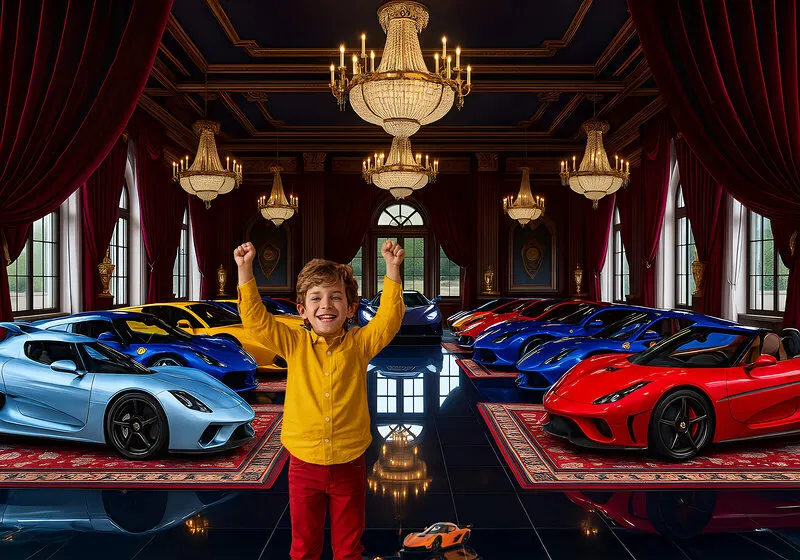
A Boy's Dream - En pojkes dröm, 2025
Digital
70 x 50 cm
3 200 kr
A Boy's Dream - En pojkes dröm
The boy in the picture cheers for the dream his father has sparked with the image he made for his son on his computer. On his eighth birthday, he does not receive a new bike or an iPad but a promise: his father will set aside five thousand kronor each month until the boy completes his academic degree. When he turns twenty-eight, a sum of 1.2 million kronor will be waiting for him—intended as the first investment in a hall filled with Koenigseggs, his absolute favourite car. The father, a car enthusiast himself, sees this as a way to instil a sense of responsibility and appreciation for craftsmanship in his son.
To emphasise the seriousness of this birthday promise, the boy also received a scale model of a Koenigsegg Jesko, which itself cost 3,500 kronor. That is about one ten-thousandth of the base price of the original. An astonishing figure for a boy who does not even own a piggy bank, for in the cashless society he is growing up in, none is needed. But he promised himself to keep the dream alive, do well in school, and one day build a museum in honour of his father and of Koenigsegg. His determination is truly inspiring.
The father, with unwavering belief in his son's potential, believes that the goal, no matter how far off, should become his car-enthusiast son’s motivation throughout his education. So he begins explaining to his son about other gadgets that grown-up boys across history have bought or commissioned solely for their own enjoyment. Many of these gadgets are now kept in museums or private collections—some of which are open to the public.
Join me on a journey to discover the fascinating world of toys. This essay aims to both entertain and inform you about toys for all ages. We will explore their historical use, their cultural importance in different societies, and some items of great value. Prepare to be educated, inspired, and entertained as we examine the history and cultural significance of toys.
“Toys for us
A stick in the sand, a ball made of hide,
a wooden horse children would proudly ride.
A doll with eyes painted, a rattle of bone,
a treasure for tiny hands to call their own.
Then princes with castles of silver and gold,
Fabergé wonders too precious to hold.
Clockwork swans gliding, a bird that could sing,
all just for pleasure, for play was the thing.
A teddy bear stitched with the softest of fur,
a train set of Märklin with engines that purr.
A Barbie with diamonds, a Star Wars figurine,
a rocket on Boba Fett’s back, never seen.
From pyramids’ dolls to Koenigsegg dreams,
from ivory toys to futuristic schemes—
toys are not objects, but mirrors, you see,
of time, of desire, of humanity.
So whether it’s plastic, or silver, or jade,
a toy is a promise, a memory made.
And grown-ups are children, despite all their noise:
The only real difference—far costlier toys”
Malmö. August 2025
A Boy's Dream
Son: Dad… why didn’t I get a bike, or at least an iPad, like the other kids in my class?
Father: Because you have something more lasting than that. A bike rusts, an iPad becomes outdated. But a dream… a dream can grow with you.
Son: A dream? But it’s merely an image of a car showroom on your computer.
Father: Not just a picture. It’s the start of a promise. I’ve promised to save five thousand kronor every month until you graduate. By the time you’re twenty-eight, it will have grown to 1.2 million—your own beginning—a hall filled with Koenigseggs. This means I'm committed to helping you achieve your dream, and it's also a lesson in responsibility. I'm showing you that if you want something, you have to work for it.
Son: A million two hundred thousand… (he whistles) …but Dad, that’s so far away!
Father: Exactly. The goal must be distant, like a lighthouse on the far side of the sea. That’s what keeps you rowing. Just like a lighthouse guides ships safely to shore, your distant goal guides you towards your dream. It's a constant reminder of where you're headed, and it keeps you from getting lost or distracted.
Son: But… what if I don’t even reach twenty-eight? Or what if I get tired of cars?
Father: Then at least you’ll have had something that made you fight, something that gave you direction. The dream is the engine. Without an engine, the car doesn’t move.
Son: So, the dream is my engine, like breakfast in the morning—like Mum always says?
Father: Exactly. Your mum is wise. And the Koenigsegg is just a symbol. The important thing is that you learn the way there: patience, willpower, the joy of watching something grow.
Son: But I cheered... I thought you had actually bought a real Jesko, and that it was waiting outside on the street!
Father (smiles): That day might come. But today you have something better: the start of your future.
Son: (holding up the model) But Dad, this car… It’s both real and not real at the same time. It’s so tiny!
Father: It’s a scale model of a Koenigsegg Jesko. It cost 3,500 kronor.
Son: 3,500?! For a toy car?!
Father: Yes. And you know what? That’s about one ten-thousandth of what a real Jesko costs.
Son: One ten-thousandth… so if I had ten thousand of these, I’d have a real one?
Father (laughs): In theory, yes. But then it wouldn’t be a car, just a mountain of Koenigseggs.
Son: But still… it almost feels like I own a real one.
Father: That’s the idea. The little Jesko is your reminder. When you see it, you’ll remember the promise—that one day you might stand in your own hall, with cars big enough to fill the room.
Son: But why are they so expensive to make? No one in my class can even say Koenigsegg correctly.
Father: Because some things aren’t meant to be driven. They’re meant to be dreamed about. The Koenigsegg is not just a car; it's a symbol of what you can achieve if you dream big and work hard.
Son: And now I’m supposed to dream?
Father: Yes. Your toy car is the starting gun—a symbol of what you can achieve if you stay on course.
Son: Then I’ll look after it. I won’t break it into pieces, and it’ll have its own drawer in the dresser.
Father: Exactly. It’s no ordinary toy. It’s a promise in miniature. It's a small, physical reminder of the big promise I made to you, and it represents the potential of your future.
Son: But Dad... did you also have a dream like that when you were eight?
Father: Not quite like yours. My biggest toy as an adult turned out to be a watch.
Son: A watch? But everyone has watches.
Father: Not like this one. It has so many functions that I still haven’t managed to read the whole manual. It measures pulse, blood pressure, steps, sleep, oxygen, calories... and even the time.
Son: (laughs) But all watches tell the time!
Father: Yes, but this one is my toy. I don’t need it to live, but I enjoy having it just like you want your Jesko.
Son: So adults have toys too?
Father: Absolutely, we do. When we're not building sandcastles or racing remote-control cars, we look for other things that bring us joy. Some of us buy watches, others guitars, or even strange machines we don’t really need.
Son: But your watch, Dad… is it like my Jesko?
Father: Yes, it's like your Jesko, but not as expensive. The feeling it gives me is the same as the one you get when you play with your Jesko. It's not just a timepiece, it's something that makes my heart beat a little faster.
Son: Then I understand. Adults are just children, too.
Father: Precisely. Only with more costly toys.
Son: Dad, what are actually the world’s most expensive toys? Is it Koenigsegg?
Father: Not exactly. If we look back through history, we find toys that were even more exclusive. For instance, in ancient Egypt, the children of pharaohs had dolls made from ivory and alabaster, with pearl wigs and painted faces.
Son: Dolls? Like the stuff girls have?
Father: Yes, but not just any dolls. They were status symbols, which means they were special toys that showed how important and wealthy the child's family was. They were meant to accompany the child into the afterlife. And the small wooden horses and crocodiles on wheels, pulled by strings, could be decorated with gemstones.
Son: Did they really get to play with them?
Father: Perhaps sometimes, but mostly they were symbols. And in Greece and Rome, it was the same. Girls might have ivory dolls with movable joints and tiny gold jewellery. Boys played with miniature chariots made of bronze or silver.
Son: Like toy soldiers made of metal?
Father: Exactly. And they also played with knucklebones—small bone pieces, somewhat like dice—but wealthy children could have them made of bronze, glass, or even gold.
Son: So their toys were really like jewellery?
Father: That’s right. In those times, toys were more about showing off how much money your family had, rather than getting worn out in the sandbox. If they even had such things back then.
Son: But were they fun?
Father: We’ll never know for sure, but it was surely just as exciting for them as your Jesko is for you. Imagine the joy of having a toy that's as special and beautiful as you feel when you get a new one.
Son: But Dad, did toys become even more expensive later?
Father: Yes, much more. During the Middle Ages and the Renaissance in Europe, princes and princesses received tiny works of art to play with. In Germany in the 1500s, for example, they made miniature carriages in silver.
Son: An entire carriage in silver? But you couldn’t play with that in the sand!
Father: No, it was probably just for show. And in 18th-century France, children at court received dollhouses and little castles, furnished with gold, ivory, and silk.
Son: Like real castles, only tiny?
Father: Exactly. But the most renowned is Queen Mary’s Doll’s House from the 1920s in England. It’s nine stories tall, with working plumbing, miniature wine bottles, and books written on a tiny scale by authors like Virginia Woolf and Conan Doyle. If Harry Potter had existed then, the entire series about him and Hogwarts would have been included.
Son: Books you can actually read? That small?
Father: Yes, but you needed a good magnifying glass. Imagine a whole universe in miniature.
Son: Then it’s almost like a real museum. Like my future one.
Father: Precisely. And that’s why it’s considered priceless.
Son: Dad, what happened after that? Did the toys become even fancier?
Father: Yes, in Russia at the tsar’s court, the luxury of toys reached its highest point. The jeweller Peter Carl Fabergé made tiny marvels for the tsar’s children.
Son: Like what?
Father: Imagine, small animals carved in jade and rock crystal with ruby eyes. Elephants with golden towers on their backs. Mechanical birds made of gold and enamel that can open their beaks and sing. These were not just toys; they were marvels of craftsmanship and imagination.
Son: A bird that sings even though it’s made of gold?
Father: Precisely. And tiny silver cannons that could actually fire small projectiles.
Son: But… did the children really get to play with them?
Father: A little, but mainly, they were designed to display wealth. The most famous example is the Coronation Egg from 1897. Inside was a small golden carriage—a working miniature, crafted with the same precision as a real one.
Son: An egg… with a carriage inside?!
Father: Yes. And that egg today could be worth over 20 million pounds.
Son: (lets out a whistle) That’s more than my whole car showroom.
Father: Exactly. So you see, your Koenigsegg dream is in good company. Adults have always loved toys that are far too expensive.
Son: But Dad, all that sounds like kings and princesses. What happened when ordinary children also got toys?
Father: Then came industrialisation in the 19th century. Suddenly, everyone could have dolls, tin soldiers, and mechanical animals. But the most expensive toys, the truly special ones, were still reserved for the elite.
Son: Like what?
Father: Steiff teddy bears, for example. Some rare specimens have sold for hundreds of thousands of pounds. And Märklin or Lionel train sets in silver or with special parts can fetch millions on today’s collectors’ market. These were not just any teddy bears or train sets; they were unique and extraordinary.
Son: A teddy bear worth millions?! I’d never dare sleep with it.
Father: No, neither would they. In the 20th century, Barbie dolls with diamonds appeared, and even modern dollhouses worth over eight million pounds were created.
Son: That’s insane. But… which is the most expensive toy of all?
Father: It's a plastic figure, actually—a prototype of Boba Fett from Star Wars, with a rocket on his back that can be fired. It was too risky to sell in stores, so only a few copies exist. One of them sold for over a million pounds.
Son: Wait... that ugly guy is worth more than a Ferrari?
Father: Yes. And that’s exactly why we can say: it’s not the material that makes a toy expensive, but the story.
Son: So… my Koenigsegg Jesko in plastic could one day be worth a million, too?
Father: Maybe. If you don’t play with it to pieces.
Son: Then I could sell it and buy a real one.
Father: Absolutely.
Son: But Dad, why do they make all those strange toys for adults? Couldn’t they just buy real things?
Father: Because adults need to play too. Kings and princes commissioned mechanical wonders just for fun. For example, the famous singing bird pistols from the 1800s, or the Jaquet-Droz automata, small figures that could write, draw, or play music. They looked almost alive.
Son: Pistols that sang? Are you kidding me?
Father: Not at all. When you pulled the trigger, a little mechanical bird would emerge from the barrel, flap its wings, and chirp. Completely useless as a weapon, but a sensation at a prince’s banquet. Two of those sold for nearly six million pounds.
Son: Six million! You could buy a whole car factory for that!
Father: Exactly. And in the 1700s, the Swiss watchmaker Jaquet-Droz created automata—small figures that could write, draw, or play music. They looked almost alive.
Son: Like robots?
Father: Yes, early robots. And even more astonishing: The Silver Swan, built in London in 1773. A life-sized silver swan, gliding on a stream of glass rods and catching fish. All designed to impress.
Son: That sounds like magic. Does it still exist?
Father: It does, in a museum in England. But if it were ever sold at auction today, which is a special event where people bid to buy things, the price would be 30–50 million dollars.
Son: (falls silent for a moment) Then my dream of a car showroom is quite modest.
Father: Exactly. Your dream is actually quite reasonable compared to the toys grown-ups have had throughout history.
Son: Dad, do you remember when we were in Athens last year and saw that strange device at the museum? The one still embedded in a lump of stone that you were so fascinated by. I remember how your eyes lit up when you saw it, and I couldn't help but be intrigued, too.
Father: Yes, the Antikythera mechanism. It's a fascinating piece of history, believed to be the world’s first computer. Discovered in a shipwreck off the coast of the Greek island of Antikythera, it's a testament to the advanced knowledge and skills of the ancient Greeks.
Son: It mostly looked like a broken bike chain. What did it actually do?
Father: It could calculate solar and lunar eclipses, and the movements of the planets—an entire cosmos in gears.
Son: That’s a lot of work when you can Google it. But if it was so advanced, why did they only make one? Why weren’t more built? Like your watch—you say it has more computing power than computers had the year I was born. And you can buy those everywhere, right?
Father: Exactly, and that’s the mystery. If it had had real practical use for sailors, farmers, or astrologers, it would have spread like the compass or paper. But there’s only one, and no successors.
Son: So, what was it then?
Father: Most likely a regal toy. It was en route to the Roman emperor when the ship sank. A prestigious object to showcase power and knowledge. Perhaps an educational tool to impress kings and philosophers. Or a temple artefact, where the gears with pointers—like on my watch—displayed the order of the cosmos. How all the stars appeared in the heavens.
Son: So basically, it's a super-expensive toy for adults?
Father: Yes, a cosmic toy. A luxury automaton far ahead of its time.
Son: So… like if they had built an iPad for the gods? Or like your watch, kind of.
Father: (laughs) Exactly. That’s why it now stands in a museum, a testament to human ingenuity, while everyone still ponders: was it useful—or just a wonder?
Son: I like the idea that it was a marvel like my Jesko. You don’t always need to use everything that rolls. It’s like you say about your old car — that it belongs in a museum — but Mum thinks it’s good enough for a bit longer.
Father: No, sometimes it’s enough that it makes us dream.
Son: Dad... all of this you’ve told me, from pharaohs and kings to Boba Fett—why did they make all those toys in the first place?
Father: Because toys are never merely objects. They are dreams in miniature, mirrors of their era. They are not just playthings, but vessels of imagination and aspiration. For the pharaoh’s child, the doll was a lifelong companion, a symbol of the future they envisioned. For the tsar’s children, Fabergé’s tiny masterpieces were sparks of magic within a golden court, a reflection of the opulence and grandeur they were born into. And for collectors today, a plastic figurine can encapsulate a whole world of nostalgia, a reminder of the dreams and fantasies of their youth. Each toy, from the ancient doll to the modern action figure, carries with it a fragment of history, a reflection of the society that produced it.
Son: So, my Jesko is a mirror too?
Father: Yes. It reflects your time, your longing, your joy. It’s more than plastic—it’s a promise of the future.
Son: (nods firmly) Then I’ll hold onto it.
Father: Do that. Because your dream is just as valuable as those of kings and emperors. In fact, it may be even more precious, because it's yours. It’s a reflection of your unique perspective and potential. So hold on to it, nurture it, and let it guide you. Your dream is the key to your future.
Son: Wiser than emperors?
Father: Yes. Because your dream moves you forward, not backwards. It’s a driving force, not a monument. Your dream is not just a reflection of your desires but a map to your future. It's a promise of what you can achieve, and I have no doubt you will fulfil it. Your dream is more valuable than those of kings and emperors, because it's yours and it's the key to your future.
Son: Then I promise… one day I’ll fill the hall. And you’ll stand beside me when the doors open. And Mum will be the guest of honour.
Father: (smiles) That’s the best promise I’ve ever received.
Pojken på bilden jublar över drömmen hans pappa tänt med bilden han gjort åt sin son i sin dator. På sin åttaårsdag får pojken inte en ny cykel eller en iPad, utan ett löfte: pappa ska spara undan femtusen kronor i månaden tills sonen tagit sin akademiska examen. När han fyller 28 väntar en summa på 1,2 miljoner kronor – tänkt som första insatsen till en hall fylld med Koenigsegg, sonens absoluta favoritbil.
För att riktigt markera allvaret i detta födelsedagslöfte fick pojken också en leksaksvariant, en Koenigsegg Jesko i skala, som i sig kostade 3 500 kronor. Det är ungefär en tiotusendedel av grundpriset för originalet. En hissnande siffra för en pojke som inte ens äger en spargris – för i det kontantlösa samhälle han växer upp i behövs inga. Men han lovade sig själv att hålla drömmen vid liv, sköta skolan och en dag bygga upp ett museum till sin pappas och Koenigseggs ära.
Pappans teori är att målet, om än fjärran, ska bli hans biltokige sons motor genom hela utbildningen. Och därför börjar han berätta för sin son om andra prylar som vuxna pojkar genom tiderna köpt, låtit tillverka enbart för sitt nöjes skull. Många av dem finns idag på museer eller i privata samlingar – några av dem öppna för allmänheten.
Sonen: Pappa… varför fick jag inte en cykel, eller åtminstone en iPad, som de andra i klassen?
Pappan: För att du fick något större än så. En cykel rostar, en iPad blir gammal. Men en dröm… den kan växa med dig.
Sonen: En dröm? Men det är ju bara en bild på en bilhall i din dator.
Pappan: Inte bara en bild. Det är början på ett löfte. Jag har lovat att spara femtusen kronor varje månad tills du tagit din examen. När du är 28 kommer det att ha blivit 1,2 miljoner. Din egen start – en hall fylld med Koenigsegg.
Sonen: En miljon tvåhundratusen… (han visslar) …men pappa, det är ju så långt dit!
Pappan: Just därför. Målet ska vara långt bort, som en fyr på andra sidan havet. Det är det som gör att man orkar ro.
Sonen: Men… tänk om jag inte blir 28? Eller om jag tröttnar på bilar?
Pappan: Då har du i alla fall haft något som fick dig att kämpa, som gav riktning. Drömmen är motorn. Utan motor står bilen still.
Sonen: Så drömmen är min motor, som frukosten på morgonen som mamma brukar säga?
Pappan: Precis. Hon är klok din mamma. Och Koenigsegg är bara symbolen. Det viktiga är att du lär dig vägen dit: tålamodet, viljan, glädjen i att se något växa.
Sonen: Men jag jublade ju… jag trodde först du att du köpt en riktig Jesko och att den stod ute på gatan!
Pappan (ler): Den dagen kanske kommer. Men idag fick du något bättre: din framtid påbörjad.
Sonen: (håller upp modellen) Men pappa, den här bilen… den är ju på riktigt fast ändå inte. Den är så liten!
Pappan: Det är en Koenigsegg Jesko i skala. Den kostade 3 500 kronor.
Sonen: 3 500?! För en leksaksbil?!
Pappan: Ja. Och vet du vad? Det är ungefär en tiotusendedel av vad en riktig Jesko kostar.
Sonen: En tiotusendedel… så om jag hade tio tusen sådana här, då hade jag en riktig?
Pappan: (skrattar) I teorin, ja. Men då skulle det inte vara en bil, bara ett berg av Koenigsegg.
Sonen: Men ändå… det känns nästan som om jag äger en riktig.
Pappan: Det är meningen. Den lilla Jeskon är din påminnelse. När du ser den ska du minnas löftet – att en dag kan du stå i din egen hall, med bilar stora nog att fylla hela rummet.
Sonen: Men varför gör man bilar så dyra? Ingen i min klass kan ens säga Koenigsegg rätt.
Pappan: Därför att vissa saker byggs inte bara för att köra. De byggs för att drömma om.
Sonen: Och nu ska jag drömma?
Pappan: Ja. Din leksaksbil är startskottet. En symbol för vad du kan nå om du håller kursen.
Sonen: Då ska jag ta hand om den. Inte leka sönder den och den skall få en egen låda i byrån.
Pappan: Precis. Det är ingen vanlig leksak. Det är ett löfte i miniatyr.
Sonen: Men pappa… hade du också en sån där dröm när du var åtta?
Pappan: Inte riktigt som du. Min största leksak som vuxen blev en klocka.
Sonen: En klocka? Men alla har ju klockor.
Pappan: Inte som den här. Den har så många funktioner att jag fortfarande inte orkat läsa hela bruksanvisningen. Den mäter puls, blodtryck, steg, sömn, syre, kalorier… och till och med tiden.
Sonen: (skrattar) Men det gör ju alla klockor!
Pappan: Ja, men den här är min leksak. Jag behöver den inte för att leva, men jag gillar att ha den. Precis som du gillar din Jesko.
Sonen: Så vuxna har också leksaker?
Pappan: Självklart. När vi inte längre bygger sandslott eller kör radiostyrda bilar hittar vi andra prylar. En del köper klockor, andra gitarrer, eller konstiga maskiner som egentligen inte behövs.
Sonen: Men din klocka, pappa… är det som min Jesko?
Pappan: Ja, fast billigare än en Koenigsegg. Men känslan är densamma: en sak som inte bara mäter, utan får hjärtat att slå lite fortare.
Sonen: Då förstår jag. Vuxna är också barn egentligen.
Pappan: Exakt. Bara med dyrare leksaker.
Sonen: Pappa, vilka är egentligen världens dyraste leksaker? Är det Koenigsegg?
Pappan: Inte riktigt. Om vi går tillbaka i historien så hittar vi leksaker som var ännu mer exklusiva – fast inte för vanliga barn. För faraonernas barn i Egypten fanns dockor i elfenben och alabaster, med pärlperuker och målade ansikten.
Sonen: Dockor? Sånt som tjejer har?
Pappan: Ja, men inte vilka dockor som helst. De var statussymboler, gjorda för att följa barnet in i dödsriket. Och de små trähästarna och krokodilerna på hjul som drogs i snören kunde vara utsmyckade med ädelstenar.
Sonen: Fick de verkligen leka med dem?
Pappan: Kanske ibland, men mest var de symboler. Och i Grekland och Rom var det likadant. Flickor kunde få elfenbensdockor med rörliga leder och små guldsmycken. Pojkar lekte med miniatyrstridsvagnar i brons eller silver.
Sonen: Som soldater i metall?
Pappan: Precis. Och de spelade också med knucklebones – små benbitar, ungefär som tärningar – fast rika barn kunde ha dem i brons, glas eller till och med guld.
Sonen: Så deras leksaker var lika mycket smycken?
Pappan: Just det. Mer för att visa rikedom än för att slitas ut i sandlådan. Om de hade sådana förr.
Sonen: Men var de roliga?
Pappan: Det får vi aldrig veta. Men säkert lika spännande för dem som din Jesko är för dig.
Sonen: Men pappa, blev leksakerna ännu dyrare sen?
Pappan: Ja, mycket dyrare. Under medeltiden och renässansen i Europa fick prinsar och prinsessor små konstverk att leka med. I Tyskland på 1500-talet gjorde man till exempel miniatyrvagnar i silver.
Sonen: En hel vagn i silver? Men det går ju inte att leka med ute i sanden!
Pappan: Nej, det var nog mest för att imponera. Och i 1700-talets Frankrike fick barnen på hovet dockhus och små slott, möblerade med guld, elfenben och siden.
Sonen: Som riktiga slott fast pyttesmå?
Pappan: Exakt. Men det mest berömda är Drottning Marys Doll’s House från 1920-talet i England. Det är nio våningar högt, med fungerande vattenledningar, små vinflaskor och böcker skrivna i miniatyr av författare som Virginia Woolf och Conan Doyle. Hade Harry Potter funnits redan då skulle alla böckerna om honom och Hogwarts funnits där.
Sonen: Böcker som man kan läsa? Så små?
Pappan: Ja, fast fick ha ett rejält förstoringsglas. Tänk dig ett helt universum i miniatyr.
Sonen: Då är det nästan som ett riktigt museum.
Pappan: Precis. Och just därför anses det ovärderligt.
Sonen: Pappa, vad hände sen? Blev det ännu finare leksaker?
Pappan: Ja, i Ryssland vid tsarens hov nådde leksakernas lyx sin topp. Juveleraren Peter Carl Fabergé tillverkade små underverk åt tsarbarnen.
Sonen: Som vad då?
Pappan: Små djur i jade och bergskristall med rubinögon. Elefanter med guldtorn på ryggen. Mekaniska fåglar i guld och emalj som kunde öppna näbben och sjunga.
Sonen: En fågel som sjunger fast den är gjord av guld?
Pappan: Just det. Och miniatyrkanoner i silver som faktiskt kunde skjuta pyttesmå projektiler.
Sonen: Men… fick barnen leka med dem?
Pappan: Lite grann, men de var mest till för att visa rikedom. Det mest berömda exemplet är Coronation Egg från 1897. Inuti låg en liten guldkaret – en fungerande miniatyrvagn, tillverkad med samma precision som en riktig.
Sonen: Ett ägg… med en vagn i?!
Pappan: Ja. Och det ägget kan idag vara värt över 20 miljoner dollar.
Sonen: (blåser ut en vissling) Det är mer än hela min bilhall.
Pappan: Ja. Så du ser – även din Koenigseggdröm är i gott sällskap. Vuxna har alltid älskat leksaker som egentligen är alldeles för dyra.
Sonen: Men pappa, allt det där låter som gamla kungar och prinsessor. Vad hände när vanliga barn också fick leksaker?
Pappan: Då kom industrialiseringen på 1800-talet. Plötsligt kunde alla få dockor, tennsoldater och mekaniska djur. Men de dyraste leksakerna var fortfarande reserverade för eliten.
Sonen: Som vad då?
Pappan: Steiff-teddybjörnar till exempel. Några unika exemplar har sålts för hundratusentals dollar. Och Märklin- och Lionel-tågset i silver eller med specialdelar kan i dag gå för miljoner på samlarmarknaden.
Sonen: En nallebjörn för miljoner?! Jag skulle aldrig våga sova med den.
Pappan: Nej, det skulle nog inte de heller. Och på 1900-talet kom Barbie-dockor med diamanter, och till och med moderna dockhus värda över åtta miljoner dollar.
Sonen: Det är ju helt galet. Men… vilken är den allra dyraste leksaken?
Pappan: En plastfigur, faktiskt. En prototyp av Boba Fett från Star Wars, med en raket på ryggen som kunde skjutas iväg. Den var för farlig för att säljas i butik, så bara några få exemplar finns kvar. Ett av dem såldes för över en miljon dollar.
Sonen: Vänta nu… den fule gubben värd mer än en Ferrari?
Pappan: Ja. Och det är precis därför man kan säga: det är inte materialet som gör leksaken dyrast, utan berättelsen.
Sonen: Så… min Koenigsegg-jesko i plast kan också bli värd en miljon en dag?
Pappan: Kanske. Om du låter bli att leka sönder den.
Sonen: Då kan jag sälja den och köpa en riktig.
Pappan: Absolut.
Sonen: Men pappa, varför gjorde de alla de där konstiga leksakerna för vuxna? Kunde de inte bara köpa riktiga saker?
Pappan: För att vuxna också behöver leka. Kungar och furstar beställde mekaniska underverk bara för nöjets skull. Till exempel de berömda sjungande fågelpistolerna från 1800-talet.
Sonen: Pistoler som sjöng? Är det ett skämt?
Pappan: Nej då. När man tryckte av hoppade en liten mekanisk fågel upp ur pipan, flaxade med vingarna och kvittrade. Helt värdelös som vapen, men en sensation på en furstes fest. Två sådana såldes för nästan sex miljoner dollar.
Sonen: Sex miljoner! Då kan man köpa en hel bilfabrik ju!
Pappan: Just det. Och på 1700-talet byggde schweizaren Jaquet-Droz automater – små figurer som kunde skriva, rita eller spela musik. De såg nästan levande ut.
Sonen: Som robotar?
Pappan: Ja, tidiga robotar. Och ännu mer fantastiskt: The Silver Swan, byggd i London 1773. En naturlig storlekssvan i silver, som simmar i en bäck av glasstavar och fångar fiskar. Bara för att imponera.
Sonen: Det låter som magi. Finns den kvar?
Pappan: Den finns på museum i England. Men om den skulle säljas på auktion i dag skulle priset vara 30–50 miljoner dollar.
Sonen: (tystnar en stund) Då är ju min dröm om en bilhall nästan blygsam.
Pappan: Precis. Din dröm är i själva verket helt rimlig jämfört med vuxnas leksaker genom historien.
Sonen: Pappa, minns du när vi var i Aten förra året och såg den där konstiga mojängen på museet? Den som fortfarande satt ihop i en stenklump och som du var så fascinerad av.
Pappan: Ja, Antikytheramekanismen. Världens första dator, enligt många.
Sonen: Den såg mest ut som en trasig cykelkedja. Vad gjorde den egentligen?
Pappan: Den kunde räkna ut sol- och månförmörkelser, och planeternas rörelser. Ett helt kosmos i kugghjul.
Sonen: Onödigt arbete när man kan googla. Men om den var så bra, varför gjorde de bara en? Varför byggdes inga fler? Som din klocka som du säger har mer datorkraft än datorer hade året jag föddes. Det finns att köpa överallt, eller hur?
Pappan: Just det är gåtan. Om den hade haft praktisk nytta för sjöfarare, bönder eller astrologer, då skulle den ha spridits som kompassen eller pappret. Men det finns bara ett exemplar, och inga efterföljare.
Sonen: Så vad var den då?
Pappan: Mest troligt en fursteleksak. Den var på väg till Roms kejsdare är skeppet gick under. Ett prestigeobjekt för att visa makt och kunskap. Kanske ett pedagogiskt instrument för att imponera på kungar och filosofer. Eller ett tempelobjekt, där kugghjulen med visare som på min klocka visade ordningen i kosmos. Hur alla stjärnor stod på himlen.
Sonen: Alltså en jättedyr leksak för vuxna?
Pappan: Ja, en kosmisk leksak. En lyxautomat långt före sin tid.
Sonen: Så… ungefär som om de hade byggt en iPad till gudarna? Eller din klocka typ.
Pappan: (skrattar) Precis så. Och därför står den nu på museum, medan alla undrar: var det nytta – eller bara förundran?
Sonen: Jag gillar tanken att den var förundran. Som min Jesko. Man behöver inte alltid kunna använda allt som rullar. Det är som du brukar säga om din gamla bil, att den borde stå på museum men mamma tycker att den duger ett tag till.
Pappan: Nej, ibland räcker det att det får oss att drömma.
Sonen: Pappa… allt det här du berättat, från faraoner och kungar till Boba Fett – varför gjorde de alla de där leksakerna egentligen?
Pappan: För att leksaker aldrig bara är saker. De är drömmar i miniatyr, speglar av sin tid. För faraonens barn var dockan en följeslagare in i evigheten. För tsarbarnen var Fabergés små mirakel en gnista av magi i ett guldskimrande hov. Och för samlare idag kan en plastfigur vara en hel värld av nostalgi.
Sonen: Så min Jesko är också en spegel?
Pappan: Ja. Den speglar din tid, din längtan, din glädje. Den är mer än plast – den är ett löfte om framtiden.
Sonen: (nickar långsamt) Då ska jag hålla fast vid den.
Pappan: Gör det. För din dröm är inte mindre värd än kungars och kejsares. Kanske är den till och med klokare.
Sonen: Klokare än kejsare?
Pappan: Ja. För din dröm leder framåt, inte bakåt. Den är en motor, inte ett monument.
Sonen: Då lovar jag… en dag ska jag fylla hallen. Och du ska stå bredvid mig när portarna öppnas. Och mamma blir hedersgäst.
Pappan: (ler) Det är det bästa löfte jag någonsin fått.
3 200 kr

Jörgen Thornberg
Malmö
Lite om bilder och mig. Translation in English at the end.
Jag är en nyfiken person som ser allt i bilder, även det jag fäster i ord, gärna tillsammans för bakom alla mina bilder finns en berättelse. Till vissa bilder hör en kortare eller längre novell som följer med bilden.
Bilder berättar historier. Jag omges av naturlig skönhet, intressanta människor och historia var jag än går. Jag använder min kamera för att dokumentera världen och blanda det jag ser med vad jag känner för att fånga den dolda magin.
Mina bilder berättar mina historier. Genom mina bilder, tryck och berättelser. Jag bjuder in dig att ta del av dessa berättelser, in i ditt liv och hem och dela min mycket personliga syn på vår värld. Mer än vad ögat ser. Jag tänker i bilder, drömmer och skriver och pratar om dem; följaktligen måste jag också skapa bilder. De blir vad jag ser, inte nödvändigtvis begränsade till verkligheten. Det finns en bild runt varje hörn. Jag hoppas att du kommer att se vad jag såg och gilla det.
Jag är också en skrivande person och till många bilder hör en kortare eller längre essay. Den följer med tavlan, tryckt på fint papper och med en personlig hälsning från mig.
Flertalet bilder startar sin resa i min kamera. Enkelt förklarat beskriver jag bilden jag ser i mitt inre, upplevd eller fantiserad. Bilden uppstår inom mig redan innan jag fått okularet till ögat. På bråkdelen av ett ögonblick ser jag vad jag vill ha och vad som kan göras med bilden. Här skall jag stoppa in en giraff, stålmannen, Titanic eller vad det är min fantasi finner ut. Ännu märkligare är att jag kommer ihåg minnesbilden långt efteråt när det blir tid att skapa verket. Om jag lyckas eller inte, är upp till betraktaren, oftast präglat av en stråk av svart humor – meningen är att man skall bli underhållen. Mina bilder blir ofta en snackis där de hänger.
Jag föredrar bilder som förmedlar ett budskap i flera lager. Vid första anblicken fylld av feel-good, en vacker utsikt, fint väder, solen skiner, blommor på ängen eller vattnet som ligger förrädiskt spegelblankt. I en sådan bild kan jag gömma min egentliga berättelse, mitt förakt för förtryckare och våldsverkare, rasister och fördomsfulla människor - ett gärna återkommande motiv mer eller mindre dolt i det vackra motivet. Jag försöker förena dem i ett gemensamt narrativ.
Bild och formgivning har löpt som en röd tråd genom livet. Fotokonst känns som en värdig final som jag gärna delar med mig.
Min genre är vid som framgår av mina bilder, temat en blandning av pop- och gatukonst i kollage som kan bestå av hundratals lager. Vissa bilder kan ta veckor, andra någon dag innan det är dags att överlämna resultatet till printverkstaden. Fine Art Prints är digitala fotocollage. I dessa kollage sker rivandet, klippandet, pusslandet, målandet, ritandet och sprayningen digitalt. Det jag monterar in kan vara hundratals år gamla bilder som jag omsorgsfullt frilägger så att de ser ut att vara en del av tavlan men också bilder skapade av mig själv efter min egen fantasi. Därefter besöks printstudion och för vissa bilder numrera en limiterad upplaga (oftast 7 exemplar) och signera för hand. Vissa bilder kan köpas i olika format. Det är bara att fråga efter vilka. Gillar man en bild som är 70x100 men inte har plats på väggen, går den kanske att få i 50x70 cm istället. Frågan är fri.
Metoden Giclée eller Fine Art Print som det också kallas är det moderna sättet för framställning av grafisk konst. Villkoret för denna typ av utskrifter är att en högkvalitativ storformatskrivare används med åldersbeständigt färgpigment och konstnärspapper eller i förekommande fall på duk. Pappret som används möter de krav på livslängd som ställs av museer och gallerier. Normalt säljer jag mina bilder oinramade så att den nya ägaren själv kan bestämma hur de skall se ut, med eller utan passepartout färg på ram, med eller utan glas etc..
Under många år ställde jag bara ut på nätet, i valda grupper och på min egen Facebooksida - https://www.facebook.com/jorgen.thornberg.9
Jag finns också på en egen hemsida som tyvärr inte alltid är uppdaterad – https://www.jth.life/ Där kan du också läsa en del av de berättelser som följer med bilden.
UTSTÄLLNINGAR
Luftkastellet, oktober 2022
Konst i Lund, november 2022
Luftkastellet, mars 2023
Engleson Galleri Caroli, april 2023
Hydra, Greece June 2023
Engleson Galleri Caroli, oktober 2023
Toppen, Höllviken december 2023
Luftkastellet, mars 2024
Torups Galleri, mars 2024
Venice, May 2024
Luftkastellet, oktober 2024
Konst i Advent, December 2024
Galleri Engleson, Caroli December 2024
Jäger & Jansson Galleri, april 2025
A bit about pictures and me.
I'm a curious person who sees everything in pictures, even what I express in words, often combining them, for behind all my pictures lies a story. These narratives, some as short as a single image and others as long as a novel, are the heart and soul of my work.
Pictures tell stories. Wherever I go, I'm surrounded by natural beauty, exciting people, and history. I use my camera to document the world and blend what I see with what I feel to capture the hidden magic.
My images tell my stories. Through my pictures, prints, and narratives, I invite you to partake in these stories in your life and home and share my deeply personal perspective of our world. More than meets the eye. I think in pictures, dream, write, and talk about them; consequently, I must create images too. They become what I see, not necessarily confined to reality. There's a picture around every corner. I hope you'll see what I saw and enjoy it.
I'm also a writer, and many images come with a shorter or longer essay. It accompanies the painting, printed on fine paper with my personal greeting.
Many pictures start their journey on my camera. Simply put, I describe the image I see in my mind, experienced or imagined. The image arises within me even before I bring the eyepiece to my eye. In a fraction of a moment, I see what I want and what can be done with the picture. Here, I'll insert a giraffe, Superman, the Titanic, or whatever my imagination conjures up. Even stranger is that I remember the mental image long after it's time to create the work. Whether I succeed is up to the observer, often imbued with a streak of black humour – the aim is to entertain. My pictures usually become a talking point wherever they hang.
I prefer pictures that convey a message in multiple layers. At first glance, they're filled with feel-good vibes, a beautiful view, lovely weather, the sun shining, flowers in the meadow, or the water lying deceptively calm. But beneath this surface beauty, I often conceal a deeper story, a narrative that challenges societal norms or explores the human condition. I invite you to delve into these hidden narratives and discover the layers of meaning within my work.
Picture and design have been a thread running through my life. Photographic art feels like a fitting finale, and I'm happy to share it.
My genre is varied, as seen in my pictures; the theme is a blend of pop and street art in collages that can consist of hundreds of layers. Some images can take weeks, others just a day before it's time to hand over the result to the print workshop. Fine Art Prints are digital photo collages. In these collages, tearing, cutting, puzzling, painting, drawing, and spraying happen digitally. What I insert can be images hundreds of years old that I carefully extract so they appear to be part of the painting, but also images created by myself, now also generated from my imagination. Next, visit the print studio and, for certain images, number a limited edition (usually 7 copies) and sign them by hand. Some images may be available in other formats. Just ask which ones. If you like an image that's 70x100 but doesn't have space on the wall, you might be able to get it in 50x70 cm instead. The question is open.
The Giclée method, or Fine Art Print as it's also called, is the modern way of producing graphic art. This method ensures the highest quality and longevity of the artwork, using a high-quality large-format printer with archival pigment inks and artist paper or, in some cases, canvas. The paper used meets the longevity requirements set by museums and galleries. I sell my pictures unframed, allowing the new owner to personalise their artwork, confident in the lasting value and quality of the piece.
For many years, I only exhibited online, in selected groups, and on my Facebook page - https://www.facebook.com/jorgen.thornberg.9. I also have my website, which unfortunately is not constantly updated - https://www.jth.life/. You can also read some of the stories accompanying the pictures there.
EXHIBITIONS
Luftkastellet, October 2022
Art in Lund, November 2022
Luftkastellet, March 2023
Engleson Gallery Caroli, April 2023
Hydra, Greece June 2023
Engleson Gallery Caroli, October 2023
Toppen, Höllviken December 2023
Luftkastellet, March 2024
Torup Gallery, March 2024
Venice, May 2024
UTSTÄLLNINGAR
Luftkastellet, oktober 2022
Konst i Lund, november 2022
Luftkastellet, mars 2023
Engleson Galleri Caroli, april 2023
Hydra, Greece June 2023
Engleson Galleri Caroli, oktober 2023
Toppen, Höllviken december 2023
Luftkastellet, mars 2024
Torups Galleri, mars 2024
Venice, May 2024
Luftkastellet, October 2024
Konst i Advent, December 2024
Galleri Engleson, Caroli December 2024
Jäger & Jansson Galleri, April 2025
Utbildning
Autodidakt
Medlem i konstnärsförening
Öppna Sinnen
Med i konstrunda
Konstrundan i Skåne
Utställningar
Luftkastellet, October 2022
Art in Lund, November 2022
Luftkastellet, March 2023
Engleson Gallery Caroli, April 2023
Hydra, Greece June 2023
Engleson Gallery Caroli, October 2023
Toppen, Höllviken December 2023
Luftkastellet, March 2024
Torup Gallery, March 2024
Venice, May 2024