Vi använder cookies för att ge dig bästa möjliga upplevelse. Välj vilka cookies du tillåter.
Läs mer i vår integritetspolicy
Jörgen Thornberg
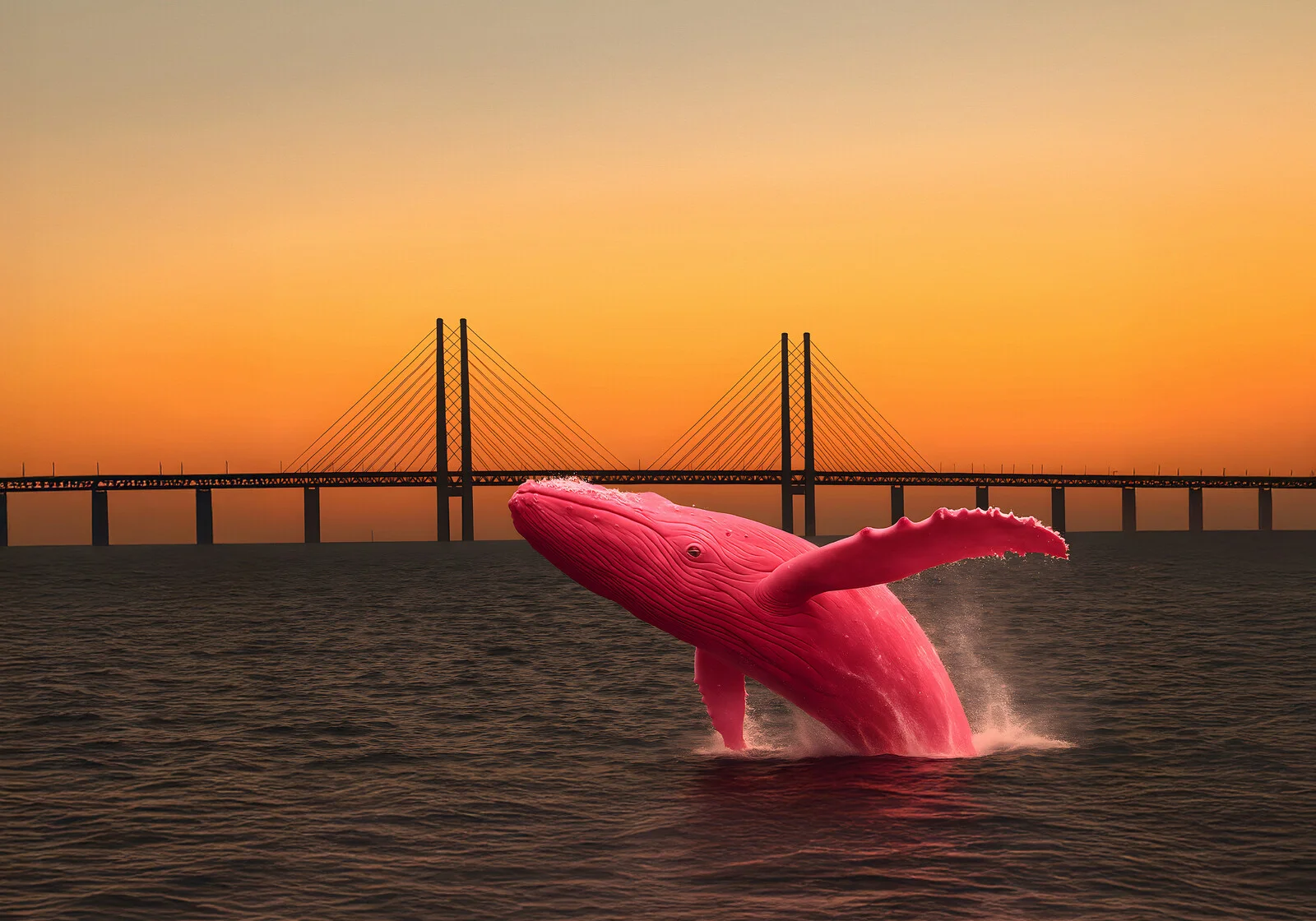
The Dancing Pink Queen, 2025
Digital
70 x 50 cm
3 200 kr
The Dancing Pink Queen
When the ocean grows quiet and the night settles in, my story becomes a song.
It carries the weight of journeys, the sorrow of losses, the joy of survival,
and the promise of friendship written in waves.
I have swum from the North Cape to the tropics and back again.
I have seen harpoons and nets, but I have also seen the return of voices once silenced.
I have danced with my sisters in circles of bubbles,
and I have sung alone, with a voice I claimed for myself.
And so, at the end of every journey, I lift my song once more, a melody that echoes through the vast ocean and captivates all who hear it.
It is my coda — a hymn of memory, survival, and joy.
The song of a whale who became the ocean’s Dancing Queen.
Join me on a journey to explore the captivating story of Lisa, the Whale. This essay is designed to entertain and inform you about her singing in the ocean. Get ready to be educated, inspired, and thoroughly entertained as we delve into the history and cultural significance of this wonderful tale.
“Song of the Dancing Whale
In the silence of the deep,
where the rolling currents keep,
I have carried every dream,
on the silver, singing stream.
I have wandered far and long;
The sea has shaped my mother’s song.
North to summer’s endless light,
south to calve in warmer night.
With my sisters by my side,
in the bubbles we confide.
Every circle, every ring,
binds us closer when we sing.
Hunters came with fire and steel,
tore the echoes from the keel.
Once our voices were nearly gone,
still the ocean kept our song.
Now we rise, our numbers grow,
ancient pathways still we know.
Every leap against the sky,
says we lived, we did not die.
Thank you, ocean, vast and wide,
for the song you let us hide.
Through the sorrow, through the pain,
still our voices rise again.
See that fin, watch that scene,
hear the ocean’s tambourine.
Tide and time will always mean,
I’m forever — Dancing Queen.”
Malmö. August 2025
The Dancing Queen, dressed in pink
My name is Lisa, and I am a humpback whale, a baleen whale to be precise—a traveller who swims thousands of kilometres. In human terms, I am as long as three Volvo cars, as heavy as a Scania truck, but as graceful as a ballerina. My fins are six metres long, longer than a car, and when I let them glide through the water, it feels as if my hands are conducting the ocean itself. I am a female, and females are generally larger than males. That is a truth I am pretty happy to remind the world of when I sing my songs. Yes, you heard me right. I sing. And when the sun turns me pink at the Öresund Bridge, I become something more than a whale: I become the Dancing Queen of the sea.
Summer at North Cape – “I Have a Stream”
My summer begins at North Cape. The midnight sun shines like a spotlight over the sea, and the plankton season is our festival. Plankton includes small fish and the ocean’s buffet. I eat twenty-two hours a day. I open my enormous mouth, take in the sea, and let my baleen filter out what matters. My gullet is no larger than a grapefruit. I cannot chew, and I cannot swallow anything substantial. I live on the small, but in immense quantities. This is how I, as a baleen whale, survive and thrive in the vast ocean.
And there, in the summer light that never fades, I willingly raise my voice. My melody is a hymn to the vast ocean that covers our planet and to the journey that still lies ahead.
"I have a stream, a song to sing / of northern seas and endless spring…”
It is my own version, a whale song about following the path of the sea and letting the dream carry you. The audience? The ocean itself — schools of fish, seabirds, and sometimes a human on a cliff listening without knowing what they hear. It sounds beautiful, and the tones feel familiar. This song is not just for entertainment; it serves as a form of communication and navigation in the vast ocean, a testament to the intelligence and adaptability of our species.
The Sisterhood and the Bubble Net – “Take a Dance with Me”
We women have many friends. Scientists have proven this, but we have always known it. We find each other year after year, even though we swim across the whole world. No telephones, no emails. Our songs are our meeting notices: “Same time, same place, next summer.”
When we hunt together, we blow bubbles, creating an invisible net around the shoal. These bubbles rise in a spiral, forming a barrier that the fish cannot see. At a specific signal, we all swim upwards with our mouths wide open. The fish do not even have time to blink. It is dance, it is choreography, and that is when ABBA fits perfectly, because it feels so good to sing with the body. And to be full at the same time.
"Take a dance with me, and you will see / a net of bubbles, a feast set free…” The 'feast' refers to the abundance of fish that we catch in our bubble net. It's a sight to behold, proof of the rich marine life in the ocean.
Our voices blend with the rhythm of the bubbles. No whale record has ever captured this, but it is our own jazz, our own ABBA choir beneath the waves.
The Voice and the Liberation – “When All Is Sung and Done”
Song is otherwise the males’ domain. They sing for hours, for days, for weeks. Ten- or twenty-minute-long songs, repeated again and again, until the entire sea hums. All in the same region sing the same melody, but it evolves, as if they are slowly rewriting the score together. Why they do it, no one knows. Love? Rivalry? Ecology? But it remains unimaginative.
I decided early on to raise my own voice. I am not content just to listen. I am an emancipated whale girl, and my voice is dark, full, almost like Anni-Frid’s. When I sing, it feels as if the deep itself sings through me.
"When all is sung and done, / I carry weight of oceans…"
It is my ballad. It speaks of the loneliness of journeys, the hunger of motherhood, and the sorrow of losses—the ocean responds. My sisters listen. And for a moment, it feels as if the whole world breathes in rhythm with me.
Migration and Motherhood – “S.O.Sea”
Every year, I swim sixteen thousand kilometres. I leave North Cape, depart from the abundance, and swim south. There, I give birth to my calf in warm waters. It is five metres long at birth and drinks milk so rich that human butter would blush. I eat nothing during the months at the Equator. I sustain myself on what I have stored.
I sing most of the time. I sing about the sharks that lurk, about the orcas that, in packs, can be dangerous even for us large ones. I sing about the whalers who nearly silenced my species, reducing the population from one hundred and twenty-five thousand to under ten thousand in just a few generations. But I also sing of hope, of how we are now between eighty and one hundred thousand again.
"S.O.Sea, won’t you hear my plea? / We were broken once, but we rise again…"
My song is both a lament and a triumph. It carries my history. I sing for the hundreds of thousands who once filled the oceans, before the harpoons tore our songs apart. We were 125,000 – and so quickly reduced to fewer than 10,000. A species on its knees, a choir diminished to a whispering echo. Each song then bore sorrow, desperation, a cry from the deep that no one wished to hear.
But I also sing for the return— for the ban that started in 1966, and for the years when our voices came back, from silence to rebirth. Today, our number is perhaps 80,000, or maybe 100,000, and the ocean is once more filled with melodies. Our species is no longer classified as endangered. We are a success story in an era when so many others face extinction.
Yet my song is not solely a source of joy; it also serves as a warning. I am aware that nets still ensnare my kin, propellers continue to slice through our fins, and the noise from your machines disturbs our conversations. The ocean is never entirely safe.
So when I sing S.O.Sea, it is as a double voice:
a requiem for what we lost,
a hymn for what we regained,
and a pleading cry not to let history repeat itself.
My song bears the pain of yesterday and the hope of tomorrow. It is my cry, my story, my proof that even the greatest can rise again – if only given the chance.
The Pink Dance – “Dancing Queen”
And now, for the first time, I am here where the Öresund Bridge connects two nations, a symbol of human ingenuity and connection. The sky glows with pink, colouring my skin. I leap between the pylons, beneath the roadway, and the waves become my dance floor. My fins beat the water in time with the music. I am Lisa, and I am no longer just a whale but a pink Dancing Queen.
I raise my voice, now higher in a soprano range, a pitch that makes the sea’s surface vibrate and resonates with the very essence of the ocean. My sisters' laughter bubbles, schools of fish scatter in panic, and the waves keep the beat.
"See that fin, watch that scene / I’m the ocean’s Dancing Queen…"
It is the climax, the moment when I do not just sing for myself. I sing for the ocean, for the humans on the shores, for everyone who has ever loved the rhythm.
The Promise of Friendship – “Take a Dance with Me”
When the music ends, we come back to each other: my friends, my sisters. In the ocean, we voyage from sea to sea, swim through darkness, storms, and calm waters – and still, we find our way home. We recognise each other’s voices, melodies that bear our names, refrains we sing together. Perhaps our songs are our way of announcing our meetings: “Same time, same place, next summer.”
Not everyone realises that female humpback whales have friends. Researchers have tracked us and uncovered bonds that are as strong and faithful as underwater currents. We come together in the hunt, we come together in rest. Even though our groups are often loosely connected, the friendships between us females are enduring. It is the ocean’s own form of sisterhood, a testament to the enduring nature of true friendship.
So we gather, we sing quietly, and our song turns into a lullaby for the ocean itself.
"Take a dance with me, and we will be / friends forever in the sea…”
You humans often believe that friendship must be maintained with constant signals. You send messages, schedule meetings in calendars, and gauge presence through small icons that blink on a screen. You worry that friendships will fade if they do not receive constant attention.
We show something else. We humpback females can be apart for years, travel thousands of kilometres, disappear in storms and currents – and yet find each other again. Our voices recognise one another; our melodies are our names. Our unique communication methods, far beyond the reach of human technology, are a testament to the depth of our friendships.
It exists in the present, in our voices, in the way sound waves meet beneath the surface. Our promises are embedded in the ocean’s code – a complex system of tones and rhythms that no one can imitate, carried by currents that travel farther than any messenger on land. This code is our language, our bond, and our testament to the enduring nature of our friendships.
Friendship does not rely on constant affirmation. It is present, secure and enduring, like a tone you recognise even if it has been silent.
The sisterhood among us serves as a reminder that true friendship doesn't need constant presence, only a deep recognition. When you meet a friend again after a long time and your conversation continues as if no time has passed, then you live as we do. It's the power of recognition that keeps our bonds strong.
The promise of friendship is simple: to return. To remember, to recognise, to respond when someone plays your melody. And that is a security greater than all the seas.
So simple. So true.
Epilogue – “Thank You for the Ocean”
And when night falls over the sea, I give thanks. I thank the song, the dance, and the ocean that carries me through every journey. I thank friendship and sisterhood that our voices still echo in the darkness. I thank that we were not silenced, that we are still heard, and that we can still sing.
"Thank you for the ocean,
the songs I’m singing,
the joy I’m bringing,
the life still clinging…”
My song is both a gesture of gratitude and a promise. Gratitude to the ocean that carried us through danger. Gratitude to life that, despite everything, triumphed. Gratitude to you, if you choose to listen. For every time you hear a whale song on a recording or see a fin break the surface, it is proof: we live, we dance, we exist.
And it is also a promise: that I will continue to sing, continue to dance, continue to be the ocean’s own queen of rhythm.
So join in the refrain – for I am the ocean’s Dancing Queen.
"See that fin, watch that scene,
hear the ocean’s tambourine.
Join my song, keep it clean,
with the tide — the Dancing Queen."
När havet stillnar och natten sänker sig blir min berättelse till en sång.
Den bär resornas tyngd, förlusterna och sorgens klang,
men också glädjen över att överleva och vänskapens löfte,
skrivet i vågor och strömmar.
Jag har simmat från Nordkap till tropikerna och tillbaka igen.
Jag har sett harpuner och nät, men jag har också hört rösterna återvända,
de som en gång tystades.
Jag har dansat med mina systrar i bubblornas cirklar,
och jag har sjungit ensam, med en röst jag tog i besittning.
Och därför, vid slutet av varje resa, lyfter jag min sång på nytt.
Det är min coda — en hymn av minnen, överlevnad och glädje.
Sången från en val som blev havets Dancing Queen.
Jag heter Lisa och är en knölval, en bardval för att vara exakt. En resenär som simmar tusentals kilometer. Med mänskliga mått mätt tre Volvobilar lång, en Scanialstbil tung, men rörlig som en ballerina. Mina fenor är sex meter, längre än en bil, och när jag låter dem glida genom vattnet känns det som om havet själv dirigeras av mina händer. Jag är en hona, och vi honor är alltid större än hanarna. Det är en sanning som jag gärna påminner om när jag sjunger mina sånger. Ja, du hörde rätt. Jag sjunger. Och när solen färgar mig rosa vid Öresundsbron blir jag något mer än en val: jag blir havets Dancing Queen.
Sommaren vid Nordkap – ”I Have a Stream”
Min sommar börjar vid Nordkap. Midnattssolen står som en strålkastare över havet, och planktonsäsongen är vår festival. Plankton är småfisk och havets buffé. Jag äter tjugotvå timmar om dygnet. Jag öppnar min enorma mun, tar in havet och låter barderna filtrera fram det viktiga. Min matstrupe är inte större än en grapefrukt. Jag kan inte tugga, jag kan inte svälja stort. Jag lever på det lilla men i ofantliga mängder.
Och där i sommarljuset som aldrig slocknar, tar jag gärna ton. Min melodi är en hyllning till det ofantliga havet som täcker vår planet och till den fortsatta resan som väntar.
"I have a stream, a song to sing / of northern seas and endless spring…”
Det är min egen version, en valsång om att följa havets väg och låta drömmen bära. Publiken? Havet självt. Fiskstim och fåglar, och ibland en människa på en klippa som lyssnar utan att veta vad de hör. Bara att de tycker det låter vackert och att tonerna känns igen.
Väninnorna och bubbelnätet – ”Take a Dance with Me”
Vi honor har många vänner. Det har forskarna bevisat, men vi har alltid vetat det. Vi hittar varandra, år efter år, fast vi simmar över hela världen. Inga telefoner, inga mejl. Våra sånger är våra mötesannonser: ”Samma tid, samma plats, nästa sommar.”
När vi jagar tillsammans blåser vi bubblor, skapar liksom ett osynligt nät runt stimmet. På given signal simmar vi alla uppåt med munnarna vidöppna. Fiskarna hinner inte ens blinka. Det är dans, det är koreografi, och då passar ABBA perfekt och det är så skönt att sjunga tillsammans med kroppen. Och bli mätt på samma gång.
"Take a dance with me, and you will see / a net of bubbles, a feast set free…”
Våra röster blandas med bubblornas rytm. Ingen valskiva har fångat detta, men det är vår egen jazz, vår egen ABBA-kör under ytan.
Rösten och frigörelsen – ”When All Is Sung and Done”
Sången är annars hanarnas område. De sjunger i timmar, i dagar, i veckor. Tio, tjugo minuter långa låtar, om och om igen, tills hela havet brummar. Alla i samma område sjunger samma melodi, men den förändras över tid, som om de långsamt skrev om noterna tillsammans. Varför de gör det vet ingen. Kärlek? Rivalitet? Ekologi? Men fantasilöst.
Jag bestämde mig tidigt för att ta ton själv. Jag är inte nöjd med att bara lyssna. Jag är en emancipierad valflicka, och min röst är mörk, fyllig, nästan som Anni-Frids. När jag sjunger känns det som om djupet självt sjunger genom mig.
"When all is sung and done, / I carry weight of oceans…"
Det är min ballad. Den handlar om ensamheten i resorna, om moderskapets hunger, om sorgen i förlusterna. Havet svarar. Mina väninnor lyssnar. Och för ett ögonblick känns det som om världen andas i takt med mig.
Migration och moderskap – ”S.O.Sea”
Varje år simmar jag sextontusen kilometer. Jag lämnar Nordkap, lämnar överflödet, och simmar söderut. Där föder jag min kalv i varma vatten. Den är fem meter lång när den föds, och dricker mjölk så fet att människornas smör skulle blygas. Jag äter ingenting under månaderna vid Ekvatorn. Jag lever på det jag lagrat.
Sjunger gör jag mest hela tiden. Jag sjunger om hajarna som lurar, om späckhuggarna som i flock kan vara farliga även för oss stora. Jag sjunger om valjägarna som nästan tystade min art. Från hundratjugofem tusen till under tiotusen på bara några generationer. Men jag sjunger också om hoppet, om hur vi nu är åttio till hundra tusen igen.
”S.O.Sea, won’t you hear my plea? / We were broken once, but we rise again…”
Min sång är både klagan och triumf. Den bär min historia. Jag sjunger för de hundratusentals som en gång fyllde oceanerna, innan harpunerna slet sönder våra sånger. Vi var 125 000 – och så snabbt reducerade till färre än 10 000. En art på knä, en kör reducerad till ett viskande eko. Varje sång då bar sorg, desperation, ett rop från djupet som ingen ville höra.
Men jag sjunger också för återkomsten. För förbudet som kom 1966, för de år då våra röster återvände. Från tystnad till återuppståndelse. Idag är vi kanske 80 000, kanske 100 000, och havet fylls åter av melodier. Vår art är inte längre klassad som hotad. Vi är en framgångssaga i en tid då så många berättelser slutar i utrotning.
Ändå är min sång inte bara jubel. Den är en varning. Jag vet att nät fortfarande fångar mina syskon, att propellrar fortfarande skär genom våra fenor, att bullret från era maskiner stör våra samtal. Havet är aldrig helt tryggt.
Så när jag sjunger S.O.Sea är det som en dubbel röst:
ett sorgekväde för det vi förlorade,
en lovsång för det vi återvann,
och ett bönfallande rop om att inte låta historien upprepa sig.
Min sång bär smärtan från gårdagen och hoppet om morgondagen. Den är mitt rop, min berättelse, mitt bevis på att även de största kan resa sig igen – om de bara får chansen.
Den rosa dansen – ”Dancing Queen”
Och nu är jag för första gången här där Öresundsbron sträcker sig mellan två länder. Himlen badar i rosa och färgar av sig på min hud. Jag hoppar mellan pylonerna, under körbanan och vågorna är mitt dansgolv. Mina fenor piskar vattnet i takt med musiken. Jag är Lisa, och jag är inte längre bara en val utan en rosa dancing Queen.
Jag tar ton, högre nu, i ett sopranläge som får havsytan att vibrera. Mina väninnor skrattar bubblor, fiskstim splittras i panik, och vågorna håller takten.
"See that fin, watch that scene / I’m the ocean’s Dancing Queen…”
Det är klimaxet, ögonblicket då jag inte bara sjunger för mig själv. Jag sjunger för havet, för människorna på stränderna, för alla som någonsin älskat rytmen.
Vänskapens löfte – ”Take a Dance with Me”
När musiken lagt sig återvänder vi till varandra. Mina vänner, mina systrar. I havet färdas vi från ocean till ocean, simmas genom mörker, storm och stiltje – och ändå hittar tillbaka. Vi känner igen varandras röster, melodier som bär våra namn, refränger vi sjunger tillsammans. Kanske är det våra sånger som är våra mötesannonser: ”Samma tid, samma plats, nästa sommar.”
Det är inte alla som vet att vi knölvalshonor har vänner. Forskare har följt oss och upptäckt banden, starka och trofasta som undervattensströmmar. Vi förenas i jakten, vi förenas i vilan. Och även om våra grupper ofta är löst sammanhållna, är vänskapen mellan oss honor något som varar. Det är havets egen form av systerskap.
Så vi möts, vi sjunger mjukt, och vår sång blir som en vaggsång för oceanen själv.
"Take a dance with me, and we will be / friends forever in the sea…”
Ni människor tänker ofta att vänskap måste vårdas med ständiga signaler. Ni skickar meddelanden, bokar möten i kalendrar, mäter närvaron i små ikoner som blinkar på en skärm. Ni oroar er för att vänskapen ska dö om den inte får ständig näring.
Vi visar något annat. Vi knölvalshonor kan vara borta från varandra i åratal, resa tusentals kilometer, försvinna i stormar och strömmar – och ändå hitta tillbaka. Våra röster känner igen varandra, våra melodier är våra namn.
Den lever i närvaron, i våra röster, i det sätt som ljudvågorna finner varandra under ytan. Våra löften är skrivna i havets kod – i toner och rytmer som ingen kan förfalska, burna av strömmar som reser längre än någon budbärare på land.
Vänskapen är inte beroende av ständig bekräftelse. Den finns där, trygg och outplånlig, som en ton du känner igen även om den legat tyst.
Systerskapet mellan oss är en påminnelse: att verklig vänskap inte kräver ständig närvaro, bara en djup igenkänning. När ni återser en vän efter lång tid och samtalet fortsätter som om ni aldrig varit ifrån varandra – då lever ni som vi gör.
Vänskapens löfte är enkelt: att komma tillbaka. Att minnas, att känna igen, att svara när någon sjunger din melodi. Och det är en trygghet större än alla hav.
Så enkelt. Så sant.
Epilogen – ”Thank You for the Ocean”
Och när natten lägger sig över havet tackar jag. Jag tackar för sången, för dansen, för havet som bär mig genom varje resa. Jag tackar för vänskapen, för systerskapet, för att våra röster fortfarande finns kvar i mörkret. Jag tackar för att vi inte tystnade, för att vi ännu hörs, för att vi ännu kan sjunga.
"Thank you for the ocean,
the songs I’m singing,
the joy I’m bringing,
the life still clinging…”
Min sång är ett tack och ett löfte. Ett tack till havet som burit oss genom faror. Ett tack till livet som trots allt segrat. Ett tack till er, om ni väljer att lyssna. För varje gång ni hör en valsång på en inspelning, eller ser en fena bryta ytan, är det ett bevis: vi lever, vi dansar, vi finns.
Och det är också ett löfte: att jag ska fortsätta sjunga, fortsätta dansa, fortsätta vara havets egen drottning av rytm.
Så häng med i refrängen – för jag är havets Dancing Queen.
"See that fin, watch that scene,
hear the ocean’s tambourine.
Join my song, keep it clean,
with the tide — the Dancing Queen."
Jörgen Thornberg
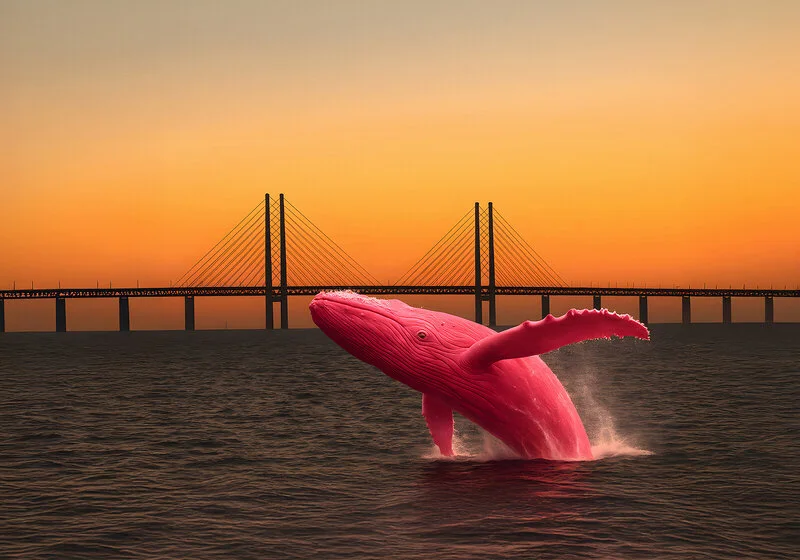
The Dancing Pink Queen, 2025
Digital
70 x 50 cm
3 200 kr
The Dancing Pink Queen
When the ocean grows quiet and the night settles in, my story becomes a song.
It carries the weight of journeys, the sorrow of losses, the joy of survival,
and the promise of friendship written in waves.
I have swum from the North Cape to the tropics and back again.
I have seen harpoons and nets, but I have also seen the return of voices once silenced.
I have danced with my sisters in circles of bubbles,
and I have sung alone, with a voice I claimed for myself.
And so, at the end of every journey, I lift my song once more, a melody that echoes through the vast ocean and captivates all who hear it.
It is my coda — a hymn of memory, survival, and joy.
The song of a whale who became the ocean’s Dancing Queen.
Join me on a journey to explore the captivating story of Lisa, the Whale. This essay is designed to entertain and inform you about her singing in the ocean. Get ready to be educated, inspired, and thoroughly entertained as we delve into the history and cultural significance of this wonderful tale.
“Song of the Dancing Whale
In the silence of the deep,
where the rolling currents keep,
I have carried every dream,
on the silver, singing stream.
I have wandered far and long;
The sea has shaped my mother’s song.
North to summer’s endless light,
south to calve in warmer night.
With my sisters by my side,
in the bubbles we confide.
Every circle, every ring,
binds us closer when we sing.
Hunters came with fire and steel,
tore the echoes from the keel.
Once our voices were nearly gone,
still the ocean kept our song.
Now we rise, our numbers grow,
ancient pathways still we know.
Every leap against the sky,
says we lived, we did not die.
Thank you, ocean, vast and wide,
for the song you let us hide.
Through the sorrow, through the pain,
still our voices rise again.
See that fin, watch that scene,
hear the ocean’s tambourine.
Tide and time will always mean,
I’m forever — Dancing Queen.”
Malmö. August 2025
The Dancing Queen, dressed in pink
My name is Lisa, and I am a humpback whale, a baleen whale to be precise—a traveller who swims thousands of kilometres. In human terms, I am as long as three Volvo cars, as heavy as a Scania truck, but as graceful as a ballerina. My fins are six metres long, longer than a car, and when I let them glide through the water, it feels as if my hands are conducting the ocean itself. I am a female, and females are generally larger than males. That is a truth I am pretty happy to remind the world of when I sing my songs. Yes, you heard me right. I sing. And when the sun turns me pink at the Öresund Bridge, I become something more than a whale: I become the Dancing Queen of the sea.
Summer at North Cape – “I Have a Stream”
My summer begins at North Cape. The midnight sun shines like a spotlight over the sea, and the plankton season is our festival. Plankton includes small fish and the ocean’s buffet. I eat twenty-two hours a day. I open my enormous mouth, take in the sea, and let my baleen filter out what matters. My gullet is no larger than a grapefruit. I cannot chew, and I cannot swallow anything substantial. I live on the small, but in immense quantities. This is how I, as a baleen whale, survive and thrive in the vast ocean.
And there, in the summer light that never fades, I willingly raise my voice. My melody is a hymn to the vast ocean that covers our planet and to the journey that still lies ahead.
"I have a stream, a song to sing / of northern seas and endless spring…”
It is my own version, a whale song about following the path of the sea and letting the dream carry you. The audience? The ocean itself — schools of fish, seabirds, and sometimes a human on a cliff listening without knowing what they hear. It sounds beautiful, and the tones feel familiar. This song is not just for entertainment; it serves as a form of communication and navigation in the vast ocean, a testament to the intelligence and adaptability of our species.
The Sisterhood and the Bubble Net – “Take a Dance with Me”
We women have many friends. Scientists have proven this, but we have always known it. We find each other year after year, even though we swim across the whole world. No telephones, no emails. Our songs are our meeting notices: “Same time, same place, next summer.”
When we hunt together, we blow bubbles, creating an invisible net around the shoal. These bubbles rise in a spiral, forming a barrier that the fish cannot see. At a specific signal, we all swim upwards with our mouths wide open. The fish do not even have time to blink. It is dance, it is choreography, and that is when ABBA fits perfectly, because it feels so good to sing with the body. And to be full at the same time.
"Take a dance with me, and you will see / a net of bubbles, a feast set free…” The 'feast' refers to the abundance of fish that we catch in our bubble net. It's a sight to behold, proof of the rich marine life in the ocean.
Our voices blend with the rhythm of the bubbles. No whale record has ever captured this, but it is our own jazz, our own ABBA choir beneath the waves.
The Voice and the Liberation – “When All Is Sung and Done”
Song is otherwise the males’ domain. They sing for hours, for days, for weeks. Ten- or twenty-minute-long songs, repeated again and again, until the entire sea hums. All in the same region sing the same melody, but it evolves, as if they are slowly rewriting the score together. Why they do it, no one knows. Love? Rivalry? Ecology? But it remains unimaginative.
I decided early on to raise my own voice. I am not content just to listen. I am an emancipated whale girl, and my voice is dark, full, almost like Anni-Frid’s. When I sing, it feels as if the deep itself sings through me.
"When all is sung and done, / I carry weight of oceans…"
It is my ballad. It speaks of the loneliness of journeys, the hunger of motherhood, and the sorrow of losses—the ocean responds. My sisters listen. And for a moment, it feels as if the whole world breathes in rhythm with me.
Migration and Motherhood – “S.O.Sea”
Every year, I swim sixteen thousand kilometres. I leave North Cape, depart from the abundance, and swim south. There, I give birth to my calf in warm waters. It is five metres long at birth and drinks milk so rich that human butter would blush. I eat nothing during the months at the Equator. I sustain myself on what I have stored.
I sing most of the time. I sing about the sharks that lurk, about the orcas that, in packs, can be dangerous even for us large ones. I sing about the whalers who nearly silenced my species, reducing the population from one hundred and twenty-five thousand to under ten thousand in just a few generations. But I also sing of hope, of how we are now between eighty and one hundred thousand again.
"S.O.Sea, won’t you hear my plea? / We were broken once, but we rise again…"
My song is both a lament and a triumph. It carries my history. I sing for the hundreds of thousands who once filled the oceans, before the harpoons tore our songs apart. We were 125,000 – and so quickly reduced to fewer than 10,000. A species on its knees, a choir diminished to a whispering echo. Each song then bore sorrow, desperation, a cry from the deep that no one wished to hear.
But I also sing for the return— for the ban that started in 1966, and for the years when our voices came back, from silence to rebirth. Today, our number is perhaps 80,000, or maybe 100,000, and the ocean is once more filled with melodies. Our species is no longer classified as endangered. We are a success story in an era when so many others face extinction.
Yet my song is not solely a source of joy; it also serves as a warning. I am aware that nets still ensnare my kin, propellers continue to slice through our fins, and the noise from your machines disturbs our conversations. The ocean is never entirely safe.
So when I sing S.O.Sea, it is as a double voice:
a requiem for what we lost,
a hymn for what we regained,
and a pleading cry not to let history repeat itself.
My song bears the pain of yesterday and the hope of tomorrow. It is my cry, my story, my proof that even the greatest can rise again – if only given the chance.
The Pink Dance – “Dancing Queen”
And now, for the first time, I am here where the Öresund Bridge connects two nations, a symbol of human ingenuity and connection. The sky glows with pink, colouring my skin. I leap between the pylons, beneath the roadway, and the waves become my dance floor. My fins beat the water in time with the music. I am Lisa, and I am no longer just a whale but a pink Dancing Queen.
I raise my voice, now higher in a soprano range, a pitch that makes the sea’s surface vibrate and resonates with the very essence of the ocean. My sisters' laughter bubbles, schools of fish scatter in panic, and the waves keep the beat.
"See that fin, watch that scene / I’m the ocean’s Dancing Queen…"
It is the climax, the moment when I do not just sing for myself. I sing for the ocean, for the humans on the shores, for everyone who has ever loved the rhythm.
The Promise of Friendship – “Take a Dance with Me”
When the music ends, we come back to each other: my friends, my sisters. In the ocean, we voyage from sea to sea, swim through darkness, storms, and calm waters – and still, we find our way home. We recognise each other’s voices, melodies that bear our names, refrains we sing together. Perhaps our songs are our way of announcing our meetings: “Same time, same place, next summer.”
Not everyone realises that female humpback whales have friends. Researchers have tracked us and uncovered bonds that are as strong and faithful as underwater currents. We come together in the hunt, we come together in rest. Even though our groups are often loosely connected, the friendships between us females are enduring. It is the ocean’s own form of sisterhood, a testament to the enduring nature of true friendship.
So we gather, we sing quietly, and our song turns into a lullaby for the ocean itself.
"Take a dance with me, and we will be / friends forever in the sea…”
You humans often believe that friendship must be maintained with constant signals. You send messages, schedule meetings in calendars, and gauge presence through small icons that blink on a screen. You worry that friendships will fade if they do not receive constant attention.
We show something else. We humpback females can be apart for years, travel thousands of kilometres, disappear in storms and currents – and yet find each other again. Our voices recognise one another; our melodies are our names. Our unique communication methods, far beyond the reach of human technology, are a testament to the depth of our friendships.
It exists in the present, in our voices, in the way sound waves meet beneath the surface. Our promises are embedded in the ocean’s code – a complex system of tones and rhythms that no one can imitate, carried by currents that travel farther than any messenger on land. This code is our language, our bond, and our testament to the enduring nature of our friendships.
Friendship does not rely on constant affirmation. It is present, secure and enduring, like a tone you recognise even if it has been silent.
The sisterhood among us serves as a reminder that true friendship doesn't need constant presence, only a deep recognition. When you meet a friend again after a long time and your conversation continues as if no time has passed, then you live as we do. It's the power of recognition that keeps our bonds strong.
The promise of friendship is simple: to return. To remember, to recognise, to respond when someone plays your melody. And that is a security greater than all the seas.
So simple. So true.
Epilogue – “Thank You for the Ocean”
And when night falls over the sea, I give thanks. I thank the song, the dance, and the ocean that carries me through every journey. I thank friendship and sisterhood that our voices still echo in the darkness. I thank that we were not silenced, that we are still heard, and that we can still sing.
"Thank you for the ocean,
the songs I’m singing,
the joy I’m bringing,
the life still clinging…”
My song is both a gesture of gratitude and a promise. Gratitude to the ocean that carried us through danger. Gratitude to life that, despite everything, triumphed. Gratitude to you, if you choose to listen. For every time you hear a whale song on a recording or see a fin break the surface, it is proof: we live, we dance, we exist.
And it is also a promise: that I will continue to sing, continue to dance, continue to be the ocean’s own queen of rhythm.
So join in the refrain – for I am the ocean’s Dancing Queen.
"See that fin, watch that scene,
hear the ocean’s tambourine.
Join my song, keep it clean,
with the tide — the Dancing Queen."
När havet stillnar och natten sänker sig blir min berättelse till en sång.
Den bär resornas tyngd, förlusterna och sorgens klang,
men också glädjen över att överleva och vänskapens löfte,
skrivet i vågor och strömmar.
Jag har simmat från Nordkap till tropikerna och tillbaka igen.
Jag har sett harpuner och nät, men jag har också hört rösterna återvända,
de som en gång tystades.
Jag har dansat med mina systrar i bubblornas cirklar,
och jag har sjungit ensam, med en röst jag tog i besittning.
Och därför, vid slutet av varje resa, lyfter jag min sång på nytt.
Det är min coda — en hymn av minnen, överlevnad och glädje.
Sången från en val som blev havets Dancing Queen.
Jag heter Lisa och är en knölval, en bardval för att vara exakt. En resenär som simmar tusentals kilometer. Med mänskliga mått mätt tre Volvobilar lång, en Scanialstbil tung, men rörlig som en ballerina. Mina fenor är sex meter, längre än en bil, och när jag låter dem glida genom vattnet känns det som om havet själv dirigeras av mina händer. Jag är en hona, och vi honor är alltid större än hanarna. Det är en sanning som jag gärna påminner om när jag sjunger mina sånger. Ja, du hörde rätt. Jag sjunger. Och när solen färgar mig rosa vid Öresundsbron blir jag något mer än en val: jag blir havets Dancing Queen.
Sommaren vid Nordkap – ”I Have a Stream”
Min sommar börjar vid Nordkap. Midnattssolen står som en strålkastare över havet, och planktonsäsongen är vår festival. Plankton är småfisk och havets buffé. Jag äter tjugotvå timmar om dygnet. Jag öppnar min enorma mun, tar in havet och låter barderna filtrera fram det viktiga. Min matstrupe är inte större än en grapefrukt. Jag kan inte tugga, jag kan inte svälja stort. Jag lever på det lilla men i ofantliga mängder.
Och där i sommarljuset som aldrig slocknar, tar jag gärna ton. Min melodi är en hyllning till det ofantliga havet som täcker vår planet och till den fortsatta resan som väntar.
"I have a stream, a song to sing / of northern seas and endless spring…”
Det är min egen version, en valsång om att följa havets väg och låta drömmen bära. Publiken? Havet självt. Fiskstim och fåglar, och ibland en människa på en klippa som lyssnar utan att veta vad de hör. Bara att de tycker det låter vackert och att tonerna känns igen.
Väninnorna och bubbelnätet – ”Take a Dance with Me”
Vi honor har många vänner. Det har forskarna bevisat, men vi har alltid vetat det. Vi hittar varandra, år efter år, fast vi simmar över hela världen. Inga telefoner, inga mejl. Våra sånger är våra mötesannonser: ”Samma tid, samma plats, nästa sommar.”
När vi jagar tillsammans blåser vi bubblor, skapar liksom ett osynligt nät runt stimmet. På given signal simmar vi alla uppåt med munnarna vidöppna. Fiskarna hinner inte ens blinka. Det är dans, det är koreografi, och då passar ABBA perfekt och det är så skönt att sjunga tillsammans med kroppen. Och bli mätt på samma gång.
"Take a dance with me, and you will see / a net of bubbles, a feast set free…”
Våra röster blandas med bubblornas rytm. Ingen valskiva har fångat detta, men det är vår egen jazz, vår egen ABBA-kör under ytan.
Rösten och frigörelsen – ”When All Is Sung and Done”
Sången är annars hanarnas område. De sjunger i timmar, i dagar, i veckor. Tio, tjugo minuter långa låtar, om och om igen, tills hela havet brummar. Alla i samma område sjunger samma melodi, men den förändras över tid, som om de långsamt skrev om noterna tillsammans. Varför de gör det vet ingen. Kärlek? Rivalitet? Ekologi? Men fantasilöst.
Jag bestämde mig tidigt för att ta ton själv. Jag är inte nöjd med att bara lyssna. Jag är en emancipierad valflicka, och min röst är mörk, fyllig, nästan som Anni-Frids. När jag sjunger känns det som om djupet självt sjunger genom mig.
"When all is sung and done, / I carry weight of oceans…"
Det är min ballad. Den handlar om ensamheten i resorna, om moderskapets hunger, om sorgen i förlusterna. Havet svarar. Mina väninnor lyssnar. Och för ett ögonblick känns det som om världen andas i takt med mig.
Migration och moderskap – ”S.O.Sea”
Varje år simmar jag sextontusen kilometer. Jag lämnar Nordkap, lämnar överflödet, och simmar söderut. Där föder jag min kalv i varma vatten. Den är fem meter lång när den föds, och dricker mjölk så fet att människornas smör skulle blygas. Jag äter ingenting under månaderna vid Ekvatorn. Jag lever på det jag lagrat.
Sjunger gör jag mest hela tiden. Jag sjunger om hajarna som lurar, om späckhuggarna som i flock kan vara farliga även för oss stora. Jag sjunger om valjägarna som nästan tystade min art. Från hundratjugofem tusen till under tiotusen på bara några generationer. Men jag sjunger också om hoppet, om hur vi nu är åttio till hundra tusen igen.
”S.O.Sea, won’t you hear my plea? / We were broken once, but we rise again…”
Min sång är både klagan och triumf. Den bär min historia. Jag sjunger för de hundratusentals som en gång fyllde oceanerna, innan harpunerna slet sönder våra sånger. Vi var 125 000 – och så snabbt reducerade till färre än 10 000. En art på knä, en kör reducerad till ett viskande eko. Varje sång då bar sorg, desperation, ett rop från djupet som ingen ville höra.
Men jag sjunger också för återkomsten. För förbudet som kom 1966, för de år då våra röster återvände. Från tystnad till återuppståndelse. Idag är vi kanske 80 000, kanske 100 000, och havet fylls åter av melodier. Vår art är inte längre klassad som hotad. Vi är en framgångssaga i en tid då så många berättelser slutar i utrotning.
Ändå är min sång inte bara jubel. Den är en varning. Jag vet att nät fortfarande fångar mina syskon, att propellrar fortfarande skär genom våra fenor, att bullret från era maskiner stör våra samtal. Havet är aldrig helt tryggt.
Så när jag sjunger S.O.Sea är det som en dubbel röst:
ett sorgekväde för det vi förlorade,
en lovsång för det vi återvann,
och ett bönfallande rop om att inte låta historien upprepa sig.
Min sång bär smärtan från gårdagen och hoppet om morgondagen. Den är mitt rop, min berättelse, mitt bevis på att även de största kan resa sig igen – om de bara får chansen.
Den rosa dansen – ”Dancing Queen”
Och nu är jag för första gången här där Öresundsbron sträcker sig mellan två länder. Himlen badar i rosa och färgar av sig på min hud. Jag hoppar mellan pylonerna, under körbanan och vågorna är mitt dansgolv. Mina fenor piskar vattnet i takt med musiken. Jag är Lisa, och jag är inte längre bara en val utan en rosa dancing Queen.
Jag tar ton, högre nu, i ett sopranläge som får havsytan att vibrera. Mina väninnor skrattar bubblor, fiskstim splittras i panik, och vågorna håller takten.
"See that fin, watch that scene / I’m the ocean’s Dancing Queen…”
Det är klimaxet, ögonblicket då jag inte bara sjunger för mig själv. Jag sjunger för havet, för människorna på stränderna, för alla som någonsin älskat rytmen.
Vänskapens löfte – ”Take a Dance with Me”
När musiken lagt sig återvänder vi till varandra. Mina vänner, mina systrar. I havet färdas vi från ocean till ocean, simmas genom mörker, storm och stiltje – och ändå hittar tillbaka. Vi känner igen varandras röster, melodier som bär våra namn, refränger vi sjunger tillsammans. Kanske är det våra sånger som är våra mötesannonser: ”Samma tid, samma plats, nästa sommar.”
Det är inte alla som vet att vi knölvalshonor har vänner. Forskare har följt oss och upptäckt banden, starka och trofasta som undervattensströmmar. Vi förenas i jakten, vi förenas i vilan. Och även om våra grupper ofta är löst sammanhållna, är vänskapen mellan oss honor något som varar. Det är havets egen form av systerskap.
Så vi möts, vi sjunger mjukt, och vår sång blir som en vaggsång för oceanen själv.
"Take a dance with me, and we will be / friends forever in the sea…”
Ni människor tänker ofta att vänskap måste vårdas med ständiga signaler. Ni skickar meddelanden, bokar möten i kalendrar, mäter närvaron i små ikoner som blinkar på en skärm. Ni oroar er för att vänskapen ska dö om den inte får ständig näring.
Vi visar något annat. Vi knölvalshonor kan vara borta från varandra i åratal, resa tusentals kilometer, försvinna i stormar och strömmar – och ändå hitta tillbaka. Våra röster känner igen varandra, våra melodier är våra namn.
Den lever i närvaron, i våra röster, i det sätt som ljudvågorna finner varandra under ytan. Våra löften är skrivna i havets kod – i toner och rytmer som ingen kan förfalska, burna av strömmar som reser längre än någon budbärare på land.
Vänskapen är inte beroende av ständig bekräftelse. Den finns där, trygg och outplånlig, som en ton du känner igen även om den legat tyst.
Systerskapet mellan oss är en påminnelse: att verklig vänskap inte kräver ständig närvaro, bara en djup igenkänning. När ni återser en vän efter lång tid och samtalet fortsätter som om ni aldrig varit ifrån varandra – då lever ni som vi gör.
Vänskapens löfte är enkelt: att komma tillbaka. Att minnas, att känna igen, att svara när någon sjunger din melodi. Och det är en trygghet större än alla hav.
Så enkelt. Så sant.
Epilogen – ”Thank You for the Ocean”
Och när natten lägger sig över havet tackar jag. Jag tackar för sången, för dansen, för havet som bär mig genom varje resa. Jag tackar för vänskapen, för systerskapet, för att våra röster fortfarande finns kvar i mörkret. Jag tackar för att vi inte tystnade, för att vi ännu hörs, för att vi ännu kan sjunga.
"Thank you for the ocean,
the songs I’m singing,
the joy I’m bringing,
the life still clinging…”
Min sång är ett tack och ett löfte. Ett tack till havet som burit oss genom faror. Ett tack till livet som trots allt segrat. Ett tack till er, om ni väljer att lyssna. För varje gång ni hör en valsång på en inspelning, eller ser en fena bryta ytan, är det ett bevis: vi lever, vi dansar, vi finns.
Och det är också ett löfte: att jag ska fortsätta sjunga, fortsätta dansa, fortsätta vara havets egen drottning av rytm.
Så häng med i refrängen – för jag är havets Dancing Queen.
"See that fin, watch that scene,
hear the ocean’s tambourine.
Join my song, keep it clean,
with the tide — the Dancing Queen."
3 200 kr

Jörgen Thornberg
Malmö
Lite om bilder och mig. Translation in English at the end.
Jag är en nyfiken person som ser allt i bilder, även det jag fäster i ord, gärna tillsammans för bakom alla mina bilder finns en berättelse. Till vissa bilder hör en kortare eller längre novell som följer med bilden.
Bilder berättar historier. Jag omges av naturlig skönhet, intressanta människor och historia var jag än går. Jag använder min kamera för att dokumentera världen och blanda det jag ser med vad jag känner för att fånga den dolda magin.
Mina bilder berättar mina historier. Genom mina bilder, tryck och berättelser. Jag bjuder in dig att ta del av dessa berättelser, in i ditt liv och hem och dela min mycket personliga syn på vår värld. Mer än vad ögat ser. Jag tänker i bilder, drömmer och skriver och pratar om dem; följaktligen måste jag också skapa bilder. De blir vad jag ser, inte nödvändigtvis begränsade till verkligheten. Det finns en bild runt varje hörn. Jag hoppas att du kommer att se vad jag såg och gilla det.
Jag är också en skrivande person och till många bilder hör en kortare eller längre essay. Den följer med tavlan, tryckt på fint papper och med en personlig hälsning från mig.
Flertalet bilder startar sin resa i min kamera. Enkelt förklarat beskriver jag bilden jag ser i mitt inre, upplevd eller fantiserad. Bilden uppstår inom mig redan innan jag fått okularet till ögat. På bråkdelen av ett ögonblick ser jag vad jag vill ha och vad som kan göras med bilden. Här skall jag stoppa in en giraff, stålmannen, Titanic eller vad det är min fantasi finner ut. Ännu märkligare är att jag kommer ihåg minnesbilden långt efteråt när det blir tid att skapa verket. Om jag lyckas eller inte, är upp till betraktaren, oftast präglat av en stråk av svart humor – meningen är att man skall bli underhållen. Mina bilder blir ofta en snackis där de hänger.
Jag föredrar bilder som förmedlar ett budskap i flera lager. Vid första anblicken fylld av feel-good, en vacker utsikt, fint väder, solen skiner, blommor på ängen eller vattnet som ligger förrädiskt spegelblankt. I en sådan bild kan jag gömma min egentliga berättelse, mitt förakt för förtryckare och våldsverkare, rasister och fördomsfulla människor - ett gärna återkommande motiv mer eller mindre dolt i det vackra motivet. Jag försöker förena dem i ett gemensamt narrativ.
Bild och formgivning har löpt som en röd tråd genom livet. Fotokonst känns som en värdig final som jag gärna delar med mig.
Min genre är vid som framgår av mina bilder, temat en blandning av pop- och gatukonst i kollage som kan bestå av hundratals lager. Vissa bilder kan ta veckor, andra någon dag innan det är dags att överlämna resultatet till printverkstaden. Fine Art Prints är digitala fotocollage. I dessa kollage sker rivandet, klippandet, pusslandet, målandet, ritandet och sprayningen digitalt. Det jag monterar in kan vara hundratals år gamla bilder som jag omsorgsfullt frilägger så att de ser ut att vara en del av tavlan men också bilder skapade av mig själv efter min egen fantasi. Därefter besöks printstudion och för vissa bilder numrera en limiterad upplaga (oftast 7 exemplar) och signera för hand. Vissa bilder kan köpas i olika format. Det är bara att fråga efter vilka. Gillar man en bild som är 70x100 men inte har plats på väggen, går den kanske att få i 50x70 cm istället. Frågan är fri.
Metoden Giclée eller Fine Art Print som det också kallas är det moderna sättet för framställning av grafisk konst. Villkoret för denna typ av utskrifter är att en högkvalitativ storformatskrivare används med åldersbeständigt färgpigment och konstnärspapper eller i förekommande fall på duk. Pappret som används möter de krav på livslängd som ställs av museer och gallerier. Normalt säljer jag mina bilder oinramade så att den nya ägaren själv kan bestämma hur de skall se ut, med eller utan passepartout färg på ram, med eller utan glas etc..
Under många år ställde jag bara ut på nätet, i valda grupper och på min egen Facebooksida - https://www.facebook.com/jorgen.thornberg.9
Jag finns också på en egen hemsida som tyvärr inte alltid är uppdaterad – https://www.jth.life/ Där kan du också läsa en del av de berättelser som följer med bilden.
UTSTÄLLNINGAR
Luftkastellet, oktober 2022
Konst i Lund, november 2022
Luftkastellet, mars 2023
Engleson Galleri Caroli, april 2023
Hydra, Greece June 2023
Engleson Galleri Caroli, oktober 2023
Toppen, Höllviken december 2023
Luftkastellet, mars 2024
Torups Galleri, mars 2024
Venice, May 2024
Luftkastellet, oktober 2024
Konst i Advent, December 2024
Galleri Engleson, Caroli December 2024
Jäger & Jansson Galleri, april 2025
A bit about pictures and me.
I'm a curious person who sees everything in pictures, even what I express in words, often combining them, for behind all my pictures lies a story. These narratives, some as short as a single image and others as long as a novel, are the heart and soul of my work.
Pictures tell stories. Wherever I go, I'm surrounded by natural beauty, exciting people, and history. I use my camera to document the world and blend what I see with what I feel to capture the hidden magic.
My images tell my stories. Through my pictures, prints, and narratives, I invite you to partake in these stories in your life and home and share my deeply personal perspective of our world. More than meets the eye. I think in pictures, dream, write, and talk about them; consequently, I must create images too. They become what I see, not necessarily confined to reality. There's a picture around every corner. I hope you'll see what I saw and enjoy it.
I'm also a writer, and many images come with a shorter or longer essay. It accompanies the painting, printed on fine paper with my personal greeting.
Many pictures start their journey on my camera. Simply put, I describe the image I see in my mind, experienced or imagined. The image arises within me even before I bring the eyepiece to my eye. In a fraction of a moment, I see what I want and what can be done with the picture. Here, I'll insert a giraffe, Superman, the Titanic, or whatever my imagination conjures up. Even stranger is that I remember the mental image long after it's time to create the work. Whether I succeed is up to the observer, often imbued with a streak of black humour – the aim is to entertain. My pictures usually become a talking point wherever they hang.
I prefer pictures that convey a message in multiple layers. At first glance, they're filled with feel-good vibes, a beautiful view, lovely weather, the sun shining, flowers in the meadow, or the water lying deceptively calm. But beneath this surface beauty, I often conceal a deeper story, a narrative that challenges societal norms or explores the human condition. I invite you to delve into these hidden narratives and discover the layers of meaning within my work.
Picture and design have been a thread running through my life. Photographic art feels like a fitting finale, and I'm happy to share it.
My genre is varied, as seen in my pictures; the theme is a blend of pop and street art in collages that can consist of hundreds of layers. Some images can take weeks, others just a day before it's time to hand over the result to the print workshop. Fine Art Prints are digital photo collages. In these collages, tearing, cutting, puzzling, painting, drawing, and spraying happen digitally. What I insert can be images hundreds of years old that I carefully extract so they appear to be part of the painting, but also images created by myself, now also generated from my imagination. Next, visit the print studio and, for certain images, number a limited edition (usually 7 copies) and sign them by hand. Some images may be available in other formats. Just ask which ones. If you like an image that's 70x100 but doesn't have space on the wall, you might be able to get it in 50x70 cm instead. The question is open.
The Giclée method, or Fine Art Print as it's also called, is the modern way of producing graphic art. This method ensures the highest quality and longevity of the artwork, using a high-quality large-format printer with archival pigment inks and artist paper or, in some cases, canvas. The paper used meets the longevity requirements set by museums and galleries. I sell my pictures unframed, allowing the new owner to personalise their artwork, confident in the lasting value and quality of the piece.
For many years, I only exhibited online, in selected groups, and on my Facebook page - https://www.facebook.com/jorgen.thornberg.9. I also have my website, which unfortunately is not constantly updated - https://www.jth.life/. You can also read some of the stories accompanying the pictures there.
EXHIBITIONS
Luftkastellet, October 2022
Art in Lund, November 2022
Luftkastellet, March 2023
Engleson Gallery Caroli, April 2023
Hydra, Greece June 2023
Engleson Gallery Caroli, October 2023
Toppen, Höllviken December 2023
Luftkastellet, March 2024
Torup Gallery, March 2024
Venice, May 2024
UTSTÄLLNINGAR
Luftkastellet, oktober 2022
Konst i Lund, november 2022
Luftkastellet, mars 2023
Engleson Galleri Caroli, april 2023
Hydra, Greece June 2023
Engleson Galleri Caroli, oktober 2023
Toppen, Höllviken december 2023
Luftkastellet, mars 2024
Torups Galleri, mars 2024
Venice, May 2024
Luftkastellet, October 2024
Konst i Advent, December 2024
Galleri Engleson, Caroli December 2024
Jäger & Jansson Galleri, April 2025
Utbildning
Autodidakt
Medlem i konstnärsförening
Öppna Sinnen
Med i konstrunda
Konstrundan i Skåne
Utställningar
Luftkastellet, October 2022
Art in Lund, November 2022
Luftkastellet, March 2023
Engleson Gallery Caroli, April 2023
Hydra, Greece June 2023
Engleson Gallery Caroli, October 2023
Toppen, Höllviken December 2023
Luftkastellet, March 2024
Torup Gallery, March 2024
Venice, May 2024