Vi använder cookies för att ge dig bästa möjliga upplevelse. Välj vilka cookies du tillåter.
Läs mer i vår integritetspolicy
Jörgen Thornberg
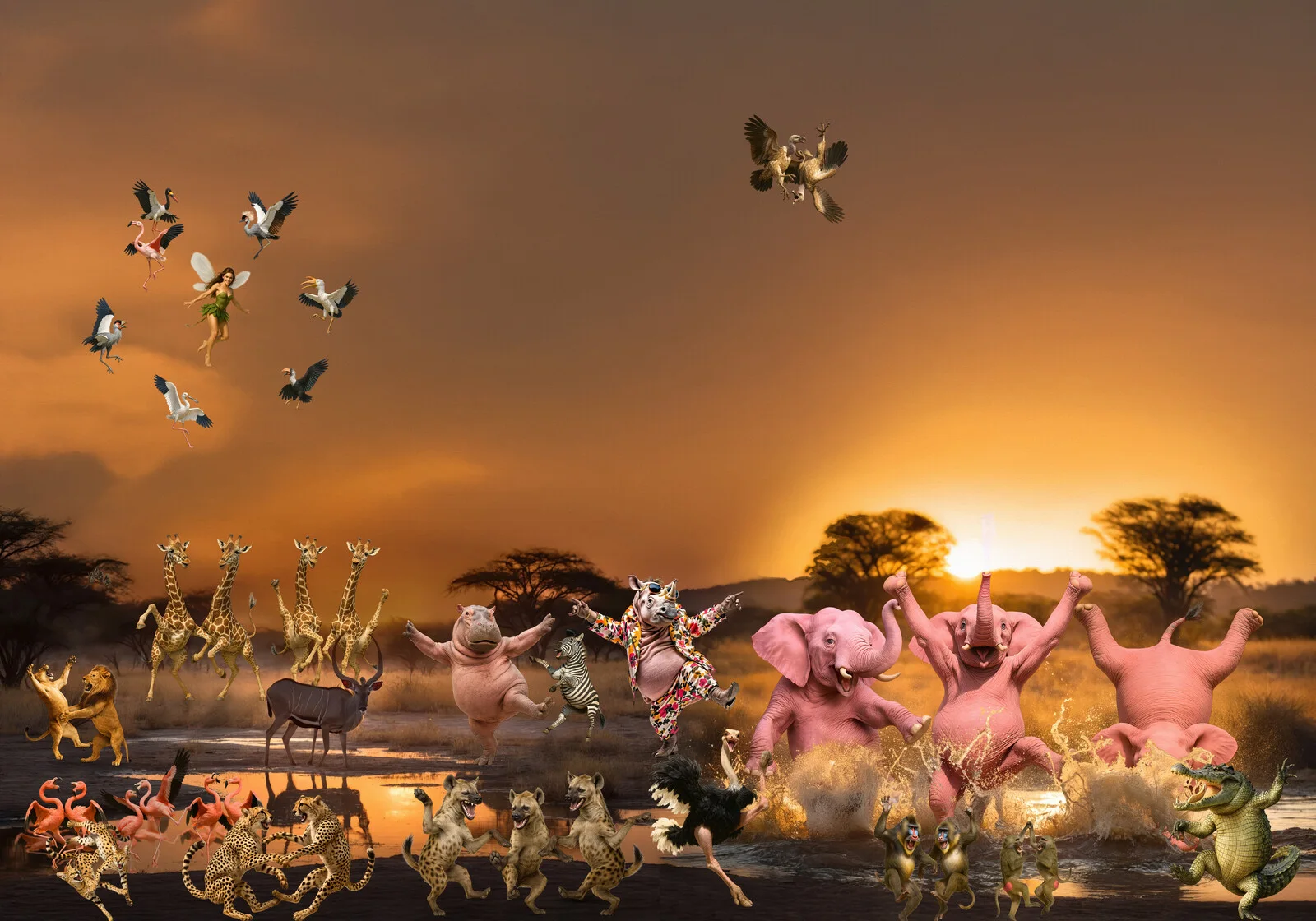
Mbube - Rock n' roll at sunset, 2025
Digital
70 x 50 cm
3 200 kr
Mbube - Rock n' roll at sunset
When the sun turns red over the savanna grass and the sky shudders in the evening heat, a harmonious event begins to unfold at the waterhole in Hluhluwe–iMfolozi. The lions cease their fight, the zebras stop flicking away flies, and even the hyenas fall silent for a moment. It is as if the entire animal kingdom has united for a single concert, a moment of peace and harmony. Soon a stomp echoes, a rhythmic hum, a phrase rolling across the land: Uyimbube… Uyimbube…
That evening, the savannah becomes a rock stage. Flamingos become backing singers, the ostrich pounds the ground like Jerry Lee Lewis on piano keys, and the crocodile growls like the father of the blues himself. All in honour of a man who once improvised a melody in a humble studio in Johannesburg – Solomon Linda. His song ‘Mbube’, a testament to the resilience and creativity of the human spirit, was born from the darkness of the mines, but it took flight across the world and became ‘The Lion Sleeps Tonight’.
Tonight, no lions sleep. Tonight, it’s rock’n’roll at the waterhole.
Join me on a journey to explore the fascinating world of a water hole. This essay aims to both entertain and inform you about the complex process of dancing rock 'n' roll, a music genre that originated in the United States in the late 1940s and early 1950s. Get ready to be educated, inspired, and entertained as we delve into the history and cultural significance of this energetic and expressive form of music.
“Rock ’n’ Roll at the Waterhole
At sunset’s glow, the stage was set,
a savanna beat you won’t forget.
The sky turned red, the grass swayed low,
and every beast was set to go.
The vultures looped a riff on high,
a duelling solo in the sky.
The storks and cranes spun round and round,
their wings the strings, their cries the sound.
The lions rose, a golden pair,
a power couple fierce and rare.
They roared in tune, they roared in time,
the jungle’s chorus in its prime.
The giraffes swayed tall, a lined-up crew,
their necks like mics, the crowd they drew.
The antelope blinked — “Am I in the band?”
Then kicked to the rhythm with hooves in the sand.
A hippo twirled with Chaplin’s grin,
pink as dawn with joy within.
Don’t laugh too hard — you’ll miss the feat:
In short, sharp sprints, he outsped the fleet.
The rhino stomped, the earth went boom,
a boogie beat that shook the room.
Another, dressed in Harlequin flair,
clapped horns to time, a joker’s stare.
A zebra twisted, striped delight,
Elvis’ mane in black and white.
“Wimoweh, wimoweh,” the crowd sang back,
as elephants blasted the brassy track.
Three pink giants trumpeted loud,
their splashy beat amazed the crowd.
While flamingos bowed with cabaret grace,
a feathered chorus in satin lace.
The servals jived, sleek spots in flight,
the leopards wrestled in wild delight.
The hyenas laughed in syncopation,
their cackles are pure percussion’s foundation.
The ostrich strutted, legs a blur,
Jerry Lee Lewis in a feathered fur.
A Little Richard screech, wings open wide,
rock’n’roll glory in full stride.
And last of all, with a toothy grin,
the crocodile growled the blues within.
Ancient voice from ages past,
yet always steady, strong, steadfast.
So if you wander where rhythms ignite,
remember the savanna that roared that night.
No lion slept, no beast stood still,
for Solomon’s song rolled down the hill.
Uyimbube… Uyimbube…”
Malmö. August 2025
Marilyn Beyond the Speed of Thought
As the sun dipped below the horizon, a diverse assembly of creatures had gathered at the waterhole in Hluhluwe–iMfolozi (KwaZulu-Natal). They were there to pay homage to Solomon Linda, the man whose melody, born in the depths of a mine, had transcended borders and cultures to grace the world’s stages and top international charts.
On this extraordinary night, even the lions, who were supposed to be asleep, found themselves caught up in the rhythm, as the entire savannah became a pulsating dance floor.
As dusk settled over Hluhluwe–iMfolozi, the only sounds were the chirping of crickets and a distant splash. Then came a gentle harmony, a steady stomp, and a回应 from behind. Zebras joined in like a doo-wop choir, the ostrich kept time with resolute kicks, and two servals twirled each other in a swing turn. Even the hyenas softened their laughter – tonight was not about prey or territory, but about music. And about Solomon Linda, the Zulu singer who, in 1939, improvised a melody in a Johannesburg studio, named it Mbube (Zulu for “lion”), and began one of the most extraordinary journeys in global music history.
From the miners’ midnight choirs to a global anthem
Linda and his band, The Evening Birds, wore crisp white shirts, striped suits, and shiny shoes around Gallo Studio’s single microphone – and with little rehearsal, their song and stomping were recorded on wax. Mbube became a South African sensation and gave its name to a powerful choral style that eventually evolved into isicathamiya (the trademark of Ladysmith Black Mambazo). The style originated among Zulu migrants living in mining hostels: Western four-part harmony blended with traditional dances and midnight contests where singers tiptoed carefully not to wake the guards.
“Uyimbube” becomes “Wimoweh”
A collection of South African records found its way to the U.S. through musicologist Alan Lomax, who informed Pete Seeger and The Weavers. The refrain uyimbube (“you are a lion”) was misheard as “Wimoweh,” and in 1951, their version became an American hit. At Carnegie Hall in 1957, the audience sang along – the melody had left the miners’ hostels, where it was a source of comfort and unity, to take its place in one of music’s grandest venues, demonstrating the universal appeal and power of music.
The Tokens, falsetto, and an operatic high B
In 1961, The Tokens took the melody, had George David Weiss write the English lyrics “In the jungle, the mighty jungle…,” and recorded it with falsetto singer Jay Siegel and an unexpected twist: operatic soprano Anita Darian soaring above the choir. The result? A U.S. #1 hit and a melody that went global – later echoing in The Lion King. Linda’s name was rarely mentioned, yet his improvised “howl” on the original recording became the very hook that made the pop version unforgettable.
The unjust jungle – and a late redemption
Behind the euphoria lay a harsh truth: Linda, the unsung hero, had sold the rights for 10 shillings and died in 1962, never seeing a share of the riches his melody generated. Only decades later did his family press for compensation; in 2006, a settlement finally brought recognition and royalties to his heirs. The story of Solomon Linda has become a stark symbol of how Black creativity was exploited – but also of how persistent journalism and legal battles can shift injustice, if only slightly.
Why the animals gather – a fable with facts at its core
It was a celebration of a melody born in KwaZulu-Natal that taught the world a lion can roar – but also whisper, and most importantly, unite.
The lions – kings and queens of the savannah – are tonight’s guests of honour. In Zulu, mbube means lion, and the refrain uyimbube becomes a gentle call-and-response, a harmonious unity, between the alpha male and the choir. If anyone is going to roar tonight, they’ll do it in the key of A major.
The zebras – the savanna’s doo-wop singers. Their black-and-white coats already resemble stage costumes; they bring the syncopation and the background “wimoweh.”
The ostrich – the rhythm section. At 70 km/h in a sprint, tonight it’s all about footwork; wings marking the off-beat like a rockabilly bassist, legs tripping like Jerry Lee Lewis on the keys – or like Little Richard in feathers.
The servals – graceful soloists, leaping as high as falsetto top notes.
The giraffes – naturally, the upper register; they see furthest, so they sense the upcoming refrain before everyone else, creating an air of anticipation and intrigue.
The elephants – the bass line. Deep, warm, steady; their steps keep the whole choir coordinated, making the audience feel the constant rhythm of the music.
And in the midst of it all stands a small memorial: a simple picture of Solomon Linda in a hat and narrow tie, just as he wore with the Evening Birds when they were “urban dandies” in the 1930s, a term used to describe stylish and sophisticated urbanites of that era. That the savannah can hush itself for a song is no surprise – isicathamiya is about community. The very word comes from a movement: “to walk softly,” “on tiptoe” – just as one does when making space for others.
A musical journey in three acts – and why it matters
Roots: the Zulu migrants’ choirs in the night competitions of Johannesburg and Durban. Harmonies borrowed from mission hymns meet traditional dances and a touch of urban flair.
Breaking out into the world: Lomax, Seeger, and The Weavers influenced Wimoweh – a misheard refrain that became a gateway to the global stage.
Pop triumph and hangover: The Tokens turned the final improvised yodel, a spontaneous and unique vocal expression, into a catchy hook; the world sang along, but the original creator was left behind. It wasn't until 2006 that restitution was achieved.
There is something beautiful – and slightly – in letting the animals have the final word. For Mbube is not just a song about lions; it embodies the sounds of labour, migration, hope, and invention. It originated from everyday life, where people shared voices when they could not share power or money. That it is now performed at a waterhole where everyone drinks together is a fitting image: music creates a truce. As the moon rises and the refrain continues, flamingos take the soprano and elephants rumble the bass. Hyenas, usually cynical, find harmony. Two servals perform one last flip; the ostrich pounds out a rhythmic break, and the old lion offers a short, gentle reply – not a roar, more an acknowledgement. Tonight the lion sleeps, but the savannah remembers. And somewhere, if you listen carefully, you can still hear how a young man in a simple Johannesburg studio invented a phrase the world has never stopped singing.
FACTS
From Mbube to The Lion Sleeps Tonight. Isicathamiya – roots and practice among Zulu migrants.
1939 – Johannesburg
Solomon Linda and The Evening Birds record Mbube at the Gallo studio. The word means “lion” in Zulu.
1940s – South Africa
The song becomes a major hit, giving rise to the mbube genre and later isicathamiya (brought to international fame by Ladysmith Black Mambazo).
1951 – USA
Pete Seeger and The Weavers' transformation of the refrain “uyimbube” into “Wimoweh” Was a pivotal moment in the song's history. This rendition achieved widespread success in folk and pop music, resonating with audiences far beyond its Zulu roots.
1961 – New York
The Tokens take the melody to number one with new lyrics – “In the jungle, the mighty jungle…” – crowned by soprano Anita Darian’s soaring high notes.
1994 – Disney
With the release of The Lion King in 1994, the song was immortalised for a new generation. The film's adaptation of 'The Lion Sleeps Tonight' brought the music to a global audience, ensuring its place in the hearts of many.
2006 – South Africa
After a lengthy legal battle, Linda’s family finally received recognition and financial compensation.
The image – almost like a programme sheet for a savannah performance.
We can observe the image from left to right, top to bottom, as if standing by the waterhole, witnessing the entire rock ballet unfold.
Top left – in the sky
A circle of birds: storks, cranes, and flamingos form a dancing ring around the floating fairy, tonight’s conductor. She hovers mid-air, wings vibrating in time with the beat.
Two vultures circle above, near the top, locked in either a duel or a partner dance – depending on your perspective. Their confrontation resembles a guitar solo face-off: Johnny B. Goode clashing with Duelling Banjos. Honour was at stake, but the crowd received double riffs for the price of one.
Centre – the grand stage of the savannah.
Far left, up in the tree, sat tonight’s orchestra – or chorus, really – the vervet monkeys shrieking loudly enough to carry across the plain.
The lion pair to the left: a lion and lioness standing upright on hind legs, ready to roar in harmony – a rock power couple if ever there was one.
The giraffes: a whole row swaying forward in a perfectly timed line dance, their long necks moving like swinging microphone stands.
The antelope stood centre stage, almost like a startled audience member who had stumbled onto the set – but soon swept away by the rhythm. Its graceful leaps and spins added a touch of elegance to the performance, mirroring the delicate notes of the music.
The hippo, painted pink like the offspring of the sky itself: a round, joyful figure twirling on its hind legs with Chaplinesque steps. And anyone who thought hippos were clumsy soon learned better – in short sprints, they can leave Usain Bolt eating dust.
The rhino: an unexpected whirlwind. Those who thought him heavy and slow saw him drop into blues pace, then burst into boogie. In short bursts faster than the fastest human, his horn marked the beat like a conductor’s baton.
The zebra: a striped rock ’n’ roll twist, mane slicked back like Elvis Presley himself. Its sleek, black-and-white stripes shimmered under the stage lights, and its hooves tapped the ground in perfect rhythm. Backing vocals in black-and-white “wimoweh,” but with the most incredible moves on the floor.
The harlequin-patterned rhino: tonight’s joker – a showman in a glittering rock suit, leading the crowd in handclaps like a Zulu Jerry Lee.
The elephants: three pink giants bouncing in sync at the water’s edge, splashing and trumpeting, forming the night’s brass section. Their bassline kept the entire savannah choir in check.
Bottom – closest to the viewer
Flamingos to the left: a cluster of pink dancers, with necks arched like choreographed cabaret arms.
In front of them, two servals cavorting – as agile as falsetto high notes – and beside them, a pair of leopards dancing wildly, almost like tussling, but full of rock’n’roll energy.
Four hyenas in a circle dancing, cackling as usual, but this time perfectly in sync – their laughter a percussion beat of its own.
The ostrich: tiptoeing like a ballerina with wings outstretched, but its legs pounding the ground like Jerry Lee Lewis on piano keys – a pure Little Richard-in-feathers moment.
To the right, monkeys danced in pairs, with mandrills flashing their colourful noses and baboons proudly displaying their bright red rears. Their energy and vibrant performances added a splash of colour to the evening, making their dance as unforgettable as any guitar solo.
And at the bottom right, a crocodile broke free, almost like a green-clad rockabilly bassist, jaws wide in a toothy grin. As a species, he was the oldest on stage: crocodiles have roamed Earth for over 200 million years, closely related to birds and dinosaurs. They communicate with deep, roaring calls – and tonight the crocodile became the father of blues: ancient, growling, but always in perfect time.
Jörgen Thornberg
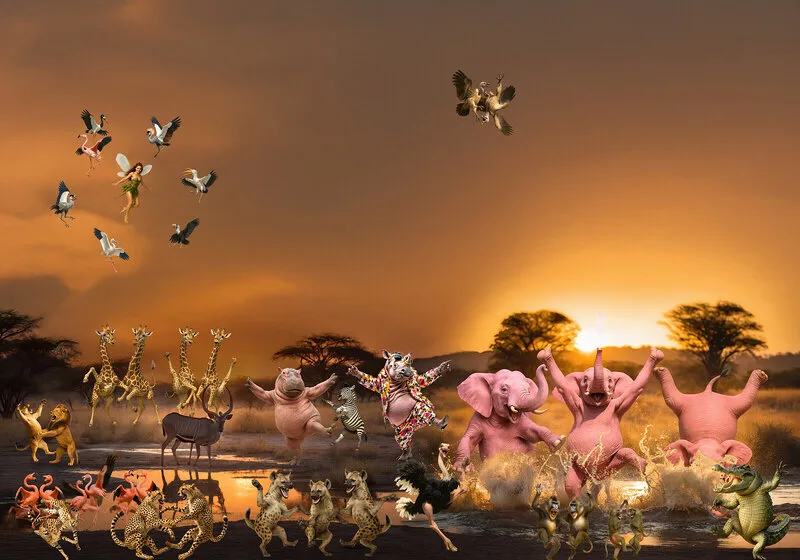
Mbube - Rock n' roll at sunset, 2025
Digital
70 x 50 cm
3 200 kr
Mbube - Rock n' roll at sunset
When the sun turns red over the savanna grass and the sky shudders in the evening heat, a harmonious event begins to unfold at the waterhole in Hluhluwe–iMfolozi. The lions cease their fight, the zebras stop flicking away flies, and even the hyenas fall silent for a moment. It is as if the entire animal kingdom has united for a single concert, a moment of peace and harmony. Soon a stomp echoes, a rhythmic hum, a phrase rolling across the land: Uyimbube… Uyimbube…
That evening, the savannah becomes a rock stage. Flamingos become backing singers, the ostrich pounds the ground like Jerry Lee Lewis on piano keys, and the crocodile growls like the father of the blues himself. All in honour of a man who once improvised a melody in a humble studio in Johannesburg – Solomon Linda. His song ‘Mbube’, a testament to the resilience and creativity of the human spirit, was born from the darkness of the mines, but it took flight across the world and became ‘The Lion Sleeps Tonight’.
Tonight, no lions sleep. Tonight, it’s rock’n’roll at the waterhole.
Join me on a journey to explore the fascinating world of a water hole. This essay aims to both entertain and inform you about the complex process of dancing rock 'n' roll, a music genre that originated in the United States in the late 1940s and early 1950s. Get ready to be educated, inspired, and entertained as we delve into the history and cultural significance of this energetic and expressive form of music.
“Rock ’n’ Roll at the Waterhole
At sunset’s glow, the stage was set,
a savanna beat you won’t forget.
The sky turned red, the grass swayed low,
and every beast was set to go.
The vultures looped a riff on high,
a duelling solo in the sky.
The storks and cranes spun round and round,
their wings the strings, their cries the sound.
The lions rose, a golden pair,
a power couple fierce and rare.
They roared in tune, they roared in time,
the jungle’s chorus in its prime.
The giraffes swayed tall, a lined-up crew,
their necks like mics, the crowd they drew.
The antelope blinked — “Am I in the band?”
Then kicked to the rhythm with hooves in the sand.
A hippo twirled with Chaplin’s grin,
pink as dawn with joy within.
Don’t laugh too hard — you’ll miss the feat:
In short, sharp sprints, he outsped the fleet.
The rhino stomped, the earth went boom,
a boogie beat that shook the room.
Another, dressed in Harlequin flair,
clapped horns to time, a joker’s stare.
A zebra twisted, striped delight,
Elvis’ mane in black and white.
“Wimoweh, wimoweh,” the crowd sang back,
as elephants blasted the brassy track.
Three pink giants trumpeted loud,
their splashy beat amazed the crowd.
While flamingos bowed with cabaret grace,
a feathered chorus in satin lace.
The servals jived, sleek spots in flight,
the leopards wrestled in wild delight.
The hyenas laughed in syncopation,
their cackles are pure percussion’s foundation.
The ostrich strutted, legs a blur,
Jerry Lee Lewis in a feathered fur.
A Little Richard screech, wings open wide,
rock’n’roll glory in full stride.
And last of all, with a toothy grin,
the crocodile growled the blues within.
Ancient voice from ages past,
yet always steady, strong, steadfast.
So if you wander where rhythms ignite,
remember the savanna that roared that night.
No lion slept, no beast stood still,
for Solomon’s song rolled down the hill.
Uyimbube… Uyimbube…”
Malmö. August 2025
Marilyn Beyond the Speed of Thought
As the sun dipped below the horizon, a diverse assembly of creatures had gathered at the waterhole in Hluhluwe–iMfolozi (KwaZulu-Natal). They were there to pay homage to Solomon Linda, the man whose melody, born in the depths of a mine, had transcended borders and cultures to grace the world’s stages and top international charts.
On this extraordinary night, even the lions, who were supposed to be asleep, found themselves caught up in the rhythm, as the entire savannah became a pulsating dance floor.
As dusk settled over Hluhluwe–iMfolozi, the only sounds were the chirping of crickets and a distant splash. Then came a gentle harmony, a steady stomp, and a回应 from behind. Zebras joined in like a doo-wop choir, the ostrich kept time with resolute kicks, and two servals twirled each other in a swing turn. Even the hyenas softened their laughter – tonight was not about prey or territory, but about music. And about Solomon Linda, the Zulu singer who, in 1939, improvised a melody in a Johannesburg studio, named it Mbube (Zulu for “lion”), and began one of the most extraordinary journeys in global music history.
From the miners’ midnight choirs to a global anthem
Linda and his band, The Evening Birds, wore crisp white shirts, striped suits, and shiny shoes around Gallo Studio’s single microphone – and with little rehearsal, their song and stomping were recorded on wax. Mbube became a South African sensation and gave its name to a powerful choral style that eventually evolved into isicathamiya (the trademark of Ladysmith Black Mambazo). The style originated among Zulu migrants living in mining hostels: Western four-part harmony blended with traditional dances and midnight contests where singers tiptoed carefully not to wake the guards.
“Uyimbube” becomes “Wimoweh”
A collection of South African records found its way to the U.S. through musicologist Alan Lomax, who informed Pete Seeger and The Weavers. The refrain uyimbube (“you are a lion”) was misheard as “Wimoweh,” and in 1951, their version became an American hit. At Carnegie Hall in 1957, the audience sang along – the melody had left the miners’ hostels, where it was a source of comfort and unity, to take its place in one of music’s grandest venues, demonstrating the universal appeal and power of music.
The Tokens, falsetto, and an operatic high B
In 1961, The Tokens took the melody, had George David Weiss write the English lyrics “In the jungle, the mighty jungle…,” and recorded it with falsetto singer Jay Siegel and an unexpected twist: operatic soprano Anita Darian soaring above the choir. The result? A U.S. #1 hit and a melody that went global – later echoing in The Lion King. Linda’s name was rarely mentioned, yet his improvised “howl” on the original recording became the very hook that made the pop version unforgettable.
The unjust jungle – and a late redemption
Behind the euphoria lay a harsh truth: Linda, the unsung hero, had sold the rights for 10 shillings and died in 1962, never seeing a share of the riches his melody generated. Only decades later did his family press for compensation; in 2006, a settlement finally brought recognition and royalties to his heirs. The story of Solomon Linda has become a stark symbol of how Black creativity was exploited – but also of how persistent journalism and legal battles can shift injustice, if only slightly.
Why the animals gather – a fable with facts at its core
It was a celebration of a melody born in KwaZulu-Natal that taught the world a lion can roar – but also whisper, and most importantly, unite.
The lions – kings and queens of the savannah – are tonight’s guests of honour. In Zulu, mbube means lion, and the refrain uyimbube becomes a gentle call-and-response, a harmonious unity, between the alpha male and the choir. If anyone is going to roar tonight, they’ll do it in the key of A major.
The zebras – the savanna’s doo-wop singers. Their black-and-white coats already resemble stage costumes; they bring the syncopation and the background “wimoweh.”
The ostrich – the rhythm section. At 70 km/h in a sprint, tonight it’s all about footwork; wings marking the off-beat like a rockabilly bassist, legs tripping like Jerry Lee Lewis on the keys – or like Little Richard in feathers.
The servals – graceful soloists, leaping as high as falsetto top notes.
The giraffes – naturally, the upper register; they see furthest, so they sense the upcoming refrain before everyone else, creating an air of anticipation and intrigue.
The elephants – the bass line. Deep, warm, steady; their steps keep the whole choir coordinated, making the audience feel the constant rhythm of the music.
And in the midst of it all stands a small memorial: a simple picture of Solomon Linda in a hat and narrow tie, just as he wore with the Evening Birds when they were “urban dandies” in the 1930s, a term used to describe stylish and sophisticated urbanites of that era. That the savannah can hush itself for a song is no surprise – isicathamiya is about community. The very word comes from a movement: “to walk softly,” “on tiptoe” – just as one does when making space for others.
A musical journey in three acts – and why it matters
Roots: the Zulu migrants’ choirs in the night competitions of Johannesburg and Durban. Harmonies borrowed from mission hymns meet traditional dances and a touch of urban flair.
Breaking out into the world: Lomax, Seeger, and The Weavers influenced Wimoweh – a misheard refrain that became a gateway to the global stage.
Pop triumph and hangover: The Tokens turned the final improvised yodel, a spontaneous and unique vocal expression, into a catchy hook; the world sang along, but the original creator was left behind. It wasn't until 2006 that restitution was achieved.
There is something beautiful – and slightly – in letting the animals have the final word. For Mbube is not just a song about lions; it embodies the sounds of labour, migration, hope, and invention. It originated from everyday life, where people shared voices when they could not share power or money. That it is now performed at a waterhole where everyone drinks together is a fitting image: music creates a truce. As the moon rises and the refrain continues, flamingos take the soprano and elephants rumble the bass. Hyenas, usually cynical, find harmony. Two servals perform one last flip; the ostrich pounds out a rhythmic break, and the old lion offers a short, gentle reply – not a roar, more an acknowledgement. Tonight the lion sleeps, but the savannah remembers. And somewhere, if you listen carefully, you can still hear how a young man in a simple Johannesburg studio invented a phrase the world has never stopped singing.
FACTS
From Mbube to The Lion Sleeps Tonight. Isicathamiya – roots and practice among Zulu migrants.
1939 – Johannesburg
Solomon Linda and The Evening Birds record Mbube at the Gallo studio. The word means “lion” in Zulu.
1940s – South Africa
The song becomes a major hit, giving rise to the mbube genre and later isicathamiya (brought to international fame by Ladysmith Black Mambazo).
1951 – USA
Pete Seeger and The Weavers' transformation of the refrain “uyimbube” into “Wimoweh” Was a pivotal moment in the song's history. This rendition achieved widespread success in folk and pop music, resonating with audiences far beyond its Zulu roots.
1961 – New York
The Tokens take the melody to number one with new lyrics – “In the jungle, the mighty jungle…” – crowned by soprano Anita Darian’s soaring high notes.
1994 – Disney
With the release of The Lion King in 1994, the song was immortalised for a new generation. The film's adaptation of 'The Lion Sleeps Tonight' brought the music to a global audience, ensuring its place in the hearts of many.
2006 – South Africa
After a lengthy legal battle, Linda’s family finally received recognition and financial compensation.
The image – almost like a programme sheet for a savannah performance.
We can observe the image from left to right, top to bottom, as if standing by the waterhole, witnessing the entire rock ballet unfold.
Top left – in the sky
A circle of birds: storks, cranes, and flamingos form a dancing ring around the floating fairy, tonight’s conductor. She hovers mid-air, wings vibrating in time with the beat.
Two vultures circle above, near the top, locked in either a duel or a partner dance – depending on your perspective. Their confrontation resembles a guitar solo face-off: Johnny B. Goode clashing with Duelling Banjos. Honour was at stake, but the crowd received double riffs for the price of one.
Centre – the grand stage of the savannah.
Far left, up in the tree, sat tonight’s orchestra – or chorus, really – the vervet monkeys shrieking loudly enough to carry across the plain.
The lion pair to the left: a lion and lioness standing upright on hind legs, ready to roar in harmony – a rock power couple if ever there was one.
The giraffes: a whole row swaying forward in a perfectly timed line dance, their long necks moving like swinging microphone stands.
The antelope stood centre stage, almost like a startled audience member who had stumbled onto the set – but soon swept away by the rhythm. Its graceful leaps and spins added a touch of elegance to the performance, mirroring the delicate notes of the music.
The hippo, painted pink like the offspring of the sky itself: a round, joyful figure twirling on its hind legs with Chaplinesque steps. And anyone who thought hippos were clumsy soon learned better – in short sprints, they can leave Usain Bolt eating dust.
The rhino: an unexpected whirlwind. Those who thought him heavy and slow saw him drop into blues pace, then burst into boogie. In short bursts faster than the fastest human, his horn marked the beat like a conductor’s baton.
The zebra: a striped rock ’n’ roll twist, mane slicked back like Elvis Presley himself. Its sleek, black-and-white stripes shimmered under the stage lights, and its hooves tapped the ground in perfect rhythm. Backing vocals in black-and-white “wimoweh,” but with the most incredible moves on the floor.
The harlequin-patterned rhino: tonight’s joker – a showman in a glittering rock suit, leading the crowd in handclaps like a Zulu Jerry Lee.
The elephants: three pink giants bouncing in sync at the water’s edge, splashing and trumpeting, forming the night’s brass section. Their bassline kept the entire savannah choir in check.
Bottom – closest to the viewer
Flamingos to the left: a cluster of pink dancers, with necks arched like choreographed cabaret arms.
In front of them, two servals cavorting – as agile as falsetto high notes – and beside them, a pair of leopards dancing wildly, almost like tussling, but full of rock’n’roll energy.
Four hyenas in a circle dancing, cackling as usual, but this time perfectly in sync – their laughter a percussion beat of its own.
The ostrich: tiptoeing like a ballerina with wings outstretched, but its legs pounding the ground like Jerry Lee Lewis on piano keys – a pure Little Richard-in-feathers moment.
To the right, monkeys danced in pairs, with mandrills flashing their colourful noses and baboons proudly displaying their bright red rears. Their energy and vibrant performances added a splash of colour to the evening, making their dance as unforgettable as any guitar solo.
And at the bottom right, a crocodile broke free, almost like a green-clad rockabilly bassist, jaws wide in a toothy grin. As a species, he was the oldest on stage: crocodiles have roamed Earth for over 200 million years, closely related to birds and dinosaurs. They communicate with deep, roaring calls – and tonight the crocodile became the father of blues: ancient, growling, but always in perfect time.
3 200 kr

Jörgen Thornberg
Malmö
Lite om bilder och mig. Translation in English at the end.
Jag är en nyfiken person som ser allt i bilder, även det jag fäster i ord, gärna tillsammans för bakom alla mina bilder finns en berättelse. Till vissa bilder hör en kortare eller längre novell som följer med bilden.
Bilder berättar historier. Jag omges av naturlig skönhet, intressanta människor och historia var jag än går. Jag använder min kamera för att dokumentera världen och blanda det jag ser med vad jag känner för att fånga den dolda magin.
Mina bilder berättar mina historier. Genom mina bilder, tryck och berättelser. Jag bjuder in dig att ta del av dessa berättelser, in i ditt liv och hem och dela min mycket personliga syn på vår värld. Mer än vad ögat ser. Jag tänker i bilder, drömmer och skriver och pratar om dem; följaktligen måste jag också skapa bilder. De blir vad jag ser, inte nödvändigtvis begränsade till verkligheten. Det finns en bild runt varje hörn. Jag hoppas att du kommer att se vad jag såg och gilla det.
Jag är också en skrivande person och till många bilder hör en kortare eller längre essay. Den följer med tavlan, tryckt på fint papper och med en personlig hälsning från mig.
Flertalet bilder startar sin resa i min kamera. Enkelt förklarat beskriver jag bilden jag ser i mitt inre, upplevd eller fantiserad. Bilden uppstår inom mig redan innan jag fått okularet till ögat. På bråkdelen av ett ögonblick ser jag vad jag vill ha och vad som kan göras med bilden. Här skall jag stoppa in en giraff, stålmannen, Titanic eller vad det är min fantasi finner ut. Ännu märkligare är att jag kommer ihåg minnesbilden långt efteråt när det blir tid att skapa verket. Om jag lyckas eller inte, är upp till betraktaren, oftast präglat av en stråk av svart humor – meningen är att man skall bli underhållen. Mina bilder blir ofta en snackis där de hänger.
Jag föredrar bilder som förmedlar ett budskap i flera lager. Vid första anblicken fylld av feel-good, en vacker utsikt, fint väder, solen skiner, blommor på ängen eller vattnet som ligger förrädiskt spegelblankt. I en sådan bild kan jag gömma min egentliga berättelse, mitt förakt för förtryckare och våldsverkare, rasister och fördomsfulla människor - ett gärna återkommande motiv mer eller mindre dolt i det vackra motivet. Jag försöker förena dem i ett gemensamt narrativ.
Bild och formgivning har löpt som en röd tråd genom livet. Fotokonst känns som en värdig final som jag gärna delar med mig.
Min genre är vid som framgår av mina bilder, temat en blandning av pop- och gatukonst i kollage som kan bestå av hundratals lager. Vissa bilder kan ta veckor, andra någon dag innan det är dags att överlämna resultatet till printverkstaden. Fine Art Prints är digitala fotocollage. I dessa kollage sker rivandet, klippandet, pusslandet, målandet, ritandet och sprayningen digitalt. Det jag monterar in kan vara hundratals år gamla bilder som jag omsorgsfullt frilägger så att de ser ut att vara en del av tavlan men också bilder skapade av mig själv efter min egen fantasi. Därefter besöks printstudion och för vissa bilder numrera en limiterad upplaga (oftast 7 exemplar) och signera för hand. Vissa bilder kan köpas i olika format. Det är bara att fråga efter vilka. Gillar man en bild som är 70x100 men inte har plats på väggen, går den kanske att få i 50x70 cm istället. Frågan är fri.
Metoden Giclée eller Fine Art Print som det också kallas är det moderna sättet för framställning av grafisk konst. Villkoret för denna typ av utskrifter är att en högkvalitativ storformatskrivare används med åldersbeständigt färgpigment och konstnärspapper eller i förekommande fall på duk. Pappret som används möter de krav på livslängd som ställs av museer och gallerier. Normalt säljer jag mina bilder oinramade så att den nya ägaren själv kan bestämma hur de skall se ut, med eller utan passepartout färg på ram, med eller utan glas etc..
Under många år ställde jag bara ut på nätet, i valda grupper och på min egen Facebooksida - https://www.facebook.com/jorgen.thornberg.9
Jag finns också på en egen hemsida som tyvärr inte alltid är uppdaterad – https://www.jth.life/ Där kan du också läsa en del av de berättelser som följer med bilden.
UTSTÄLLNINGAR
Luftkastellet, oktober 2022
Konst i Lund, november 2022
Luftkastellet, mars 2023
Engleson Galleri Caroli, april 2023
Hydra, Greece June 2023
Engleson Galleri Caroli, oktober 2023
Toppen, Höllviken december 2023
Luftkastellet, mars 2024
Torups Galleri, mars 2024
Venice, May 2024
Luftkastellet, oktober 2024
Konst i Advent, December 2024
Galleri Engleson, Caroli December 2024
Jäger & Jansson Galleri, april 2025
A bit about pictures and me.
I'm a curious person who sees everything in pictures, even what I express in words, often combining them, for behind all my pictures lies a story. These narratives, some as short as a single image and others as long as a novel, are the heart and soul of my work.
Pictures tell stories. Wherever I go, I'm surrounded by natural beauty, exciting people, and history. I use my camera to document the world and blend what I see with what I feel to capture the hidden magic.
My images tell my stories. Through my pictures, prints, and narratives, I invite you to partake in these stories in your life and home and share my deeply personal perspective of our world. More than meets the eye. I think in pictures, dream, write, and talk about them; consequently, I must create images too. They become what I see, not necessarily confined to reality. There's a picture around every corner. I hope you'll see what I saw and enjoy it.
I'm also a writer, and many images come with a shorter or longer essay. It accompanies the painting, printed on fine paper with my personal greeting.
Many pictures start their journey on my camera. Simply put, I describe the image I see in my mind, experienced or imagined. The image arises within me even before I bring the eyepiece to my eye. In a fraction of a moment, I see what I want and what can be done with the picture. Here, I'll insert a giraffe, Superman, the Titanic, or whatever my imagination conjures up. Even stranger is that I remember the mental image long after it's time to create the work. Whether I succeed is up to the observer, often imbued with a streak of black humour – the aim is to entertain. My pictures usually become a talking point wherever they hang.
I prefer pictures that convey a message in multiple layers. At first glance, they're filled with feel-good vibes, a beautiful view, lovely weather, the sun shining, flowers in the meadow, or the water lying deceptively calm. But beneath this surface beauty, I often conceal a deeper story, a narrative that challenges societal norms or explores the human condition. I invite you to delve into these hidden narratives and discover the layers of meaning within my work.
Picture and design have been a thread running through my life. Photographic art feels like a fitting finale, and I'm happy to share it.
My genre is varied, as seen in my pictures; the theme is a blend of pop and street art in collages that can consist of hundreds of layers. Some images can take weeks, others just a day before it's time to hand over the result to the print workshop. Fine Art Prints are digital photo collages. In these collages, tearing, cutting, puzzling, painting, drawing, and spraying happen digitally. What I insert can be images hundreds of years old that I carefully extract so they appear to be part of the painting, but also images created by myself, now also generated from my imagination. Next, visit the print studio and, for certain images, number a limited edition (usually 7 copies) and sign them by hand. Some images may be available in other formats. Just ask which ones. If you like an image that's 70x100 but doesn't have space on the wall, you might be able to get it in 50x70 cm instead. The question is open.
The Giclée method, or Fine Art Print as it's also called, is the modern way of producing graphic art. This method ensures the highest quality and longevity of the artwork, using a high-quality large-format printer with archival pigment inks and artist paper or, in some cases, canvas. The paper used meets the longevity requirements set by museums and galleries. I sell my pictures unframed, allowing the new owner to personalise their artwork, confident in the lasting value and quality of the piece.
For many years, I only exhibited online, in selected groups, and on my Facebook page - https://www.facebook.com/jorgen.thornberg.9. I also have my website, which unfortunately is not constantly updated - https://www.jth.life/. You can also read some of the stories accompanying the pictures there.
EXHIBITIONS
Luftkastellet, October 2022
Art in Lund, November 2022
Luftkastellet, March 2023
Engleson Gallery Caroli, April 2023
Hydra, Greece June 2023
Engleson Gallery Caroli, October 2023
Toppen, Höllviken December 2023
Luftkastellet, March 2024
Torup Gallery, March 2024
Venice, May 2024
UTSTÄLLNINGAR
Luftkastellet, oktober 2022
Konst i Lund, november 2022
Luftkastellet, mars 2023
Engleson Galleri Caroli, april 2023
Hydra, Greece June 2023
Engleson Galleri Caroli, oktober 2023
Toppen, Höllviken december 2023
Luftkastellet, mars 2024
Torups Galleri, mars 2024
Venice, May 2024
Luftkastellet, October 2024
Konst i Advent, December 2024
Galleri Engleson, Caroli December 2024
Jäger & Jansson Galleri, April 2025
Utbildning
Autodidakt
Medlem i konstnärsförening
Öppna Sinnen
Med i konstrunda
Konstrundan i Skåne
Utställningar
Luftkastellet, October 2022
Art in Lund, November 2022
Luftkastellet, March 2023
Engleson Gallery Caroli, April 2023
Hydra, Greece June 2023
Engleson Gallery Caroli, October 2023
Toppen, Höllviken December 2023
Luftkastellet, March 2024
Torup Gallery, March 2024
Venice, May 2024