Vi använder cookies för att ge dig bästa möjliga upplevelse. Välj vilka cookies du tillåter.
Läs mer i vår integritetspolicy
Jörgen Thornberg
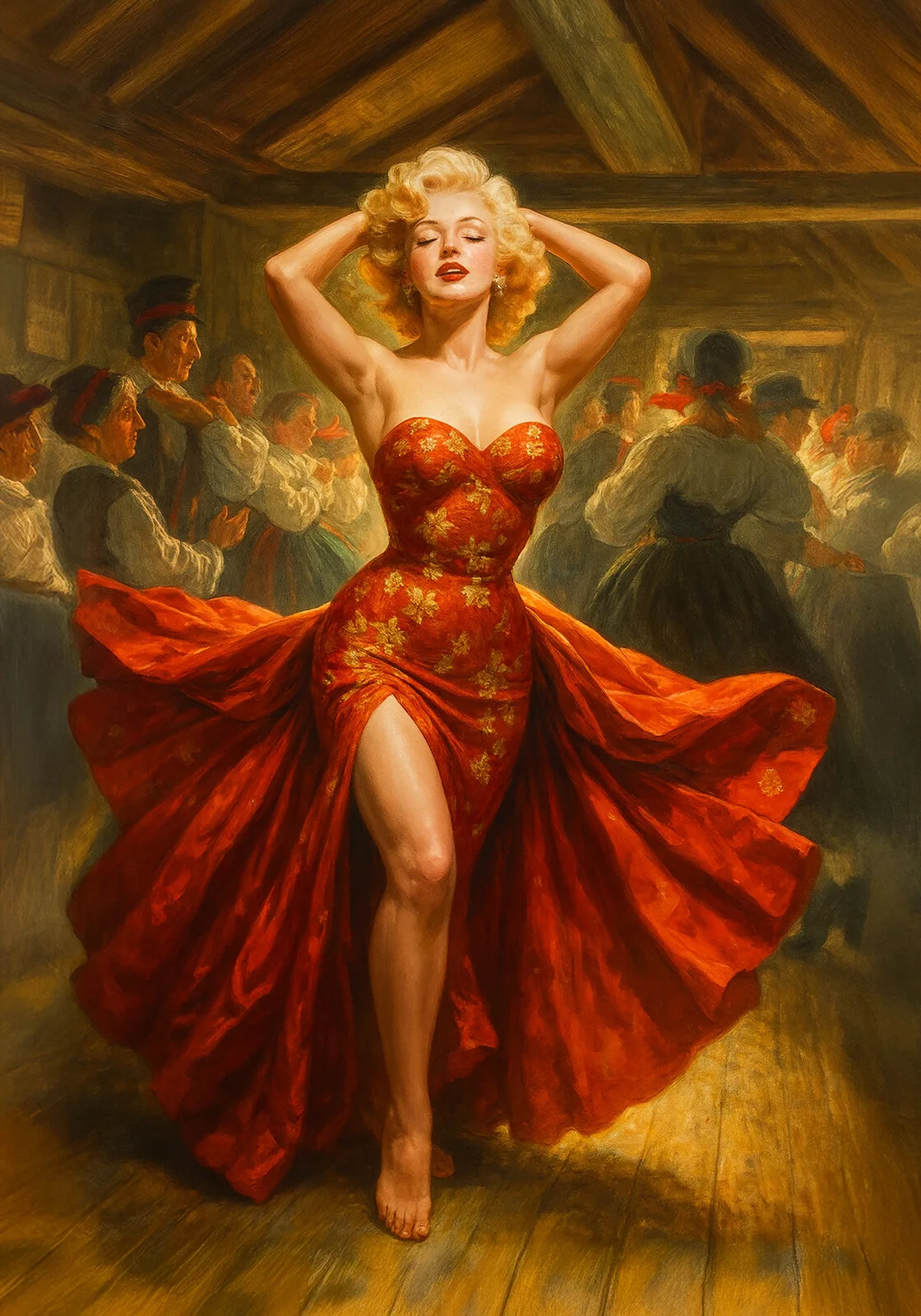
Dance in Gopsmor Cabin - Dans i Gopsmorstugan, 2025
Digital
50 x 70 cm
3 200 kr
Dance at Gopsmor 2025 - Dans på Gopsmor 2025
It commences, like many improbable tales, with a meeting that defies all norms of logic and reason. The year is 2025 – or perhaps it is 1914, or both simultaneously – for in the realm of art and memory, time is not bound by the constraints of a linear narrative. In the heart of Dalarna, where the Österdal River meanders past ancient forests and weathered timber walls, a fire blazes in Gopsmorstugan. Outside, the snow blankets the roof. Inside, the air is heavy with the harmonious notes of music, the scent of tarred wood, and the warm breath of people huddled together.
Through the door steps Marilyn Monroe, her red dress a stark contrast against the rustic timber walls, her eyes sweeping across the room with both curiosity and certainty. Somewhere in the shadows, unseen but utterly present, Anders Zorn watches. This is his domain – his timbered refuge, his stage for the dances he calls lekstugor. And yet tonight, the dance is not entirely his.
What unfolds is not a mere historical account, nor a figment of imagination. It is the type of scene that only art can bring to life: a rendezvous across centuries, a moment when the rhythm of a polska can unite two individuals – one from the silver screen, the other from the silver light of the Nordic winter – in the same breath, the same room, the same step, sharing a unique and timeless experience.
Join me on a journey to explore the intriguing world of pictures. This essay seeks to entertain and enlighten you about the complicated nature of love in a good story. Prepare to be enlightened.
“Two Smiles, One Blade
Polska at Gopsmor
In Gopsmor’s hall, two hundred years worn,
where pine beams creak and the hearth keeps warm,
the fiddles sound as the shadows bend,
and past and present begin to blend.
Zorn’s back once more, the master returned,
from realms beyond where the starlight burned.
And at his side, with a glance that glows,
walks Marilyn, in her scarlet clothes.
The boots all pound with a farmer’s might,
their rhythm deep as the winter night.
But lighter still, on the pine boards set,
Marilyn’s naked feet in a bright pirouette.
She floats and turns through the smoky air,
the scarlet hem like a whispered dare.
Zorn watches closely from the shadow’s keep,
and paints her dance where the echoes sleep.
Two hundred years in the timber stay,
yet time itself seems to slip away—
for in that hall, where the polska swirls,
the master dances with the world’s bright girls.”
Malmö. August 2025
Dance at Gopsmor, 2025
Imagine if Anders Zorn, the renowned artist known for his depictions of beautiful women, were to return to Earth today, he wouldn't arrive alone. One could easily picture him stepping out of a cosmic portal, with Marilyn Monroe by his side – she, with her iconic blend of innocence and calculated allure. This unique charm, which captivated hearts and minds, was a trait he shared with the confident men who bask in both artistic fame and a well-established reputation as a ladies’ man.
On Earth, Zorn had a fondness for beautiful women, and it is no coincidence that his paintings often depict naked bodies in baths or amidst nature. Marilyn, for her part, was no stranger to dancing, parties, or lingering glances. In Gopsmor Cottage, Zorn’s cherished retreat in Dalarna, the two could have met in a moment that transcended time. He would have invited her to one of his legendary evenings – “lekstugorna,” as he called them – where fiddles played and the floor swayed to the rhythm of the polska.
The dance commenced with a chord, a musical note that seemed to linger in the air, inviting everyone to partake. The first step, a stomp on the plank floor, set the entire cottage abuzz. The walls, tables, benches, and even the cups on the shelf trembled slightly, as if in eager anticipation. The warmth from the fire and the people was already palpable, and now it gained a pulse, a rhythm that was impossible to resist.
The fiddlers sat shoulder to shoulder, as if sharing more than just music. Their old violins, their varnish darkened by decades, bore a history of weddings, harvest feasts, and secret meetings in barns. The bows tore through the thick air, a scrape and a gentle caress, a pulling stroke that propelled the dance onwards, echoing the traditions of generations past.
The polska was three steps that became six, then twelve. The floor echoed with the sound of heavy leather soles: thump, thump, sweep. Round and round, in a pattern as old as the timber in the walls. The men held the women firmly, but there was nothing stiff in their grip – only the strength needed to keep pace with the whirl.
And then, in the centre of the circle, something shattered with all that was familiar. Barefoot steps. Light, soundless. Marilyn moved as if the polska had always run in her veins. Her feet, nails painted the same deep red as her dress, glided over the planks with effortless daring. Her steps were softer than the dull thud of shoes, yet with a precision that made the dance ignite, like a laugh in the middle of a serious song.
Dancing barefoot was a bold act of defiance, a symbolic rebellion against centuries of societal norms. In Zorn’s era, it was unthinkable for a respectable woman to show her toes outside the washbasin. Yet, here was Marilyn, not just with her feet bare, but with an entire attitude, a stance that defied the constraints of cloth, laced bodices, heavy skirts, and shackled minds.
The heat grew hotter. The fire threw long, lively shadows on the walls. A girl giggled, and a man pressed the beat more firmly. The polska spun again and again. The fiddlers’ eyes sparkled above their bows – they were playing as much for the foreign guest as for the local dancers.
In the shadows, where the firelight struggled to reach, was the artist himself. He could not be seen, but his gaze was there, following every turn, every swing of hair, every step that landed on the floor. He was both present and absent, as if he had already begun painting what he called his “Lekstuga” in his mind. The 'Lekstuga' was a term Zorn used to describe his paintings of playful, carefree scenes, and it was probably why he stayed hidden, not to disturb the scene, but to capture it in his mind for his future work.
And the music continued. The polska inhaled and exhaled, as if it were a living being. Marilyn’s movements matched the rhythm, her skirt absorbing the heat of the dance and tossing it back with each spin. The shoes around her tramped heavily and earthbound, while her bare feet seemed to drift above them, like a fearless flower on the worn boards of the floor.
When the tune finally faded, it was as if the cottage took a breath and hesitated before the next inhale. The fire in the open hearth crackled, the fiddles rested, and in the silence that followed, Marilyn stood barefoot, smiling, her breath high in her chest. She was both there and not as much a part of the evening as part of a painting still in the making. The aftermath of the dance was a moment of stillness and reflection, a pause before the next chapter in the evening's story.
Gopsmor was not just a place – it was a reflection of a way of life, a life of admirable simplicity. Nestled along the Österdal River and constructed from old timber houses he had moved there piece by piece, it became his refuge from the urbane life of the Zorn House and the watchful eyes of the town of Mora. Here he lived “in the way of the forefathers”: simple food, primitive comforts, and freedom from the demands of social games. He fished, hunted, painted, and lived close to what he perceived as the essence of Sweden.
Today, as you stroll among the seven buildings – the barn from Landbobyn, dating back to the winter of 1324–25; the storehouse from Gopshus, from the mid-1500s; the cottage from the early 1800s – you can't help but be awed by their historical significance. The crackling fire in the hearth, the scent of tar and wood, shutters that kept out both the cold and prying eyes, all transport you back to his time. In that setting, the image of Marilyn in her red, strapless gown feels almost otherworldly. In her own time—the mid-20th century—it was already daring. In Zorn’s era, with layers of skirts and a headscarf, it would have been scandalous. But Zorn, already well-known to the world as the painter of fully nude kullor, would more likely have raised his glass than his voice.
In 1904, Zorn purchased the land from his uncle Per. He moved timber structures onto the site, including the old barn, and established a combined studio, fishing lodge, and gathering place. It was here that he invited local youths to dance, always accompanied by fiddlers such as Ljuder Anders from Gopshus, his son, and his grandsons. It was also at this location that he received friends from artistic circles – Karlfeldt, who disliked the lack of a private morning toilet; Bruno Liljefors and Albert Engström, who appreciated the simplicity.
Zorn’s life in Gopsmor followed its rhythm. Winters in January and summers just before Midsummer were busy times for painting. It might be nude models by the fire, kullor skiing over the ice, or landscapes of snow-covered pines. When the Österdal River was regulated in the 1970s, the original Gopsmor went underwater, but it was rebuilt in a location carefully chosen to resemble the old one.
His art – especially his nude paintings – has always invited questions. Art historian Svenson describes his figure studies as free from mysticism or hidden symbols, as expressions of secular sensualism. However, there were also rumours about Zorn – that he had affairs with his models and fathered children in the countryside. Many of these claims are probably gossip; with women from Mora and the Siljan district, he was cautious. They were neighbours, sisters, and daughters of people he knew. The reputation for promiscuity was more likely connected to his travels.
One piece of evidence for this is the story of Emily Bartlett, the American socialite, whom she met in Paris in 1897. She was married to sculptor Paul Wayland Bartlett, but when the couple separated the following year, Emily travelled to Sweden. Zorn himself describes how one evening he saw her naked through a window, her reddish hair loose, and how he became “dangerously inflamed.”
The fact that he later introduced Emily to his wife Emma as his passion is one of the more remarkable episodes in his life. Emma, both dutiful and loyal, never forgave that betrayal. The marriage remained intact – divorce was unthinkable – but transformed into a life lived more alongside each other than together.
“Did he sleep with his models?”
The question has persisted in Anders Zorn’s legacy through the decades, just as much as the scent of linseed oil in his studios. The answer is, almost certainly: yes. Equally sure is that he did not mind people taking it for granted. There was something in his personality that thrived on the innuendo – perhaps as a way to foster the myth of the pleasure-seeking artist, perhaps as a deliberate challenge to the moral standards of his era.
But when it came to the kullor – the young models from Mora and the surrounding parishes by Lake Siljan – the answer was just as likely: no. They were daughters, sisters, and granddaughters of his neighbours, women from a community he cared about and where his reputation was an asset to be guarded. He knew it would be shameful, both for him and for their families, if anyone in the district were thought to have “lain for Zorn” in the most literal sense. Respect for the social fabric of his home region weighed more heavily than fleeting desire.
Therefore, we can confidently dismiss the stories that often arise in local folklore – tales of “children in the district” as evidence of the artist’s excesses. They belong to the world of folk legend, as persistent as they are hard to verify.
That Zorn, at the age of thirty-seven, likely contracted syphilis, is another matter—one that points to a promiscuous life beyond his home territory. Out there, far from Siljan’s mirror-smooth waters and the church bells of Mora, there was neither the social safety net nor the unspoken agreements that held village life together. Out in the world, he was free to live as he wished—and he used that freedom.
The question “How did Emma endure?” keeps coming up. She was a woman who centred her life around her husband’s career, and after his death, she established the Zorn Museum and the Zorn Collections. Without her, it's unlikely that Zorn’s name would be so well known today.
But Zorn’s image is a composite. He was not always a pleasant figure, especially when the brännvin flowed. In writer Lars Forssell’s memoir Vänner (Friends), he recalls a young Evert Taube who ended up at the same tavern table as the older “men of culture” – Erik Axel Karlfeldt, Albert Engström, and Anders Zorn. Taube could not bear their “ruthless, chauvinistic superman ideals.”
It emanates a foul, brown sludge from afar. But who points that out when national icons are to be honoured and celebrated through history? Properly, we should not judge yesterday’s people solely by today’s norms and values. Still, Zorn and his male companions seem to have been extraordinary examples in this regard, especially in their views on women. It does not make it easier when one considers his voyeuristic nudes taken outdoors and in brothel settings.
The photographs he left behind, however, reveal other facets: people and environments from distant lands, scenes from daily life in his home region – always with an artist’s eye, though often with a detachment that suggests his engagement ended with fascination. These images, captured with his unique artistic vision, invite us to see the world through his lens.
One image that witnesses his decline is a self-portrait taken on New Year’s Day 1920, with the dog Liten perched on his shoulder. He gazes directly into the camera’s eye. The look is stark, naked, exposed, already heading into eternity. The physical decay is profound. Anders Zorn is a wreck and no advertisement for either spirits or cigarettes. His fate is evident in his appearance, a stark reminder of the inevitability of our mortal journey. Everyone eventually goes into the ground – the social climber, the king of painters, the class traveller, the glutton, the bon vivant, and the chauvinist.
And here, in this final image, one could imagine the scene from Gopsmorstugan in 2025. The fire crackles, the fiddles play, and on the floor, Marilyn Monroe spins in her red dress. She belongs there as naturally as Zorn himself, for in art, time is neither linear nor confined. They meet in the dance – he with the brush, she with the steps – and leave behind a moment that, if it had been captured on canvas, would have been as much history as fantasy.
One question remains unanswered: how did Emma ever endure? Her resilience and dedication to her husband's legacy are truly admirable, earning her our utmost respect.
Det börjar, som så många osannolika historier gör, med ett möte som egentligen aldrig hade kunnat ske. Året är 2025 – eller kanske 1914, eller båda samtidigt – för i konstens och minnets värld är tiden en flytande sak. I Dalarnas djupa hjärta, där Österdalälven slingrar sig förbi skogar och gamla timmerväggar, brinner en eld i Gopsmorstugan. Utanför ligger snön tung på taket. Inne är luften tjock av musik, doften av tjärat trä och den varma andedräkten från människor som står tätt intill varandra.
Genom dörren stiger Marilyn Monroe in, den röda klänningen smiter åt henne som en viskad skandal, blicken sveper över rummet med både nyfikenhet och självklarhet. Någonstans i skuggorna, osedd men närvarande, finns Anders Zorn. Det här är hans domän – hans timrade fristad, hans scen för de danser han kallar lekstugor. Men i kväll är dansen inte helt hans egen.
Det som följer är varken historia så som den hände, eller ren och skär uppdiktning. Det är den sorts scen som konsten själv gör möjlig: ett möte över sekler, ett ögonblick där polskans rytm kan bära två människor – en från filmens silverduk, en från det nordiska vinterljusets silver – in i samma andetag, samma rum, samma steg.
Dans på Gopsmor 2025
Om Anders Zorn hade återvänt till jorden i vår tid är det ingen vågad gissning att han inte hade gjort det ensam. Man kan mycket väl tänka sig honom stiga ur maskhålet från yttre rymden med Marilyn Monroe vid sin sida – hon i sin ikoniska blandning av oskuldsfull charm och medveten sensualism, han med den där självsäkra hållningen som bara män med både konstnärligt erkännande och ett grundmurat rykte som kvinnokarl kan upprätthålla.
Zorn hade på jorden visat smak för vackra kvinnor, och det är ingen tillfällighet att hans målningar ofta förknippas med nakna kroppar i bad eller natur. Marilyn, å sin sida, var ingen främling för dans, fest och blickar som fastnar. I Gopsmorstugan, Zorns älskade tillflyktsort i Dalarna, hade de två kunnat mötas i ett ögonblick som trotsade tidens linjer. Han hade bjudit in henne till en av sina legendariska kvällar – ’lekstugorna’, som han kallade dem – där fiolerna spelade och golvet bågnade under polskans rytm.
Det började med ett ackord som tar sats. Sedan det första steget – trampet mot plankgolvet – och hela stugan svarar. Väggarna, borden, bänkarna, till och med kopparna på hyllan darrar lätt. Värmen från spisen och människorna är redan tung, och nu får den en puls.
Spelemännen sitter axel mot axel, som om de delar mer än bara musiken. De gamla fiolerna, dess av årtionden mörknade lack bär på sin historia av bröllop, skördefester och hemliga möten i lador. Stråkarna river i den täta luften, ett slit och en smekning samtidigt, ett sugande drag som driver dansen framåt.
Polskan är tre steg som blir till sex, som blir till tolv. Golvet fylls av ljudet av grova lädersulor: dunk, dunk, svep. Runt, runt, i ett mönster lika gammalt som timret i väggarna. Männen håller kvinnorna med fast hand, men det finns inget stelt i greppet – bara den styrka som behövs för att följa virveln.
Och så, mitt i kretsen, något som bryter mot allt det invanda. Barfotasteg. Lätta, ljudlösa. Marilyn rör sig som om polskan fanns i hennes blod. Fötterna, naglarna målade i samma djupa rött som hennes klänning, glider över plankorna med självklar fräckhet. Hennes steg är mjukare än skornas dova slag, men med en precision som får dansen att blixtra till, som ett skratt mitt i en allvarsam sång.
Barfotadansen är en hudlös nakenhet. I Zorns tid hade ingen flicka av god familj vågat visa tårna utanför tvagningskaret. Här är det inte bara Marlilyns fötter som är bara – det är en hållning, en attityd, en utmaning mot århundraden av tyg, knutna snörliv, tunga kjolar och fjättrade sinnen.
Värmen växer. Elden kastar långa, dansande skuggor mot väggarna. En flicka skrattar, en man stampar takten hårdare. Polskan tar ett nytt varv, och ännu ett. Spelemännens ögon glittrar över stråkarna – de spelar nu lika mycket för den främmande gästen som för dansarna från bygden.
I skuggorna, dit ljuset från spisen har svårt att nå, finns konstnären själv. Han syns inte, men blicken finnns där, följande varje sväng, varje hårsvall, vart steg som landar mot golvet. Han är både närvarande och frånvarande, som om han redan börjat måla det han kallar sin ’Lekstuga’ i huvudet. Det är säkert därför han håller sig undan – för att inte störa scenen.
Och musiken fortsätter. Polskan andas ut och in, som om den vore ett levande väsen. Marilyns rörelser är en del av rytmen, hennes kjol fläktar av värmen i dansen och böljar tillbaka i varje snurr. Skorna runt henne stampar vidare, tunga och jordbundna, medan hennes bara fötter liksom flyter obanpå som en trotsig blomma på golvets slitna brädor.
När låten klingar ut är det som om stugan tar andan och tvekar inför nästa andetag. Det knäpper från elden i den öppna spisen, fiolerna vilar, och i tystnaden som följer står Marilyn barfota, leende, med andan högt i bröstet. Hon är där och ändå inte – lika mycket en del av kvällen som en del av en målning som är i vardande.
Gopsmor var inte bara en plats, det var ett uttryck för en livshållning. Belägen vid Österdalälven och uppbyggd av gamla timmerhus som han flyttat dit bit för bit, blev den hans fristad från Zorngårdens mondäna liv och Mora stadens blickar. Här levde han "på fädrens vis": enkel mat, primitiva bekvämligheter, och frihet från det sociala spelets krav. Han fiskade, jagade, målade och levde nära det han uppfattade som det ursprungliga Sverige.
När man idag vandrar mellan de sju byggnaderna – ladan från Landbobyn, daterad till vintern 1324–25; härbret från Gopshus, från mitten av 1500-talet; stugan från tidigt 1800-tal – är det lätt att föreställa sig hur miljön sett ut i hans dagar. Elden i spisen, lukten av tjära och trä, fönsterluckor som stänger ute både kyla och nyfikna blickar. I det sammanhanget blir tanken på Marilyn i sin röda, axelbandslösa klänning nästan överjordisk. På hennes tid, i mitten av 1900-talet, var det redan vågat. På Zorns tid, med lager på lager av kjolar och huvudduk, hade det varit skandal. Men Zorn, som världen redan vant sig vid som målaren av helnakna kullor, hade nog snarare höjt sitt glas än sin röst.
År 1904 köpte Zorn marken av sin morbror Per. Han flyttade hit timmerhus, bland annat den gamla ladan, och skapade ett slags kombinerad ateljé, fiskarstuga och sällskapsrum. Det var här han bjöd in ungdomar från bygden till dans, alltid ackompanjerade av spelmän som Ljuder Anders från Gopshus, hans son och sonsöner. Det var här han också tog emot sina vänner från konstnärskretsarna – Karlfeldt, som ogillade bristen på privat morgontoalett; Bruno Liljefors och Albert Engström, som älskade enkelheten.
Zorns liv i Gopsmor var indelat i perioder. Vintern i januari och sommaren strax före midsommar var högtider för måleriet. Det kunde vara nakna modeller framför eldstaden, skidåkande kullor på isen eller landskapsvyer över snötäckta granar. När Dalälven reglerades på 1970-talet hamnade det ursprungliga Gopsmor under vatten, men man återuppbyggde det på en plats som noggrant valdes för att efterlikna den gamla.
Hans konst – särskilt nakenmåleriet – har alltid väckt frågor. Konsthistorikern Svenson beskriver hans modellmålningar som fria från mystik eller dolda symboler, uttryck för en sekulär sensualism. Men kring Zorn fanns också rykten – att han haft relationer med modellerna, att han hade barn på bygden. Mycket tyder på att detta var skvaller; med kvinnor från Mora och Siljansbygden var han noga. De var grannar, systrar och döttrar till människor han kände. Ryktet om hans promiskuösa leverne var nog mer knutet till hans resor.
Ett bevis på det är historien om Emily Bartlett, den amerikanska societetsdamen han träffade i Paris 1897. Hon var gift med skulptören Paul Wayland Bartlett, men när paret separerade året därpå reste Emily till Sverige. Zorn beskriver själv hur han en kväll såg henne naken genom ett fönster, med det rödlätta håret utslaget, och hur han blev "farligt upptänd".
Att han senare presenterade Emily för sin hustru Emma som sin passion är ett av de mer anmärkningsvärda inslagen i hans liv. Emma, som var både plikttrogen och lojal, förlät aldrig det sveket. Äktenskapet förblev intakt – skilsmässa var otänkbart – men förändrades till att bli ett liv mer vid sidan av varandra än tillsammans.
”Hade han sex med modeller?” frågan har följt Anders Zorn eftermäle genom decennierna, lika envist som doften av linolja i hans ateljéer. Svaret är, med näst intill visshet: Ja. Lika säkert är nog att han inte hade något emot att många tog det för givet. Det låg något i hans personlighet som trivdes med anspelningarna – kanske som ett sätt att odla myten om den livsnjutande konstnären, kanske som en utmaning till samtidens moral.
Men när det gäller kullorna – de unga modellerna från Mora och de kringliggande socknarna vid Siljan – är svaret lika sannolikt, nej. De var döttrar, systrar och barnbarn till hans grannar, kvinnor från en bygd han månade om och där hans anseende var en tillgång att vårda. Han visste att det skulle vara skamligt, både för honom och för familjerna, om någon i trakten ansågs ha ”stått för Zorn” i en alltför bokstavlig mening, lagt sig på rygg. Respekten för hembygdens sociala nätverk vägde tyngre än tillfälliga begär.
Av den orsaken kan vi med stor säkerhet avfärda de historier som gärna dyker upp i folkliga berättelser – påståenden om ”barn på bygden” som bevis på konstnärens utsvävningar. De hör hemma i kategorin vandringssägner, lika seglivade som de är svåra att styrka.
Att Zorn däremot vid 37 års ålder sannolikt drog på sig syfilis är en annan historia, och den pekar mot ett promiskuöst liv utanför hembygden. Där, långt från Siljans spegelblanka ytor och Moras kyrkklockor, fanns varken det sociala skyddsnätet eller de tysta överenskommelser som höll samman bygemenskapen. Ute i världen var han fri att leva som han ville – och den friheten använde han.
Frågan "Hur stod Emma ut?" återkommer. Hon var en kvinna som byggde sitt liv kring makens karriär och som efter hans död skapade Zornmuseet och Zornsamlingarna. Utan henne är det tveksamt om Zorns namn varit lika levande i dag.
Men bilden av Zorn är sammansatt. Anders Zorn var inte alltid någon trevlig figur, särskilt inte när brännvinet flödade. I författaren Lars Forssells memoarer "Vänner" skriver han om en ung Evert Taube som råkade hamna vid samma krogbord som de äldre "kulturmännen" Erik Axel Karlfeldt, Albert Engström och Anders Zorn. Han stod inte ut med deras "hänsynslösa, manschauvinistiska övermänniskoideal".
Det luktar brun sörja lång väg. Men vem påpekar sådant när nationalikonerna skall hedras och äras genom historien? Ok, vi ska inte döma gårdagens människor efter nutidens normer och värderingar men Zorn och hans manliga kamrater synes ha varit extraordinära exempel i sammanhanget, särskilt i synen på kvinnan. Det gör inte saken lättare när man tar del av alla hans voyeristiska nakenbilder tagna utomhus och i bordellmiljöer.
Fotografierna han lämnade efter sig visar andra sidor: människor och miljöer från fjärran länder, scener från vardagen i hembygden, alltid med en konstnärs blick men ofta med en distans som antyder att hans engagemang stannade vid fascinationen.
En bild som vittnar om hans egen utförslöpa är en han tog av sig själv nyårsdagen 1920 med hunden Liten på sin axel. Han stirrar rakt in i kameraögat. Blicken är stirrande, naken, utsatt, på väg in i evigheten. Kroppens förfall är monumental. Anders Zorn är ett vrak och absolut ingen reklampelare för varken brännvin eller cigaretter. Det syns att hans öde är beseglat. Alla ska i jorden. Så även uppkomlingen, målarkungen, klassresenären, frossaren, livsnjutaren och mansgrisen.
Och här, i denna sista bild, kan man placera scenen från Gopsmorstugan 2025. Elden sprakar, fiolerna spelar, och på golvet snurrar Marilyn Monroe i sin röda klänning. Hon är där lika självklart som Zorn själv, för i konsten är tiden varken linjär eller begränsad. De möts i dansen – han med penseln, hon med stegen – och lämnar efter sig ett ögonblick som, om det fångats på duk, hade varit lika mycket historia som fantasi.
En fråga förblir obesvarad. Hur stod Emma egentligen ut?
Jörgen Thornberg
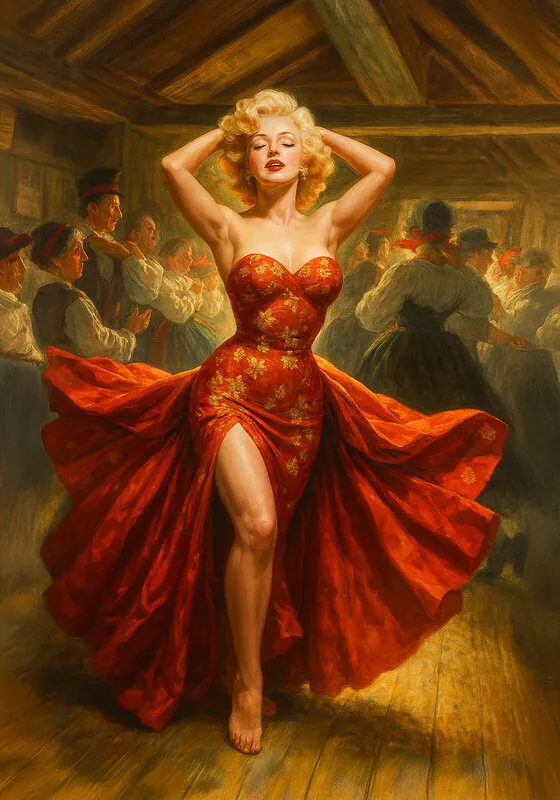
Dance in Gopsmor Cabin - Dans i Gopsmorstugan, 2025
Digital
50 x 70 cm
3 200 kr
Dance at Gopsmor 2025 - Dans på Gopsmor 2025
It commences, like many improbable tales, with a meeting that defies all norms of logic and reason. The year is 2025 – or perhaps it is 1914, or both simultaneously – for in the realm of art and memory, time is not bound by the constraints of a linear narrative. In the heart of Dalarna, where the Österdal River meanders past ancient forests and weathered timber walls, a fire blazes in Gopsmorstugan. Outside, the snow blankets the roof. Inside, the air is heavy with the harmonious notes of music, the scent of tarred wood, and the warm breath of people huddled together.
Through the door steps Marilyn Monroe, her red dress a stark contrast against the rustic timber walls, her eyes sweeping across the room with both curiosity and certainty. Somewhere in the shadows, unseen but utterly present, Anders Zorn watches. This is his domain – his timbered refuge, his stage for the dances he calls lekstugor. And yet tonight, the dance is not entirely his.
What unfolds is not a mere historical account, nor a figment of imagination. It is the type of scene that only art can bring to life: a rendezvous across centuries, a moment when the rhythm of a polska can unite two individuals – one from the silver screen, the other from the silver light of the Nordic winter – in the same breath, the same room, the same step, sharing a unique and timeless experience.
Join me on a journey to explore the intriguing world of pictures. This essay seeks to entertain and enlighten you about the complicated nature of love in a good story. Prepare to be enlightened.
“Two Smiles, One Blade
Polska at Gopsmor
In Gopsmor’s hall, two hundred years worn,
where pine beams creak and the hearth keeps warm,
the fiddles sound as the shadows bend,
and past and present begin to blend.
Zorn’s back once more, the master returned,
from realms beyond where the starlight burned.
And at his side, with a glance that glows,
walks Marilyn, in her scarlet clothes.
The boots all pound with a farmer’s might,
their rhythm deep as the winter night.
But lighter still, on the pine boards set,
Marilyn’s naked feet in a bright pirouette.
She floats and turns through the smoky air,
the scarlet hem like a whispered dare.
Zorn watches closely from the shadow’s keep,
and paints her dance where the echoes sleep.
Two hundred years in the timber stay,
yet time itself seems to slip away—
for in that hall, where the polska swirls,
the master dances with the world’s bright girls.”
Malmö. August 2025
Dance at Gopsmor, 2025
Imagine if Anders Zorn, the renowned artist known for his depictions of beautiful women, were to return to Earth today, he wouldn't arrive alone. One could easily picture him stepping out of a cosmic portal, with Marilyn Monroe by his side – she, with her iconic blend of innocence and calculated allure. This unique charm, which captivated hearts and minds, was a trait he shared with the confident men who bask in both artistic fame and a well-established reputation as a ladies’ man.
On Earth, Zorn had a fondness for beautiful women, and it is no coincidence that his paintings often depict naked bodies in baths or amidst nature. Marilyn, for her part, was no stranger to dancing, parties, or lingering glances. In Gopsmor Cottage, Zorn’s cherished retreat in Dalarna, the two could have met in a moment that transcended time. He would have invited her to one of his legendary evenings – “lekstugorna,” as he called them – where fiddles played and the floor swayed to the rhythm of the polska.
The dance commenced with a chord, a musical note that seemed to linger in the air, inviting everyone to partake. The first step, a stomp on the plank floor, set the entire cottage abuzz. The walls, tables, benches, and even the cups on the shelf trembled slightly, as if in eager anticipation. The warmth from the fire and the people was already palpable, and now it gained a pulse, a rhythm that was impossible to resist.
The fiddlers sat shoulder to shoulder, as if sharing more than just music. Their old violins, their varnish darkened by decades, bore a history of weddings, harvest feasts, and secret meetings in barns. The bows tore through the thick air, a scrape and a gentle caress, a pulling stroke that propelled the dance onwards, echoing the traditions of generations past.
The polska was three steps that became six, then twelve. The floor echoed with the sound of heavy leather soles: thump, thump, sweep. Round and round, in a pattern as old as the timber in the walls. The men held the women firmly, but there was nothing stiff in their grip – only the strength needed to keep pace with the whirl.
And then, in the centre of the circle, something shattered with all that was familiar. Barefoot steps. Light, soundless. Marilyn moved as if the polska had always run in her veins. Her feet, nails painted the same deep red as her dress, glided over the planks with effortless daring. Her steps were softer than the dull thud of shoes, yet with a precision that made the dance ignite, like a laugh in the middle of a serious song.
Dancing barefoot was a bold act of defiance, a symbolic rebellion against centuries of societal norms. In Zorn’s era, it was unthinkable for a respectable woman to show her toes outside the washbasin. Yet, here was Marilyn, not just with her feet bare, but with an entire attitude, a stance that defied the constraints of cloth, laced bodices, heavy skirts, and shackled minds.
The heat grew hotter. The fire threw long, lively shadows on the walls. A girl giggled, and a man pressed the beat more firmly. The polska spun again and again. The fiddlers’ eyes sparkled above their bows – they were playing as much for the foreign guest as for the local dancers.
In the shadows, where the firelight struggled to reach, was the artist himself. He could not be seen, but his gaze was there, following every turn, every swing of hair, every step that landed on the floor. He was both present and absent, as if he had already begun painting what he called his “Lekstuga” in his mind. The 'Lekstuga' was a term Zorn used to describe his paintings of playful, carefree scenes, and it was probably why he stayed hidden, not to disturb the scene, but to capture it in his mind for his future work.
And the music continued. The polska inhaled and exhaled, as if it were a living being. Marilyn’s movements matched the rhythm, her skirt absorbing the heat of the dance and tossing it back with each spin. The shoes around her tramped heavily and earthbound, while her bare feet seemed to drift above them, like a fearless flower on the worn boards of the floor.
When the tune finally faded, it was as if the cottage took a breath and hesitated before the next inhale. The fire in the open hearth crackled, the fiddles rested, and in the silence that followed, Marilyn stood barefoot, smiling, her breath high in her chest. She was both there and not as much a part of the evening as part of a painting still in the making. The aftermath of the dance was a moment of stillness and reflection, a pause before the next chapter in the evening's story.
Gopsmor was not just a place – it was a reflection of a way of life, a life of admirable simplicity. Nestled along the Österdal River and constructed from old timber houses he had moved there piece by piece, it became his refuge from the urbane life of the Zorn House and the watchful eyes of the town of Mora. Here he lived “in the way of the forefathers”: simple food, primitive comforts, and freedom from the demands of social games. He fished, hunted, painted, and lived close to what he perceived as the essence of Sweden.
Today, as you stroll among the seven buildings – the barn from Landbobyn, dating back to the winter of 1324–25; the storehouse from Gopshus, from the mid-1500s; the cottage from the early 1800s – you can't help but be awed by their historical significance. The crackling fire in the hearth, the scent of tar and wood, shutters that kept out both the cold and prying eyes, all transport you back to his time. In that setting, the image of Marilyn in her red, strapless gown feels almost otherworldly. In her own time—the mid-20th century—it was already daring. In Zorn’s era, with layers of skirts and a headscarf, it would have been scandalous. But Zorn, already well-known to the world as the painter of fully nude kullor, would more likely have raised his glass than his voice.
In 1904, Zorn purchased the land from his uncle Per. He moved timber structures onto the site, including the old barn, and established a combined studio, fishing lodge, and gathering place. It was here that he invited local youths to dance, always accompanied by fiddlers such as Ljuder Anders from Gopshus, his son, and his grandsons. It was also at this location that he received friends from artistic circles – Karlfeldt, who disliked the lack of a private morning toilet; Bruno Liljefors and Albert Engström, who appreciated the simplicity.
Zorn’s life in Gopsmor followed its rhythm. Winters in January and summers just before Midsummer were busy times for painting. It might be nude models by the fire, kullor skiing over the ice, or landscapes of snow-covered pines. When the Österdal River was regulated in the 1970s, the original Gopsmor went underwater, but it was rebuilt in a location carefully chosen to resemble the old one.
His art – especially his nude paintings – has always invited questions. Art historian Svenson describes his figure studies as free from mysticism or hidden symbols, as expressions of secular sensualism. However, there were also rumours about Zorn – that he had affairs with his models and fathered children in the countryside. Many of these claims are probably gossip; with women from Mora and the Siljan district, he was cautious. They were neighbours, sisters, and daughters of people he knew. The reputation for promiscuity was more likely connected to his travels.
One piece of evidence for this is the story of Emily Bartlett, the American socialite, whom she met in Paris in 1897. She was married to sculptor Paul Wayland Bartlett, but when the couple separated the following year, Emily travelled to Sweden. Zorn himself describes how one evening he saw her naked through a window, her reddish hair loose, and how he became “dangerously inflamed.”
The fact that he later introduced Emily to his wife Emma as his passion is one of the more remarkable episodes in his life. Emma, both dutiful and loyal, never forgave that betrayal. The marriage remained intact – divorce was unthinkable – but transformed into a life lived more alongside each other than together.
“Did he sleep with his models?”
The question has persisted in Anders Zorn’s legacy through the decades, just as much as the scent of linseed oil in his studios. The answer is, almost certainly: yes. Equally sure is that he did not mind people taking it for granted. There was something in his personality that thrived on the innuendo – perhaps as a way to foster the myth of the pleasure-seeking artist, perhaps as a deliberate challenge to the moral standards of his era.
But when it came to the kullor – the young models from Mora and the surrounding parishes by Lake Siljan – the answer was just as likely: no. They were daughters, sisters, and granddaughters of his neighbours, women from a community he cared about and where his reputation was an asset to be guarded. He knew it would be shameful, both for him and for their families, if anyone in the district were thought to have “lain for Zorn” in the most literal sense. Respect for the social fabric of his home region weighed more heavily than fleeting desire.
Therefore, we can confidently dismiss the stories that often arise in local folklore – tales of “children in the district” as evidence of the artist’s excesses. They belong to the world of folk legend, as persistent as they are hard to verify.
That Zorn, at the age of thirty-seven, likely contracted syphilis, is another matter—one that points to a promiscuous life beyond his home territory. Out there, far from Siljan’s mirror-smooth waters and the church bells of Mora, there was neither the social safety net nor the unspoken agreements that held village life together. Out in the world, he was free to live as he wished—and he used that freedom.
The question “How did Emma endure?” keeps coming up. She was a woman who centred her life around her husband’s career, and after his death, she established the Zorn Museum and the Zorn Collections. Without her, it's unlikely that Zorn’s name would be so well known today.
But Zorn’s image is a composite. He was not always a pleasant figure, especially when the brännvin flowed. In writer Lars Forssell’s memoir Vänner (Friends), he recalls a young Evert Taube who ended up at the same tavern table as the older “men of culture” – Erik Axel Karlfeldt, Albert Engström, and Anders Zorn. Taube could not bear their “ruthless, chauvinistic superman ideals.”
It emanates a foul, brown sludge from afar. But who points that out when national icons are to be honoured and celebrated through history? Properly, we should not judge yesterday’s people solely by today’s norms and values. Still, Zorn and his male companions seem to have been extraordinary examples in this regard, especially in their views on women. It does not make it easier when one considers his voyeuristic nudes taken outdoors and in brothel settings.
The photographs he left behind, however, reveal other facets: people and environments from distant lands, scenes from daily life in his home region – always with an artist’s eye, though often with a detachment that suggests his engagement ended with fascination. These images, captured with his unique artistic vision, invite us to see the world through his lens.
One image that witnesses his decline is a self-portrait taken on New Year’s Day 1920, with the dog Liten perched on his shoulder. He gazes directly into the camera’s eye. The look is stark, naked, exposed, already heading into eternity. The physical decay is profound. Anders Zorn is a wreck and no advertisement for either spirits or cigarettes. His fate is evident in his appearance, a stark reminder of the inevitability of our mortal journey. Everyone eventually goes into the ground – the social climber, the king of painters, the class traveller, the glutton, the bon vivant, and the chauvinist.
And here, in this final image, one could imagine the scene from Gopsmorstugan in 2025. The fire crackles, the fiddles play, and on the floor, Marilyn Monroe spins in her red dress. She belongs there as naturally as Zorn himself, for in art, time is neither linear nor confined. They meet in the dance – he with the brush, she with the steps – and leave behind a moment that, if it had been captured on canvas, would have been as much history as fantasy.
One question remains unanswered: how did Emma ever endure? Her resilience and dedication to her husband's legacy are truly admirable, earning her our utmost respect.
Det börjar, som så många osannolika historier gör, med ett möte som egentligen aldrig hade kunnat ske. Året är 2025 – eller kanske 1914, eller båda samtidigt – för i konstens och minnets värld är tiden en flytande sak. I Dalarnas djupa hjärta, där Österdalälven slingrar sig förbi skogar och gamla timmerväggar, brinner en eld i Gopsmorstugan. Utanför ligger snön tung på taket. Inne är luften tjock av musik, doften av tjärat trä och den varma andedräkten från människor som står tätt intill varandra.
Genom dörren stiger Marilyn Monroe in, den röda klänningen smiter åt henne som en viskad skandal, blicken sveper över rummet med både nyfikenhet och självklarhet. Någonstans i skuggorna, osedd men närvarande, finns Anders Zorn. Det här är hans domän – hans timrade fristad, hans scen för de danser han kallar lekstugor. Men i kväll är dansen inte helt hans egen.
Det som följer är varken historia så som den hände, eller ren och skär uppdiktning. Det är den sorts scen som konsten själv gör möjlig: ett möte över sekler, ett ögonblick där polskans rytm kan bära två människor – en från filmens silverduk, en från det nordiska vinterljusets silver – in i samma andetag, samma rum, samma steg.
Dans på Gopsmor 2025
Om Anders Zorn hade återvänt till jorden i vår tid är det ingen vågad gissning att han inte hade gjort det ensam. Man kan mycket väl tänka sig honom stiga ur maskhålet från yttre rymden med Marilyn Monroe vid sin sida – hon i sin ikoniska blandning av oskuldsfull charm och medveten sensualism, han med den där självsäkra hållningen som bara män med både konstnärligt erkännande och ett grundmurat rykte som kvinnokarl kan upprätthålla.
Zorn hade på jorden visat smak för vackra kvinnor, och det är ingen tillfällighet att hans målningar ofta förknippas med nakna kroppar i bad eller natur. Marilyn, å sin sida, var ingen främling för dans, fest och blickar som fastnar. I Gopsmorstugan, Zorns älskade tillflyktsort i Dalarna, hade de två kunnat mötas i ett ögonblick som trotsade tidens linjer. Han hade bjudit in henne till en av sina legendariska kvällar – ’lekstugorna’, som han kallade dem – där fiolerna spelade och golvet bågnade under polskans rytm.
Det började med ett ackord som tar sats. Sedan det första steget – trampet mot plankgolvet – och hela stugan svarar. Väggarna, borden, bänkarna, till och med kopparna på hyllan darrar lätt. Värmen från spisen och människorna är redan tung, och nu får den en puls.
Spelemännen sitter axel mot axel, som om de delar mer än bara musiken. De gamla fiolerna, dess av årtionden mörknade lack bär på sin historia av bröllop, skördefester och hemliga möten i lador. Stråkarna river i den täta luften, ett slit och en smekning samtidigt, ett sugande drag som driver dansen framåt.
Polskan är tre steg som blir till sex, som blir till tolv. Golvet fylls av ljudet av grova lädersulor: dunk, dunk, svep. Runt, runt, i ett mönster lika gammalt som timret i väggarna. Männen håller kvinnorna med fast hand, men det finns inget stelt i greppet – bara den styrka som behövs för att följa virveln.
Och så, mitt i kretsen, något som bryter mot allt det invanda. Barfotasteg. Lätta, ljudlösa. Marilyn rör sig som om polskan fanns i hennes blod. Fötterna, naglarna målade i samma djupa rött som hennes klänning, glider över plankorna med självklar fräckhet. Hennes steg är mjukare än skornas dova slag, men med en precision som får dansen att blixtra till, som ett skratt mitt i en allvarsam sång.
Barfotadansen är en hudlös nakenhet. I Zorns tid hade ingen flicka av god familj vågat visa tårna utanför tvagningskaret. Här är det inte bara Marlilyns fötter som är bara – det är en hållning, en attityd, en utmaning mot århundraden av tyg, knutna snörliv, tunga kjolar och fjättrade sinnen.
Värmen växer. Elden kastar långa, dansande skuggor mot väggarna. En flicka skrattar, en man stampar takten hårdare. Polskan tar ett nytt varv, och ännu ett. Spelemännens ögon glittrar över stråkarna – de spelar nu lika mycket för den främmande gästen som för dansarna från bygden.
I skuggorna, dit ljuset från spisen har svårt att nå, finns konstnären själv. Han syns inte, men blicken finnns där, följande varje sväng, varje hårsvall, vart steg som landar mot golvet. Han är både närvarande och frånvarande, som om han redan börjat måla det han kallar sin ’Lekstuga’ i huvudet. Det är säkert därför han håller sig undan – för att inte störa scenen.
Och musiken fortsätter. Polskan andas ut och in, som om den vore ett levande väsen. Marilyns rörelser är en del av rytmen, hennes kjol fläktar av värmen i dansen och böljar tillbaka i varje snurr. Skorna runt henne stampar vidare, tunga och jordbundna, medan hennes bara fötter liksom flyter obanpå som en trotsig blomma på golvets slitna brädor.
När låten klingar ut är det som om stugan tar andan och tvekar inför nästa andetag. Det knäpper från elden i den öppna spisen, fiolerna vilar, och i tystnaden som följer står Marilyn barfota, leende, med andan högt i bröstet. Hon är där och ändå inte – lika mycket en del av kvällen som en del av en målning som är i vardande.
Gopsmor var inte bara en plats, det var ett uttryck för en livshållning. Belägen vid Österdalälven och uppbyggd av gamla timmerhus som han flyttat dit bit för bit, blev den hans fristad från Zorngårdens mondäna liv och Mora stadens blickar. Här levde han "på fädrens vis": enkel mat, primitiva bekvämligheter, och frihet från det sociala spelets krav. Han fiskade, jagade, målade och levde nära det han uppfattade som det ursprungliga Sverige.
När man idag vandrar mellan de sju byggnaderna – ladan från Landbobyn, daterad till vintern 1324–25; härbret från Gopshus, från mitten av 1500-talet; stugan från tidigt 1800-tal – är det lätt att föreställa sig hur miljön sett ut i hans dagar. Elden i spisen, lukten av tjära och trä, fönsterluckor som stänger ute både kyla och nyfikna blickar. I det sammanhanget blir tanken på Marilyn i sin röda, axelbandslösa klänning nästan överjordisk. På hennes tid, i mitten av 1900-talet, var det redan vågat. På Zorns tid, med lager på lager av kjolar och huvudduk, hade det varit skandal. Men Zorn, som världen redan vant sig vid som målaren av helnakna kullor, hade nog snarare höjt sitt glas än sin röst.
År 1904 köpte Zorn marken av sin morbror Per. Han flyttade hit timmerhus, bland annat den gamla ladan, och skapade ett slags kombinerad ateljé, fiskarstuga och sällskapsrum. Det var här han bjöd in ungdomar från bygden till dans, alltid ackompanjerade av spelmän som Ljuder Anders från Gopshus, hans son och sonsöner. Det var här han också tog emot sina vänner från konstnärskretsarna – Karlfeldt, som ogillade bristen på privat morgontoalett; Bruno Liljefors och Albert Engström, som älskade enkelheten.
Zorns liv i Gopsmor var indelat i perioder. Vintern i januari och sommaren strax före midsommar var högtider för måleriet. Det kunde vara nakna modeller framför eldstaden, skidåkande kullor på isen eller landskapsvyer över snötäckta granar. När Dalälven reglerades på 1970-talet hamnade det ursprungliga Gopsmor under vatten, men man återuppbyggde det på en plats som noggrant valdes för att efterlikna den gamla.
Hans konst – särskilt nakenmåleriet – har alltid väckt frågor. Konsthistorikern Svenson beskriver hans modellmålningar som fria från mystik eller dolda symboler, uttryck för en sekulär sensualism. Men kring Zorn fanns också rykten – att han haft relationer med modellerna, att han hade barn på bygden. Mycket tyder på att detta var skvaller; med kvinnor från Mora och Siljansbygden var han noga. De var grannar, systrar och döttrar till människor han kände. Ryktet om hans promiskuösa leverne var nog mer knutet till hans resor.
Ett bevis på det är historien om Emily Bartlett, den amerikanska societetsdamen han träffade i Paris 1897. Hon var gift med skulptören Paul Wayland Bartlett, men när paret separerade året därpå reste Emily till Sverige. Zorn beskriver själv hur han en kväll såg henne naken genom ett fönster, med det rödlätta håret utslaget, och hur han blev "farligt upptänd".
Att han senare presenterade Emily för sin hustru Emma som sin passion är ett av de mer anmärkningsvärda inslagen i hans liv. Emma, som var både plikttrogen och lojal, förlät aldrig det sveket. Äktenskapet förblev intakt – skilsmässa var otänkbart – men förändrades till att bli ett liv mer vid sidan av varandra än tillsammans.
”Hade han sex med modeller?” frågan har följt Anders Zorn eftermäle genom decennierna, lika envist som doften av linolja i hans ateljéer. Svaret är, med näst intill visshet: Ja. Lika säkert är nog att han inte hade något emot att många tog det för givet. Det låg något i hans personlighet som trivdes med anspelningarna – kanske som ett sätt att odla myten om den livsnjutande konstnären, kanske som en utmaning till samtidens moral.
Men när det gäller kullorna – de unga modellerna från Mora och de kringliggande socknarna vid Siljan – är svaret lika sannolikt, nej. De var döttrar, systrar och barnbarn till hans grannar, kvinnor från en bygd han månade om och där hans anseende var en tillgång att vårda. Han visste att det skulle vara skamligt, både för honom och för familjerna, om någon i trakten ansågs ha ”stått för Zorn” i en alltför bokstavlig mening, lagt sig på rygg. Respekten för hembygdens sociala nätverk vägde tyngre än tillfälliga begär.
Av den orsaken kan vi med stor säkerhet avfärda de historier som gärna dyker upp i folkliga berättelser – påståenden om ”barn på bygden” som bevis på konstnärens utsvävningar. De hör hemma i kategorin vandringssägner, lika seglivade som de är svåra att styrka.
Att Zorn däremot vid 37 års ålder sannolikt drog på sig syfilis är en annan historia, och den pekar mot ett promiskuöst liv utanför hembygden. Där, långt från Siljans spegelblanka ytor och Moras kyrkklockor, fanns varken det sociala skyddsnätet eller de tysta överenskommelser som höll samman bygemenskapen. Ute i världen var han fri att leva som han ville – och den friheten använde han.
Frågan "Hur stod Emma ut?" återkommer. Hon var en kvinna som byggde sitt liv kring makens karriär och som efter hans död skapade Zornmuseet och Zornsamlingarna. Utan henne är det tveksamt om Zorns namn varit lika levande i dag.
Men bilden av Zorn är sammansatt. Anders Zorn var inte alltid någon trevlig figur, särskilt inte när brännvinet flödade. I författaren Lars Forssells memoarer "Vänner" skriver han om en ung Evert Taube som råkade hamna vid samma krogbord som de äldre "kulturmännen" Erik Axel Karlfeldt, Albert Engström och Anders Zorn. Han stod inte ut med deras "hänsynslösa, manschauvinistiska övermänniskoideal".
Det luktar brun sörja lång väg. Men vem påpekar sådant när nationalikonerna skall hedras och äras genom historien? Ok, vi ska inte döma gårdagens människor efter nutidens normer och värderingar men Zorn och hans manliga kamrater synes ha varit extraordinära exempel i sammanhanget, särskilt i synen på kvinnan. Det gör inte saken lättare när man tar del av alla hans voyeristiska nakenbilder tagna utomhus och i bordellmiljöer.
Fotografierna han lämnade efter sig visar andra sidor: människor och miljöer från fjärran länder, scener från vardagen i hembygden, alltid med en konstnärs blick men ofta med en distans som antyder att hans engagemang stannade vid fascinationen.
En bild som vittnar om hans egen utförslöpa är en han tog av sig själv nyårsdagen 1920 med hunden Liten på sin axel. Han stirrar rakt in i kameraögat. Blicken är stirrande, naken, utsatt, på väg in i evigheten. Kroppens förfall är monumental. Anders Zorn är ett vrak och absolut ingen reklampelare för varken brännvin eller cigaretter. Det syns att hans öde är beseglat. Alla ska i jorden. Så även uppkomlingen, målarkungen, klassresenären, frossaren, livsnjutaren och mansgrisen.
Och här, i denna sista bild, kan man placera scenen från Gopsmorstugan 2025. Elden sprakar, fiolerna spelar, och på golvet snurrar Marilyn Monroe i sin röda klänning. Hon är där lika självklart som Zorn själv, för i konsten är tiden varken linjär eller begränsad. De möts i dansen – han med penseln, hon med stegen – och lämnar efter sig ett ögonblick som, om det fångats på duk, hade varit lika mycket historia som fantasi.
En fråga förblir obesvarad. Hur stod Emma egentligen ut?
3 200 kr

Jörgen Thornberg
Malmö
Lite om bilder och mig. Translation in English at the end.
Jag är en nyfiken person som ser allt i bilder, även det jag fäster i ord, gärna tillsammans för bakom alla mina bilder finns en berättelse. Till vissa bilder hör en kortare eller längre novell som följer med bilden.
Bilder berättar historier. Jag omges av naturlig skönhet, intressanta människor och historia var jag än går. Jag använder min kamera för att dokumentera världen och blanda det jag ser med vad jag känner för att fånga den dolda magin.
Mina bilder berättar mina historier. Genom mina bilder, tryck och berättelser. Jag bjuder in dig att ta del av dessa berättelser, in i ditt liv och hem och dela min mycket personliga syn på vår värld. Mer än vad ögat ser. Jag tänker i bilder, drömmer och skriver och pratar om dem; följaktligen måste jag också skapa bilder. De blir vad jag ser, inte nödvändigtvis begränsade till verkligheten. Det finns en bild runt varje hörn. Jag hoppas att du kommer att se vad jag såg och gilla det.
Jag är också en skrivande person och till många bilder hör en kortare eller längre essay. Den följer med tavlan, tryckt på fint papper och med en personlig hälsning från mig.
Flertalet bilder startar sin resa i min kamera. Enkelt förklarat beskriver jag bilden jag ser i mitt inre, upplevd eller fantiserad. Bilden uppstår inom mig redan innan jag fått okularet till ögat. På bråkdelen av ett ögonblick ser jag vad jag vill ha och vad som kan göras med bilden. Här skall jag stoppa in en giraff, stålmannen, Titanic eller vad det är min fantasi finner ut. Ännu märkligare är att jag kommer ihåg minnesbilden långt efteråt när det blir tid att skapa verket. Om jag lyckas eller inte, är upp till betraktaren, oftast präglat av en stråk av svart humor – meningen är att man skall bli underhållen. Mina bilder blir ofta en snackis där de hänger.
Jag föredrar bilder som förmedlar ett budskap i flera lager. Vid första anblicken fylld av feel-good, en vacker utsikt, fint väder, solen skiner, blommor på ängen eller vattnet som ligger förrädiskt spegelblankt. I en sådan bild kan jag gömma min egentliga berättelse, mitt förakt för förtryckare och våldsverkare, rasister och fördomsfulla människor - ett gärna återkommande motiv mer eller mindre dolt i det vackra motivet. Jag försöker förena dem i ett gemensamt narrativ.
Bild och formgivning har löpt som en röd tråd genom livet. Fotokonst känns som en värdig final som jag gärna delar med mig.
Min genre är vid som framgår av mina bilder, temat en blandning av pop- och gatukonst i kollage som kan bestå av hundratals lager. Vissa bilder kan ta veckor, andra någon dag innan det är dags att överlämna resultatet till printverkstaden. Fine Art Prints är digitala fotocollage. I dessa kollage sker rivandet, klippandet, pusslandet, målandet, ritandet och sprayningen digitalt. Det jag monterar in kan vara hundratals år gamla bilder som jag omsorgsfullt frilägger så att de ser ut att vara en del av tavlan men också bilder skapade av mig själv efter min egen fantasi. Därefter besöks printstudion och för vissa bilder numrera en limiterad upplaga (oftast 7 exemplar) och signera för hand. Vissa bilder kan köpas i olika format. Det är bara att fråga efter vilka. Gillar man en bild som är 70x100 men inte har plats på väggen, går den kanske att få i 50x70 cm istället. Frågan är fri.
Metoden Giclée eller Fine Art Print som det också kallas är det moderna sättet för framställning av grafisk konst. Villkoret för denna typ av utskrifter är att en högkvalitativ storformatskrivare används med åldersbeständigt färgpigment och konstnärspapper eller i förekommande fall på duk. Pappret som används möter de krav på livslängd som ställs av museer och gallerier. Normalt säljer jag mina bilder oinramade så att den nya ägaren själv kan bestämma hur de skall se ut, med eller utan passepartout färg på ram, med eller utan glas etc..
Under många år ställde jag bara ut på nätet, i valda grupper och på min egen Facebooksida - https://www.facebook.com/jorgen.thornberg.9
Jag finns också på en egen hemsida som tyvärr inte alltid är uppdaterad – https://www.jth.life/ Där kan du också läsa en del av de berättelser som följer med bilden.
UTSTÄLLNINGAR
Luftkastellet, oktober 2022
Konst i Lund, november 2022
Luftkastellet, mars 2023
Engleson Galleri Caroli, april 2023
Hydra, Greece June 2023
Engleson Galleri Caroli, oktober 2023
Toppen, Höllviken december 2023
Luftkastellet, mars 2024
Torups Galleri, mars 2024
Venice, May 2024
Luftkastellet, oktober 2024
Konst i Advent, December 2024
Galleri Engleson, Caroli December 2024
Jäger & Jansson Galleri, april 2025
A bit about pictures and me.
I'm a curious person who sees everything in pictures, even what I express in words, often combining them, for behind all my pictures lies a story. These narratives, some as short as a single image and others as long as a novel, are the heart and soul of my work.
Pictures tell stories. Wherever I go, I'm surrounded by natural beauty, exciting people, and history. I use my camera to document the world and blend what I see with what I feel to capture the hidden magic.
My images tell my stories. Through my pictures, prints, and narratives, I invite you to partake in these stories in your life and home and share my deeply personal perspective of our world. More than meets the eye. I think in pictures, dream, write, and talk about them; consequently, I must create images too. They become what I see, not necessarily confined to reality. There's a picture around every corner. I hope you'll see what I saw and enjoy it.
I'm also a writer, and many images come with a shorter or longer essay. It accompanies the painting, printed on fine paper with my personal greeting.
Many pictures start their journey on my camera. Simply put, I describe the image I see in my mind, experienced or imagined. The image arises within me even before I bring the eyepiece to my eye. In a fraction of a moment, I see what I want and what can be done with the picture. Here, I'll insert a giraffe, Superman, the Titanic, or whatever my imagination conjures up. Even stranger is that I remember the mental image long after it's time to create the work. Whether I succeed is up to the observer, often imbued with a streak of black humour – the aim is to entertain. My pictures usually become a talking point wherever they hang.
I prefer pictures that convey a message in multiple layers. At first glance, they're filled with feel-good vibes, a beautiful view, lovely weather, the sun shining, flowers in the meadow, or the water lying deceptively calm. But beneath this surface beauty, I often conceal a deeper story, a narrative that challenges societal norms or explores the human condition. I invite you to delve into these hidden narratives and discover the layers of meaning within my work.
Picture and design have been a thread running through my life. Photographic art feels like a fitting finale, and I'm happy to share it.
My genre is varied, as seen in my pictures; the theme is a blend of pop and street art in collages that can consist of hundreds of layers. Some images can take weeks, others just a day before it's time to hand over the result to the print workshop. Fine Art Prints are digital photo collages. In these collages, tearing, cutting, puzzling, painting, drawing, and spraying happen digitally. What I insert can be images hundreds of years old that I carefully extract so they appear to be part of the painting, but also images created by myself, now also generated from my imagination. Next, visit the print studio and, for certain images, number a limited edition (usually 7 copies) and sign them by hand. Some images may be available in other formats. Just ask which ones. If you like an image that's 70x100 but doesn't have space on the wall, you might be able to get it in 50x70 cm instead. The question is open.
The Giclée method, or Fine Art Print as it's also called, is the modern way of producing graphic art. This method ensures the highest quality and longevity of the artwork, using a high-quality large-format printer with archival pigment inks and artist paper or, in some cases, canvas. The paper used meets the longevity requirements set by museums and galleries. I sell my pictures unframed, allowing the new owner to personalise their artwork, confident in the lasting value and quality of the piece.
For many years, I only exhibited online, in selected groups, and on my Facebook page - https://www.facebook.com/jorgen.thornberg.9. I also have my website, which unfortunately is not constantly updated - https://www.jth.life/. You can also read some of the stories accompanying the pictures there.
EXHIBITIONS
Luftkastellet, October 2022
Art in Lund, November 2022
Luftkastellet, March 2023
Engleson Gallery Caroli, April 2023
Hydra, Greece June 2023
Engleson Gallery Caroli, October 2023
Toppen, Höllviken December 2023
Luftkastellet, March 2024
Torup Gallery, March 2024
Venice, May 2024
UTSTÄLLNINGAR
Luftkastellet, oktober 2022
Konst i Lund, november 2022
Luftkastellet, mars 2023
Engleson Galleri Caroli, april 2023
Hydra, Greece June 2023
Engleson Galleri Caroli, oktober 2023
Toppen, Höllviken december 2023
Luftkastellet, mars 2024
Torups Galleri, mars 2024
Venice, May 2024
Luftkastellet, October 2024
Konst i Advent, December 2024
Galleri Engleson, Caroli December 2024
Jäger & Jansson Galleri, April 2025
Utbildning
Autodidakt
Medlem i konstnärsförening
Öppna Sinnen
Med i konstrunda
Konstrundan i Skåne
Utställningar
Luftkastellet, October 2022
Art in Lund, November 2022
Luftkastellet, March 2023
Engleson Gallery Caroli, April 2023
Hydra, Greece June 2023
Engleson Gallery Caroli, October 2023
Toppen, Höllviken December 2023
Luftkastellet, March 2024
Torup Gallery, March 2024
Venice, May 2024