Vi använder cookies för att ge dig bästa möjliga upplevelse. Välj vilka cookies du tillåter.
Läs mer i vår integritetspolicy
Jörgen Thornberg
The Puppet at Sundborn, 2025
Digital
70 x 50 cm
3 200 kr
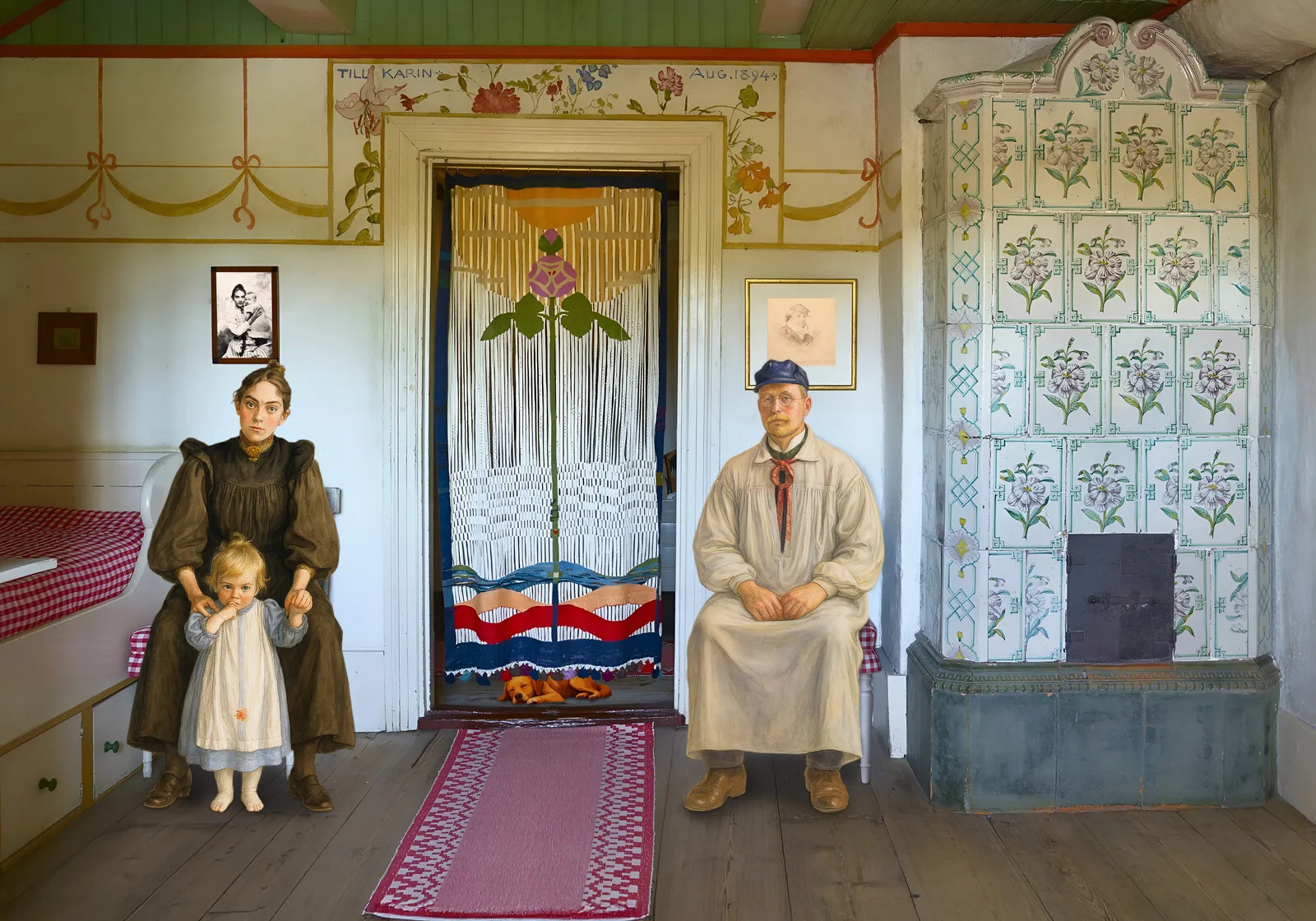
The Puppet at Sundborn
The title encapsulates the theme of being a mere actor in the scenes of life, not always by choice. This is a poignant reflection on the absence of a loved one and the memories that linger in their place. She’s gone. But not from the pictures. Not from the scent of the coat still hanging in the hallway. Not from the chair, still pulled out slightly, as if she had only left the table for a moment to answer the phone or check the weather. Her essence lingers in these familiar objects, a comforting reminder of the enduring nature of love and memory, a presence that is kept alive in spirit through shared memories and art, fostering a sense of connection and continuity.
It’s autumn outside, the kind she loved — not the grey, muddy kind, but the one that glows with brass, the one that smells of apples and rain-soaked leaves. It's a season I now appreciate more than ever for its breathtaking beauty, just as she did.
I sit down in front of the screen and open the folder. Our pictures. Four decades or more—a thousand moments captured—not for the world, but for us. These images stand as a testament to our deeply personal journey, a private archive of our love and life together.
And suddenly, she’s here again.
“A Poem for Lisa
You never signed your name in bold,
but in light —
a brushstroke in the margin,
a sigh behind the colour.
Your hands knew silence better than words,
could coax a petal
from stubborn pigment,
a memory
from empty space.
You laughed like someone
who had bargained with sorrow
and still chosen joy,
who saw the crack in everything
and painted through it.
You wore your strength
like linen in summer —
cool, unassuming,
creased by life.
And now,
when the screen flickers,
when the light shifts,
when I pass that open chair —
I still hear you.
Not your voice,
but the hush after it.
Not your steps,
but the echo in the hallway.
Not your hands,
but the warmth on my back
as I stand alone
in the studio.
Still together,
in every unfinished canvas
and in all the things
we never dared to paint.”
Malmö July 2025
The Empty Chair - Autumn Memories
The image can deceive, but it can also reveal, much like my text, an entire life. The seemingly perfect scene — the puppy sleeping beneath Carl’s bedframe, the couple sitting on their respective chairs — captures more than it shows. Above Karin’s head hangs a photograph of her with their eldest child, while above Carl’s is a pencil drawing of himself as a young army recruit.
It is a surreal reflection of a rehearsed life, where the figures resemble puppets in a museum — a little too still, overly staged — revealing that even the idyll can be a façade. The perfection of the scene, with its carefully arranged objects and frozen smiles, all hint at a life that was more about appearances than reality.
A life behind a beautiful home, a smile masking silence. In Carl’s world, he was often shadowed by doubt despite outward harmony. In my life, Lisa represented colour, light, and movement. In this image, we only see the painted figures, but in reality, we were alive, and now it feels as if even my own home is beginning to freeze into the same stillness, because that is the way of memories. They freeze time, preserving moments in a way that reality cannot.
The chairs from the painting remain at Sundborn, just as Lisa’s chair is elsewhere — a place no one else can occupy. Not because it's forbidden, but because it's already taken. Lisa is here, as tangible as the pale autumn light on the equinox, her birthday.
‘The Puppet at Sundborn’ serves as a poignant reminder that sometimes we find ourselves playing roles in scenes we did not choose. Yet, beneath the surface, our actual lives persist. Our yearning, our grief, our love. And that love, it doesn't dissipate. It remains, it observes, it endures — as long as we possess the fortitude to remember.
The image is a puzzle within me, deliberately misleading. It could just as easily be Lisa and me, the mother of my children, with our daughter. Yet, at the same time, our son was always too restless to be captured in a picture, always moving, always living.
In the painting, Carl and Karin are seated in her bedroom with their daughter Kersti standing. Back then, everything was as it should be. A blank sheet of paper or an empty Photoshop file always lies ahead of me. That is life — a challenge constantly calling out to be filled with something. Without the emptiness that demands to be filled, I would no longer exist.
Her chair has been empty for five years because, metaphorically, it’s not about Karin—it’s about Lisa, my late wife, who left before me. In Carl’s case, it was the other way around—he departed this life ten years before Karin, so my story isn’t about the Carlssons, but about events that occurred sixty to a hundred years later. Still, there are similarities—perhaps not artistically—but in how our lives unfolded and those of our families. For many years, Lisa’s and my life could also be painted in pastel tones, a Skåne version of Sundborn, an idyll envied by many. But reality is deceptive. It's a stark reminder that life's path is not always as it seems, and the idyll we seek can be shattered in an instant. This deception of appearances prompts us to question our perceptions and seek a deeper understanding of life's complexities. But now to Lisa's and my imaginary pictures, some more real than others.
In one of my pictures, we’re both sitting in the garden—Lisa in a sunhat, I with a coffee cup—and our hands meet on the table between us. Nothing special happened that day, but the image has become a symbol. It's a reminder that everyday life carried us, that we didn’t need more than each other. Perhaps that’s what makes grief so difficult—when someone present in every daily routine is suddenly gone, it’s as if time itself loses its shape. The weight of these everyday moments, now stripped of their significance, remains a constant reminder of the void left by loss. But it's also a transformative force, altering our perception of time and the world around us, inspiring us to cherish every moment and find beauty in the ordinary. Grief, in its profound way, teaches us to appreciate the fleeting moments of joy and love that are a part of our lives.
The chair remains there, beneath the family idyll. No one has moved it, nor can anyone remove it, because it’s where she sat — not just her body, but all of her, her ideas, and the voice in the room. No one else may sit there. Not because it’s forbidden, but because the chair is already occupied. In spirit, she is always present, invisible — yet her presence is felt, a comforting reminder that our loved ones never truly leave us. Their essence lingers, offering solace in our moments of solitude.
It’s tempting to see Carl Larsson’s life as a sunshine story, but his idyllic Sundborn images are misleading. He was the poor boy who became one of the country’s most celebrated artists, an ambitious social climber who rose from humble beginnings to great heights. We share a brooding and complex personality, which is barely evident in our respective family idylls. Carl once said he saw himself as a natural knight, someone who wanted to save the world. I’ve felt something similar. I want to stress that artistically, we are in entirely different leagues — Carl on the highest Parnassus, I among the many far below. That’s not the point. What matters is the reality behind the image — for the surface others interpret as idyllic conceals much pain and many disappointments. The struggle to maintain his artistic integrity in the face of commercial pressures, the strain of his marriage, and the loss of his children are just a few of the challenges Carl faced. But now, back to that reality.
Out of sight in the hallway, a collection of business cards, notes, and small, useful items rests in an 18th-century pewter dish. On a smudged Post-it note, it says, “Lisa, don’t forget.” Lisa — the most beautiful name I know. On another note, it simply states 149.1. It resembled a hymn number in church, and it was, because ‘Day by Day’ was the hymn my mother insisted should be played at her funeral — only the first verse, which was sufficiently religious. And so it was performed by a string quartet that gave the hymn a lovely, secular tone. Why the note with the numbers remains there is hard to explain — it's been over ten years since she passed away. I’ve requested the same hymn for myself, but in a jazz version by Daddy Benny. ‘Kun en dag,’ he calls it, because he’s Danish. You thought it was a little sacrilegious, but you got John Lennon as you wished — not such a controversial choice. Imagine! The song you loved and probably took with you to your star. I sensed her nodding inside me. After fifty years, you know each other. And in sharing these experiences, I hope to remind you that you are not alone in your grief.
It was the autumn equinox, a time when day and night are of equal length, symbolising the balance of life. The weather was just as it should be that day — a bit of everything, a few raindrops, swift clouds, and a sun that peeked through now and then. I spoke to myself, hoping the words would reach my beloved wife.
Today, we would have celebrated our 50th wedding anniversary. Golden anniversary, my dearest Lisa. The same day we married, not by coincidence, but as a tribute to you. And our wedding march that day became the recessional music today. You would’ve loved that.” Once again, I felt her inner warmth radiating towards me.
“I am so profoundly grateful for the forty-nine years, six months, and three days we shared as a married couple. In addition, the four years before that, living together, make it feel surreal not having you by my side, especially on a day like this. I miss you so terribly. My beloved Lisa.” The depth of my love for you, Lisa, is immeasurable, and my memories of you will never fade.
Dear Lisa, have you read the words I posted on Facebook three weeks ago? They are seared into my mind. If you missed what I wrote, it went like this: “My great love has very unexpectedly left me and the children in boundless grief and despair. We will always love you, Lisa, and you will remain with us in our hearts. We must now try to live on with all the beautiful memories we have of you.”
You are desperately missed and loved by everyone—you were the best of us two. Lisa, my forever positive, life-loving, genuine, charismatic, beautiful, helpful, warm girl, mother, wife, and my best friend—there is no one like you.
I hope you’re painting on in eternity, and I feel you watching over all your loved ones—we all sense you watching over us. We love you so incredibly much.” I find solace in the thought of you, Lisa, continuing your art in a place of eternal peace.
Our shared portal—the website about us and our art—is a treasure trove of memories. I am grateful for the moments we captured and the art we created together. I let the computer run a chronological slideshow where it randomly mixed our pictures, each one a cherished memory.
One of my favourite portraits of Lisa depicts her standing in our studio, paintbrush in hand, with an enigmatic smile on her lips. Behind her, a work in progress—a woman dressed in red with a smile as mysterious as Mona Lisa’s. In the archive, the piece is titled “Lisa Paints Lisa.” It feels as if she knew she was painting it for us, and no one else.
We had discussed creating a joint archive of our works for years, but it never materialised while you were alive. And yet it exists—now—in my head and on my hard drive: an imaginary gallery with two signatures. I can see how our brushstrokes sometimes followed similar lines, how we approached the same themes from different directions—like two musicians in a chamber piece. You never dreamed of exhibiting at the Moderna, but you often said our pictures belonged together. And now, as they flicker past on the screen, I understand precisely what you meant.
Sometimes the images became almost unbearable. They felt too vivid. Lisa smiled at me from the screen as if nothing had happened. But after a while, her face became a comfort.
Not just as a record of what once was, but because they preserve something that still lives inside me: your gaze, your sense of colour, your world. They affirm that we created something together that didn’t die.
Life unfolded like a revue—over fifty years of images, a mosaic of lifetime moments scrolling forward. As the pictures passed, I spoke to Lisa as if she were standing beside me, seeing the same images. It probably sounded formal, for in truth, I was reading aloud a letter to Lisa that I had written in my mind at the same time.
It was quiet now. Not deathly silent, as the house still lived—pipes clicked, the computer fan hummed softly. But the other silence was absolute: the kind that comes when no one calls out from the kitchen anymore, no one laughs at their joke. That silence is harder to bear. It reminds you of what will never be repeated, of the enduring love and the painful loss.
“When you wanted to prevent our son from being born on April 1st, we walked together for days up and down the Brösarp hills. There, in what is the very essence of Österlen—among blooming cowslips and puffing steam trains across the rolling landscape—we solved many of the world’s problems. The vistas are magnificent, with sweeping views over the Verkeån valley, and the scenery has constantly appeared in both our paintings, either as background or as the stage for our stories. I’m sure you remember it as well as I do, Lisa.”
On the screen, the image of a blooming flower meadow by the shores of Lake Bolmen in Småland seemed to freeze time. A hand holding a bunch of poppies, and a naive girl with a flower crown in her hair. In the sky above, an angel suspiciously resembling Marilyn Monroe floated—the movie star we both had a kind of mental connection with.
January 1st, 1969, is an important date. That’s when we got engaged, and I had money in the bank and wanted to buy a house. Imagine—a whole half-century can pass so quickly, and all the memories remain. Even the ones without pictures.” I heard Lisa sigh at the time’s merciless pace. I sighed too.
A place to live. We soon found our dream. Renovation. Craftsmen. Plumbers, electricians—and remember Nils, the old carpenter, who taught me not to hit my thumb with a hammer because it hurts. It took a lot for two young people who had nothing. IKEA, Svenskt Tenn, and Nordiska Galleriet—polar opposites, but we made space for both—the porters in their old-fashioned peaked caps. We moved into the house on the plain, so you no longer had to stay with that Nazi hag in Lund. Her name was Helga, wasn’t it?” Lisa nodded so hard I felt it in my whole body. That pathetic old woman had given us many laughs.
“Look! There’s our very first shared studio that you recreated many years later. In the house across the courtyard, we could work side by side. It was a revolution, a symbol of our shared dreams and aspirations, a space where our creative energies intertwined. I nodded, and Lisa relaxed.
The unforgettable wedding, with all those speeches that often revealed more about the speakers themselves than about their knowledge of us. You got what you’d wished for—sun and rain, wind and calm in the bridal crown—a prophecy of a long and enduring marriage with a bit of everything through all the shifts of life. And so it has been. The weather was perfect, even though you have now left me all too soon. But despite having just buried my beloved, I found the strength to laugh heartily, a testament to the resilience we shared.
Do you remember the City Theatre’s ticket office? Back then, you had to buy tickets there. We were newlyweds, both of us loving opera and operettas—Mozart, Puccini, and Strauss—as well as theatre. Do you recall Hjalmar Bergman’s ‘Grandmother and the Lord’ with Agneta Prytz? That was one of our finest moments, when we sat silently holding hands and met in beauty and harmony on the stage’s fairyland. It was a joyful experience we shared, a memory that keeps us connected.
The following image shows Icarus above Malmö, painted in vivid detail. “Sture, our mutual friend, who climbed the social ladder but took too great a risk. The financial crisis struck, and he fell irreparably, choosing to travel far away, beyond the realm of the earthly. Life is so fragile!” Lisa’s compassion filled me, for what happened had hit her hard. He had been a childhood friend. This reflection on friendship and life's fragility invites us to contemplate our relationships and the transient nature of life.
We were both healthy — you had your migraines that sometimes forced you into dark rooms until the pain eased. Otherwise, only decapitation helped, as you used to joke with your gallows humour.” Lisa laughed again, and I assumed migraines don’t follow us into eternity. Her laughter, a shared joy, warmed my heart, evoking a sense of nostalgia and connection despite our shared struggles.
The image of a grandchild playing with fireflies in the Stockholm archipelago stirs memories. Right? I’m sure I saw Lisa nod. “In the background sailed Mirabelle, our boat with a name that was a beautiful view, a summer house on a keel, an old lady from 1938, which you and I bravely sanded, painted, and restored over twenty years. The 1930s yacht appears in many more images inspired by our journeys with the children. A half-hour film with Leonard Cohen singing from the foredeck aired on Swedish TV in 1988, and I’ve met him many times since he left this earth. But that’s, as they say, a whole other story, though you’ve met him on his star, Lisa, even if we never shared that experience.”
Then came the image of Maria, age three, awestruck by a stone lantern in the Singapore Botanic Gardens after her big brother Joakim told her a troll lived inside. That moment was immortalised in a modern version where Maria had grown up, and a troll lurked in the beech forest. How much we’ve achieved together, my beloved—you, the children, and I.” This reflection on our shared achievements fills me with a sense of pride and satisfaction, and I'm sure it will do the same for you, Lisa.
Bella Italia! Suddenly, we had a house in Italy. The pictures began to flourish, along with your culinary skills. Your kitchen diary is filled with illustrations and recipes. Those were the days, Lisa, and the boat often rested at the dock back home in Sweden.
The slideshow continues, and I can’t help but wonder how it would have been if you were standing here beside me. Physically, that is—for spiritually, I feel your presence, Lisa.” For a moment, it felt comforting, wrapping me in a blanket of warmth and peace that only our shared experiences can bring.
When you painted a plague doctor from the era of the Black Death, but dressed in a comical clown outfit, I should have become suspicious. It was so unlike you, who loved light and the colours of nature. The contrast between the dull beige-grey surroundings and the brightly coloured figure was striking.
Hope and despair in the same image—I realised this after a while. You titled the painting ‘Doctor X’ and ‘Z’, after the spies in the magazine Svenska Mad, one white and the other black, who always fought each other. In English, the pair was called ‘Spy vs. Spy,’ but that doesn’t make any sense in this case.
Doctor X and Z would, sadly, become a recurring presence in our reality, even if you never repainted them.
It became clear from the stream of images that something new and otherworldly had entered our shared life. You had painted a new acquaintance, a woman you called ‘My Angel’—a counsellor dressed in earth-toned clothes and sensible shoes. You captured her compassionate face so well; she arrived and departed quietly like a spirit. I knew you valued her, but she provoked defeatist feelings in me. I said nothing, but it was as if death’s messenger was knocking at the door. That was, of course, why she was there—to prepare, not to tempt with wishful thinking like I did.
One of your paintings was titled ‘Mama’, even though your mother-in-law, Greta, had left us long ago. She had always quietly stayed in the background to allow us to lead our own lives, and now, in this moment of need, she was being called upon. Only after a brief pause did I realise you had painted one of the nurses. The portrait was beautiful, and the resemblance striking, and the woman herself shared a substantial personality similarity to Greta as well.
This is when the images begin to fade and transform. Yours almost disappears altogether, Lisa. There was no time between home care, follow-up appointments, and ambulance rides. The pharmacy kept recurring. In such moments, one doesn’t have the strength to think in images.
Hmm! The images darkened, influenced by reality. ICA. Bland food and lactose-free milk. You had realised that your sensitive stomach didn’t like milk. After a long life, the insight finally came, and you improved immediately. You even said: ‘Now you’ll see, I’m going to get well.’ That’s how you sounded, Lisa—your whole life denying the darkness and only wanting to see what was good. That’s how I heard you speak within me—incorrigible. Better a beautiful lie than an ugly, unpleasant truth.
“ICA and Sabis, dry cleaning, the pharmacy, and so on. Even those images have their place in life. Empty pharmacy bags and pill schedules—they, too, belong to the image suite. That kind of sorrow still breathes tenderness, and it’s nothing I want to forget.”
Home started being managed by phone and internet, and I went out to fetch whatever wasn’t delivered to the door. You no longer had the strength to go shopping—something you had always loved. You were bedridden but laughed it off, saying you were just a bit woozy. “It’ll pass. Just like the migraines.” So typical of you to dismiss the worst. I sighed so deeply I startled myself, feeling the weight of your condition on my shoulders.
I noticed that some images were brighter than others, as if they carried light from within. It wasn’t the technique; it was your thoughts. In every choice of colour, in every composition, you painted with tenderness. I began to sense that images can shine with more than just colour—they can glow with presence, radiating a beauty that transcends the canvas.
The images on the screen started to blur, the motifs blending into one another like an expressionist landscape by van Gogh. I had to stop flipping through our paintings when darkness descended over my eyes and I, like a drowning man, tried to see through the salty waters of the Öresund. A paper napkin later, I was able to carry on.
Your final painting was inspired by Frida Kahlo’s watermelons, which she painted while lying in bed just days before she passed away. It was an omen I didn’t dare comment on—denial is a powerful force. I didn’t want to know.
‘If she could, so can I,’ you said, and painted a picture that was not for sale: Frida Kahlo alongside Marilyn Monroe, among the clouds near the Pearly Gates. It is one of your best, Lisa, and when I have the strength to face the memory, it will hang in a place of honour. This shared creativity, this ability to create something beautiful even in the face of mortality, is a testament to the enduring power of art and love, inspiring us to find beauty in the most challenging moments.
One image lingers a little longer. It’s the one you called ‘The Final Room’—a space without walls, ceiling, or floor, only light, with a table where no one sits anymore. You never wanted to sell it. “It should stay in the family,” you said. Perhaps you already knew something then that I hadn’t yet understood. Now, it is I who watches over the room, in awe of the beauty and depth of this final creation.
On the screen, an image flickered of a long staircase rising towards the heavens, or at least towards Christ and Mary Magdalene at the top. The winding staircase, carved from the whitest marble, emerged from nothing—perhaps from where the funeral home was. Behind Jesus stood a priest round as a cheese. Neither you nor I, Lisa, were believers in the literal sense, yet we had a respectful relationship with the church. But when we were young, priests were often well-fed.
The Harlequin and the Coffin. Your quirky painting of the Harlequin in his motley costume, sitting atop his coffin as he rides it into the grave. ‘That’s how I want to go when my time comes,’ you joked. But that’s not how it happened — it was a simple white one, as pure as your soul.”
My image of Lazarus carrying the urn with his ashes flickered past. He didn’t want to part from his earthly remains, and according to legend, he now wanders through eternity in that state.
There’s one last picture I haven’t uploaded yet. It’s leaning against the wall in the studio, half-shrouded in shadow. It’s not finished. Just a field of dappled light, with something that might be a path, perhaps a road leading nowhere. I haven’t dared look too closely. Maybe you’re waiting there, Lisa. Possibly we’ll soon stand there together—but on the same side of the light.” She shook her head inside me, as if to say: “Don’t rush—eternity is long. Remember, the children still need you. After you, there is no one.”
That’s where I stopped. The priest’s words about dust returning to dust were too much, and I walked away from the computer, but I felt Lisa tagging along in solidarity. That’s how she always was in life. She stuck with me, a constant companion in the journey of grief and remembrance.
In just a few minutes, I had been reunited with fifty years of my life. I stood tall as I took off the dark clothes. I could still hold my head high, like a proud human being. Whatever the circumstances, I have tasted the sweetest life has to offer—something other poor souls never had the chance to experience. And Lisa is still there, waiting among the stars. Until we meet again, I’ll make do with the children—the next best thing, the living embodiment of our love and the continuation of our legacy. This acceptance of mortality, this understanding that life is fleeting but beautiful, brings a sense of peace and contemplation.
I believe that every image we have created is like a frozen moment of our love, preserved on canvas or in pixels, stored among the stars or in my heart. These memories, like the painting that was never made but always imagined, are the ones now hanging in the space between us. Every time I open our folder, our image collection, I feel as if you’re with me. You were always there, Lisa—and always will be. These shared memories, these moments of love and creativity, are what keep us connected, even in your absence, and they will continue to do so, forever.
Jörgen Thornberg
The Puppet at Sundborn, 2025
Digital
70 x 50 cm
3 200 kr
The Puppet at Sundborn
The title encapsulates the theme of being a mere actor in the scenes of life, not always by choice. This is a poignant reflection on the absence of a loved one and the memories that linger in their place. She’s gone. But not from the pictures. Not from the scent of the coat still hanging in the hallway. Not from the chair, still pulled out slightly, as if she had only left the table for a moment to answer the phone or check the weather. Her essence lingers in these familiar objects, a comforting reminder of the enduring nature of love and memory, a presence that is kept alive in spirit through shared memories and art, fostering a sense of connection and continuity.
It’s autumn outside, the kind she loved — not the grey, muddy kind, but the one that glows with brass, the one that smells of apples and rain-soaked leaves. It's a season I now appreciate more than ever for its breathtaking beauty, just as she did.
I sit down in front of the screen and open the folder. Our pictures. Four decades or more—a thousand moments captured—not for the world, but for us. These images stand as a testament to our deeply personal journey, a private archive of our love and life together.
And suddenly, she’s here again.
“A Poem for Lisa
You never signed your name in bold,
but in light —
a brushstroke in the margin,
a sigh behind the colour.
Your hands knew silence better than words,
could coax a petal
from stubborn pigment,
a memory
from empty space.
You laughed like someone
who had bargained with sorrow
and still chosen joy,
who saw the crack in everything
and painted through it.
You wore your strength
like linen in summer —
cool, unassuming,
creased by life.
And now,
when the screen flickers,
when the light shifts,
when I pass that open chair —
I still hear you.
Not your voice,
but the hush after it.
Not your steps,
but the echo in the hallway.
Not your hands,
but the warmth on my back
as I stand alone
in the studio.
Still together,
in every unfinished canvas
and in all the things
we never dared to paint.”
Malmö July 2025
The Empty Chair - Autumn Memories
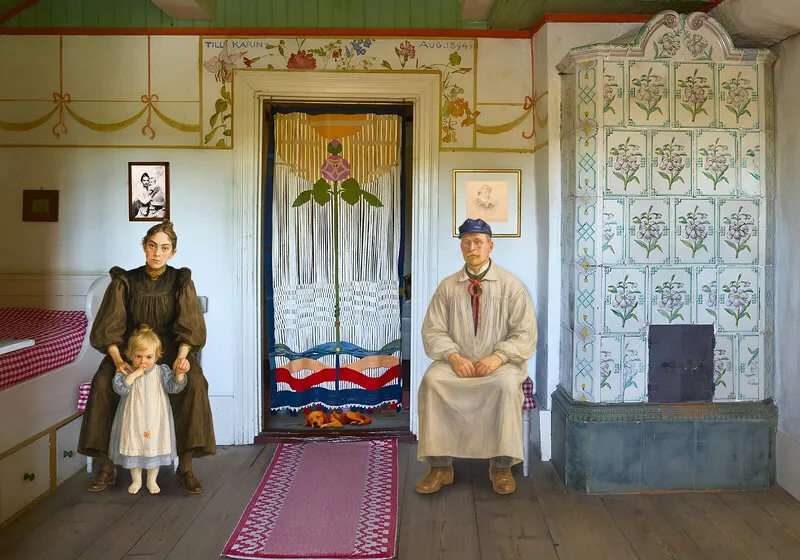
The image can deceive, but it can also reveal, much like my text, an entire life. The seemingly perfect scene — the puppy sleeping beneath Carl’s bedframe, the couple sitting on their respective chairs — captures more than it shows. Above Karin’s head hangs a photograph of her with their eldest child, while above Carl’s is a pencil drawing of himself as a young army recruit.
It is a surreal reflection of a rehearsed life, where the figures resemble puppets in a museum — a little too still, overly staged — revealing that even the idyll can be a façade. The perfection of the scene, with its carefully arranged objects and frozen smiles, all hint at a life that was more about appearances than reality.
A life behind a beautiful home, a smile masking silence. In Carl’s world, he was often shadowed by doubt despite outward harmony. In my life, Lisa represented colour, light, and movement. In this image, we only see the painted figures, but in reality, we were alive, and now it feels as if even my own home is beginning to freeze into the same stillness, because that is the way of memories. They freeze time, preserving moments in a way that reality cannot.
The chairs from the painting remain at Sundborn, just as Lisa’s chair is elsewhere — a place no one else can occupy. Not because it's forbidden, but because it's already taken. Lisa is here, as tangible as the pale autumn light on the equinox, her birthday.
‘The Puppet at Sundborn’ serves as a poignant reminder that sometimes we find ourselves playing roles in scenes we did not choose. Yet, beneath the surface, our actual lives persist. Our yearning, our grief, our love. And that love, it doesn't dissipate. It remains, it observes, it endures — as long as we possess the fortitude to remember.
The image is a puzzle within me, deliberately misleading. It could just as easily be Lisa and me, the mother of my children, with our daughter. Yet, at the same time, our son was always too restless to be captured in a picture, always moving, always living.
In the painting, Carl and Karin are seated in her bedroom with their daughter Kersti standing. Back then, everything was as it should be. A blank sheet of paper or an empty Photoshop file always lies ahead of me. That is life — a challenge constantly calling out to be filled with something. Without the emptiness that demands to be filled, I would no longer exist.
Her chair has been empty for five years because, metaphorically, it’s not about Karin—it’s about Lisa, my late wife, who left before me. In Carl’s case, it was the other way around—he departed this life ten years before Karin, so my story isn’t about the Carlssons, but about events that occurred sixty to a hundred years later. Still, there are similarities—perhaps not artistically—but in how our lives unfolded and those of our families. For many years, Lisa’s and my life could also be painted in pastel tones, a Skåne version of Sundborn, an idyll envied by many. But reality is deceptive. It's a stark reminder that life's path is not always as it seems, and the idyll we seek can be shattered in an instant. This deception of appearances prompts us to question our perceptions and seek a deeper understanding of life's complexities. But now to Lisa's and my imaginary pictures, some more real than others.
In one of my pictures, we’re both sitting in the garden—Lisa in a sunhat, I with a coffee cup—and our hands meet on the table between us. Nothing special happened that day, but the image has become a symbol. It's a reminder that everyday life carried us, that we didn’t need more than each other. Perhaps that’s what makes grief so difficult—when someone present in every daily routine is suddenly gone, it’s as if time itself loses its shape. The weight of these everyday moments, now stripped of their significance, remains a constant reminder of the void left by loss. But it's also a transformative force, altering our perception of time and the world around us, inspiring us to cherish every moment and find beauty in the ordinary. Grief, in its profound way, teaches us to appreciate the fleeting moments of joy and love that are a part of our lives.
The chair remains there, beneath the family idyll. No one has moved it, nor can anyone remove it, because it’s where she sat — not just her body, but all of her, her ideas, and the voice in the room. No one else may sit there. Not because it’s forbidden, but because the chair is already occupied. In spirit, she is always present, invisible — yet her presence is felt, a comforting reminder that our loved ones never truly leave us. Their essence lingers, offering solace in our moments of solitude.
It’s tempting to see Carl Larsson’s life as a sunshine story, but his idyllic Sundborn images are misleading. He was the poor boy who became one of the country’s most celebrated artists, an ambitious social climber who rose from humble beginnings to great heights. We share a brooding and complex personality, which is barely evident in our respective family idylls. Carl once said he saw himself as a natural knight, someone who wanted to save the world. I’ve felt something similar. I want to stress that artistically, we are in entirely different leagues — Carl on the highest Parnassus, I among the many far below. That’s not the point. What matters is the reality behind the image — for the surface others interpret as idyllic conceals much pain and many disappointments. The struggle to maintain his artistic integrity in the face of commercial pressures, the strain of his marriage, and the loss of his children are just a few of the challenges Carl faced. But now, back to that reality.
Out of sight in the hallway, a collection of business cards, notes, and small, useful items rests in an 18th-century pewter dish. On a smudged Post-it note, it says, “Lisa, don’t forget.” Lisa — the most beautiful name I know. On another note, it simply states 149.1. It resembled a hymn number in church, and it was, because ‘Day by Day’ was the hymn my mother insisted should be played at her funeral — only the first verse, which was sufficiently religious. And so it was performed by a string quartet that gave the hymn a lovely, secular tone. Why the note with the numbers remains there is hard to explain — it's been over ten years since she passed away. I’ve requested the same hymn for myself, but in a jazz version by Daddy Benny. ‘Kun en dag,’ he calls it, because he’s Danish. You thought it was a little sacrilegious, but you got John Lennon as you wished — not such a controversial choice. Imagine! The song you loved and probably took with you to your star. I sensed her nodding inside me. After fifty years, you know each other. And in sharing these experiences, I hope to remind you that you are not alone in your grief.
It was the autumn equinox, a time when day and night are of equal length, symbolising the balance of life. The weather was just as it should be that day — a bit of everything, a few raindrops, swift clouds, and a sun that peeked through now and then. I spoke to myself, hoping the words would reach my beloved wife.
Today, we would have celebrated our 50th wedding anniversary. Golden anniversary, my dearest Lisa. The same day we married, not by coincidence, but as a tribute to you. And our wedding march that day became the recessional music today. You would’ve loved that.” Once again, I felt her inner warmth radiating towards me.
“I am so profoundly grateful for the forty-nine years, six months, and three days we shared as a married couple. In addition, the four years before that, living together, make it feel surreal not having you by my side, especially on a day like this. I miss you so terribly. My beloved Lisa.” The depth of my love for you, Lisa, is immeasurable, and my memories of you will never fade.
Dear Lisa, have you read the words I posted on Facebook three weeks ago? They are seared into my mind. If you missed what I wrote, it went like this: “My great love has very unexpectedly left me and the children in boundless grief and despair. We will always love you, Lisa, and you will remain with us in our hearts. We must now try to live on with all the beautiful memories we have of you.”
You are desperately missed and loved by everyone—you were the best of us two. Lisa, my forever positive, life-loving, genuine, charismatic, beautiful, helpful, warm girl, mother, wife, and my best friend—there is no one like you.
I hope you’re painting on in eternity, and I feel you watching over all your loved ones—we all sense you watching over us. We love you so incredibly much.” I find solace in the thought of you, Lisa, continuing your art in a place of eternal peace.
Our shared portal—the website about us and our art—is a treasure trove of memories. I am grateful for the moments we captured and the art we created together. I let the computer run a chronological slideshow where it randomly mixed our pictures, each one a cherished memory.
One of my favourite portraits of Lisa depicts her standing in our studio, paintbrush in hand, with an enigmatic smile on her lips. Behind her, a work in progress—a woman dressed in red with a smile as mysterious as Mona Lisa’s. In the archive, the piece is titled “Lisa Paints Lisa.” It feels as if she knew she was painting it for us, and no one else.
We had discussed creating a joint archive of our works for years, but it never materialised while you were alive. And yet it exists—now—in my head and on my hard drive: an imaginary gallery with two signatures. I can see how our brushstrokes sometimes followed similar lines, how we approached the same themes from different directions—like two musicians in a chamber piece. You never dreamed of exhibiting at the Moderna, but you often said our pictures belonged together. And now, as they flicker past on the screen, I understand precisely what you meant.
Sometimes the images became almost unbearable. They felt too vivid. Lisa smiled at me from the screen as if nothing had happened. But after a while, her face became a comfort.
Not just as a record of what once was, but because they preserve something that still lives inside me: your gaze, your sense of colour, your world. They affirm that we created something together that didn’t die.
Life unfolded like a revue—over fifty years of images, a mosaic of lifetime moments scrolling forward. As the pictures passed, I spoke to Lisa as if she were standing beside me, seeing the same images. It probably sounded formal, for in truth, I was reading aloud a letter to Lisa that I had written in my mind at the same time.
It was quiet now. Not deathly silent, as the house still lived—pipes clicked, the computer fan hummed softly. But the other silence was absolute: the kind that comes when no one calls out from the kitchen anymore, no one laughs at their joke. That silence is harder to bear. It reminds you of what will never be repeated, of the enduring love and the painful loss.
“When you wanted to prevent our son from being born on April 1st, we walked together for days up and down the Brösarp hills. There, in what is the very essence of Österlen—among blooming cowslips and puffing steam trains across the rolling landscape—we solved many of the world’s problems. The vistas are magnificent, with sweeping views over the Verkeån valley, and the scenery has constantly appeared in both our paintings, either as background or as the stage for our stories. I’m sure you remember it as well as I do, Lisa.”
On the screen, the image of a blooming flower meadow by the shores of Lake Bolmen in Småland seemed to freeze time. A hand holding a bunch of poppies, and a naive girl with a flower crown in her hair. In the sky above, an angel suspiciously resembling Marilyn Monroe floated—the movie star we both had a kind of mental connection with.
January 1st, 1969, is an important date. That’s when we got engaged, and I had money in the bank and wanted to buy a house. Imagine—a whole half-century can pass so quickly, and all the memories remain. Even the ones without pictures.” I heard Lisa sigh at the time’s merciless pace. I sighed too.
A place to live. We soon found our dream. Renovation. Craftsmen. Plumbers, electricians—and remember Nils, the old carpenter, who taught me not to hit my thumb with a hammer because it hurts. It took a lot for two young people who had nothing. IKEA, Svenskt Tenn, and Nordiska Galleriet—polar opposites, but we made space for both—the porters in their old-fashioned peaked caps. We moved into the house on the plain, so you no longer had to stay with that Nazi hag in Lund. Her name was Helga, wasn’t it?” Lisa nodded so hard I felt it in my whole body. That pathetic old woman had given us many laughs.
“Look! There’s our very first shared studio that you recreated many years later. In the house across the courtyard, we could work side by side. It was a revolution, a symbol of our shared dreams and aspirations, a space where our creative energies intertwined. I nodded, and Lisa relaxed.
The unforgettable wedding, with all those speeches that often revealed more about the speakers themselves than about their knowledge of us. You got what you’d wished for—sun and rain, wind and calm in the bridal crown—a prophecy of a long and enduring marriage with a bit of everything through all the shifts of life. And so it has been. The weather was perfect, even though you have now left me all too soon. But despite having just buried my beloved, I found the strength to laugh heartily, a testament to the resilience we shared.
Do you remember the City Theatre’s ticket office? Back then, you had to buy tickets there. We were newlyweds, both of us loving opera and operettas—Mozart, Puccini, and Strauss—as well as theatre. Do you recall Hjalmar Bergman’s ‘Grandmother and the Lord’ with Agneta Prytz? That was one of our finest moments, when we sat silently holding hands and met in beauty and harmony on the stage’s fairyland. It was a joyful experience we shared, a memory that keeps us connected.
The following image shows Icarus above Malmö, painted in vivid detail. “Sture, our mutual friend, who climbed the social ladder but took too great a risk. The financial crisis struck, and he fell irreparably, choosing to travel far away, beyond the realm of the earthly. Life is so fragile!” Lisa’s compassion filled me, for what happened had hit her hard. He had been a childhood friend. This reflection on friendship and life's fragility invites us to contemplate our relationships and the transient nature of life.
We were both healthy — you had your migraines that sometimes forced you into dark rooms until the pain eased. Otherwise, only decapitation helped, as you used to joke with your gallows humour.” Lisa laughed again, and I assumed migraines don’t follow us into eternity. Her laughter, a shared joy, warmed my heart, evoking a sense of nostalgia and connection despite our shared struggles.
The image of a grandchild playing with fireflies in the Stockholm archipelago stirs memories. Right? I’m sure I saw Lisa nod. “In the background sailed Mirabelle, our boat with a name that was a beautiful view, a summer house on a keel, an old lady from 1938, which you and I bravely sanded, painted, and restored over twenty years. The 1930s yacht appears in many more images inspired by our journeys with the children. A half-hour film with Leonard Cohen singing from the foredeck aired on Swedish TV in 1988, and I’ve met him many times since he left this earth. But that’s, as they say, a whole other story, though you’ve met him on his star, Lisa, even if we never shared that experience.”
Then came the image of Maria, age three, awestruck by a stone lantern in the Singapore Botanic Gardens after her big brother Joakim told her a troll lived inside. That moment was immortalised in a modern version where Maria had grown up, and a troll lurked in the beech forest. How much we’ve achieved together, my beloved—you, the children, and I.” This reflection on our shared achievements fills me with a sense of pride and satisfaction, and I'm sure it will do the same for you, Lisa.
Bella Italia! Suddenly, we had a house in Italy. The pictures began to flourish, along with your culinary skills. Your kitchen diary is filled with illustrations and recipes. Those were the days, Lisa, and the boat often rested at the dock back home in Sweden.
The slideshow continues, and I can’t help but wonder how it would have been if you were standing here beside me. Physically, that is—for spiritually, I feel your presence, Lisa.” For a moment, it felt comforting, wrapping me in a blanket of warmth and peace that only our shared experiences can bring.
When you painted a plague doctor from the era of the Black Death, but dressed in a comical clown outfit, I should have become suspicious. It was so unlike you, who loved light and the colours of nature. The contrast between the dull beige-grey surroundings and the brightly coloured figure was striking.
Hope and despair in the same image—I realised this after a while. You titled the painting ‘Doctor X’ and ‘Z’, after the spies in the magazine Svenska Mad, one white and the other black, who always fought each other. In English, the pair was called ‘Spy vs. Spy,’ but that doesn’t make any sense in this case.
Doctor X and Z would, sadly, become a recurring presence in our reality, even if you never repainted them.
It became clear from the stream of images that something new and otherworldly had entered our shared life. You had painted a new acquaintance, a woman you called ‘My Angel’—a counsellor dressed in earth-toned clothes and sensible shoes. You captured her compassionate face so well; she arrived and departed quietly like a spirit. I knew you valued her, but she provoked defeatist feelings in me. I said nothing, but it was as if death’s messenger was knocking at the door. That was, of course, why she was there—to prepare, not to tempt with wishful thinking like I did.
One of your paintings was titled ‘Mama’, even though your mother-in-law, Greta, had left us long ago. She had always quietly stayed in the background to allow us to lead our own lives, and now, in this moment of need, she was being called upon. Only after a brief pause did I realise you had painted one of the nurses. The portrait was beautiful, and the resemblance striking, and the woman herself shared a substantial personality similarity to Greta as well.
This is when the images begin to fade and transform. Yours almost disappears altogether, Lisa. There was no time between home care, follow-up appointments, and ambulance rides. The pharmacy kept recurring. In such moments, one doesn’t have the strength to think in images.
Hmm! The images darkened, influenced by reality. ICA. Bland food and lactose-free milk. You had realised that your sensitive stomach didn’t like milk. After a long life, the insight finally came, and you improved immediately. You even said: ‘Now you’ll see, I’m going to get well.’ That’s how you sounded, Lisa—your whole life denying the darkness and only wanting to see what was good. That’s how I heard you speak within me—incorrigible. Better a beautiful lie than an ugly, unpleasant truth.
“ICA and Sabis, dry cleaning, the pharmacy, and so on. Even those images have their place in life. Empty pharmacy bags and pill schedules—they, too, belong to the image suite. That kind of sorrow still breathes tenderness, and it’s nothing I want to forget.”
Home started being managed by phone and internet, and I went out to fetch whatever wasn’t delivered to the door. You no longer had the strength to go shopping—something you had always loved. You were bedridden but laughed it off, saying you were just a bit woozy. “It’ll pass. Just like the migraines.” So typical of you to dismiss the worst. I sighed so deeply I startled myself, feeling the weight of your condition on my shoulders.
I noticed that some images were brighter than others, as if they carried light from within. It wasn’t the technique; it was your thoughts. In every choice of colour, in every composition, you painted with tenderness. I began to sense that images can shine with more than just colour—they can glow with presence, radiating a beauty that transcends the canvas.
The images on the screen started to blur, the motifs blending into one another like an expressionist landscape by van Gogh. I had to stop flipping through our paintings when darkness descended over my eyes and I, like a drowning man, tried to see through the salty waters of the Öresund. A paper napkin later, I was able to carry on.
Your final painting was inspired by Frida Kahlo’s watermelons, which she painted while lying in bed just days before she passed away. It was an omen I didn’t dare comment on—denial is a powerful force. I didn’t want to know.
‘If she could, so can I,’ you said, and painted a picture that was not for sale: Frida Kahlo alongside Marilyn Monroe, among the clouds near the Pearly Gates. It is one of your best, Lisa, and when I have the strength to face the memory, it will hang in a place of honour. This shared creativity, this ability to create something beautiful even in the face of mortality, is a testament to the enduring power of art and love, inspiring us to find beauty in the most challenging moments.
One image lingers a little longer. It’s the one you called ‘The Final Room’—a space without walls, ceiling, or floor, only light, with a table where no one sits anymore. You never wanted to sell it. “It should stay in the family,” you said. Perhaps you already knew something then that I hadn’t yet understood. Now, it is I who watches over the room, in awe of the beauty and depth of this final creation.
On the screen, an image flickered of a long staircase rising towards the heavens, or at least towards Christ and Mary Magdalene at the top. The winding staircase, carved from the whitest marble, emerged from nothing—perhaps from where the funeral home was. Behind Jesus stood a priest round as a cheese. Neither you nor I, Lisa, were believers in the literal sense, yet we had a respectful relationship with the church. But when we were young, priests were often well-fed.
The Harlequin and the Coffin. Your quirky painting of the Harlequin in his motley costume, sitting atop his coffin as he rides it into the grave. ‘That’s how I want to go when my time comes,’ you joked. But that’s not how it happened — it was a simple white one, as pure as your soul.”
My image of Lazarus carrying the urn with his ashes flickered past. He didn’t want to part from his earthly remains, and according to legend, he now wanders through eternity in that state.
There’s one last picture I haven’t uploaded yet. It’s leaning against the wall in the studio, half-shrouded in shadow. It’s not finished. Just a field of dappled light, with something that might be a path, perhaps a road leading nowhere. I haven’t dared look too closely. Maybe you’re waiting there, Lisa. Possibly we’ll soon stand there together—but on the same side of the light.” She shook her head inside me, as if to say: “Don’t rush—eternity is long. Remember, the children still need you. After you, there is no one.”
That’s where I stopped. The priest’s words about dust returning to dust were too much, and I walked away from the computer, but I felt Lisa tagging along in solidarity. That’s how she always was in life. She stuck with me, a constant companion in the journey of grief and remembrance.
In just a few minutes, I had been reunited with fifty years of my life. I stood tall as I took off the dark clothes. I could still hold my head high, like a proud human being. Whatever the circumstances, I have tasted the sweetest life has to offer—something other poor souls never had the chance to experience. And Lisa is still there, waiting among the stars. Until we meet again, I’ll make do with the children—the next best thing, the living embodiment of our love and the continuation of our legacy. This acceptance of mortality, this understanding that life is fleeting but beautiful, brings a sense of peace and contemplation.
I believe that every image we have created is like a frozen moment of our love, preserved on canvas or in pixels, stored among the stars or in my heart. These memories, like the painting that was never made but always imagined, are the ones now hanging in the space between us. Every time I open our folder, our image collection, I feel as if you’re with me. You were always there, Lisa—and always will be. These shared memories, these moments of love and creativity, are what keep us connected, even in your absence, and they will continue to do so, forever.
3 200 kr

Jörgen Thornberg
Malmö
Lite om bilder och mig. Translation in English at the end.
Jag är en nyfiken person som ser allt i bilder, även det jag fäster i ord, gärna tillsammans för bakom alla mina bilder finns en berättelse. Till vissa bilder hör en kortare eller längre novell som följer med bilden.
Bilder berättar historier. Jag omges av naturlig skönhet, intressanta människor och historia var jag än går. Jag använder min kamera för att dokumentera världen och blanda det jag ser med vad jag känner för att fånga den dolda magin.
Mina bilder berättar mina historier. Genom mina bilder, tryck och berättelser. Jag bjuder in dig att ta del av dessa berättelser, in i ditt liv och hem och dela min mycket personliga syn på vår värld. Mer än vad ögat ser. Jag tänker i bilder, drömmer och skriver och pratar om dem; följaktligen måste jag också skapa bilder. De blir vad jag ser, inte nödvändigtvis begränsade till verkligheten. Det finns en bild runt varje hörn. Jag hoppas att du kommer att se vad jag såg och gilla det.
Jag är också en skrivande person och till många bilder hör en kortare eller längre essay. Den följer med tavlan, tryckt på fint papper och med en personlig hälsning från mig.
Flertalet bilder startar sin resa i min kamera. Enkelt förklarat beskriver jag bilden jag ser i mitt inre, upplevd eller fantiserad. Bilden uppstår inom mig redan innan jag fått okularet till ögat. På bråkdelen av ett ögonblick ser jag vad jag vill ha och vad som kan göras med bilden. Här skall jag stoppa in en giraff, stålmannen, Titanic eller vad det är min fantasi finner ut. Ännu märkligare är att jag kommer ihåg minnesbilden långt efteråt när det blir tid att skapa verket. Om jag lyckas eller inte, är upp till betraktaren, oftast präglat av en stråk av svart humor – meningen är att man skall bli underhållen. Mina bilder blir ofta en snackis där de hänger.
Jag föredrar bilder som förmedlar ett budskap i flera lager. Vid första anblicken fylld av feel-good, en vacker utsikt, fint väder, solen skiner, blommor på ängen eller vattnet som ligger förrädiskt spegelblankt. I en sådan bild kan jag gömma min egentliga berättelse, mitt förakt för förtryckare och våldsverkare, rasister och fördomsfulla människor - ett gärna återkommande motiv mer eller mindre dolt i det vackra motivet. Jag försöker förena dem i ett gemensamt narrativ.
Bild och formgivning har löpt som en röd tråd genom livet. Fotokonst känns som en värdig final som jag gärna delar med mig.
Min genre är vid som framgår av mina bilder, temat en blandning av pop- och gatukonst i kollage som kan bestå av hundratals lager. Vissa bilder kan ta veckor, andra någon dag innan det är dags att överlämna resultatet till printverkstaden. Fine Art Prints är digitala fotocollage. I dessa kollage sker rivandet, klippandet, pusslandet, målandet, ritandet och sprayningen digitalt. Det jag monterar in kan vara hundratals år gamla bilder som jag omsorgsfullt frilägger så att de ser ut att vara en del av tavlan men också bilder skapade av mig själv efter min egen fantasi. Därefter besöks printstudion och för vissa bilder numrera en limiterad upplaga (oftast 7 exemplar) och signera för hand. Vissa bilder kan köpas i olika format. Det är bara att fråga efter vilka. Gillar man en bild som är 70x100 men inte har plats på väggen, går den kanske att få i 50x70 cm istället. Frågan är fri.
Metoden Giclée eller Fine Art Print som det också kallas är det moderna sättet för framställning av grafisk konst. Villkoret för denna typ av utskrifter är att en högkvalitativ storformatskrivare används med åldersbeständigt färgpigment och konstnärspapper eller i förekommande fall på duk. Pappret som används möter de krav på livslängd som ställs av museer och gallerier. Normalt säljer jag mina bilder oinramade så att den nya ägaren själv kan bestämma hur de skall se ut, med eller utan passepartout färg på ram, med eller utan glas etc..
Under många år ställde jag bara ut på nätet, i valda grupper och på min egen Facebooksida - https://www.facebook.com/jorgen.thornberg.9
Jag finns också på en egen hemsida som tyvärr inte alltid är uppdaterad – https://www.jth.life/ Där kan du också läsa en del av de berättelser som följer med bilden.
UTSTÄLLNINGAR
Luftkastellet, oktober 2022
Konst i Lund, november 2022
Luftkastellet, mars 2023
Engleson Galleri Caroli, april 2023
Hydra, Greece June 2023
Engleson Galleri Caroli, oktober 2023
Toppen, Höllviken december 2023
Luftkastellet, mars 2024
Torups Galleri, mars 2024
Venice, May 2024
Luftkastellet, oktober 2024
Konst i Advent, December 2024
Galleri Engleson, Caroli December 2024
Jäger & Jansson Galleri, april 2025
A bit about pictures and me.
I'm a curious person who sees everything in pictures, even what I express in words, often combining them, for behind all my pictures lies a story. These narratives, some as short as a single image and others as long as a novel, are the heart and soul of my work.
Pictures tell stories. Wherever I go, I'm surrounded by natural beauty, exciting people, and history. I use my camera to document the world and blend what I see with what I feel to capture the hidden magic.
My images tell my stories. Through my pictures, prints, and narratives, I invite you to partake in these stories in your life and home and share my deeply personal perspective of our world. More than meets the eye. I think in pictures, dream, write, and talk about them; consequently, I must create images too. They become what I see, not necessarily confined to reality. There's a picture around every corner. I hope you'll see what I saw and enjoy it.
I'm also a writer, and many images come with a shorter or longer essay. It accompanies the painting, printed on fine paper with my personal greeting.
Many pictures start their journey on my camera. Simply put, I describe the image I see in my mind, experienced or imagined. The image arises within me even before I bring the eyepiece to my eye. In a fraction of a moment, I see what I want and what can be done with the picture. Here, I'll insert a giraffe, Superman, the Titanic, or whatever my imagination conjures up. Even stranger is that I remember the mental image long after it's time to create the work. Whether I succeed is up to the observer, often imbued with a streak of black humour – the aim is to entertain. My pictures usually become a talking point wherever they hang.
I prefer pictures that convey a message in multiple layers. At first glance, they're filled with feel-good vibes, a beautiful view, lovely weather, the sun shining, flowers in the meadow, or the water lying deceptively calm. But beneath this surface beauty, I often conceal a deeper story, a narrative that challenges societal norms or explores the human condition. I invite you to delve into these hidden narratives and discover the layers of meaning within my work.
Picture and design have been a thread running through my life. Photographic art feels like a fitting finale, and I'm happy to share it.
My genre is varied, as seen in my pictures; the theme is a blend of pop and street art in collages that can consist of hundreds of layers. Some images can take weeks, others just a day before it's time to hand over the result to the print workshop. Fine Art Prints are digital photo collages. In these collages, tearing, cutting, puzzling, painting, drawing, and spraying happen digitally. What I insert can be images hundreds of years old that I carefully extract so they appear to be part of the painting, but also images created by myself, now also generated from my imagination. Next, visit the print studio and, for certain images, number a limited edition (usually 7 copies) and sign them by hand. Some images may be available in other formats. Just ask which ones. If you like an image that's 70x100 but doesn't have space on the wall, you might be able to get it in 50x70 cm instead. The question is open.
The Giclée method, or Fine Art Print as it's also called, is the modern way of producing graphic art. This method ensures the highest quality and longevity of the artwork, using a high-quality large-format printer with archival pigment inks and artist paper or, in some cases, canvas. The paper used meets the longevity requirements set by museums and galleries. I sell my pictures unframed, allowing the new owner to personalise their artwork, confident in the lasting value and quality of the piece.
For many years, I only exhibited online, in selected groups, and on my Facebook page - https://www.facebook.com/jorgen.thornberg.9. I also have my website, which unfortunately is not constantly updated - https://www.jth.life/. You can also read some of the stories accompanying the pictures there.
EXHIBITIONS
Luftkastellet, October 2022
Art in Lund, November 2022
Luftkastellet, March 2023
Engleson Gallery Caroli, April 2023
Hydra, Greece June 2023
Engleson Gallery Caroli, October 2023
Toppen, Höllviken December 2023
Luftkastellet, March 2024
Torup Gallery, March 2024
Venice, May 2024
UTSTÄLLNINGAR
Luftkastellet, oktober 2022
Konst i Lund, november 2022
Luftkastellet, mars 2023
Engleson Galleri Caroli, april 2023
Hydra, Greece June 2023
Engleson Galleri Caroli, oktober 2023
Toppen, Höllviken december 2023
Luftkastellet, mars 2024
Torups Galleri, mars 2024
Venice, May 2024
Luftkastellet, October 2024
Konst i Advent, December 2024
Galleri Engleson, Caroli December 2024
Jäger & Jansson Galleri, April 2025
Utbildning
Autodidakt
Medlem i konstnärsförening
Öppna Sinnen
Med i konstrunda
Konstrundan i Skåne
Utställningar
Luftkastellet, October 2022
Art in Lund, November 2022
Luftkastellet, March 2023
Engleson Gallery Caroli, April 2023
Hydra, Greece June 2023
Engleson Gallery Caroli, October 2023
Toppen, Höllviken December 2023
Luftkastellet, March 2024
Torup Gallery, March 2024
Venice, May 2024