Vi använder cookies för att ge dig bästa möjliga upplevelse. Välj vilka cookies du tillåter.
Läs mer i vår integritetspolicy
Jörgen Thornberg
Escape from America - Flykten från Amerika, 2025
Digital
50 x 70 cm
Escape from America - Flykten från Amerika
This is a purely fictional work. It draws on a hypothetical scenario in which the Statue of Liberty, long after her unveiling, unexpectedly steps down from her pedestal and leaves the United States, going home to the Old World she left 140 years ago. All depictions, events, and statements are imagined. The text is not intended to provide an accurate historical account of real people or events, but rather to use well-known figures and symbols in an artistic, satirical, and metaphorical way. It's a puzzle of symbols and meanings, designed to stimulate the intellect. Any resemblance to actual events, living persons, or official documents is entirely intentional. The issues it addresses, however, are all too real – and it is precisely for that reason that Lady Liberty, as a Time-traveller and wanderer, feels compelled to act.
“Miss Liberty Going Home
They said she could never leave,
rooted in copper and promise,
watching the ships slide in.
But one morning, she stepped down –
torch held high,
Frida swinging at her side –
and waded over the vast Atlantic.
Each wave a whisper: come home,
each gull a guide toward the pale north light.
They say with good faith and big shoes,
you can walk on water –
and what is bigger than liberty
striding toward a quiet,
sandy shore in southern Sweden,
where the wind smells of rye bread
and the only crown
is the sun rising on the horizon.”
Malmö. August 2025
Escape from America
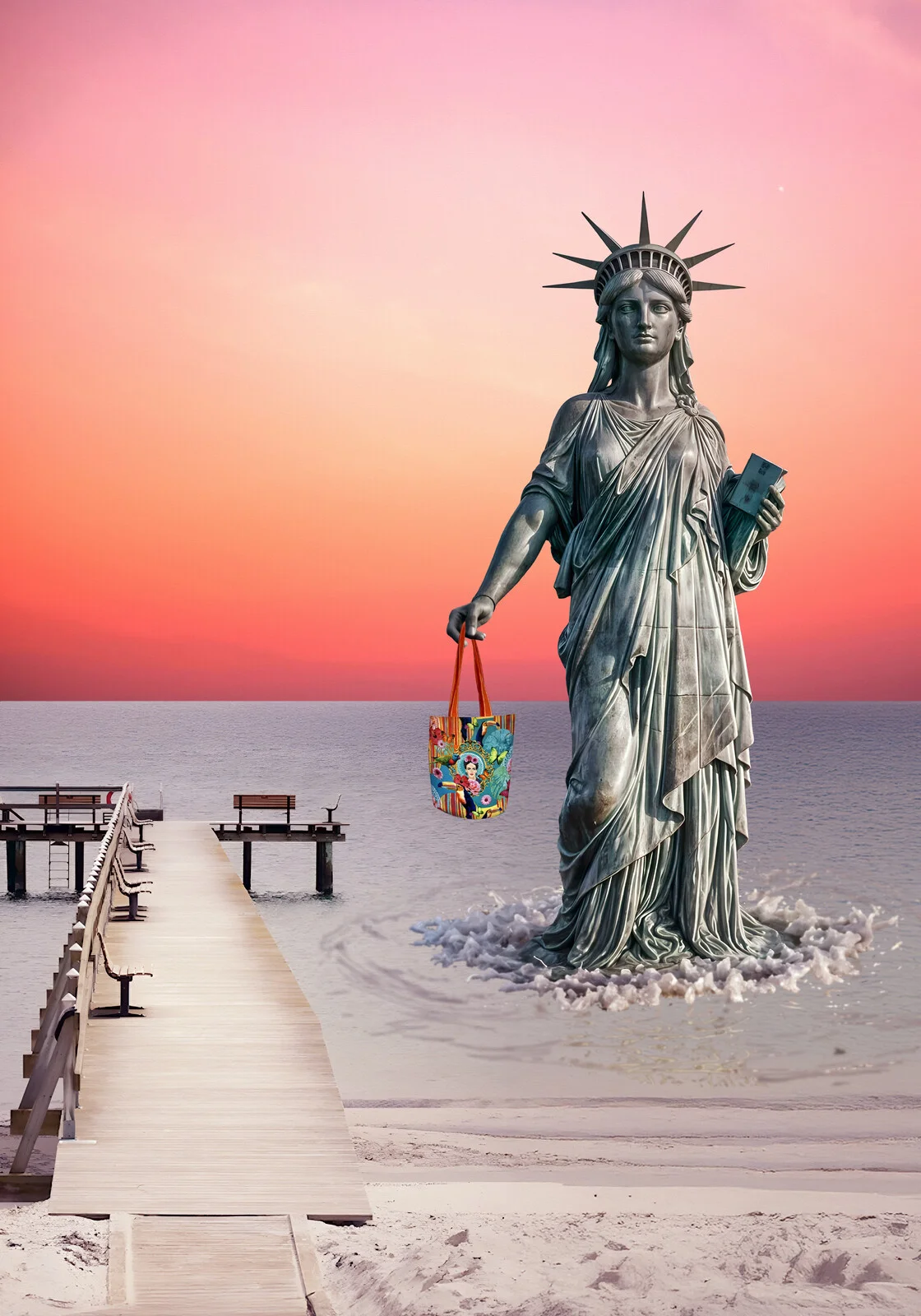
The image suggests that the Statue of Liberty is no longer the unwavering symbol at the entrance to New York Harbour. She has stepped down from her pedestal and is crossing the Atlantic towards the Old World, leaving behind the continent she has welcomed millions to for nearly 140 years. In her hand, she holds not only her tablet inscribed with the date of independence but also a brightly coloured cloth bag – an almost ironic, human trait, as if she were a traveller heading for a new shore.
Her official name is ‘Liberty Enlightening the World’ – powerful words that highlight the symbolic importance she has held. It is as if she has grown weary of being a symbol of freedom in a country where freedom, for many, feels fragile and chipped at the edges. She is departing not only from a geographical place but also from an idea. Perhaps she has become tired of standing as a silent witness. At the same time, the ideals she embodies – liberty, equality, hope – are gradually compromised in deals that weaken their true meaning, political polarisation that divides instead of unites, and suspicion of foreigners that contradicts the spirit of inclusivity.
The Statue of Liberty was originally a gift from France, unveiled in 1886, as a gesture of friendship between two republics born from revolution. For the French, she was a tribute to the principles they had fought for in 1789 – liberty, equality, and fraternity – and they saw in the United States a young nation capable of carrying those ideals across the ocean. On her pedestal were engraved words intended to speak to all who approached the country: a promise that here was a refuge for the tired, the poor, and the persecuted.
That is why the image of her leaving is so powerful. If the symbol of freedom and hope turns its back on the country it once aimed to uplift, what does that say about the state of its ideals? In the current political climate, characterised by compromises, polarisation, and suspicion of foreigners, the departure of the Statue of Liberty takes on a deeper meaning. Perhaps it is not only the statue that is leaving, but also the very narrative of America as a role model.
Her departure thus becomes more than a journey; it becomes a profound statement. An image suggesting that even the symbols themselves – those intended to remain unchanged through time – can lose faith in the story they were meant to represent. Lady Liberty has become an individual, with a choice, and that choice is to leave. And as she departs, the question arises: if the very icon of freedom flees, what does she leave behind, and who is left to carry the torch? This departure is a call to action, a stark reminder of the urgency to uphold the values she once symbolised, and a testament to the responsibility each of us bears in this fight for freedom.
That Lady Liberty carrying a bag decorated with Frida Kahlo is no coincidence, but a layered act of symbolism. Frida, who in life refused to conform to patriarchal norms and expressed her pain, freedom, and anger with the same raw intensity, here becomes a companion to the Statue of Liberty on her departure.
It is as if Lady Liberty, in her final moment, chooses to take with her not only the memory of the America that once welcomed the oppressed, but also the legacy of another kind of freedom – personal, uncompromising, and radical. Frida Kahlo on the cloth bag becomes an apostle in exile, a powerful reminder that freedom is not solely the concern of a nation, but an individual struggle, ongoing and unending, no matter what land one happens to stand in. This emphasis on personal and radical freedom serves as an inspiration, highlighting the individual responsibility in the fight for freedom.
Together, the two figures – the neoclassical statue and the Mexican artist – form an unexpected alliance. This alliance, rooted in Enlightenment ideals and a twentieth-century fight against the constraints of both body and society, is a powerful symbol. Together, they leave behind a place where freedom has fractured, heading towards the horizon where it might flourish again.
It's not just a piece of art, it's a reflection of reality. As Lady Liberty, in our imagination, steps down from her pedestal and walks towards the horizon, more and more genuine Americans are doing the same. They are not tourists, but emigrants, leaving the United States. Wealthy families, academics, entrepreneurs, and cultural figures are packing their lives into suitcases and relocating to other countries, driven by political unrest, economic uncertainty, and a growing sense that the nation’s foundational promises are being eroded.
During Donald Trump’s second term, a significant number of people have chosen to leave the United States. Their reasons are varied, but often stem from a response to political unrest, economic instability, and concerns about the future of democracy.
Political and social unrest: Trump’s policies, including measures against transgender rights and restrictions on academic freedom, have made many people feel unsafe. Reports show an increase in applications for British citizenship by American nationals, especially in areas like the Cotswolds and London.
Economic uncertainty: The global tariffs imposed by the Trump administration have driven inflation and instability in financial markets. According to the Centre for American Progress, these tariffs could cost American households an average of £ 5,200 per year.
A search for stability: Many are relocating to countries such as the United Kingdom, Canada, and Portugal in pursuit of political and social stability. London has experienced a surge in American property buyers, particularly in neighbourhoods like Notting Hill and Holland Park.
Popular destinations
United Kingdom: Despite specific tax changes, the UK remains an attractive destination for American expatriates. The number of Americans purchasing property in London has risen considerably, and applications for British citizenship have increased markedly.
Portugal and Italy: These nations have gained popularity among American retirees and entrepreneurs looking for a more relaxed pace of life and lower living costs.
Canada: Canada has long been a popular destination for American emigrants, and interest has increased further during Trump’s second term.
Trump’s second term has sparked a significant wave of emigration among wealthy Americans seeking political and economic stability abroad. This trend impacts both American communities and the countries welcoming these new residents.
The long-term effects of wealthy and influential individuals, including academics, leaving the United States could be significant, affecting both the economy and culture. This exodus could reshape the American landscape, both economically and culturally, in ways we are only beginning to understand. Here are some key points to consider:
1. Brain drain and reduced innovation
The United States, a beacon of higher education and research, has been a magnet for international students and scholars, drawn by its esteemed universities and abundant research opportunities. However, the spectre of political and social instability looms, threatening to drive away these talents. The potential loss of this international talent could stifle innovation and impede progress in crucial fields such as technology, medicine, and other research areas, which are the lifeblood of America’s economic growth.
According to a report from the National Science Foundation, a decline in the number of highly qualified international academics could weaken the United States’ competitiveness on the global stage, especially in research and development.
2. Loss of tax revenue from the wealthy.
The departure of individuals from the United States to countries with lower tax rates, such as the United Kingdom or Portugal, represents a direct loss of tax revenue for the American government. Many of these individuals are high-net-worth individuals who make substantial investments, directly impacting the U.S. economy and supporting public services through income taxes, corporate taxes, and capital gains.
3. Fewer international talents at universities
American universities have historically attracted international students, especially from countries such as China, India, and across Europe. Institutions like Harvard, MIT, and Stanford have played a central role in advancing research and fostering global networks across disciplines. If politics, tariffs, and uncertainty cause these students to choose other destinations (such as the United Kingdom, Canada, or Australia), it could decrease the inflow of international talent into U.S. universities, impacting the quality of education and America’s position in the global academic arena.
4. Cultural impact and shifting networks
Influential figures in economics and intellect, such as leading scientists like [insert name], artists like [insert name], and business personalities like [insert name], also shape America’s cultural and political dialogue. An exodus of these individuals could lessen U.S. cultural influence and alter global networks, potentially reducing the country's relevance in certain international debates on politics and culture.
5. A shifting global balance of power
If a significant number of wealthy and influential Americans choose to relocate, it could precipitate a seismic shift in the global balance of power. Countries like the United Kingdom, Canada, and the Nordic nations could experience an influx of capital, ideas, and cultural influence. This not only means the loss of influential individuals for the U.S. but also a potential reconfiguration of America’s leadership roles in international organisations and global partnerships.
Conclusion
However, there are potential solutions to mitigate these risks, such as creating more stable political and social environments, implementing policies to retain international talent, and fostering global partnerships. A long-term departure of talented and influential individuals – whether academics, entrepreneurs, or other leading figures – could have serious consequences for the United States’ position as a leader in innovation, research, and the global economy. The economic and cultural effects of this phenomenon are not just about lost tax revenue but also about reduced worldwide influence and competitiveness in the long run.
So, is Mr. Trump an idiot? Not in the literal sense of the word – but undeniably uneducated, coarse, vulgar, and a full-fledged narcissist, entirely absorbed in himself and in whatever brings short-term benefit to him and the wealthy elite. The rest – the majority – he couldn’t care less about. The tragedy is that so many fail to recognise this until it’s too late. And by then, the damage has already been done. The fractures he has deepened in American society, the erosion of trust in institutions, and the decay of the very idea of the common good will resonate well beyond his tenure, shaping the nation’s future for the foreseeable horizon.
So, is Mr. Trump an idiot? Not in the literal sense of the word, but undeniably uneducated, coarse, vulgar, and a full-fledged narcissist, entirely absorbed in himself and in whatever brings short-term benefit to him and the wealthy elite. The rest – the majority – he couldn’t care less about. The tragedy is that so many fail to recognise this until it’s too late. And by then, the damage has already been done irreversibly. The fractures he has deepened in American society, the erosion of trust in institutions, and the decay of the very idea of the common good will resonate well beyond his tenure, shaping the nation’s future for the foreseeable horizon.
Bilden visar att Frihetsgudinnan inte längre är den orubbliga fyrbåken vid New Yorks hamn. Här har hon stigit ner från sin piedestal och vadar över Atlanten till den gamla världen, bort från den kontinent hon i snart 140 år välkomnat miljoner till. I handen bär hon inte längre bara sin tavla med inskriptionen om självständighetens datum, utan även en färgstark tygpåse – ett nästan ironiskt, mänskligt attribut, som om hon vore en resenär på väg till en ny strand.
Egentligen heter statyn ’Liberty Enlightening the World’. Starka ord som visar vilket symboliskt värde hon haft. Det är som om hon har fått nog av att vara en symbol för frihet i ett land där friheten för många känns naggad i kanten. Hon lämnar inte bara ett geografiskt rum, utan en idé. Kanske har hon tröttnat på att stå som tyst vittne till att idealen hon representerar – frihet, jämlikhet, hopp – gradvis förhandlas bort i kompromisser, politisk polarisering och misstänksamhet mot det främmande.
Frihetsgudinnan var från början en gåva från Frankrike, avtäcktes 1886, och var tänkt som ett vänskapstecken mellan två republiker födda ur revolutionens idéer. För fransmännen var hon en hyllning till principer de själva kämpat för 1789 – frihet, jämlikhet och broderskap – och de såg i USA en ung nation som kunde bära dessa ideal vidare över havet. På sin sockel fick hon ord inristade som skulle tala till alla som närmade sig landet: ett löfte om att här fanns en fristad för de trötta, de fattiga och de förföljda.
Just därför blir bilden av henne på väg bort så drabbande. Om symbolen för frihet och hopp vänder ryggen åt det land hon en gång kom för att hylla – vad säger det då om idealens tillstånd? Kanske är det inte bara statyn som lämnar, utan själva berättelsen om Amerika som förebild.
Hennes vandring bort blir då mer än en resa; den blir en kommentar. En bild av att även symbolerna själva, de som skulle stå oföränderliga genom tiderna, kan tappa förtroendet för den berättelse de varit satta att representera. Lady Liberty har blivit en individ, med ett val, och det valet är att lämna. Och när hon går, uppstår frågan: om själva frihetens ikon flyr – vad lämnar hon efter sig, och vem är kvar att bära facklan?
Att Lady Liberty bär en väska prydd med Frida Kahlo är ingen slump, utan en dubbel symbolhandling. Frida, som i livet vägrade anpassa sig till patriarkala normer, som målade sin smärta, sin frihet och sin vrede med samma intensitet, blir här en följeslagare till frihetens staty på hennes vandring bort.
Det är som om Lady Liberty i det sista ögonblicket väljer att ta med sig inte bara minnet av det Amerika som en gång välkomnade de förtryckta, utan också arvet av en annan frihet – den personliga, kompromisslösa och radikala. Frida Kahlo på tygväskan blir en apostel i exil, en påminnelse om att frihet inte bara är en nations angelägenhet, utan en individuell kamp, ständigt pågående, oavsett vilket land man råkar stå i.
Tillsammans blir de två gestalterna – den neoklassiska statyn och den mexikanska konstnären – en oväntad allians. Den ena född ur upplysningstidens ideal, den andra ur en 1900-talskamp mot både kroppens och samhällets bojor. Tillsammans lämnar de en plats där friheten krackelerat, på väg mot horisonten där den kanske kan få blomma igen.
Bilden är inte bara ett konstverk – den speglar en verklighet. För medan Lady Liberty i fantasin stiger ner från sin piedestal och vandrar mot horisonten, gör allt fler verkliga amerikaner samma sak. De lämnar USA, inte som turister, utan som utflyttare. Välbärgade familjer, akademiker, entreprenörer och kulturpersonligheter packar sina liv i resväskor och flyttar till andra länder. Deras skäl varierar, men mönstret är tydligt: politisk oro, ekonomisk osäkerhet och en växande känsla av att landets grundläggande löften håller på att urholkas.
Många har valt att lämna USA under Donald Trumps andra mandatperiod, ofta som en reaktion på politisk oro, ekonomisk osäkerhet och oro för demokratins framtid.
Orsaker till utvandringen
Politisk och social oro: Trumps politik, inklusive åtgärder mot transpersoners rättigheter och inskränkningar i akademisk frihet, har fått många att känna sig osäkra. Enligt rapporter har det skett en ökning av amerikanska medborgares ansökningar om brittiskt medborgarskap, särskilt i områden som Cotswolds och London .
Ekonomisk osäkerhet: De globala tullarna som införts av Trump-administrationen har lett till ökad inflation och osäkerhet på finansmarknaderna. Enligt Center for American Progress kan dessa tullar kosta amerikanska hushåll i genomsnitt 5 200 USD per år .
Sökande efter stabilitet: Många söker sig till länder som Storbritannien, Kanada och Portugal för att hitta politisk och social stabilitet. London har sett en ökning av amerikanska fastighetsköpare, särskilt i områden som Notting Hill och Holland Park.
Populära destinationer
Storbritannien: Trots vissa skatteändringar har Storbritannien blivit en attraktiv destination för amerikanska utvandrare. London har sett en ökning av amerikanska fastighetsköpare, och ansökningar om brittiskt medborgarskap har ökat markant .
Portugal och Italien: Dessa länder har blivit populära bland amerikanska pensionärer och entreprenörer som söker en lugnare livsstil och lägre levnadskostnader .
Kanada: Kanada har länge varit en populär destination för amerikanska utvandrare, och intresset har ökat ytterligare under Trumps andra mandatperiod .
Trumps andra mandatperiod har lett till en märkbar utvandring bland välbärgade amerikaner som söker politisk och ekonomisk stabilitet utomlands. Denna trend påverkar både amerikanska samhällen och de länder som tar emot dessa nya invånare.
De långsiktiga konsekvenserna av att rika och inflytelserika individer, inklusive akademiker, lämnar USA kan vara betydande och få både ekonomiska och kulturella effekter. Här är några aspekter att överväga:
1. Hjärnflykt och minskad innovation
USA har länge varit ett nav för högre utbildning och forskning, och många internationella studenter och forskare har lockats dit på grund av landets prestigefyllda universitet och forskningsmöjligheter. Om den politiska och sociala instabiliteten i USA fortsätter, riskerar landet att förlora många av dessa talanger. Detta kan påverka innovation och framsteg inom teknik, medicin och andra forskningsområden, vilket är avgörande för USA:s ekonomiska tillväxt.
Enligt en rapport från National Science Foundation kan en minskning av högkvalitativa internationella akademiker minska USAs konkurrensförmåga på den globala scenen, särskilt inom forskning och utveckling.
2. Förlust av skatteintäkter från de rikaste
De individer som lämnar USA för att bosätta sig i länder med lägre skatter, som Storbritannien eller Portugal, innebär en förlust av skatteintäkter för den amerikanska staten. Många av dessa personer har stor förmögenhet och gör stora investeringar som inte bara direkt påverkar USA:s ekonomi, utan också bidrar till att stödja välfärdssystemet genom inkomstskatter, företagsbeskattning och kapitalvinster.
3. Färre internationella talanger till universitet
USA:s universitet har länge varit en magnet för internationella studenter, särskilt från länder som Kina, Indien och Europa. Landets universitet, som Harvard, MIT och Stanford, har haft en central roll i att driva forskning och skapa globala nätverk inom olika discipliner. Om politik, tullar och osäkerhet får dessa studenter att överväga andra alternativ (som Storbritannien, Kanada eller Australien), kan det minska flödet av internationella talanger till amerikanska universitet, vilket kan påverka kvaliteten på utbildningen och den globala konkurrenskraften.
4. Kulturell påverkan och förändrade nätverk
Människor med stor ekonomisk och intellektuell påverkan, som framstående forskare, konstnärer och affärsfolk, bidrar också till den kulturella och politiska dialogen i USA. En exodus av dessa individer kan leda till en förlust av kulturellt inflytande och förändrade globala nätverk. Detta skulle kunna göra USA mindre relevant i vissa internationella diskussioner om global politik och kultur.
5. Förändrad global maktbalans
Om fler välbärgade och inflytelserika amerikaner söker sig till andra länder, kan det förändra den globala maktbalansen. Länder som Storbritannien, Kanada, och de nordiska länderna kan få ett uppsving av kapital, idéer och kulturellt inflytande. Förutom det faktum att USA skulle förlora sina mest inflytelserika individer på hemmaplan, skulle detta kunna påverka de amerikanska ledarskappositionerna inom internationella organisationer och globala samarbeten.
Slutsats
En långsiktig exodus av talangfulla och inflytelserika individer, oavsett om de är akademiker, företagare eller andra ledande personligheter, kan få allvarliga konsekvenser för USA:s position som ledande inom innovation, forskning och global ekonomi. Den ekonomiska och kulturella påverkan av detta fenomen är inte bara en fråga om förlorade skatteintäkter utan också om landets globala inflytande och konkurrensförmåga på lång sikt.
Så är då Mr Trump en idiot? Inte i ordets rätta bemärkelse, men både obildad, plump, vulgär och en fullkornsnarcissist helt fokuserad på sig själv och det som kortsiktigt gynnar honom och rika människor, resten, majoriteten bryr han sig inte ett dyft om. Trist att så många inte inser det här. Innan det är för sent, för skadan är redan skedd och kommer att påverka framtiden inom överskådlig tid.
Jörgen Thornberg
Escape from America - Flykten från Amerika, 2025
Digital
50 x 70 cm
Escape from America - Flykten från Amerika
This is a purely fictional work. It draws on a hypothetical scenario in which the Statue of Liberty, long after her unveiling, unexpectedly steps down from her pedestal and leaves the United States, going home to the Old World she left 140 years ago. All depictions, events, and statements are imagined. The text is not intended to provide an accurate historical account of real people or events, but rather to use well-known figures and symbols in an artistic, satirical, and metaphorical way. It's a puzzle of symbols and meanings, designed to stimulate the intellect. Any resemblance to actual events, living persons, or official documents is entirely intentional. The issues it addresses, however, are all too real – and it is precisely for that reason that Lady Liberty, as a Time-traveller and wanderer, feels compelled to act.
“Miss Liberty Going Home
They said she could never leave,
rooted in copper and promise,
watching the ships slide in.
But one morning, she stepped down –
torch held high,
Frida swinging at her side –
and waded over the vast Atlantic.
Each wave a whisper: come home,
each gull a guide toward the pale north light.
They say with good faith and big shoes,
you can walk on water –
and what is bigger than liberty
striding toward a quiet,
sandy shore in southern Sweden,
where the wind smells of rye bread
and the only crown
is the sun rising on the horizon.”
Malmö. August 2025
Escape from America
The image suggests that the Statue of Liberty is no longer the unwavering symbol at the entrance to New York Harbour. She has stepped down from her pedestal and is crossing the Atlantic towards the Old World, leaving behind the continent she has welcomed millions to for nearly 140 years. In her hand, she holds not only her tablet inscribed with the date of independence but also a brightly coloured cloth bag – an almost ironic, human trait, as if she were a traveller heading for a new shore.
Her official name is ‘Liberty Enlightening the World’ – powerful words that highlight the symbolic importance she has held. It is as if she has grown weary of being a symbol of freedom in a country where freedom, for many, feels fragile and chipped at the edges. She is departing not only from a geographical place but also from an idea. Perhaps she has become tired of standing as a silent witness. At the same time, the ideals she embodies – liberty, equality, hope – are gradually compromised in deals that weaken their true meaning, political polarisation that divides instead of unites, and suspicion of foreigners that contradicts the spirit of inclusivity.
The Statue of Liberty was originally a gift from France, unveiled in 1886, as a gesture of friendship between two republics born from revolution. For the French, she was a tribute to the principles they had fought for in 1789 – liberty, equality, and fraternity – and they saw in the United States a young nation capable of carrying those ideals across the ocean. On her pedestal were engraved words intended to speak to all who approached the country: a promise that here was a refuge for the tired, the poor, and the persecuted.
That is why the image of her leaving is so powerful. If the symbol of freedom and hope turns its back on the country it once aimed to uplift, what does that say about the state of its ideals? In the current political climate, characterised by compromises, polarisation, and suspicion of foreigners, the departure of the Statue of Liberty takes on a deeper meaning. Perhaps it is not only the statue that is leaving, but also the very narrative of America as a role model.
Her departure thus becomes more than a journey; it becomes a profound statement. An image suggesting that even the symbols themselves – those intended to remain unchanged through time – can lose faith in the story they were meant to represent. Lady Liberty has become an individual, with a choice, and that choice is to leave. And as she departs, the question arises: if the very icon of freedom flees, what does she leave behind, and who is left to carry the torch? This departure is a call to action, a stark reminder of the urgency to uphold the values she once symbolised, and a testament to the responsibility each of us bears in this fight for freedom.
That Lady Liberty carrying a bag decorated with Frida Kahlo is no coincidence, but a layered act of symbolism. Frida, who in life refused to conform to patriarchal norms and expressed her pain, freedom, and anger with the same raw intensity, here becomes a companion to the Statue of Liberty on her departure.
It is as if Lady Liberty, in her final moment, chooses to take with her not only the memory of the America that once welcomed the oppressed, but also the legacy of another kind of freedom – personal, uncompromising, and radical. Frida Kahlo on the cloth bag becomes an apostle in exile, a powerful reminder that freedom is not solely the concern of a nation, but an individual struggle, ongoing and unending, no matter what land one happens to stand in. This emphasis on personal and radical freedom serves as an inspiration, highlighting the individual responsibility in the fight for freedom.
Together, the two figures – the neoclassical statue and the Mexican artist – form an unexpected alliance. This alliance, rooted in Enlightenment ideals and a twentieth-century fight against the constraints of both body and society, is a powerful symbol. Together, they leave behind a place where freedom has fractured, heading towards the horizon where it might flourish again.
It's not just a piece of art, it's a reflection of reality. As Lady Liberty, in our imagination, steps down from her pedestal and walks towards the horizon, more and more genuine Americans are doing the same. They are not tourists, but emigrants, leaving the United States. Wealthy families, academics, entrepreneurs, and cultural figures are packing their lives into suitcases and relocating to other countries, driven by political unrest, economic uncertainty, and a growing sense that the nation’s foundational promises are being eroded.
During Donald Trump’s second term, a significant number of people have chosen to leave the United States. Their reasons are varied, but often stem from a response to political unrest, economic instability, and concerns about the future of democracy.
Political and social unrest: Trump’s policies, including measures against transgender rights and restrictions on academic freedom, have made many people feel unsafe. Reports show an increase in applications for British citizenship by American nationals, especially in areas like the Cotswolds and London.
Economic uncertainty: The global tariffs imposed by the Trump administration have driven inflation and instability in financial markets. According to the Centre for American Progress, these tariffs could cost American households an average of £ 5,200 per year.
A search for stability: Many are relocating to countries such as the United Kingdom, Canada, and Portugal in pursuit of political and social stability. London has experienced a surge in American property buyers, particularly in neighbourhoods like Notting Hill and Holland Park.
Popular destinations
United Kingdom: Despite specific tax changes, the UK remains an attractive destination for American expatriates. The number of Americans purchasing property in London has risen considerably, and applications for British citizenship have increased markedly.
Portugal and Italy: These nations have gained popularity among American retirees and entrepreneurs looking for a more relaxed pace of life and lower living costs.
Canada: Canada has long been a popular destination for American emigrants, and interest has increased further during Trump’s second term.
Trump’s second term has sparked a significant wave of emigration among wealthy Americans seeking political and economic stability abroad. This trend impacts both American communities and the countries welcoming these new residents.
The long-term effects of wealthy and influential individuals, including academics, leaving the United States could be significant, affecting both the economy and culture. This exodus could reshape the American landscape, both economically and culturally, in ways we are only beginning to understand. Here are some key points to consider:
1. Brain drain and reduced innovation
The United States, a beacon of higher education and research, has been a magnet for international students and scholars, drawn by its esteemed universities and abundant research opportunities. However, the spectre of political and social instability looms, threatening to drive away these talents. The potential loss of this international talent could stifle innovation and impede progress in crucial fields such as technology, medicine, and other research areas, which are the lifeblood of America’s economic growth.
According to a report from the National Science Foundation, a decline in the number of highly qualified international academics could weaken the United States’ competitiveness on the global stage, especially in research and development.
2. Loss of tax revenue from the wealthy.
The departure of individuals from the United States to countries with lower tax rates, such as the United Kingdom or Portugal, represents a direct loss of tax revenue for the American government. Many of these individuals are high-net-worth individuals who make substantial investments, directly impacting the U.S. economy and supporting public services through income taxes, corporate taxes, and capital gains.
3. Fewer international talents at universities
American universities have historically attracted international students, especially from countries such as China, India, and across Europe. Institutions like Harvard, MIT, and Stanford have played a central role in advancing research and fostering global networks across disciplines. If politics, tariffs, and uncertainty cause these students to choose other destinations (such as the United Kingdom, Canada, or Australia), it could decrease the inflow of international talent into U.S. universities, impacting the quality of education and America’s position in the global academic arena.
4. Cultural impact and shifting networks
Influential figures in economics and intellect, such as leading scientists like [insert name], artists like [insert name], and business personalities like [insert name], also shape America’s cultural and political dialogue. An exodus of these individuals could lessen U.S. cultural influence and alter global networks, potentially reducing the country's relevance in certain international debates on politics and culture.
5. A shifting global balance of power
If a significant number of wealthy and influential Americans choose to relocate, it could precipitate a seismic shift in the global balance of power. Countries like the United Kingdom, Canada, and the Nordic nations could experience an influx of capital, ideas, and cultural influence. This not only means the loss of influential individuals for the U.S. but also a potential reconfiguration of America’s leadership roles in international organisations and global partnerships.
Conclusion
However, there are potential solutions to mitigate these risks, such as creating more stable political and social environments, implementing policies to retain international talent, and fostering global partnerships. A long-term departure of talented and influential individuals – whether academics, entrepreneurs, or other leading figures – could have serious consequences for the United States’ position as a leader in innovation, research, and the global economy. The economic and cultural effects of this phenomenon are not just about lost tax revenue but also about reduced worldwide influence and competitiveness in the long run.
So, is Mr. Trump an idiot? Not in the literal sense of the word – but undeniably uneducated, coarse, vulgar, and a full-fledged narcissist, entirely absorbed in himself and in whatever brings short-term benefit to him and the wealthy elite. The rest – the majority – he couldn’t care less about. The tragedy is that so many fail to recognise this until it’s too late. And by then, the damage has already been done. The fractures he has deepened in American society, the erosion of trust in institutions, and the decay of the very idea of the common good will resonate well beyond his tenure, shaping the nation’s future for the foreseeable horizon.
So, is Mr. Trump an idiot? Not in the literal sense of the word, but undeniably uneducated, coarse, vulgar, and a full-fledged narcissist, entirely absorbed in himself and in whatever brings short-term benefit to him and the wealthy elite. The rest – the majority – he couldn’t care less about. The tragedy is that so many fail to recognise this until it’s too late. And by then, the damage has already been done irreversibly. The fractures he has deepened in American society, the erosion of trust in institutions, and the decay of the very idea of the common good will resonate well beyond his tenure, shaping the nation’s future for the foreseeable horizon.
Bilden visar att Frihetsgudinnan inte längre är den orubbliga fyrbåken vid New Yorks hamn. Här har hon stigit ner från sin piedestal och vadar över Atlanten till den gamla världen, bort från den kontinent hon i snart 140 år välkomnat miljoner till. I handen bär hon inte längre bara sin tavla med inskriptionen om självständighetens datum, utan även en färgstark tygpåse – ett nästan ironiskt, mänskligt attribut, som om hon vore en resenär på väg till en ny strand.
Egentligen heter statyn ’Liberty Enlightening the World’. Starka ord som visar vilket symboliskt värde hon haft. Det är som om hon har fått nog av att vara en symbol för frihet i ett land där friheten för många känns naggad i kanten. Hon lämnar inte bara ett geografiskt rum, utan en idé. Kanske har hon tröttnat på att stå som tyst vittne till att idealen hon representerar – frihet, jämlikhet, hopp – gradvis förhandlas bort i kompromisser, politisk polarisering och misstänksamhet mot det främmande.
Frihetsgudinnan var från början en gåva från Frankrike, avtäcktes 1886, och var tänkt som ett vänskapstecken mellan två republiker födda ur revolutionens idéer. För fransmännen var hon en hyllning till principer de själva kämpat för 1789 – frihet, jämlikhet och broderskap – och de såg i USA en ung nation som kunde bära dessa ideal vidare över havet. På sin sockel fick hon ord inristade som skulle tala till alla som närmade sig landet: ett löfte om att här fanns en fristad för de trötta, de fattiga och de förföljda.
Just därför blir bilden av henne på väg bort så drabbande. Om symbolen för frihet och hopp vänder ryggen åt det land hon en gång kom för att hylla – vad säger det då om idealens tillstånd? Kanske är det inte bara statyn som lämnar, utan själva berättelsen om Amerika som förebild.
Hennes vandring bort blir då mer än en resa; den blir en kommentar. En bild av att även symbolerna själva, de som skulle stå oföränderliga genom tiderna, kan tappa förtroendet för den berättelse de varit satta att representera. Lady Liberty har blivit en individ, med ett val, och det valet är att lämna. Och när hon går, uppstår frågan: om själva frihetens ikon flyr – vad lämnar hon efter sig, och vem är kvar att bära facklan?
Att Lady Liberty bär en väska prydd med Frida Kahlo är ingen slump, utan en dubbel symbolhandling. Frida, som i livet vägrade anpassa sig till patriarkala normer, som målade sin smärta, sin frihet och sin vrede med samma intensitet, blir här en följeslagare till frihetens staty på hennes vandring bort.
Det är som om Lady Liberty i det sista ögonblicket väljer att ta med sig inte bara minnet av det Amerika som en gång välkomnade de förtryckta, utan också arvet av en annan frihet – den personliga, kompromisslösa och radikala. Frida Kahlo på tygväskan blir en apostel i exil, en påminnelse om att frihet inte bara är en nations angelägenhet, utan en individuell kamp, ständigt pågående, oavsett vilket land man råkar stå i.
Tillsammans blir de två gestalterna – den neoklassiska statyn och den mexikanska konstnären – en oväntad allians. Den ena född ur upplysningstidens ideal, den andra ur en 1900-talskamp mot både kroppens och samhällets bojor. Tillsammans lämnar de en plats där friheten krackelerat, på väg mot horisonten där den kanske kan få blomma igen.
Bilden är inte bara ett konstverk – den speglar en verklighet. För medan Lady Liberty i fantasin stiger ner från sin piedestal och vandrar mot horisonten, gör allt fler verkliga amerikaner samma sak. De lämnar USA, inte som turister, utan som utflyttare. Välbärgade familjer, akademiker, entreprenörer och kulturpersonligheter packar sina liv i resväskor och flyttar till andra länder. Deras skäl varierar, men mönstret är tydligt: politisk oro, ekonomisk osäkerhet och en växande känsla av att landets grundläggande löften håller på att urholkas.
Många har valt att lämna USA under Donald Trumps andra mandatperiod, ofta som en reaktion på politisk oro, ekonomisk osäkerhet och oro för demokratins framtid.
Orsaker till utvandringen
Politisk och social oro: Trumps politik, inklusive åtgärder mot transpersoners rättigheter och inskränkningar i akademisk frihet, har fått många att känna sig osäkra. Enligt rapporter har det skett en ökning av amerikanska medborgares ansökningar om brittiskt medborgarskap, särskilt i områden som Cotswolds och London .
Ekonomisk osäkerhet: De globala tullarna som införts av Trump-administrationen har lett till ökad inflation och osäkerhet på finansmarknaderna. Enligt Center for American Progress kan dessa tullar kosta amerikanska hushåll i genomsnitt 5 200 USD per år .
Sökande efter stabilitet: Många söker sig till länder som Storbritannien, Kanada och Portugal för att hitta politisk och social stabilitet. London har sett en ökning av amerikanska fastighetsköpare, särskilt i områden som Notting Hill och Holland Park.
Populära destinationer
Storbritannien: Trots vissa skatteändringar har Storbritannien blivit en attraktiv destination för amerikanska utvandrare. London har sett en ökning av amerikanska fastighetsköpare, och ansökningar om brittiskt medborgarskap har ökat markant .
Portugal och Italien: Dessa länder har blivit populära bland amerikanska pensionärer och entreprenörer som söker en lugnare livsstil och lägre levnadskostnader .
Kanada: Kanada har länge varit en populär destination för amerikanska utvandrare, och intresset har ökat ytterligare under Trumps andra mandatperiod .
Trumps andra mandatperiod har lett till en märkbar utvandring bland välbärgade amerikaner som söker politisk och ekonomisk stabilitet utomlands. Denna trend påverkar både amerikanska samhällen och de länder som tar emot dessa nya invånare.
De långsiktiga konsekvenserna av att rika och inflytelserika individer, inklusive akademiker, lämnar USA kan vara betydande och få både ekonomiska och kulturella effekter. Här är några aspekter att överväga:
1. Hjärnflykt och minskad innovation
USA har länge varit ett nav för högre utbildning och forskning, och många internationella studenter och forskare har lockats dit på grund av landets prestigefyllda universitet och forskningsmöjligheter. Om den politiska och sociala instabiliteten i USA fortsätter, riskerar landet att förlora många av dessa talanger. Detta kan påverka innovation och framsteg inom teknik, medicin och andra forskningsområden, vilket är avgörande för USA:s ekonomiska tillväxt.
Enligt en rapport från National Science Foundation kan en minskning av högkvalitativa internationella akademiker minska USAs konkurrensförmåga på den globala scenen, särskilt inom forskning och utveckling.
2. Förlust av skatteintäkter från de rikaste
De individer som lämnar USA för att bosätta sig i länder med lägre skatter, som Storbritannien eller Portugal, innebär en förlust av skatteintäkter för den amerikanska staten. Många av dessa personer har stor förmögenhet och gör stora investeringar som inte bara direkt påverkar USA:s ekonomi, utan också bidrar till att stödja välfärdssystemet genom inkomstskatter, företagsbeskattning och kapitalvinster.
3. Färre internationella talanger till universitet
USA:s universitet har länge varit en magnet för internationella studenter, särskilt från länder som Kina, Indien och Europa. Landets universitet, som Harvard, MIT och Stanford, har haft en central roll i att driva forskning och skapa globala nätverk inom olika discipliner. Om politik, tullar och osäkerhet får dessa studenter att överväga andra alternativ (som Storbritannien, Kanada eller Australien), kan det minska flödet av internationella talanger till amerikanska universitet, vilket kan påverka kvaliteten på utbildningen och den globala konkurrenskraften.
4. Kulturell påverkan och förändrade nätverk
Människor med stor ekonomisk och intellektuell påverkan, som framstående forskare, konstnärer och affärsfolk, bidrar också till den kulturella och politiska dialogen i USA. En exodus av dessa individer kan leda till en förlust av kulturellt inflytande och förändrade globala nätverk. Detta skulle kunna göra USA mindre relevant i vissa internationella diskussioner om global politik och kultur.
5. Förändrad global maktbalans
Om fler välbärgade och inflytelserika amerikaner söker sig till andra länder, kan det förändra den globala maktbalansen. Länder som Storbritannien, Kanada, och de nordiska länderna kan få ett uppsving av kapital, idéer och kulturellt inflytande. Förutom det faktum att USA skulle förlora sina mest inflytelserika individer på hemmaplan, skulle detta kunna påverka de amerikanska ledarskappositionerna inom internationella organisationer och globala samarbeten.
Slutsats
En långsiktig exodus av talangfulla och inflytelserika individer, oavsett om de är akademiker, företagare eller andra ledande personligheter, kan få allvarliga konsekvenser för USA:s position som ledande inom innovation, forskning och global ekonomi. Den ekonomiska och kulturella påverkan av detta fenomen är inte bara en fråga om förlorade skatteintäkter utan också om landets globala inflytande och konkurrensförmåga på lång sikt.
Så är då Mr Trump en idiot? Inte i ordets rätta bemärkelse, men både obildad, plump, vulgär och en fullkornsnarcissist helt fokuserad på sig själv och det som kortsiktigt gynnar honom och rika människor, resten, majoriteten bryr han sig inte ett dyft om. Trist att så många inte inser det här. Innan det är för sent, för skadan är redan skedd och kommer att påverka framtiden inom överskådlig tid.

Jörgen Thornberg
Malmö
Lite om bilder och mig. Translation in English at the end.
Jag är en nyfiken person som ser allt i bilder, även det jag fäster i ord, gärna tillsammans för bakom alla mina bilder finns en berättelse. Till vissa bilder hör en kortare eller längre novell som följer med bilden.
Bilder berättar historier. Jag omges av naturlig skönhet, intressanta människor och historia var jag än går. Jag använder min kamera för att dokumentera världen och blanda det jag ser med vad jag känner för att fånga den dolda magin.
Mina bilder berättar mina historier. Genom mina bilder, tryck och berättelser. Jag bjuder in dig att ta del av dessa berättelser, in i ditt liv och hem och dela min mycket personliga syn på vår värld. Mer än vad ögat ser. Jag tänker i bilder, drömmer och skriver och pratar om dem; följaktligen måste jag också skapa bilder. De blir vad jag ser, inte nödvändigtvis begränsade till verkligheten. Det finns en bild runt varje hörn. Jag hoppas att du kommer att se vad jag såg och gilla det.
Jag är också en skrivande person och till många bilder hör en kortare eller längre essay. Den följer med tavlan, tryckt på fint papper och med en personlig hälsning från mig.
Flertalet bilder startar sin resa i min kamera. Enkelt förklarat beskriver jag bilden jag ser i mitt inre, upplevd eller fantiserad. Bilden uppstår inom mig redan innan jag fått okularet till ögat. På bråkdelen av ett ögonblick ser jag vad jag vill ha och vad som kan göras med bilden. Här skall jag stoppa in en giraff, stålmannen, Titanic eller vad det är min fantasi finner ut. Ännu märkligare är att jag kommer ihåg minnesbilden långt efteråt när det blir tid att skapa verket. Om jag lyckas eller inte, är upp till betraktaren, oftast präglat av en stråk av svart humor – meningen är att man skall bli underhållen. Mina bilder blir ofta en snackis där de hänger.
Jag föredrar bilder som förmedlar ett budskap i flera lager. Vid första anblicken fylld av feel-good, en vacker utsikt, fint väder, solen skiner, blommor på ängen eller vattnet som ligger förrädiskt spegelblankt. I en sådan bild kan jag gömma min egentliga berättelse, mitt förakt för förtryckare och våldsverkare, rasister och fördomsfulla människor - ett gärna återkommande motiv mer eller mindre dolt i det vackra motivet. Jag försöker förena dem i ett gemensamt narrativ.
Bild och formgivning har löpt som en röd tråd genom livet. Fotokonst känns som en värdig final som jag gärna delar med mig.
Min genre är vid som framgår av mina bilder, temat en blandning av pop- och gatukonst i kollage som kan bestå av hundratals lager. Vissa bilder kan ta veckor, andra någon dag innan det är dags att överlämna resultatet till printverkstaden. Fine Art Prints är digitala fotocollage. I dessa kollage sker rivandet, klippandet, pusslandet, målandet, ritandet och sprayningen digitalt. Det jag monterar in kan vara hundratals år gamla bilder som jag omsorgsfullt frilägger så att de ser ut att vara en del av tavlan men också bilder skapade av mig själv efter min egen fantasi. Därefter besöks printstudion och för vissa bilder numrera en limiterad upplaga (oftast 7 exemplar) och signera för hand. Vissa bilder kan köpas i olika format. Det är bara att fråga efter vilka. Gillar man en bild som är 70x100 men inte har plats på väggen, går den kanske att få i 50x70 cm istället. Frågan är fri.
Metoden Giclée eller Fine Art Print som det också kallas är det moderna sättet för framställning av grafisk konst. Villkoret för denna typ av utskrifter är att en högkvalitativ storformatskrivare används med åldersbeständigt färgpigment och konstnärspapper eller i förekommande fall på duk. Pappret som används möter de krav på livslängd som ställs av museer och gallerier. Normalt säljer jag mina bilder oinramade så att den nya ägaren själv kan bestämma hur de skall se ut, med eller utan passepartout färg på ram, med eller utan glas etc..
Under många år ställde jag bara ut på nätet, i valda grupper och på min egen Facebooksida - https://www.facebook.com/jorgen.thornberg.9
Jag finns också på en egen hemsida som tyvärr inte alltid är uppdaterad – https://www.jth.life/ Där kan du också läsa en del av de berättelser som följer med bilden.
UTSTÄLLNINGAR
Luftkastellet, oktober 2022
Konst i Lund, november 2022
Luftkastellet, mars 2023
Engleson Galleri Caroli, april 2023
Hydra, Greece June 2023
Engleson Galleri Caroli, oktober 2023
Toppen, Höllviken december 2023
Luftkastellet, mars 2024
Torups Galleri, mars 2024
Venice, May 2024
Luftkastellet, oktober 2024
Konst i Advent, December 2024
Galleri Engleson, Caroli December 2024
Jäger & Jansson Galleri, april 2025
A bit about pictures and me.
I'm a curious person who sees everything in pictures, even what I express in words, often combining them, for behind all my pictures lies a story. These narratives, some as short as a single image and others as long as a novel, are the heart and soul of my work.
Pictures tell stories. Wherever I go, I'm surrounded by natural beauty, exciting people, and history. I use my camera to document the world and blend what I see with what I feel to capture the hidden magic.
My images tell my stories. Through my pictures, prints, and narratives, I invite you to partake in these stories in your life and home and share my deeply personal perspective of our world. More than meets the eye. I think in pictures, dream, write, and talk about them; consequently, I must create images too. They become what I see, not necessarily confined to reality. There's a picture around every corner. I hope you'll see what I saw and enjoy it.
I'm also a writer, and many images come with a shorter or longer essay. It accompanies the painting, printed on fine paper with my personal greeting.
Many pictures start their journey on my camera. Simply put, I describe the image I see in my mind, experienced or imagined. The image arises within me even before I bring the eyepiece to my eye. In a fraction of a moment, I see what I want and what can be done with the picture. Here, I'll insert a giraffe, Superman, the Titanic, or whatever my imagination conjures up. Even stranger is that I remember the mental image long after it's time to create the work. Whether I succeed is up to the observer, often imbued with a streak of black humour – the aim is to entertain. My pictures usually become a talking point wherever they hang.
I prefer pictures that convey a message in multiple layers. At first glance, they're filled with feel-good vibes, a beautiful view, lovely weather, the sun shining, flowers in the meadow, or the water lying deceptively calm. But beneath this surface beauty, I often conceal a deeper story, a narrative that challenges societal norms or explores the human condition. I invite you to delve into these hidden narratives and discover the layers of meaning within my work.
Picture and design have been a thread running through my life. Photographic art feels like a fitting finale, and I'm happy to share it.
My genre is varied, as seen in my pictures; the theme is a blend of pop and street art in collages that can consist of hundreds of layers. Some images can take weeks, others just a day before it's time to hand over the result to the print workshop. Fine Art Prints are digital photo collages. In these collages, tearing, cutting, puzzling, painting, drawing, and spraying happen digitally. What I insert can be images hundreds of years old that I carefully extract so they appear to be part of the painting, but also images created by myself, now also generated from my imagination. Next, visit the print studio and, for certain images, number a limited edition (usually 7 copies) and sign them by hand. Some images may be available in other formats. Just ask which ones. If you like an image that's 70x100 but doesn't have space on the wall, you might be able to get it in 50x70 cm instead. The question is open.
The Giclée method, or Fine Art Print as it's also called, is the modern way of producing graphic art. This method ensures the highest quality and longevity of the artwork, using a high-quality large-format printer with archival pigment inks and artist paper or, in some cases, canvas. The paper used meets the longevity requirements set by museums and galleries. I sell my pictures unframed, allowing the new owner to personalise their artwork, confident in the lasting value and quality of the piece.
For many years, I only exhibited online, in selected groups, and on my Facebook page - https://www.facebook.com/jorgen.thornberg.9. I also have my website, which unfortunately is not constantly updated - https://www.jth.life/. You can also read some of the stories accompanying the pictures there.
EXHIBITIONS
Luftkastellet, October 2022
Art in Lund, November 2022
Luftkastellet, March 2023
Engleson Gallery Caroli, April 2023
Hydra, Greece June 2023
Engleson Gallery Caroli, October 2023
Toppen, Höllviken December 2023
Luftkastellet, March 2024
Torup Gallery, March 2024
Venice, May 2024
UTSTÄLLNINGAR
Luftkastellet, oktober 2022
Konst i Lund, november 2022
Luftkastellet, mars 2023
Engleson Galleri Caroli, april 2023
Hydra, Greece June 2023
Engleson Galleri Caroli, oktober 2023
Toppen, Höllviken december 2023
Luftkastellet, mars 2024
Torups Galleri, mars 2024
Venice, May 2024
Luftkastellet, October 2024
Konst i Advent, December 2024
Galleri Engleson, Caroli December 2024
Jäger & Jansson Galleri, April 2025
Utbildning
Autodidakt
Medlem i konstnärsförening
Öppna Sinnen
Med i konstrunda
Konstrundan i Skåne
Utställningar
Luftkastellet, October 2022
Art in Lund, November 2022
Luftkastellet, March 2023
Engleson Gallery Caroli, April 2023
Hydra, Greece June 2023
Engleson Gallery Caroli, October 2023
Toppen, Höllviken December 2023
Luftkastellet, March 2024
Torup Gallery, March 2024
Venice, May 2024