Vi använder cookies för att ge dig bästa möjliga upplevelse. Välj vilka cookies du tillåter.
Läs mer i vår integritetspolicy

Jörgen Thornberg
La Dolce Vita, 2025
Digital
50 x 70 cm
3 200 kr
La Dolce Vita
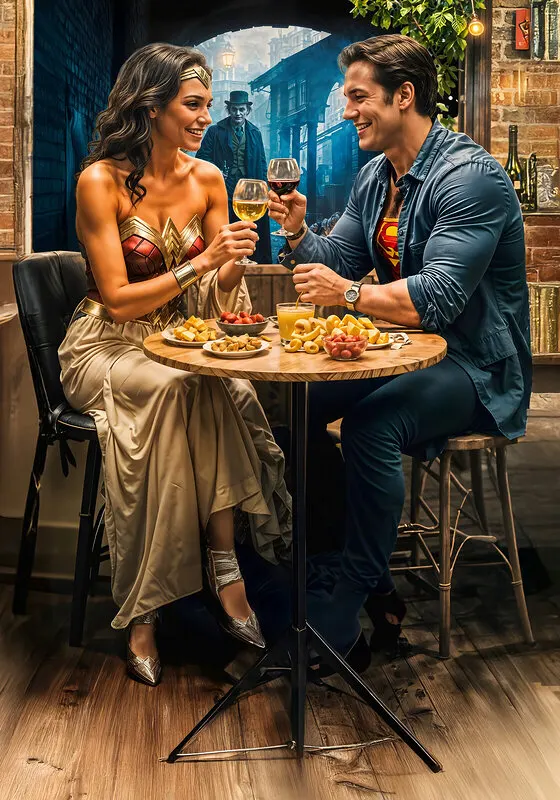
This is a purely fictional work. It depicts an imagined scene where two legendary figures – Wonder Woman and Superman – share a moment of La Dolce Vita, only to be overshadowed by another presence. All events, dialogues, and situations are invented. The text does not aim to offer a factual account of any real individuals but instead uses well-known fictional and theatrical characters in an artistic, satirical, and metaphorical manner. Any resemblance to real events or persons is entirely intentional, serving the purpose of creative expression. So, rest assured, this is a journey into the realm of imagination.
In this story, the couple’s sunlit grace is disrupted by the shadowy figure – The Joker, dressed as his kindred spirit, Mack the Knife. Here, charm and danger share the same space, and the fine line between laughter and fear remains as sharp as ever. The use of 'Mack the Knife' and 'The Joker' as metaphorical figures represents the duality of human nature, where charm can coexist with danger, and laughter can turn into fear in an instant. This narrative is a reflection of the complex and often contradictory aspects of human relationships and emotions.
Join me on a journey to explore the intriguing world of pictures. This essay seeks to entertain and enlighten you about the complicated nature of love in a good story.
“Two Smiles, One Blade
One wears a flower in his lapel,
the other a knife in his sleeve.
Both walk into a room like a joke you don’t get
until the laughter turns cold.
Mack hums his tune in the fog of the docks,
The Joker whistles in Gotham’s rain.
Different streets, same shadows –
the kind that stick to your shoes.
They court the crowd with easy charm,
spill silk from their tongues,
and leave footprints no soap can wash away.
Two smiles, one blade –
and the cut is always deeper
when you never saw it coming.”
Malmö. August 2025
La Dolce Vita
At the table, two icons, Wonder Woman and Superman, sit absorbed in laughter and wine, with small dishes shimmering in the evening light. They are caught in a moment of effortless ease, as if the whole world were nothing but one long, slow breath. The choice of Wonder Woman and Superman as the central characters in this narrative is a nod to their status as cultural icons, representing strength, grace, and heroism. Their interaction in this scene serves as a contrast to the darker undertones brought by the presence of Mack the Knife, adding depth and complexity to the narrative.
But in the background, framed by the window, stands another figure. The hat conceals his eyes, the coat hangs heavily, and beneath it all, you sense the smile. Mack the Knife, an unexpected presence in this scene, as natural in the shadows as a refrain you thought you’d forgotten. The title 'Mack the Knife' itself is a metaphor for the character's dangerous nature, as a knife is often associated with violence and danger. He is the cool undertone in the warm melody, a promise that sweetness is never entirely without a sting. It is The Joker dressed in the clothes of his kindred spirit, stepping across the centuries.
Even in La Dolce Vita, the sweet life, there is a rhythm that beats in a minor key, a subtle reminder that even the most beautiful moments can be tinged with a hint of sadness or danger.
A Song Everyone Knows, but a Story Few Recognise
At some stage in their lives, most people will have heard ‘Mack the Knife’. Whether it was Louis Armstrong’s smoky warmth, Bobby Darin’s swinging charm, Frank Sinatra’s effortless cool, or even Roger Daltrey’s rock-infused rendition, the melody is deceptively cheerful, the rhythm catchy, and the delivery often playful. Yet behind its toe-tapping surface lies a much darker story. This enduring appeal of Mack the Knife not only entertains us but also connects us to a cultural legacy that spans centuries, making us feel part of a rich artistic tradition.
It's a surprising twist that the song’s central figure – Mack the Knife – has origins not in 1950s jazz clubs but in London's underworld of the 1720s. His name was originally Captain Macheath, a fictional highwayman created in John Gay’s 1728 ballad opera The Beggar’s Opera. This unexpected origin story adds a layer of intrigue to the song's history, making it even more fascinating.
From there, the figure moved again – this time into popular music – stripped of some of his darker edges, yet never entirely losing the glint of the knife behind the smile. The transformation of Captain Macheath from satirical stage antihero to enduring cultural icon is a profound story of reinvention, adaptation, and the fine line between roguish glamour and genuine menace. 'Mack the Knife' has undergone a significant cultural evolution, from its origins in 18th-century theatre to its status as a popular jazz and pop standard. This transformation not only entertains us but also connects us to a cultural legacy that spans centuries, making us feel part of a rich artistic tradition.
The Birth of Captain Macheath – John Gay’s The Beggar’s Opera (1728)
When The Beggar’s Opera premiered at Lincoln’s Inn Fields Theatre in 1728, it was unlike anything the London stage had seen before. John Gay, already renowned for his sharp wit, had created what might be considered the first “jukebox musical.” Instead of commissioning an original score, he used popular tunes of the time – folk songs, ballads, and even well-known operatic airs – and rewrote the lyrics to suit his sharp narrative.
At the centre of this new ballad opera was Captain Macheath, a dashing highwayman and unapologetic womaniser. Gay loosely based him on Jack Sheppard (1702–1724), a real-life thief and escape artist who had captured the public imagination, while his nemesis, Mr. Peachum, drew inspiration from Jonathan Wild (c. 1688–1725), the notorious thief-taker who ruled London’s underworld under the guise of law enforcement.
The plot follows Macheath’s romantic involvement with Polly, Peachum’s daughter. Peachum, who profits from both catching and protecting criminals, is appalled at the match and vows to have Macheath hanged. The subsequent scenes are filled with bawdy humour, encounters with sex workers, daring escapes from prison, and satirical jabs at hypocrisy among the powerful. In the end, Macheath is taken to the gallows – only for the playwright himself to step onto the stage and announce a last-minute reprieve. The highwayman is spared, and the audience departs with a hero who defies both justice and morality.
Yet Gay’s purpose extended far beyond narrating a lively underworld romance. Through characters like Peachum, he directed his satire squarely at the ruling elite. In Peachum’s opening number, the cynicism is apparent:
“The priest calls the lawyer a cheat,
The lawyer believes in the Divine,
And the statesman, because he’s so great,
Thinks his trade as honest as mine.”
The message was clear: ministers of state were no better than organised criminals. In particular, Gay’s pen targeted Prime Minister Sir Robert Walpole, whose reputation for corruption made him a perfect stand-in for Peachum’s self-serving duplicity. And that time they had no Mr Trump.
With The Beggar’s Opera, Gay not only created Captain Macheath but also established the archetype of the “heroic highwayman” in popular culture. This charming rogue could be admired even while breaking the law.
The Heroic Highwayman – Romanticism and Social Critique: A Study of Macheath's Evolution
By the time The Beggar’s Opera took London by storm, the image of the highwayman was already evolving in the public imagination. Criminal biographies such as Alexander Smith’s History of the Highwaymen (1714) and Charles Johnson’s work of the same title (1734) had started depicting certain robbers as gallant figures – noble outlaws who, while they might rob the rich, were generous to the poor.
Gay’s Macheath, a character that seamlessly fit into the romanticised mould of the highwayman archetype, was handsome, witty, brave, and, importantly, a master of charm. He recoiled from unnecessary violence, favouring seduction and cunning over brute force. For audiences tired of corrupt officials and harsh laws, Macheath’s confident independence was intoxicating.
But Gay’s creation was more than just escapist entertainment. It was a reflection of Georgian society. The opera satirised the hypocrisies of the ruling class, blurring the line between the “respectable” elite and the criminal underworld. In Peachum’s world, as in Walpole’s Britain, power was upheld through patronage, bribery, and manipulation. The law itself could be bought, bent, or ignored, depending on who stood to profit.
The public loved the satire. The play ran for a then-record 62 performances in its first season and sparked a cultural phenomenon. Macheath became the symbol of the dashing rogue, shaping later literary and theatrical works. Even real criminals played up the myth: highwaymen like James Maclaine (1724–1750) cultivated a Macheath-like image, dressing well, speaking politely, and acting the gentleman in the hope of gaining public sympathy – and perhaps a more lenient sentence if caught.
In Macheath, audiences encountered both fantasy and critique: a hero who operated outside the law, yet exposed how the law itself could be just as corrupt as the villains it condemned.
4. From Stage to Penny Dreadfuls – The Victorian Reinvention
By the mid-19th century, the rise of cheap printing had fostered an insatiable demand for sensational stories among the lower-middle and working classes and into this thriving market stepped the penny dreadful – affordable serialised tales sold for a penny an issue, filled with crime, melodrama, and improbable escapes. These publications played a significant role in popular culture at the time, influencing the literary tastes and moral views of a broad audience.
Highwaymen were among the most popular subjects, their exploits reimagined to blend historical fact, theatrical legend, and outright invention. Names like Dick Turpin and Robin Hood appeared alongside older figures such as Jack Sheppard – and, inevitably, Captain Macheath.
Authors drew inspiration from Gay’s creation but took significant liberties. Pierce Egan the Younger (1814–1880), a prolific writer of sensational fiction, published Captain Macheath: The Highwayman of a Century Since (1840), which depicted the highwayman in broad, romantic terms, highlighting daring robberies, hairbreadth escapes, and chivalrous rescues of threatened women. Later, anonymously written serials such as Captain Macheath: The Prince of the Highway (1892) shamelessly recycled Egan’s material, changing little more than the title.
These Victorian adaptations largely lost Gay’s satirical edge. Macheath was no longer a tool for political critique. Still, it became a symbol of pure adventure – a gentleman-thief whose charm and skill at evading the law offered readers thrilling escapism. A reassuring certainty replaced the moral ambiguity of the original. This Macheath might be an outlaw, but he was “our” outlaw, the kind who punished villains worse than himself.
In the process, Captain Macheath’s cultural identity evolved. He was no longer simply a character from a subversive 18th-century ballad opera; he became a staple of popular folklore, standing alongside the great rogues of English legend. It was this folkloric Macheath – charming, dangerous, and marketable – who would eventually be reborn on a very different stage in the 20th century, reminding us of our shared cultural heritage and the enduring appeal of this dashing rogue.
Brecht and Weill – The Threepenny Opera (1928)
By the late 1920s, Germany’s Weimar Republic was marked by stark contrasts: political unrest, economic instability, and a vibrant, often subversive, artistic scene. Into this volatile cultural climate, playwright Bertolt Brecht and composer Kurt Weill introduced Die Dreigroschenoper (The Threepenny Opera), a modern reimagining of The Beggar’s Opera.
Brecht took John Gay’s satirical framework and cast it against the shadows of industrial-age corruption. Victorian London replaced Georgian England as the setting, and the once roguishly charming Macheath was transformed into “Mackie Messer” – Mack the Knife – a man whose smile masked a capacity for ruthless violence, a transformation that starkly highlights the impact of social critique.
The most striking new element was the opening song, Die Moritat von Mackie Messer, a street ballad that introduced the audience to Mack’s darker side. Sung in a deceptively cheerful, almost casual tone, the lyrics listed an array of brutal crimes: murders, thefts, arson, and sexual assault. Each verse combined charm with menace, suggesting that the real danger was not the visible knife but the invisible one hidden behind a gentleman’s gloves.
“Oh, the shark has pretty teeth, dear,
And it shows them pearly white,
But the knife that Macheath carries,
No one knows where it may be.”
In Brecht’s version, Mack is not just a clever criminal avoiding justice; he is a predator who flourishes within a corrupt capitalist system. The story keeps the main outline of Gay’s original – Mack marries Polly Peachum, incurring her father’s fury, who plots with the Chief of Police to destroy him – but the moral tone is different. Here, crime and respectability are not opposites but reflections of each other. The play ends with Mack saved from hanging, not as a romantic gesture, but as a stark reminder that the powerful protect their own. Raised to a baronetcy, Mack can now loot legally.
Brecht’s socialist critique was explicit: in a capitalist city, the difference between thief and businessman, gangster and politician, is a matter of social standing, not morality, a powerful message that resonates to this day. Just as Gay had exposed the hypocrisy of 18th-century elites, Brecht directed his satire at the modern bourgeois order, showing it as an ecosystem where exploitation and crime are fundamental.
Musically, Weill’s score combined cabaret, jazz, and classical styles, creating a sound that was both easy to enjoy and unsettling. The Threepenny Opera became an instant hit, running for years in Berlin and quickly spreading across Europe. Its most lasting legacy, however, is that opening song – the lively yet sinister Mack the Knife – which would eventually break free from the theatre and take on a life of its own.
From Moritat to Pop Hit – Louis Armstrong, Bobby Darin, and Beyond
When Die Moritat von Mackie Messer first echoed through Berlin’s theatres in 1928, it was deeply rooted in Brecht and Weill’s sharp social critique. However, within a few decades, the song would lose much of its original political edge and become one of the most recognisable tunes in popular music. This transformation, from a sharp social critique to a popular tune, reflects the changing cultural and political landscapes of the eras it traversed.
The shift started with translations and adaptations. In 1954, Marc Blitzstein’s English-language version of The Threepenny Opera debuted Off-Broadway in New York, introducing American audiences to “Mack the Knife.” Blitzstein’s lyrics softened the most shocking crimes from Brecht’s original, replacing some of the harsher imagery with a clever, almost playful tone. Mack remained dangerous, but his edges were smoother, and his sins were more hinted at than openly described.
In 1956, the legendary Louis Armstrong, known for his warm, swinging, and full of sly asides style, recorded his version of Mack the Knife. His interpretation, less the menacing predator of Weimar theatre and more a charming rogue with a knowing smile, brought the song to the jazz world and set the stage for its most significant commercial success.
That achievement occurred in 1959 when Bobby Darin took Mack the Knife to the top of the charts. Darin’s version exuded pure Rat Pack-era confidence: a brassy big band arrangement, a jaunty vocal, and an irresistible rhythm. It earned him a Grammy for Record of the Year and secured the song’s place in the Great American Songbook. Mack, once a symbol of systemic corruption and predatory capitalism, had become a crowd-pleasing showstopper.
Other prominent artists followed suit. Frank Sinatra, Ella Fitzgerald, and even rock vocalists like Roger Daltrey each left their mark on the tune. In Fitzgerald’s renowned live performance in Berlin in 1960, she forgot the lyrics halfway through and improvised new ones on the spot – a captivating display of vocal spontaneity that only added to the song’s legend.
The popular Mack the Knife kept just enough of its sinister edge to give it impact, but for most listeners, it was simply a catchy, sophisticated tune. The darker truths of Brecht’s Mackie Messer – the arsonist, the killer, the rapist – had been largely removed. Yet, that contrast between the cheerful swing of the melody and the dark undertone of the lyrics may be precisely what kept audiences captivated.
From Berlin’s smoky cabarets to Las Vegas showrooms, from biting political satire to mainstream entertainment, Mack the Knife has proven endlessly adaptable. Its enduring allure, a testament to the charm of a villain, has kept audiences captivated and intrigued.
7. The Enduring Appeal of Mack the Knife
From his first swagger onto the Georgian stage to his reinventions in Victorian penny dreadfuls, from Brecht’s razor-sharp satire to the swinging big-band era, Captain Macheath – Mack the Knife – has proven to be remarkably resilient. Part of his enduring appeal lies in his ability to be reinterpreted for each era. In Gay’s London, he was the rakish highwayman whose charm masked a critique of political corruption. In Brecht’s Weimar Berlin, he became the embodiment of predatory capitalism and moral decay. In mid-century America, he was reborn as a lounge-suited showman, his crimes smoothed into sly innuendo.
What unites these incarnations is the delicate balance between danger and allure. Mack is never entirely a villain nor a hero. He acts as a mirror for the society that recreates him: reflecting its hypocrisies, its desires, and its appetite for glamour tinged with risk. Audiences are drawn to him because he occupies that morally ambiguous space where charm and threat overlap – a place where we can safely flirt with transgression without stepping too far into the dark. This concept of Mack as a 'charming villain' is a key factor in his enduring appeal.
The song’s journey, from its origins in Berlin’s theatres to its adaptations for radio, nightclubs, and television, is a fascinating one. It has managed to retain just enough of its original menace to keep listeners intrigued. Each listener can decide for themselves whether Mack is a charming rogue, a dangerous predator, or both at the same time.
Ultimately, Mack the Knife persists because he fulfils two conflicting urges: the desire for a hero who exists outside the system and the intrigue with the very systems that create such figures. As long as audiences enjoy that thrill between the smile and the blade, Mack will continue to reappear, stepping out from the shadows, tipping his hat, and reminding us that the boundary between respectability and crime is narrower than we like to believe.
Why Mack the Knife is The Joker’s Favourite
For The Joker, Mack the Knife is not just a catchy tune – it’s a captivating spirit in song. In Mack, he sees a perfect blend of allure and danger, a figure who hides the blade behind a charming smile. The Joker, too, is drawn to this allure: the ability to entertain and terrify in the same breath.
Brecht’s Mackie Messer, like The Joker, moves through the world as both predator and performer. He does not need to roar or display the knife openly; the real danger lies in what you don’t see coming. But beneath his urbane manners, Mack is no harmless rogue. In The Threepenny Opera, his list of crimes is long and shocking: murder, arson, assault, and even the rape of a sleeping victim. He is a predator who moves effortlessly between the shadows of the underworld and the parlours of polite society – and in that, The Joker sees himself.
Both Mack the Knife and The Joker are masters of adaptation. They can seamlessly transition from a crime scene to mingling with the elite without losing their composure. Mack can accept a drink in a drawing room as easily as The Joker can crash a Gotham gala. Their civility is a façade, their wit a weapon, and their violence all the more shocking for being concealed beneath the surface.
Both Mack the Knife and The Joker understand the power of myth. Mack’s reputation is celebrated in the streets, his misdeeds turned into a ballad that everyone knows. The Joker builds his legend in real time, staging each crime like a theatre, ensuring that the city talks about him long after the act is over. For both men, notoriety is not a side effect – it is the goal.
There is also the charisma that draws people in, even when they are aware of the danger. Mack seduces, The Joker entrances. They exploit that human weakness for charm, transforming fear into fascination, fascination into loyalty, and loyalty into complicity.
When The Joker hums Mack the Knife, it’s not out of nostalgia – it’s solidarity. He perceives in that lilting melody the rhythm of his own life: the blending of charm and savagery, the artistry of violence, and the understanding that every smile conceals a blade. And like Mack, he knows that when the next verse begins, the story will only grow darker.
The Real-Life Roots of Captain Macheath
Although Captain Macheath first appeared on stage in John Gay’s The Beggar’s Opera (1728), he was not entirely a fictional character. Gay drew from the notoriety of two very real figures from London’s early 18th-century underworld – men whose lives, reputations, and violent ends had captured the public’s imagination.
Jack Sheppard (1702–1724) was the primary and most evident influence. A young thief and burglar, Sheppard became a folk hero not because of his crimes, but because of his remarkable escapes from custody. Repeatedly, he broke out of supposedly secure prisons, sometimes within days of being captured. Londoners revelled in tales of his daring – here was a man who defied authority with flair and cleverness. Pamphlets and ballads depicted him as a charming rogue, a “gentleman” thief whose wrongdoings were almost excusable because he embarrassed the very officials who sought to hang him. In Macheath, Gay captured Sheppard’s youth, charisma, and public allure.
But Macheath’s world – and his nemesis, Peachum – stemmed from another real-life figure: Jonathan Wild (c. 1682–1725). Wild held the formal title of “thief-taker general,” a type of freelance law enforcer paid through rewards for capturing criminals. In truth, he was the mastermind behind London’s largest organised crime network. He commanded gangs of thieves, decided who would operate under his protection, and betrayed others to the gallows when it suited his interests. To the public, Wild was both feared and despised – a man who blurred the line between lawman and outlaw so entirely that it almost vanished.
In The Beggar’s Opera, Gay merged these two characters into a satirical landscape where power, corruption, and charm all intertwined. Macheath inherited Sheppard’s good looks and bravado but also the ruthless streak common among real highwaymen. Peachum, based on Wild, became the epitome of a corrupt system in which crime and respectability were just different sides of the same coin.
Later, when Bertolt Brecht adapted the story into The Threepenny Opera (1928), he removed much of Gay’s romanticism. His Mackie Messer kept the charisma of Sheppard’s legend but gained the darker traits of real violent criminals: cold-blooded murder, arson, and sexual assault. In doing so, Brecht drew the character closer to the true brutality that often lay behind the myths of the “gentleman rogue.”
Captain Macheath is more than just a literary creation. He embodies the charmers and predators of history, serving as a reminder that the same man who can enthral an audience might also be capable of violence – and that in London of 1728, the line between hero and villain was dangerously thin.
Jörgen Thornberg
La Dolce Vita, 2025
Digital
50 x 70 cm
3 200 kr
La Dolce Vita
This is a purely fictional work. It depicts an imagined scene where two legendary figures – Wonder Woman and Superman – share a moment of La Dolce Vita, only to be overshadowed by another presence. All events, dialogues, and situations are invented. The text does not aim to offer a factual account of any real individuals but instead uses well-known fictional and theatrical characters in an artistic, satirical, and metaphorical manner. Any resemblance to real events or persons is entirely intentional, serving the purpose of creative expression. So, rest assured, this is a journey into the realm of imagination.
In this story, the couple’s sunlit grace is disrupted by the shadowy figure – The Joker, dressed as his kindred spirit, Mack the Knife. Here, charm and danger share the same space, and the fine line between laughter and fear remains as sharp as ever. The use of 'Mack the Knife' and 'The Joker' as metaphorical figures represents the duality of human nature, where charm can coexist with danger, and laughter can turn into fear in an instant. This narrative is a reflection of the complex and often contradictory aspects of human relationships and emotions.
Join me on a journey to explore the intriguing world of pictures. This essay seeks to entertain and enlighten you about the complicated nature of love in a good story.
“Two Smiles, One Blade
One wears a flower in his lapel,
the other a knife in his sleeve.
Both walk into a room like a joke you don’t get
until the laughter turns cold.
Mack hums his tune in the fog of the docks,
The Joker whistles in Gotham’s rain.
Different streets, same shadows –
the kind that stick to your shoes.
They court the crowd with easy charm,
spill silk from their tongues,
and leave footprints no soap can wash away.
Two smiles, one blade –
and the cut is always deeper
when you never saw it coming.”
Malmö. August 2025
La Dolce Vita
At the table, two icons, Wonder Woman and Superman, sit absorbed in laughter and wine, with small dishes shimmering in the evening light. They are caught in a moment of effortless ease, as if the whole world were nothing but one long, slow breath. The choice of Wonder Woman and Superman as the central characters in this narrative is a nod to their status as cultural icons, representing strength, grace, and heroism. Their interaction in this scene serves as a contrast to the darker undertones brought by the presence of Mack the Knife, adding depth and complexity to the narrative.
But in the background, framed by the window, stands another figure. The hat conceals his eyes, the coat hangs heavily, and beneath it all, you sense the smile. Mack the Knife, an unexpected presence in this scene, as natural in the shadows as a refrain you thought you’d forgotten. The title 'Mack the Knife' itself is a metaphor for the character's dangerous nature, as a knife is often associated with violence and danger. He is the cool undertone in the warm melody, a promise that sweetness is never entirely without a sting. It is The Joker dressed in the clothes of his kindred spirit, stepping across the centuries.
Even in La Dolce Vita, the sweet life, there is a rhythm that beats in a minor key, a subtle reminder that even the most beautiful moments can be tinged with a hint of sadness or danger.
A Song Everyone Knows, but a Story Few Recognise
At some stage in their lives, most people will have heard ‘Mack the Knife’. Whether it was Louis Armstrong’s smoky warmth, Bobby Darin’s swinging charm, Frank Sinatra’s effortless cool, or even Roger Daltrey’s rock-infused rendition, the melody is deceptively cheerful, the rhythm catchy, and the delivery often playful. Yet behind its toe-tapping surface lies a much darker story. This enduring appeal of Mack the Knife not only entertains us but also connects us to a cultural legacy that spans centuries, making us feel part of a rich artistic tradition.
It's a surprising twist that the song’s central figure – Mack the Knife – has origins not in 1950s jazz clubs but in London's underworld of the 1720s. His name was originally Captain Macheath, a fictional highwayman created in John Gay’s 1728 ballad opera The Beggar’s Opera. This unexpected origin story adds a layer of intrigue to the song's history, making it even more fascinating.
From there, the figure moved again – this time into popular music – stripped of some of his darker edges, yet never entirely losing the glint of the knife behind the smile. The transformation of Captain Macheath from satirical stage antihero to enduring cultural icon is a profound story of reinvention, adaptation, and the fine line between roguish glamour and genuine menace. 'Mack the Knife' has undergone a significant cultural evolution, from its origins in 18th-century theatre to its status as a popular jazz and pop standard. This transformation not only entertains us but also connects us to a cultural legacy that spans centuries, making us feel part of a rich artistic tradition.
The Birth of Captain Macheath – John Gay’s The Beggar’s Opera (1728)
When The Beggar’s Opera premiered at Lincoln’s Inn Fields Theatre in 1728, it was unlike anything the London stage had seen before. John Gay, already renowned for his sharp wit, had created what might be considered the first “jukebox musical.” Instead of commissioning an original score, he used popular tunes of the time – folk songs, ballads, and even well-known operatic airs – and rewrote the lyrics to suit his sharp narrative.
At the centre of this new ballad opera was Captain Macheath, a dashing highwayman and unapologetic womaniser. Gay loosely based him on Jack Sheppard (1702–1724), a real-life thief and escape artist who had captured the public imagination, while his nemesis, Mr. Peachum, drew inspiration from Jonathan Wild (c. 1688–1725), the notorious thief-taker who ruled London’s underworld under the guise of law enforcement.
The plot follows Macheath’s romantic involvement with Polly, Peachum’s daughter. Peachum, who profits from both catching and protecting criminals, is appalled at the match and vows to have Macheath hanged. The subsequent scenes are filled with bawdy humour, encounters with sex workers, daring escapes from prison, and satirical jabs at hypocrisy among the powerful. In the end, Macheath is taken to the gallows – only for the playwright himself to step onto the stage and announce a last-minute reprieve. The highwayman is spared, and the audience departs with a hero who defies both justice and morality.
Yet Gay’s purpose extended far beyond narrating a lively underworld romance. Through characters like Peachum, he directed his satire squarely at the ruling elite. In Peachum’s opening number, the cynicism is apparent:
“The priest calls the lawyer a cheat,
The lawyer believes in the Divine,
And the statesman, because he’s so great,
Thinks his trade as honest as mine.”
The message was clear: ministers of state were no better than organised criminals. In particular, Gay’s pen targeted Prime Minister Sir Robert Walpole, whose reputation for corruption made him a perfect stand-in for Peachum’s self-serving duplicity. And that time they had no Mr Trump.
With The Beggar’s Opera, Gay not only created Captain Macheath but also established the archetype of the “heroic highwayman” in popular culture. This charming rogue could be admired even while breaking the law.
The Heroic Highwayman – Romanticism and Social Critique: A Study of Macheath's Evolution
By the time The Beggar’s Opera took London by storm, the image of the highwayman was already evolving in the public imagination. Criminal biographies such as Alexander Smith’s History of the Highwaymen (1714) and Charles Johnson’s work of the same title (1734) had started depicting certain robbers as gallant figures – noble outlaws who, while they might rob the rich, were generous to the poor.
Gay’s Macheath, a character that seamlessly fit into the romanticised mould of the highwayman archetype, was handsome, witty, brave, and, importantly, a master of charm. He recoiled from unnecessary violence, favouring seduction and cunning over brute force. For audiences tired of corrupt officials and harsh laws, Macheath’s confident independence was intoxicating.
But Gay’s creation was more than just escapist entertainment. It was a reflection of Georgian society. The opera satirised the hypocrisies of the ruling class, blurring the line between the “respectable” elite and the criminal underworld. In Peachum’s world, as in Walpole’s Britain, power was upheld through patronage, bribery, and manipulation. The law itself could be bought, bent, or ignored, depending on who stood to profit.
The public loved the satire. The play ran for a then-record 62 performances in its first season and sparked a cultural phenomenon. Macheath became the symbol of the dashing rogue, shaping later literary and theatrical works. Even real criminals played up the myth: highwaymen like James Maclaine (1724–1750) cultivated a Macheath-like image, dressing well, speaking politely, and acting the gentleman in the hope of gaining public sympathy – and perhaps a more lenient sentence if caught.
In Macheath, audiences encountered both fantasy and critique: a hero who operated outside the law, yet exposed how the law itself could be just as corrupt as the villains it condemned.
4. From Stage to Penny Dreadfuls – The Victorian Reinvention
By the mid-19th century, the rise of cheap printing had fostered an insatiable demand for sensational stories among the lower-middle and working classes and into this thriving market stepped the penny dreadful – affordable serialised tales sold for a penny an issue, filled with crime, melodrama, and improbable escapes. These publications played a significant role in popular culture at the time, influencing the literary tastes and moral views of a broad audience.
Highwaymen were among the most popular subjects, their exploits reimagined to blend historical fact, theatrical legend, and outright invention. Names like Dick Turpin and Robin Hood appeared alongside older figures such as Jack Sheppard – and, inevitably, Captain Macheath.
Authors drew inspiration from Gay’s creation but took significant liberties. Pierce Egan the Younger (1814–1880), a prolific writer of sensational fiction, published Captain Macheath: The Highwayman of a Century Since (1840), which depicted the highwayman in broad, romantic terms, highlighting daring robberies, hairbreadth escapes, and chivalrous rescues of threatened women. Later, anonymously written serials such as Captain Macheath: The Prince of the Highway (1892) shamelessly recycled Egan’s material, changing little more than the title.
These Victorian adaptations largely lost Gay’s satirical edge. Macheath was no longer a tool for political critique. Still, it became a symbol of pure adventure – a gentleman-thief whose charm and skill at evading the law offered readers thrilling escapism. A reassuring certainty replaced the moral ambiguity of the original. This Macheath might be an outlaw, but he was “our” outlaw, the kind who punished villains worse than himself.
In the process, Captain Macheath’s cultural identity evolved. He was no longer simply a character from a subversive 18th-century ballad opera; he became a staple of popular folklore, standing alongside the great rogues of English legend. It was this folkloric Macheath – charming, dangerous, and marketable – who would eventually be reborn on a very different stage in the 20th century, reminding us of our shared cultural heritage and the enduring appeal of this dashing rogue.
Brecht and Weill – The Threepenny Opera (1928)
By the late 1920s, Germany’s Weimar Republic was marked by stark contrasts: political unrest, economic instability, and a vibrant, often subversive, artistic scene. Into this volatile cultural climate, playwright Bertolt Brecht and composer Kurt Weill introduced Die Dreigroschenoper (The Threepenny Opera), a modern reimagining of The Beggar’s Opera.
Brecht took John Gay’s satirical framework and cast it against the shadows of industrial-age corruption. Victorian London replaced Georgian England as the setting, and the once roguishly charming Macheath was transformed into “Mackie Messer” – Mack the Knife – a man whose smile masked a capacity for ruthless violence, a transformation that starkly highlights the impact of social critique.
The most striking new element was the opening song, Die Moritat von Mackie Messer, a street ballad that introduced the audience to Mack’s darker side. Sung in a deceptively cheerful, almost casual tone, the lyrics listed an array of brutal crimes: murders, thefts, arson, and sexual assault. Each verse combined charm with menace, suggesting that the real danger was not the visible knife but the invisible one hidden behind a gentleman’s gloves.
“Oh, the shark has pretty teeth, dear,
And it shows them pearly white,
But the knife that Macheath carries,
No one knows where it may be.”
In Brecht’s version, Mack is not just a clever criminal avoiding justice; he is a predator who flourishes within a corrupt capitalist system. The story keeps the main outline of Gay’s original – Mack marries Polly Peachum, incurring her father’s fury, who plots with the Chief of Police to destroy him – but the moral tone is different. Here, crime and respectability are not opposites but reflections of each other. The play ends with Mack saved from hanging, not as a romantic gesture, but as a stark reminder that the powerful protect their own. Raised to a baronetcy, Mack can now loot legally.
Brecht’s socialist critique was explicit: in a capitalist city, the difference between thief and businessman, gangster and politician, is a matter of social standing, not morality, a powerful message that resonates to this day. Just as Gay had exposed the hypocrisy of 18th-century elites, Brecht directed his satire at the modern bourgeois order, showing it as an ecosystem where exploitation and crime are fundamental.
Musically, Weill’s score combined cabaret, jazz, and classical styles, creating a sound that was both easy to enjoy and unsettling. The Threepenny Opera became an instant hit, running for years in Berlin and quickly spreading across Europe. Its most lasting legacy, however, is that opening song – the lively yet sinister Mack the Knife – which would eventually break free from the theatre and take on a life of its own.
From Moritat to Pop Hit – Louis Armstrong, Bobby Darin, and Beyond
When Die Moritat von Mackie Messer first echoed through Berlin’s theatres in 1928, it was deeply rooted in Brecht and Weill’s sharp social critique. However, within a few decades, the song would lose much of its original political edge and become one of the most recognisable tunes in popular music. This transformation, from a sharp social critique to a popular tune, reflects the changing cultural and political landscapes of the eras it traversed.
The shift started with translations and adaptations. In 1954, Marc Blitzstein’s English-language version of The Threepenny Opera debuted Off-Broadway in New York, introducing American audiences to “Mack the Knife.” Blitzstein’s lyrics softened the most shocking crimes from Brecht’s original, replacing some of the harsher imagery with a clever, almost playful tone. Mack remained dangerous, but his edges were smoother, and his sins were more hinted at than openly described.
In 1956, the legendary Louis Armstrong, known for his warm, swinging, and full of sly asides style, recorded his version of Mack the Knife. His interpretation, less the menacing predator of Weimar theatre and more a charming rogue with a knowing smile, brought the song to the jazz world and set the stage for its most significant commercial success.
That achievement occurred in 1959 when Bobby Darin took Mack the Knife to the top of the charts. Darin’s version exuded pure Rat Pack-era confidence: a brassy big band arrangement, a jaunty vocal, and an irresistible rhythm. It earned him a Grammy for Record of the Year and secured the song’s place in the Great American Songbook. Mack, once a symbol of systemic corruption and predatory capitalism, had become a crowd-pleasing showstopper.
Other prominent artists followed suit. Frank Sinatra, Ella Fitzgerald, and even rock vocalists like Roger Daltrey each left their mark on the tune. In Fitzgerald’s renowned live performance in Berlin in 1960, she forgot the lyrics halfway through and improvised new ones on the spot – a captivating display of vocal spontaneity that only added to the song’s legend.
The popular Mack the Knife kept just enough of its sinister edge to give it impact, but for most listeners, it was simply a catchy, sophisticated tune. The darker truths of Brecht’s Mackie Messer – the arsonist, the killer, the rapist – had been largely removed. Yet, that contrast between the cheerful swing of the melody and the dark undertone of the lyrics may be precisely what kept audiences captivated.
From Berlin’s smoky cabarets to Las Vegas showrooms, from biting political satire to mainstream entertainment, Mack the Knife has proven endlessly adaptable. Its enduring allure, a testament to the charm of a villain, has kept audiences captivated and intrigued.
7. The Enduring Appeal of Mack the Knife
From his first swagger onto the Georgian stage to his reinventions in Victorian penny dreadfuls, from Brecht’s razor-sharp satire to the swinging big-band era, Captain Macheath – Mack the Knife – has proven to be remarkably resilient. Part of his enduring appeal lies in his ability to be reinterpreted for each era. In Gay’s London, he was the rakish highwayman whose charm masked a critique of political corruption. In Brecht’s Weimar Berlin, he became the embodiment of predatory capitalism and moral decay. In mid-century America, he was reborn as a lounge-suited showman, his crimes smoothed into sly innuendo.
What unites these incarnations is the delicate balance between danger and allure. Mack is never entirely a villain nor a hero. He acts as a mirror for the society that recreates him: reflecting its hypocrisies, its desires, and its appetite for glamour tinged with risk. Audiences are drawn to him because he occupies that morally ambiguous space where charm and threat overlap – a place where we can safely flirt with transgression without stepping too far into the dark. This concept of Mack as a 'charming villain' is a key factor in his enduring appeal.
The song’s journey, from its origins in Berlin’s theatres to its adaptations for radio, nightclubs, and television, is a fascinating one. It has managed to retain just enough of its original menace to keep listeners intrigued. Each listener can decide for themselves whether Mack is a charming rogue, a dangerous predator, or both at the same time.
Ultimately, Mack the Knife persists because he fulfils two conflicting urges: the desire for a hero who exists outside the system and the intrigue with the very systems that create such figures. As long as audiences enjoy that thrill between the smile and the blade, Mack will continue to reappear, stepping out from the shadows, tipping his hat, and reminding us that the boundary between respectability and crime is narrower than we like to believe.
Why Mack the Knife is The Joker’s Favourite
For The Joker, Mack the Knife is not just a catchy tune – it’s a captivating spirit in song. In Mack, he sees a perfect blend of allure and danger, a figure who hides the blade behind a charming smile. The Joker, too, is drawn to this allure: the ability to entertain and terrify in the same breath.
Brecht’s Mackie Messer, like The Joker, moves through the world as both predator and performer. He does not need to roar or display the knife openly; the real danger lies in what you don’t see coming. But beneath his urbane manners, Mack is no harmless rogue. In The Threepenny Opera, his list of crimes is long and shocking: murder, arson, assault, and even the rape of a sleeping victim. He is a predator who moves effortlessly between the shadows of the underworld and the parlours of polite society – and in that, The Joker sees himself.
Both Mack the Knife and The Joker are masters of adaptation. They can seamlessly transition from a crime scene to mingling with the elite without losing their composure. Mack can accept a drink in a drawing room as easily as The Joker can crash a Gotham gala. Their civility is a façade, their wit a weapon, and their violence all the more shocking for being concealed beneath the surface.
Both Mack the Knife and The Joker understand the power of myth. Mack’s reputation is celebrated in the streets, his misdeeds turned into a ballad that everyone knows. The Joker builds his legend in real time, staging each crime like a theatre, ensuring that the city talks about him long after the act is over. For both men, notoriety is not a side effect – it is the goal.
There is also the charisma that draws people in, even when they are aware of the danger. Mack seduces, The Joker entrances. They exploit that human weakness for charm, transforming fear into fascination, fascination into loyalty, and loyalty into complicity.
When The Joker hums Mack the Knife, it’s not out of nostalgia – it’s solidarity. He perceives in that lilting melody the rhythm of his own life: the blending of charm and savagery, the artistry of violence, and the understanding that every smile conceals a blade. And like Mack, he knows that when the next verse begins, the story will only grow darker.
The Real-Life Roots of Captain Macheath
Although Captain Macheath first appeared on stage in John Gay’s The Beggar’s Opera (1728), he was not entirely a fictional character. Gay drew from the notoriety of two very real figures from London’s early 18th-century underworld – men whose lives, reputations, and violent ends had captured the public’s imagination.
Jack Sheppard (1702–1724) was the primary and most evident influence. A young thief and burglar, Sheppard became a folk hero not because of his crimes, but because of his remarkable escapes from custody. Repeatedly, he broke out of supposedly secure prisons, sometimes within days of being captured. Londoners revelled in tales of his daring – here was a man who defied authority with flair and cleverness. Pamphlets and ballads depicted him as a charming rogue, a “gentleman” thief whose wrongdoings were almost excusable because he embarrassed the very officials who sought to hang him. In Macheath, Gay captured Sheppard’s youth, charisma, and public allure.
But Macheath’s world – and his nemesis, Peachum – stemmed from another real-life figure: Jonathan Wild (c. 1682–1725). Wild held the formal title of “thief-taker general,” a type of freelance law enforcer paid through rewards for capturing criminals. In truth, he was the mastermind behind London’s largest organised crime network. He commanded gangs of thieves, decided who would operate under his protection, and betrayed others to the gallows when it suited his interests. To the public, Wild was both feared and despised – a man who blurred the line between lawman and outlaw so entirely that it almost vanished.
In The Beggar’s Opera, Gay merged these two characters into a satirical landscape where power, corruption, and charm all intertwined. Macheath inherited Sheppard’s good looks and bravado but also the ruthless streak common among real highwaymen. Peachum, based on Wild, became the epitome of a corrupt system in which crime and respectability were just different sides of the same coin.
Later, when Bertolt Brecht adapted the story into The Threepenny Opera (1928), he removed much of Gay’s romanticism. His Mackie Messer kept the charisma of Sheppard’s legend but gained the darker traits of real violent criminals: cold-blooded murder, arson, and sexual assault. In doing so, Brecht drew the character closer to the true brutality that often lay behind the myths of the “gentleman rogue.”
Captain Macheath is more than just a literary creation. He embodies the charmers and predators of history, serving as a reminder that the same man who can enthral an audience might also be capable of violence – and that in London of 1728, the line between hero and villain was dangerously thin.
3 200 kr

Jörgen Thornberg
Malmö
Lite om bilder och mig. Translation in English at the end.
Jag är en nyfiken person som ser allt i bilder, även det jag fäster i ord, gärna tillsammans för bakom alla mina bilder finns en berättelse. Till vissa bilder hör en kortare eller längre novell som följer med bilden.
Bilder berättar historier. Jag omges av naturlig skönhet, intressanta människor och historia var jag än går. Jag använder min kamera för att dokumentera världen och blanda det jag ser med vad jag känner för att fånga den dolda magin.
Mina bilder berättar mina historier. Genom mina bilder, tryck och berättelser. Jag bjuder in dig att ta del av dessa berättelser, in i ditt liv och hem och dela min mycket personliga syn på vår värld. Mer än vad ögat ser. Jag tänker i bilder, drömmer och skriver och pratar om dem; följaktligen måste jag också skapa bilder. De blir vad jag ser, inte nödvändigtvis begränsade till verkligheten. Det finns en bild runt varje hörn. Jag hoppas att du kommer att se vad jag såg och gilla det.
Jag är också en skrivande person och till många bilder hör en kortare eller längre essay. Den följer med tavlan, tryckt på fint papper och med en personlig hälsning från mig.
Flertalet bilder startar sin resa i min kamera. Enkelt förklarat beskriver jag bilden jag ser i mitt inre, upplevd eller fantiserad. Bilden uppstår inom mig redan innan jag fått okularet till ögat. På bråkdelen av ett ögonblick ser jag vad jag vill ha och vad som kan göras med bilden. Här skall jag stoppa in en giraff, stålmannen, Titanic eller vad det är min fantasi finner ut. Ännu märkligare är att jag kommer ihåg minnesbilden långt efteråt när det blir tid att skapa verket. Om jag lyckas eller inte, är upp till betraktaren, oftast präglat av en stråk av svart humor – meningen är att man skall bli underhållen. Mina bilder blir ofta en snackis där de hänger.
Jag föredrar bilder som förmedlar ett budskap i flera lager. Vid första anblicken fylld av feel-good, en vacker utsikt, fint väder, solen skiner, blommor på ängen eller vattnet som ligger förrädiskt spegelblankt. I en sådan bild kan jag gömma min egentliga berättelse, mitt förakt för förtryckare och våldsverkare, rasister och fördomsfulla människor - ett gärna återkommande motiv mer eller mindre dolt i det vackra motivet. Jag försöker förena dem i ett gemensamt narrativ.
Bild och formgivning har löpt som en röd tråd genom livet. Fotokonst känns som en värdig final som jag gärna delar med mig.
Min genre är vid som framgår av mina bilder, temat en blandning av pop- och gatukonst i kollage som kan bestå av hundratals lager. Vissa bilder kan ta veckor, andra någon dag innan det är dags att överlämna resultatet till printverkstaden. Fine Art Prints är digitala fotocollage. I dessa kollage sker rivandet, klippandet, pusslandet, målandet, ritandet och sprayningen digitalt. Det jag monterar in kan vara hundratals år gamla bilder som jag omsorgsfullt frilägger så att de ser ut att vara en del av tavlan men också bilder skapade av mig själv efter min egen fantasi. Därefter besöks printstudion och för vissa bilder numrera en limiterad upplaga (oftast 7 exemplar) och signera för hand. Vissa bilder kan köpas i olika format. Det är bara att fråga efter vilka. Gillar man en bild som är 70x100 men inte har plats på väggen, går den kanske att få i 50x70 cm istället. Frågan är fri.
Metoden Giclée eller Fine Art Print som det också kallas är det moderna sättet för framställning av grafisk konst. Villkoret för denna typ av utskrifter är att en högkvalitativ storformatskrivare används med åldersbeständigt färgpigment och konstnärspapper eller i förekommande fall på duk. Pappret som används möter de krav på livslängd som ställs av museer och gallerier. Normalt säljer jag mina bilder oinramade så att den nya ägaren själv kan bestämma hur de skall se ut, med eller utan passepartout färg på ram, med eller utan glas etc..
Under många år ställde jag bara ut på nätet, i valda grupper och på min egen Facebooksida - https://www.facebook.com/jorgen.thornberg.9
Jag finns också på en egen hemsida som tyvärr inte alltid är uppdaterad – https://www.jth.life/ Där kan du också läsa en del av de berättelser som följer med bilden.
UTSTÄLLNINGAR
Luftkastellet, oktober 2022
Konst i Lund, november 2022
Luftkastellet, mars 2023
Engleson Galleri Caroli, april 2023
Hydra, Greece June 2023
Engleson Galleri Caroli, oktober 2023
Toppen, Höllviken december 2023
Luftkastellet, mars 2024
Torups Galleri, mars 2024
Venice, May 2024
Luftkastellet, oktober 2024
Konst i Advent, December 2024
Galleri Engleson, Caroli December 2024
Jäger & Jansson Galleri, april 2025
A bit about pictures and me.
I'm a curious person who sees everything in pictures, even what I express in words, often combining them, for behind all my pictures lies a story. These narratives, some as short as a single image and others as long as a novel, are the heart and soul of my work.
Pictures tell stories. Wherever I go, I'm surrounded by natural beauty, exciting people, and history. I use my camera to document the world and blend what I see with what I feel to capture the hidden magic.
My images tell my stories. Through my pictures, prints, and narratives, I invite you to partake in these stories in your life and home and share my deeply personal perspective of our world. More than meets the eye. I think in pictures, dream, write, and talk about them; consequently, I must create images too. They become what I see, not necessarily confined to reality. There's a picture around every corner. I hope you'll see what I saw and enjoy it.
I'm also a writer, and many images come with a shorter or longer essay. It accompanies the painting, printed on fine paper with my personal greeting.
Many pictures start their journey on my camera. Simply put, I describe the image I see in my mind, experienced or imagined. The image arises within me even before I bring the eyepiece to my eye. In a fraction of a moment, I see what I want and what can be done with the picture. Here, I'll insert a giraffe, Superman, the Titanic, or whatever my imagination conjures up. Even stranger is that I remember the mental image long after it's time to create the work. Whether I succeed is up to the observer, often imbued with a streak of black humour – the aim is to entertain. My pictures usually become a talking point wherever they hang.
I prefer pictures that convey a message in multiple layers. At first glance, they're filled with feel-good vibes, a beautiful view, lovely weather, the sun shining, flowers in the meadow, or the water lying deceptively calm. But beneath this surface beauty, I often conceal a deeper story, a narrative that challenges societal norms or explores the human condition. I invite you to delve into these hidden narratives and discover the layers of meaning within my work.
Picture and design have been a thread running through my life. Photographic art feels like a fitting finale, and I'm happy to share it.
My genre is varied, as seen in my pictures; the theme is a blend of pop and street art in collages that can consist of hundreds of layers. Some images can take weeks, others just a day before it's time to hand over the result to the print workshop. Fine Art Prints are digital photo collages. In these collages, tearing, cutting, puzzling, painting, drawing, and spraying happen digitally. What I insert can be images hundreds of years old that I carefully extract so they appear to be part of the painting, but also images created by myself, now also generated from my imagination. Next, visit the print studio and, for certain images, number a limited edition (usually 7 copies) and sign them by hand. Some images may be available in other formats. Just ask which ones. If you like an image that's 70x100 but doesn't have space on the wall, you might be able to get it in 50x70 cm instead. The question is open.
The Giclée method, or Fine Art Print as it's also called, is the modern way of producing graphic art. This method ensures the highest quality and longevity of the artwork, using a high-quality large-format printer with archival pigment inks and artist paper or, in some cases, canvas. The paper used meets the longevity requirements set by museums and galleries. I sell my pictures unframed, allowing the new owner to personalise their artwork, confident in the lasting value and quality of the piece.
For many years, I only exhibited online, in selected groups, and on my Facebook page - https://www.facebook.com/jorgen.thornberg.9. I also have my website, which unfortunately is not constantly updated - https://www.jth.life/. You can also read some of the stories accompanying the pictures there.
EXHIBITIONS
Luftkastellet, October 2022
Art in Lund, November 2022
Luftkastellet, March 2023
Engleson Gallery Caroli, April 2023
Hydra, Greece June 2023
Engleson Gallery Caroli, October 2023
Toppen, Höllviken December 2023
Luftkastellet, March 2024
Torup Gallery, March 2024
Venice, May 2024
UTSTÄLLNINGAR
Luftkastellet, oktober 2022
Konst i Lund, november 2022
Luftkastellet, mars 2023
Engleson Galleri Caroli, april 2023
Hydra, Greece June 2023
Engleson Galleri Caroli, oktober 2023
Toppen, Höllviken december 2023
Luftkastellet, mars 2024
Torups Galleri, mars 2024
Venice, May 2024
Luftkastellet, October 2024
Konst i Advent, December 2024
Galleri Engleson, Caroli December 2024
Jäger & Jansson Galleri, April 2025
Utbildning
Autodidakt
Medlem i konstnärsförening
Öppna Sinnen
Med i konstrunda
Konstrundan i Skåne
Utställningar
Luftkastellet, October 2022
Art in Lund, November 2022
Luftkastellet, March 2023
Engleson Gallery Caroli, April 2023
Hydra, Greece June 2023
Engleson Gallery Caroli, October 2023
Toppen, Höllviken December 2023
Luftkastellet, March 2024
Torup Gallery, March 2024
Venice, May 2024