Vi använder cookies för att ge dig bästa möjliga upplevelse. Välj vilka cookies du tillåter.
Läs mer i vår integritetspolicy
Jörgen Thornberg
Que Sera, Sera, 2025
Digital
50 x 70 cm
3 200 kr
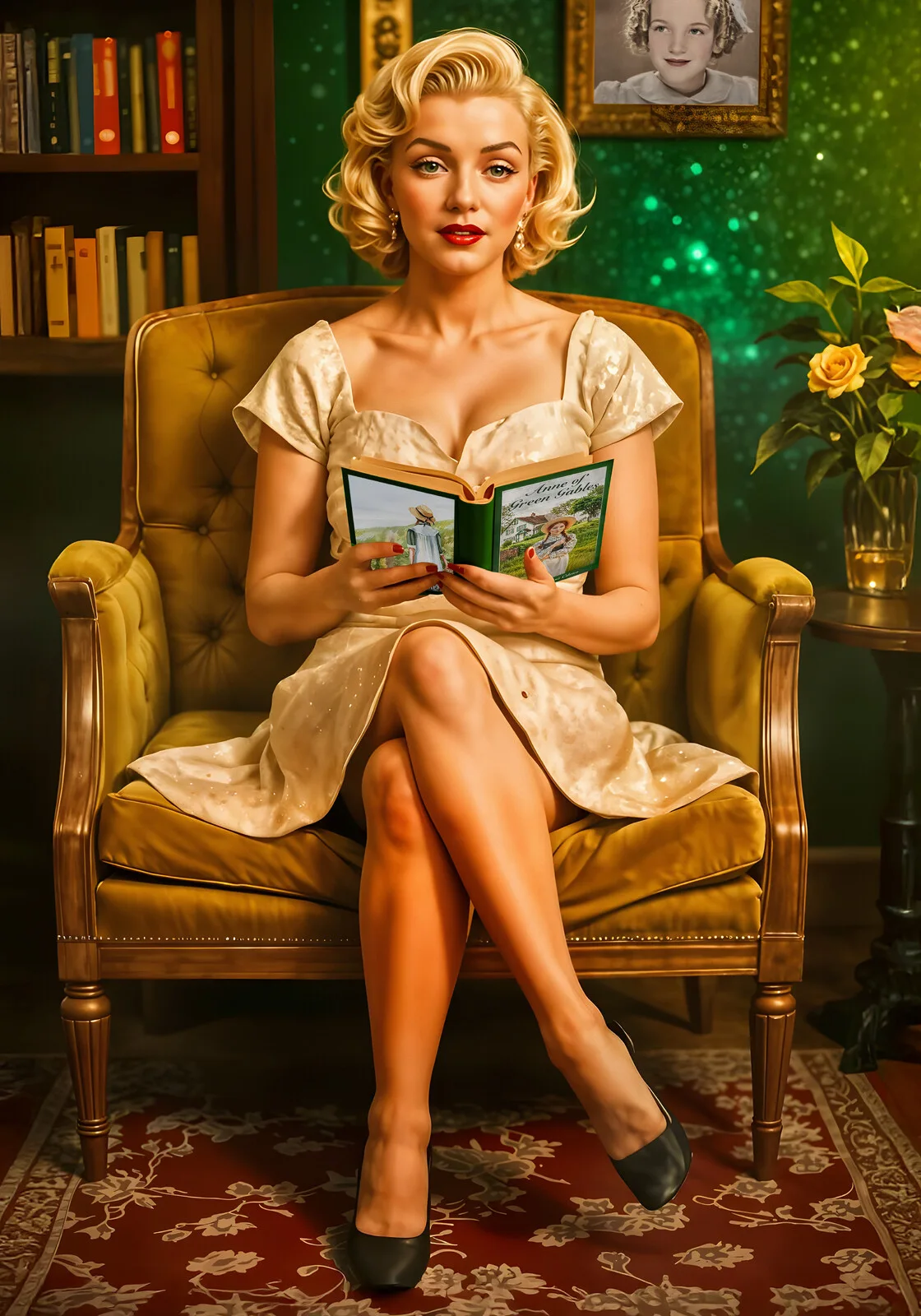
Que Sera, Sera (Whatever Will Be, Will Be)
There are books that never truly leave us. They linger like a scent, like an old photograph we always know exactly where to find. Anne of Green Gables is one of those books. The story of the red‑haired girl with too many words and too many dreams, a book that remains as relevant today as it was a hundred years ago, has followed generation after generation – sometimes as a children’s book, sometimes as a secret manifesto for anyone who refuses to settle for a supporting role in their own life. Its enduring relevance connects us to a timeless piece of literature.
In the picture, Marilyn Monroe is sitting with that very book in her hands. It’s more than a beautiful image – it’s a reminder that behind the most mythical of film stars was a woman who read, thought, and longed. Perhaps she saw herself in Anne. Maybe she recognised in her a kind of mirror – a girl eager for freedom, yet constantly told how she should be.
And perhaps that’s why we still open the book a hundred years later: to see a little of ourselves in Anne – our dreams, our questions, our attempts to write our own story. Anne's character is so relatable, it's like she's a part of us, forging a personal connection to the story.
”Que Sera, Sera" is a song that encapsulates the theme of fate and acceptance, a theme that resonates deeply with the lives of Marilyn Monroe and Anne Shirley. This song, which Marilyn famously sang in the film 'The Man Who Knew Too Much', reflects the uncertainty of the future and the acceptance of whatever it may bring, a sentiment that both Anne and Marilyn could relate to in their own ways.
When I was just a little girl
I asked my mother
What will I be?
Will I be pretty?
Will I be rich?
Here's what she said to me:
Que sera, sera.
Whatever will be, will be.
The future's not ours to see.
Que sera, sera.
What will be, will be.
When I grew up and fell in love
I asked my sweetheart
What lies ahead?
Will we have rainbows?
Day after day?
Here's what my sweetheart said:
Que sera, sera.
Whatever will be, will be.
The future's not ours to see.
Que sera, sera.
What will be, will be.
Now I have children of my own.
They ask their mother,
What will I be?
Will I be handsome?
Will I be rich?
I tell them tenderly:
Que sera, sera.
Whatever will be, will be.
The future's not ours to see.
Que sera, sera.
What will be, will be.
Que sera, sera”
Ray Evans/Jay Livingston 1955
Trading Destinys
In the picture, Marilyn Monroe is doing what she often did in her life – reading a book. This time, it’s ‘Anne of Green Gables.’ Marilyn was no “dumb blonde,” and as a person, she was far removed from the sultry vamp image the studios marketed her as. On the contrary, she had an impressively high IQ – 168 – a testament to her intelligence and depth. It’s worth noting that Albert Einstein was around 160.
Behind the myth, there was a human being. To the world, Marilyn Monroe was the epitome of glamour, desire, and fame. But at home, when the cameras were off and the makeup was removed, she was Norma Jeane – a woman who read world literature, kept a journal, recited poetry, and dreamed of something beyond red carpets and studio lights. This stark contrast between her public and private personas is a revelation that invites us to reconsider our perceptions of her. Similarly, Anne Shirley, the spirited, rebellious heroine, had her private world, a world of imagination and self-expression, that was often overshadowed by her public image.
Her love for literature was profound, a part of her essence. She was a student of the written word, taking writing classes and carrying books like others carried handbags. She read Whitman, Joyce, Proust – and indeed ‘Anne of Green Gables’ when she was a little girl. As an adult, whenever she felt like trading lives for a while, she would borrow Anne’s instead of her own. It was a perfect match, since Anne had always wanted to step forward and be seen, and why not as a Hollywood star?
It’s easy to picture Marilyn sitting on the floor, barefoot, in a simple nightgown – far from Hollywood – and pondering:
“What would it be like to live a quieter, simpler life?”
A life where she could be left alone, just be herself, make breakfast without anyone snapping pictures, walk to the corner store, or shop on the high street without a tail of paparazzi behind her—a life where she could be a woman, not an icon.
Anne and Marilyn – two dreamers, two contrasts. In each book, Anne longed for a bigger life – away from poverty, away from orphanages. Marilyn, however, yearned for a simpler existence – away from overexposure, away from expectations, away from the constant gaze upon her. Yet, both these women, in their ways, showed remarkable resilience in the face of their challenges, inspiring us with their strength and ability to overcome.
From the very first page, it was clear – Anne Shirley wouldn’t sit quietly in the background. She claimed the leading role, complete with braids, and refused to give it up.
“Everyone’s childhood plays itself out. No wonder no one knows the other or can completely understand.”
—Marilyn Monroe
Chapter 1 – A Redheaded Revolution: Anne’s Birth in Literature
The year was 1908. It would be another eighteen years before Norma Jeane Mortenson was born, and another thirty before the song that gives this image its name was written.
The world still had Victorian sensibilities at the edges, and in literature, girls were often confined to minor roles in their own stories. They were sweet and quiet, or dutiful and proper, but seldom loud, ankapitel 2gry, or laughing in the wrong place. Anne, on the other hand, was a stark contrast to these norms.
And then came Anne Shirley.
L.M. Montgomery wrote ‘Anne of Green Gables’ almost on a whim. She revived an old idea about a child sent to the wrong foster parents – originally intended to be a boy, but Montgomery transformed him into a girl. And not just any girl.
Anne was red-haired, freckled, and as thin as a rake, but more than that, she was talkative, stubborn, and full of opinions. She could criticise her teacher, smash a slate over a schoolmate’s head, or deliver a sermon about the beauty of cherry blossoms.
At a time when girls in children’s books were often told to “fold their hands in their lap and wait their turn,” Anne burst into the world as a redheaded revolution. She didn’t just want to take part – she aimed to shape, rename, and create anew.
And she did it with imagination as her weapon.
Anne christened landscapes as if they were lines of poetry – “The Lake of Shining Waters,” “The White Way of Delight.” She elevated every path and tree into something greater than reality. It was a radical act for a girl in the early 1900s: to declare, “My gaze determines what the world is,” inspiring generations with her bold use of imagination.
Chapter 2 – The Heroine in Her Drama
Anne often said she wanted to be a “heroine in a story. For Anne, being a "heroine in a story" wasn’t about seeking spotlights and applause. It was a declaration of her refusal to be a mere supporting character in her own life.
She didn't just live each day; she transformed it into a spectacle. A simple walk became a pilgrimage, a kitchen chore a tragedy fit for Shakespeare. She didn't just feel emotions, she immersed herself in them – laughed too loudly, cried too deeply, loved too fiercely. Anne's life was a testament to the power of imagination and the importance of self-expression, inspiring us to embrace our creativity.
It’s easy to smile at her theatrics, but there was a feminist strength behind it. Because at a time when girls were expected to sit quietly, lower their voices, and wait for others to tell their story, Anne did the opposite: she took the starring role from the very first line.
For Anne, life was her stage, and she was the lead actress. She didn’t aspire to be a literal actress, but she lived her life as if it were the most critical role in the world, turning every mundane task into a dramatic performance.
Claiming the leading role was Anne's first act of rebellion, a defiance of the societal norms that expected girls to be passive and silent. And she continued to rebel in this way.
And in my story, they meet: two girls who, at their heart, want the same thing – a home, a place where they can be loved for who they truly are, but one on stage, the other off.
Chapter 3 – The Unintended Daughter: Childhood, Dreams and “a Room of Her Own”
Anne Shirley arrives at Green Gables by mistake. Marilla and Matthew Cuthbert had asked the orphanage for a boy—someone to help with the heavy farm work—and instead, a slender girl with red braids and a vocabulary larger than all of Avonlea steps off the train.
The first days are filled with uncertainty. Marilla isn’t sure she can keep her. Anne, who often observes that the world looks away from girls like her, throws out her words like lifelines: she talks, she dreams, she exaggerates, she paints pictures – all to create a place for herself.
And it works. Because how can anyone resist someone who sees a pond as a “Lake of Shining Waters” or a maple-lined road as “The White Way of Delight”? Anne talks herself into the family – and does what she will always do: she reshapes her reality.
But beneath her talkative surface lies another truth: Anne is a child without parents, who has been shuttled between homes and orphanages, and who has never had anything truly her own. At Green Gables, she is, for the first time, given her room. And for Anne, it isn’t just a room – it’s a kingdom.
In that small, slanted-ceiling bedroom, Anne has a private space for her dreams for the first time. Here she can read, write, and imagine. She can create stories, grow, and think. It is, in an almost startlingly early way, a living embodiment of Virginia Woolf’s later idea that every woman needs “a room of her own.”
And while the world expected her to be grateful and quiet, Anne did something greater: she began shaping her life to fit her dreams, not the other way around.
Chapter 4 – Creativity as Resistance: The Girl Who Wrote Herself Free
For Anne, imagination wasn’t just a pastime. It was a vital survival tactic. She wrote short stories and lengthy letters, founded “Improvement Societies” with her friends, performed monologues to trees, and read aloud to flowers. When daily life was dull, she coloured it with pink, purple, and gold through her words.
It might sound charming – and it is – but it’s also radical. Because in the early 1900s, there was an expectation for girls: be polite, be still, and above all, be quiet. Anne refused.
She talked too much. She wrote too much. She dreamed out loud, too. In doing so, she defied societal norms and became a feminist long before the word was common on people's lips.
And in doing so, she created a world where her voice held value, where her imagination was as real as anyone else’s practical duties, a testament to the power of creativity.
Here, Anne mirrors her creator, L.M. Montgomery. Lucy Maud grew up on Prince Edward Island in a strict household where girls’ words didn’t always count. She wrote in secret, sent stories to magazines, collected rejection letters – and refused to give up.
That’s why Anne’s words feel like they burn. They aren’t decorations. They are resilient.
Anne had written herself free long before she was truly free. And in the process, she taught us something that endures across generations: To write, to create, to imagine – is not to escape reality. The goal is to build your own.
Chapter 5 – Love, Proposals, and Freedom: Anne and L.M. Montgomery’s Life Choices
Anne Shirley grows up with a heart as big as her vocabulary – but she doesn’t rush to give it away.
Gilbert Blythe, the schoolboy who initially teases her about her red hair and has a slate smashed over his head, eventually becomes a friend, but Anne remains hesitant for a long time.
For Anne, love isn’t just something you simply “agree to.” It should be like a fairy tale, a poem, something that makes the world sparkle. She rejects Gilbert’s proposal when they are young because she would rather keep dreaming than settle. Her independence in this matter is a testament to her strong character and serves as an inspiration to all who read her story.
This reflects L.M. Montgomery’s own life. She had many suitors, but she rejected them repeatedly because none of them felt right. She patiently waited.
Eventually, at the age of 36, she married Ewan Macdonald, a Presbyterian minister. He wasn’t particularly brilliant, and he wrestled with depression and mental illness. Montgomery found herself in a marriage that wasn’t entirely happy, but it was also one of the few options available to a woman in early 20th-century Britain.
This is where Anne stands out from many other girl characters in books of her era. She marries, too – but on her terms. When she finally accepts Gilbert, it’s not because she must, not because anyone pressures her, but because she chooses him.
And that’s what makes her journey so significant. Anne's journey is not just a story, but a powerful testament to the fact that love doesn’t have to mean losing yourself; it can – if you are stubborn enough – be the freedom to love and stay true to yourself. Her choices carry a weight that resonates with readers, making her journey all the more impactful.
Chapter 6 – Longing for Home: Who Gets to Dream?
Anne Shirley was always on her way somewhere – whether with her feet or her thoughts. She dreamed of castles and salons, of Paris and poetry, of journeys to worlds that perhaps only existed in her mind. But just as much, she dreamed of something far simpler: a home that felt truly her own.
It’s a strange duality in Anne – the longing away and the longing for home, all at once. She wanted to escape everything that stifled her, but she also wanted roots. That contradiction is part of why she still feels modern. Because isn’t that exactly how we still live? We want to see the world – and we want a kitchen with a teapot that’s always waiting for us.
Anne received both. She left Green Gables to educate herself, to teach, and to write. She explored new places and met new people. But she also returned, not as a defeat, but as her own choice.
There is a strong feminist core here: Anne demonstrates that girls’ dreams can be grand and soaring, yet they can also be still. She teaches us that wanting a home isn’t the same as abandoning ambition. Her character exudes strength and resilience, inspiring all who read her story.
For Anne, it's not a matter of either/or. She creates a life where both dreams coexist – and demonstrates that this could be the most revolutionary act of all.
Chapter 8 – The Legacy of Anne: A Feminist Icon in a Skirt and Braids
More than a century has passed since Anne Shirley stepped off the train in Avonlea with a worn suitcase and a head full of dreams. And yet, she’s still here, not just in literature, but in how we perceive what a girl can be.
Anne, a girl with no magical powers or kingdom behind her, but armed with words, stubbornness, and imagination, stood out in an era when girls were expected to be well-behaved ornaments. She talked too much, burned brightly, and took up space, which not everyone appreciated. Her refusal to conform to the 'proper' role was a testament to her resilience, and it’s precisely this quality that opened doors.
Feminism, with its many faces, includes a red-haired girl with braids naming a pond, saying “I want more,” and teaching generations of girls that their imagination isn’t just a cute side hobby but a weapon, a tool, a way out. Anne's influence extends beyond her own story, inspiring countless heroines who came after her – from Pippi Longstocking to Hermione Granger. Every time a girl in a book speaks too loudly, asks an inconvenient question, or refuses to back down, there’s a little shadow of Anne there, and it's a reason to be proud.
And perhaps that’s Anne’s greatest gift to humanity: demonstrating that a girl can be the protagonist in her own life, even if she started as the “wrong delivery” to a farm on Prince Edward Island.
Anne Shirley was, and still is, a revolution in red braids. And she keeps reminding everyone who opens the book:
“Think big. Dream wildly. And never settle for a supporting role.”
Chapter 9 – Anne Grows Up: The Spark That Never Went Out
When we first meet Anne, she’s eleven, stepping off the train in Avonlea like a whirlwind of red braids, chatter, and hope. It’s easy to think she’s just a children’s book heroine, destined to remain in eternal childhood, like Peter Pan.
But Anne grows up – and we get to follow her all the way.
In ‘Anne of Avonlea’, we see her grow into a teenager and a teacher, suddenly responsible for other children. The girl who was once always being scolded now holds the pointer herself, though her way of teaching still brims with as much imagination as her daydreams. This transition from a scolded child to a responsible teacher is a significant part of Anne's personal growth.
In ‘Anne of the Island’, she leaves the safety of Avonlea for college. There, she experiences what many young women still encounter today: the freedom and confusion of suddenly standing on your own. She makes lifelong friends, writes, explores the world, and begins to understand what love means.
When she finally marries Gilbert in ‘Anne’s House of Dreams’ and they move into their first home, it’s not as a girl giving up her dreams, but as a woman building them further.
In later books, we see her as a mother, an advisor, and a steady force for her growing family. Her life is filled with small daily miracles and deep sorrows – a miscarriage, the shadow of World War, children who grow up and move on.
And yet, she remains Anne. She still names paths and blooming meadows, she still transforms the ordinary into something magical, she still clings to the spark that allowed her, as an eleven-year-old, to stand in a complex world and say: “I’m going to dream anyway."
That’s perhaps why Anne still feels so alive. She grows up, but she never loses what makes her who she is. She teaches us that it’s possible to become an adult— to love, to work, to grieve, to take responsibility – without losing the child who once dreamt us here.
Epilogue – Que Sera, Sera
It’s late, and Marilyn has set the book down. Anne of Green Gables lies open on the armrest, her fingers unconsciously tapping along the spine as if humming a melody.
Perhaps it’s Que Sera, Sera that comes to her, the song she once sang out to the world.
“Whatever will be, will be. The future’s not ours to see.”
Because there’s something in Anne’s story – the girl who talked too much, dreamed too loudly, and refused to apologise – that resonates with Marilyn. And perhaps with us too.
Anne dreamed of a grander life. Marilyn dreamed of a simpler one.
Both, deep down, shared the same desire: to be true to themselves.
That’s why the red-haired girl and the blonde star meet here, in an armchair, between two covers.
And that’s why we still open the book, a hundred years later, because we’re still searching for the same thing.
A home for our dreams.
Summary
Anne of Green Gables is just the beginning. Lucy Maud Montgomery wrote eight books in total about Anne Shirley, tracing her from the chatty red-haired eleven-year-old to a mature woman with children and a life of her own.
Here’s the rough outline of the series:
Anne of Green Gables (1908) – Anne arrives at Green Gables aged 11, finds a home with Marilla and Matthew, and begins her journey.
Anne of Avonlea (1909) – Her teenage years; Anne becomes a teacher and starts to find her place in society.
Anne of the Island (1915) – Anne leaves Avonlea for college, makes new friends, writes, and begins to understand what she truly wants from life.
Anne of Windy Poplars (1936) – Anne works as a school principal while waiting to marry Gilbert.
Anne’s House of Dreams (1917) – Anne marries Gilbert, and they move into their first home together.
Anne of Ingleside (1939) – Anne is now a mother to several children, and we see her in a more mature role.
Rainbow Valley (1919) and Rilla of Ingleside (1921) – the focus shifts more to her children (especially her daughter Rilla in the last book), but Anne remains a central figure.
What makes the Anne books unique is that we follow her entire life, watching her grow from a girl into a mature woman, making mistakes, falling in love, working, marrying, having children, while still retaining that spark which made her special from the outset.
Jörgen Thornberg
Que Sera, Sera, 2025
Digital
50 x 70 cm
3 200 kr
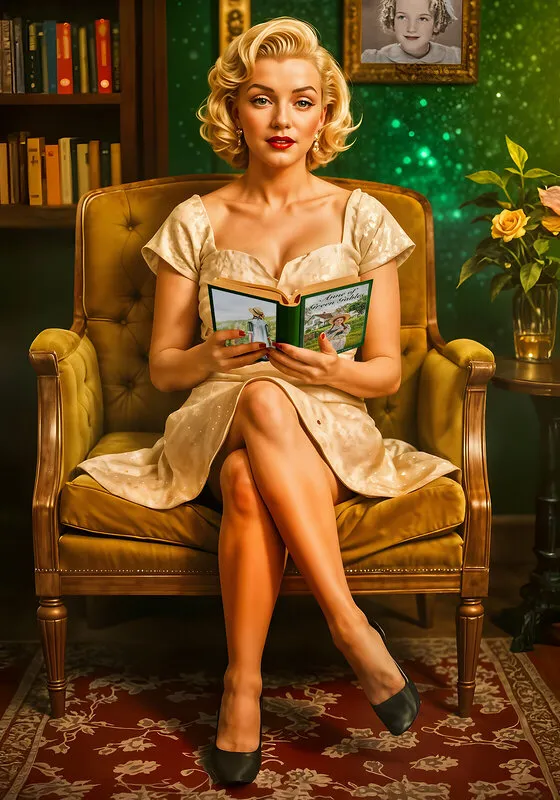
Que Sera, Sera (Whatever Will Be, Will Be)
There are books that never truly leave us. They linger like a scent, like an old photograph we always know exactly where to find. Anne of Green Gables is one of those books. The story of the red‑haired girl with too many words and too many dreams, a book that remains as relevant today as it was a hundred years ago, has followed generation after generation – sometimes as a children’s book, sometimes as a secret manifesto for anyone who refuses to settle for a supporting role in their own life. Its enduring relevance connects us to a timeless piece of literature.
In the picture, Marilyn Monroe is sitting with that very book in her hands. It’s more than a beautiful image – it’s a reminder that behind the most mythical of film stars was a woman who read, thought, and longed. Perhaps she saw herself in Anne. Maybe she recognised in her a kind of mirror – a girl eager for freedom, yet constantly told how she should be.
And perhaps that’s why we still open the book a hundred years later: to see a little of ourselves in Anne – our dreams, our questions, our attempts to write our own story. Anne's character is so relatable, it's like she's a part of us, forging a personal connection to the story.
”Que Sera, Sera" is a song that encapsulates the theme of fate and acceptance, a theme that resonates deeply with the lives of Marilyn Monroe and Anne Shirley. This song, which Marilyn famously sang in the film 'The Man Who Knew Too Much', reflects the uncertainty of the future and the acceptance of whatever it may bring, a sentiment that both Anne and Marilyn could relate to in their own ways.
When I was just a little girl
I asked my mother
What will I be?
Will I be pretty?
Will I be rich?
Here's what she said to me:
Que sera, sera.
Whatever will be, will be.
The future's not ours to see.
Que sera, sera.
What will be, will be.
When I grew up and fell in love
I asked my sweetheart
What lies ahead?
Will we have rainbows?
Day after day?
Here's what my sweetheart said:
Que sera, sera.
Whatever will be, will be.
The future's not ours to see.
Que sera, sera.
What will be, will be.
Now I have children of my own.
They ask their mother,
What will I be?
Will I be handsome?
Will I be rich?
I tell them tenderly:
Que sera, sera.
Whatever will be, will be.
The future's not ours to see.
Que sera, sera.
What will be, will be.
Que sera, sera”
Ray Evans/Jay Livingston 1955
Trading Destinys
In the picture, Marilyn Monroe is doing what she often did in her life – reading a book. This time, it’s ‘Anne of Green Gables.’ Marilyn was no “dumb blonde,” and as a person, she was far removed from the sultry vamp image the studios marketed her as. On the contrary, she had an impressively high IQ – 168 – a testament to her intelligence and depth. It’s worth noting that Albert Einstein was around 160.
Behind the myth, there was a human being. To the world, Marilyn Monroe was the epitome of glamour, desire, and fame. But at home, when the cameras were off and the makeup was removed, she was Norma Jeane – a woman who read world literature, kept a journal, recited poetry, and dreamed of something beyond red carpets and studio lights. This stark contrast between her public and private personas is a revelation that invites us to reconsider our perceptions of her. Similarly, Anne Shirley, the spirited, rebellious heroine, had her private world, a world of imagination and self-expression, that was often overshadowed by her public image.
Her love for literature was profound, a part of her essence. She was a student of the written word, taking writing classes and carrying books like others carried handbags. She read Whitman, Joyce, Proust – and indeed ‘Anne of Green Gables’ when she was a little girl. As an adult, whenever she felt like trading lives for a while, she would borrow Anne’s instead of her own. It was a perfect match, since Anne had always wanted to step forward and be seen, and why not as a Hollywood star?
It’s easy to picture Marilyn sitting on the floor, barefoot, in a simple nightgown – far from Hollywood – and pondering:
“What would it be like to live a quieter, simpler life?”
A life where she could be left alone, just be herself, make breakfast without anyone snapping pictures, walk to the corner store, or shop on the high street without a tail of paparazzi behind her—a life where she could be a woman, not an icon.
Anne and Marilyn – two dreamers, two contrasts. In each book, Anne longed for a bigger life – away from poverty, away from orphanages. Marilyn, however, yearned for a simpler existence – away from overexposure, away from expectations, away from the constant gaze upon her. Yet, both these women, in their ways, showed remarkable resilience in the face of their challenges, inspiring us with their strength and ability to overcome.
From the very first page, it was clear – Anne Shirley wouldn’t sit quietly in the background. She claimed the leading role, complete with braids, and refused to give it up.
“Everyone’s childhood plays itself out. No wonder no one knows the other or can completely understand.”
—Marilyn Monroe
Chapter 1 – A Redheaded Revolution: Anne’s Birth in Literature
The year was 1908. It would be another eighteen years before Norma Jeane Mortenson was born, and another thirty before the song that gives this image its name was written.
The world still had Victorian sensibilities at the edges, and in literature, girls were often confined to minor roles in their own stories. They were sweet and quiet, or dutiful and proper, but seldom loud, ankapitel 2gry, or laughing in the wrong place. Anne, on the other hand, was a stark contrast to these norms.
And then came Anne Shirley.
L.M. Montgomery wrote ‘Anne of Green Gables’ almost on a whim. She revived an old idea about a child sent to the wrong foster parents – originally intended to be a boy, but Montgomery transformed him into a girl. And not just any girl.
Anne was red-haired, freckled, and as thin as a rake, but more than that, she was talkative, stubborn, and full of opinions. She could criticise her teacher, smash a slate over a schoolmate’s head, or deliver a sermon about the beauty of cherry blossoms.
At a time when girls in children’s books were often told to “fold their hands in their lap and wait their turn,” Anne burst into the world as a redheaded revolution. She didn’t just want to take part – she aimed to shape, rename, and create anew.
And she did it with imagination as her weapon.
Anne christened landscapes as if they were lines of poetry – “The Lake of Shining Waters,” “The White Way of Delight.” She elevated every path and tree into something greater than reality. It was a radical act for a girl in the early 1900s: to declare, “My gaze determines what the world is,” inspiring generations with her bold use of imagination.
Chapter 2 – The Heroine in Her Drama
Anne often said she wanted to be a “heroine in a story. For Anne, being a "heroine in a story" wasn’t about seeking spotlights and applause. It was a declaration of her refusal to be a mere supporting character in her own life.
She didn't just live each day; she transformed it into a spectacle. A simple walk became a pilgrimage, a kitchen chore a tragedy fit for Shakespeare. She didn't just feel emotions, she immersed herself in them – laughed too loudly, cried too deeply, loved too fiercely. Anne's life was a testament to the power of imagination and the importance of self-expression, inspiring us to embrace our creativity.
It’s easy to smile at her theatrics, but there was a feminist strength behind it. Because at a time when girls were expected to sit quietly, lower their voices, and wait for others to tell their story, Anne did the opposite: she took the starring role from the very first line.
For Anne, life was her stage, and she was the lead actress. She didn’t aspire to be a literal actress, but she lived her life as if it were the most critical role in the world, turning every mundane task into a dramatic performance.
Claiming the leading role was Anne's first act of rebellion, a defiance of the societal norms that expected girls to be passive and silent. And she continued to rebel in this way.
And in my story, they meet: two girls who, at their heart, want the same thing – a home, a place where they can be loved for who they truly are, but one on stage, the other off.
Chapter 3 – The Unintended Daughter: Childhood, Dreams and “a Room of Her Own”
Anne Shirley arrives at Green Gables by mistake. Marilla and Matthew Cuthbert had asked the orphanage for a boy—someone to help with the heavy farm work—and instead, a slender girl with red braids and a vocabulary larger than all of Avonlea steps off the train.
The first days are filled with uncertainty. Marilla isn’t sure she can keep her. Anne, who often observes that the world looks away from girls like her, throws out her words like lifelines: she talks, she dreams, she exaggerates, she paints pictures – all to create a place for herself.
And it works. Because how can anyone resist someone who sees a pond as a “Lake of Shining Waters” or a maple-lined road as “The White Way of Delight”? Anne talks herself into the family – and does what she will always do: she reshapes her reality.
But beneath her talkative surface lies another truth: Anne is a child without parents, who has been shuttled between homes and orphanages, and who has never had anything truly her own. At Green Gables, she is, for the first time, given her room. And for Anne, it isn’t just a room – it’s a kingdom.
In that small, slanted-ceiling bedroom, Anne has a private space for her dreams for the first time. Here she can read, write, and imagine. She can create stories, grow, and think. It is, in an almost startlingly early way, a living embodiment of Virginia Woolf’s later idea that every woman needs “a room of her own.”
And while the world expected her to be grateful and quiet, Anne did something greater: she began shaping her life to fit her dreams, not the other way around.
Chapter 4 – Creativity as Resistance: The Girl Who Wrote Herself Free
For Anne, imagination wasn’t just a pastime. It was a vital survival tactic. She wrote short stories and lengthy letters, founded “Improvement Societies” with her friends, performed monologues to trees, and read aloud to flowers. When daily life was dull, she coloured it with pink, purple, and gold through her words.
It might sound charming – and it is – but it’s also radical. Because in the early 1900s, there was an expectation for girls: be polite, be still, and above all, be quiet. Anne refused.
She talked too much. She wrote too much. She dreamed out loud, too. In doing so, she defied societal norms and became a feminist long before the word was common on people's lips.
And in doing so, she created a world where her voice held value, where her imagination was as real as anyone else’s practical duties, a testament to the power of creativity.
Here, Anne mirrors her creator, L.M. Montgomery. Lucy Maud grew up on Prince Edward Island in a strict household where girls’ words didn’t always count. She wrote in secret, sent stories to magazines, collected rejection letters – and refused to give up.
That’s why Anne’s words feel like they burn. They aren’t decorations. They are resilient.
Anne had written herself free long before she was truly free. And in the process, she taught us something that endures across generations: To write, to create, to imagine – is not to escape reality. The goal is to build your own.
Chapter 5 – Love, Proposals, and Freedom: Anne and L.M. Montgomery’s Life Choices
Anne Shirley grows up with a heart as big as her vocabulary – but she doesn’t rush to give it away.
Gilbert Blythe, the schoolboy who initially teases her about her red hair and has a slate smashed over his head, eventually becomes a friend, but Anne remains hesitant for a long time.
For Anne, love isn’t just something you simply “agree to.” It should be like a fairy tale, a poem, something that makes the world sparkle. She rejects Gilbert’s proposal when they are young because she would rather keep dreaming than settle. Her independence in this matter is a testament to her strong character and serves as an inspiration to all who read her story.
This reflects L.M. Montgomery’s own life. She had many suitors, but she rejected them repeatedly because none of them felt right. She patiently waited.
Eventually, at the age of 36, she married Ewan Macdonald, a Presbyterian minister. He wasn’t particularly brilliant, and he wrestled with depression and mental illness. Montgomery found herself in a marriage that wasn’t entirely happy, but it was also one of the few options available to a woman in early 20th-century Britain.
This is where Anne stands out from many other girl characters in books of her era. She marries, too – but on her terms. When she finally accepts Gilbert, it’s not because she must, not because anyone pressures her, but because she chooses him.
And that’s what makes her journey so significant. Anne's journey is not just a story, but a powerful testament to the fact that love doesn’t have to mean losing yourself; it can – if you are stubborn enough – be the freedom to love and stay true to yourself. Her choices carry a weight that resonates with readers, making her journey all the more impactful.
Chapter 6 – Longing for Home: Who Gets to Dream?
Anne Shirley was always on her way somewhere – whether with her feet or her thoughts. She dreamed of castles and salons, of Paris and poetry, of journeys to worlds that perhaps only existed in her mind. But just as much, she dreamed of something far simpler: a home that felt truly her own.
It’s a strange duality in Anne – the longing away and the longing for home, all at once. She wanted to escape everything that stifled her, but she also wanted roots. That contradiction is part of why she still feels modern. Because isn’t that exactly how we still live? We want to see the world – and we want a kitchen with a teapot that’s always waiting for us.
Anne received both. She left Green Gables to educate herself, to teach, and to write. She explored new places and met new people. But she also returned, not as a defeat, but as her own choice.
There is a strong feminist core here: Anne demonstrates that girls’ dreams can be grand and soaring, yet they can also be still. She teaches us that wanting a home isn’t the same as abandoning ambition. Her character exudes strength and resilience, inspiring all who read her story.
For Anne, it's not a matter of either/or. She creates a life where both dreams coexist – and demonstrates that this could be the most revolutionary act of all.
Chapter 8 – The Legacy of Anne: A Feminist Icon in a Skirt and Braids
More than a century has passed since Anne Shirley stepped off the train in Avonlea with a worn suitcase and a head full of dreams. And yet, she’s still here, not just in literature, but in how we perceive what a girl can be.
Anne, a girl with no magical powers or kingdom behind her, but armed with words, stubbornness, and imagination, stood out in an era when girls were expected to be well-behaved ornaments. She talked too much, burned brightly, and took up space, which not everyone appreciated. Her refusal to conform to the 'proper' role was a testament to her resilience, and it’s precisely this quality that opened doors.
Feminism, with its many faces, includes a red-haired girl with braids naming a pond, saying “I want more,” and teaching generations of girls that their imagination isn’t just a cute side hobby but a weapon, a tool, a way out. Anne's influence extends beyond her own story, inspiring countless heroines who came after her – from Pippi Longstocking to Hermione Granger. Every time a girl in a book speaks too loudly, asks an inconvenient question, or refuses to back down, there’s a little shadow of Anne there, and it's a reason to be proud.
And perhaps that’s Anne’s greatest gift to humanity: demonstrating that a girl can be the protagonist in her own life, even if she started as the “wrong delivery” to a farm on Prince Edward Island.
Anne Shirley was, and still is, a revolution in red braids. And she keeps reminding everyone who opens the book:
“Think big. Dream wildly. And never settle for a supporting role.”
Chapter 9 – Anne Grows Up: The Spark That Never Went Out
When we first meet Anne, she’s eleven, stepping off the train in Avonlea like a whirlwind of red braids, chatter, and hope. It’s easy to think she’s just a children’s book heroine, destined to remain in eternal childhood, like Peter Pan.
But Anne grows up – and we get to follow her all the way.
In ‘Anne of Avonlea’, we see her grow into a teenager and a teacher, suddenly responsible for other children. The girl who was once always being scolded now holds the pointer herself, though her way of teaching still brims with as much imagination as her daydreams. This transition from a scolded child to a responsible teacher is a significant part of Anne's personal growth.
In ‘Anne of the Island’, she leaves the safety of Avonlea for college. There, she experiences what many young women still encounter today: the freedom and confusion of suddenly standing on your own. She makes lifelong friends, writes, explores the world, and begins to understand what love means.
When she finally marries Gilbert in ‘Anne’s House of Dreams’ and they move into their first home, it’s not as a girl giving up her dreams, but as a woman building them further.
In later books, we see her as a mother, an advisor, and a steady force for her growing family. Her life is filled with small daily miracles and deep sorrows – a miscarriage, the shadow of World War, children who grow up and move on.
And yet, she remains Anne. She still names paths and blooming meadows, she still transforms the ordinary into something magical, she still clings to the spark that allowed her, as an eleven-year-old, to stand in a complex world and say: “I’m going to dream anyway."
That’s perhaps why Anne still feels so alive. She grows up, but she never loses what makes her who she is. She teaches us that it’s possible to become an adult— to love, to work, to grieve, to take responsibility – without losing the child who once dreamt us here.
Epilogue – Que Sera, Sera
It’s late, and Marilyn has set the book down. Anne of Green Gables lies open on the armrest, her fingers unconsciously tapping along the spine as if humming a melody.
Perhaps it’s Que Sera, Sera that comes to her, the song she once sang out to the world.
“Whatever will be, will be. The future’s not ours to see.”
Because there’s something in Anne’s story – the girl who talked too much, dreamed too loudly, and refused to apologise – that resonates with Marilyn. And perhaps with us too.
Anne dreamed of a grander life. Marilyn dreamed of a simpler one.
Both, deep down, shared the same desire: to be true to themselves.
That’s why the red-haired girl and the blonde star meet here, in an armchair, between two covers.
And that’s why we still open the book, a hundred years later, because we’re still searching for the same thing.
A home for our dreams.
Summary
Anne of Green Gables is just the beginning. Lucy Maud Montgomery wrote eight books in total about Anne Shirley, tracing her from the chatty red-haired eleven-year-old to a mature woman with children and a life of her own.
Here’s the rough outline of the series:
Anne of Green Gables (1908) – Anne arrives at Green Gables aged 11, finds a home with Marilla and Matthew, and begins her journey.
Anne of Avonlea (1909) – Her teenage years; Anne becomes a teacher and starts to find her place in society.
Anne of the Island (1915) – Anne leaves Avonlea for college, makes new friends, writes, and begins to understand what she truly wants from life.
Anne of Windy Poplars (1936) – Anne works as a school principal while waiting to marry Gilbert.
Anne’s House of Dreams (1917) – Anne marries Gilbert, and they move into their first home together.
Anne of Ingleside (1939) – Anne is now a mother to several children, and we see her in a more mature role.
Rainbow Valley (1919) and Rilla of Ingleside (1921) – the focus shifts more to her children (especially her daughter Rilla in the last book), but Anne remains a central figure.
What makes the Anne books unique is that we follow her entire life, watching her grow from a girl into a mature woman, making mistakes, falling in love, working, marrying, having children, while still retaining that spark which made her special from the outset.
3 200 kr

Jörgen Thornberg
Malmö
Lite om bilder och mig. Translation in English at the end.
Jag är en nyfiken person som ser allt i bilder, även det jag fäster i ord, gärna tillsammans för bakom alla mina bilder finns en berättelse. Till vissa bilder hör en kortare eller längre novell som följer med bilden.
Bilder berättar historier. Jag omges av naturlig skönhet, intressanta människor och historia var jag än går. Jag använder min kamera för att dokumentera världen och blanda det jag ser med vad jag känner för att fånga den dolda magin.
Mina bilder berättar mina historier. Genom mina bilder, tryck och berättelser. Jag bjuder in dig att ta del av dessa berättelser, in i ditt liv och hem och dela min mycket personliga syn på vår värld. Mer än vad ögat ser. Jag tänker i bilder, drömmer och skriver och pratar om dem; följaktligen måste jag också skapa bilder. De blir vad jag ser, inte nödvändigtvis begränsade till verkligheten. Det finns en bild runt varje hörn. Jag hoppas att du kommer att se vad jag såg och gilla det.
Jag är också en skrivande person och till många bilder hör en kortare eller längre essay. Den följer med tavlan, tryckt på fint papper och med en personlig hälsning från mig.
Flertalet bilder startar sin resa i min kamera. Enkelt förklarat beskriver jag bilden jag ser i mitt inre, upplevd eller fantiserad. Bilden uppstår inom mig redan innan jag fått okularet till ögat. På bråkdelen av ett ögonblick ser jag vad jag vill ha och vad som kan göras med bilden. Här skall jag stoppa in en giraff, stålmannen, Titanic eller vad det är min fantasi finner ut. Ännu märkligare är att jag kommer ihåg minnesbilden långt efteråt när det blir tid att skapa verket. Om jag lyckas eller inte, är upp till betraktaren, oftast präglat av en stråk av svart humor – meningen är att man skall bli underhållen. Mina bilder blir ofta en snackis där de hänger.
Jag föredrar bilder som förmedlar ett budskap i flera lager. Vid första anblicken fylld av feel-good, en vacker utsikt, fint väder, solen skiner, blommor på ängen eller vattnet som ligger förrädiskt spegelblankt. I en sådan bild kan jag gömma min egentliga berättelse, mitt förakt för förtryckare och våldsverkare, rasister och fördomsfulla människor - ett gärna återkommande motiv mer eller mindre dolt i det vackra motivet. Jag försöker förena dem i ett gemensamt narrativ.
Bild och formgivning har löpt som en röd tråd genom livet. Fotokonst känns som en värdig final som jag gärna delar med mig.
Min genre är vid som framgår av mina bilder, temat en blandning av pop- och gatukonst i kollage som kan bestå av hundratals lager. Vissa bilder kan ta veckor, andra någon dag innan det är dags att överlämna resultatet till printverkstaden. Fine Art Prints är digitala fotocollage. I dessa kollage sker rivandet, klippandet, pusslandet, målandet, ritandet och sprayningen digitalt. Det jag monterar in kan vara hundratals år gamla bilder som jag omsorgsfullt frilägger så att de ser ut att vara en del av tavlan men också bilder skapade av mig själv efter min egen fantasi. Därefter besöks printstudion och för vissa bilder numrera en limiterad upplaga (oftast 7 exemplar) och signera för hand. Vissa bilder kan köpas i olika format. Det är bara att fråga efter vilka. Gillar man en bild som är 70x100 men inte har plats på väggen, går den kanske att få i 50x70 cm istället. Frågan är fri.
Metoden Giclée eller Fine Art Print som det också kallas är det moderna sättet för framställning av grafisk konst. Villkoret för denna typ av utskrifter är att en högkvalitativ storformatskrivare används med åldersbeständigt färgpigment och konstnärspapper eller i förekommande fall på duk. Pappret som används möter de krav på livslängd som ställs av museer och gallerier. Normalt säljer jag mina bilder oinramade så att den nya ägaren själv kan bestämma hur de skall se ut, med eller utan passepartout färg på ram, med eller utan glas etc..
Under många år ställde jag bara ut på nätet, i valda grupper och på min egen Facebooksida - https://www.facebook.com/jorgen.thornberg.9
Jag finns också på en egen hemsida som tyvärr inte alltid är uppdaterad – https://www.jth.life/ Där kan du också läsa en del av de berättelser som följer med bilden.
UTSTÄLLNINGAR
Luftkastellet, oktober 2022
Konst i Lund, november 2022
Luftkastellet, mars 2023
Engleson Galleri Caroli, april 2023
Hydra, Greece June 2023
Engleson Galleri Caroli, oktober 2023
Toppen, Höllviken december 2023
Luftkastellet, mars 2024
Torups Galleri, mars 2024
Venice, May 2024
Luftkastellet, oktober 2024
Konst i Advent, December 2024
Galleri Engleson, Caroli December 2024
Jäger & Jansson Galleri, april 2025
A bit about pictures and me.
I'm a curious person who sees everything in pictures, even what I express in words, often combining them, for behind all my pictures lies a story. These narratives, some as short as a single image and others as long as a novel, are the heart and soul of my work.
Pictures tell stories. Wherever I go, I'm surrounded by natural beauty, exciting people, and history. I use my camera to document the world and blend what I see with what I feel to capture the hidden magic.
My images tell my stories. Through my pictures, prints, and narratives, I invite you to partake in these stories in your life and home and share my deeply personal perspective of our world. More than meets the eye. I think in pictures, dream, write, and talk about them; consequently, I must create images too. They become what I see, not necessarily confined to reality. There's a picture around every corner. I hope you'll see what I saw and enjoy it.
I'm also a writer, and many images come with a shorter or longer essay. It accompanies the painting, printed on fine paper with my personal greeting.
Many pictures start their journey on my camera. Simply put, I describe the image I see in my mind, experienced or imagined. The image arises within me even before I bring the eyepiece to my eye. In a fraction of a moment, I see what I want and what can be done with the picture. Here, I'll insert a giraffe, Superman, the Titanic, or whatever my imagination conjures up. Even stranger is that I remember the mental image long after it's time to create the work. Whether I succeed is up to the observer, often imbued with a streak of black humour – the aim is to entertain. My pictures usually become a talking point wherever they hang.
I prefer pictures that convey a message in multiple layers. At first glance, they're filled with feel-good vibes, a beautiful view, lovely weather, the sun shining, flowers in the meadow, or the water lying deceptively calm. But beneath this surface beauty, I often conceal a deeper story, a narrative that challenges societal norms or explores the human condition. I invite you to delve into these hidden narratives and discover the layers of meaning within my work.
Picture and design have been a thread running through my life. Photographic art feels like a fitting finale, and I'm happy to share it.
My genre is varied, as seen in my pictures; the theme is a blend of pop and street art in collages that can consist of hundreds of layers. Some images can take weeks, others just a day before it's time to hand over the result to the print workshop. Fine Art Prints are digital photo collages. In these collages, tearing, cutting, puzzling, painting, drawing, and spraying happen digitally. What I insert can be images hundreds of years old that I carefully extract so they appear to be part of the painting, but also images created by myself, now also generated from my imagination. Next, visit the print studio and, for certain images, number a limited edition (usually 7 copies) and sign them by hand. Some images may be available in other formats. Just ask which ones. If you like an image that's 70x100 but doesn't have space on the wall, you might be able to get it in 50x70 cm instead. The question is open.
The Giclée method, or Fine Art Print as it's also called, is the modern way of producing graphic art. This method ensures the highest quality and longevity of the artwork, using a high-quality large-format printer with archival pigment inks and artist paper or, in some cases, canvas. The paper used meets the longevity requirements set by museums and galleries. I sell my pictures unframed, allowing the new owner to personalise their artwork, confident in the lasting value and quality of the piece.
For many years, I only exhibited online, in selected groups, and on my Facebook page - https://www.facebook.com/jorgen.thornberg.9. I also have my website, which unfortunately is not constantly updated - https://www.jth.life/. You can also read some of the stories accompanying the pictures there.
EXHIBITIONS
Luftkastellet, October 2022
Art in Lund, November 2022
Luftkastellet, March 2023
Engleson Gallery Caroli, April 2023
Hydra, Greece June 2023
Engleson Gallery Caroli, October 2023
Toppen, Höllviken December 2023
Luftkastellet, March 2024
Torup Gallery, March 2024
Venice, May 2024
UTSTÄLLNINGAR
Luftkastellet, oktober 2022
Konst i Lund, november 2022
Luftkastellet, mars 2023
Engleson Galleri Caroli, april 2023
Hydra, Greece June 2023
Engleson Galleri Caroli, oktober 2023
Toppen, Höllviken december 2023
Luftkastellet, mars 2024
Torups Galleri, mars 2024
Venice, May 2024
Luftkastellet, October 2024
Konst i Advent, December 2024
Galleri Engleson, Caroli December 2024
Jäger & Jansson Galleri, April 2025
Utbildning
Autodidakt
Medlem i konstnärsförening
Öppna Sinnen
Med i konstrunda
Konstrundan i Skåne
Utställningar
Luftkastellet, October 2022
Art in Lund, November 2022
Luftkastellet, March 2023
Engleson Gallery Caroli, April 2023
Hydra, Greece June 2023
Engleson Gallery Caroli, October 2023
Toppen, Höllviken December 2023
Luftkastellet, March 2024
Torup Gallery, March 2024
Venice, May 2024