Vi använder cookies för att ge dig bästa möjliga upplevelse. Välj vilka cookies du tillåter.
Läs mer i vår integritetspolicy
Jörgen Thornberg
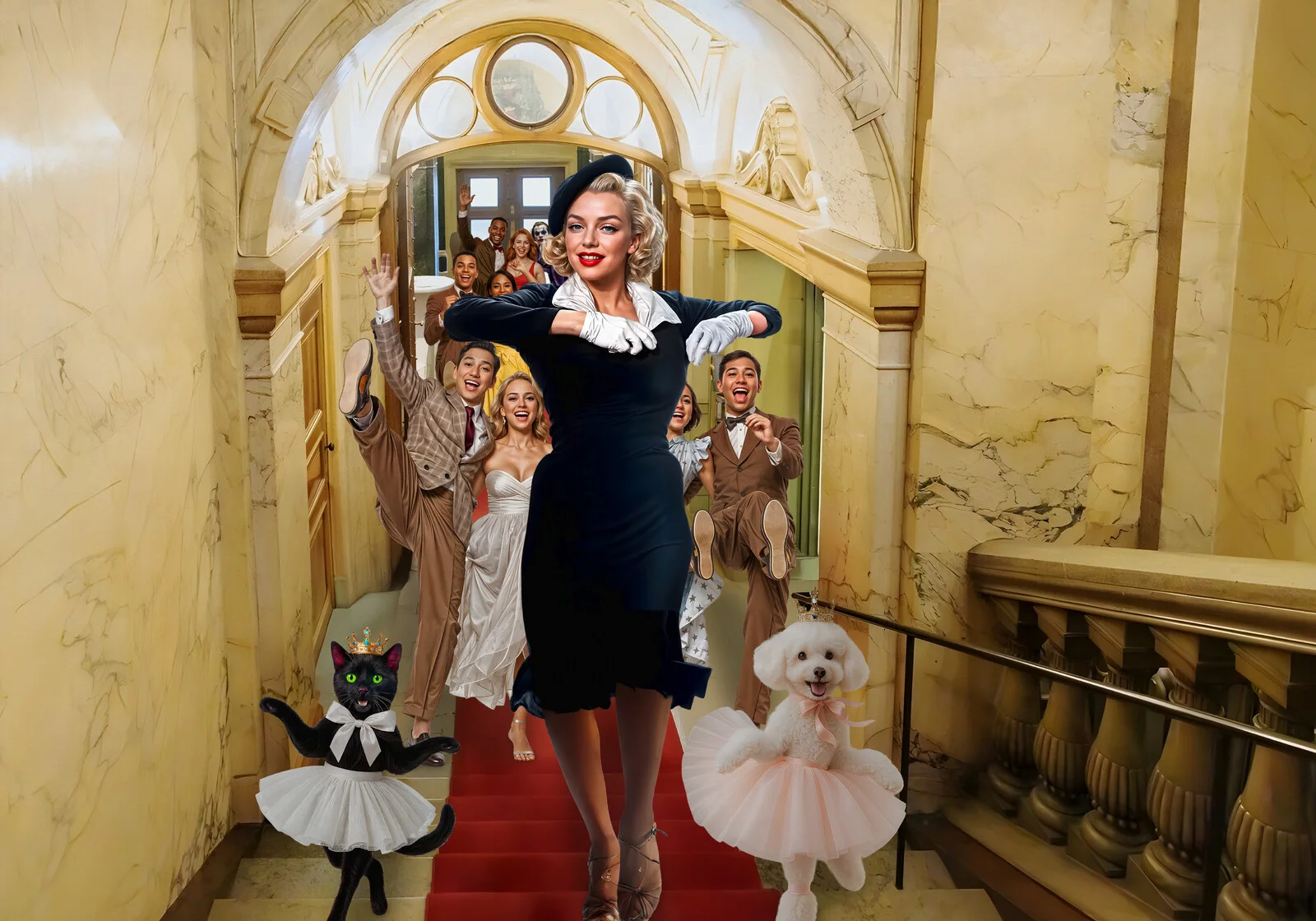
Dancing Queen, 2025
Digital
70 x 50 cm
3 200 kr
Dancing Queen
It always starts with a single step.
A gentle tap on the floor, the first movement that breaks the silence. Then another step, a sway of the hips, a smile breaking through, a body recalling something it barely knew it held: a rhythm, a spark, a promise.
In Malmö, the steps are many, and the stories are even richer. From cobbled streets where old love songs have lingered, to city hall chambers where crystal chandeliers sparkle above modern aspirations, the city keeps dancing—resolute, diverse, vibrant. Here, Marilyn Monroe returns, not as a fading icon but as an eternal movement—in every step, every laugh, every note of music. By her side dance poodle princesses and feline queens, carnival kings and disco divas, Malmö’s multicoloured citizens who understand that joy never requests titles. This is a city where every step is a tribute to our rich history and a celebration of our diverse culture.
This is not a tale of royal palaces or battlefields. It is a story of the kingdom of dance, where freedom reigns and togetherness crowns every heart. A tale of the revolution of footsteps, of the triumph of joy, of an evening where everyone gets to shine.
In Malmö, one truth always holds: everyone dances. Regardless of age, gender, or background, everyone is welcome to join the celebration of our vibrant dance culture. And tonight, you are part of that story.
Welcome to ‘The Dancing Queen’, a vibrant celebration of Malmö's dance culture.
“A Step Through Time
One step forward, a foot meets the ground,
Ancient drums in the distance sound.
A barefoot rhythm by the fireside’s glow,
In circles they danced where wild winds blow.
A step to the left, through temples of old,
Egyptian dancers with bangles of gold.
Their stories in motion, their prayers in sway,
In every twirl, the gods held their say.
A step to the right, on Grecian stone floors,
Choruses echo by marble-clad shores.
Masks on their faces, but bodies set free,
Spinning through tragedy, dancing with glee.
A skip through the meadows, a stomp in the square,
Medieval ring-dances twirling midair.
Pestilence raged, but the music rang clear,
Steps fought the silence, embraced every year.
A glide in silk slippers through mirrored halls,
Minuets whispered in Versailles’ gold walls.
Curtsies and bows, power dressed up in grace,
Steps spoke of status, of lineage and place.
A jump on street corners, on asphalt so grey,
Jazz and the jitterbug cleared out the way.
Charleston fingers, hips swinging wide,
Steps found new swagger, with cities as guide.
A break on the pavement, a spin on the floor,
Hip-hop was born from the urban heart’s core.
Beatboxes thumping, sneakers alight,
Steps claimed the street and danced through the night.
And now in the discos, where lights spin around,
The steps are electric, and the bass shakes the ground.
One step forward, a lifetime set free,
In every footfall, a claim: this is me.
A step through the ages, from earth into sky,
In footsteps we whisper, we laugh, and we cry.
For when words are forgotten and history fades,
It’s the steps that remind us of the joy we've made.”
Malmö July 2025
Dancing Queen
The Dancing Queen – Malmö Version
Marilyn Monroe, a timeless and unstoppable figure, has returned to Earth, residing in Ohlssonska hörnan by Stortorget – in the apartment formerly belonging to Anita Ekberg, now transformed into a unique sanctuary for time-travellers. Tonight, she glides up the grand staircase of Malmö City Hall’s banquet hall, more radiant than ever before. Beside her, a crowned poodle princess and a crowned cat princess float gracefully, both with tulle skirts fluttering as they move – one black, the other white. Her presence and elegance, reminiscent of the 'Dancing Queen' theme, a celebration of individuality and self-expression, inspire everyone to embrace their inner royalty and dance the night away.
She leads a jubilant procession of Malmö citizens – proudly multicoloured, defiantly diverse, and gloriously alive – as if pulled from a dream where everyone is royalty for one night. The steps of the staircase echo beneath the high heels, dance shoes, sandals, and polished dress shoes of all those heading to dance beneath the chandeliers of Knut Hall, a historic venue inspired by the Palace of Versailles, used for grand celebrations, official receptions, and banquets. Malmö is the city that proudly showcases its contrasts – from harbour quarters to grand salons, from street art to opera, from everyday life to glamour.
And tonight, only one rule applies: everyone dances. On the City Hall’s polished wooden floor, Marilyn is not the only star – because tonight, everyone is a star. Everyone is a queen. Everyone is a king. And everyone is a dancer. The highlight of the evening was none other than 'Dancing Queen', a song penned by ABBA’s Björn and Benny fifty years ago. With its uplifting lyrics and infectious rhythm, this track has become a symbol of self-expression and happiness through dance, setting the stage for a night of joy, laughter, and unforgettable memories.
Chapter 1: Crowned by Rhythm
Some queens are born into their crowns. Others marry into them, and some, like Cinderella, have worked tirelessly to reach the king and half a kingdom. And then some dance their way to it.
This is the story of the latter kind of queen. She rises from everyday life with nothing but her feet and her heart as weapons. She allows music to take over her body, letting rhythm break down borders, loosen chains, and turn every step into an act of rebellion.
From ancient drums around campfires to glittering dance floors under the glow of chandeliers, dance has always been the language of the people—the body’s cry for freedom when words fall short. In Malmö, it’s not a bloodline that grants the title, nor a throne of gold or inheritance from influential families. Here, it’s about the dance—the steps that make the floor tremble, the smiles that burst forth in the rush of rhythm, the joy that fills the air with every movement. It's a universal language that unites us all, making us part of a larger, connected community.
For a single evening, there are no chosen ones, no outsiders—only bodies in motion, hearts in harmony, and feet stamping the floor. The queen is not crowned with metal but with virtual laurels woven from rhythm, energy, and togetherness. On the dance floor, no queen sits alone on a throne surrounded by walls or borders—her realm is a dance floor where everyone belongs, where everyone is part of a larger, united community.
That is where true power resides.
Chapter 2: When the World Moves – A Short History of the Power of Dance
Dance, a form of expression that predates words, is a universal language that transcends cultural and historical boundaries. Before humans painted on cave walls or carved runes into stone, they imprinted their emotions into the earth. Before chronicles recorded kings and wars, the body expressed desire and longing, as well as joy and sorrow. The cultural and historical significance of dance enlightens us about our shared human experience.
Under starry skies around fires, the first steps were danced— as prayer, as celebration, as storytelling. Drums echoed across savannahs, and feet kicked up dust to the rhythm. The body was the instrument, and rhythm its language.
From ritual dances like the Haka of the Maori people, celebrating harvests, to the defiant stares of warrior dances like the War Dance of Native American tribes, dance was life, dance was death, and dance was everything in between.
And when civilisations rose with palaces and temples, dance became more refined but never lost its heart. Egypt’s dancing priestesses bowed before the gods, the Greek theatre’s choros celebrated drama, and the ring dances of the Middle Ages defied the plague with the stubbornness of life itself.
In royal palaces, dance reflected power—minuets and gavottes, where hips were controlled and steps became a form of political expression. Yet outside, in village squares, the people still danced, the earth warm with polkas and reels, jigs and flamenco. These dances were not about perfection, but about life, about community, about the shared human experience.
Dance, a testament to the human spirit, has outlived every ruler and every prohibition. When Puritans silenced songs, people danced nonetheless— in secret chambers, behind closed doors, in winding courtyards. Dance cannot be imprisoned. It is a symbol of resilience and endurance, a powerful force that not only survives but also inspires us all.
And then came ballet, with its pointed toes and strict rules, followed by jazz dance, with its urban rhythm. Breakdance emerged on concrete and asphalt. Each era crafted its dance, a way to defy gravity, with steps that declared: “We are still here. We are alive.” This defiance of gravity in dance is a powerful testament to the human spirit's strength and resilience.
In Malmö, dance holds all these memories. On the parquet floors of City Hall, dabke blends with disco, salsa with street, ballet with break. From Möllevången Square to the grand stage of the opera house, the rhythm of life, love, and laughter resonates. Regardless of language or skin colour, the body can whisper, shout, or sing: “I dance, therefore I am.”
As night falls over the city, and lights flicker across the wooden floor, old stories blend with new ones. This is the timeless promise of dance: a freedom that transcends time, equality in every step, and a sense of community in rhythm that has echoed through the ages.
Chapter 3: Margareta Svensson and the Linoleum Floor
The queens of Knut Hall, a local dance community, missed Margareta Svensson, the undisputed ruler of dance floors beneath plastic roofs and linoleum tiles. She was never on the guest list, but she reigned over karaoke bars, courtyard parties, and summer weddings. She never misses a schottische, and she lets her heart forget its age as soon as the opening chords of "Dancing Queen" ring out, because that song belongs to every kind of celebration.
Margareta has danced her way through life, from folk parks to hotel ballrooms, always filled with the same energy and a smile that sparkled like disco lights in the 1980s. She is the woman who never leaves a dance floor empty, pulling along old friends, young acquaintances, and unsuspecting men in shirts and ties. With a firm grip, a bold step forward, and a glittering laugh, she transforms every venue into her kingdom, turning every evening into her ball. Her passion for dance is a beacon of inspiration, reminding us all of the joy and freedom that dance can bring.
She doesn’t dance to impress. She dances to live. To defy gravity, to chase away loneliness, and to remind us all that rhythm has no age. Under colourful lights, with the scent of popcorn and grilled sausages in the air, her throne stands—a plastic chair provided by the party committee. A brief rest, a sip of water, then she rises again, because the next song is calling. And out there, another heart waits to be asked to dance—because for Margareta, every dance is a lady’s choice, and on her dance floor, it is always she who leads, always she who chooses the rhythm.
Chapter 4: A Kingdom of Steps
There was once a time when kingdoms were built with swords and violence. But such a realm was never meant for ordinary people. In the world of the many, steps have always been mightier than swords, rhythm stronger than the clatter of weapons, and the queen ruled not from a throne of gold but from a dance floor made of stamped earth, uneven stones, or simple wooden planks, set amidst the lush greenery and vibrant flowers of the kingdom.
She was crowned not by priests or nobles. Her crown was woven from melodies, and her symbol of power was a pair of well-worn dance shoes. Through the swirling circles of waltzes and the rhythmic clapping of folk dances, she set the tempo. When she took her first steps on the dance floor, hearts lifted, borders dissolved, and old grudges faded away. A single dance could unite towns, heal entire communities, and even reconcile enemies, connecting all in a larger, harmonious community.
Boys and girls learned the steps before they learned words. The elderly carried their stories with pride in every pirouette. In this kingdom, no one asked about birthright or wealth. The only things that mattered were rhythm and openness. The shyest found courage in the arms of rhythm. The lonely found companionship, and the quiet could raise their voices in song.
And when the sun set and the sky was coloured in pink and gold, as the cobblestones of the square retained the warmth of the day, her footsteps echoed across the ground, and no one could stay still. Even the most hardened warrior softened, the sourest merchant smiled, and the city’s gates opened to the free world of dance.
And so the kingdom stayed forever young — not through conquests or inheritance, but through the steps taken beneath the stars. Where dance reigns, freedom lives. And the queen? She continues to dance as long as the music plays, her steps echoing the joy and freedom that dance brings, uplifting all who witness her grace.
Chapter 5: Dancing Queen – ABBA’s Eternal Magic
Some songs have a unique power to act as time machines, transporting us from the mundane of our daily lives to a world of light, euphoria, and dance. Dancing Queen is one such song. It carries the rhythm of an entire era, the sparkle of disco balls, and the unmistakable feeling of freedom on a dance floor where everyone gets to shine, even if only for one night.
The song was written in 1975 and released a year later into a world craving colour and rhythm, for dancing and unity. When Dancing Queen was first played in the studio, it’s said that Frida and Agnetha cried—not tears of sadness, but of pure emotion—a feeling that something magical had been created. A sound bigger than just pop, bigger than ABBA itself. A sound that captured the joy of being young, alive, and free.
Musically, Dancing Queen was a daring journey. Benny and Björn embraced the rising wave of American disco and blended it with European pop sophistication. They listened to George McCrae’s ‘Rock Your Baby’, felt the irresistible draw of the disco beat, and wondered, “Why not us?” The result was a song that moved seamlessly between worlds—just as natural in American nightclubs as in Swedish dance halls, just as cherished on gay dance floors as at wedding parties. The song's use of a 4/4 beat, its catchy melody, and the harmonious blend of Frida and Agnetha's voices all contributed to its universal appeal.
The song even gained royal prestige. When ABBA performed it at King Carl XVI Gustaf’s wedding celebration in June 1976, it was playfully referred to as the 'Dancing King.' This was a moment of global recognition; a new musical monarch had been crowned. The song took over the world, topping charts in more than fifteen countries, including the USA, where it became ABBA’s only number one on the Billboard Hot 100.
However, 'Dancing Queen' is about more than just chart success. It’s about the feeling of being unstoppable, about those moments when you let go of the mundane, cast your worries aside, and allow your body to lead you elsewhere. That’s why the song has outlasted fashion trends and the passage of time. That’s why it was inducted into the Grammy Hall of Fame in 2015. And that’s why, even today, it’s still played wherever people gather to celebrate life, connecting us to a timeless tradition of joy and freedom.
For many, Dancing Queen became more than just a pop song. In the LGBTQ+ community, it stands as a song of freedom, a rainbow anthem, and a wink of encouragement to be yourself, unapologetically. It is sung by drag queens, played by DJs, and embraced equally by schoolchildren, pensioners, wedding guests, and lonely dancers swaying in their kitchens late at night. It reminds us of a simple yet powerful truth: we are all royalty when we dance. Everyone deserves their moment in the spotlight.
That’s also why *Dancing Queen* became the title of this story. Because amidst all the glitter, laughter, and melancholy, it’s really about this—daring to dance, daring to let go, daring to feel alive. Knowing you are worthy, you deserve joy, and you have every right to take your place on life’s dance floor, where every step is a celebration of life and happiness.
As it resonated in Knut Hall, 'Dancing Queen' transcended borders, echoing in karaoke bars and under the open sky. Royal titles may fade, but the allure of the Dancing Queen remains timeless and universal.
When Malmö drifts off in the small hours, after the dance floor has been cleared and the chandeliers turned off, the rhythm lingers. In the city’s alleyways, among sleeping hearts still beating in time, in dreams still spinning through the night. Because the magic of dance is greater than the night, greater than any song, greater than a single evening, it is our shared heartbeat through time. Beneath the ceiling of Knut Hall, everyone has danced, and everyone has been allowed to shine. The story continues because there is always space for more steps, more laughter, and more moments of pure joy. As long as the music plays and our feet find the rhythm, we will keep dancing, united in our shared human experiences.
And in this enduring truth about the joy of dance, we find the most beautiful revelation of all.
Jörgen Thornberg
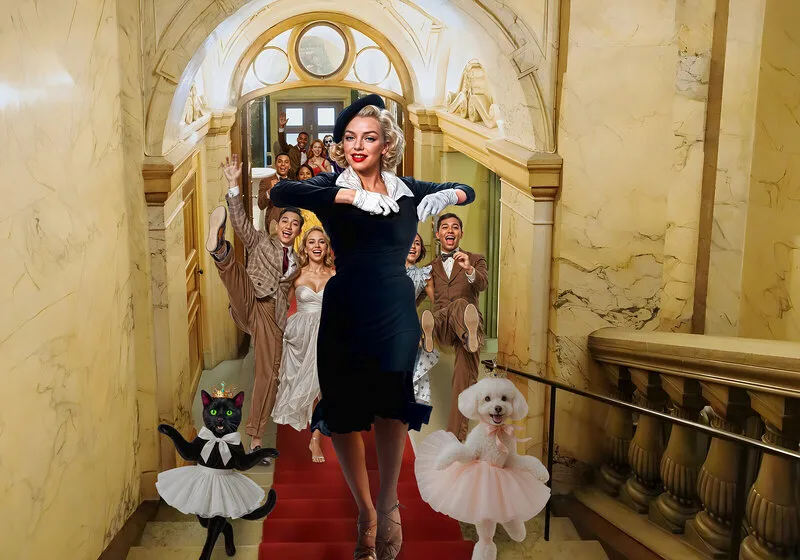
Dancing Queen, 2025
Digital
70 x 50 cm
3 200 kr
Dancing Queen
It always starts with a single step.
A gentle tap on the floor, the first movement that breaks the silence. Then another step, a sway of the hips, a smile breaking through, a body recalling something it barely knew it held: a rhythm, a spark, a promise.
In Malmö, the steps are many, and the stories are even richer. From cobbled streets where old love songs have lingered, to city hall chambers where crystal chandeliers sparkle above modern aspirations, the city keeps dancing—resolute, diverse, vibrant. Here, Marilyn Monroe returns, not as a fading icon but as an eternal movement—in every step, every laugh, every note of music. By her side dance poodle princesses and feline queens, carnival kings and disco divas, Malmö’s multicoloured citizens who understand that joy never requests titles. This is a city where every step is a tribute to our rich history and a celebration of our diverse culture.
This is not a tale of royal palaces or battlefields. It is a story of the kingdom of dance, where freedom reigns and togetherness crowns every heart. A tale of the revolution of footsteps, of the triumph of joy, of an evening where everyone gets to shine.
In Malmö, one truth always holds: everyone dances. Regardless of age, gender, or background, everyone is welcome to join the celebration of our vibrant dance culture. And tonight, you are part of that story.
Welcome to ‘The Dancing Queen’, a vibrant celebration of Malmö's dance culture.
“A Step Through Time
One step forward, a foot meets the ground,
Ancient drums in the distance sound.
A barefoot rhythm by the fireside’s glow,
In circles they danced where wild winds blow.
A step to the left, through temples of old,
Egyptian dancers with bangles of gold.
Their stories in motion, their prayers in sway,
In every twirl, the gods held their say.
A step to the right, on Grecian stone floors,
Choruses echo by marble-clad shores.
Masks on their faces, but bodies set free,
Spinning through tragedy, dancing with glee.
A skip through the meadows, a stomp in the square,
Medieval ring-dances twirling midair.
Pestilence raged, but the music rang clear,
Steps fought the silence, embraced every year.
A glide in silk slippers through mirrored halls,
Minuets whispered in Versailles’ gold walls.
Curtsies and bows, power dressed up in grace,
Steps spoke of status, of lineage and place.
A jump on street corners, on asphalt so grey,
Jazz and the jitterbug cleared out the way.
Charleston fingers, hips swinging wide,
Steps found new swagger, with cities as guide.
A break on the pavement, a spin on the floor,
Hip-hop was born from the urban heart’s core.
Beatboxes thumping, sneakers alight,
Steps claimed the street and danced through the night.
And now in the discos, where lights spin around,
The steps are electric, and the bass shakes the ground.
One step forward, a lifetime set free,
In every footfall, a claim: this is me.
A step through the ages, from earth into sky,
In footsteps we whisper, we laugh, and we cry.
For when words are forgotten and history fades,
It’s the steps that remind us of the joy we've made.”
Malmö July 2025
Dancing Queen
The Dancing Queen – Malmö Version
Marilyn Monroe, a timeless and unstoppable figure, has returned to Earth, residing in Ohlssonska hörnan by Stortorget – in the apartment formerly belonging to Anita Ekberg, now transformed into a unique sanctuary for time-travellers. Tonight, she glides up the grand staircase of Malmö City Hall’s banquet hall, more radiant than ever before. Beside her, a crowned poodle princess and a crowned cat princess float gracefully, both with tulle skirts fluttering as they move – one black, the other white. Her presence and elegance, reminiscent of the 'Dancing Queen' theme, a celebration of individuality and self-expression, inspire everyone to embrace their inner royalty and dance the night away.
She leads a jubilant procession of Malmö citizens – proudly multicoloured, defiantly diverse, and gloriously alive – as if pulled from a dream where everyone is royalty for one night. The steps of the staircase echo beneath the high heels, dance shoes, sandals, and polished dress shoes of all those heading to dance beneath the chandeliers of Knut Hall, a historic venue inspired by the Palace of Versailles, used for grand celebrations, official receptions, and banquets. Malmö is the city that proudly showcases its contrasts – from harbour quarters to grand salons, from street art to opera, from everyday life to glamour.
And tonight, only one rule applies: everyone dances. On the City Hall’s polished wooden floor, Marilyn is not the only star – because tonight, everyone is a star. Everyone is a queen. Everyone is a king. And everyone is a dancer. The highlight of the evening was none other than 'Dancing Queen', a song penned by ABBA’s Björn and Benny fifty years ago. With its uplifting lyrics and infectious rhythm, this track has become a symbol of self-expression and happiness through dance, setting the stage for a night of joy, laughter, and unforgettable memories.
Chapter 1: Crowned by Rhythm
Some queens are born into their crowns. Others marry into them, and some, like Cinderella, have worked tirelessly to reach the king and half a kingdom. And then some dance their way to it.
This is the story of the latter kind of queen. She rises from everyday life with nothing but her feet and her heart as weapons. She allows music to take over her body, letting rhythm break down borders, loosen chains, and turn every step into an act of rebellion.
From ancient drums around campfires to glittering dance floors under the glow of chandeliers, dance has always been the language of the people—the body’s cry for freedom when words fall short. In Malmö, it’s not a bloodline that grants the title, nor a throne of gold or inheritance from influential families. Here, it’s about the dance—the steps that make the floor tremble, the smiles that burst forth in the rush of rhythm, the joy that fills the air with every movement. It's a universal language that unites us all, making us part of a larger, connected community.
For a single evening, there are no chosen ones, no outsiders—only bodies in motion, hearts in harmony, and feet stamping the floor. The queen is not crowned with metal but with virtual laurels woven from rhythm, energy, and togetherness. On the dance floor, no queen sits alone on a throne surrounded by walls or borders—her realm is a dance floor where everyone belongs, where everyone is part of a larger, united community.
That is where true power resides.
Chapter 2: When the World Moves – A Short History of the Power of Dance
Dance, a form of expression that predates words, is a universal language that transcends cultural and historical boundaries. Before humans painted on cave walls or carved runes into stone, they imprinted their emotions into the earth. Before chronicles recorded kings and wars, the body expressed desire and longing, as well as joy and sorrow. The cultural and historical significance of dance enlightens us about our shared human experience.
Under starry skies around fires, the first steps were danced— as prayer, as celebration, as storytelling. Drums echoed across savannahs, and feet kicked up dust to the rhythm. The body was the instrument, and rhythm its language.
From ritual dances like the Haka of the Maori people, celebrating harvests, to the defiant stares of warrior dances like the War Dance of Native American tribes, dance was life, dance was death, and dance was everything in between.
And when civilisations rose with palaces and temples, dance became more refined but never lost its heart. Egypt’s dancing priestesses bowed before the gods, the Greek theatre’s choros celebrated drama, and the ring dances of the Middle Ages defied the plague with the stubbornness of life itself.
In royal palaces, dance reflected power—minuets and gavottes, where hips were controlled and steps became a form of political expression. Yet outside, in village squares, the people still danced, the earth warm with polkas and reels, jigs and flamenco. These dances were not about perfection, but about life, about community, about the shared human experience.
Dance, a testament to the human spirit, has outlived every ruler and every prohibition. When Puritans silenced songs, people danced nonetheless— in secret chambers, behind closed doors, in winding courtyards. Dance cannot be imprisoned. It is a symbol of resilience and endurance, a powerful force that not only survives but also inspires us all.
And then came ballet, with its pointed toes and strict rules, followed by jazz dance, with its urban rhythm. Breakdance emerged on concrete and asphalt. Each era crafted its dance, a way to defy gravity, with steps that declared: “We are still here. We are alive.” This defiance of gravity in dance is a powerful testament to the human spirit's strength and resilience.
In Malmö, dance holds all these memories. On the parquet floors of City Hall, dabke blends with disco, salsa with street, ballet with break. From Möllevången Square to the grand stage of the opera house, the rhythm of life, love, and laughter resonates. Regardless of language or skin colour, the body can whisper, shout, or sing: “I dance, therefore I am.”
As night falls over the city, and lights flicker across the wooden floor, old stories blend with new ones. This is the timeless promise of dance: a freedom that transcends time, equality in every step, and a sense of community in rhythm that has echoed through the ages.
Chapter 3: Margareta Svensson and the Linoleum Floor
The queens of Knut Hall, a local dance community, missed Margareta Svensson, the undisputed ruler of dance floors beneath plastic roofs and linoleum tiles. She was never on the guest list, but she reigned over karaoke bars, courtyard parties, and summer weddings. She never misses a schottische, and she lets her heart forget its age as soon as the opening chords of "Dancing Queen" ring out, because that song belongs to every kind of celebration.
Margareta has danced her way through life, from folk parks to hotel ballrooms, always filled with the same energy and a smile that sparkled like disco lights in the 1980s. She is the woman who never leaves a dance floor empty, pulling along old friends, young acquaintances, and unsuspecting men in shirts and ties. With a firm grip, a bold step forward, and a glittering laugh, she transforms every venue into her kingdom, turning every evening into her ball. Her passion for dance is a beacon of inspiration, reminding us all of the joy and freedom that dance can bring.
She doesn’t dance to impress. She dances to live. To defy gravity, to chase away loneliness, and to remind us all that rhythm has no age. Under colourful lights, with the scent of popcorn and grilled sausages in the air, her throne stands—a plastic chair provided by the party committee. A brief rest, a sip of water, then she rises again, because the next song is calling. And out there, another heart waits to be asked to dance—because for Margareta, every dance is a lady’s choice, and on her dance floor, it is always she who leads, always she who chooses the rhythm.
Chapter 4: A Kingdom of Steps
There was once a time when kingdoms were built with swords and violence. But such a realm was never meant for ordinary people. In the world of the many, steps have always been mightier than swords, rhythm stronger than the clatter of weapons, and the queen ruled not from a throne of gold but from a dance floor made of stamped earth, uneven stones, or simple wooden planks, set amidst the lush greenery and vibrant flowers of the kingdom.
She was crowned not by priests or nobles. Her crown was woven from melodies, and her symbol of power was a pair of well-worn dance shoes. Through the swirling circles of waltzes and the rhythmic clapping of folk dances, she set the tempo. When she took her first steps on the dance floor, hearts lifted, borders dissolved, and old grudges faded away. A single dance could unite towns, heal entire communities, and even reconcile enemies, connecting all in a larger, harmonious community.
Boys and girls learned the steps before they learned words. The elderly carried their stories with pride in every pirouette. In this kingdom, no one asked about birthright or wealth. The only things that mattered were rhythm and openness. The shyest found courage in the arms of rhythm. The lonely found companionship, and the quiet could raise their voices in song.
And when the sun set and the sky was coloured in pink and gold, as the cobblestones of the square retained the warmth of the day, her footsteps echoed across the ground, and no one could stay still. Even the most hardened warrior softened, the sourest merchant smiled, and the city’s gates opened to the free world of dance.
And so the kingdom stayed forever young — not through conquests or inheritance, but through the steps taken beneath the stars. Where dance reigns, freedom lives. And the queen? She continues to dance as long as the music plays, her steps echoing the joy and freedom that dance brings, uplifting all who witness her grace.
Chapter 5: Dancing Queen – ABBA’s Eternal Magic
Some songs have a unique power to act as time machines, transporting us from the mundane of our daily lives to a world of light, euphoria, and dance. Dancing Queen is one such song. It carries the rhythm of an entire era, the sparkle of disco balls, and the unmistakable feeling of freedom on a dance floor where everyone gets to shine, even if only for one night.
The song was written in 1975 and released a year later into a world craving colour and rhythm, for dancing and unity. When Dancing Queen was first played in the studio, it’s said that Frida and Agnetha cried—not tears of sadness, but of pure emotion—a feeling that something magical had been created. A sound bigger than just pop, bigger than ABBA itself. A sound that captured the joy of being young, alive, and free.
Musically, Dancing Queen was a daring journey. Benny and Björn embraced the rising wave of American disco and blended it with European pop sophistication. They listened to George McCrae’s ‘Rock Your Baby’, felt the irresistible draw of the disco beat, and wondered, “Why not us?” The result was a song that moved seamlessly between worlds—just as natural in American nightclubs as in Swedish dance halls, just as cherished on gay dance floors as at wedding parties. The song's use of a 4/4 beat, its catchy melody, and the harmonious blend of Frida and Agnetha's voices all contributed to its universal appeal.
The song even gained royal prestige. When ABBA performed it at King Carl XVI Gustaf’s wedding celebration in June 1976, it was playfully referred to as the 'Dancing King.' This was a moment of global recognition; a new musical monarch had been crowned. The song took over the world, topping charts in more than fifteen countries, including the USA, where it became ABBA’s only number one on the Billboard Hot 100.
However, 'Dancing Queen' is about more than just chart success. It’s about the feeling of being unstoppable, about those moments when you let go of the mundane, cast your worries aside, and allow your body to lead you elsewhere. That’s why the song has outlasted fashion trends and the passage of time. That’s why it was inducted into the Grammy Hall of Fame in 2015. And that’s why, even today, it’s still played wherever people gather to celebrate life, connecting us to a timeless tradition of joy and freedom.
For many, Dancing Queen became more than just a pop song. In the LGBTQ+ community, it stands as a song of freedom, a rainbow anthem, and a wink of encouragement to be yourself, unapologetically. It is sung by drag queens, played by DJs, and embraced equally by schoolchildren, pensioners, wedding guests, and lonely dancers swaying in their kitchens late at night. It reminds us of a simple yet powerful truth: we are all royalty when we dance. Everyone deserves their moment in the spotlight.
That’s also why *Dancing Queen* became the title of this story. Because amidst all the glitter, laughter, and melancholy, it’s really about this—daring to dance, daring to let go, daring to feel alive. Knowing you are worthy, you deserve joy, and you have every right to take your place on life’s dance floor, where every step is a celebration of life and happiness.
As it resonated in Knut Hall, 'Dancing Queen' transcended borders, echoing in karaoke bars and under the open sky. Royal titles may fade, but the allure of the Dancing Queen remains timeless and universal.
When Malmö drifts off in the small hours, after the dance floor has been cleared and the chandeliers turned off, the rhythm lingers. In the city’s alleyways, among sleeping hearts still beating in time, in dreams still spinning through the night. Because the magic of dance is greater than the night, greater than any song, greater than a single evening, it is our shared heartbeat through time. Beneath the ceiling of Knut Hall, everyone has danced, and everyone has been allowed to shine. The story continues because there is always space for more steps, more laughter, and more moments of pure joy. As long as the music plays and our feet find the rhythm, we will keep dancing, united in our shared human experiences.
And in this enduring truth about the joy of dance, we find the most beautiful revelation of all.
3 200 kr

Jörgen Thornberg
Malmö
Lite om bilder och mig. Translation in English at the end.
Jag är en nyfiken person som ser allt i bilder, även det jag fäster i ord, gärna tillsammans för bakom alla mina bilder finns en berättelse. Till vissa bilder hör en kortare eller längre novell som följer med bilden.
Bilder berättar historier. Jag omges av naturlig skönhet, intressanta människor och historia var jag än går. Jag använder min kamera för att dokumentera världen och blanda det jag ser med vad jag känner för att fånga den dolda magin.
Mina bilder berättar mina historier. Genom mina bilder, tryck och berättelser. Jag bjuder in dig att ta del av dessa berättelser, in i ditt liv och hem och dela min mycket personliga syn på vår värld. Mer än vad ögat ser. Jag tänker i bilder, drömmer och skriver och pratar om dem; följaktligen måste jag också skapa bilder. De blir vad jag ser, inte nödvändigtvis begränsade till verkligheten. Det finns en bild runt varje hörn. Jag hoppas att du kommer att se vad jag såg och gilla det.
Jag är också en skrivande person och till många bilder hör en kortare eller längre essay. Den följer med tavlan, tryckt på fint papper och med en personlig hälsning från mig.
Flertalet bilder startar sin resa i min kamera. Enkelt förklarat beskriver jag bilden jag ser i mitt inre, upplevd eller fantiserad. Bilden uppstår inom mig redan innan jag fått okularet till ögat. På bråkdelen av ett ögonblick ser jag vad jag vill ha och vad som kan göras med bilden. Här skall jag stoppa in en giraff, stålmannen, Titanic eller vad det är min fantasi finner ut. Ännu märkligare är att jag kommer ihåg minnesbilden långt efteråt när det blir tid att skapa verket. Om jag lyckas eller inte, är upp till betraktaren, oftast präglat av en stråk av svart humor – meningen är att man skall bli underhållen. Mina bilder blir ofta en snackis där de hänger.
Jag föredrar bilder som förmedlar ett budskap i flera lager. Vid första anblicken fylld av feel-good, en vacker utsikt, fint väder, solen skiner, blommor på ängen eller vattnet som ligger förrädiskt spegelblankt. I en sådan bild kan jag gömma min egentliga berättelse, mitt förakt för förtryckare och våldsverkare, rasister och fördomsfulla människor - ett gärna återkommande motiv mer eller mindre dolt i det vackra motivet. Jag försöker förena dem i ett gemensamt narrativ.
Bild och formgivning har löpt som en röd tråd genom livet. Fotokonst känns som en värdig final som jag gärna delar med mig.
Min genre är vid som framgår av mina bilder, temat en blandning av pop- och gatukonst i kollage som kan bestå av hundratals lager. Vissa bilder kan ta veckor, andra någon dag innan det är dags att överlämna resultatet till printverkstaden. Fine Art Prints är digitala fotocollage. I dessa kollage sker rivandet, klippandet, pusslandet, målandet, ritandet och sprayningen digitalt. Det jag monterar in kan vara hundratals år gamla bilder som jag omsorgsfullt frilägger så att de ser ut att vara en del av tavlan men också bilder skapade av mig själv efter min egen fantasi. Därefter besöks printstudion och för vissa bilder numrera en limiterad upplaga (oftast 7 exemplar) och signera för hand. Vissa bilder kan köpas i olika format. Det är bara att fråga efter vilka. Gillar man en bild som är 70x100 men inte har plats på väggen, går den kanske att få i 50x70 cm istället. Frågan är fri.
Metoden Giclée eller Fine Art Print som det också kallas är det moderna sättet för framställning av grafisk konst. Villkoret för denna typ av utskrifter är att en högkvalitativ storformatskrivare används med åldersbeständigt färgpigment och konstnärspapper eller i förekommande fall på duk. Pappret som används möter de krav på livslängd som ställs av museer och gallerier. Normalt säljer jag mina bilder oinramade så att den nya ägaren själv kan bestämma hur de skall se ut, med eller utan passepartout färg på ram, med eller utan glas etc..
Under många år ställde jag bara ut på nätet, i valda grupper och på min egen Facebooksida - https://www.facebook.com/jorgen.thornberg.9
Jag finns också på en egen hemsida som tyvärr inte alltid är uppdaterad – https://www.jth.life/ Där kan du också läsa en del av de berättelser som följer med bilden.
UTSTÄLLNINGAR
Luftkastellet, oktober 2022
Konst i Lund, november 2022
Luftkastellet, mars 2023
Engleson Galleri Caroli, april 2023
Hydra, Greece June 2023
Engleson Galleri Caroli, oktober 2023
Toppen, Höllviken december 2023
Luftkastellet, mars 2024
Torups Galleri, mars 2024
Venice, May 2024
Luftkastellet, oktober 2024
Konst i Advent, December 2024
Galleri Engleson, Caroli December 2024
Jäger & Jansson Galleri, april 2025
A bit about pictures and me.
I'm a curious person who sees everything in pictures, even what I express in words, often combining them, for behind all my pictures lies a story. These narratives, some as short as a single image and others as long as a novel, are the heart and soul of my work.
Pictures tell stories. Wherever I go, I'm surrounded by natural beauty, exciting people, and history. I use my camera to document the world and blend what I see with what I feel to capture the hidden magic.
My images tell my stories. Through my pictures, prints, and narratives, I invite you to partake in these stories in your life and home and share my deeply personal perspective of our world. More than meets the eye. I think in pictures, dream, write, and talk about them; consequently, I must create images too. They become what I see, not necessarily confined to reality. There's a picture around every corner. I hope you'll see what I saw and enjoy it.
I'm also a writer, and many images come with a shorter or longer essay. It accompanies the painting, printed on fine paper with my personal greeting.
Many pictures start their journey on my camera. Simply put, I describe the image I see in my mind, experienced or imagined. The image arises within me even before I bring the eyepiece to my eye. In a fraction of a moment, I see what I want and what can be done with the picture. Here, I'll insert a giraffe, Superman, the Titanic, or whatever my imagination conjures up. Even stranger is that I remember the mental image long after it's time to create the work. Whether I succeed is up to the observer, often imbued with a streak of black humour – the aim is to entertain. My pictures usually become a talking point wherever they hang.
I prefer pictures that convey a message in multiple layers. At first glance, they're filled with feel-good vibes, a beautiful view, lovely weather, the sun shining, flowers in the meadow, or the water lying deceptively calm. But beneath this surface beauty, I often conceal a deeper story, a narrative that challenges societal norms or explores the human condition. I invite you to delve into these hidden narratives and discover the layers of meaning within my work.
Picture and design have been a thread running through my life. Photographic art feels like a fitting finale, and I'm happy to share it.
My genre is varied, as seen in my pictures; the theme is a blend of pop and street art in collages that can consist of hundreds of layers. Some images can take weeks, others just a day before it's time to hand over the result to the print workshop. Fine Art Prints are digital photo collages. In these collages, tearing, cutting, puzzling, painting, drawing, and spraying happen digitally. What I insert can be images hundreds of years old that I carefully extract so they appear to be part of the painting, but also images created by myself, now also generated from my imagination. Next, visit the print studio and, for certain images, number a limited edition (usually 7 copies) and sign them by hand. Some images may be available in other formats. Just ask which ones. If you like an image that's 70x100 but doesn't have space on the wall, you might be able to get it in 50x70 cm instead. The question is open.
The Giclée method, or Fine Art Print as it's also called, is the modern way of producing graphic art. This method ensures the highest quality and longevity of the artwork, using a high-quality large-format printer with archival pigment inks and artist paper or, in some cases, canvas. The paper used meets the longevity requirements set by museums and galleries. I sell my pictures unframed, allowing the new owner to personalise their artwork, confident in the lasting value and quality of the piece.
For many years, I only exhibited online, in selected groups, and on my Facebook page - https://www.facebook.com/jorgen.thornberg.9. I also have my website, which unfortunately is not constantly updated - https://www.jth.life/. You can also read some of the stories accompanying the pictures there.
EXHIBITIONS
Luftkastellet, October 2022
Art in Lund, November 2022
Luftkastellet, March 2023
Engleson Gallery Caroli, April 2023
Hydra, Greece June 2023
Engleson Gallery Caroli, October 2023
Toppen, Höllviken December 2023
Luftkastellet, March 2024
Torup Gallery, March 2024
Venice, May 2024
UTSTÄLLNINGAR
Luftkastellet, oktober 2022
Konst i Lund, november 2022
Luftkastellet, mars 2023
Engleson Galleri Caroli, april 2023
Hydra, Greece June 2023
Engleson Galleri Caroli, oktober 2023
Toppen, Höllviken december 2023
Luftkastellet, mars 2024
Torups Galleri, mars 2024
Venice, May 2024
Luftkastellet, October 2024
Konst i Advent, December 2024
Galleri Engleson, Caroli December 2024
Jäger & Jansson Galleri, April 2025
Utbildning
Autodidakt
Medlem i konstnärsförening
Öppna Sinnen
Med i konstrunda
Konstrundan i Skåne
Utställningar
Luftkastellet, October 2022
Art in Lund, November 2022
Luftkastellet, March 2023
Engleson Gallery Caroli, April 2023
Hydra, Greece June 2023
Engleson Gallery Caroli, October 2023
Toppen, Höllviken December 2023
Luftkastellet, March 2024
Torup Gallery, March 2024
Venice, May 2024