Vi använder cookies för att ge dig bästa möjliga upplevelse. Välj vilka cookies du tillåter.
Läs mer i vår integritetspolicy
Jörgen Thornberg
Falling Stars, 2025
Digital
50 x 70 cm
3 200 kr
Falling Stars
Everything comes to an end with a fall. For Icarus, it was the sun. For Atlantis, the sea. And for our superheroes? Silence and falling curves.
We find ourselves in the wake of an era when billowing capes soared above cityscapes, when unyielding hands upheld justice, and when the world held firm to the belief that all could be redeemed—so long as the costume was snug enough. Yet now, we witness the last vestiges of a bygone splendour, performing in frayed spandex beneath a sky that no longer cheers. Superheroes, once thought to be immortal, now trudge forward on the legs of retirees, devoid of an audience, devoid of purpose.
Their narrative is woven into our cultural fabric: from newsstands to niche stores, from youthful aspirations of liberation to the scepticism of maturity. We saw them conquer the world, but now we witness their descent, not with a thunderous crash, but with a murmur—a final breath of falling stars over a society that has swapped symbols of optimism for the allure of cynicism.
And here, amidst frayed capes and worn-out tunes, our narrative unfolds: why heroes falter, why we lose faith, and what, just maybe, can emerge anew from the ruins.
“Ballad of the Fading Capes
They called him steel but watched him rust,
His golden shield turned grey with dust.
The lasso snapped, and the truth grew weak,
And wisdom slurs when old minds speak.
They whispered tales of sidekick ties,
Of longing glances, stolen sighs.
Was Robin blushing just for fame?
Or hiding love they dared not name?
Professor X forgot his creed,
His powers lost to age and need.
No mind could hold, no thought stayed bright,
His battles ended in the night.
The tights grew loose, the boots wore thin,
No crowds to cheer, no wars to win.
The muscles sagged, the poses failed,
And every myth was soon unveiled.
Yet in those lines, those silver hairs,
Lay richer tales than fights or flares.
Not strength but flaws make heroes grand —
A shaking voice, a trembling hand.
So hang the cape, unmask the face,
Let kindness claim the hero’s place.
No laser eyes or thunder call —
Just fragile hearts that sometimes fall.”
Malmö July 2025
Falling Stars – When heroes crashed from the Sky
This is my reflection on the final battle of the superheroes, a significant event that marked the end of an era and why their story no longer holds interest for us. The very title bears its melancholy—simple yet brutal, infused with bittersweet irony. A name that could just as easily refer to the cosmic moment when a star erupts into light and descends through the Earth’s atmosphere—an ephemeral firework in the vastness of space. But it can just as easily refer to other stars: those that once dazzled the entire world but whose glow has now faded. Stars that have outlived their prime and now drift aimlessly as fading symbols, more product than story. Their fading glow leaves a void, a sense of loss for the bygone glory of superheroes.
We are witnessing a cultural Ragnarok, a cosmic shift where yesterday’s heroes fall, sometimes literally, now and then, metaphorically. Those whose powers once symbolised courage, endurance, and superhuman strength have become prisoners of their narratives. Age catches up even with those who were never meant to die. Charles Xavier, the leader of the X-Men, became a prophetic figure in a dystopian world. In the Fox Marvel Universe, he eventually destroyed himself and his disciples when his ageing mind betrayed him, and his Alzheimer’s became too much to bear. He couldn’t even remember his name, let alone his purpose. Superpowers are not eternal. Nor are legends. This decline, this fall from grace, is not a tragedy, but a natural progression.
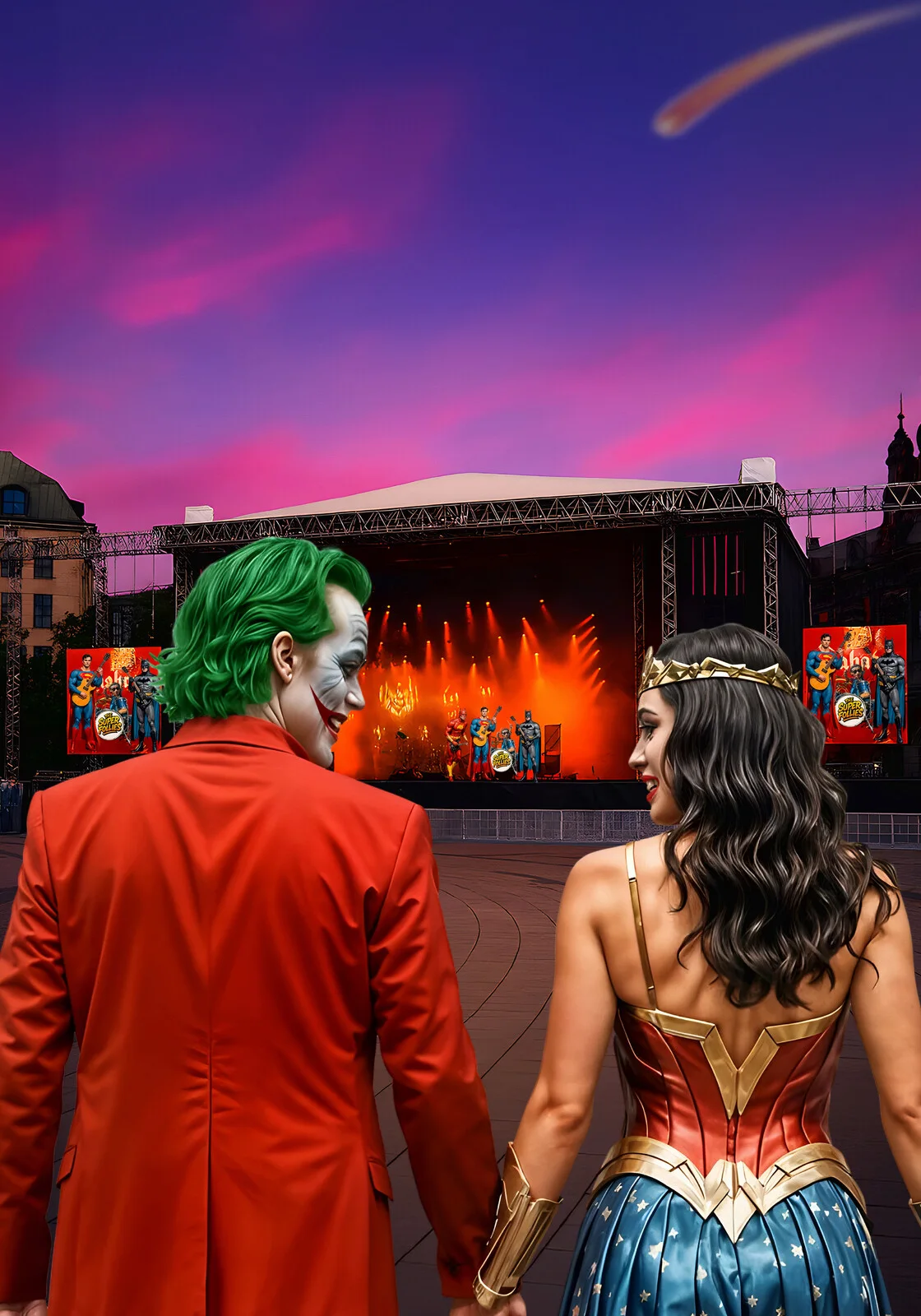
And perhaps there is a certain poetic justice in the fact that Superman, Batman, Firestorm, and Robin now find themselves moonlighting as a superhero band. On a battered stage, beneath a pink sky where meteors fall like whispers from the universe, they perform in torn costumes, dutifully singing choruses that no one listens to anymore. It’s a farewell tour nobody requested. A show unworthy of its name, performed by fallen gods who no longer remember why they are on stage. The audience seats sit empty; the once-loyal fanbase has disappeared long ago. What awaits after the final song? No one knows. But at this rate, it’s probably a one-way ticket to poverty, oblivion, and social ruin. Retirement has never been part of the hero’s safety net. Homelessness looms. Their plight evokes a profound sense of empathy among the audience for the superheroes, who once stood for everything good and noble, a stark contrast to their current state.
A pair of indifferent onlookers witness the fading spectacle—Joker and Wonder Woman. He with his decaying smile, she with her statue-like aura of strength and beauty—enemy and warrior princess—hand in hand. Superman sings with a cracked voice, Batman fumbles his guitar solo, Firestorm desperately tries to find the right pitch, his flame flickering briefly before vanishing again. Robin plays drums that no one hears anymore; his powers have waned. The final show, before a crowd that neither cheers nor boos, allows the story to fade away in silence, a poignant reminder of the heroes' diminishing presence. Yet, they perform with a sense of acceptance, knowing that their time has passed.
The pink sky is a distorted romance—a dreamy, deceitful shimmer trying to hide its true nature: a ruined concert for the fallen, a funeral hymn for a bygone era. And perhaps the most tragic of all is that they do not even realise how far they have fallen. Superman casts yearning glances at Wonder Woman. Batman appears as if he wants to shout something. Firestorm’s eyes flicker about—all three caught in nostalgic longing, envious of Joker’s triumph. For when the curtain falls, only he remains—a symbol of chaos that never needs to justify itself, starkly contrasting the fading heroes. The heroes fall. The villains endure. Love carves its path amidst the societal upheaval.
Perhaps this is precisely where we should begin, at the moment when the stars fade away. When capes hang crookedly, when heroics become slapstick, and superpowers are reduced to jokes, an era is ending, and a new chapter is ready to be written. This anticipation for the new chapter, filled with hope and promise, offers the audience a sense of optimism amidst the fading heroes.
What is a hero worth when the world no longer believes that superheroes in tights can save us, but instead waits to see what Putin, Trump, and the Ayatollahs will do next? And we, the old and the wise, sit watching, wondering if any true heroes remain.
When the Cape Shrinks – The ageing of Superheroes and the lost love of the people.
Once upon a time, they walked the earth like modern gods. Superman soared over Metropolis with his iconic cape, Batman prowled Gotham with watchful vigilance, and Wonder Woman raised her golden lasso as a symbol of truth and justice. There was a time when these heroes sold hundreds of thousands of copies every month, when children saved their pocket money to follow them on their next adventure, and when every newly published comic book was a promise of excitement, morality, and immortal victory.
But time is a relentless enemy – and even superheroes age. Perhaps not physically, but as phenomena and ideas. Today, their chapters have become thinner, and their sales have diminished to a shadow of what they once were. Whereas comic books in the 1960s sold millions of copies, they have now contracted to a niche market where only a few loyal collectors keep the legacy alive. This decline in sales is a cause for concern, and one must ask: What happened?
Indeed, one could blame the transformation of distribution systems. When comic books disappeared from kiosks and supermarkets and instead moved into speciality shops, they shifted from being everyday items to cult objects. The act of seeking out comics became a deliberate choice, rather than a casual encounter at a petrol station on the way home from school. This shift marked the transition of comics from a spontaneous form of pop culture to a niche hobby for enthusiasts.
But there are deeper cracks. The powers of superheroes—once dazzling—have begun to seem like stylised gimmicks from another era. Superman’s flights and laser vision, once symbols of hope, now feel more like a nostalgic pastiche than a living promise of salvation. Batman, the crime-fighting millionaire in tights, now stands more as a monument to unrealistic masculinity than as a reflection of our era’s moral struggles. This shift in perception invites us to reflect on the changing cultural landscape.
Meanwhile, the world has transformed. Our heroes no longer embody the fears and dreams that shape society. Superheroes emerged from the conflicts of the twentieth century, including the Cold War, World War II, and the Great Depression. They were knights of morality, patriots with straight backs and unwavering integrity. Today, people long for something else—heroes who are vulnerable, with inner doubts and struggles with identity. This shift in heroism reflects the evolving societal values and the growing complexity of our world.
The new heroes, devoid of capes, carry experiences of alienation, questions about gender and sexuality, and they face mental health struggles and economic hardship. Their relatability is what makes them heroes. Superpower is no longer about flying or breaking through walls, but about enduring and surviving. Kamala Khan, Ms. Marvel from Jersey City, becomes an idol not because she can stretch her arms, but because she dares to be a teenager and Muslim in a time that is suspicious of both identities. That is where the power lies now.
And the role of sexuality has also evolved. A strange puritanism marked the era of the old caped men: bodies were stiff and skin-tight, but never enticing. Now, sexuality is a significant part of the story—sometimes too explicit, sometimes too superficial—but at least it is honest for younger readers. The old moral high ground rarely appeals, and heroes in tight spandex defending the status quo seem to many as outdated as VHS tapes. This honest portrayal of sexuality respects the readers' intelligence and maturity.
Another dilemma is the industry’s self-inflicted fatigue. When every story requires you to have read six prequels, watched four films, and followed a TV series to grasp what’s happening, then spontaneity is lost. Marvel’s multiverses, DC’s endless reboots, and perpetual resurrections have turned every death into a marketing ploy and every defeat into just a brief pause before another time-travel twist erases the consequences.
And yet, a fragment of beauty persists. Superman might be outdated, but the symbol of selflessness endures. Wonder Woman may be a relic, but her fight for women’s freedom remains a timeless and pertinent cause. It is not the heroes who have perished, but the stories they have been compelled to conform to. They have been regarded as products, templates, endlessly reusable franchise properties — not as living myths. The enduring appeal of these themes and characters reassures us that while the form of superhero narratives may change, their essence remains timeless.
Perhaps the future isn't about polishing old capes, but about daring to set them free. Let heroes age, let them die, and make room for new ones. Maybe we don’t need more versions of Bruce Wayne, but a story of him as an elderly man, one who realises Gotham needs something beyond his fists. Perhaps Superman needs to become truly human and understand that the greatest act of heroism is to stay and listen. While Marvel and DC falter, Manga sales soar. There, readers follow everyday life, love, small moments of sorrow and triumph. There, self-contained stories are told, where heroes stumble for real, where strength is not just about muscles but about heart and will. This need for new hero narratives brings hope for the future of superhero storytelling.
Our old superheroes resemble Icarus—flying too close to the sun on the wings of their success, but now the wax begins to melt. The question is whether anyone will catch them before they crash to the ground. Perhaps it isn’t a fall, but a landing. A chance to begin again. To cast aside the cape, ditch the spandex, and instead ask: what hero does the world need now? And what kind of hero do we want to be ourselves? That is where the story of tomorrow’s heroes begins — not with superpowers, but with the harsh truth. Perhaps that is how the people’s love for heroes can return — not through perfect bodies or everlasting youth, but through stories that are brave enough to be human, forgiving, and honest. Let heroes be people; let them be weak at times and strong at others. Allow them to age and die, and enable new powers to emerge to replace them — smarter, more vulnerable, and more aware of our world’s realities.
Jörgen Thornberg
Falling Stars, 2025
Digital
50 x 70 cm
3 200 kr
Falling Stars
Everything comes to an end with a fall. For Icarus, it was the sun. For Atlantis, the sea. And for our superheroes? Silence and falling curves.
We find ourselves in the wake of an era when billowing capes soared above cityscapes, when unyielding hands upheld justice, and when the world held firm to the belief that all could be redeemed—so long as the costume was snug enough. Yet now, we witness the last vestiges of a bygone splendour, performing in frayed spandex beneath a sky that no longer cheers. Superheroes, once thought to be immortal, now trudge forward on the legs of retirees, devoid of an audience, devoid of purpose.
Their narrative is woven into our cultural fabric: from newsstands to niche stores, from youthful aspirations of liberation to the scepticism of maturity. We saw them conquer the world, but now we witness their descent, not with a thunderous crash, but with a murmur—a final breath of falling stars over a society that has swapped symbols of optimism for the allure of cynicism.
And here, amidst frayed capes and worn-out tunes, our narrative unfolds: why heroes falter, why we lose faith, and what, just maybe, can emerge anew from the ruins.
“Ballad of the Fading Capes
They called him steel but watched him rust,
His golden shield turned grey with dust.
The lasso snapped, and the truth grew weak,
And wisdom slurs when old minds speak.
They whispered tales of sidekick ties,
Of longing glances, stolen sighs.
Was Robin blushing just for fame?
Or hiding love they dared not name?
Professor X forgot his creed,
His powers lost to age and need.
No mind could hold, no thought stayed bright,
His battles ended in the night.
The tights grew loose, the boots wore thin,
No crowds to cheer, no wars to win.
The muscles sagged, the poses failed,
And every myth was soon unveiled.
Yet in those lines, those silver hairs,
Lay richer tales than fights or flares.
Not strength but flaws make heroes grand —
A shaking voice, a trembling hand.
So hang the cape, unmask the face,
Let kindness claim the hero’s place.
No laser eyes or thunder call —
Just fragile hearts that sometimes fall.”
Malmö July 2025
Falling Stars – When heroes crashed from the Sky
This is my reflection on the final battle of the superheroes, a significant event that marked the end of an era and why their story no longer holds interest for us. The very title bears its melancholy—simple yet brutal, infused with bittersweet irony. A name that could just as easily refer to the cosmic moment when a star erupts into light and descends through the Earth’s atmosphere—an ephemeral firework in the vastness of space. But it can just as easily refer to other stars: those that once dazzled the entire world but whose glow has now faded. Stars that have outlived their prime and now drift aimlessly as fading symbols, more product than story. Their fading glow leaves a void, a sense of loss for the bygone glory of superheroes.
We are witnessing a cultural Ragnarok, a cosmic shift where yesterday’s heroes fall, sometimes literally, now and then, metaphorically. Those whose powers once symbolised courage, endurance, and superhuman strength have become prisoners of their narratives. Age catches up even with those who were never meant to die. Charles Xavier, the leader of the X-Men, became a prophetic figure in a dystopian world. In the Fox Marvel Universe, he eventually destroyed himself and his disciples when his ageing mind betrayed him, and his Alzheimer’s became too much to bear. He couldn’t even remember his name, let alone his purpose. Superpowers are not eternal. Nor are legends. This decline, this fall from grace, is not a tragedy, but a natural progression.
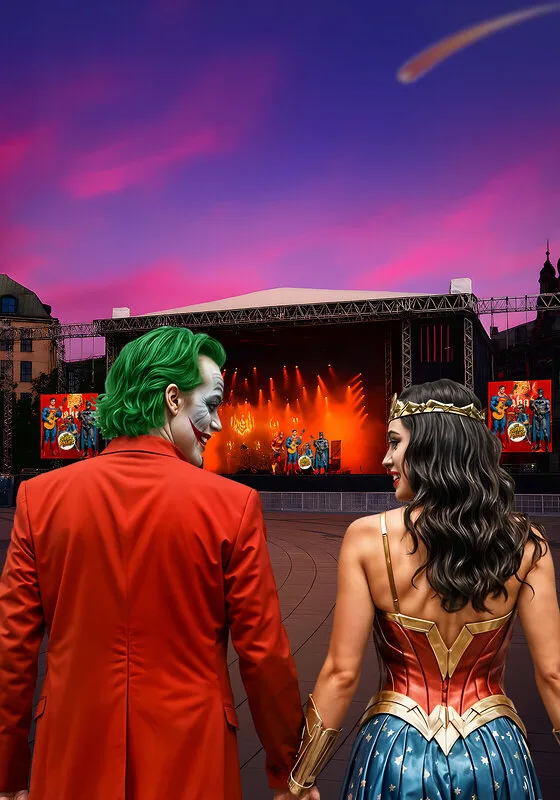
And perhaps there is a certain poetic justice in the fact that Superman, Batman, Firestorm, and Robin now find themselves moonlighting as a superhero band. On a battered stage, beneath a pink sky where meteors fall like whispers from the universe, they perform in torn costumes, dutifully singing choruses that no one listens to anymore. It’s a farewell tour nobody requested. A show unworthy of its name, performed by fallen gods who no longer remember why they are on stage. The audience seats sit empty; the once-loyal fanbase has disappeared long ago. What awaits after the final song? No one knows. But at this rate, it’s probably a one-way ticket to poverty, oblivion, and social ruin. Retirement has never been part of the hero’s safety net. Homelessness looms. Their plight evokes a profound sense of empathy among the audience for the superheroes, who once stood for everything good and noble, a stark contrast to their current state.
A pair of indifferent onlookers witness the fading spectacle—Joker and Wonder Woman. He with his decaying smile, she with her statue-like aura of strength and beauty—enemy and warrior princess—hand in hand. Superman sings with a cracked voice, Batman fumbles his guitar solo, Firestorm desperately tries to find the right pitch, his flame flickering briefly before vanishing again. Robin plays drums that no one hears anymore; his powers have waned. The final show, before a crowd that neither cheers nor boos, allows the story to fade away in silence, a poignant reminder of the heroes' diminishing presence. Yet, they perform with a sense of acceptance, knowing that their time has passed.
The pink sky is a distorted romance—a dreamy, deceitful shimmer trying to hide its true nature: a ruined concert for the fallen, a funeral hymn for a bygone era. And perhaps the most tragic of all is that they do not even realise how far they have fallen. Superman casts yearning glances at Wonder Woman. Batman appears as if he wants to shout something. Firestorm’s eyes flicker about—all three caught in nostalgic longing, envious of Joker’s triumph. For when the curtain falls, only he remains—a symbol of chaos that never needs to justify itself, starkly contrasting the fading heroes. The heroes fall. The villains endure. Love carves its path amidst the societal upheaval.
Perhaps this is precisely where we should begin, at the moment when the stars fade away. When capes hang crookedly, when heroics become slapstick, and superpowers are reduced to jokes, an era is ending, and a new chapter is ready to be written. This anticipation for the new chapter, filled with hope and promise, offers the audience a sense of optimism amidst the fading heroes.
What is a hero worth when the world no longer believes that superheroes in tights can save us, but instead waits to see what Putin, Trump, and the Ayatollahs will do next? And we, the old and the wise, sit watching, wondering if any true heroes remain.
When the Cape Shrinks – The ageing of Superheroes and the lost love of the people.
Once upon a time, they walked the earth like modern gods. Superman soared over Metropolis with his iconic cape, Batman prowled Gotham with watchful vigilance, and Wonder Woman raised her golden lasso as a symbol of truth and justice. There was a time when these heroes sold hundreds of thousands of copies every month, when children saved their pocket money to follow them on their next adventure, and when every newly published comic book was a promise of excitement, morality, and immortal victory.
But time is a relentless enemy – and even superheroes age. Perhaps not physically, but as phenomena and ideas. Today, their chapters have become thinner, and their sales have diminished to a shadow of what they once were. Whereas comic books in the 1960s sold millions of copies, they have now contracted to a niche market where only a few loyal collectors keep the legacy alive. This decline in sales is a cause for concern, and one must ask: What happened?
Indeed, one could blame the transformation of distribution systems. When comic books disappeared from kiosks and supermarkets and instead moved into speciality shops, they shifted from being everyday items to cult objects. The act of seeking out comics became a deliberate choice, rather than a casual encounter at a petrol station on the way home from school. This shift marked the transition of comics from a spontaneous form of pop culture to a niche hobby for enthusiasts.
But there are deeper cracks. The powers of superheroes—once dazzling—have begun to seem like stylised gimmicks from another era. Superman’s flights and laser vision, once symbols of hope, now feel more like a nostalgic pastiche than a living promise of salvation. Batman, the crime-fighting millionaire in tights, now stands more as a monument to unrealistic masculinity than as a reflection of our era’s moral struggles. This shift in perception invites us to reflect on the changing cultural landscape.
Meanwhile, the world has transformed. Our heroes no longer embody the fears and dreams that shape society. Superheroes emerged from the conflicts of the twentieth century, including the Cold War, World War II, and the Great Depression. They were knights of morality, patriots with straight backs and unwavering integrity. Today, people long for something else—heroes who are vulnerable, with inner doubts and struggles with identity. This shift in heroism reflects the evolving societal values and the growing complexity of our world.
The new heroes, devoid of capes, carry experiences of alienation, questions about gender and sexuality, and they face mental health struggles and economic hardship. Their relatability is what makes them heroes. Superpower is no longer about flying or breaking through walls, but about enduring and surviving. Kamala Khan, Ms. Marvel from Jersey City, becomes an idol not because she can stretch her arms, but because she dares to be a teenager and Muslim in a time that is suspicious of both identities. That is where the power lies now.
And the role of sexuality has also evolved. A strange puritanism marked the era of the old caped men: bodies were stiff and skin-tight, but never enticing. Now, sexuality is a significant part of the story—sometimes too explicit, sometimes too superficial—but at least it is honest for younger readers. The old moral high ground rarely appeals, and heroes in tight spandex defending the status quo seem to many as outdated as VHS tapes. This honest portrayal of sexuality respects the readers' intelligence and maturity.
Another dilemma is the industry’s self-inflicted fatigue. When every story requires you to have read six prequels, watched four films, and followed a TV series to grasp what’s happening, then spontaneity is lost. Marvel’s multiverses, DC’s endless reboots, and perpetual resurrections have turned every death into a marketing ploy and every defeat into just a brief pause before another time-travel twist erases the consequences.
And yet, a fragment of beauty persists. Superman might be outdated, but the symbol of selflessness endures. Wonder Woman may be a relic, but her fight for women’s freedom remains a timeless and pertinent cause. It is not the heroes who have perished, but the stories they have been compelled to conform to. They have been regarded as products, templates, endlessly reusable franchise properties — not as living myths. The enduring appeal of these themes and characters reassures us that while the form of superhero narratives may change, their essence remains timeless.
Perhaps the future isn't about polishing old capes, but about daring to set them free. Let heroes age, let them die, and make room for new ones. Maybe we don’t need more versions of Bruce Wayne, but a story of him as an elderly man, one who realises Gotham needs something beyond his fists. Perhaps Superman needs to become truly human and understand that the greatest act of heroism is to stay and listen. While Marvel and DC falter, Manga sales soar. There, readers follow everyday life, love, small moments of sorrow and triumph. There, self-contained stories are told, where heroes stumble for real, where strength is not just about muscles but about heart and will. This need for new hero narratives brings hope for the future of superhero storytelling.
Our old superheroes resemble Icarus—flying too close to the sun on the wings of their success, but now the wax begins to melt. The question is whether anyone will catch them before they crash to the ground. Perhaps it isn’t a fall, but a landing. A chance to begin again. To cast aside the cape, ditch the spandex, and instead ask: what hero does the world need now? And what kind of hero do we want to be ourselves? That is where the story of tomorrow’s heroes begins — not with superpowers, but with the harsh truth. Perhaps that is how the people’s love for heroes can return — not through perfect bodies or everlasting youth, but through stories that are brave enough to be human, forgiving, and honest. Let heroes be people; let them be weak at times and strong at others. Allow them to age and die, and enable new powers to emerge to replace them — smarter, more vulnerable, and more aware of our world’s realities.
3 200 kr

Jörgen Thornberg
Malmö
Lite om bilder och mig. Translation in English at the end.
Jag är en nyfiken person som ser allt i bilder, även det jag fäster i ord, gärna tillsammans för bakom alla mina bilder finns en berättelse. Till vissa bilder hör en kortare eller längre novell som följer med bilden.
Bilder berättar historier. Jag omges av naturlig skönhet, intressanta människor och historia var jag än går. Jag använder min kamera för att dokumentera världen och blanda det jag ser med vad jag känner för att fånga den dolda magin.
Mina bilder berättar mina historier. Genom mina bilder, tryck och berättelser. Jag bjuder in dig att ta del av dessa berättelser, in i ditt liv och hem och dela min mycket personliga syn på vår värld. Mer än vad ögat ser. Jag tänker i bilder, drömmer och skriver och pratar om dem; följaktligen måste jag också skapa bilder. De blir vad jag ser, inte nödvändigtvis begränsade till verkligheten. Det finns en bild runt varje hörn. Jag hoppas att du kommer att se vad jag såg och gilla det.
Jag är också en skrivande person och till många bilder hör en kortare eller längre essay. Den följer med tavlan, tryckt på fint papper och med en personlig hälsning från mig.
Flertalet bilder startar sin resa i min kamera. Enkelt förklarat beskriver jag bilden jag ser i mitt inre, upplevd eller fantiserad. Bilden uppstår inom mig redan innan jag fått okularet till ögat. På bråkdelen av ett ögonblick ser jag vad jag vill ha och vad som kan göras med bilden. Här skall jag stoppa in en giraff, stålmannen, Titanic eller vad det är min fantasi finner ut. Ännu märkligare är att jag kommer ihåg minnesbilden långt efteråt när det blir tid att skapa verket. Om jag lyckas eller inte, är upp till betraktaren, oftast präglat av en stråk av svart humor – meningen är att man skall bli underhållen. Mina bilder blir ofta en snackis där de hänger.
Jag föredrar bilder som förmedlar ett budskap i flera lager. Vid första anblicken fylld av feel-good, en vacker utsikt, fint väder, solen skiner, blommor på ängen eller vattnet som ligger förrädiskt spegelblankt. I en sådan bild kan jag gömma min egentliga berättelse, mitt förakt för förtryckare och våldsverkare, rasister och fördomsfulla människor - ett gärna återkommande motiv mer eller mindre dolt i det vackra motivet. Jag försöker förena dem i ett gemensamt narrativ.
Bild och formgivning har löpt som en röd tråd genom livet. Fotokonst känns som en värdig final som jag gärna delar med mig.
Min genre är vid som framgår av mina bilder, temat en blandning av pop- och gatukonst i kollage som kan bestå av hundratals lager. Vissa bilder kan ta veckor, andra någon dag innan det är dags att överlämna resultatet till printverkstaden. Fine Art Prints är digitala fotocollage. I dessa kollage sker rivandet, klippandet, pusslandet, målandet, ritandet och sprayningen digitalt. Det jag monterar in kan vara hundratals år gamla bilder som jag omsorgsfullt frilägger så att de ser ut att vara en del av tavlan men också bilder skapade av mig själv efter min egen fantasi. Därefter besöks printstudion och för vissa bilder numrera en limiterad upplaga (oftast 7 exemplar) och signera för hand. Vissa bilder kan köpas i olika format. Det är bara att fråga efter vilka. Gillar man en bild som är 70x100 men inte har plats på väggen, går den kanske att få i 50x70 cm istället. Frågan är fri.
Metoden Giclée eller Fine Art Print som det också kallas är det moderna sättet för framställning av grafisk konst. Villkoret för denna typ av utskrifter är att en högkvalitativ storformatskrivare används med åldersbeständigt färgpigment och konstnärspapper eller i förekommande fall på duk. Pappret som används möter de krav på livslängd som ställs av museer och gallerier. Normalt säljer jag mina bilder oinramade så att den nya ägaren själv kan bestämma hur de skall se ut, med eller utan passepartout färg på ram, med eller utan glas etc..
Under många år ställde jag bara ut på nätet, i valda grupper och på min egen Facebooksida - https://www.facebook.com/jorgen.thornberg.9
Jag finns också på en egen hemsida som tyvärr inte alltid är uppdaterad – https://www.jth.life/ Där kan du också läsa en del av de berättelser som följer med bilden.
UTSTÄLLNINGAR
Luftkastellet, oktober 2022
Konst i Lund, november 2022
Luftkastellet, mars 2023
Engleson Galleri Caroli, april 2023
Hydra, Greece June 2023
Engleson Galleri Caroli, oktober 2023
Toppen, Höllviken december 2023
Luftkastellet, mars 2024
Torups Galleri, mars 2024
Venice, May 2024
Luftkastellet, oktober 2024
Konst i Advent, December 2024
Galleri Engleson, Caroli December 2024
Jäger & Jansson Galleri, april 2025
A bit about pictures and me.
I'm a curious person who sees everything in pictures, even what I express in words, often combining them, for behind all my pictures lies a story. These narratives, some as short as a single image and others as long as a novel, are the heart and soul of my work.
Pictures tell stories. Wherever I go, I'm surrounded by natural beauty, exciting people, and history. I use my camera to document the world and blend what I see with what I feel to capture the hidden magic.
My images tell my stories. Through my pictures, prints, and narratives, I invite you to partake in these stories in your life and home and share my deeply personal perspective of our world. More than meets the eye. I think in pictures, dream, write, and talk about them; consequently, I must create images too. They become what I see, not necessarily confined to reality. There's a picture around every corner. I hope you'll see what I saw and enjoy it.
I'm also a writer, and many images come with a shorter or longer essay. It accompanies the painting, printed on fine paper with my personal greeting.
Many pictures start their journey on my camera. Simply put, I describe the image I see in my mind, experienced or imagined. The image arises within me even before I bring the eyepiece to my eye. In a fraction of a moment, I see what I want and what can be done with the picture. Here, I'll insert a giraffe, Superman, the Titanic, or whatever my imagination conjures up. Even stranger is that I remember the mental image long after it's time to create the work. Whether I succeed is up to the observer, often imbued with a streak of black humour – the aim is to entertain. My pictures usually become a talking point wherever they hang.
I prefer pictures that convey a message in multiple layers. At first glance, they're filled with feel-good vibes, a beautiful view, lovely weather, the sun shining, flowers in the meadow, or the water lying deceptively calm. But beneath this surface beauty, I often conceal a deeper story, a narrative that challenges societal norms or explores the human condition. I invite you to delve into these hidden narratives and discover the layers of meaning within my work.
Picture and design have been a thread running through my life. Photographic art feels like a fitting finale, and I'm happy to share it.
My genre is varied, as seen in my pictures; the theme is a blend of pop and street art in collages that can consist of hundreds of layers. Some images can take weeks, others just a day before it's time to hand over the result to the print workshop. Fine Art Prints are digital photo collages. In these collages, tearing, cutting, puzzling, painting, drawing, and spraying happen digitally. What I insert can be images hundreds of years old that I carefully extract so they appear to be part of the painting, but also images created by myself, now also generated from my imagination. Next, visit the print studio and, for certain images, number a limited edition (usually 7 copies) and sign them by hand. Some images may be available in other formats. Just ask which ones. If you like an image that's 70x100 but doesn't have space on the wall, you might be able to get it in 50x70 cm instead. The question is open.
The Giclée method, or Fine Art Print as it's also called, is the modern way of producing graphic art. This method ensures the highest quality and longevity of the artwork, using a high-quality large-format printer with archival pigment inks and artist paper or, in some cases, canvas. The paper used meets the longevity requirements set by museums and galleries. I sell my pictures unframed, allowing the new owner to personalise their artwork, confident in the lasting value and quality of the piece.
For many years, I only exhibited online, in selected groups, and on my Facebook page - https://www.facebook.com/jorgen.thornberg.9. I also have my website, which unfortunately is not constantly updated - https://www.jth.life/. You can also read some of the stories accompanying the pictures there.
EXHIBITIONS
Luftkastellet, October 2022
Art in Lund, November 2022
Luftkastellet, March 2023
Engleson Gallery Caroli, April 2023
Hydra, Greece June 2023
Engleson Gallery Caroli, October 2023
Toppen, Höllviken December 2023
Luftkastellet, March 2024
Torup Gallery, March 2024
Venice, May 2024
UTSTÄLLNINGAR
Luftkastellet, oktober 2022
Konst i Lund, november 2022
Luftkastellet, mars 2023
Engleson Galleri Caroli, april 2023
Hydra, Greece June 2023
Engleson Galleri Caroli, oktober 2023
Toppen, Höllviken december 2023
Luftkastellet, mars 2024
Torups Galleri, mars 2024
Venice, May 2024
Luftkastellet, October 2024
Konst i Advent, December 2024
Galleri Engleson, Caroli December 2024
Jäger & Jansson Galleri, April 2025
Utbildning
Autodidakt
Medlem i konstnärsförening
Öppna Sinnen
Med i konstrunda
Konstrundan i Skåne
Utställningar
Luftkastellet, October 2022
Art in Lund, November 2022
Luftkastellet, March 2023
Engleson Gallery Caroli, April 2023
Hydra, Greece June 2023
Engleson Gallery Caroli, October 2023
Toppen, Höllviken December 2023
Luftkastellet, March 2024
Torup Gallery, March 2024
Venice, May 2024