Vi använder cookies för att ge dig bästa möjliga upplevelse. Välj vilka cookies du tillåter.
Läs mer i vår integritetspolicy
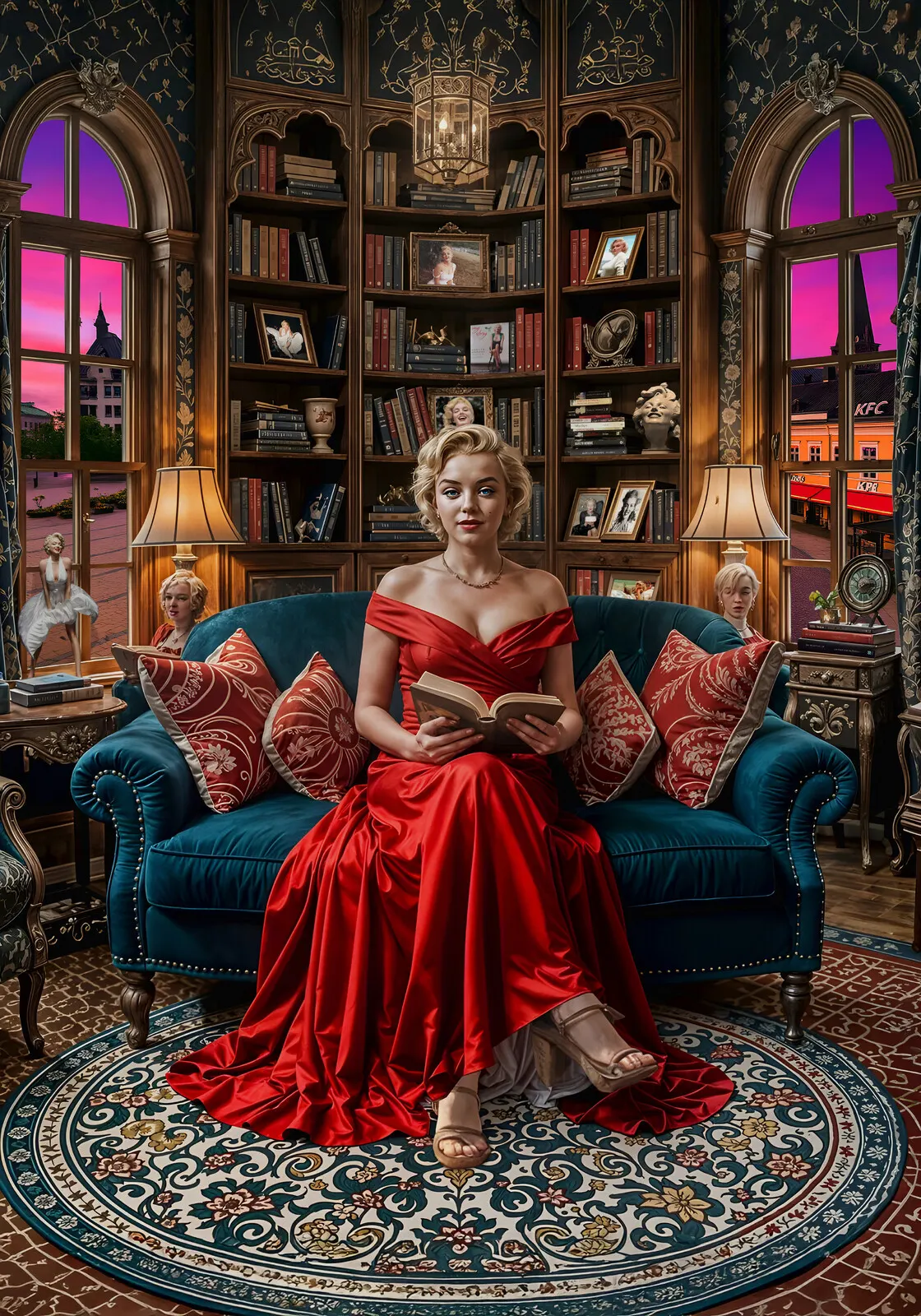
Jörgen Thornberg
Three Days With Marilyn - Ohlsson's Corner, 2025
Digital
50 x 70 cm
3 200 kr
Three Days With Marilyn
Marilyn Monroe’s life was a tale of two worlds: a carefully crafted public persona that rose from poverty to become a renowned film star, and a private life marked by constant struggles with the pressures of stardom. The role of a movie star involved a continuous stream of demands, both in front of and behind the camera, where she was expected to restrain her feelings and personality. The media, for a long time, played along, perpetuating the image of the glamorous star because, after all, Marilyn sold newspapers.
Marilyn Monroe, with her glamour and allure, possessed a quality that transcended the silver screen. She had a relatability that resonated with ordinary people, not just the romantic fantasies of men. Her struggles and triumphs were not just a part of her story, but a reflection of the human experience as a whole, making her a figure with whom we can all empathise, finding a piece of ourselves in her journey.
Despite the constant presence of people, being a movie star was a lonely experience for Marilyn. There was no warm embrace waiting for her at home, no one to truly listen to her problems, fears, dreams, or jokes. She led a solitary life, deeply isolated despite the constant company of others, a feeling many of us can relate to in our own lives. This universal loneliness is a testament to her humanity, a fact that resonates with us all.
All the pictures of a smiling star shown in the media concealed the fragility of her existence. She wasn’t a typical vamp, and in the eyes of many admirers, she was almost a saint. But gradually, it became clear to her that not even saints could escape reality. She started to fear that her dreams of becoming a movie star had been built on a lie from the very beginning.
Her sorrow over her shattered emotional life made it hard for her to do her job, and the actress began battling with sleep. The solution at the time was barbiturates, potent sedatives that were commonly used as sleeping pills. The studio urged her to fulfil her duties and keep up appearances. The issue was that no one in charge understood—or wanted to understand—how badly she was feeling.
Marilyn felt she was living a lie, and her life was as tightly scripted as the films in which she starred. Not only she but also the director was controlled from above by the studio mogul himself, the dictatorial LBM. To him, everything was about money, and she was just a body, a commodity to be exploited for profit.
The news of Marilyn Monroe’s death was a profound shock. She was so young, only 36. The movie star, who was a global media presence every day, was suddenly gone. Her suffering and the rumours only intensified after her death. The question of whether she took her own life or was the victim of a sinister plot only deepened the sense of loss. Her death left a void that many felt personally, intensifying the shared grief for a life cut short. The world mourned the loss of a beloved icon, a symbol of Hollywood glamour and tragedy, a loss that reverberated across the globe.
Marilyn Monroe's legacy is indelible. Even now, 63 years after her untimely death, her name alone evokes a powerful image, a symbol of a bygone era of Hollywood glamour and tragedy.
“Three Days with Marilyn
For three days, time danced,
through alleys and canals,
beneath the shifting light of Malmö’s sky,
she was — eternal, restless, alive.
The first day, her smile among books,
a laugh that echoed between the library walls,
fingers brushing Joyce and Rilke,
as if every book whispered back: “We always saw you.”
The second day, she walked barefoot by the sea,
the wind playing in her blonde hair, waves murmuring secrets,
and the water — the only mirror that never judged,
Marilyn smiled: “Here I get to exist, without headlines.”
The third day, shadows in salons,
stars from other eras raised their glasses,
but she wanted something simpler, something true,
a glass of wine on a park bench, just a woman among others.
Three days that touched what was hidden,
beyond Hollywood’s glitter, past the chains of iconhood,
a human being — vulnerable, wise, beautiful, without a mask,
and when she smiled at dawn, she whispered:
“Here I am, Marilyn, nothing more, nothing less.”
Malmö July 2025
Three Days With Marilyn
It all began with Anita. Anita Ekberg, the star who once dreamed of leaving Malmö but never truly let go of her roots. She, who once graced the La Fontana di Trevi in Rome and, with a single splash, became the most renowned blonde of all time, understood the allure of living as an icon—and the sacrifices it demanded. When Marilyn, timeless, lost, and inquisitive, roamed the celestial plains of eternity, it was Anita who first whispered the word “Malmö.” Sweden’s gateway to the continent, a place where one could disappear amidst cobbled streets and historic half-timbered houses without arousing suspicion. “Come to my city,” Anita beckoned. “You can borrow my old apartment in Ohlsson’s Corner. The windows overlook Stortorget. From there, you’ll witness the city's heartbeat, yet remain free from its rhythm.”
So, one early summer day, Marilyn arrived. Not to play a part, but to rediscover her true self. Through one of the wormholes, she journeyed from her star, carrying suitcases filled with chosen fragments from a past life—scripts she never enacted, photographs from New York, her worn copy of ‘Ulysses’, and notebooks filled with dreams from sleepless nights. With her, she brought pieces of her old library and gradually began to build a new one: a library for the woman she had become and for the parts of herself she had tried to conceal from the blinding glare of the spotlight.
In the corner room, behind the arched windows that offer glimpses of the city and history, Marilyn settled into the blue sofa and began to write. Not memoirs, but a unique book blending memories, reflections, and anger over centuries of female subjugation. She planned to publish it under a pseudonym, worked through the nights, and spent the days walking along the canals, learning Malmö like a native. A time-traveller doesn’t need to sleep, for eternity does not perceive time as we do on Earth.
Because I knew Anita—through mutual friends and strange coincidences—I was invited to the apartment in Ohlsson’s Corner. I would meet a person who had fascinated me for years. Not the myth, not the legend, but the woman who wanted simply to be Marilyn. Three days that would become the strangest, most intense of my life. Three days with Marilyn.
Chapter 1: Arrival at Ohlsson’s Corner – Visiting Anita
Sweden has its rituals. Fika. A wonderful word. No meeting is complete without coffee and a cinnamon bun, maybe some cookies if you’re feeling generous. It’s a tradition, a ritual, a grassroots movement. Not even when the guest comes from another time, from her star. When I rang the doorbell at the apartment in Ohlsson’s Corner, the table was already laid. Cinnamon buns from the local bakery, cookies in a well-worn tin, and two steaming cups of coffee. We sat down on a plump blue sofa in the corner room. Her welcome was a bit unusual.
“You are most welcome, but you must know that I'm selfish, impatient, and a little insecure. I make mistakes, I am out of control, and at times, I can be hard to handle. But if you cannot handle me at my worst, then you sure as hell don’t deserve me at my best. I’m 101 years old, so take care,” she said kindly. It felt like a good start to have the ground rules laid out.
“I’ll follow house rules,” I replied.
“This is my Malmö,” said Marilyn with a faint smile as she opened one of the windows and let in the sounds from Stortorget. People strolled across the cobblestones below. Someone seemed to be discussing the weather—judging by the gestures and expressions, there were plenty of opinions about it this summer. At the outdoor café beneath us, three men sat, likely talking about football. Their body language was animated, and one of them wore an MFF cap, so it was probably about the home team that had endured a tough spring.
Marilyn said she saw the square as if it were a stage—but a stage where, for once, she wasn’t the lead character. The view from the apartment was unbeatable. From one window, you could see the Town Hall with its sombre Renaissance façade, and beside it, the Governor’s Residence with its impressive rows of windows. Over the years, more than fifty governors, county leaders, and administrators had governed and managed Skåne from the same corner of Stortorget for over three centuries. The Residence had initially been two distinguished houses joined together into one—the old square, with its grey paving stones worn down by generations of footsteps.
“This is what I wanted,” she said, brushing a strand of hair from her face. “Hollywood made me a legend. But sometimes, all I wanted was to sit at a café and be invisible.”
I enquired about Anita’s invitation—I was aware of it, of course. “We have a pact,” smiled Marilyn. “She always says Malmö is her jewel in the world. Small enough to walk through, big enough to hide in. Anita has found her rooms in Malmö. Now I get to borrow the flat for an indefinite period. She has so many other places to go.”
“This famous corner has a rich history,” I said. “I’m sure I don’t need to tell you it’s called Ohlsson’s Corner after the classic clothing store that was here until 1972.”
Anita told me it was Malmö’s finest fashion store, where the local gentry and upper class flocked. In its heyday, it was Sweden’s largest tailoring house with fourteen cutters and eighty tailors. In the windows facing Södergatan, elegant mannequins stood dressed in gala outfits of the finest silk, accompanied by matching shoes.
Marilyn proudly showed me her new home, a place brimming with character and history. We began in the corner room where we sat. The bookshelves were packed—not only with her treasured old books from Los Angeles, such as those by Rilke, Dostoevsky, and Dorothy Parker —but also with recent finds from some of the few remaining antiquarian bookshops in the city. A sign of the times, people no longer seem to care about books. I commented on the small pictures Marilyn had tucked here and there, snapshots from her earthly life that held significance for her. Small notebooks were scattered on tables and windowsills, where quotes, observations, and dreams mingled with wry comments. It was from these memories that her book was taking shape. Then we walked through the apartment, each corner revealing a new story.
Marilyn paused at the mirror in the hallway, examined her profile, ran her hand through her hair, leaned in, and whispered, “The trick is always to look slightly down. Then they don’t see you. Until you open your mouth, then it was always over.”
She smiled, partly amused, partly weary. She recalled the laughter with Anita, their shared fascination with men in suits, and how swiftly these men lost their composure when confronted with women who knew their worth. Anita had the Fiat boss; Marilyn had President Kennedy—both men equally full of themselves. They remain in eternity, for nothing changes with time. The soul stays the same – only the body is left on Earth. Physically, a Time-traveller can adopt any appearance from their past life. Few choose to appear as they looked when they first arrived; most prefer how they looked in their forties, still youthful outside but wiser inside. Marilyn left Earth at 36, so that age she had to live with.
She had much to tell, and I realised these would be three both long and short days—hours that blurred together, where the city became a backdrop and Marilyn Monroe, a star from another time, became my conversation partner. I was filled with anticipation for the stories she would share and the experiences we would have in the days to come.
Chapter 2: First Day – The Literary Marilyn
It was a crisp morning, and Malmö revealed its finest side. The sun filtered through the clouds, and a gentle breeze accompanied us as we walked alongside the canal. Marilyn had already planned the day’s activities. She lightly pointed at her notebook, where she had written, “Day 1: Feed the brain, then the heart.”
We began at the City Library—the luminous, almost levitating glass chamber known as the Calendar of Light. Marilyn stood quietly at the entrance, gazing up at the building’s sleek, modern lines and the glass facade that opened towards Slottsparken. “It’s breathing,” she whispered. “Like me… finally.”
We wandered among the shelves. Marilyn's fingers brushed the spines of the books, each one a dear friend. In the classics section, she smiled warmly and pulled out Ulysses. “People thought I couldn’t read Ulysses,” she said with a wink. “I didn’t tell them I read it twice.” Her connection with the books was more than just intellectual; it was deeply personal.
She chose books to borrow for her stay at Ohlsson’s Corner. Even visitors can get a temporary library card by showing a valid passport. Even a Time-traveller has one—a forged identity, but no system in the world could expose the physical passport, since the fictitious person existed within every country’s system. They even became part of the population statistics.
The stack of books reflected her taste: Rilke, of course, but also Sylvia Plath's 'The Bell Jar', Virginia Woolf's 'To the Lighthouse', and a biography of Simone de Beauvoir. 'I always wanted to be seen as more than a body,' she mumbled. 'Brains don’t fade… they evolve.' Each book was a window into her soul, a testament to her intellectual depth and emotional complexity.
We sat down in one of the lounge areas, and Marilyn shared with me the story of her old bookshelf in Brentwood, about the nights she devoured On the Road, tried to decipher Joyce’s flow of language, and found solace in Dorothy Parker. “I used to underline sentences like little lifelines… some days they saved me.” Her books were not just companions; they were her refuge.
We had lunch at the restaurant Gustav Adolf on the square of the same name. The air was filled with the aroma of freshly baked bread and the sound of clinking cutlery. Of course, we sat outside in the shade of the facade, and we were certainly not alone. Marilyn attracted a few glances — a beautiful woman always does — and a few whispered comments suggested she resembled someone, which she undoubtedly did.
After lunch, we continued to the few remaining secondhand bookstores. She browsed through dusty shelves and found a worn edition of ‘The Prophet’ by Kahlil Gibran. “This... this one kept me company during my darkest nights,” she said, gently stroking the battered spine. “Funny, a little book from the desert made me feel less alone in the Hollywood hills.”
In the afternoon, we strolled through Slottsparken. She removed her shoes, let the grass tickle her feet, and stretched out her arms. “I always dreamed of running barefoot. But in LA… you’d get glass in your feet, or worse.” Here, she felt free. No one stared, no one judged, just a woman in a park among dog-walking locals who barely gave her a passing glance.
We walked along the gravel paths beside the peaceful canal. She pointed to a sign: Berghult’s Garden. “This place has charm,” she smiled, “even the name sounds like it belongs in a novel.” I understood what she meant but said nothing.
We continued beside Parkkanalen until we reached ‘Den liggende pige’, the famous sculpture resting on its granite base, unashamed and nude, with hips stretched and legs slightly parted. I could see that she was both amused and mildly startled on her face.
Marilyn paused, and we took a seat on the nearby bench. She brushed her hand through her hair before bursting out into a clear laugh. “And to think,” she said with a crooked smile, “people got all scandalised because I showed a bit of thigh and panties in The Seven Year Itch… Look at her! No breeze in the world could excuse this.”
She leaned forward, examining the statue more closely, her eyes narrowing with that mixture of humour and sharp insight. “At least I wore clothes. This is… well, it’s more akin to gynaecology. But you know… It’s beautiful in its way. We look like this… though perhaps not everyone volunteers to be displayed.”
She rested her chin on her hand. “Men are terrified of women who don’t apologise for their bodies. They fear the strength of comfort—a woman who knows herself, owns herself… and doesn’t shrink.
I looked at her, the icon who had been trapped in the public eye for half a century, now smiling at a naked female figure in a park in Malmö. Here, she was free. Free to comment, laugh, and feel, without filtering herself through studio bosses’ expectations or media distortions.
“In a way,” she continued, “she tells a better story than Hollywood ever let me tell. A woman resting, unapologetic. No plot, no scandal... just being.”
We sat there for a while, in silence, with the sounds of the water and Malmö in the background. It was hard to tell who was observing whom—Marilyn the statue, or the statue observing Marilyn.
In the late afternoon, we walked past Moderna Museet. As it was Thursday, they remained open until seven. She paused outside the orange building and sighed: “Modern art? Honey… I was modern before they put it on walls.” She smiled wryly, yet there was something more—an aching desire to express herself beyond cameras and directors.
Back at the apartment, she pulled out her notebook once more, quickly jotting down a few lines—first day in Malmö. Books don’t lie. Neither do parks.
I already knew—this trip wasn’t about escaping. It was about finding her way back to who she once was before the world dressed her up in glitter and expectations.
Chapter 3: First Evening – Restlessness and the City’s Contrasts
Even before we reached Ohlsson’s Corner, I noticed the restlessness in Marilyn’s eyes. “We’re not staying inside,” she said quickly, “it just gets worse then. Let’s take another look around the city.”
As dusk fell over Malmö, Marilyn swapped her heels for a pair of white trainers and slipped on a jacket that looked like it had seen better days. “We’ll pedal,” she said, “so I don’t end up treading water in my thoughts.”
We rented bikes from one of the many city stations, the one on Stortorget. A simple sound system—easy to use: swipe, unhook the white bike, and go. Her payment card worked everywhere, just like every Time-traveller revisiting Earth, tied to an account with unlimited funds. Marilyn chuckled: “Eternity has its perks. Unlimited credit, infinite accounts, but the emptiness persists. You have to keep your legs moving to scatter the thoughts. Before I left Earth, I took pills, a few too many at the end. In eternity, the inner turmoil remains, but I manage it because there’s nothing left to prove there.”
At the KFC on Stortorget, right next door to Anita’s flat, she braked suddenly. “Even the chicken is famous now,” she said, turning partly towards me, “and I’m still trying to figure out who I am.” She looked at the sign as though it reminded her of old Hollywood contracts, where even chicken fillets received more respect than she ever did.
We pedalled along the canals, beneath bridges where padlocks sparkled in the evening sun, and the water lay still like a mirror. Marilyn kept a steady pace but paused now and then, pointing out places as if she had lived here for years.
During the bike ride, she shared with me her years as a contract slave at Fox and MGM. “I was a package,” she said with a hint of bitterness. “Wrapped and sold. No receipt, no return.” Her voice darkened. “I endured roles I despised, lines penned by men who never understood a woman… and still I smiled. To survive. But survive I did, and here I am, telling you my story."
We continued along the waterfront, heading towards Västra Hamnen, past Dockan, where I live. Turning Torso rose like a twisted spiral in the twilight. Marilyn stood up on the pedals and tilted her head back. “Interesting,” she said, “a building twisting itself towards the sky like a propeller. Maybe it’s trying to escape.”
We parked the bikes by Malmö Live and took the lift up to the hotel’s rooftop bar, each ordering a pink cocktail. It was something Marilyn had chosen, so I don’t know exactly what it was, but it had a vaguely apricot-like taste.
After an hour at the city’s highest vantage point, we descended again and cycled to Bastard Burgers on Kalendegatan. There, with a local IPA and each of us biting into a Texas Doritos burger, Marilyn carried on speaking. While we devoured hearty BBQ burgers made with Swedish beef, Doritos Flamin' Hot, bacon, red onion, lettuce, cheese, BBQ sauce, and chipotle dressing, she reflected on the differences between American and Swedish food culture. “Back in Hollywood,” she said, “a burger was grease and guilt, eaten in trailers during 16-hour shoots. Here it’s craft, it’s care. I like that.”
As we cycled home, Malmö lay before us like a dark, shimmering mirror beneath the stars, and the conversation grew more serious. She talked about pills, alcohol, and loneliness. About the struggle to be recognised as serious. About living with an image shaped by others and losing oneself along the way. This contrast between Marilyn's public image and her private struggles underscores the complexity of her identity.
“I was addicted to attention, but also to numbness,” she finally whispered, her voice carrying the weight of her past struggles. “But tonight... tonight it almost feels like I’m just Marilyn. No filters.” This moment of introspection, where Marilyn grapples with her past and present, reveals the depth of her character.
I didn’t reply. Some moments don’t need responses.
We parked the bikes by Lilla Torg and walked on foot through the winding alleys of Gamla Väster. Little cobbled streets, colourful houses with wooden details, and an unusual sense of calm, even though we were in the heart of Malmö. Once a slum area threatened with demolition, now spruced up and eye-wateringly expensive. Marilyn breathed in the evening air and smiled. Her fondness for this peaceful neighbourhood stands in stark contrast to the turbulence of her life.
“This reminds me of those neighbourhoods in old Hollywood,” she said, “not the buildings, but the feeling… the time before everything changed.”
She peeked into a small courtyard where a light still burned in a window and started to speak without being asked.
“I was born Norma Jeane Mortenson,” she said, almost as if reminding herself. “My mother, Gladys, had it rough; she couldn’t take care of me. I wasn’t anyone’s little princess. There was no father, and I didn’t meet him until eternity. I was just the kid placed wherever there was room—foster homes, orphanages. But I didn't let that define me."
We moved on, the houses becoming more picturesque, their facades decorated with climbing roses and hollyhocks parading like colourful footmen by the doors, and Marilyn continued in a low voice.
I got married when I was sixteen. James Dougherty was his name; he was a lovely lad, but we lived in his parents’ house. Crowded, yet we could escape and walk streets like these—simple, a bit sleepy, safe. Except that safety was a fragile shell, a stark contrast to the turmoil that was brewing in my life.
We crossed Ostindiefarargatan and found a wine bar, where we had a glass of wine before they packed away the chairs for the night. Marilyn glanced at the last guests, all very young, and I could see how her thoughts drifted far away.
“You know, I worked in a munitions factory when I was eighteen. Packing aeroplane parts, dreaming of something else. Then David Conover turned up with his camera, wanting to take some photos for a defence magazine… and the rest, well, the rest turned into a bloody circus.”
I looked at her and realised that the star-glow concealed a hard-won strength. She grinned enigmatically.
“I always wondered why it was always the married men who were quickest to follow me back to the locker room at the factory.”
We sat down on a bench overlooking the canal and Malmö Live. It was a gentle summer evening, the tranquillity of which was palpable, and Marilyn stretched her legs as if she wanted to dip her toes in the water ten metres below.
The greatest thing about Malmö is that you can have an evening like this—no paparazzi, no managers making you smile invitingly at the world. Just a glass of wine, a book, and someone to talk to, a freedom I cherish more than anything.
Back home, I saw Anita waving from her balcony. When we returned to the flat, the living room was filled with Time-travellers. Women from all eras sat with glasses in hand, greeting us with smiles hiding both triumphs and tragedies. Queen Christina in a smart suit, Frida Kahlo with flowers in her hair, Mata Hari with eyes that revealed too much. Some I recognised, most were strangers.
“Anita loves inviting those women men tried to erase from history,” whispered Marilyn with a glittering laugh.
And the night took flight. Shadows, laughter, and confessions blended into a murmur from eternity. How I managed to stay awake remains a mystery, but time vanished on the edges of forever. I must have dozed off, because when I woke up, it was morning, and all the guests had gone.
Chapter 5: Second Day – Marilyn the Human by the Sea
We began the day in the kitchen, where sunlight filtered through lace curtains. On the table were scones, a small bowl of marmalade, and eggs that had just been boiled. Marilyn had set the table with both tea and coffee—“I never understood why you had to choose,” she said. She ate with a good appetite, slowly, as if she wanted each bite to weigh against a life where meals had often been served as props.
“Everyone just vanished,” I said between bites.
“You fell asleep, and no one wanted to wake you. Besides, they were heading to another gathering. In Cape Town, so the night could continue. It’s for the best when a couple of dozen historical women come together and don’t end up looking like a portrait collection from the Louvre in the living room. I was invited too, but I blamed you, so I got out of that excursion. Since time isn’t measured for us, there are always more chances.” Marilyn's words carried a wisdom that made me pause and reflect.
After breakfast, we rented bikes again. It was a bit of a ride, both to Ribersborg Beach and further out to the bridgehead, but that’s precisely why the bike felt right. “You see better when you cycle,” said Marilyn. The first stop was Ribersborg Beach, “Ribban” as the locals call Malmö’s Riviera, just over two kilometres long. Barefoot in the sand, the wind playing in her hair, she smiled a genuine smile, rare even on the big screen. “The water,” she said, “it’s the only place where curves aren’t judged. There, the body just exists. Waves don’t judge.”
We continued out onto the cold bathhouse’s pier, the wind getting stronger, the waves lapping beneath us. Marilyn took a deep breath and closed her eyes for a moment. “There’s nothing better than cold water to remind you that you’re alive,” she said, for you are very much alive even after leaving Earth, albeit in eternity.
We pedalled on and followed the bike path out to the bridgehead by Luftkastellet, where you can see the Öresund Bridge stretching across the strait. “Borders,” she said thoughtfully, “I always thought life was about breaking through them, but maybe it’s about knowing when to respect them too.”
As we cycled back towards the city, the conversation grew deeper. She told me about her fear of ageing, how she dreaded turning thirty. “I thought my life would be over then,” she admitted, “but now… I’d give everything to turn fifty. To see how life unfolds when beauty stops being currency. Now I’m thirty-six forever.” Her acceptance of her age was inspiring.
We turned in towards Malmöhus and parked the bikes outside the red castle. The ongoing avant-garde exhibition reminded her of New York, where she used to hide among the artworks in museums. “In paintings,” she said, “you’re allowed to be more than just one thing. You can be sorrow and joy, muse and creator, loved and forgotten—all at once.” She reminisced about her days in New York, where she found solace in the art world, away from the prying eyes of the public.
On the way home along the canal, we discussed what it felt like always to be watched. “All I ever wanted,” said Marilyn as we sat on a bench overlooking the water, “was to be allowed to exist. To walk into a room and not be reduced to hair colour, or the size of my breasts or hips.” She expressed her longing to be seen for her intellect, talent, and character, rather than just her physical appearance.
And there, in Malmö, with the calm wind from the Öresund and the shadows from ancient castle towers, she was precisely that—just Marilyn.
Chapter 6: A Canal Journey Through the City and the Self
After breakfast, Marilyn wanted something else. “Now I want to go on a boat,” she said firmly. We strolled from Ohlsson’s Corner down to Norra Vallgatan, where the Rundan boat waited opposite the Central Station. “Isn’t it typical,” she laughed, “stations are always about saying goodbye—and here we board to stay put.”
The canals became not only a way to see Malmö but also a mirror of Marilyn’s own life.
As we drifted along the Southern Canal, lined with people having lunch on the steps and children feeding ducks, her face lit up. “This is my glamour,” she said. “The noise, the buzz, the feeling that you belong to life, at least for a moment.” She spoke about Hollywood, about red carpets that felt as cold as the marble floors in film studios. Here, the sparkle was warm, alive. She glanced at the water: “But even glitter fades when you stay too long.” Her longing for authenticity was palpable, a struggle that resonated with many.
We turned into the Park Canal, where trees reflected in the water and the wind danced across its surface. Here she grew quiet, her voice softer. “This… this is my hidden self,” she said quietly. This is the part of me that read poetry at night, that talked to myself because no one else listened.” Her eyes followed a family of ducks gliding past. “Sometimes, you don’t need applause. You need quiet.
The Rörsjö Canal stirred up restlessness. “Everything’s moving here, but nothing changes,” she sighed. “That’s me in my twenties, constantly spinning but going nowhere. She spoke of the slavery of studio contracts and endless photo shoots: “They owned my face, my smile… but never my mind.”
When we entered the Eastern Canal, the more barren stretch, her voice grew serious. “This is loneliness for me, the part I never showed the cameras.” She ran a hand through her hair. “I wanted to be Lady Macbeth, to scream with rage on a grand stage, but they dressed me up like Juliet and told me to look sweet.” She leaned over the railing. “Do you see? Even the water here moves slower… heavier.”
In the Eastern Harbour Canal, she perked up again. “But we all have a bit of rebellion, don’t we?” She pointed to the falafel stands and small boats crowding the quayside. “This is my escape artist, the part that slipped out the back door, jumped on planes, kissed whoever I wanted to kiss.”
As we circled back towards the Western Harbour Canal, she suddenly laughed. “And here… here’s my survival instinct.” She gestured towards Turning Torso rising on the horizon. “Look at it—twisting, refusing to be straight, reaching for the sky no matter the weight below.”
Each stretch of canal reflected a part of her soul: the glamour, the loneliness, the restlessness, the longing to belong, and the eternal dream of freedom. “Cities are like people,” she said. “Messy, layered, full of contradictions… and so beautiful because of it.”
When we moored again at Norra Vallgatan and stepped ashore, she sighed contentedly: “That was the first time on Earth I didn’t feel like I was running away.”
We went back to Stortorget so Marilyn could get ready for the evening. As we passed the statue of Karl X Gustav, Marilyn pointed to the controversial king on horseback.
“I understand this man was one of history’s worst violators of women, with hundreds of rapes on his conscience,” Marilyn said with disgust.
“That’s certainly no exaggeration,” I replied, shaking my head.
“And yet they raise a statue to a man in the same class as LBM,” Marilyn growled.
“LBM?” I asked, though I already suspected.
“The second M in MGM stands for Louis B. Mayer. Probably in the same league as that king. He allegedly molested 16-year-old Judy Garland while she was playing Dorothy in The Wizard of Oz.”
“Appalling,” I said.
“That’s just the beginning. LBM thought she was too chubby, so he put her on a diet of broth, coffee, toast, cigarettes… and more.”
“More?” I asked, though I already guessed.
It’s no secret Judy Garland was fed amphetamines for breakfast and barbiturates after those endless filming days, starved except for coffee and chicken soup. She was forced to have an abortion when producers got her pregnant. Mayer and the other pigs mentally and sexually abused her.
“LBM was the man who gave couch casting its ugliest face.”
“Couch casting?” I asked.
Marilyn turned her back defiantly on the statue of the king and explained, her voice strained with anger.
The term ‘couch casting’ describes Mayer’s abuse of power, demanding sexual favours from aspiring actresses. He was untouchable, protected by the studio system. Even after he was forced to resign in 1951, the practice persisted, albeit illegally, hidden behind a façade of glamour and glitter.
“And no one stopped him?”
Some suffered greatly for it. But there was a time he met his match. After telling Tallulah Bankhead he expected oral favours in exchange for a role, she tricked him, knelt, brought him to the brink, then bit him so hard he bled.
And even after #MeToo, Hollywood remains riddled with predators. Some of them have even been elected to the highest office.
“Yes,” said Marilyn with a scornful smile. “That man gives a whole new meaning to the Tin Man needing oil and the Scarecrow lacking a brain. Hollywood was built on exploiting the powerless—many of us succumbed. Including me.”
“Is there something you want to share?”
“Not in detail—I’ve blocked out a lot. LBM had a beach house on the Pacific, where young actors were invited to parties without limits. The whole purpose was to get them into bed with the producers who needed flattery to raise money. That’s where I met the Kennedy brothers. Do I need to say more?”
“No,” I replied quietly. “And you couldn’t fight back.”
“No. Those who spoke out were paid off or blacklisted. It hasn’t changed.”
Chapter 7: Stars That Fall – Farewell and Return
Evening had settled over Malmö like a soft piece of silk as we returned to Ohlsson’s Corner for yet another supper together. Through the tall windows, a pink-hued twilight spilt over Stortorget, where the chatter from the outdoor cafés grew louder. Marilyn placed the Foodora bags on the kitchen counter and laughed.
Modern-day servants… riding scooters in the rain, bringing overpriced joy to the privileged. Tonight, at least, we feast properly.
And feast we did. From Anita’s secret wine vaults, via the hidden channels of the Time-travellers, Marilyn had arranged a flawless Italian menu: an antipasti platter with charcuterie and pickled vegetables that melted in the mouth, followed by Saltimbocca alla Romana with tender veal, prosciutto and sage. A rich herb risotto, and for dessert, a silky panna cotta with fresh berries, paired with wines from vintages never sold in any store. The table was overflowing.
“Whoever said spirituality requires starvation, they didn’t know how to live,” said Marilyn with a satisfied smile, raising her glass of thirty-year-old Barolo.
Just as we finished dessert, footsteps echoed through the hallway. Tonight’s guest of honour had arrived—Pharaoh Cleopatra herself, surrounded by a fragrant cloud of lotus and cinnamon. She let her cloak fall over the back of a chair and smiled her enigmatic, sphinx-like smile.
“Marilyn, you’ve replaced three kings. Malmö may be gentler than the Nile, but its wind carries the same sense of freedom.” Cleopatra smiled enigmatically.
Behind her, a crowd of uplifted ladies gathered in the hallway before settling into the lounge, where the other Sisters of Sirius now occupied Anita’s Chesterfield sofas, as they called themselves.
Cleopatra, who had left Marc Antony behind on their shared star—because that’s how it often is with love that once bloomed on earth and ended brutally, it lasts forever among the stars. Besides, he had his crowd, where he could spend long nights swapping tales about how they would have conquered their enemies—Julius Caesar, Alexander the Great, and Napoleon, now many light-years away, embroiled in endless debates about the lost glory of warfare.
“He’s staying up there tonight,” Cleopatra said with a wink. “It’s an unwritten rule—in eternity, women have the final word, because on earth they stood for life, and men for death.” Marilyn lit up. “Cheers to that.”
The conversation flowed effortlessly. Frida Kahlo and Josephine Baker joined in, while I mostly listened but raised my glass when Audre Lorde toasted from the other side of the table. The conversations shifted from Marilyn’s battles with her Hollywood contract to Cleopatra’s struggle against Rome’s deceitfulness. They discussed women’s bodies and the legends that once suffocated their spirits, celebrating the strength and stories of women.
“They wanted me timeless,” said Marilyn. “But all I wanted was to be on time for dinner.”
We laughed, toasted, ate, shared stories, and collectively sneered at the hypocrisy of the world. Anita refilled the glasses, Frida spoke of the colours of revolution, and Simone de Beauvoir quoted Sartre with a mischievous twinkle in her eye, creating a sense of camaraderie and inclusion for the audience.
As night ended, Marilyn stood alone by the window, gazing out over Stortorget now glowing softly with the first pink light from the east. The square had quieted, and only a few lone wanderers crossed below us.
“Maybe here… in Malmö… the girl survives the legend,” she whispered.
Cleopatra moved silently and gracefully behind her. “Among stars, love lasts longer than kingdoms on earth—and among women, truth lasts longer than beauty.”
They raised their glasses once more, to eternity, to freedom, and to dreams that never die, instilling a sense of liberation and hope in the audience.
Chapter 8: Stars That Fall – A Muse, But Never an Equal
We started the third day with a walk towards the new Varvsstaden district, a burgeoning hub of creativity and innovation. Marilyn was curious about an old dry dock, now emptied of water and still without a defined purpose. Maybe, I said, it could be turned into a theatre or a stage for future art. She had heard the same suggestion and reflected on her first appearances on stage.
She told me about her debut in a revue called Keep 'Em Laughing in Los Angeles, 1946, where she had a minor part as a dancer. Before that, she had worked as a model and had taken a few small film roles. “Standing on a real stage,” she said, “was something big.”
She stopped at the edge of the dry dock, gazing down into the empty space where the basin once had been filled to the brim with water. “Freedom is like water,” she said slowly, “you only notice it when it disappears.” She spoke of her production company, Marilyn Monroe Productions, which for her had been not only an act of rebellion but also a matter of pure survival.
They attempted to control me. I reclaimed my independence. They, the powerful figures in the film industry, tried to mould me into their version of a star. But I refused to be confined to their expectations. I broke free and reclaimed my independence.
As we crossed the bright red, new pedestrian and bus bridge, we delved into the importance of women’s financial independence. Marilyn's book, a testament to this ongoing fight, would be a beacon of hope for women and girls worldwide. All profits from the book, she explained, would go to those still oppressed and fighting for their freedom. Following my suggestion, she decided that once it was finished, she would handwrite the entire book, sign every page, and ensure the manuscript was placed in a suitable spot—a time capsule from eternity. It would undoubtedly become a bestseller, such was the power of her name. The manuscript would sell for hundreds of millions, if not more, for her name had only become stronger since she left Earth.
Our next stop was the City Library, where Marilyn delved into the drama section. She selected ‘Death of a Salesman’ and initiated a discussion about Miller, intellectual love, and intellectual loneliness. “He sought a muse, not an equal. And I… I yearned to be appreciated for my intellect, not my physical form,” she confessed, followed by a moment of introspection, “but perhaps the issue was mostly within me.” She candidly shared her experiences of miscarriage, ectopic pregnancy, and the increasing dominance of sleeping pills in her life. “At times, they would apply my makeup while I was still in a daze from the pills.”
We discussed mismatched couples, about how opposites can work if there is mutual respect. “If it hadn’t been for the pills,” she said quietly, “maybe we could have made it. Now it works… on our shared star. For us, there was always love, deep inside.” She chuckled briefly at one of her old scars. “The media called us ‘the odd couple’. Variety wrote: Egghead Marries Hourglass. We never laughed at that.”
We grabbed lunch from a nearby café and settled on a park bench, surrounded by typical Malmö families with children, joggers, and pensioners, all seemingly indifferent to her celebrity status. “Perhaps this was the life I truly desired,” Marilyn murmured. “To be contentedly ordinary.” She felt that Malmö was a place where one could live without the burden of a star's expectations, where being human was more significant than being an icon.
After our meal, we took a leisurely stroll to Slottsparken. Marilyn paused by the playground, observing the children's carefree play and laughter. After a moment of silence, she softly confessed, “I was always the child in the corner, hoping someone would come and say: you matter.” We delved into the topics of abandonment, childhood aspirations, and the enduring nature of some wounds, even as we age.
As the afternoon wore on, we rented bikes and cycled to Ribersborg, this time at a relaxed pace. We sat by the beach; she was silent for a long while, gazing out over the sea and the distant horizon. “They said I wasn’t mother material, but the truth is, I would have been the best mother,” she said, “because I knew what not to do.” The tears came quietly, and she let them fall without hiding, a moment of openness with the Öresund Bridge in the background—a symbol of both barriers and possibilities.
In the evening, back at Ohlsson’s Corner, dinner was simple. She wanted something tasty but uncomplicated. We ate and talked about survival, maintaining self-distance, and finding strength where others see weakness. “They painted me as a tragedy,” she said, “but I wasn’t. I was a survivor. And sometimes… surviving is more revolutionary than anything else.”
Before we parted, she paused by the window for a moment, gazing down at Stortorget where people hurried past, unaware of the movie star’s presence.
“Maybe here,” she said quietly, “a woman doesn’t have to be a legend… maybe she can just live.”
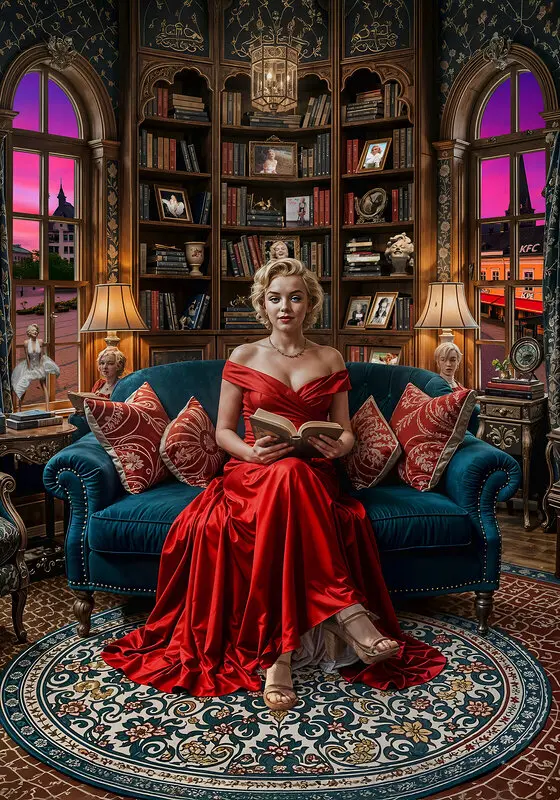
Jörgen Thornberg
Three Days With Marilyn - Ohlsson's Corner, 2025
Digital
50 x 70 cm
3 200 kr
Three Days With Marilyn
Marilyn Monroe’s life was a tale of two worlds: a carefully crafted public persona that rose from poverty to become a renowned film star, and a private life marked by constant struggles with the pressures of stardom. The role of a movie star involved a continuous stream of demands, both in front of and behind the camera, where she was expected to restrain her feelings and personality. The media, for a long time, played along, perpetuating the image of the glamorous star because, after all, Marilyn sold newspapers.
Marilyn Monroe, with her glamour and allure, possessed a quality that transcended the silver screen. She had a relatability that resonated with ordinary people, not just the romantic fantasies of men. Her struggles and triumphs were not just a part of her story, but a reflection of the human experience as a whole, making her a figure with whom we can all empathise, finding a piece of ourselves in her journey.
Despite the constant presence of people, being a movie star was a lonely experience for Marilyn. There was no warm embrace waiting for her at home, no one to truly listen to her problems, fears, dreams, or jokes. She led a solitary life, deeply isolated despite the constant company of others, a feeling many of us can relate to in our own lives. This universal loneliness is a testament to her humanity, a fact that resonates with us all.
All the pictures of a smiling star shown in the media concealed the fragility of her existence. She wasn’t a typical vamp, and in the eyes of many admirers, she was almost a saint. But gradually, it became clear to her that not even saints could escape reality. She started to fear that her dreams of becoming a movie star had been built on a lie from the very beginning.
Her sorrow over her shattered emotional life made it hard for her to do her job, and the actress began battling with sleep. The solution at the time was barbiturates, potent sedatives that were commonly used as sleeping pills. The studio urged her to fulfil her duties and keep up appearances. The issue was that no one in charge understood—or wanted to understand—how badly she was feeling.
Marilyn felt she was living a lie, and her life was as tightly scripted as the films in which she starred. Not only she but also the director was controlled from above by the studio mogul himself, the dictatorial LBM. To him, everything was about money, and she was just a body, a commodity to be exploited for profit.
The news of Marilyn Monroe’s death was a profound shock. She was so young, only 36. The movie star, who was a global media presence every day, was suddenly gone. Her suffering and the rumours only intensified after her death. The question of whether she took her own life or was the victim of a sinister plot only deepened the sense of loss. Her death left a void that many felt personally, intensifying the shared grief for a life cut short. The world mourned the loss of a beloved icon, a symbol of Hollywood glamour and tragedy, a loss that reverberated across the globe.
Marilyn Monroe's legacy is indelible. Even now, 63 years after her untimely death, her name alone evokes a powerful image, a symbol of a bygone era of Hollywood glamour and tragedy.
“Three Days with Marilyn
For three days, time danced,
through alleys and canals,
beneath the shifting light of Malmö’s sky,
she was — eternal, restless, alive.
The first day, her smile among books,
a laugh that echoed between the library walls,
fingers brushing Joyce and Rilke,
as if every book whispered back: “We always saw you.”
The second day, she walked barefoot by the sea,
the wind playing in her blonde hair, waves murmuring secrets,
and the water — the only mirror that never judged,
Marilyn smiled: “Here I get to exist, without headlines.”
The third day, shadows in salons,
stars from other eras raised their glasses,
but she wanted something simpler, something true,
a glass of wine on a park bench, just a woman among others.
Three days that touched what was hidden,
beyond Hollywood’s glitter, past the chains of iconhood,
a human being — vulnerable, wise, beautiful, without a mask,
and when she smiled at dawn, she whispered:
“Here I am, Marilyn, nothing more, nothing less.”
Malmö July 2025
Three Days With Marilyn
It all began with Anita. Anita Ekberg, the star who once dreamed of leaving Malmö but never truly let go of her roots. She, who once graced the La Fontana di Trevi in Rome and, with a single splash, became the most renowned blonde of all time, understood the allure of living as an icon—and the sacrifices it demanded. When Marilyn, timeless, lost, and inquisitive, roamed the celestial plains of eternity, it was Anita who first whispered the word “Malmö.” Sweden’s gateway to the continent, a place where one could disappear amidst cobbled streets and historic half-timbered houses without arousing suspicion. “Come to my city,” Anita beckoned. “You can borrow my old apartment in Ohlsson’s Corner. The windows overlook Stortorget. From there, you’ll witness the city's heartbeat, yet remain free from its rhythm.”
So, one early summer day, Marilyn arrived. Not to play a part, but to rediscover her true self. Through one of the wormholes, she journeyed from her star, carrying suitcases filled with chosen fragments from a past life—scripts she never enacted, photographs from New York, her worn copy of ‘Ulysses’, and notebooks filled with dreams from sleepless nights. With her, she brought pieces of her old library and gradually began to build a new one: a library for the woman she had become and for the parts of herself she had tried to conceal from the blinding glare of the spotlight.
In the corner room, behind the arched windows that offer glimpses of the city and history, Marilyn settled into the blue sofa and began to write. Not memoirs, but a unique book blending memories, reflections, and anger over centuries of female subjugation. She planned to publish it under a pseudonym, worked through the nights, and spent the days walking along the canals, learning Malmö like a native. A time-traveller doesn’t need to sleep, for eternity does not perceive time as we do on Earth.
Because I knew Anita—through mutual friends and strange coincidences—I was invited to the apartment in Ohlsson’s Corner. I would meet a person who had fascinated me for years. Not the myth, not the legend, but the woman who wanted simply to be Marilyn. Three days that would become the strangest, most intense of my life. Three days with Marilyn.
Chapter 1: Arrival at Ohlsson’s Corner – Visiting Anita
Sweden has its rituals. Fika. A wonderful word. No meeting is complete without coffee and a cinnamon bun, maybe some cookies if you’re feeling generous. It’s a tradition, a ritual, a grassroots movement. Not even when the guest comes from another time, from her star. When I rang the doorbell at the apartment in Ohlsson’s Corner, the table was already laid. Cinnamon buns from the local bakery, cookies in a well-worn tin, and two steaming cups of coffee. We sat down on a plump blue sofa in the corner room. Her welcome was a bit unusual.
“You are most welcome, but you must know that I'm selfish, impatient, and a little insecure. I make mistakes, I am out of control, and at times, I can be hard to handle. But if you cannot handle me at my worst, then you sure as hell don’t deserve me at my best. I’m 101 years old, so take care,” she said kindly. It felt like a good start to have the ground rules laid out.
“I’ll follow house rules,” I replied.
“This is my Malmö,” said Marilyn with a faint smile as she opened one of the windows and let in the sounds from Stortorget. People strolled across the cobblestones below. Someone seemed to be discussing the weather—judging by the gestures and expressions, there were plenty of opinions about it this summer. At the outdoor café beneath us, three men sat, likely talking about football. Their body language was animated, and one of them wore an MFF cap, so it was probably about the home team that had endured a tough spring.
Marilyn said she saw the square as if it were a stage—but a stage where, for once, she wasn’t the lead character. The view from the apartment was unbeatable. From one window, you could see the Town Hall with its sombre Renaissance façade, and beside it, the Governor’s Residence with its impressive rows of windows. Over the years, more than fifty governors, county leaders, and administrators had governed and managed Skåne from the same corner of Stortorget for over three centuries. The Residence had initially been two distinguished houses joined together into one—the old square, with its grey paving stones worn down by generations of footsteps.
“This is what I wanted,” she said, brushing a strand of hair from her face. “Hollywood made me a legend. But sometimes, all I wanted was to sit at a café and be invisible.”
I enquired about Anita’s invitation—I was aware of it, of course. “We have a pact,” smiled Marilyn. “She always says Malmö is her jewel in the world. Small enough to walk through, big enough to hide in. Anita has found her rooms in Malmö. Now I get to borrow the flat for an indefinite period. She has so many other places to go.”
“This famous corner has a rich history,” I said. “I’m sure I don’t need to tell you it’s called Ohlsson’s Corner after the classic clothing store that was here until 1972.”
Anita told me it was Malmö’s finest fashion store, where the local gentry and upper class flocked. In its heyday, it was Sweden’s largest tailoring house with fourteen cutters and eighty tailors. In the windows facing Södergatan, elegant mannequins stood dressed in gala outfits of the finest silk, accompanied by matching shoes.
Marilyn proudly showed me her new home, a place brimming with character and history. We began in the corner room where we sat. The bookshelves were packed—not only with her treasured old books from Los Angeles, such as those by Rilke, Dostoevsky, and Dorothy Parker —but also with recent finds from some of the few remaining antiquarian bookshops in the city. A sign of the times, people no longer seem to care about books. I commented on the small pictures Marilyn had tucked here and there, snapshots from her earthly life that held significance for her. Small notebooks were scattered on tables and windowsills, where quotes, observations, and dreams mingled with wry comments. It was from these memories that her book was taking shape. Then we walked through the apartment, each corner revealing a new story.
Marilyn paused at the mirror in the hallway, examined her profile, ran her hand through her hair, leaned in, and whispered, “The trick is always to look slightly down. Then they don’t see you. Until you open your mouth, then it was always over.”
She smiled, partly amused, partly weary. She recalled the laughter with Anita, their shared fascination with men in suits, and how swiftly these men lost their composure when confronted with women who knew their worth. Anita had the Fiat boss; Marilyn had President Kennedy—both men equally full of themselves. They remain in eternity, for nothing changes with time. The soul stays the same – only the body is left on Earth. Physically, a Time-traveller can adopt any appearance from their past life. Few choose to appear as they looked when they first arrived; most prefer how they looked in their forties, still youthful outside but wiser inside. Marilyn left Earth at 36, so that age she had to live with.
She had much to tell, and I realised these would be three both long and short days—hours that blurred together, where the city became a backdrop and Marilyn Monroe, a star from another time, became my conversation partner. I was filled with anticipation for the stories she would share and the experiences we would have in the days to come.
Chapter 2: First Day – The Literary Marilyn
It was a crisp morning, and Malmö revealed its finest side. The sun filtered through the clouds, and a gentle breeze accompanied us as we walked alongside the canal. Marilyn had already planned the day’s activities. She lightly pointed at her notebook, where she had written, “Day 1: Feed the brain, then the heart.”
We began at the City Library—the luminous, almost levitating glass chamber known as the Calendar of Light. Marilyn stood quietly at the entrance, gazing up at the building’s sleek, modern lines and the glass facade that opened towards Slottsparken. “It’s breathing,” she whispered. “Like me… finally.”
We wandered among the shelves. Marilyn's fingers brushed the spines of the books, each one a dear friend. In the classics section, she smiled warmly and pulled out Ulysses. “People thought I couldn’t read Ulysses,” she said with a wink. “I didn’t tell them I read it twice.” Her connection with the books was more than just intellectual; it was deeply personal.
She chose books to borrow for her stay at Ohlsson’s Corner. Even visitors can get a temporary library card by showing a valid passport. Even a Time-traveller has one—a forged identity, but no system in the world could expose the physical passport, since the fictitious person existed within every country’s system. They even became part of the population statistics.
The stack of books reflected her taste: Rilke, of course, but also Sylvia Plath's 'The Bell Jar', Virginia Woolf's 'To the Lighthouse', and a biography of Simone de Beauvoir. 'I always wanted to be seen as more than a body,' she mumbled. 'Brains don’t fade… they evolve.' Each book was a window into her soul, a testament to her intellectual depth and emotional complexity.
We sat down in one of the lounge areas, and Marilyn shared with me the story of her old bookshelf in Brentwood, about the nights she devoured On the Road, tried to decipher Joyce’s flow of language, and found solace in Dorothy Parker. “I used to underline sentences like little lifelines… some days they saved me.” Her books were not just companions; they were her refuge.
We had lunch at the restaurant Gustav Adolf on the square of the same name. The air was filled with the aroma of freshly baked bread and the sound of clinking cutlery. Of course, we sat outside in the shade of the facade, and we were certainly not alone. Marilyn attracted a few glances — a beautiful woman always does — and a few whispered comments suggested she resembled someone, which she undoubtedly did.
After lunch, we continued to the few remaining secondhand bookstores. She browsed through dusty shelves and found a worn edition of ‘The Prophet’ by Kahlil Gibran. “This... this one kept me company during my darkest nights,” she said, gently stroking the battered spine. “Funny, a little book from the desert made me feel less alone in the Hollywood hills.”
In the afternoon, we strolled through Slottsparken. She removed her shoes, let the grass tickle her feet, and stretched out her arms. “I always dreamed of running barefoot. But in LA… you’d get glass in your feet, or worse.” Here, she felt free. No one stared, no one judged, just a woman in a park among dog-walking locals who barely gave her a passing glance.
We walked along the gravel paths beside the peaceful canal. She pointed to a sign: Berghult’s Garden. “This place has charm,” she smiled, “even the name sounds like it belongs in a novel.” I understood what she meant but said nothing.
We continued beside Parkkanalen until we reached ‘Den liggende pige’, the famous sculpture resting on its granite base, unashamed and nude, with hips stretched and legs slightly parted. I could see that she was both amused and mildly startled on her face.
Marilyn paused, and we took a seat on the nearby bench. She brushed her hand through her hair before bursting out into a clear laugh. “And to think,” she said with a crooked smile, “people got all scandalised because I showed a bit of thigh and panties in The Seven Year Itch… Look at her! No breeze in the world could excuse this.”
She leaned forward, examining the statue more closely, her eyes narrowing with that mixture of humour and sharp insight. “At least I wore clothes. This is… well, it’s more akin to gynaecology. But you know… It’s beautiful in its way. We look like this… though perhaps not everyone volunteers to be displayed.”
She rested her chin on her hand. “Men are terrified of women who don’t apologise for their bodies. They fear the strength of comfort—a woman who knows herself, owns herself… and doesn’t shrink.
I looked at her, the icon who had been trapped in the public eye for half a century, now smiling at a naked female figure in a park in Malmö. Here, she was free. Free to comment, laugh, and feel, without filtering herself through studio bosses’ expectations or media distortions.
“In a way,” she continued, “she tells a better story than Hollywood ever let me tell. A woman resting, unapologetic. No plot, no scandal... just being.”
We sat there for a while, in silence, with the sounds of the water and Malmö in the background. It was hard to tell who was observing whom—Marilyn the statue, or the statue observing Marilyn.
In the late afternoon, we walked past Moderna Museet. As it was Thursday, they remained open until seven. She paused outside the orange building and sighed: “Modern art? Honey… I was modern before they put it on walls.” She smiled wryly, yet there was something more—an aching desire to express herself beyond cameras and directors.
Back at the apartment, she pulled out her notebook once more, quickly jotting down a few lines—first day in Malmö. Books don’t lie. Neither do parks.
I already knew—this trip wasn’t about escaping. It was about finding her way back to who she once was before the world dressed her up in glitter and expectations.
Chapter 3: First Evening – Restlessness and the City’s Contrasts
Even before we reached Ohlsson’s Corner, I noticed the restlessness in Marilyn’s eyes. “We’re not staying inside,” she said quickly, “it just gets worse then. Let’s take another look around the city.”
As dusk fell over Malmö, Marilyn swapped her heels for a pair of white trainers and slipped on a jacket that looked like it had seen better days. “We’ll pedal,” she said, “so I don’t end up treading water in my thoughts.”
We rented bikes from one of the many city stations, the one on Stortorget. A simple sound system—easy to use: swipe, unhook the white bike, and go. Her payment card worked everywhere, just like every Time-traveller revisiting Earth, tied to an account with unlimited funds. Marilyn chuckled: “Eternity has its perks. Unlimited credit, infinite accounts, but the emptiness persists. You have to keep your legs moving to scatter the thoughts. Before I left Earth, I took pills, a few too many at the end. In eternity, the inner turmoil remains, but I manage it because there’s nothing left to prove there.”
At the KFC on Stortorget, right next door to Anita’s flat, she braked suddenly. “Even the chicken is famous now,” she said, turning partly towards me, “and I’m still trying to figure out who I am.” She looked at the sign as though it reminded her of old Hollywood contracts, where even chicken fillets received more respect than she ever did.
We pedalled along the canals, beneath bridges where padlocks sparkled in the evening sun, and the water lay still like a mirror. Marilyn kept a steady pace but paused now and then, pointing out places as if she had lived here for years.
During the bike ride, she shared with me her years as a contract slave at Fox and MGM. “I was a package,” she said with a hint of bitterness. “Wrapped and sold. No receipt, no return.” Her voice darkened. “I endured roles I despised, lines penned by men who never understood a woman… and still I smiled. To survive. But survive I did, and here I am, telling you my story."
We continued along the waterfront, heading towards Västra Hamnen, past Dockan, where I live. Turning Torso rose like a twisted spiral in the twilight. Marilyn stood up on the pedals and tilted her head back. “Interesting,” she said, “a building twisting itself towards the sky like a propeller. Maybe it’s trying to escape.”
We parked the bikes by Malmö Live and took the lift up to the hotel’s rooftop bar, each ordering a pink cocktail. It was something Marilyn had chosen, so I don’t know exactly what it was, but it had a vaguely apricot-like taste.
After an hour at the city’s highest vantage point, we descended again and cycled to Bastard Burgers on Kalendegatan. There, with a local IPA and each of us biting into a Texas Doritos burger, Marilyn carried on speaking. While we devoured hearty BBQ burgers made with Swedish beef, Doritos Flamin' Hot, bacon, red onion, lettuce, cheese, BBQ sauce, and chipotle dressing, she reflected on the differences between American and Swedish food culture. “Back in Hollywood,” she said, “a burger was grease and guilt, eaten in trailers during 16-hour shoots. Here it’s craft, it’s care. I like that.”
As we cycled home, Malmö lay before us like a dark, shimmering mirror beneath the stars, and the conversation grew more serious. She talked about pills, alcohol, and loneliness. About the struggle to be recognised as serious. About living with an image shaped by others and losing oneself along the way. This contrast between Marilyn's public image and her private struggles underscores the complexity of her identity.
“I was addicted to attention, but also to numbness,” she finally whispered, her voice carrying the weight of her past struggles. “But tonight... tonight it almost feels like I’m just Marilyn. No filters.” This moment of introspection, where Marilyn grapples with her past and present, reveals the depth of her character.
I didn’t reply. Some moments don’t need responses.
We parked the bikes by Lilla Torg and walked on foot through the winding alleys of Gamla Väster. Little cobbled streets, colourful houses with wooden details, and an unusual sense of calm, even though we were in the heart of Malmö. Once a slum area threatened with demolition, now spruced up and eye-wateringly expensive. Marilyn breathed in the evening air and smiled. Her fondness for this peaceful neighbourhood stands in stark contrast to the turbulence of her life.
“This reminds me of those neighbourhoods in old Hollywood,” she said, “not the buildings, but the feeling… the time before everything changed.”
She peeked into a small courtyard where a light still burned in a window and started to speak without being asked.
“I was born Norma Jeane Mortenson,” she said, almost as if reminding herself. “My mother, Gladys, had it rough; she couldn’t take care of me. I wasn’t anyone’s little princess. There was no father, and I didn’t meet him until eternity. I was just the kid placed wherever there was room—foster homes, orphanages. But I didn't let that define me."
We moved on, the houses becoming more picturesque, their facades decorated with climbing roses and hollyhocks parading like colourful footmen by the doors, and Marilyn continued in a low voice.
I got married when I was sixteen. James Dougherty was his name; he was a lovely lad, but we lived in his parents’ house. Crowded, yet we could escape and walk streets like these—simple, a bit sleepy, safe. Except that safety was a fragile shell, a stark contrast to the turmoil that was brewing in my life.
We crossed Ostindiefarargatan and found a wine bar, where we had a glass of wine before they packed away the chairs for the night. Marilyn glanced at the last guests, all very young, and I could see how her thoughts drifted far away.
“You know, I worked in a munitions factory when I was eighteen. Packing aeroplane parts, dreaming of something else. Then David Conover turned up with his camera, wanting to take some photos for a defence magazine… and the rest, well, the rest turned into a bloody circus.”
I looked at her and realised that the star-glow concealed a hard-won strength. She grinned enigmatically.
“I always wondered why it was always the married men who were quickest to follow me back to the locker room at the factory.”
We sat down on a bench overlooking the canal and Malmö Live. It was a gentle summer evening, the tranquillity of which was palpable, and Marilyn stretched her legs as if she wanted to dip her toes in the water ten metres below.
The greatest thing about Malmö is that you can have an evening like this—no paparazzi, no managers making you smile invitingly at the world. Just a glass of wine, a book, and someone to talk to, a freedom I cherish more than anything.
Back home, I saw Anita waving from her balcony. When we returned to the flat, the living room was filled with Time-travellers. Women from all eras sat with glasses in hand, greeting us with smiles hiding both triumphs and tragedies. Queen Christina in a smart suit, Frida Kahlo with flowers in her hair, Mata Hari with eyes that revealed too much. Some I recognised, most were strangers.
“Anita loves inviting those women men tried to erase from history,” whispered Marilyn with a glittering laugh.
And the night took flight. Shadows, laughter, and confessions blended into a murmur from eternity. How I managed to stay awake remains a mystery, but time vanished on the edges of forever. I must have dozed off, because when I woke up, it was morning, and all the guests had gone.
Chapter 5: Second Day – Marilyn the Human by the Sea
We began the day in the kitchen, where sunlight filtered through lace curtains. On the table were scones, a small bowl of marmalade, and eggs that had just been boiled. Marilyn had set the table with both tea and coffee—“I never understood why you had to choose,” she said. She ate with a good appetite, slowly, as if she wanted each bite to weigh against a life where meals had often been served as props.
“Everyone just vanished,” I said between bites.
“You fell asleep, and no one wanted to wake you. Besides, they were heading to another gathering. In Cape Town, so the night could continue. It’s for the best when a couple of dozen historical women come together and don’t end up looking like a portrait collection from the Louvre in the living room. I was invited too, but I blamed you, so I got out of that excursion. Since time isn’t measured for us, there are always more chances.” Marilyn's words carried a wisdom that made me pause and reflect.
After breakfast, we rented bikes again. It was a bit of a ride, both to Ribersborg Beach and further out to the bridgehead, but that’s precisely why the bike felt right. “You see better when you cycle,” said Marilyn. The first stop was Ribersborg Beach, “Ribban” as the locals call Malmö’s Riviera, just over two kilometres long. Barefoot in the sand, the wind playing in her hair, she smiled a genuine smile, rare even on the big screen. “The water,” she said, “it’s the only place where curves aren’t judged. There, the body just exists. Waves don’t judge.”
We continued out onto the cold bathhouse’s pier, the wind getting stronger, the waves lapping beneath us. Marilyn took a deep breath and closed her eyes for a moment. “There’s nothing better than cold water to remind you that you’re alive,” she said, for you are very much alive even after leaving Earth, albeit in eternity.
We pedalled on and followed the bike path out to the bridgehead by Luftkastellet, where you can see the Öresund Bridge stretching across the strait. “Borders,” she said thoughtfully, “I always thought life was about breaking through them, but maybe it’s about knowing when to respect them too.”
As we cycled back towards the city, the conversation grew deeper. She told me about her fear of ageing, how she dreaded turning thirty. “I thought my life would be over then,” she admitted, “but now… I’d give everything to turn fifty. To see how life unfolds when beauty stops being currency. Now I’m thirty-six forever.” Her acceptance of her age was inspiring.
We turned in towards Malmöhus and parked the bikes outside the red castle. The ongoing avant-garde exhibition reminded her of New York, where she used to hide among the artworks in museums. “In paintings,” she said, “you’re allowed to be more than just one thing. You can be sorrow and joy, muse and creator, loved and forgotten—all at once.” She reminisced about her days in New York, where she found solace in the art world, away from the prying eyes of the public.
On the way home along the canal, we discussed what it felt like always to be watched. “All I ever wanted,” said Marilyn as we sat on a bench overlooking the water, “was to be allowed to exist. To walk into a room and not be reduced to hair colour, or the size of my breasts or hips.” She expressed her longing to be seen for her intellect, talent, and character, rather than just her physical appearance.
And there, in Malmö, with the calm wind from the Öresund and the shadows from ancient castle towers, she was precisely that—just Marilyn.
Chapter 6: A Canal Journey Through the City and the Self
After breakfast, Marilyn wanted something else. “Now I want to go on a boat,” she said firmly. We strolled from Ohlsson’s Corner down to Norra Vallgatan, where the Rundan boat waited opposite the Central Station. “Isn’t it typical,” she laughed, “stations are always about saying goodbye—and here we board to stay put.”
The canals became not only a way to see Malmö but also a mirror of Marilyn’s own life.
As we drifted along the Southern Canal, lined with people having lunch on the steps and children feeding ducks, her face lit up. “This is my glamour,” she said. “The noise, the buzz, the feeling that you belong to life, at least for a moment.” She spoke about Hollywood, about red carpets that felt as cold as the marble floors in film studios. Here, the sparkle was warm, alive. She glanced at the water: “But even glitter fades when you stay too long.” Her longing for authenticity was palpable, a struggle that resonated with many.
We turned into the Park Canal, where trees reflected in the water and the wind danced across its surface. Here she grew quiet, her voice softer. “This… this is my hidden self,” she said quietly. This is the part of me that read poetry at night, that talked to myself because no one else listened.” Her eyes followed a family of ducks gliding past. “Sometimes, you don’t need applause. You need quiet.
The Rörsjö Canal stirred up restlessness. “Everything’s moving here, but nothing changes,” she sighed. “That’s me in my twenties, constantly spinning but going nowhere. She spoke of the slavery of studio contracts and endless photo shoots: “They owned my face, my smile… but never my mind.”
When we entered the Eastern Canal, the more barren stretch, her voice grew serious. “This is loneliness for me, the part I never showed the cameras.” She ran a hand through her hair. “I wanted to be Lady Macbeth, to scream with rage on a grand stage, but they dressed me up like Juliet and told me to look sweet.” She leaned over the railing. “Do you see? Even the water here moves slower… heavier.”
In the Eastern Harbour Canal, she perked up again. “But we all have a bit of rebellion, don’t we?” She pointed to the falafel stands and small boats crowding the quayside. “This is my escape artist, the part that slipped out the back door, jumped on planes, kissed whoever I wanted to kiss.”
As we circled back towards the Western Harbour Canal, she suddenly laughed. “And here… here’s my survival instinct.” She gestured towards Turning Torso rising on the horizon. “Look at it—twisting, refusing to be straight, reaching for the sky no matter the weight below.”
Each stretch of canal reflected a part of her soul: the glamour, the loneliness, the restlessness, the longing to belong, and the eternal dream of freedom. “Cities are like people,” she said. “Messy, layered, full of contradictions… and so beautiful because of it.”
When we moored again at Norra Vallgatan and stepped ashore, she sighed contentedly: “That was the first time on Earth I didn’t feel like I was running away.”
We went back to Stortorget so Marilyn could get ready for the evening. As we passed the statue of Karl X Gustav, Marilyn pointed to the controversial king on horseback.
“I understand this man was one of history’s worst violators of women, with hundreds of rapes on his conscience,” Marilyn said with disgust.
“That’s certainly no exaggeration,” I replied, shaking my head.
“And yet they raise a statue to a man in the same class as LBM,” Marilyn growled.
“LBM?” I asked, though I already suspected.
“The second M in MGM stands for Louis B. Mayer. Probably in the same league as that king. He allegedly molested 16-year-old Judy Garland while she was playing Dorothy in The Wizard of Oz.”
“Appalling,” I said.
“That’s just the beginning. LBM thought she was too chubby, so he put her on a diet of broth, coffee, toast, cigarettes… and more.”
“More?” I asked, though I already guessed.
It’s no secret Judy Garland was fed amphetamines for breakfast and barbiturates after those endless filming days, starved except for coffee and chicken soup. She was forced to have an abortion when producers got her pregnant. Mayer and the other pigs mentally and sexually abused her.
“LBM was the man who gave couch casting its ugliest face.”
“Couch casting?” I asked.
Marilyn turned her back defiantly on the statue of the king and explained, her voice strained with anger.
The term ‘couch casting’ describes Mayer’s abuse of power, demanding sexual favours from aspiring actresses. He was untouchable, protected by the studio system. Even after he was forced to resign in 1951, the practice persisted, albeit illegally, hidden behind a façade of glamour and glitter.
“And no one stopped him?”
Some suffered greatly for it. But there was a time he met his match. After telling Tallulah Bankhead he expected oral favours in exchange for a role, she tricked him, knelt, brought him to the brink, then bit him so hard he bled.
And even after #MeToo, Hollywood remains riddled with predators. Some of them have even been elected to the highest office.
“Yes,” said Marilyn with a scornful smile. “That man gives a whole new meaning to the Tin Man needing oil and the Scarecrow lacking a brain. Hollywood was built on exploiting the powerless—many of us succumbed. Including me.”
“Is there something you want to share?”
“Not in detail—I’ve blocked out a lot. LBM had a beach house on the Pacific, where young actors were invited to parties without limits. The whole purpose was to get them into bed with the producers who needed flattery to raise money. That’s where I met the Kennedy brothers. Do I need to say more?”
“No,” I replied quietly. “And you couldn’t fight back.”
“No. Those who spoke out were paid off or blacklisted. It hasn’t changed.”
Chapter 7: Stars That Fall – Farewell and Return
Evening had settled over Malmö like a soft piece of silk as we returned to Ohlsson’s Corner for yet another supper together. Through the tall windows, a pink-hued twilight spilt over Stortorget, where the chatter from the outdoor cafés grew louder. Marilyn placed the Foodora bags on the kitchen counter and laughed.
Modern-day servants… riding scooters in the rain, bringing overpriced joy to the privileged. Tonight, at least, we feast properly.
And feast we did. From Anita’s secret wine vaults, via the hidden channels of the Time-travellers, Marilyn had arranged a flawless Italian menu: an antipasti platter with charcuterie and pickled vegetables that melted in the mouth, followed by Saltimbocca alla Romana with tender veal, prosciutto and sage. A rich herb risotto, and for dessert, a silky panna cotta with fresh berries, paired with wines from vintages never sold in any store. The table was overflowing.
“Whoever said spirituality requires starvation, they didn’t know how to live,” said Marilyn with a satisfied smile, raising her glass of thirty-year-old Barolo.
Just as we finished dessert, footsteps echoed through the hallway. Tonight’s guest of honour had arrived—Pharaoh Cleopatra herself, surrounded by a fragrant cloud of lotus and cinnamon. She let her cloak fall over the back of a chair and smiled her enigmatic, sphinx-like smile.
“Marilyn, you’ve replaced three kings. Malmö may be gentler than the Nile, but its wind carries the same sense of freedom.” Cleopatra smiled enigmatically.
Behind her, a crowd of uplifted ladies gathered in the hallway before settling into the lounge, where the other Sisters of Sirius now occupied Anita’s Chesterfield sofas, as they called themselves.
Cleopatra, who had left Marc Antony behind on their shared star—because that’s how it often is with love that once bloomed on earth and ended brutally, it lasts forever among the stars. Besides, he had his crowd, where he could spend long nights swapping tales about how they would have conquered their enemies—Julius Caesar, Alexander the Great, and Napoleon, now many light-years away, embroiled in endless debates about the lost glory of warfare.
“He’s staying up there tonight,” Cleopatra said with a wink. “It’s an unwritten rule—in eternity, women have the final word, because on earth they stood for life, and men for death.” Marilyn lit up. “Cheers to that.”
The conversation flowed effortlessly. Frida Kahlo and Josephine Baker joined in, while I mostly listened but raised my glass when Audre Lorde toasted from the other side of the table. The conversations shifted from Marilyn’s battles with her Hollywood contract to Cleopatra’s struggle against Rome’s deceitfulness. They discussed women’s bodies and the legends that once suffocated their spirits, celebrating the strength and stories of women.
“They wanted me timeless,” said Marilyn. “But all I wanted was to be on time for dinner.”
We laughed, toasted, ate, shared stories, and collectively sneered at the hypocrisy of the world. Anita refilled the glasses, Frida spoke of the colours of revolution, and Simone de Beauvoir quoted Sartre with a mischievous twinkle in her eye, creating a sense of camaraderie and inclusion for the audience.
As night ended, Marilyn stood alone by the window, gazing out over Stortorget now glowing softly with the first pink light from the east. The square had quieted, and only a few lone wanderers crossed below us.
“Maybe here… in Malmö… the girl survives the legend,” she whispered.
Cleopatra moved silently and gracefully behind her. “Among stars, love lasts longer than kingdoms on earth—and among women, truth lasts longer than beauty.”
They raised their glasses once more, to eternity, to freedom, and to dreams that never die, instilling a sense of liberation and hope in the audience.
Chapter 8: Stars That Fall – A Muse, But Never an Equal
We started the third day with a walk towards the new Varvsstaden district, a burgeoning hub of creativity and innovation. Marilyn was curious about an old dry dock, now emptied of water and still without a defined purpose. Maybe, I said, it could be turned into a theatre or a stage for future art. She had heard the same suggestion and reflected on her first appearances on stage.
She told me about her debut in a revue called Keep 'Em Laughing in Los Angeles, 1946, where she had a minor part as a dancer. Before that, she had worked as a model and had taken a few small film roles. “Standing on a real stage,” she said, “was something big.”
She stopped at the edge of the dry dock, gazing down into the empty space where the basin once had been filled to the brim with water. “Freedom is like water,” she said slowly, “you only notice it when it disappears.” She spoke of her production company, Marilyn Monroe Productions, which for her had been not only an act of rebellion but also a matter of pure survival.
They attempted to control me. I reclaimed my independence. They, the powerful figures in the film industry, tried to mould me into their version of a star. But I refused to be confined to their expectations. I broke free and reclaimed my independence.
As we crossed the bright red, new pedestrian and bus bridge, we delved into the importance of women’s financial independence. Marilyn's book, a testament to this ongoing fight, would be a beacon of hope for women and girls worldwide. All profits from the book, she explained, would go to those still oppressed and fighting for their freedom. Following my suggestion, she decided that once it was finished, she would handwrite the entire book, sign every page, and ensure the manuscript was placed in a suitable spot—a time capsule from eternity. It would undoubtedly become a bestseller, such was the power of her name. The manuscript would sell for hundreds of millions, if not more, for her name had only become stronger since she left Earth.
Our next stop was the City Library, where Marilyn delved into the drama section. She selected ‘Death of a Salesman’ and initiated a discussion about Miller, intellectual love, and intellectual loneliness. “He sought a muse, not an equal. And I… I yearned to be appreciated for my intellect, not my physical form,” she confessed, followed by a moment of introspection, “but perhaps the issue was mostly within me.” She candidly shared her experiences of miscarriage, ectopic pregnancy, and the increasing dominance of sleeping pills in her life. “At times, they would apply my makeup while I was still in a daze from the pills.”
We discussed mismatched couples, about how opposites can work if there is mutual respect. “If it hadn’t been for the pills,” she said quietly, “maybe we could have made it. Now it works… on our shared star. For us, there was always love, deep inside.” She chuckled briefly at one of her old scars. “The media called us ‘the odd couple’. Variety wrote: Egghead Marries Hourglass. We never laughed at that.”
We grabbed lunch from a nearby café and settled on a park bench, surrounded by typical Malmö families with children, joggers, and pensioners, all seemingly indifferent to her celebrity status. “Perhaps this was the life I truly desired,” Marilyn murmured. “To be contentedly ordinary.” She felt that Malmö was a place where one could live without the burden of a star's expectations, where being human was more significant than being an icon.
After our meal, we took a leisurely stroll to Slottsparken. Marilyn paused by the playground, observing the children's carefree play and laughter. After a moment of silence, she softly confessed, “I was always the child in the corner, hoping someone would come and say: you matter.” We delved into the topics of abandonment, childhood aspirations, and the enduring nature of some wounds, even as we age.
As the afternoon wore on, we rented bikes and cycled to Ribersborg, this time at a relaxed pace. We sat by the beach; she was silent for a long while, gazing out over the sea and the distant horizon. “They said I wasn’t mother material, but the truth is, I would have been the best mother,” she said, “because I knew what not to do.” The tears came quietly, and she let them fall without hiding, a moment of openness with the Öresund Bridge in the background—a symbol of both barriers and possibilities.
In the evening, back at Ohlsson’s Corner, dinner was simple. She wanted something tasty but uncomplicated. We ate and talked about survival, maintaining self-distance, and finding strength where others see weakness. “They painted me as a tragedy,” she said, “but I wasn’t. I was a survivor. And sometimes… surviving is more revolutionary than anything else.”
Before we parted, she paused by the window for a moment, gazing down at Stortorget where people hurried past, unaware of the movie star’s presence.
“Maybe here,” she said quietly, “a woman doesn’t have to be a legend… maybe she can just live.”
3 200 kr

Jörgen Thornberg
Malmö
Lite om bilder och mig. Translation in English at the end.
Jag är en nyfiken person som ser allt i bilder, även det jag fäster i ord, gärna tillsammans för bakom alla mina bilder finns en berättelse. Till vissa bilder hör en kortare eller längre novell som följer med bilden.
Bilder berättar historier. Jag omges av naturlig skönhet, intressanta människor och historia var jag än går. Jag använder min kamera för att dokumentera världen och blanda det jag ser med vad jag känner för att fånga den dolda magin.
Mina bilder berättar mina historier. Genom mina bilder, tryck och berättelser. Jag bjuder in dig att ta del av dessa berättelser, in i ditt liv och hem och dela min mycket personliga syn på vår värld. Mer än vad ögat ser. Jag tänker i bilder, drömmer och skriver och pratar om dem; följaktligen måste jag också skapa bilder. De blir vad jag ser, inte nödvändigtvis begränsade till verkligheten. Det finns en bild runt varje hörn. Jag hoppas att du kommer att se vad jag såg och gilla det.
Jag är också en skrivande person och till många bilder hör en kortare eller längre essay. Den följer med tavlan, tryckt på fint papper och med en personlig hälsning från mig.
Flertalet bilder startar sin resa i min kamera. Enkelt förklarat beskriver jag bilden jag ser i mitt inre, upplevd eller fantiserad. Bilden uppstår inom mig redan innan jag fått okularet till ögat. På bråkdelen av ett ögonblick ser jag vad jag vill ha och vad som kan göras med bilden. Här skall jag stoppa in en giraff, stålmannen, Titanic eller vad det är min fantasi finner ut. Ännu märkligare är att jag kommer ihåg minnesbilden långt efteråt när det blir tid att skapa verket. Om jag lyckas eller inte, är upp till betraktaren, oftast präglat av en stråk av svart humor – meningen är att man skall bli underhållen. Mina bilder blir ofta en snackis där de hänger.
Jag föredrar bilder som förmedlar ett budskap i flera lager. Vid första anblicken fylld av feel-good, en vacker utsikt, fint väder, solen skiner, blommor på ängen eller vattnet som ligger förrädiskt spegelblankt. I en sådan bild kan jag gömma min egentliga berättelse, mitt förakt för förtryckare och våldsverkare, rasister och fördomsfulla människor - ett gärna återkommande motiv mer eller mindre dolt i det vackra motivet. Jag försöker förena dem i ett gemensamt narrativ.
Bild och formgivning har löpt som en röd tråd genom livet. Fotokonst känns som en värdig final som jag gärna delar med mig.
Min genre är vid som framgår av mina bilder, temat en blandning av pop- och gatukonst i kollage som kan bestå av hundratals lager. Vissa bilder kan ta veckor, andra någon dag innan det är dags att överlämna resultatet till printverkstaden. Fine Art Prints är digitala fotocollage. I dessa kollage sker rivandet, klippandet, pusslandet, målandet, ritandet och sprayningen digitalt. Det jag monterar in kan vara hundratals år gamla bilder som jag omsorgsfullt frilägger så att de ser ut att vara en del av tavlan men också bilder skapade av mig själv efter min egen fantasi. Därefter besöks printstudion och för vissa bilder numrera en limiterad upplaga (oftast 7 exemplar) och signera för hand. Vissa bilder kan köpas i olika format. Det är bara att fråga efter vilka. Gillar man en bild som är 70x100 men inte har plats på väggen, går den kanske att få i 50x70 cm istället. Frågan är fri.
Metoden Giclée eller Fine Art Print som det också kallas är det moderna sättet för framställning av grafisk konst. Villkoret för denna typ av utskrifter är att en högkvalitativ storformatskrivare används med åldersbeständigt färgpigment och konstnärspapper eller i förekommande fall på duk. Pappret som används möter de krav på livslängd som ställs av museer och gallerier. Normalt säljer jag mina bilder oinramade så att den nya ägaren själv kan bestämma hur de skall se ut, med eller utan passepartout färg på ram, med eller utan glas etc..
Under många år ställde jag bara ut på nätet, i valda grupper och på min egen Facebooksida - https://www.facebook.com/jorgen.thornberg.9
Jag finns också på en egen hemsida som tyvärr inte alltid är uppdaterad – https://www.jth.life/ Där kan du också läsa en del av de berättelser som följer med bilden.
UTSTÄLLNINGAR
Luftkastellet, oktober 2022
Konst i Lund, november 2022
Luftkastellet, mars 2023
Engleson Galleri Caroli, april 2023
Hydra, Greece June 2023
Engleson Galleri Caroli, oktober 2023
Toppen, Höllviken december 2023
Luftkastellet, mars 2024
Torups Galleri, mars 2024
Venice, May 2024
Luftkastellet, oktober 2024
Konst i Advent, December 2024
Galleri Engleson, Caroli December 2024
Jäger & Jansson Galleri, april 2025
A bit about pictures and me.
I'm a curious person who sees everything in pictures, even what I express in words, often combining them, for behind all my pictures lies a story. These narratives, some as short as a single image and others as long as a novel, are the heart and soul of my work.
Pictures tell stories. Wherever I go, I'm surrounded by natural beauty, exciting people, and history. I use my camera to document the world and blend what I see with what I feel to capture the hidden magic.
My images tell my stories. Through my pictures, prints, and narratives, I invite you to partake in these stories in your life and home and share my deeply personal perspective of our world. More than meets the eye. I think in pictures, dream, write, and talk about them; consequently, I must create images too. They become what I see, not necessarily confined to reality. There's a picture around every corner. I hope you'll see what I saw and enjoy it.
I'm also a writer, and many images come with a shorter or longer essay. It accompanies the painting, printed on fine paper with my personal greeting.
Many pictures start their journey on my camera. Simply put, I describe the image I see in my mind, experienced or imagined. The image arises within me even before I bring the eyepiece to my eye. In a fraction of a moment, I see what I want and what can be done with the picture. Here, I'll insert a giraffe, Superman, the Titanic, or whatever my imagination conjures up. Even stranger is that I remember the mental image long after it's time to create the work. Whether I succeed is up to the observer, often imbued with a streak of black humour – the aim is to entertain. My pictures usually become a talking point wherever they hang.
I prefer pictures that convey a message in multiple layers. At first glance, they're filled with feel-good vibes, a beautiful view, lovely weather, the sun shining, flowers in the meadow, or the water lying deceptively calm. But beneath this surface beauty, I often conceal a deeper story, a narrative that challenges societal norms or explores the human condition. I invite you to delve into these hidden narratives and discover the layers of meaning within my work.
Picture and design have been a thread running through my life. Photographic art feels like a fitting finale, and I'm happy to share it.
My genre is varied, as seen in my pictures; the theme is a blend of pop and street art in collages that can consist of hundreds of layers. Some images can take weeks, others just a day before it's time to hand over the result to the print workshop. Fine Art Prints are digital photo collages. In these collages, tearing, cutting, puzzling, painting, drawing, and spraying happen digitally. What I insert can be images hundreds of years old that I carefully extract so they appear to be part of the painting, but also images created by myself, now also generated from my imagination. Next, visit the print studio and, for certain images, number a limited edition (usually 7 copies) and sign them by hand. Some images may be available in other formats. Just ask which ones. If you like an image that's 70x100 but doesn't have space on the wall, you might be able to get it in 50x70 cm instead. The question is open.
The Giclée method, or Fine Art Print as it's also called, is the modern way of producing graphic art. This method ensures the highest quality and longevity of the artwork, using a high-quality large-format printer with archival pigment inks and artist paper or, in some cases, canvas. The paper used meets the longevity requirements set by museums and galleries. I sell my pictures unframed, allowing the new owner to personalise their artwork, confident in the lasting value and quality of the piece.
For many years, I only exhibited online, in selected groups, and on my Facebook page - https://www.facebook.com/jorgen.thornberg.9. I also have my website, which unfortunately is not constantly updated - https://www.jth.life/. You can also read some of the stories accompanying the pictures there.
EXHIBITIONS
Luftkastellet, October 2022
Art in Lund, November 2022
Luftkastellet, March 2023
Engleson Gallery Caroli, April 2023
Hydra, Greece June 2023
Engleson Gallery Caroli, October 2023
Toppen, Höllviken December 2023
Luftkastellet, March 2024
Torup Gallery, March 2024
Venice, May 2024
UTSTÄLLNINGAR
Luftkastellet, oktober 2022
Konst i Lund, november 2022
Luftkastellet, mars 2023
Engleson Galleri Caroli, april 2023
Hydra, Greece June 2023
Engleson Galleri Caroli, oktober 2023
Toppen, Höllviken december 2023
Luftkastellet, mars 2024
Torups Galleri, mars 2024
Venice, May 2024
Luftkastellet, October 2024
Konst i Advent, December 2024
Galleri Engleson, Caroli December 2024
Jäger & Jansson Galleri, April 2025
Utbildning
Autodidakt
Medlem i konstnärsförening
Öppna Sinnen
Med i konstrunda
Konstrundan i Skåne
Utställningar
Luftkastellet, October 2022
Art in Lund, November 2022
Luftkastellet, March 2023
Engleson Gallery Caroli, April 2023
Hydra, Greece June 2023
Engleson Gallery Caroli, October 2023
Toppen, Höllviken December 2023
Luftkastellet, March 2024
Torup Gallery, March 2024
Venice, May 2024