Vi använder cookies för att ge dig bästa möjliga upplevelse. Välj vilka cookies du tillåter.
Läs mer i vår integritetspolicy
Jörgen Thornberg
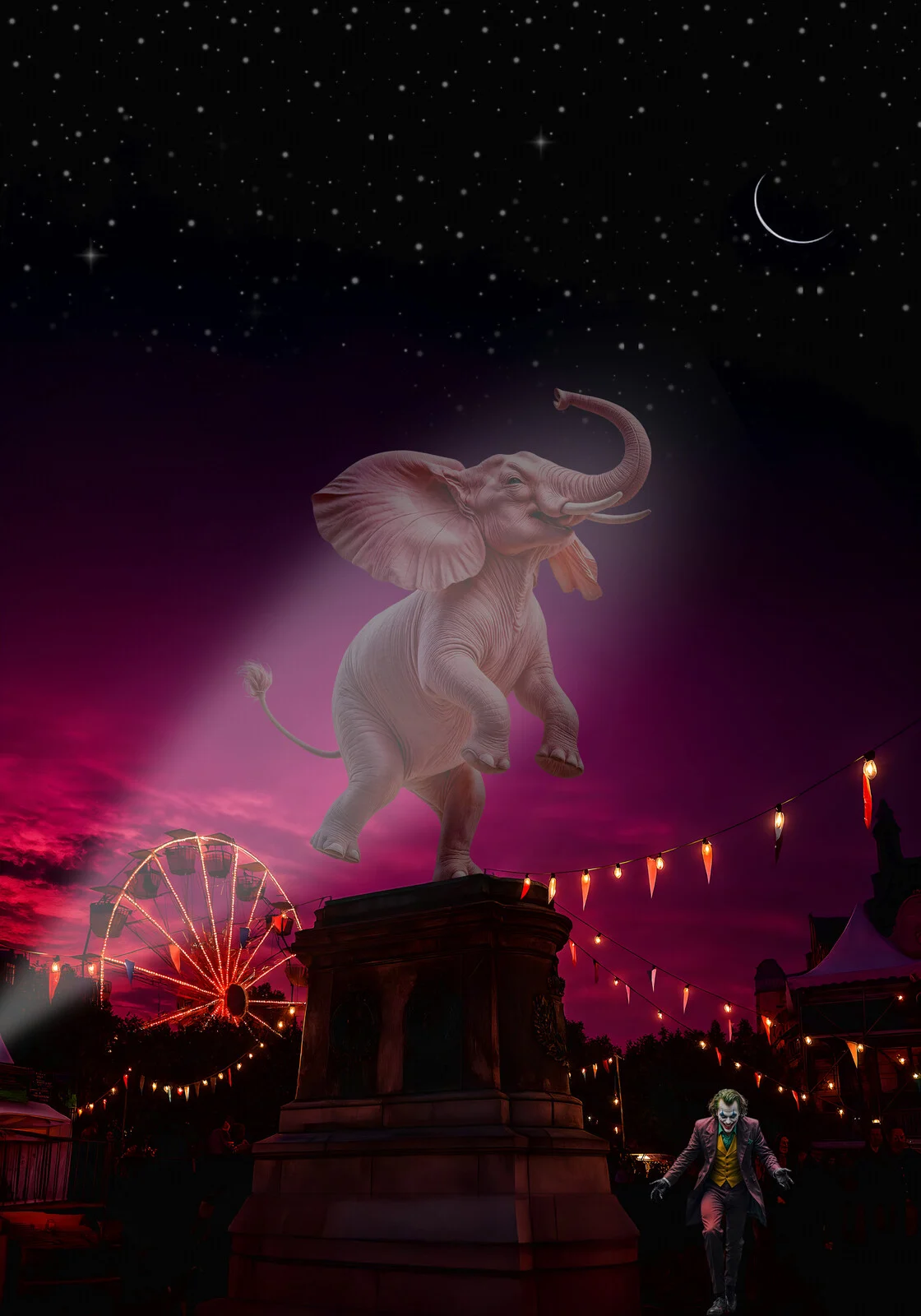
The Big Pink Celebration, 2024
Digital
50 x 70 cm
3 200 kr
The Big Pink Celebration
In every city, there comes a moment when history takes an unexpected turn—when the stiff monuments of the past yield to symbols of something entirely different. In Malmö, that moment arrived most spectacularly: with the unveiling of a bright pink elephant in the centre of Stortorget. What began as a controversial donation turned into a festival of colours, laughter, and chaos—a civic spectacle where history, politics, and absurdity collided in the most flamboyant way possible.
This is more than just a story about a statue. It is a tale of changing times, challenging tradition, and the odd, unpredictable ways in which society reinvents itself. It also touches on pink elephants, those curious creatures of folklore and intoxication, and the cultural meanings we assign to colour, celebration, and public memory. And yes, it is also a story about Malmö, a city that has long danced between history and reinvention, now with a cheerful elephant at its centre.
Let’s begin with the day Malmö changed forever.
“Ode to the Pink Colossus
Behold the beast in blushing tones,
With polished trunk and metal bones.
No sword, no crown, no warlike grin—
Just bubblegum hide and a jubilant chin.
Once, kings on horses ruled this square,
With a stern-faced glare and an iron stare.
But now, dear Malmö, rejoice and sing,
For tyranny fell… to a pastel thing.
No steely steed, no history’s yoke,
Just wobbly legs in a millennial pink cloak.
An elephant stands where monarchs fell—
And tourists arrive with Instagram to tell.
Some called it madness, others art,
Some claimed it shattered the civic heart.
Yet wallets were happy, and councils were keen,
To trade royal gloom for a carnival scene.
So drink to the future, in rosé and gin,
To pachyderms ruling where despots had been.
If chaos is sovereign, then long may it reign—
In cities of colour… and elephants vain.”
Malmö July 2025
The Big Pink Celebration
As the image shows, a festive atmosphere prevailed when the city’s new, unexpected statue was unveiled with great pomp and circumstance. It was a moment that caught everyone off guard, like a surprise party thrown a whole month before Malmö’s grand August festival. Everyone was there, it’s safe to say, and people had come from all over the world, including a returning visitor with greenish hair, who was rumoured to be a distant relative of the statue's donor and had dyed his hair in celebration.
A generous donation from an anonymous benefactor made it possible. At last, Malmö removed the much-hated statue of Karl X Gustav, who for too long had dominated the city’s most important square. The statue of Karl X Gustav, a controversial figure in Swedish history, served as a constant reminder of the city's past struggles and was a subject of heated debate among residents. Its removal was a significant moment, a turning point in the city's history.
The replacement statue may not have been the city council’s first choice, but what can you do when money talks? Not only did the donor pay for the new statue—an insignificant amount in this context— but also contributed 666 million SEK to be freely used for beautifying the city centre: an enormous sum, roughly a third of the city’s annual expenditure on culture and leisure.
Although the donation was made anonymously, it was entirely public, so such a gift could not be ignored. Many political experts considered the claim that the choice of statue was non-negotiable to be weak. A cheerful pink elephant! This choice sparked a heated debate, with some finding it unacceptable and others seeing it as a potential tourist attraction. The unexpectedness of the choice added a layer of shock and amusement to the debate. “A boost for our strained economy,” said the opposition councillor. He was colour-blind, so it made no difference to him. He suffered from protanopia, red-blindness, and in his view, pink appears as a dull grey, brown, or beige shade. Pale pink shades like the upcoming statue could almost vanish and blend into the background, so in daylight, he only saw the pedestal. Nevertheless, he saw the king on horseback every day on his way to work. A curious reflection on how colour blindness sometimes affects political decisions more than anyone cares to admit.
“The donation will brighten up an otherwise rather grey square, but most importantly, the city’s bottom line,” said the opposition councillor, who was initially against the donation but eventually saw its potential benefits. His initial opposition sparked a healthy debate, and his eventual support was crucial in swaying a clear majority to vote in favour of accepting the donation.
Naturally, politicians, the media, and parts of the public speculated about the nature of the money involved. The fact that the gift was paid in Bitcoin was unusual, but if you want to remain anonymous, that's what you would do. According to “reliable sources” within the city administration—meaning vaguely informed but overly enthusiastic insiders who have a knack for uncovering secrets—the money came from a man who is not a Malmö local but rather someone who embraces the philosophy of chaos and despises societal norms.
The official at City Hall was given strict instructions to convert the funds into Swedish kronor as quickly as possible. Being somewhat speculative by nature, he managed to raise the donation from 666 million to 701 million, which also felt more appropriate. The number 666 is traditionally considered the “Number of the Beast” according to Revelation 13:18 in the New Testament, a reference to a figure associated with evil in Christian theology. The decision to increase the donation amount was a symbolic gesture to distance the gift from any negative connotations.
This benefactor views the world as an absurd spectacle where rules, morals, and order are hypocritical—a thin veneer that readily cracks. For this individual, society's laws are laughable, all authorities are corrupt, and human civilisation is a facade built on self-deception. He believes that deep down, everyone is just as crazy as he is—you just have to push someone far enough. His vision is of a world without rules, where chaos rules and everyone reveals their true selves. A pink elephant symbolises this worldview. Since I disliked the old statue and have nothing particular against elephants—on the contrary, they are wise creatures—I decided to keep this information to myself. Still do. The pink elephant, in this context, represents the absurdity and chaos that the benefactor believes underlie society, and the statue serves as a provocative symbol of this worldview.
We all have our heroes, and what could be more meaningful than sitting quietly on a bench by a pond and admiring the monument erected in honour of one of them? Especially if the hero isn't a retired king infamous for his wars and cruelties. That sort is far too common in urban spaces. Instead, imagine a hero that is as rare and delightful as a pink elephant, shaped and coloured for the enjoyment of others.
Pink elephants, those whimsical creatures of inebriated imagination, have pirouetted through folklore, literature, and intoxicated minds for centuries. But what is the origin of these rosy pachyderms, and why do they haunt the corridors of drunken reverie with such persistent vibrancy? Let's embark on a journey of discovery, exploring the rich cultural and historical tapestry and unravelling the mystique behind these delightful yet elusive creatures.
Let's delve into the vibrant tapestry of history and uncover the mystery behind these charming yet enigmatic creatures.
The story of pink elephants dates back to ancient times, when early cultures told tales of mythical beings and fantastical encounters. In Indian folklore, the elephant symbolised wisdom, strength, and prosperity, revered as a sacred creature. However, it wasn't until recent times, with the rise of alcohol-fueled celebrations, that these noble animals adopted a new, more whimsical appearance.
Fast forward to the roaring twenties, an era of decadence, excess, and secret speakeasies. It was here, amidst the clinking of glasses and the swirling jazz, that the pink elephant made its grand entrance into popular culture. As drinks flowed freely and inhibitions faded like morning dew, revellers started to report sightings of these fantastical creatures cavorting amongst the alcohol-induced clouds of euphoria.
But why pink, you might ask? Some speculate that the hue's association with femininity and whimsy makes it ideal for these enchanting apparitions. Others suggest that the rosy tint was merely a side effect of overindulgence, a hallucinatory flourish in the kaleidoscope of intoxication.
Regardless of its origins, the pink elephant swiftly became a symbol of the hallucinations and delirium tremens experienced by those who drank excessively. It acted as a humorous shorthand for the absurdity of drunkenness, serving as a playful reminder that even the most sober-minded among us can fall prey to the unpredictable whims of intoxication.
Over time, the pink elephant has become a fixture in popular culture, appearing in literature, film, and art as a symbol of drunken revelry and surreal absurdity. From Disney's iconic 'Dumbo' to Salvador Dalí's surrealist masterpieces, the pink elephant has left an indelible mark on the collective imagination, entertaining and intriguing us with its whimsical presence.
But perhaps the most enduring legacy of the pink elephant is its role as a cautionary tale, a whimsical reminder of the dangers of excess and the unpredictability of the human mind under the influence of alcohol. So, the next time you raise a glass in celebration, take a moment to reflect on the elusive pink pachyderm and its fantastical world. After all, in a world where reality often feels stranger than fiction, who's to say that pink elephants aren't real? Cheers to that!
In the kaleidoscope of colours that adorn the tapestry of history, one hue stands out like a bashful debutante at a ball: pink. Oh, the tales it could tell, the scandals it has witnessed, and the transformations it has undergone!
Let us embark on a whimsical journey through the history of time, where pink appears as a central figure in the remarkable story of human civilisation. From the ancient cultures that revered the colour to the modern interpretations of its symbolism, the story of pink is as vibrant and varied as the hues it represents. Therefore, the statue on Stortorget looks notably forward-thinking.
Jörgen Thornberg
The Big Pink Celebration, 2024
Digital
50 x 70 cm
3 200 kr
The Big Pink Celebration
In every city, there comes a moment when history takes an unexpected turn—when the stiff monuments of the past yield to symbols of something entirely different. In Malmö, that moment arrived most spectacularly: with the unveiling of a bright pink elephant in the centre of Stortorget. What began as a controversial donation turned into a festival of colours, laughter, and chaos—a civic spectacle where history, politics, and absurdity collided in the most flamboyant way possible.
This is more than just a story about a statue. It is a tale of changing times, challenging tradition, and the odd, unpredictable ways in which society reinvents itself. It also touches on pink elephants, those curious creatures of folklore and intoxication, and the cultural meanings we assign to colour, celebration, and public memory. And yes, it is also a story about Malmö, a city that has long danced between history and reinvention, now with a cheerful elephant at its centre.
Let’s begin with the day Malmö changed forever.
“Ode to the Pink Colossus
Behold the beast in blushing tones,
With polished trunk and metal bones.
No sword, no crown, no warlike grin—
Just bubblegum hide and a jubilant chin.
Once, kings on horses ruled this square,
With a stern-faced glare and an iron stare.
But now, dear Malmö, rejoice and sing,
For tyranny fell… to a pastel thing.
No steely steed, no history’s yoke,
Just wobbly legs in a millennial pink cloak.
An elephant stands where monarchs fell—
And tourists arrive with Instagram to tell.
Some called it madness, others art,
Some claimed it shattered the civic heart.
Yet wallets were happy, and councils were keen,
To trade royal gloom for a carnival scene.
So drink to the future, in rosé and gin,
To pachyderms ruling where despots had been.
If chaos is sovereign, then long may it reign—
In cities of colour… and elephants vain.”
Malmö July 2025
The Big Pink Celebration
As the image shows, a festive atmosphere prevailed when the city’s new, unexpected statue was unveiled with great pomp and circumstance. It was a moment that caught everyone off guard, like a surprise party thrown a whole month before Malmö’s grand August festival. Everyone was there, it’s safe to say, and people had come from all over the world, including a returning visitor with greenish hair, who was rumoured to be a distant relative of the statue's donor and had dyed his hair in celebration.
A generous donation from an anonymous benefactor made it possible. At last, Malmö removed the much-hated statue of Karl X Gustav, who for too long had dominated the city’s most important square. The statue of Karl X Gustav, a controversial figure in Swedish history, served as a constant reminder of the city's past struggles and was a subject of heated debate among residents. Its removal was a significant moment, a turning point in the city's history.
The replacement statue may not have been the city council’s first choice, but what can you do when money talks? Not only did the donor pay for the new statue—an insignificant amount in this context— but also contributed 666 million SEK to be freely used for beautifying the city centre: an enormous sum, roughly a third of the city’s annual expenditure on culture and leisure.
Although the donation was made anonymously, it was entirely public, so such a gift could not be ignored. Many political experts considered the claim that the choice of statue was non-negotiable to be weak. A cheerful pink elephant! This choice sparked a heated debate, with some finding it unacceptable and others seeing it as a potential tourist attraction. The unexpectedness of the choice added a layer of shock and amusement to the debate. “A boost for our strained economy,” said the opposition councillor. He was colour-blind, so it made no difference to him. He suffered from protanopia, red-blindness, and in his view, pink appears as a dull grey, brown, or beige shade. Pale pink shades like the upcoming statue could almost vanish and blend into the background, so in daylight, he only saw the pedestal. Nevertheless, he saw the king on horseback every day on his way to work. A curious reflection on how colour blindness sometimes affects political decisions more than anyone cares to admit.
“The donation will brighten up an otherwise rather grey square, but most importantly, the city’s bottom line,” said the opposition councillor, who was initially against the donation but eventually saw its potential benefits. His initial opposition sparked a healthy debate, and his eventual support was crucial in swaying a clear majority to vote in favour of accepting the donation.
Naturally, politicians, the media, and parts of the public speculated about the nature of the money involved. The fact that the gift was paid in Bitcoin was unusual, but if you want to remain anonymous, that's what you would do. According to “reliable sources” within the city administration—meaning vaguely informed but overly enthusiastic insiders who have a knack for uncovering secrets—the money came from a man who is not a Malmö local but rather someone who embraces the philosophy of chaos and despises societal norms.
The official at City Hall was given strict instructions to convert the funds into Swedish kronor as quickly as possible. Being somewhat speculative by nature, he managed to raise the donation from 666 million to 701 million, which also felt more appropriate. The number 666 is traditionally considered the “Number of the Beast” according to Revelation 13:18 in the New Testament, a reference to a figure associated with evil in Christian theology. The decision to increase the donation amount was a symbolic gesture to distance the gift from any negative connotations.
This benefactor views the world as an absurd spectacle where rules, morals, and order are hypocritical—a thin veneer that readily cracks. For this individual, society's laws are laughable, all authorities are corrupt, and human civilisation is a facade built on self-deception. He believes that deep down, everyone is just as crazy as he is—you just have to push someone far enough. His vision is of a world without rules, where chaos rules and everyone reveals their true selves. A pink elephant symbolises this worldview. Since I disliked the old statue and have nothing particular against elephants—on the contrary, they are wise creatures—I decided to keep this information to myself. Still do. The pink elephant, in this context, represents the absurdity and chaos that the benefactor believes underlie society, and the statue serves as a provocative symbol of this worldview.
We all have our heroes, and what could be more meaningful than sitting quietly on a bench by a pond and admiring the monument erected in honour of one of them? Especially if the hero isn't a retired king infamous for his wars and cruelties. That sort is far too common in urban spaces. Instead, imagine a hero that is as rare and delightful as a pink elephant, shaped and coloured for the enjoyment of others.
Pink elephants, those whimsical creatures of inebriated imagination, have pirouetted through folklore, literature, and intoxicated minds for centuries. But what is the origin of these rosy pachyderms, and why do they haunt the corridors of drunken reverie with such persistent vibrancy? Let's embark on a journey of discovery, exploring the rich cultural and historical tapestry and unravelling the mystique behind these delightful yet elusive creatures.
Let's delve into the vibrant tapestry of history and uncover the mystery behind these charming yet enigmatic creatures.
The story of pink elephants dates back to ancient times, when early cultures told tales of mythical beings and fantastical encounters. In Indian folklore, the elephant symbolised wisdom, strength, and prosperity, revered as a sacred creature. However, it wasn't until recent times, with the rise of alcohol-fueled celebrations, that these noble animals adopted a new, more whimsical appearance.
Fast forward to the roaring twenties, an era of decadence, excess, and secret speakeasies. It was here, amidst the clinking of glasses and the swirling jazz, that the pink elephant made its grand entrance into popular culture. As drinks flowed freely and inhibitions faded like morning dew, revellers started to report sightings of these fantastical creatures cavorting amongst the alcohol-induced clouds of euphoria.
But why pink, you might ask? Some speculate that the hue's association with femininity and whimsy makes it ideal for these enchanting apparitions. Others suggest that the rosy tint was merely a side effect of overindulgence, a hallucinatory flourish in the kaleidoscope of intoxication.
Regardless of its origins, the pink elephant swiftly became a symbol of the hallucinations and delirium tremens experienced by those who drank excessively. It acted as a humorous shorthand for the absurdity of drunkenness, serving as a playful reminder that even the most sober-minded among us can fall prey to the unpredictable whims of intoxication.
Over time, the pink elephant has become a fixture in popular culture, appearing in literature, film, and art as a symbol of drunken revelry and surreal absurdity. From Disney's iconic 'Dumbo' to Salvador Dalí's surrealist masterpieces, the pink elephant has left an indelible mark on the collective imagination, entertaining and intriguing us with its whimsical presence.
But perhaps the most enduring legacy of the pink elephant is its role as a cautionary tale, a whimsical reminder of the dangers of excess and the unpredictability of the human mind under the influence of alcohol. So, the next time you raise a glass in celebration, take a moment to reflect on the elusive pink pachyderm and its fantastical world. After all, in a world where reality often feels stranger than fiction, who's to say that pink elephants aren't real? Cheers to that!
In the kaleidoscope of colours that adorn the tapestry of history, one hue stands out like a bashful debutante at a ball: pink. Oh, the tales it could tell, the scandals it has witnessed, and the transformations it has undergone!
Let us embark on a whimsical journey through the history of time, where pink appears as a central figure in the remarkable story of human civilisation. From the ancient cultures that revered the colour to the modern interpretations of its symbolism, the story of pink is as vibrant and varied as the hues it represents. Therefore, the statue on Stortorget looks notably forward-thinking.
3 200 kr

Jörgen Thornberg
Malmö
Lite om bilder och mig. Translation in English at the end.
Jag är en nyfiken person som ser allt i bilder, även det jag fäster i ord, gärna tillsammans för bakom alla mina bilder finns en berättelse. Till vissa bilder hör en kortare eller längre novell som följer med bilden.
Bilder berättar historier. Jag omges av naturlig skönhet, intressanta människor och historia var jag än går. Jag använder min kamera för att dokumentera världen och blanda det jag ser med vad jag känner för att fånga den dolda magin.
Mina bilder berättar mina historier. Genom mina bilder, tryck och berättelser. Jag bjuder in dig att ta del av dessa berättelser, in i ditt liv och hem och dela min mycket personliga syn på vår värld. Mer än vad ögat ser. Jag tänker i bilder, drömmer och skriver och pratar om dem; följaktligen måste jag också skapa bilder. De blir vad jag ser, inte nödvändigtvis begränsade till verkligheten. Det finns en bild runt varje hörn. Jag hoppas att du kommer att se vad jag såg och gilla det.
Jag är också en skrivande person och till många bilder hör en kortare eller längre essay. Den följer med tavlan, tryckt på fint papper och med en personlig hälsning från mig.
Flertalet bilder startar sin resa i min kamera. Enkelt förklarat beskriver jag bilden jag ser i mitt inre, upplevd eller fantiserad. Bilden uppstår inom mig redan innan jag fått okularet till ögat. På bråkdelen av ett ögonblick ser jag vad jag vill ha och vad som kan göras med bilden. Här skall jag stoppa in en giraff, stålmannen, Titanic eller vad det är min fantasi finner ut. Ännu märkligare är att jag kommer ihåg minnesbilden långt efteråt när det blir tid att skapa verket. Om jag lyckas eller inte, är upp till betraktaren, oftast präglat av en stråk av svart humor – meningen är att man skall bli underhållen. Mina bilder blir ofta en snackis där de hänger.
Jag föredrar bilder som förmedlar ett budskap i flera lager. Vid första anblicken fylld av feel-good, en vacker utsikt, fint väder, solen skiner, blommor på ängen eller vattnet som ligger förrädiskt spegelblankt. I en sådan bild kan jag gömma min egentliga berättelse, mitt förakt för förtryckare och våldsverkare, rasister och fördomsfulla människor - ett gärna återkommande motiv mer eller mindre dolt i det vackra motivet. Jag försöker förena dem i ett gemensamt narrativ.
Bild och formgivning har löpt som en röd tråd genom livet. Fotokonst känns som en värdig final som jag gärna delar med mig.
Min genre är vid som framgår av mina bilder, temat en blandning av pop- och gatukonst i kollage som kan bestå av hundratals lager. Vissa bilder kan ta veckor, andra någon dag innan det är dags att överlämna resultatet till printverkstaden. Fine Art Prints är digitala fotocollage. I dessa kollage sker rivandet, klippandet, pusslandet, målandet, ritandet och sprayningen digitalt. Det jag monterar in kan vara hundratals år gamla bilder som jag omsorgsfullt frilägger så att de ser ut att vara en del av tavlan men också bilder skapade av mig själv efter min egen fantasi. Därefter besöks printstudion och för vissa bilder numrera en limiterad upplaga (oftast 7 exemplar) och signera för hand. Vissa bilder kan köpas i olika format. Det är bara att fråga efter vilka. Gillar man en bild som är 70x100 men inte har plats på väggen, går den kanske att få i 50x70 cm istället. Frågan är fri.
Metoden Giclée eller Fine Art Print som det också kallas är det moderna sättet för framställning av grafisk konst. Villkoret för denna typ av utskrifter är att en högkvalitativ storformatskrivare används med åldersbeständigt färgpigment och konstnärspapper eller i förekommande fall på duk. Pappret som används möter de krav på livslängd som ställs av museer och gallerier. Normalt säljer jag mina bilder oinramade så att den nya ägaren själv kan bestämma hur de skall se ut, med eller utan passepartout färg på ram, med eller utan glas etc..
Under många år ställde jag bara ut på nätet, i valda grupper och på min egen Facebooksida - https://www.facebook.com/jorgen.thornberg.9
Jag finns också på en egen hemsida som tyvärr inte alltid är uppdaterad – https://www.jth.life/ Där kan du också läsa en del av de berättelser som följer med bilden.
UTSTÄLLNINGAR
Luftkastellet, oktober 2022
Konst i Lund, november 2022
Luftkastellet, mars 2023
Engleson Galleri Caroli, april 2023
Hydra, Greece June 2023
Engleson Galleri Caroli, oktober 2023
Toppen, Höllviken december 2023
Luftkastellet, mars 2024
Torups Galleri, mars 2024
Venice, May 2024
Luftkastellet, oktober 2024
Konst i Advent, December 2024
Galleri Engleson, Caroli December 2024
Jäger & Jansson Galleri, april 2025
A bit about pictures and me.
I'm a curious person who sees everything in pictures, even what I express in words, often combining them, for behind all my pictures lies a story. These narratives, some as short as a single image and others as long as a novel, are the heart and soul of my work.
Pictures tell stories. Wherever I go, I'm surrounded by natural beauty, exciting people, and history. I use my camera to document the world and blend what I see with what I feel to capture the hidden magic.
My images tell my stories. Through my pictures, prints, and narratives, I invite you to partake in these stories in your life and home and share my deeply personal perspective of our world. More than meets the eye. I think in pictures, dream, write, and talk about them; consequently, I must create images too. They become what I see, not necessarily confined to reality. There's a picture around every corner. I hope you'll see what I saw and enjoy it.
I'm also a writer, and many images come with a shorter or longer essay. It accompanies the painting, printed on fine paper with my personal greeting.
Many pictures start their journey on my camera. Simply put, I describe the image I see in my mind, experienced or imagined. The image arises within me even before I bring the eyepiece to my eye. In a fraction of a moment, I see what I want and what can be done with the picture. Here, I'll insert a giraffe, Superman, the Titanic, or whatever my imagination conjures up. Even stranger is that I remember the mental image long after it's time to create the work. Whether I succeed is up to the observer, often imbued with a streak of black humour – the aim is to entertain. My pictures usually become a talking point wherever they hang.
I prefer pictures that convey a message in multiple layers. At first glance, they're filled with feel-good vibes, a beautiful view, lovely weather, the sun shining, flowers in the meadow, or the water lying deceptively calm. But beneath this surface beauty, I often conceal a deeper story, a narrative that challenges societal norms or explores the human condition. I invite you to delve into these hidden narratives and discover the layers of meaning within my work.
Picture and design have been a thread running through my life. Photographic art feels like a fitting finale, and I'm happy to share it.
My genre is varied, as seen in my pictures; the theme is a blend of pop and street art in collages that can consist of hundreds of layers. Some images can take weeks, others just a day before it's time to hand over the result to the print workshop. Fine Art Prints are digital photo collages. In these collages, tearing, cutting, puzzling, painting, drawing, and spraying happen digitally. What I insert can be images hundreds of years old that I carefully extract so they appear to be part of the painting, but also images created by myself, now also generated from my imagination. Next, visit the print studio and, for certain images, number a limited edition (usually 7 copies) and sign them by hand. Some images may be available in other formats. Just ask which ones. If you like an image that's 70x100 but doesn't have space on the wall, you might be able to get it in 50x70 cm instead. The question is open.
The Giclée method, or Fine Art Print as it's also called, is the modern way of producing graphic art. This method ensures the highest quality and longevity of the artwork, using a high-quality large-format printer with archival pigment inks and artist paper or, in some cases, canvas. The paper used meets the longevity requirements set by museums and galleries. I sell my pictures unframed, allowing the new owner to personalise their artwork, confident in the lasting value and quality of the piece.
For many years, I only exhibited online, in selected groups, and on my Facebook page - https://www.facebook.com/jorgen.thornberg.9. I also have my website, which unfortunately is not constantly updated - https://www.jth.life/. You can also read some of the stories accompanying the pictures there.
EXHIBITIONS
Luftkastellet, October 2022
Art in Lund, November 2022
Luftkastellet, March 2023
Engleson Gallery Caroli, April 2023
Hydra, Greece June 2023
Engleson Gallery Caroli, October 2023
Toppen, Höllviken December 2023
Luftkastellet, March 2024
Torup Gallery, March 2024
Venice, May 2024
UTSTÄLLNINGAR
Luftkastellet, oktober 2022
Konst i Lund, november 2022
Luftkastellet, mars 2023
Engleson Galleri Caroli, april 2023
Hydra, Greece June 2023
Engleson Galleri Caroli, oktober 2023
Toppen, Höllviken december 2023
Luftkastellet, mars 2024
Torups Galleri, mars 2024
Venice, May 2024
Luftkastellet, October 2024
Konst i Advent, December 2024
Galleri Engleson, Caroli December 2024
Jäger & Jansson Galleri, April 2025
Utbildning
Autodidakt
Medlem i konstnärsförening
Öppna Sinnen
Med i konstrunda
Konstrundan i Skåne
Utställningar
Luftkastellet, October 2022
Art in Lund, November 2022
Luftkastellet, March 2023
Engleson Gallery Caroli, April 2023
Hydra, Greece June 2023
Engleson Gallery Caroli, October 2023
Toppen, Höllviken December 2023
Luftkastellet, March 2024
Torup Gallery, March 2024
Venice, May 2024