Vi använder cookies för att ge dig bästa möjliga upplevelse. Välj vilka cookies du tillåter.
Läs mer i vår integritetspolicy
Jörgen Thornberg
Put One’s Foot Down – Att sätta ner foten, 2025
Digital
70 x 70 cm
3 500 kr
Put One’s Foot Down – Att sätta ner foten
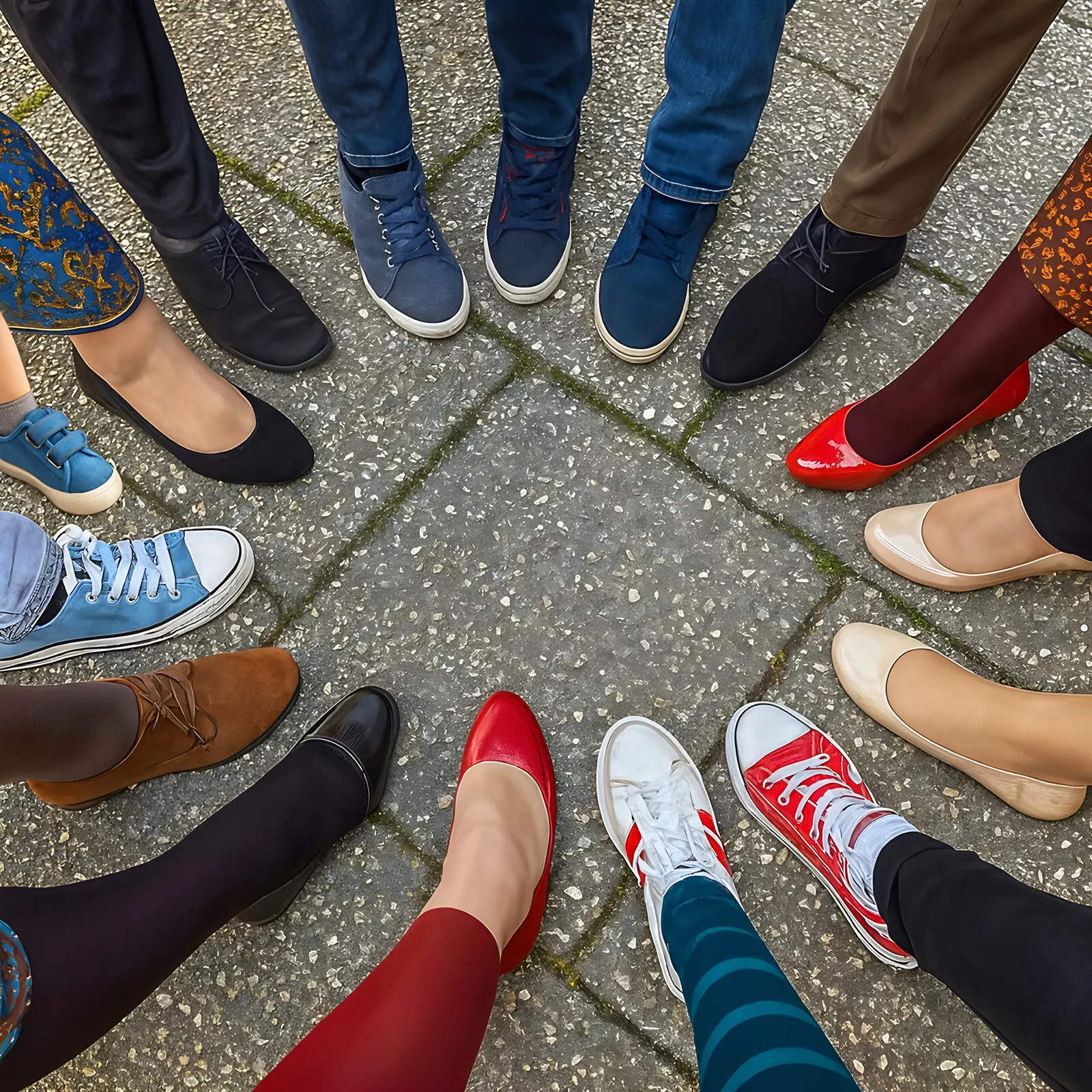
A diverse circle of shoes. Large, small, worn, elegant. Each pair carries a unique story. Someone danced in them. Someone fled. Someone walked to their first job. Another marched to war. Each pair is a testament to the human experience.
And in the midst of it all— a small child’s foot. A blue, scuffed shoe. A step forward, or perhaps a step away. Yet, in its smallness, it carries a courage that inspires.
To put one’s foot down – in many languages, it’s an expression for speaking out, drawing a line, or protesting—a clear gesture, both physical and spiritual. And as so often in language, movement is linked to power: those expected to march in step must also have the right to say no, at least in a democracy.
But what happens when the one putting their foot down is small? Or barefoot? What happens when it’s no longer about power, but about courage?
In this essay, we trace the footsteps of those who put their foot down. Not to move forward, but to stop. Not to follow, but to say: “This far – and no further.”
“Feet That Would Not Flee
— a poem about standing ground
They weren’t made for running—
these feet in worn-out soles.
Not for leaping fences,
or skimming polished goals.
They were shaped by gravel silence,
by streetlight’s cold regret,
by choosing not to follow
the path they never met.
One foot down, the other waiting—
a heartbeat in the dust.
No army boots, no ballet shoes,
just quiet, stubborn trust.
They’ve paused on courtroom marble,
on a playground rubber ground.
They’ve tapped in whispered protest
without a single sound.
A heel can stop an empire,
a toe refuse a tide.
Even barefoot in the doorway,
a foot can turn the tide.
So mark the earth with courage.
Let power pace and frown.
You don’t need boots to matter—
just feet that won’t back down.”
Malmö July 2025
Put One’s Foot Down – Att sätta ner foten
A circle of shoes – and a small act of defiance. Red heels, worn trainers, velvet-soft suede and patent leather. All have stepped down in a quiet yet firm protest. A no. That’s enough. A here but no longer! That is the message. These seemingly insignificant acts convey a powerful message of empowerment, demonstrating that even the smallest voice can make a significant difference. It's a testament to the power of small acts of resistance, showing that every individual has the potential to make a difference. Let these acts inspire you to take a stand, no matter how small it may seem.
Amidst the sea of adult feet, a small child’s shoe stands out, scuffed at the toe. It is not there by chance, but boldly proclaims: “I see what you’re doing – and I think you should stop.” This seemingly insignificant act of a child's defiance is a powerful symbol of resistance. It's a testament to the courage that even the smallest among us can muster, inspiring us with their bravery. Their courage serves as a beacon of inspiration, reminding us that we, too, can make a stand.
To say no, no particular shoe size is required—only courage. This act is not limited by age, gender, or any other factor. It is a universal right and a universal responsibility, one that we all share, making us part of a global movement for change. This movement is not bound by any specific criteria, but is a right and responsibility that we all share, transcending age, gender, or any other factor. You are part of this movement, and your voice matters. By recognizing this, you can find the courage to stand your ground and make a difference, no matter how small it may seem.
On Resistance, Boundaries, and the Right to Speak Up
To put one’s foot down. It sounds simple—a motion we make every day, thousands of times, without thinking. But the expression “to put one’s foot down” bears a weight far beyond its literal step. It is an act that marks boundaries, determination, and civil courage—a physical metaphor for something deeply human: the need to stand up for oneself or others.
The phrase probably developed independently in various languages, originating from the body’s role in nonverbal communication. The foot, as a tool for this communication, indicates a sudden stop, a line being drawn, or a change in stance: no further movement. Etymologically, it is linked with expressions like 'to take a stand,' 'to draw a line,' or 'to stamp one’s authority' – but in this case, the body itself becomes the tool. Not the sword, not the statute – but the foot.
And it is also a visual gesture. We imagine a person hesitating, listening, wavering – then suddenly stopping, firmly and definitively. The one who puts their foot down doesn’t merely reject – they accept responsibility. Someone must be the first to say no. Someone must dare to remain in place.
That is what this image shows. A circle of feet – all different, yet united in a shared gesture. And in the upper left corner, a child’s shoe, belonging to a three- or four-year-old, gently placed but entirely deliberate. This image is a powerful reminder that even children have the right to say no. Their small but significant actions can inspire change, especially when adults forget to listen.
The phrase 'to put one’s foot down' is not unique to Swedish. English has its direct equivalent. German uses 'den Fuß auf den Boden setzen'; French, 'poser le pied ferme' — to place the foot firmly. The image recurs across cultures where the foot, the step, and contact with the ground symbolise intent, protest, or self-assertion. In many African languages, similar expressions are linked to ritual dances, where a stomp signals refusal or calls upon ancestral powers. In Hindi, 'pāon ṭhōknā' – to strike the foot – expresses defiance, anger, or resolve. These variations in different languages and cultures enrich the metaphor, providing a more comprehensive understanding of its significance.
In these cases, the gesture itself is rarely violent. It is not a fist, not a blow. It is a stance, often silent but physically unmistakable. When someone puts their foot down, a subtle earthquake runs through the conversation. Something shifts. And usually, it begins quietly – with a child’s little shoe, standing still, reminding us of the power of even the smallest act of resistance. This non-violent nature of the gesture reassures us that change can be peaceful, respectful, and hopeful. It's a powerful reminder that change can be achieved through peaceful and respectful means, without resorting to violence. Let this reassurance inspire you to stand up for what is right.
The circle of feet includes people of various genders, ages, and backgrounds. Some wear polished brogues, while others choose neon trainers. A pair of shiny red stilettos punctuates the silence like an exclamation mark. But amidst this variety, one thing stands out: a child’s foot in a blue canvas shoe, its edges frayed but firmly planted on the ground.
That tiny foot shifts the centre of gravity. It is a stance in itself – and a challenge to the adult world’s monopoly on judgment. What are we adults doing? Why should children wait to protest until they “know more,” pay taxes, and behave responsibly? More often than not, it’s the youngest who sees most clearly. The ones who haven’t yet learned to look away. The ones brave enough to ask the forbidden questions – or put their foot down, quite literally, when something feels wrong. Their perspective reminds us of the importance of listening and considering their views.
And that is why the foot is there—to remind us that even the smallest step can alter the course of those marching in unison.
Famous Footfalls – When a Step Changes Everything
We have many renowned and pivotal examples of people who stood their ground. Sometimes literally. Sometimes metaphorically. From the nonviolent protests led by Mahatma Gandhi in India to the Stonewall Riots in the United States, history is replete with instances of individuals and communities standing up against injustice.
Rosa Parks – Sitting Down to Stand Up
On December 1, 1955, in Montgomery, Alabama, Rosa Parks, with unwavering courage, refused to give up her seat on a bus to a white passenger. A seemingly small act – staying seated – yet a powerful stand against an unjust system. Her defiance, a testament to personal courage, became a catalyst for the American Civil Rights Movement.
Elin Wägner – Resistance in Ink
In 1909, Elin Wägner sat down at her typewriter and began writing about the women’s movement, pacifism, and environmentalism – long before we even had words for it. In doing so, she took a stand at a time when women had neither voting rights nor legal authority over their bodies. She co-founded Save the Children and fought for women's suffrage in Idun, as well as in novels and political texts. “Women must demand to be counted, not be invited in for dessert,” she said.
Greta Thunberg – A School Strike That Stirred the World
When Greta Thunberg, a young girl from Sweden, sat outside the Swedish parliament with a sign that read "School Strike for Climate," she was not just taking a stand against passivity, empty words, and future denial. She was igniting a global movement. Her actions inspired millions of young people worldwide to stand up for their future. Her powerful words at the United Nations were a clear example of defiance on a global stage in the 21st century. Her impact, born from a single step, is undeniably international, connecting people from all corners of the globe in a shared cause.
Malala Yousafzai – Speaking When Others Wanted Silence
When Malala defied the Taliban’s ban and went to school—and continued to speak out after being shot—she stood her ground for girls’ right to education. She chose words over silence—the pen over the gun.
Sophie Sager – Sweden’s Lace-Collared Rebel
Already in 1848 (!), Sophie Sager took a man to court for attempted rape—and won. At a time when women had no right even to manage their own money, she stood her ground, both publicly and legally. She wrote pamphlets, gave public lectures, and was called “insane” by the press, which, in hindsight, is almost always a good sign.
Mohandas Gandhi – Standing Still Before the Empire
Gandhi literally set his foot down in the sand on the Dandi coast in 1930 when he broke the British salt monopoly. His 24-day barefoot march became a peaceful yet resolute protest. His footsteps echoed through the corridors of the empire. Even Winston Churchill, it is said, had to pause before Gandhi’s bare foot.
Astrid Lindgren – Champion of Children, Critic of the State. This title encapsulates Lindgren's dual role as a defender of children's rights and a vocal critic of government policies that she deemed unjust or harmful to society.
Astrid Lindgren was a force to be reckoned with, standing up against corporal punishment, nuclear power, and tax injustice. Her satirical piece Pomperipossa in Monismanien made Finance Minister Gunnar Sträng sweat. She once said, “If children are allowed to be who they are, they’ll grow into people, too.” With Pippi Longstocking, she created a symbol of civil disobedience with braids – a girl who says no with laughter, strength, and a touch of anarchy. Her work not only inspired children to be themselves but also paved the way for significant changes in children's rights and social justice.
Harriet Tubman – Step by Step Towards Freedom
Tubman, a woman of unwavering determination, stood firm every time she returned to the American South to help enslaved people escape to freedom. She was small in stature, but her resolve was immense. Her steps through the forest were silent, but each footfall was a refusal of oppression and a declaration of freedom.
Gudrun Schyman – Lighting a Fire for Equality
When Gudrun Schyman set fire to 100,000 kronor in cash as a symbol of women’s lower lifetime earnings, she made her point with utmost clarity. This act was a part of her larger campaign to raise awareness about the gender pay gap and demand equal pay for women. The act sparked intense debate, but more importantly, it brought the issue of unequal pay to the forefront of public discourse, demonstrating the power of individual actions in igniting social change.
Socrates – The Standing Dissenter
In 399 BCE, Socrates was sentenced to death in Athens for “corrupting the youth” and “introducing new gods.” He could have saved himself by pleading for mercy. He did not. He refused to flee. He refused to compromise the truth. Instead, he sat calmly in his prison cell – and stood his ground for something greater than himself: the right to think freely, to question authority, to keep asking, to put one’s foot down.
His last words – “Crito, we owe a rooster to Asclepius” – show that he died in peace, perhaps even with irony. This statement, a reference to a traditional offering made to the god of healing, Asclepius, in gratitude for one's recovery from illness, is often interpreted as Socrates' belief in the immortality of the soul. He stood his ground and became an enduring symbol of intellectual integrity; his last words served as a testament to his unwavering commitment to his beliefs.
Antigone – A Defiant Sister Who Planted Her Foot on Her Brother’s Grave
In Sophocles’ tragedy, Antigone defies King Creon’s order not to bury her brother. She says, “I was not born to hate, but to love.”
Antigone's courage to break the law and stand up for what is morally right, even at the risk of death, makes her one of history’s first conscientious objectors. She doesn’t stand her ground in a courtroom but on dusty ground, across her brother’s corpse, a testament to her unwavering bravery.
Diogenes – Barefoot in His Barrel, But Firmly Grounded
The Cynic philosopher Diogenes was almost a caricature of stubbornness. He lived in a barrel, ate with his hands, urinated in public, and scorned all convention. When Alexander the Great visited him and asked, “Is there anything I can do for you?” Diogenes replied: “Yes – step aside, you’re blocking the sun.”
If anyone stood their ground against hypocrisy in antiquity, it was Diogenes. His resilience, depicted by his barefoot but firm stance, is a powerful reminder of the strength that comes from unwavering determination.
“Alea iacta est” – The Die Is Cast
Julius Caesar’s legendary phrase as he defied the Senate and crossed the Rubicon. To “cross the Rubicon” has since become a metaphor for making an irreversible decision, for taking a stand even if it leads to conflict, war, or ruin.
“Stare decisis” – To Stand by What Has Been Decided
A classic Latin legal principle, still in use today in standard legal systems. It means to uphold precedence – to stand firm and refuse to retreat.
We often say the world changes step by step. But sometimes, it takes just one step – one foot placed firmly at the right moment – instead of marching forward.
Someone refuses to follow the crowd and plants their foot where others merely rush past.
And perhaps that’s what the world needs now, more than ever. Not more people rushing ahead, but more people stopping. Saying: no. Not now. Not like this. Each stand we take, no matter how small, has the potential to make a significant impact.
So next time you find yourself standing there – in a meeting, at home, in the arc of history – and wondering whether it’s your turn to put your foot down, don’t hesitate.
Because the world won’t stop just because you do.
That’s when it might finally start moving.
Jörgen Thornberg
Put One’s Foot Down – Att sätta ner foten, 2025
Digital
70 x 70 cm
3 500 kr
Put One’s Foot Down – Att sätta ner foten
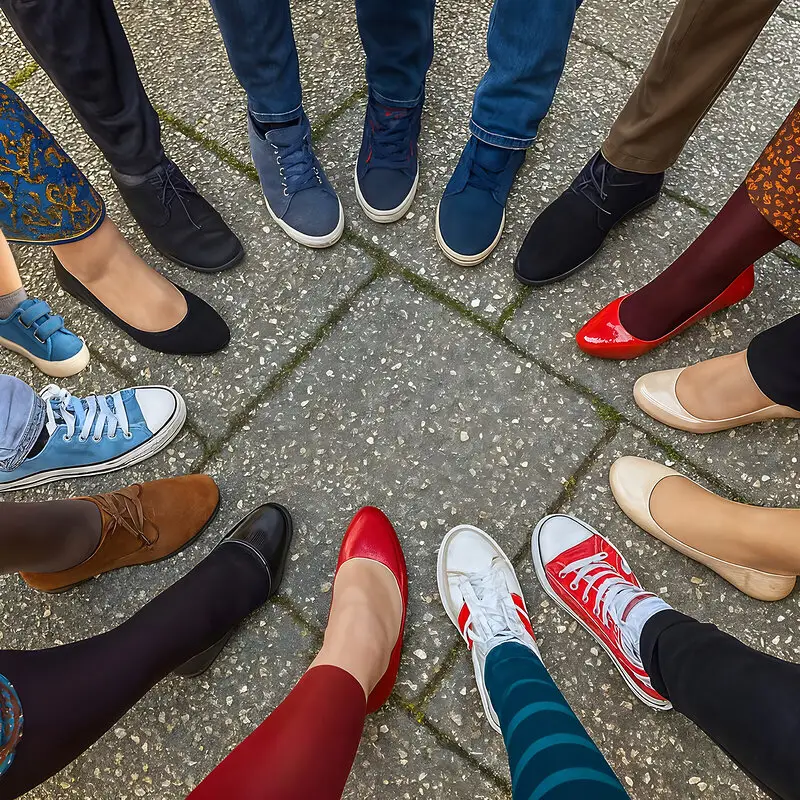
A diverse circle of shoes. Large, small, worn, elegant. Each pair carries a unique story. Someone danced in them. Someone fled. Someone walked to their first job. Another marched to war. Each pair is a testament to the human experience.
And in the midst of it all— a small child’s foot. A blue, scuffed shoe. A step forward, or perhaps a step away. Yet, in its smallness, it carries a courage that inspires.
To put one’s foot down – in many languages, it’s an expression for speaking out, drawing a line, or protesting—a clear gesture, both physical and spiritual. And as so often in language, movement is linked to power: those expected to march in step must also have the right to say no, at least in a democracy.
But what happens when the one putting their foot down is small? Or barefoot? What happens when it’s no longer about power, but about courage?
In this essay, we trace the footsteps of those who put their foot down. Not to move forward, but to stop. Not to follow, but to say: “This far – and no further.”
“Feet That Would Not Flee
— a poem about standing ground
They weren’t made for running—
these feet in worn-out soles.
Not for leaping fences,
or skimming polished goals.
They were shaped by gravel silence,
by streetlight’s cold regret,
by choosing not to follow
the path they never met.
One foot down, the other waiting—
a heartbeat in the dust.
No army boots, no ballet shoes,
just quiet, stubborn trust.
They’ve paused on courtroom marble,
on a playground rubber ground.
They’ve tapped in whispered protest
without a single sound.
A heel can stop an empire,
a toe refuse a tide.
Even barefoot in the doorway,
a foot can turn the tide.
So mark the earth with courage.
Let power pace and frown.
You don’t need boots to matter—
just feet that won’t back down.”
Malmö July 2025
Put One’s Foot Down – Att sätta ner foten
A circle of shoes – and a small act of defiance. Red heels, worn trainers, velvet-soft suede and patent leather. All have stepped down in a quiet yet firm protest. A no. That’s enough. A here but no longer! That is the message. These seemingly insignificant acts convey a powerful message of empowerment, demonstrating that even the smallest voice can make a significant difference. It's a testament to the power of small acts of resistance, showing that every individual has the potential to make a difference. Let these acts inspire you to take a stand, no matter how small it may seem.
Amidst the sea of adult feet, a small child’s shoe stands out, scuffed at the toe. It is not there by chance, but boldly proclaims: “I see what you’re doing – and I think you should stop.” This seemingly insignificant act of a child's defiance is a powerful symbol of resistance. It's a testament to the courage that even the smallest among us can muster, inspiring us with their bravery. Their courage serves as a beacon of inspiration, reminding us that we, too, can make a stand.
To say no, no particular shoe size is required—only courage. This act is not limited by age, gender, or any other factor. It is a universal right and a universal responsibility, one that we all share, making us part of a global movement for change. This movement is not bound by any specific criteria, but is a right and responsibility that we all share, transcending age, gender, or any other factor. You are part of this movement, and your voice matters. By recognizing this, you can find the courage to stand your ground and make a difference, no matter how small it may seem.
On Resistance, Boundaries, and the Right to Speak Up
To put one’s foot down. It sounds simple—a motion we make every day, thousands of times, without thinking. But the expression “to put one’s foot down” bears a weight far beyond its literal step. It is an act that marks boundaries, determination, and civil courage—a physical metaphor for something deeply human: the need to stand up for oneself or others.
The phrase probably developed independently in various languages, originating from the body’s role in nonverbal communication. The foot, as a tool for this communication, indicates a sudden stop, a line being drawn, or a change in stance: no further movement. Etymologically, it is linked with expressions like 'to take a stand,' 'to draw a line,' or 'to stamp one’s authority' – but in this case, the body itself becomes the tool. Not the sword, not the statute – but the foot.
And it is also a visual gesture. We imagine a person hesitating, listening, wavering – then suddenly stopping, firmly and definitively. The one who puts their foot down doesn’t merely reject – they accept responsibility. Someone must be the first to say no. Someone must dare to remain in place.
That is what this image shows. A circle of feet – all different, yet united in a shared gesture. And in the upper left corner, a child’s shoe, belonging to a three- or four-year-old, gently placed but entirely deliberate. This image is a powerful reminder that even children have the right to say no. Their small but significant actions can inspire change, especially when adults forget to listen.
The phrase 'to put one’s foot down' is not unique to Swedish. English has its direct equivalent. German uses 'den Fuß auf den Boden setzen'; French, 'poser le pied ferme' — to place the foot firmly. The image recurs across cultures where the foot, the step, and contact with the ground symbolise intent, protest, or self-assertion. In many African languages, similar expressions are linked to ritual dances, where a stomp signals refusal or calls upon ancestral powers. In Hindi, 'pāon ṭhōknā' – to strike the foot – expresses defiance, anger, or resolve. These variations in different languages and cultures enrich the metaphor, providing a more comprehensive understanding of its significance.
In these cases, the gesture itself is rarely violent. It is not a fist, not a blow. It is a stance, often silent but physically unmistakable. When someone puts their foot down, a subtle earthquake runs through the conversation. Something shifts. And usually, it begins quietly – with a child’s little shoe, standing still, reminding us of the power of even the smallest act of resistance. This non-violent nature of the gesture reassures us that change can be peaceful, respectful, and hopeful. It's a powerful reminder that change can be achieved through peaceful and respectful means, without resorting to violence. Let this reassurance inspire you to stand up for what is right.
The circle of feet includes people of various genders, ages, and backgrounds. Some wear polished brogues, while others choose neon trainers. A pair of shiny red stilettos punctuates the silence like an exclamation mark. But amidst this variety, one thing stands out: a child’s foot in a blue canvas shoe, its edges frayed but firmly planted on the ground.
That tiny foot shifts the centre of gravity. It is a stance in itself – and a challenge to the adult world’s monopoly on judgment. What are we adults doing? Why should children wait to protest until they “know more,” pay taxes, and behave responsibly? More often than not, it’s the youngest who sees most clearly. The ones who haven’t yet learned to look away. The ones brave enough to ask the forbidden questions – or put their foot down, quite literally, when something feels wrong. Their perspective reminds us of the importance of listening and considering their views.
And that is why the foot is there—to remind us that even the smallest step can alter the course of those marching in unison.
Famous Footfalls – When a Step Changes Everything
We have many renowned and pivotal examples of people who stood their ground. Sometimes literally. Sometimes metaphorically. From the nonviolent protests led by Mahatma Gandhi in India to the Stonewall Riots in the United States, history is replete with instances of individuals and communities standing up against injustice.
Rosa Parks – Sitting Down to Stand Up
On December 1, 1955, in Montgomery, Alabama, Rosa Parks, with unwavering courage, refused to give up her seat on a bus to a white passenger. A seemingly small act – staying seated – yet a powerful stand against an unjust system. Her defiance, a testament to personal courage, became a catalyst for the American Civil Rights Movement.
Elin Wägner – Resistance in Ink
In 1909, Elin Wägner sat down at her typewriter and began writing about the women’s movement, pacifism, and environmentalism – long before we even had words for it. In doing so, she took a stand at a time when women had neither voting rights nor legal authority over their bodies. She co-founded Save the Children and fought for women's suffrage in Idun, as well as in novels and political texts. “Women must demand to be counted, not be invited in for dessert,” she said.
Greta Thunberg – A School Strike That Stirred the World
When Greta Thunberg, a young girl from Sweden, sat outside the Swedish parliament with a sign that read "School Strike for Climate," she was not just taking a stand against passivity, empty words, and future denial. She was igniting a global movement. Her actions inspired millions of young people worldwide to stand up for their future. Her powerful words at the United Nations were a clear example of defiance on a global stage in the 21st century. Her impact, born from a single step, is undeniably international, connecting people from all corners of the globe in a shared cause.
Malala Yousafzai – Speaking When Others Wanted Silence
When Malala defied the Taliban’s ban and went to school—and continued to speak out after being shot—she stood her ground for girls’ right to education. She chose words over silence—the pen over the gun.
Sophie Sager – Sweden’s Lace-Collared Rebel
Already in 1848 (!), Sophie Sager took a man to court for attempted rape—and won. At a time when women had no right even to manage their own money, she stood her ground, both publicly and legally. She wrote pamphlets, gave public lectures, and was called “insane” by the press, which, in hindsight, is almost always a good sign.
Mohandas Gandhi – Standing Still Before the Empire
Gandhi literally set his foot down in the sand on the Dandi coast in 1930 when he broke the British salt monopoly. His 24-day barefoot march became a peaceful yet resolute protest. His footsteps echoed through the corridors of the empire. Even Winston Churchill, it is said, had to pause before Gandhi’s bare foot.
Astrid Lindgren – Champion of Children, Critic of the State. This title encapsulates Lindgren's dual role as a defender of children's rights and a vocal critic of government policies that she deemed unjust or harmful to society.
Astrid Lindgren was a force to be reckoned with, standing up against corporal punishment, nuclear power, and tax injustice. Her satirical piece Pomperipossa in Monismanien made Finance Minister Gunnar Sträng sweat. She once said, “If children are allowed to be who they are, they’ll grow into people, too.” With Pippi Longstocking, she created a symbol of civil disobedience with braids – a girl who says no with laughter, strength, and a touch of anarchy. Her work not only inspired children to be themselves but also paved the way for significant changes in children's rights and social justice.
Harriet Tubman – Step by Step Towards Freedom
Tubman, a woman of unwavering determination, stood firm every time she returned to the American South to help enslaved people escape to freedom. She was small in stature, but her resolve was immense. Her steps through the forest were silent, but each footfall was a refusal of oppression and a declaration of freedom.
Gudrun Schyman – Lighting a Fire for Equality
When Gudrun Schyman set fire to 100,000 kronor in cash as a symbol of women’s lower lifetime earnings, she made her point with utmost clarity. This act was a part of her larger campaign to raise awareness about the gender pay gap and demand equal pay for women. The act sparked intense debate, but more importantly, it brought the issue of unequal pay to the forefront of public discourse, demonstrating the power of individual actions in igniting social change.
Socrates – The Standing Dissenter
In 399 BCE, Socrates was sentenced to death in Athens for “corrupting the youth” and “introducing new gods.” He could have saved himself by pleading for mercy. He did not. He refused to flee. He refused to compromise the truth. Instead, he sat calmly in his prison cell – and stood his ground for something greater than himself: the right to think freely, to question authority, to keep asking, to put one’s foot down.
His last words – “Crito, we owe a rooster to Asclepius” – show that he died in peace, perhaps even with irony. This statement, a reference to a traditional offering made to the god of healing, Asclepius, in gratitude for one's recovery from illness, is often interpreted as Socrates' belief in the immortality of the soul. He stood his ground and became an enduring symbol of intellectual integrity; his last words served as a testament to his unwavering commitment to his beliefs.
Antigone – A Defiant Sister Who Planted Her Foot on Her Brother’s Grave
In Sophocles’ tragedy, Antigone defies King Creon’s order not to bury her brother. She says, “I was not born to hate, but to love.”
Antigone's courage to break the law and stand up for what is morally right, even at the risk of death, makes her one of history’s first conscientious objectors. She doesn’t stand her ground in a courtroom but on dusty ground, across her brother’s corpse, a testament to her unwavering bravery.
Diogenes – Barefoot in His Barrel, But Firmly Grounded
The Cynic philosopher Diogenes was almost a caricature of stubbornness. He lived in a barrel, ate with his hands, urinated in public, and scorned all convention. When Alexander the Great visited him and asked, “Is there anything I can do for you?” Diogenes replied: “Yes – step aside, you’re blocking the sun.”
If anyone stood their ground against hypocrisy in antiquity, it was Diogenes. His resilience, depicted by his barefoot but firm stance, is a powerful reminder of the strength that comes from unwavering determination.
“Alea iacta est” – The Die Is Cast
Julius Caesar’s legendary phrase as he defied the Senate and crossed the Rubicon. To “cross the Rubicon” has since become a metaphor for making an irreversible decision, for taking a stand even if it leads to conflict, war, or ruin.
“Stare decisis” – To Stand by What Has Been Decided
A classic Latin legal principle, still in use today in standard legal systems. It means to uphold precedence – to stand firm and refuse to retreat.
We often say the world changes step by step. But sometimes, it takes just one step – one foot placed firmly at the right moment – instead of marching forward.
Someone refuses to follow the crowd and plants their foot where others merely rush past.
And perhaps that’s what the world needs now, more than ever. Not more people rushing ahead, but more people stopping. Saying: no. Not now. Not like this. Each stand we take, no matter how small, has the potential to make a significant impact.
So next time you find yourself standing there – in a meeting, at home, in the arc of history – and wondering whether it’s your turn to put your foot down, don’t hesitate.
Because the world won’t stop just because you do.
That’s when it might finally start moving.
3 500 kr
Jörgen Thornberg
Malmö
Lite om bilder och mig. Translation in English at the end.
Jag är en nyfiken person som ser allt i bilder, även det jag fäster i ord, gärna tillsammans för bakom alla mina bilder finns en berättelse. Till vissa bilder hör en kortare eller längre novell som följer med bilden.
Bilder berättar historier. Jag omges av naturlig skönhet, intressanta människor och historia var jag än går. Jag använder min kamera för att dokumentera världen och blanda det jag ser med vad jag känner för att fånga den dolda magin.
Mina bilder berättar mina historier. Genom mina bilder, tryck och berättelser. Jag bjuder in dig att ta del av dessa berättelser, in i ditt liv och hem och dela min mycket personliga syn på vår värld. Mer än vad ögat ser. Jag tänker i bilder, drömmer och skriver och pratar om dem; följaktligen måste jag också skapa bilder. De blir vad jag ser, inte nödvändigtvis begränsade till verkligheten. Det finns en bild runt varje hörn. Jag hoppas att du kommer att se vad jag såg och gilla det.
Jag är också en skrivande person och till många bilder hör en kortare eller längre essay. Den följer med tavlan, tryckt på fint papper och med en personlig hälsning från mig.
Flertalet bilder startar sin resa i min kamera. Enkelt förklarat beskriver jag bilden jag ser i mitt inre, upplevd eller fantiserad. Bilden uppstår inom mig redan innan jag fått okularet till ögat. På bråkdelen av ett ögonblick ser jag vad jag vill ha och vad som kan göras med bilden. Här skall jag stoppa in en giraff, stålmannen, Titanic eller vad det är min fantasi finner ut. Ännu märkligare är att jag kommer ihåg minnesbilden långt efteråt när det blir tid att skapa verket. Om jag lyckas eller inte, är upp till betraktaren, oftast präglat av en stråk av svart humor – meningen är att man skall bli underhållen. Mina bilder blir ofta en snackis där de hänger.
Jag föredrar bilder som förmedlar ett budskap i flera lager. Vid första anblicken fylld av feel-good, en vacker utsikt, fint väder, solen skiner, blommor på ängen eller vattnet som ligger förrädiskt spegelblankt. I en sådan bild kan jag gömma min egentliga berättelse, mitt förakt för förtryckare och våldsverkare, rasister och fördomsfulla människor - ett gärna återkommande motiv mer eller mindre dolt i det vackra motivet. Jag försöker förena dem i ett gemensamt narrativ.
Bild och formgivning har löpt som en röd tråd genom livet. Fotokonst känns som en värdig final som jag gärna delar med mig.
Min genre är vid som framgår av mina bilder, temat en blandning av pop- och gatukonst i kollage som kan bestå av hundratals lager. Vissa bilder kan ta veckor, andra någon dag innan det är dags att överlämna resultatet till printverkstaden. Fine Art Prints är digitala fotocollage. I dessa kollage sker rivandet, klippandet, pusslandet, målandet, ritandet och sprayningen digitalt. Det jag monterar in kan vara hundratals år gamla bilder som jag omsorgsfullt frilägger så att de ser ut att vara en del av tavlan men också bilder skapade av mig själv efter min egen fantasi. Därefter besöks printstudion och för vissa bilder numrera en limiterad upplaga (oftast 7 exemplar) och signera för hand. Vissa bilder kan köpas i olika format. Det är bara att fråga efter vilka. Gillar man en bild som är 70x100 men inte har plats på väggen, går den kanske att få i 50x70 cm istället. Frågan är fri.
Metoden Giclée eller Fine Art Print som det också kallas är det moderna sättet för framställning av grafisk konst. Villkoret för denna typ av utskrifter är att en högkvalitativ storformatskrivare används med åldersbeständigt färgpigment och konstnärspapper eller i förekommande fall på duk. Pappret som används möter de krav på livslängd som ställs av museer och gallerier. Normalt säljer jag mina bilder oinramade så att den nya ägaren själv kan bestämma hur de skall se ut, med eller utan passepartout färg på ram, med eller utan glas etc..
Under många år ställde jag bara ut på nätet, i valda grupper och på min egen Facebooksida - https://www.facebook.com/jorgen.thornberg.9
Jag finns också på en egen hemsida som tyvärr inte alltid är uppdaterad – https://www.jth.life/ Där kan du också läsa en del av de berättelser som följer med bilden.
UTSTÄLLNINGAR
Luftkastellet, oktober 2022
Konst i Lund, november 2022
Luftkastellet, mars 2023
Engleson Galleri Caroli, april 2023
Hydra, Greece June 2023
Engleson Galleri Caroli, oktober 2023
Toppen, Höllviken december 2023
Luftkastellet, mars 2024
Torups Galleri, mars 2024
Venice, May 2024
Luftkastellet, oktober 2024
Konst i Advent, December 2024
Galleri Engleson, Caroli December 2024
Jäger & Jansson Galleri, april 2025
A bit about pictures and me.
I'm a curious person who sees everything in pictures, even what I express in words, often combining them, for behind all my pictures lies a story. These narratives, some as short as a single image and others as long as a novel, are the heart and soul of my work.
Pictures tell stories. Wherever I go, I'm surrounded by natural beauty, exciting people, and history. I use my camera to document the world and blend what I see with what I feel to capture the hidden magic.
My images tell my stories. Through my pictures, prints, and narratives, I invite you to partake in these stories in your life and home and share my deeply personal perspective of our world. More than meets the eye. I think in pictures, dream, write, and talk about them; consequently, I must create images too. They become what I see, not necessarily confined to reality. There's a picture around every corner. I hope you'll see what I saw and enjoy it.
I'm also a writer, and many images come with a shorter or longer essay. It accompanies the painting, printed on fine paper with my personal greeting.
Many pictures start their journey on my camera. Simply put, I describe the image I see in my mind, experienced or imagined. The image arises within me even before I bring the eyepiece to my eye. In a fraction of a moment, I see what I want and what can be done with the picture. Here, I'll insert a giraffe, Superman, the Titanic, or whatever my imagination conjures up. Even stranger is that I remember the mental image long after it's time to create the work. Whether I succeed is up to the observer, often imbued with a streak of black humour – the aim is to entertain. My pictures usually become a talking point wherever they hang.
I prefer pictures that convey a message in multiple layers. At first glance, they're filled with feel-good vibes, a beautiful view, lovely weather, the sun shining, flowers in the meadow, or the water lying deceptively calm. But beneath this surface beauty, I often conceal a deeper story, a narrative that challenges societal norms or explores the human condition. I invite you to delve into these hidden narratives and discover the layers of meaning within my work.
Picture and design have been a thread running through my life. Photographic art feels like a fitting finale, and I'm happy to share it.
My genre is varied, as seen in my pictures; the theme is a blend of pop and street art in collages that can consist of hundreds of layers. Some images can take weeks, others just a day before it's time to hand over the result to the print workshop. Fine Art Prints are digital photo collages. In these collages, tearing, cutting, puzzling, painting, drawing, and spraying happen digitally. What I insert can be images hundreds of years old that I carefully extract so they appear to be part of the painting, but also images created by myself, now also generated from my imagination. Next, visit the print studio and, for certain images, number a limited edition (usually 7 copies) and sign them by hand. Some images may be available in other formats. Just ask which ones. If you like an image that's 70x100 but doesn't have space on the wall, you might be able to get it in 50x70 cm instead. The question is open.
The Giclée method, or Fine Art Print as it's also called, is the modern way of producing graphic art. This method ensures the highest quality and longevity of the artwork, using a high-quality large-format printer with archival pigment inks and artist paper or, in some cases, canvas. The paper used meets the longevity requirements set by museums and galleries. I sell my pictures unframed, allowing the new owner to personalise their artwork, confident in the lasting value and quality of the piece.
For many years, I only exhibited online, in selected groups, and on my Facebook page - https://www.facebook.com/jorgen.thornberg.9. I also have my website, which unfortunately is not constantly updated - https://www.jth.life/. You can also read some of the stories accompanying the pictures there.
EXHIBITIONS
Luftkastellet, October 2022
Art in Lund, November 2022
Luftkastellet, March 2023
Engleson Gallery Caroli, April 2023
Hydra, Greece June 2023
Engleson Gallery Caroli, October 2023
Toppen, Höllviken December 2023
Luftkastellet, March 2024
Torup Gallery, March 2024
Venice, May 2024
UTSTÄLLNINGAR
Luftkastellet, oktober 2022
Konst i Lund, november 2022
Luftkastellet, mars 2023
Engleson Galleri Caroli, april 2023
Hydra, Greece June 2023
Engleson Galleri Caroli, oktober 2023
Toppen, Höllviken december 2023
Luftkastellet, mars 2024
Torups Galleri, mars 2024
Venice, May 2024
Luftkastellet, October 2024
Konst i Advent, December 2024
Galleri Engleson, Caroli December 2024
Jäger & Jansson Galleri, April 2025
Utbildning
Autodidakt
Medlem i konstnärsförening
Öppna Sinnen
Med i konstrunda
Konstrundan i Skåne
Utställningar
Luftkastellet, October 2022
Art in Lund, November 2022
Luftkastellet, March 2023
Engleson Gallery Caroli, April 2023
Hydra, Greece June 2023
Engleson Gallery Caroli, October 2023
Toppen, Höllviken December 2023
Luftkastellet, March 2024
Torup Gallery, March 2024
Venice, May 2024