Vi använder cookies för att ge dig bästa möjliga upplevelse. Välj vilka cookies du tillåter.
Läs mer i vår integritetspolicy
Jörgen Thornberg
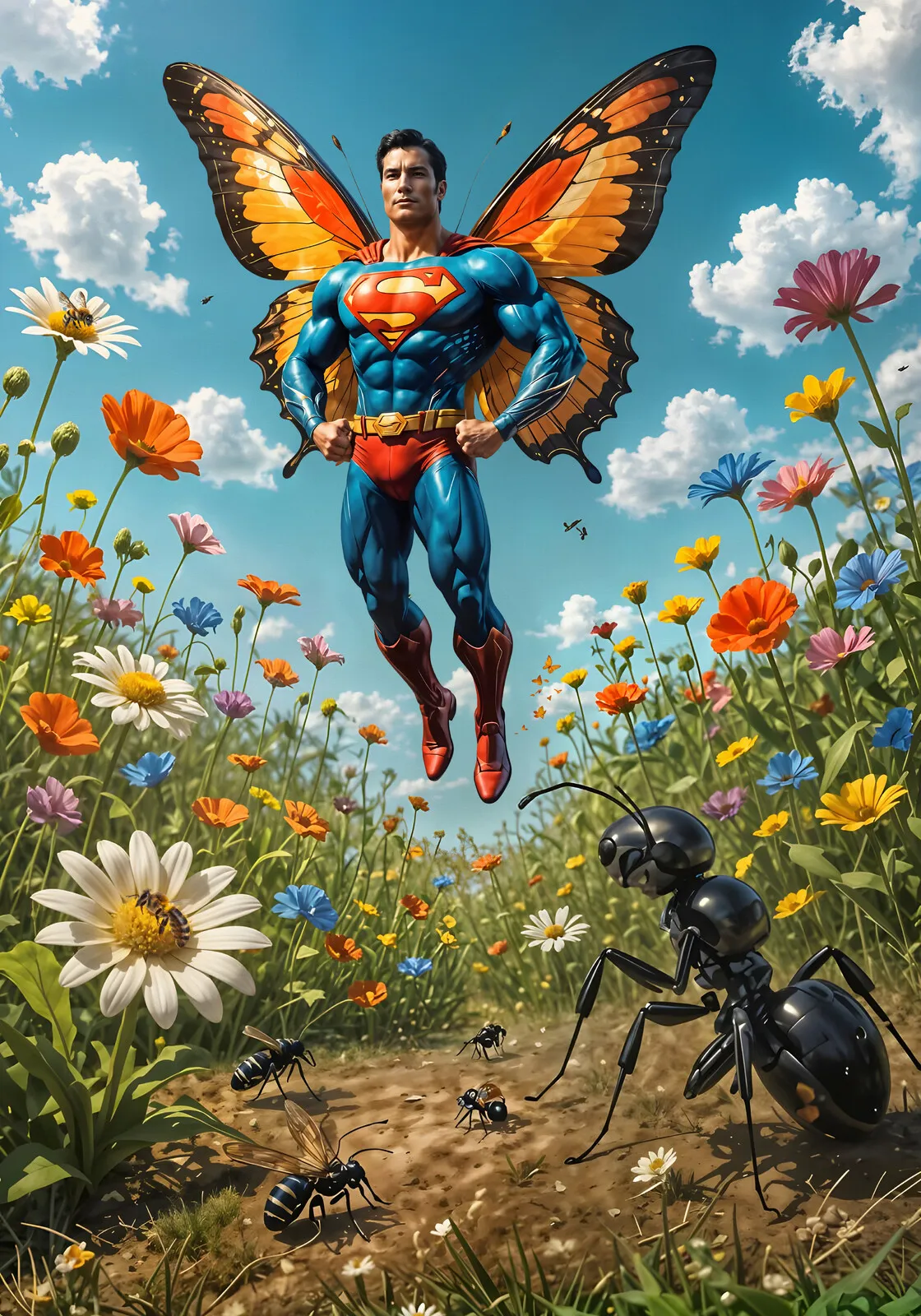
Superfly – the Flutterman, 2025
Digital
70 x 100 cm
3 200 kr
Superfly – the Flutterman
Before the wars over oil, before the water conflicts, before the borderless flight of viruses and fire – there was silence. A silence so gradual we didn’t notice it at first. Fewer wings. Fewer hums. Fewer flowers that set fruit. We blamed the weather. We blamed the season. We blamed everything except the vanishing itself. However, the signs were there, and they could not be ignored.
But deep in the soil, between the roots, and in the soft glow of dandelion fields, the signs were there. The decline of the pollinators. The slow unravelling of the invisible threads that hold life together, reminding us of our shared fate in this intricate web of life.
And then one day, something fluttered down from the sky.
Not a bee. Not a butterfly. But someone with wings made for more than flight – a creature of wind and warning, carrying not just strength, but sorrow. His name is Superfly – the Flutterman – and he came not to defeat evil, but to ask for our help before we defeat ourselves.
This is his story.
And it is ours.
“The Bees Remember
They never asked for applause.
They danced in darkness,
mapped the sky through scent and spin,
gathered gold not for glory,
but to feed the trembling hive.
They lived in silence,
a soft geometry of wings and purpose,
built with wax and instinct
what no human hand could replicate.
The bees remember
what we forget—
that nothing blooms alone,
that sweetness is earned
by moving from flower to flower,
tirelessly,
without pride.
Now they fall—
in fields that echo with spray and steel,
in gardens trimmed too clean,
in orchards where no hum returns.
And still they do not curse us.
They vanish like old songs,
like languages no one spoke aloud
but everyone understood.”
Malmö July 2025
Superfly – the Flutterman and the Pollinator War
On a blooming meadow somewhere between fairy tale and reality, where only hours ago, graceful fairies had walked barefoot through the morning dew, a strange figure hovers in the air – a butterfly-winged Flutterman in blue and red. He is called Superfly, but his real name is Kal-El Papilio. He is a distant relative of Superman, born in a parallel ecosystem on Krypton where butterflies were among the most highly developed species. As a tiny chrysalis, he found his way into the capsule that carried Superman to Earth.
While Superman grew up to save the world from supervillains, Superfly was never meant to save humanity itself, but rather the environment and all the species that, in turn, save humanity—among them, the bees.
But the threat is greater than he imagined, and he struggles to keep pace with the accelerating decline. One must also consider scale. Today, there are just over eight billion humans on Earth, but between ten quintillion and one trillion trillion insects exist. That’s about 1.25 billion insects per person, yet some still complain about a few mosquitoes in the garden. Most insects live in the tropics, but they also thrive in farmlands, fertile soil, meadows, and even in urban landscapes.
In a heavily urbanised city like Malmö, there could be as many as fifty billion insects in the soil, beneath stones, in parks, gardens, on rooftops, in basements, within cracks in walls, and inside our homes. Most remain unnoticed, harmless, and unseen, quietly playing their part in maintaining the ecosystem's delicate balance. Of these, an estimated hundred million are bees. Malmö has become a haven for pollinators, featuring green roofs, public gardens, flowering beds, and small-scale beekeeping initiatives in allotments and schoolyards. But even here, the Fog is spreading—silent, scentless, nearly invisible. And right now, it is these vital creatures that Superfly fights for. What happens in the world happens here, too.
It’s no longer just pesticides like neonicotinoids, monocultures, and climate change that are wiping out the bees. A new menace has emerged: The Fog – a nanotechnological swarm initially created by humans to clean the air, now living its own microscopic life, poisoning pollinators and destroying their chemical scent trails. This Fog, silent, scentless, and nearly invisible, poses a grave threat to the delicate balance of our ecosystem.
The bees are dying. The butterflies are losing their sense of direction. The ants are rebuilding their colonies into fortresses. Superfly is strong, but he is no chemist. He needs an ally from the human world – someone who understands both the needs of nature and the workings of human politics. Human intervention is urgently required to save these vital species.
And that’s where she steps in.
Greta.
She hears about Superfly through a group of pollinator enthusiasts online, a community of passionate individuals dedicated to protecting and conserving pollinators, and follows the trail to a small meadow where time seems to stand still. She sees him. And he sees her.
“I’m not here to save the world,” he says. “I’m here to ask you to do it.”
Greta has yet to give him an answer. Too much else has come in the way. Only the future can tell whether Superfly will succeed in persuading her to become the voice of the bees, because the bees’ crisis is rapidly becoming humanity’s. Greta, your role is crucial. Please, take on the mantle and crown yourself Queen of the Pollinators. Time is running out.
The Bee Crisis – A Threat to the Fabric of Life
Bees are not just buzzing creatures in our gardens or producers of breakfast honey, which in many cases is counterfeit and has never even seen a beehive. They are a crucial pillar of the planet’s ecosystem. Alongside other pollinators, they are responsible for the pollination of roughly 75 per cent of all crops eaten by humans – everything from apples and coffee to avocados and almonds. Without bees, large parts of our food system would collapse.
But bees are not just in danger; they are in a state of severe, urgent peril.
Several threats are silently converging, creating a complex web of danger for bees. Pesticides, particularly the so-called neonicotinoids, disrupt the bees’ nervous systems and their ability to navigate. Many bees perish instantly, while others vanish without a trace. This has been dubbed “Silent Spring 2.0,” a reference to Rachel Carson’s seminal work from 1962. Simultaneously, modern monocultures are expanding – vast fields of rapeseed, corn, and soybeans, which are visually green but lack biological diversity. These fields offer no sustenance for bees during significant parts of the year. The result is a stark absence of variety and floral abundance. The bees are left to starve, surrounded by millions of plants.
Climate change is worsening the situation. For instance, flowers bloom earlier than usual due to rising temperatures, while bees wake up too late, disrupting their natural life cycle. Rain patterns are changing, leading to unpredictable weather conditions that affect bees' foraging activities. Droughts become more severe, reducing the availability of nectar and pollen. The entire pollination cycle is disrupted. Additionally, the Varroa mite – a vampire-like parasite that feeds on bee blood and spreads viruses, as well as bacterial infections and fungal spores - destroys already stressed colonies. Moreover, industrial beekeeping may worsen the problem: honeybees are now kept on a large scale as production animals, leading to inbreeding, loss of genetic diversity, and the spread of disease between hives. These bees might even outcompete wild species that are more vital to certain plants.
This is not just an environmental issue; it is an existential one. When bees die, plants die too. When plants die, animals follow. Humanity may be next, and this could happen faster than we expect – a generation is only thirty years, and much can change in that time. The potential consequences of inaction are grave, and we must act now to prevent them.
Now, let's add another layer to this complex issue – species that cause more harm than good. Some bees and wasps, instead of helping, worsen the crisis. The Asian giant hornet, Vespa mandarinia, often referred to as “The Murder Hornet,” is technically a wasp, not a bee; however, it still plays a crucial role in this context. It can grow over five centimetres long and can destroy an entire hive in hours by decapitating honey bees. Discovered first in the State of Washington in 2019, it has since sparked widespread concern. It is also dangerous to humans. In Superfly’s world, it might be called Mandarax – Pollinator Slayer. This is not just a distant problem, but a pressing issue that demands our collective attention and action.
Another example is the Africanised honey bee, a hybrid between the European and African subspecies, developed in Brazil during the 1950s. It spread unintentionally and has since invaded large parts of the Americas. It is highly aggressive, swarms easily, attacks in groups, and outcompetes other pollinators. A kind of bee turned into a weapon – perhaps manipulated by a human antagonist or by something even darker, like what Superfly calls The Fog.
An additional terrifying species is the Japanese giant hornet – Vespa mandarinia japonica – a subspecies of the Asian giant hornet. It is native to Japan, where honeybees have developed a collective defence strategy: surrounding and heating the hornet to death. However, in Europe, bees lack this defence, and the risk of its establishment remains a genuine concern. In mythic form, this creature might appear as ‘The Burning Sting’.
Even our common European honey bees have, in some regions, become problematic. In Australia and parts of the United States, they were introduced by humans and have changed ecosystems where they don’t belong. They displace native species, disturb ecological balance, and spread diseases. It’s a harsh lesson: that good intentions can lead to disaster, and that humans often fail to understand the systems they try to manage.
Superfly – the Flutterman – might be a creature of imagination, but his struggle is very real. His enemies are not only giant agrochemical corporations, mutated predator bees, or genetically engineered hybrids. His actual opponents are indifference, short-term thinking, and forgetfulness.
In our world, efforts are already in progress to replace the bees. Mini-drones and artificial pollinators are being developed. However, these solutions are fragile, costly, technically unreliable, and unable to restore the rhythm of life. They are not solutions – they are symptoms of a society that has already lost faith in nature as a living partner. If we continue down this path, we risk losing the very essence of life as we know it.
As long as bees survive, we still have a chance. Their resilience in the face of these challenges is a testament to the power of nature. And maybe we do need someone like Superfly – not to save us, but to remind us why it is still worth trying.
Jörgen Thornberg
Superfly – the Flutterman, 2025
Digital
70 x 100 cm
3 200 kr
Superfly – the Flutterman
Before the wars over oil, before the water conflicts, before the borderless flight of viruses and fire – there was silence. A silence so gradual we didn’t notice it at first. Fewer wings. Fewer hums. Fewer flowers that set fruit. We blamed the weather. We blamed the season. We blamed everything except the vanishing itself. However, the signs were there, and they could not be ignored.
But deep in the soil, between the roots, and in the soft glow of dandelion fields, the signs were there. The decline of the pollinators. The slow unravelling of the invisible threads that hold life together, reminding us of our shared fate in this intricate web of life.
And then one day, something fluttered down from the sky.
Not a bee. Not a butterfly. But someone with wings made for more than flight – a creature of wind and warning, carrying not just strength, but sorrow. His name is Superfly – the Flutterman – and he came not to defeat evil, but to ask for our help before we defeat ourselves.
This is his story.
And it is ours.
“The Bees Remember
They never asked for applause.
They danced in darkness,
mapped the sky through scent and spin,
gathered gold not for glory,
but to feed the trembling hive.
They lived in silence,
a soft geometry of wings and purpose,
built with wax and instinct
what no human hand could replicate.
The bees remember
what we forget—
that nothing blooms alone,
that sweetness is earned
by moving from flower to flower,
tirelessly,
without pride.
Now they fall—
in fields that echo with spray and steel,
in gardens trimmed too clean,
in orchards where no hum returns.
And still they do not curse us.
They vanish like old songs,
like languages no one spoke aloud
but everyone understood.”
Malmö July 2025
Superfly – the Flutterman and the Pollinator War
On a blooming meadow somewhere between fairy tale and reality, where only hours ago, graceful fairies had walked barefoot through the morning dew, a strange figure hovers in the air – a butterfly-winged Flutterman in blue and red. He is called Superfly, but his real name is Kal-El Papilio. He is a distant relative of Superman, born in a parallel ecosystem on Krypton where butterflies were among the most highly developed species. As a tiny chrysalis, he found his way into the capsule that carried Superman to Earth.
While Superman grew up to save the world from supervillains, Superfly was never meant to save humanity itself, but rather the environment and all the species that, in turn, save humanity—among them, the bees.
But the threat is greater than he imagined, and he struggles to keep pace with the accelerating decline. One must also consider scale. Today, there are just over eight billion humans on Earth, but between ten quintillion and one trillion trillion insects exist. That’s about 1.25 billion insects per person, yet some still complain about a few mosquitoes in the garden. Most insects live in the tropics, but they also thrive in farmlands, fertile soil, meadows, and even in urban landscapes.
In a heavily urbanised city like Malmö, there could be as many as fifty billion insects in the soil, beneath stones, in parks, gardens, on rooftops, in basements, within cracks in walls, and inside our homes. Most remain unnoticed, harmless, and unseen, quietly playing their part in maintaining the ecosystem's delicate balance. Of these, an estimated hundred million are bees. Malmö has become a haven for pollinators, featuring green roofs, public gardens, flowering beds, and small-scale beekeeping initiatives in allotments and schoolyards. But even here, the Fog is spreading—silent, scentless, nearly invisible. And right now, it is these vital creatures that Superfly fights for. What happens in the world happens here, too.
It’s no longer just pesticides like neonicotinoids, monocultures, and climate change that are wiping out the bees. A new menace has emerged: The Fog – a nanotechnological swarm initially created by humans to clean the air, now living its own microscopic life, poisoning pollinators and destroying their chemical scent trails. This Fog, silent, scentless, and nearly invisible, poses a grave threat to the delicate balance of our ecosystem.
The bees are dying. The butterflies are losing their sense of direction. The ants are rebuilding their colonies into fortresses. Superfly is strong, but he is no chemist. He needs an ally from the human world – someone who understands both the needs of nature and the workings of human politics. Human intervention is urgently required to save these vital species.
And that’s where she steps in.
Greta.
She hears about Superfly through a group of pollinator enthusiasts online, a community of passionate individuals dedicated to protecting and conserving pollinators, and follows the trail to a small meadow where time seems to stand still. She sees him. And he sees her.
“I’m not here to save the world,” he says. “I’m here to ask you to do it.”
Greta has yet to give him an answer. Too much else has come in the way. Only the future can tell whether Superfly will succeed in persuading her to become the voice of the bees, because the bees’ crisis is rapidly becoming humanity’s. Greta, your role is crucial. Please, take on the mantle and crown yourself Queen of the Pollinators. Time is running out.
The Bee Crisis – A Threat to the Fabric of Life
Bees are not just buzzing creatures in our gardens or producers of breakfast honey, which in many cases is counterfeit and has never even seen a beehive. They are a crucial pillar of the planet’s ecosystem. Alongside other pollinators, they are responsible for the pollination of roughly 75 per cent of all crops eaten by humans – everything from apples and coffee to avocados and almonds. Without bees, large parts of our food system would collapse.
But bees are not just in danger; they are in a state of severe, urgent peril.
Several threats are silently converging, creating a complex web of danger for bees. Pesticides, particularly the so-called neonicotinoids, disrupt the bees’ nervous systems and their ability to navigate. Many bees perish instantly, while others vanish without a trace. This has been dubbed “Silent Spring 2.0,” a reference to Rachel Carson’s seminal work from 1962. Simultaneously, modern monocultures are expanding – vast fields of rapeseed, corn, and soybeans, which are visually green but lack biological diversity. These fields offer no sustenance for bees during significant parts of the year. The result is a stark absence of variety and floral abundance. The bees are left to starve, surrounded by millions of plants.
Climate change is worsening the situation. For instance, flowers bloom earlier than usual due to rising temperatures, while bees wake up too late, disrupting their natural life cycle. Rain patterns are changing, leading to unpredictable weather conditions that affect bees' foraging activities. Droughts become more severe, reducing the availability of nectar and pollen. The entire pollination cycle is disrupted. Additionally, the Varroa mite – a vampire-like parasite that feeds on bee blood and spreads viruses, as well as bacterial infections and fungal spores - destroys already stressed colonies. Moreover, industrial beekeeping may worsen the problem: honeybees are now kept on a large scale as production animals, leading to inbreeding, loss of genetic diversity, and the spread of disease between hives. These bees might even outcompete wild species that are more vital to certain plants.
This is not just an environmental issue; it is an existential one. When bees die, plants die too. When plants die, animals follow. Humanity may be next, and this could happen faster than we expect – a generation is only thirty years, and much can change in that time. The potential consequences of inaction are grave, and we must act now to prevent them.
Now, let's add another layer to this complex issue – species that cause more harm than good. Some bees and wasps, instead of helping, worsen the crisis. The Asian giant hornet, Vespa mandarinia, often referred to as “The Murder Hornet,” is technically a wasp, not a bee; however, it still plays a crucial role in this context. It can grow over five centimetres long and can destroy an entire hive in hours by decapitating honey bees. Discovered first in the State of Washington in 2019, it has since sparked widespread concern. It is also dangerous to humans. In Superfly’s world, it might be called Mandarax – Pollinator Slayer. This is not just a distant problem, but a pressing issue that demands our collective attention and action.
Another example is the Africanised honey bee, a hybrid between the European and African subspecies, developed in Brazil during the 1950s. It spread unintentionally and has since invaded large parts of the Americas. It is highly aggressive, swarms easily, attacks in groups, and outcompetes other pollinators. A kind of bee turned into a weapon – perhaps manipulated by a human antagonist or by something even darker, like what Superfly calls The Fog.
An additional terrifying species is the Japanese giant hornet – Vespa mandarinia japonica – a subspecies of the Asian giant hornet. It is native to Japan, where honeybees have developed a collective defence strategy: surrounding and heating the hornet to death. However, in Europe, bees lack this defence, and the risk of its establishment remains a genuine concern. In mythic form, this creature might appear as ‘The Burning Sting’.
Even our common European honey bees have, in some regions, become problematic. In Australia and parts of the United States, they were introduced by humans and have changed ecosystems where they don’t belong. They displace native species, disturb ecological balance, and spread diseases. It’s a harsh lesson: that good intentions can lead to disaster, and that humans often fail to understand the systems they try to manage.
Superfly – the Flutterman – might be a creature of imagination, but his struggle is very real. His enemies are not only giant agrochemical corporations, mutated predator bees, or genetically engineered hybrids. His actual opponents are indifference, short-term thinking, and forgetfulness.
In our world, efforts are already in progress to replace the bees. Mini-drones and artificial pollinators are being developed. However, these solutions are fragile, costly, technically unreliable, and unable to restore the rhythm of life. They are not solutions – they are symptoms of a society that has already lost faith in nature as a living partner. If we continue down this path, we risk losing the very essence of life as we know it.
As long as bees survive, we still have a chance. Their resilience in the face of these challenges is a testament to the power of nature. And maybe we do need someone like Superfly – not to save us, but to remind us why it is still worth trying.
3 200 kr

Jörgen Thornberg
Malmö
Lite om bilder och mig. Translation in English at the end.
Jag är en nyfiken person som ser allt i bilder, även det jag fäster i ord, gärna tillsammans för bakom alla mina bilder finns en berättelse. Till vissa bilder hör en kortare eller längre novell som följer med bilden.
Bilder berättar historier. Jag omges av naturlig skönhet, intressanta människor och historia var jag än går. Jag använder min kamera för att dokumentera världen och blanda det jag ser med vad jag känner för att fånga den dolda magin.
Mina bilder berättar mina historier. Genom mina bilder, tryck och berättelser. Jag bjuder in dig att ta del av dessa berättelser, in i ditt liv och hem och dela min mycket personliga syn på vår värld. Mer än vad ögat ser. Jag tänker i bilder, drömmer och skriver och pratar om dem; följaktligen måste jag också skapa bilder. De blir vad jag ser, inte nödvändigtvis begränsade till verkligheten. Det finns en bild runt varje hörn. Jag hoppas att du kommer att se vad jag såg och gilla det.
Jag är också en skrivande person och till många bilder hör en kortare eller längre essay. Den följer med tavlan, tryckt på fint papper och med en personlig hälsning från mig.
Flertalet bilder startar sin resa i min kamera. Enkelt förklarat beskriver jag bilden jag ser i mitt inre, upplevd eller fantiserad. Bilden uppstår inom mig redan innan jag fått okularet till ögat. På bråkdelen av ett ögonblick ser jag vad jag vill ha och vad som kan göras med bilden. Här skall jag stoppa in en giraff, stålmannen, Titanic eller vad det är min fantasi finner ut. Ännu märkligare är att jag kommer ihåg minnesbilden långt efteråt när det blir tid att skapa verket. Om jag lyckas eller inte, är upp till betraktaren, oftast präglat av en stråk av svart humor – meningen är att man skall bli underhållen. Mina bilder blir ofta en snackis där de hänger.
Jag föredrar bilder som förmedlar ett budskap i flera lager. Vid första anblicken fylld av feel-good, en vacker utsikt, fint väder, solen skiner, blommor på ängen eller vattnet som ligger förrädiskt spegelblankt. I en sådan bild kan jag gömma min egentliga berättelse, mitt förakt för förtryckare och våldsverkare, rasister och fördomsfulla människor - ett gärna återkommande motiv mer eller mindre dolt i det vackra motivet. Jag försöker förena dem i ett gemensamt narrativ.
Bild och formgivning har löpt som en röd tråd genom livet. Fotokonst känns som en värdig final som jag gärna delar med mig.
Min genre är vid som framgår av mina bilder, temat en blandning av pop- och gatukonst i kollage som kan bestå av hundratals lager. Vissa bilder kan ta veckor, andra någon dag innan det är dags att överlämna resultatet till printverkstaden. Fine Art Prints är digitala fotocollage. I dessa kollage sker rivandet, klippandet, pusslandet, målandet, ritandet och sprayningen digitalt. Det jag monterar in kan vara hundratals år gamla bilder som jag omsorgsfullt frilägger så att de ser ut att vara en del av tavlan men också bilder skapade av mig själv efter min egen fantasi. Därefter besöks printstudion och för vissa bilder numrera en limiterad upplaga (oftast 7 exemplar) och signera för hand. Vissa bilder kan köpas i olika format. Det är bara att fråga efter vilka. Gillar man en bild som är 70x100 men inte har plats på väggen, går den kanske att få i 50x70 cm istället. Frågan är fri.
Metoden Giclée eller Fine Art Print som det också kallas är det moderna sättet för framställning av grafisk konst. Villkoret för denna typ av utskrifter är att en högkvalitativ storformatskrivare används med åldersbeständigt färgpigment och konstnärspapper eller i förekommande fall på duk. Pappret som används möter de krav på livslängd som ställs av museer och gallerier. Normalt säljer jag mina bilder oinramade så att den nya ägaren själv kan bestämma hur de skall se ut, med eller utan passepartout färg på ram, med eller utan glas etc..
Under många år ställde jag bara ut på nätet, i valda grupper och på min egen Facebooksida - https://www.facebook.com/jorgen.thornberg.9
Jag finns också på en egen hemsida som tyvärr inte alltid är uppdaterad – https://www.jth.life/ Där kan du också läsa en del av de berättelser som följer med bilden.
UTSTÄLLNINGAR
Luftkastellet, oktober 2022
Konst i Lund, november 2022
Luftkastellet, mars 2023
Engleson Galleri Caroli, april 2023
Hydra, Greece June 2023
Engleson Galleri Caroli, oktober 2023
Toppen, Höllviken december 2023
Luftkastellet, mars 2024
Torups Galleri, mars 2024
Venice, May 2024
Luftkastellet, oktober 2024
Konst i Advent, December 2024
Galleri Engleson, Caroli December 2024
Jäger & Jansson Galleri, april 2025
A bit about pictures and me.
I'm a curious person who sees everything in pictures, even what I express in words, often combining them, for behind all my pictures lies a story. These narratives, some as short as a single image and others as long as a novel, are the heart and soul of my work.
Pictures tell stories. Wherever I go, I'm surrounded by natural beauty, exciting people, and history. I use my camera to document the world and blend what I see with what I feel to capture the hidden magic.
My images tell my stories. Through my pictures, prints, and narratives, I invite you to partake in these stories in your life and home and share my deeply personal perspective of our world. More than meets the eye. I think in pictures, dream, write, and talk about them; consequently, I must create images too. They become what I see, not necessarily confined to reality. There's a picture around every corner. I hope you'll see what I saw and enjoy it.
I'm also a writer, and many images come with a shorter or longer essay. It accompanies the painting, printed on fine paper with my personal greeting.
Many pictures start their journey on my camera. Simply put, I describe the image I see in my mind, experienced or imagined. The image arises within me even before I bring the eyepiece to my eye. In a fraction of a moment, I see what I want and what can be done with the picture. Here, I'll insert a giraffe, Superman, the Titanic, or whatever my imagination conjures up. Even stranger is that I remember the mental image long after it's time to create the work. Whether I succeed is up to the observer, often imbued with a streak of black humour – the aim is to entertain. My pictures usually become a talking point wherever they hang.
I prefer pictures that convey a message in multiple layers. At first glance, they're filled with feel-good vibes, a beautiful view, lovely weather, the sun shining, flowers in the meadow, or the water lying deceptively calm. But beneath this surface beauty, I often conceal a deeper story, a narrative that challenges societal norms or explores the human condition. I invite you to delve into these hidden narratives and discover the layers of meaning within my work.
Picture and design have been a thread running through my life. Photographic art feels like a fitting finale, and I'm happy to share it.
My genre is varied, as seen in my pictures; the theme is a blend of pop and street art in collages that can consist of hundreds of layers. Some images can take weeks, others just a day before it's time to hand over the result to the print workshop. Fine Art Prints are digital photo collages. In these collages, tearing, cutting, puzzling, painting, drawing, and spraying happen digitally. What I insert can be images hundreds of years old that I carefully extract so they appear to be part of the painting, but also images created by myself, now also generated from my imagination. Next, visit the print studio and, for certain images, number a limited edition (usually 7 copies) and sign them by hand. Some images may be available in other formats. Just ask which ones. If you like an image that's 70x100 but doesn't have space on the wall, you might be able to get it in 50x70 cm instead. The question is open.
The Giclée method, or Fine Art Print as it's also called, is the modern way of producing graphic art. This method ensures the highest quality and longevity of the artwork, using a high-quality large-format printer with archival pigment inks and artist paper or, in some cases, canvas. The paper used meets the longevity requirements set by museums and galleries. I sell my pictures unframed, allowing the new owner to personalise their artwork, confident in the lasting value and quality of the piece.
For many years, I only exhibited online, in selected groups, and on my Facebook page - https://www.facebook.com/jorgen.thornberg.9. I also have my website, which unfortunately is not constantly updated - https://www.jth.life/. You can also read some of the stories accompanying the pictures there.
EXHIBITIONS
Luftkastellet, October 2022
Art in Lund, November 2022
Luftkastellet, March 2023
Engleson Gallery Caroli, April 2023
Hydra, Greece June 2023
Engleson Gallery Caroli, October 2023
Toppen, Höllviken December 2023
Luftkastellet, March 2024
Torup Gallery, March 2024
Venice, May 2024
UTSTÄLLNINGAR
Luftkastellet, oktober 2022
Konst i Lund, november 2022
Luftkastellet, mars 2023
Engleson Galleri Caroli, april 2023
Hydra, Greece June 2023
Engleson Galleri Caroli, oktober 2023
Toppen, Höllviken december 2023
Luftkastellet, mars 2024
Torups Galleri, mars 2024
Venice, May 2024
Luftkastellet, October 2024
Konst i Advent, December 2024
Galleri Engleson, Caroli December 2024
Jäger & Jansson Galleri, April 2025
Utbildning
Autodidakt
Medlem i konstnärsförening
Öppna Sinnen
Med i konstrunda
Konstrundan i Skåne
Utställningar
Luftkastellet, October 2022
Art in Lund, November 2022
Luftkastellet, March 2023
Engleson Gallery Caroli, April 2023
Hydra, Greece June 2023
Engleson Gallery Caroli, October 2023
Toppen, Höllviken December 2023
Luftkastellet, March 2024
Torup Gallery, March 2024
Venice, May 2024