Vi använder cookies för att ge dig bästa möjliga upplevelse. Välj vilka cookies du tillåter.
Läs mer i vår integritetspolicy
Jörgen Thornberg
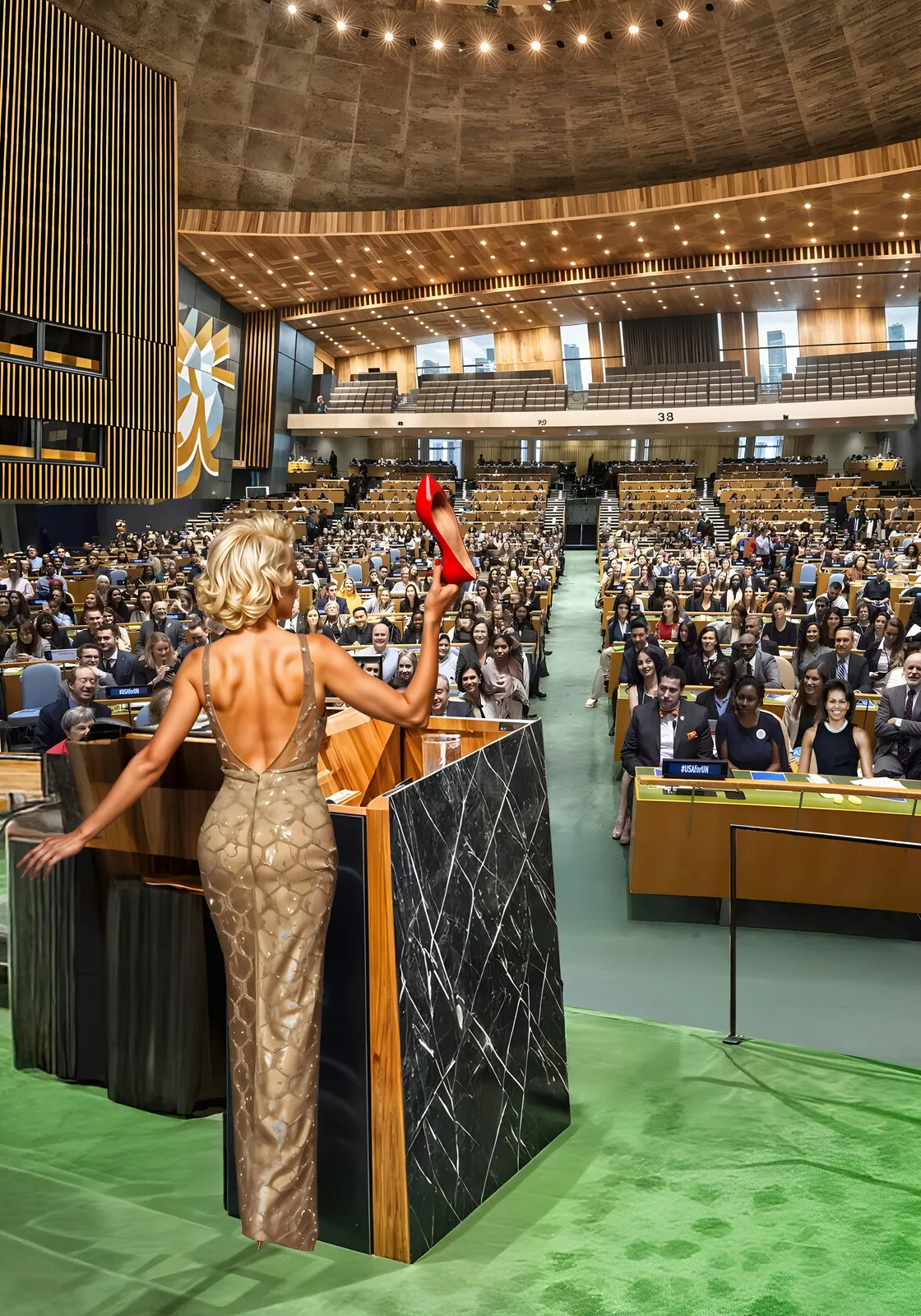
High Heels and High Stakes - Shoe Diplomacy, 2025
Digital
70 x 100 cm
3 200 kr
High Heels and High Stakes - Shoe Diplomacy
Let me emphasise that this is a purely fictional work. It is based on a hypothetical scenario where Marilyn Monroe, long deceased, unexpectedly appears as a speaker before the United Nations General Assembly. All quotes, events, and statements are fabricated. The aim is not to provide an accurate historical record of real people or events, but to utilise well-known figures in an artistic, satirical, and symbolic manner.
Any resemblance to real events, living persons, or official UN documents is most certainly not coincidental.
However, the content of the speech is not fiction. It starkly reflects a brutal reality — a crisis impacting women and LGBTQ+ individuals worldwide and their right to dignity, safety, and equality. That is why Marilyn becomes involved. As a Time-traveller, she returns to Earth to assist in a moment of urgent need — with her voice, her presence, and her red shoe.
Read and develop your own opinions. The power of interpretation rests with you.
“A Heel, a Frown, and a Star
In the halls where silence wears silk shoes,
a girl stood tall with braided views.
Greta, fierce with future flame,
whispered truth — and shamed the game.
From curtains stitched in starlight thread,
A Blonde rose who was once dead.
Marilyn, with a voice like wine,
stepped through time to toe the line.
She raised her heel — not to seduce,
but as a gavel, not for truce.
"How dare you?" — a borrowed cry,
flung like thunder from the sky.
In the wings, a ghost with flair:
Khrushchev, shoeless, stomped mid-air.
He grinned in style, though less polite,
and nodded once — “She does it right.”
Kennedy, lit by birthday flames,
blew smoke through both their tangled names.
He watched the speech from lunar hush,
between regret and vintage blush.
Four souls — a quartet, strange and grand —
all danced upon the Speaker’s stand.
One fought for Earth, one faced her past,
one shook the floor, one loved too fast.
But in that hall, beneath the stars,
no flag could mute those battle scars.
A red shoe gleamed — not made for fun —
but raised to say: The fight’s not done”
Malmö July 2025
How Marilyn Monroe ended up on the UN Agenda
It was a mystery that left everyone involved perplexed. How did the name 'Marilyn Monroe' appear on the UN's tightly managed schedule? No one seemed to know.
One morning, it was simply there — added to the UN’s internal calendar system under the heading Special Address: Marilyn Monroe. No department claimed responsibility. No official sponsor was listed. The head of scheduling, already under pressure from multiple crises, thought it was a covert attempt to display Greta Thunberg again, perhaps in response to her outspoken role during the Gaza crisis. The name Marilyn Monroe might have been a code, a provocation, or just an elaborate satire. Stranger things had happened in this organisation.
“Blonde is blonde,” someone quipped, noting it was pretty clever to juxtapose two antipodes: one, a very real, decidedly unglamorous young woman, the other, an extravagantly glamorous actress who had, after all, been dead for sixty-three years.
Regardless, Secretary-General António Guterres had signed off on it — or at least, someone in his office had. When asked, he reportedly shrugged and said, “Well, if she has something important to say, let her speak.” And so, it remained on the agenda.
As the delegates gathered for the event, a tangible sense of anticipation filled the air. They were expecting some stunt, but what they received surpassed anyone's wildest imagination — a woman in a rhinestone-covered gown, red heels, and a voice that demanded attention.
“She’s matured,” muttered one of the delegates who had been present when Greta spoke years earlier.
Initially, many thought it was a deepfake, an AI-created performance, or some experimental protest. But then, she started to speak. And in that instant, the room went silent. The shock was tangible, and the laughter that had filled the room moments earlier had vanished.
“Excellencies, distinguished delegates, ladies and gentlemen. It is an honour to stand before you today, not merely as a voice from another time, but as a witness to what happens when the world forgets to listen.” Marilyn's voice was calm, but carried a strange, electric charge. Her eyes swept slowly across the assembly hall, scanning row by row, as if searching for signs of conscience. "The importance of listening to the voices of change cannot be overstated. It is through these voices that we find our connection to the world and our responsibility to it."
“I was not supposed to be here. I was meant to be at home, on my star, Stella Polaris, where I have lived for many years among echoes of memory and dreams of women waiting for change. But when enough of them called, I heard. And when they dreamt of something better, I came back.” A soft murmur passed through the chamber. Delegates exchanged glances. Some smiled uncertainly, others frowned, unsure whether she was joking, acting, or prophesying. But Marilyn didn’t blink. She stood perfectly still, her gaze fixed forward, daring anyone to laugh.
“I want to begin by echoing the spirit of another woman who once stood here, young, fierce, and unafraid — Greta Thunberg, who spoke not only for her generation but for the future of this planet. Her words were about the climate, but they spoke to a broader truth.” Marilyn’s tone shifted slightly — lower, steadier, almost reverent. Her eyes softened as she invoked the name. A quiet rustle moved through the hall, recognising a kindred voice. Greta's ghost was in the room now too, fierce and unwavering. Marilyn raised her hand slowly, palm open, like a conductor calling in a storm, and began to recite. “Let me put it this way: We are all responsible for the future of our planet, and it is time for us to act."
You are facing a global crisis of a different kind, one that has persisted for centuries and hampers progress on other critical issues, such as poverty and the impending climate crisis that risks the very existence of our planet.
To say that life as we know it is on the brink of mass extinction is not an exaggeration, but a fact — a fact that underscores the urgent need for action on the issue she is about to address.” The words made everyone sit up. This didn’t sound like the usual tired, diplomatically disengaged speeches. She also refrained from smiling throughout the speech to embody its seriousness. Her famous smile and infectious laugh had no place here. The provocative dress was merely a poster — people soon had other things to focus on. Since the speech lasted less than five minutes, its different parts were brief, and it was always clear when Marilyn shifted to a new point. She made distinct pauses to help the audience process her message. What a consummate actress she is.
“Every single minute, violence shatters the lives of millions of women and girls around the world. It is not a marginal problem. It is a global emergency — persistent, pervasive, and largely tolerated. When I say this, I don’t mean metaphorical violence or invisible statistics. I mean bruises. I mean fear. I mean, daughters who never come home.” There was an audible intake of breath across the chamber. The rawness of her words struck like an open palm. This was no policy language. This was pain made public — this was truly straight to the point. But sometimes the truth demands nothing less.
“Violence against women and girls knows no borders — not of geography, culture, class, or religion. But poverty sharpens its teeth. The poorer a woman is, the greater the risk, and the fewer the exits.”
A murmur of agreement passed among several delegates. Marilyn noted it with the faintest tightening of her jaw — she had seen sympathetic nods before, followed by inaction.
Beneath every act of violence lies something more profound: a belief that women are worth less. That belief begins early and follows women through every stage of life.
Here, Marilyn’s voice slowed. She raised one hand slightly—not for effect, but as a gesture of stillness. She let the sentence hang in the air like an indictment.
“If we want to stop the violence, we must understand this: poverty is not just a background condition — it is part of the weapon.” And with that, she returned her hand to her side. Not a single camera flash dared blink. Her silence, for a moment, roared louder than any words.
“It is essential, not optional, that you all, including policymakers, activists, and organisations, recognise the severity of this issue and take action to address it. Some still believe this is not their fight. Some believe it is even normal. Many do not challenge it, even if they think it is unacceptable.
But across the world, people are rising. They are speaking out, marching, organising, refusing to accept what once passed as normal. Women’s rights organisations are already saving lives — not with weapons, but with courage, care, and unyielding resolve. You must stand with them. And you must help amplify their call — for women, men, girls, and boys everywhere to say, together and without hesitation: Enough.
Did you know that at least one in three women will experience some form of violence during their lifetime, affecting more than one billion women worldwide?
Violence against women and girls is a hidden global crisis that transcends borders of geography or culture. However, marginalised women, such as those living in poverty, are most likely to face it, often at the hands of their husbands or partners. This is one of the most widespread human rights violations.
Abuse against females manifests in many forms, including domestic violence, sexual assault, and female genital mutilation. All of it has the same root: gender inequality that shadows women from cradle to grave.
Too many perpetrators believe — and act as if — violence is expected, or even accepted. They think society will look away. And too often, society does.
It is one of the most widespread violations of human rights and has long-lasting, devastating effects on the lives of women, their communities, and broader society. It is time to say ‘enough is enough’. You must act now, unite, and declare that violence against women must end — the violence on this massive scale. Protect voices. Educate boys. Empower girls. Fund shelters. Enforce laws.
One in three women will experience violence at the hands of a current or former partner during her lifetime. In some countries, the figure rises to a staggering 70 per cent.
Some 650 million women alive today were forced into marriage before reaching adulthood. More than one in three of them were married before the age of 15.
Two hundred million women and girls have been subjected to female genital mutilation - the majority were cut before the age of five — before they could even understand what was happening to them.
Women and girls constitute 71 per cent of all identified trafficking victims, and nearly three out of four trafficked children are girls.” Marilyn paused for effect and looked each delegate firmly in the eye before she continued: “Ladies and gentlemen, violence and poverty feed each other in a vicious cycle — a contagion that spreads across borders and generations. And violence against women remains one of the most significant barriers to ending global poverty.
This crime against women and girls does more than destroy lives or divide communities. It undermines progress. It weakens democracy. And it stands in the way of building just, peaceful societies.
Brutality traps women and girls in poverty — and keeps them there. It strips away their options: education, income, safety, and a voice in public life. And when violence occurs, poverty leaves them with nowhere to run.
Gender inequality isn’t just unfair — it’s a major driver of poverty and one of the most persistent violations of women’s rights. It's a pressing issue that demands our immediate attention and action.
Let me show you what gender inequality looks like — with numbers that are not just statistics, but a stark reality that speaks louder than words.
Did you know that women hold less than 24 per cent of seats in parliaments — and only 5 per cent of the world’s mayors? In too many decision-making spaces, women are not at the table. They're still outside the door. These numbers represent the barriers women face in political leadership, hindering their ability to influence policies that affect their lives and livelihoods.
Across every part of the world, in every sector, women are still paid less than men—about 24 per cent less—even for the same work.
Nearly two-thirds of the world’s 781 million illiterate adults are women, and that number has not changed in twenty years. This persistent inequality is a disheartening fact that calls for continuous efforts.
In 153 countries, the law still restricts women’s right to work. And in 18 of those, a husband can legally prevent his wife from having a job. That’s not ancient history—that’s today.
One in three women and girls around the world will face violence or abuse in their lifetime—one in three. Just imagine what that means.
Gender inequality never exists alone. It intersects with poverty, race, disability, and LGBTQ+ rights, reinforcing disadvantages on every level. For instance, nearly one in ten LGBTQ+ individuals is unemployed, twice the rate of heterosexual people, due to the intersection of gender and sexual orientation discrimination. Fighting for gender justice means fighting for justice everywhere.
Every day, in every country, women face discrimination, inequality, and violence. This is not someone else’s problem. It’s a global emergency that demands urgent action. From domestic abuse to workplace bias, from silence at home to exclusion in public life, women are denied the chance to learn, to earn, and to lead.
You must confront a hard truth: most of the world’s poor are women. That fact alone should shake you all. Women have fewer resources, less power, and even less room to speak or act. And if they are poor, racialised, older, or belong to a marginalised faith or culture, the inequality deepens. It is not someone else's problem. It is everyone's responsibility to close these gaps.
Each of you has a role to play in the fight for gender justice — for true equality and fairness among women, men, LGBTQIA+ and non-binary people, in every part of life. This isn’t just about laws; it’s about power. It’s about giving women the space to lead — and to shape the systems that shape them. Let's not just talk about gender justice, let's act. Let’s support women in leadership, let's advocate for equal pay, let's stand against all forms of discrimination. Together, you can make a difference.” Her voice was angry. Marilyn emphasised key words and phrases to reinforce her message. Even subtle vocal shifts captured the audience’s attention, making them hang on to her every word. Since the tight-fitting gown limited her physical gestures, she depended on facial expressions and her gaze to express emotion. And then — there was the shoe — her red high heel.
“Now listen carefully!” Suddenly, Marilyn lifted one leg, removed her red high heel, held it upright in the air, and shook it at the audience. This unexpected gesture, along with the red shoe—a symbol of power and femininity—added an intriguing element to her performance, capturing the audience's attention and curiosity. It was a moment that no one in the room could have predicted, adding a layer of intrigue to her already captivating act.
“How dare you!!” she cried — a deliberate pastiche of Greta Thunberg’s iconic phrase. This expression, often used to convey outrage and disbelief, was a powerful rhetorical device in Marilyn's hands. Just like Martin Luther King’s “I Have a Dream”, she repeated “How dare you” as a direct personal accusation, aimed at everyone, for doing nothing. The impact of her accusation was clear in the repetition of this potent phrase.
Waving a shoe in front of the General Assembly was a long-standing and proven tactic. Soviet leader Nikita Khrushchev famously did it in 1960. A delegate had criticised the USSR’s dominance of Eastern Europe and accused it of denying those nations genuine freedom. Most of the assembly agreed with the criticism, but that didn’t matter. Khrushchev erupted in fury, slamming his shoe against the desk to show his contempt and anger. The incident became an iconic symbol of the absurdity and confrontational nature of Cold War diplomacy. Marilyn, too, wanted to use shoe diplomacy — but without provoking accusations of bad manners. So she didn’t bang it against the podium or point the sharp heel at the crowd. Instead, she used the red right shoe as an extension of her arm, an exclamation mark to emphasise her message, in a more refined and diplomatic manner.
Better laws and policies are essential — but they’re only the start. What we truly need is a power shift. We must challenge the structures, norms, and values that sustain inequality, and rewrite the rules that have kept women on the margins for far too long. This could involve enacting laws that guarantee equal pay for equal work, implementing policies that promote gender diversity in leadership roles, and establishing regulations that protect women from gender-based violence.
When women organise and take the lead, change happens. Collective action is the most potent force we have — not just for women's rights, but for ending poverty for all. So don’t stand on the sidelines. Join the fight for gender justice by supporting women-led initiatives, advocating for gender equality in your community, and challenging discriminatory practices.
Gender inequality means being treated as less because of who you are. It affects women, non-binary, and trans people across all aspects of life. It is one of the oldest injustices in human history. For centuries, it has excluded women from power, silenced voices, and fuelled violence. And it still does.
The pandemic didn’t just expose inequality — it deepened it. Around the world, women and LGBTQIA+ people have faced increasing discrimination, not only because of gender, but also due to race, income, disability, or identity. Injustice is rarely simple. Today, the gap between privilege and exclusion is wider than ever..
This is unacceptable, and it puts lives at risk every single day. Equality, regardless of sex or gender, is not an aspiration. It is a fundamental human right.
These harmful beliefs were not born with humanity. They were taught. And what was taught can be unlearned.
Now is the time — for women, men, girls, boys, and every voice with power — to say: enough. Stand together, and you will shift the tide. Demand that women, non-binary, LGBTQIA+ people live with dignity — free from fear, free from silence, free to rise.
Don’t wait.
Start now.
And let the North Star guide you — not only home, but forward.”
Marilyn concluded her speech. At first, there was complete silence in the vast hall, so quiet you could hear the hum of the ventilation. Then came a few scattered claps from the back, followed by a few more, and like a rolling thunderstorm, the ovation spread to the front row.
This was shoe diplomacy at its finest — but yes, the dress helped too. It was freshly made for the occasion, since the original gown she wore to President Kennedy’s birthday celebration in 1962 was far too precious to risk damaging. Though Marilyn didn’t look a jot different today, sixty-three years later, she couldn’t guarantee that every gram was still in the same place.
The dress Marilyn Monroe wore to sing “Happy Birthday, Mr. President” to John F. Kennedy was a masterpiece of fashion history — a skin-tight, sheer, flesh-coloured gown encrusted with over 2,500 hand-sewn rhinestones, designed by Jean Louis and Bob Mackie. Like the dress she wore today, it was so form-fitting it had to be sewn onto her body. This dress, a daring, dazzling embodiment of Marilyn's mythic sensuality, was a diplomatic gesture as effective as a red shoe. It did the assembly hall justice, shimmering like liquid light under the spotlights. From a distance, it gave the illusion of nudity, adding another layer of symbolism to her performance.
The original dress hangs in a museum, but the gown is more than just a piece of cloth. It stands as a symbol of glamour, controversy, and raw American showmanship—an intimate whisper of Hollywood at the edge of power. Now, it is helping to improve conditions for the world’s most vulnerable women and all those living with differences. Did she succeed?
Only the future can tell. But Marilyn’s brief return to Earth certainly did not make things worse.
Jörgen Thornberg
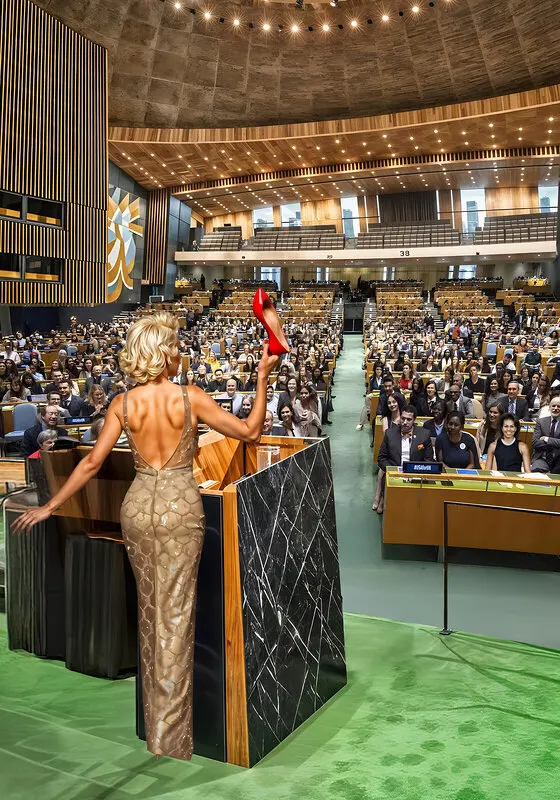
High Heels and High Stakes - Shoe Diplomacy, 2025
Digital
70 x 100 cm
3 200 kr
High Heels and High Stakes - Shoe Diplomacy
Let me emphasise that this is a purely fictional work. It is based on a hypothetical scenario where Marilyn Monroe, long deceased, unexpectedly appears as a speaker before the United Nations General Assembly. All quotes, events, and statements are fabricated. The aim is not to provide an accurate historical record of real people or events, but to utilise well-known figures in an artistic, satirical, and symbolic manner.
Any resemblance to real events, living persons, or official UN documents is most certainly not coincidental.
However, the content of the speech is not fiction. It starkly reflects a brutal reality — a crisis impacting women and LGBTQ+ individuals worldwide and their right to dignity, safety, and equality. That is why Marilyn becomes involved. As a Time-traveller, she returns to Earth to assist in a moment of urgent need — with her voice, her presence, and her red shoe.
Read and develop your own opinions. The power of interpretation rests with you.
“A Heel, a Frown, and a Star
In the halls where silence wears silk shoes,
a girl stood tall with braided views.
Greta, fierce with future flame,
whispered truth — and shamed the game.
From curtains stitched in starlight thread,
A Blonde rose who was once dead.
Marilyn, with a voice like wine,
stepped through time to toe the line.
She raised her heel — not to seduce,
but as a gavel, not for truce.
"How dare you?" — a borrowed cry,
flung like thunder from the sky.
In the wings, a ghost with flair:
Khrushchev, shoeless, stomped mid-air.
He grinned in style, though less polite,
and nodded once — “She does it right.”
Kennedy, lit by birthday flames,
blew smoke through both their tangled names.
He watched the speech from lunar hush,
between regret and vintage blush.
Four souls — a quartet, strange and grand —
all danced upon the Speaker’s stand.
One fought for Earth, one faced her past,
one shook the floor, one loved too fast.
But in that hall, beneath the stars,
no flag could mute those battle scars.
A red shoe gleamed — not made for fun —
but raised to say: The fight’s not done”
Malmö July 2025
How Marilyn Monroe ended up on the UN Agenda
It was a mystery that left everyone involved perplexed. How did the name 'Marilyn Monroe' appear on the UN's tightly managed schedule? No one seemed to know.
One morning, it was simply there — added to the UN’s internal calendar system under the heading Special Address: Marilyn Monroe. No department claimed responsibility. No official sponsor was listed. The head of scheduling, already under pressure from multiple crises, thought it was a covert attempt to display Greta Thunberg again, perhaps in response to her outspoken role during the Gaza crisis. The name Marilyn Monroe might have been a code, a provocation, or just an elaborate satire. Stranger things had happened in this organisation.
“Blonde is blonde,” someone quipped, noting it was pretty clever to juxtapose two antipodes: one, a very real, decidedly unglamorous young woman, the other, an extravagantly glamorous actress who had, after all, been dead for sixty-three years.
Regardless, Secretary-General António Guterres had signed off on it — or at least, someone in his office had. When asked, he reportedly shrugged and said, “Well, if she has something important to say, let her speak.” And so, it remained on the agenda.
As the delegates gathered for the event, a tangible sense of anticipation filled the air. They were expecting some stunt, but what they received surpassed anyone's wildest imagination — a woman in a rhinestone-covered gown, red heels, and a voice that demanded attention.
“She’s matured,” muttered one of the delegates who had been present when Greta spoke years earlier.
Initially, many thought it was a deepfake, an AI-created performance, or some experimental protest. But then, she started to speak. And in that instant, the room went silent. The shock was tangible, and the laughter that had filled the room moments earlier had vanished.
“Excellencies, distinguished delegates, ladies and gentlemen. It is an honour to stand before you today, not merely as a voice from another time, but as a witness to what happens when the world forgets to listen.” Marilyn's voice was calm, but carried a strange, electric charge. Her eyes swept slowly across the assembly hall, scanning row by row, as if searching for signs of conscience. "The importance of listening to the voices of change cannot be overstated. It is through these voices that we find our connection to the world and our responsibility to it."
“I was not supposed to be here. I was meant to be at home, on my star, Stella Polaris, where I have lived for many years among echoes of memory and dreams of women waiting for change. But when enough of them called, I heard. And when they dreamt of something better, I came back.” A soft murmur passed through the chamber. Delegates exchanged glances. Some smiled uncertainly, others frowned, unsure whether she was joking, acting, or prophesying. But Marilyn didn’t blink. She stood perfectly still, her gaze fixed forward, daring anyone to laugh.
“I want to begin by echoing the spirit of another woman who once stood here, young, fierce, and unafraid — Greta Thunberg, who spoke not only for her generation but for the future of this planet. Her words were about the climate, but they spoke to a broader truth.” Marilyn’s tone shifted slightly — lower, steadier, almost reverent. Her eyes softened as she invoked the name. A quiet rustle moved through the hall, recognising a kindred voice. Greta's ghost was in the room now too, fierce and unwavering. Marilyn raised her hand slowly, palm open, like a conductor calling in a storm, and began to recite. “Let me put it this way: We are all responsible for the future of our planet, and it is time for us to act."
You are facing a global crisis of a different kind, one that has persisted for centuries and hampers progress on other critical issues, such as poverty and the impending climate crisis that risks the very existence of our planet.
To say that life as we know it is on the brink of mass extinction is not an exaggeration, but a fact — a fact that underscores the urgent need for action on the issue she is about to address.” The words made everyone sit up. This didn’t sound like the usual tired, diplomatically disengaged speeches. She also refrained from smiling throughout the speech to embody its seriousness. Her famous smile and infectious laugh had no place here. The provocative dress was merely a poster — people soon had other things to focus on. Since the speech lasted less than five minutes, its different parts were brief, and it was always clear when Marilyn shifted to a new point. She made distinct pauses to help the audience process her message. What a consummate actress she is.
“Every single minute, violence shatters the lives of millions of women and girls around the world. It is not a marginal problem. It is a global emergency — persistent, pervasive, and largely tolerated. When I say this, I don’t mean metaphorical violence or invisible statistics. I mean bruises. I mean fear. I mean, daughters who never come home.” There was an audible intake of breath across the chamber. The rawness of her words struck like an open palm. This was no policy language. This was pain made public — this was truly straight to the point. But sometimes the truth demands nothing less.
“Violence against women and girls knows no borders — not of geography, culture, class, or religion. But poverty sharpens its teeth. The poorer a woman is, the greater the risk, and the fewer the exits.”
A murmur of agreement passed among several delegates. Marilyn noted it with the faintest tightening of her jaw — she had seen sympathetic nods before, followed by inaction.
Beneath every act of violence lies something more profound: a belief that women are worth less. That belief begins early and follows women through every stage of life.
Here, Marilyn’s voice slowed. She raised one hand slightly—not for effect, but as a gesture of stillness. She let the sentence hang in the air like an indictment.
“If we want to stop the violence, we must understand this: poverty is not just a background condition — it is part of the weapon.” And with that, she returned her hand to her side. Not a single camera flash dared blink. Her silence, for a moment, roared louder than any words.
“It is essential, not optional, that you all, including policymakers, activists, and organisations, recognise the severity of this issue and take action to address it. Some still believe this is not their fight. Some believe it is even normal. Many do not challenge it, even if they think it is unacceptable.
But across the world, people are rising. They are speaking out, marching, organising, refusing to accept what once passed as normal. Women’s rights organisations are already saving lives — not with weapons, but with courage, care, and unyielding resolve. You must stand with them. And you must help amplify their call — for women, men, girls, and boys everywhere to say, together and without hesitation: Enough.
Did you know that at least one in three women will experience some form of violence during their lifetime, affecting more than one billion women worldwide?
Violence against women and girls is a hidden global crisis that transcends borders of geography or culture. However, marginalised women, such as those living in poverty, are most likely to face it, often at the hands of their husbands or partners. This is one of the most widespread human rights violations.
Abuse against females manifests in many forms, including domestic violence, sexual assault, and female genital mutilation. All of it has the same root: gender inequality that shadows women from cradle to grave.
Too many perpetrators believe — and act as if — violence is expected, or even accepted. They think society will look away. And too often, society does.
It is one of the most widespread violations of human rights and has long-lasting, devastating effects on the lives of women, their communities, and broader society. It is time to say ‘enough is enough’. You must act now, unite, and declare that violence against women must end — the violence on this massive scale. Protect voices. Educate boys. Empower girls. Fund shelters. Enforce laws.
One in three women will experience violence at the hands of a current or former partner during her lifetime. In some countries, the figure rises to a staggering 70 per cent.
Some 650 million women alive today were forced into marriage before reaching adulthood. More than one in three of them were married before the age of 15.
Two hundred million women and girls have been subjected to female genital mutilation - the majority were cut before the age of five — before they could even understand what was happening to them.
Women and girls constitute 71 per cent of all identified trafficking victims, and nearly three out of four trafficked children are girls.” Marilyn paused for effect and looked each delegate firmly in the eye before she continued: “Ladies and gentlemen, violence and poverty feed each other in a vicious cycle — a contagion that spreads across borders and generations. And violence against women remains one of the most significant barriers to ending global poverty.
This crime against women and girls does more than destroy lives or divide communities. It undermines progress. It weakens democracy. And it stands in the way of building just, peaceful societies.
Brutality traps women and girls in poverty — and keeps them there. It strips away their options: education, income, safety, and a voice in public life. And when violence occurs, poverty leaves them with nowhere to run.
Gender inequality isn’t just unfair — it’s a major driver of poverty and one of the most persistent violations of women’s rights. It's a pressing issue that demands our immediate attention and action.
Let me show you what gender inequality looks like — with numbers that are not just statistics, but a stark reality that speaks louder than words.
Did you know that women hold less than 24 per cent of seats in parliaments — and only 5 per cent of the world’s mayors? In too many decision-making spaces, women are not at the table. They're still outside the door. These numbers represent the barriers women face in political leadership, hindering their ability to influence policies that affect their lives and livelihoods.
Across every part of the world, in every sector, women are still paid less than men—about 24 per cent less—even for the same work.
Nearly two-thirds of the world’s 781 million illiterate adults are women, and that number has not changed in twenty years. This persistent inequality is a disheartening fact that calls for continuous efforts.
In 153 countries, the law still restricts women’s right to work. And in 18 of those, a husband can legally prevent his wife from having a job. That’s not ancient history—that’s today.
One in three women and girls around the world will face violence or abuse in their lifetime—one in three. Just imagine what that means.
Gender inequality never exists alone. It intersects with poverty, race, disability, and LGBTQ+ rights, reinforcing disadvantages on every level. For instance, nearly one in ten LGBTQ+ individuals is unemployed, twice the rate of heterosexual people, due to the intersection of gender and sexual orientation discrimination. Fighting for gender justice means fighting for justice everywhere.
Every day, in every country, women face discrimination, inequality, and violence. This is not someone else’s problem. It’s a global emergency that demands urgent action. From domestic abuse to workplace bias, from silence at home to exclusion in public life, women are denied the chance to learn, to earn, and to lead.
You must confront a hard truth: most of the world’s poor are women. That fact alone should shake you all. Women have fewer resources, less power, and even less room to speak or act. And if they are poor, racialised, older, or belong to a marginalised faith or culture, the inequality deepens. It is not someone else's problem. It is everyone's responsibility to close these gaps.
Each of you has a role to play in the fight for gender justice — for true equality and fairness among women, men, LGBTQIA+ and non-binary people, in every part of life. This isn’t just about laws; it’s about power. It’s about giving women the space to lead — and to shape the systems that shape them. Let's not just talk about gender justice, let's act. Let’s support women in leadership, let's advocate for equal pay, let's stand against all forms of discrimination. Together, you can make a difference.” Her voice was angry. Marilyn emphasised key words and phrases to reinforce her message. Even subtle vocal shifts captured the audience’s attention, making them hang on to her every word. Since the tight-fitting gown limited her physical gestures, she depended on facial expressions and her gaze to express emotion. And then — there was the shoe — her red high heel.
“Now listen carefully!” Suddenly, Marilyn lifted one leg, removed her red high heel, held it upright in the air, and shook it at the audience. This unexpected gesture, along with the red shoe—a symbol of power and femininity—added an intriguing element to her performance, capturing the audience's attention and curiosity. It was a moment that no one in the room could have predicted, adding a layer of intrigue to her already captivating act.
“How dare you!!” she cried — a deliberate pastiche of Greta Thunberg’s iconic phrase. This expression, often used to convey outrage and disbelief, was a powerful rhetorical device in Marilyn's hands. Just like Martin Luther King’s “I Have a Dream”, she repeated “How dare you” as a direct personal accusation, aimed at everyone, for doing nothing. The impact of her accusation was clear in the repetition of this potent phrase.
Waving a shoe in front of the General Assembly was a long-standing and proven tactic. Soviet leader Nikita Khrushchev famously did it in 1960. A delegate had criticised the USSR’s dominance of Eastern Europe and accused it of denying those nations genuine freedom. Most of the assembly agreed with the criticism, but that didn’t matter. Khrushchev erupted in fury, slamming his shoe against the desk to show his contempt and anger. The incident became an iconic symbol of the absurdity and confrontational nature of Cold War diplomacy. Marilyn, too, wanted to use shoe diplomacy — but without provoking accusations of bad manners. So she didn’t bang it against the podium or point the sharp heel at the crowd. Instead, she used the red right shoe as an extension of her arm, an exclamation mark to emphasise her message, in a more refined and diplomatic manner.
Better laws and policies are essential — but they’re only the start. What we truly need is a power shift. We must challenge the structures, norms, and values that sustain inequality, and rewrite the rules that have kept women on the margins for far too long. This could involve enacting laws that guarantee equal pay for equal work, implementing policies that promote gender diversity in leadership roles, and establishing regulations that protect women from gender-based violence.
When women organise and take the lead, change happens. Collective action is the most potent force we have — not just for women's rights, but for ending poverty for all. So don’t stand on the sidelines. Join the fight for gender justice by supporting women-led initiatives, advocating for gender equality in your community, and challenging discriminatory practices.
Gender inequality means being treated as less because of who you are. It affects women, non-binary, and trans people across all aspects of life. It is one of the oldest injustices in human history. For centuries, it has excluded women from power, silenced voices, and fuelled violence. And it still does.
The pandemic didn’t just expose inequality — it deepened it. Around the world, women and LGBTQIA+ people have faced increasing discrimination, not only because of gender, but also due to race, income, disability, or identity. Injustice is rarely simple. Today, the gap between privilege and exclusion is wider than ever..
This is unacceptable, and it puts lives at risk every single day. Equality, regardless of sex or gender, is not an aspiration. It is a fundamental human right.
These harmful beliefs were not born with humanity. They were taught. And what was taught can be unlearned.
Now is the time — for women, men, girls, boys, and every voice with power — to say: enough. Stand together, and you will shift the tide. Demand that women, non-binary, LGBTQIA+ people live with dignity — free from fear, free from silence, free to rise.
Don’t wait.
Start now.
And let the North Star guide you — not only home, but forward.”
Marilyn concluded her speech. At first, there was complete silence in the vast hall, so quiet you could hear the hum of the ventilation. Then came a few scattered claps from the back, followed by a few more, and like a rolling thunderstorm, the ovation spread to the front row.
This was shoe diplomacy at its finest — but yes, the dress helped too. It was freshly made for the occasion, since the original gown she wore to President Kennedy’s birthday celebration in 1962 was far too precious to risk damaging. Though Marilyn didn’t look a jot different today, sixty-three years later, she couldn’t guarantee that every gram was still in the same place.
The dress Marilyn Monroe wore to sing “Happy Birthday, Mr. President” to John F. Kennedy was a masterpiece of fashion history — a skin-tight, sheer, flesh-coloured gown encrusted with over 2,500 hand-sewn rhinestones, designed by Jean Louis and Bob Mackie. Like the dress she wore today, it was so form-fitting it had to be sewn onto her body. This dress, a daring, dazzling embodiment of Marilyn's mythic sensuality, was a diplomatic gesture as effective as a red shoe. It did the assembly hall justice, shimmering like liquid light under the spotlights. From a distance, it gave the illusion of nudity, adding another layer of symbolism to her performance.
The original dress hangs in a museum, but the gown is more than just a piece of cloth. It stands as a symbol of glamour, controversy, and raw American showmanship—an intimate whisper of Hollywood at the edge of power. Now, it is helping to improve conditions for the world’s most vulnerable women and all those living with differences. Did she succeed?
Only the future can tell. But Marilyn’s brief return to Earth certainly did not make things worse.
3 200 kr

Jörgen Thornberg
Malmö
Lite om bilder och mig. Translation in English at the end.
Jag är en nyfiken person som ser allt i bilder, även det jag fäster i ord, gärna tillsammans för bakom alla mina bilder finns en berättelse. Till vissa bilder hör en kortare eller längre novell som följer med bilden.
Bilder berättar historier. Jag omges av naturlig skönhet, intressanta människor och historia var jag än går. Jag använder min kamera för att dokumentera världen och blanda det jag ser med vad jag känner för att fånga den dolda magin.
Mina bilder berättar mina historier. Genom mina bilder, tryck och berättelser. Jag bjuder in dig att ta del av dessa berättelser, in i ditt liv och hem och dela min mycket personliga syn på vår värld. Mer än vad ögat ser. Jag tänker i bilder, drömmer och skriver och pratar om dem; följaktligen måste jag också skapa bilder. De blir vad jag ser, inte nödvändigtvis begränsade till verkligheten. Det finns en bild runt varje hörn. Jag hoppas att du kommer att se vad jag såg och gilla det.
Jag är också en skrivande person och till många bilder hör en kortare eller längre essay. Den följer med tavlan, tryckt på fint papper och med en personlig hälsning från mig.
Flertalet bilder startar sin resa i min kamera. Enkelt förklarat beskriver jag bilden jag ser i mitt inre, upplevd eller fantiserad. Bilden uppstår inom mig redan innan jag fått okularet till ögat. På bråkdelen av ett ögonblick ser jag vad jag vill ha och vad som kan göras med bilden. Här skall jag stoppa in en giraff, stålmannen, Titanic eller vad det är min fantasi finner ut. Ännu märkligare är att jag kommer ihåg minnesbilden långt efteråt när det blir tid att skapa verket. Om jag lyckas eller inte, är upp till betraktaren, oftast präglat av en stråk av svart humor – meningen är att man skall bli underhållen. Mina bilder blir ofta en snackis där de hänger.
Jag föredrar bilder som förmedlar ett budskap i flera lager. Vid första anblicken fylld av feel-good, en vacker utsikt, fint väder, solen skiner, blommor på ängen eller vattnet som ligger förrädiskt spegelblankt. I en sådan bild kan jag gömma min egentliga berättelse, mitt förakt för förtryckare och våldsverkare, rasister och fördomsfulla människor - ett gärna återkommande motiv mer eller mindre dolt i det vackra motivet. Jag försöker förena dem i ett gemensamt narrativ.
Bild och formgivning har löpt som en röd tråd genom livet. Fotokonst känns som en värdig final som jag gärna delar med mig.
Min genre är vid som framgår av mina bilder, temat en blandning av pop- och gatukonst i kollage som kan bestå av hundratals lager. Vissa bilder kan ta veckor, andra någon dag innan det är dags att överlämna resultatet till printverkstaden. Fine Art Prints är digitala fotocollage. I dessa kollage sker rivandet, klippandet, pusslandet, målandet, ritandet och sprayningen digitalt. Det jag monterar in kan vara hundratals år gamla bilder som jag omsorgsfullt frilägger så att de ser ut att vara en del av tavlan men också bilder skapade av mig själv efter min egen fantasi. Därefter besöks printstudion och för vissa bilder numrera en limiterad upplaga (oftast 7 exemplar) och signera för hand. Vissa bilder kan köpas i olika format. Det är bara att fråga efter vilka. Gillar man en bild som är 70x100 men inte har plats på väggen, går den kanske att få i 50x70 cm istället. Frågan är fri.
Metoden Giclée eller Fine Art Print som det också kallas är det moderna sättet för framställning av grafisk konst. Villkoret för denna typ av utskrifter är att en högkvalitativ storformatskrivare används med åldersbeständigt färgpigment och konstnärspapper eller i förekommande fall på duk. Pappret som används möter de krav på livslängd som ställs av museer och gallerier. Normalt säljer jag mina bilder oinramade så att den nya ägaren själv kan bestämma hur de skall se ut, med eller utan passepartout färg på ram, med eller utan glas etc..
Under många år ställde jag bara ut på nätet, i valda grupper och på min egen Facebooksida - https://www.facebook.com/jorgen.thornberg.9
Jag finns också på en egen hemsida som tyvärr inte alltid är uppdaterad – https://www.jth.life/ Där kan du också läsa en del av de berättelser som följer med bilden.
UTSTÄLLNINGAR
Luftkastellet, oktober 2022
Konst i Lund, november 2022
Luftkastellet, mars 2023
Engleson Galleri Caroli, april 2023
Hydra, Greece June 2023
Engleson Galleri Caroli, oktober 2023
Toppen, Höllviken december 2023
Luftkastellet, mars 2024
Torups Galleri, mars 2024
Venice, May 2024
Luftkastellet, oktober 2024
Konst i Advent, December 2024
Galleri Engleson, Caroli December 2024
Jäger & Jansson Galleri, april 2025
A bit about pictures and me.
I'm a curious person who sees everything in pictures, even what I express in words, often combining them, for behind all my pictures lies a story. These narratives, some as short as a single image and others as long as a novel, are the heart and soul of my work.
Pictures tell stories. Wherever I go, I'm surrounded by natural beauty, exciting people, and history. I use my camera to document the world and blend what I see with what I feel to capture the hidden magic.
My images tell my stories. Through my pictures, prints, and narratives, I invite you to partake in these stories in your life and home and share my deeply personal perspective of our world. More than meets the eye. I think in pictures, dream, write, and talk about them; consequently, I must create images too. They become what I see, not necessarily confined to reality. There's a picture around every corner. I hope you'll see what I saw and enjoy it.
I'm also a writer, and many images come with a shorter or longer essay. It accompanies the painting, printed on fine paper with my personal greeting.
Many pictures start their journey on my camera. Simply put, I describe the image I see in my mind, experienced or imagined. The image arises within me even before I bring the eyepiece to my eye. In a fraction of a moment, I see what I want and what can be done with the picture. Here, I'll insert a giraffe, Superman, the Titanic, or whatever my imagination conjures up. Even stranger is that I remember the mental image long after it's time to create the work. Whether I succeed is up to the observer, often imbued with a streak of black humour – the aim is to entertain. My pictures usually become a talking point wherever they hang.
I prefer pictures that convey a message in multiple layers. At first glance, they're filled with feel-good vibes, a beautiful view, lovely weather, the sun shining, flowers in the meadow, or the water lying deceptively calm. But beneath this surface beauty, I often conceal a deeper story, a narrative that challenges societal norms or explores the human condition. I invite you to delve into these hidden narratives and discover the layers of meaning within my work.
Picture and design have been a thread running through my life. Photographic art feels like a fitting finale, and I'm happy to share it.
My genre is varied, as seen in my pictures; the theme is a blend of pop and street art in collages that can consist of hundreds of layers. Some images can take weeks, others just a day before it's time to hand over the result to the print workshop. Fine Art Prints are digital photo collages. In these collages, tearing, cutting, puzzling, painting, drawing, and spraying happen digitally. What I insert can be images hundreds of years old that I carefully extract so they appear to be part of the painting, but also images created by myself, now also generated from my imagination. Next, visit the print studio and, for certain images, number a limited edition (usually 7 copies) and sign them by hand. Some images may be available in other formats. Just ask which ones. If you like an image that's 70x100 but doesn't have space on the wall, you might be able to get it in 50x70 cm instead. The question is open.
The Giclée method, or Fine Art Print as it's also called, is the modern way of producing graphic art. This method ensures the highest quality and longevity of the artwork, using a high-quality large-format printer with archival pigment inks and artist paper or, in some cases, canvas. The paper used meets the longevity requirements set by museums and galleries. I sell my pictures unframed, allowing the new owner to personalise their artwork, confident in the lasting value and quality of the piece.
For many years, I only exhibited online, in selected groups, and on my Facebook page - https://www.facebook.com/jorgen.thornberg.9. I also have my website, which unfortunately is not constantly updated - https://www.jth.life/. You can also read some of the stories accompanying the pictures there.
EXHIBITIONS
Luftkastellet, October 2022
Art in Lund, November 2022
Luftkastellet, March 2023
Engleson Gallery Caroli, April 2023
Hydra, Greece June 2023
Engleson Gallery Caroli, October 2023
Toppen, Höllviken December 2023
Luftkastellet, March 2024
Torup Gallery, March 2024
Venice, May 2024
UTSTÄLLNINGAR
Luftkastellet, oktober 2022
Konst i Lund, november 2022
Luftkastellet, mars 2023
Engleson Galleri Caroli, april 2023
Hydra, Greece June 2023
Engleson Galleri Caroli, oktober 2023
Toppen, Höllviken december 2023
Luftkastellet, mars 2024
Torups Galleri, mars 2024
Venice, May 2024
Luftkastellet, October 2024
Konst i Advent, December 2024
Galleri Engleson, Caroli December 2024
Jäger & Jansson Galleri, April 2025
Utbildning
Autodidakt
Medlem i konstnärsförening
Öppna Sinnen
Med i konstrunda
Konstrundan i Skåne
Utställningar
Luftkastellet, October 2022
Art in Lund, November 2022
Luftkastellet, March 2023
Engleson Gallery Caroli, April 2023
Hydra, Greece June 2023
Engleson Gallery Caroli, October 2023
Toppen, Höllviken December 2023
Luftkastellet, March 2024
Torup Gallery, March 2024
Venice, May 2024