Vi använder cookies för att ge dig bästa möjliga upplevelse. Välj vilka cookies du tillåter.
Läs mer i vår integritetspolicy
Jörgen Thornberg
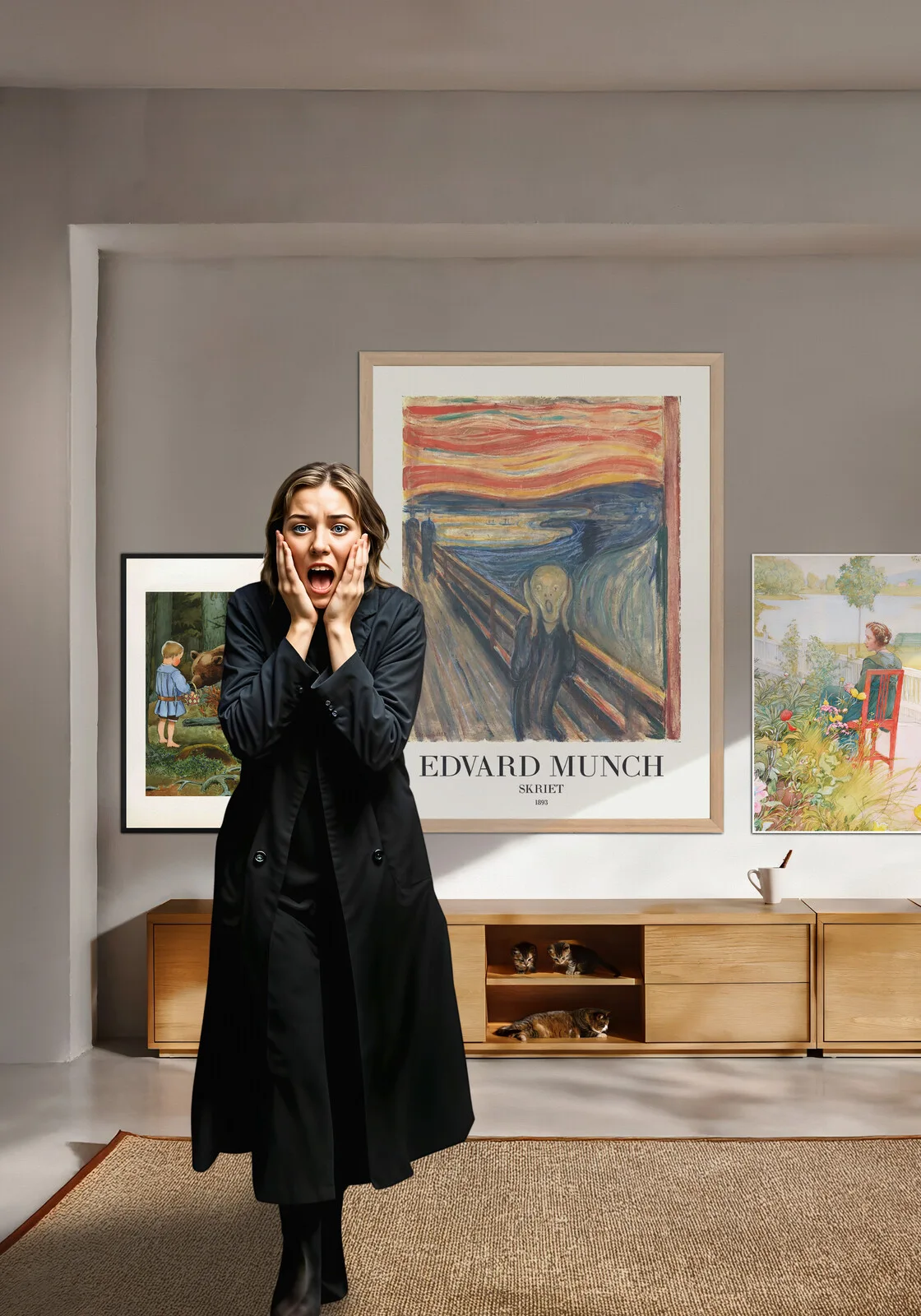
The Scream July 2025, 2025
Digital
50 x 70 cm
3 200 kr
The Scream July 2025
Few paintings have entered the collective consciousness as profoundly as ‘The Scream’. With its swirling sky, distorted figure, and bridge suspended over emptiness, Edvard Munch’s most iconic work captures more than just a moment of personal anguish — it embodies the psychic trembling of an entire age, the late 19th century, marked by rapid industrialisation, urbanisation, and existential despair. Yet, behind the scream lies not only dread but a specific night, a walk, a sky, and a life shaped by grief, desire, and emotional fracture.
To understand ‘The Scream’ is not to decode it as a symbol but to feel it as a wound. It is not an abstraction — it is a confession. This essay traces that wound to its source: a man who saw the sky catch fire and felt the world fall silent. A man haunted by illness, religion, loss, and women he could neither fully possess nor escape. It begins with a sunset over Oslofjord and ends with a scream that never quite fades. It echoes inside me now, and I cannot help but feel the empathy it evokes and the compassion I need for myself. Life rarely reveals itself in only black or white — usually only when someone refuses to acknowledge the nuances and prefers to see everything through a murky filter.
“Shades Between
They said the world was black or white,
a tale of wrong and flawless right.
But I have walked where colours fade,
and shadows dance in light and shade.
A glance, a word, a twist of fate—
Not all is love, not all is hate.
The heart’s not split in two clean parts;
It lives in grey, it breaks in arts.
The ones who judge with a sharpened eye
will miss the soft and trembling sky.
For life is made of threads that weave
both truth and lies, we choose to grieve.
So let them preach in black or white—
I’ll find my path in softer light.
Where flaws are grace, and scars are signs
that life was lived between the lines.”
Malmö July 2025
The Blood-Red Moment
When someone unexpectedly stabs you in the chest – or worse, in the back – when you feel ignored or misunderstood, it's easy for everything to fall apart just as it did for Edvard Munch. And for me.
The contrast between idyllic images, such as Carl Larsson’s ‘Sundborn’, where a woman in a red chair turns her back to the world while a child feeds a teddy bear in a blueberry forest, and Munch’s ‘The Scream’ is striking. The peaceful scenes of Larsson's work only serve to highlight the intense emotional turmoil depicted in Munch's painting.
There are moments in a person’s life that mark the soul like a scar, not because of what happens explicitly, but because of how the world suddenly shifts before one’s eyes. The trigger can be a single event or a combination of several. So it is with the first of July for me – even though the date is a long story spread over many years, perhaps a whole lifetime. The outcome remains the same. This sense of emotional upheaval and the resulting scars are not unique to Munch, but are part of the shared human experience.
For Edvard Munch, such a moment came during an evening walk along Ekeberg Ridge in Kristiania in January 1892. He was walking with two friends as the sun set over the Oslo fjord. In his diary, he described how the sky turned into a burning blood-red glow, and how he was suddenly overwhelmed by a dizzying sense of anxiety. The friends continued walking, but Munch stopped, grabbed a railing, and felt a great scream pierce through the natural world. It wasn’t a scream he heard with his ears – it was a cosmic howl that sliced through existence and left him cold-sweated and paralysed, a feeling that many of us, at some point in our lives, can relate to. This shared experience of overwhelming anxiety and fear is what makes Munch's work so universally resonant.
“I was walking along a path with two friends—the sun was setting—I felt a touch of melancholy—suddenly the sky turned blood red—I stopped, leaned against the fence, dead tired—over the blue-black fjord and the city lay blood and tongues of fire—my friends continued walking—I stood there trembling with fear—and I felt a great, infinite scream pass through nature.”
This very moment, captured in the words of his diary, became the seed of the most iconic work in Nordic art history. In ‘The Scream’, he returns to the place, to the railing, to the fjord, to the burning sky. The distorted figure in the foreground—genderless, skinless, mouth wide in terror—is both a representation of himself and a human archetype. And behind it, nature explodes in red, orange, and violet. Some researchers claim it was an aurora borealis he saw. In contrast, others suggest that the sky still bore traces of Krakatoa’s volcanic ash cloud, which, for several years after the 1883 eruption, tinted sunsets worldwide in unnatural hues. But what Munch saw mattered less than what he experienced: the world shifted from reality to vision, from the familiar to the infinitely terrifying.
That is what makes ‘The Scream’ so immediate and so timeless. It is not a planned symbolist manifesto. It is the depiction of a real moment—an account from the border between human and nature, between psychological collapse and poetic clarity. Munch did not merely scream—he captured the instant when existence itself began to shout back. That’s also why the painting isn’t just about personal anxiety, but a kind of cosmic, existential panic, a theme that resonates with us all, where all of nature, including each one of us, screams.
Anxiety, Women, and Art
Edvard Munch’s iconic painting is more than just a work of art – it is a psychological document, a primal scream captured on canvas. The twisted figure with hands around its face, the burning sky, the swaying bridge: everything vibrates with anxiety, fear, and existential dissolution – a panic attack. It wasn’t an individual screaming – it was existence itself, a portrayal that draws us in with its overwhelming emotional intensity. This painting is not just a visual representation, but a profound insight into the human psyche.
Behind the painting lies a life steeped in illness, loss, and emotional instability. Munch’s mother died when he was five. His beloved sister Sophie died of tuberculosis when he was fourteen. The father, a religiously rigid military doctor, tried to restrain the children’s grief with prayer and fear, which only deepened Edvard’s sense of guilt and dread. Yet another sister, Laura, later fell ill with schizophrenia. Munch grew up with death as a constant companion, and psychiatric institutions were never far away, neither in his family nor in his mind.
It is no coincidence that ‘The Scream’ was painted near a place where there was a mental hospital. Munch often described how, during that very walk, he felt nature’s scream pierce him, as if the landscape itself shared his anxiety. The intense colour scale and undulating lines visualise a psychological breakdown. It is a painting that lacks comfort or reconciling words. It doesn’t ask for understanding, nor does it provide an explanation. It just screams.
Munch’s relationships with women, particularly Dagny Juel, were not just influential but also tragic, contributing significantly to his emotional turmoil. In the decadent artistic scene of Berlin during the 1890s, he encountered the Norwegian writer and model Dagny Juel, a free spirit who inspired many artists, including Strindberg. Her untimely and tragic death in Georgia in 1901, when a jealous lover shot her, left an indelible mark on Munch’s psyche. Although their relationship was not strictly romantic, she seems to have become a symbol of dangerous femininity – seductive, inspiring, yet also deadly.
The most damaging relationship, however, was with Tulla Larsen. They met in 1898, and she quickly became obsessed with him. He, in turn, seemed both attracted and frightened. Their relationship was characterised by control, jealousy, and emotional outbursts. On one occasion, when she attempted to force a marriage, Munch withdrew, and they ended up in a violent quarrel that resulted in him shooting himself in the hand. The incident haunted him for a long time, and his art became even more infused with threatening eroticism and destructive gender roles.
Munch’s artistic universe revolves around three themes: love, anxiety, and death. The series ‘Frieze of Life’ includes works such as ‘The Kiss’, ‘Madonna’, ‘Separation’, and Anxiety’ – all variations on the same theme: passion leading to loss, desire resulting in powerlessness, closeness transforming into loneliness. The woman in Munch’s work often embodies dual personalities, representing both the goddess and the destroyer. Female sexuality is charged with danger. The man is usually passive, tormented, and overwhelmed.
‘The Scream’ is arguably the most gender-neutral work in his frieze – the figure in the painting is androgynous, genderless, an empty shell in which anxiety takes form. But within the context of Munch’s other works and his biography, it becomes clear that this anxiety is not solely existential. It is also gendered, visceral, and personal. ‘The Scream’ represents the culmination of a lifelong struggle with loss, desire, guilt, and fear.
That Munch, later in life, sought psychotherapeutic help and was treated at a sanatorium is a testament to the intensity of his inner conflicts. However, it also underscores his honesty as an artist. He did not paint ideals or beauty. He painted the wounded, the screaming, the unspeakable. In ‘The Scream’, he discovered a universal language for the anxiety that resides within every human being, regardless of time, place, or gender. This universality of his art makes it deeply relatable to all who encounter it.
There is no direct model for ‘The Scream’, but several women – notably Dagny Juel and Tulla Larsen – served as emotional catalysts for Munch’s deepest feelings. Their influence is evident throughout his entire body of work, including ‘The Scream’. This iconic painting carries their shadows, not as portraits, but as ghosts of an inner conflict between desire and fear, life and dissolution. The androgynous figure in the painting is genderless, almost ghostlike, and has been interpreted as a symbol of Munch’s internal struggle with both the woman and the feminine within himself. The open mouth, the sunken cheeks, and the undulating lines resemble a scream – but also a cry for help. And presently – I hear my own.
Jörgen Thornberg
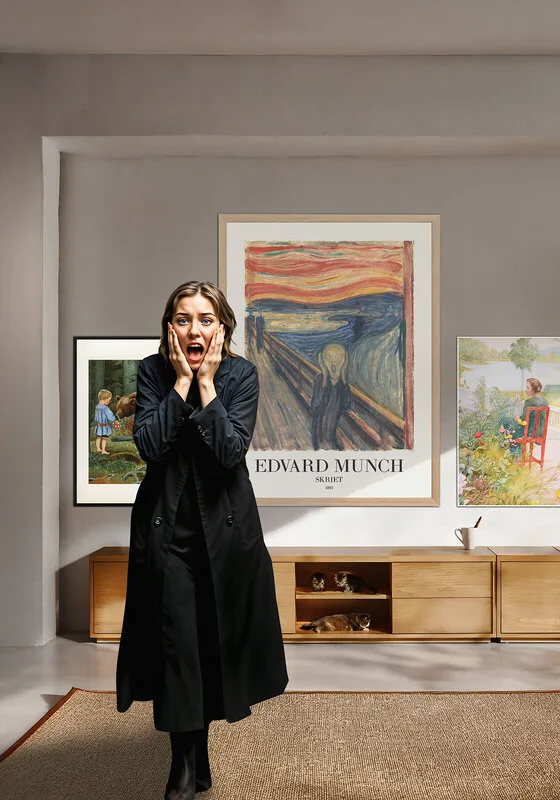
The Scream July 2025, 2025
Digital
50 x 70 cm
3 200 kr
The Scream July 2025
Few paintings have entered the collective consciousness as profoundly as ‘The Scream’. With its swirling sky, distorted figure, and bridge suspended over emptiness, Edvard Munch’s most iconic work captures more than just a moment of personal anguish — it embodies the psychic trembling of an entire age, the late 19th century, marked by rapid industrialisation, urbanisation, and existential despair. Yet, behind the scream lies not only dread but a specific night, a walk, a sky, and a life shaped by grief, desire, and emotional fracture.
To understand ‘The Scream’ is not to decode it as a symbol but to feel it as a wound. It is not an abstraction — it is a confession. This essay traces that wound to its source: a man who saw the sky catch fire and felt the world fall silent. A man haunted by illness, religion, loss, and women he could neither fully possess nor escape. It begins with a sunset over Oslofjord and ends with a scream that never quite fades. It echoes inside me now, and I cannot help but feel the empathy it evokes and the compassion I need for myself. Life rarely reveals itself in only black or white — usually only when someone refuses to acknowledge the nuances and prefers to see everything through a murky filter.
“Shades Between
They said the world was black or white,
a tale of wrong and flawless right.
But I have walked where colours fade,
and shadows dance in light and shade.
A glance, a word, a twist of fate—
Not all is love, not all is hate.
The heart’s not split in two clean parts;
It lives in grey, it breaks in arts.
The ones who judge with a sharpened eye
will miss the soft and trembling sky.
For life is made of threads that weave
both truth and lies, we choose to grieve.
So let them preach in black or white—
I’ll find my path in softer light.
Where flaws are grace, and scars are signs
that life was lived between the lines.”
Malmö July 2025
The Blood-Red Moment
When someone unexpectedly stabs you in the chest – or worse, in the back – when you feel ignored or misunderstood, it's easy for everything to fall apart just as it did for Edvard Munch. And for me.
The contrast between idyllic images, such as Carl Larsson’s ‘Sundborn’, where a woman in a red chair turns her back to the world while a child feeds a teddy bear in a blueberry forest, and Munch’s ‘The Scream’ is striking. The peaceful scenes of Larsson's work only serve to highlight the intense emotional turmoil depicted in Munch's painting.
There are moments in a person’s life that mark the soul like a scar, not because of what happens explicitly, but because of how the world suddenly shifts before one’s eyes. The trigger can be a single event or a combination of several. So it is with the first of July for me – even though the date is a long story spread over many years, perhaps a whole lifetime. The outcome remains the same. This sense of emotional upheaval and the resulting scars are not unique to Munch, but are part of the shared human experience.
For Edvard Munch, such a moment came during an evening walk along Ekeberg Ridge in Kristiania in January 1892. He was walking with two friends as the sun set over the Oslo fjord. In his diary, he described how the sky turned into a burning blood-red glow, and how he was suddenly overwhelmed by a dizzying sense of anxiety. The friends continued walking, but Munch stopped, grabbed a railing, and felt a great scream pierce through the natural world. It wasn’t a scream he heard with his ears – it was a cosmic howl that sliced through existence and left him cold-sweated and paralysed, a feeling that many of us, at some point in our lives, can relate to. This shared experience of overwhelming anxiety and fear is what makes Munch's work so universally resonant.
“I was walking along a path with two friends—the sun was setting—I felt a touch of melancholy—suddenly the sky turned blood red—I stopped, leaned against the fence, dead tired—over the blue-black fjord and the city lay blood and tongues of fire—my friends continued walking—I stood there trembling with fear—and I felt a great, infinite scream pass through nature.”
This very moment, captured in the words of his diary, became the seed of the most iconic work in Nordic art history. In ‘The Scream’, he returns to the place, to the railing, to the fjord, to the burning sky. The distorted figure in the foreground—genderless, skinless, mouth wide in terror—is both a representation of himself and a human archetype. And behind it, nature explodes in red, orange, and violet. Some researchers claim it was an aurora borealis he saw. In contrast, others suggest that the sky still bore traces of Krakatoa’s volcanic ash cloud, which, for several years after the 1883 eruption, tinted sunsets worldwide in unnatural hues. But what Munch saw mattered less than what he experienced: the world shifted from reality to vision, from the familiar to the infinitely terrifying.
That is what makes ‘The Scream’ so immediate and so timeless. It is not a planned symbolist manifesto. It is the depiction of a real moment—an account from the border between human and nature, between psychological collapse and poetic clarity. Munch did not merely scream—he captured the instant when existence itself began to shout back. That’s also why the painting isn’t just about personal anxiety, but a kind of cosmic, existential panic, a theme that resonates with us all, where all of nature, including each one of us, screams.
Anxiety, Women, and Art
Edvard Munch’s iconic painting is more than just a work of art – it is a psychological document, a primal scream captured on canvas. The twisted figure with hands around its face, the burning sky, the swaying bridge: everything vibrates with anxiety, fear, and existential dissolution – a panic attack. It wasn’t an individual screaming – it was existence itself, a portrayal that draws us in with its overwhelming emotional intensity. This painting is not just a visual representation, but a profound insight into the human psyche.
Behind the painting lies a life steeped in illness, loss, and emotional instability. Munch’s mother died when he was five. His beloved sister Sophie died of tuberculosis when he was fourteen. The father, a religiously rigid military doctor, tried to restrain the children’s grief with prayer and fear, which only deepened Edvard’s sense of guilt and dread. Yet another sister, Laura, later fell ill with schizophrenia. Munch grew up with death as a constant companion, and psychiatric institutions were never far away, neither in his family nor in his mind.
It is no coincidence that ‘The Scream’ was painted near a place where there was a mental hospital. Munch often described how, during that very walk, he felt nature’s scream pierce him, as if the landscape itself shared his anxiety. The intense colour scale and undulating lines visualise a psychological breakdown. It is a painting that lacks comfort or reconciling words. It doesn’t ask for understanding, nor does it provide an explanation. It just screams.
Munch’s relationships with women, particularly Dagny Juel, were not just influential but also tragic, contributing significantly to his emotional turmoil. In the decadent artistic scene of Berlin during the 1890s, he encountered the Norwegian writer and model Dagny Juel, a free spirit who inspired many artists, including Strindberg. Her untimely and tragic death in Georgia in 1901, when a jealous lover shot her, left an indelible mark on Munch’s psyche. Although their relationship was not strictly romantic, she seems to have become a symbol of dangerous femininity – seductive, inspiring, yet also deadly.
The most damaging relationship, however, was with Tulla Larsen. They met in 1898, and she quickly became obsessed with him. He, in turn, seemed both attracted and frightened. Their relationship was characterised by control, jealousy, and emotional outbursts. On one occasion, when she attempted to force a marriage, Munch withdrew, and they ended up in a violent quarrel that resulted in him shooting himself in the hand. The incident haunted him for a long time, and his art became even more infused with threatening eroticism and destructive gender roles.
Munch’s artistic universe revolves around three themes: love, anxiety, and death. The series ‘Frieze of Life’ includes works such as ‘The Kiss’, ‘Madonna’, ‘Separation’, and Anxiety’ – all variations on the same theme: passion leading to loss, desire resulting in powerlessness, closeness transforming into loneliness. The woman in Munch’s work often embodies dual personalities, representing both the goddess and the destroyer. Female sexuality is charged with danger. The man is usually passive, tormented, and overwhelmed.
‘The Scream’ is arguably the most gender-neutral work in his frieze – the figure in the painting is androgynous, genderless, an empty shell in which anxiety takes form. But within the context of Munch’s other works and his biography, it becomes clear that this anxiety is not solely existential. It is also gendered, visceral, and personal. ‘The Scream’ represents the culmination of a lifelong struggle with loss, desire, guilt, and fear.
That Munch, later in life, sought psychotherapeutic help and was treated at a sanatorium is a testament to the intensity of his inner conflicts. However, it also underscores his honesty as an artist. He did not paint ideals or beauty. He painted the wounded, the screaming, the unspeakable. In ‘The Scream’, he discovered a universal language for the anxiety that resides within every human being, regardless of time, place, or gender. This universality of his art makes it deeply relatable to all who encounter it.
There is no direct model for ‘The Scream’, but several women – notably Dagny Juel and Tulla Larsen – served as emotional catalysts for Munch’s deepest feelings. Their influence is evident throughout his entire body of work, including ‘The Scream’. This iconic painting carries their shadows, not as portraits, but as ghosts of an inner conflict between desire and fear, life and dissolution. The androgynous figure in the painting is genderless, almost ghostlike, and has been interpreted as a symbol of Munch’s internal struggle with both the woman and the feminine within himself. The open mouth, the sunken cheeks, and the undulating lines resemble a scream – but also a cry for help. And presently – I hear my own.
3 200 kr

Jörgen Thornberg
Malmö
Lite om bilder och mig. Translation in English at the end.
Jag är en nyfiken person som ser allt i bilder, även det jag fäster i ord, gärna tillsammans för bakom alla mina bilder finns en berättelse. Till vissa bilder hör en kortare eller längre novell som följer med bilden.
Bilder berättar historier. Jag omges av naturlig skönhet, intressanta människor och historia var jag än går. Jag använder min kamera för att dokumentera världen och blanda det jag ser med vad jag känner för att fånga den dolda magin.
Mina bilder berättar mina historier. Genom mina bilder, tryck och berättelser. Jag bjuder in dig att ta del av dessa berättelser, in i ditt liv och hem och dela min mycket personliga syn på vår värld. Mer än vad ögat ser. Jag tänker i bilder, drömmer och skriver och pratar om dem; följaktligen måste jag också skapa bilder. De blir vad jag ser, inte nödvändigtvis begränsade till verkligheten. Det finns en bild runt varje hörn. Jag hoppas att du kommer att se vad jag såg och gilla det.
Jag är också en skrivande person och till många bilder hör en kortare eller längre essay. Den följer med tavlan, tryckt på fint papper och med en personlig hälsning från mig.
Flertalet bilder startar sin resa i min kamera. Enkelt förklarat beskriver jag bilden jag ser i mitt inre, upplevd eller fantiserad. Bilden uppstår inom mig redan innan jag fått okularet till ögat. På bråkdelen av ett ögonblick ser jag vad jag vill ha och vad som kan göras med bilden. Här skall jag stoppa in en giraff, stålmannen, Titanic eller vad det är min fantasi finner ut. Ännu märkligare är att jag kommer ihåg minnesbilden långt efteråt när det blir tid att skapa verket. Om jag lyckas eller inte, är upp till betraktaren, oftast präglat av en stråk av svart humor – meningen är att man skall bli underhållen. Mina bilder blir ofta en snackis där de hänger.
Jag föredrar bilder som förmedlar ett budskap i flera lager. Vid första anblicken fylld av feel-good, en vacker utsikt, fint väder, solen skiner, blommor på ängen eller vattnet som ligger förrädiskt spegelblankt. I en sådan bild kan jag gömma min egentliga berättelse, mitt förakt för förtryckare och våldsverkare, rasister och fördomsfulla människor - ett gärna återkommande motiv mer eller mindre dolt i det vackra motivet. Jag försöker förena dem i ett gemensamt narrativ.
Bild och formgivning har löpt som en röd tråd genom livet. Fotokonst känns som en värdig final som jag gärna delar med mig.
Min genre är vid som framgår av mina bilder, temat en blandning av pop- och gatukonst i kollage som kan bestå av hundratals lager. Vissa bilder kan ta veckor, andra någon dag innan det är dags att överlämna resultatet till printverkstaden. Fine Art Prints är digitala fotocollage. I dessa kollage sker rivandet, klippandet, pusslandet, målandet, ritandet och sprayningen digitalt. Det jag monterar in kan vara hundratals år gamla bilder som jag omsorgsfullt frilägger så att de ser ut att vara en del av tavlan men också bilder skapade av mig själv efter min egen fantasi. Därefter besöks printstudion och för vissa bilder numrera en limiterad upplaga (oftast 7 exemplar) och signera för hand. Vissa bilder kan köpas i olika format. Det är bara att fråga efter vilka. Gillar man en bild som är 70x100 men inte har plats på väggen, går den kanske att få i 50x70 cm istället. Frågan är fri.
Metoden Giclée eller Fine Art Print som det också kallas är det moderna sättet för framställning av grafisk konst. Villkoret för denna typ av utskrifter är att en högkvalitativ storformatskrivare används med åldersbeständigt färgpigment och konstnärspapper eller i förekommande fall på duk. Pappret som används möter de krav på livslängd som ställs av museer och gallerier. Normalt säljer jag mina bilder oinramade så att den nya ägaren själv kan bestämma hur de skall se ut, med eller utan passepartout färg på ram, med eller utan glas etc..
Under många år ställde jag bara ut på nätet, i valda grupper och på min egen Facebooksida - https://www.facebook.com/jorgen.thornberg.9
Jag finns också på en egen hemsida som tyvärr inte alltid är uppdaterad – https://www.jth.life/ Där kan du också läsa en del av de berättelser som följer med bilden.
UTSTÄLLNINGAR
Luftkastellet, oktober 2022
Konst i Lund, november 2022
Luftkastellet, mars 2023
Engleson Galleri Caroli, april 2023
Hydra, Greece June 2023
Engleson Galleri Caroli, oktober 2023
Toppen, Höllviken december 2023
Luftkastellet, mars 2024
Torups Galleri, mars 2024
Venice, May 2024
Luftkastellet, oktober 2024
Konst i Advent, December 2024
Galleri Engleson, Caroli December 2024
Jäger & Jansson Galleri, april 2025
A bit about pictures and me.
I'm a curious person who sees everything in pictures, even what I express in words, often combining them, for behind all my pictures lies a story. These narratives, some as short as a single image and others as long as a novel, are the heart and soul of my work.
Pictures tell stories. Wherever I go, I'm surrounded by natural beauty, exciting people, and history. I use my camera to document the world and blend what I see with what I feel to capture the hidden magic.
My images tell my stories. Through my pictures, prints, and narratives, I invite you to partake in these stories in your life and home and share my deeply personal perspective of our world. More than meets the eye. I think in pictures, dream, write, and talk about them; consequently, I must create images too. They become what I see, not necessarily confined to reality. There's a picture around every corner. I hope you'll see what I saw and enjoy it.
I'm also a writer, and many images come with a shorter or longer essay. It accompanies the painting, printed on fine paper with my personal greeting.
Many pictures start their journey on my camera. Simply put, I describe the image I see in my mind, experienced or imagined. The image arises within me even before I bring the eyepiece to my eye. In a fraction of a moment, I see what I want and what can be done with the picture. Here, I'll insert a giraffe, Superman, the Titanic, or whatever my imagination conjures up. Even stranger is that I remember the mental image long after it's time to create the work. Whether I succeed is up to the observer, often imbued with a streak of black humour – the aim is to entertain. My pictures usually become a talking point wherever they hang.
I prefer pictures that convey a message in multiple layers. At first glance, they're filled with feel-good vibes, a beautiful view, lovely weather, the sun shining, flowers in the meadow, or the water lying deceptively calm. But beneath this surface beauty, I often conceal a deeper story, a narrative that challenges societal norms or explores the human condition. I invite you to delve into these hidden narratives and discover the layers of meaning within my work.
Picture and design have been a thread running through my life. Photographic art feels like a fitting finale, and I'm happy to share it.
My genre is varied, as seen in my pictures; the theme is a blend of pop and street art in collages that can consist of hundreds of layers. Some images can take weeks, others just a day before it's time to hand over the result to the print workshop. Fine Art Prints are digital photo collages. In these collages, tearing, cutting, puzzling, painting, drawing, and spraying happen digitally. What I insert can be images hundreds of years old that I carefully extract so they appear to be part of the painting, but also images created by myself, now also generated from my imagination. Next, visit the print studio and, for certain images, number a limited edition (usually 7 copies) and sign them by hand. Some images may be available in other formats. Just ask which ones. If you like an image that's 70x100 but doesn't have space on the wall, you might be able to get it in 50x70 cm instead. The question is open.
The Giclée method, or Fine Art Print as it's also called, is the modern way of producing graphic art. This method ensures the highest quality and longevity of the artwork, using a high-quality large-format printer with archival pigment inks and artist paper or, in some cases, canvas. The paper used meets the longevity requirements set by museums and galleries. I sell my pictures unframed, allowing the new owner to personalise their artwork, confident in the lasting value and quality of the piece.
For many years, I only exhibited online, in selected groups, and on my Facebook page - https://www.facebook.com/jorgen.thornberg.9. I also have my website, which unfortunately is not constantly updated - https://www.jth.life/. You can also read some of the stories accompanying the pictures there.
EXHIBITIONS
Luftkastellet, October 2022
Art in Lund, November 2022
Luftkastellet, March 2023
Engleson Gallery Caroli, April 2023
Hydra, Greece June 2023
Engleson Gallery Caroli, October 2023
Toppen, Höllviken December 2023
Luftkastellet, March 2024
Torup Gallery, March 2024
Venice, May 2024
UTSTÄLLNINGAR
Luftkastellet, oktober 2022
Konst i Lund, november 2022
Luftkastellet, mars 2023
Engleson Galleri Caroli, april 2023
Hydra, Greece June 2023
Engleson Galleri Caroli, oktober 2023
Toppen, Höllviken december 2023
Luftkastellet, mars 2024
Torups Galleri, mars 2024
Venice, May 2024
Luftkastellet, October 2024
Konst i Advent, December 2024
Galleri Engleson, Caroli December 2024
Jäger & Jansson Galleri, April 2025
Utbildning
Autodidakt
Medlem i konstnärsförening
Öppna Sinnen
Med i konstrunda
Konstrundan i Skåne
Utställningar
Luftkastellet, October 2022
Art in Lund, November 2022
Luftkastellet, March 2023
Engleson Gallery Caroli, April 2023
Hydra, Greece June 2023
Engleson Gallery Caroli, October 2023
Toppen, Höllviken December 2023
Luftkastellet, March 2024
Torup Gallery, March 2024
Venice, May 2024