Vi använder cookies för att ge dig bästa möjliga upplevelse. Välj vilka cookies du tillåter.
Läs mer i vår integritetspolicy
Jörgen Thornberg
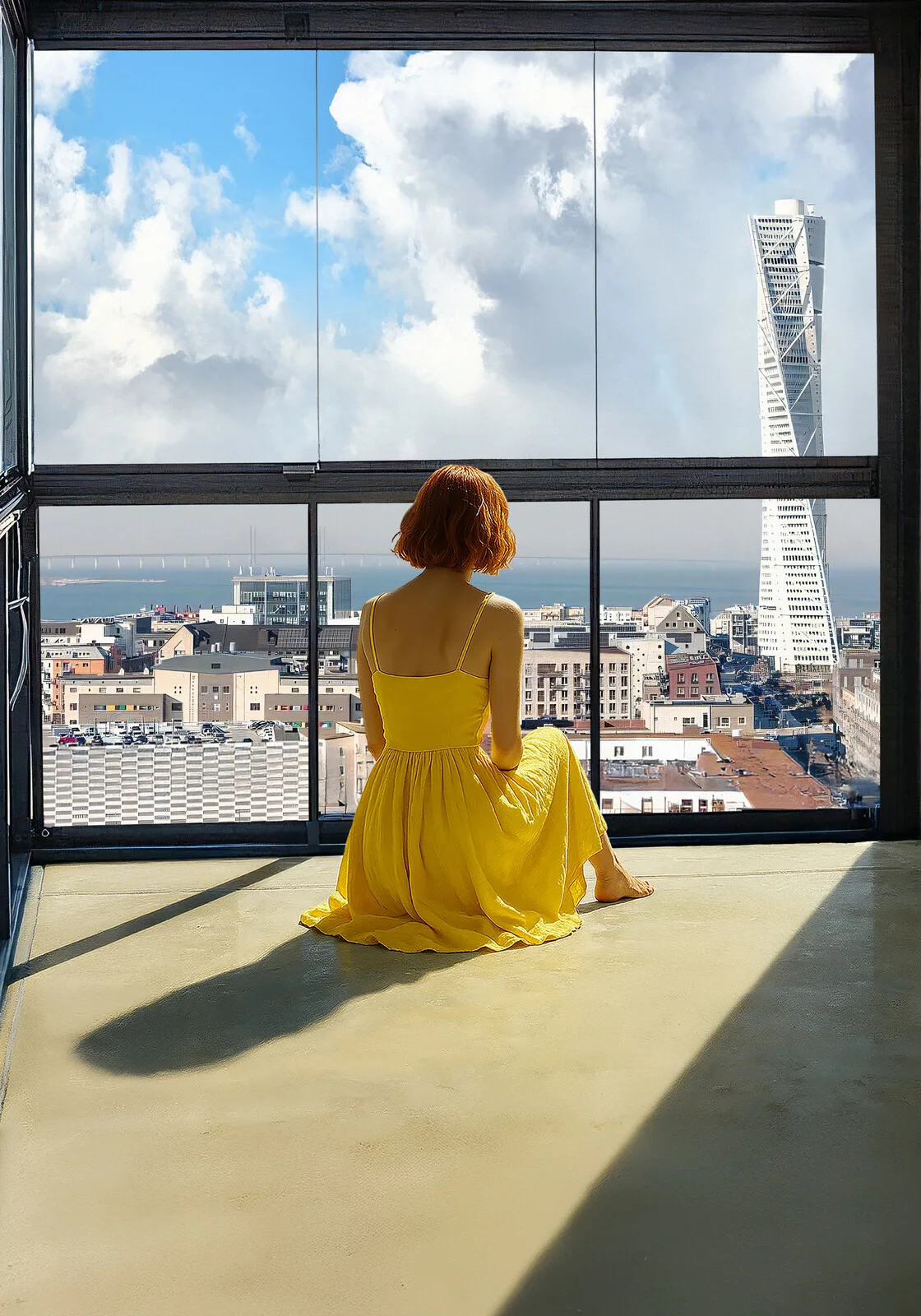
Advice to my dear daughter, if I had one, 2025
Digital
50 x 70 cm
3 200 kr
Advice to a dear little girl
As the image indicates, we see a woman lost in thought, sitting on the raw concrete floor of a glass-enclosed balcony in Malmö’s new prestige building, The Docks. Before her lies what could be perceived as the whole world, and within her, thoughts circle a girl—a daughter she does not yet have, or perhaps has, or why not… a granddaughter. Her deep introspection invites the audience to reflect and contemplate alongside her.
The poem I’ve written is inspired by some of the most renowned verses in Swedish poetry. However, it differs on many levels, not least because the original was penned by Anna Maria Lenngren over two hundred and twenty-five years ago. “Some Words to My Dear Daughter, If I Had One” remains, even today, both understandable and deeply relevant, bridging the gap between past and present. I haven’t distorted Lenngren’s words; instead, I have concentrated on writing from the heart — about forty stanzas in total, so it has taken its time, but, for me, it has been worth the effort. This historical context, I believe, will add a layer of intrigue to the poem for the poetry enthusiasts among you.
First, I have the daughter that Lenngren lacked — and she certainly doesn’t need my advice. This personal connection, our shared bloodline, adds a profound depth to my poem. Second, I don’t need to conceal social criticism in irony and satire. It should also be noted that I haven’t dedicated this poem to my daughter, but to a granddaughter, who kindly lent me her name.
So, the poem isn’t satire but should be read as a loving message from a grandfather who has put her mother’s words into his pen (purely for technical reasons, such as maintaining the poetic flow and rhythm — nothing else). I hope she’ll agree with most of it, as her perspective is valuable to me. Within our cultural context, the content of my words is far less controversial than Lenngren’s was in 1798. Even if the fight for women’s equality continues in Sweden, at least on paper, most of the work has now been done. For an eight-year-old girl, the future in this regard looks bright.
There are other challenges my poem addresses. Please see it as a heartfelt gift, not a lecture on the obvious — that’s something her parents already handle admirably. And now, the poem. Following this, there is a comprehensive background and references to Anna Maria Lenngren, including her life, works, and the historical context in which she wrote. Enjoy, dear Elly — and all others who may read this.
“Advice to the grandchild, I have
My dearest Elly! You’ll soon be grown
and leave your dolls behind, no less.
So listen now to your mother’s tone—
and take to heart this small address.
The world, which you’ve not yet explored,
can bring both sorrow, weight and pain;
But with your wit and joy restored,
you’ll turn misfortune into gain.
On life’s long road, tread soft and wise,
don’t trust each whisper that you hear;
for though the world wears many guise,
it’s still the finest one, my dear.
The world you meet remains the same—
with fools and sages all around;
But choose to treat it like a game,
and laugh more often than you frown.
Too much mistrust may harden you,
too much belief brings heartache near;
Don’t see a thorn in every view,
nor virtue in each man sincere.
You’ll thrive if you are calmly bright
and follow wisdom’s older lady;
Don’t rush with rage into each fight—
a steady hand won’t make you shady.
Do give some time to thoughtful prose—
our sex has much it still must learn;
And when you read, make sure it shows
where not to click or where to turn.
Keep an open mind and gentle grace,
let AI guide where thoughts are thin.
But child, observe the human race—
life speaks much louder from within.
For every person, Elly, is a page—
a book with thoughts to be revealed.
Learn well to read both fool and sage,
so time and care won’t be misdealed.
And if you’re fond of written lore,
then let it show, but never boast.
Don’t flaunt your learning—what is more,
good sense is best when shared by most.
For those too learned, strange but true,
invite sharp tongues and pointed jest;
And you might look, when day is through,
like someone guarding her small nest.
So follow nature’s wise decree—
Don’t scorn the honours men may hold;
Their worth, though flawed, is plain to see—
a knowing nod is sometimes gold.
A woman’s wit is calm and sly;
She plays her part with subtle grace.
The man may scratch his head and sigh—
she’s left him in a thoughtful place.
Just like your mother in her den,
who tends the daily tasks with care;
with balance found in “now” and “then,”
no Instagram required there.
Dear Elly, kindness, grace, and pace—
like flowers blooming where you’ve tread.
Duty, honour, love, and place—
a proper blend that keeps you fed.
True charm often walks hand in hand
with diligence in the smallest deed.
Let clothes speak louder than a brand—
but match your flair with humble creed.
Follow the path of simple taste,
don’t let mere glamour cloud your mind.
Layer on frills? What a sorry waste—
it’s like a singer out of time.
In company, flee the chatter crowd,
but don’t sit mute like some old riddle.
And steer far clear of powders loud—
They dull a woman more than a griddle.
Choose words that fall with a graceful tone,
and don’t cast judgment with a sneer;
speak briefly, Elly, on your own—
for clumsy speech will harden here.
Let humour dance with gentle skill,
a twist of wit, not too direct;
we laugh with those whose hearts are still,
but love the ones who show respect.
The idle soul, worn out and slow,
grows weary of life’s gentle gift;
Another idler joins the show—
“Let’s play some cards to get a lift!”
An idle girl, both soft and sweet,
will soon be overstuffed and blurred,
she won’t keep pace in the smart elite—
She ends up trashed, her hopes deferred.
A game is fine from time to time,
but not for those who strive with grace;
Such habits turn to social grime,
and slow the mind in every place.
Your blue eyes, Dearest, reflect your soul,
they show the dreams that lie within.
No makeup makes a liar whole—
no mascara hides what’s been.
Dear Elly, you must stay aware
of TikTok, Facebook, and Instagram.
It looks like life, but take great care,
beneath the gloss, it’s mostly a scam.
Don’t accept all that you see —
We choose what we want to share
And that’s rarely the whole reality.
We all have things not to lay bare.
There is always another side to the story
Nobody is perfect, whatever they post
Maybe they cry or wrestle with worry.
We can all feel lonely, anxious or lost.
You can feel lost or full of doubt,
no matter what the surface shows.
So don’t let shiny likes crowd out
the quiet truth your own heart knows.
The Climate issue is easy to hide or forget,
especially when it’s taboo or unclear.
But silence will be humanity’s regret—
This is a truth we all must hold dear.
The Earth’s on loan, as poets have known.
Yet so much has already gone wrong.
Elly, one of the bright seeds we’ve sown—
you won’t stay quiet when lies grow strong.
Follow Greta—at first, she stood all alone
for forests in flames and receding snow.
Let your voice and your reason be clearly shown;
Thus, you’ll help the world sustainably grow.
Elly, your strength exceeds the strongest hand.
Beneath your golden hair with fearless flair,
are sharp thoughts that reach distant lands—
Your brilliant mind is uniquely rare.
You can be anything in a world of your own,
with courage greater than power or pride.
Your finest gift is deeply grown—
It’s feminine, sharp, and shines from inside.
There are fields in life you best perceive,
where instinct and reason form your might.
So never trust those who only deceive—
Let sound judgment guide you toward the right.
And now that we’ve solved the world’s concern,
we draw a bit closer, you and I—
to love, and all that you may learn
of building a life, with someone nearby.
To meet a man, Elly, may be a quest,
but never a goal you must pursue.
It takes both courage and love to invest—
and it must be equal for both of you.
To marry—yes, a theme so vast,
with books of tips and endless chatter;
But Elly, darling, hold on fast—
a man’s sweet words should never flatter.
You are two of equal worth,
share all in storm as well as drought.
So say the wise of land and earth—
It’s not the gender, but the route.
The one who wins your heart one day
must be the best of all there are to find;
If he can earn your love, then say
Your praises are true, and speak your mind.
Take what life brings with gentle air,
and then it won’t weigh you down;
And trust me, child, the sweetest pair
stay young when joy outshines the frown.
But Elly, time moves on so fast,
and what a loss we face, how grim,
if all we’ve built and done and cast
lacks room for joy within its brim.
Let joy and laughter have their place,
don’t judge light things as shallow waste.
In a well-kept life, there is still space
for bits of fun and private taste.
Let joy become your truest friend,
and keep within your heart at peace;
May happiness be yours to send
against the storms that never cease.
Dear Elly, life is rich and grand,
but don’t forget yourself in flight.
And now my loving verse must end—
Just know: you are my heart’s delight.”
Malmö June 2025
Advice to my dear daughter
Anna Maria Lenngren’s poem “Some Words to My Dear Daughter, If I Had One” (1798) is a brilliant example of how irony and satire can serve as powerful tools for social criticism, particularly in the context of women’s roles in 18th-century Swedish society. On the surface, we encounter a mother giving her daughter “sound advice,” discouraging her from reading too much, from pursuing ambition, and instead urging her to remain modest, industrious in household matters, and never try to compete with men. But beneath this seemingly well-meaning counsel lies a sharp and deliberate critique of the structures that reduced women to silent ornaments in a man’s world.
It is precisely this double tone that gives the poem its power. With a near-conspiratorial voice and a tone that appears morally respectable, Lenngren exposes the absurdity and suffocating nature of the prevailing norms. The irony lies not in what is said, but in how confidently it is expressed. The satire resides in the gap between the literal meaning and the real message.
The poem is also formally clever. By writing as if a mother is addressing a daughter she does not have—a fictional child—Lenngren creates an artistic distance that enables her to express sensitive, even dangerous ideas without directly confronting anyone. It is a rhetorical manoeuvre that offers her both protection and freedom. Simultaneously, this device allows her to look forward to women not yet born, but whom she dared to imagine.
It is here, in this literary leap across time, that Lenngren’s poem remains relevant. Although it was written at the end of Sweden’s Age of Liberty, in a bourgeois salon culture where women’s education was to be “measured and discreet,” the subject matter remains far from outdated. Much has changed in Sweden since the 18th century—women’s rights have gradually strengthened, and gender equality is enshrined in law and education. Yet, the struggle is far from over, and Lenngren's poem serves as a poignant reminder of the ongoing fight for women's rights.
We should also remember that what may seem evident to us in the Nordic countries—access to education, freedom of movement, the right to choose one’s partner, to dress freely, to speak one’s mind—remains unthinkable for millions of women worldwide. In countries governed by patriarchal and religious dictatorships, women’s lives are fundamentally restricted. Iran stands as one of the clearest examples. In the 20th century, Iran transformed a society where women began to gain rights, access to education, careers, and a greater presence in public life—the veil became optional. But after the Islamic Revolution in 1979, that progress was reversed. Today, women in Iran are once again subjected to religious oppression, where morality police enforce dress codes, freedom is punished, and protest is met with brutal force. Demanding the right to live as a free woman can lead to imprisonment, beatings, or death. Likewise, the situation in Afghanistan is dire, with women's rights being rolled back following the Taliban's return to power in 2021.
The situation in Afghanistan is a tragic example of how hard-won rights can be lost. After the Taliban's return to power in 2021, women who had begun to reclaim access to education, employment, and public life during the early 2000s were pushed back into the shadows. Girls are now banned from attending school beyond sixth grade; women have been driven out of universities, workplaces, and public spaces. A generation of young women who grew up with hope and ambition have had their dreams shattered—literally overnight. It is as if the clock was turned back a hundred years—or more.
In the face of such stark realities, Lenngren’s satire is anything but outdated. It serves as a stark reminder of how long the road to freedom can be—and how easily hard-won rights can be lost. For every Elly growing up in an open and equal society, there is another girl forced to remain silent, to cover her hair, to lower her voice, and to deny her gifts. This enduring struggle for women's rights demands our unwavering determination and resilience, underscoring the necessity of defending these rights.
Lenngren’s poem is therefore not merely a relic of Swedish intellectual history—it is a literary lantern that still burns. And it continues to illuminate both what we have gained and what we still need to defend.t still defend.
Jörgen Thornberg
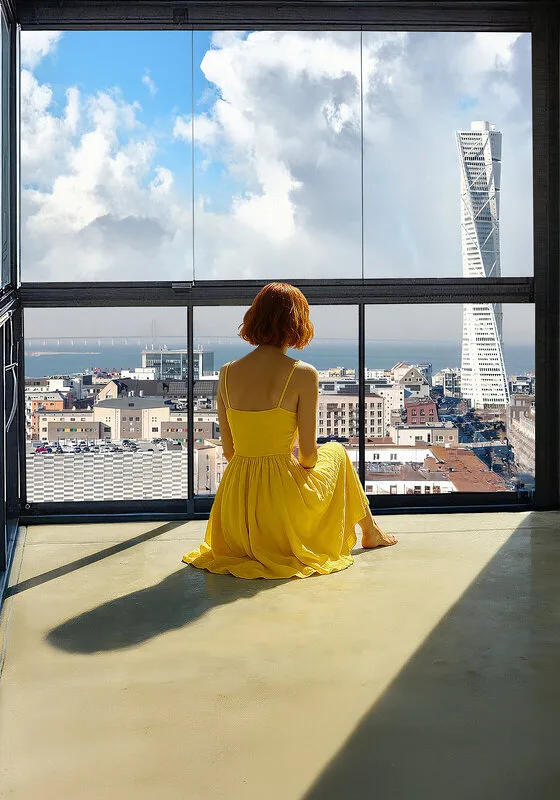
Advice to my dear daughter, if I had one, 2025
Digital
50 x 70 cm
3 200 kr
Advice to a dear little girl
As the image indicates, we see a woman lost in thought, sitting on the raw concrete floor of a glass-enclosed balcony in Malmö’s new prestige building, The Docks. Before her lies what could be perceived as the whole world, and within her, thoughts circle a girl—a daughter she does not yet have, or perhaps has, or why not… a granddaughter. Her deep introspection invites the audience to reflect and contemplate alongside her.
The poem I’ve written is inspired by some of the most renowned verses in Swedish poetry. However, it differs on many levels, not least because the original was penned by Anna Maria Lenngren over two hundred and twenty-five years ago. “Some Words to My Dear Daughter, If I Had One” remains, even today, both understandable and deeply relevant, bridging the gap between past and present. I haven’t distorted Lenngren’s words; instead, I have concentrated on writing from the heart — about forty stanzas in total, so it has taken its time, but, for me, it has been worth the effort. This historical context, I believe, will add a layer of intrigue to the poem for the poetry enthusiasts among you.
First, I have the daughter that Lenngren lacked — and she certainly doesn’t need my advice. This personal connection, our shared bloodline, adds a profound depth to my poem. Second, I don’t need to conceal social criticism in irony and satire. It should also be noted that I haven’t dedicated this poem to my daughter, but to a granddaughter, who kindly lent me her name.
So, the poem isn’t satire but should be read as a loving message from a grandfather who has put her mother’s words into his pen (purely for technical reasons, such as maintaining the poetic flow and rhythm — nothing else). I hope she’ll agree with most of it, as her perspective is valuable to me. Within our cultural context, the content of my words is far less controversial than Lenngren’s was in 1798. Even if the fight for women’s equality continues in Sweden, at least on paper, most of the work has now been done. For an eight-year-old girl, the future in this regard looks bright.
There are other challenges my poem addresses. Please see it as a heartfelt gift, not a lecture on the obvious — that’s something her parents already handle admirably. And now, the poem. Following this, there is a comprehensive background and references to Anna Maria Lenngren, including her life, works, and the historical context in which she wrote. Enjoy, dear Elly — and all others who may read this.
“Advice to the grandchild, I have
My dearest Elly! You’ll soon be grown
and leave your dolls behind, no less.
So listen now to your mother’s tone—
and take to heart this small address.
The world, which you’ve not yet explored,
can bring both sorrow, weight and pain;
But with your wit and joy restored,
you’ll turn misfortune into gain.
On life’s long road, tread soft and wise,
don’t trust each whisper that you hear;
for though the world wears many guise,
it’s still the finest one, my dear.
The world you meet remains the same—
with fools and sages all around;
But choose to treat it like a game,
and laugh more often than you frown.
Too much mistrust may harden you,
too much belief brings heartache near;
Don’t see a thorn in every view,
nor virtue in each man sincere.
You’ll thrive if you are calmly bright
and follow wisdom’s older lady;
Don’t rush with rage into each fight—
a steady hand won’t make you shady.
Do give some time to thoughtful prose—
our sex has much it still must learn;
And when you read, make sure it shows
where not to click or where to turn.
Keep an open mind and gentle grace,
let AI guide where thoughts are thin.
But child, observe the human race—
life speaks much louder from within.
For every person, Elly, is a page—
a book with thoughts to be revealed.
Learn well to read both fool and sage,
so time and care won’t be misdealed.
And if you’re fond of written lore,
then let it show, but never boast.
Don’t flaunt your learning—what is more,
good sense is best when shared by most.
For those too learned, strange but true,
invite sharp tongues and pointed jest;
And you might look, when day is through,
like someone guarding her small nest.
So follow nature’s wise decree—
Don’t scorn the honours men may hold;
Their worth, though flawed, is plain to see—
a knowing nod is sometimes gold.
A woman’s wit is calm and sly;
She plays her part with subtle grace.
The man may scratch his head and sigh—
she’s left him in a thoughtful place.
Just like your mother in her den,
who tends the daily tasks with care;
with balance found in “now” and “then,”
no Instagram required there.
Dear Elly, kindness, grace, and pace—
like flowers blooming where you’ve tread.
Duty, honour, love, and place—
a proper blend that keeps you fed.
True charm often walks hand in hand
with diligence in the smallest deed.
Let clothes speak louder than a brand—
but match your flair with humble creed.
Follow the path of simple taste,
don’t let mere glamour cloud your mind.
Layer on frills? What a sorry waste—
it’s like a singer out of time.
In company, flee the chatter crowd,
but don’t sit mute like some old riddle.
And steer far clear of powders loud—
They dull a woman more than a griddle.
Choose words that fall with a graceful tone,
and don’t cast judgment with a sneer;
speak briefly, Elly, on your own—
for clumsy speech will harden here.
Let humour dance with gentle skill,
a twist of wit, not too direct;
we laugh with those whose hearts are still,
but love the ones who show respect.
The idle soul, worn out and slow,
grows weary of life’s gentle gift;
Another idler joins the show—
“Let’s play some cards to get a lift!”
An idle girl, both soft and sweet,
will soon be overstuffed and blurred,
she won’t keep pace in the smart elite—
She ends up trashed, her hopes deferred.
A game is fine from time to time,
but not for those who strive with grace;
Such habits turn to social grime,
and slow the mind in every place.
Your blue eyes, Dearest, reflect your soul,
they show the dreams that lie within.
No makeup makes a liar whole—
no mascara hides what’s been.
Dear Elly, you must stay aware
of TikTok, Facebook, and Instagram.
It looks like life, but take great care,
beneath the gloss, it’s mostly a scam.
Don’t accept all that you see —
We choose what we want to share
And that’s rarely the whole reality.
We all have things not to lay bare.
There is always another side to the story
Nobody is perfect, whatever they post
Maybe they cry or wrestle with worry.
We can all feel lonely, anxious or lost.
You can feel lost or full of doubt,
no matter what the surface shows.
So don’t let shiny likes crowd out
the quiet truth your own heart knows.
The Climate issue is easy to hide or forget,
especially when it’s taboo or unclear.
But silence will be humanity’s regret—
This is a truth we all must hold dear.
The Earth’s on loan, as poets have known.
Yet so much has already gone wrong.
Elly, one of the bright seeds we’ve sown—
you won’t stay quiet when lies grow strong.
Follow Greta—at first, she stood all alone
for forests in flames and receding snow.
Let your voice and your reason be clearly shown;
Thus, you’ll help the world sustainably grow.
Elly, your strength exceeds the strongest hand.
Beneath your golden hair with fearless flair,
are sharp thoughts that reach distant lands—
Your brilliant mind is uniquely rare.
You can be anything in a world of your own,
with courage greater than power or pride.
Your finest gift is deeply grown—
It’s feminine, sharp, and shines from inside.
There are fields in life you best perceive,
where instinct and reason form your might.
So never trust those who only deceive—
Let sound judgment guide you toward the right.
And now that we’ve solved the world’s concern,
we draw a bit closer, you and I—
to love, and all that you may learn
of building a life, with someone nearby.
To meet a man, Elly, may be a quest,
but never a goal you must pursue.
It takes both courage and love to invest—
and it must be equal for both of you.
To marry—yes, a theme so vast,
with books of tips and endless chatter;
But Elly, darling, hold on fast—
a man’s sweet words should never flatter.
You are two of equal worth,
share all in storm as well as drought.
So say the wise of land and earth—
It’s not the gender, but the route.
The one who wins your heart one day
must be the best of all there are to find;
If he can earn your love, then say
Your praises are true, and speak your mind.
Take what life brings with gentle air,
and then it won’t weigh you down;
And trust me, child, the sweetest pair
stay young when joy outshines the frown.
But Elly, time moves on so fast,
and what a loss we face, how grim,
if all we’ve built and done and cast
lacks room for joy within its brim.
Let joy and laughter have their place,
don’t judge light things as shallow waste.
In a well-kept life, there is still space
for bits of fun and private taste.
Let joy become your truest friend,
and keep within your heart at peace;
May happiness be yours to send
against the storms that never cease.
Dear Elly, life is rich and grand,
but don’t forget yourself in flight.
And now my loving verse must end—
Just know: you are my heart’s delight.”
Malmö June 2025
Advice to my dear daughter
Anna Maria Lenngren’s poem “Some Words to My Dear Daughter, If I Had One” (1798) is a brilliant example of how irony and satire can serve as powerful tools for social criticism, particularly in the context of women’s roles in 18th-century Swedish society. On the surface, we encounter a mother giving her daughter “sound advice,” discouraging her from reading too much, from pursuing ambition, and instead urging her to remain modest, industrious in household matters, and never try to compete with men. But beneath this seemingly well-meaning counsel lies a sharp and deliberate critique of the structures that reduced women to silent ornaments in a man’s world.
It is precisely this double tone that gives the poem its power. With a near-conspiratorial voice and a tone that appears morally respectable, Lenngren exposes the absurdity and suffocating nature of the prevailing norms. The irony lies not in what is said, but in how confidently it is expressed. The satire resides in the gap between the literal meaning and the real message.
The poem is also formally clever. By writing as if a mother is addressing a daughter she does not have—a fictional child—Lenngren creates an artistic distance that enables her to express sensitive, even dangerous ideas without directly confronting anyone. It is a rhetorical manoeuvre that offers her both protection and freedom. Simultaneously, this device allows her to look forward to women not yet born, but whom she dared to imagine.
It is here, in this literary leap across time, that Lenngren’s poem remains relevant. Although it was written at the end of Sweden’s Age of Liberty, in a bourgeois salon culture where women’s education was to be “measured and discreet,” the subject matter remains far from outdated. Much has changed in Sweden since the 18th century—women’s rights have gradually strengthened, and gender equality is enshrined in law and education. Yet, the struggle is far from over, and Lenngren's poem serves as a poignant reminder of the ongoing fight for women's rights.
We should also remember that what may seem evident to us in the Nordic countries—access to education, freedom of movement, the right to choose one’s partner, to dress freely, to speak one’s mind—remains unthinkable for millions of women worldwide. In countries governed by patriarchal and religious dictatorships, women’s lives are fundamentally restricted. Iran stands as one of the clearest examples. In the 20th century, Iran transformed a society where women began to gain rights, access to education, careers, and a greater presence in public life—the veil became optional. But after the Islamic Revolution in 1979, that progress was reversed. Today, women in Iran are once again subjected to religious oppression, where morality police enforce dress codes, freedom is punished, and protest is met with brutal force. Demanding the right to live as a free woman can lead to imprisonment, beatings, or death. Likewise, the situation in Afghanistan is dire, with women's rights being rolled back following the Taliban's return to power in 2021.
The situation in Afghanistan is a tragic example of how hard-won rights can be lost. After the Taliban's return to power in 2021, women who had begun to reclaim access to education, employment, and public life during the early 2000s were pushed back into the shadows. Girls are now banned from attending school beyond sixth grade; women have been driven out of universities, workplaces, and public spaces. A generation of young women who grew up with hope and ambition have had their dreams shattered—literally overnight. It is as if the clock was turned back a hundred years—or more.
In the face of such stark realities, Lenngren’s satire is anything but outdated. It serves as a stark reminder of how long the road to freedom can be—and how easily hard-won rights can be lost. For every Elly growing up in an open and equal society, there is another girl forced to remain silent, to cover her hair, to lower her voice, and to deny her gifts. This enduring struggle for women's rights demands our unwavering determination and resilience, underscoring the necessity of defending these rights.
Lenngren’s poem is therefore not merely a relic of Swedish intellectual history—it is a literary lantern that still burns. And it continues to illuminate both what we have gained and what we still need to defend.t still defend.
3 200 kr

Jörgen Thornberg
Malmö
Lite om bilder och mig. Translation in English at the end.
Jag är en nyfiken person som ser allt i bilder, även det jag fäster i ord, gärna tillsammans för bakom alla mina bilder finns en berättelse. Till vissa bilder hör en kortare eller längre novell som följer med bilden.
Bilder berättar historier. Jag omges av naturlig skönhet, intressanta människor och historia var jag än går. Jag använder min kamera för att dokumentera världen och blanda det jag ser med vad jag känner för att fånga den dolda magin.
Mina bilder berättar mina historier. Genom mina bilder, tryck och berättelser. Jag bjuder in dig att ta del av dessa berättelser, in i ditt liv och hem och dela min mycket personliga syn på vår värld. Mer än vad ögat ser. Jag tänker i bilder, drömmer och skriver och pratar om dem; följaktligen måste jag också skapa bilder. De blir vad jag ser, inte nödvändigtvis begränsade till verkligheten. Det finns en bild runt varje hörn. Jag hoppas att du kommer att se vad jag såg och gilla det.
Jag är också en skrivande person och till många bilder hör en kortare eller längre essay. Den följer med tavlan, tryckt på fint papper och med en personlig hälsning från mig.
Flertalet bilder startar sin resa i min kamera. Enkelt förklarat beskriver jag bilden jag ser i mitt inre, upplevd eller fantiserad. Bilden uppstår inom mig redan innan jag fått okularet till ögat. På bråkdelen av ett ögonblick ser jag vad jag vill ha och vad som kan göras med bilden. Här skall jag stoppa in en giraff, stålmannen, Titanic eller vad det är min fantasi finner ut. Ännu märkligare är att jag kommer ihåg minnesbilden långt efteråt när det blir tid att skapa verket. Om jag lyckas eller inte, är upp till betraktaren, oftast präglat av en stråk av svart humor – meningen är att man skall bli underhållen. Mina bilder blir ofta en snackis där de hänger.
Jag föredrar bilder som förmedlar ett budskap i flera lager. Vid första anblicken fylld av feel-good, en vacker utsikt, fint väder, solen skiner, blommor på ängen eller vattnet som ligger förrädiskt spegelblankt. I en sådan bild kan jag gömma min egentliga berättelse, mitt förakt för förtryckare och våldsverkare, rasister och fördomsfulla människor - ett gärna återkommande motiv mer eller mindre dolt i det vackra motivet. Jag försöker förena dem i ett gemensamt narrativ.
Bild och formgivning har löpt som en röd tråd genom livet. Fotokonst känns som en värdig final som jag gärna delar med mig.
Min genre är vid som framgår av mina bilder, temat en blandning av pop- och gatukonst i kollage som kan bestå av hundratals lager. Vissa bilder kan ta veckor, andra någon dag innan det är dags att överlämna resultatet till printverkstaden. Fine Art Prints är digitala fotocollage. I dessa kollage sker rivandet, klippandet, pusslandet, målandet, ritandet och sprayningen digitalt. Det jag monterar in kan vara hundratals år gamla bilder som jag omsorgsfullt frilägger så att de ser ut att vara en del av tavlan men också bilder skapade av mig själv efter min egen fantasi. Därefter besöks printstudion och för vissa bilder numrera en limiterad upplaga (oftast 7 exemplar) och signera för hand. Vissa bilder kan köpas i olika format. Det är bara att fråga efter vilka. Gillar man en bild som är 70x100 men inte har plats på väggen, går den kanske att få i 50x70 cm istället. Frågan är fri.
Metoden Giclée eller Fine Art Print som det också kallas är det moderna sättet för framställning av grafisk konst. Villkoret för denna typ av utskrifter är att en högkvalitativ storformatskrivare används med åldersbeständigt färgpigment och konstnärspapper eller i förekommande fall på duk. Pappret som används möter de krav på livslängd som ställs av museer och gallerier. Normalt säljer jag mina bilder oinramade så att den nya ägaren själv kan bestämma hur de skall se ut, med eller utan passepartout färg på ram, med eller utan glas etc..
Under många år ställde jag bara ut på nätet, i valda grupper och på min egen Facebooksida - https://www.facebook.com/jorgen.thornberg.9
Jag finns också på en egen hemsida som tyvärr inte alltid är uppdaterad – https://www.jth.life/ Där kan du också läsa en del av de berättelser som följer med bilden.
UTSTÄLLNINGAR
Luftkastellet, oktober 2022
Konst i Lund, november 2022
Luftkastellet, mars 2023
Engleson Galleri Caroli, april 2023
Hydra, Greece June 2023
Engleson Galleri Caroli, oktober 2023
Toppen, Höllviken december 2023
Luftkastellet, mars 2024
Torups Galleri, mars 2024
Venice, May 2024
Luftkastellet, oktober 2024
Konst i Advent, December 2024
Galleri Engleson, Caroli December 2024
Jäger & Jansson Galleri, april 2025
A bit about pictures and me.
I'm a curious person who sees everything in pictures, even what I express in words, often combining them, for behind all my pictures lies a story. These narratives, some as short as a single image and others as long as a novel, are the heart and soul of my work.
Pictures tell stories. Wherever I go, I'm surrounded by natural beauty, exciting people, and history. I use my camera to document the world and blend what I see with what I feel to capture the hidden magic.
My images tell my stories. Through my pictures, prints, and narratives, I invite you to partake in these stories in your life and home and share my deeply personal perspective of our world. More than meets the eye. I think in pictures, dream, write, and talk about them; consequently, I must create images too. They become what I see, not necessarily confined to reality. There's a picture around every corner. I hope you'll see what I saw and enjoy it.
I'm also a writer, and many images come with a shorter or longer essay. It accompanies the painting, printed on fine paper with my personal greeting.
Many pictures start their journey on my camera. Simply put, I describe the image I see in my mind, experienced or imagined. The image arises within me even before I bring the eyepiece to my eye. In a fraction of a moment, I see what I want and what can be done with the picture. Here, I'll insert a giraffe, Superman, the Titanic, or whatever my imagination conjures up. Even stranger is that I remember the mental image long after it's time to create the work. Whether I succeed is up to the observer, often imbued with a streak of black humour – the aim is to entertain. My pictures usually become a talking point wherever they hang.
I prefer pictures that convey a message in multiple layers. At first glance, they're filled with feel-good vibes, a beautiful view, lovely weather, the sun shining, flowers in the meadow, or the water lying deceptively calm. But beneath this surface beauty, I often conceal a deeper story, a narrative that challenges societal norms or explores the human condition. I invite you to delve into these hidden narratives and discover the layers of meaning within my work.
Picture and design have been a thread running through my life. Photographic art feels like a fitting finale, and I'm happy to share it.
My genre is varied, as seen in my pictures; the theme is a blend of pop and street art in collages that can consist of hundreds of layers. Some images can take weeks, others just a day before it's time to hand over the result to the print workshop. Fine Art Prints are digital photo collages. In these collages, tearing, cutting, puzzling, painting, drawing, and spraying happen digitally. What I insert can be images hundreds of years old that I carefully extract so they appear to be part of the painting, but also images created by myself, now also generated from my imagination. Next, visit the print studio and, for certain images, number a limited edition (usually 7 copies) and sign them by hand. Some images may be available in other formats. Just ask which ones. If you like an image that's 70x100 but doesn't have space on the wall, you might be able to get it in 50x70 cm instead. The question is open.
The Giclée method, or Fine Art Print as it's also called, is the modern way of producing graphic art. This method ensures the highest quality and longevity of the artwork, using a high-quality large-format printer with archival pigment inks and artist paper or, in some cases, canvas. The paper used meets the longevity requirements set by museums and galleries. I sell my pictures unframed, allowing the new owner to personalise their artwork, confident in the lasting value and quality of the piece.
For many years, I only exhibited online, in selected groups, and on my Facebook page - https://www.facebook.com/jorgen.thornberg.9. I also have my website, which unfortunately is not constantly updated - https://www.jth.life/. You can also read some of the stories accompanying the pictures there.
EXHIBITIONS
Luftkastellet, October 2022
Art in Lund, November 2022
Luftkastellet, March 2023
Engleson Gallery Caroli, April 2023
Hydra, Greece June 2023
Engleson Gallery Caroli, October 2023
Toppen, Höllviken December 2023
Luftkastellet, March 2024
Torup Gallery, March 2024
Venice, May 2024
UTSTÄLLNINGAR
Luftkastellet, oktober 2022
Konst i Lund, november 2022
Luftkastellet, mars 2023
Engleson Galleri Caroli, april 2023
Hydra, Greece June 2023
Engleson Galleri Caroli, oktober 2023
Toppen, Höllviken december 2023
Luftkastellet, mars 2024
Torups Galleri, mars 2024
Venice, May 2024
Luftkastellet, October 2024
Konst i Advent, December 2024
Galleri Engleson, Caroli December 2024
Jäger & Jansson Galleri, April 2025
Utbildning
Autodidakt
Medlem i konstnärsförening
Öppna Sinnen
Med i konstrunda
Konstrundan i Skåne
Utställningar
Luftkastellet, October 2022
Art in Lund, November 2022
Luftkastellet, March 2023
Engleson Gallery Caroli, April 2023
Hydra, Greece June 2023
Engleson Gallery Caroli, October 2023
Toppen, Höllviken December 2023
Luftkastellet, March 2024
Torup Gallery, March 2024
Venice, May 2024