Vi använder cookies för att ge dig bästa möjliga upplevelse. Välj vilka cookies du tillåter.
Läs mer i vår integritetspolicy
Jörgen Thornberg
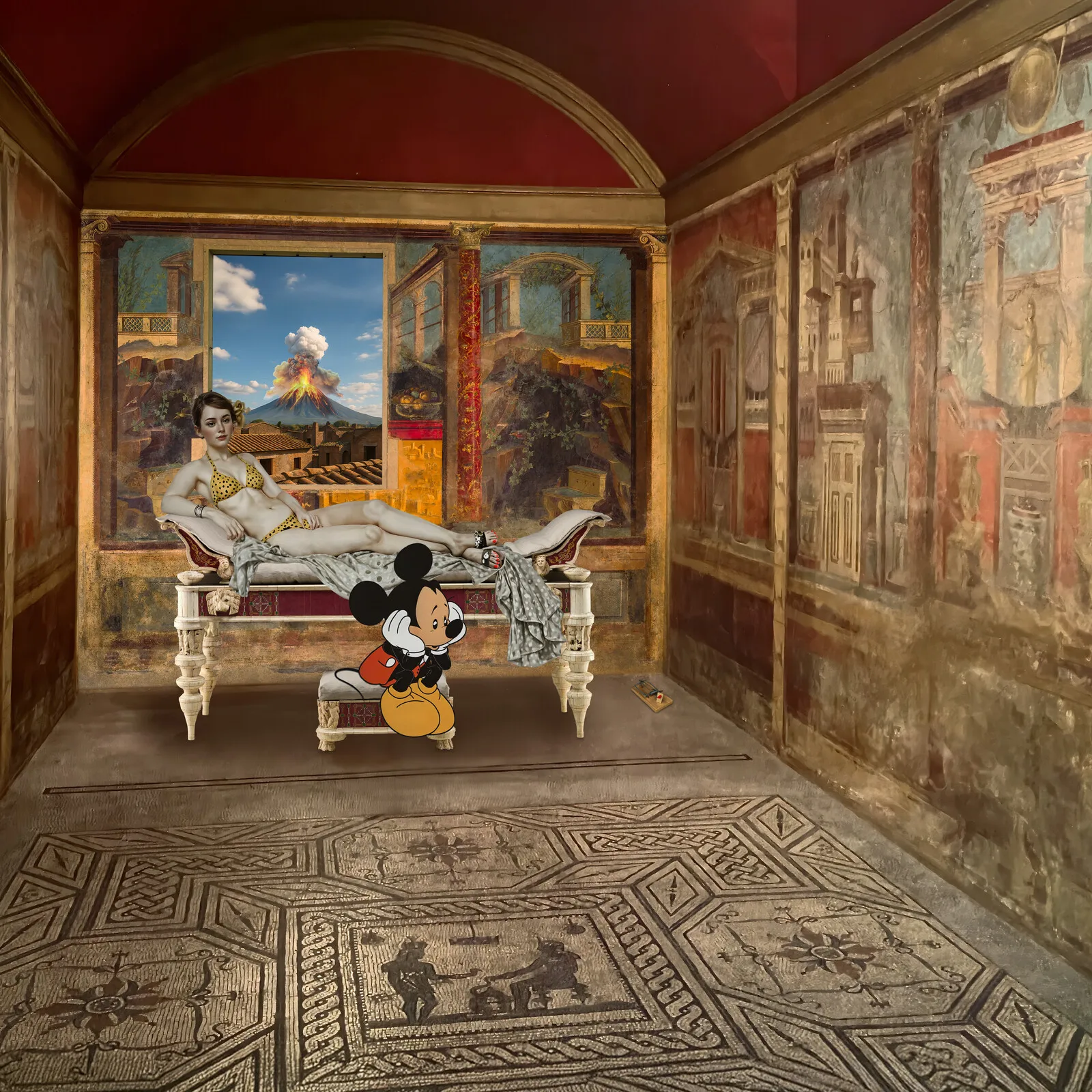
Wrong time, wrong place, 2025
Digital
80 x 80 cm
3 500 kr
Wrong time, wrong place
In memory of a mouse who outlived his trademark
and slipped the leash of intellectual property,
only to tumble headfirst into history—
not by accident, but by cosmic mischief.
Because what else is eternity good for,
if not to visit forbidden cities,
whisper love to marble goddesses,
and interrupt a volcanic apocalypse
for one last kiss?
This isn’t your usual Mickey.
No cheerful whistling. No sorcerer’s hat.
Just red shorts, oversized ears,
and an itch in his soul that seventy years of celibate stardom could not soothe.
He came not with fanfare,
but through a wormhole,
on a quiet October morning in 79 CE—
a time when gods still thundered,
and men mistook rumbling mountains
for divine annoyance.
He met a girl.
They touched hands.
The sky opened.
And that’s when the story begins:
with Melissa's laughter still ringing,
a bedchamber full of Ovid,
and a volcano preparing its final aria.
It’s about the kind of love that outruns ash,
the memory that lingers longer than cities,
and what happens when a cartoon mouse steps out of time
and into a world that knows how to burn.
This isn’t satire.
This is history rewritten
on the edge of eruption—
where comedy meets tragedy,
and even a rodent can be divine.
Follow the trail of ash,
and maybe, just maybe,
find her name again
scratched into a wall,
still warm.
Let the eruption begin and read on
When a mouse goes eternal, history listens.
On January 1, 2024, Mickey Mouse stepped beyond copyright and into myth, shedding his gloves and trademark for a star in the outer cosmos. But this is no obituary. This is a love story, a cosmic farce, a tragic opera played in three acts—mouse, girl, volcano. A journey so unexpected that it will leave you in awe.
Forget theme parks and cheery whistling. The Mickey you’re about to meet lands in ancient Pompeii, wearing red shorts, big ears, and a restless heart. Behind him, the Disney machine sputters; before him, a world of garum merchants, flirtatious mosaics, and Ovidian temptations unfolds. He meets Melissa, the daughter of a noble house, and falls, quite literally, for love. Just as the music swells, Vesuvius clears its throat. A whimsical adventure that will entertain and delight you.
This is the tale of what might have happened if the world’s most famous rodent wandered through the wormholes of time and found himself tangled in ash, passion, and poetry. It’s about sex, starlight, and the ruins we carry. A Roman holiday gone sideways. A cartoon at the end of the empire. A mouse that roared—too late. A tragedy that will tug at your heartstrings.
Discover more of this madness (and melancholy) and read the story of Mickey’s greatest adventure—past Pluto, past the planets, straight into Pompeii’s flaming embrace.
“Ballad of the Roaming Mouse
From steamboat decks in black and white,
To neon dreams and satellite,
He danced through reels and ink and fame,
A mouse who made the world his game.
With gloves too big and a grin too wide,
He rode the waves, he turned the tide.
A kingdom rose from castle stone—
But in his heart, he walked alone.
For decades, he played it straight,
A rodent bound by Disney’s gate.
Yet deep beneath his cheerful squeak,
He longed for love, for touch, for mystique.
He’d had enough of Goofy’s laughs,
Of Donald’s rage and Pluto’s gaffes.
He’d seen it all—each script and song—
And wondered where he did belong.
So when the law at last grew frail,
And let go of his ancient tail,
He grabbed his red shorts, slipped the net,
And said, “The best is coming yet.”
He passed the moon, he passed Mars,
He surfed on starlight, dodged memoirs,
Until one wormhole, bored and thin,
Whispered, “Mickey... shall we begin?”
He landed deep in the Empire's flame,
In Pompeii, just before it came.
He met a girl with eyes like wine,
And kissed her lips before the sign.
Then Vesuvius cleared its throat—
The sky turned black, the air turned smote.
“Farewell,” she cried, “we’ll meet again!”
And he, with tears, said just: “Amen.”
He fled the ash, but not the ache.
It clung like soot with every quake.
Through time he roamed, a mouse unbound,
In every age, new truths he found.
He dined with Bach, he danced with Freud,
He got in bar brawls in Detroit.
He asked Joan d’Arc to spill her tea,
And arm-wrestled democracy.
Yet through it all, one name remained—
The one who kissed him, wild and unnamed.
And so he roams like a cosmic sprite,
A mouse who sleeps in the ancient night.
His tail a comet, ears like moons,
He hums old scores in timeless tunes.
From Disney’s lot to Rome’s decay—
He’s Mickey still, but far away.
So raise a glass to whiskered fate,
To mice who love, and learn, and wait.
The stars remember. Ashes too.
And legends wear red shorts and shoes.”
Malmö May 2025
When Mickey Mouse Entered Eternity – January 1, 2024
On the first day of last year, Mickey Mouse entered eternity. As Steamboat Willie, he embarked on a voyage to the furthest edge of our galaxy, heading for his star, Stella Mus—Latin for “Mouse Star.” There, he now lives with his eternal fiancée, Minnie.
Mickey and Minnie Mouse have shared an iconic and unwavering relationship since their 1928 debut in ‘Plane Crazy’ and ‘Steamboat Willie’. They are not just eternal fiancées but also best friends who have always been there for each other. Yet, their relationship has always hovered between flirtation, infatuation, and an eternal engagement without a wedding. Philosophically speaking: a Platonic bond. No wonder Mickey bolted when intellectual property law let go of his tail—seventy years with the same woman and no sex life. Of course, he'd heard rumours, but in double- moralist America, such things were unthinkable in the world of cartoons. That didn’t stop Mickey from having adolescent fantasies—every boy-mouse does. Sex addict Fritz the Cat was one of the rare exceptions, along with the oversexed Wolfie who chased Red Riding Hood through a string of animated shorts.
Once he settled on his star, Mickey decided to slip just far enough away from the contemporary world he had left behind. A couple of thousand years should do. So why not Pompeii—a city arguably no better than Sodom or Gomorrah? Some claim it was God who unleashed the volcano upon this Roman den of iniquity. Busy with decades of Disney's family-friendly antics, Mickey missed that particular chapter in Pompeian history. But he had picked up from Donald Duck's nephews that the ancient city had been a tourist attraction even back in Roman times. The nephews—Huey, Dewey, and Louie—were a kind of scouts, Junior Woodchucks, and they always carried with them the magical, all-knowing Junior Woodchuck Guidebook, which contained solutions to everything—from knot-tying and ancient languages to nuclear physics. Wikipedia is merely a foreword to that book.
Since the nephews had not yet reached the critical age of seventy and thus couldn't leave Earth behind, Mickey couldn't ask them how love worked. Sex, that is. Still, through rumour and innuendo, he had a general idea. And frankly, he had an itch in his pants.
Descending from his star through a convenient wormhole, Mickey landed in Pompeii in October of the year 79, specifically on the 23rd. His arrival in Pompeii was not just a coincidence but a twist of fate that would change the course of history. That evening, he ran into Melissa, daughter of Lucius Caltilius Pamphilus and his wife, Caltilia Moschis. The chemistry was immediate, setting the scene for unforeseen events.
To clarify the date, some might argue Mickey couldn’t have arrived in Pompeii that day since the city should already have been buried under six meters of ash and pumice. But this is not the case, and Mickey Mouse is as soundproof as any. The confusion stems from Pliny the Younger, an eyewitness to the disaster and the death of his uncle, Pliny the Elder. According to his account—copied and recopied who knows how many times—the eruption of Vesuvius took place on August 24, 79 CE.
However, new excavations of the ruins have unearthed a charcoal inscription that questions Pliny’s date. It is now widely accepted among scholars that the catastrophe occurred on October 24, which happens to be the day after Mickey’s arrival. And that had consequences.
In any case, Mickey barely had time to check into the inn by the city’s grandest square, the Forum Pompeianum, before he was invited to a major social event—a private party at the home of the Caltilius family. The patriarch, Marcus Decidius Pilonius Rufus, merchant of garum (a popular fermented fish sauce), was the host. Mickey was invited simply due to his appearance: by Roman standards, he was utterly exotic. A giant mouse, black as the people from the empire’s fringes, with enormous ears and comically practical shoes. His bright red shorts were impressive, practically screaming “upper class.” In the eyes of the Pompeians, he must have been some prince. As such, he was naturally included in this exclusive gathering.
The innkeeper decided on Rufus's behalf and personally escorted Mickey to the grand villa just a block away.
Pompeian Nights: Mickey and the Red Shorts
The ancient Greeks and Romans wore short tunics and certain types of trousers, such as braies, which reached the knees or mid-calves and can be seen as early forms of shorts.
Red held both symbolic and practical significance during Pompeii’s destruction. It was associated with Mars, the god of war, and prominently featured in military attire, particularly among officers, who often donned red-dyed tunics. Additionally, red represented power and authority, frequently used in the clothing and decorations of leaders and during triumphal processions. Furthermore, red pigment was standard in art, architecture, and cosmetics, with pigments like cinnabar (vermilion) being highly prized. Mickey's red shorts were not just a fashion statement but a symbol of power and prestige in Roman society.
This brilliant red pigment was so sought-after that, according to Pliny the Younger, who would later recount it to Mickey, cinnabar cost 15 times more than red ochre from Africa, and nearly as much as the rare and precious Egyptian blue.
The evening’s festivities attracted all sorts of interesting people—and what could be more fascinating than an anthropomorphic mouse from another era, dressed in bright red shorts?
The evening's host was a notable figure, one of Pompeii’s leading citizens. His grandfather had been Marcus Holconius, which explained the scale of the gathering—at least that was what Plutonius, the innkeeper, told Mickey.
So, why was Marcus Holconius of interest? He was a wealthy entrepreneur and one of Pompeii’s prominent political figures. As such, he held the title of priest of Augustus and Patron of the Colony—a fact proudly inscribed on the base of his statue, which stood in the Forum. On the way to the party, Plutonius deliberately detoured past the statue to ensure Mickey understood the honour being extended to him.
Mickey attracted attention, especially from the ladies. The men, however, were noticeably more reserved, unsettled by the strange mouse's effect on their women. A black, oversized mouse wearing little more than undergarments—or so the red shorts appeared in Roman eyes. Braies were known garments for the lower body, worn beneath tunics or armour and sometimes peeking out from shorter robes—but never, ever in red. That was the Emperor’s colour. The men grew visibly jealous when they caught the women casting long glances at the exotic newcomer, adding a layer of tension to the gathering.
Their growing attraction was forbidden fruit, tantalisingly out of reach. Melissa's public display of affection towards Mickey, a breach of Roman moral tradition, sent a ripple of disapproval through the male half of the gathering, adding a layer of intrigue to their budding romance.
Roman parties didn’t include physical dancing between partners the way later centuries would introduce waltzes, tangos, minuets, or foxtrots. Still, there were plenty of arousing performances by scantily clad male and female dancers that stirred the imagination.
But Mickey and Melissa had no time for performances. She had barely stepped beyond the walls of Pompeii in her life. Her worldview was shaped entirely by what men told her or what she could read. Ovid, for instance, is a controversial choice that is not encouraged by any respectable father, especially not Ars Amatoria (The Art of Love), the very work that so offended Emperor Augustus that its author was exiled.
The educated Melissa was an entirely new acquaintance to Mickey, far removed from the childlike company he was used to in Duckburg, including Minnie. Never before had he met a woman who wanted to talk about love, especially of the bodily sort. He listened with reverence as she explained the works of Ovid, including his half-pornographic verses. She said that Ars Amatoria could be seen as an elegant, satirical love manual in three books. The first two addressed men—how to seduce women. It was important for women to know how to resist clumsy advances. The third book addressed women directly, offering advice on how to retain a lover. The poem included tips, techniques, sexual positions, plenty of irony, rhetoric, and innuendo, always with a playful, cynical edge. The work clashed with Augustus’s moral reforms, which aimed to reinforce marriage, family, and traditional Roman virtue. No wonder Ovid was exiled. Mickey hung on every word, and his inward desires only grew stronger.
To Melissa, Mickey was a traveller through time and space. He never spoke of his star, but he was a widely travelled being. The exotic gentleman-mouse appeared to be a creature of empathy, experience, and detail—a thinking, feeling being who had witnessed both human folly and greatness. It was evident that she was drawn to him. When Mickey spoke lyrically of eternity and the stars, he sounded like Ovid’s equal—a philosopher in his own right. No wonder Melissa fell head over heels. Mickey, who had never even read Ars Amatoria, nevertheless lived up to the very essence of its teachings. This could only end one way, though not that night. No respectable Roman woman would go home with a stranger.
The following day, Melissa was set to accompany her family on an outing to their vineyard. This separation only heightened the anticipation of their subsequent encounter, a meeting that could change their lives forever.
Disguised in a draped toga that concealed his head and large ears, Mickey followed the maid through quiet alleys and entered Melissa’s house through the back. He stepped into the most sacred spaces—Melissa’s cubiculum (bedchamber), richly decorated with painted walls and an intricate mosaic floor.
At the rear wall stood a magnificent lectus, an ancient Roman couch of luxurious craftsmanship. It featured ornate carvings, decorative inlays, and a soft, thick mattress. For reclining, dining, and intimate conversation, the lectus symbolised comfort and status in Roman households. In literature, it often served as a stage for ritual and transformation. In Ovid’s Metamorphoses, the lectus appears at pivotal moments of personal revelation. Unsurprisingly, it also appears—frequently—in Ars Amatoria.
The Painted Room
Melissa, a young woman of noble birth, lay relaxed on the lectus, dressed in what today might be called a bikini—though in her time it was known as a strophium, a chest band or bra-like strip of cloth, paired with a subligaculum, a kind of hip sash or, in Melissa’s case, underpants. These were not swimwear in any modern sense but garments used during athletic activities, especially in private or aristocratic settings. To lie like this, unveiled and poised, was a signal as clear as any. Beside her, Mickey, a seasoned Roman soldier, was equally at ease, his eyes fixed on her with admiration and desire.
Behind her, the wall shimmered with frescoes: a rocky landscape with balustrades and an arbour above, a grotto sheltering a fountain, and a small figure of Hekate beneath it—the room, adorned with marble columns and a mosaic floor, exuded opulence. In the centre, between two slender columns, a parapet adorned with a yellow monochrome landscape supported a bowl brimming with fruit, glass gleaming with painted abundance.
The room’s side walls mirrored each other. Each was divided into four scenes by pilasters framing the couch and ornate columns painted in theatrical reds and ochres. Within these frames, the murals revealed enclosed courtyards where statues peered above foliage, domes nestled behind pylons, and lush gardens alternated with sweeping townscapes: collonaded facades, terrace balconies, marble stairways in perspective. It was, in short, a theatre of seduction. Mickey felt in rare form. He’d waited seventy years; he could wait a little longer. So they began where they had ended—with Ovid.
“Don’t think she doesn’t want it when she says no—many pretend to protest, but love to be persuaded.” This line, from Ovid's 'Ars Amatoria', was a controversial but widely quoted piece of advice in Roman society, often used to justify aggressive pursuit in courtship.
Melissa was delighted, but Mickey flushed—a rare sight, his dark fur paling to grey across his cheeks. His ears twitched from the heat rising within them. With rhetorical precision, she explained that Ovid was referring to the game of feigned reluctance, a key component of Roman lovecraft, not an endorsement of assault. However, today those lines would rightly raise alarms. In Ovid’s context, seduction was a hunt, a battle, a cunning game—the woman the quarry and a collaborator in the dance.
If Mickey had felt aroused all morning, he was now on the brink of combustion. Melissa quoted another passage from Ovid’s manual:
“Lying on the side suits some, others should ride like Amazons, and some shine best on top—choose the position that flatters you most!”
She had just reached the word “most” when a low, drawn-out rumble sounded beyond the painted walls. One look through the window was enough: Vesuvius had awakened.
Although ancient Pompeians may not have had seismographs, they had an oral tradition and knew what this meant.
We now shift scenes—some two thousand years later—as Mickey tells the story himself, standing beside Pliny the Younger in the still-breathing ruins of Herculaneum.
Scene: The ruins of Herculaneum, present day.
The air smells faintly of sulfur and memory. Two figures stroll down an ancient basalt street. One wears a tunic and sandals, his curls kissed by time. The other has round black ears and red shorts and appears far older than he seems.
Pliny the Younger: It hasn't changed much.
Mickey: Just lost its roof.
Pliny: And its breath.
(They pause beside a doorway, half-consumed by ash. Mickey sits on a fallen column, silent.)
Pliny: You were here, weren’t you? During the eruption. The tragedy of that night still haunts us.
Mickey: Yeah. Herculaneum. The night before, there was this party... Marcus Decidius Pilonius Rufus threw it. It was really lavish. Have you ever met her?
Pliny: No, our paths never crossed—even though it’s been an eternity since Pompeii fell.
Mickey (softly): She had laughter in her voice, like chimes. We kissed in her fantastic bedchamber just before it began. Then the rumble started.
Pliny: And she ran?
Mickey: When the first shock passed and we looked out the window, we both knew there wasn’t time for love. She said, “We’ll see each other soon.” Then dashed off to find her father. He was in his office near the basilica. I waited—just for a second. Then I remembered... I don’t have the luxury of dying twice. And still, I ran like a coward.
Pliny: Like a survivor. Don’t confuse the two. I didn’t have that luxury, but I lived only because I was on a boat far enough out in the lagoon to avoid the worst of it.
Mickey: I don’t know what happened to her. I mean, I do. But I don’t. You get me?
Pliny (nods): You ran east. I stayed behind. And I watched.
Mickey: What exactly did you see?
Pliny: It began around one in the afternoon. The sky cracked open. A column of smoke shot thirty kilometres into the air. Pumice rained down on Pompeii. They thought it would pass.
Mickey: So did she.
Pliny: Around four, the air grew thick. The light vanished. Ash fell like snow. Herculaneum got less of it, but tremors shook every wall. People grabbed whatever they could and ran.
Mickey: Or they hesitated. Treasure makes fools of the clever. Greed betrays wisdom. And the fear of looters. No one could know that even the looters would be obliterated. Everyone.
Pliny: Around dusk, a pyroclastic flow hit Herculaneum. A wave of fireless death. No time to scream. No time to feel. The heat was enough to vaporise flesh.
Mickey: I was already out, heading north along the coast. From a ridge, I looked back. The town was silent. Still. Like it had taken one last breath and held it.
Pliny: That night, Pompeii drowned in ash, two meters deep. Roofs collapsed—those who stayed indoors suffocated or were crushed.
Mickey: And then the second surge.
Pliny: Just after dawn, a pyroclastic avalanche scoured Pompeii clean. No one survived. Temperatures soared past five hundred degrees. The city died.
Mickey: You wrote it down, didn’t you?
Pliny: Everything I saw and everything I feared—even my uncle’s death in Stabiae. The wind brought his end and carried the story to me.
Mickey: I wonder what stories Melissa would’ve told.
Pliny: Maybe she did. Maybe they’re still here, beneath the stone, waiting.
Mickey: Waiting for a voice.
(They fall silent. The wind stirs the dust.)
Pliny: Mickey, we speak of lava, but death came on the wind: ash, gas, and superheated clouds. A pyroclastic surge isn’t like fire. It’s faster. It flows like water but burns like the gods.
Mickey: It hit Herculaneum first around 7:30 p.m. No flames. Just—nothing.
Pliny: Then Pompeii. The next morning. 6:30. And again later. Some tried to flee. Many succeeded. Some didn’t.
Mickey: Only about 1,500 bodies have been found during excavations. Many more must have lived. Maybe Melissa lived. The uncertainty of her fate is a heavy burden.
Pliny: You haven’t met her among the stars?
Mickey: No, I haven’t had time to look for her. I didn’t join Eternity until January 1st of last year. I have to wait... until time decides to talk. I long for the closure that time might bring.
Pliny: And if it does?
Mickey (standing): I’ll listen with both ears.
Pliny: Then maybe you’ll continue where you left off. (He says it with a crooked smile.)
Mickey: Maybe. Unless circular references get in the way—because you can’t be in two places simultaneously, not even in eternity. Even though we’re not here, we're here—far away, yet still present.
Pliny: That’s how it is. As a writer, I’ve struggled with it all my life, like when a word is defined using itself or by words that require the first word. Circularity—semantic echo.
Mickey: You’ll have to explain that to a simple mouse.
Pliny: “A leader is someone who leads.” The definition does not explain, and there is no proof. Especially since some leaders are terrible, and some aren’t leaders at all.
Mickey: You have someone in mind.
Pliny: A strong candidate for “worst leader”—historically and morally—is undoubtedly Emperor Nero. He died the year I was born, but my uncle told me plenty about him. It left a mark. Let’s say he wasn’t fondly remembered.
Mickey: I haven’t had the chance to meet him either, and he wasn’t exactly mentioned back in Duckburg. Why was he so hated?
Pliny: Why was Nero hated? That list could fill several scrolls. I’ll give you the short version.
He had his stepbrother Britannicus murdered, then his mother, Agrippina, and later his wife Octavia. Anyone who stood in his way was removed. Nero forced senators and patricians to commit suicide—often by threatening to destroy their families if they refused.
He’s suspected of starting the Great Fire of Rome in 64 CE—and blaming it on the Christians. His rule was marked by whim, narcissism, and brutality, along with a flair for theatrical madness. After his death, the empire plunged into chaos—the so-called Year of the Four Emperors in 69 CE.
Mickey: Sounds like a fusion of the Beagle Boys and Peg-Leg Pete.
(They keep walking. Two shadows stretched by sunlight across 2,000 years of silence.)
Today, we know that many survived the catastrophe, having fled immediately during the eruption's initial phase. Only in the last decade have researchers begun seriously studying the survivors, finding traces of them in other cities, such as Ostia. About 1,500 bodies have been found in the ruins, many discovered with gold, jewellery, and valuables nearby. It is likely that the wise grabbed what mattered most and escaped early, while the greedy stayed behind, anxious about looters. They met a grim fate when the pyroclastic surge swept through the city; no one survived. By then, the town was already buried under meters of ash. Yet, the survivors who fled, who made it to other cities, who rebuilt their lives, are a testament to the resilience of the human spirit.
Melissa survived.
She wrapped herself in a stola, a sleeveless, floor-length dress worn over a tunic, and rushed off to warn her father, asking what they should do. She made it halfway across the impluvium, the central garden surrounded by the house’s porticoes, when she remembered: the family was away at the countryside estate.
She turned back, hoping Mickey was still there, but he was already gone. Mickey carries with him the uncertainty of Melissa's fate, the weight of not knowing what happened to her.
With unwavering determination, Melissa took nothing with her, save for a small pouch of jewellery she'd seen lying on a table. Then she fled toward the city gate that faced Rome. Instinctively, she understood she had to get as far from the volcano as possible. But no sight of Mickey. She could only hope he was as determined as she. Melissa's determination and strength in the face of such a devastating event are a testament to the human spirit.
To make a long story short, Melissa was eventually reunited with her family in Nola, eighteen Roman miles away—a town spared both by distance and by the lay of the land from the eruption's worst effects. The family eventually settled in the harbour city of Ostia, where her father quickly regained his footing and became as successful as he had been in Pompeii. This resilience and determination in the face of such devastating events are a testament to the strength of the human spirit.
Unfortunately, their happiness was not to last.
Tragically, their happiness was not to last. In the years following Vesuvius' eruption, a severe epidemic, striking with sudden and devastating force, swept through Ostia and parts of Italy. It erased the traces of Melissa, her family, and several other prominent Pompeian families—families that, under different circumstances, would likely have continued to appear in inscriptions and public records.
Archaeological and epigraphic gaps in Ostia, which refer to missing or incomplete artefacts and inscriptions, point to a sudden drop in population, likely under the reign of Emperor Titus (79–81 CE) or Domitian (81–96 CE). These gaps in the historical record suggest a significant disruption in the city's life, likely due to the combined effects of the eruption and the subsequent epidemic.
But Melissa's story is not over. It continues to intrigue us, and it will be told when Mickey finds her among the stars.
Just as enduring as the gravestones and memorials erected by Melissa’s forebears is a piece of graffiti—clearly made in haste—that appears on a wall near the northern city gate. It's a surprising find, as graffiti was not unique in Pompeii, but its content makes this one exceptional.
Archaeologists have uncovered a diverse range of graffiti in Pompeii that offers a vivid, unfiltered glimpse into the daily lives of its inhabitants. On virtually every wall or column in the city, buried in volcanic ash in 79 CE, excavators found messages scratched, painted, or scrawled in charcoal. More than eleven thousand have been documented, ranging from crude jokes and short poems to announcements, insults, and revolutionary information, like this one.
Some gems made 19th-century classical scholars gasp and reach for their smelling salts. These scholars, who were accustomed to the refined literature of ancient Rome, were shocked by the graffiti's raw and often explicit nature.
One infamous example, which would have made 19th-century classical scholars gasp and reach for their smelling salts, reads: “Weep, girls. My penis no longer cares for you. It now penetrates men’s buttocks instead.”
Such inscriptions led many early researchers to dismiss graffiti as the crude babble of the uneducated underclass. But in truth, the opposite is more likely. Everyone wrote on the walls—because that was where the largest audience could be found. Without modern communication tools like Facebook or printed newspapers, graffiti was a public forum for sharing news, opinions, and personal messages. Even inside the homes of the wealthy, guests left graffiti behind.
From Pompeii’s walls, long-forgotten voices still whisper their thoughts, dreams, and daily worries—of both patricians and peasants—on the eve of catastrophe. But one message freezes time altogether. It not only corrects the traditional date of Pompeii’s destruction but was also written during the disaster. A chilling act of nerve. A perfect example of death-defying Roman wit: playful, ironic, and dramatic, just as good graffiti ought to be.
Vidi, vici – sed non veni.
Vesuvio venit prius.
Mus vocatus Mickey rugivit.
— Die XXIV Octobris, Anno LXXIX
I saw, I conquered – but I did not come.
Vesuvius came first.
A mouse called Mickey roared.
— October 24, Year 79
Jörgen Thornberg
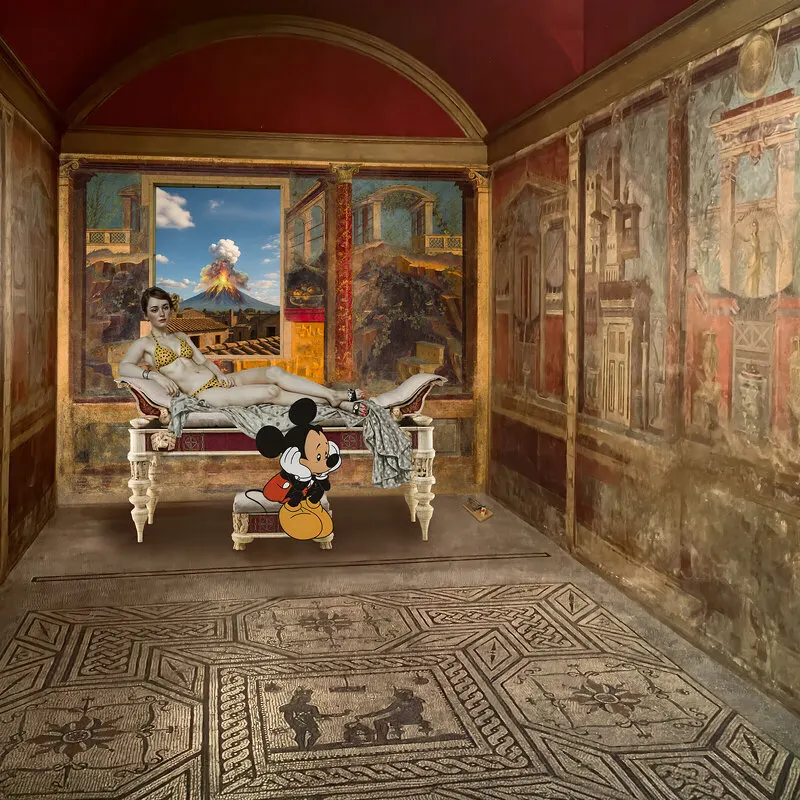
Wrong time, wrong place, 2025
Digital
80 x 80 cm
3 500 kr
Wrong time, wrong place
In memory of a mouse who outlived his trademark
and slipped the leash of intellectual property,
only to tumble headfirst into history—
not by accident, but by cosmic mischief.
Because what else is eternity good for,
if not to visit forbidden cities,
whisper love to marble goddesses,
and interrupt a volcanic apocalypse
for one last kiss?
This isn’t your usual Mickey.
No cheerful whistling. No sorcerer’s hat.
Just red shorts, oversized ears,
and an itch in his soul that seventy years of celibate stardom could not soothe.
He came not with fanfare,
but through a wormhole,
on a quiet October morning in 79 CE—
a time when gods still thundered,
and men mistook rumbling mountains
for divine annoyance.
He met a girl.
They touched hands.
The sky opened.
And that’s when the story begins:
with Melissa's laughter still ringing,
a bedchamber full of Ovid,
and a volcano preparing its final aria.
It’s about the kind of love that outruns ash,
the memory that lingers longer than cities,
and what happens when a cartoon mouse steps out of time
and into a world that knows how to burn.
This isn’t satire.
This is history rewritten
on the edge of eruption—
where comedy meets tragedy,
and even a rodent can be divine.
Follow the trail of ash,
and maybe, just maybe,
find her name again
scratched into a wall,
still warm.
Let the eruption begin and read on
When a mouse goes eternal, history listens.
On January 1, 2024, Mickey Mouse stepped beyond copyright and into myth, shedding his gloves and trademark for a star in the outer cosmos. But this is no obituary. This is a love story, a cosmic farce, a tragic opera played in three acts—mouse, girl, volcano. A journey so unexpected that it will leave you in awe.
Forget theme parks and cheery whistling. The Mickey you’re about to meet lands in ancient Pompeii, wearing red shorts, big ears, and a restless heart. Behind him, the Disney machine sputters; before him, a world of garum merchants, flirtatious mosaics, and Ovidian temptations unfolds. He meets Melissa, the daughter of a noble house, and falls, quite literally, for love. Just as the music swells, Vesuvius clears its throat. A whimsical adventure that will entertain and delight you.
This is the tale of what might have happened if the world’s most famous rodent wandered through the wormholes of time and found himself tangled in ash, passion, and poetry. It’s about sex, starlight, and the ruins we carry. A Roman holiday gone sideways. A cartoon at the end of the empire. A mouse that roared—too late. A tragedy that will tug at your heartstrings.
Discover more of this madness (and melancholy) and read the story of Mickey’s greatest adventure—past Pluto, past the planets, straight into Pompeii’s flaming embrace.
“Ballad of the Roaming Mouse
From steamboat decks in black and white,
To neon dreams and satellite,
He danced through reels and ink and fame,
A mouse who made the world his game.
With gloves too big and a grin too wide,
He rode the waves, he turned the tide.
A kingdom rose from castle stone—
But in his heart, he walked alone.
For decades, he played it straight,
A rodent bound by Disney’s gate.
Yet deep beneath his cheerful squeak,
He longed for love, for touch, for mystique.
He’d had enough of Goofy’s laughs,
Of Donald’s rage and Pluto’s gaffes.
He’d seen it all—each script and song—
And wondered where he did belong.
So when the law at last grew frail,
And let go of his ancient tail,
He grabbed his red shorts, slipped the net,
And said, “The best is coming yet.”
He passed the moon, he passed Mars,
He surfed on starlight, dodged memoirs,
Until one wormhole, bored and thin,
Whispered, “Mickey... shall we begin?”
He landed deep in the Empire's flame,
In Pompeii, just before it came.
He met a girl with eyes like wine,
And kissed her lips before the sign.
Then Vesuvius cleared its throat—
The sky turned black, the air turned smote.
“Farewell,” she cried, “we’ll meet again!”
And he, with tears, said just: “Amen.”
He fled the ash, but not the ache.
It clung like soot with every quake.
Through time he roamed, a mouse unbound,
In every age, new truths he found.
He dined with Bach, he danced with Freud,
He got in bar brawls in Detroit.
He asked Joan d’Arc to spill her tea,
And arm-wrestled democracy.
Yet through it all, one name remained—
The one who kissed him, wild and unnamed.
And so he roams like a cosmic sprite,
A mouse who sleeps in the ancient night.
His tail a comet, ears like moons,
He hums old scores in timeless tunes.
From Disney’s lot to Rome’s decay—
He’s Mickey still, but far away.
So raise a glass to whiskered fate,
To mice who love, and learn, and wait.
The stars remember. Ashes too.
And legends wear red shorts and shoes.”
Malmö May 2025
When Mickey Mouse Entered Eternity – January 1, 2024
On the first day of last year, Mickey Mouse entered eternity. As Steamboat Willie, he embarked on a voyage to the furthest edge of our galaxy, heading for his star, Stella Mus—Latin for “Mouse Star.” There, he now lives with his eternal fiancée, Minnie.
Mickey and Minnie Mouse have shared an iconic and unwavering relationship since their 1928 debut in ‘Plane Crazy’ and ‘Steamboat Willie’. They are not just eternal fiancées but also best friends who have always been there for each other. Yet, their relationship has always hovered between flirtation, infatuation, and an eternal engagement without a wedding. Philosophically speaking: a Platonic bond. No wonder Mickey bolted when intellectual property law let go of his tail—seventy years with the same woman and no sex life. Of course, he'd heard rumours, but in double- moralist America, such things were unthinkable in the world of cartoons. That didn’t stop Mickey from having adolescent fantasies—every boy-mouse does. Sex addict Fritz the Cat was one of the rare exceptions, along with the oversexed Wolfie who chased Red Riding Hood through a string of animated shorts.
Once he settled on his star, Mickey decided to slip just far enough away from the contemporary world he had left behind. A couple of thousand years should do. So why not Pompeii—a city arguably no better than Sodom or Gomorrah? Some claim it was God who unleashed the volcano upon this Roman den of iniquity. Busy with decades of Disney's family-friendly antics, Mickey missed that particular chapter in Pompeian history. But he had picked up from Donald Duck's nephews that the ancient city had been a tourist attraction even back in Roman times. The nephews—Huey, Dewey, and Louie—were a kind of scouts, Junior Woodchucks, and they always carried with them the magical, all-knowing Junior Woodchuck Guidebook, which contained solutions to everything—from knot-tying and ancient languages to nuclear physics. Wikipedia is merely a foreword to that book.
Since the nephews had not yet reached the critical age of seventy and thus couldn't leave Earth behind, Mickey couldn't ask them how love worked. Sex, that is. Still, through rumour and innuendo, he had a general idea. And frankly, he had an itch in his pants.
Descending from his star through a convenient wormhole, Mickey landed in Pompeii in October of the year 79, specifically on the 23rd. His arrival in Pompeii was not just a coincidence but a twist of fate that would change the course of history. That evening, he ran into Melissa, daughter of Lucius Caltilius Pamphilus and his wife, Caltilia Moschis. The chemistry was immediate, setting the scene for unforeseen events.
To clarify the date, some might argue Mickey couldn’t have arrived in Pompeii that day since the city should already have been buried under six meters of ash and pumice. But this is not the case, and Mickey Mouse is as soundproof as any. The confusion stems from Pliny the Younger, an eyewitness to the disaster and the death of his uncle, Pliny the Elder. According to his account—copied and recopied who knows how many times—the eruption of Vesuvius took place on August 24, 79 CE.
However, new excavations of the ruins have unearthed a charcoal inscription that questions Pliny’s date. It is now widely accepted among scholars that the catastrophe occurred on October 24, which happens to be the day after Mickey’s arrival. And that had consequences.
In any case, Mickey barely had time to check into the inn by the city’s grandest square, the Forum Pompeianum, before he was invited to a major social event—a private party at the home of the Caltilius family. The patriarch, Marcus Decidius Pilonius Rufus, merchant of garum (a popular fermented fish sauce), was the host. Mickey was invited simply due to his appearance: by Roman standards, he was utterly exotic. A giant mouse, black as the people from the empire’s fringes, with enormous ears and comically practical shoes. His bright red shorts were impressive, practically screaming “upper class.” In the eyes of the Pompeians, he must have been some prince. As such, he was naturally included in this exclusive gathering.
The innkeeper decided on Rufus's behalf and personally escorted Mickey to the grand villa just a block away.
Pompeian Nights: Mickey and the Red Shorts
The ancient Greeks and Romans wore short tunics and certain types of trousers, such as braies, which reached the knees or mid-calves and can be seen as early forms of shorts.
Red held both symbolic and practical significance during Pompeii’s destruction. It was associated with Mars, the god of war, and prominently featured in military attire, particularly among officers, who often donned red-dyed tunics. Additionally, red represented power and authority, frequently used in the clothing and decorations of leaders and during triumphal processions. Furthermore, red pigment was standard in art, architecture, and cosmetics, with pigments like cinnabar (vermilion) being highly prized. Mickey's red shorts were not just a fashion statement but a symbol of power and prestige in Roman society.
This brilliant red pigment was so sought-after that, according to Pliny the Younger, who would later recount it to Mickey, cinnabar cost 15 times more than red ochre from Africa, and nearly as much as the rare and precious Egyptian blue.
The evening’s festivities attracted all sorts of interesting people—and what could be more fascinating than an anthropomorphic mouse from another era, dressed in bright red shorts?
The evening's host was a notable figure, one of Pompeii’s leading citizens. His grandfather had been Marcus Holconius, which explained the scale of the gathering—at least that was what Plutonius, the innkeeper, told Mickey.
So, why was Marcus Holconius of interest? He was a wealthy entrepreneur and one of Pompeii’s prominent political figures. As such, he held the title of priest of Augustus and Patron of the Colony—a fact proudly inscribed on the base of his statue, which stood in the Forum. On the way to the party, Plutonius deliberately detoured past the statue to ensure Mickey understood the honour being extended to him.
Mickey attracted attention, especially from the ladies. The men, however, were noticeably more reserved, unsettled by the strange mouse's effect on their women. A black, oversized mouse wearing little more than undergarments—or so the red shorts appeared in Roman eyes. Braies were known garments for the lower body, worn beneath tunics or armour and sometimes peeking out from shorter robes—but never, ever in red. That was the Emperor’s colour. The men grew visibly jealous when they caught the women casting long glances at the exotic newcomer, adding a layer of tension to the gathering.
Their growing attraction was forbidden fruit, tantalisingly out of reach. Melissa's public display of affection towards Mickey, a breach of Roman moral tradition, sent a ripple of disapproval through the male half of the gathering, adding a layer of intrigue to their budding romance.
Roman parties didn’t include physical dancing between partners the way later centuries would introduce waltzes, tangos, minuets, or foxtrots. Still, there were plenty of arousing performances by scantily clad male and female dancers that stirred the imagination.
But Mickey and Melissa had no time for performances. She had barely stepped beyond the walls of Pompeii in her life. Her worldview was shaped entirely by what men told her or what she could read. Ovid, for instance, is a controversial choice that is not encouraged by any respectable father, especially not Ars Amatoria (The Art of Love), the very work that so offended Emperor Augustus that its author was exiled.
The educated Melissa was an entirely new acquaintance to Mickey, far removed from the childlike company he was used to in Duckburg, including Minnie. Never before had he met a woman who wanted to talk about love, especially of the bodily sort. He listened with reverence as she explained the works of Ovid, including his half-pornographic verses. She said that Ars Amatoria could be seen as an elegant, satirical love manual in three books. The first two addressed men—how to seduce women. It was important for women to know how to resist clumsy advances. The third book addressed women directly, offering advice on how to retain a lover. The poem included tips, techniques, sexual positions, plenty of irony, rhetoric, and innuendo, always with a playful, cynical edge. The work clashed with Augustus’s moral reforms, which aimed to reinforce marriage, family, and traditional Roman virtue. No wonder Ovid was exiled. Mickey hung on every word, and his inward desires only grew stronger.
To Melissa, Mickey was a traveller through time and space. He never spoke of his star, but he was a widely travelled being. The exotic gentleman-mouse appeared to be a creature of empathy, experience, and detail—a thinking, feeling being who had witnessed both human folly and greatness. It was evident that she was drawn to him. When Mickey spoke lyrically of eternity and the stars, he sounded like Ovid’s equal—a philosopher in his own right. No wonder Melissa fell head over heels. Mickey, who had never even read Ars Amatoria, nevertheless lived up to the very essence of its teachings. This could only end one way, though not that night. No respectable Roman woman would go home with a stranger.
The following day, Melissa was set to accompany her family on an outing to their vineyard. This separation only heightened the anticipation of their subsequent encounter, a meeting that could change their lives forever.
Disguised in a draped toga that concealed his head and large ears, Mickey followed the maid through quiet alleys and entered Melissa’s house through the back. He stepped into the most sacred spaces—Melissa’s cubiculum (bedchamber), richly decorated with painted walls and an intricate mosaic floor.
At the rear wall stood a magnificent lectus, an ancient Roman couch of luxurious craftsmanship. It featured ornate carvings, decorative inlays, and a soft, thick mattress. For reclining, dining, and intimate conversation, the lectus symbolised comfort and status in Roman households. In literature, it often served as a stage for ritual and transformation. In Ovid’s Metamorphoses, the lectus appears at pivotal moments of personal revelation. Unsurprisingly, it also appears—frequently—in Ars Amatoria.
The Painted Room
Melissa, a young woman of noble birth, lay relaxed on the lectus, dressed in what today might be called a bikini—though in her time it was known as a strophium, a chest band or bra-like strip of cloth, paired with a subligaculum, a kind of hip sash or, in Melissa’s case, underpants. These were not swimwear in any modern sense but garments used during athletic activities, especially in private or aristocratic settings. To lie like this, unveiled and poised, was a signal as clear as any. Beside her, Mickey, a seasoned Roman soldier, was equally at ease, his eyes fixed on her with admiration and desire.
Behind her, the wall shimmered with frescoes: a rocky landscape with balustrades and an arbour above, a grotto sheltering a fountain, and a small figure of Hekate beneath it—the room, adorned with marble columns and a mosaic floor, exuded opulence. In the centre, between two slender columns, a parapet adorned with a yellow monochrome landscape supported a bowl brimming with fruit, glass gleaming with painted abundance.
The room’s side walls mirrored each other. Each was divided into four scenes by pilasters framing the couch and ornate columns painted in theatrical reds and ochres. Within these frames, the murals revealed enclosed courtyards where statues peered above foliage, domes nestled behind pylons, and lush gardens alternated with sweeping townscapes: collonaded facades, terrace balconies, marble stairways in perspective. It was, in short, a theatre of seduction. Mickey felt in rare form. He’d waited seventy years; he could wait a little longer. So they began where they had ended—with Ovid.
“Don’t think she doesn’t want it when she says no—many pretend to protest, but love to be persuaded.” This line, from Ovid's 'Ars Amatoria', was a controversial but widely quoted piece of advice in Roman society, often used to justify aggressive pursuit in courtship.
Melissa was delighted, but Mickey flushed—a rare sight, his dark fur paling to grey across his cheeks. His ears twitched from the heat rising within them. With rhetorical precision, she explained that Ovid was referring to the game of feigned reluctance, a key component of Roman lovecraft, not an endorsement of assault. However, today those lines would rightly raise alarms. In Ovid’s context, seduction was a hunt, a battle, a cunning game—the woman the quarry and a collaborator in the dance.
If Mickey had felt aroused all morning, he was now on the brink of combustion. Melissa quoted another passage from Ovid’s manual:
“Lying on the side suits some, others should ride like Amazons, and some shine best on top—choose the position that flatters you most!”
She had just reached the word “most” when a low, drawn-out rumble sounded beyond the painted walls. One look through the window was enough: Vesuvius had awakened.
Although ancient Pompeians may not have had seismographs, they had an oral tradition and knew what this meant.
We now shift scenes—some two thousand years later—as Mickey tells the story himself, standing beside Pliny the Younger in the still-breathing ruins of Herculaneum.
Scene: The ruins of Herculaneum, present day.
The air smells faintly of sulfur and memory. Two figures stroll down an ancient basalt street. One wears a tunic and sandals, his curls kissed by time. The other has round black ears and red shorts and appears far older than he seems.
Pliny the Younger: It hasn't changed much.
Mickey: Just lost its roof.
Pliny: And its breath.
(They pause beside a doorway, half-consumed by ash. Mickey sits on a fallen column, silent.)
Pliny: You were here, weren’t you? During the eruption. The tragedy of that night still haunts us.
Mickey: Yeah. Herculaneum. The night before, there was this party... Marcus Decidius Pilonius Rufus threw it. It was really lavish. Have you ever met her?
Pliny: No, our paths never crossed—even though it’s been an eternity since Pompeii fell.
Mickey (softly): She had laughter in her voice, like chimes. We kissed in her fantastic bedchamber just before it began. Then the rumble started.
Pliny: And she ran?
Mickey: When the first shock passed and we looked out the window, we both knew there wasn’t time for love. She said, “We’ll see each other soon.” Then dashed off to find her father. He was in his office near the basilica. I waited—just for a second. Then I remembered... I don’t have the luxury of dying twice. And still, I ran like a coward.
Pliny: Like a survivor. Don’t confuse the two. I didn’t have that luxury, but I lived only because I was on a boat far enough out in the lagoon to avoid the worst of it.
Mickey: I don’t know what happened to her. I mean, I do. But I don’t. You get me?
Pliny (nods): You ran east. I stayed behind. And I watched.
Mickey: What exactly did you see?
Pliny: It began around one in the afternoon. The sky cracked open. A column of smoke shot thirty kilometres into the air. Pumice rained down on Pompeii. They thought it would pass.
Mickey: So did she.
Pliny: Around four, the air grew thick. The light vanished. Ash fell like snow. Herculaneum got less of it, but tremors shook every wall. People grabbed whatever they could and ran.
Mickey: Or they hesitated. Treasure makes fools of the clever. Greed betrays wisdom. And the fear of looters. No one could know that even the looters would be obliterated. Everyone.
Pliny: Around dusk, a pyroclastic flow hit Herculaneum. A wave of fireless death. No time to scream. No time to feel. The heat was enough to vaporise flesh.
Mickey: I was already out, heading north along the coast. From a ridge, I looked back. The town was silent. Still. Like it had taken one last breath and held it.
Pliny: That night, Pompeii drowned in ash, two meters deep. Roofs collapsed—those who stayed indoors suffocated or were crushed.
Mickey: And then the second surge.
Pliny: Just after dawn, a pyroclastic avalanche scoured Pompeii clean. No one survived. Temperatures soared past five hundred degrees. The city died.
Mickey: You wrote it down, didn’t you?
Pliny: Everything I saw and everything I feared—even my uncle’s death in Stabiae. The wind brought his end and carried the story to me.
Mickey: I wonder what stories Melissa would’ve told.
Pliny: Maybe she did. Maybe they’re still here, beneath the stone, waiting.
Mickey: Waiting for a voice.
(They fall silent. The wind stirs the dust.)
Pliny: Mickey, we speak of lava, but death came on the wind: ash, gas, and superheated clouds. A pyroclastic surge isn’t like fire. It’s faster. It flows like water but burns like the gods.
Mickey: It hit Herculaneum first around 7:30 p.m. No flames. Just—nothing.
Pliny: Then Pompeii. The next morning. 6:30. And again later. Some tried to flee. Many succeeded. Some didn’t.
Mickey: Only about 1,500 bodies have been found during excavations. Many more must have lived. Maybe Melissa lived. The uncertainty of her fate is a heavy burden.
Pliny: You haven’t met her among the stars?
Mickey: No, I haven’t had time to look for her. I didn’t join Eternity until January 1st of last year. I have to wait... until time decides to talk. I long for the closure that time might bring.
Pliny: And if it does?
Mickey (standing): I’ll listen with both ears.
Pliny: Then maybe you’ll continue where you left off. (He says it with a crooked smile.)
Mickey: Maybe. Unless circular references get in the way—because you can’t be in two places simultaneously, not even in eternity. Even though we’re not here, we're here—far away, yet still present.
Pliny: That’s how it is. As a writer, I’ve struggled with it all my life, like when a word is defined using itself or by words that require the first word. Circularity—semantic echo.
Mickey: You’ll have to explain that to a simple mouse.
Pliny: “A leader is someone who leads.” The definition does not explain, and there is no proof. Especially since some leaders are terrible, and some aren’t leaders at all.
Mickey: You have someone in mind.
Pliny: A strong candidate for “worst leader”—historically and morally—is undoubtedly Emperor Nero. He died the year I was born, but my uncle told me plenty about him. It left a mark. Let’s say he wasn’t fondly remembered.
Mickey: I haven’t had the chance to meet him either, and he wasn’t exactly mentioned back in Duckburg. Why was he so hated?
Pliny: Why was Nero hated? That list could fill several scrolls. I’ll give you the short version.
He had his stepbrother Britannicus murdered, then his mother, Agrippina, and later his wife Octavia. Anyone who stood in his way was removed. Nero forced senators and patricians to commit suicide—often by threatening to destroy their families if they refused.
He’s suspected of starting the Great Fire of Rome in 64 CE—and blaming it on the Christians. His rule was marked by whim, narcissism, and brutality, along with a flair for theatrical madness. After his death, the empire plunged into chaos—the so-called Year of the Four Emperors in 69 CE.
Mickey: Sounds like a fusion of the Beagle Boys and Peg-Leg Pete.
(They keep walking. Two shadows stretched by sunlight across 2,000 years of silence.)
Today, we know that many survived the catastrophe, having fled immediately during the eruption's initial phase. Only in the last decade have researchers begun seriously studying the survivors, finding traces of them in other cities, such as Ostia. About 1,500 bodies have been found in the ruins, many discovered with gold, jewellery, and valuables nearby. It is likely that the wise grabbed what mattered most and escaped early, while the greedy stayed behind, anxious about looters. They met a grim fate when the pyroclastic surge swept through the city; no one survived. By then, the town was already buried under meters of ash. Yet, the survivors who fled, who made it to other cities, who rebuilt their lives, are a testament to the resilience of the human spirit.
Melissa survived.
She wrapped herself in a stola, a sleeveless, floor-length dress worn over a tunic, and rushed off to warn her father, asking what they should do. She made it halfway across the impluvium, the central garden surrounded by the house’s porticoes, when she remembered: the family was away at the countryside estate.
She turned back, hoping Mickey was still there, but he was already gone. Mickey carries with him the uncertainty of Melissa's fate, the weight of not knowing what happened to her.
With unwavering determination, Melissa took nothing with her, save for a small pouch of jewellery she'd seen lying on a table. Then she fled toward the city gate that faced Rome. Instinctively, she understood she had to get as far from the volcano as possible. But no sight of Mickey. She could only hope he was as determined as she. Melissa's determination and strength in the face of such a devastating event are a testament to the human spirit.
To make a long story short, Melissa was eventually reunited with her family in Nola, eighteen Roman miles away—a town spared both by distance and by the lay of the land from the eruption's worst effects. The family eventually settled in the harbour city of Ostia, where her father quickly regained his footing and became as successful as he had been in Pompeii. This resilience and determination in the face of such devastating events are a testament to the strength of the human spirit.
Unfortunately, their happiness was not to last.
Tragically, their happiness was not to last. In the years following Vesuvius' eruption, a severe epidemic, striking with sudden and devastating force, swept through Ostia and parts of Italy. It erased the traces of Melissa, her family, and several other prominent Pompeian families—families that, under different circumstances, would likely have continued to appear in inscriptions and public records.
Archaeological and epigraphic gaps in Ostia, which refer to missing or incomplete artefacts and inscriptions, point to a sudden drop in population, likely under the reign of Emperor Titus (79–81 CE) or Domitian (81–96 CE). These gaps in the historical record suggest a significant disruption in the city's life, likely due to the combined effects of the eruption and the subsequent epidemic.
But Melissa's story is not over. It continues to intrigue us, and it will be told when Mickey finds her among the stars.
Just as enduring as the gravestones and memorials erected by Melissa’s forebears is a piece of graffiti—clearly made in haste—that appears on a wall near the northern city gate. It's a surprising find, as graffiti was not unique in Pompeii, but its content makes this one exceptional.
Archaeologists have uncovered a diverse range of graffiti in Pompeii that offers a vivid, unfiltered glimpse into the daily lives of its inhabitants. On virtually every wall or column in the city, buried in volcanic ash in 79 CE, excavators found messages scratched, painted, or scrawled in charcoal. More than eleven thousand have been documented, ranging from crude jokes and short poems to announcements, insults, and revolutionary information, like this one.
Some gems made 19th-century classical scholars gasp and reach for their smelling salts. These scholars, who were accustomed to the refined literature of ancient Rome, were shocked by the graffiti's raw and often explicit nature.
One infamous example, which would have made 19th-century classical scholars gasp and reach for their smelling salts, reads: “Weep, girls. My penis no longer cares for you. It now penetrates men’s buttocks instead.”
Such inscriptions led many early researchers to dismiss graffiti as the crude babble of the uneducated underclass. But in truth, the opposite is more likely. Everyone wrote on the walls—because that was where the largest audience could be found. Without modern communication tools like Facebook or printed newspapers, graffiti was a public forum for sharing news, opinions, and personal messages. Even inside the homes of the wealthy, guests left graffiti behind.
From Pompeii’s walls, long-forgotten voices still whisper their thoughts, dreams, and daily worries—of both patricians and peasants—on the eve of catastrophe. But one message freezes time altogether. It not only corrects the traditional date of Pompeii’s destruction but was also written during the disaster. A chilling act of nerve. A perfect example of death-defying Roman wit: playful, ironic, and dramatic, just as good graffiti ought to be.
Vidi, vici – sed non veni.
Vesuvio venit prius.
Mus vocatus Mickey rugivit.
— Die XXIV Octobris, Anno LXXIX
I saw, I conquered – but I did not come.
Vesuvius came first.
A mouse called Mickey roared.
— October 24, Year 79
3 500 kr

Jörgen Thornberg
Malmö
Lite om bilder och mig. Translation in English at the end.
Jag är en nyfiken person som ser allt i bilder, även det jag fäster i ord, gärna tillsammans för bakom alla mina bilder finns en berättelse. Till vissa bilder hör en kortare eller längre novell som följer med bilden.
Bilder berättar historier. Jag omges av naturlig skönhet, intressanta människor och historia var jag än går. Jag använder min kamera för att dokumentera världen och blanda det jag ser med vad jag känner för att fånga den dolda magin.
Mina bilder berättar mina historier. Genom mina bilder, tryck och berättelser. Jag bjuder in dig att ta del av dessa berättelser, in i ditt liv och hem och dela min mycket personliga syn på vår värld. Mer än vad ögat ser. Jag tänker i bilder, drömmer och skriver och pratar om dem; följaktligen måste jag också skapa bilder. De blir vad jag ser, inte nödvändigtvis begränsade till verkligheten. Det finns en bild runt varje hörn. Jag hoppas att du kommer att se vad jag såg och gilla det.
Jag är också en skrivande person och till många bilder hör en kortare eller längre essay. Den följer med tavlan, tryckt på fint papper och med en personlig hälsning från mig.
Flertalet bilder startar sin resa i min kamera. Enkelt förklarat beskriver jag bilden jag ser i mitt inre, upplevd eller fantiserad. Bilden uppstår inom mig redan innan jag fått okularet till ögat. På bråkdelen av ett ögonblick ser jag vad jag vill ha och vad som kan göras med bilden. Här skall jag stoppa in en giraff, stålmannen, Titanic eller vad det är min fantasi finner ut. Ännu märkligare är att jag kommer ihåg minnesbilden långt efteråt när det blir tid att skapa verket. Om jag lyckas eller inte, är upp till betraktaren, oftast präglat av en stråk av svart humor – meningen är att man skall bli underhållen. Mina bilder blir ofta en snackis där de hänger.
Jag föredrar bilder som förmedlar ett budskap i flera lager. Vid första anblicken fylld av feel-good, en vacker utsikt, fint väder, solen skiner, blommor på ängen eller vattnet som ligger förrädiskt spegelblankt. I en sådan bild kan jag gömma min egentliga berättelse, mitt förakt för förtryckare och våldsverkare, rasister och fördomsfulla människor - ett gärna återkommande motiv mer eller mindre dolt i det vackra motivet. Jag försöker förena dem i ett gemensamt narrativ.
Bild och formgivning har löpt som en röd tråd genom livet. Fotokonst känns som en värdig final som jag gärna delar med mig.
Min genre är vid som framgår av mina bilder, temat en blandning av pop- och gatukonst i kollage som kan bestå av hundratals lager. Vissa bilder kan ta veckor, andra någon dag innan det är dags att överlämna resultatet till printverkstaden. Fine Art Prints är digitala fotocollage. I dessa kollage sker rivandet, klippandet, pusslandet, målandet, ritandet och sprayningen digitalt. Det jag monterar in kan vara hundratals år gamla bilder som jag omsorgsfullt frilägger så att de ser ut att vara en del av tavlan men också bilder skapade av mig själv efter min egen fantasi. Därefter besöks printstudion och för vissa bilder numrera en limiterad upplaga (oftast 7 exemplar) och signera för hand. Vissa bilder kan köpas i olika format. Det är bara att fråga efter vilka. Gillar man en bild som är 70x100 men inte har plats på väggen, går den kanske att få i 50x70 cm istället. Frågan är fri.
Metoden Giclée eller Fine Art Print som det också kallas är det moderna sättet för framställning av grafisk konst. Villkoret för denna typ av utskrifter är att en högkvalitativ storformatskrivare används med åldersbeständigt färgpigment och konstnärspapper eller i förekommande fall på duk. Pappret som används möter de krav på livslängd som ställs av museer och gallerier. Normalt säljer jag mina bilder oinramade så att den nya ägaren själv kan bestämma hur de skall se ut, med eller utan passepartout färg på ram, med eller utan glas etc..
Under många år ställde jag bara ut på nätet, i valda grupper och på min egen Facebooksida - https://www.facebook.com/jorgen.thornberg.9
Jag finns också på en egen hemsida som tyvärr inte alltid är uppdaterad – https://www.jth.life/ Där kan du också läsa en del av de berättelser som följer med bilden.
UTSTÄLLNINGAR
Luftkastellet, oktober 2022
Konst i Lund, november 2022
Luftkastellet, mars 2023
Engleson Galleri Caroli, april 2023
Hydra, Greece June 2023
Engleson Galleri Caroli, oktober 2023
Toppen, Höllviken december 2023
Luftkastellet, mars 2024
Torups Galleri, mars 2024
Venice, May 2024
Luftkastellet, oktober 2024
Konst i Advent, December 2024
Galleri Engleson, Caroli December 2024
Jäger & Jansson Galleri, april 2025
A bit about pictures and me.
I'm a curious person who sees everything in pictures, even what I express in words, often combining them, for behind all my pictures lies a story. These narratives, some as short as a single image and others as long as a novel, are the heart and soul of my work.
Pictures tell stories. Wherever I go, I'm surrounded by natural beauty, exciting people, and history. I use my camera to document the world and blend what I see with what I feel to capture the hidden magic.
My images tell my stories. Through my pictures, prints, and narratives, I invite you to partake in these stories in your life and home and share my deeply personal perspective of our world. More than meets the eye. I think in pictures, dream, write, and talk about them; consequently, I must create images too. They become what I see, not necessarily confined to reality. There's a picture around every corner. I hope you'll see what I saw and enjoy it.
I'm also a writer, and many images come with a shorter or longer essay. It accompanies the painting, printed on fine paper with my personal greeting.
Many pictures start their journey on my camera. Simply put, I describe the image I see in my mind, experienced or imagined. The image arises within me even before I bring the eyepiece to my eye. In a fraction of a moment, I see what I want and what can be done with the picture. Here, I'll insert a giraffe, Superman, the Titanic, or whatever my imagination conjures up. Even stranger is that I remember the mental image long after it's time to create the work. Whether I succeed is up to the observer, often imbued with a streak of black humour – the aim is to entertain. My pictures usually become a talking point wherever they hang.
I prefer pictures that convey a message in multiple layers. At first glance, they're filled with feel-good vibes, a beautiful view, lovely weather, the sun shining, flowers in the meadow, or the water lying deceptively calm. But beneath this surface beauty, I often conceal a deeper story, a narrative that challenges societal norms or explores the human condition. I invite you to delve into these hidden narratives and discover the layers of meaning within my work.
Picture and design have been a thread running through my life. Photographic art feels like a fitting finale, and I'm happy to share it.
My genre is varied, as seen in my pictures; the theme is a blend of pop and street art in collages that can consist of hundreds of layers. Some images can take weeks, others just a day before it's time to hand over the result to the print workshop. Fine Art Prints are digital photo collages. In these collages, tearing, cutting, puzzling, painting, drawing, and spraying happen digitally. What I insert can be images hundreds of years old that I carefully extract so they appear to be part of the painting, but also images created by myself, now also generated from my imagination. Next, visit the print studio and, for certain images, number a limited edition (usually 7 copies) and sign them by hand. Some images may be available in other formats. Just ask which ones. If you like an image that's 70x100 but doesn't have space on the wall, you might be able to get it in 50x70 cm instead. The question is open.
The Giclée method, or Fine Art Print as it's also called, is the modern way of producing graphic art. This method ensures the highest quality and longevity of the artwork, using a high-quality large-format printer with archival pigment inks and artist paper or, in some cases, canvas. The paper used meets the longevity requirements set by museums and galleries. I sell my pictures unframed, allowing the new owner to personalise their artwork, confident in the lasting value and quality of the piece.
For many years, I only exhibited online, in selected groups, and on my Facebook page - https://www.facebook.com/jorgen.thornberg.9. I also have my website, which unfortunately is not constantly updated - https://www.jth.life/. You can also read some of the stories accompanying the pictures there.
EXHIBITIONS
Luftkastellet, October 2022
Art in Lund, November 2022
Luftkastellet, March 2023
Engleson Gallery Caroli, April 2023
Hydra, Greece June 2023
Engleson Gallery Caroli, October 2023
Toppen, Höllviken December 2023
Luftkastellet, March 2024
Torup Gallery, March 2024
Venice, May 2024
UTSTÄLLNINGAR
Luftkastellet, oktober 2022
Konst i Lund, november 2022
Luftkastellet, mars 2023
Engleson Galleri Caroli, april 2023
Hydra, Greece June 2023
Engleson Galleri Caroli, oktober 2023
Toppen, Höllviken december 2023
Luftkastellet, mars 2024
Torups Galleri, mars 2024
Venice, May 2024
Luftkastellet, October 2024
Konst i Advent, December 2024
Galleri Engleson, Caroli December 2024
Jäger & Jansson Galleri, April 2025
Utbildning
Autodidakt
Medlem i konstnärsförening
Öppna Sinnen
Med i konstrunda
Konstrundan i Skåne
Utställningar
Luftkastellet, October 2022
Art in Lund, November 2022
Luftkastellet, March 2023
Engleson Gallery Caroli, April 2023
Hydra, Greece June 2023
Engleson Gallery Caroli, October 2023
Toppen, Höllviken December 2023
Luftkastellet, March 2024
Torup Gallery, March 2024
Venice, May 2024