Vi använder cookies för att ge dig bästa möjliga upplevelse. Välj vilka cookies du tillåter.
Läs mer i vår integritetspolicy
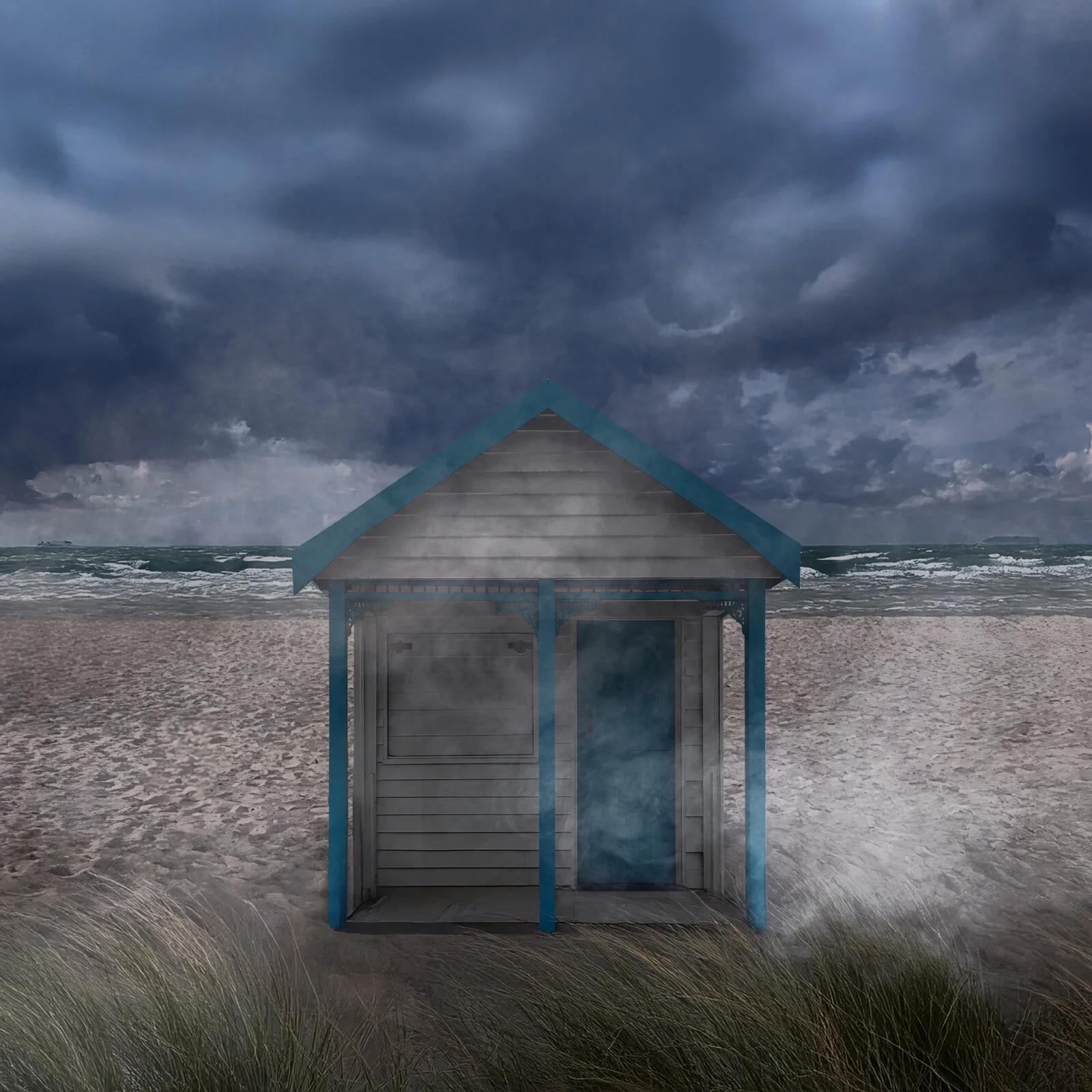
Jörgen Thornberg
Closed for Winter, Open to Memory, 2025
Digital
80 x 80 cm
3 500 kr
Closed for Winter, Open to Memory
When the last footprints fade from the sand and the wind begins to compose its own symphony, a silence settles over the beach hut. Closed for winter—but not forgotten. What follows is a story in three movements: wind, rain, storm. It listens, remembers, and waits. Just like we do, please read on.
“Winter Fugue for a Beach Hut
I. Allegro – The Wind Begins the Story
She does not speak, the beach hut,
but her silence is full of rehearsal.
The shutters blink like eyelids
half-closed against too much sky.
Snow begins—not to fall,
but to whisper. One flake. Another.
Like violin strokes across frozen breath.
A bow tugs the sea awake.
The wind rattles its sheet music.
And suddenly, the tempo breaks—
not fury, but frenzy.
The gulls are scattered notes.
The dunes lean in for cover.
She listens. She remembers. She braces.
II. Largo – Fire in the Memory
Now comes the hush.
Rain instead of snow,
tapping in even meter
like someone quietly refusing to leave.
Inside the beach hut—
no fire, but the memory of one.
No hearth, but the echo of warmth.
A coat on a peg that isn’t there.
A cup held by hands long gone.
Steam rising in the dark
like a solo violin
singing of homes that no longer exist
but have not stopped burning.
III. Presto – The Storm Writes Its Name
First: a tremble. Then: a chase.
A violin takes off running
and the orchestra follows like wolves.
This is not snow. It is sharp music,
blown sideways, desperate to compose
what cannot be remembered in calm.
The sea climbs higher.
The grass folds flat.
The sky forgets itself entirely.
And still, the hut stands—
stubborn as a rest note,
anchored in a symphony
written by no hand but wind.
She has survived this before.
She hums a few bars of August,
lets the roof creak in 6/8 time,
and waits.
Coda:
When spring comes,
she will not applaud.
She will open one eye,
let the sand settle,
and whisper—
“I never left. You just stopped listening.”
Malmö May 2025
Closed for Winter, Open to Memory
It is a winter story in three uncertain acts, beginning, as all things do, with the wind.
Not the romantic kind that tousles your hair and kisses your cheeks, but the brutal, sideways-blown gale that feels like it knows your name—and says it with disdain. The sea is shouting again, and the clouds above have gathered like muttering aunts in dark coats. Even the sand has gone silent, pulled taut like linen over an empty table. The beach hut—closed, grey, hunched between the dunes—does not complain. It simply endures.
The door is shut with a tired resolve. The shutters blink like old eyelids. Yet something inside remembers heat, laughter, and wet footprints. Something in the warped wood still smells of salt and childhood. Nothing dramatic—just the sun-warmed back of a cousin, the echo of a radio playing too loud, a seagull stealing a sandwich.
Out at sea, ships flicker like thoughts attempting to reach you. But you are not lonely here. There’s a strange comfort in standing in a place the world has momentarily abandoned. When darkness descends over Sweden, everything seems to fade into emptiness. The calendar loses its significance. But we endure. We wait through the silence of December and the ache of January. And one day, the light returns. The sand softens. The dunes rise, as if stretching after a long slumber.
But maybe eternal light isn’t the prize we think it is.
Perhaps it's the darkness that makes us so content in the North. It limits us. Wraps us. Grounds us. And inside, there are warm clothes, a fire in the hearth, and soup thick enough to hold a spoon upright. One of the oldest northern pleasures is looking out on winter’s fury from behind glass—safe, full, and slightly smug.
The beach hut knows this. She’s not longing. She is remembering.
She dreams in storms. In drifting sand and flickering northern light. In gull cries. In the touch of warm skin on sun-heated planks. In laughter too loud, towels were left behind, and someone was running in wet grass, calling back to a friend who no longer remembers this place.
She dreams of Vivaldi and a winter story in three uncertain acts – in the tempo of the great composer. It begins, as all things do here, with the wind.
Not the romantic kind that tousles your hair and kisses your cheeks, but the brutal, sideways-blown gale composed of sixteenth notes—sharp, insistent, cold. The sea is all timpani and tremolo, and the sky above rumbles like a dissonant chord unresolved. Even the sand holds its breath, as if waiting for the downbeat. The beach hut—closed, grey, hunched between the dunes—does not resist. It listens, in awe of the storm's fierce beauty.
The door, weather-worn and silent, closes like a fermata. Within the walls: stillness. Outside, the storm opens in measured trills, and snowflakes fall slowly and persistently. Each is a violin’s breath, a solitary descent from somewhere higher. And then: a flicker. A gust. The bow quickens. Teeth chatter. The tempo rises.
In Vivaldi’s first movement, winter wakes like this: At first, it is delicate, then frantic. The solo violin leads us through the snow's hush and the wind’s bite. The strings erupt—fluttering and fierce—like the landscape has become an orchestra. The beach hut holds fast.
Inside, nothing. Or maybe everything.
No fire, no kettle, no boots by the door. But if you close your eyes, you can feel it. You can hear the second movement.
There, the tempo slows. It's raining now, not snowing. Faceless and wrapped in wool, a man sits by an unseen hearth. He listens to droplets tap against the windowpane in 4/4 time. The violin sings—a warm melody, private and tender. This is winter’s lullaby, its offering of pause. The storm continues beyond the glass, but inside: light, soup, and shelter. There is music in the mundane, Vivaldi reminds us. Peace can be orchestrated; in this narrative, music is the thread that ties everything together.
And then, almost imperceptibly, we are led into the third movement.
It begins as a whisper. A high violin trembles—alone—like the first blade of grass rising through snow. But behind it, a force gathers—a wind from the south, a fury not yet named. The orchestra enters, no longer tentative but roaring. Strings scrape like sleet. Bow strokes become gales. The melody spins like a blizzard—circular, relentless—a Mediterranean fury crashing into Nordic resistance.
The dunes lean, the grass flattens, the shutters of the beach hut rattle like cymbals. Still, it stands. Still, it remembers.
It remembers laughter—wet swimsuits hanging crookedly in the sun, fingers dripping ice cream, a gull’s insolent theft, a child running down to the water, repeatedly shouting the same name, the echo of the surf swallowed.
It remembers silence. The kind that only comes when snow has erased the road and no one is coming.
So when darkness falls over Sweden, it is not a tragedy. It is an overture. The beach hut listens. She feels the key change. She knows that the light will return, but the darkness, too, has its score. We light candles. We eat thick soup. We pull blankets higher. We become quieter and more precise. Winter tunes us like an instrument.
Outside, the wind reaches its cadenza. The sea joins—wild, magnificent. This is Vivaldi’s conclusion: not peace, but awe.
And then, like all music, it ends.
The clouds pull back. The tide recedes. A single note—held, suspended—fades into silence.
The beach hut is closed. But her memory is in perfect pitch.
Closed for winter. Open to memory.
Always. And then spring arrives.
Jörgen Thornberg
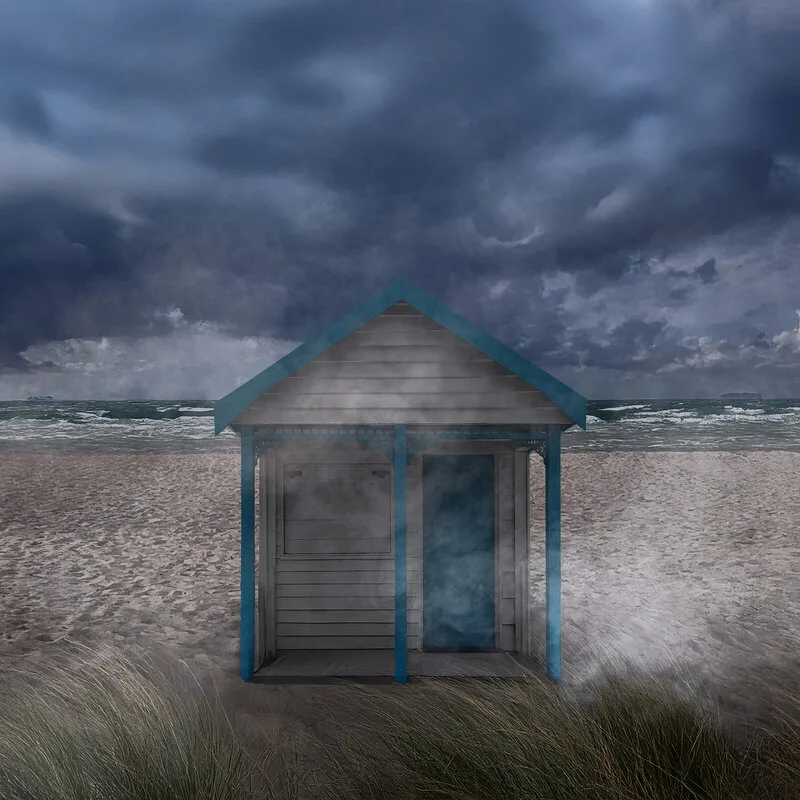
Closed for Winter, Open to Memory, 2025
Digital
80 x 80 cm
3 500 kr
Closed for Winter, Open to Memory
When the last footprints fade from the sand and the wind begins to compose its own symphony, a silence settles over the beach hut. Closed for winter—but not forgotten. What follows is a story in three movements: wind, rain, storm. It listens, remembers, and waits. Just like we do, please read on.
“Winter Fugue for a Beach Hut
I. Allegro – The Wind Begins the Story
She does not speak, the beach hut,
but her silence is full of rehearsal.
The shutters blink like eyelids
half-closed against too much sky.
Snow begins—not to fall,
but to whisper. One flake. Another.
Like violin strokes across frozen breath.
A bow tugs the sea awake.
The wind rattles its sheet music.
And suddenly, the tempo breaks—
not fury, but frenzy.
The gulls are scattered notes.
The dunes lean in for cover.
She listens. She remembers. She braces.
II. Largo – Fire in the Memory
Now comes the hush.
Rain instead of snow,
tapping in even meter
like someone quietly refusing to leave.
Inside the beach hut—
no fire, but the memory of one.
No hearth, but the echo of warmth.
A coat on a peg that isn’t there.
A cup held by hands long gone.
Steam rising in the dark
like a solo violin
singing of homes that no longer exist
but have not stopped burning.
III. Presto – The Storm Writes Its Name
First: a tremble. Then: a chase.
A violin takes off running
and the orchestra follows like wolves.
This is not snow. It is sharp music,
blown sideways, desperate to compose
what cannot be remembered in calm.
The sea climbs higher.
The grass folds flat.
The sky forgets itself entirely.
And still, the hut stands—
stubborn as a rest note,
anchored in a symphony
written by no hand but wind.
She has survived this before.
She hums a few bars of August,
lets the roof creak in 6/8 time,
and waits.
Coda:
When spring comes,
she will not applaud.
She will open one eye,
let the sand settle,
and whisper—
“I never left. You just stopped listening.”
Malmö May 2025
Closed for Winter, Open to Memory
It is a winter story in three uncertain acts, beginning, as all things do, with the wind.
Not the romantic kind that tousles your hair and kisses your cheeks, but the brutal, sideways-blown gale that feels like it knows your name—and says it with disdain. The sea is shouting again, and the clouds above have gathered like muttering aunts in dark coats. Even the sand has gone silent, pulled taut like linen over an empty table. The beach hut—closed, grey, hunched between the dunes—does not complain. It simply endures.
The door is shut with a tired resolve. The shutters blink like old eyelids. Yet something inside remembers heat, laughter, and wet footprints. Something in the warped wood still smells of salt and childhood. Nothing dramatic—just the sun-warmed back of a cousin, the echo of a radio playing too loud, a seagull stealing a sandwich.
Out at sea, ships flicker like thoughts attempting to reach you. But you are not lonely here. There’s a strange comfort in standing in a place the world has momentarily abandoned. When darkness descends over Sweden, everything seems to fade into emptiness. The calendar loses its significance. But we endure. We wait through the silence of December and the ache of January. And one day, the light returns. The sand softens. The dunes rise, as if stretching after a long slumber.
But maybe eternal light isn’t the prize we think it is.
Perhaps it's the darkness that makes us so content in the North. It limits us. Wraps us. Grounds us. And inside, there are warm clothes, a fire in the hearth, and soup thick enough to hold a spoon upright. One of the oldest northern pleasures is looking out on winter’s fury from behind glass—safe, full, and slightly smug.
The beach hut knows this. She’s not longing. She is remembering.
She dreams in storms. In drifting sand and flickering northern light. In gull cries. In the touch of warm skin on sun-heated planks. In laughter too loud, towels were left behind, and someone was running in wet grass, calling back to a friend who no longer remembers this place.
She dreams of Vivaldi and a winter story in three uncertain acts – in the tempo of the great composer. It begins, as all things do here, with the wind.
Not the romantic kind that tousles your hair and kisses your cheeks, but the brutal, sideways-blown gale composed of sixteenth notes—sharp, insistent, cold. The sea is all timpani and tremolo, and the sky above rumbles like a dissonant chord unresolved. Even the sand holds its breath, as if waiting for the downbeat. The beach hut—closed, grey, hunched between the dunes—does not resist. It listens, in awe of the storm's fierce beauty.
The door, weather-worn and silent, closes like a fermata. Within the walls: stillness. Outside, the storm opens in measured trills, and snowflakes fall slowly and persistently. Each is a violin’s breath, a solitary descent from somewhere higher. And then: a flicker. A gust. The bow quickens. Teeth chatter. The tempo rises.
In Vivaldi’s first movement, winter wakes like this: At first, it is delicate, then frantic. The solo violin leads us through the snow's hush and the wind’s bite. The strings erupt—fluttering and fierce—like the landscape has become an orchestra. The beach hut holds fast.
Inside, nothing. Or maybe everything.
No fire, no kettle, no boots by the door. But if you close your eyes, you can feel it. You can hear the second movement.
There, the tempo slows. It's raining now, not snowing. Faceless and wrapped in wool, a man sits by an unseen hearth. He listens to droplets tap against the windowpane in 4/4 time. The violin sings—a warm melody, private and tender. This is winter’s lullaby, its offering of pause. The storm continues beyond the glass, but inside: light, soup, and shelter. There is music in the mundane, Vivaldi reminds us. Peace can be orchestrated; in this narrative, music is the thread that ties everything together.
And then, almost imperceptibly, we are led into the third movement.
It begins as a whisper. A high violin trembles—alone—like the first blade of grass rising through snow. But behind it, a force gathers—a wind from the south, a fury not yet named. The orchestra enters, no longer tentative but roaring. Strings scrape like sleet. Bow strokes become gales. The melody spins like a blizzard—circular, relentless—a Mediterranean fury crashing into Nordic resistance.
The dunes lean, the grass flattens, the shutters of the beach hut rattle like cymbals. Still, it stands. Still, it remembers.
It remembers laughter—wet swimsuits hanging crookedly in the sun, fingers dripping ice cream, a gull’s insolent theft, a child running down to the water, repeatedly shouting the same name, the echo of the surf swallowed.
It remembers silence. The kind that only comes when snow has erased the road and no one is coming.
So when darkness falls over Sweden, it is not a tragedy. It is an overture. The beach hut listens. She feels the key change. She knows that the light will return, but the darkness, too, has its score. We light candles. We eat thick soup. We pull blankets higher. We become quieter and more precise. Winter tunes us like an instrument.
Outside, the wind reaches its cadenza. The sea joins—wild, magnificent. This is Vivaldi’s conclusion: not peace, but awe.
And then, like all music, it ends.
The clouds pull back. The tide recedes. A single note—held, suspended—fades into silence.
The beach hut is closed. But her memory is in perfect pitch.
Closed for winter. Open to memory.
Always. And then spring arrives.
3 500 kr

Jörgen Thornberg
Malmö
Lite om bilder och mig. Translation in English at the end.
Jag är en nyfiken person som ser allt i bilder, även det jag fäster i ord, gärna tillsammans för bakom alla mina bilder finns en berättelse. Till vissa bilder hör en kortare eller längre novell som följer med bilden.
Bilder berättar historier. Jag omges av naturlig skönhet, intressanta människor och historia var jag än går. Jag använder min kamera för att dokumentera världen och blanda det jag ser med vad jag känner för att fånga den dolda magin.
Mina bilder berättar mina historier. Genom mina bilder, tryck och berättelser. Jag bjuder in dig att ta del av dessa berättelser, in i ditt liv och hem och dela min mycket personliga syn på vår värld. Mer än vad ögat ser. Jag tänker i bilder, drömmer och skriver och pratar om dem; följaktligen måste jag också skapa bilder. De blir vad jag ser, inte nödvändigtvis begränsade till verkligheten. Det finns en bild runt varje hörn. Jag hoppas att du kommer att se vad jag såg och gilla det.
Jag är också en skrivande person och till många bilder hör en kortare eller längre essay. Den följer med tavlan, tryckt på fint papper och med en personlig hälsning från mig.
Flertalet bilder startar sin resa i min kamera. Enkelt förklarat beskriver jag bilden jag ser i mitt inre, upplevd eller fantiserad. Bilden uppstår inom mig redan innan jag fått okularet till ögat. På bråkdelen av ett ögonblick ser jag vad jag vill ha och vad som kan göras med bilden. Här skall jag stoppa in en giraff, stålmannen, Titanic eller vad det är min fantasi finner ut. Ännu märkligare är att jag kommer ihåg minnesbilden långt efteråt när det blir tid att skapa verket. Om jag lyckas eller inte, är upp till betraktaren, oftast präglat av en stråk av svart humor – meningen är att man skall bli underhållen. Mina bilder blir ofta en snackis där de hänger.
Jag föredrar bilder som förmedlar ett budskap i flera lager. Vid första anblicken fylld av feel-good, en vacker utsikt, fint väder, solen skiner, blommor på ängen eller vattnet som ligger förrädiskt spegelblankt. I en sådan bild kan jag gömma min egentliga berättelse, mitt förakt för förtryckare och våldsverkare, rasister och fördomsfulla människor - ett gärna återkommande motiv mer eller mindre dolt i det vackra motivet. Jag försöker förena dem i ett gemensamt narrativ.
Bild och formgivning har löpt som en röd tråd genom livet. Fotokonst känns som en värdig final som jag gärna delar med mig.
Min genre är vid som framgår av mina bilder, temat en blandning av pop- och gatukonst i kollage som kan bestå av hundratals lager. Vissa bilder kan ta veckor, andra någon dag innan det är dags att överlämna resultatet till printverkstaden. Fine Art Prints är digitala fotocollage. I dessa kollage sker rivandet, klippandet, pusslandet, målandet, ritandet och sprayningen digitalt. Det jag monterar in kan vara hundratals år gamla bilder som jag omsorgsfullt frilägger så att de ser ut att vara en del av tavlan men också bilder skapade av mig själv efter min egen fantasi. Därefter besöks printstudion och för vissa bilder numrera en limiterad upplaga (oftast 7 exemplar) och signera för hand. Vissa bilder kan köpas i olika format. Det är bara att fråga efter vilka. Gillar man en bild som är 70x100 men inte har plats på väggen, går den kanske att få i 50x70 cm istället. Frågan är fri.
Metoden Giclée eller Fine Art Print som det också kallas är det moderna sättet för framställning av grafisk konst. Villkoret för denna typ av utskrifter är att en högkvalitativ storformatskrivare används med åldersbeständigt färgpigment och konstnärspapper eller i förekommande fall på duk. Pappret som används möter de krav på livslängd som ställs av museer och gallerier. Normalt säljer jag mina bilder oinramade så att den nya ägaren själv kan bestämma hur de skall se ut, med eller utan passepartout färg på ram, med eller utan glas etc..
Under många år ställde jag bara ut på nätet, i valda grupper och på min egen Facebooksida - https://www.facebook.com/jorgen.thornberg.9
Jag finns också på en egen hemsida som tyvärr inte alltid är uppdaterad – https://www.jth.life/ Där kan du också läsa en del av de berättelser som följer med bilden.
UTSTÄLLNINGAR
Luftkastellet, oktober 2022
Konst i Lund, november 2022
Luftkastellet, mars 2023
Engleson Galleri Caroli, april 2023
Hydra, Greece June 2023
Engleson Galleri Caroli, oktober 2023
Toppen, Höllviken december 2023
Luftkastellet, mars 2024
Torups Galleri, mars 2024
Venice, May 2024
Luftkastellet, oktober 2024
Konst i Advent, December 2024
Galleri Engleson, Caroli December 2024
Jäger & Jansson Galleri, april 2025
A bit about pictures and me.
I'm a curious person who sees everything in pictures, even what I express in words, often combining them, for behind all my pictures lies a story. These narratives, some as short as a single image and others as long as a novel, are the heart and soul of my work.
Pictures tell stories. Wherever I go, I'm surrounded by natural beauty, exciting people, and history. I use my camera to document the world and blend what I see with what I feel to capture the hidden magic.
My images tell my stories. Through my pictures, prints, and narratives, I invite you to partake in these stories in your life and home and share my deeply personal perspective of our world. More than meets the eye. I think in pictures, dream, write, and talk about them; consequently, I must create images too. They become what I see, not necessarily confined to reality. There's a picture around every corner. I hope you'll see what I saw and enjoy it.
I'm also a writer, and many images come with a shorter or longer essay. It accompanies the painting, printed on fine paper with my personal greeting.
Many pictures start their journey on my camera. Simply put, I describe the image I see in my mind, experienced or imagined. The image arises within me even before I bring the eyepiece to my eye. In a fraction of a moment, I see what I want and what can be done with the picture. Here, I'll insert a giraffe, Superman, the Titanic, or whatever my imagination conjures up. Even stranger is that I remember the mental image long after it's time to create the work. Whether I succeed is up to the observer, often imbued with a streak of black humour – the aim is to entertain. My pictures usually become a talking point wherever they hang.
I prefer pictures that convey a message in multiple layers. At first glance, they're filled with feel-good vibes, a beautiful view, lovely weather, the sun shining, flowers in the meadow, or the water lying deceptively calm. But beneath this surface beauty, I often conceal a deeper story, a narrative that challenges societal norms or explores the human condition. I invite you to delve into these hidden narratives and discover the layers of meaning within my work.
Picture and design have been a thread running through my life. Photographic art feels like a fitting finale, and I'm happy to share it.
My genre is varied, as seen in my pictures; the theme is a blend of pop and street art in collages that can consist of hundreds of layers. Some images can take weeks, others just a day before it's time to hand over the result to the print workshop. Fine Art Prints are digital photo collages. In these collages, tearing, cutting, puzzling, painting, drawing, and spraying happen digitally. What I insert can be images hundreds of years old that I carefully extract so they appear to be part of the painting, but also images created by myself, now also generated from my imagination. Next, visit the print studio and, for certain images, number a limited edition (usually 7 copies) and sign them by hand. Some images may be available in other formats. Just ask which ones. If you like an image that's 70x100 but doesn't have space on the wall, you might be able to get it in 50x70 cm instead. The question is open.
The Giclée method, or Fine Art Print as it's also called, is the modern way of producing graphic art. This method ensures the highest quality and longevity of the artwork, using a high-quality large-format printer with archival pigment inks and artist paper or, in some cases, canvas. The paper used meets the longevity requirements set by museums and galleries. I sell my pictures unframed, allowing the new owner to personalise their artwork, confident in the lasting value and quality of the piece.
For many years, I only exhibited online, in selected groups, and on my Facebook page - https://www.facebook.com/jorgen.thornberg.9. I also have my website, which unfortunately is not constantly updated - https://www.jth.life/. You can also read some of the stories accompanying the pictures there.
EXHIBITIONS
Luftkastellet, October 2022
Art in Lund, November 2022
Luftkastellet, March 2023
Engleson Gallery Caroli, April 2023
Hydra, Greece June 2023
Engleson Gallery Caroli, October 2023
Toppen, Höllviken December 2023
Luftkastellet, March 2024
Torup Gallery, March 2024
Venice, May 2024
UTSTÄLLNINGAR
Luftkastellet, oktober 2022
Konst i Lund, november 2022
Luftkastellet, mars 2023
Engleson Galleri Caroli, april 2023
Hydra, Greece June 2023
Engleson Galleri Caroli, oktober 2023
Toppen, Höllviken december 2023
Luftkastellet, mars 2024
Torups Galleri, mars 2024
Venice, May 2024
Luftkastellet, October 2024
Konst i Advent, December 2024
Galleri Engleson, Caroli December 2024
Jäger & Jansson Galleri, April 2025
Utbildning
Autodidakt
Medlem i konstnärsförening
Öppna Sinnen
Med i konstrunda
Konstrundan i Skåne
Utställningar
Luftkastellet, October 2022
Art in Lund, November 2022
Luftkastellet, March 2023
Engleson Gallery Caroli, April 2023
Hydra, Greece June 2023
Engleson Gallery Caroli, October 2023
Toppen, Höllviken December 2023
Luftkastellet, March 2024
Torup Gallery, March 2024
Venice, May 2024