Vi använder cookies för att ge dig bästa möjliga upplevelse. Välj vilka cookies du tillåter.
Läs mer i vår integritetspolicy
Jörgen Thornberg
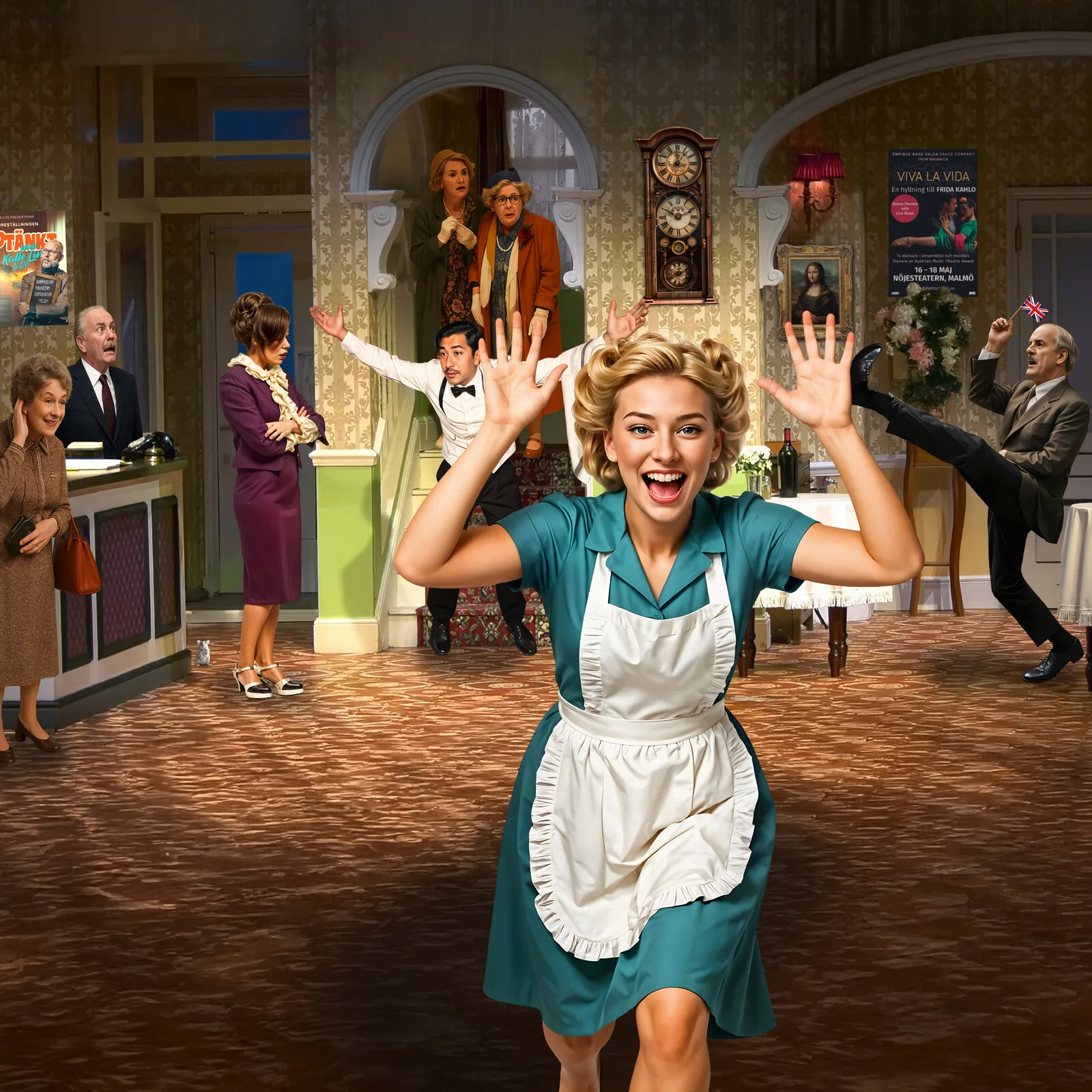
No, no, not a rat. A Siberian hamster, they said in shop., 2025
Digital
80 x 80 cm
3 500 kr
No, no, not a rat. A Siberian hamster, they said in shop. The confusion is as comical as it is absurd.
Welcome to Fawlty Towers – where the biscuits are stale, the tempers explosive, and the hamsters mysteriously resemble rats.
In this theatrical retelling of chaos incarnate, a health inspector named Schmutz is on his way, a rat is politely gnawing beneath the reception desk, and Basil Fawlty is clinging to dignity by the frayed hem of his wife’s disapproval. As Polly flails, Manuel mistranslates, and Sybil smirks icily through catastrophe, one thing becomes clear:
This is not a hotel. This is a nervous breakdown with breakfast service.
“Ballad of Fawlty Towers
(or: The Biscuit, the Rat and the Man chewing ice
In Torquay by the English coast,
There stood a man who tried the most
To run a hotel, fine and grand—
With chaos always close at hand.
His name was Basil, tall and terse,
A master of the bitter curse.
He dreamed of dukes with silent shoes,
But got complaints and German blues.
With Sybil sharp and always near,
He lived in matrimonial fear.
He muttered names like "little tart,"
While clutching his broken heart.
Manuel came from far away,
Confused by every word they’d say.
He smiled through rage and pastry storms,
And never quite obeyed the norms.
Polly painted, served and sighed,
A voice of reason misapplied.
She calmed the guests, ignored the screams,
And held together Basil’s dreams.
The Major drank, and the bell was cracked,
The health inspector soon attacked.
And just when peace seemed near at last—
A tail was seen. And all hell just passed.
A creature small, with silent grace,
Peered out beneath the lobby’s base.
The guests all gasped, the staff took flight—
Basil turned a shade of white.
“A hamster!” Manuel proudly claimed,
While Basil turned and wildly blamed.
“DON’T MENTION WAR!” he cried aloud—
And tripped into a German crowd.
The ladies screamed, the biscuit fell,
The rat, amused, ignored the yell.
He munched, he sniffed, then left with flair—
The only sane one anywhere.
So raise a glass to beds unmade,
To rats misnamed and guests betrayed.
At Fawlty Towers, rules are bent—
But what a stay! What an event!”
Malmö May 2025
Scene 5: "The Siberian Hamster Incident" is a pivotal moment in the play. A case of mistaken identity leads to a series of hilarious misunderstandings.
Act II, Fawlty Hotel – a cacophony of excuses, cheese, and absurdities. The chaos is palpable and the audience can't help but be entertained.
Lights up.
The lobby is a whirlwind of activity. Telegraph lines quiver, and the smell of overcooked cauliflower and lavender-scented cleaning products fills the air. A rat, seemingly the only creature not in a panic, sits beneath the reception desk. He nibbles on a piece of digestive biscuit, observing the chaos with a bemused expression. This uproar is not about him. Yet. It’s about a hamster, mistaken for a rat—a rodent, at any rate. Rodents include mice, rats, guinea pigs, hamsters, chinchillas, and gerbils. So he might be considered a cousin.
Polly, the flustered and overworked receptionist, rushes straight toward the audience, terrified, hands in the air.
"I said we weren’t to allow pets! Not even hamsters! And not the kind with tails – because they’re not hamsters!" Polly exclaims, her voice trembling with fear and frustration.
The two ladies (on the stairs, dramatically horrified):
"We saw the tail, didn’t we, Myrtle? It twitched, and the creature smiled. In a malicious way!" Myrtle nodded in agreement.
Manuel (waving a piece of cheese):
"He no rat! He is Basil junior! Very polite! He says gracias when I feed him! No, no, no rat. A Siberian hamster, they said in shop."
Basil (storms in, red in the face and wet on one foot after tripping on the Major’s ice bucket. The old man not only drank the place dry but also chewed ice cubes to "keep a cool head" – or so he claimed.):
"Listen! Emergency alert: The Health Inspector’s on his way – name’s Schmutz. Might be German. Or Swiss with something to prove. When he comes through that door: DON’T MENTION THE WAR!! Got it?" Basil shouts, his face red with panic, his voice a mix of fear and desperation.
Manuel (beaming):
"Which war?"
Sybil (rolling her eyes):
"All of them, Manuel. All the wars. All the rodents. All the cooks. Anything that upsets Basil. Everything."
The rat (looks up, chews slowly, thinks to himself):
"I just wanted to eat in peace. A bit of biscuit. A bite of marmalade. But those two-legged creatures – what a racket they make. It's like they're in a perpetual state of chaos!"
Basil (trips on a flower vase, points at Polly):
"You! Keep an eye on the hamster menace! You! (points at Manuel) Keep an eye on yourself! And you! (points at Sybil) Keep an eye on everything I can’t keep an eye on!"
(mutters as he passes Sybil, low but fully audible to the audience):
"My little Kommandant... sabre-toothed tart... Queen of pain..."
Sybil (without turning around):
"I heard that, Basil."
Basil (mumbles):
"Sorry, my little piranha."
Manuel (triumphantly, pointing at the rat):
"LOOK! Basil’s cousin is eating a biscuit! That’s the real rat, not Basil junior." Manuel triumphantly points at the rat, making a playful jab at Basil's family and the ongoing confusion about the rat's identity.
All heads slowly turned to the floor beneath the reception desk. The rat freezes.
Sybil (quiet, cold as gin without tonic):
"If that is a hamster, Basil – then I’m the Queen of Denmark."
Lights freeze. Everyone stares at the rat. He sighs and exits the scene with his tail held high.
Polly runs off, laughing at the absurdity. Her presence at the hotel was due to being married to Basil, not Sybil. If she had been Basil's real wife, he would’ve strangled her long ago. This line not only highlights the strained relationship between Basil and Polly but also the dynamic between Basil and Sybil, who is often the voice of reason in the chaos of the hotel.
The Major behind the reception nodded to her in sympathy. He and she were probably the only sane ones in the hotel. He saw this gig as a little supplement to his meagre pension, and besides, he lived there rent-free with all-inclusive benefits, and Basil's bar was well-stocked. He was always just the right level of drunk to survive. The Major, a resident of the hotel, serves as a voice of reason and a source of comic relief in the chaotic environment of the hotel.
As soon as the scene wrapped, the Major retreated to the bar for a dry martini – so dry that the olive floated on the surface tension. Of course, he wouldn’t drink alone; he usually had company from Donald.
Donald Sinclair was the co-proprietor of the Gleneagles Hotel in Torquay, Devon, England. He helped manage the hotel after a long career as an officer in the Merchant Navy and the Royal Navy. During the Second World War, Sinclair survived the sinking of the ships he served on twice. He thanked his divine patron among the gods, Pan, for his luck and often raised a glass in his honour.
Sinclair inspired the character Basil Fawlty, played by John Cleese, in the television sitcom "Fawlty Towers," which Cleese co-wrote. This was due to Sinclair’s allegedly stuffy, snobbish, and eccentric treatment of his guests, including Cleese and other members of the Monty Python cast.
The Greek god Pan is renowned for his connection to the wild, shepherds, and the unrestrained pursuit of pleasure, including drinking and sexual escapades. He is frequently portrayed as a satyr – a half-human, half-goat figure. Pan’s passion for music, particularly the pan flute he played, is also widely recognised.
Pan, as a god of nature and the untamed, was often depicted with a phallus almost as big as himself, reflecting his association with fertility and unbridled male sexuality, as well as his tendency to pursue nymphs. He was also a companion of Dionysus, the god of wine and festivities, which enhanced his reputation for revelry and pleasure.
It was lucky Donald was around because Basil was tightly controlled – both by his offstage partner, Polly, and his onstage wife, Sybil. The latter was a real battle-axe in real life, and Polly was not as sweet as her face suggested. Basil was a henpecked husband, not that he ever admitted it. By shouting and blustering, he gave the illusion of being macho. That wouldn’t fool an old military man.
Basil Fawlty is one of television history’s most iconic characters – a man desperately trying to maintain order, class, and dignity while failing spectacularly at every turn.
In short, he is a frustrated hotelier trapped in hell. A first-class hypocrite, snob, and disaster magnet. He runs the small hotel Fawlty Towers in Torquay with Sybil (whom he both fears and despises). Basil desperately tries to appear cultured, proper, and "upper class"—despite reality constantly undermining his self-image.
He's snobbish, obsessed with status, dreams of aristocratic guests, loathes "ordinary people," and feels mortified when reality reminds him of his lower-middle-class roots.
Basil is a simmering volcano prone to eruptions, swinging between nervous servility and sudden rages, often directed at guests, staff, or furniture.
He is passive-aggressive – especially towards Sybil, whom he calls everything from "my little nest of vipers" to "that golfing puff adder" – usually behind her back.
He is incapable of self-reflection – everything is always someone else’s fault. Usually, it's Manuel's, the guests’, or the weather. Rarely is it Sybil's, because he doesn't even dare think it.
As a character, Basil is a master of physical comedy—crawling, stumbling, flailing, and thrashing chairs with branches.
He both fears and resents Sybil. He sees her as superior and undermining, but cannot function without her.
Poor Manuel is a perpetual misunderstood and a perfect underdog. Basil shouts constantly at him, and Manuel responds in broken English. He's from Barcelona, you see.
Polly is the only one he respects – occasionally. She saves him more often than he realises. But then again, they’re married in real life, and he’s scared of her temper too, though she never shows it on set. She saves that for home. Best to stay quiet.
According to the Major, Basil Fawlty wants to be a gentleman but has the temper of a London cab driver and the bad luck of Mr. Bean.
Jörgen Thornberg
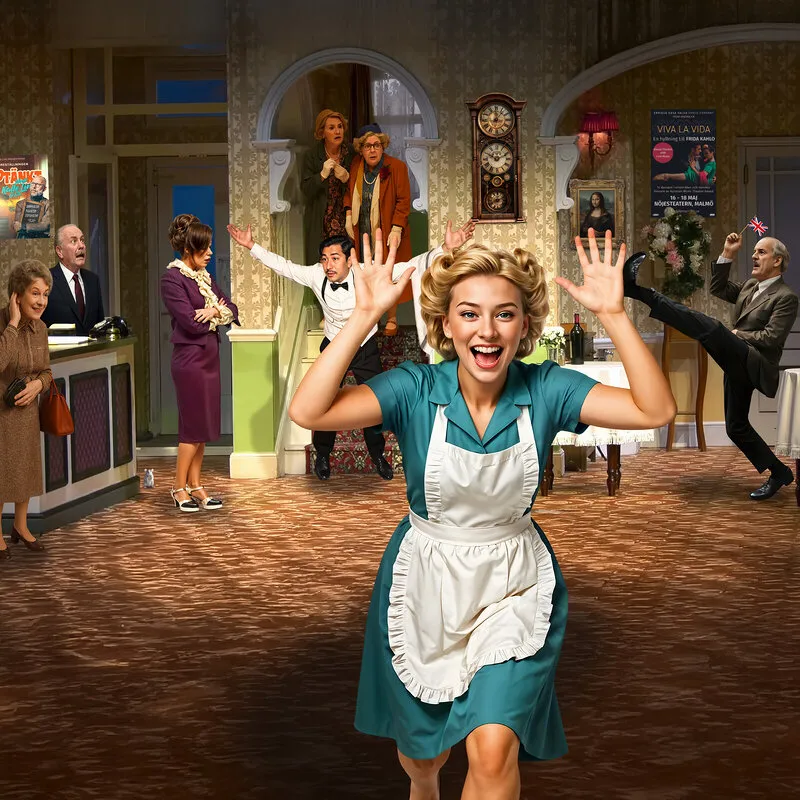
No, no, not a rat. A Siberian hamster, they said in shop., 2025
Digital
80 x 80 cm
3 500 kr
No, no, not a rat. A Siberian hamster, they said in shop. The confusion is as comical as it is absurd.
Welcome to Fawlty Towers – where the biscuits are stale, the tempers explosive, and the hamsters mysteriously resemble rats.
In this theatrical retelling of chaos incarnate, a health inspector named Schmutz is on his way, a rat is politely gnawing beneath the reception desk, and Basil Fawlty is clinging to dignity by the frayed hem of his wife’s disapproval. As Polly flails, Manuel mistranslates, and Sybil smirks icily through catastrophe, one thing becomes clear:
This is not a hotel. This is a nervous breakdown with breakfast service.
“Ballad of Fawlty Towers
(or: The Biscuit, the Rat and the Man chewing ice
In Torquay by the English coast,
There stood a man who tried the most
To run a hotel, fine and grand—
With chaos always close at hand.
His name was Basil, tall and terse,
A master of the bitter curse.
He dreamed of dukes with silent shoes,
But got complaints and German blues.
With Sybil sharp and always near,
He lived in matrimonial fear.
He muttered names like "little tart,"
While clutching his broken heart.
Manuel came from far away,
Confused by every word they’d say.
He smiled through rage and pastry storms,
And never quite obeyed the norms.
Polly painted, served and sighed,
A voice of reason misapplied.
She calmed the guests, ignored the screams,
And held together Basil’s dreams.
The Major drank, and the bell was cracked,
The health inspector soon attacked.
And just when peace seemed near at last—
A tail was seen. And all hell just passed.
A creature small, with silent grace,
Peered out beneath the lobby’s base.
The guests all gasped, the staff took flight—
Basil turned a shade of white.
“A hamster!” Manuel proudly claimed,
While Basil turned and wildly blamed.
“DON’T MENTION WAR!” he cried aloud—
And tripped into a German crowd.
The ladies screamed, the biscuit fell,
The rat, amused, ignored the yell.
He munched, he sniffed, then left with flair—
The only sane one anywhere.
So raise a glass to beds unmade,
To rats misnamed and guests betrayed.
At Fawlty Towers, rules are bent—
But what a stay! What an event!”
Malmö May 2025
Scene 5: "The Siberian Hamster Incident" is a pivotal moment in the play. A case of mistaken identity leads to a series of hilarious misunderstandings.
Act II, Fawlty Hotel – a cacophony of excuses, cheese, and absurdities. The chaos is palpable and the audience can't help but be entertained.
Lights up.
The lobby is a whirlwind of activity. Telegraph lines quiver, and the smell of overcooked cauliflower and lavender-scented cleaning products fills the air. A rat, seemingly the only creature not in a panic, sits beneath the reception desk. He nibbles on a piece of digestive biscuit, observing the chaos with a bemused expression. This uproar is not about him. Yet. It’s about a hamster, mistaken for a rat—a rodent, at any rate. Rodents include mice, rats, guinea pigs, hamsters, chinchillas, and gerbils. So he might be considered a cousin.
Polly, the flustered and overworked receptionist, rushes straight toward the audience, terrified, hands in the air.
"I said we weren’t to allow pets! Not even hamsters! And not the kind with tails – because they’re not hamsters!" Polly exclaims, her voice trembling with fear and frustration.
The two ladies (on the stairs, dramatically horrified):
"We saw the tail, didn’t we, Myrtle? It twitched, and the creature smiled. In a malicious way!" Myrtle nodded in agreement.
Manuel (waving a piece of cheese):
"He no rat! He is Basil junior! Very polite! He says gracias when I feed him! No, no, no rat. A Siberian hamster, they said in shop."
Basil (storms in, red in the face and wet on one foot after tripping on the Major’s ice bucket. The old man not only drank the place dry but also chewed ice cubes to "keep a cool head" – or so he claimed.):
"Listen! Emergency alert: The Health Inspector’s on his way – name’s Schmutz. Might be German. Or Swiss with something to prove. When he comes through that door: DON’T MENTION THE WAR!! Got it?" Basil shouts, his face red with panic, his voice a mix of fear and desperation.
Manuel (beaming):
"Which war?"
Sybil (rolling her eyes):
"All of them, Manuel. All the wars. All the rodents. All the cooks. Anything that upsets Basil. Everything."
The rat (looks up, chews slowly, thinks to himself):
"I just wanted to eat in peace. A bit of biscuit. A bite of marmalade. But those two-legged creatures – what a racket they make. It's like they're in a perpetual state of chaos!"
Basil (trips on a flower vase, points at Polly):
"You! Keep an eye on the hamster menace! You! (points at Manuel) Keep an eye on yourself! And you! (points at Sybil) Keep an eye on everything I can’t keep an eye on!"
(mutters as he passes Sybil, low but fully audible to the audience):
"My little Kommandant... sabre-toothed tart... Queen of pain..."
Sybil (without turning around):
"I heard that, Basil."
Basil (mumbles):
"Sorry, my little piranha."
Manuel (triumphantly, pointing at the rat):
"LOOK! Basil’s cousin is eating a biscuit! That’s the real rat, not Basil junior." Manuel triumphantly points at the rat, making a playful jab at Basil's family and the ongoing confusion about the rat's identity.
All heads slowly turned to the floor beneath the reception desk. The rat freezes.
Sybil (quiet, cold as gin without tonic):
"If that is a hamster, Basil – then I’m the Queen of Denmark."
Lights freeze. Everyone stares at the rat. He sighs and exits the scene with his tail held high.
Polly runs off, laughing at the absurdity. Her presence at the hotel was due to being married to Basil, not Sybil. If she had been Basil's real wife, he would’ve strangled her long ago. This line not only highlights the strained relationship between Basil and Polly but also the dynamic between Basil and Sybil, who is often the voice of reason in the chaos of the hotel.
The Major behind the reception nodded to her in sympathy. He and she were probably the only sane ones in the hotel. He saw this gig as a little supplement to his meagre pension, and besides, he lived there rent-free with all-inclusive benefits, and Basil's bar was well-stocked. He was always just the right level of drunk to survive. The Major, a resident of the hotel, serves as a voice of reason and a source of comic relief in the chaotic environment of the hotel.
As soon as the scene wrapped, the Major retreated to the bar for a dry martini – so dry that the olive floated on the surface tension. Of course, he wouldn’t drink alone; he usually had company from Donald.
Donald Sinclair was the co-proprietor of the Gleneagles Hotel in Torquay, Devon, England. He helped manage the hotel after a long career as an officer in the Merchant Navy and the Royal Navy. During the Second World War, Sinclair survived the sinking of the ships he served on twice. He thanked his divine patron among the gods, Pan, for his luck and often raised a glass in his honour.
Sinclair inspired the character Basil Fawlty, played by John Cleese, in the television sitcom "Fawlty Towers," which Cleese co-wrote. This was due to Sinclair’s allegedly stuffy, snobbish, and eccentric treatment of his guests, including Cleese and other members of the Monty Python cast.
The Greek god Pan is renowned for his connection to the wild, shepherds, and the unrestrained pursuit of pleasure, including drinking and sexual escapades. He is frequently portrayed as a satyr – a half-human, half-goat figure. Pan’s passion for music, particularly the pan flute he played, is also widely recognised.
Pan, as a god of nature and the untamed, was often depicted with a phallus almost as big as himself, reflecting his association with fertility and unbridled male sexuality, as well as his tendency to pursue nymphs. He was also a companion of Dionysus, the god of wine and festivities, which enhanced his reputation for revelry and pleasure.
It was lucky Donald was around because Basil was tightly controlled – both by his offstage partner, Polly, and his onstage wife, Sybil. The latter was a real battle-axe in real life, and Polly was not as sweet as her face suggested. Basil was a henpecked husband, not that he ever admitted it. By shouting and blustering, he gave the illusion of being macho. That wouldn’t fool an old military man.
Basil Fawlty is one of television history’s most iconic characters – a man desperately trying to maintain order, class, and dignity while failing spectacularly at every turn.
In short, he is a frustrated hotelier trapped in hell. A first-class hypocrite, snob, and disaster magnet. He runs the small hotel Fawlty Towers in Torquay with Sybil (whom he both fears and despises). Basil desperately tries to appear cultured, proper, and "upper class"—despite reality constantly undermining his self-image.
He's snobbish, obsessed with status, dreams of aristocratic guests, loathes "ordinary people," and feels mortified when reality reminds him of his lower-middle-class roots.
Basil is a simmering volcano prone to eruptions, swinging between nervous servility and sudden rages, often directed at guests, staff, or furniture.
He is passive-aggressive – especially towards Sybil, whom he calls everything from "my little nest of vipers" to "that golfing puff adder" – usually behind her back.
He is incapable of self-reflection – everything is always someone else’s fault. Usually, it's Manuel's, the guests’, or the weather. Rarely is it Sybil's, because he doesn't even dare think it.
As a character, Basil is a master of physical comedy—crawling, stumbling, flailing, and thrashing chairs with branches.
He both fears and resents Sybil. He sees her as superior and undermining, but cannot function without her.
Poor Manuel is a perpetual misunderstood and a perfect underdog. Basil shouts constantly at him, and Manuel responds in broken English. He's from Barcelona, you see.
Polly is the only one he respects – occasionally. She saves him more often than he realises. But then again, they’re married in real life, and he’s scared of her temper too, though she never shows it on set. She saves that for home. Best to stay quiet.
According to the Major, Basil Fawlty wants to be a gentleman but has the temper of a London cab driver and the bad luck of Mr. Bean.
3 500 kr

Jörgen Thornberg
Malmö
Lite om bilder och mig. Translation in English at the end.
Jag är en nyfiken person som ser allt i bilder, även det jag fäster i ord, gärna tillsammans för bakom alla mina bilder finns en berättelse. Till vissa bilder hör en kortare eller längre novell som följer med bilden.
Bilder berättar historier. Jag omges av naturlig skönhet, intressanta människor och historia var jag än går. Jag använder min kamera för att dokumentera världen och blanda det jag ser med vad jag känner för att fånga den dolda magin.
Mina bilder berättar mina historier. Genom mina bilder, tryck och berättelser. Jag bjuder in dig att ta del av dessa berättelser, in i ditt liv och hem och dela min mycket personliga syn på vår värld. Mer än vad ögat ser. Jag tänker i bilder, drömmer och skriver och pratar om dem; följaktligen måste jag också skapa bilder. De blir vad jag ser, inte nödvändigtvis begränsade till verkligheten. Det finns en bild runt varje hörn. Jag hoppas att du kommer att se vad jag såg och gilla det.
Jag är också en skrivande person och till många bilder hör en kortare eller längre essay. Den följer med tavlan, tryckt på fint papper och med en personlig hälsning från mig.
Flertalet bilder startar sin resa i min kamera. Enkelt förklarat beskriver jag bilden jag ser i mitt inre, upplevd eller fantiserad. Bilden uppstår inom mig redan innan jag fått okularet till ögat. På bråkdelen av ett ögonblick ser jag vad jag vill ha och vad som kan göras med bilden. Här skall jag stoppa in en giraff, stålmannen, Titanic eller vad det är min fantasi finner ut. Ännu märkligare är att jag kommer ihåg minnesbilden långt efteråt när det blir tid att skapa verket. Om jag lyckas eller inte, är upp till betraktaren, oftast präglat av en stråk av svart humor – meningen är att man skall bli underhållen. Mina bilder blir ofta en snackis där de hänger.
Jag föredrar bilder som förmedlar ett budskap i flera lager. Vid första anblicken fylld av feel-good, en vacker utsikt, fint väder, solen skiner, blommor på ängen eller vattnet som ligger förrädiskt spegelblankt. I en sådan bild kan jag gömma min egentliga berättelse, mitt förakt för förtryckare och våldsverkare, rasister och fördomsfulla människor - ett gärna återkommande motiv mer eller mindre dolt i det vackra motivet. Jag försöker förena dem i ett gemensamt narrativ.
Bild och formgivning har löpt som en röd tråd genom livet. Fotokonst känns som en värdig final som jag gärna delar med mig.
Min genre är vid som framgår av mina bilder, temat en blandning av pop- och gatukonst i kollage som kan bestå av hundratals lager. Vissa bilder kan ta veckor, andra någon dag innan det är dags att överlämna resultatet till printverkstaden. Fine Art Prints är digitala fotocollage. I dessa kollage sker rivandet, klippandet, pusslandet, målandet, ritandet och sprayningen digitalt. Det jag monterar in kan vara hundratals år gamla bilder som jag omsorgsfullt frilägger så att de ser ut att vara en del av tavlan men också bilder skapade av mig själv efter min egen fantasi. Därefter besöks printstudion och för vissa bilder numrera en limiterad upplaga (oftast 7 exemplar) och signera för hand. Vissa bilder kan köpas i olika format. Det är bara att fråga efter vilka. Gillar man en bild som är 70x100 men inte har plats på väggen, går den kanske att få i 50x70 cm istället. Frågan är fri.
Metoden Giclée eller Fine Art Print som det också kallas är det moderna sättet för framställning av grafisk konst. Villkoret för denna typ av utskrifter är att en högkvalitativ storformatskrivare används med åldersbeständigt färgpigment och konstnärspapper eller i förekommande fall på duk. Pappret som används möter de krav på livslängd som ställs av museer och gallerier. Normalt säljer jag mina bilder oinramade så att den nya ägaren själv kan bestämma hur de skall se ut, med eller utan passepartout färg på ram, med eller utan glas etc..
Under många år ställde jag bara ut på nätet, i valda grupper och på min egen Facebooksida - https://www.facebook.com/jorgen.thornberg.9
Jag finns också på en egen hemsida som tyvärr inte alltid är uppdaterad – https://www.jth.life/ Där kan du också läsa en del av de berättelser som följer med bilden.
UTSTÄLLNINGAR
Luftkastellet, oktober 2022
Konst i Lund, november 2022
Luftkastellet, mars 2023
Engleson Galleri Caroli, april 2023
Hydra, Greece June 2023
Engleson Galleri Caroli, oktober 2023
Toppen, Höllviken december 2023
Luftkastellet, mars 2024
Torups Galleri, mars 2024
Venice, May 2024
Luftkastellet, oktober 2024
Konst i Advent, December 2024
Galleri Engleson, Caroli December 2024
Jäger & Jansson Galleri, april 2025
A bit about pictures and me.
I'm a curious person who sees everything in pictures, even what I express in words, often combining them, for behind all my pictures lies a story. These narratives, some as short as a single image and others as long as a novel, are the heart and soul of my work.
Pictures tell stories. Wherever I go, I'm surrounded by natural beauty, exciting people, and history. I use my camera to document the world and blend what I see with what I feel to capture the hidden magic.
My images tell my stories. Through my pictures, prints, and narratives, I invite you to partake in these stories in your life and home and share my deeply personal perspective of our world. More than meets the eye. I think in pictures, dream, write, and talk about them; consequently, I must create images too. They become what I see, not necessarily confined to reality. There's a picture around every corner. I hope you'll see what I saw and enjoy it.
I'm also a writer, and many images come with a shorter or longer essay. It accompanies the painting, printed on fine paper with my personal greeting.
Many pictures start their journey on my camera. Simply put, I describe the image I see in my mind, experienced or imagined. The image arises within me even before I bring the eyepiece to my eye. In a fraction of a moment, I see what I want and what can be done with the picture. Here, I'll insert a giraffe, Superman, the Titanic, or whatever my imagination conjures up. Even stranger is that I remember the mental image long after it's time to create the work. Whether I succeed is up to the observer, often imbued with a streak of black humour – the aim is to entertain. My pictures usually become a talking point wherever they hang.
I prefer pictures that convey a message in multiple layers. At first glance, they're filled with feel-good vibes, a beautiful view, lovely weather, the sun shining, flowers in the meadow, or the water lying deceptively calm. But beneath this surface beauty, I often conceal a deeper story, a narrative that challenges societal norms or explores the human condition. I invite you to delve into these hidden narratives and discover the layers of meaning within my work.
Picture and design have been a thread running through my life. Photographic art feels like a fitting finale, and I'm happy to share it.
My genre is varied, as seen in my pictures; the theme is a blend of pop and street art in collages that can consist of hundreds of layers. Some images can take weeks, others just a day before it's time to hand over the result to the print workshop. Fine Art Prints are digital photo collages. In these collages, tearing, cutting, puzzling, painting, drawing, and spraying happen digitally. What I insert can be images hundreds of years old that I carefully extract so they appear to be part of the painting, but also images created by myself, now also generated from my imagination. Next, visit the print studio and, for certain images, number a limited edition (usually 7 copies) and sign them by hand. Some images may be available in other formats. Just ask which ones. If you like an image that's 70x100 but doesn't have space on the wall, you might be able to get it in 50x70 cm instead. The question is open.
The Giclée method, or Fine Art Print as it's also called, is the modern way of producing graphic art. This method ensures the highest quality and longevity of the artwork, using a high-quality large-format printer with archival pigment inks and artist paper or, in some cases, canvas. The paper used meets the longevity requirements set by museums and galleries. I sell my pictures unframed, allowing the new owner to personalise their artwork, confident in the lasting value and quality of the piece.
For many years, I only exhibited online, in selected groups, and on my Facebook page - https://www.facebook.com/jorgen.thornberg.9. I also have my website, which unfortunately is not constantly updated - https://www.jth.life/. You can also read some of the stories accompanying the pictures there.
EXHIBITIONS
Luftkastellet, October 2022
Art in Lund, November 2022
Luftkastellet, March 2023
Engleson Gallery Caroli, April 2023
Hydra, Greece June 2023
Engleson Gallery Caroli, October 2023
Toppen, Höllviken December 2023
Luftkastellet, March 2024
Torup Gallery, March 2024
Venice, May 2024
UTSTÄLLNINGAR
Luftkastellet, oktober 2022
Konst i Lund, november 2022
Luftkastellet, mars 2023
Engleson Galleri Caroli, april 2023
Hydra, Greece June 2023
Engleson Galleri Caroli, oktober 2023
Toppen, Höllviken december 2023
Luftkastellet, mars 2024
Torups Galleri, mars 2024
Venice, May 2024
Luftkastellet, October 2024
Konst i Advent, December 2024
Galleri Engleson, Caroli December 2024
Jäger & Jansson Galleri, April 2025
Utbildning
Autodidakt
Medlem i konstnärsförening
Öppna Sinnen
Med i konstrunda
Konstrundan i Skåne
Utställningar
Luftkastellet, October 2022
Art in Lund, November 2022
Luftkastellet, March 2023
Engleson Gallery Caroli, April 2023
Hydra, Greece June 2023
Engleson Gallery Caroli, October 2023
Toppen, Höllviken December 2023
Luftkastellet, March 2024
Torup Gallery, March 2024
Venice, May 2024