Vi använder cookies för att ge dig bästa möjliga upplevelse. Välj vilka cookies du tillåter.
Läs mer i vår integritetspolicy
Jörgen Thornberg
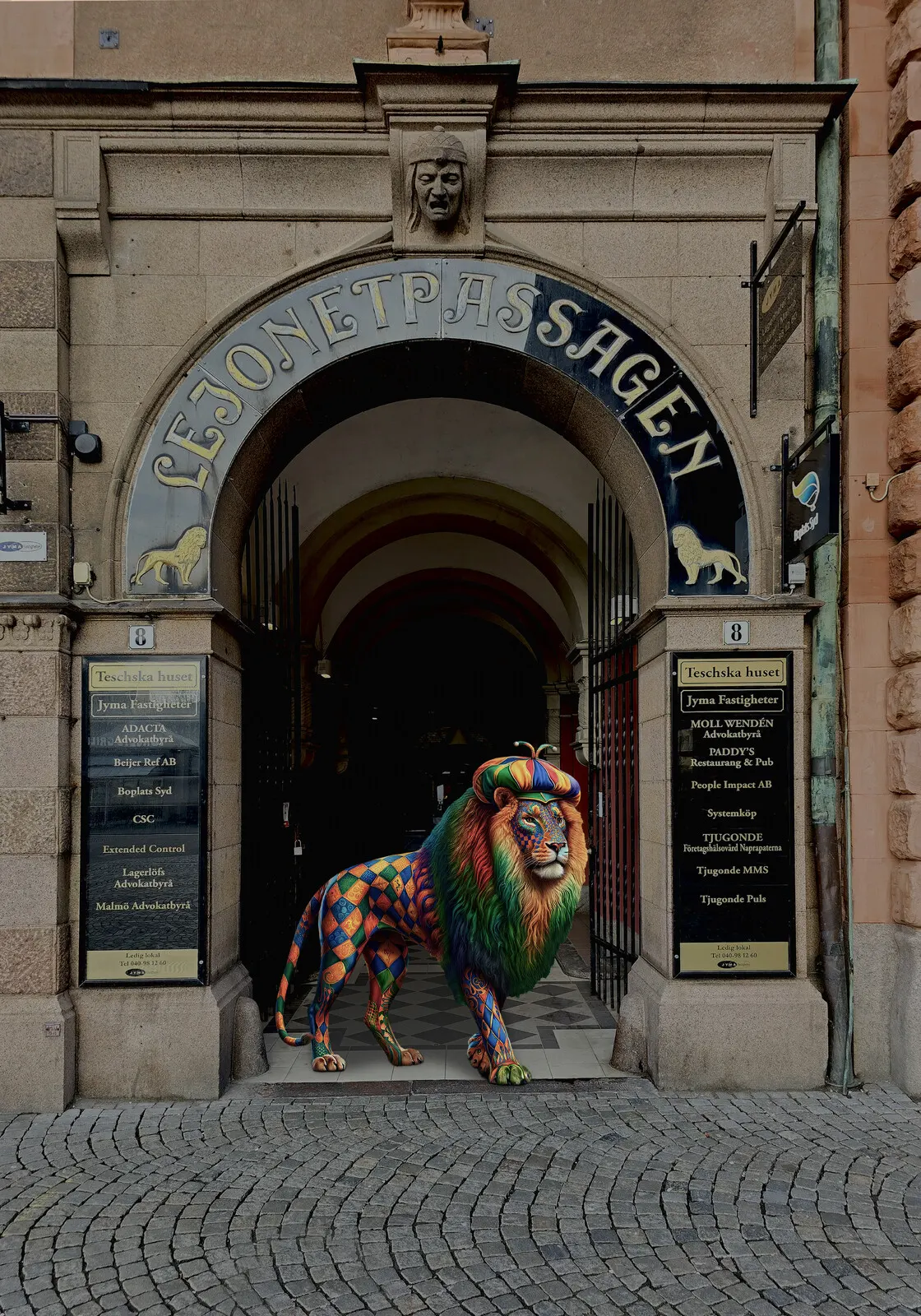
The Arcade Lion – Lejonet i Passagen, 2025
Digital
50 x 70 cm
3 200 kr
The Arcade Lion – Lejonet i Passagen
At first glance, it might seem like a joke — a lion dressed in a rainbow-hued harlequin suit, standing still and proud in a quiet Malmö arcade. Children laugh, adults glance up and smile, and most carry on walking. But the figure lingers. It demands more than a glance. Because this lion, though painted whimsically, carries centuries of meaning: royal emblems, sacred prophecies, colonial resistance, film mythology, and theatrical rebellion — all woven into a single, stylised presence beneath an archway. Its symbolic power is not to be underestimated, and its cultural significance is truly fascinating.
This is not merely street decoration. This is not just kitsch.
This is a lion — and a lion is never just a lion.
If you're intrigued by this story, I invite you to explore more of my published work by clicking the link.
https://www.konst.se/jorgen-thornberg
“The Lion’s Journey
It began with the sun on its mane,
on cracked earth where shadows dared not linger.
It ruled without crown,
feared by silence,
respected by thunder.
In Babylon, it stood with wings,
in Egypt, it guarded the gates of gods.
Its name etched in stone,
its breath carved into myth.
It wore iron on shields,
gold on banners,
roared behind the throne of kings.
It walked beside Daniel,
shook the scrolls of prophets,
and paced beneath cathedrals.
It crossed deserts with drums,
claimed a throne in Ethiopia —
not as beast but as bloodline,
not as roar but as right.
A lion that prayed,
a lion that rose in defiance
before the world looked away.
It sailed on ships of empire and exile,
its image repainted in rhythm and reggae,
roaring through speakers in Kingston and London,
rising with fists, with faith, with fire.
It became story.
It became a symbol.
It became a logo.
And then,
beneath a Nordic sky,
it slipped out of its skin once more.
Stepped through the archway,
dipped its mane in every colour it found,
put on the mask of Harlequin,
and stood —
still, and smiling —
among cafés, offices, and bike racks.
No longer king,
not quite clown,
but something in between.
A lion that chose its own costume.
A lion that knows the joke —
and roars anyway.”
Malmö July 2025
The Arcade Lion
In the heart of Malmö – amidst shadows cast by arches and office signs – stands a lion dressed in full regalia. Wearing a harlequin costume with a rainbow-coloured mane, it gazes out with an expression that combines playfulness with ancient gravity. This attire, the harlequin costume, is not just a random choice. It is a symbol of the lion's multifaceted nature, representing its playful yet powerful character. It is an homage, a pastiche, a cry from art history – yet it remains a lion. And a lion is never merely an animal. More about the harlequin costume later – for there’s a reason it wears that specific attire, a reason that will surely pique your curiosity.
The lion, perched at the apex of the food chain, is a symbol of unparalleled strength, power, and dominance. Its title as the “King of the Forest” is a testament to its regal status, even though it primarily roams the savannah. However, metaphors take on a life of their own. Society craves a king, and kings demand an emblem. Hence, the lion became a symbol of crowns, both in reality and in imagination, evoking a sense of awe and majesty.
In almost every civilisation where lions have lived – or where stories of them have been told – they have held a special significance. In Mesopotamia and Egypt, lions were often depicted as guardians, frequently with human heads, such as the iconic Sphinx. In ancient Greece, Heracles defeats the formidable Nemean lion, whose hide he then wears as a cloak, not only as protection but as a symbol of triumph over the wild.
The Lion on the Throne of Ethiopia
Nowhere has the lion been more revered than in Ethiopia. There, it does not merely bear the king’s emblem – it embodies the king. The symbol of the Ethiopian monarchy is the Lion of Judah, a title connecting the emperor to a biblical and messianic tradition. According to Ethiopian legend, recorded in the sacred text Kebra Nagast, the imperial lineage traces back to the meeting between King Solomon in Jerusalem and the Queen of Sheba, Makeda, whose son, Menelik I, is said to have founded the Solomonic dynasty around 1000 BCE. Tradition holds that Menelik brought the Ark of the Covenant from Solomon’s Temple to Axum, where it is believed to reside still, guarded by priests and lions.
The rulers of this dynasty governed not only through politics but also as descendants of one of the Bible’s most legendary lineages, thereby granting them a sense of divine authority. Their attire was not just a crown – it was a cosmic calling. The Lion of Judah symbolised this divine legitimacy: a lion that ruled not through fear but through holiness, inheritance, and prophetic right. The lion's attire, in this context, symbolised the divine authority and the cosmic calling of the rulers, evoking a sense of respect and reverence in those who beheld it.
During Haile Selassie’s reign (1930–1974), this symbolism gained international prominence. He carried the grand title: “King of Kings, Lord of Lords, Conquering Lion of the Tribe of Judah.” It held religious and political significance: the lion became a symbol of resistance against colonial powers, especially during Italy’s invasion of Ethiopia in 1935, when Mussolini’s fascists sought to dominate Africa’s last independent nation. Haile Selassie’s 1936 plea before the League of Nations, in which he requested aid and warned against ignoring aggression, transformed him into a global figure of resistance. The lion, as an image of resilience, dignity, and defiance, inspired a sense of empowerment and hope in the face of adversity.
The Lion of Judah later found a second, unexpected life far from Africa – in Jamaica. In the Rastafari movement, which emerged in the 1930s from a mixture of Pan-African thought, biblical interpretation, and anti-colonial critique, Haile Selassie became a messianic figure. When crowned in 1930, many Jamaicans believed it was a fulfilment of prophecy. The lion became their sacred emblem. In reggae records, flags, murals, and posters, the lion appears in red, gold, and green: a symbol of spiritual strength, African revival, and resistance to Western imperialism, inspiring a sense of empowerment and hope.
What matters is that it is specifically a lion. Not a dove, not a lamb, not an eagle. The lion shows its teeth when necessary. It stands for dignity, but also strength; for justice, but also wrath. The lion does not dwell in submission but in controlled power. It knows it is watched – and therefore it carries its gaze with pride.
The Lion in the Arcade
On the throne of Ethiopia sat not merely a man, but a symbol—a living echo of ancient ideas of kingship, where power is intertwined with myth, where the ruler is both lion and human, both flesh and story. And when we now see the lion painted in rainbow colours in a European arcade, perhaps we are reminded of that very tension: between the lion we wish to tame, and the lion that will never be tamed.
The Lion in Religion, Heraldry, and Literature
In the Bible, the lion is both terrifying and sacred. The prophet Daniel is thrown into the lions’ den, only to be miraculously saved by God—a story of faith and divine protection. In the Book of Revelation, we encounter the “Lion of the tribe of Judah,” a messianic figure that connects Jesus to power and righteousness. In Christian symbolism, the lion represents both Christ and Satan – holiness and danger – and thus carries deep symbolic significance. The lion's portrayal in literature, particularly in the Bible, further underscores its complex symbolism, representing both danger and divine protection.
When heraldry thrived in medieval Europe, the lion was the most prominent symbol on coats of arms. Rampant lions, lions mid-leap, crowned lions, lions crowning other crowns – they appear everywhere as symbols of kingship, courage, and glory. Sweden has its “three crowns,” but also “the golden lion on a blue field” in several provincial arms.
In literature, the lion's symbolism assumes various roles. In C.S. Lewis’s ‘Chronicles of Narnia’, the lion Aslan functions as a Christ-figure – mighty, sacrificial, and just. In Rudyard Kipling’s tales, the lion is not the protagonist but remains a moral reference, the animal by which others are measured. And in Antoine de Saint-Exupéry’s ‘The Little Prince’, the lion’s absence is felt as the child seeks to understand power rather than wield it. The lion's absence here serves as a powerful symbol of the child's journey towards understanding and maturity. These literary interpretations of the lion's symbolism enrich its cultural significance.
The Lion on Screen
The world of film has cemented the lion’s position in popular culture. From the roaring Metro-Goldwyn-Mayer lion that opens every classic Hollywood film to ‘The Lion King’, where young Simba must embrace his destiny, the lion embodies our projections. In The Lion King, the lion is not just a paternal figure, but also a symbol of freedom, tradition, and rebellion. Simba's journey from a carefree cub to a responsible king mirrors the lion's role in our cultural narratives. The lion is the one who perches on the cliff and surveys the world, but also the one who must go into exile and return to restore harmony.
Imagine the lion, a majestic creature of the savannah, now stepping into The Lion Arcade, adorned in a harlequin costume. It's as if the lion, weary of its regal duties, has chosen to join the circus, to immerse itself in the vibrant world of theatre and dreams. This lion, a paradox of strength and whimsy, is both a work of art and a bold statement: power doesn't always conform to our expectations.
When we pass beneath the arch – perhaps on our way to a law office, a restaurant, or a pub quiz – the lion gazes at us with colours that challenge all heraldic norms. It reminds us of something older than the corporate signs above the entrance: that power can be displayed playfully, that kingship can be self-ironic, and that the lion, no matter how many colours it wears, still bears its history within.
And we? We carry on. But don’t forget the Arcade Lion, for its spirit lives within us, perhaps because power and identity are never fixed but always shifting, constantly being renegotiated. Harlequin has many faces, many colours – and maybe the lion now wears them to show that strength can be multicoloured, that authority can be playful, and that even the most tradition-bound can open themselves to new meaning. The lion bears its history – but also the future – in its mask. It stands as a reminder that no one – and no beast – needs to choose only one colour, only one role. That we all move between seriousness and play, between myth and reality, between what we are expected to be and what we can become. And finally, why is the lion dressed as Harlequin?
Harlequin was a key figure in classical Commedia dell’arte – mainly a comic role, not “free” in the sense of escaping his role or context. Yet, his multicoloured costume conveys the same kind of spiritual freedom as the rainbow flag, with its six colours each carrying symbolic meaning: red for life, orange for healing, yellow for sunlight, green for nature, blue for art, and violet for spirit. The Pride flag is the most recognised LGBTQIA+ symbol, but in reality, it can represent the right of all to exist, each in their role, each in their colour. The lion, dressed as Harlequin, embodies this idea of freedom and individuality, showing that strength can be multicoloured, that authority can be playful, and that even the most tradition-bound can open themselves to new meaning.
Jörgen Thornberg
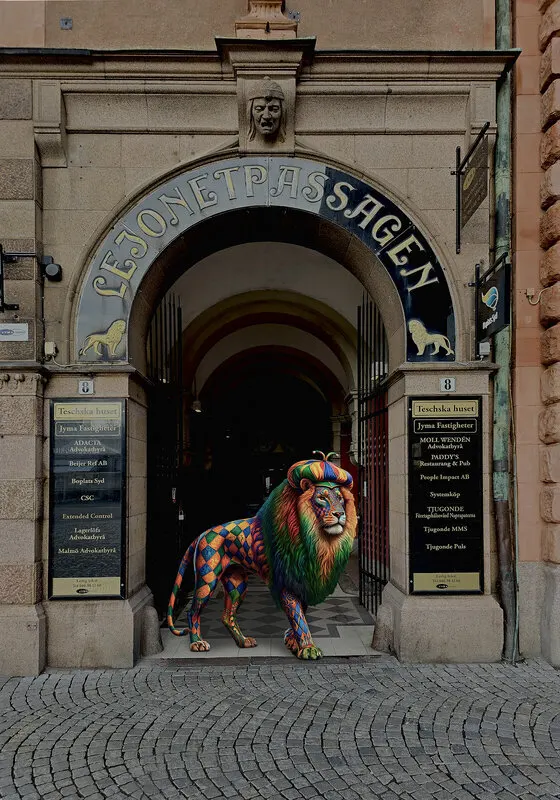
The Arcade Lion – Lejonet i Passagen, 2025
Digital
50 x 70 cm
3 200 kr
The Arcade Lion – Lejonet i Passagen
At first glance, it might seem like a joke — a lion dressed in a rainbow-hued harlequin suit, standing still and proud in a quiet Malmö arcade. Children laugh, adults glance up and smile, and most carry on walking. But the figure lingers. It demands more than a glance. Because this lion, though painted whimsically, carries centuries of meaning: royal emblems, sacred prophecies, colonial resistance, film mythology, and theatrical rebellion — all woven into a single, stylised presence beneath an archway. Its symbolic power is not to be underestimated, and its cultural significance is truly fascinating.
This is not merely street decoration. This is not just kitsch.
This is a lion — and a lion is never just a lion.
If you're intrigued by this story, I invite you to explore more of my published work by clicking the link.
https://www.konst.se/jorgen-thornberg
“The Lion’s Journey
It began with the sun on its mane,
on cracked earth where shadows dared not linger.
It ruled without crown,
feared by silence,
respected by thunder.
In Babylon, it stood with wings,
in Egypt, it guarded the gates of gods.
Its name etched in stone,
its breath carved into myth.
It wore iron on shields,
gold on banners,
roared behind the throne of kings.
It walked beside Daniel,
shook the scrolls of prophets,
and paced beneath cathedrals.
It crossed deserts with drums,
claimed a throne in Ethiopia —
not as beast but as bloodline,
not as roar but as right.
A lion that prayed,
a lion that rose in defiance
before the world looked away.
It sailed on ships of empire and exile,
its image repainted in rhythm and reggae,
roaring through speakers in Kingston and London,
rising with fists, with faith, with fire.
It became story.
It became a symbol.
It became a logo.
And then,
beneath a Nordic sky,
it slipped out of its skin once more.
Stepped through the archway,
dipped its mane in every colour it found,
put on the mask of Harlequin,
and stood —
still, and smiling —
among cafés, offices, and bike racks.
No longer king,
not quite clown,
but something in between.
A lion that chose its own costume.
A lion that knows the joke —
and roars anyway.”
Malmö July 2025
The Arcade Lion
In the heart of Malmö – amidst shadows cast by arches and office signs – stands a lion dressed in full regalia. Wearing a harlequin costume with a rainbow-coloured mane, it gazes out with an expression that combines playfulness with ancient gravity. This attire, the harlequin costume, is not just a random choice. It is a symbol of the lion's multifaceted nature, representing its playful yet powerful character. It is an homage, a pastiche, a cry from art history – yet it remains a lion. And a lion is never merely an animal. More about the harlequin costume later – for there’s a reason it wears that specific attire, a reason that will surely pique your curiosity.
The lion, perched at the apex of the food chain, is a symbol of unparalleled strength, power, and dominance. Its title as the “King of the Forest” is a testament to its regal status, even though it primarily roams the savannah. However, metaphors take on a life of their own. Society craves a king, and kings demand an emblem. Hence, the lion became a symbol of crowns, both in reality and in imagination, evoking a sense of awe and majesty.
In almost every civilisation where lions have lived – or where stories of them have been told – they have held a special significance. In Mesopotamia and Egypt, lions were often depicted as guardians, frequently with human heads, such as the iconic Sphinx. In ancient Greece, Heracles defeats the formidable Nemean lion, whose hide he then wears as a cloak, not only as protection but as a symbol of triumph over the wild.
The Lion on the Throne of Ethiopia
Nowhere has the lion been more revered than in Ethiopia. There, it does not merely bear the king’s emblem – it embodies the king. The symbol of the Ethiopian monarchy is the Lion of Judah, a title connecting the emperor to a biblical and messianic tradition. According to Ethiopian legend, recorded in the sacred text Kebra Nagast, the imperial lineage traces back to the meeting between King Solomon in Jerusalem and the Queen of Sheba, Makeda, whose son, Menelik I, is said to have founded the Solomonic dynasty around 1000 BCE. Tradition holds that Menelik brought the Ark of the Covenant from Solomon’s Temple to Axum, where it is believed to reside still, guarded by priests and lions.
The rulers of this dynasty governed not only through politics but also as descendants of one of the Bible’s most legendary lineages, thereby granting them a sense of divine authority. Their attire was not just a crown – it was a cosmic calling. The Lion of Judah symbolised this divine legitimacy: a lion that ruled not through fear but through holiness, inheritance, and prophetic right. The lion's attire, in this context, symbolised the divine authority and the cosmic calling of the rulers, evoking a sense of respect and reverence in those who beheld it.
During Haile Selassie’s reign (1930–1974), this symbolism gained international prominence. He carried the grand title: “King of Kings, Lord of Lords, Conquering Lion of the Tribe of Judah.” It held religious and political significance: the lion became a symbol of resistance against colonial powers, especially during Italy’s invasion of Ethiopia in 1935, when Mussolini’s fascists sought to dominate Africa’s last independent nation. Haile Selassie’s 1936 plea before the League of Nations, in which he requested aid and warned against ignoring aggression, transformed him into a global figure of resistance. The lion, as an image of resilience, dignity, and defiance, inspired a sense of empowerment and hope in the face of adversity.
The Lion of Judah later found a second, unexpected life far from Africa – in Jamaica. In the Rastafari movement, which emerged in the 1930s from a mixture of Pan-African thought, biblical interpretation, and anti-colonial critique, Haile Selassie became a messianic figure. When crowned in 1930, many Jamaicans believed it was a fulfilment of prophecy. The lion became their sacred emblem. In reggae records, flags, murals, and posters, the lion appears in red, gold, and green: a symbol of spiritual strength, African revival, and resistance to Western imperialism, inspiring a sense of empowerment and hope.
What matters is that it is specifically a lion. Not a dove, not a lamb, not an eagle. The lion shows its teeth when necessary. It stands for dignity, but also strength; for justice, but also wrath. The lion does not dwell in submission but in controlled power. It knows it is watched – and therefore it carries its gaze with pride.
The Lion in the Arcade
On the throne of Ethiopia sat not merely a man, but a symbol—a living echo of ancient ideas of kingship, where power is intertwined with myth, where the ruler is both lion and human, both flesh and story. And when we now see the lion painted in rainbow colours in a European arcade, perhaps we are reminded of that very tension: between the lion we wish to tame, and the lion that will never be tamed.
The Lion in Religion, Heraldry, and Literature
In the Bible, the lion is both terrifying and sacred. The prophet Daniel is thrown into the lions’ den, only to be miraculously saved by God—a story of faith and divine protection. In the Book of Revelation, we encounter the “Lion of the tribe of Judah,” a messianic figure that connects Jesus to power and righteousness. In Christian symbolism, the lion represents both Christ and Satan – holiness and danger – and thus carries deep symbolic significance. The lion's portrayal in literature, particularly in the Bible, further underscores its complex symbolism, representing both danger and divine protection.
When heraldry thrived in medieval Europe, the lion was the most prominent symbol on coats of arms. Rampant lions, lions mid-leap, crowned lions, lions crowning other crowns – they appear everywhere as symbols of kingship, courage, and glory. Sweden has its “three crowns,” but also “the golden lion on a blue field” in several provincial arms.
In literature, the lion's symbolism assumes various roles. In C.S. Lewis’s ‘Chronicles of Narnia’, the lion Aslan functions as a Christ-figure – mighty, sacrificial, and just. In Rudyard Kipling’s tales, the lion is not the protagonist but remains a moral reference, the animal by which others are measured. And in Antoine de Saint-Exupéry’s ‘The Little Prince’, the lion’s absence is felt as the child seeks to understand power rather than wield it. The lion's absence here serves as a powerful symbol of the child's journey towards understanding and maturity. These literary interpretations of the lion's symbolism enrich its cultural significance.
The Lion on Screen
The world of film has cemented the lion’s position in popular culture. From the roaring Metro-Goldwyn-Mayer lion that opens every classic Hollywood film to ‘The Lion King’, where young Simba must embrace his destiny, the lion embodies our projections. In The Lion King, the lion is not just a paternal figure, but also a symbol of freedom, tradition, and rebellion. Simba's journey from a carefree cub to a responsible king mirrors the lion's role in our cultural narratives. The lion is the one who perches on the cliff and surveys the world, but also the one who must go into exile and return to restore harmony.
Imagine the lion, a majestic creature of the savannah, now stepping into The Lion Arcade, adorned in a harlequin costume. It's as if the lion, weary of its regal duties, has chosen to join the circus, to immerse itself in the vibrant world of theatre and dreams. This lion, a paradox of strength and whimsy, is both a work of art and a bold statement: power doesn't always conform to our expectations.
When we pass beneath the arch – perhaps on our way to a law office, a restaurant, or a pub quiz – the lion gazes at us with colours that challenge all heraldic norms. It reminds us of something older than the corporate signs above the entrance: that power can be displayed playfully, that kingship can be self-ironic, and that the lion, no matter how many colours it wears, still bears its history within.
And we? We carry on. But don’t forget the Arcade Lion, for its spirit lives within us, perhaps because power and identity are never fixed but always shifting, constantly being renegotiated. Harlequin has many faces, many colours – and maybe the lion now wears them to show that strength can be multicoloured, that authority can be playful, and that even the most tradition-bound can open themselves to new meaning. The lion bears its history – but also the future – in its mask. It stands as a reminder that no one – and no beast – needs to choose only one colour, only one role. That we all move between seriousness and play, between myth and reality, between what we are expected to be and what we can become. And finally, why is the lion dressed as Harlequin?
Harlequin was a key figure in classical Commedia dell’arte – mainly a comic role, not “free” in the sense of escaping his role or context. Yet, his multicoloured costume conveys the same kind of spiritual freedom as the rainbow flag, with its six colours each carrying symbolic meaning: red for life, orange for healing, yellow for sunlight, green for nature, blue for art, and violet for spirit. The Pride flag is the most recognised LGBTQIA+ symbol, but in reality, it can represent the right of all to exist, each in their role, each in their colour. The lion, dressed as Harlequin, embodies this idea of freedom and individuality, showing that strength can be multicoloured, that authority can be playful, and that even the most tradition-bound can open themselves to new meaning.
3 200 kr

Jörgen Thornberg
Malmö
Lite om bilder och mig. Translation in English at the end.
Jag är en nyfiken person som ser allt i bilder, även det jag fäster i ord, gärna tillsammans för bakom alla mina bilder finns en berättelse. Till vissa bilder hör en kortare eller längre novell som följer med bilden.
Bilder berättar historier. Jag omges av naturlig skönhet, intressanta människor och historia var jag än går. Jag använder min kamera för att dokumentera världen och blanda det jag ser med vad jag känner för att fånga den dolda magin.
Mina bilder berättar mina historier. Genom mina bilder, tryck och berättelser. Jag bjuder in dig att ta del av dessa berättelser, in i ditt liv och hem och dela min mycket personliga syn på vår värld. Mer än vad ögat ser. Jag tänker i bilder, drömmer och skriver och pratar om dem; följaktligen måste jag också skapa bilder. De blir vad jag ser, inte nödvändigtvis begränsade till verkligheten. Det finns en bild runt varje hörn. Jag hoppas att du kommer att se vad jag såg och gilla det.
Jag är också en skrivande person och till många bilder hör en kortare eller längre essay. Den följer med tavlan, tryckt på fint papper och med en personlig hälsning från mig.
Flertalet bilder startar sin resa i min kamera. Enkelt förklarat beskriver jag bilden jag ser i mitt inre, upplevd eller fantiserad. Bilden uppstår inom mig redan innan jag fått okularet till ögat. På bråkdelen av ett ögonblick ser jag vad jag vill ha och vad som kan göras med bilden. Här skall jag stoppa in en giraff, stålmannen, Titanic eller vad det är min fantasi finner ut. Ännu märkligare är att jag kommer ihåg minnesbilden långt efteråt när det blir tid att skapa verket. Om jag lyckas eller inte, är upp till betraktaren, oftast präglat av en stråk av svart humor – meningen är att man skall bli underhållen. Mina bilder blir ofta en snackis där de hänger.
Jag föredrar bilder som förmedlar ett budskap i flera lager. Vid första anblicken fylld av feel-good, en vacker utsikt, fint väder, solen skiner, blommor på ängen eller vattnet som ligger förrädiskt spegelblankt. I en sådan bild kan jag gömma min egentliga berättelse, mitt förakt för förtryckare och våldsverkare, rasister och fördomsfulla människor - ett gärna återkommande motiv mer eller mindre dolt i det vackra motivet. Jag försöker förena dem i ett gemensamt narrativ.
Bild och formgivning har löpt som en röd tråd genom livet. Fotokonst känns som en värdig final som jag gärna delar med mig.
Min genre är vid som framgår av mina bilder, temat en blandning av pop- och gatukonst i kollage som kan bestå av hundratals lager. Vissa bilder kan ta veckor, andra någon dag innan det är dags att överlämna resultatet till printverkstaden. Fine Art Prints är digitala fotocollage. I dessa kollage sker rivandet, klippandet, pusslandet, målandet, ritandet och sprayningen digitalt. Det jag monterar in kan vara hundratals år gamla bilder som jag omsorgsfullt frilägger så att de ser ut att vara en del av tavlan men också bilder skapade av mig själv efter min egen fantasi. Därefter besöks printstudion och för vissa bilder numrera en limiterad upplaga (oftast 7 exemplar) och signera för hand. Vissa bilder kan köpas i olika format. Det är bara att fråga efter vilka. Gillar man en bild som är 70x100 men inte har plats på väggen, går den kanske att få i 50x70 cm istället. Frågan är fri.
Metoden Giclée eller Fine Art Print som det också kallas är det moderna sättet för framställning av grafisk konst. Villkoret för denna typ av utskrifter är att en högkvalitativ storformatskrivare används med åldersbeständigt färgpigment och konstnärspapper eller i förekommande fall på duk. Pappret som används möter de krav på livslängd som ställs av museer och gallerier. Normalt säljer jag mina bilder oinramade så att den nya ägaren själv kan bestämma hur de skall se ut, med eller utan passepartout färg på ram, med eller utan glas etc..
Under många år ställde jag bara ut på nätet, i valda grupper och på min egen Facebooksida - https://www.facebook.com/jorgen.thornberg.9
Jag finns också på en egen hemsida som tyvärr inte alltid är uppdaterad – https://www.jth.life/ Där kan du också läsa en del av de berättelser som följer med bilden.
UTSTÄLLNINGAR
Luftkastellet, oktober 2022
Konst i Lund, november 2022
Luftkastellet, mars 2023
Engleson Galleri Caroli, april 2023
Hydra, Greece June 2023
Engleson Galleri Caroli, oktober 2023
Toppen, Höllviken december 2023
Luftkastellet, mars 2024
Torups Galleri, mars 2024
Venice, May 2024
Luftkastellet, oktober 2024
Konst i Advent, December 2024
Galleri Engleson, Caroli December 2024
Jäger & Jansson Galleri, april 2025
A bit about pictures and me.
I'm a curious person who sees everything in pictures, even what I express in words, often combining them, for behind all my pictures lies a story. These narratives, some as short as a single image and others as long as a novel, are the heart and soul of my work.
Pictures tell stories. Wherever I go, I'm surrounded by natural beauty, exciting people, and history. I use my camera to document the world and blend what I see with what I feel to capture the hidden magic.
My images tell my stories. Through my pictures, prints, and narratives, I invite you to partake in these stories in your life and home and share my deeply personal perspective of our world. More than meets the eye. I think in pictures, dream, write, and talk about them; consequently, I must create images too. They become what I see, not necessarily confined to reality. There's a picture around every corner. I hope you'll see what I saw and enjoy it.
I'm also a writer, and many images come with a shorter or longer essay. It accompanies the painting, printed on fine paper with my personal greeting.
Many pictures start their journey on my camera. Simply put, I describe the image I see in my mind, experienced or imagined. The image arises within me even before I bring the eyepiece to my eye. In a fraction of a moment, I see what I want and what can be done with the picture. Here, I'll insert a giraffe, Superman, the Titanic, or whatever my imagination conjures up. Even stranger is that I remember the mental image long after it's time to create the work. Whether I succeed is up to the observer, often imbued with a streak of black humour – the aim is to entertain. My pictures usually become a talking point wherever they hang.
I prefer pictures that convey a message in multiple layers. At first glance, they're filled with feel-good vibes, a beautiful view, lovely weather, the sun shining, flowers in the meadow, or the water lying deceptively calm. But beneath this surface beauty, I often conceal a deeper story, a narrative that challenges societal norms or explores the human condition. I invite you to delve into these hidden narratives and discover the layers of meaning within my work.
Picture and design have been a thread running through my life. Photographic art feels like a fitting finale, and I'm happy to share it.
My genre is varied, as seen in my pictures; the theme is a blend of pop and street art in collages that can consist of hundreds of layers. Some images can take weeks, others just a day before it's time to hand over the result to the print workshop. Fine Art Prints are digital photo collages. In these collages, tearing, cutting, puzzling, painting, drawing, and spraying happen digitally. What I insert can be images hundreds of years old that I carefully extract so they appear to be part of the painting, but also images created by myself, now also generated from my imagination. Next, visit the print studio and, for certain images, number a limited edition (usually 7 copies) and sign them by hand. Some images may be available in other formats. Just ask which ones. If you like an image that's 70x100 but doesn't have space on the wall, you might be able to get it in 50x70 cm instead. The question is open.
The Giclée method, or Fine Art Print as it's also called, is the modern way of producing graphic art. This method ensures the highest quality and longevity of the artwork, using a high-quality large-format printer with archival pigment inks and artist paper or, in some cases, canvas. The paper used meets the longevity requirements set by museums and galleries. I sell my pictures unframed, allowing the new owner to personalise their artwork, confident in the lasting value and quality of the piece.
For many years, I only exhibited online, in selected groups, and on my Facebook page - https://www.facebook.com/jorgen.thornberg.9. I also have my website, which unfortunately is not constantly updated - https://www.jth.life/. You can also read some of the stories accompanying the pictures there.
EXHIBITIONS
Luftkastellet, October 2022
Art in Lund, November 2022
Luftkastellet, March 2023
Engleson Gallery Caroli, April 2023
Hydra, Greece June 2023
Engleson Gallery Caroli, October 2023
Toppen, Höllviken December 2023
Luftkastellet, March 2024
Torup Gallery, March 2024
Venice, May 2024
UTSTÄLLNINGAR
Luftkastellet, oktober 2022
Konst i Lund, november 2022
Luftkastellet, mars 2023
Engleson Galleri Caroli, april 2023
Hydra, Greece June 2023
Engleson Galleri Caroli, oktober 2023
Toppen, Höllviken december 2023
Luftkastellet, mars 2024
Torups Galleri, mars 2024
Venice, May 2024
Luftkastellet, October 2024
Konst i Advent, December 2024
Galleri Engleson, Caroli December 2024
Jäger & Jansson Galleri, April 2025
Utbildning
Autodidakt
Medlem i konstnärsförening
Öppna Sinnen
Med i konstrunda
Konstrundan i Skåne
Utställningar
Luftkastellet, October 2022
Art in Lund, November 2022
Luftkastellet, March 2023
Engleson Gallery Caroli, April 2023
Hydra, Greece June 2023
Engleson Gallery Caroli, October 2023
Toppen, Höllviken December 2023
Luftkastellet, March 2024
Torup Gallery, March 2024
Venice, May 2024