Vi använder cookies för att ge dig bästa möjliga upplevelse. Välj vilka cookies du tillåter.
Läs mer i vår integritetspolicy
Jörgen Thornberg
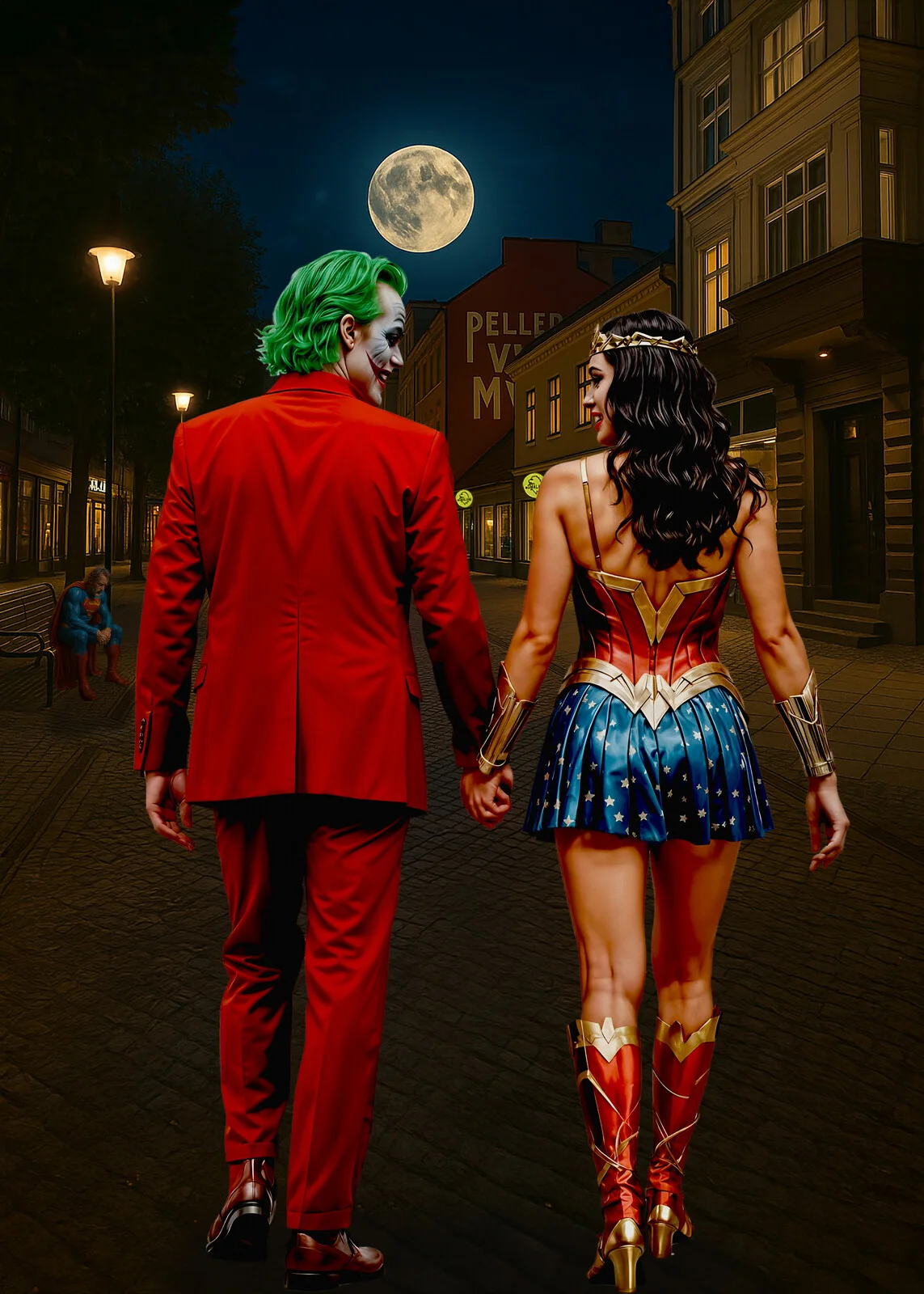
Fate Deals Uneven Hands - Olika falla livets lotter, 2025
Digital
50 x 70 cm
3 200 kr
Fate Deals Uneven Hands
He used to fly. Now he simply sits.
Once, he was the symbol of hope, truth, justice, and a better tomorrow. Today, he's slumped on a bench in Malmö, ignored by passersby, rusting from the inside out. The man of steel has become a man of silence. His cape no longer flutters; it hangs heavy like memories. The world has changed, and with it, our ideals. The rise of cynicism, the loss of innocence, and the erosion of trust have all contributed to this transformation.
Meanwhile, the world continues its journey. Wonder Woman hones her blade. The Joker sharpens his wit. Children, once inspired to reach for the sky, now aspire to wear the mask.
This is not the age of Superman.
This is the age after the reign of Superman, an era where our aspirations have shifted, our heroes have changed, and our society has evolved. It's a time of uncertainty, where the symbols of hope and justice that once guided us have lost their lustre.
“A Cape Forgotten
He used to lift cities,
now he lifts his gaze—
slowly—
to watch pigeons claim the sky
he once called home.
His chest, once proud
with an emblem that meant forever,
now sinks beneath
layers of yesterday’s news
and rain-soaked cloth.
No one asks for autographs.
No one brings him lunch.
Children pass by
wearing capes of chaos,
laughing not at evil—
but at him.
Truth left with the headlines.
Justice took early retirement.
A better tomorrow?
That bus doesn’t stop here anymore.
He sits,
not with dignity,
but with the ache of rusting knees
and a mind replaying
fires he could have stopped
if anyone had asked.
And still,
when the moonlight
hits the bench just right,
you might—just might—
see the flicker
of a man
who once
flew.”
Malmö July 2025
Fate deals uneven hands.
The phrase reflects that life is distributed unfairly, with fate being unpredictable - some are born into wealth and happiness, while others face suffering and sorrow. This randomness is not necessarily deserved but simply “how it falls,” like a random harvest. Similar to its Swedish equivalent ‘Olika falla livets lotter’ (Life's lots fall differently), it is a biblically influenced, poetic, and old-fashioned expression, solemn and emphasising the sense of fate-driven injustice. However, it is rare in modern English. The more common phrase in English is the straightforward and pragmatic “Such is life,” which acknowledges life’s unfairness but lacks the poetic and ominous tone.
The clown king of our times
Meanwhile, something unexpected has happened. His opposite – the anarchistic, narcissistic, unpredictable Joker – has stepped out of the shadows and begun to capture people’s hearts. Not just as a movie icon or Halloween mask, but as a symbol. As... an alternative. It is, of course, frightening, but also logical. Because it is no longer virtue that wins elections, but power and influence, it is not humility, responsibility, and balance that are rewarded. It is laughter, contempt, twisted grins. It is men like Trump. Like Putin. Men who play the role of the Joker with such conviction that the world now applauds when they topple the chessboard rather than play the game. The rise of the Joker, a symbol of chaos and unpredictability, has now taken a prominent place in people’s hearts, marking a significant shift in societal attitudes. This rise of the Joker highlights societal change and challenges to traditional notions of good and evil.
Revolution and Chaos
And Wonder Woman? What is she doing there, beside the Joker? It might seem like a strange alliance: the Amazon queen and the chaotic clown. But think: she is revolutionary. She is not here to keep the world as it is. She aims to dismantle patriarchy, disrupt the order, and topple power. And what is the Joker, if not an expert at overthrowing everything? Superman’s liberal world has failed. That dream of justice for all, of “being good” enough – it is broken. The climate is collapsing. Democracies are weakening. Right becomes wrong. Wrong becomes president. So perhaps what we are witnessing isn’t a love story. Maybe it’s a pact. A temporary alliance between revolution and chaos. Between rage and mockery. And Superman? He’s left to sit — he, who never said anything inappropriate. Never struck below the belt. Never mocked the weak. He believed goodness was enough. This alliance between Wonder Woman and the Joker reflects a theme of societal change, where traditional ideas of good and evil are being challenged and redefined.
Judging eyes and painted mirrors
What makes Wonder Woman dangerous is not her strength; it's her vulnerability. Not the lasso, not the sword, not her immortality. It’s that she sees through everything. She wasn’t born into a world where power hides in financial systems and legal codes, but in the mythic landscape where power is exposed: the whims of gods, the blood of warriors, the crucible of motherhood. She has a profound understanding of what power is, and she knows it’s never given up freely. That’s why she never quite fit into the liberal project. She tolerated it. Flirted with it. But she never truly believed in it. Not completely. Superman’s compromises, his constant attempts to balance goodness with the status quo – that was never her path. When he saved cities, she sought to transform societies. When he avoided politics, she stepped right into it. But now… maybe she’s tired. Perhaps she has realised that change doesn’t happen through proposals and panel debates. Maybe she’s given up on ideals and turned to someone who can shatter them instead.
Because the Joker has never upheld ideals, he is a mirror, a painted mask reflecting the whispers of the times. He laughs when we strike downward. He points out when we dehumanise. He applauds every tweet that scorns weakness. He embodies the shape of our age – our clown king, our ringmaster, our demon. His character has evolved with the times: in the 1950s comics, he was a giggling prankster, dangerous yet harmless; in Nolan’s films, he was a nihilist with a penchant for petrol and a persuasion problem; in ‘Joker’ (2019), he became a martyr for the embittered and lost, an angel of vengeance. And now? Now he is a power model. For how to command the room by destroying it. For how to win by turning everything into a joke. How to evade responsibility by feigning madness, or being mad.
Children Change Their Heroes
So perhaps it’s not so strange that he walks hand in hand with Wonder Woman. Maybe she doesn’t see him as a partner, but rather as a means to an end. Maybe she thinks: if the world is going to burn anyway, let me at least direct the flames. And maybe he thinks: she believes she can use me. But I’m the one writing the script.
Children once wanted to be like Superman. Strong, good, invulnerable. They ran across schoolyards with red towel capes, lifted invisible buses over their heads, and fought for what was right—even if they didn’t quite know what that was. His morality was easily manipulated. He never said the wrong thing. He never did the wrong thing. He was a safe adult world wrapped in tights. But now? When children draw heroes, the cape is often gone. Or burning and or fluttering behind someone who doesn’t smile. They might still play Wonder Woman, but she has her sword drawn and her eyes shaded. They often choose The Joker—not because they understand him, but because the world around them does. The joke has become serious. Laughter is the weapon. The mask is more real than the face. This shift from Superman to The Joker is not just a personal choice but a reflection of the changing societal values that shape our heroes.
Superman disappeared quietly. Not with a gunshot or a cross—but with silence. He was no longer on lunchboxes. His S became generic. His message, “truth, justice and a better tomorrow,” suddenly felt empty in a time when the future was burning. For what is goodness in a world where truth is subjective and justice a meme? What is a steel-capped man flying around fixing skyscrapers when children see their schools getting state budget cuts and their world boiling? They no longer see heroism in following rules. They see heroism in refusing. In laughing. In blowing the door open. So now Superman sits. Once an icon, now an echo. And perhaps it is the children who left him there, not with hatred, not with mockery, but simply with forgetfulness. They’ve already moved on. To Wonder Woman with wrath in her step. To The Joker with laughter that shatters language. This transformation of heroism from the traditional to the chaotic is not just a change, but a fascinating evolution.
The Moon’s Judgment
The moon sees everything. And high above everything–above treetops, streetlights and lost illusions-the moon hangs. Silent. Unmoved. Awake. She has seen this before. She saw when Hercules fell, when Achilles trembled, when Gilgamesh wept for his friend. When Roman emperors dressed their slaves in gold. When knights died for names they’d forgotten. When Lenin was carried as an icon, Superman was taken as a lunchbox. She saw when Wonder Woman rose from the sea, holding her truth as a weapon. And she saw when The Joker stepped out from the side street and laughed so the world stopped, not in joy but in confusion. And she saw Superman when he was still flying. And now, when he sits.
The moon, a silent observer, does not judge. Her light falls equally on all, from the couple in the triumph of the masquerade to the man who once could lift mountains but now struggles to rise from the bench. She understands that roles change, masks get exchanged, and what was once sacred becomes a joke. She knows that nothing lasts forever, except perhaps one thing: humankind's eternal quest for a hero. And when it tires of the hero, it seeks a madman. Or a goddess. Or both at once. The moon shines over the old town, over fates, over masks and capes, laughter and silence. She sees everything, but she whispers nothing. She has seen a thousand lives fall in different lots, and she already knows how it ends. But she allows us to carry on, a silent testament to the equality and fairness in the hero's journey.
The Post-Cape Era
That Superman ended up as a homeless man on a bench in Malmö, a city known for its progressive values and social welfare system, is not just tragicomic – it is telling and full of symbolism. Malmö, a city that prides itself on its social safety nets and equality, is a stark reminder that even in the most progressive societies, there are still those who fall through the cracks. Superman, once a symbol of hope and justice, is now a rusting memorial to the ideals of another age. His body, made of steel, is now worn out. The joints creak from corrosion. The strength is fading. And perhaps the worst part of all, no one notices him anymore. Who looks at a homeless man?
It is not only his physique that has stagnated, but his ethos. The liberal, righteous, principle-driven heroism he once embodied has lost its footing in the present day. In a world where truth is increasingly subjective and self-realisation is celebrated over solidarity, Superman's unwavering commitment to truth and justice seems out of place. What is goodness when fewer and fewer believe in truth, and prefer the alternative? What is responsibility in a world that celebrates self-realisation over solidarity?
His opposite, The Joker – Batman’s constant adversary, the jester without conscience – seems instead to step into the spotlight. The mad, unpredictable, laughter-reflecting figure has become a cultural archetype for contemporary power. A sign of the times: we live in an era where the male ideal increasingly begins to resemble The Joker—impulsive, boundary-breaking, and laughing at collapse rather than fearing it.
Trump and Putin both bear The Joker’s mark. They come across as men without shame or empathy, yet with a flair for the game. They do not govern through respect—they govern through spectacle. Their power isn’t rooted in intellect or moral superiority, but in their ability to distort the truth and escape the consequences. They are the anti-heroes of the real world, and their success has made authoritarianism an appealing alternative again. The Joker's mark, a symbol of chaos and unpredictability, has become a cultural archetype for contemporary power. It signifies a shift in the perception of power, from traditional notions of respect and moral authority to a more theatrical and manipulative form of control.
That The Joker walks hand in hand with the revolutionary Wonder Woman may seem paradoxical. But perhaps it isn’t. Maybe their alliance signifies a new kind of partnership: between chaos and struggle, between cynicism and transformation. Wonder Woman, a symbol of justice and empowerment, seems an unlikely ally for The Joker, a figure of chaos and unpredictability. However, their partnership may symbolise a new approach to societal change, one that combines the revolutionary spirit of Wonder Woman with the disruptive force of The Joker. When Superman’s world—the Western liberal order—has proven inadequate, people seek something else. Anything. As long as it’s strong. As long as it’s new. Simple solutions to complex problems. Slightly outdated, yet pushed into the future. Let the grandchildren deal with it.
And thus, a new hero model emerges: the ruthless one. The one who asks for neither permission nor forgiveness. The one who crushes opposition rather than persuades it. We have seen this before. Fascism, Nazism, Communism—all arose from crises where order failed. And they were driven forward by grotesquely evil men with visions that cost hundreds of millions of lives: Hitler, Stalin, Mao. In their wake march thousands of pragmatists–technocrats, capitalists, bureaucrats-who turn a blind eye whilst profiting from organised evil, without wielding the sword themselves.
Our era has its equivalents. The Russian oligarchs, born from the fall of an empire, have forged a new aristocracy where loyalty is exchanged for luxury and privilege. In the West, we see their mirror images: Elon Musk, Jeff Bezos, and others in the technology, finance, and entertainment sectors. They do not stand on the barricades, but they control the algorithms. They do not need to preach ideology – they are the ideology, embodied in disruption, growth, and control.
Here we stand during this transition. The hero in the red cape and the S on his chest is no longer the story’s central figure. He is a ghost on a park bench. The world belongs to those who laugh at rules, burn the map, and draw a new one with black ink. It is the Joker’s era. And we are still at the very beginning.
Jörgen Thornberg
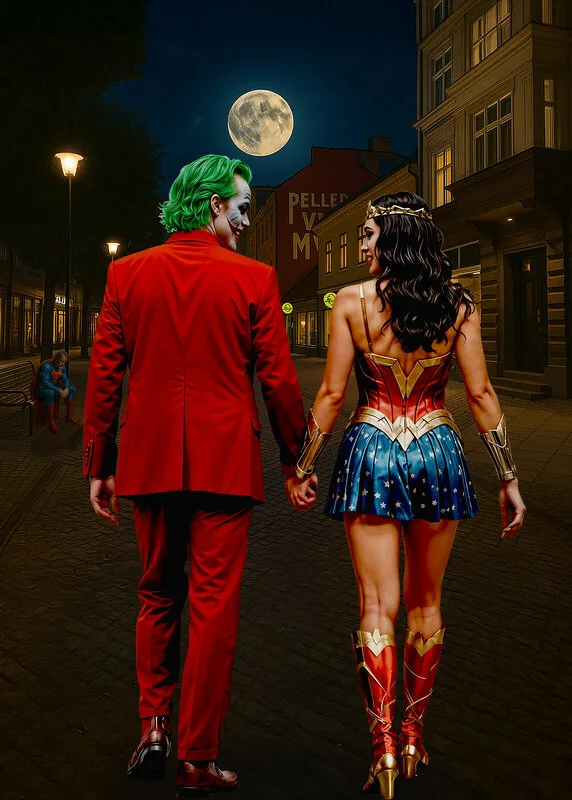
Fate Deals Uneven Hands - Olika falla livets lotter, 2025
Digital
50 x 70 cm
3 200 kr
Fate Deals Uneven Hands
He used to fly. Now he simply sits.
Once, he was the symbol of hope, truth, justice, and a better tomorrow. Today, he's slumped on a bench in Malmö, ignored by passersby, rusting from the inside out. The man of steel has become a man of silence. His cape no longer flutters; it hangs heavy like memories. The world has changed, and with it, our ideals. The rise of cynicism, the loss of innocence, and the erosion of trust have all contributed to this transformation.
Meanwhile, the world continues its journey. Wonder Woman hones her blade. The Joker sharpens his wit. Children, once inspired to reach for the sky, now aspire to wear the mask.
This is not the age of Superman.
This is the age after the reign of Superman, an era where our aspirations have shifted, our heroes have changed, and our society has evolved. It's a time of uncertainty, where the symbols of hope and justice that once guided us have lost their lustre.
“A Cape Forgotten
He used to lift cities,
now he lifts his gaze—
slowly—
to watch pigeons claim the sky
he once called home.
His chest, once proud
with an emblem that meant forever,
now sinks beneath
layers of yesterday’s news
and rain-soaked cloth.
No one asks for autographs.
No one brings him lunch.
Children pass by
wearing capes of chaos,
laughing not at evil—
but at him.
Truth left with the headlines.
Justice took early retirement.
A better tomorrow?
That bus doesn’t stop here anymore.
He sits,
not with dignity,
but with the ache of rusting knees
and a mind replaying
fires he could have stopped
if anyone had asked.
And still,
when the moonlight
hits the bench just right,
you might—just might—
see the flicker
of a man
who once
flew.”
Malmö July 2025
Fate deals uneven hands.
The phrase reflects that life is distributed unfairly, with fate being unpredictable - some are born into wealth and happiness, while others face suffering and sorrow. This randomness is not necessarily deserved but simply “how it falls,” like a random harvest. Similar to its Swedish equivalent ‘Olika falla livets lotter’ (Life's lots fall differently), it is a biblically influenced, poetic, and old-fashioned expression, solemn and emphasising the sense of fate-driven injustice. However, it is rare in modern English. The more common phrase in English is the straightforward and pragmatic “Such is life,” which acknowledges life’s unfairness but lacks the poetic and ominous tone.
The clown king of our times
Meanwhile, something unexpected has happened. His opposite – the anarchistic, narcissistic, unpredictable Joker – has stepped out of the shadows and begun to capture people’s hearts. Not just as a movie icon or Halloween mask, but as a symbol. As... an alternative. It is, of course, frightening, but also logical. Because it is no longer virtue that wins elections, but power and influence, it is not humility, responsibility, and balance that are rewarded. It is laughter, contempt, twisted grins. It is men like Trump. Like Putin. Men who play the role of the Joker with such conviction that the world now applauds when they topple the chessboard rather than play the game. The rise of the Joker, a symbol of chaos and unpredictability, has now taken a prominent place in people’s hearts, marking a significant shift in societal attitudes. This rise of the Joker highlights societal change and challenges to traditional notions of good and evil.
Revolution and Chaos
And Wonder Woman? What is she doing there, beside the Joker? It might seem like a strange alliance: the Amazon queen and the chaotic clown. But think: she is revolutionary. She is not here to keep the world as it is. She aims to dismantle patriarchy, disrupt the order, and topple power. And what is the Joker, if not an expert at overthrowing everything? Superman’s liberal world has failed. That dream of justice for all, of “being good” enough – it is broken. The climate is collapsing. Democracies are weakening. Right becomes wrong. Wrong becomes president. So perhaps what we are witnessing isn’t a love story. Maybe it’s a pact. A temporary alliance between revolution and chaos. Between rage and mockery. And Superman? He’s left to sit — he, who never said anything inappropriate. Never struck below the belt. Never mocked the weak. He believed goodness was enough. This alliance between Wonder Woman and the Joker reflects a theme of societal change, where traditional ideas of good and evil are being challenged and redefined.
Judging eyes and painted mirrors
What makes Wonder Woman dangerous is not her strength; it's her vulnerability. Not the lasso, not the sword, not her immortality. It’s that she sees through everything. She wasn’t born into a world where power hides in financial systems and legal codes, but in the mythic landscape where power is exposed: the whims of gods, the blood of warriors, the crucible of motherhood. She has a profound understanding of what power is, and she knows it’s never given up freely. That’s why she never quite fit into the liberal project. She tolerated it. Flirted with it. But she never truly believed in it. Not completely. Superman’s compromises, his constant attempts to balance goodness with the status quo – that was never her path. When he saved cities, she sought to transform societies. When he avoided politics, she stepped right into it. But now… maybe she’s tired. Perhaps she has realised that change doesn’t happen through proposals and panel debates. Maybe she’s given up on ideals and turned to someone who can shatter them instead.
Because the Joker has never upheld ideals, he is a mirror, a painted mask reflecting the whispers of the times. He laughs when we strike downward. He points out when we dehumanise. He applauds every tweet that scorns weakness. He embodies the shape of our age – our clown king, our ringmaster, our demon. His character has evolved with the times: in the 1950s comics, he was a giggling prankster, dangerous yet harmless; in Nolan’s films, he was a nihilist with a penchant for petrol and a persuasion problem; in ‘Joker’ (2019), he became a martyr for the embittered and lost, an angel of vengeance. And now? Now he is a power model. For how to command the room by destroying it. For how to win by turning everything into a joke. How to evade responsibility by feigning madness, or being mad.
Children Change Their Heroes
So perhaps it’s not so strange that he walks hand in hand with Wonder Woman. Maybe she doesn’t see him as a partner, but rather as a means to an end. Maybe she thinks: if the world is going to burn anyway, let me at least direct the flames. And maybe he thinks: she believes she can use me. But I’m the one writing the script.
Children once wanted to be like Superman. Strong, good, invulnerable. They ran across schoolyards with red towel capes, lifted invisible buses over their heads, and fought for what was right—even if they didn’t quite know what that was. His morality was easily manipulated. He never said the wrong thing. He never did the wrong thing. He was a safe adult world wrapped in tights. But now? When children draw heroes, the cape is often gone. Or burning and or fluttering behind someone who doesn’t smile. They might still play Wonder Woman, but she has her sword drawn and her eyes shaded. They often choose The Joker—not because they understand him, but because the world around them does. The joke has become serious. Laughter is the weapon. The mask is more real than the face. This shift from Superman to The Joker is not just a personal choice but a reflection of the changing societal values that shape our heroes.
Superman disappeared quietly. Not with a gunshot or a cross—but with silence. He was no longer on lunchboxes. His S became generic. His message, “truth, justice and a better tomorrow,” suddenly felt empty in a time when the future was burning. For what is goodness in a world where truth is subjective and justice a meme? What is a steel-capped man flying around fixing skyscrapers when children see their schools getting state budget cuts and their world boiling? They no longer see heroism in following rules. They see heroism in refusing. In laughing. In blowing the door open. So now Superman sits. Once an icon, now an echo. And perhaps it is the children who left him there, not with hatred, not with mockery, but simply with forgetfulness. They’ve already moved on. To Wonder Woman with wrath in her step. To The Joker with laughter that shatters language. This transformation of heroism from the traditional to the chaotic is not just a change, but a fascinating evolution.
The Moon’s Judgment
The moon sees everything. And high above everything–above treetops, streetlights and lost illusions-the moon hangs. Silent. Unmoved. Awake. She has seen this before. She saw when Hercules fell, when Achilles trembled, when Gilgamesh wept for his friend. When Roman emperors dressed their slaves in gold. When knights died for names they’d forgotten. When Lenin was carried as an icon, Superman was taken as a lunchbox. She saw when Wonder Woman rose from the sea, holding her truth as a weapon. And she saw when The Joker stepped out from the side street and laughed so the world stopped, not in joy but in confusion. And she saw Superman when he was still flying. And now, when he sits.
The moon, a silent observer, does not judge. Her light falls equally on all, from the couple in the triumph of the masquerade to the man who once could lift mountains but now struggles to rise from the bench. She understands that roles change, masks get exchanged, and what was once sacred becomes a joke. She knows that nothing lasts forever, except perhaps one thing: humankind's eternal quest for a hero. And when it tires of the hero, it seeks a madman. Or a goddess. Or both at once. The moon shines over the old town, over fates, over masks and capes, laughter and silence. She sees everything, but she whispers nothing. She has seen a thousand lives fall in different lots, and she already knows how it ends. But she allows us to carry on, a silent testament to the equality and fairness in the hero's journey.
The Post-Cape Era
That Superman ended up as a homeless man on a bench in Malmö, a city known for its progressive values and social welfare system, is not just tragicomic – it is telling and full of symbolism. Malmö, a city that prides itself on its social safety nets and equality, is a stark reminder that even in the most progressive societies, there are still those who fall through the cracks. Superman, once a symbol of hope and justice, is now a rusting memorial to the ideals of another age. His body, made of steel, is now worn out. The joints creak from corrosion. The strength is fading. And perhaps the worst part of all, no one notices him anymore. Who looks at a homeless man?
It is not only his physique that has stagnated, but his ethos. The liberal, righteous, principle-driven heroism he once embodied has lost its footing in the present day. In a world where truth is increasingly subjective and self-realisation is celebrated over solidarity, Superman's unwavering commitment to truth and justice seems out of place. What is goodness when fewer and fewer believe in truth, and prefer the alternative? What is responsibility in a world that celebrates self-realisation over solidarity?
His opposite, The Joker – Batman’s constant adversary, the jester without conscience – seems instead to step into the spotlight. The mad, unpredictable, laughter-reflecting figure has become a cultural archetype for contemporary power. A sign of the times: we live in an era where the male ideal increasingly begins to resemble The Joker—impulsive, boundary-breaking, and laughing at collapse rather than fearing it.
Trump and Putin both bear The Joker’s mark. They come across as men without shame or empathy, yet with a flair for the game. They do not govern through respect—they govern through spectacle. Their power isn’t rooted in intellect or moral superiority, but in their ability to distort the truth and escape the consequences. They are the anti-heroes of the real world, and their success has made authoritarianism an appealing alternative again. The Joker's mark, a symbol of chaos and unpredictability, has become a cultural archetype for contemporary power. It signifies a shift in the perception of power, from traditional notions of respect and moral authority to a more theatrical and manipulative form of control.
That The Joker walks hand in hand with the revolutionary Wonder Woman may seem paradoxical. But perhaps it isn’t. Maybe their alliance signifies a new kind of partnership: between chaos and struggle, between cynicism and transformation. Wonder Woman, a symbol of justice and empowerment, seems an unlikely ally for The Joker, a figure of chaos and unpredictability. However, their partnership may symbolise a new approach to societal change, one that combines the revolutionary spirit of Wonder Woman with the disruptive force of The Joker. When Superman’s world—the Western liberal order—has proven inadequate, people seek something else. Anything. As long as it’s strong. As long as it’s new. Simple solutions to complex problems. Slightly outdated, yet pushed into the future. Let the grandchildren deal with it.
And thus, a new hero model emerges: the ruthless one. The one who asks for neither permission nor forgiveness. The one who crushes opposition rather than persuades it. We have seen this before. Fascism, Nazism, Communism—all arose from crises where order failed. And they were driven forward by grotesquely evil men with visions that cost hundreds of millions of lives: Hitler, Stalin, Mao. In their wake march thousands of pragmatists–technocrats, capitalists, bureaucrats-who turn a blind eye whilst profiting from organised evil, without wielding the sword themselves.
Our era has its equivalents. The Russian oligarchs, born from the fall of an empire, have forged a new aristocracy where loyalty is exchanged for luxury and privilege. In the West, we see their mirror images: Elon Musk, Jeff Bezos, and others in the technology, finance, and entertainment sectors. They do not stand on the barricades, but they control the algorithms. They do not need to preach ideology – they are the ideology, embodied in disruption, growth, and control.
Here we stand during this transition. The hero in the red cape and the S on his chest is no longer the story’s central figure. He is a ghost on a park bench. The world belongs to those who laugh at rules, burn the map, and draw a new one with black ink. It is the Joker’s era. And we are still at the very beginning.
3 200 kr

Jörgen Thornberg
Malmö
Lite om bilder och mig. Translation in English at the end.
Jag är en nyfiken person som ser allt i bilder, även det jag fäster i ord, gärna tillsammans för bakom alla mina bilder finns en berättelse. Till vissa bilder hör en kortare eller längre novell som följer med bilden.
Bilder berättar historier. Jag omges av naturlig skönhet, intressanta människor och historia var jag än går. Jag använder min kamera för att dokumentera världen och blanda det jag ser med vad jag känner för att fånga den dolda magin.
Mina bilder berättar mina historier. Genom mina bilder, tryck och berättelser. Jag bjuder in dig att ta del av dessa berättelser, in i ditt liv och hem och dela min mycket personliga syn på vår värld. Mer än vad ögat ser. Jag tänker i bilder, drömmer och skriver och pratar om dem; följaktligen måste jag också skapa bilder. De blir vad jag ser, inte nödvändigtvis begränsade till verkligheten. Det finns en bild runt varje hörn. Jag hoppas att du kommer att se vad jag såg och gilla det.
Jag är också en skrivande person och till många bilder hör en kortare eller längre essay. Den följer med tavlan, tryckt på fint papper och med en personlig hälsning från mig.
Flertalet bilder startar sin resa i min kamera. Enkelt förklarat beskriver jag bilden jag ser i mitt inre, upplevd eller fantiserad. Bilden uppstår inom mig redan innan jag fått okularet till ögat. På bråkdelen av ett ögonblick ser jag vad jag vill ha och vad som kan göras med bilden. Här skall jag stoppa in en giraff, stålmannen, Titanic eller vad det är min fantasi finner ut. Ännu märkligare är att jag kommer ihåg minnesbilden långt efteråt när det blir tid att skapa verket. Om jag lyckas eller inte, är upp till betraktaren, oftast präglat av en stråk av svart humor – meningen är att man skall bli underhållen. Mina bilder blir ofta en snackis där de hänger.
Jag föredrar bilder som förmedlar ett budskap i flera lager. Vid första anblicken fylld av feel-good, en vacker utsikt, fint väder, solen skiner, blommor på ängen eller vattnet som ligger förrädiskt spegelblankt. I en sådan bild kan jag gömma min egentliga berättelse, mitt förakt för förtryckare och våldsverkare, rasister och fördomsfulla människor - ett gärna återkommande motiv mer eller mindre dolt i det vackra motivet. Jag försöker förena dem i ett gemensamt narrativ.
Bild och formgivning har löpt som en röd tråd genom livet. Fotokonst känns som en värdig final som jag gärna delar med mig.
Min genre är vid som framgår av mina bilder, temat en blandning av pop- och gatukonst i kollage som kan bestå av hundratals lager. Vissa bilder kan ta veckor, andra någon dag innan det är dags att överlämna resultatet till printverkstaden. Fine Art Prints är digitala fotocollage. I dessa kollage sker rivandet, klippandet, pusslandet, målandet, ritandet och sprayningen digitalt. Det jag monterar in kan vara hundratals år gamla bilder som jag omsorgsfullt frilägger så att de ser ut att vara en del av tavlan men också bilder skapade av mig själv efter min egen fantasi. Därefter besöks printstudion och för vissa bilder numrera en limiterad upplaga (oftast 7 exemplar) och signera för hand. Vissa bilder kan köpas i olika format. Det är bara att fråga efter vilka. Gillar man en bild som är 70x100 men inte har plats på väggen, går den kanske att få i 50x70 cm istället. Frågan är fri.
Metoden Giclée eller Fine Art Print som det också kallas är det moderna sättet för framställning av grafisk konst. Villkoret för denna typ av utskrifter är att en högkvalitativ storformatskrivare används med åldersbeständigt färgpigment och konstnärspapper eller i förekommande fall på duk. Pappret som används möter de krav på livslängd som ställs av museer och gallerier. Normalt säljer jag mina bilder oinramade så att den nya ägaren själv kan bestämma hur de skall se ut, med eller utan passepartout färg på ram, med eller utan glas etc..
Under många år ställde jag bara ut på nätet, i valda grupper och på min egen Facebooksida - https://www.facebook.com/jorgen.thornberg.9
Jag finns också på en egen hemsida som tyvärr inte alltid är uppdaterad – https://www.jth.life/ Där kan du också läsa en del av de berättelser som följer med bilden.
UTSTÄLLNINGAR
Luftkastellet, oktober 2022
Konst i Lund, november 2022
Luftkastellet, mars 2023
Engleson Galleri Caroli, april 2023
Hydra, Greece June 2023
Engleson Galleri Caroli, oktober 2023
Toppen, Höllviken december 2023
Luftkastellet, mars 2024
Torups Galleri, mars 2024
Venice, May 2024
Luftkastellet, oktober 2024
Konst i Advent, December 2024
Galleri Engleson, Caroli December 2024
Jäger & Jansson Galleri, april 2025
A bit about pictures and me.
I'm a curious person who sees everything in pictures, even what I express in words, often combining them, for behind all my pictures lies a story. These narratives, some as short as a single image and others as long as a novel, are the heart and soul of my work.
Pictures tell stories. Wherever I go, I'm surrounded by natural beauty, exciting people, and history. I use my camera to document the world and blend what I see with what I feel to capture the hidden magic.
My images tell my stories. Through my pictures, prints, and narratives, I invite you to partake in these stories in your life and home and share my deeply personal perspective of our world. More than meets the eye. I think in pictures, dream, write, and talk about them; consequently, I must create images too. They become what I see, not necessarily confined to reality. There's a picture around every corner. I hope you'll see what I saw and enjoy it.
I'm also a writer, and many images come with a shorter or longer essay. It accompanies the painting, printed on fine paper with my personal greeting.
Many pictures start their journey on my camera. Simply put, I describe the image I see in my mind, experienced or imagined. The image arises within me even before I bring the eyepiece to my eye. In a fraction of a moment, I see what I want and what can be done with the picture. Here, I'll insert a giraffe, Superman, the Titanic, or whatever my imagination conjures up. Even stranger is that I remember the mental image long after it's time to create the work. Whether I succeed is up to the observer, often imbued with a streak of black humour – the aim is to entertain. My pictures usually become a talking point wherever they hang.
I prefer pictures that convey a message in multiple layers. At first glance, they're filled with feel-good vibes, a beautiful view, lovely weather, the sun shining, flowers in the meadow, or the water lying deceptively calm. But beneath this surface beauty, I often conceal a deeper story, a narrative that challenges societal norms or explores the human condition. I invite you to delve into these hidden narratives and discover the layers of meaning within my work.
Picture and design have been a thread running through my life. Photographic art feels like a fitting finale, and I'm happy to share it.
My genre is varied, as seen in my pictures; the theme is a blend of pop and street art in collages that can consist of hundreds of layers. Some images can take weeks, others just a day before it's time to hand over the result to the print workshop. Fine Art Prints are digital photo collages. In these collages, tearing, cutting, puzzling, painting, drawing, and spraying happen digitally. What I insert can be images hundreds of years old that I carefully extract so they appear to be part of the painting, but also images created by myself, now also generated from my imagination. Next, visit the print studio and, for certain images, number a limited edition (usually 7 copies) and sign them by hand. Some images may be available in other formats. Just ask which ones. If you like an image that's 70x100 but doesn't have space on the wall, you might be able to get it in 50x70 cm instead. The question is open.
The Giclée method, or Fine Art Print as it's also called, is the modern way of producing graphic art. This method ensures the highest quality and longevity of the artwork, using a high-quality large-format printer with archival pigment inks and artist paper or, in some cases, canvas. The paper used meets the longevity requirements set by museums and galleries. I sell my pictures unframed, allowing the new owner to personalise their artwork, confident in the lasting value and quality of the piece.
For many years, I only exhibited online, in selected groups, and on my Facebook page - https://www.facebook.com/jorgen.thornberg.9. I also have my website, which unfortunately is not constantly updated - https://www.jth.life/. You can also read some of the stories accompanying the pictures there.
EXHIBITIONS
Luftkastellet, October 2022
Art in Lund, November 2022
Luftkastellet, March 2023
Engleson Gallery Caroli, April 2023
Hydra, Greece June 2023
Engleson Gallery Caroli, October 2023
Toppen, Höllviken December 2023
Luftkastellet, March 2024
Torup Gallery, March 2024
Venice, May 2024
UTSTÄLLNINGAR
Luftkastellet, oktober 2022
Konst i Lund, november 2022
Luftkastellet, mars 2023
Engleson Galleri Caroli, april 2023
Hydra, Greece June 2023
Engleson Galleri Caroli, oktober 2023
Toppen, Höllviken december 2023
Luftkastellet, mars 2024
Torups Galleri, mars 2024
Venice, May 2024
Luftkastellet, October 2024
Konst i Advent, December 2024
Galleri Engleson, Caroli December 2024
Jäger & Jansson Galleri, April 2025
Utbildning
Autodidakt
Medlem i konstnärsförening
Öppna Sinnen
Med i konstrunda
Konstrundan i Skåne
Utställningar
Luftkastellet, October 2022
Art in Lund, November 2022
Luftkastellet, March 2023
Engleson Gallery Caroli, April 2023
Hydra, Greece June 2023
Engleson Gallery Caroli, October 2023
Toppen, Höllviken December 2023
Luftkastellet, March 2024
Torup Gallery, March 2024
Venice, May 2024