Vi använder cookies för att ge dig bästa möjliga upplevelse. Välj vilka cookies du tillåter.
Läs mer i vår integritetspolicy
Jörgen Thornberg
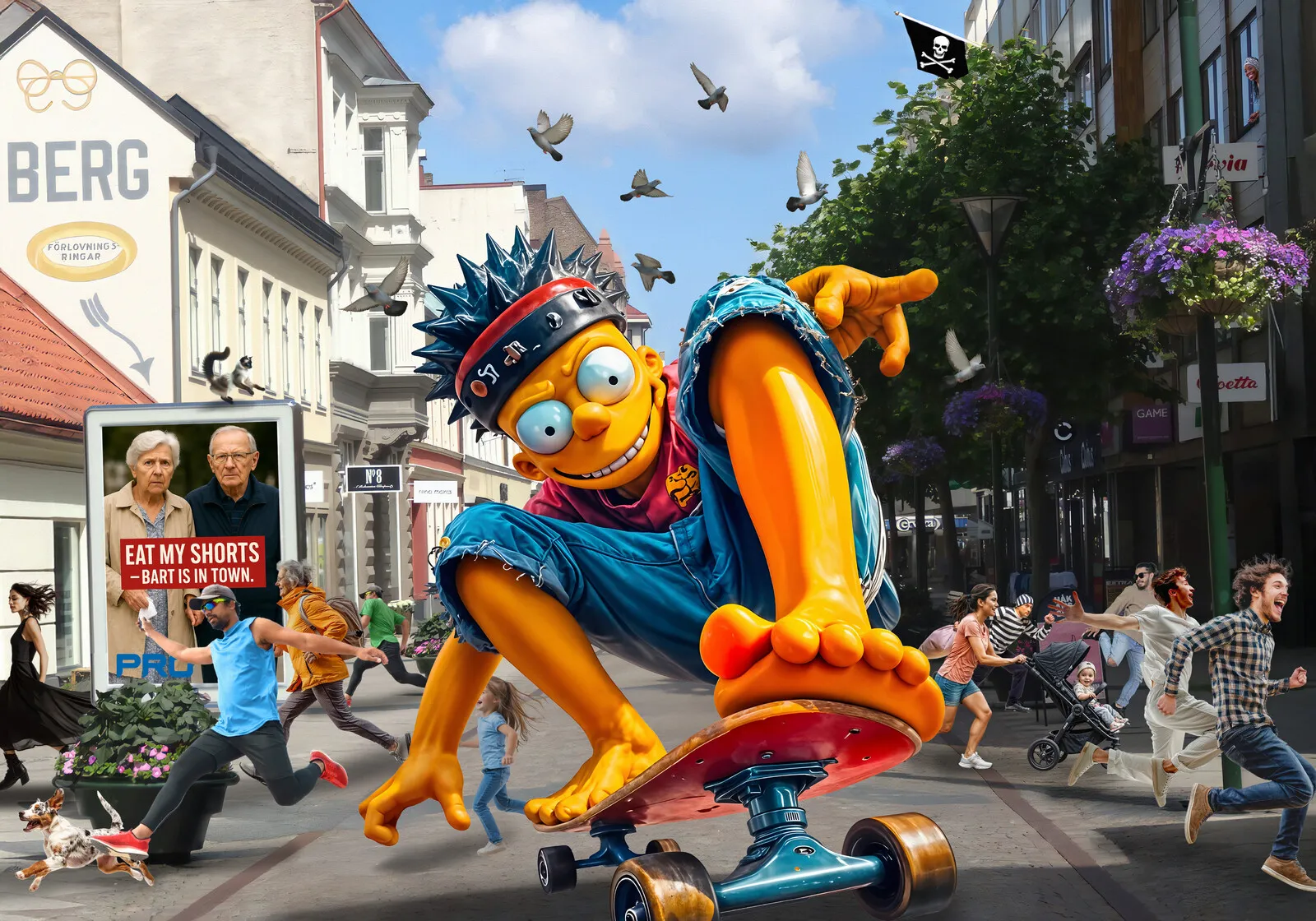
Bart Simpson on the fly, 2025
Digital
70 x 50 cm
3 200 kr
Bart Simpson on the Fly
Embark on a whimsical journey with two mischief-makers who, although never meeting in person, share a bond of unruliness. Anderssonskans Kalle, the Swedish legend of pranks, rebellion, and rough-edged charm, and Bart Simpson, the eternal ten-year-old with a slingshot and a heart full of chaos. One a product of early 20th-century Kirseberg, the other a yellow cartoon from Springfield, USA.
Imagine if Bart, on a whim, decided to grace Malmö with his presence. Picture him stepping out of the screen, his skateboard gliding along Södra Förstadsgatan, and his mischievous eyes spotting traces of Kalle in the archive, the cobbled streets, and the laughter of old ladies from Limhamn.
This is that story. A tale that moves between past and present, between Malmö and Berlin, between innocent anarchy and sharp social critique. It’s a tribute to all kids who refused to sit still, and all the grown-ups who forgot they once knew how to fly downhill in a bathtub.
So fasten your seatbelt – or don't. Kalle never did. And Bart wouldn't even know how.
“A Prankster's Legacy
He rigged a bench with hidden sound,
let popcorn rain upon the ground.
A pigeon storm, a startled shriek —
Bart grinned and filmed it all last week.
But long before the smartphones blinked,
when ink was smudged and post was inked,
young Kalle crept with sly delight
through Kirsebergs forbidden night.
He taught a bird to curse the Lord,
put pickles in a bishop’s Ford.
He turned a bathtub into a sled
and rode through Kirseberg’s spread.
He filled a shoe with meadow dung,
saw candidates unseated, stung.
He faked his death in Sege å —
Then rose like Lazarus, in straw.
Bart saw the tales in archive dust,
and knew that pranksters must adjust.
So TikTok took the torch in hand —
with blue-dyed pools and ice on land.
One skates on memes, the other on mud,
but both have chaos in their blood.
And somewhere still, when grownups preach,
a prankster plots — just out of reach.”
Malmö June 2025
Bart in Malmö – in Kalle’s Footsteps
Once upon a time, there was a book—not just any book, but the kind that smells like a boy’s bedroom, matches, and cap pistols. A book that speaks to boys who climb, scheme, sneak, and set things off with a bang. And one day, that very book ended up in the hands of Bart Simpson, Springfield’s slingshot romantic, school-weary slacker, and freeze-defying short-pants menace.
How the book found its way to a townhouse on Evergreen Terrace remains a mystery. Perhaps Milhouse received it from his Swedish aunt in Ystad, or it was a fortunate find at Comic Book Guy’s 'Scandinavian Mayhem' bargain bin. But how doesn’t matter. What matters is that Bart devoured it, read it like a map to his own heart, and decided to embark on an adventure. To Malmö. To the capital of Skåne. To the place where his kindred spirit, Karl Andersson—commonly known as Kalle—had lived, caused mischief, and shot peas into ladies’ hats a hundred years earlier.
It’s in that light you should view the picture. The one where Bart, barefoot and wild-eyed, is hurtling on his skateboard down the pedestrian street from Regementsgatan to Triangeln. A small yellow whirlwind of anarchy and cultural clash, with a slingshot in his back pocket and Anderssonskans Kalle in his spine.
He knew the book by heart. Every line, every prank. It wasn’t just inspiration – it was a manifesto. And just like Kalle, Bart brought along his trusty slingshot, ready to test the acoustics of Malmö’s shop windows. The clink of glass is a language to him. And Malmö, as it turned out, understood perfectly.
One of Bart's favourite scenes to recreate was when Kalle burned some greasy waste he’d stolen from the garage to send smoke over Pilgrenska’s spring laundry—a soot-and-trouble masterpiece. But as Bart looked around modern Malmö, he couldn't find the right setting. No clotheslines, no old ladies, tumble dryers, or condensation. 'What’s happened to the world?' Bart wondered. 'How’s anyone supposed to live a poetic rebel life in a society where no one hangs out their laundry any more?'
But Bart was not discouraged. There were other scenes to revive.
Bart in Malmö – in Kalle’s Footsteps
Kalle – Anderssonskans Kalle was, of course, originally from the heights of Söder in Stockholm. That’s where he nailed down goloshes, set off firecrackers under the outhouse, and taught a parrot to swear so fiercely the church bells nearly rang backwards. However, the remarkable thing about powerful characters is that they grow beyond their immediate surroundings. They spread. And so, already in the early 20th century, a colleague appeared in Malmö – a mischief-maker and determined individual, who also happened to be named Karl Andersson. It was as if the streets themselves demanded their own Kalle. As if the old ladies, sidewalks, and backyard toilets required him. Malmö-Kalle lived in the Caroli quarter, a neighbourhood slated for demolition over a hundred years ago.
Malmö-Kalle dressed the same, thought the same, and carried his slingshot as naturally as others wore bows. And here, too, it was the ladies who paid the price – in ruined skirts, toppled laundry baskets, and the occasional cardiac scare.
It was this book, a collection of pranks and legends from both Söder and Malmö, that truly captured Bart's imagination. And it was Malmö-Kalle who stood out. Not just because “Malmö” sounded cool, but because Kalle’s methods had a certain... Skåne-style, continental flair. Like Bart himself, Malmö-Kalle mixed technical inventiveness with social sabotage. It wasn’t just mischief – it was performance art.
Bobergskan’s Belongings – A Moving Disaster for the Ages
It started with good intentions – as things often did in Kalle’s world. Bobergskan had caught him red-handed, carving the name of his beloved Ann-Mari into a doorpost. To avoid getting reported, he offered to help her move. She was relocating. He would carry.
He shouldn’t have.
What followed was nothing less than a fully furnished catastrophe. A mirror shattered. A rocking chair snapped in two. Porcelain clinked its way to the afterlife, and a plaster statue – supposedly someone’s aunt in antique toga – toppled like a fallen goddess. Not out of malice, not by plan, but through pure and unfiltered Kalle-logic. You do your best, rarely think ahead, and then scare the horse so the moving wagon bolts like a heavenly enema.
It had taken Bobergskan thirty years to gather what she owned. Kalle dusted it to oblivion in twenty minutes. Remarkable what a boy can accomplish.
Reading about Bobergskan's move in modern Malmö, Bart laughed out loud, not from schadenfreude, but out of admiration. 'This guy's an artist,' Bart thought, appreciating Kalle's unique approach to mischief.
“This guy’s an artist,” Bart exclaimed, his admiration for Kalle's unique brand of mischief evident in his voice.
But Bobergskan’s move wasn’t easy to replicate. Horse-drawn wagons were uncommon in Malmö in 2025.
So he waited several days. And finally, on a Tuesday morning, his opportunity arrived—a fully electric moving truck parked on Davidshallsgatan. Two sweaty movers in shorts carried wicker chairs and bulky mirrors, while an elderly lady nervously directed from the third floor with binoculars. Bart saw his moment. He sneaked up, swapped the “UP” labels with “DOWN,” rewired the lift, and changed the GPS destination to “Folkets Park, performance stage.”
An hour later, Bobergskan’s spiritual inheritance lay scattered on a lawn between food trucks and fiddlers behind the Moriskan Pavilion. Malmö-Kalle had been avenged stylishly. Bart grinned, thoroughly satisfied with his mischievous triumph. He hadn’t even needed a horse..
The Washing Pier, the Parrot, and the Big Splash
A hundred years earlier, it was the last day of school at Kirseberg School: white shirts and blouses, brass bands, sunlight at shin height, and diplomas in sweaty hands. Anderssonskan’s Kalle had top marks in everything—except for being tidy. That delighted his sister Majken, puzzled the teacher, and annoyed the neighbourhood ladies. Kalle ran down to the washing pier by the Sege River to show his mother. That’s where the old ladies knelt in silence, rinsing linens and expressing disapproval. From there, one could see the distant Spillepengen—but all they saw was Kalle.
They gossiped about him. Mrs Pilgren complained that Kalle had taught her parrot to screech “Satan in hell!” and “Bloody damnation!” all day long. Mrs Boberg questioned why boys like Kalle weren’t kept locked up somewhere. That was when he arrived, with his grades held high, soaking up praise and hypocrisy equally.
There were words exchanged. There were shoves. Then came a splash. Kalle vanished under the pier. The ladies thought he had drowned. Moments later, his mother arrived, heard the accusations, and rushed to defend him. And just then, up he popped—soaked, sputtering, triumphant.
A century later, Bart sat on a bench at the Ribersborg open-air baths. He had watched a group of senior citizens in bathrobes wade into the sea, whistle at the wind, and dry off with dignity. He overheard one of them gossiping about a certain youth who had kicked over an electric scooter outside the sauna. It sounded familiar. It sounded like an accusation.
He smiled.
“The parrot lives,” he thought. “And so do the old ladies.” Something was comforting in that—like time was circling itself. Bart didn’t have a mother waiting on the pier, but he had a report card of sorts: that photo of him bombing down the pedestrian street while people dived for cover. That was his diploma.
And besides, he had taught a seagull to scream *“Eat my shorts!”* by the Turning Torso.
The Skirt in the Door and Beer in Baskets
It was a typical day in the yard outside Anderssonskan’s house. Laundry fluttered, the sun shone, and the ladies pinned sheets with the precision of generals on a linen battlefield. Kalle, always ready for a bit of mischief, lay in ambush. He’d long been annoyed with Mrs Pilgren—her shrill voice, her relentless scolding. So when she bent over to peg a sheet, he quietly caught her skirt in the door and gave it a push.
The door slammed. The skirt was trapped. Mrs Pilgren became one with the façade.
Kalle vanished in a whirlwind of laughter and pursuit. The ladies howled, brooms were raised, and he fled through the neighbourhood until he reached Mrs Lundström’s dry goods shop. There, he made up a story: that he was being chased for delivering beer to the ladies’ husbands. A panic lie—but delivered with such flair that it almost became true.
Shortly thereafter, he was spotted at a construction site with forty bottles of pilsner arranged in two baskets. He charged two öre per bottle for delivery. He wasn’t just a rascal—he was an entrepreneur, always finding a way to turn a situation to his advantage.
Bart, reading that tale in modern-day Malmö, took special delight in the story. He resolved to stage something similar. Not with pilsner—but with IPA. And on a Saturday afternoon, just after the liquor store had closed and wouldn’t reopen until Monday, he put his plan into action.
He loaded his scooter with six-packs from Systembolaget on Södra Förstadsgatan, snatched a few cardboard boxes from behind a convenience store, scribbled “Delivery – Gentlemen’s Club” in ballpoint pen, and posted up at Möllevångstorget. Foolproof location with built-in demand. He claimed it was a new delivery system: “A pint beer via education.”
When a man in a trench coat asked for ID, Bart replied:
“If Kalle could deliver pilsner in shorts in 1912, I can deliver IPA in trainers in 2025.”
No one understood what he meant. Everyone assumed it was a quote, and the beer vanished within minutes.
Hollywood in the Backyard – From Laundry Poles to TikTok
Kalle loved cinema long before anyone could afford a ticket. Together with his friends, he built a camera out of boxes, thread spools, and tin cans. It didn’t work, of course—but that didn’t matter. Imagination was enough. They charcoaled their faces, dressed up as Indians, and chose their lead actress: Mrs Boberg.
She had not auditioned.
They tied her to a laundry pole and staged a frontier ambush—complete with Russian firecrackers detonating under her chair. The ladies rushed to her aid, Mrs Boberg screamed like a siren, and Kalle vanished in a cloud of giggles and guilt.
It wasn’t evil. It was children making cinema, with reality as their extra.
Bart, today in Malmö, headed to Slottsparken. His phone was charged. His editing app was ready. And he had a plan:
Malmö was about to get its matinée drama.
“If Kalle could deliver pilsner in shorts in 1912, I can deliver IPA in trainers in 2025.”
No one understood what he meant. Everyone assumed it was a quote, and the beer vanished within minutes.
Hollywood in the Backyard – From Laundry Poles to TikTok
Kalle's love for cinema blossomed long before the era of ticket sales. With his friends, he constructed a camera from humble materials like boxes, thread spools, and tin cans. It was a futile endeavour, but their boundless imagination compensated for the lack of functionality. They adorned themselves with charcoal, assumed the roles of Indians, and selected their leading lady: Mrs. Boberg.
She had not auditioned.
They tied her to a laundry pole and staged a frontier ambush—complete with Russian firecrackers detonating under her chair. The ladies rushed to her aid, Mrs Boberg screamed like a siren, and Kalle disappeared in a cloud of laughter and a hint of guilt.
It wasn’t evil. It was children making cinema, with reality as their extra.
Bart, today in Malmö, headed to Slottsparken. His phone was charged. His editing app was ready. And he had a plan:
Malmö was about to get its matinée drama.
He rigged a park bench with balloons, hid a wireless speaker behind the bushes, and let a group of extras – young, unsuspecting passersby – become part of the script.
When a lady sat down, the speaker began blasting dramatic film music, followed by a recorded shout: "Release the pigeons!" – At that very moment, Bart tossed a handful of popcorn into the air. A flock of hungry pigeons attacked.
The clip went viral. The comment section was filled with likes and outrage. Someone wrote: "Was this planned?"
Bart replied: "Bobergskan would have understood." It wasn’t cruel. It was a tribute—a homage to improvised chaos with comic timing.
Tjörnarp, Poachers, and a Methane Bomb
Kalle hadn't asked to be sent to the colony in Tjörnarp. It was the school doctor who dispatched him there, a kind of well-meaning exile from the city. He probably thought that fresh air, the sea, and potato stews would straighten the boy out. They didn’t.
He rigged a park bench with balloons, hid a wireless speaker behind the bushes, and let a group of extras—young, unsuspecting passersby—become part of the script.
As the lady took her seat, the speaker unleashed dramatic film music, and a recorded voice commanded: "Release the pigeons!" Bart's popcorn shower was the spark that ignited the chaotic frenzy of the hungry pigeons.
The clip went viral. The comment section was filled with likes and outrage. Someone wrote: "Was this planned?"
Bart's response was as unexpected as his prank: "Bobergskan would have understood." It wasn’t cruel. It was a tribute—a homage to improvised chaos with comic timing that left everyone in stitches.
Tjörnarp, Poachers, and a Methane Bomb
Kalle hadn't asked to be sent to the colony in Tjörnarp. It was the school doctor who dispatched him there, a kind of well-meaning exile from the city. He probably thought that fresh air, the sea, and potato stews would straighten the boy out. They didn’t.
Already on the train, he released mice in the compartment, which caused a minor hysteria among the passengers. Once there, he soon became perhaps the colony’s most unexpected hero. Poachers harassed Tjörnarp Bay. Kalle, in a twist of fate, annoyed them with a homemade shark fin so convincing that they packed up their crayfish traps and left – you couldn’t be entirely sure what was swimming around in that mysterious lake. There had long been rumours of a relative of the Loch Ness monster, so why not a shark?
But the best – or worst – came when the ladies from the city, including Pilgrenskan and Bobergskan, arrived on their summer outing. They brought picnic baskets, swimsuits, thermoses, juice, blankets, and that constant sense of moral superiority.
Kalle saw them from across the field. And he saw something else – a herd of cows.
He opened the gate.
It became a smorgasbord for the beasts. Blankets were chewed, thermoses knocked over, a hat devoured by a hungry heifer, and before anyone knew what was happening, Bobergskan lay flat in a bed of oxeye daisies, screaming about ruined pickles and grass stains on her blouse.
Much later, Bart was wandering through the Castle Garden in Malmö when he felt a particular kinship as he passed a sign that read “Climate-neutral mowing.” Some stunt cooked up by the city, because usually it was just hares and rabbits running around here. The sign read: "Note! Grazing sheep – show consideration." He didn’t plan to show anything.
He pulled out his bag of sugar-coated popcorn – the same used in an earlier prank – and tossed the contents over the fence. The sheep flocked. One burped loudly. Another wasn’t satisfied with just popcorn and chewed up part of the information sign. Bart felt proud. Then came the icing on the cake – or rather the methane. A goat let out a ripper so loud that two e-bikers stopped and removed their helmets in reverence.
Bart laughed and quickly typed on his phone to his mum on the other side of the Atlantic.
“Climate neutral? Hardly. A farting goat is a biological weapon of mass destruction.”
Then he added: “In memory of Kalle. This is exactly how he would have wanted to celebrate summer.”
Disguised as girls, escape to Copenhagen, and Bart’s road to freedom
It wasn’t the first time Kalle had disguised himself, but it was the first time he wore a dress with such purpose. He had decided: Helling, the performer who stole both jewels and Majken’s attention, had to be stopped. And it had to happen on the other side of the strait.
So they transformed themselves into girls. Dress, bonnet, basket – the whole package. And they managed to sneak aboard the ferry to Copenhagen. This was before the bridge, before passport-free travel, but a time of obvious controls. To slip past, all it took was a summer dress, a flirtatious smile, and a decent haircut.
On deck, they kept a low profile. Or tried to. When Helling appeared in a white hat and frilly coat, Kalle stayed in the shadows. He took notes, observed, and finally gathered proof: Helling was the thief. And the plan to flee to America with the stolen goods could be stopped.
It was a different time. But courage – that was timeless.
Bart, in present-day Malmö, thought about all this as he stood at the old ferry terminal at Hjälmarekajen. These days, there are no regular ferries to Copenhagen from here. The Öresund Bridge has taken over everything. But Bart still stared out across the water. Freedom was over there—beer, anarchy, and hot dogs. And maybe a place where no one knew what “exploding in a pastry shop” meant.
He smiled, slipped into his sister Lisa’s summer dress – the one he’d borrowed "for a social experiment" – and rolled his skateboard aboard a sightseeing boat with a Danish flag on the stern. This was Bart's way of connecting with Kalle's past, stepping into his shoes, and continuing his legacy in a modern context.
The captain blinked, asked nothing.
Bart planted his feet wide at the bow and whispered, "Kalle, we’re on our way. You and me. Let’s go."
Ski Boots, the Flight to Berlin, and Bart’s Guide to True Crime
When Kastrup opened in 1925, many people in Malmö looked towards the horizon and thought: Now you can fly away from anything. And for Anderssonskan’s Kalle, this was no exception. He had long suspected Helling – that performer with cologne in his hair and fingers in others’ pockets – of being behind a series of thefts in the city. When Helling suddenly mentioned a trip to Berlin, suspicions turned into certainty. Kalle, with unwavering bravery, decided to follow him.
Once in Copenhagen and at the newly built Kastrup airport, Kalle was smuggled aboard one of the new postal planes that had started serving the continent via Kastrup. Hidden in a mail sack, he felt the wings of history – and the smell of salted herring.
In Berlin, he trailed Helling along Unter den Linden. He checked into a hotel and bribed the porter with the help of a ventriloquist dummy and a cream pastry, then snuck into Helling’s room and searched the luggage. After a bit of digging, he found the evidence: the stolen jewels hidden in the heel of a boot. Not particularly clever, but good enough to make history. The deal fell through when Helling cut his trip to Berlin short.
When the plane returned to Kastrup, Kalle jumped the line and handed a note to customs. He’d written that stolen goods – diamonds – could be found in a particular person’s luggage, hidden in a heel — such a tip no customs officer ignores. Helling was arrested, and Kalle returned to Malmö a hero. Gustav got a scoop and then a permanent job at the paper. Majken chose the right man. And Kalle received a cash reward – and a thought: maybe, one day, he’d become an engineer.
Bart Simpson, who on that summer day had read the chapter while sitting on a plastic chair outside Espresso House at Central Station, was deeply impressed. He said nothing, as comic characters do in bubbles above their heads. But in his notebook, he wrote:
A ski boot.
An AirTag.
A sign: "True Crime For True Kids."
Then Bart googled:
"How to sneak aboard an Öresund train to Berlin."
And muttered to himself:
"Helling, baby... now you're my algorithm."
School's Out in Kirseberg – and Bart at Möllan
It was the last day of the spring term at the old Kirseberg School in 1925. Gasping music wheezed from an old pump organ, girls in white dresses tiptoed across the schoolyard, and in the bustle of anticipation and fluttering report cards stood Anderssonskan’s Kalle, with top marks in everything. Well, everything except conduct. Majken teared up; she always did.
He slipped away before the applause had time to fade down to the laundry pier, where the neighbourhood ladies knelt and rinsed with steady curses. The pier lay as usual at the Sege River, where you could glimpse the then-version of the Turning Torso – the old Kirseberg water tower, already converted into housing.
As Kalle approached, the tension between him and the ladies was palpable. Pilgrenska shook her head disapprovingly, Bobergska hissed through her teeth, and Pilgrenska once again lamented about the parrot Kalle had taught to shout profanities so loudly that the windowpanes rattled.
Kalle presented his report card, but the ladies were more concerned about his appearance. A heated argument erupted, and in a dramatic turn of events, Kalle either lost his balance or deliberately fell into the water. The splash was deafening, sparking a flurry of concern and even a presumed fatality. The ladies gathered in a circle, some shedding tears, while most looked visibly relieved.
Emerging from the water, Kalle was drenched but undeterred, a triumphant smile on his face. His mother, always ready to defend her son, appeared on the scene, her voice filled with concern. Despite the ladies' mutterings, Kalle stood his ground, a testament to his resilience in the face of adversity. His unwavering spirit was a lesson in perseverance for all who witnessed it.
In today’s Malmö—at Möllevång Square—Bart Simpson staged the whole scene as TikTok theatre.
His performance was a spectacle of absurdity. Bart had ingeniously constructed a stage from pallets, donned a parrot costume borrowed from a children's theatre, and programmed a voice assistant to spew Scanian curses at unsuspecting passersby. The result was a hilarious and entertaining show that left the audience in stitches, a testament to Bart's wit and creativity.
In the middle of the square was a kiddie pool, filled to the brim with water dyed blue with food colouring. Bart rose from it holding a fake report card from Kirseberg School: “A in Effort. F in Conformity.”
A lady from Limhamn got angry when he splashed blue water on her pale summer coat and smacked him with her cloth bag. A man in a trench coat filmed the scene. A few schoolkids on summer break cheered.
Kalle lives," Bart said, wiping blue water from his ear. He was entirely blue. "And Kalle walked this square too. For real. Back then, though, the granite lump wasn’t here yet."
Tougher Than Sundström – Dreams in the Hay and Bart Facing Reality
Summer arrived. Kalle and his friends lay in the hayloft of Uncle Pettersson's barn, staring up at the beams where not even spiders dared disturb their dreams. They discussed what truly mattered: gold, diamonds, coconuts, and lions. They would be pirates, cowboys, and explorers. Rich as trolls. Cooler than anyone.
The plan was set. Kalle and his mates would go to Africa, dig for treasure, shoot lions—and when they came home, they’d outshine every smug graduate prancing around in white hats and shiny blazers. They’d hand out coconuts and bananas and pretend to be humble, but everyone would know they were the best.
And most important: Kalle would once and for all outdo Candidate Sundström—the smug, self-important fop who always tried to impress the ladies by hitting little boys with twigs and tossing their clothes into the lake. He was the adult world’s avatar of arrogance, and Kalle hated him with a passion.
One time, when the candidate was kissing in the park, Kalle snuck up and shoved a cowpat in each shoe, and bathed his blazer in a red ant hill. It wasn’t civilised. But it was justice.
Bart, lounging on a bench in Pildammsparken, chewing on a protein bar he’d swiped from a gym, tried to understand.
Lion hunting and colonial fantasies were hopelessly outdated. Cowpats were rare, and the park had no angry ants. But the feeling-the urge to outwit snobs, to dream yourself away from school, teachers, and the pointless adult world-that was eternal. Bart felt it too, back in Springfield.
He pulled out his phone, opened his notes app, and wrote:
"When I grow up, I’ll go to Lomma, catch a plastic mermaid and sell it to an NFT dealer from Berlin. Then I’ll buy back Skåne from Sweden and turn it into a republic. Free from teachers. Free from rules. Big greenhouses with bananas."
He ended with: "To all Candidate Sundströms in the world: There’s a cowpat with your name on it. AI-generated, but still."
One must remember: Bart was born ten years old when the first season aired in 1989. So Bart is 44—but forever a child.
Sledges, Crates, and Climate Denial – From Kirseberg to TikTok
The winter of 1925 struck Malmö so fiercely that even the old ladies fell silent for a while. In the hills around Kirseberg, where snow lay thick over gardens, Kalle organised a grand sledge parade. These weren’t simple sledges with ropes—no, these were repurposed wheelbarrows, wooden troughs, a sewing machine box on runners, and in one case, a discarded bathtub from Sorgenfri.
The starting point was the old water tower. The finish line... unclear. But somewhere near Kirseberg Square, things became truly exciting.
Kalle, leading the race, rounded a bend faster than a runaway horse (or so it seemed) and crashed straight into a smokehouse where herring was being dried. Smoke billowed around him as he narrowly avoided becoming grilled fish himself. The smokers chased him with spits. The only option was to keep on sledging.
The chase led to Segeå, where Bobergska slipped into an ice hole—she who had come “to give the boy a piece of her mind.” She was rescued just in time by Gustav with a ladder, Majken with a rope, and Kalle with a big laugh.
Bart read all this in the old volumes of the city archive while rain fell on what was the ice rink at Folkets Park during winter. Snow no longer fell in Malmö, but Bart was not one to give up.
The next day, with clear skies, Bart bought three hundred kilograms of crushed ice from a fish wholesaler in Limhamn and spread it on a hill at Jesusparken—a popular summer spot for sunbathers, dog walkers, and drinkers. He smoothed the ice with a leaf blower and started filming.
On his sledge—a modified electric scooter—he sped towards a sign he had placed: “Smokehouse – No Young Gentlemen Allowed!” When he crashed through it into a container filled with herring tins (also staged), the crowd erupted in cheers. At least two people thought it was a piece of performance art.
An older woman from Fridhem said, “This is the closest we get to a real winter these days. Especially in summer.”
Bart crawled out, took a selfie with a herring inside his T-shirt, and posted the video captioned:
"Climate change can’t stop Kalle. Not in his Malmö."
That’s where we leave Bart and Malmö for now—but only for now. There’s much more to say about Anderssonskans Kalle: about his gang, his pranks, his rebellion, and his secret heart. But that will have to wait.
Until then... keep an eye out for a certain blond cowlick forever fighting the wind. He always appears when the adult world becomes too smug.
Jörgen Thornberg
Bart Simpson on the fly, 2025
Digital
70 x 50 cm
3 200 kr
Bart Simpson on the Fly
Embark on a whimsical journey with two mischief-makers who, although never meeting in person, share a bond of unruliness. Anderssonskans Kalle, the Swedish legend of pranks, rebellion, and rough-edged charm, and Bart Simpson, the eternal ten-year-old with a slingshot and a heart full of chaos. One a product of early 20th-century Kirseberg, the other a yellow cartoon from Springfield, USA.
Imagine if Bart, on a whim, decided to grace Malmö with his presence. Picture him stepping out of the screen, his skateboard gliding along Södra Förstadsgatan, and his mischievous eyes spotting traces of Kalle in the archive, the cobbled streets, and the laughter of old ladies from Limhamn.
This is that story. A tale that moves between past and present, between Malmö and Berlin, between innocent anarchy and sharp social critique. It’s a tribute to all kids who refused to sit still, and all the grown-ups who forgot they once knew how to fly downhill in a bathtub.
So fasten your seatbelt – or don't. Kalle never did. And Bart wouldn't even know how.
“A Prankster's Legacy
He rigged a bench with hidden sound,
let popcorn rain upon the ground.
A pigeon storm, a startled shriek —
Bart grinned and filmed it all last week.
But long before the smartphones blinked,
when ink was smudged and post was inked,
young Kalle crept with sly delight
through Kirsebergs forbidden night.
He taught a bird to curse the Lord,
put pickles in a bishop’s Ford.
He turned a bathtub into a sled
and rode through Kirseberg’s spread.
He filled a shoe with meadow dung,
saw candidates unseated, stung.
He faked his death in Sege å —
Then rose like Lazarus, in straw.
Bart saw the tales in archive dust,
and knew that pranksters must adjust.
So TikTok took the torch in hand —
with blue-dyed pools and ice on land.
One skates on memes, the other on mud,
but both have chaos in their blood.
And somewhere still, when grownups preach,
a prankster plots — just out of reach.”
Malmö June 2025
Bart in Malmö – in Kalle’s Footsteps
Once upon a time, there was a book—not just any book, but the kind that smells like a boy’s bedroom, matches, and cap pistols. A book that speaks to boys who climb, scheme, sneak, and set things off with a bang. And one day, that very book ended up in the hands of Bart Simpson, Springfield’s slingshot romantic, school-weary slacker, and freeze-defying short-pants menace.
How the book found its way to a townhouse on Evergreen Terrace remains a mystery. Perhaps Milhouse received it from his Swedish aunt in Ystad, or it was a fortunate find at Comic Book Guy’s 'Scandinavian Mayhem' bargain bin. But how doesn’t matter. What matters is that Bart devoured it, read it like a map to his own heart, and decided to embark on an adventure. To Malmö. To the capital of Skåne. To the place where his kindred spirit, Karl Andersson—commonly known as Kalle—had lived, caused mischief, and shot peas into ladies’ hats a hundred years earlier.
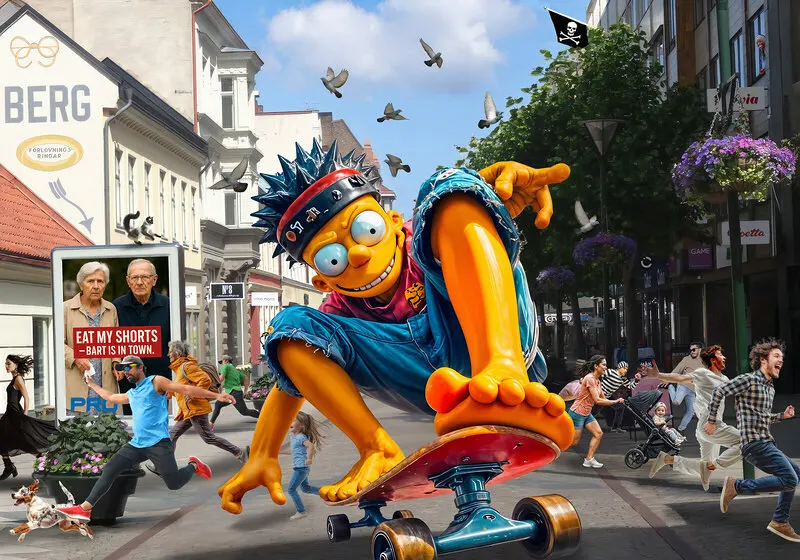
It’s in that light you should view the picture. The one where Bart, barefoot and wild-eyed, is hurtling on his skateboard down the pedestrian street from Regementsgatan to Triangeln. A small yellow whirlwind of anarchy and cultural clash, with a slingshot in his back pocket and Anderssonskans Kalle in his spine.
He knew the book by heart. Every line, every prank. It wasn’t just inspiration – it was a manifesto. And just like Kalle, Bart brought along his trusty slingshot, ready to test the acoustics of Malmö’s shop windows. The clink of glass is a language to him. And Malmö, as it turned out, understood perfectly.
One of Bart's favourite scenes to recreate was when Kalle burned some greasy waste he’d stolen from the garage to send smoke over Pilgrenska’s spring laundry—a soot-and-trouble masterpiece. But as Bart looked around modern Malmö, he couldn't find the right setting. No clotheslines, no old ladies, tumble dryers, or condensation. 'What’s happened to the world?' Bart wondered. 'How’s anyone supposed to live a poetic rebel life in a society where no one hangs out their laundry any more?'
But Bart was not discouraged. There were other scenes to revive.
Bart in Malmö – in Kalle’s Footsteps
Kalle – Anderssonskans Kalle was, of course, originally from the heights of Söder in Stockholm. That’s where he nailed down goloshes, set off firecrackers under the outhouse, and taught a parrot to swear so fiercely the church bells nearly rang backwards. However, the remarkable thing about powerful characters is that they grow beyond their immediate surroundings. They spread. And so, already in the early 20th century, a colleague appeared in Malmö – a mischief-maker and determined individual, who also happened to be named Karl Andersson. It was as if the streets themselves demanded their own Kalle. As if the old ladies, sidewalks, and backyard toilets required him. Malmö-Kalle lived in the Caroli quarter, a neighbourhood slated for demolition over a hundred years ago.
Malmö-Kalle dressed the same, thought the same, and carried his slingshot as naturally as others wore bows. And here, too, it was the ladies who paid the price – in ruined skirts, toppled laundry baskets, and the occasional cardiac scare.
It was this book, a collection of pranks and legends from both Söder and Malmö, that truly captured Bart's imagination. And it was Malmö-Kalle who stood out. Not just because “Malmö” sounded cool, but because Kalle’s methods had a certain... Skåne-style, continental flair. Like Bart himself, Malmö-Kalle mixed technical inventiveness with social sabotage. It wasn’t just mischief – it was performance art.
Bobergskan’s Belongings – A Moving Disaster for the Ages
It started with good intentions – as things often did in Kalle’s world. Bobergskan had caught him red-handed, carving the name of his beloved Ann-Mari into a doorpost. To avoid getting reported, he offered to help her move. She was relocating. He would carry.
He shouldn’t have.
What followed was nothing less than a fully furnished catastrophe. A mirror shattered. A rocking chair snapped in two. Porcelain clinked its way to the afterlife, and a plaster statue – supposedly someone’s aunt in antique toga – toppled like a fallen goddess. Not out of malice, not by plan, but through pure and unfiltered Kalle-logic. You do your best, rarely think ahead, and then scare the horse so the moving wagon bolts like a heavenly enema.
It had taken Bobergskan thirty years to gather what she owned. Kalle dusted it to oblivion in twenty minutes. Remarkable what a boy can accomplish.
Reading about Bobergskan's move in modern Malmö, Bart laughed out loud, not from schadenfreude, but out of admiration. 'This guy's an artist,' Bart thought, appreciating Kalle's unique approach to mischief.
“This guy’s an artist,” Bart exclaimed, his admiration for Kalle's unique brand of mischief evident in his voice.
But Bobergskan’s move wasn’t easy to replicate. Horse-drawn wagons were uncommon in Malmö in 2025.
So he waited several days. And finally, on a Tuesday morning, his opportunity arrived—a fully electric moving truck parked on Davidshallsgatan. Two sweaty movers in shorts carried wicker chairs and bulky mirrors, while an elderly lady nervously directed from the third floor with binoculars. Bart saw his moment. He sneaked up, swapped the “UP” labels with “DOWN,” rewired the lift, and changed the GPS destination to “Folkets Park, performance stage.”
An hour later, Bobergskan’s spiritual inheritance lay scattered on a lawn between food trucks and fiddlers behind the Moriskan Pavilion. Malmö-Kalle had been avenged stylishly. Bart grinned, thoroughly satisfied with his mischievous triumph. He hadn’t even needed a horse..
The Washing Pier, the Parrot, and the Big Splash
A hundred years earlier, it was the last day of school at Kirseberg School: white shirts and blouses, brass bands, sunlight at shin height, and diplomas in sweaty hands. Anderssonskan’s Kalle had top marks in everything—except for being tidy. That delighted his sister Majken, puzzled the teacher, and annoyed the neighbourhood ladies. Kalle ran down to the washing pier by the Sege River to show his mother. That’s where the old ladies knelt in silence, rinsing linens and expressing disapproval. From there, one could see the distant Spillepengen—but all they saw was Kalle.
They gossiped about him. Mrs Pilgren complained that Kalle had taught her parrot to screech “Satan in hell!” and “Bloody damnation!” all day long. Mrs Boberg questioned why boys like Kalle weren’t kept locked up somewhere. That was when he arrived, with his grades held high, soaking up praise and hypocrisy equally.
There were words exchanged. There were shoves. Then came a splash. Kalle vanished under the pier. The ladies thought he had drowned. Moments later, his mother arrived, heard the accusations, and rushed to defend him. And just then, up he popped—soaked, sputtering, triumphant.
A century later, Bart sat on a bench at the Ribersborg open-air baths. He had watched a group of senior citizens in bathrobes wade into the sea, whistle at the wind, and dry off with dignity. He overheard one of them gossiping about a certain youth who had kicked over an electric scooter outside the sauna. It sounded familiar. It sounded like an accusation.
He smiled.
“The parrot lives,” he thought. “And so do the old ladies.” Something was comforting in that—like time was circling itself. Bart didn’t have a mother waiting on the pier, but he had a report card of sorts: that photo of him bombing down the pedestrian street while people dived for cover. That was his diploma.
And besides, he had taught a seagull to scream *“Eat my shorts!”* by the Turning Torso.
The Skirt in the Door and Beer in Baskets
It was a typical day in the yard outside Anderssonskan’s house. Laundry fluttered, the sun shone, and the ladies pinned sheets with the precision of generals on a linen battlefield. Kalle, always ready for a bit of mischief, lay in ambush. He’d long been annoyed with Mrs Pilgren—her shrill voice, her relentless scolding. So when she bent over to peg a sheet, he quietly caught her skirt in the door and gave it a push.
The door slammed. The skirt was trapped. Mrs Pilgren became one with the façade.
Kalle vanished in a whirlwind of laughter and pursuit. The ladies howled, brooms were raised, and he fled through the neighbourhood until he reached Mrs Lundström’s dry goods shop. There, he made up a story: that he was being chased for delivering beer to the ladies’ husbands. A panic lie—but delivered with such flair that it almost became true.
Shortly thereafter, he was spotted at a construction site with forty bottles of pilsner arranged in two baskets. He charged two öre per bottle for delivery. He wasn’t just a rascal—he was an entrepreneur, always finding a way to turn a situation to his advantage.
Bart, reading that tale in modern-day Malmö, took special delight in the story. He resolved to stage something similar. Not with pilsner—but with IPA. And on a Saturday afternoon, just after the liquor store had closed and wouldn’t reopen until Monday, he put his plan into action.
He loaded his scooter with six-packs from Systembolaget on Södra Förstadsgatan, snatched a few cardboard boxes from behind a convenience store, scribbled “Delivery – Gentlemen’s Club” in ballpoint pen, and posted up at Möllevångstorget. Foolproof location with built-in demand. He claimed it was a new delivery system: “A pint beer via education.”
When a man in a trench coat asked for ID, Bart replied:
“If Kalle could deliver pilsner in shorts in 1912, I can deliver IPA in trainers in 2025.”
No one understood what he meant. Everyone assumed it was a quote, and the beer vanished within minutes.
Hollywood in the Backyard – From Laundry Poles to TikTok
Kalle loved cinema long before anyone could afford a ticket. Together with his friends, he built a camera out of boxes, thread spools, and tin cans. It didn’t work, of course—but that didn’t matter. Imagination was enough. They charcoaled their faces, dressed up as Indians, and chose their lead actress: Mrs Boberg.
She had not auditioned.
They tied her to a laundry pole and staged a frontier ambush—complete with Russian firecrackers detonating under her chair. The ladies rushed to her aid, Mrs Boberg screamed like a siren, and Kalle vanished in a cloud of giggles and guilt.
It wasn’t evil. It was children making cinema, with reality as their extra.
Bart, today in Malmö, headed to Slottsparken. His phone was charged. His editing app was ready. And he had a plan:
Malmö was about to get its matinée drama.
“If Kalle could deliver pilsner in shorts in 1912, I can deliver IPA in trainers in 2025.”
No one understood what he meant. Everyone assumed it was a quote, and the beer vanished within minutes.
Hollywood in the Backyard – From Laundry Poles to TikTok
Kalle's love for cinema blossomed long before the era of ticket sales. With his friends, he constructed a camera from humble materials like boxes, thread spools, and tin cans. It was a futile endeavour, but their boundless imagination compensated for the lack of functionality. They adorned themselves with charcoal, assumed the roles of Indians, and selected their leading lady: Mrs. Boberg.
She had not auditioned.
They tied her to a laundry pole and staged a frontier ambush—complete with Russian firecrackers detonating under her chair. The ladies rushed to her aid, Mrs Boberg screamed like a siren, and Kalle disappeared in a cloud of laughter and a hint of guilt.
It wasn’t evil. It was children making cinema, with reality as their extra.
Bart, today in Malmö, headed to Slottsparken. His phone was charged. His editing app was ready. And he had a plan:
Malmö was about to get its matinée drama.
He rigged a park bench with balloons, hid a wireless speaker behind the bushes, and let a group of extras – young, unsuspecting passersby – become part of the script.
When a lady sat down, the speaker began blasting dramatic film music, followed by a recorded shout: "Release the pigeons!" – At that very moment, Bart tossed a handful of popcorn into the air. A flock of hungry pigeons attacked.
The clip went viral. The comment section was filled with likes and outrage. Someone wrote: "Was this planned?"
Bart replied: "Bobergskan would have understood." It wasn’t cruel. It was a tribute—a homage to improvised chaos with comic timing.
Tjörnarp, Poachers, and a Methane Bomb
Kalle hadn't asked to be sent to the colony in Tjörnarp. It was the school doctor who dispatched him there, a kind of well-meaning exile from the city. He probably thought that fresh air, the sea, and potato stews would straighten the boy out. They didn’t.
He rigged a park bench with balloons, hid a wireless speaker behind the bushes, and let a group of extras—young, unsuspecting passersby—become part of the script.
As the lady took her seat, the speaker unleashed dramatic film music, and a recorded voice commanded: "Release the pigeons!" Bart's popcorn shower was the spark that ignited the chaotic frenzy of the hungry pigeons.
The clip went viral. The comment section was filled with likes and outrage. Someone wrote: "Was this planned?"
Bart's response was as unexpected as his prank: "Bobergskan would have understood." It wasn’t cruel. It was a tribute—a homage to improvised chaos with comic timing that left everyone in stitches.
Tjörnarp, Poachers, and a Methane Bomb
Kalle hadn't asked to be sent to the colony in Tjörnarp. It was the school doctor who dispatched him there, a kind of well-meaning exile from the city. He probably thought that fresh air, the sea, and potato stews would straighten the boy out. They didn’t.
Already on the train, he released mice in the compartment, which caused a minor hysteria among the passengers. Once there, he soon became perhaps the colony’s most unexpected hero. Poachers harassed Tjörnarp Bay. Kalle, in a twist of fate, annoyed them with a homemade shark fin so convincing that they packed up their crayfish traps and left – you couldn’t be entirely sure what was swimming around in that mysterious lake. There had long been rumours of a relative of the Loch Ness monster, so why not a shark?
But the best – or worst – came when the ladies from the city, including Pilgrenskan and Bobergskan, arrived on their summer outing. They brought picnic baskets, swimsuits, thermoses, juice, blankets, and that constant sense of moral superiority.
Kalle saw them from across the field. And he saw something else – a herd of cows.
He opened the gate.
It became a smorgasbord for the beasts. Blankets were chewed, thermoses knocked over, a hat devoured by a hungry heifer, and before anyone knew what was happening, Bobergskan lay flat in a bed of oxeye daisies, screaming about ruined pickles and grass stains on her blouse.
Much later, Bart was wandering through the Castle Garden in Malmö when he felt a particular kinship as he passed a sign that read “Climate-neutral mowing.” Some stunt cooked up by the city, because usually it was just hares and rabbits running around here. The sign read: "Note! Grazing sheep – show consideration." He didn’t plan to show anything.
He pulled out his bag of sugar-coated popcorn – the same used in an earlier prank – and tossed the contents over the fence. The sheep flocked. One burped loudly. Another wasn’t satisfied with just popcorn and chewed up part of the information sign. Bart felt proud. Then came the icing on the cake – or rather the methane. A goat let out a ripper so loud that two e-bikers stopped and removed their helmets in reverence.
Bart laughed and quickly typed on his phone to his mum on the other side of the Atlantic.
“Climate neutral? Hardly. A farting goat is a biological weapon of mass destruction.”
Then he added: “In memory of Kalle. This is exactly how he would have wanted to celebrate summer.”
Disguised as girls, escape to Copenhagen, and Bart’s road to freedom
It wasn’t the first time Kalle had disguised himself, but it was the first time he wore a dress with such purpose. He had decided: Helling, the performer who stole both jewels and Majken’s attention, had to be stopped. And it had to happen on the other side of the strait.
So they transformed themselves into girls. Dress, bonnet, basket – the whole package. And they managed to sneak aboard the ferry to Copenhagen. This was before the bridge, before passport-free travel, but a time of obvious controls. To slip past, all it took was a summer dress, a flirtatious smile, and a decent haircut.
On deck, they kept a low profile. Or tried to. When Helling appeared in a white hat and frilly coat, Kalle stayed in the shadows. He took notes, observed, and finally gathered proof: Helling was the thief. And the plan to flee to America with the stolen goods could be stopped.
It was a different time. But courage – that was timeless.
Bart, in present-day Malmö, thought about all this as he stood at the old ferry terminal at Hjälmarekajen. These days, there are no regular ferries to Copenhagen from here. The Öresund Bridge has taken over everything. But Bart still stared out across the water. Freedom was over there—beer, anarchy, and hot dogs. And maybe a place where no one knew what “exploding in a pastry shop” meant.
He smiled, slipped into his sister Lisa’s summer dress – the one he’d borrowed "for a social experiment" – and rolled his skateboard aboard a sightseeing boat with a Danish flag on the stern. This was Bart's way of connecting with Kalle's past, stepping into his shoes, and continuing his legacy in a modern context.
The captain blinked, asked nothing.
Bart planted his feet wide at the bow and whispered, "Kalle, we’re on our way. You and me. Let’s go."
Ski Boots, the Flight to Berlin, and Bart’s Guide to True Crime
When Kastrup opened in 1925, many people in Malmö looked towards the horizon and thought: Now you can fly away from anything. And for Anderssonskan’s Kalle, this was no exception. He had long suspected Helling – that performer with cologne in his hair and fingers in others’ pockets – of being behind a series of thefts in the city. When Helling suddenly mentioned a trip to Berlin, suspicions turned into certainty. Kalle, with unwavering bravery, decided to follow him.
Once in Copenhagen and at the newly built Kastrup airport, Kalle was smuggled aboard one of the new postal planes that had started serving the continent via Kastrup. Hidden in a mail sack, he felt the wings of history – and the smell of salted herring.
In Berlin, he trailed Helling along Unter den Linden. He checked into a hotel and bribed the porter with the help of a ventriloquist dummy and a cream pastry, then snuck into Helling’s room and searched the luggage. After a bit of digging, he found the evidence: the stolen jewels hidden in the heel of a boot. Not particularly clever, but good enough to make history. The deal fell through when Helling cut his trip to Berlin short.
When the plane returned to Kastrup, Kalle jumped the line and handed a note to customs. He’d written that stolen goods – diamonds – could be found in a particular person’s luggage, hidden in a heel — such a tip no customs officer ignores. Helling was arrested, and Kalle returned to Malmö a hero. Gustav got a scoop and then a permanent job at the paper. Majken chose the right man. And Kalle received a cash reward – and a thought: maybe, one day, he’d become an engineer.
Bart Simpson, who on that summer day had read the chapter while sitting on a plastic chair outside Espresso House at Central Station, was deeply impressed. He said nothing, as comic characters do in bubbles above their heads. But in his notebook, he wrote:
A ski boot.
An AirTag.
A sign: "True Crime For True Kids."
Then Bart googled:
"How to sneak aboard an Öresund train to Berlin."
And muttered to himself:
"Helling, baby... now you're my algorithm."
School's Out in Kirseberg – and Bart at Möllan
It was the last day of the spring term at the old Kirseberg School in 1925. Gasping music wheezed from an old pump organ, girls in white dresses tiptoed across the schoolyard, and in the bustle of anticipation and fluttering report cards stood Anderssonskan’s Kalle, with top marks in everything. Well, everything except conduct. Majken teared up; she always did.
He slipped away before the applause had time to fade down to the laundry pier, where the neighbourhood ladies knelt and rinsed with steady curses. The pier lay as usual at the Sege River, where you could glimpse the then-version of the Turning Torso – the old Kirseberg water tower, already converted into housing.
As Kalle approached, the tension between him and the ladies was palpable. Pilgrenska shook her head disapprovingly, Bobergska hissed through her teeth, and Pilgrenska once again lamented about the parrot Kalle had taught to shout profanities so loudly that the windowpanes rattled.
Kalle presented his report card, but the ladies were more concerned about his appearance. A heated argument erupted, and in a dramatic turn of events, Kalle either lost his balance or deliberately fell into the water. The splash was deafening, sparking a flurry of concern and even a presumed fatality. The ladies gathered in a circle, some shedding tears, while most looked visibly relieved.
Emerging from the water, Kalle was drenched but undeterred, a triumphant smile on his face. His mother, always ready to defend her son, appeared on the scene, her voice filled with concern. Despite the ladies' mutterings, Kalle stood his ground, a testament to his resilience in the face of adversity. His unwavering spirit was a lesson in perseverance for all who witnessed it.
In today’s Malmö—at Möllevång Square—Bart Simpson staged the whole scene as TikTok theatre.
His performance was a spectacle of absurdity. Bart had ingeniously constructed a stage from pallets, donned a parrot costume borrowed from a children's theatre, and programmed a voice assistant to spew Scanian curses at unsuspecting passersby. The result was a hilarious and entertaining show that left the audience in stitches, a testament to Bart's wit and creativity.
In the middle of the square was a kiddie pool, filled to the brim with water dyed blue with food colouring. Bart rose from it holding a fake report card from Kirseberg School: “A in Effort. F in Conformity.”
A lady from Limhamn got angry when he splashed blue water on her pale summer coat and smacked him with her cloth bag. A man in a trench coat filmed the scene. A few schoolkids on summer break cheered.
Kalle lives," Bart said, wiping blue water from his ear. He was entirely blue. "And Kalle walked this square too. For real. Back then, though, the granite lump wasn’t here yet."
Tougher Than Sundström – Dreams in the Hay and Bart Facing Reality
Summer arrived. Kalle and his friends lay in the hayloft of Uncle Pettersson's barn, staring up at the beams where not even spiders dared disturb their dreams. They discussed what truly mattered: gold, diamonds, coconuts, and lions. They would be pirates, cowboys, and explorers. Rich as trolls. Cooler than anyone.
The plan was set. Kalle and his mates would go to Africa, dig for treasure, shoot lions—and when they came home, they’d outshine every smug graduate prancing around in white hats and shiny blazers. They’d hand out coconuts and bananas and pretend to be humble, but everyone would know they were the best.
And most important: Kalle would once and for all outdo Candidate Sundström—the smug, self-important fop who always tried to impress the ladies by hitting little boys with twigs and tossing their clothes into the lake. He was the adult world’s avatar of arrogance, and Kalle hated him with a passion.
One time, when the candidate was kissing in the park, Kalle snuck up and shoved a cowpat in each shoe, and bathed his blazer in a red ant hill. It wasn’t civilised. But it was justice.
Bart, lounging on a bench in Pildammsparken, chewing on a protein bar he’d swiped from a gym, tried to understand.
Lion hunting and colonial fantasies were hopelessly outdated. Cowpats were rare, and the park had no angry ants. But the feeling-the urge to outwit snobs, to dream yourself away from school, teachers, and the pointless adult world-that was eternal. Bart felt it too, back in Springfield.
He pulled out his phone, opened his notes app, and wrote:
"When I grow up, I’ll go to Lomma, catch a plastic mermaid and sell it to an NFT dealer from Berlin. Then I’ll buy back Skåne from Sweden and turn it into a republic. Free from teachers. Free from rules. Big greenhouses with bananas."
He ended with: "To all Candidate Sundströms in the world: There’s a cowpat with your name on it. AI-generated, but still."
One must remember: Bart was born ten years old when the first season aired in 1989. So Bart is 44—but forever a child.
Sledges, Crates, and Climate Denial – From Kirseberg to TikTok
The winter of 1925 struck Malmö so fiercely that even the old ladies fell silent for a while. In the hills around Kirseberg, where snow lay thick over gardens, Kalle organised a grand sledge parade. These weren’t simple sledges with ropes—no, these were repurposed wheelbarrows, wooden troughs, a sewing machine box on runners, and in one case, a discarded bathtub from Sorgenfri.
The starting point was the old water tower. The finish line... unclear. But somewhere near Kirseberg Square, things became truly exciting.
Kalle, leading the race, rounded a bend faster than a runaway horse (or so it seemed) and crashed straight into a smokehouse where herring was being dried. Smoke billowed around him as he narrowly avoided becoming grilled fish himself. The smokers chased him with spits. The only option was to keep on sledging.
The chase led to Segeå, where Bobergska slipped into an ice hole—she who had come “to give the boy a piece of her mind.” She was rescued just in time by Gustav with a ladder, Majken with a rope, and Kalle with a big laugh.
Bart read all this in the old volumes of the city archive while rain fell on what was the ice rink at Folkets Park during winter. Snow no longer fell in Malmö, but Bart was not one to give up.
The next day, with clear skies, Bart bought three hundred kilograms of crushed ice from a fish wholesaler in Limhamn and spread it on a hill at Jesusparken—a popular summer spot for sunbathers, dog walkers, and drinkers. He smoothed the ice with a leaf blower and started filming.
On his sledge—a modified electric scooter—he sped towards a sign he had placed: “Smokehouse – No Young Gentlemen Allowed!” When he crashed through it into a container filled with herring tins (also staged), the crowd erupted in cheers. At least two people thought it was a piece of performance art.
An older woman from Fridhem said, “This is the closest we get to a real winter these days. Especially in summer.”
Bart crawled out, took a selfie with a herring inside his T-shirt, and posted the video captioned:
"Climate change can’t stop Kalle. Not in his Malmö."
That’s where we leave Bart and Malmö for now—but only for now. There’s much more to say about Anderssonskans Kalle: about his gang, his pranks, his rebellion, and his secret heart. But that will have to wait.
Until then... keep an eye out for a certain blond cowlick forever fighting the wind. He always appears when the adult world becomes too smug.
3 200 kr

Jörgen Thornberg
Malmö
Lite om bilder och mig. Translation in English at the end.
Jag är en nyfiken person som ser allt i bilder, även det jag fäster i ord, gärna tillsammans för bakom alla mina bilder finns en berättelse. Till vissa bilder hör en kortare eller längre novell som följer med bilden.
Bilder berättar historier. Jag omges av naturlig skönhet, intressanta människor och historia var jag än går. Jag använder min kamera för att dokumentera världen och blanda det jag ser med vad jag känner för att fånga den dolda magin.
Mina bilder berättar mina historier. Genom mina bilder, tryck och berättelser. Jag bjuder in dig att ta del av dessa berättelser, in i ditt liv och hem och dela min mycket personliga syn på vår värld. Mer än vad ögat ser. Jag tänker i bilder, drömmer och skriver och pratar om dem; följaktligen måste jag också skapa bilder. De blir vad jag ser, inte nödvändigtvis begränsade till verkligheten. Det finns en bild runt varje hörn. Jag hoppas att du kommer att se vad jag såg och gilla det.
Jag är också en skrivande person och till många bilder hör en kortare eller längre essay. Den följer med tavlan, tryckt på fint papper och med en personlig hälsning från mig.
Flertalet bilder startar sin resa i min kamera. Enkelt förklarat beskriver jag bilden jag ser i mitt inre, upplevd eller fantiserad. Bilden uppstår inom mig redan innan jag fått okularet till ögat. På bråkdelen av ett ögonblick ser jag vad jag vill ha och vad som kan göras med bilden. Här skall jag stoppa in en giraff, stålmannen, Titanic eller vad det är min fantasi finner ut. Ännu märkligare är att jag kommer ihåg minnesbilden långt efteråt när det blir tid att skapa verket. Om jag lyckas eller inte, är upp till betraktaren, oftast präglat av en stråk av svart humor – meningen är att man skall bli underhållen. Mina bilder blir ofta en snackis där de hänger.
Jag föredrar bilder som förmedlar ett budskap i flera lager. Vid första anblicken fylld av feel-good, en vacker utsikt, fint väder, solen skiner, blommor på ängen eller vattnet som ligger förrädiskt spegelblankt. I en sådan bild kan jag gömma min egentliga berättelse, mitt förakt för förtryckare och våldsverkare, rasister och fördomsfulla människor - ett gärna återkommande motiv mer eller mindre dolt i det vackra motivet. Jag försöker förena dem i ett gemensamt narrativ.
Bild och formgivning har löpt som en röd tråd genom livet. Fotokonst känns som en värdig final som jag gärna delar med mig.
Min genre är vid som framgår av mina bilder, temat en blandning av pop- och gatukonst i kollage som kan bestå av hundratals lager. Vissa bilder kan ta veckor, andra någon dag innan det är dags att överlämna resultatet till printverkstaden. Fine Art Prints är digitala fotocollage. I dessa kollage sker rivandet, klippandet, pusslandet, målandet, ritandet och sprayningen digitalt. Det jag monterar in kan vara hundratals år gamla bilder som jag omsorgsfullt frilägger så att de ser ut att vara en del av tavlan men också bilder skapade av mig själv efter min egen fantasi. Därefter besöks printstudion och för vissa bilder numrera en limiterad upplaga (oftast 7 exemplar) och signera för hand. Vissa bilder kan köpas i olika format. Det är bara att fråga efter vilka. Gillar man en bild som är 70x100 men inte har plats på väggen, går den kanske att få i 50x70 cm istället. Frågan är fri.
Metoden Giclée eller Fine Art Print som det också kallas är det moderna sättet för framställning av grafisk konst. Villkoret för denna typ av utskrifter är att en högkvalitativ storformatskrivare används med åldersbeständigt färgpigment och konstnärspapper eller i förekommande fall på duk. Pappret som används möter de krav på livslängd som ställs av museer och gallerier. Normalt säljer jag mina bilder oinramade så att den nya ägaren själv kan bestämma hur de skall se ut, med eller utan passepartout färg på ram, med eller utan glas etc..
Under många år ställde jag bara ut på nätet, i valda grupper och på min egen Facebooksida - https://www.facebook.com/jorgen.thornberg.9
Jag finns också på en egen hemsida som tyvärr inte alltid är uppdaterad – https://www.jth.life/ Där kan du också läsa en del av de berättelser som följer med bilden.
UTSTÄLLNINGAR
Luftkastellet, oktober 2022
Konst i Lund, november 2022
Luftkastellet, mars 2023
Engleson Galleri Caroli, april 2023
Hydra, Greece June 2023
Engleson Galleri Caroli, oktober 2023
Toppen, Höllviken december 2023
Luftkastellet, mars 2024
Torups Galleri, mars 2024
Venice, May 2024
Luftkastellet, oktober 2024
Konst i Advent, December 2024
Galleri Engleson, Caroli December 2024
Jäger & Jansson Galleri, april 2025
A bit about pictures and me.
I'm a curious person who sees everything in pictures, even what I express in words, often combining them, for behind all my pictures lies a story. These narratives, some as short as a single image and others as long as a novel, are the heart and soul of my work.
Pictures tell stories. Wherever I go, I'm surrounded by natural beauty, exciting people, and history. I use my camera to document the world and blend what I see with what I feel to capture the hidden magic.
My images tell my stories. Through my pictures, prints, and narratives, I invite you to partake in these stories in your life and home and share my deeply personal perspective of our world. More than meets the eye. I think in pictures, dream, write, and talk about them; consequently, I must create images too. They become what I see, not necessarily confined to reality. There's a picture around every corner. I hope you'll see what I saw and enjoy it.
I'm also a writer, and many images come with a shorter or longer essay. It accompanies the painting, printed on fine paper with my personal greeting.
Many pictures start their journey on my camera. Simply put, I describe the image I see in my mind, experienced or imagined. The image arises within me even before I bring the eyepiece to my eye. In a fraction of a moment, I see what I want and what can be done with the picture. Here, I'll insert a giraffe, Superman, the Titanic, or whatever my imagination conjures up. Even stranger is that I remember the mental image long after it's time to create the work. Whether I succeed is up to the observer, often imbued with a streak of black humour – the aim is to entertain. My pictures usually become a talking point wherever they hang.
I prefer pictures that convey a message in multiple layers. At first glance, they're filled with feel-good vibes, a beautiful view, lovely weather, the sun shining, flowers in the meadow, or the water lying deceptively calm. But beneath this surface beauty, I often conceal a deeper story, a narrative that challenges societal norms or explores the human condition. I invite you to delve into these hidden narratives and discover the layers of meaning within my work.
Picture and design have been a thread running through my life. Photographic art feels like a fitting finale, and I'm happy to share it.
My genre is varied, as seen in my pictures; the theme is a blend of pop and street art in collages that can consist of hundreds of layers. Some images can take weeks, others just a day before it's time to hand over the result to the print workshop. Fine Art Prints are digital photo collages. In these collages, tearing, cutting, puzzling, painting, drawing, and spraying happen digitally. What I insert can be images hundreds of years old that I carefully extract so they appear to be part of the painting, but also images created by myself, now also generated from my imagination. Next, visit the print studio and, for certain images, number a limited edition (usually 7 copies) and sign them by hand. Some images may be available in other formats. Just ask which ones. If you like an image that's 70x100 but doesn't have space on the wall, you might be able to get it in 50x70 cm instead. The question is open.
The Giclée method, or Fine Art Print as it's also called, is the modern way of producing graphic art. This method ensures the highest quality and longevity of the artwork, using a high-quality large-format printer with archival pigment inks and artist paper or, in some cases, canvas. The paper used meets the longevity requirements set by museums and galleries. I sell my pictures unframed, allowing the new owner to personalise their artwork, confident in the lasting value and quality of the piece.
For many years, I only exhibited online, in selected groups, and on my Facebook page - https://www.facebook.com/jorgen.thornberg.9. I also have my website, which unfortunately is not constantly updated - https://www.jth.life/. You can also read some of the stories accompanying the pictures there.
EXHIBITIONS
Luftkastellet, October 2022
Art in Lund, November 2022
Luftkastellet, March 2023
Engleson Gallery Caroli, April 2023
Hydra, Greece June 2023
Engleson Gallery Caroli, October 2023
Toppen, Höllviken December 2023
Luftkastellet, March 2024
Torup Gallery, March 2024
Venice, May 2024
UTSTÄLLNINGAR
Luftkastellet, oktober 2022
Konst i Lund, november 2022
Luftkastellet, mars 2023
Engleson Galleri Caroli, april 2023
Hydra, Greece June 2023
Engleson Galleri Caroli, oktober 2023
Toppen, Höllviken december 2023
Luftkastellet, mars 2024
Torups Galleri, mars 2024
Venice, May 2024
Luftkastellet, October 2024
Konst i Advent, December 2024
Galleri Engleson, Caroli December 2024
Jäger & Jansson Galleri, April 2025
Utbildning
Autodidakt
Medlem i konstnärsförening
Öppna Sinnen
Med i konstrunda
Konstrundan i Skåne
Utställningar
Luftkastellet, October 2022
Art in Lund, November 2022
Luftkastellet, March 2023
Engleson Gallery Caroli, April 2023
Hydra, Greece June 2023
Engleson Gallery Caroli, October 2023
Toppen, Höllviken December 2023
Luftkastellet, March 2024
Torup Gallery, March 2024
Venice, May 2024