Vi använder cookies för att ge dig bästa möjliga upplevelse. Välj vilka cookies du tillåter.
Läs mer i vår integritetspolicy
Jörgen Thornberg
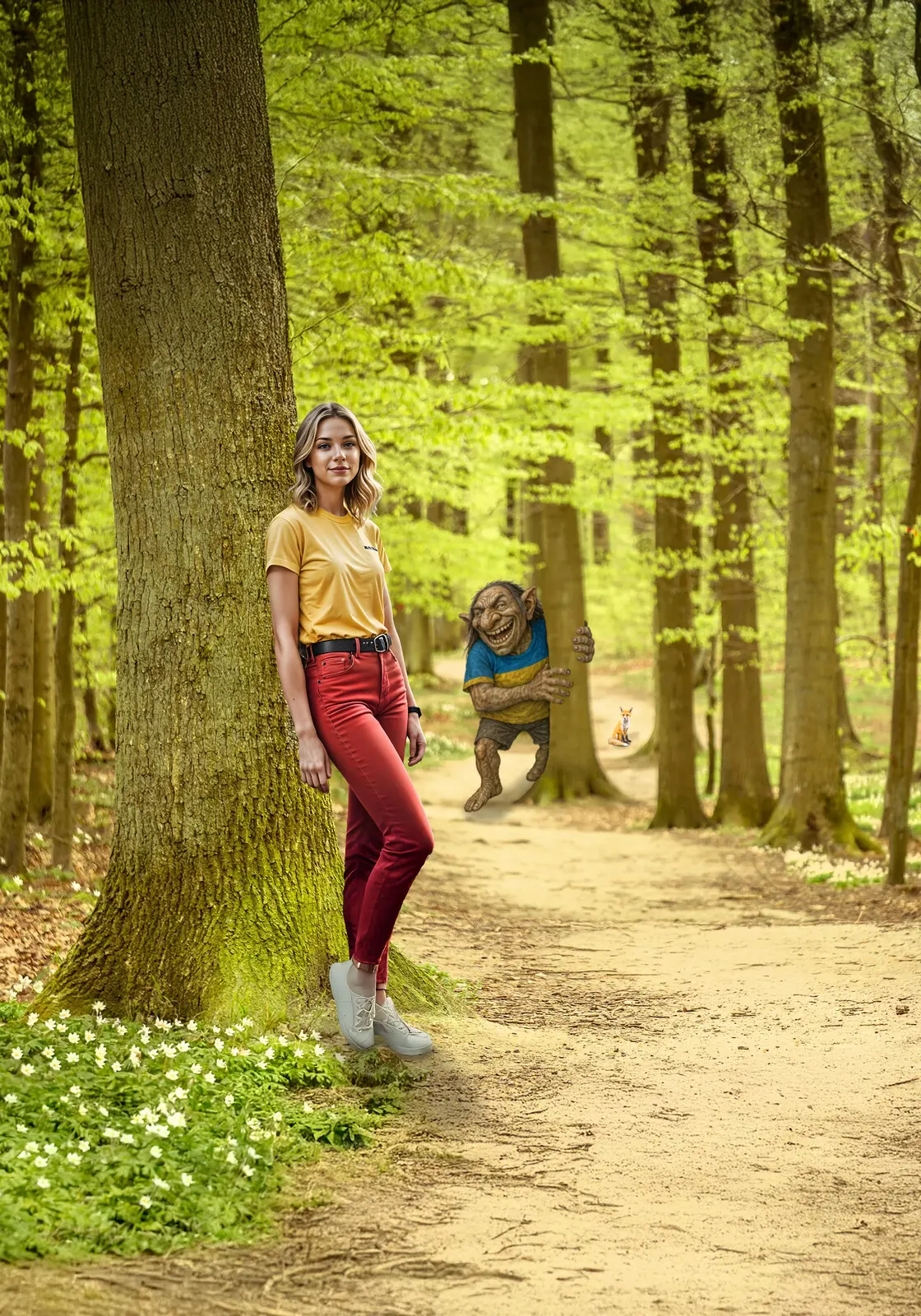
Can't see the forest for the girl., 2025
Digital
50 x 70 cm
3 200 kr
Can't see the forest for the girl.
Some images speak quietly, others in riddles — and a few beckon us into subtle revelations. This picture from Bokskogen, just outside Malmö, falls into the last category. At first glance, it appears almost ordinary: a young woman leaning against a tree in the late spring-green light of a Scandinavian forest. But look again. And then once more.
Because in this photograph — partly staged and enchanted — something begins to reveal itself. A proverb comes alive, and our eyes are gently deceived. What do we truly see, and what passes unnoticed?
This essay explores the ideas of perspective, attention, and the unseen, examining how we sometimes miss the forest for the trees, but also for the girl.
“What You Miss in Bokskogen
You saw her —
in yellow and red,
a sunbeam stitched into denim and breath.
Leaning like a secret
against a tree
that has stood for two hundred years.
But did you see
the fox in boots,
with a pocket watch and a sly regret
as he vanished behind the roots?
Did you hear
the fiddle-tune
from the brook where the Nixie
now wears a baseball cap
and hums ABBA sitting in the moss?
Did you notice
the fairy-ring of violets
where wild hares bow to the moonlight
and a tiny choir of frogs rehearse
for the rain?
Did you smell
the ghost of coffee
left by two trolls in flannel shirts
on a log that no one owns?
Did you feel
the shift in air
when the wind passed through
a doorway made of branches
that led to somewhere not on maps?
No?
Then you missed
the elder-tree's whisper,
the hollow under a stone,
the page from a lost Midsummer Dream
still fluttering, near the path.
You saw the girl.
And yes —
she was worth the gaze.
But the forest sighed,
and faded away
while you were blinking.”
Malmö June 2025
Can’t See the Forest for the Girl
– An essay on perspective, perception, and what hides in the woods.
Some expressions cling to us like burrs on socks after a walk in the forest. “Can’t see the forest for the trees” is one of these — a linguistic phrase that stubbornly reappears in conversations about perspective, overview, and the very human tendency to get lost in detail. But what happens when the trees fade into the background, and we no longer see the forest for... a girl?
The scene from Bokskogen, just outside Malmö, captures a moment bathed in the lush green light of early summer. The straight trunks rise like organ pipes in a tranquil cathedral of nature, and the forest floor is scattered with wood anemones like confetti after a silent wedding. In the foreground, a young woman leans casually against a thick tree trunk, dressed in a lemon-yellow T-shirt and deep red trousers — a colour pairing that glows beautifully against the greenery. Incidentally, they are the colours of Skåne. She gazes dreamily towards the viewer, her allure so captivating that it draws us in, her part in this unfolding story unbeknownst to her.
And that’s the thing: she captures our gaze. So completely that we may fail to notice what’s happening in the background — and no, I’m not talking about the curious fox.
Because just behind her, half-concealed by a tree, stands a troll-like figure in a blue and yellow shirt, with pointed ears and a mischievous glint in his eye. He doesn’t seem to belong to the same world as the girl — more like a resident of another realm entirely, a folkloric layer where strange beings still linger among the trees. Behind him, barely visible, a small fox strikes a pose, as if Beatrix Potter had misplaced one of her characters in Skåne. These unexpected elements add a layer of surprise and intrigue to the image.
And here we are. We’ve stared ourselves blind at the girl by the tree. She’s the one who’s captured us — with her colours, her calm, her beauty, her grounded realism. So much so that we missed the troll, the fox, and perhaps even the forest itself. The old saying gains new meaning: we didn’t see the forest for the girl.
Enchanted by the Obvious
In our visual culture, we’re trained to immediately direct our attention towards people—human faces, especially harmonious ones, often take precedence over background, context, and sometimes even narrative. The composition of the image — central focus, contrasting colour, foreground versus background — leads us straight into the trap.
But it’s not just a visual phenomenon; it’s psychological. We tend to interpret the world through what’s most graspable, most familiar, most attractive. We cling to what reflects ourselves, often ignoring the subtle details that move at the periphery. Like a troll. Or a fox. Or a more profound truth. This psychological aspect of our perception invites us to reflect on our habits of seeing and understanding, prompting us to examine our perceptions more closely.
The Forest as Place and Metaphor
Bokskogen, located outside Malmö, is more than just a place; it’s a symbol. It stands for everything we don’t see unless we pause—the collective, the slow-growing, the organic things that surround us without demanding our attention. The forest is there, whether or not we look. But what happens when we only see the tree — or the girl? This image serves as a reminder of the importance of noticing details, of understanding that every tree, every wood anemone, every unexpected creature carries its own story. It encourages us to be more observant, to look beyond the obvious, and to appreciate the beauty of the unseen.
In this image, the forest becomes more than a backdrop. It becomes a reminder that every tree, every wood anemone, every detail, every unexpected creature carries its own story. Perhaps we need to see both the girl and the troll to understand what lies before us truly. And let’s not forget the little fox.
The Conclusion: Both-And, Not Either-Or
To not see the woods for the trees — or the girl, in this case — is a choice, but also a habit. This image gently interrupts that habit. It invites us to see again, to be captivated by beauty, and then offers a chance to notice something more — a forest adventure with a wink, a visual prank, a nod from the unseen.
So the next time you walk through Bokskogen, one of Malmö’s parks, or the metaphorical woods of your own life, stop. Look at the girl, of course. But don’t forget — there may be a fox in a hat behind the next tree. And a troll giggling at the fact that you passed him by, without even noticing. The forest hides many secrets behind its trees, even if you don’t believe in trolls. And bear in mind — these days, even the forest spirits have updated their wardrobes. The wood-nymph wears jeans and a T-shirt, the elves have swapped flower crowns for sneakers, and old Näcken now struts around in a baseball cap.
Jörgen Thornberg
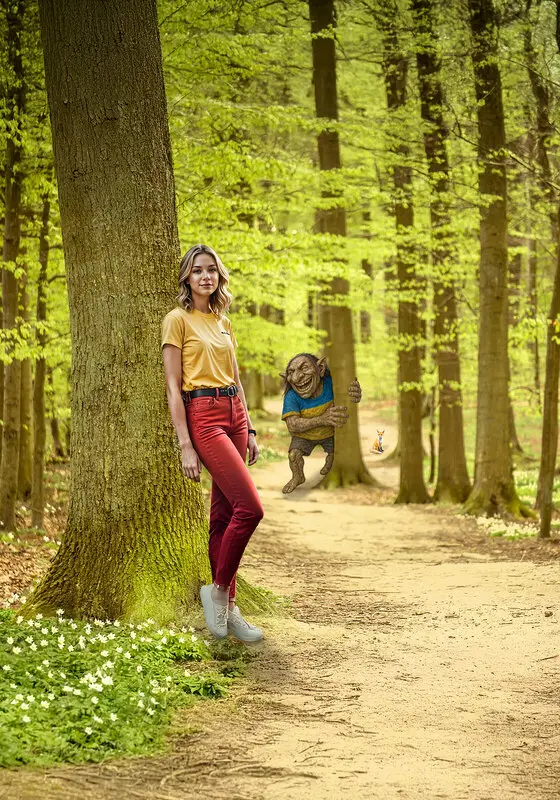
Can't see the forest for the girl., 2025
Digital
50 x 70 cm
3 200 kr
Can't see the forest for the girl.
Some images speak quietly, others in riddles — and a few beckon us into subtle revelations. This picture from Bokskogen, just outside Malmö, falls into the last category. At first glance, it appears almost ordinary: a young woman leaning against a tree in the late spring-green light of a Scandinavian forest. But look again. And then once more.
Because in this photograph — partly staged and enchanted — something begins to reveal itself. A proverb comes alive, and our eyes are gently deceived. What do we truly see, and what passes unnoticed?
This essay explores the ideas of perspective, attention, and the unseen, examining how we sometimes miss the forest for the trees, but also for the girl.
“What You Miss in Bokskogen
You saw her —
in yellow and red,
a sunbeam stitched into denim and breath.
Leaning like a secret
against a tree
that has stood for two hundred years.
But did you see
the fox in boots,
with a pocket watch and a sly regret
as he vanished behind the roots?
Did you hear
the fiddle-tune
from the brook where the Nixie
now wears a baseball cap
and hums ABBA sitting in the moss?
Did you notice
the fairy-ring of violets
where wild hares bow to the moonlight
and a tiny choir of frogs rehearse
for the rain?
Did you smell
the ghost of coffee
left by two trolls in flannel shirts
on a log that no one owns?
Did you feel
the shift in air
when the wind passed through
a doorway made of branches
that led to somewhere not on maps?
No?
Then you missed
the elder-tree's whisper,
the hollow under a stone,
the page from a lost Midsummer Dream
still fluttering, near the path.
You saw the girl.
And yes —
she was worth the gaze.
But the forest sighed,
and faded away
while you were blinking.”
Malmö June 2025
Can’t See the Forest for the Girl
– An essay on perspective, perception, and what hides in the woods.
Some expressions cling to us like burrs on socks after a walk in the forest. “Can’t see the forest for the trees” is one of these — a linguistic phrase that stubbornly reappears in conversations about perspective, overview, and the very human tendency to get lost in detail. But what happens when the trees fade into the background, and we no longer see the forest for... a girl?
The scene from Bokskogen, just outside Malmö, captures a moment bathed in the lush green light of early summer. The straight trunks rise like organ pipes in a tranquil cathedral of nature, and the forest floor is scattered with wood anemones like confetti after a silent wedding. In the foreground, a young woman leans casually against a thick tree trunk, dressed in a lemon-yellow T-shirt and deep red trousers — a colour pairing that glows beautifully against the greenery. Incidentally, they are the colours of Skåne. She gazes dreamily towards the viewer, her allure so captivating that it draws us in, her part in this unfolding story unbeknownst to her.
And that’s the thing: she captures our gaze. So completely that we may fail to notice what’s happening in the background — and no, I’m not talking about the curious fox.
Because just behind her, half-concealed by a tree, stands a troll-like figure in a blue and yellow shirt, with pointed ears and a mischievous glint in his eye. He doesn’t seem to belong to the same world as the girl — more like a resident of another realm entirely, a folkloric layer where strange beings still linger among the trees. Behind him, barely visible, a small fox strikes a pose, as if Beatrix Potter had misplaced one of her characters in Skåne. These unexpected elements add a layer of surprise and intrigue to the image.
And here we are. We’ve stared ourselves blind at the girl by the tree. She’s the one who’s captured us — with her colours, her calm, her beauty, her grounded realism. So much so that we missed the troll, the fox, and perhaps even the forest itself. The old saying gains new meaning: we didn’t see the forest for the girl.
Enchanted by the Obvious
In our visual culture, we’re trained to immediately direct our attention towards people—human faces, especially harmonious ones, often take precedence over background, context, and sometimes even narrative. The composition of the image — central focus, contrasting colour, foreground versus background — leads us straight into the trap.
But it’s not just a visual phenomenon; it’s psychological. We tend to interpret the world through what’s most graspable, most familiar, most attractive. We cling to what reflects ourselves, often ignoring the subtle details that move at the periphery. Like a troll. Or a fox. Or a more profound truth. This psychological aspect of our perception invites us to reflect on our habits of seeing and understanding, prompting us to examine our perceptions more closely.
The Forest as Place and Metaphor
Bokskogen, located outside Malmö, is more than just a place; it’s a symbol. It stands for everything we don’t see unless we pause—the collective, the slow-growing, the organic things that surround us without demanding our attention. The forest is there, whether or not we look. But what happens when we only see the tree — or the girl? This image serves as a reminder of the importance of noticing details, of understanding that every tree, every wood anemone, every unexpected creature carries its own story. It encourages us to be more observant, to look beyond the obvious, and to appreciate the beauty of the unseen.
In this image, the forest becomes more than a backdrop. It becomes a reminder that every tree, every wood anemone, every detail, every unexpected creature carries its own story. Perhaps we need to see both the girl and the troll to understand what lies before us truly. And let’s not forget the little fox.
The Conclusion: Both-And, Not Either-Or
To not see the woods for the trees — or the girl, in this case — is a choice, but also a habit. This image gently interrupts that habit. It invites us to see again, to be captivated by beauty, and then offers a chance to notice something more — a forest adventure with a wink, a visual prank, a nod from the unseen.
So the next time you walk through Bokskogen, one of Malmö’s parks, or the metaphorical woods of your own life, stop. Look at the girl, of course. But don’t forget — there may be a fox in a hat behind the next tree. And a troll giggling at the fact that you passed him by, without even noticing. The forest hides many secrets behind its trees, even if you don’t believe in trolls. And bear in mind — these days, even the forest spirits have updated their wardrobes. The wood-nymph wears jeans and a T-shirt, the elves have swapped flower crowns for sneakers, and old Näcken now struts around in a baseball cap.
3 200 kr

Jörgen Thornberg
Malmö
Lite om bilder och mig. Translation in English at the end.
Jag är en nyfiken person som ser allt i bilder, även det jag fäster i ord, gärna tillsammans för bakom alla mina bilder finns en berättelse. Till vissa bilder hör en kortare eller längre novell som följer med bilden.
Bilder berättar historier. Jag omges av naturlig skönhet, intressanta människor och historia var jag än går. Jag använder min kamera för att dokumentera världen och blanda det jag ser med vad jag känner för att fånga den dolda magin.
Mina bilder berättar mina historier. Genom mina bilder, tryck och berättelser. Jag bjuder in dig att ta del av dessa berättelser, in i ditt liv och hem och dela min mycket personliga syn på vår värld. Mer än vad ögat ser. Jag tänker i bilder, drömmer och skriver och pratar om dem; följaktligen måste jag också skapa bilder. De blir vad jag ser, inte nödvändigtvis begränsade till verkligheten. Det finns en bild runt varje hörn. Jag hoppas att du kommer att se vad jag såg och gilla det.
Jag är också en skrivande person och till många bilder hör en kortare eller längre essay. Den följer med tavlan, tryckt på fint papper och med en personlig hälsning från mig.
Flertalet bilder startar sin resa i min kamera. Enkelt förklarat beskriver jag bilden jag ser i mitt inre, upplevd eller fantiserad. Bilden uppstår inom mig redan innan jag fått okularet till ögat. På bråkdelen av ett ögonblick ser jag vad jag vill ha och vad som kan göras med bilden. Här skall jag stoppa in en giraff, stålmannen, Titanic eller vad det är min fantasi finner ut. Ännu märkligare är att jag kommer ihåg minnesbilden långt efteråt när det blir tid att skapa verket. Om jag lyckas eller inte, är upp till betraktaren, oftast präglat av en stråk av svart humor – meningen är att man skall bli underhållen. Mina bilder blir ofta en snackis där de hänger.
Jag föredrar bilder som förmedlar ett budskap i flera lager. Vid första anblicken fylld av feel-good, en vacker utsikt, fint väder, solen skiner, blommor på ängen eller vattnet som ligger förrädiskt spegelblankt. I en sådan bild kan jag gömma min egentliga berättelse, mitt förakt för förtryckare och våldsverkare, rasister och fördomsfulla människor - ett gärna återkommande motiv mer eller mindre dolt i det vackra motivet. Jag försöker förena dem i ett gemensamt narrativ.
Bild och formgivning har löpt som en röd tråd genom livet. Fotokonst känns som en värdig final som jag gärna delar med mig.
Min genre är vid som framgår av mina bilder, temat en blandning av pop- och gatukonst i kollage som kan bestå av hundratals lager. Vissa bilder kan ta veckor, andra någon dag innan det är dags att överlämna resultatet till printverkstaden. Fine Art Prints är digitala fotocollage. I dessa kollage sker rivandet, klippandet, pusslandet, målandet, ritandet och sprayningen digitalt. Det jag monterar in kan vara hundratals år gamla bilder som jag omsorgsfullt frilägger så att de ser ut att vara en del av tavlan men också bilder skapade av mig själv efter min egen fantasi. Därefter besöks printstudion och för vissa bilder numrera en limiterad upplaga (oftast 7 exemplar) och signera för hand. Vissa bilder kan köpas i olika format. Det är bara att fråga efter vilka. Gillar man en bild som är 70x100 men inte har plats på väggen, går den kanske att få i 50x70 cm istället. Frågan är fri.
Metoden Giclée eller Fine Art Print som det också kallas är det moderna sättet för framställning av grafisk konst. Villkoret för denna typ av utskrifter är att en högkvalitativ storformatskrivare används med åldersbeständigt färgpigment och konstnärspapper eller i förekommande fall på duk. Pappret som används möter de krav på livslängd som ställs av museer och gallerier. Normalt säljer jag mina bilder oinramade så att den nya ägaren själv kan bestämma hur de skall se ut, med eller utan passepartout färg på ram, med eller utan glas etc..
Under många år ställde jag bara ut på nätet, i valda grupper och på min egen Facebooksida - https://www.facebook.com/jorgen.thornberg.9
Jag finns också på en egen hemsida som tyvärr inte alltid är uppdaterad – https://www.jth.life/ Där kan du också läsa en del av de berättelser som följer med bilden.
UTSTÄLLNINGAR
Luftkastellet, oktober 2022
Konst i Lund, november 2022
Luftkastellet, mars 2023
Engleson Galleri Caroli, april 2023
Hydra, Greece June 2023
Engleson Galleri Caroli, oktober 2023
Toppen, Höllviken december 2023
Luftkastellet, mars 2024
Torups Galleri, mars 2024
Venice, May 2024
Luftkastellet, oktober 2024
Konst i Advent, December 2024
Galleri Engleson, Caroli December 2024
Jäger & Jansson Galleri, april 2025
A bit about pictures and me.
I'm a curious person who sees everything in pictures, even what I express in words, often combining them, for behind all my pictures lies a story. These narratives, some as short as a single image and others as long as a novel, are the heart and soul of my work.
Pictures tell stories. Wherever I go, I'm surrounded by natural beauty, exciting people, and history. I use my camera to document the world and blend what I see with what I feel to capture the hidden magic.
My images tell my stories. Through my pictures, prints, and narratives, I invite you to partake in these stories in your life and home and share my deeply personal perspective of our world. More than meets the eye. I think in pictures, dream, write, and talk about them; consequently, I must create images too. They become what I see, not necessarily confined to reality. There's a picture around every corner. I hope you'll see what I saw and enjoy it.
I'm also a writer, and many images come with a shorter or longer essay. It accompanies the painting, printed on fine paper with my personal greeting.
Many pictures start their journey on my camera. Simply put, I describe the image I see in my mind, experienced or imagined. The image arises within me even before I bring the eyepiece to my eye. In a fraction of a moment, I see what I want and what can be done with the picture. Here, I'll insert a giraffe, Superman, the Titanic, or whatever my imagination conjures up. Even stranger is that I remember the mental image long after it's time to create the work. Whether I succeed is up to the observer, often imbued with a streak of black humour – the aim is to entertain. My pictures usually become a talking point wherever they hang.
I prefer pictures that convey a message in multiple layers. At first glance, they're filled with feel-good vibes, a beautiful view, lovely weather, the sun shining, flowers in the meadow, or the water lying deceptively calm. But beneath this surface beauty, I often conceal a deeper story, a narrative that challenges societal norms or explores the human condition. I invite you to delve into these hidden narratives and discover the layers of meaning within my work.
Picture and design have been a thread running through my life. Photographic art feels like a fitting finale, and I'm happy to share it.
My genre is varied, as seen in my pictures; the theme is a blend of pop and street art in collages that can consist of hundreds of layers. Some images can take weeks, others just a day before it's time to hand over the result to the print workshop. Fine Art Prints are digital photo collages. In these collages, tearing, cutting, puzzling, painting, drawing, and spraying happen digitally. What I insert can be images hundreds of years old that I carefully extract so they appear to be part of the painting, but also images created by myself, now also generated from my imagination. Next, visit the print studio and, for certain images, number a limited edition (usually 7 copies) and sign them by hand. Some images may be available in other formats. Just ask which ones. If you like an image that's 70x100 but doesn't have space on the wall, you might be able to get it in 50x70 cm instead. The question is open.
The Giclée method, or Fine Art Print as it's also called, is the modern way of producing graphic art. This method ensures the highest quality and longevity of the artwork, using a high-quality large-format printer with archival pigment inks and artist paper or, in some cases, canvas. The paper used meets the longevity requirements set by museums and galleries. I sell my pictures unframed, allowing the new owner to personalise their artwork, confident in the lasting value and quality of the piece.
For many years, I only exhibited online, in selected groups, and on my Facebook page - https://www.facebook.com/jorgen.thornberg.9. I also have my website, which unfortunately is not constantly updated - https://www.jth.life/. You can also read some of the stories accompanying the pictures there.
EXHIBITIONS
Luftkastellet, October 2022
Art in Lund, November 2022
Luftkastellet, March 2023
Engleson Gallery Caroli, April 2023
Hydra, Greece June 2023
Engleson Gallery Caroli, October 2023
Toppen, Höllviken December 2023
Luftkastellet, March 2024
Torup Gallery, March 2024
Venice, May 2024
UTSTÄLLNINGAR
Luftkastellet, oktober 2022
Konst i Lund, november 2022
Luftkastellet, mars 2023
Engleson Galleri Caroli, april 2023
Hydra, Greece June 2023
Engleson Galleri Caroli, oktober 2023
Toppen, Höllviken december 2023
Luftkastellet, mars 2024
Torups Galleri, mars 2024
Venice, May 2024
Luftkastellet, October 2024
Konst i Advent, December 2024
Galleri Engleson, Caroli December 2024
Jäger & Jansson Galleri, April 2025
Utbildning
Autodidakt
Medlem i konstnärsförening
Öppna Sinnen
Med i konstrunda
Konstrundan i Skåne
Utställningar
Luftkastellet, October 2022
Art in Lund, November 2022
Luftkastellet, March 2023
Engleson Gallery Caroli, April 2023
Hydra, Greece June 2023
Engleson Gallery Caroli, October 2023
Toppen, Höllviken December 2023
Luftkastellet, March 2024
Torup Gallery, March 2024
Venice, May 2024