Vi använder cookies för att ge dig bästa möjliga upplevelse. Välj vilka cookies du tillåter.
Läs mer i vår integritetspolicy
Jörgen Thornberg
I let you go — now go help the world, 2025
Digital
50 x 70 cm
3 200 kr
I let you go — now go help the world
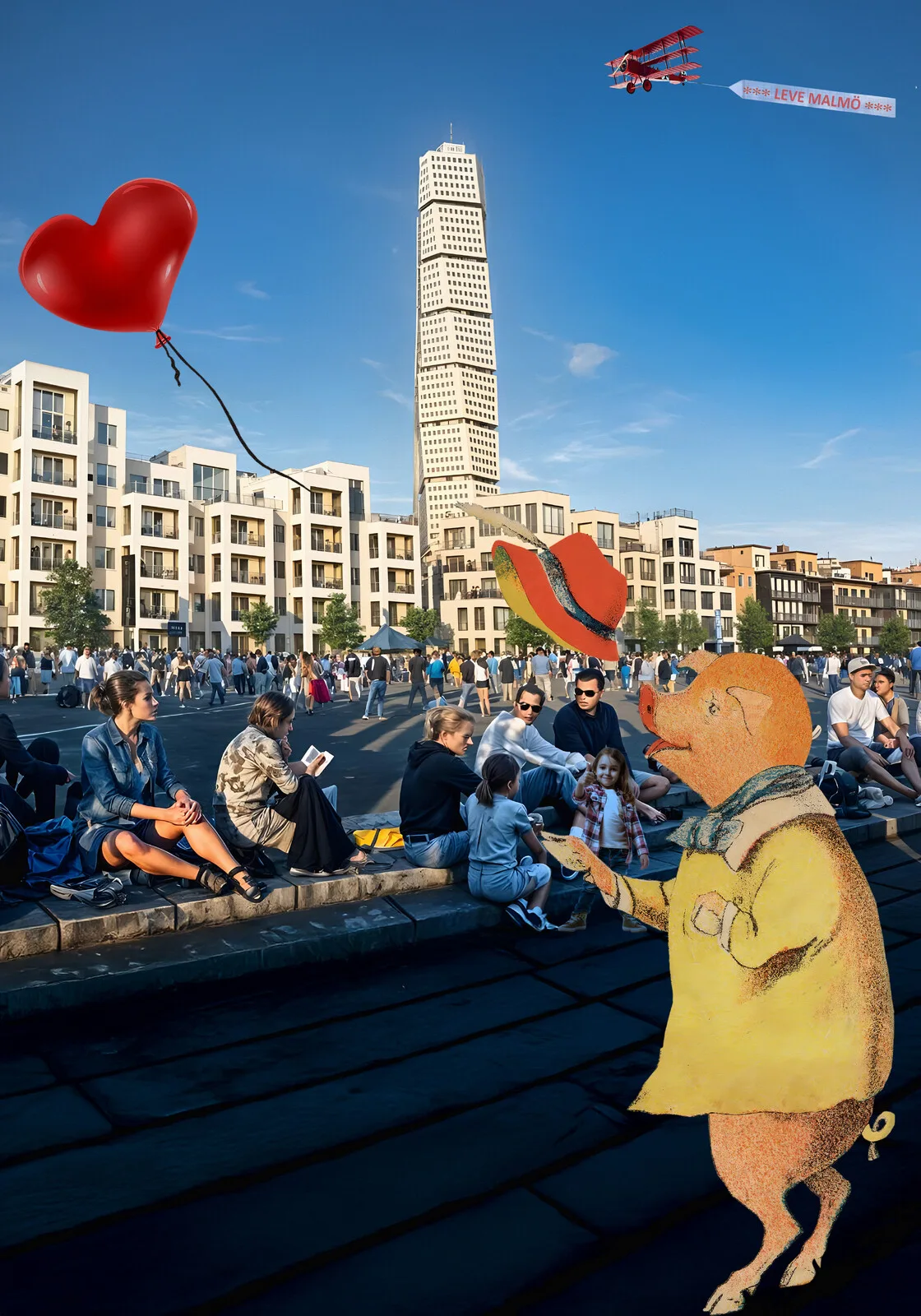
It started with a balloon. Not a weapon, speech, or protest sign – just a red, heart-shaped balloon, gently swaying in the hand of a girl dressed for Sunday. While others laughed, posed for photos, stared at their screens, or turned their faces to the sun, she stood still. And then let go.
Some may argue that the balloon drifted off by mistake. But I was there. I saw her hand release the string. I saw the young girl behind her smile and raise her thumb. I witnessed a small gesture that carried a profound message: “Go now. Carry something bigger than me.”
This isn’t just about a balloon. It’s about how we overlook what truly matters, again and again, how the loudest voices drown out the quietest courage. It's about how a girl in a yellow coat, with her remarkable clarity, might have more insight than all of us combined.
So yes – this is a tribute to Banksy, a renowned artist who often uses simple, everyday objects to convey powerful messages. But it is also a tribute to a child who lets go to free something, just as Banksy's art often frees us from our preconceptions.
“A victorious flight
It rose like a whisper,
not shouted,
not forced—
but carried
on the soft breath of a Sunday wind.
Above Västra Hamnen
where seagulls looped and laughter echoed,
the red heart sailed
past towers and rooftops,
past ice cream queues and arguments,
past “likes” and sunglasses
and the man on the bench who never looked up.
Pigsy stood still,
one paw lifted,
lipstick smudged by the sea breeze.
She didn’t wave.
She didn’t need to.
The balloon knew where to go.
Over cranes and cathedrals,
over borders drawn with trembling hands,
it drifted past watchtowers,
through smog and scripture,
across checkpoints and broken domes
where little girls whisper in languages
no one listens to.
It passed a girl in Tehran
who blinked up once
before hiding her eyes again.
A child in Donetsk
saw the red flicker
and thought—just for a moment—
of cherries in June.
In Kabul, the wind caught it
between gunshots and the prayer call
and lifted it higher.
It is still flying.
Over oceans.
Through missiles.
Above headlines.
A heart-shaped thing
from a small yellow coat
with enough courage
to disobey gravity
and carry love
as if it were
a weapon of light.”
Malmö July 2025
I let you go — now go help the world.
Pigsy lets her balloon go. It’s my tribute to Banksy, but much more than that. There’s an ongoing debate about whether the girl in Banksy’s image accidentally loses her balloon and feels sad, or whether, as in my image, she consciously lets it go so that it can drift out into the world and spread a message of freedom. This debate, rooted in the interpretation of art, is a fascinating exploration of the power of perception and the potential for art to convey multiple meanings.
Everyone in the picture is completely absorbed in themselves, their families, friends, or they glance absentmindedly at the aeroplane above, buzzing past with an advert for Malmö. This advert, a symbol of consumerism and the distractions of modern life, contrasts with the girl's act of releasing the balloon, creating a powerful social commentary. It’s a public celebration – unclear what for – but Västra Hamnen and the Sundspromenad were truly filled with people.
In the centre of the image, half hidden behind Pigsy, the piglet girl, stands the little girl with a warm smile and a thumbs-up. She’s dressed in jeans and plaid, and her gaze isn’t directed at the crowd, Turning Torso, or even the balloon, but straight at the piglet girl. Her presence, with her warm smile and encouraging gesture, serves as a reminder of the importance of awareness and support in the pursuit of freedom. She sees something no one else seems to notice.
The girl is the witness, the affirmation, and the hope that wants to change the world. Her hope is palpable, inspiring the audience. It becomes a story about how someone sees you when you do what’s right, even if the world seems busy with other things. That small act of courage echoes.
She’s the only one who truly sees Pigsy, the Piglet Girl. And she cares. Everyone else is busy with their phones, each other, a book, or simply the sunshine, because it’s a day of celebration. But she, the little girl in the plaid shirt, meets Pigsy’s eyes and wants her gesture to say: “I understand you. What you’re doing matters.” Her simple act of empathy, in a world where many are indifferent to the suffering of others, is a powerful reminder of our shared humanity. It's a testament to the transformative power of empathy, connecting us all in our shared human experience.
Because the image conveys something much greater than hundreds of people, the promenade, Västra Hamnen, or Malmö, it shows how humans constantly manage to miss what is truly happening. It's a stark reminder of the importance of noticing societal issues and the weight of our inaction when we fail to do so. It's a call to action, urging us to be vigilant and responsible in our society.
In the 1930s, people missed the rise of fascism and looked the other way while the Nazis murdered millions – Jews, Roma, people with disabilities, and other minorities deemed unworthy of life. We must not repeat this historical indifference. We must learn from it and act. It's a stark lesson from history, motivating us to be informed and vigilant in our present.
It keeps happening: now Russia is attacking an innocent neighbour, Ukraine, bombing homes and schools. And in Iran, the regime is steadily building a nuclear bomb to annihilate its enemies, while people are preoccupied with simply living.
History repeats itself like a Dantean hell without end:
“They had their faces twisted toward their haunches
and found it necessary to walk backwards,
because they could not see ahead of them.
... and since he wanted so to see ahead,
He looks behind and walks a backwards path.”
Dante Alighieri’s poem may have influenced Banksy. Allegorically, the Renaissance poet’s Inferno depicts a poor soul recognising sin for what it truly is. Dante’s beasts symbolise various forms of evil, such as gluttony, violence, and malice, which are powerful forces behind much of what Banksy fights against.
Banksy, the Balloon, and the Fight for Freedom
It's a mystery whether the elusive artist has ever set foot in Malmö and Västra Hamnen. His work was showcased some years ago at Amiralen. If he had indeed visited, he left no trace, leaving us with a lingering curiosity about his possible presence.
Years ago, hardly a brick wall remained in the old Kockums district that hadn’t been scribbled on. But not by Banksy. Most of the old workshops have now been demolished or renovated, and the walls are clean and tidy. Here and there, remnants of old Kockums murals remain – unwanted and small, and they could have been more inventive.
If Banksy were to make an appearance, there's a chance his 'Girl with Balloon' would be embraced. It carries a potent message of love, instilling a sense of hope in the hearts of those who come across it.
But the question lingers: did the girl lose her balloon to the wind, or did she release it with intent? I can say with certainty: it was a deliberate act.
In my version, a little piglet girl – Pigsy – had stopped on her way to “Titanic,” the lookout point overlooking the Öresund and the world. It was one of those wonderful early summer days.
She looked happy in her new yellow coat and her neat feathered hat. It must have been a Sunday – she’d painted her nails and put on red lipstick. In her right hand, she held a red, heart-shaped balloon. It swayed lazily in the soft breeze.
Far in the distance stood Suell on his statue, with his all-seeing gaze. Pigsy paused and pondered. She turned her head, searching for Suell’s distant eyes. The statue seemed to nod. She turned back towards the sea, and a few minutes passed. Then she decided to let the balloon go.
I could see the distant admiral nod again – this time with a pleased smile. He once built a genuine harbour to give Malmö its rightful place in the world and to allow freedom to flow in from beyond.
Why, then, shouldn’t a balloon be released – with a heartfelt message to other cities?
Pigsy wanted it to be a symbol of all the young women in the world who are not free:
Girls in Iran are persecuted and gassed by the regime,
The Russians kidnap girls in eastern Ukraine,
The Taliban enslave girls in Afghanistan.
Pigsy has given much thought to the plight of other girls – she has had the good fortune to be born in a free country, a democracy with a functioning rule of law.e of law.
More than 30 million women and girls have been forced to flee their homes due to war, conflict, and persecution. In Sudan, Chad, the Central African Republic, Mali, and Niger, girls are repeatedly killed by Islamist extremists. They are fleeing for their lives.
A girl on the run is highly vulnerable, and being forced to leave home and live in unfamiliar places can be life-threatening. Many more around the world face systematic hate crimes and persecution. That's why Pigsy let the balloon go.
Learn more about Pigsy's decision – and about Banksy.
Banksy is undoubtedly the unrecognised king of street art. He is a genius and a star artist who moves people by speaking to their souls, with works that are often ironic, political, but always poetic.
Banksy, the enigmatic graffiti artist from Bristol, remains a captivating mystery in the art world. His anonymous identity adds a layer of intrigue to his renowned works, which have consistently made headlines and sparked debate for years.
The exhibition I had the privilege of visiting, The Mystery of Banksy – A Genius Mind, is a comprehensive journey through every aspect of his iconic work. It showcases over 150 reproductions of the acclaimed street artist's creations, inviting viewers to immerse themselves in his masterpieces and use art as a tool for influence and inspiration.
Skilled artists have recreated photographs, graffiti, sculptures, video installations, and prints on various materials, especially for this special exhibition. In line with Banksy's motto, "Copyright is for losers TM," the artist himself has not authorised this tribute due to his anonymous status.
In a moment that stunned the art world, an unframed copy of Girl with Balloon was spontaneously shredded during a Sotheby's auction in 2018. The mechanical device hidden in the frame was revealed to be part of Banksy's plan, and he confirmed his authorship by giving the altered piece a new title: "Love is in the Bin."
Sotheby's declared it "the first artwork in history created during a live auction." The half-shredded piece was later sold for approximately $ 25.40. 4 million in 2021.
Banksy’s girl, a symbol of hope and resilience, has transcended geographical boundaries, appearing in various locations around the world – on Waterloo Bridge and other sites in London, on the West Bank barrier, and in Bethlehem. In March 2014, on the third anniversary of the Syrian war, Banksy reworked the image to depict a Syrian refugee girl and added the hashtag #WithSyria. He had her projected onto the Eiffel Tower and Nelson’s Column, a powerful testament to the global reach of his art.
The artist has explored a wide range of political and social themes – often through various "anti" perspectives, including anti-consumerism, anti-war, anti-fascism, anti-imperialism, anti-authoritarianism, anarchism, nihilism, and existentialism.
His works frequently critique the human condition, including the Seven Deadly Sins – gluttony, greed, sloth, wrath, envy, pride, and lust – alongside his additions: war, injustice, poverty, hypocrisy, boredom, despair, absurdity, and alienation.
But always with love as a counterforce, a beacon of hope in the face of despair.
Love is no sin.
It’s a lengthy list. I feel a kinship with it and will continue my work, as I have for nearly twenty years, creating images with a message I hope resonates with others.
Banksy has donated several works to support various causes. He privately funded a rescue boat to aid refugees in distress on the Mediterranean. The ship was painted pink, featuring a young girl holding a heart-shaped lifebuoy on the side. Banksy is deserving of all this support.
The piglet girl may seem tiny and helpless, but she is clever and must not be underestimated. A balloon, when used correctly, is a powerful weapon – and a symbol of freedom. Pigsy understands that.
Letting the words drift and sail away means more people will receive the message. Like ripples on the water, she will spread her message of love after casting a stone.
She is not religious, but she agrees with the Dalai Lama that love is the only way to overcome all deadly sins. It’s not just common sense, it's a powerful truth that can guide us all.
“O blind cupidity and insane anger,
which goad us on so much in our short life,
then steep us in such grief eternally!”
Jörgen Thornberg
I let you go — now go help the world, 2025
Digital
50 x 70 cm
3 200 kr
I let you go — now go help the world
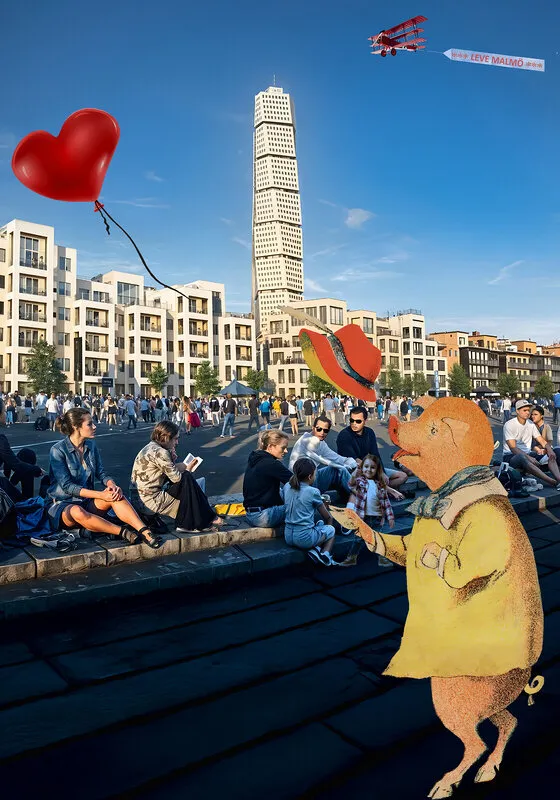
It started with a balloon. Not a weapon, speech, or protest sign – just a red, heart-shaped balloon, gently swaying in the hand of a girl dressed for Sunday. While others laughed, posed for photos, stared at their screens, or turned their faces to the sun, she stood still. And then let go.
Some may argue that the balloon drifted off by mistake. But I was there. I saw her hand release the string. I saw the young girl behind her smile and raise her thumb. I witnessed a small gesture that carried a profound message: “Go now. Carry something bigger than me.”
This isn’t just about a balloon. It’s about how we overlook what truly matters, again and again, how the loudest voices drown out the quietest courage. It's about how a girl in a yellow coat, with her remarkable clarity, might have more insight than all of us combined.
So yes – this is a tribute to Banksy, a renowned artist who often uses simple, everyday objects to convey powerful messages. But it is also a tribute to a child who lets go to free something, just as Banksy's art often frees us from our preconceptions.
“A victorious flight
It rose like a whisper,
not shouted,
not forced—
but carried
on the soft breath of a Sunday wind.
Above Västra Hamnen
where seagulls looped and laughter echoed,
the red heart sailed
past towers and rooftops,
past ice cream queues and arguments,
past “likes” and sunglasses
and the man on the bench who never looked up.
Pigsy stood still,
one paw lifted,
lipstick smudged by the sea breeze.
She didn’t wave.
She didn’t need to.
The balloon knew where to go.
Over cranes and cathedrals,
over borders drawn with trembling hands,
it drifted past watchtowers,
through smog and scripture,
across checkpoints and broken domes
where little girls whisper in languages
no one listens to.
It passed a girl in Tehran
who blinked up once
before hiding her eyes again.
A child in Donetsk
saw the red flicker
and thought—just for a moment—
of cherries in June.
In Kabul, the wind caught it
between gunshots and the prayer call
and lifted it higher.
It is still flying.
Over oceans.
Through missiles.
Above headlines.
A heart-shaped thing
from a small yellow coat
with enough courage
to disobey gravity
and carry love
as if it were
a weapon of light.”
Malmö July 2025
I let you go — now go help the world.
Pigsy lets her balloon go. It’s my tribute to Banksy, but much more than that. There’s an ongoing debate about whether the girl in Banksy’s image accidentally loses her balloon and feels sad, or whether, as in my image, she consciously lets it go so that it can drift out into the world and spread a message of freedom. This debate, rooted in the interpretation of art, is a fascinating exploration of the power of perception and the potential for art to convey multiple meanings.
Everyone in the picture is completely absorbed in themselves, their families, friends, or they glance absentmindedly at the aeroplane above, buzzing past with an advert for Malmö. This advert, a symbol of consumerism and the distractions of modern life, contrasts with the girl's act of releasing the balloon, creating a powerful social commentary. It’s a public celebration – unclear what for – but Västra Hamnen and the Sundspromenad were truly filled with people.
In the centre of the image, half hidden behind Pigsy, the piglet girl, stands the little girl with a warm smile and a thumbs-up. She’s dressed in jeans and plaid, and her gaze isn’t directed at the crowd, Turning Torso, or even the balloon, but straight at the piglet girl. Her presence, with her warm smile and encouraging gesture, serves as a reminder of the importance of awareness and support in the pursuit of freedom. She sees something no one else seems to notice.
The girl is the witness, the affirmation, and the hope that wants to change the world. Her hope is palpable, inspiring the audience. It becomes a story about how someone sees you when you do what’s right, even if the world seems busy with other things. That small act of courage echoes.
She’s the only one who truly sees Pigsy, the Piglet Girl. And she cares. Everyone else is busy with their phones, each other, a book, or simply the sunshine, because it’s a day of celebration. But she, the little girl in the plaid shirt, meets Pigsy’s eyes and wants her gesture to say: “I understand you. What you’re doing matters.” Her simple act of empathy, in a world where many are indifferent to the suffering of others, is a powerful reminder of our shared humanity. It's a testament to the transformative power of empathy, connecting us all in our shared human experience.
Because the image conveys something much greater than hundreds of people, the promenade, Västra Hamnen, or Malmö, it shows how humans constantly manage to miss what is truly happening. It's a stark reminder of the importance of noticing societal issues and the weight of our inaction when we fail to do so. It's a call to action, urging us to be vigilant and responsible in our society.
In the 1930s, people missed the rise of fascism and looked the other way while the Nazis murdered millions – Jews, Roma, people with disabilities, and other minorities deemed unworthy of life. We must not repeat this historical indifference. We must learn from it and act. It's a stark lesson from history, motivating us to be informed and vigilant in our present.
It keeps happening: now Russia is attacking an innocent neighbour, Ukraine, bombing homes and schools. And in Iran, the regime is steadily building a nuclear bomb to annihilate its enemies, while people are preoccupied with simply living.
History repeats itself like a Dantean hell without end:
“They had their faces twisted toward their haunches
and found it necessary to walk backwards,
because they could not see ahead of them.
... and since he wanted so to see ahead,
He looks behind and walks a backwards path.”
Dante Alighieri’s poem may have influenced Banksy. Allegorically, the Renaissance poet’s Inferno depicts a poor soul recognising sin for what it truly is. Dante’s beasts symbolise various forms of evil, such as gluttony, violence, and malice, which are powerful forces behind much of what Banksy fights against.
Banksy, the Balloon, and the Fight for Freedom
It's a mystery whether the elusive artist has ever set foot in Malmö and Västra Hamnen. His work was showcased some years ago at Amiralen. If he had indeed visited, he left no trace, leaving us with a lingering curiosity about his possible presence.
Years ago, hardly a brick wall remained in the old Kockums district that hadn’t been scribbled on. But not by Banksy. Most of the old workshops have now been demolished or renovated, and the walls are clean and tidy. Here and there, remnants of old Kockums murals remain – unwanted and small, and they could have been more inventive.
If Banksy were to make an appearance, there's a chance his 'Girl with Balloon' would be embraced. It carries a potent message of love, instilling a sense of hope in the hearts of those who come across it.
But the question lingers: did the girl lose her balloon to the wind, or did she release it with intent? I can say with certainty: it was a deliberate act.
In my version, a little piglet girl – Pigsy – had stopped on her way to “Titanic,” the lookout point overlooking the Öresund and the world. It was one of those wonderful early summer days.
She looked happy in her new yellow coat and her neat feathered hat. It must have been a Sunday – she’d painted her nails and put on red lipstick. In her right hand, she held a red, heart-shaped balloon. It swayed lazily in the soft breeze.
Far in the distance stood Suell on his statue, with his all-seeing gaze. Pigsy paused and pondered. She turned her head, searching for Suell’s distant eyes. The statue seemed to nod. She turned back towards the sea, and a few minutes passed. Then she decided to let the balloon go.
I could see the distant admiral nod again – this time with a pleased smile. He once built a genuine harbour to give Malmö its rightful place in the world and to allow freedom to flow in from beyond.
Why, then, shouldn’t a balloon be released – with a heartfelt message to other cities?
Pigsy wanted it to be a symbol of all the young women in the world who are not free:
Girls in Iran are persecuted and gassed by the regime,
The Russians kidnap girls in eastern Ukraine,
The Taliban enslave girls in Afghanistan.
Pigsy has given much thought to the plight of other girls – she has had the good fortune to be born in a free country, a democracy with a functioning rule of law.e of law.
More than 30 million women and girls have been forced to flee their homes due to war, conflict, and persecution. In Sudan, Chad, the Central African Republic, Mali, and Niger, girls are repeatedly killed by Islamist extremists. They are fleeing for their lives.
A girl on the run is highly vulnerable, and being forced to leave home and live in unfamiliar places can be life-threatening. Many more around the world face systematic hate crimes and persecution. That's why Pigsy let the balloon go.
Learn more about Pigsy's decision – and about Banksy.
Banksy is undoubtedly the unrecognised king of street art. He is a genius and a star artist who moves people by speaking to their souls, with works that are often ironic, political, but always poetic.
Banksy, the enigmatic graffiti artist from Bristol, remains a captivating mystery in the art world. His anonymous identity adds a layer of intrigue to his renowned works, which have consistently made headlines and sparked debate for years.
The exhibition I had the privilege of visiting, The Mystery of Banksy – A Genius Mind, is a comprehensive journey through every aspect of his iconic work. It showcases over 150 reproductions of the acclaimed street artist's creations, inviting viewers to immerse themselves in his masterpieces and use art as a tool for influence and inspiration.
Skilled artists have recreated photographs, graffiti, sculptures, video installations, and prints on various materials, especially for this special exhibition. In line with Banksy's motto, "Copyright is for losers TM," the artist himself has not authorised this tribute due to his anonymous status.
In a moment that stunned the art world, an unframed copy of Girl with Balloon was spontaneously shredded during a Sotheby's auction in 2018. The mechanical device hidden in the frame was revealed to be part of Banksy's plan, and he confirmed his authorship by giving the altered piece a new title: "Love is in the Bin."
Sotheby's declared it "the first artwork in history created during a live auction." The half-shredded piece was later sold for approximately $ 25.40. 4 million in 2021.
Banksy’s girl, a symbol of hope and resilience, has transcended geographical boundaries, appearing in various locations around the world – on Waterloo Bridge and other sites in London, on the West Bank barrier, and in Bethlehem. In March 2014, on the third anniversary of the Syrian war, Banksy reworked the image to depict a Syrian refugee girl and added the hashtag #WithSyria. He had her projected onto the Eiffel Tower and Nelson’s Column, a powerful testament to the global reach of his art.
The artist has explored a wide range of political and social themes – often through various "anti" perspectives, including anti-consumerism, anti-war, anti-fascism, anti-imperialism, anti-authoritarianism, anarchism, nihilism, and existentialism.
His works frequently critique the human condition, including the Seven Deadly Sins – gluttony, greed, sloth, wrath, envy, pride, and lust – alongside his additions: war, injustice, poverty, hypocrisy, boredom, despair, absurdity, and alienation.
But always with love as a counterforce, a beacon of hope in the face of despair.
Love is no sin.
It’s a lengthy list. I feel a kinship with it and will continue my work, as I have for nearly twenty years, creating images with a message I hope resonates with others.
Banksy has donated several works to support various causes. He privately funded a rescue boat to aid refugees in distress on the Mediterranean. The ship was painted pink, featuring a young girl holding a heart-shaped lifebuoy on the side. Banksy is deserving of all this support.
The piglet girl may seem tiny and helpless, but she is clever and must not be underestimated. A balloon, when used correctly, is a powerful weapon – and a symbol of freedom. Pigsy understands that.
Letting the words drift and sail away means more people will receive the message. Like ripples on the water, she will spread her message of love after casting a stone.
She is not religious, but she agrees with the Dalai Lama that love is the only way to overcome all deadly sins. It’s not just common sense, it's a powerful truth that can guide us all.
“O blind cupidity and insane anger,
which goad us on so much in our short life,
then steep us in such grief eternally!”
3 200 kr

Jörgen Thornberg
Malmö
Lite om bilder och mig. Translation in English at the end.
Jag är en nyfiken person som ser allt i bilder, även det jag fäster i ord, gärna tillsammans för bakom alla mina bilder finns en berättelse. Till vissa bilder hör en kortare eller längre novell som följer med bilden.
Bilder berättar historier. Jag omges av naturlig skönhet, intressanta människor och historia var jag än går. Jag använder min kamera för att dokumentera världen och blanda det jag ser med vad jag känner för att fånga den dolda magin.
Mina bilder berättar mina historier. Genom mina bilder, tryck och berättelser. Jag bjuder in dig att ta del av dessa berättelser, in i ditt liv och hem och dela min mycket personliga syn på vår värld. Mer än vad ögat ser. Jag tänker i bilder, drömmer och skriver och pratar om dem; följaktligen måste jag också skapa bilder. De blir vad jag ser, inte nödvändigtvis begränsade till verkligheten. Det finns en bild runt varje hörn. Jag hoppas att du kommer att se vad jag såg och gilla det.
Jag är också en skrivande person och till många bilder hör en kortare eller längre essay. Den följer med tavlan, tryckt på fint papper och med en personlig hälsning från mig.
Flertalet bilder startar sin resa i min kamera. Enkelt förklarat beskriver jag bilden jag ser i mitt inre, upplevd eller fantiserad. Bilden uppstår inom mig redan innan jag fått okularet till ögat. På bråkdelen av ett ögonblick ser jag vad jag vill ha och vad som kan göras med bilden. Här skall jag stoppa in en giraff, stålmannen, Titanic eller vad det är min fantasi finner ut. Ännu märkligare är att jag kommer ihåg minnesbilden långt efteråt när det blir tid att skapa verket. Om jag lyckas eller inte, är upp till betraktaren, oftast präglat av en stråk av svart humor – meningen är att man skall bli underhållen. Mina bilder blir ofta en snackis där de hänger.
Jag föredrar bilder som förmedlar ett budskap i flera lager. Vid första anblicken fylld av feel-good, en vacker utsikt, fint väder, solen skiner, blommor på ängen eller vattnet som ligger förrädiskt spegelblankt. I en sådan bild kan jag gömma min egentliga berättelse, mitt förakt för förtryckare och våldsverkare, rasister och fördomsfulla människor - ett gärna återkommande motiv mer eller mindre dolt i det vackra motivet. Jag försöker förena dem i ett gemensamt narrativ.
Bild och formgivning har löpt som en röd tråd genom livet. Fotokonst känns som en värdig final som jag gärna delar med mig.
Min genre är vid som framgår av mina bilder, temat en blandning av pop- och gatukonst i kollage som kan bestå av hundratals lager. Vissa bilder kan ta veckor, andra någon dag innan det är dags att överlämna resultatet till printverkstaden. Fine Art Prints är digitala fotocollage. I dessa kollage sker rivandet, klippandet, pusslandet, målandet, ritandet och sprayningen digitalt. Det jag monterar in kan vara hundratals år gamla bilder som jag omsorgsfullt frilägger så att de ser ut att vara en del av tavlan men också bilder skapade av mig själv efter min egen fantasi. Därefter besöks printstudion och för vissa bilder numrera en limiterad upplaga (oftast 7 exemplar) och signera för hand. Vissa bilder kan köpas i olika format. Det är bara att fråga efter vilka. Gillar man en bild som är 70x100 men inte har plats på väggen, går den kanske att få i 50x70 cm istället. Frågan är fri.
Metoden Giclée eller Fine Art Print som det också kallas är det moderna sättet för framställning av grafisk konst. Villkoret för denna typ av utskrifter är att en högkvalitativ storformatskrivare används med åldersbeständigt färgpigment och konstnärspapper eller i förekommande fall på duk. Pappret som används möter de krav på livslängd som ställs av museer och gallerier. Normalt säljer jag mina bilder oinramade så att den nya ägaren själv kan bestämma hur de skall se ut, med eller utan passepartout färg på ram, med eller utan glas etc..
Under många år ställde jag bara ut på nätet, i valda grupper och på min egen Facebooksida - https://www.facebook.com/jorgen.thornberg.9
Jag finns också på en egen hemsida som tyvärr inte alltid är uppdaterad – https://www.jth.life/ Där kan du också läsa en del av de berättelser som följer med bilden.
UTSTÄLLNINGAR
Luftkastellet, oktober 2022
Konst i Lund, november 2022
Luftkastellet, mars 2023
Engleson Galleri Caroli, april 2023
Hydra, Greece June 2023
Engleson Galleri Caroli, oktober 2023
Toppen, Höllviken december 2023
Luftkastellet, mars 2024
Torups Galleri, mars 2024
Venice, May 2024
Luftkastellet, oktober 2024
Konst i Advent, December 2024
Galleri Engleson, Caroli December 2024
Jäger & Jansson Galleri, april 2025
A bit about pictures and me.
I'm a curious person who sees everything in pictures, even what I express in words, often combining them, for behind all my pictures lies a story. These narratives, some as short as a single image and others as long as a novel, are the heart and soul of my work.
Pictures tell stories. Wherever I go, I'm surrounded by natural beauty, exciting people, and history. I use my camera to document the world and blend what I see with what I feel to capture the hidden magic.
My images tell my stories. Through my pictures, prints, and narratives, I invite you to partake in these stories in your life and home and share my deeply personal perspective of our world. More than meets the eye. I think in pictures, dream, write, and talk about them; consequently, I must create images too. They become what I see, not necessarily confined to reality. There's a picture around every corner. I hope you'll see what I saw and enjoy it.
I'm also a writer, and many images come with a shorter or longer essay. It accompanies the painting, printed on fine paper with my personal greeting.
Many pictures start their journey on my camera. Simply put, I describe the image I see in my mind, experienced or imagined. The image arises within me even before I bring the eyepiece to my eye. In a fraction of a moment, I see what I want and what can be done with the picture. Here, I'll insert a giraffe, Superman, the Titanic, or whatever my imagination conjures up. Even stranger is that I remember the mental image long after it's time to create the work. Whether I succeed is up to the observer, often imbued with a streak of black humour – the aim is to entertain. My pictures usually become a talking point wherever they hang.
I prefer pictures that convey a message in multiple layers. At first glance, they're filled with feel-good vibes, a beautiful view, lovely weather, the sun shining, flowers in the meadow, or the water lying deceptively calm. But beneath this surface beauty, I often conceal a deeper story, a narrative that challenges societal norms or explores the human condition. I invite you to delve into these hidden narratives and discover the layers of meaning within my work.
Picture and design have been a thread running through my life. Photographic art feels like a fitting finale, and I'm happy to share it.
My genre is varied, as seen in my pictures; the theme is a blend of pop and street art in collages that can consist of hundreds of layers. Some images can take weeks, others just a day before it's time to hand over the result to the print workshop. Fine Art Prints are digital photo collages. In these collages, tearing, cutting, puzzling, painting, drawing, and spraying happen digitally. What I insert can be images hundreds of years old that I carefully extract so they appear to be part of the painting, but also images created by myself, now also generated from my imagination. Next, visit the print studio and, for certain images, number a limited edition (usually 7 copies) and sign them by hand. Some images may be available in other formats. Just ask which ones. If you like an image that's 70x100 but doesn't have space on the wall, you might be able to get it in 50x70 cm instead. The question is open.
The Giclée method, or Fine Art Print as it's also called, is the modern way of producing graphic art. This method ensures the highest quality and longevity of the artwork, using a high-quality large-format printer with archival pigment inks and artist paper or, in some cases, canvas. The paper used meets the longevity requirements set by museums and galleries. I sell my pictures unframed, allowing the new owner to personalise their artwork, confident in the lasting value and quality of the piece.
For many years, I only exhibited online, in selected groups, and on my Facebook page - https://www.facebook.com/jorgen.thornberg.9. I also have my website, which unfortunately is not constantly updated - https://www.jth.life/. You can also read some of the stories accompanying the pictures there.
EXHIBITIONS
Luftkastellet, October 2022
Art in Lund, November 2022
Luftkastellet, March 2023
Engleson Gallery Caroli, April 2023
Hydra, Greece June 2023
Engleson Gallery Caroli, October 2023
Toppen, Höllviken December 2023
Luftkastellet, March 2024
Torup Gallery, March 2024
Venice, May 2024
UTSTÄLLNINGAR
Luftkastellet, oktober 2022
Konst i Lund, november 2022
Luftkastellet, mars 2023
Engleson Galleri Caroli, april 2023
Hydra, Greece June 2023
Engleson Galleri Caroli, oktober 2023
Toppen, Höllviken december 2023
Luftkastellet, mars 2024
Torups Galleri, mars 2024
Venice, May 2024
Luftkastellet, October 2024
Konst i Advent, December 2024
Galleri Engleson, Caroli December 2024
Jäger & Jansson Galleri, April 2025
Utbildning
Autodidakt
Medlem i konstnärsförening
Öppna Sinnen
Med i konstrunda
Konstrundan i Skåne
Utställningar
Luftkastellet, October 2022
Art in Lund, November 2022
Luftkastellet, March 2023
Engleson Gallery Caroli, April 2023
Hydra, Greece June 2023
Engleson Gallery Caroli, October 2023
Toppen, Höllviken December 2023
Luftkastellet, March 2024
Torup Gallery, March 2024
Venice, May 2024