Vi använder cookies för att ge dig bästa möjliga upplevelse. Välj vilka cookies du tillåter.
Läs mer i vår integritetspolicy
Jörgen Thornberg
Compact Living, 2025
Digital
70 x 50 cm
3 200 kr
Compact Living
This is neither a design manual nor a political manifesto; it is something in between.
Perhaps a reflection. A quiet unfolding of space and time, memory and future, built not of concrete or plywood, but of language. We speak so often of rooms, yet rarely of what they hold—not in square metres, but in meaning. This text is about compact living, yes, but it is also about our longings, dignity, pragmatism, and dreams.
It concerns the lives we fit into boxes, and the lives we build beyond them. It's a topic that's more important than we might realise.
“A Housing Contest
One lived in a hut made of straw and dry pine,
“No fridge, but the forest is perfectly fine.”
Another in an igloo, wrapped tight in a rug,
“It’s cosy,” he shivered, “but not snug.”
A third in a cave with a stalactite beam,
“My mattress is moss and I bathe in a stream.”
A fourth in a slum flat, eight beds in one single room,
“We argue, but somehow rice and curry cut the gloom.”
A fifth in a manor, with thirty-eight doors,
“It’s spacious,” she yawned, “but echoing chores.”
A sixth in a palace, where trumpets announce,
“I’m never alone—but my thoughts rarely bounce.”
Then the seventh just grinned from a ditch in the ground:
“No rent and no rules, and the sky all around.
I sleep with my cat and the stars overhead—
You may call it a hole, but it’s better than a bed.”
An eighth, aged thirty-nine, lived still with his mum,
"Just saving," he said, "till the right flat will come."
He cooked once a month, kept his comics in stacks,
And dreamed of a loft—and let her pay his tax.”
Malmö May 2025
A Table in a Box
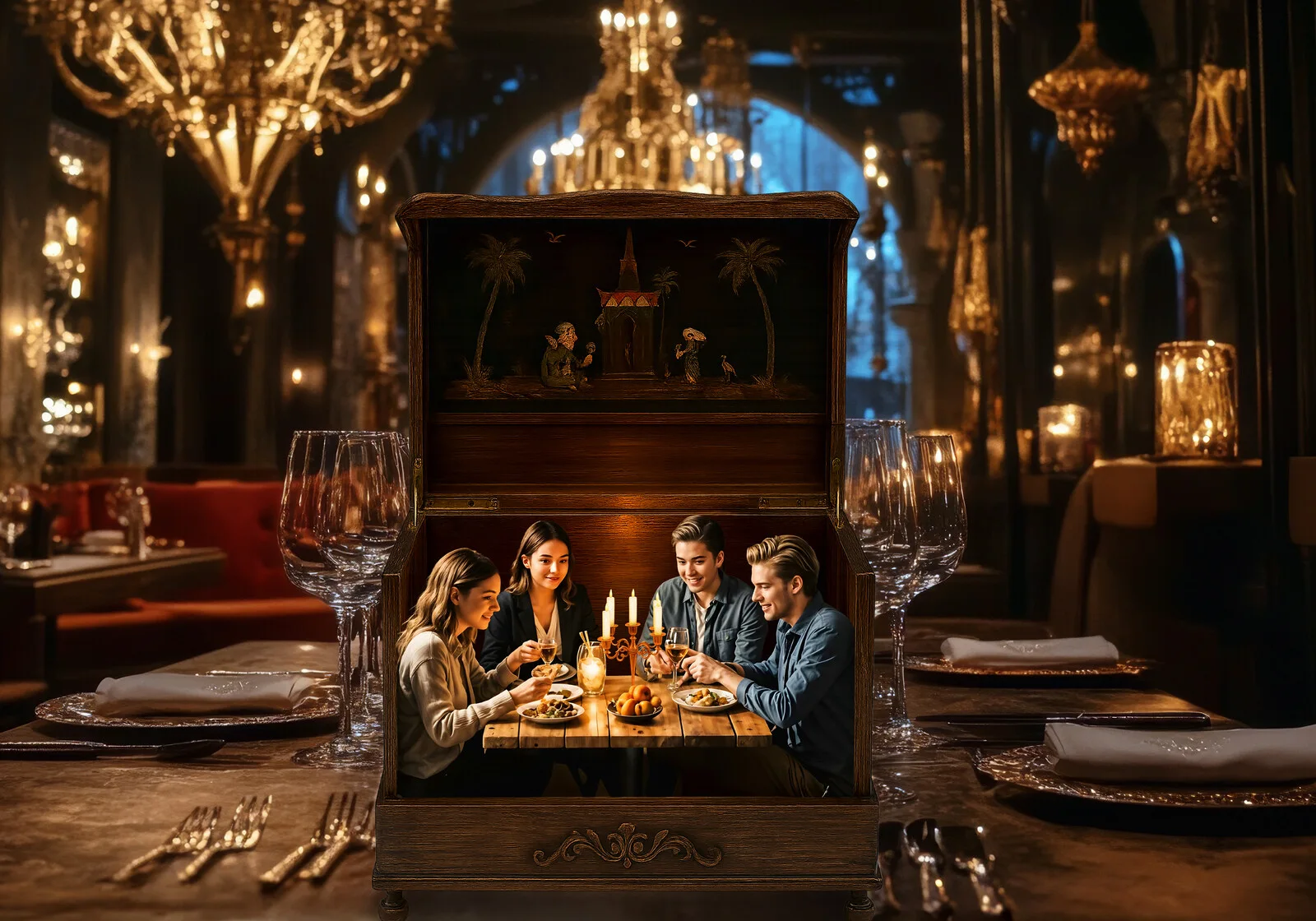
The image serves as a captivating visual metaphor for compact living. It beautifully captures the essence of this lifestyle, where even the most intimate moments are adorned within a limited space, creating a unique and inspiring living experience.
Look closely at the dinner table in the image—the image within the image, that is. Small, yet warm. Alive with laughter, candlelight, and quiet presence. A table where four young people sit closely together, so near they can hear each other breathe and see the smiles flickering in one another’s eyes through the shadows of a vast room. But their table isn’t placed in a typical room—it stands inside a case. An antique, hand-carved chest, set like a jewel at the narrow end of a far grander banquet. Around it: crystal glasses, silver cutlery, heavy velvet curtains, empty padded chairs.
This is not merely a picture. It’s the truth.
For isn’t this how many live today? In a world where a privileged few have ever-larger rooms, endless choices, and towers reaching the sky, most lives have grown smaller. Their homes shrink, and life becomes more compressed—but also, at best, more focused. On the small things. The near things. The things that fit inside a box or a chest.
Compact living is not just an architectural term or a design trend; it's a way of life. It’s a mirror of our time: an attempt to create closeness where there is no space, to redefine what a home is—and what can truly fit within it. It is both a resistance to excess and a symptom of crisis. It is both a necessity and a possibility, a reality that many of us can relate to and engage with.
This is a story about how we live—but also about how we have lived, and how we might live in the future. It’s a story of crowded rooms, of compact visions to come, and of the dreams we carry with us—even when we have only a single room. The potential for future living to integrate technology and shared spaces can make us feel hopeful and excited about the endless possibilities it holds.
Or a box.
Compact living, once a reflection of personal values and a conscious choice to live more simply, modestly, and sustainably, has now transformed into a response to mounting urban pressures. This shift from a lifestyle choice to a pressing necessity is a stark reality in our major cities, where the concept of 'necessity knows no law' holds. You do what you have to do.
By modern standards, overcrowding is defined as having more than one person per room, excluding the kitchen and living room. In practice, this standard mainly remains a dream in urban centres. We are walking backwards into the future, returning to the housing norms of the 1950s. "Compact living" easily becomes a euphemism for overcrowding.
Of course, for some, it can still be a deliberate choice: to live smaller to reduce costs, tread more lightly on the climate, or enjoy proximity to the city’s vibrant core. For others, it’s a way to adapt to changing life circumstances, such as a separation, an illness, or a new job. But for most people, it has become a necessity. Skyrocketing housing prices, high interest rates, and intense competition in the real estate market have left many with limited options. They are not choosing—they are being pushed.
But has it ever truly been different? Has overcrowding not, in fact, more often been the rule than the exception?
My parents’ generation—working-class and lower-middle-class—did not have the space to stretch out. For those with the lowest incomes, living in a one-room apartment meant the entire family shared that space. If you improved your lot and could afford a two-room flat, the parents slept in the living room and the children, foot to foot, on a pull-out sofa in the kitchen. This was my reality, and it's a reality for many even today.
As a child, I slept in the living room, separated by a brightly patterned cretonne curtain, decorated with princes and princesses. They stirred my curiosity and imagination, something that still lives within me today. We were considered lucky—in our three-room apartment, there was a small chamber reserved for the maid. That was just expected if your mother worked outside the home.
I must admit that I compensated for my modest childhood in adulthood, making increasingly foolish choices regarding housing: big, bigger, and biggest. The worst was when we took on an old manor house, with a fifty-metre walk from our enormous bedroom in one wing to the kitchen somewhere in the centre. Yes, it was beautiful, but good grief, how impractical! We were young and foolish. But oh, the parties we had—indoors and in the park.
The New Normal – or Just the Old in Disguise?
So what about this so-called "new normal"? Shouldn’t we instead ask whether it is a return to the old one? How did people live before the Million Programme and the rise of modern home ownership?
Before the welfare state and the sweeping modernisation of the Swedish' folkhem,' overcrowding was a natural condition of life for large parts of the population. In cities, families often shared a single room, sometimes with lodgers. In working-class suburbs, three generations might share a two-room apartment without a bathroom, with laundry done in the basement and the toilet out in the yard. In rural areas, it wasn’t uncommon for three or four children to share the same bed. Despite these challenges, past generations demonstrated remarkable resilience and adaptability, making the most of their living conditions and inspiring us with their resourcefulness.
There were, of course, exceptions—the homes of wealthy merchants, estates and manors—but they were merely exceptions. For the majority, housing meant adapting to scarcity. Daily life revolved around the rhythm of the rooms, furniture that could fold in and out, and strict sleeping arrangements. Children knew precisely when to speak, when to go to bed, and whose turn it was to wash the dishes or bring in firewood.
While life was physically more cramped in the past, it was perhaps, in some cases, emotionally richer—or at least more present. You knew a great deal about one another’s habits, sorrows, and dreams. You couldn’t afford not to see each other. This emotional richness, this deep understanding of each other's lives, is a significant aspect of compact living that's often overlooked; yet, it's what truly enriches our human connections and makes our living spaces more than just a roof over our heads.
A History of Living – Sharing Space Through Time and Need
When we look beyond the current real estate landscape and square metre prices, we find that compact living is not a new concept. It is an ancient idea shaped by necessity, habit, climate, and social structure. From the simplest huts to the dense cities of antiquity, the home has always been a product of what was available, what was needed, and, above all, what was shared. The historical context of compact living reminds us of the enduring nature of this housing model, rooted in tradition and necessity, and its continued relevance in modern life.
In hunter-gatherer societies, people constructed temporary shelters from whatever natural materials were available, including branches, animal hides, earth, and snow. The North American teepee—easy to erect and dismantle—was a masterpiece of function and mobility, ideally suited to a nomadic lifestyle. On the tundra, the Inuit invented the igloo: a room made of snow, with built-in thermal balance and quiet. The Sámi of the north lived in lavvu tents—portable, smoky, communal spaces where everything and everyone fit inside.
In ancient agrarian communities, from the Middle East to Scandinavia, longhouses developed—narrow wooden structures where humans and animals cohabited under the same roof. The hearth was central, walls were thick with turf or clay, and the floor was shared. There were no private rooms—just sleeping areas, work zones, and storage that shifted with the seasons.
In ancient Egypt, most people lived in small mudbrick houses with flat roofs, where much of life took place outside rather than inside. Homes typically consisted of one or two rooms and were clustered tightly along the Nile. In Babylon and Mesopotamia, houses were built from sun-dried bricks, often multi-storied, with inner courtyards that let in light and served as the family’s social hub.
The Greeks built urban stone houses with windows facing inwards towards courtyards—an early expression of privacy. The rooms were small but purposeful: men and women often occupied separate sections of the house, and much of life played out in public. In ancient Rome, housing became a mix of luxury and density: the wealthy lived in spacious domus villas, while ordinary citizens resided in insulae—multi-storey apartment blocks, often without running water, where fire and collapse were constant risks. Poor families shared single rooms with paper-thin walls and the ever-present sounds of their neighbours.
During the Middle Ages, housing once again became more basic for most people. In the countryside, people lived in timbered cottages with dirt floors, low ceilings, and open hearths. Families, servants, and livestock all shared the same roof. In cities, homes stretched upwards on narrow plots; the rich had parlours, but most people were crammed into drafty attic rooms or lofts above shops. The house was not a private temple but part of a larger social fabric.
In short, the idea of living spaciously, privately, and apart is a modern luxury—made possible by industrialisation, urban planning, and economic growth. Throughout history, the home has been a site of collective survival rather than an individual's cultivation. People shared roofs and tables, dreams and colds—and learned how to live close together.
From Collective Survival to Individual Optimisation
There was a unique charm in the old experience of overcrowding that transcended mere scarcity. It was a time of togetherness, sometimes enforced, but always present. People lived in close quarters, sharing the everyday scenes of life without the luxury of solitude. Privacy was a fluid concept, and loneliness a rare occurrence. Family, siblings, sometimes grandparents, sometimes a lodger—all of them in sync within the same rhythm: someone got up, someone lay down, someone coughed in the night, someone turned on a lamp to read. This nostalgia, for the shared experiences and the constant presence of others, is a feeling many of us can relate to.
Today’s version of compact living strikes a different tone. It is not the collective’s conditions that govern, but the individual’s. Or rather: the solitary individual’s attempt to maintain some form of dignity in a housing market that no longer supports them. We live small—but each on our own. The walls may be thin, but the connection is even thinner. This struggle, this battle for personal space and dignity, is a reality for many in today's urban landscape.
In our time, we have learned that the home should reflect one's identity, taste, and self-realisation. Function is not enough—we want it to represent us. A compact home must also be aesthetically pleasing, smartly organised, and Instagram-friendly. A fold-out bed no longer suffices—it should ideally be hidden behind an ingeniously collapsible bookshelf.
We optimise not only our square metres but also our personalities. It’s a strange paradox: to live in less space, yet more as an individual. This paradox, this balancing act between physical space and personal identity, is a thought-provoking aspect of modern urban living.
The Future—More Compact, Smarter, Greener?
Looking ahead to a world where the climate crisis demands changed lifestyles, where artificial intelligence reshapes work, and where the sharing economy creates new models of ownership, compact living may take on new meanings—or many.
In a more optimistic future, compact housing is no longer a desperate measure but a node in a broader, more intelligent ecosystem. Homes are technologically integrated, with AI adjusting lighting, temperature, and sound according to our needs and rhythms. Walls shift shape, furniture transforms at the click of a button, and surfaces are used multifunctionally around the clock. The washing machine is no longer in the bathroom but in a communal, booking-free space in the neighbourhood, solar-powered and whisper-quiet. This vision offers hope for a brighter, greener future.
The sharing economy fosters communal spaces within residential blocks, including libraries, hobby rooms, music studios, and co-working areas. The private home shrinks, but the shared environment expands. Rather than everyone owning everything, we share more and own less. It's both an ecological and economic necessity. This shift towards shared spaces could potentially promote a sense of community, challenging the notion that compact living inevitably leads to isolation.
Yet there is another possible future—one in which the compact home becomes increasingly isolated, where AI replaces human connection rather than complements it, and where solitary living becomes the norm even at a young age—a society of hyper-optimised individuals, measured by exact square footage, with few points of contact. Where compact living is no longer a choice, but a sign that we have lost the communal spirit, this potential future raises concerns about the erosion of community, the impact on mental health, and the loss of shared experiences.
Perhaps this is the very question we must ask: What should a home encompass, beyond ourselves? What, in the end, do we make space for?
Compact living may be a modern term, but overcrowding is an ancient reality. Throughout history, humans have adapted to whatever space was available, with creativity, closeness, and often a fair amount of compromise. We have lived in huts, longhouses, mudbrick cubes, and overfilled apartments; sometimes fleeing, sometimes secure, constantly moving between need and possibility. Understanding this historical context can provide a broader perspective on the evolution of compact living and its societal implications.
Today’s compact living reflects a new paradox: technologically, we are more capable than ever of building more innovative, more energy-efficient, and more flexible homes—yet market forces, social inequality, and runaway urbanisation pressure us. The result is often neither freely chosen nor sustainable, but rather a modern form of necessity dressed in new clothes. This struggle of the individual in today's compact living is a reality that many of us can empathise with.
We often discuss square metres or square footage, but rarely about what that space holds in human terms. Perhaps this is what we must reclaim: the idea that a home is not just a space for our bodies, but for our lives—our relationships, our rest, our shared existence. By emphasising this, we can feel a deeper connection to the concept of home.
Compact living can lead to something better—if we choose to see it as more than just a measurement of physical space. Suppose we allow history to remind us of the value of living together, and let the future inspire new ways to do so. It's a call to action, an inspiration to create a more connected and sustainable future.
In the end, it’s not about how small we can live, but how fully.
Compact Living – Concepts, Illusions, and Practical Advice
Compact living, also known as small-space living, has emerged as a lifestyle trend in recent years. It sounds intentional, modern, even stylish—as if it were a choice. But the reality is often less romantic. For most, it's not about design philosophy but about everyday logistics: making life fit into a limited space. The buzzword rarely conveys how it feels—only how it looks in photos.
At its core, it's about living efficiently and functionally in a small space, usually in an urban context where every square meter is costly. It requires planning, prioritising, and sometimes real inventiveness. It's about thinking in layers rather than rooms: what can be hidden, folded, stacked, pulled out, transformed?
The key is effective spatial planning. Social media is full of advice: choose multifunctional furniture—a sofa bed, a table with storage, a stool that also serves as a ladder. Think vertically—utilise your walls to their maximum potential by placing shelves up to the ceiling. Use light colours—white, pale grey, soft pastels—to reflect light and trick the eye into perceiving more space. And don’t forget mirrors—large, strategically placed—to create the illusion of depth.
It's just as much about what you leave out. Bulky heirlooms, oversized sofas, three sets of china, and things that serve no real purpose rarely belong in the compact home. Selective minimalism rules here, yet without sacrificing personality. It’s the art of living light, without losing oneself.
Compact living is therefore not necessarily a dream lifestyle, but it can be a kind of life art. And perhaps, at best, an opportunity to rethink what a home should be: not big, but right.
Jörgen Thornberg
Compact Living, 2025
Digital
70 x 50 cm
3 200 kr
Compact Living
This is neither a design manual nor a political manifesto; it is something in between.
Perhaps a reflection. A quiet unfolding of space and time, memory and future, built not of concrete or plywood, but of language. We speak so often of rooms, yet rarely of what they hold—not in square metres, but in meaning. This text is about compact living, yes, but it is also about our longings, dignity, pragmatism, and dreams.
It concerns the lives we fit into boxes, and the lives we build beyond them. It's a topic that's more important than we might realise.
“A Housing Contest
One lived in a hut made of straw and dry pine,
“No fridge, but the forest is perfectly fine.”
Another in an igloo, wrapped tight in a rug,
“It’s cosy,” he shivered, “but not snug.”
A third in a cave with a stalactite beam,
“My mattress is moss and I bathe in a stream.”
A fourth in a slum flat, eight beds in one single room,
“We argue, but somehow rice and curry cut the gloom.”
A fifth in a manor, with thirty-eight doors,
“It’s spacious,” she yawned, “but echoing chores.”
A sixth in a palace, where trumpets announce,
“I’m never alone—but my thoughts rarely bounce.”
Then the seventh just grinned from a ditch in the ground:
“No rent and no rules, and the sky all around.
I sleep with my cat and the stars overhead—
You may call it a hole, but it’s better than a bed.”
An eighth, aged thirty-nine, lived still with his mum,
"Just saving," he said, "till the right flat will come."
He cooked once a month, kept his comics in stacks,
And dreamed of a loft—and let her pay his tax.”
Malmö May 2025
A Table in a Box
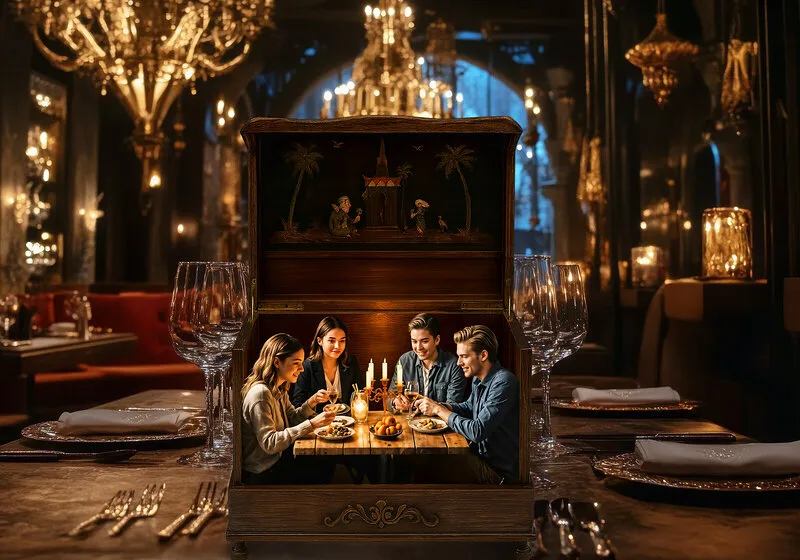
The image serves as a captivating visual metaphor for compact living. It beautifully captures the essence of this lifestyle, where even the most intimate moments are adorned within a limited space, creating a unique and inspiring living experience.
Look closely at the dinner table in the image—the image within the image, that is. Small, yet warm. Alive with laughter, candlelight, and quiet presence. A table where four young people sit closely together, so near they can hear each other breathe and see the smiles flickering in one another’s eyes through the shadows of a vast room. But their table isn’t placed in a typical room—it stands inside a case. An antique, hand-carved chest, set like a jewel at the narrow end of a far grander banquet. Around it: crystal glasses, silver cutlery, heavy velvet curtains, empty padded chairs.
This is not merely a picture. It’s the truth.
For isn’t this how many live today? In a world where a privileged few have ever-larger rooms, endless choices, and towers reaching the sky, most lives have grown smaller. Their homes shrink, and life becomes more compressed—but also, at best, more focused. On the small things. The near things. The things that fit inside a box or a chest.
Compact living is not just an architectural term or a design trend; it's a way of life. It’s a mirror of our time: an attempt to create closeness where there is no space, to redefine what a home is—and what can truly fit within it. It is both a resistance to excess and a symptom of crisis. It is both a necessity and a possibility, a reality that many of us can relate to and engage with.
This is a story about how we live—but also about how we have lived, and how we might live in the future. It’s a story of crowded rooms, of compact visions to come, and of the dreams we carry with us—even when we have only a single room. The potential for future living to integrate technology and shared spaces can make us feel hopeful and excited about the endless possibilities it holds.
Or a box.
Compact living, once a reflection of personal values and a conscious choice to live more simply, modestly, and sustainably, has now transformed into a response to mounting urban pressures. This shift from a lifestyle choice to a pressing necessity is a stark reality in our major cities, where the concept of 'necessity knows no law' holds. You do what you have to do.
By modern standards, overcrowding is defined as having more than one person per room, excluding the kitchen and living room. In practice, this standard mainly remains a dream in urban centres. We are walking backwards into the future, returning to the housing norms of the 1950s. "Compact living" easily becomes a euphemism for overcrowding.
Of course, for some, it can still be a deliberate choice: to live smaller to reduce costs, tread more lightly on the climate, or enjoy proximity to the city’s vibrant core. For others, it’s a way to adapt to changing life circumstances, such as a separation, an illness, or a new job. But for most people, it has become a necessity. Skyrocketing housing prices, high interest rates, and intense competition in the real estate market have left many with limited options. They are not choosing—they are being pushed.
But has it ever truly been different? Has overcrowding not, in fact, more often been the rule than the exception?
My parents’ generation—working-class and lower-middle-class—did not have the space to stretch out. For those with the lowest incomes, living in a one-room apartment meant the entire family shared that space. If you improved your lot and could afford a two-room flat, the parents slept in the living room and the children, foot to foot, on a pull-out sofa in the kitchen. This was my reality, and it's a reality for many even today.
As a child, I slept in the living room, separated by a brightly patterned cretonne curtain, decorated with princes and princesses. They stirred my curiosity and imagination, something that still lives within me today. We were considered lucky—in our three-room apartment, there was a small chamber reserved for the maid. That was just expected if your mother worked outside the home.
I must admit that I compensated for my modest childhood in adulthood, making increasingly foolish choices regarding housing: big, bigger, and biggest. The worst was when we took on an old manor house, with a fifty-metre walk from our enormous bedroom in one wing to the kitchen somewhere in the centre. Yes, it was beautiful, but good grief, how impractical! We were young and foolish. But oh, the parties we had—indoors and in the park.
The New Normal – or Just the Old in Disguise?
So what about this so-called "new normal"? Shouldn’t we instead ask whether it is a return to the old one? How did people live before the Million Programme and the rise of modern home ownership?
Before the welfare state and the sweeping modernisation of the Swedish' folkhem,' overcrowding was a natural condition of life for large parts of the population. In cities, families often shared a single room, sometimes with lodgers. In working-class suburbs, three generations might share a two-room apartment without a bathroom, with laundry done in the basement and the toilet out in the yard. In rural areas, it wasn’t uncommon for three or four children to share the same bed. Despite these challenges, past generations demonstrated remarkable resilience and adaptability, making the most of their living conditions and inspiring us with their resourcefulness.
There were, of course, exceptions—the homes of wealthy merchants, estates and manors—but they were merely exceptions. For the majority, housing meant adapting to scarcity. Daily life revolved around the rhythm of the rooms, furniture that could fold in and out, and strict sleeping arrangements. Children knew precisely when to speak, when to go to bed, and whose turn it was to wash the dishes or bring in firewood.
While life was physically more cramped in the past, it was perhaps, in some cases, emotionally richer—or at least more present. You knew a great deal about one another’s habits, sorrows, and dreams. You couldn’t afford not to see each other. This emotional richness, this deep understanding of each other's lives, is a significant aspect of compact living that's often overlooked; yet, it's what truly enriches our human connections and makes our living spaces more than just a roof over our heads.
A History of Living – Sharing Space Through Time and Need
When we look beyond the current real estate landscape and square metre prices, we find that compact living is not a new concept. It is an ancient idea shaped by necessity, habit, climate, and social structure. From the simplest huts to the dense cities of antiquity, the home has always been a product of what was available, what was needed, and, above all, what was shared. The historical context of compact living reminds us of the enduring nature of this housing model, rooted in tradition and necessity, and its continued relevance in modern life.
In hunter-gatherer societies, people constructed temporary shelters from whatever natural materials were available, including branches, animal hides, earth, and snow. The North American teepee—easy to erect and dismantle—was a masterpiece of function and mobility, ideally suited to a nomadic lifestyle. On the tundra, the Inuit invented the igloo: a room made of snow, with built-in thermal balance and quiet. The Sámi of the north lived in lavvu tents—portable, smoky, communal spaces where everything and everyone fit inside.
In ancient agrarian communities, from the Middle East to Scandinavia, longhouses developed—narrow wooden structures where humans and animals cohabited under the same roof. The hearth was central, walls were thick with turf or clay, and the floor was shared. There were no private rooms—just sleeping areas, work zones, and storage that shifted with the seasons.
In ancient Egypt, most people lived in small mudbrick houses with flat roofs, where much of life took place outside rather than inside. Homes typically consisted of one or two rooms and were clustered tightly along the Nile. In Babylon and Mesopotamia, houses were built from sun-dried bricks, often multi-storied, with inner courtyards that let in light and served as the family’s social hub.
The Greeks built urban stone houses with windows facing inwards towards courtyards—an early expression of privacy. The rooms were small but purposeful: men and women often occupied separate sections of the house, and much of life played out in public. In ancient Rome, housing became a mix of luxury and density: the wealthy lived in spacious domus villas, while ordinary citizens resided in insulae—multi-storey apartment blocks, often without running water, where fire and collapse were constant risks. Poor families shared single rooms with paper-thin walls and the ever-present sounds of their neighbours.
During the Middle Ages, housing once again became more basic for most people. In the countryside, people lived in timbered cottages with dirt floors, low ceilings, and open hearths. Families, servants, and livestock all shared the same roof. In cities, homes stretched upwards on narrow plots; the rich had parlours, but most people were crammed into drafty attic rooms or lofts above shops. The house was not a private temple but part of a larger social fabric.
In short, the idea of living spaciously, privately, and apart is a modern luxury—made possible by industrialisation, urban planning, and economic growth. Throughout history, the home has been a site of collective survival rather than an individual's cultivation. People shared roofs and tables, dreams and colds—and learned how to live close together.
From Collective Survival to Individual Optimisation
There was a unique charm in the old experience of overcrowding that transcended mere scarcity. It was a time of togetherness, sometimes enforced, but always present. People lived in close quarters, sharing the everyday scenes of life without the luxury of solitude. Privacy was a fluid concept, and loneliness a rare occurrence. Family, siblings, sometimes grandparents, sometimes a lodger—all of them in sync within the same rhythm: someone got up, someone lay down, someone coughed in the night, someone turned on a lamp to read. This nostalgia, for the shared experiences and the constant presence of others, is a feeling many of us can relate to.
Today’s version of compact living strikes a different tone. It is not the collective’s conditions that govern, but the individual’s. Or rather: the solitary individual’s attempt to maintain some form of dignity in a housing market that no longer supports them. We live small—but each on our own. The walls may be thin, but the connection is even thinner. This struggle, this battle for personal space and dignity, is a reality for many in today's urban landscape.
In our time, we have learned that the home should reflect one's identity, taste, and self-realisation. Function is not enough—we want it to represent us. A compact home must also be aesthetically pleasing, smartly organised, and Instagram-friendly. A fold-out bed no longer suffices—it should ideally be hidden behind an ingeniously collapsible bookshelf.
We optimise not only our square metres but also our personalities. It’s a strange paradox: to live in less space, yet more as an individual. This paradox, this balancing act between physical space and personal identity, is a thought-provoking aspect of modern urban living.
The Future—More Compact, Smarter, Greener?
Looking ahead to a world where the climate crisis demands changed lifestyles, where artificial intelligence reshapes work, and where the sharing economy creates new models of ownership, compact living may take on new meanings—or many.
In a more optimistic future, compact housing is no longer a desperate measure but a node in a broader, more intelligent ecosystem. Homes are technologically integrated, with AI adjusting lighting, temperature, and sound according to our needs and rhythms. Walls shift shape, furniture transforms at the click of a button, and surfaces are used multifunctionally around the clock. The washing machine is no longer in the bathroom but in a communal, booking-free space in the neighbourhood, solar-powered and whisper-quiet. This vision offers hope for a brighter, greener future.
The sharing economy fosters communal spaces within residential blocks, including libraries, hobby rooms, music studios, and co-working areas. The private home shrinks, but the shared environment expands. Rather than everyone owning everything, we share more and own less. It's both an ecological and economic necessity. This shift towards shared spaces could potentially promote a sense of community, challenging the notion that compact living inevitably leads to isolation.
Yet there is another possible future—one in which the compact home becomes increasingly isolated, where AI replaces human connection rather than complements it, and where solitary living becomes the norm even at a young age—a society of hyper-optimised individuals, measured by exact square footage, with few points of contact. Where compact living is no longer a choice, but a sign that we have lost the communal spirit, this potential future raises concerns about the erosion of community, the impact on mental health, and the loss of shared experiences.
Perhaps this is the very question we must ask: What should a home encompass, beyond ourselves? What, in the end, do we make space for?
Compact living may be a modern term, but overcrowding is an ancient reality. Throughout history, humans have adapted to whatever space was available, with creativity, closeness, and often a fair amount of compromise. We have lived in huts, longhouses, mudbrick cubes, and overfilled apartments; sometimes fleeing, sometimes secure, constantly moving between need and possibility. Understanding this historical context can provide a broader perspective on the evolution of compact living and its societal implications.
Today’s compact living reflects a new paradox: technologically, we are more capable than ever of building more innovative, more energy-efficient, and more flexible homes—yet market forces, social inequality, and runaway urbanisation pressure us. The result is often neither freely chosen nor sustainable, but rather a modern form of necessity dressed in new clothes. This struggle of the individual in today's compact living is a reality that many of us can empathise with.
We often discuss square metres or square footage, but rarely about what that space holds in human terms. Perhaps this is what we must reclaim: the idea that a home is not just a space for our bodies, but for our lives—our relationships, our rest, our shared existence. By emphasising this, we can feel a deeper connection to the concept of home.
Compact living can lead to something better—if we choose to see it as more than just a measurement of physical space. Suppose we allow history to remind us of the value of living together, and let the future inspire new ways to do so. It's a call to action, an inspiration to create a more connected and sustainable future.
In the end, it’s not about how small we can live, but how fully.
Compact Living – Concepts, Illusions, and Practical Advice
Compact living, also known as small-space living, has emerged as a lifestyle trend in recent years. It sounds intentional, modern, even stylish—as if it were a choice. But the reality is often less romantic. For most, it's not about design philosophy but about everyday logistics: making life fit into a limited space. The buzzword rarely conveys how it feels—only how it looks in photos.
At its core, it's about living efficiently and functionally in a small space, usually in an urban context where every square meter is costly. It requires planning, prioritising, and sometimes real inventiveness. It's about thinking in layers rather than rooms: what can be hidden, folded, stacked, pulled out, transformed?
The key is effective spatial planning. Social media is full of advice: choose multifunctional furniture—a sofa bed, a table with storage, a stool that also serves as a ladder. Think vertically—utilise your walls to their maximum potential by placing shelves up to the ceiling. Use light colours—white, pale grey, soft pastels—to reflect light and trick the eye into perceiving more space. And don’t forget mirrors—large, strategically placed—to create the illusion of depth.
It's just as much about what you leave out. Bulky heirlooms, oversized sofas, three sets of china, and things that serve no real purpose rarely belong in the compact home. Selective minimalism rules here, yet without sacrificing personality. It’s the art of living light, without losing oneself.
Compact living is therefore not necessarily a dream lifestyle, but it can be a kind of life art. And perhaps, at best, an opportunity to rethink what a home should be: not big, but right.
3 200 kr

Jörgen Thornberg
Malmö
Lite om bilder och mig. Translation in English at the end.
Jag är en nyfiken person som ser allt i bilder, även det jag fäster i ord, gärna tillsammans för bakom alla mina bilder finns en berättelse. Till vissa bilder hör en kortare eller längre novell som följer med bilden.
Bilder berättar historier. Jag omges av naturlig skönhet, intressanta människor och historia var jag än går. Jag använder min kamera för att dokumentera världen och blanda det jag ser med vad jag känner för att fånga den dolda magin.
Mina bilder berättar mina historier. Genom mina bilder, tryck och berättelser. Jag bjuder in dig att ta del av dessa berättelser, in i ditt liv och hem och dela min mycket personliga syn på vår värld. Mer än vad ögat ser. Jag tänker i bilder, drömmer och skriver och pratar om dem; följaktligen måste jag också skapa bilder. De blir vad jag ser, inte nödvändigtvis begränsade till verkligheten. Det finns en bild runt varje hörn. Jag hoppas att du kommer att se vad jag såg och gilla det.
Jag är också en skrivande person och till många bilder hör en kortare eller längre essay. Den följer med tavlan, tryckt på fint papper och med en personlig hälsning från mig.
Flertalet bilder startar sin resa i min kamera. Enkelt förklarat beskriver jag bilden jag ser i mitt inre, upplevd eller fantiserad. Bilden uppstår inom mig redan innan jag fått okularet till ögat. På bråkdelen av ett ögonblick ser jag vad jag vill ha och vad som kan göras med bilden. Här skall jag stoppa in en giraff, stålmannen, Titanic eller vad det är min fantasi finner ut. Ännu märkligare är att jag kommer ihåg minnesbilden långt efteråt när det blir tid att skapa verket. Om jag lyckas eller inte, är upp till betraktaren, oftast präglat av en stråk av svart humor – meningen är att man skall bli underhållen. Mina bilder blir ofta en snackis där de hänger.
Jag föredrar bilder som förmedlar ett budskap i flera lager. Vid första anblicken fylld av feel-good, en vacker utsikt, fint väder, solen skiner, blommor på ängen eller vattnet som ligger förrädiskt spegelblankt. I en sådan bild kan jag gömma min egentliga berättelse, mitt förakt för förtryckare och våldsverkare, rasister och fördomsfulla människor - ett gärna återkommande motiv mer eller mindre dolt i det vackra motivet. Jag försöker förena dem i ett gemensamt narrativ.
Bild och formgivning har löpt som en röd tråd genom livet. Fotokonst känns som en värdig final som jag gärna delar med mig.
Min genre är vid som framgår av mina bilder, temat en blandning av pop- och gatukonst i kollage som kan bestå av hundratals lager. Vissa bilder kan ta veckor, andra någon dag innan det är dags att överlämna resultatet till printverkstaden. Fine Art Prints är digitala fotocollage. I dessa kollage sker rivandet, klippandet, pusslandet, målandet, ritandet och sprayningen digitalt. Det jag monterar in kan vara hundratals år gamla bilder som jag omsorgsfullt frilägger så att de ser ut att vara en del av tavlan men också bilder skapade av mig själv efter min egen fantasi. Därefter besöks printstudion och för vissa bilder numrera en limiterad upplaga (oftast 7 exemplar) och signera för hand. Vissa bilder kan köpas i olika format. Det är bara att fråga efter vilka. Gillar man en bild som är 70x100 men inte har plats på väggen, går den kanske att få i 50x70 cm istället. Frågan är fri.
Metoden Giclée eller Fine Art Print som det också kallas är det moderna sättet för framställning av grafisk konst. Villkoret för denna typ av utskrifter är att en högkvalitativ storformatskrivare används med åldersbeständigt färgpigment och konstnärspapper eller i förekommande fall på duk. Pappret som används möter de krav på livslängd som ställs av museer och gallerier. Normalt säljer jag mina bilder oinramade så att den nya ägaren själv kan bestämma hur de skall se ut, med eller utan passepartout färg på ram, med eller utan glas etc..
Under många år ställde jag bara ut på nätet, i valda grupper och på min egen Facebooksida - https://www.facebook.com/jorgen.thornberg.9
Jag finns också på en egen hemsida som tyvärr inte alltid är uppdaterad – https://www.jth.life/ Där kan du också läsa en del av de berättelser som följer med bilden.
UTSTÄLLNINGAR
Luftkastellet, oktober 2022
Konst i Lund, november 2022
Luftkastellet, mars 2023
Engleson Galleri Caroli, april 2023
Hydra, Greece June 2023
Engleson Galleri Caroli, oktober 2023
Toppen, Höllviken december 2023
Luftkastellet, mars 2024
Torups Galleri, mars 2024
Venice, May 2024
Luftkastellet, oktober 2024
Konst i Advent, December 2024
Galleri Engleson, Caroli December 2024
Jäger & Jansson Galleri, april 2025
A bit about pictures and me.
I'm a curious person who sees everything in pictures, even what I express in words, often combining them, for behind all my pictures lies a story. These narratives, some as short as a single image and others as long as a novel, are the heart and soul of my work.
Pictures tell stories. Wherever I go, I'm surrounded by natural beauty, exciting people, and history. I use my camera to document the world and blend what I see with what I feel to capture the hidden magic.
My images tell my stories. Through my pictures, prints, and narratives, I invite you to partake in these stories in your life and home and share my deeply personal perspective of our world. More than meets the eye. I think in pictures, dream, write, and talk about them; consequently, I must create images too. They become what I see, not necessarily confined to reality. There's a picture around every corner. I hope you'll see what I saw and enjoy it.
I'm also a writer, and many images come with a shorter or longer essay. It accompanies the painting, printed on fine paper with my personal greeting.
Many pictures start their journey on my camera. Simply put, I describe the image I see in my mind, experienced or imagined. The image arises within me even before I bring the eyepiece to my eye. In a fraction of a moment, I see what I want and what can be done with the picture. Here, I'll insert a giraffe, Superman, the Titanic, or whatever my imagination conjures up. Even stranger is that I remember the mental image long after it's time to create the work. Whether I succeed is up to the observer, often imbued with a streak of black humour – the aim is to entertain. My pictures usually become a talking point wherever they hang.
I prefer pictures that convey a message in multiple layers. At first glance, they're filled with feel-good vibes, a beautiful view, lovely weather, the sun shining, flowers in the meadow, or the water lying deceptively calm. But beneath this surface beauty, I often conceal a deeper story, a narrative that challenges societal norms or explores the human condition. I invite you to delve into these hidden narratives and discover the layers of meaning within my work.
Picture and design have been a thread running through my life. Photographic art feels like a fitting finale, and I'm happy to share it.
My genre is varied, as seen in my pictures; the theme is a blend of pop and street art in collages that can consist of hundreds of layers. Some images can take weeks, others just a day before it's time to hand over the result to the print workshop. Fine Art Prints are digital photo collages. In these collages, tearing, cutting, puzzling, painting, drawing, and spraying happen digitally. What I insert can be images hundreds of years old that I carefully extract so they appear to be part of the painting, but also images created by myself, now also generated from my imagination. Next, visit the print studio and, for certain images, number a limited edition (usually 7 copies) and sign them by hand. Some images may be available in other formats. Just ask which ones. If you like an image that's 70x100 but doesn't have space on the wall, you might be able to get it in 50x70 cm instead. The question is open.
The Giclée method, or Fine Art Print as it's also called, is the modern way of producing graphic art. This method ensures the highest quality and longevity of the artwork, using a high-quality large-format printer with archival pigment inks and artist paper or, in some cases, canvas. The paper used meets the longevity requirements set by museums and galleries. I sell my pictures unframed, allowing the new owner to personalise their artwork, confident in the lasting value and quality of the piece.
For many years, I only exhibited online, in selected groups, and on my Facebook page - https://www.facebook.com/jorgen.thornberg.9. I also have my website, which unfortunately is not constantly updated - https://www.jth.life/. You can also read some of the stories accompanying the pictures there.
EXHIBITIONS
Luftkastellet, October 2022
Art in Lund, November 2022
Luftkastellet, March 2023
Engleson Gallery Caroli, April 2023
Hydra, Greece June 2023
Engleson Gallery Caroli, October 2023
Toppen, Höllviken December 2023
Luftkastellet, March 2024
Torup Gallery, March 2024
Venice, May 2024
UTSTÄLLNINGAR
Luftkastellet, oktober 2022
Konst i Lund, november 2022
Luftkastellet, mars 2023
Engleson Galleri Caroli, april 2023
Hydra, Greece June 2023
Engleson Galleri Caroli, oktober 2023
Toppen, Höllviken december 2023
Luftkastellet, mars 2024
Torups Galleri, mars 2024
Venice, May 2024
Luftkastellet, October 2024
Konst i Advent, December 2024
Galleri Engleson, Caroli December 2024
Jäger & Jansson Galleri, April 2025
Utbildning
Autodidakt
Medlem i konstnärsförening
Öppna Sinnen
Med i konstrunda
Konstrundan i Skåne
Utställningar
Luftkastellet, October 2022
Art in Lund, November 2022
Luftkastellet, March 2023
Engleson Gallery Caroli, April 2023
Hydra, Greece June 2023
Engleson Gallery Caroli, October 2023
Toppen, Höllviken December 2023
Luftkastellet, March 2024
Torup Gallery, March 2024
Venice, May 2024