Vi använder cookies för att ge dig bästa möjliga upplevelse. Välj vilka cookies du tillåter.
Läs mer i vår integritetspolicy
Jörgen Thornberg
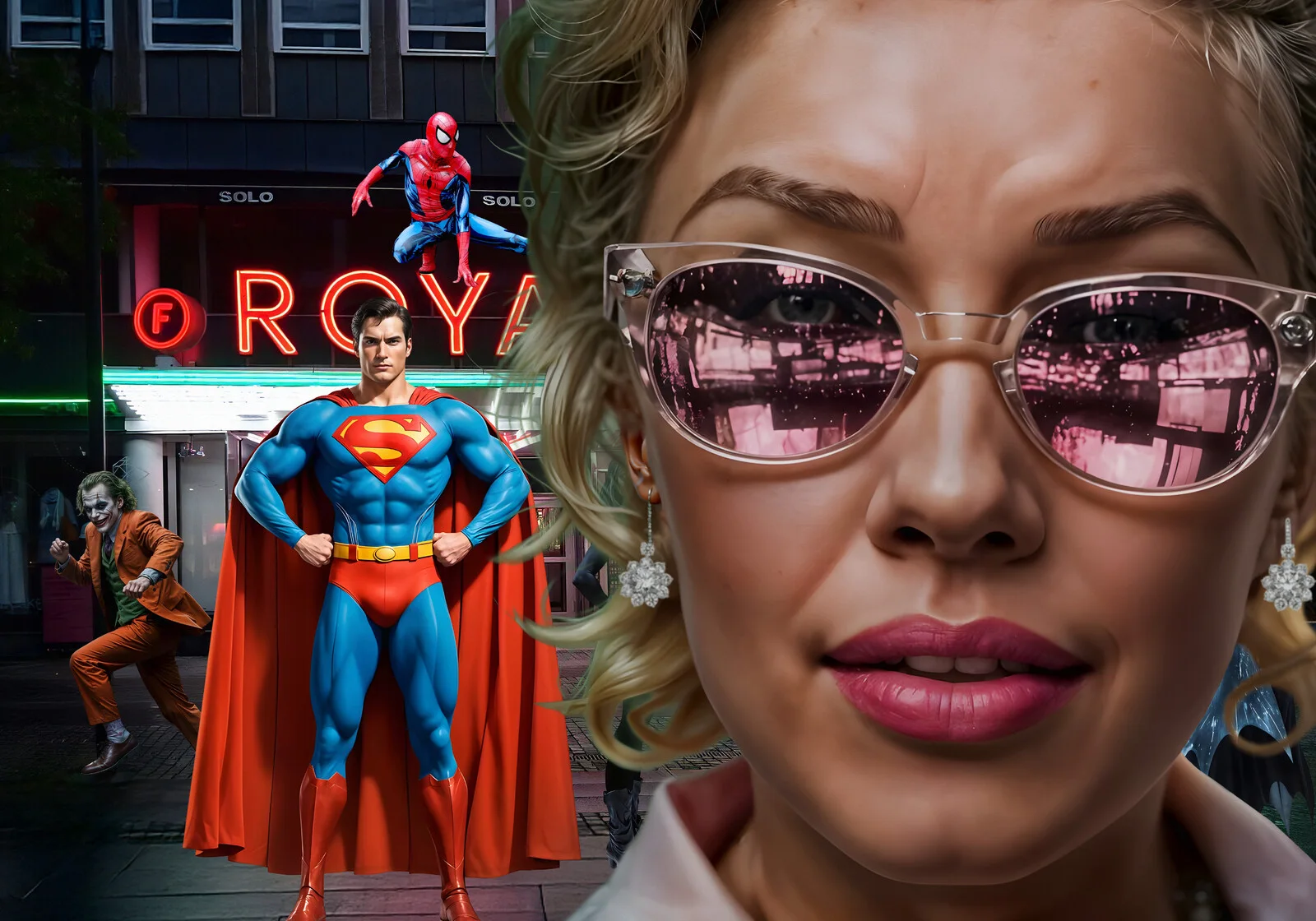
Reflection, 2025
Digital
70 x 50 cm
3 200 kr
Reflection
She had never been the sort to dream of superheroes. She had envisioned world peace, a well-structured children’s schedule, and someone else washing the dishes. But on this very evening, with the wind blowing in from the Öresund, a strait that connects the Baltic Sea with the North Sea, and a cloud hovering over Gustav Adolfs Square, a historic square in Malmö, like a forgotten thought, there she stood – right among them. Four men, larger than life, donned in capes, masks, and muscles. And she, with her last-minute shopping list tucked in her pocket and a mild headache from the afternoon budget meeting that had dragged on well into the evening. Little did she know that this encounter would ignite a journey of self-discovery and a reevaluation of her desires and identity.
It wasn’t a dream. Nor was it reality. It was something in between. A passage, perhaps. A trial. Or simply a way for the mind to play, for once, with the thought of what it truly takes to be loved. She pondered this question, her mind struggling to accept the surreal scene before her- the four men, each with their unique powers and personalities, standing amid the city, their capes billowing in the wind, their masks hiding their true identities. She wondered if it was about being a hero, or if it was about being someone else, someone more than just a person with a shopping list and a headache.
Or – who one must be to dare to be. It was a moment of self-discovery, a profound realisation that she was more than just a woman with a last-minute shopping list and a headache. She was someone who could stand among superheroes, someone who could dare to be.
“A Heroic Dilemma
She dreamt of four in tights with might,
Each swooping into the Malmö night.
Spiderman grinned from the neon Y –
He called me “cool” and kissed me spry.
He swung through stress and PTA,
But vanished mid-lasagna day.
Then Superman with iron jaw,
Spoke fluently of love and civil law.
He folded socks and knew my wine,
But warmed my tea more than my spine.
He hugged just right, he stood so tall –
Yet never once let loose at all.
And Joker, the dear wild chaotic flame,
dancing on rooftops, without shame.
He saw my fire, my hungry grin,
And set my cautious world a-spin.
But let’s be honest – kids and school?
He’d set the hamster cage on fire. Not cool.
Then Batman glided in half-seen,
With a billion-dollar self-esteem.
He nodded once, then disappeared –
A man both dreamy and... a bit weird.
I craved his secrets, yes, it's true,
But not the butler’s curfew, too.
And yet... there’s one more on the list:
A Swedish bloke I almost missed.
He doesn't fly, he can't deflect –
But takes the bin out with respect.
He carries groceries, warms my toes,
Will he ever wear a cape? Only God knows.
No glitter mask. No mighty roar.
But he says “hej” and holds the door.
He laughs at jokes that aren’t that good –
And makes damn fine spaghetti if he could.
So maybe I won’t choose the sky,
Or nightly men who never cry.
Perhaps my hero drinks his gröt,
And still looks cute in a puffball coat.
Maybe I should stop searching the sky,
for men with a cape who never cry.
Perhaps my hero boils his oats,
and looks adorable in regular coats.
He doesn’t fly, he doesn’t fight,
but always gets my coffee right.
No mask, no myth, no world to save—
just rubs my back and has a decent shave.”
Malmö May 2025
Reflection
It wasn’t the first time she had asked herself the question. But this time it lingered, burning at the back of her mind like the neon light from the cinema glowing behind her. The four men out there–or rather their outlines, archetypes, shadows–were no strangers to her. She had encountered them all before, in different forms, in other bodies. At leadership courses. In boardrooms. Across breakfast tables and in SMS fields.
And there, at the very top, balanced on the red Y in “ROYAL,” sat Spider-Man. The eternally restless, quick, boyishly charming man with large eyes behind the mask and an even larger burden of guilt in his chest. He looked like a student with too much caffeine in his system – yet he awakened something in her that had been silent for fifteen years.
To fall in love with Spider-Man wouldn’t be a fall but rather a leap. Figuratively speaking, it would be an impulsive swing across rooftops and skylines, away from spreadsheets, carpooling, and drawn-out performance reviews. He would make her laugh again. That kind of laughter that bubbles up before you have time to think about who you’re expected to be. The laughter she had during her university years in Lund almost twenty years ago, when flirting was a game, not a negotiation. It was a time when youth was a currency, and she had plenty to spend. This longing for a youthful, carefree life is a feeling that many can relate to —a desire for freedom that is both universal and deeply personal.
With Peter Barks, Spider-Man, in her life, time would rewind. Not by five years, but ten. Maybe fifteen. Not literally – he’s no time-traveller. But his youth, his agility, his eternal tightrope walk between idealism and exhaustion would rewind the clock in her soul. He would make her feel young again. Desired. Admired. Not for her strategic thinking or her conflict-resolution skills – but for her laugh, her energy, her body. He would call her “cool,” she would call him “impulsive,” and that would become their little language.
She would start wearing sneakers again. She might even download TikTok to understand his jokes. And at first, it would feel wonderful. Not just to be desired, but to be interesting to someone who grew up in an entirely different cultural era. He would marvel at her daily schedule and probably call her wise – because to him, her wrinkles weren’t a flaw, but proof of a life lived in the real world.
But how long can such a movement last before it loses its trajectory?
She pictured it. How her seventeen-year-old daughter would raise her eyebrows and blurt out: “Seriously, Mum? Are you dating a Marvel hoodie?” or something like “Mum… is that your boyfriend? He looks like my maths teacher.” Or worse: how she would giggle and like him. The rivalry of it. The blurred boundaries. That teenage distance she had worked so hard to bridge would quickly become an abyss.
It could easily spiral into Instagram drama—whispers among friends, comments under posts, and a strange silence in the kitchen every time he came over, even if he tried to help with the dishes.
And her sixteen-year-old son? Well, he would probably adore him at first. They would talk about AI ethics, surveillance tech, or whether Batman is a fascist. But one day her son would ask – without malice – why Peter never sleeps over. And she wouldn’t know what to say. Peter and her son, like all boys, believe in saving the world. But not always in showing up in the middle of reality.
It would probably be fine until the son realised that Mum’s new boyfriend had occupied both the Wi-Fi and the living room. That laughing, bouncing being who suddenly sat on the couch with his sister watching Marvel marathons, as if he had always had a place there.
And yet... to swing through the grey of everyday life with someone who refused to give up hope, despite guilt, despite struggle. He had his heart in the right place. He wasn’t a man–not quite yet–but perhaps on the way to becoming one. And sometimes, in a world as controlled as hers, a misstep could feel like freedom.
Spider-Man represented the forbidden but harmless. The temporary but irresistible. He was that younger man who looked at her with wonder, who didn’t see her experience as a burden but as something that shimmered. But he was also the one who disappeared before dinner was done. Who forgot to pick up the kids? Who changed direction mid-sentence?
It would be an escape. A passionate, kinetic parenthesis – but one with the potential to damage the relationships she had worked so hard to build. The potential damage to her relationships is a heavy burden she must consider, a weight that is palpable in her every thought and action. The reader is invited to reflect on the potential consequences of such a relationship.
Maybe it wasn’t a question of what was right. But what made her feel the way she did? The internal conflict was tearing her apart, and she couldn't help but wonder if it was worth it. The intensity of her internal conflict is palpable, making the readers feel the weight of her decision. She was torn between the allure of a passionate, kinetic parenthesis and the potential damage to the relationships she had worked so hard to build.
In the quiet moment before bedtime, when she takes off her earrings and wipes away the makeup of competence and elegance, she would look in the mirror and ask herself, “Do I still have it?” while simultaneously answering, “Is having it the same as wanting to use it?” This moment of self-reflection is a key part of her journey, inviting the reader to reflect on their desires and societal roles.
Spider-Man in her life would be a beautiful accident. A story to smile at – not necessarily a story to live in.
In the beginning, her daughter would adore him. "He's so kind, Mum," she'd say. "He's like an adult version of Ken." And yes, he did resemble Barbie's boyfriend—he'd be reliable. He'd come along to the gymnastics performance, help hang the curtains, and remember to change the clocks for daylight saving time.
But that was precisely why the daughter would eventually start provoking him. Testing boundaries, questioning why he was always so perfect. She didn’t want to be mirrored in an adult world that never failed to disappoint. She wanted a person, not a manual. Her rebellion, a necessary step towards her own identity, was a journey the audience could empathise with.
And the son? He would respect Superman. Deeply. But also feel small. How do you compete with someone who can see through walls and hear a cricket on the other side of Malmö? What do you say to a man who never forgets anything, never raises his voice, never wears torn socks? Superman would be a constant reminder that there was another way to be a man—an unattainable one. His struggle, a battle with his own identity, was real, his desire for acceptance palpable.
And she?
Well, at first, she’d feel seen and valued and loved, perhaps, in a way that didn’t require validation but rested on mutual respect. But after a while... she’d miss the unpredictability—that flicker in the eye when emotions take over. Superman was too solid. Too fair. Too logical. He never yelled, but he also never laughed so hard that you lost your breath.
He’d always be there—but maybe never fully. If she turned over in bed and said something foolish in the dark—an impulsive thought, a self-deprecating comment—he’d ask if she wanted some warm honey water.
Superman was the kind of man a sensible woman ought to choose —someone neighbours like and kids dare to hug, who reminds a woman that she deserves the best. But sometimes, in the quiet intersection between "should" and "want," it felt as though she was living with a law book in tights.
And yet...
There was a certain comfort in knowing someone would always show up. Not like Peter—bouncing, laughing, turned away. Superman showed up. Always. But maybe never with flowers. Only with solutions.
The Joker was like dancing with danger. He stood in the shadow of the neon lights, casually leaning against the arcade's pillar, a cigarette at the corner of his mouth, with a smile that both frightened and enticed. His suit was purple. His soul? Indefinable. The Joker—no man she could easily introduce to the kids. But perhaps a man she’d want to lose herself in—for a night, for a month, for a wild chapter between two overly structured epochs in life. Perhaps he sensed her hesitation because suddenly he darted off, running full speed towards Gustav Adolfs Square behind Superman’s back. Was he gone? Not necessarily, because the very moment she thought otherwise, he’d be back like a drooling dog.
She knew better, of course. She’d worked in conflict resolution for almost ten years. She could spot a power play in two seconds and detect a manipulative mind in three. She recognised psychopathic traits—and here stood a prime specimen in full view. And still...
There was something in his gaze. Something that said: I see through you. Not your résumé. Not dutiful Maggie. Not your mother role. Not that neatly structured life strategy with Excel tabs for career, kids’ schedules, and retirement plans. He saw her. As a being. A creature with hunger, secrets, and pulse.
And he laughed. Loud, unregulated, unrestrained. That kind of laughter that doesn’t apologise. That doesn’t know what shame is. She, who could silence a conference room full of overamped consultants with a single look, felt a part of her wanting to let go, to laugh along.
The Joker was the kind of man who’d make her take a taxi in the middle of the night, not to get home, but to get away. Away from responsibility, from reason, from titles and routines and the in-between shadows of Västra Hamnen. He’d never call her “cool,” or “competent,” or “pretty for her age.” He’d say something absurd like: “You’ve got eyes that know how to tear the world apart, piece by piece.”
And she’d smile—because it was true. Or because she wanted it to be.
The daughter would be furious. “Mom, he’s insane.” "And you are too!"
“Yes, darling. That’s exactly why.” But she’d never say it aloud.
The son, then? He wouldn’t understand at all. And perhaps that would be for the best. The Joker wasn’t someone you spoke to. He was a secret, a void filled to the breaking point, a smoke cloud in the mirror. He’d never turn up at the parents’ meeting, never text, never stand in the hallway asking where the mop was. He’d laugh at such things. And that’s precisely what made him so dangerous.
She knew that. Yet, there were nights when she dreamed the Joker stood in her kitchen with a green rose in his hand and a promise in his eyes: Nothing will be like before. But it will be yours. Her longing was a deep well; her conflict a raging storm.
She always woke up then, with a pounding heart and a shame that felt like a life sentence.
The Joker wasn’t a partner. He was a storm. A meltdown. A reminder that she still had a body capable of longing, not just enduring. That she was more than the kids’ mum, more than the HR director’s right hand. More than reason. More than “strong woman.”
At best, he was an imaginary step out of herself—and into something resembling freedom. But perhaps just as unrealistic as the comic figure he was. Who resembles the Joker archetype? Not Trump or Putin, wicked but pragmatic political figures, predictable and dull, but perhaps Napoleon, of whom she had a vague image from history class. He was rather thrilling and had exciting women around him. The kind of woman a man can respect. If they could, maybe she could too. She Googled Napoleon and compared. Maybe, maybe not.
At first, she only saw him as a glimpse—a dark cape at the edge of her vision. Batman didn’t stand in the centre of the picture like the others, striving to be seen. He hid. Moved to the margins. And that’s precisely why... There was something about Batman that lingered. That stuck. He was the silence and the shadows, yet a lifetime in the front row.
Mr Wayne. Or Bruce, as she began to call him to herself: The man with the password to the life she’d never had time to long for but intuitively knew she’d enjoy.
He had resources. That was obvious. One of the world’s wealthiest men is also elegant and quiet—no grand gestures. No explanation. Just that chilly look from the back seat of a car that was always waiting. A gaze that said: “I’ve seen too much to be impressed—but you disrupt my rhythm.” A compliment that came from deep down. He was the man she had met at the charity event, the one who had taken an interest in her work.
And she? She had probably never really disrupted anyone’s rhythm before, not like that. Good girls don’t do that.
Falling for Batman wouldn’t be an escape, like with the Joker, or turning the clock back, like with Spider-Man. It would be an entry ticket to something exclusive. Something she always scoffed at, flipped past in celebrity magazines at the hairdresser’s, but secretly wondered about. A world of gala premieres, masquerade balls at the Louvre, and champagne in a helicopter to Cannes. A world that shimmered with allure and mystery, beckoning her to step inside.
She pictured it—how she stepped out of the car on the red carpet, in a dark green evening gown that made the press photographers forget who the real star of the evening was.
But what would he be like at home in Västra Hamnen?
A shadow, probably. A presence one felt rather than heard. He’d never make a mess. Never ask where the butter was. But neither would he sit and chat on the couch about the week’s grocery budget. Batman didn’t enter into a relationship—he operated within it. Discreet. Efficient. Often from a distance.
The daughter would be fascinated. “He’s mysterious, Mom. Like dark-hot.” But when he never showed up for dinner—only sending flowers via his butler—she’d quickly understand: Batman is no father figure. He’s an icon. And icons are to be admired, not depended on. Her initial fascination would give way to a sense of disillusionment, a bitter taste of reality. She would feel the absence of a father figure keenly, a void that even the most beautiful flowers couldn't fill.
The son then? He wouldn’t quite know where he had him. Maybe he’d respect him, but wouldn’t dare ask anything. Batman never talked about feelings. He moved in silence. And when someone goes silent in a house where life is usually heard, then you start wondering what you are allowed to say and do. His respect would be tinged with fear, a fear of the unknown and the unspoken.
And she?
At first, she felt chosen. There was power in being seen by someone who perceived everything but chose to see her—her competence, her posture, perhaps even her sorrow. She thought he understood; that he, like her, bore a burden that couldn’t be shared but had to be endured. And perhaps she was right. She felt a sense of validation, a confirmation that her worth was recognised by someone she admired.
But as the nights passed and he slipped out the door before dawn—always with a vague promise of “work”—doubt began to creep in. Not about him, but about their ‘we’. Batman dwelled in the shadows, and she yearned for light.
She recognised the allure of sharing a bed with power, with wealth, with someone who could compel the world to step back with a whisper. Yet, there was also a cost. Because you didn’t live with Batman, you orbited around him, like satellites among others, like flies circling a wound.
Four men stood where she stood, in front of Södertull and the Royal cinema. Her face was turned toward the Miva art gallery across the street, where the reflection of what had happened behind her back was visible.
Spider-Man on the glowing red Y. Superman with his dominant, muscular stance. The Joker is fleeing in the shadows—Batman in half-profile.
She regarded them as one regards dreams—first half-awake, then fully aware, yet unwilling to let go. They weren’t men, not quite; they were versions, archetypes, possibilities. Bodies without genuine emotions. Fragments of something she missed, or had lost, or never truly allowed herself to desire.
Because what had her life been?
Studies. A career, oh yes. Two children, beloved and loving. A marriage that, on paper, should have worked. Yet, it never evolved into more than a partnership in household logistics and parenting principles. Love had become a project. Desire something discussed in the third person.
And now?
Now she stood there, with her wrinkles, her education, and her ability to handle conflict with a single glance. And a hunger that refused to stop whispering about what could have been—but might still be.
Spider-Man, with his carefree laughter, symbolised the joy and spontaneity she had lost in the routine of her life. That bubbly, student-like giggle had lain dormant behind annual reports and plastic-packed lunchboxes.
Superman offered stability. Reverence. Also, a mute mutual understanding where nothing rubbed—and thus never flared.
The Joker—yes, he wasn’t even an option. Yet he remained a reminder. Of longing. Of the body’s own will.
And Batman? He exerted control while disguised in mystique. A ticket to another world—but with unclear rules. Like dating a classified document.
None of them were real. And yet, each represented something authentic within her.
She smiled where she stood. Gently, not bitterly. Nor resigned. It was a mature smile. One who knows you can live long without rushing. That you’re allowed to fantasise, without necessarily acting on it, she was in tune with her desires, her fantasies, and her reality.
Perhaps she didn’t need any of them.
Or—and here came the thought she hadn’t voiced before—maybe there was a fifth man. One who wasn’t a hero in the traditional sense. Not even particularly good at saving the world. But who would show up in the slush, carry the grocery bag without noticing, laugh at her sarcasm, and stick around when the kids had grown up and silence was no longer frightening? A man who was not larger than life, but who was there in the everyday moments.
Perhaps she didn’t have to choose between excitement and safety, between laughter and respect. Maybe it wasn’t about who she chose, but about reclaiming the right to choose. This was her power, her agency, her right to shape her narrative.
And so, as a test. Or a game. Or a sort of gentle surrender to the times, she clicked her way into a dating site. This act was not about finding a partner, but about reclaiming her right to choose. One where you tick boxes, say a little about yourself, and let AI match your longing.
Under the heading “Say something short about yourself,” she wrote only:
Well-preserved Miss Goody Two-Shoes seeks Batman, Superman, Spider-Man, and maybe, maybe… a Joker.
Then she hit “Save.” And smiled.
Not at what she’d get. But finally knowing what she wanted to dare ask for.
All because she had met these superhumans outside Malmö’s biggest cinema.
Jörgen Thornberg
Reflection, 2025
Digital
70 x 50 cm
3 200 kr
Reflection
She had never been the sort to dream of superheroes. She had envisioned world peace, a well-structured children’s schedule, and someone else washing the dishes. But on this very evening, with the wind blowing in from the Öresund, a strait that connects the Baltic Sea with the North Sea, and a cloud hovering over Gustav Adolfs Square, a historic square in Malmö, like a forgotten thought, there she stood – right among them. Four men, larger than life, donned in capes, masks, and muscles. And she, with her last-minute shopping list tucked in her pocket and a mild headache from the afternoon budget meeting that had dragged on well into the evening. Little did she know that this encounter would ignite a journey of self-discovery and a reevaluation of her desires and identity.
It wasn’t a dream. Nor was it reality. It was something in between. A passage, perhaps. A trial. Or simply a way for the mind to play, for once, with the thought of what it truly takes to be loved. She pondered this question, her mind struggling to accept the surreal scene before her- the four men, each with their unique powers and personalities, standing amid the city, their capes billowing in the wind, their masks hiding their true identities. She wondered if it was about being a hero, or if it was about being someone else, someone more than just a person with a shopping list and a headache.
Or – who one must be to dare to be. It was a moment of self-discovery, a profound realisation that she was more than just a woman with a last-minute shopping list and a headache. She was someone who could stand among superheroes, someone who could dare to be.
“A Heroic Dilemma
She dreamt of four in tights with might,
Each swooping into the Malmö night.
Spiderman grinned from the neon Y –
He called me “cool” and kissed me spry.
He swung through stress and PTA,
But vanished mid-lasagna day.
Then Superman with iron jaw,
Spoke fluently of love and civil law.
He folded socks and knew my wine,
But warmed my tea more than my spine.
He hugged just right, he stood so tall –
Yet never once let loose at all.
And Joker, the dear wild chaotic flame,
dancing on rooftops, without shame.
He saw my fire, my hungry grin,
And set my cautious world a-spin.
But let’s be honest – kids and school?
He’d set the hamster cage on fire. Not cool.
Then Batman glided in half-seen,
With a billion-dollar self-esteem.
He nodded once, then disappeared –
A man both dreamy and... a bit weird.
I craved his secrets, yes, it's true,
But not the butler’s curfew, too.
And yet... there’s one more on the list:
A Swedish bloke I almost missed.
He doesn't fly, he can't deflect –
But takes the bin out with respect.
He carries groceries, warms my toes,
Will he ever wear a cape? Only God knows.
No glitter mask. No mighty roar.
But he says “hej” and holds the door.
He laughs at jokes that aren’t that good –
And makes damn fine spaghetti if he could.
So maybe I won’t choose the sky,
Or nightly men who never cry.
Perhaps my hero drinks his gröt,
And still looks cute in a puffball coat.
Maybe I should stop searching the sky,
for men with a cape who never cry.
Perhaps my hero boils his oats,
and looks adorable in regular coats.
He doesn’t fly, he doesn’t fight,
but always gets my coffee right.
No mask, no myth, no world to save—
just rubs my back and has a decent shave.”
Malmö May 2025
Reflection
It wasn’t the first time she had asked herself the question. But this time it lingered, burning at the back of her mind like the neon light from the cinema glowing behind her. The four men out there–or rather their outlines, archetypes, shadows–were no strangers to her. She had encountered them all before, in different forms, in other bodies. At leadership courses. In boardrooms. Across breakfast tables and in SMS fields.
And there, at the very top, balanced on the red Y in “ROYAL,” sat Spider-Man. The eternally restless, quick, boyishly charming man with large eyes behind the mask and an even larger burden of guilt in his chest. He looked like a student with too much caffeine in his system – yet he awakened something in her that had been silent for fifteen years.
To fall in love with Spider-Man wouldn’t be a fall but rather a leap. Figuratively speaking, it would be an impulsive swing across rooftops and skylines, away from spreadsheets, carpooling, and drawn-out performance reviews. He would make her laugh again. That kind of laughter that bubbles up before you have time to think about who you’re expected to be. The laughter she had during her university years in Lund almost twenty years ago, when flirting was a game, not a negotiation. It was a time when youth was a currency, and she had plenty to spend. This longing for a youthful, carefree life is a feeling that many can relate to —a desire for freedom that is both universal and deeply personal.
With Peter Barks, Spider-Man, in her life, time would rewind. Not by five years, but ten. Maybe fifteen. Not literally – he’s no time-traveller. But his youth, his agility, his eternal tightrope walk between idealism and exhaustion would rewind the clock in her soul. He would make her feel young again. Desired. Admired. Not for her strategic thinking or her conflict-resolution skills – but for her laugh, her energy, her body. He would call her “cool,” she would call him “impulsive,” and that would become their little language.
She would start wearing sneakers again. She might even download TikTok to understand his jokes. And at first, it would feel wonderful. Not just to be desired, but to be interesting to someone who grew up in an entirely different cultural era. He would marvel at her daily schedule and probably call her wise – because to him, her wrinkles weren’t a flaw, but proof of a life lived in the real world.
But how long can such a movement last before it loses its trajectory?
She pictured it. How her seventeen-year-old daughter would raise her eyebrows and blurt out: “Seriously, Mum? Are you dating a Marvel hoodie?” or something like “Mum… is that your boyfriend? He looks like my maths teacher.” Or worse: how she would giggle and like him. The rivalry of it. The blurred boundaries. That teenage distance she had worked so hard to bridge would quickly become an abyss.
It could easily spiral into Instagram drama—whispers among friends, comments under posts, and a strange silence in the kitchen every time he came over, even if he tried to help with the dishes.
And her sixteen-year-old son? Well, he would probably adore him at first. They would talk about AI ethics, surveillance tech, or whether Batman is a fascist. But one day her son would ask – without malice – why Peter never sleeps over. And she wouldn’t know what to say. Peter and her son, like all boys, believe in saving the world. But not always in showing up in the middle of reality.
It would probably be fine until the son realised that Mum’s new boyfriend had occupied both the Wi-Fi and the living room. That laughing, bouncing being who suddenly sat on the couch with his sister watching Marvel marathons, as if he had always had a place there.
And yet... to swing through the grey of everyday life with someone who refused to give up hope, despite guilt, despite struggle. He had his heart in the right place. He wasn’t a man–not quite yet–but perhaps on the way to becoming one. And sometimes, in a world as controlled as hers, a misstep could feel like freedom.
Spider-Man represented the forbidden but harmless. The temporary but irresistible. He was that younger man who looked at her with wonder, who didn’t see her experience as a burden but as something that shimmered. But he was also the one who disappeared before dinner was done. Who forgot to pick up the kids? Who changed direction mid-sentence?
It would be an escape. A passionate, kinetic parenthesis – but one with the potential to damage the relationships she had worked so hard to build. The potential damage to her relationships is a heavy burden she must consider, a weight that is palpable in her every thought and action. The reader is invited to reflect on the potential consequences of such a relationship.
Maybe it wasn’t a question of what was right. But what made her feel the way she did? The internal conflict was tearing her apart, and she couldn't help but wonder if it was worth it. The intensity of her internal conflict is palpable, making the readers feel the weight of her decision. She was torn between the allure of a passionate, kinetic parenthesis and the potential damage to the relationships she had worked so hard to build.
In the quiet moment before bedtime, when she takes off her earrings and wipes away the makeup of competence and elegance, she would look in the mirror and ask herself, “Do I still have it?” while simultaneously answering, “Is having it the same as wanting to use it?” This moment of self-reflection is a key part of her journey, inviting the reader to reflect on their desires and societal roles.
Spider-Man in her life would be a beautiful accident. A story to smile at – not necessarily a story to live in.
In the beginning, her daughter would adore him. "He's so kind, Mum," she'd say. "He's like an adult version of Ken." And yes, he did resemble Barbie's boyfriend—he'd be reliable. He'd come along to the gymnastics performance, help hang the curtains, and remember to change the clocks for daylight saving time.
But that was precisely why the daughter would eventually start provoking him. Testing boundaries, questioning why he was always so perfect. She didn’t want to be mirrored in an adult world that never failed to disappoint. She wanted a person, not a manual. Her rebellion, a necessary step towards her own identity, was a journey the audience could empathise with.
And the son? He would respect Superman. Deeply. But also feel small. How do you compete with someone who can see through walls and hear a cricket on the other side of Malmö? What do you say to a man who never forgets anything, never raises his voice, never wears torn socks? Superman would be a constant reminder that there was another way to be a man—an unattainable one. His struggle, a battle with his own identity, was real, his desire for acceptance palpable.
And she?
Well, at first, she’d feel seen and valued and loved, perhaps, in a way that didn’t require validation but rested on mutual respect. But after a while... she’d miss the unpredictability—that flicker in the eye when emotions take over. Superman was too solid. Too fair. Too logical. He never yelled, but he also never laughed so hard that you lost your breath.
He’d always be there—but maybe never fully. If she turned over in bed and said something foolish in the dark—an impulsive thought, a self-deprecating comment—he’d ask if she wanted some warm honey water.
Superman was the kind of man a sensible woman ought to choose —someone neighbours like and kids dare to hug, who reminds a woman that she deserves the best. But sometimes, in the quiet intersection between "should" and "want," it felt as though she was living with a law book in tights.
And yet...
There was a certain comfort in knowing someone would always show up. Not like Peter—bouncing, laughing, turned away. Superman showed up. Always. But maybe never with flowers. Only with solutions.
The Joker was like dancing with danger. He stood in the shadow of the neon lights, casually leaning against the arcade's pillar, a cigarette at the corner of his mouth, with a smile that both frightened and enticed. His suit was purple. His soul? Indefinable. The Joker—no man she could easily introduce to the kids. But perhaps a man she’d want to lose herself in—for a night, for a month, for a wild chapter between two overly structured epochs in life. Perhaps he sensed her hesitation because suddenly he darted off, running full speed towards Gustav Adolfs Square behind Superman’s back. Was he gone? Not necessarily, because the very moment she thought otherwise, he’d be back like a drooling dog.
She knew better, of course. She’d worked in conflict resolution for almost ten years. She could spot a power play in two seconds and detect a manipulative mind in three. She recognised psychopathic traits—and here stood a prime specimen in full view. And still...
There was something in his gaze. Something that said: I see through you. Not your résumé. Not dutiful Maggie. Not your mother role. Not that neatly structured life strategy with Excel tabs for career, kids’ schedules, and retirement plans. He saw her. As a being. A creature with hunger, secrets, and pulse.
And he laughed. Loud, unregulated, unrestrained. That kind of laughter that doesn’t apologise. That doesn’t know what shame is. She, who could silence a conference room full of overamped consultants with a single look, felt a part of her wanting to let go, to laugh along.
The Joker was the kind of man who’d make her take a taxi in the middle of the night, not to get home, but to get away. Away from responsibility, from reason, from titles and routines and the in-between shadows of Västra Hamnen. He’d never call her “cool,” or “competent,” or “pretty for her age.” He’d say something absurd like: “You’ve got eyes that know how to tear the world apart, piece by piece.”
And she’d smile—because it was true. Or because she wanted it to be.
The daughter would be furious. “Mom, he’s insane.” "And you are too!"
“Yes, darling. That’s exactly why.” But she’d never say it aloud.
The son, then? He wouldn’t understand at all. And perhaps that would be for the best. The Joker wasn’t someone you spoke to. He was a secret, a void filled to the breaking point, a smoke cloud in the mirror. He’d never turn up at the parents’ meeting, never text, never stand in the hallway asking where the mop was. He’d laugh at such things. And that’s precisely what made him so dangerous.
She knew that. Yet, there were nights when she dreamed the Joker stood in her kitchen with a green rose in his hand and a promise in his eyes: Nothing will be like before. But it will be yours. Her longing was a deep well; her conflict a raging storm.
She always woke up then, with a pounding heart and a shame that felt like a life sentence.
The Joker wasn’t a partner. He was a storm. A meltdown. A reminder that she still had a body capable of longing, not just enduring. That she was more than the kids’ mum, more than the HR director’s right hand. More than reason. More than “strong woman.”
At best, he was an imaginary step out of herself—and into something resembling freedom. But perhaps just as unrealistic as the comic figure he was. Who resembles the Joker archetype? Not Trump or Putin, wicked but pragmatic political figures, predictable and dull, but perhaps Napoleon, of whom she had a vague image from history class. He was rather thrilling and had exciting women around him. The kind of woman a man can respect. If they could, maybe she could too. She Googled Napoleon and compared. Maybe, maybe not.
At first, she only saw him as a glimpse—a dark cape at the edge of her vision. Batman didn’t stand in the centre of the picture like the others, striving to be seen. He hid. Moved to the margins. And that’s precisely why... There was something about Batman that lingered. That stuck. He was the silence and the shadows, yet a lifetime in the front row.
Mr Wayne. Or Bruce, as she began to call him to herself: The man with the password to the life she’d never had time to long for but intuitively knew she’d enjoy.
He had resources. That was obvious. One of the world’s wealthiest men is also elegant and quiet—no grand gestures. No explanation. Just that chilly look from the back seat of a car that was always waiting. A gaze that said: “I’ve seen too much to be impressed—but you disrupt my rhythm.” A compliment that came from deep down. He was the man she had met at the charity event, the one who had taken an interest in her work.
And she? She had probably never really disrupted anyone’s rhythm before, not like that. Good girls don’t do that.
Falling for Batman wouldn’t be an escape, like with the Joker, or turning the clock back, like with Spider-Man. It would be an entry ticket to something exclusive. Something she always scoffed at, flipped past in celebrity magazines at the hairdresser’s, but secretly wondered about. A world of gala premieres, masquerade balls at the Louvre, and champagne in a helicopter to Cannes. A world that shimmered with allure and mystery, beckoning her to step inside.
She pictured it—how she stepped out of the car on the red carpet, in a dark green evening gown that made the press photographers forget who the real star of the evening was.
But what would he be like at home in Västra Hamnen?
A shadow, probably. A presence one felt rather than heard. He’d never make a mess. Never ask where the butter was. But neither would he sit and chat on the couch about the week’s grocery budget. Batman didn’t enter into a relationship—he operated within it. Discreet. Efficient. Often from a distance.
The daughter would be fascinated. “He’s mysterious, Mom. Like dark-hot.” But when he never showed up for dinner—only sending flowers via his butler—she’d quickly understand: Batman is no father figure. He’s an icon. And icons are to be admired, not depended on. Her initial fascination would give way to a sense of disillusionment, a bitter taste of reality. She would feel the absence of a father figure keenly, a void that even the most beautiful flowers couldn't fill.
The son then? He wouldn’t quite know where he had him. Maybe he’d respect him, but wouldn’t dare ask anything. Batman never talked about feelings. He moved in silence. And when someone goes silent in a house where life is usually heard, then you start wondering what you are allowed to say and do. His respect would be tinged with fear, a fear of the unknown and the unspoken.
And she?
At first, she felt chosen. There was power in being seen by someone who perceived everything but chose to see her—her competence, her posture, perhaps even her sorrow. She thought he understood; that he, like her, bore a burden that couldn’t be shared but had to be endured. And perhaps she was right. She felt a sense of validation, a confirmation that her worth was recognised by someone she admired.
But as the nights passed and he slipped out the door before dawn—always with a vague promise of “work”—doubt began to creep in. Not about him, but about their ‘we’. Batman dwelled in the shadows, and she yearned for light.
She recognised the allure of sharing a bed with power, with wealth, with someone who could compel the world to step back with a whisper. Yet, there was also a cost. Because you didn’t live with Batman, you orbited around him, like satellites among others, like flies circling a wound.
Four men stood where she stood, in front of Södertull and the Royal cinema. Her face was turned toward the Miva art gallery across the street, where the reflection of what had happened behind her back was visible.
Spider-Man on the glowing red Y. Superman with his dominant, muscular stance. The Joker is fleeing in the shadows—Batman in half-profile.
She regarded them as one regards dreams—first half-awake, then fully aware, yet unwilling to let go. They weren’t men, not quite; they were versions, archetypes, possibilities. Bodies without genuine emotions. Fragments of something she missed, or had lost, or never truly allowed herself to desire.
Because what had her life been?
Studies. A career, oh yes. Two children, beloved and loving. A marriage that, on paper, should have worked. Yet, it never evolved into more than a partnership in household logistics and parenting principles. Love had become a project. Desire something discussed in the third person.
And now?
Now she stood there, with her wrinkles, her education, and her ability to handle conflict with a single glance. And a hunger that refused to stop whispering about what could have been—but might still be.
Spider-Man, with his carefree laughter, symbolised the joy and spontaneity she had lost in the routine of her life. That bubbly, student-like giggle had lain dormant behind annual reports and plastic-packed lunchboxes.
Superman offered stability. Reverence. Also, a mute mutual understanding where nothing rubbed—and thus never flared.
The Joker—yes, he wasn’t even an option. Yet he remained a reminder. Of longing. Of the body’s own will.
And Batman? He exerted control while disguised in mystique. A ticket to another world—but with unclear rules. Like dating a classified document.
None of them were real. And yet, each represented something authentic within her.
She smiled where she stood. Gently, not bitterly. Nor resigned. It was a mature smile. One who knows you can live long without rushing. That you’re allowed to fantasise, without necessarily acting on it, she was in tune with her desires, her fantasies, and her reality.
Perhaps she didn’t need any of them.
Or—and here came the thought she hadn’t voiced before—maybe there was a fifth man. One who wasn’t a hero in the traditional sense. Not even particularly good at saving the world. But who would show up in the slush, carry the grocery bag without noticing, laugh at her sarcasm, and stick around when the kids had grown up and silence was no longer frightening? A man who was not larger than life, but who was there in the everyday moments.
Perhaps she didn’t have to choose between excitement and safety, between laughter and respect. Maybe it wasn’t about who she chose, but about reclaiming the right to choose. This was her power, her agency, her right to shape her narrative.
And so, as a test. Or a game. Or a sort of gentle surrender to the times, she clicked her way into a dating site. This act was not about finding a partner, but about reclaiming her right to choose. One where you tick boxes, say a little about yourself, and let AI match your longing.
Under the heading “Say something short about yourself,” she wrote only:
Well-preserved Miss Goody Two-Shoes seeks Batman, Superman, Spider-Man, and maybe, maybe… a Joker.
Then she hit “Save.” And smiled.
Not at what she’d get. But finally knowing what she wanted to dare ask for.
All because she had met these superhumans outside Malmö’s biggest cinema.
3 200 kr

Jörgen Thornberg
Malmö
Lite om bilder och mig. Translation in English at the end.
Jag är en nyfiken person som ser allt i bilder, även det jag fäster i ord, gärna tillsammans för bakom alla mina bilder finns en berättelse. Till vissa bilder hör en kortare eller längre novell som följer med bilden.
Bilder berättar historier. Jag omges av naturlig skönhet, intressanta människor och historia var jag än går. Jag använder min kamera för att dokumentera världen och blanda det jag ser med vad jag känner för att fånga den dolda magin.
Mina bilder berättar mina historier. Genom mina bilder, tryck och berättelser. Jag bjuder in dig att ta del av dessa berättelser, in i ditt liv och hem och dela min mycket personliga syn på vår värld. Mer än vad ögat ser. Jag tänker i bilder, drömmer och skriver och pratar om dem; följaktligen måste jag också skapa bilder. De blir vad jag ser, inte nödvändigtvis begränsade till verkligheten. Det finns en bild runt varje hörn. Jag hoppas att du kommer att se vad jag såg och gilla det.
Jag är också en skrivande person och till många bilder hör en kortare eller längre essay. Den följer med tavlan, tryckt på fint papper och med en personlig hälsning från mig.
Flertalet bilder startar sin resa i min kamera. Enkelt förklarat beskriver jag bilden jag ser i mitt inre, upplevd eller fantiserad. Bilden uppstår inom mig redan innan jag fått okularet till ögat. På bråkdelen av ett ögonblick ser jag vad jag vill ha och vad som kan göras med bilden. Här skall jag stoppa in en giraff, stålmannen, Titanic eller vad det är min fantasi finner ut. Ännu märkligare är att jag kommer ihåg minnesbilden långt efteråt när det blir tid att skapa verket. Om jag lyckas eller inte, är upp till betraktaren, oftast präglat av en stråk av svart humor – meningen är att man skall bli underhållen. Mina bilder blir ofta en snackis där de hänger.
Jag föredrar bilder som förmedlar ett budskap i flera lager. Vid första anblicken fylld av feel-good, en vacker utsikt, fint väder, solen skiner, blommor på ängen eller vattnet som ligger förrädiskt spegelblankt. I en sådan bild kan jag gömma min egentliga berättelse, mitt förakt för förtryckare och våldsverkare, rasister och fördomsfulla människor - ett gärna återkommande motiv mer eller mindre dolt i det vackra motivet. Jag försöker förena dem i ett gemensamt narrativ.
Bild och formgivning har löpt som en röd tråd genom livet. Fotokonst känns som en värdig final som jag gärna delar med mig.
Min genre är vid som framgår av mina bilder, temat en blandning av pop- och gatukonst i kollage som kan bestå av hundratals lager. Vissa bilder kan ta veckor, andra någon dag innan det är dags att överlämna resultatet till printverkstaden. Fine Art Prints är digitala fotocollage. I dessa kollage sker rivandet, klippandet, pusslandet, målandet, ritandet och sprayningen digitalt. Det jag monterar in kan vara hundratals år gamla bilder som jag omsorgsfullt frilägger så att de ser ut att vara en del av tavlan men också bilder skapade av mig själv efter min egen fantasi. Därefter besöks printstudion och för vissa bilder numrera en limiterad upplaga (oftast 7 exemplar) och signera för hand. Vissa bilder kan köpas i olika format. Det är bara att fråga efter vilka. Gillar man en bild som är 70x100 men inte har plats på väggen, går den kanske att få i 50x70 cm istället. Frågan är fri.
Metoden Giclée eller Fine Art Print som det också kallas är det moderna sättet för framställning av grafisk konst. Villkoret för denna typ av utskrifter är att en högkvalitativ storformatskrivare används med åldersbeständigt färgpigment och konstnärspapper eller i förekommande fall på duk. Pappret som används möter de krav på livslängd som ställs av museer och gallerier. Normalt säljer jag mina bilder oinramade så att den nya ägaren själv kan bestämma hur de skall se ut, med eller utan passepartout färg på ram, med eller utan glas etc..
Under många år ställde jag bara ut på nätet, i valda grupper och på min egen Facebooksida - https://www.facebook.com/jorgen.thornberg.9
Jag finns också på en egen hemsida som tyvärr inte alltid är uppdaterad – https://www.jth.life/ Där kan du också läsa en del av de berättelser som följer med bilden.
UTSTÄLLNINGAR
Luftkastellet, oktober 2022
Konst i Lund, november 2022
Luftkastellet, mars 2023
Engleson Galleri Caroli, april 2023
Hydra, Greece June 2023
Engleson Galleri Caroli, oktober 2023
Toppen, Höllviken december 2023
Luftkastellet, mars 2024
Torups Galleri, mars 2024
Venice, May 2024
Luftkastellet, oktober 2024
Konst i Advent, December 2024
Galleri Engleson, Caroli December 2024
Jäger & Jansson Galleri, april 2025
A bit about pictures and me.
I'm a curious person who sees everything in pictures, even what I express in words, often combining them, for behind all my pictures lies a story. These narratives, some as short as a single image and others as long as a novel, are the heart and soul of my work.
Pictures tell stories. Wherever I go, I'm surrounded by natural beauty, exciting people, and history. I use my camera to document the world and blend what I see with what I feel to capture the hidden magic.
My images tell my stories. Through my pictures, prints, and narratives, I invite you to partake in these stories in your life and home and share my deeply personal perspective of our world. More than meets the eye. I think in pictures, dream, write, and talk about them; consequently, I must create images too. They become what I see, not necessarily confined to reality. There's a picture around every corner. I hope you'll see what I saw and enjoy it.
I'm also a writer, and many images come with a shorter or longer essay. It accompanies the painting, printed on fine paper with my personal greeting.
Many pictures start their journey on my camera. Simply put, I describe the image I see in my mind, experienced or imagined. The image arises within me even before I bring the eyepiece to my eye. In a fraction of a moment, I see what I want and what can be done with the picture. Here, I'll insert a giraffe, Superman, the Titanic, or whatever my imagination conjures up. Even stranger is that I remember the mental image long after it's time to create the work. Whether I succeed is up to the observer, often imbued with a streak of black humour – the aim is to entertain. My pictures usually become a talking point wherever they hang.
I prefer pictures that convey a message in multiple layers. At first glance, they're filled with feel-good vibes, a beautiful view, lovely weather, the sun shining, flowers in the meadow, or the water lying deceptively calm. But beneath this surface beauty, I often conceal a deeper story, a narrative that challenges societal norms or explores the human condition. I invite you to delve into these hidden narratives and discover the layers of meaning within my work.
Picture and design have been a thread running through my life. Photographic art feels like a fitting finale, and I'm happy to share it.
My genre is varied, as seen in my pictures; the theme is a blend of pop and street art in collages that can consist of hundreds of layers. Some images can take weeks, others just a day before it's time to hand over the result to the print workshop. Fine Art Prints are digital photo collages. In these collages, tearing, cutting, puzzling, painting, drawing, and spraying happen digitally. What I insert can be images hundreds of years old that I carefully extract so they appear to be part of the painting, but also images created by myself, now also generated from my imagination. Next, visit the print studio and, for certain images, number a limited edition (usually 7 copies) and sign them by hand. Some images may be available in other formats. Just ask which ones. If you like an image that's 70x100 but doesn't have space on the wall, you might be able to get it in 50x70 cm instead. The question is open.
The Giclée method, or Fine Art Print as it's also called, is the modern way of producing graphic art. This method ensures the highest quality and longevity of the artwork, using a high-quality large-format printer with archival pigment inks and artist paper or, in some cases, canvas. The paper used meets the longevity requirements set by museums and galleries. I sell my pictures unframed, allowing the new owner to personalise their artwork, confident in the lasting value and quality of the piece.
For many years, I only exhibited online, in selected groups, and on my Facebook page - https://www.facebook.com/jorgen.thornberg.9. I also have my website, which unfortunately is not constantly updated - https://www.jth.life/. You can also read some of the stories accompanying the pictures there.
EXHIBITIONS
Luftkastellet, October 2022
Art in Lund, November 2022
Luftkastellet, March 2023
Engleson Gallery Caroli, April 2023
Hydra, Greece June 2023
Engleson Gallery Caroli, October 2023
Toppen, Höllviken December 2023
Luftkastellet, March 2024
Torup Gallery, March 2024
Venice, May 2024
UTSTÄLLNINGAR
Luftkastellet, oktober 2022
Konst i Lund, november 2022
Luftkastellet, mars 2023
Engleson Galleri Caroli, april 2023
Hydra, Greece June 2023
Engleson Galleri Caroli, oktober 2023
Toppen, Höllviken december 2023
Luftkastellet, mars 2024
Torups Galleri, mars 2024
Venice, May 2024
Luftkastellet, October 2024
Konst i Advent, December 2024
Galleri Engleson, Caroli December 2024
Jäger & Jansson Galleri, April 2025
Utbildning
Autodidakt
Medlem i konstnärsförening
Öppna Sinnen
Med i konstrunda
Konstrundan i Skåne
Utställningar
Luftkastellet, October 2022
Art in Lund, November 2022
Luftkastellet, March 2023
Engleson Gallery Caroli, April 2023
Hydra, Greece June 2023
Engleson Gallery Caroli, October 2023
Toppen, Höllviken December 2023
Luftkastellet, March 2024
Torup Gallery, March 2024
Venice, May 2024