Vi använder cookies för att ge dig bästa möjliga upplevelse. Välj vilka cookies du tillåter.
Läs mer i vår integritetspolicy
Jörgen Thornberg
The Dream That Fell From the Sky, 2025
Digital
50 x 70 cm
3 200 kr
The Dream That Fell From the Sky
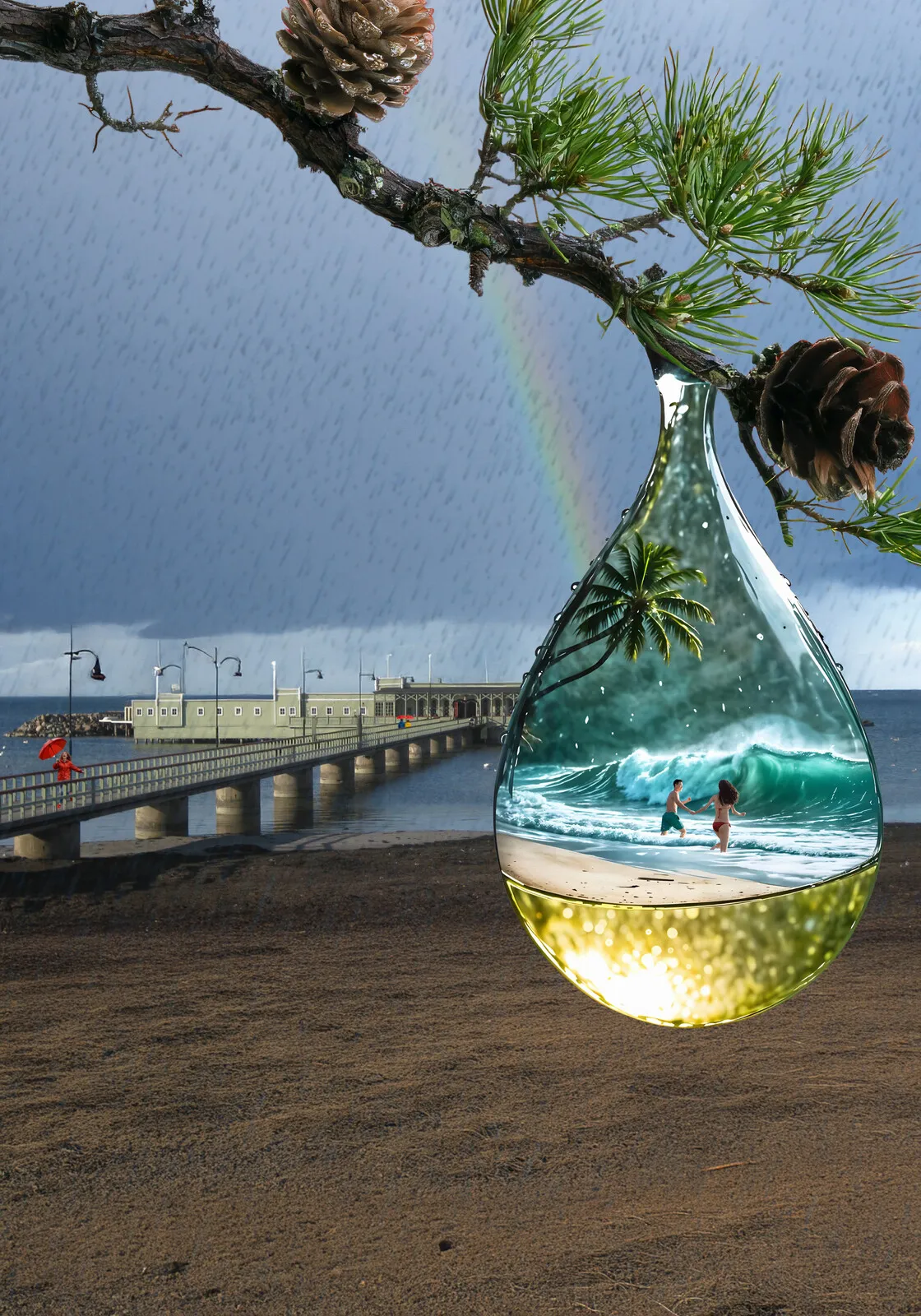
It begins with a drop. It doesn't start with thunder or fanfare, but with something small—a subtle gesture from the sky. A raindrop, hanging from a branch, caught between gravity and grace. You might walk past it. You might not even notice it. But if you do—if you pause, if you look—you might realise that it holds a universe within.
This is not the tale of a storm. It's the chronicle of what weather stirs in us: memories, yearnings, resistance—a landscape mirrored in a drop. A kiss remembered in the rain. A paradise that dwells not on a map, but in the body, in the breath, in the flicker of a dream we cling to.
To write about rain is to write about time. To write about cold is to speak of warmth. To stand on a grey pier and feel the sting of wind is to recall how it felt to dive into a warm sea, once, or to envision doing so, someday.
This is a story of climates: outer and inner, Nordic and tropical, remembered and imagined. Of women in red coats and umbrellas, of bathhouses and lovers, of droplets that contain everything we’ve lost and everything we still hope for.
And all of it begins, quietly, with a single drop.
”A Dream Within the Drop
It hangs—
a glimmer, a globe, a held breath,
a raindrop trembling at the edge of now.
Inside it, the world softens.
There are dreams in the drop.
Dreams of now—
of warm hands holding mugs,
of laughter over wet cobblestones,
of eyes meeting beneath shared umbrellas.
There are dreams of better—
of the sun on skin without fear,
of streets without sirens,
of mornings where no one wakes alone.
There are dreams of the missed—
those who should have stood beside us,
whose voices echo only in rain,
whose names bloom each time it falls.
There are dreams of elsewhere—
islands with names like songs,
waves that kiss the shore like promises,
a suitcase waiting by the door, half-zipped,
filled with hope and swimwear.
And there are dreams
of a world wide enough, kind enough—
where children sleep without hunger,
where borders melt like mist,
where every drop of water
creates its own ocean.
The drop will fall.
It always does.
But for one luminous second,
it holds the whole dream—
shimmering, complete,
enough to go on.”
Malmö, June 2025
The Weather Inside
It dangles from a branch, a fragile thought too delicate to voice. A solitary raindrop, caught between tempest and tranquillity, cradles a dream. Within it, against all reason, a dream unfurls. Not a mere metaphor, but a landscape: waves crashing against pristine shores, a pair of lovers racing into the sea, palms swaying under an impossible sun. This dream, like many others, holds the power to transform.
Outside the drop, the sky is iron. Rain needles the Baltic shore. A rainbow stutters to life behind a long pier where a lone figure in red crosses towards the sea. She is headed not for warmth, but for the cold ritual of the bathhouse—Kallbadhuset, stoic and saltworn, jutting into the grey.
But the drop offers another story.
Inside, there's no chill. No need for coats or umbrellas. No room for doubt. The couple is aglow with a light the northern sky has long forgotten. They're barefoot, bare-skinned, laughing. They're not fleeing the rain, but embracing it, their laughter a symphony in the downpour, their joy a beacon in the grey.
The raindrop becomes a gateway. Not to escape, but to remember. To recall what the body craves when the soul turns seasonal. To remember that dreams are not always born in sleep, but in stillness, when the world slows just enough to reflect itself. It's in these moments of reflection that we realise the profound influence of memories on our reality.
To dream is to resist the horizon, to push against the boundaries of what is known and what is possible, to reach for the unattainable.
And sometimes, all it takes is a single drop, a small and seemingly insignificant moment, to open the door to a world of dreams and memories that can transform our reality. These dreams and memories, with their captivating beauty, have the power to engage us in the narrative of our lives.
Weather of the Mind
We often speak of weather as a phenomenon of the sky, but in truth, it usually mirrors our inner world, stirring up emotions and moods, connecting us to our inner selves.
The clouds that gather above are echoes of the clouds that drift inside. A passing low-pressure system may mimic a sudden doubt, just as a clear blue sky can reflect a peaceful mind. A shaft of sunlight through rain becomes a fragile hope—brief, golden, gone. The sea mist that erases the horizon is not unlike the fog that rolls in when grief lingers, undefined. Like weather, they shift and shimmer—never quite the same, always just beyond grasp.
To say “it’s a grey day” is to express far more than a mere meteorological fact. It is a confession, a mood, a metaphor dressed in everyday language.
Rain, in particular, possesses its psychology. It muffles the world and sharpens thought. It invites retreat but also reflection. Under an umbrella, the mind curls inwards. On exposed skin, it awakens. There is something elemental about getting wet, like being rewritten, drop by drop.
In northern places, where the sun is rationed and the skies shift hourly, weather is not just a backdrop—it becomes a tempo, a temperament, an inner voice, a reflection. The rain doesn’t require permission; it simply arrives, as memory does: uninvited, persistent, and sometimes redemptive, stirring up memories of days long past.
And so we adapt. We carry umbrellas like exclamation marks, while we don't wear rubber boots like parentheses. We allow the wind to rearrange our thoughts. It's a testament to our resilience, our ability to adjust and find new ways of being in the world, instilling a sense of empowerment and hope.
The woman in red who walks the pier is not merely seeking a bath, for indeed, people in the North swim in the sea year-round. She moves through weather the way we navigate memory—step by step, coat buttoned, heart ajar. Her red jacket, a symbol of passion and warmth, serves as a shield against the cold, just as our memories can provide a shield against life's harshness.
The raindrop that shelters the lovers on a southern shore is not an escape from the weather; it is a metamorphosis—a space where storm becomes sanctuary. Where the downpour doesn't drown but purifies, it reminds us that even amid chaos, there is potential for growth and renewal, a change for the better worth waiting for.
Inside the droplet, the climate shifts—not just around them but within them. It's a reminder that our inner world is constantly evolving and that we have the power to shape our emotional landscape.
The Architecture of a Drop
A raindrop, a fleeting masterpiece, is not a mere sphere. It is an architecture of tension—a brief alliance between gravity and surface. Flattened at the base and rounded at the top, each drop is a compromise, a negotiation with the sky. And like dreams, it does not last.
Yet within its curve, the world is refracted. An inverted panorama: trees grow upside down, buildings curve in on themselves, and a passer-by becomes a ghost. It is a lens, a trick, a miniature oracle. Raindrops alter our perception, showing us not the world as it is, but the world as it might be remembered—in distortion, in shimmer, in delicate collapse.
What hangs from the branch in our image is more than water. It is a dream waiting to happen. Or perhaps a premonition. A drop does not ask to be noticed, and yet when we do—when we catch it before it falls—we are given a glimpse into another scale of time—one where seconds stretch into eternity, where gravity pauses, where the world forgets to end.
In such moments, we become architects too, not of buildings, but of wonder. And every reflection is an invitation.
Time Beneath the Surface
Time, like memory, is not a predictable force. It can stall, race ahead, or stand still in the moment before a drop falls. Memory, too, operates in unpredictable ways—not in straight lines but in ripples and spirals, reappearing when least expected, like rain on a dry window.
In the raindrop’s suspended dream, we are not confined to the present. The lovers in the water are not merely a couple at the beach; they might be echoes of someone else—of us, decades ago—or of someone we have yet to meet. The droplet becomes a carrier not just of light, but of lineage—of hope passed forward, of laughter sent ahead.
Even in northern rain, we carry southern dreams.
Every soaked jacket, every steaming breath, every child splashing through puddles holds a story not yet told or retold in different clothes. The rain, it seems, is never simply falling; it is returning.
The Body in Two Climates
To stand shivering by the shore, wrapped in towels and longing for warmth, is not just a physical state—it is a universal emotional one. The body recalls other climates, other freedoms. A humid breeze from a distant beach may brush past in memory, colliding with the sting of Nordic wind on bare skin. One climate belongs to the present, the other to a shared desire for escape.
We carry within us the landscapes we have loved. Our shoulders tighten in cold winds, not only out of discomfort but also in protest. The sun-kissed limbs of dream and memory rebel against the grey drizzle that governs this shore. It is the body that refuses to forget, that insists on the persistence of memory.
And there are other dreams too—not just of warmth, but of escape. Of stepping out of grey routines and into technicolour days. The dream of a terrace in Tangier, of palms brushing blue air, of a coral-red sarong fluttering in a room with open shutters. The dream of anonymity in a foreign city where no one knows your name, and you can become someone else, lighter, looser, alive. The dream of the sea, not merely as water but as possibility, an erasure of the known, a floating present tense.
To dream is not a sign of weakness, but a powerful act of resistance. The body, in its aching, cold, hopeful state, understands this truth more deeply than most. Dreams are not mere illusions, but potent forces that can shape our reality, inspiring us to hope for a better tomorrow.
A Dream Within a Drop – On the Double Reality of Place: the Cold Bath House & Paradise
Some places carry more than one truth at once—places where the visible and the imagined occupy the exact coordinates. The cold bath house by the sea is such a place. On the surface, it is bare wood, wet planks, goosebumps, the smell of salt and tar. Yet within each droplet of water clinging to the skin, another world shimmers—a tropical mirage tucked into the folds of perception, a fascinating beauty to behold.
The body walks across the creaking boards, but the soul slips elsewhere. A rain-wet railing becomes a jungle vine. The grey Baltic morphs into the turquoise Aegean. And in the steam rising from hot skin meeting cold air, the dream begins floating in warm seas, of hammocks and papayas, of lovers who taste of sun.
These dual realities, far from negating each other, exist in a delicate balance. The cold bath is a tangible, stern, and purifying reality. Yet, it also evokes a fantasy: a paradise woven into the fabric of absence and lack. The longing for warmth intensifies the imagined heat, while the chill sharpens the dream. This paradox is the enigmatic magic of place: what it lacks can be the very thing it offers, if only as a vision.
And sometimes, the dream drifts further, into memories of what was or what might have been. We dream not only of places, but of people: those who once stood beside us on the same boards, laughed in the same steam, kissed us in saltwater. Now they live solely in the warm currents of memory. Drömmar om de nära och kära som inte längre är här men ändå viskar till oss i varje vindpust, varje vågskvalp.
A dream offers an alternative reality—no less actual for being fleeting. It holds, for a moment, everything the waking world withholds. And like a sudden summer rain, it surrounds us… until it stops. But even when it stops, its imprint persists, comforting us with its lingering presence.
Epilogue: What Falls, Remains
Rain is always on standby. It arrives unannounced, rewriting the landscape with each drop. Pavements darken. Horizons blur. Faces turn inward. Yet, when the rain stops, not everything is washed away.
Some things remain: the scent of wet stone, the outline of a footprint in sand, the lingering chill on skin. Traces. Proofs that something passed through and touched us. Just as dreams.
A dream, like weather, falls on us unexpectedly, enveloping us in its essence. It seeps through the layers of logic and daily habit, leaving behind the shimmer of something half-remembered. Not quite real, yet more vivid than reality itself. What falls may vanish, but its imprint persists, lingering in our thoughts and memories.
The people we once loved, the lives we almost lived, the selves we might have become—they return to us in dreams, not as ghosts, but as companions in a parallel now. A laugh from the past. A kiss that never faded. A child we never held. These are the treasures of the inner climate, the emotional weather system that shapes our dreams and memories. We wake wet-eyed, not only from sorrow but from recognition.
Rain, like memory, speaks a language of its own. It falls, and in falling, it gives form to longing. It reminds us that even what slips through our fingers has weight. And sometimes, the most lasting truths are those that disappear, leaving behind nothing but reflection and the echo of where we stood when the sky opened.
Return to the Drop
The woman beneath the red umbrella is neither hurried nor heavy. She has just finished a cold dip in the March chill of Öresund, followed by a sauna. The rain taps lightly, a rhythm she no longer minds. Her cheeks are flushed, not from the cold, but from joy—she and her partner have just booked the trip. Two tickets, one dream: a Caribbean island where the waves are as warm and monumental as in the drop’s hidden world, where the palms lean lovingly toward the sea, as if listening.
In the raindrop still hanging from the branch, that very island awaits, not as fantasy, but as a plan. As something real, approaching. Her laughter rises as she steps onto the pier, her red umbrella bobbing like a buoy in a grey sea of drizzle. She doesn’t mind the weather. Not today.
Malmö’s own Riviera has its moment too. It's high summer. When Öresund softens, it opens and becomes almost sweet against the skin. There are days when even the north plays at being south—when salt and sun conspire, and all you need is a towel, a thermos, and someone to share the view with.
And yet, even then, even in July, the dream will remain—in the curve of a drop, in the echo of what might be. The architecture of longing doesn’t dissolve in sunshine. It merely refracts in new directions.
Because a raindrop never forgets the paradise it once contained. Here, the 'raindrop' symbolises a dream, a moment of happiness that lingers, reminding us of the beauty we've experienced and the longing for more.
Jörgen Thornberg
The Dream That Fell From the Sky, 2025
Digital
50 x 70 cm
3 200 kr
The Dream That Fell From the Sky
It begins with a drop. It doesn't start with thunder or fanfare, but with something small—a subtle gesture from the sky. A raindrop, hanging from a branch, caught between gravity and grace. You might walk past it. You might not even notice it. But if you do—if you pause, if you look—you might realise that it holds a universe within.
This is not the tale of a storm. It's the chronicle of what weather stirs in us: memories, yearnings, resistance—a landscape mirrored in a drop. A kiss remembered in the rain. A paradise that dwells not on a map, but in the body, in the breath, in the flicker of a dream we cling to.
To write about rain is to write about time. To write about cold is to speak of warmth. To stand on a grey pier and feel the sting of wind is to recall how it felt to dive into a warm sea, once, or to envision doing so, someday.
This is a story of climates: outer and inner, Nordic and tropical, remembered and imagined. Of women in red coats and umbrellas, of bathhouses and lovers, of droplets that contain everything we’ve lost and everything we still hope for.
And all of it begins, quietly, with a single drop.
”A Dream Within the Drop
It hangs—
a glimmer, a globe, a held breath,
a raindrop trembling at the edge of now.
Inside it, the world softens.
There are dreams in the drop.
Dreams of now—
of warm hands holding mugs,
of laughter over wet cobblestones,
of eyes meeting beneath shared umbrellas.
There are dreams of better—
of the sun on skin without fear,
of streets without sirens,
of mornings where no one wakes alone.
There are dreams of the missed—
those who should have stood beside us,
whose voices echo only in rain,
whose names bloom each time it falls.
There are dreams of elsewhere—
islands with names like songs,
waves that kiss the shore like promises,
a suitcase waiting by the door, half-zipped,
filled with hope and swimwear.
And there are dreams
of a world wide enough, kind enough—
where children sleep without hunger,
where borders melt like mist,
where every drop of water
creates its own ocean.
The drop will fall.
It always does.
But for one luminous second,
it holds the whole dream—
shimmering, complete,
enough to go on.”
Malmö, June 2025
The Weather Inside
It dangles from a branch, a fragile thought too delicate to voice. A solitary raindrop, caught between tempest and tranquillity, cradles a dream. Within it, against all reason, a dream unfurls. Not a mere metaphor, but a landscape: waves crashing against pristine shores, a pair of lovers racing into the sea, palms swaying under an impossible sun. This dream, like many others, holds the power to transform.
Outside the drop, the sky is iron. Rain needles the Baltic shore. A rainbow stutters to life behind a long pier where a lone figure in red crosses towards the sea. She is headed not for warmth, but for the cold ritual of the bathhouse—Kallbadhuset, stoic and saltworn, jutting into the grey.
But the drop offers another story.
Inside, there's no chill. No need for coats or umbrellas. No room for doubt. The couple is aglow with a light the northern sky has long forgotten. They're barefoot, bare-skinned, laughing. They're not fleeing the rain, but embracing it, their laughter a symphony in the downpour, their joy a beacon in the grey.
The raindrop becomes a gateway. Not to escape, but to remember. To recall what the body craves when the soul turns seasonal. To remember that dreams are not always born in sleep, but in stillness, when the world slows just enough to reflect itself. It's in these moments of reflection that we realise the profound influence of memories on our reality.
To dream is to resist the horizon, to push against the boundaries of what is known and what is possible, to reach for the unattainable.
And sometimes, all it takes is a single drop, a small and seemingly insignificant moment, to open the door to a world of dreams and memories that can transform our reality. These dreams and memories, with their captivating beauty, have the power to engage us in the narrative of our lives.
Weather of the Mind
We often speak of weather as a phenomenon of the sky, but in truth, it usually mirrors our inner world, stirring up emotions and moods, connecting us to our inner selves.
The clouds that gather above are echoes of the clouds that drift inside. A passing low-pressure system may mimic a sudden doubt, just as a clear blue sky can reflect a peaceful mind. A shaft of sunlight through rain becomes a fragile hope—brief, golden, gone. The sea mist that erases the horizon is not unlike the fog that rolls in when grief lingers, undefined. Like weather, they shift and shimmer—never quite the same, always just beyond grasp.
To say “it’s a grey day” is to express far more than a mere meteorological fact. It is a confession, a mood, a metaphor dressed in everyday language.
Rain, in particular, possesses its psychology. It muffles the world and sharpens thought. It invites retreat but also reflection. Under an umbrella, the mind curls inwards. On exposed skin, it awakens. There is something elemental about getting wet, like being rewritten, drop by drop.
In northern places, where the sun is rationed and the skies shift hourly, weather is not just a backdrop—it becomes a tempo, a temperament, an inner voice, a reflection. The rain doesn’t require permission; it simply arrives, as memory does: uninvited, persistent, and sometimes redemptive, stirring up memories of days long past.
And so we adapt. We carry umbrellas like exclamation marks, while we don't wear rubber boots like parentheses. We allow the wind to rearrange our thoughts. It's a testament to our resilience, our ability to adjust and find new ways of being in the world, instilling a sense of empowerment and hope.
The woman in red who walks the pier is not merely seeking a bath, for indeed, people in the North swim in the sea year-round. She moves through weather the way we navigate memory—step by step, coat buttoned, heart ajar. Her red jacket, a symbol of passion and warmth, serves as a shield against the cold, just as our memories can provide a shield against life's harshness.
The raindrop that shelters the lovers on a southern shore is not an escape from the weather; it is a metamorphosis—a space where storm becomes sanctuary. Where the downpour doesn't drown but purifies, it reminds us that even amid chaos, there is potential for growth and renewal, a change for the better worth waiting for.
Inside the droplet, the climate shifts—not just around them but within them. It's a reminder that our inner world is constantly evolving and that we have the power to shape our emotional landscape.
The Architecture of a Drop
A raindrop, a fleeting masterpiece, is not a mere sphere. It is an architecture of tension—a brief alliance between gravity and surface. Flattened at the base and rounded at the top, each drop is a compromise, a negotiation with the sky. And like dreams, it does not last.
Yet within its curve, the world is refracted. An inverted panorama: trees grow upside down, buildings curve in on themselves, and a passer-by becomes a ghost. It is a lens, a trick, a miniature oracle. Raindrops alter our perception, showing us not the world as it is, but the world as it might be remembered—in distortion, in shimmer, in delicate collapse.
What hangs from the branch in our image is more than water. It is a dream waiting to happen. Or perhaps a premonition. A drop does not ask to be noticed, and yet when we do—when we catch it before it falls—we are given a glimpse into another scale of time—one where seconds stretch into eternity, where gravity pauses, where the world forgets to end.
In such moments, we become architects too, not of buildings, but of wonder. And every reflection is an invitation.
Time Beneath the Surface
Time, like memory, is not a predictable force. It can stall, race ahead, or stand still in the moment before a drop falls. Memory, too, operates in unpredictable ways—not in straight lines but in ripples and spirals, reappearing when least expected, like rain on a dry window.
In the raindrop’s suspended dream, we are not confined to the present. The lovers in the water are not merely a couple at the beach; they might be echoes of someone else—of us, decades ago—or of someone we have yet to meet. The droplet becomes a carrier not just of light, but of lineage—of hope passed forward, of laughter sent ahead.
Even in northern rain, we carry southern dreams.
Every soaked jacket, every steaming breath, every child splashing through puddles holds a story not yet told or retold in different clothes. The rain, it seems, is never simply falling; it is returning.
The Body in Two Climates
To stand shivering by the shore, wrapped in towels and longing for warmth, is not just a physical state—it is a universal emotional one. The body recalls other climates, other freedoms. A humid breeze from a distant beach may brush past in memory, colliding with the sting of Nordic wind on bare skin. One climate belongs to the present, the other to a shared desire for escape.
We carry within us the landscapes we have loved. Our shoulders tighten in cold winds, not only out of discomfort but also in protest. The sun-kissed limbs of dream and memory rebel against the grey drizzle that governs this shore. It is the body that refuses to forget, that insists on the persistence of memory.
And there are other dreams too—not just of warmth, but of escape. Of stepping out of grey routines and into technicolour days. The dream of a terrace in Tangier, of palms brushing blue air, of a coral-red sarong fluttering in a room with open shutters. The dream of anonymity in a foreign city where no one knows your name, and you can become someone else, lighter, looser, alive. The dream of the sea, not merely as water but as possibility, an erasure of the known, a floating present tense.
To dream is not a sign of weakness, but a powerful act of resistance. The body, in its aching, cold, hopeful state, understands this truth more deeply than most. Dreams are not mere illusions, but potent forces that can shape our reality, inspiring us to hope for a better tomorrow.
A Dream Within a Drop – On the Double Reality of Place: the Cold Bath House & Paradise
Some places carry more than one truth at once—places where the visible and the imagined occupy the exact coordinates. The cold bath house by the sea is such a place. On the surface, it is bare wood, wet planks, goosebumps, the smell of salt and tar. Yet within each droplet of water clinging to the skin, another world shimmers—a tropical mirage tucked into the folds of perception, a fascinating beauty to behold.
The body walks across the creaking boards, but the soul slips elsewhere. A rain-wet railing becomes a jungle vine. The grey Baltic morphs into the turquoise Aegean. And in the steam rising from hot skin meeting cold air, the dream begins floating in warm seas, of hammocks and papayas, of lovers who taste of sun.
These dual realities, far from negating each other, exist in a delicate balance. The cold bath is a tangible, stern, and purifying reality. Yet, it also evokes a fantasy: a paradise woven into the fabric of absence and lack. The longing for warmth intensifies the imagined heat, while the chill sharpens the dream. This paradox is the enigmatic magic of place: what it lacks can be the very thing it offers, if only as a vision.
And sometimes, the dream drifts further, into memories of what was or what might have been. We dream not only of places, but of people: those who once stood beside us on the same boards, laughed in the same steam, kissed us in saltwater. Now they live solely in the warm currents of memory. Drömmar om de nära och kära som inte längre är här men ändå viskar till oss i varje vindpust, varje vågskvalp.
A dream offers an alternative reality—no less actual for being fleeting. It holds, for a moment, everything the waking world withholds. And like a sudden summer rain, it surrounds us… until it stops. But even when it stops, its imprint persists, comforting us with its lingering presence.
Epilogue: What Falls, Remains
Rain is always on standby. It arrives unannounced, rewriting the landscape with each drop. Pavements darken. Horizons blur. Faces turn inward. Yet, when the rain stops, not everything is washed away.
Some things remain: the scent of wet stone, the outline of a footprint in sand, the lingering chill on skin. Traces. Proofs that something passed through and touched us. Just as dreams.
A dream, like weather, falls on us unexpectedly, enveloping us in its essence. It seeps through the layers of logic and daily habit, leaving behind the shimmer of something half-remembered. Not quite real, yet more vivid than reality itself. What falls may vanish, but its imprint persists, lingering in our thoughts and memories.
The people we once loved, the lives we almost lived, the selves we might have become—they return to us in dreams, not as ghosts, but as companions in a parallel now. A laugh from the past. A kiss that never faded. A child we never held. These are the treasures of the inner climate, the emotional weather system that shapes our dreams and memories. We wake wet-eyed, not only from sorrow but from recognition.
Rain, like memory, speaks a language of its own. It falls, and in falling, it gives form to longing. It reminds us that even what slips through our fingers has weight. And sometimes, the most lasting truths are those that disappear, leaving behind nothing but reflection and the echo of where we stood when the sky opened.
Return to the Drop
The woman beneath the red umbrella is neither hurried nor heavy. She has just finished a cold dip in the March chill of Öresund, followed by a sauna. The rain taps lightly, a rhythm she no longer minds. Her cheeks are flushed, not from the cold, but from joy—she and her partner have just booked the trip. Two tickets, one dream: a Caribbean island where the waves are as warm and monumental as in the drop’s hidden world, where the palms lean lovingly toward the sea, as if listening.
In the raindrop still hanging from the branch, that very island awaits, not as fantasy, but as a plan. As something real, approaching. Her laughter rises as she steps onto the pier, her red umbrella bobbing like a buoy in a grey sea of drizzle. She doesn’t mind the weather. Not today.
Malmö’s own Riviera has its moment too. It's high summer. When Öresund softens, it opens and becomes almost sweet against the skin. There are days when even the north plays at being south—when salt and sun conspire, and all you need is a towel, a thermos, and someone to share the view with.
And yet, even then, even in July, the dream will remain—in the curve of a drop, in the echo of what might be. The architecture of longing doesn’t dissolve in sunshine. It merely refracts in new directions.
Because a raindrop never forgets the paradise it once contained. Here, the 'raindrop' symbolises a dream, a moment of happiness that lingers, reminding us of the beauty we've experienced and the longing for more.
3 200 kr

Jörgen Thornberg
Malmö
Lite om bilder och mig. Translation in English at the end.
Jag är en nyfiken person som ser allt i bilder, även det jag fäster i ord, gärna tillsammans för bakom alla mina bilder finns en berättelse. Till vissa bilder hör en kortare eller längre novell som följer med bilden.
Bilder berättar historier. Jag omges av naturlig skönhet, intressanta människor och historia var jag än går. Jag använder min kamera för att dokumentera världen och blanda det jag ser med vad jag känner för att fånga den dolda magin.
Mina bilder berättar mina historier. Genom mina bilder, tryck och berättelser. Jag bjuder in dig att ta del av dessa berättelser, in i ditt liv och hem och dela min mycket personliga syn på vår värld. Mer än vad ögat ser. Jag tänker i bilder, drömmer och skriver och pratar om dem; följaktligen måste jag också skapa bilder. De blir vad jag ser, inte nödvändigtvis begränsade till verkligheten. Det finns en bild runt varje hörn. Jag hoppas att du kommer att se vad jag såg och gilla det.
Jag är också en skrivande person och till många bilder hör en kortare eller längre essay. Den följer med tavlan, tryckt på fint papper och med en personlig hälsning från mig.
Flertalet bilder startar sin resa i min kamera. Enkelt förklarat beskriver jag bilden jag ser i mitt inre, upplevd eller fantiserad. Bilden uppstår inom mig redan innan jag fått okularet till ögat. På bråkdelen av ett ögonblick ser jag vad jag vill ha och vad som kan göras med bilden. Här skall jag stoppa in en giraff, stålmannen, Titanic eller vad det är min fantasi finner ut. Ännu märkligare är att jag kommer ihåg minnesbilden långt efteråt när det blir tid att skapa verket. Om jag lyckas eller inte, är upp till betraktaren, oftast präglat av en stråk av svart humor – meningen är att man skall bli underhållen. Mina bilder blir ofta en snackis där de hänger.
Jag föredrar bilder som förmedlar ett budskap i flera lager. Vid första anblicken fylld av feel-good, en vacker utsikt, fint väder, solen skiner, blommor på ängen eller vattnet som ligger förrädiskt spegelblankt. I en sådan bild kan jag gömma min egentliga berättelse, mitt förakt för förtryckare och våldsverkare, rasister och fördomsfulla människor - ett gärna återkommande motiv mer eller mindre dolt i det vackra motivet. Jag försöker förena dem i ett gemensamt narrativ.
Bild och formgivning har löpt som en röd tråd genom livet. Fotokonst känns som en värdig final som jag gärna delar med mig.
Min genre är vid som framgår av mina bilder, temat en blandning av pop- och gatukonst i kollage som kan bestå av hundratals lager. Vissa bilder kan ta veckor, andra någon dag innan det är dags att överlämna resultatet till printverkstaden. Fine Art Prints är digitala fotocollage. I dessa kollage sker rivandet, klippandet, pusslandet, målandet, ritandet och sprayningen digitalt. Det jag monterar in kan vara hundratals år gamla bilder som jag omsorgsfullt frilägger så att de ser ut att vara en del av tavlan men också bilder skapade av mig själv efter min egen fantasi. Därefter besöks printstudion och för vissa bilder numrera en limiterad upplaga (oftast 7 exemplar) och signera för hand. Vissa bilder kan köpas i olika format. Det är bara att fråga efter vilka. Gillar man en bild som är 70x100 men inte har plats på väggen, går den kanske att få i 50x70 cm istället. Frågan är fri.
Metoden Giclée eller Fine Art Print som det också kallas är det moderna sättet för framställning av grafisk konst. Villkoret för denna typ av utskrifter är att en högkvalitativ storformatskrivare används med åldersbeständigt färgpigment och konstnärspapper eller i förekommande fall på duk. Pappret som används möter de krav på livslängd som ställs av museer och gallerier. Normalt säljer jag mina bilder oinramade så att den nya ägaren själv kan bestämma hur de skall se ut, med eller utan passepartout färg på ram, med eller utan glas etc..
Under många år ställde jag bara ut på nätet, i valda grupper och på min egen Facebooksida - https://www.facebook.com/jorgen.thornberg.9
Jag finns också på en egen hemsida som tyvärr inte alltid är uppdaterad – https://www.jth.life/ Där kan du också läsa en del av de berättelser som följer med bilden.
UTSTÄLLNINGAR
Luftkastellet, oktober 2022
Konst i Lund, november 2022
Luftkastellet, mars 2023
Engleson Galleri Caroli, april 2023
Hydra, Greece June 2023
Engleson Galleri Caroli, oktober 2023
Toppen, Höllviken december 2023
Luftkastellet, mars 2024
Torups Galleri, mars 2024
Venice, May 2024
Luftkastellet, oktober 2024
Konst i Advent, December 2024
Galleri Engleson, Caroli December 2024
Jäger & Jansson Galleri, april 2025
A bit about pictures and me.
I'm a curious person who sees everything in pictures, even what I express in words, often combining them, for behind all my pictures lies a story. These narratives, some as short as a single image and others as long as a novel, are the heart and soul of my work.
Pictures tell stories. Wherever I go, I'm surrounded by natural beauty, exciting people, and history. I use my camera to document the world and blend what I see with what I feel to capture the hidden magic.
My images tell my stories. Through my pictures, prints, and narratives, I invite you to partake in these stories in your life and home and share my deeply personal perspective of our world. More than meets the eye. I think in pictures, dream, write, and talk about them; consequently, I must create images too. They become what I see, not necessarily confined to reality. There's a picture around every corner. I hope you'll see what I saw and enjoy it.
I'm also a writer, and many images come with a shorter or longer essay. It accompanies the painting, printed on fine paper with my personal greeting.
Many pictures start their journey on my camera. Simply put, I describe the image I see in my mind, experienced or imagined. The image arises within me even before I bring the eyepiece to my eye. In a fraction of a moment, I see what I want and what can be done with the picture. Here, I'll insert a giraffe, Superman, the Titanic, or whatever my imagination conjures up. Even stranger is that I remember the mental image long after it's time to create the work. Whether I succeed is up to the observer, often imbued with a streak of black humour – the aim is to entertain. My pictures usually become a talking point wherever they hang.
I prefer pictures that convey a message in multiple layers. At first glance, they're filled with feel-good vibes, a beautiful view, lovely weather, the sun shining, flowers in the meadow, or the water lying deceptively calm. But beneath this surface beauty, I often conceal a deeper story, a narrative that challenges societal norms or explores the human condition. I invite you to delve into these hidden narratives and discover the layers of meaning within my work.
Picture and design have been a thread running through my life. Photographic art feels like a fitting finale, and I'm happy to share it.
My genre is varied, as seen in my pictures; the theme is a blend of pop and street art in collages that can consist of hundreds of layers. Some images can take weeks, others just a day before it's time to hand over the result to the print workshop. Fine Art Prints are digital photo collages. In these collages, tearing, cutting, puzzling, painting, drawing, and spraying happen digitally. What I insert can be images hundreds of years old that I carefully extract so they appear to be part of the painting, but also images created by myself, now also generated from my imagination. Next, visit the print studio and, for certain images, number a limited edition (usually 7 copies) and sign them by hand. Some images may be available in other formats. Just ask which ones. If you like an image that's 70x100 but doesn't have space on the wall, you might be able to get it in 50x70 cm instead. The question is open.
The Giclée method, or Fine Art Print as it's also called, is the modern way of producing graphic art. This method ensures the highest quality and longevity of the artwork, using a high-quality large-format printer with archival pigment inks and artist paper or, in some cases, canvas. The paper used meets the longevity requirements set by museums and galleries. I sell my pictures unframed, allowing the new owner to personalise their artwork, confident in the lasting value and quality of the piece.
For many years, I only exhibited online, in selected groups, and on my Facebook page - https://www.facebook.com/jorgen.thornberg.9. I also have my website, which unfortunately is not constantly updated - https://www.jth.life/. You can also read some of the stories accompanying the pictures there.
EXHIBITIONS
Luftkastellet, October 2022
Art in Lund, November 2022
Luftkastellet, March 2023
Engleson Gallery Caroli, April 2023
Hydra, Greece June 2023
Engleson Gallery Caroli, October 2023
Toppen, Höllviken December 2023
Luftkastellet, March 2024
Torup Gallery, March 2024
Venice, May 2024
UTSTÄLLNINGAR
Luftkastellet, oktober 2022
Konst i Lund, november 2022
Luftkastellet, mars 2023
Engleson Galleri Caroli, april 2023
Hydra, Greece June 2023
Engleson Galleri Caroli, oktober 2023
Toppen, Höllviken december 2023
Luftkastellet, mars 2024
Torups Galleri, mars 2024
Venice, May 2024
Luftkastellet, October 2024
Konst i Advent, December 2024
Galleri Engleson, Caroli December 2024
Jäger & Jansson Galleri, April 2025
Utbildning
Autodidakt
Medlem i konstnärsförening
Öppna Sinnen
Med i konstrunda
Konstrundan i Skåne
Utställningar
Luftkastellet, October 2022
Art in Lund, November 2022
Luftkastellet, March 2023
Engleson Gallery Caroli, April 2023
Hydra, Greece June 2023
Engleson Gallery Caroli, October 2023
Toppen, Höllviken December 2023
Luftkastellet, March 2024
Torup Gallery, March 2024
Venice, May 2024