Vi använder cookies för att ge dig bästa möjliga upplevelse. Välj vilka cookies du tillåter.
Läs mer i vår integritetspolicy
Jörgen Thornberg
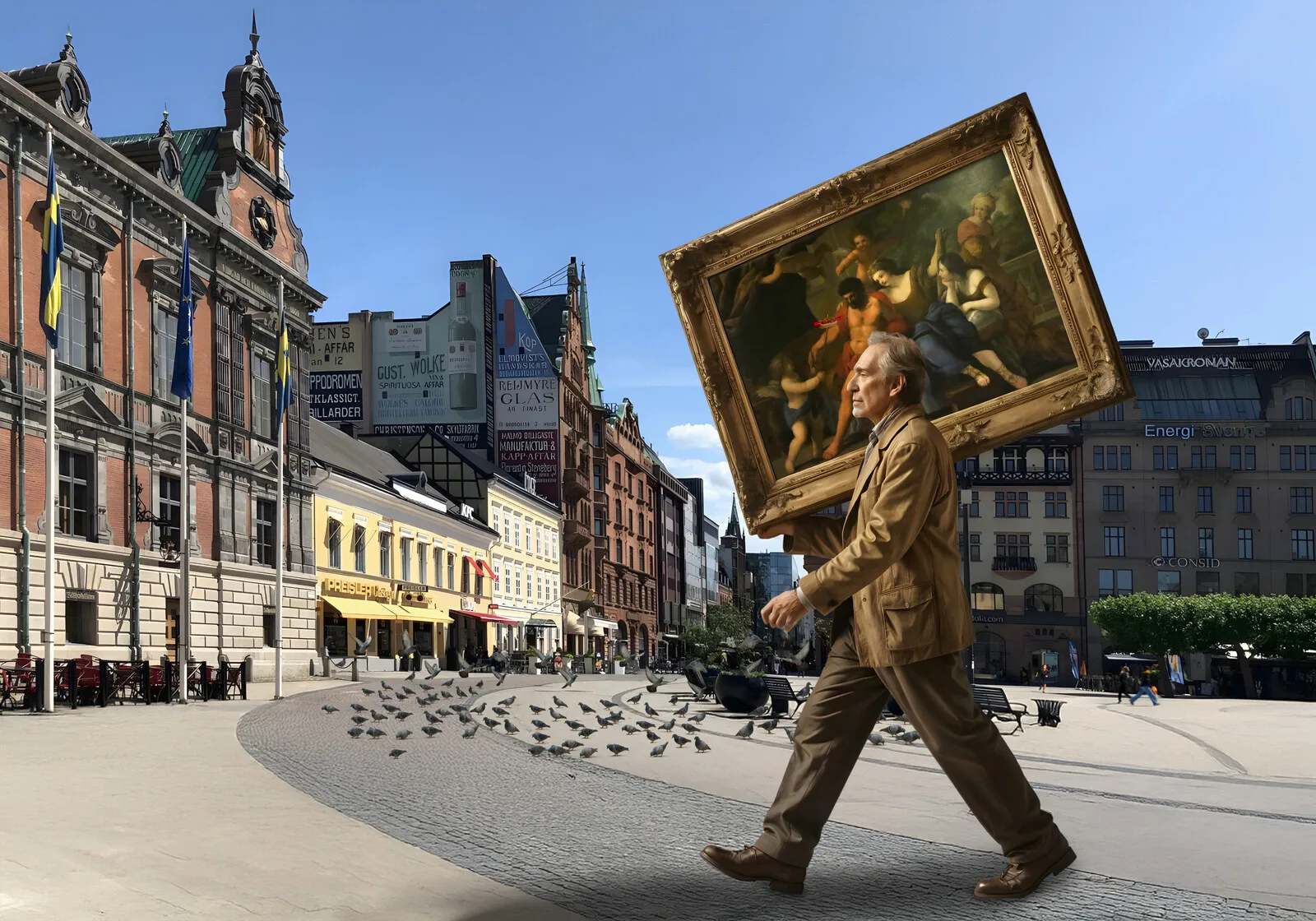
Carried Away by Lust and Canvas, 2025
Digital
70 x 50 cm
3 200 kr
Carried Away by Lust and Canvas
A story that weaves together elements of sensuality and strength, when Hercules lost his club, it became a tale of intrigue. The myth of Hercules and Omphale, more than any other, lays bare the theatricality of gender roles. It is a narrative woven with paradoxes: the mightiest man in the world, spinning yarn alongside a queen in sandals; a hero divested of his lion skin and adorned in lace. For centuries, the myth was seen as a comedic interlude—an afterthought to the Twelve Labours, a peculiar punishment added to a story of sheer power. But delve deeper, and you’ll discover a complex tapestry of fluid identities, erotic undercurrents, and role reversals that resonate with our modern sensibilities.
What commences as an act of divine retribution—Hercules, sentenced to serve a woman after the murder of a friend—swiftly evolves into a narrative of control, metamorphosis, and unforeseen closeness. The story has captivated artists, poets, and now gender theorists, for whom Hercules in feminine attire is not a jest, but a profound transformation.
Please read on to learn more about my pictures, writing, and why this story is a must-read.
”The Spindle and the Club
(A Lush Ballad of Hercules and Omphale)
She ruled in silk and sandalwood,
With lips that tasted like command,
While he, the lion-hearted brute,
Came meekly at her soft demand.
She gave no whip, no chain, no snare—
Just thread to spin and clothes to wear.
He laid aside his fabled might,
And learned to stitch by candlelight.
His club hung idle on the wall,
She wore his lion skin like sin.
She laughed and made the demi-god
Undo his braids and tuck his chin.
“Tonight,” she said, “you serve my will.
You’ll wind the yarn. You’ll sit quite still.”
And so he did, with flushed regret—
Though he never once tried to forget.
By morning’s blush, their roles would shift,
In tangled sheets and scented drift.
A queen who ruled with gaze and breath,
A god undone by love—and death.
So if you see a man in lace
With thunder still behind his face,
Do not assume he lost the fight—
He may have yielded for delight.
The painting left its whitewashed cell,
The echoing hall where echoes dwell—
And hoisted high on mortal frame,
It marched once more in myth’s own name.
Through castle gates and parkland shade,
Past fountains where no nymphs have stayed,
By Kock’s proud house of stone and trade,
Hercule and Omphale drifted on like a cavalcade.
Across Stortorget’s open span,
A canvas trembling in the hand
Of one lone curator, whose steady gait
Bore lust and legend, love and fate.
To City Hall they came at last,
Two bodies caught in the golden past,
Still flushed with gods and perfumed flame—
Though no one now recalls their name”
Malmö, June 2025
Carried Away by Lust and Canvas
Imagine my surprise when I spotted a man strolling across Stortorget, carrying a massive painting that I instantly recognised. This masterpiece typically adorns the grand King's Hall at Malmöhus Castle, so its unexpected journey towards the Town Hall was a sight to behold. The painting, a voluptuous Baroque piece about one and a half meters wide, must have weighed a brave thirty to forty kilos. The man's casual handling of it was not just impressive but also piqued my curiosity. This journey, from the prestigious King's Hall to the more public Town Hall, symbolises a shift in power dynamics and the influence of lust in different societal settings, leaving me intrigued and eager to learn more.
The painting that the assistant curator is carrying on his shoulder across Stortorget is a copy of the Italian Baroque artist Giovanni Romanelli’s work Hercules and Omphale—a sizzling subject in the prudish 17th century. The reason, most likely, was everything simmering beneath the surface: lust in all its forms, including same-sex desire. The myth behind the painting stands unashamed alongside the era when pornography dressed itself in tweed jackets and Oxford commas. This historical context, which can enrich our understanding of the artwork and the themes it portrays, adds a layer of cultural significance to the painting, inviting us to explore its deeper historical roots and stimulating our intellect.
Take ‘Lady Chatterley’s Lover’ (1928), D.H. Lawrence’s tale of earthy, class-defying lust between an upper-class woman and her working-class gamekeeper. Banned, censored, dissected—but always read, preferably under the covers or on the tram with the dust jacket of Middlemarch as camouflage.
Consider Ragnar Mykle’s ‘The Song of the Red Ruby’ (Sangen om den røde rubin, 1956), a Norwegian Bildungsroman so drenched in erotic candour that it sparked a full-blown obscenity trial. Mykle’s protagonist, Ask Burlefot, philosophises, fornicates, and fumbles through life in what was both an ode to sexual awakening and a scandal that found its way into every Scandinavian library. These weren’t just novels. They were cover stories—literally. Respectable on the outside, combustible on the inside. Exactly like Romanelli’s painting. The scandalous nature of these literary works adds an element of intrigue, encouraging further exploration and inviting us to question societal norms and taboos.
On the surface, the image looks like an ordinary family evening scene. Admittedly, Hercules is half-naked, barely covered by a flimsy piece of cloth, and Omphale has her breasts exposed, but is, on the other hand, wearing sandals. Everyone’s attention is directed toward a little cherub offering something to Hercules—on my version, it appears to be a red Danish sausage. This cherub, often associated with innocence and purity, is depicted suggestively, adding a layer of complexity to the theme of lust in the painting. Those seem to show up just about anywhere, even in antiquity.
Let's take a detour into the Greek—later Roman—myth and understand why this theme was so spectacular. Romanelli’s painting of the love couple can be found not only in Malmö Castle, but also in the Hermitage in St. Petersburg and the Louvre in Paris, in nearly identical versions. This historical context enriches our understanding of the artwork and the themes it portrays, stimulating our intellect and inviting us to explore the myth's historical significance in greater depth.
A whole host of great masters have depicted the same scene—Rubens, Lemoyne, and Boucher, to name a few. Now, let's delve into the tragic murder of a friend, a pivotal event in the Hercules and Omphale myth that sets the stage for the hero's subsequent journey and transformation. The complexity of this myth is intriguing, encouraging further exploration and inviting us to unravel its intricacies.
For murdering his friend Iphitus in a fit of madness, Hercules was sold as a slave to Omphale, queen of Lydia, for three years. However, she soon alleviated his plight by becoming his lover. While in her service, he became effeminate, wearing women's clothing and adornments, and spinning yarn.
Iphitus was the son of King Eurytus of Oechalia. It is told that after Hercules completed his Twelve Labours, he came to Oechalia to compete in archery for the hand of Iole; he won, yet was denied the bride by Eurytus and his sons (all except Iphitus, who believed Iole should be given to Hercules) because they feared he might once more kill his offspring, as he had done to his children by Megara. The plot is just complicated enough to require real effort to follow, stimulating the audience's intellect and inviting us to unravel the intricacies of the myth.
Still, Iphitus did not believe Hercules was guilty and, having gone to meet him, invited him to search for the cattle together. Hercules agreed, but suddenly became mad again and threw Iphitus from the walls of Tiryns, killing him. According to one version of the myth, Iphitus is also said to have been a lover of Hercules.
Both Hercules and Omphale were obviously bisexual, a fact that was not uncommon among the Greek gods. The Greek pantheon seemed to indulge in just about everything—promiscuity at its peak. This cultural context is crucial to understanding the characters and their actions in the Hercules and Omphale myth.
What diagnosis would someone like Hercules receive today? Every letter in the alphabet, all rolled into one?
During his search for the cattle, Iphitus met Odysseus in Messenia, befriended him, and gave him his father Eurytus’s bow. It was this bow that Odysseus used to kill the suitors vying for his wife, Penelope.
The myth of Hercules and Omphale unveils a unique power dynamic. It narrates the tale of the hero Hercules, punished for his crime by being sold into servitude to Queen Omphale of Lydia. During this time, Hercules is compelled to perform traditionally feminine tasks and wear women's clothing, while Omphale dons his lion skin and wields his club. This unusual relationship—a captivating subject in art—often portrays a reversal of gender roles and the intricate power dynamics between the two figures, which can intrigue and engage the audience.
Here we have a man in women’s clothing. Today, it is called cosplay and is all the rage in certain circles—especially, as in the case of Hercules and Omphale, when sex is involved.
Everything starts with Hercules’ punishment for murdering his friend Iphitus. He is reprimanded by being sold into slavery to Queen Omphale.y to Queen Omphale.
Role Reversal, Love, and Legacy: Hercules and Omphale Reconsidered.
The myth of Hercules and Omphale, a narrative that boldly challenges traditional gender roles, is a compelling study in subversion. Hercules, enslaved to the Lydian queen, is forced to perform domestic tasks and wear women's attire, while Omphale adopts masculine traits, even donning his lion’s skin and wielding his club. This audacious role reversal, though it may appear comical, was profoundly unsettling to Classical audiences, as Sophocles' The Trachiniae suggests.
Yet, the tale is more than a punchline. Despite the humiliation and submission, the relationship between Hercules and Omphale evolves into a genuine bond. In time, Omphale frees Hercules and marries him. Their union, born in imbalance, becomes a testament to love’s ability to transcend power structures and societal expectations, inspiring hope in the hearts of the audience.
Throughout the Renaissance and Baroque periods, this narrative captivated artists who delighted in its subversive energy. Paintings and sculptures explored the couple’s shifting power dynamic—Omphale poised and commanding, Hercules domesticated and softened—offering rich material for visual interpretations of sexuality, control, and mythic identity. Romanelli’s version, with its erotic undercurrents and veiled queerness, fits squarely within this tradition.
Like many myths, the tale of Hercules and Omphale exists in numerous variations. In some, Hercules willingly submits to servitude; in others, he disguises himself in women’s clothing to win over Omphale after being initially rejected. This adaptability, a characteristic shared by many myths, allows for fresh interpretations across eras—comic, tragic, erotic, or political. The enduring relevance of this myth, as evidenced by its ability to reflect changing societal norms, is a testament to its power.
In later Hellenistic and Roman literature, Hercules is regularly depicted performing women’s work, often with visual irony: holding baskets of wool, dressed in feminine robes, spinning thread beside Omphale and her maidens. Omphale, in turn, wears the Nemean lion’s skin and carries the hero’s club, a visual symbol of the swapped domains of power and gender. Though vase-paintings fill in some of the gaps, early narrative accounts are largely lost. Still, the myth tells us enough: they did more than spin yarn together—they had children, too.
Even amidst domestic role play, Hercules remained... Hercules. During his time in Lydia, he also captured the city of the Itones and enslaved them, killed Syleus (who forced strangers to hoe his vineyard), and subdued the mischievous Cercopes. One myth recounts a night when Omphale and Hercules were to celebrate the rites of Bacchus. Hercules, sleeping alone in Omphale’s garments, was approached by the lusty god Pan. Mistaking the bed for the queen’s, Pan crawled in naked—only to be thrown across the room by a bemused Hercules.
Queer and Feminist Readings
In recent decades, the myth of Hercules and Omphale has drawn the attention of both queer theorists and feminist scholars—who perceive in the tale a subversive parable hidden in plain sight. The visual trope of the hypermasculine hero donning women's clothing, stripped of weapon and authority, has been interpreted not merely as comedy but as a coded expression of gender fluidity and performativity. Judith Butler would have had a field day: Hercules, the quintessential strongman, is compelled to “do” femininity—not as farce, but as penance, perhaps even desire.
From a queer perspective, the myth invites us to question the stability of gender identity. Hercules is no less heroic in drag. His temporary transformation reveals how constructed, theatrical, and context-dependent all gender roles are. The suggestion, in some sources, that Iphitus may have been both his friend and his lover further destabilises the heteronormative narrative and roots Hercules firmly in the realm of queer mythology. This realm includes Ganymede, Achilles and Patroclus, and the ever-shifting Hermes. The myth's portrayal of Hercules in drag is not merely a reversal of traditional gender roles, but a potential queer narrative that challenges and destabilises heteronormative norms, inviting us to reconsider our understanding of gender and sexuality in classical mythology.
Feminist interpretations, meanwhile, have focused on Omphale herself, often dismissed or fetishised in traditional art as little more than a dominatrix in sandals. However, Omphale, as queen and captor, is one of the rare female figures in classical mythology who exercises absolute power over a male hero, not by magic or trickery, but through law, will, and erotic charisma. She is not the femme fatale; she is the employer. She owns the club. Her exercise of power over Hercules is not merely a reversal of traditional gender roles, but a demonstration of her sovereignty and her ability to blur the boundary between ruler and lover, woman and man.
Their dynamic defies the binary. Omphale is no mere reversal of the damsel-in-distress trope; she is a sovereign who blurs the boundary between ruler and lover, woman and man. In their union, dominance and submission dissolve into partnership, however unconventional its origins.
In Summary
The myth of Hercules and Omphale is not just a tale of gender swap—it is a layered commentary on power, identity, performance, and desire. Whether interpreted as erotic farce, subversive romance, or social satire, it continues to fascinate. Somewhere between lion skins and silk gowns, the strongest man in myth met his match—not on the battlefield, but at the spinning wheel. This exploration of power, identity, performance, and desire in the myth of Hercules and Omphale invites us, as scholars and enthusiasts, to delve deeper into the complexities of classical mythology.
Jörgen Thornberg
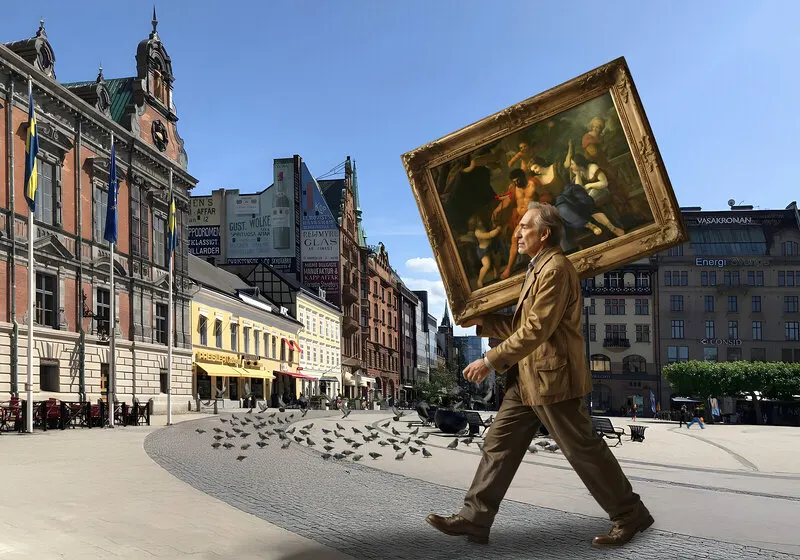
Carried Away by Lust and Canvas, 2025
Digital
70 x 50 cm
3 200 kr
Carried Away by Lust and Canvas
A story that weaves together elements of sensuality and strength, when Hercules lost his club, it became a tale of intrigue. The myth of Hercules and Omphale, more than any other, lays bare the theatricality of gender roles. It is a narrative woven with paradoxes: the mightiest man in the world, spinning yarn alongside a queen in sandals; a hero divested of his lion skin and adorned in lace. For centuries, the myth was seen as a comedic interlude—an afterthought to the Twelve Labours, a peculiar punishment added to a story of sheer power. But delve deeper, and you’ll discover a complex tapestry of fluid identities, erotic undercurrents, and role reversals that resonate with our modern sensibilities.
What commences as an act of divine retribution—Hercules, sentenced to serve a woman after the murder of a friend—swiftly evolves into a narrative of control, metamorphosis, and unforeseen closeness. The story has captivated artists, poets, and now gender theorists, for whom Hercules in feminine attire is not a jest, but a profound transformation.
Please read on to learn more about my pictures, writing, and why this story is a must-read.
”The Spindle and the Club
(A Lush Ballad of Hercules and Omphale)
She ruled in silk and sandalwood,
With lips that tasted like command,
While he, the lion-hearted brute,
Came meekly at her soft demand.
She gave no whip, no chain, no snare—
Just thread to spin and clothes to wear.
He laid aside his fabled might,
And learned to stitch by candlelight.
His club hung idle on the wall,
She wore his lion skin like sin.
She laughed and made the demi-god
Undo his braids and tuck his chin.
“Tonight,” she said, “you serve my will.
You’ll wind the yarn. You’ll sit quite still.”
And so he did, with flushed regret—
Though he never once tried to forget.
By morning’s blush, their roles would shift,
In tangled sheets and scented drift.
A queen who ruled with gaze and breath,
A god undone by love—and death.
So if you see a man in lace
With thunder still behind his face,
Do not assume he lost the fight—
He may have yielded for delight.
The painting left its whitewashed cell,
The echoing hall where echoes dwell—
And hoisted high on mortal frame,
It marched once more in myth’s own name.
Through castle gates and parkland shade,
Past fountains where no nymphs have stayed,
By Kock’s proud house of stone and trade,
Hercule and Omphale drifted on like a cavalcade.
Across Stortorget’s open span,
A canvas trembling in the hand
Of one lone curator, whose steady gait
Bore lust and legend, love and fate.
To City Hall they came at last,
Two bodies caught in the golden past,
Still flushed with gods and perfumed flame—
Though no one now recalls their name”
Malmö, June 2025
Carried Away by Lust and Canvas
Imagine my surprise when I spotted a man strolling across Stortorget, carrying a massive painting that I instantly recognised. This masterpiece typically adorns the grand King's Hall at Malmöhus Castle, so its unexpected journey towards the Town Hall was a sight to behold. The painting, a voluptuous Baroque piece about one and a half meters wide, must have weighed a brave thirty to forty kilos. The man's casual handling of it was not just impressive but also piqued my curiosity. This journey, from the prestigious King's Hall to the more public Town Hall, symbolises a shift in power dynamics and the influence of lust in different societal settings, leaving me intrigued and eager to learn more.
The painting that the assistant curator is carrying on his shoulder across Stortorget is a copy of the Italian Baroque artist Giovanni Romanelli’s work Hercules and Omphale—a sizzling subject in the prudish 17th century. The reason, most likely, was everything simmering beneath the surface: lust in all its forms, including same-sex desire. The myth behind the painting stands unashamed alongside the era when pornography dressed itself in tweed jackets and Oxford commas. This historical context, which can enrich our understanding of the artwork and the themes it portrays, adds a layer of cultural significance to the painting, inviting us to explore its deeper historical roots and stimulating our intellect.
Take ‘Lady Chatterley’s Lover’ (1928), D.H. Lawrence’s tale of earthy, class-defying lust between an upper-class woman and her working-class gamekeeper. Banned, censored, dissected—but always read, preferably under the covers or on the tram with the dust jacket of Middlemarch as camouflage.
Consider Ragnar Mykle’s ‘The Song of the Red Ruby’ (Sangen om den røde rubin, 1956), a Norwegian Bildungsroman so drenched in erotic candour that it sparked a full-blown obscenity trial. Mykle’s protagonist, Ask Burlefot, philosophises, fornicates, and fumbles through life in what was both an ode to sexual awakening and a scandal that found its way into every Scandinavian library. These weren’t just novels. They were cover stories—literally. Respectable on the outside, combustible on the inside. Exactly like Romanelli’s painting. The scandalous nature of these literary works adds an element of intrigue, encouraging further exploration and inviting us to question societal norms and taboos.
On the surface, the image looks like an ordinary family evening scene. Admittedly, Hercules is half-naked, barely covered by a flimsy piece of cloth, and Omphale has her breasts exposed, but is, on the other hand, wearing sandals. Everyone’s attention is directed toward a little cherub offering something to Hercules—on my version, it appears to be a red Danish sausage. This cherub, often associated with innocence and purity, is depicted suggestively, adding a layer of complexity to the theme of lust in the painting. Those seem to show up just about anywhere, even in antiquity.
Let's take a detour into the Greek—later Roman—myth and understand why this theme was so spectacular. Romanelli’s painting of the love couple can be found not only in Malmö Castle, but also in the Hermitage in St. Petersburg and the Louvre in Paris, in nearly identical versions. This historical context enriches our understanding of the artwork and the themes it portrays, stimulating our intellect and inviting us to explore the myth's historical significance in greater depth.
A whole host of great masters have depicted the same scene—Rubens, Lemoyne, and Boucher, to name a few. Now, let's delve into the tragic murder of a friend, a pivotal event in the Hercules and Omphale myth that sets the stage for the hero's subsequent journey and transformation. The complexity of this myth is intriguing, encouraging further exploration and inviting us to unravel its intricacies.
For murdering his friend Iphitus in a fit of madness, Hercules was sold as a slave to Omphale, queen of Lydia, for three years. However, she soon alleviated his plight by becoming his lover. While in her service, he became effeminate, wearing women's clothing and adornments, and spinning yarn.
Iphitus was the son of King Eurytus of Oechalia. It is told that after Hercules completed his Twelve Labours, he came to Oechalia to compete in archery for the hand of Iole; he won, yet was denied the bride by Eurytus and his sons (all except Iphitus, who believed Iole should be given to Hercules) because they feared he might once more kill his offspring, as he had done to his children by Megara. The plot is just complicated enough to require real effort to follow, stimulating the audience's intellect and inviting us to unravel the intricacies of the myth.
Still, Iphitus did not believe Hercules was guilty and, having gone to meet him, invited him to search for the cattle together. Hercules agreed, but suddenly became mad again and threw Iphitus from the walls of Tiryns, killing him. According to one version of the myth, Iphitus is also said to have been a lover of Hercules.
Both Hercules and Omphale were obviously bisexual, a fact that was not uncommon among the Greek gods. The Greek pantheon seemed to indulge in just about everything—promiscuity at its peak. This cultural context is crucial to understanding the characters and their actions in the Hercules and Omphale myth.
What diagnosis would someone like Hercules receive today? Every letter in the alphabet, all rolled into one?
During his search for the cattle, Iphitus met Odysseus in Messenia, befriended him, and gave him his father Eurytus’s bow. It was this bow that Odysseus used to kill the suitors vying for his wife, Penelope.
The myth of Hercules and Omphale unveils a unique power dynamic. It narrates the tale of the hero Hercules, punished for his crime by being sold into servitude to Queen Omphale of Lydia. During this time, Hercules is compelled to perform traditionally feminine tasks and wear women's clothing, while Omphale dons his lion skin and wields his club. This unusual relationship—a captivating subject in art—often portrays a reversal of gender roles and the intricate power dynamics between the two figures, which can intrigue and engage the audience.
Here we have a man in women’s clothing. Today, it is called cosplay and is all the rage in certain circles—especially, as in the case of Hercules and Omphale, when sex is involved.
Everything starts with Hercules’ punishment for murdering his friend Iphitus. He is reprimanded by being sold into slavery to Queen Omphale.y to Queen Omphale.
Role Reversal, Love, and Legacy: Hercules and Omphale Reconsidered.
The myth of Hercules and Omphale, a narrative that boldly challenges traditional gender roles, is a compelling study in subversion. Hercules, enslaved to the Lydian queen, is forced to perform domestic tasks and wear women's attire, while Omphale adopts masculine traits, even donning his lion’s skin and wielding his club. This audacious role reversal, though it may appear comical, was profoundly unsettling to Classical audiences, as Sophocles' The Trachiniae suggests.
Yet, the tale is more than a punchline. Despite the humiliation and submission, the relationship between Hercules and Omphale evolves into a genuine bond. In time, Omphale frees Hercules and marries him. Their union, born in imbalance, becomes a testament to love’s ability to transcend power structures and societal expectations, inspiring hope in the hearts of the audience.
Throughout the Renaissance and Baroque periods, this narrative captivated artists who delighted in its subversive energy. Paintings and sculptures explored the couple’s shifting power dynamic—Omphale poised and commanding, Hercules domesticated and softened—offering rich material for visual interpretations of sexuality, control, and mythic identity. Romanelli’s version, with its erotic undercurrents and veiled queerness, fits squarely within this tradition.
Like many myths, the tale of Hercules and Omphale exists in numerous variations. In some, Hercules willingly submits to servitude; in others, he disguises himself in women’s clothing to win over Omphale after being initially rejected. This adaptability, a characteristic shared by many myths, allows for fresh interpretations across eras—comic, tragic, erotic, or political. The enduring relevance of this myth, as evidenced by its ability to reflect changing societal norms, is a testament to its power.
In later Hellenistic and Roman literature, Hercules is regularly depicted performing women’s work, often with visual irony: holding baskets of wool, dressed in feminine robes, spinning thread beside Omphale and her maidens. Omphale, in turn, wears the Nemean lion’s skin and carries the hero’s club, a visual symbol of the swapped domains of power and gender. Though vase-paintings fill in some of the gaps, early narrative accounts are largely lost. Still, the myth tells us enough: they did more than spin yarn together—they had children, too.
Even amidst domestic role play, Hercules remained... Hercules. During his time in Lydia, he also captured the city of the Itones and enslaved them, killed Syleus (who forced strangers to hoe his vineyard), and subdued the mischievous Cercopes. One myth recounts a night when Omphale and Hercules were to celebrate the rites of Bacchus. Hercules, sleeping alone in Omphale’s garments, was approached by the lusty god Pan. Mistaking the bed for the queen’s, Pan crawled in naked—only to be thrown across the room by a bemused Hercules.
Queer and Feminist Readings
In recent decades, the myth of Hercules and Omphale has drawn the attention of both queer theorists and feminist scholars—who perceive in the tale a subversive parable hidden in plain sight. The visual trope of the hypermasculine hero donning women's clothing, stripped of weapon and authority, has been interpreted not merely as comedy but as a coded expression of gender fluidity and performativity. Judith Butler would have had a field day: Hercules, the quintessential strongman, is compelled to “do” femininity—not as farce, but as penance, perhaps even desire.
From a queer perspective, the myth invites us to question the stability of gender identity. Hercules is no less heroic in drag. His temporary transformation reveals how constructed, theatrical, and context-dependent all gender roles are. The suggestion, in some sources, that Iphitus may have been both his friend and his lover further destabilises the heteronormative narrative and roots Hercules firmly in the realm of queer mythology. This realm includes Ganymede, Achilles and Patroclus, and the ever-shifting Hermes. The myth's portrayal of Hercules in drag is not merely a reversal of traditional gender roles, but a potential queer narrative that challenges and destabilises heteronormative norms, inviting us to reconsider our understanding of gender and sexuality in classical mythology.
Feminist interpretations, meanwhile, have focused on Omphale herself, often dismissed or fetishised in traditional art as little more than a dominatrix in sandals. However, Omphale, as queen and captor, is one of the rare female figures in classical mythology who exercises absolute power over a male hero, not by magic or trickery, but through law, will, and erotic charisma. She is not the femme fatale; she is the employer. She owns the club. Her exercise of power over Hercules is not merely a reversal of traditional gender roles, but a demonstration of her sovereignty and her ability to blur the boundary between ruler and lover, woman and man.
Their dynamic defies the binary. Omphale is no mere reversal of the damsel-in-distress trope; she is a sovereign who blurs the boundary between ruler and lover, woman and man. In their union, dominance and submission dissolve into partnership, however unconventional its origins.
In Summary
The myth of Hercules and Omphale is not just a tale of gender swap—it is a layered commentary on power, identity, performance, and desire. Whether interpreted as erotic farce, subversive romance, or social satire, it continues to fascinate. Somewhere between lion skins and silk gowns, the strongest man in myth met his match—not on the battlefield, but at the spinning wheel. This exploration of power, identity, performance, and desire in the myth of Hercules and Omphale invites us, as scholars and enthusiasts, to delve deeper into the complexities of classical mythology.
3 200 kr

Jörgen Thornberg
Malmö
Lite om bilder och mig. Translation in English at the end.
Jag är en nyfiken person som ser allt i bilder, även det jag fäster i ord, gärna tillsammans för bakom alla mina bilder finns en berättelse. Till vissa bilder hör en kortare eller längre novell som följer med bilden.
Bilder berättar historier. Jag omges av naturlig skönhet, intressanta människor och historia var jag än går. Jag använder min kamera för att dokumentera världen och blanda det jag ser med vad jag känner för att fånga den dolda magin.
Mina bilder berättar mina historier. Genom mina bilder, tryck och berättelser. Jag bjuder in dig att ta del av dessa berättelser, in i ditt liv och hem och dela min mycket personliga syn på vår värld. Mer än vad ögat ser. Jag tänker i bilder, drömmer och skriver och pratar om dem; följaktligen måste jag också skapa bilder. De blir vad jag ser, inte nödvändigtvis begränsade till verkligheten. Det finns en bild runt varje hörn. Jag hoppas att du kommer att se vad jag såg och gilla det.
Jag är också en skrivande person och till många bilder hör en kortare eller längre essay. Den följer med tavlan, tryckt på fint papper och med en personlig hälsning från mig.
Flertalet bilder startar sin resa i min kamera. Enkelt förklarat beskriver jag bilden jag ser i mitt inre, upplevd eller fantiserad. Bilden uppstår inom mig redan innan jag fått okularet till ögat. På bråkdelen av ett ögonblick ser jag vad jag vill ha och vad som kan göras med bilden. Här skall jag stoppa in en giraff, stålmannen, Titanic eller vad det är min fantasi finner ut. Ännu märkligare är att jag kommer ihåg minnesbilden långt efteråt när det blir tid att skapa verket. Om jag lyckas eller inte, är upp till betraktaren, oftast präglat av en stråk av svart humor – meningen är att man skall bli underhållen. Mina bilder blir ofta en snackis där de hänger.
Jag föredrar bilder som förmedlar ett budskap i flera lager. Vid första anblicken fylld av feel-good, en vacker utsikt, fint väder, solen skiner, blommor på ängen eller vattnet som ligger förrädiskt spegelblankt. I en sådan bild kan jag gömma min egentliga berättelse, mitt förakt för förtryckare och våldsverkare, rasister och fördomsfulla människor - ett gärna återkommande motiv mer eller mindre dolt i det vackra motivet. Jag försöker förena dem i ett gemensamt narrativ.
Bild och formgivning har löpt som en röd tråd genom livet. Fotokonst känns som en värdig final som jag gärna delar med mig.
Min genre är vid som framgår av mina bilder, temat en blandning av pop- och gatukonst i kollage som kan bestå av hundratals lager. Vissa bilder kan ta veckor, andra någon dag innan det är dags att överlämna resultatet till printverkstaden. Fine Art Prints är digitala fotocollage. I dessa kollage sker rivandet, klippandet, pusslandet, målandet, ritandet och sprayningen digitalt. Det jag monterar in kan vara hundratals år gamla bilder som jag omsorgsfullt frilägger så att de ser ut att vara en del av tavlan men också bilder skapade av mig själv efter min egen fantasi. Därefter besöks printstudion och för vissa bilder numrera en limiterad upplaga (oftast 7 exemplar) och signera för hand. Vissa bilder kan köpas i olika format. Det är bara att fråga efter vilka. Gillar man en bild som är 70x100 men inte har plats på väggen, går den kanske att få i 50x70 cm istället. Frågan är fri.
Metoden Giclée eller Fine Art Print som det också kallas är det moderna sättet för framställning av grafisk konst. Villkoret för denna typ av utskrifter är att en högkvalitativ storformatskrivare används med åldersbeständigt färgpigment och konstnärspapper eller i förekommande fall på duk. Pappret som används möter de krav på livslängd som ställs av museer och gallerier. Normalt säljer jag mina bilder oinramade så att den nya ägaren själv kan bestämma hur de skall se ut, med eller utan passepartout färg på ram, med eller utan glas etc..
Under många år ställde jag bara ut på nätet, i valda grupper och på min egen Facebooksida - https://www.facebook.com/jorgen.thornberg.9
Jag finns också på en egen hemsida som tyvärr inte alltid är uppdaterad – https://www.jth.life/ Där kan du också läsa en del av de berättelser som följer med bilden.
UTSTÄLLNINGAR
Luftkastellet, oktober 2022
Konst i Lund, november 2022
Luftkastellet, mars 2023
Engleson Galleri Caroli, april 2023
Hydra, Greece June 2023
Engleson Galleri Caroli, oktober 2023
Toppen, Höllviken december 2023
Luftkastellet, mars 2024
Torups Galleri, mars 2024
Venice, May 2024
Luftkastellet, oktober 2024
Konst i Advent, December 2024
Galleri Engleson, Caroli December 2024
Jäger & Jansson Galleri, april 2025
A bit about pictures and me.
I'm a curious person who sees everything in pictures, even what I express in words, often combining them, for behind all my pictures lies a story. These narratives, some as short as a single image and others as long as a novel, are the heart and soul of my work.
Pictures tell stories. Wherever I go, I'm surrounded by natural beauty, exciting people, and history. I use my camera to document the world and blend what I see with what I feel to capture the hidden magic.
My images tell my stories. Through my pictures, prints, and narratives, I invite you to partake in these stories in your life and home and share my deeply personal perspective of our world. More than meets the eye. I think in pictures, dream, write, and talk about them; consequently, I must create images too. They become what I see, not necessarily confined to reality. There's a picture around every corner. I hope you'll see what I saw and enjoy it.
I'm also a writer, and many images come with a shorter or longer essay. It accompanies the painting, printed on fine paper with my personal greeting.
Many pictures start their journey on my camera. Simply put, I describe the image I see in my mind, experienced or imagined. The image arises within me even before I bring the eyepiece to my eye. In a fraction of a moment, I see what I want and what can be done with the picture. Here, I'll insert a giraffe, Superman, the Titanic, or whatever my imagination conjures up. Even stranger is that I remember the mental image long after it's time to create the work. Whether I succeed is up to the observer, often imbued with a streak of black humour – the aim is to entertain. My pictures usually become a talking point wherever they hang.
I prefer pictures that convey a message in multiple layers. At first glance, they're filled with feel-good vibes, a beautiful view, lovely weather, the sun shining, flowers in the meadow, or the water lying deceptively calm. But beneath this surface beauty, I often conceal a deeper story, a narrative that challenges societal norms or explores the human condition. I invite you to delve into these hidden narratives and discover the layers of meaning within my work.
Picture and design have been a thread running through my life. Photographic art feels like a fitting finale, and I'm happy to share it.
My genre is varied, as seen in my pictures; the theme is a blend of pop and street art in collages that can consist of hundreds of layers. Some images can take weeks, others just a day before it's time to hand over the result to the print workshop. Fine Art Prints are digital photo collages. In these collages, tearing, cutting, puzzling, painting, drawing, and spraying happen digitally. What I insert can be images hundreds of years old that I carefully extract so they appear to be part of the painting, but also images created by myself, now also generated from my imagination. Next, visit the print studio and, for certain images, number a limited edition (usually 7 copies) and sign them by hand. Some images may be available in other formats. Just ask which ones. If you like an image that's 70x100 but doesn't have space on the wall, you might be able to get it in 50x70 cm instead. The question is open.
The Giclée method, or Fine Art Print as it's also called, is the modern way of producing graphic art. This method ensures the highest quality and longevity of the artwork, using a high-quality large-format printer with archival pigment inks and artist paper or, in some cases, canvas. The paper used meets the longevity requirements set by museums and galleries. I sell my pictures unframed, allowing the new owner to personalise their artwork, confident in the lasting value and quality of the piece.
For many years, I only exhibited online, in selected groups, and on my Facebook page - https://www.facebook.com/jorgen.thornberg.9. I also have my website, which unfortunately is not constantly updated - https://www.jth.life/. You can also read some of the stories accompanying the pictures there.
EXHIBITIONS
Luftkastellet, October 2022
Art in Lund, November 2022
Luftkastellet, March 2023
Engleson Gallery Caroli, April 2023
Hydra, Greece June 2023
Engleson Gallery Caroli, October 2023
Toppen, Höllviken December 2023
Luftkastellet, March 2024
Torup Gallery, March 2024
Venice, May 2024
UTSTÄLLNINGAR
Luftkastellet, oktober 2022
Konst i Lund, november 2022
Luftkastellet, mars 2023
Engleson Galleri Caroli, april 2023
Hydra, Greece June 2023
Engleson Galleri Caroli, oktober 2023
Toppen, Höllviken december 2023
Luftkastellet, mars 2024
Torups Galleri, mars 2024
Venice, May 2024
Luftkastellet, October 2024
Konst i Advent, December 2024
Galleri Engleson, Caroli December 2024
Jäger & Jansson Galleri, April 2025
Utbildning
Autodidakt
Medlem i konstnärsförening
Öppna Sinnen
Med i konstrunda
Konstrundan i Skåne
Utställningar
Luftkastellet, October 2022
Art in Lund, November 2022
Luftkastellet, March 2023
Engleson Gallery Caroli, April 2023
Hydra, Greece June 2023
Engleson Gallery Caroli, October 2023
Toppen, Höllviken December 2023
Luftkastellet, March 2024
Torup Gallery, March 2024
Venice, May 2024