Vi använder cookies för att ge dig bästa möjliga upplevelse. Välj vilka cookies du tillåter.
Läs mer i vår integritetspolicy

Jörgen Thornberg
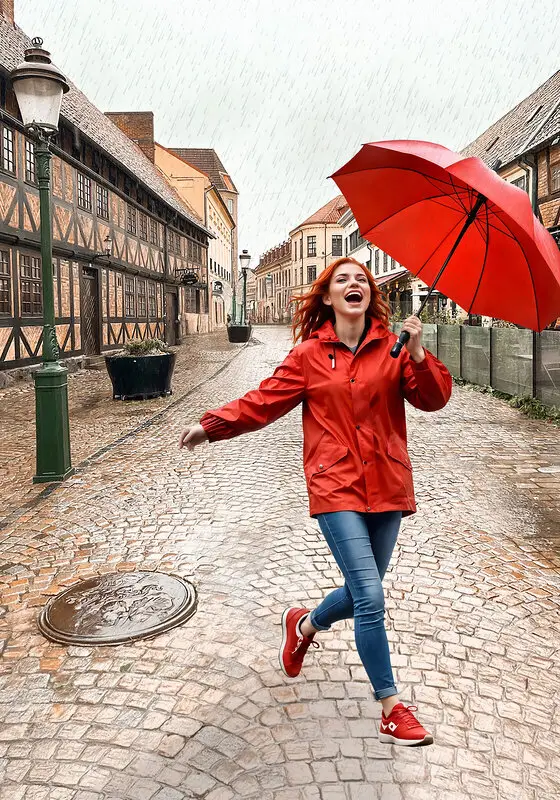
Red Is the Colour of a Rainy Day, 2025
Digital
50 x 70 cm
3 200 kr
Red Is the Colour of a Rainy Day
There is a symbolic 'red thread' that weaves through forests, fantasies, and feminism. This metaphorical thread, often used to represent a common theme or connection, is a literary device that underscores the recurring presence of the colour red in fairy tales. What is it about the colour red that makes it burn through these stories, flickering like a warning flare—or a wink?
It's the hue that stains the hood of a little girl wandering through a forest. It's the flash from the lips of a cabaret dancer, dazzling a cartoon wolf. It's the gleam from a pair of enchanted shoes that refuse to stop dancing. Red is not just temptation, danger, defiance. It's the colour of blood and blushes, of revolution and rebellion. It's a complex hue, with many facets, each telling a different story.
This essay follows the colour red as it winds its way through classic stories, childhood warnings, and adult reinterpretations. It begins with an exploration of Little Red Riding Hood, a tale once told to keep girls in line, and its modern reinterpretations. It then delves into Tex Avery’s Red Hot Riding Hood, which breaks every rule with a shimmy and a howl, and finally to Hans Christian Andersen’s The Red Shoes, where vanity has a price and art comes with pain. Each of these stories serves as a lens through which we can understand the complex symbolism of the colour red.
Here, red is more than a colour. It's a character that embodies the roles of temptation, danger, and rebellion. It's a mood that evokes feelings of passion, intensity, and sometimes, fear. It's a mirror, reflecting the societal norms and individual desires that it symbolises. But it's also a catalyst for change, a force that empowers and transforms.
Let’s begin.
”Wolfie and Red
– A Cabaret Ballad
He sat in the dark with a grin like a slit,
A tie round his neck, but no soul to fit.
She twirled in the light, in her lipstick and lace,
A scarlet eclipse with a hurricane face.
He howled at the sight, he whistled and swore,
Beat time on the table, fell off to the floor.
His tongue hit the tiles, his heart did a spin—
She winked at the crowd but never at him.
“Hey Red,” he whispered, “you’re burning me through!”
She laughed like a trumpet: “Darling, that’s you.”
She danced like a secret with nowhere to hide,
And Wolfie sat melting with pride and with tide.
He rose from his seat with a plan and a dream,
A rose in his teeth, a low-budget scheme.
But Red spun her parasol, calm as a queen:
“I lead the rhythm. You’re just the scene.”
He drooled and combusted, he barked and he bled,
Then shot his desire straight into his head.
But even in ghost form, he wouldn't behave—
Still whistling at women from beyond the grave.
So if you see Red with her heels held high,
And a glint in her eye like a crimson sky,
Just know that she danced with a wolf once, too.
And left him howling in a state of blue.”
Malmö, June 2025
Red Is the Colour of a Rainy Day
The girl in the picture radiates joy, not because of the rain or the dominance of red in her life, but from a film she watched with a friend from the neighbouring block. This film, a timeless delight for modern girls, despite its 1940s origin, narrates the beloved tale of Little Red Riding Hood, a story that continues to captivate hearts.
She skips along Larochegatan, a street steeped in history, leading to Lilla Torg. Named after Leonard de la Rose, wigmaker and innkeeper for Charles XII’s lifeguards, this short street is a testament to the city's past. The Faxeska House, the timber-framed building she’s just passed, is a part of this rich history. The street, now located in the Gamla Väster district, is renowned for its well-preserved historic buildings, serving as a living museum of the city's past.
De la Rose represents a classic Malmö tale of successful immigrants. The family patriarch—a wigmaker and grocer—was born in Corese, France, in 1669 and died in Warsaw in 1707 during one of Charles XII’s military campaigns. Before that, he had already made his mark. Several of his sons and grandsons went on to become mayors, council members, and other dignitaries. The male line died out in 1903.
La Roche AG, commonly known as Roche, is a Swiss multinational healthcare company and has no connection to this Malmö street. However, our red-haired girl does use their skincare products. Let us return to the theme of red in literature and film.
A famous story featuring the colour red is "Little Red Riding Hood." This fairy tale centres on a young girl who wears a red hood and cloak and her encounter with a wolf in the woods while visiting her grandmother. The colour red is prominently associated with the protagonist and her distinctive clothing.
The story of 'Little Red Riding Hood' is a tale of many cultures, known in various versions. It typically involves the wolf deceiving the young girl and her grandmother, often resulting in a grim outcome. This universal tale is known across different cultures, each with its unique interpretation, referred to as 'Little Red Cap' or 'Rotkäppchen.'
Red Riding Hood – A Tale of Wolves, Paths, and Wandering Women.
It begins so innocently. A little girl, a basket of treats, a sick grandmother. A mother’s instruction: go straight through the woods, don’t stray, don’t speak to strangers. What could go wrong?
Well, everything.
Red Riding Hood, the most crimson-caped rebel in all of fairy tales, embodies a fascinating duality. She is a girl on her way somewhere, not necessarily where her mother intended. Her blazing garment, equal parts warning sign and fashion statement, draws us into the collective unconscious’s most mythical landscape: the forest. This is the place where paths end and symbols begin to speak, where the innocence of the girl meets the rebellion of the woman.
The Forest as Trial
To children, Red Riding Hood is a tale of obedience. Stay on the path. Don’t talk to strangers. Listen to your mother. Full stop. A moral traffic sign with flashing red lights: "Follow the rules or get eaten."
But adults have always sensed something more. Beneath the pedagogical surface lies another message, one that whispers from the forest shadows. It speaks of desire, temptation, and the line between safety and the unknown. And, of course, the wolf.
The Wolf as Warning—or Temptation
When Charles Perrault wrote down the story in 1697, his moral was crystal clear: young girls should beware of wolves, especially those who look handsome and charming. In other words: beware of seductive men. The wolf in this version isn’t an animal but a man in a wolf costume, ready to lure the innocent girl into ruin. And when he finally devours both the grandmother and Red Riding Hood—well, there’s no rescue. No hunter. No miracle. The end.
Perrault, the French moralist, apparently wanted to teach girls to keep their legs together rather than think for themselves. But fairy tales have their paths. And Red Riding Hood refuses to be defined so easily.
Feminist Movement in a Red Cape
In modern interpretations, Red Riding Hood reclaims her power. She’s not just an innocent girl—she’s a symbol of female liberation, exploration, and strength. The forest is no longer merely dangerous—it is a place of transformation. It is where one must get lost to be found, where Red Riding Hood discovers her true strength and cunning.
In some versions, she outsmarts the wolf. In others, she befriends him. In the boldest retellings, she is the wolf—one who dresses in red so that everyone sees her coming. The wolf, traditionally a symbol of danger and malevolence, is reinterpreted as a figure of power and agency in these versions. She doesn’t get lost. She chooses the way.
In Avery’s version, no grandmother gets eaten, there is no forest, no other moral than this: maintain control over your desire. The setting is a bar, a stage, a few tables, some spotlights—and an old tale dressed in a new, glittering, decadent micro-dress. Yet strangely, it’s still the same story: about gazes, desire, and boundaries. But now it’s not the girl who must learn to be cautious—it’s the wolf who receives a lesson in self-restraint once he fails.
And Granny? She now reappears as an elderly lady who still possesses desire.
And the audience? They are captivated. This is no longer just a fairy tale; it is a moment where all the roles shift. Where Red Riding Hood—from folk tale to Freud to feminist icon—finally steps onto the stage and declares: “Now I’m the one telling the story. And I’m in control.”
With red lipstick and a red spotlight. And the wolf paid with his life for the ticket. That’s what happens to pervy old men—though in real life, sex addicts like Harvey Weinstein end up in prison. Thanks to #MeToo.
Another notable story featuring red is ‘The Red Shoes’ by Hans Christian Andersen. It is far more restrained and does not invite fanciful reinterpretations. Its moral is brutally clear.
This tale follows a young girl who becomes obsessed with a pair of red dancing shoes, leading to unfortunate consequences as she is compelled to dance uncontrollably. The red shoes symbolise vanity and obsession, and the story serves as a cautionary tale about the dangers of pride and disobedience.
‘The Red Shoes’ is a moralistic tale about a young girl, Karen, who grows up poor and is seduced by the beauty of a pair of red shoes. Karen becomes obsessed with them, reflecting her growing vanity, even wearing them to church. Because of this, she is cursed to dance in the shoes until she begs for her feet to be cut off, after which she repents and is redeemed.
Unlike the collected folk tales from the oral tradition, such as those by the Brothers Grimm, Andersen's fairy tales comprise original compositions, versions of Danish folk stories he heard as a child, and tales inspired by other literary sources, all peppered with contemporary social satire and autobiographical allusions.
The Red Shoes is one such story that combines some of Andersen's own life experiences with biting social satire, including the deadly dangers of vanity, the hypocrisy of the rich, and the dominance of the church in 1800s Denmark.
One autobiographical detail is the name of the central character. Andersen had a half-sister, Karen Marie, with whom he had little contact throughout his life. While some have suggested he used her name out of disdain or that the story is a thinly veiled critique of her alleged life as a prostitute, there's little concrete evidence for this.
What we do know is that Karen Marie was born out of wedlock, possibly from prostitution, that she wrote to Andersen a few times in her life, and, as he deliberately omits her from all three of his autobiographies, was a source of shame to him. This may have been because he was determined to ascend into the upper classes while she remained a poor washerwoman.
Another detail from Andersen's life seems to have inspired The Red Shoes: Andersen's father was a shoemaker. He recalled an incident from his childhood when a wealthy woman sent his father a piece of expensive red silk to create a pair of dancing shoes for her daughter. He worked tirelessly on the boots, combining the silk with his red leather, but when the woman came for them, she was critical, saying that he had done nothing but spoil her silk. Andersen's father responded that he might as well spoil his leather, too, and cut up the shoes in front of her.
Finally, the background of Karen's miserable poverty, the pitfalls of sudden fortune, and the delights and pains of pursuing art (in Karen's case, dance) can be seen to reflect Andersen's life story. He grew up in abject poverty but was determined to work his way up in society as an artist. In his early years, he constantly struggled for money, dependent on wealthy patrons. Even when Hans Christian achieved European acclaim, he often wrote of the fear of the past returning and of everything he had achieved being taken away again.
These stories—'Little Red Riding Hood’ and ‘The Red Shoes’—both use the colour red to represent significant themes and elements within their narratives, making them enduring tales where red shines not just on fabric, but in meaning.
Jörgen Thornberg
Red Is the Colour of a Rainy Day, 2025
Digital
50 x 70 cm
3 200 kr
Red Is the Colour of a Rainy Day
There is a symbolic 'red thread' that weaves through forests, fantasies, and feminism. This metaphorical thread, often used to represent a common theme or connection, is a literary device that underscores the recurring presence of the colour red in fairy tales. What is it about the colour red that makes it burn through these stories, flickering like a warning flare—or a wink?
It's the hue that stains the hood of a little girl wandering through a forest. It's the flash from the lips of a cabaret dancer, dazzling a cartoon wolf. It's the gleam from a pair of enchanted shoes that refuse to stop dancing. Red is not just temptation, danger, defiance. It's the colour of blood and blushes, of revolution and rebellion. It's a complex hue, with many facets, each telling a different story.
This essay follows the colour red as it winds its way through classic stories, childhood warnings, and adult reinterpretations. It begins with an exploration of Little Red Riding Hood, a tale once told to keep girls in line, and its modern reinterpretations. It then delves into Tex Avery’s Red Hot Riding Hood, which breaks every rule with a shimmy and a howl, and finally to Hans Christian Andersen’s The Red Shoes, where vanity has a price and art comes with pain. Each of these stories serves as a lens through which we can understand the complex symbolism of the colour red.
Here, red is more than a colour. It's a character that embodies the roles of temptation, danger, and rebellion. It's a mood that evokes feelings of passion, intensity, and sometimes, fear. It's a mirror, reflecting the societal norms and individual desires that it symbolises. But it's also a catalyst for change, a force that empowers and transforms.
Let’s begin.
”Wolfie and Red
– A Cabaret Ballad
He sat in the dark with a grin like a slit,
A tie round his neck, but no soul to fit.
She twirled in the light, in her lipstick and lace,
A scarlet eclipse with a hurricane face.
He howled at the sight, he whistled and swore,
Beat time on the table, fell off to the floor.
His tongue hit the tiles, his heart did a spin—
She winked at the crowd but never at him.
“Hey Red,” he whispered, “you’re burning me through!”
She laughed like a trumpet: “Darling, that’s you.”
She danced like a secret with nowhere to hide,
And Wolfie sat melting with pride and with tide.
He rose from his seat with a plan and a dream,
A rose in his teeth, a low-budget scheme.
But Red spun her parasol, calm as a queen:
“I lead the rhythm. You’re just the scene.”
He drooled and combusted, he barked and he bled,
Then shot his desire straight into his head.
But even in ghost form, he wouldn't behave—
Still whistling at women from beyond the grave.
So if you see Red with her heels held high,
And a glint in her eye like a crimson sky,
Just know that she danced with a wolf once, too.
And left him howling in a state of blue.”
Malmö, June 2025
Red Is the Colour of a Rainy Day
The girl in the picture radiates joy, not because of the rain or the dominance of red in her life, but from a film she watched with a friend from the neighbouring block. This film, a timeless delight for modern girls, despite its 1940s origin, narrates the beloved tale of Little Red Riding Hood, a story that continues to captivate hearts.
She skips along Larochegatan, a street steeped in history, leading to Lilla Torg. Named after Leonard de la Rose, wigmaker and innkeeper for Charles XII’s lifeguards, this short street is a testament to the city's past. The Faxeska House, the timber-framed building she’s just passed, is a part of this rich history. The street, now located in the Gamla Väster district, is renowned for its well-preserved historic buildings, serving as a living museum of the city's past.
De la Rose represents a classic Malmö tale of successful immigrants. The family patriarch—a wigmaker and grocer—was born in Corese, France, in 1669 and died in Warsaw in 1707 during one of Charles XII’s military campaigns. Before that, he had already made his mark. Several of his sons and grandsons went on to become mayors, council members, and other dignitaries. The male line died out in 1903.
La Roche AG, commonly known as Roche, is a Swiss multinational healthcare company and has no connection to this Malmö street. However, our red-haired girl does use their skincare products. Let us return to the theme of red in literature and film.
A famous story featuring the colour red is "Little Red Riding Hood." This fairy tale centres on a young girl who wears a red hood and cloak and her encounter with a wolf in the woods while visiting her grandmother. The colour red is prominently associated with the protagonist and her distinctive clothing.
The story of 'Little Red Riding Hood' is a tale of many cultures, known in various versions. It typically involves the wolf deceiving the young girl and her grandmother, often resulting in a grim outcome. This universal tale is known across different cultures, each with its unique interpretation, referred to as 'Little Red Cap' or 'Rotkäppchen.'
Red Riding Hood – A Tale of Wolves, Paths, and Wandering Women.
It begins so innocently. A little girl, a basket of treats, a sick grandmother. A mother’s instruction: go straight through the woods, don’t stray, don’t speak to strangers. What could go wrong?
Well, everything.
Red Riding Hood, the most crimson-caped rebel in all of fairy tales, embodies a fascinating duality. She is a girl on her way somewhere, not necessarily where her mother intended. Her blazing garment, equal parts warning sign and fashion statement, draws us into the collective unconscious’s most mythical landscape: the forest. This is the place where paths end and symbols begin to speak, where the innocence of the girl meets the rebellion of the woman.
The Forest as Trial
To children, Red Riding Hood is a tale of obedience. Stay on the path. Don’t talk to strangers. Listen to your mother. Full stop. A moral traffic sign with flashing red lights: "Follow the rules or get eaten."
But adults have always sensed something more. Beneath the pedagogical surface lies another message, one that whispers from the forest shadows. It speaks of desire, temptation, and the line between safety and the unknown. And, of course, the wolf.
The Wolf as Warning—or Temptation
When Charles Perrault wrote down the story in 1697, his moral was crystal clear: young girls should beware of wolves, especially those who look handsome and charming. In other words: beware of seductive men. The wolf in this version isn’t an animal but a man in a wolf costume, ready to lure the innocent girl into ruin. And when he finally devours both the grandmother and Red Riding Hood—well, there’s no rescue. No hunter. No miracle. The end.
Perrault, the French moralist, apparently wanted to teach girls to keep their legs together rather than think for themselves. But fairy tales have their paths. And Red Riding Hood refuses to be defined so easily.
Feminist Movement in a Red Cape
In modern interpretations, Red Riding Hood reclaims her power. She’s not just an innocent girl—she’s a symbol of female liberation, exploration, and strength. The forest is no longer merely dangerous—it is a place of transformation. It is where one must get lost to be found, where Red Riding Hood discovers her true strength and cunning.
In some versions, she outsmarts the wolf. In others, she befriends him. In the boldest retellings, she is the wolf—one who dresses in red so that everyone sees her coming. The wolf, traditionally a symbol of danger and malevolence, is reinterpreted as a figure of power and agency in these versions. She doesn’t get lost. She chooses the way.
In Avery’s version, no grandmother gets eaten, there is no forest, no other moral than this: maintain control over your desire. The setting is a bar, a stage, a few tables, some spotlights—and an old tale dressed in a new, glittering, decadent micro-dress. Yet strangely, it’s still the same story: about gazes, desire, and boundaries. But now it’s not the girl who must learn to be cautious—it’s the wolf who receives a lesson in self-restraint once he fails.
And Granny? She now reappears as an elderly lady who still possesses desire.
And the audience? They are captivated. This is no longer just a fairy tale; it is a moment where all the roles shift. Where Red Riding Hood—from folk tale to Freud to feminist icon—finally steps onto the stage and declares: “Now I’m the one telling the story. And I’m in control.”
With red lipstick and a red spotlight. And the wolf paid with his life for the ticket. That’s what happens to pervy old men—though in real life, sex addicts like Harvey Weinstein end up in prison. Thanks to #MeToo.
Another notable story featuring red is ‘The Red Shoes’ by Hans Christian Andersen. It is far more restrained and does not invite fanciful reinterpretations. Its moral is brutally clear.
This tale follows a young girl who becomes obsessed with a pair of red dancing shoes, leading to unfortunate consequences as she is compelled to dance uncontrollably. The red shoes symbolise vanity and obsession, and the story serves as a cautionary tale about the dangers of pride and disobedience.
‘The Red Shoes’ is a moralistic tale about a young girl, Karen, who grows up poor and is seduced by the beauty of a pair of red shoes. Karen becomes obsessed with them, reflecting her growing vanity, even wearing them to church. Because of this, she is cursed to dance in the shoes until she begs for her feet to be cut off, after which she repents and is redeemed.
Unlike the collected folk tales from the oral tradition, such as those by the Brothers Grimm, Andersen's fairy tales comprise original compositions, versions of Danish folk stories he heard as a child, and tales inspired by other literary sources, all peppered with contemporary social satire and autobiographical allusions.
The Red Shoes is one such story that combines some of Andersen's own life experiences with biting social satire, including the deadly dangers of vanity, the hypocrisy of the rich, and the dominance of the church in 1800s Denmark.
One autobiographical detail is the name of the central character. Andersen had a half-sister, Karen Marie, with whom he had little contact throughout his life. While some have suggested he used her name out of disdain or that the story is a thinly veiled critique of her alleged life as a prostitute, there's little concrete evidence for this.
What we do know is that Karen Marie was born out of wedlock, possibly from prostitution, that she wrote to Andersen a few times in her life, and, as he deliberately omits her from all three of his autobiographies, was a source of shame to him. This may have been because he was determined to ascend into the upper classes while she remained a poor washerwoman.
Another detail from Andersen's life seems to have inspired The Red Shoes: Andersen's father was a shoemaker. He recalled an incident from his childhood when a wealthy woman sent his father a piece of expensive red silk to create a pair of dancing shoes for her daughter. He worked tirelessly on the boots, combining the silk with his red leather, but when the woman came for them, she was critical, saying that he had done nothing but spoil her silk. Andersen's father responded that he might as well spoil his leather, too, and cut up the shoes in front of her.
Finally, the background of Karen's miserable poverty, the pitfalls of sudden fortune, and the delights and pains of pursuing art (in Karen's case, dance) can be seen to reflect Andersen's life story. He grew up in abject poverty but was determined to work his way up in society as an artist. In his early years, he constantly struggled for money, dependent on wealthy patrons. Even when Hans Christian achieved European acclaim, he often wrote of the fear of the past returning and of everything he had achieved being taken away again.
These stories—'Little Red Riding Hood’ and ‘The Red Shoes’—both use the colour red to represent significant themes and elements within their narratives, making them enduring tales where red shines not just on fabric, but in meaning.
3 200 kr

Jörgen Thornberg
Malmö
Lite om bilder och mig. Translation in English at the end.
Jag är en nyfiken person som ser allt i bilder, även det jag fäster i ord, gärna tillsammans för bakom alla mina bilder finns en berättelse. Till vissa bilder hör en kortare eller längre novell som följer med bilden.
Bilder berättar historier. Jag omges av naturlig skönhet, intressanta människor och historia var jag än går. Jag använder min kamera för att dokumentera världen och blanda det jag ser med vad jag känner för att fånga den dolda magin.
Mina bilder berättar mina historier. Genom mina bilder, tryck och berättelser. Jag bjuder in dig att ta del av dessa berättelser, in i ditt liv och hem och dela min mycket personliga syn på vår värld. Mer än vad ögat ser. Jag tänker i bilder, drömmer och skriver och pratar om dem; följaktligen måste jag också skapa bilder. De blir vad jag ser, inte nödvändigtvis begränsade till verkligheten. Det finns en bild runt varje hörn. Jag hoppas att du kommer att se vad jag såg och gilla det.
Jag är också en skrivande person och till många bilder hör en kortare eller längre essay. Den följer med tavlan, tryckt på fint papper och med en personlig hälsning från mig.
Flertalet bilder startar sin resa i min kamera. Enkelt förklarat beskriver jag bilden jag ser i mitt inre, upplevd eller fantiserad. Bilden uppstår inom mig redan innan jag fått okularet till ögat. På bråkdelen av ett ögonblick ser jag vad jag vill ha och vad som kan göras med bilden. Här skall jag stoppa in en giraff, stålmannen, Titanic eller vad det är min fantasi finner ut. Ännu märkligare är att jag kommer ihåg minnesbilden långt efteråt när det blir tid att skapa verket. Om jag lyckas eller inte, är upp till betraktaren, oftast präglat av en stråk av svart humor – meningen är att man skall bli underhållen. Mina bilder blir ofta en snackis där de hänger.
Jag föredrar bilder som förmedlar ett budskap i flera lager. Vid första anblicken fylld av feel-good, en vacker utsikt, fint väder, solen skiner, blommor på ängen eller vattnet som ligger förrädiskt spegelblankt. I en sådan bild kan jag gömma min egentliga berättelse, mitt förakt för förtryckare och våldsverkare, rasister och fördomsfulla människor - ett gärna återkommande motiv mer eller mindre dolt i det vackra motivet. Jag försöker förena dem i ett gemensamt narrativ.
Bild och formgivning har löpt som en röd tråd genom livet. Fotokonst känns som en värdig final som jag gärna delar med mig.
Min genre är vid som framgår av mina bilder, temat en blandning av pop- och gatukonst i kollage som kan bestå av hundratals lager. Vissa bilder kan ta veckor, andra någon dag innan det är dags att överlämna resultatet till printverkstaden. Fine Art Prints är digitala fotocollage. I dessa kollage sker rivandet, klippandet, pusslandet, målandet, ritandet och sprayningen digitalt. Det jag monterar in kan vara hundratals år gamla bilder som jag omsorgsfullt frilägger så att de ser ut att vara en del av tavlan men också bilder skapade av mig själv efter min egen fantasi. Därefter besöks printstudion och för vissa bilder numrera en limiterad upplaga (oftast 7 exemplar) och signera för hand. Vissa bilder kan köpas i olika format. Det är bara att fråga efter vilka. Gillar man en bild som är 70x100 men inte har plats på väggen, går den kanske att få i 50x70 cm istället. Frågan är fri.
Metoden Giclée eller Fine Art Print som det också kallas är det moderna sättet för framställning av grafisk konst. Villkoret för denna typ av utskrifter är att en högkvalitativ storformatskrivare används med åldersbeständigt färgpigment och konstnärspapper eller i förekommande fall på duk. Pappret som används möter de krav på livslängd som ställs av museer och gallerier. Normalt säljer jag mina bilder oinramade så att den nya ägaren själv kan bestämma hur de skall se ut, med eller utan passepartout färg på ram, med eller utan glas etc..
Under många år ställde jag bara ut på nätet, i valda grupper och på min egen Facebooksida - https://www.facebook.com/jorgen.thornberg.9
Jag finns också på en egen hemsida som tyvärr inte alltid är uppdaterad – https://www.jth.life/ Där kan du också läsa en del av de berättelser som följer med bilden.
UTSTÄLLNINGAR
Luftkastellet, oktober 2022
Konst i Lund, november 2022
Luftkastellet, mars 2023
Engleson Galleri Caroli, april 2023
Hydra, Greece June 2023
Engleson Galleri Caroli, oktober 2023
Toppen, Höllviken december 2023
Luftkastellet, mars 2024
Torups Galleri, mars 2024
Venice, May 2024
Luftkastellet, oktober 2024
Konst i Advent, December 2024
Galleri Engleson, Caroli December 2024
Jäger & Jansson Galleri, april 2025
A bit about pictures and me.
I'm a curious person who sees everything in pictures, even what I express in words, often combining them, for behind all my pictures lies a story. These narratives, some as short as a single image and others as long as a novel, are the heart and soul of my work.
Pictures tell stories. Wherever I go, I'm surrounded by natural beauty, exciting people, and history. I use my camera to document the world and blend what I see with what I feel to capture the hidden magic.
My images tell my stories. Through my pictures, prints, and narratives, I invite you to partake in these stories in your life and home and share my deeply personal perspective of our world. More than meets the eye. I think in pictures, dream, write, and talk about them; consequently, I must create images too. They become what I see, not necessarily confined to reality. There's a picture around every corner. I hope you'll see what I saw and enjoy it.
I'm also a writer, and many images come with a shorter or longer essay. It accompanies the painting, printed on fine paper with my personal greeting.
Many pictures start their journey on my camera. Simply put, I describe the image I see in my mind, experienced or imagined. The image arises within me even before I bring the eyepiece to my eye. In a fraction of a moment, I see what I want and what can be done with the picture. Here, I'll insert a giraffe, Superman, the Titanic, or whatever my imagination conjures up. Even stranger is that I remember the mental image long after it's time to create the work. Whether I succeed is up to the observer, often imbued with a streak of black humour – the aim is to entertain. My pictures usually become a talking point wherever they hang.
I prefer pictures that convey a message in multiple layers. At first glance, they're filled with feel-good vibes, a beautiful view, lovely weather, the sun shining, flowers in the meadow, or the water lying deceptively calm. But beneath this surface beauty, I often conceal a deeper story, a narrative that challenges societal norms or explores the human condition. I invite you to delve into these hidden narratives and discover the layers of meaning within my work.
Picture and design have been a thread running through my life. Photographic art feels like a fitting finale, and I'm happy to share it.
My genre is varied, as seen in my pictures; the theme is a blend of pop and street art in collages that can consist of hundreds of layers. Some images can take weeks, others just a day before it's time to hand over the result to the print workshop. Fine Art Prints are digital photo collages. In these collages, tearing, cutting, puzzling, painting, drawing, and spraying happen digitally. What I insert can be images hundreds of years old that I carefully extract so they appear to be part of the painting, but also images created by myself, now also generated from my imagination. Next, visit the print studio and, for certain images, number a limited edition (usually 7 copies) and sign them by hand. Some images may be available in other formats. Just ask which ones. If you like an image that's 70x100 but doesn't have space on the wall, you might be able to get it in 50x70 cm instead. The question is open.
The Giclée method, or Fine Art Print as it's also called, is the modern way of producing graphic art. This method ensures the highest quality and longevity of the artwork, using a high-quality large-format printer with archival pigment inks and artist paper or, in some cases, canvas. The paper used meets the longevity requirements set by museums and galleries. I sell my pictures unframed, allowing the new owner to personalise their artwork, confident in the lasting value and quality of the piece.
For many years, I only exhibited online, in selected groups, and on my Facebook page - https://www.facebook.com/jorgen.thornberg.9. I also have my website, which unfortunately is not constantly updated - https://www.jth.life/. You can also read some of the stories accompanying the pictures there.
EXHIBITIONS
Luftkastellet, October 2022
Art in Lund, November 2022
Luftkastellet, March 2023
Engleson Gallery Caroli, April 2023
Hydra, Greece June 2023
Engleson Gallery Caroli, October 2023
Toppen, Höllviken December 2023
Luftkastellet, March 2024
Torup Gallery, March 2024
Venice, May 2024
UTSTÄLLNINGAR
Luftkastellet, oktober 2022
Konst i Lund, november 2022
Luftkastellet, mars 2023
Engleson Galleri Caroli, april 2023
Hydra, Greece June 2023
Engleson Galleri Caroli, oktober 2023
Toppen, Höllviken december 2023
Luftkastellet, mars 2024
Torups Galleri, mars 2024
Venice, May 2024
Luftkastellet, October 2024
Konst i Advent, December 2024
Galleri Engleson, Caroli December 2024
Jäger & Jansson Galleri, April 2025
Utbildning
Autodidakt
Medlem i konstnärsförening
Öppna Sinnen
Med i konstrunda
Konstrundan i Skåne
Utställningar
Luftkastellet, October 2022
Art in Lund, November 2022
Luftkastellet, March 2023
Engleson Gallery Caroli, April 2023
Hydra, Greece June 2023
Engleson Gallery Caroli, October 2023
Toppen, Höllviken December 2023
Luftkastellet, March 2024
Torup Gallery, March 2024
Venice, May 2024