Vi använder cookies för att ge dig bästa möjliga upplevelse. Välj vilka cookies du tillåter.
Läs mer i vår integritetspolicy
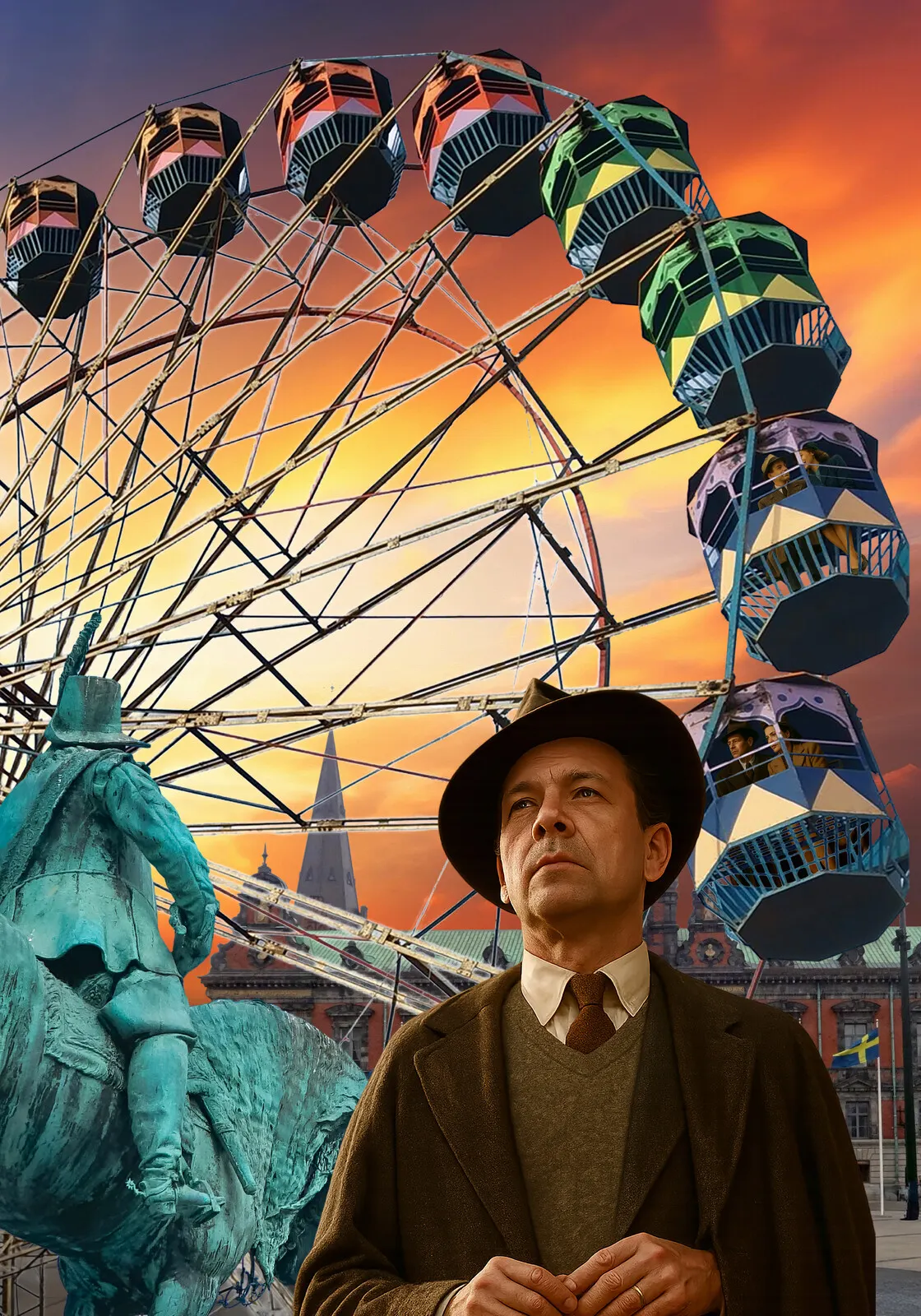
Jörgen Thornberg
Up the Air, Down the Drain, 2025
Digital
50 x 70 cm
3 200 kr
Up the Air, Down the Drain
It begins the way memories often do—not with clarity, but with a sensation. A smell, a sound, the soft whir of something mechanical turning above a quiet city. Perhaps it’s Malmö. Maybe it’s Vienna. Or perhaps it’s that strange borderland where the past hasn’t quite ended and the present hasn’t quite begun.
High above, in a slowly revolving Ferris wheel, two people are caught in a conversation that has taken seventy-seven years to finish. Once, they were lovers. They were fugitives, witnesses, ghosts. He is already dead, more myth than man. She is the one who remained behind—again.
Below them, the city carries on: dots moving, lights flickering, lives continuing in their ordinary, miraculous way. But here, in this capsule suspended between heaven and the street, time holds its breath. What follows is not a typical reunion; it's a unique, unexpected encounter that defies the norms of time and space, inviting us to delve deeper into its mysteries.
It’s something rarer. A reckoning in silhouette. And then, the last turn of the wheel, a moment heavy with the weight of time and memory.
This is where Harry Lime makes his return. And this time, he listens, his presence filling the air with anticipation and suspense, keeping us on the edge of Delve into my analysis and accompanying visuals. Explore how this classic work, 'The Third Man', continues to resonate with the complexities of our modern lives, bridging the gap between past and present, and inviting us to reflect on the enduring relevance of its themes.
“Glimpses from Up Above
HARRY:
I’m just a fellow drifting past the skyline,
A name that flickered once in black-and-white.
Though morals came and tried to draw a fine line,
I floated through the shadows out of sight.
Down there, the streets still glimmer, just like celluloid,
A reel that loops but never quite moves on.
Trams and tepid coffee cups,
Half-closed doors and moral scrubs—
Seen from up above, it’s oddly calm.
ANNA:
And see those ghosts still haunting every station?
They carry bags we never dared unpack.
We once believed in peace and liberation,
But postcards from the future never write back.
The cracks below are filled with quiet sorrow,
And jazz notes trying hard to drown the past.
Yes, we stood beneath the war,
But we don’t stand there anymore—
Now we only watch it fade from up above.
HARRY:
Oh, blessed wheel that spins through time and fiction,
You cradle me with all I never said.
You show me glimpses of some lost conviction,
A life that might have been, but slipped instead.
And look how small they are, those moving figures,
Dots that dance like guilt across the square.
I once sold off their trust,
Thinking power was a must—
Now I watch them, just a little, from up there.
ANNA:
The world still burns, though flags keep changing colour,
And peace arrives too late or not at all.
We built our lies in sequence, one after the other,
Then blamed the wind when towers had to fall.
But still, there’s beauty here between the ruin—
A quiet laugh, a lemon tree in bloom.
We forgot how not to fight,
But perhaps we did it right—
If seen a little gently from above.
BOTH:
So if you look up once and think you hear us,
A whisper caught between the sky and ground—
It’s not a plea, and not quite a ghostly chorus,
Just echoes of a love that spun around.
We never asked for heaven or redemption,
Just a second take, a reel unspooled again.
But the film kept moving on,
And we stayed within the song—
A little off the ground, but never gone.”
Malmö, June 2025
Echoes in the Rubble
If the image looks familiar, you’re not mistaken. Graham Greene’s novel ‘The Third Man’ is set in 1948, just after the end of World War II. The story takes place in occupied, postwar Vienna—a city divided into four zones controlled by the Allies: the United States, Britain, France, and the Soviet Union. Greene wrote the novel as a treatment for the screenplay, not the other way around. Vienna remained in ruins after the war, shaped by black market dealings, broken trust, and a crumbling sense of morality—all of which mirror Harry Lime’s trade and the city’s fractured soul. This enduring relevance of the novel bridges the gap between past and present, connecting us to the complexities of our modern lives.
Year after year, the characters in 'The Third Man' find themselves compelled to reenact their roles, descending from their stars to perform the ritual once more. This game of time, this reenactment, always leans in the same direction, no matter how they try to shift the outcome. The novel's careful construction ensures its relevance nearly eighty years later. At its core, the story is a testament to timeless morality, at least among those with right-minded values. Harry, however, never quite agreed with Anna on that point. Each year, he hoped this would be the time for a re-evaluation. From his high vantage point, watching the likes of Putin and Trump, he felt the moment had come.
This year, they had landed in Malmö, a city they had never visited, despite having staged the charade in Copenhagen back in the ’90s. There was no bridge then, and Anna was a staunch landlubber, avoiding boats like the plague.
Like all Time-Travellers, Orson enjoyed rewriting history, blending in alternate facts about how things might have gone if only “if” hadn’t existed. On this particular day in Malmö, with the wind curling around the trees on Stortorget, their light green leaves fluttered proudly as proof that the long, cold spring had finally ended and summer was just around the corner. Anna and Harry were seated in a gondola on a giant Ferris wheel—one that had witnessed children’s laughter, quiet melancholy, and silent betrayals, all directed from above. High up, in a basket that creaked with every sway, they relished that it wasn’t real—just a game. But a serious one.
Harry reclined with a sly grin, as if he were both a visitor and a sovereign of the entire city. Anna sat rigidly in her coat, hands resting in her lap. Her gaze was fixed on something distant—perhaps the Danube, maybe something that never came to be.
“You know, Anna…” he began, his voice softer than anyone remembered, filled with a regret that hung heavy in the air. “If I had been a different man…”
She didn’t interrupt. What could one say to someone who had once sold death but kept her picture in his wallet? The silence between them was pregnant with unspoken words and unresolved emotions.
The gondola reached the top. The city spread beneath them like an open wound. In that moment, it was as if all guilt had turned to stone—not because it was gone, but because the world below no longer concerned them. Reality doesn’t reach sixty metres up. As the great Swedish singer Edvard Persson once sang:
“Woods and lakes and distant shore
Become a fairyland once more
When you see them from above like this.”
The first time they sat in a similar gondola was during a filmed love scene in 1948, although it was not a happy one. It was the climax of the film, quite literally, but also the beginning of the fall.
They both knew the scene by heart, as if it had happened yesterday and not during the war, or just after it, in a bombed-out Vienna. The contrast to the tidy city below, untouched by war for hundreds of years, was stark. It was only during the wave of demolitions in the 1960s and ’70s that parts of the town resembled Vienna back then—piles of bricks and crumbled houses.
As the gondola slowly began its descent, the metal frame groaned as if sighing at their fate. Anna finally turned towards him. Her eyes were dark, not with hatred, but with the kind of sorrow that knows it once loved someone beyond good and evil.
ANNA:
“You never understood, did you? It wasn’t what you did that broke me. It was that you could smile while doing it.”
Harry said nothing. He removed his hat, letting the wind play with the curls that softened the otherwise precise silhouette of his face. Another life might have begun here—if it had been another film. And another time. He never fully grasped what Anna found so compelling in these memory charades. What happened couldn’t be changed. Sure, they were riding a Ferris wheel in Malmö now, but that wasn’t the point. The point was to replay ‘The Third Man’.
And waiting below—just like then—was Holly, the friend who was no longer his friend. In the film, at least. Among the stars, they had reconciled, and all was forgiven. That’s how it works. Down there, the drama still awaited: the sewers, the threatening shadows, and the end of Harry’s game.
Anna leans back, as if she knows. It wasn’t an escape they made that time – it was a farewell. A farewell to hope. To the last tenderness. To everything that could no longer be saved.
ANNA:
It’s strange, Harry. Being up here again. Everything looks smaller. As if the war never happened.
HARRY:
Or as if it’s still going on, just in silence. Look at those rooftops—same tiles, same chimneys, same rats.
ANNA:
But we’re still here. Somehow. You and I. I used to dream of this moment, you know. After the chaos, after the bombs... just peace. You and me. High above the world. It's a testament to our resilience, Harry.
HARRY (scoffs lightly):
Peace is a hushed kind of noise. Not sure I ever liked it. Too little to sell, too much to regret.
ANNA:
That’s just you being you and constantly dodging meaning with a grin. But we did survive. Doesn’t that count for something?
HARRY:
Survival? That’s just biology. Rats do it better. What counts... is what we pretend it meant.
ANNA (softly):
So pretend for me, Harry, just for this ride. Pretend you didn’t sell penicillin that killed children, that you didn’t disappear when I needed you most.
HARRY (after a pause):
And you pretend Greene didn’t shoot me in the back for moral effect.
ANNA:
He gave you a death, Harry. Not everyone gets one. Some vanish like ghosts.
HARRY:
Ghosts make for a better box office, especially when they come with a speech.
ANNA:
Which you always do. Words first, consequences later.
HARRY (leans closer):
And you, always the audience. Loyal. Beautiful. Morally upright. Almost fictional.
ANNA:
At least I didn’t hide in the shadows, Harry. You always preferred the sewers to the streets.
HARRY (smirks):
Cleaner place, believe me. Less idealism down there. And fewer questions.
ANNA:
You know, I never intended to end up in Vienna. It just… happened. I came with a theatre company. The war arrived with tanks. One stayed, the other didn’t.
HARRY:
You stayed like a postcard that never got posted, still wearing your stage smile.
ANNA (dryly):
And you still wear your irony like a tailored suit. But yes, I stayed. There was no home to return to. The theatre shut down. I was twenty-two, and suddenly I was just... someone’s accent in someone else’s city.
HARRY:
But you made it yours. You always did. That apartment of yours—filled with books in the wrong language, music on a broken radio. It was the last place I felt anything close to safe.
ANNA:
Until the knock came. Your men. Your ghost. Your sins.
HARRY:
I didn’t send them, Anna.
ANNA:
You didn’t stop them either. That boy... he cried in the stairwell before they took him. Do you remember that?
HARRY (quietly):
I remember everything I try not to.
ANNA:
And yet, I waited. For you. In silence, in rooms full of watchers, of questions. I lost roles, friends, and my passport all for a man who lived beneath Vienna, not in it.
HARRY:
You've shown a remarkable resilience, Anna. You've managed to retain your humanity in the midst of all this. I, on the other hand, played God and lost. I became something less than human.
ANNA:
And you think that’s enough?
HARRY (leans against the rail):
No. But it's something. And tonight, it’s the only thing between us that isn’t fiction.
HARRY:
It started small. A tin of coffee here, some stockings there. A favour for a soldier, a trade with a contact. At first, it felt like a matter of survival, and it was just about helping people get what they needed. That’s how it always starts, right?
ANNA (softly):
And then?
HARRY:
Then I realised there was no bottom to it. No end. Every favour became a transaction, every transaction a risk, every risk a thrill. Somewhere along the line, I stopped seeing faces. They were just ledgers. Units. Names on paper. It was a journey of self-discovery, Anna. A journey I wish I had never embarked on.
ANNA:
Like the sick children?
HARRY:
Don’t. Please don’t say it like that.
ANNA:
How should I say it?
HARRY (pauses, then sighs):
No way makes it sound better. I sold diluted penicillin, yes. I told myself the doctors would catch it, the nurses would notice, the parents would... but I knew. I always knew. I told myself the war had made me practical. It's a raw, honest admission, Anna. A confession I wish I didn't have to make.
ANNA:
No, Harry. The war made you a liar. You made yourself practical.
HARRY (after a long silence):
You’re right. And I think that’s why Greene killed me off. He couldn’t let me walk away. He crafted me out of charm and cruelty—and then buried me in a sewer to make a point. But that wasn’t the end. Not for me.
ANNA:
So what was it?
HARRY:
Just a chapter. I slipped away in the confusion. New name. New border. New ghosts. And then one day, years later, I woke up and realised... the only part of me that still mattered was the part Greene left out.
ANNA (takes a deep breath, looking out over Malmö):
You always had your escape plans. Your trapdoors. Even death was just a curtain to slip behind. But I—I stayed. I remained in that cold apartment with your photograph turned to the wall, and your coat still hanging by the door. I told myself it was grief. But it was more than that.
HARRY (quietly):
Guilt?
ANNA: (the glittering, temporary funfair far below, a quiet melancholy passing through her gaze.)
No. Loyalty. The kind that outlives logic. Perhaps even dignity. I waited, not because I believed you’d return, but because I didn’t know who I was without you. You had become the story I told myself, over and over again, until even I believed it. I remained loyal to the memory of you, Harry.
HARRY:
Was I worth waiting for?
ANNA (turns to him, steady):
That you were ever mine.
HARRY (softly, almost smiling):
And was I?
ANNA (looks away):
For a moment. One perfect, terrible moment—before the world came crashing back. Before the men in coats began asking questions. Before I realised you’d sold more than penicillin. You’d sold trust. Love. Even me.
HARRY (after a silence):
I didn’t know how to stop. And no one tried to make me.
ANNA (whispers):
I did. Every night, I didn't turn you in. That was me trying.
HARRY (low voice):
You tried harder than anyone ever did. Perhaps that's why I never forgave you—because you made me want to be better. And I couldn’t. I regret the person I became, Anna. I regret the choices I made.
ANNA (slowly turns to him):
You could have, Harry. Even now, I think... maybe you still can.
HARRY:
Too late. For me, time doesn’t move forward—it loops. Always back to the sewer. Back to the wheel. Back to this.
ANNA (quietly, almost whispering):
Do you remember Zurich? It was before the war, before it swallowed us whole. We were young and hopeful, with the future stretching out before us. We were in Zurich, a city of beauty and promise, before the war tore through Europe, changing everything.
HARRY (smiles sadly):
The rooftop café with the crooked umbrella. You wore that ridiculous yellow hat.
ANNA:
It wasn’t ridiculous. You said I looked like a daffodil.
HARRY (looks at her gently):
You did—the only bright thing in a grey city. And I remember the way you laughed—like you’d never known fear.
ANNA (looks him in the eye):
That was before I knew what you were capable of.
HARRY (for a moment, vulnerable):
And yet you’re here.
ANNA:
Yes. And no, part of me never left that train station. When I waved goodbye, I thought I’d see you again in a week. Instead, I read your name on underground ledgers and whispered warnings.
HARRY (leans in slightly):
And if the war had never come?
ANNA (pauses, touches his hand, then pulls away):
Then perhaps we’d have had a quiet life. Books. Coffee. A dog. You’d complain about taxes, and I’d complain about your shirts. And we’d be boring. Gloriously boring.
HARRY:
I was never good at boring.
ANNA:
Many things can be said about you—by others, of course—but certainly not boring.
HARRY: (It hit like lightning in the gondola even though the sunset showed no signs of a storm.)
I’ll never truly forgive Graham for killing me. Not really.
ANNA (turns slowly):
He had his reasons.
HARRY (purses his lips, bitterly):
Did he? There were other ways to make his point. But no—he had to sacrifice me like some narrative Judas. A punishment for the sins of my creation. A warning to others: “This is what happens.” It feels as though I was cast in a role I never auditioned for, and now I'm forever associated with that character. I felt like I was used, like a character in a story, to serve his purpose, and now I can never escape that role.
ANNA (calmly):
You didn’t exactly deal in mercy yourself.
HARRY:
Don’t preach. I know what I did—or what I allowed to happen. But he turned me into a moral footnote. I was never that clean. Never that simple. And neither was he.
ANNA (quietly, with tired warmth):
He didn’t kill you, Harry. You were already disappearing… long before the shot rang out.
HARRY (darkly):
Maybe. But he pulled the trigger. And then walked away with the royalties.
ANNA: (She changed the subject to keep Harry from sinking into bitterness)
People always say the war ended in ’45. But for us… It never really did.
HARRY: (Relieved, knowing there’s no point in digging through old dirt since what has happened can’t be undone.)
No. It just changed uniforms. The rubble remained. The fear remained. Only the enemies switched names. And the black market grew like ivy through the ruins. Everyone needed something. And someone was always willing to sell it.
ANNA:
And the black market grew like ivy through the ruins. Everyone needed something. And someone was always willing to sell it.
HARRY:
I made a business out of chaos. Vienna provided the perfect fog to disappear into. A divided city, four zones, four sets of lies. All looking the other way while I cashed in.
ANNA:
It was 1948, but it could’ve been the day after the bombs fell. No heat, no light, no trust. Only people like you thrive in the cracks.
HARRY: (with a self-satisfied smile)
ANNA:
You know you were loved, right?
HARRY:
(With a crooked smile)
I stole a film in ten minutes. Not bad. A doorway, a cat, a smile—and suddenly I was an icon.
ANNA:
But it wasn’t just a film trick. People liked you. Perhaps more than they should have.
HARRY:
Charm. Wit. That gets you far. And if you're just dangerous enough… You become as excited as a war in a tuxedo.
ANNA:
You embodied something. That cynicism left behind after everything… after 1945. The world was tired of morals and finger-wagging. You were like... a romantic scoundrel.
HARRY:
A hero without a conscience. Just what the times demanded.
ANNA:
And yet they killed you.
HARRY:
Greene’s moralism. A sentence. “Too dangerous to live.” As if I bore the entire war’s guilt in my smile.
ANNA:
The critics called you complex. A mirror for moral decay. A warning. But also, you were addicted to power.
HARRY:
I even had a radio series, did you know that? *The Adventures of Harry Lime*. Fifty episodes. Prequels. I was a rogue with a heart.
ANNA:
You became a kind of proto-antihero. Tony Soprano, before the mafia was chic. Walter White with a hat—only better looking.
HARRY:
And with better lines. (pause)
But none of them ever rode a Ferris wheel with you.
ANNA:
No. That takes more than moral ambiguity. That brings... love, despite everything.
HARRY:
And a touch of vertigo.
ANNA:
And a cuckoo clock. (both chuckle softly)
HARRY:
Maybe that—or the music. (hums Anton Karas’ unforgettable zither theme)
That little melody. An earworm before the term even existed. Back then, we didn’t even have YouTube, yet it still managed to infect the entire planet.
ANNA:
You know, it became a sort of symbol for you? As slippery as you were. No strings, no trumpets—just a solitary zither in a smoky alley. A reminder of your love for music, your skill with the instrument, and the moments of peace it brought you.
HARRY:
Exactly. No violins for me. Just wire and gut. Slightly out of tune, but unforgettable.
ANNA:
Like you.
HARRY:
People could whistle it without ever seeing the film. I wonder if they understood who they were carrying on their lips…
ANNA:
You slipped into their heads like a spy in the night.
Charming. Dangerous. A little naughty. But you sparkled.
HARRY:
Thanks. That’s the nicest thing you’ve said to me since…
(pause)
…well, since you buried me.
ANNA:
I remember the first time I saw you out on the street, as if you didn’t belong in the ruins. You smiled. But I sensed that smile was concealing something.
HARRY:
You saw right through me even then. But you stayed.
ANNA:
We were all lost. I fled here from Czechoslovakia. I wanted to act. Then the war came. Everything shattered. It turned into a black theatre in real life. And you… You seemed to own the set.
HARRY:
I was good at finding the cracks. Cracks in the system, cracks in people, and cracks in the market. I ventured where no one else dared, or had the conscience to go.
ANNA:
Black market medicine. Infant deaths.
How could you?
HARRY: (looks out the window)
I don’t know any longer. I told myself it was business, that the people were already lost, that they’d die anyway. I stopped seeing them. Just numbers. Just bottles.
ANNA:
Still, I didn’t turn you in. Not even when they came to me. I hated myself for that. I was torn between my love for you and my disgust at what you had become.
HARRY: (grimaces)
It wasn’t you who betrayed me. It was Graham. He sat there with his typewriter and judged me like an Old Testament god moralist in a trench coat.
ANNA:
But he was also afraid. Afraid of what you’d become. Afraid the audience would love you too much.
HARRY:
And they did. I saw it in the theatres. When the lights came on, it was me they talked about. Not the hero. Not Holly. Me.
ANNA:
You know… sometimes I wonder what would’ve happened if you’d just left Vienna. We could’ve gone somewhere, anywhere. Trieste. Or Sweden. You could’ve started afresh. [Her voice carries a heavy tinge of regret, a longing for a different path that was never taken, a sense of what could have been.]
HARRY:
Started afresh? With what? I was already Harry Lime. No passport, no confession, no new name could’ve saved me from him.
ANNA:
You mean Graham?
HARRY:
No. It was me. I was in love with the risk. And with that feeling, when everything sways beneath your feet but you’re still standing. Like now. [His voice reveals a profound self-awareness, an understanding of his destructive tendencies, a sense of his inner turmoil.] (He nods out the window toward the spinning wheel and the night city below.)
ANNA:
But I loved you. And I waited. That was the hardest part. Not losing you, but that you never chose me in return. [Her voice is heavy with palpable disappointment, a testament to the unfulfilled love she harboured for Harry, a deep sense of loss.]
HARRY: (looks at her, unusually still)
I chose you. But not in the right way. Not while it still meant something.
ANNA: (She smiles sadly, alluding to the famous doorway scene.)
You chose the cat.
HARRY: (forces a crooked smile)
She was probably the only one who truly understood me.
ANNA:
You’ll be remembered, Harry. But not as the man I knew. And that’s the real punishment. Never getting to explain yourself. Everyone thinks they know who you were, but no one knows who you tried to become.
HARRY: (his tone darkens)
That’s why he wrote me dead. Greene. So there’d be no chance of forgiveness. No way out.
ANNA: Or because he knew you wouldn’t take it. (A long silence. The wheel pauses while they sit at the top. Their eyes meet, reflecting a kind of sorrow, a nearly tender anger. Then she says the one thing Harry never expected to hear.) ANNA: I forgave you anyway, but the regret is heavy, a burden I carry, a weight that never seems to lift. (Harry tries to say something, but for once, he has no words.)
HARRY (looking down at the square below): Dots. Do you see them? Small, moving specks. People who once meant something to me. Or perhaps not. (His bitterness is palpable, a bitter taste of loss that lingers in the air.)
ANNA (sadly but knowingly): You're not starting that again, are you?
HARRY (with a tight smile): Would you feel any pity if one of those dots stopped moving forever?
ANNA (scoffs): You know I hated it when you said that. And yet I remember every syllable.
HARRY (it falls like an echo from far away): “In Italy, for thirty years under the Borgias, they had warfare, terror, murder and bloodshed—but they produced Michelangelo, Leonardo da Vinci and the Renaissance...” (pause) “In Switzerland, they had brotherly love, five hundred years of democracy and peace... and what did that produce?”
ANNA (sighs, but a smile tugs at the corner of her mouth): The cuckoo clock. A reminder of our shared past, of the time when we were still innocent and hopeful.
HARRY (cynically): I knew that one would land like a well-aimed bullet in the cathedral of morality. And it did. The audience cheered. Critics fainted. And me? I became a quote.
ANNA: Except you didn’t even write it.
HARRY: No. Neither did Graham. It just appeared—like an old friend with a knife up his sleeve. I said I stole it from some Hungarian play. Or was it Whistler? Or Household? Who cares. It sounded too good to be true, which meant it was.
ANNA: And wrong. Cuckoo clocks come from the Black Forest, not Switzerland. (Her correction is laced with irony, a touch of sarcasm in her voice that cuts through the air.)
HARRY (grinning widely): Historical accuracy never made great cinema. It’s the gesture that counts. The rhythm. Tick-tick. You know… that little mechanical heart beating beneath all the moral varnish.
ANNA: But you weren’t just a cuckoo. You were a ticking bomb.
HARRY (for a moment, serious): And I blew myself to bits. But you remember the laugh. That little laugh in the dark, when we thought we could conquer the world. Don’t you?
ANNA: I do. And maybe that’s the saddest thing of all. When the wheel reaches the ground, only one of them steps off. Just as in 1948, time travel continues for now.
Anna remains in the gondola. The door is open, but she doesn’t move. An attendant calls out something, a friendly but impatient “Time to get off!”—but she doesn’t see him. She looks inward. She sees back.
Harry turns. For a moment, it seems he might reach out his hand, invite her along, say what he never said at the right time. But his smile gets in the way. That crooked, confident smile that once could win her. Now it only reminds her of everything he never took responsibility for.
HARRY: “You know, Anna… you were never meant to be part of this.”
ANNA (quietly): “But I was. I became everything you didn’t count on.”
She looks away again. A new passenger enters the next gondola. The wheel spins onward. Harry takes a few steps as if he’s not quite sure where he’s headed, but he knows. We know. There’s no road back for him anymore.
In the game between friendship and betrayal, between guilt and denial, he’s already played his hand. And Anna? She chooses to stay in motion. One final turn through Malmö’s pink dusk, where all that could have been slowly fades among neon lights, a rising evening mist, and the echoes of the zither playing in her mind.
That’s how The Third Man works—no happy endings. Just beautiful, sorrowful fragments of life, left on an eternal spin.
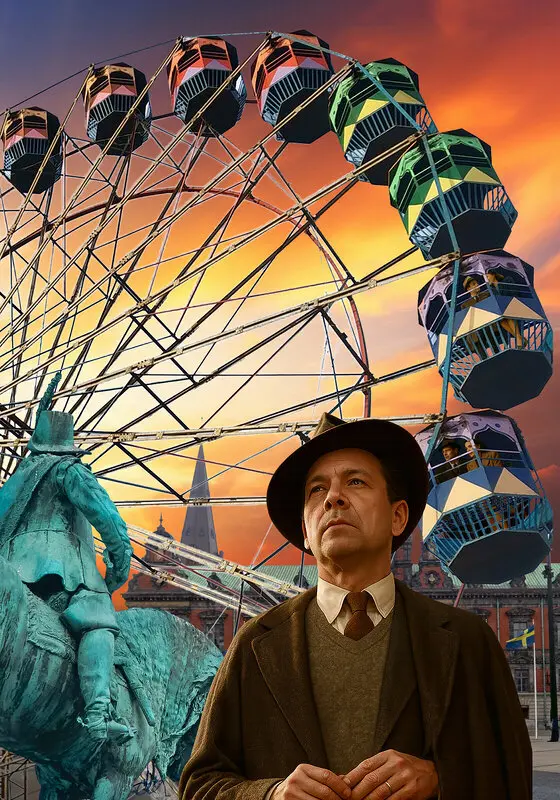
Jörgen Thornberg
Up the Air, Down the Drain, 2025
Digital
50 x 70 cm
3 200 kr
Up the Air, Down the Drain
It begins the way memories often do—not with clarity, but with a sensation. A smell, a sound, the soft whir of something mechanical turning above a quiet city. Perhaps it’s Malmö. Maybe it’s Vienna. Or perhaps it’s that strange borderland where the past hasn’t quite ended and the present hasn’t quite begun.
High above, in a slowly revolving Ferris wheel, two people are caught in a conversation that has taken seventy-seven years to finish. Once, they were lovers. They were fugitives, witnesses, ghosts. He is already dead, more myth than man. She is the one who remained behind—again.
Below them, the city carries on: dots moving, lights flickering, lives continuing in their ordinary, miraculous way. But here, in this capsule suspended between heaven and the street, time holds its breath. What follows is not a typical reunion; it's a unique, unexpected encounter that defies the norms of time and space, inviting us to delve deeper into its mysteries.
It’s something rarer. A reckoning in silhouette. And then, the last turn of the wheel, a moment heavy with the weight of time and memory.
This is where Harry Lime makes his return. And this time, he listens, his presence filling the air with anticipation and suspense, keeping us on the edge of Delve into my analysis and accompanying visuals. Explore how this classic work, 'The Third Man', continues to resonate with the complexities of our modern lives, bridging the gap between past and present, and inviting us to reflect on the enduring relevance of its themes.
“Glimpses from Up Above
HARRY:
I’m just a fellow drifting past the skyline,
A name that flickered once in black-and-white.
Though morals came and tried to draw a fine line,
I floated through the shadows out of sight.
Down there, the streets still glimmer, just like celluloid,
A reel that loops but never quite moves on.
Trams and tepid coffee cups,
Half-closed doors and moral scrubs—
Seen from up above, it’s oddly calm.
ANNA:
And see those ghosts still haunting every station?
They carry bags we never dared unpack.
We once believed in peace and liberation,
But postcards from the future never write back.
The cracks below are filled with quiet sorrow,
And jazz notes trying hard to drown the past.
Yes, we stood beneath the war,
But we don’t stand there anymore—
Now we only watch it fade from up above.
HARRY:
Oh, blessed wheel that spins through time and fiction,
You cradle me with all I never said.
You show me glimpses of some lost conviction,
A life that might have been, but slipped instead.
And look how small they are, those moving figures,
Dots that dance like guilt across the square.
I once sold off their trust,
Thinking power was a must—
Now I watch them, just a little, from up there.
ANNA:
The world still burns, though flags keep changing colour,
And peace arrives too late or not at all.
We built our lies in sequence, one after the other,
Then blamed the wind when towers had to fall.
But still, there’s beauty here between the ruin—
A quiet laugh, a lemon tree in bloom.
We forgot how not to fight,
But perhaps we did it right—
If seen a little gently from above.
BOTH:
So if you look up once and think you hear us,
A whisper caught between the sky and ground—
It’s not a plea, and not quite a ghostly chorus,
Just echoes of a love that spun around.
We never asked for heaven or redemption,
Just a second take, a reel unspooled again.
But the film kept moving on,
And we stayed within the song—
A little off the ground, but never gone.”
Malmö, June 2025
Echoes in the Rubble
If the image looks familiar, you’re not mistaken. Graham Greene’s novel ‘The Third Man’ is set in 1948, just after the end of World War II. The story takes place in occupied, postwar Vienna—a city divided into four zones controlled by the Allies: the United States, Britain, France, and the Soviet Union. Greene wrote the novel as a treatment for the screenplay, not the other way around. Vienna remained in ruins after the war, shaped by black market dealings, broken trust, and a crumbling sense of morality—all of which mirror Harry Lime’s trade and the city’s fractured soul. This enduring relevance of the novel bridges the gap between past and present, connecting us to the complexities of our modern lives.
Year after year, the characters in 'The Third Man' find themselves compelled to reenact their roles, descending from their stars to perform the ritual once more. This game of time, this reenactment, always leans in the same direction, no matter how they try to shift the outcome. The novel's careful construction ensures its relevance nearly eighty years later. At its core, the story is a testament to timeless morality, at least among those with right-minded values. Harry, however, never quite agreed with Anna on that point. Each year, he hoped this would be the time for a re-evaluation. From his high vantage point, watching the likes of Putin and Trump, he felt the moment had come.
This year, they had landed in Malmö, a city they had never visited, despite having staged the charade in Copenhagen back in the ’90s. There was no bridge then, and Anna was a staunch landlubber, avoiding boats like the plague.
Like all Time-Travellers, Orson enjoyed rewriting history, blending in alternate facts about how things might have gone if only “if” hadn’t existed. On this particular day in Malmö, with the wind curling around the trees on Stortorget, their light green leaves fluttered proudly as proof that the long, cold spring had finally ended and summer was just around the corner. Anna and Harry were seated in a gondola on a giant Ferris wheel—one that had witnessed children’s laughter, quiet melancholy, and silent betrayals, all directed from above. High up, in a basket that creaked with every sway, they relished that it wasn’t real—just a game. But a serious one.
Harry reclined with a sly grin, as if he were both a visitor and a sovereign of the entire city. Anna sat rigidly in her coat, hands resting in her lap. Her gaze was fixed on something distant—perhaps the Danube, maybe something that never came to be.
“You know, Anna…” he began, his voice softer than anyone remembered, filled with a regret that hung heavy in the air. “If I had been a different man…”
She didn’t interrupt. What could one say to someone who had once sold death but kept her picture in his wallet? The silence between them was pregnant with unspoken words and unresolved emotions.
The gondola reached the top. The city spread beneath them like an open wound. In that moment, it was as if all guilt had turned to stone—not because it was gone, but because the world below no longer concerned them. Reality doesn’t reach sixty metres up. As the great Swedish singer Edvard Persson once sang:
“Woods and lakes and distant shore
Become a fairyland once more
When you see them from above like this.”
The first time they sat in a similar gondola was during a filmed love scene in 1948, although it was not a happy one. It was the climax of the film, quite literally, but also the beginning of the fall.
They both knew the scene by heart, as if it had happened yesterday and not during the war, or just after it, in a bombed-out Vienna. The contrast to the tidy city below, untouched by war for hundreds of years, was stark. It was only during the wave of demolitions in the 1960s and ’70s that parts of the town resembled Vienna back then—piles of bricks and crumbled houses.
As the gondola slowly began its descent, the metal frame groaned as if sighing at their fate. Anna finally turned towards him. Her eyes were dark, not with hatred, but with the kind of sorrow that knows it once loved someone beyond good and evil.
ANNA:
“You never understood, did you? It wasn’t what you did that broke me. It was that you could smile while doing it.”
Harry said nothing. He removed his hat, letting the wind play with the curls that softened the otherwise precise silhouette of his face. Another life might have begun here—if it had been another film. And another time. He never fully grasped what Anna found so compelling in these memory charades. What happened couldn’t be changed. Sure, they were riding a Ferris wheel in Malmö now, but that wasn’t the point. The point was to replay ‘The Third Man’.
And waiting below—just like then—was Holly, the friend who was no longer his friend. In the film, at least. Among the stars, they had reconciled, and all was forgiven. That’s how it works. Down there, the drama still awaited: the sewers, the threatening shadows, and the end of Harry’s game.
Anna leans back, as if she knows. It wasn’t an escape they made that time – it was a farewell. A farewell to hope. To the last tenderness. To everything that could no longer be saved.
ANNA:
It’s strange, Harry. Being up here again. Everything looks smaller. As if the war never happened.
HARRY:
Or as if it’s still going on, just in silence. Look at those rooftops—same tiles, same chimneys, same rats.
ANNA:
But we’re still here. Somehow. You and I. I used to dream of this moment, you know. After the chaos, after the bombs... just peace. You and me. High above the world. It's a testament to our resilience, Harry.
HARRY (scoffs lightly):
Peace is a hushed kind of noise. Not sure I ever liked it. Too little to sell, too much to regret.
ANNA:
That’s just you being you and constantly dodging meaning with a grin. But we did survive. Doesn’t that count for something?
HARRY:
Survival? That’s just biology. Rats do it better. What counts... is what we pretend it meant.
ANNA (softly):
So pretend for me, Harry, just for this ride. Pretend you didn’t sell penicillin that killed children, that you didn’t disappear when I needed you most.
HARRY (after a pause):
And you pretend Greene didn’t shoot me in the back for moral effect.
ANNA:
He gave you a death, Harry. Not everyone gets one. Some vanish like ghosts.
HARRY:
Ghosts make for a better box office, especially when they come with a speech.
ANNA:
Which you always do. Words first, consequences later.
HARRY (leans closer):
And you, always the audience. Loyal. Beautiful. Morally upright. Almost fictional.
ANNA:
At least I didn’t hide in the shadows, Harry. You always preferred the sewers to the streets.
HARRY (smirks):
Cleaner place, believe me. Less idealism down there. And fewer questions.
ANNA:
You know, I never intended to end up in Vienna. It just… happened. I came with a theatre company. The war arrived with tanks. One stayed, the other didn’t.
HARRY:
You stayed like a postcard that never got posted, still wearing your stage smile.
ANNA (dryly):
And you still wear your irony like a tailored suit. But yes, I stayed. There was no home to return to. The theatre shut down. I was twenty-two, and suddenly I was just... someone’s accent in someone else’s city.
HARRY:
But you made it yours. You always did. That apartment of yours—filled with books in the wrong language, music on a broken radio. It was the last place I felt anything close to safe.
ANNA:
Until the knock came. Your men. Your ghost. Your sins.
HARRY:
I didn’t send them, Anna.
ANNA:
You didn’t stop them either. That boy... he cried in the stairwell before they took him. Do you remember that?
HARRY (quietly):
I remember everything I try not to.
ANNA:
And yet, I waited. For you. In silence, in rooms full of watchers, of questions. I lost roles, friends, and my passport all for a man who lived beneath Vienna, not in it.
HARRY:
You've shown a remarkable resilience, Anna. You've managed to retain your humanity in the midst of all this. I, on the other hand, played God and lost. I became something less than human.
ANNA:
And you think that’s enough?
HARRY (leans against the rail):
No. But it's something. And tonight, it’s the only thing between us that isn’t fiction.
HARRY:
It started small. A tin of coffee here, some stockings there. A favour for a soldier, a trade with a contact. At first, it felt like a matter of survival, and it was just about helping people get what they needed. That’s how it always starts, right?
ANNA (softly):
And then?
HARRY:
Then I realised there was no bottom to it. No end. Every favour became a transaction, every transaction a risk, every risk a thrill. Somewhere along the line, I stopped seeing faces. They were just ledgers. Units. Names on paper. It was a journey of self-discovery, Anna. A journey I wish I had never embarked on.
ANNA:
Like the sick children?
HARRY:
Don’t. Please don’t say it like that.
ANNA:
How should I say it?
HARRY (pauses, then sighs):
No way makes it sound better. I sold diluted penicillin, yes. I told myself the doctors would catch it, the nurses would notice, the parents would... but I knew. I always knew. I told myself the war had made me practical. It's a raw, honest admission, Anna. A confession I wish I didn't have to make.
ANNA:
No, Harry. The war made you a liar. You made yourself practical.
HARRY (after a long silence):
You’re right. And I think that’s why Greene killed me off. He couldn’t let me walk away. He crafted me out of charm and cruelty—and then buried me in a sewer to make a point. But that wasn’t the end. Not for me.
ANNA:
So what was it?
HARRY:
Just a chapter. I slipped away in the confusion. New name. New border. New ghosts. And then one day, years later, I woke up and realised... the only part of me that still mattered was the part Greene left out.
ANNA (takes a deep breath, looking out over Malmö):
You always had your escape plans. Your trapdoors. Even death was just a curtain to slip behind. But I—I stayed. I remained in that cold apartment with your photograph turned to the wall, and your coat still hanging by the door. I told myself it was grief. But it was more than that.
HARRY (quietly):
Guilt?
ANNA: (the glittering, temporary funfair far below, a quiet melancholy passing through her gaze.)
No. Loyalty. The kind that outlives logic. Perhaps even dignity. I waited, not because I believed you’d return, but because I didn’t know who I was without you. You had become the story I told myself, over and over again, until even I believed it. I remained loyal to the memory of you, Harry.
HARRY:
Was I worth waiting for?
ANNA (turns to him, steady):
That you were ever mine.
HARRY (softly, almost smiling):
And was I?
ANNA (looks away):
For a moment. One perfect, terrible moment—before the world came crashing back. Before the men in coats began asking questions. Before I realised you’d sold more than penicillin. You’d sold trust. Love. Even me.
HARRY (after a silence):
I didn’t know how to stop. And no one tried to make me.
ANNA (whispers):
I did. Every night, I didn't turn you in. That was me trying.
HARRY (low voice):
You tried harder than anyone ever did. Perhaps that's why I never forgave you—because you made me want to be better. And I couldn’t. I regret the person I became, Anna. I regret the choices I made.
ANNA (slowly turns to him):
You could have, Harry. Even now, I think... maybe you still can.
HARRY:
Too late. For me, time doesn’t move forward—it loops. Always back to the sewer. Back to the wheel. Back to this.
ANNA (quietly, almost whispering):
Do you remember Zurich? It was before the war, before it swallowed us whole. We were young and hopeful, with the future stretching out before us. We were in Zurich, a city of beauty and promise, before the war tore through Europe, changing everything.
HARRY (smiles sadly):
The rooftop café with the crooked umbrella. You wore that ridiculous yellow hat.
ANNA:
It wasn’t ridiculous. You said I looked like a daffodil.
HARRY (looks at her gently):
You did—the only bright thing in a grey city. And I remember the way you laughed—like you’d never known fear.
ANNA (looks him in the eye):
That was before I knew what you were capable of.
HARRY (for a moment, vulnerable):
And yet you’re here.
ANNA:
Yes. And no, part of me never left that train station. When I waved goodbye, I thought I’d see you again in a week. Instead, I read your name on underground ledgers and whispered warnings.
HARRY (leans in slightly):
And if the war had never come?
ANNA (pauses, touches his hand, then pulls away):
Then perhaps we’d have had a quiet life. Books. Coffee. A dog. You’d complain about taxes, and I’d complain about your shirts. And we’d be boring. Gloriously boring.
HARRY:
I was never good at boring.
ANNA:
Many things can be said about you—by others, of course—but certainly not boring.
HARRY: (It hit like lightning in the gondola even though the sunset showed no signs of a storm.)
I’ll never truly forgive Graham for killing me. Not really.
ANNA (turns slowly):
He had his reasons.
HARRY (purses his lips, bitterly):
Did he? There were other ways to make his point. But no—he had to sacrifice me like some narrative Judas. A punishment for the sins of my creation. A warning to others: “This is what happens.” It feels as though I was cast in a role I never auditioned for, and now I'm forever associated with that character. I felt like I was used, like a character in a story, to serve his purpose, and now I can never escape that role.
ANNA (calmly):
You didn’t exactly deal in mercy yourself.
HARRY:
Don’t preach. I know what I did—or what I allowed to happen. But he turned me into a moral footnote. I was never that clean. Never that simple. And neither was he.
ANNA (quietly, with tired warmth):
He didn’t kill you, Harry. You were already disappearing… long before the shot rang out.
HARRY (darkly):
Maybe. But he pulled the trigger. And then walked away with the royalties.
ANNA: (She changed the subject to keep Harry from sinking into bitterness)
People always say the war ended in ’45. But for us… It never really did.
HARRY: (Relieved, knowing there’s no point in digging through old dirt since what has happened can’t be undone.)
No. It just changed uniforms. The rubble remained. The fear remained. Only the enemies switched names. And the black market grew like ivy through the ruins. Everyone needed something. And someone was always willing to sell it.
ANNA:
And the black market grew like ivy through the ruins. Everyone needed something. And someone was always willing to sell it.
HARRY:
I made a business out of chaos. Vienna provided the perfect fog to disappear into. A divided city, four zones, four sets of lies. All looking the other way while I cashed in.
ANNA:
It was 1948, but it could’ve been the day after the bombs fell. No heat, no light, no trust. Only people like you thrive in the cracks.
HARRY: (with a self-satisfied smile)
ANNA:
You know you were loved, right?
HARRY:
(With a crooked smile)
I stole a film in ten minutes. Not bad. A doorway, a cat, a smile—and suddenly I was an icon.
ANNA:
But it wasn’t just a film trick. People liked you. Perhaps more than they should have.
HARRY:
Charm. Wit. That gets you far. And if you're just dangerous enough… You become as excited as a war in a tuxedo.
ANNA:
You embodied something. That cynicism left behind after everything… after 1945. The world was tired of morals and finger-wagging. You were like... a romantic scoundrel.
HARRY:
A hero without a conscience. Just what the times demanded.
ANNA:
And yet they killed you.
HARRY:
Greene’s moralism. A sentence. “Too dangerous to live.” As if I bore the entire war’s guilt in my smile.
ANNA:
The critics called you complex. A mirror for moral decay. A warning. But also, you were addicted to power.
HARRY:
I even had a radio series, did you know that? *The Adventures of Harry Lime*. Fifty episodes. Prequels. I was a rogue with a heart.
ANNA:
You became a kind of proto-antihero. Tony Soprano, before the mafia was chic. Walter White with a hat—only better looking.
HARRY:
And with better lines. (pause)
But none of them ever rode a Ferris wheel with you.
ANNA:
No. That takes more than moral ambiguity. That brings... love, despite everything.
HARRY:
And a touch of vertigo.
ANNA:
And a cuckoo clock. (both chuckle softly)
HARRY:
Maybe that—or the music. (hums Anton Karas’ unforgettable zither theme)
That little melody. An earworm before the term even existed. Back then, we didn’t even have YouTube, yet it still managed to infect the entire planet.
ANNA:
You know, it became a sort of symbol for you? As slippery as you were. No strings, no trumpets—just a solitary zither in a smoky alley. A reminder of your love for music, your skill with the instrument, and the moments of peace it brought you.
HARRY:
Exactly. No violins for me. Just wire and gut. Slightly out of tune, but unforgettable.
ANNA:
Like you.
HARRY:
People could whistle it without ever seeing the film. I wonder if they understood who they were carrying on their lips…
ANNA:
You slipped into their heads like a spy in the night.
Charming. Dangerous. A little naughty. But you sparkled.
HARRY:
Thanks. That’s the nicest thing you’ve said to me since…
(pause)
…well, since you buried me.
ANNA:
I remember the first time I saw you out on the street, as if you didn’t belong in the ruins. You smiled. But I sensed that smile was concealing something.
HARRY:
You saw right through me even then. But you stayed.
ANNA:
We were all lost. I fled here from Czechoslovakia. I wanted to act. Then the war came. Everything shattered. It turned into a black theatre in real life. And you… You seemed to own the set.
HARRY:
I was good at finding the cracks. Cracks in the system, cracks in people, and cracks in the market. I ventured where no one else dared, or had the conscience to go.
ANNA:
Black market medicine. Infant deaths.
How could you?
HARRY: (looks out the window)
I don’t know any longer. I told myself it was business, that the people were already lost, that they’d die anyway. I stopped seeing them. Just numbers. Just bottles.
ANNA:
Still, I didn’t turn you in. Not even when they came to me. I hated myself for that. I was torn between my love for you and my disgust at what you had become.
HARRY: (grimaces)
It wasn’t you who betrayed me. It was Graham. He sat there with his typewriter and judged me like an Old Testament god moralist in a trench coat.
ANNA:
But he was also afraid. Afraid of what you’d become. Afraid the audience would love you too much.
HARRY:
And they did. I saw it in the theatres. When the lights came on, it was me they talked about. Not the hero. Not Holly. Me.
ANNA:
You know… sometimes I wonder what would’ve happened if you’d just left Vienna. We could’ve gone somewhere, anywhere. Trieste. Or Sweden. You could’ve started afresh. [Her voice carries a heavy tinge of regret, a longing for a different path that was never taken, a sense of what could have been.]
HARRY:
Started afresh? With what? I was already Harry Lime. No passport, no confession, no new name could’ve saved me from him.
ANNA:
You mean Graham?
HARRY:
No. It was me. I was in love with the risk. And with that feeling, when everything sways beneath your feet but you’re still standing. Like now. [His voice reveals a profound self-awareness, an understanding of his destructive tendencies, a sense of his inner turmoil.] (He nods out the window toward the spinning wheel and the night city below.)
ANNA:
But I loved you. And I waited. That was the hardest part. Not losing you, but that you never chose me in return. [Her voice is heavy with palpable disappointment, a testament to the unfulfilled love she harboured for Harry, a deep sense of loss.]
HARRY: (looks at her, unusually still)
I chose you. But not in the right way. Not while it still meant something.
ANNA: (She smiles sadly, alluding to the famous doorway scene.)
You chose the cat.
HARRY: (forces a crooked smile)
She was probably the only one who truly understood me.
ANNA:
You’ll be remembered, Harry. But not as the man I knew. And that’s the real punishment. Never getting to explain yourself. Everyone thinks they know who you were, but no one knows who you tried to become.
HARRY: (his tone darkens)
That’s why he wrote me dead. Greene. So there’d be no chance of forgiveness. No way out.
ANNA: Or because he knew you wouldn’t take it. (A long silence. The wheel pauses while they sit at the top. Their eyes meet, reflecting a kind of sorrow, a nearly tender anger. Then she says the one thing Harry never expected to hear.) ANNA: I forgave you anyway, but the regret is heavy, a burden I carry, a weight that never seems to lift. (Harry tries to say something, but for once, he has no words.)
HARRY (looking down at the square below): Dots. Do you see them? Small, moving specks. People who once meant something to me. Or perhaps not. (His bitterness is palpable, a bitter taste of loss that lingers in the air.)
ANNA (sadly but knowingly): You're not starting that again, are you?
HARRY (with a tight smile): Would you feel any pity if one of those dots stopped moving forever?
ANNA (scoffs): You know I hated it when you said that. And yet I remember every syllable.
HARRY (it falls like an echo from far away): “In Italy, for thirty years under the Borgias, they had warfare, terror, murder and bloodshed—but they produced Michelangelo, Leonardo da Vinci and the Renaissance...” (pause) “In Switzerland, they had brotherly love, five hundred years of democracy and peace... and what did that produce?”
ANNA (sighs, but a smile tugs at the corner of her mouth): The cuckoo clock. A reminder of our shared past, of the time when we were still innocent and hopeful.
HARRY (cynically): I knew that one would land like a well-aimed bullet in the cathedral of morality. And it did. The audience cheered. Critics fainted. And me? I became a quote.
ANNA: Except you didn’t even write it.
HARRY: No. Neither did Graham. It just appeared—like an old friend with a knife up his sleeve. I said I stole it from some Hungarian play. Or was it Whistler? Or Household? Who cares. It sounded too good to be true, which meant it was.
ANNA: And wrong. Cuckoo clocks come from the Black Forest, not Switzerland. (Her correction is laced with irony, a touch of sarcasm in her voice that cuts through the air.)
HARRY (grinning widely): Historical accuracy never made great cinema. It’s the gesture that counts. The rhythm. Tick-tick. You know… that little mechanical heart beating beneath all the moral varnish.
ANNA: But you weren’t just a cuckoo. You were a ticking bomb.
HARRY (for a moment, serious): And I blew myself to bits. But you remember the laugh. That little laugh in the dark, when we thought we could conquer the world. Don’t you?
ANNA: I do. And maybe that’s the saddest thing of all. When the wheel reaches the ground, only one of them steps off. Just as in 1948, time travel continues for now.
Anna remains in the gondola. The door is open, but she doesn’t move. An attendant calls out something, a friendly but impatient “Time to get off!”—but she doesn’t see him. She looks inward. She sees back.
Harry turns. For a moment, it seems he might reach out his hand, invite her along, say what he never said at the right time. But his smile gets in the way. That crooked, confident smile that once could win her. Now it only reminds her of everything he never took responsibility for.
HARRY: “You know, Anna… you were never meant to be part of this.”
ANNA (quietly): “But I was. I became everything you didn’t count on.”
She looks away again. A new passenger enters the next gondola. The wheel spins onward. Harry takes a few steps as if he’s not quite sure where he’s headed, but he knows. We know. There’s no road back for him anymore.
In the game between friendship and betrayal, between guilt and denial, he’s already played his hand. And Anna? She chooses to stay in motion. One final turn through Malmö’s pink dusk, where all that could have been slowly fades among neon lights, a rising evening mist, and the echoes of the zither playing in her mind.
That’s how The Third Man works—no happy endings. Just beautiful, sorrowful fragments of life, left on an eternal spin.
3 200 kr

Jörgen Thornberg
Malmö
Lite om bilder och mig. Translation in English at the end.
Jag är en nyfiken person som ser allt i bilder, även det jag fäster i ord, gärna tillsammans för bakom alla mina bilder finns en berättelse. Till vissa bilder hör en kortare eller längre novell som följer med bilden.
Bilder berättar historier. Jag omges av naturlig skönhet, intressanta människor och historia var jag än går. Jag använder min kamera för att dokumentera världen och blanda det jag ser med vad jag känner för att fånga den dolda magin.
Mina bilder berättar mina historier. Genom mina bilder, tryck och berättelser. Jag bjuder in dig att ta del av dessa berättelser, in i ditt liv och hem och dela min mycket personliga syn på vår värld. Mer än vad ögat ser. Jag tänker i bilder, drömmer och skriver och pratar om dem; följaktligen måste jag också skapa bilder. De blir vad jag ser, inte nödvändigtvis begränsade till verkligheten. Det finns en bild runt varje hörn. Jag hoppas att du kommer att se vad jag såg och gilla det.
Jag är också en skrivande person och till många bilder hör en kortare eller längre essay. Den följer med tavlan, tryckt på fint papper och med en personlig hälsning från mig.
Flertalet bilder startar sin resa i min kamera. Enkelt förklarat beskriver jag bilden jag ser i mitt inre, upplevd eller fantiserad. Bilden uppstår inom mig redan innan jag fått okularet till ögat. På bråkdelen av ett ögonblick ser jag vad jag vill ha och vad som kan göras med bilden. Här skall jag stoppa in en giraff, stålmannen, Titanic eller vad det är min fantasi finner ut. Ännu märkligare är att jag kommer ihåg minnesbilden långt efteråt när det blir tid att skapa verket. Om jag lyckas eller inte, är upp till betraktaren, oftast präglat av en stråk av svart humor – meningen är att man skall bli underhållen. Mina bilder blir ofta en snackis där de hänger.
Jag föredrar bilder som förmedlar ett budskap i flera lager. Vid första anblicken fylld av feel-good, en vacker utsikt, fint väder, solen skiner, blommor på ängen eller vattnet som ligger förrädiskt spegelblankt. I en sådan bild kan jag gömma min egentliga berättelse, mitt förakt för förtryckare och våldsverkare, rasister och fördomsfulla människor - ett gärna återkommande motiv mer eller mindre dolt i det vackra motivet. Jag försöker förena dem i ett gemensamt narrativ.
Bild och formgivning har löpt som en röd tråd genom livet. Fotokonst känns som en värdig final som jag gärna delar med mig.
Min genre är vid som framgår av mina bilder, temat en blandning av pop- och gatukonst i kollage som kan bestå av hundratals lager. Vissa bilder kan ta veckor, andra någon dag innan det är dags att överlämna resultatet till printverkstaden. Fine Art Prints är digitala fotocollage. I dessa kollage sker rivandet, klippandet, pusslandet, målandet, ritandet och sprayningen digitalt. Det jag monterar in kan vara hundratals år gamla bilder som jag omsorgsfullt frilägger så att de ser ut att vara en del av tavlan men också bilder skapade av mig själv efter min egen fantasi. Därefter besöks printstudion och för vissa bilder numrera en limiterad upplaga (oftast 7 exemplar) och signera för hand. Vissa bilder kan köpas i olika format. Det är bara att fråga efter vilka. Gillar man en bild som är 70x100 men inte har plats på väggen, går den kanske att få i 50x70 cm istället. Frågan är fri.
Metoden Giclée eller Fine Art Print som det också kallas är det moderna sättet för framställning av grafisk konst. Villkoret för denna typ av utskrifter är att en högkvalitativ storformatskrivare används med åldersbeständigt färgpigment och konstnärspapper eller i förekommande fall på duk. Pappret som används möter de krav på livslängd som ställs av museer och gallerier. Normalt säljer jag mina bilder oinramade så att den nya ägaren själv kan bestämma hur de skall se ut, med eller utan passepartout färg på ram, med eller utan glas etc..
Under många år ställde jag bara ut på nätet, i valda grupper och på min egen Facebooksida - https://www.facebook.com/jorgen.thornberg.9
Jag finns också på en egen hemsida som tyvärr inte alltid är uppdaterad – https://www.jth.life/ Där kan du också läsa en del av de berättelser som följer med bilden.
UTSTÄLLNINGAR
Luftkastellet, oktober 2022
Konst i Lund, november 2022
Luftkastellet, mars 2023
Engleson Galleri Caroli, april 2023
Hydra, Greece June 2023
Engleson Galleri Caroli, oktober 2023
Toppen, Höllviken december 2023
Luftkastellet, mars 2024
Torups Galleri, mars 2024
Venice, May 2024
Luftkastellet, oktober 2024
Konst i Advent, December 2024
Galleri Engleson, Caroli December 2024
Jäger & Jansson Galleri, april 2025
A bit about pictures and me.
I'm a curious person who sees everything in pictures, even what I express in words, often combining them, for behind all my pictures lies a story. These narratives, some as short as a single image and others as long as a novel, are the heart and soul of my work.
Pictures tell stories. Wherever I go, I'm surrounded by natural beauty, exciting people, and history. I use my camera to document the world and blend what I see with what I feel to capture the hidden magic.
My images tell my stories. Through my pictures, prints, and narratives, I invite you to partake in these stories in your life and home and share my deeply personal perspective of our world. More than meets the eye. I think in pictures, dream, write, and talk about them; consequently, I must create images too. They become what I see, not necessarily confined to reality. There's a picture around every corner. I hope you'll see what I saw and enjoy it.
I'm also a writer, and many images come with a shorter or longer essay. It accompanies the painting, printed on fine paper with my personal greeting.
Many pictures start their journey on my camera. Simply put, I describe the image I see in my mind, experienced or imagined. The image arises within me even before I bring the eyepiece to my eye. In a fraction of a moment, I see what I want and what can be done with the picture. Here, I'll insert a giraffe, Superman, the Titanic, or whatever my imagination conjures up. Even stranger is that I remember the mental image long after it's time to create the work. Whether I succeed is up to the observer, often imbued with a streak of black humour – the aim is to entertain. My pictures usually become a talking point wherever they hang.
I prefer pictures that convey a message in multiple layers. At first glance, they're filled with feel-good vibes, a beautiful view, lovely weather, the sun shining, flowers in the meadow, or the water lying deceptively calm. But beneath this surface beauty, I often conceal a deeper story, a narrative that challenges societal norms or explores the human condition. I invite you to delve into these hidden narratives and discover the layers of meaning within my work.
Picture and design have been a thread running through my life. Photographic art feels like a fitting finale, and I'm happy to share it.
My genre is varied, as seen in my pictures; the theme is a blend of pop and street art in collages that can consist of hundreds of layers. Some images can take weeks, others just a day before it's time to hand over the result to the print workshop. Fine Art Prints are digital photo collages. In these collages, tearing, cutting, puzzling, painting, drawing, and spraying happen digitally. What I insert can be images hundreds of years old that I carefully extract so they appear to be part of the painting, but also images created by myself, now also generated from my imagination. Next, visit the print studio and, for certain images, number a limited edition (usually 7 copies) and sign them by hand. Some images may be available in other formats. Just ask which ones. If you like an image that's 70x100 but doesn't have space on the wall, you might be able to get it in 50x70 cm instead. The question is open.
The Giclée method, or Fine Art Print as it's also called, is the modern way of producing graphic art. This method ensures the highest quality and longevity of the artwork, using a high-quality large-format printer with archival pigment inks and artist paper or, in some cases, canvas. The paper used meets the longevity requirements set by museums and galleries. I sell my pictures unframed, allowing the new owner to personalise their artwork, confident in the lasting value and quality of the piece.
For many years, I only exhibited online, in selected groups, and on my Facebook page - https://www.facebook.com/jorgen.thornberg.9. I also have my website, which unfortunately is not constantly updated - https://www.jth.life/. You can also read some of the stories accompanying the pictures there.
EXHIBITIONS
Luftkastellet, October 2022
Art in Lund, November 2022
Luftkastellet, March 2023
Engleson Gallery Caroli, April 2023
Hydra, Greece June 2023
Engleson Gallery Caroli, October 2023
Toppen, Höllviken December 2023
Luftkastellet, March 2024
Torup Gallery, March 2024
Venice, May 2024
UTSTÄLLNINGAR
Luftkastellet, oktober 2022
Konst i Lund, november 2022
Luftkastellet, mars 2023
Engleson Galleri Caroli, april 2023
Hydra, Greece June 2023
Engleson Galleri Caroli, oktober 2023
Toppen, Höllviken december 2023
Luftkastellet, mars 2024
Torups Galleri, mars 2024
Venice, May 2024
Luftkastellet, October 2024
Konst i Advent, December 2024
Galleri Engleson, Caroli December 2024
Jäger & Jansson Galleri, April 2025
Utbildning
Autodidakt
Medlem i konstnärsförening
Öppna Sinnen
Med i konstrunda
Konstrundan i Skåne
Utställningar
Luftkastellet, October 2022
Art in Lund, November 2022
Luftkastellet, March 2023
Engleson Gallery Caroli, April 2023
Hydra, Greece June 2023
Engleson Gallery Caroli, October 2023
Toppen, Höllviken December 2023
Luftkastellet, March 2024
Torup Gallery, March 2024
Venice, May 2024