Vi använder cookies för att ge dig bästa möjliga upplevelse. Välj vilka cookies du tillåter.
Läs mer i vår integritetspolicy
Jörgen Thornberg
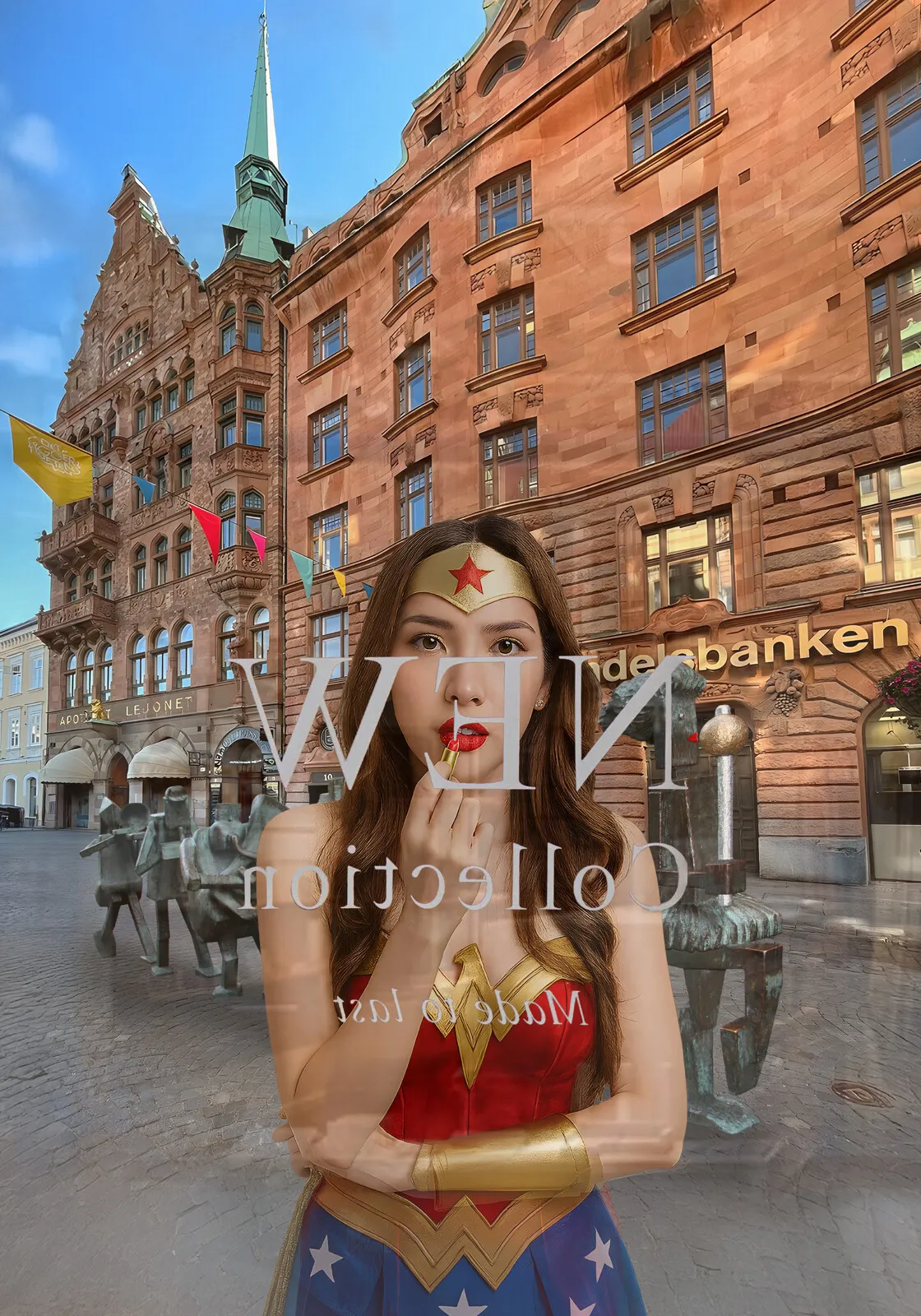
Doing Her Lips, 2025
Digital
50 x 70 cm
3 200 kr
Doing Her Lips
This is not merely a tale of colour. It’s a narrative of power, protest, performance, and the delicate red line between seduction and subversion. Lipstick, with its silent glide across a mouth, serves as a captivating storyteller. It whispers secrets in bathrooms, bellows across barricades, and etches its mark on the collars of emperors and clowns alike.
And sometimes… it bleeds into crime scenes.
Because even the gentlest of acts, like a kiss, can be perilous. Especially when it’s inscribed in lipstick.
Ask the baton-wielding matriarch leading the Optimist Band at Stortorget in Malmö. She never intended to take sides. Yet, someone unexpectedly left a crimson kiss on her cheek. You may call it vandalism, or a signature, or perhaps just another message in the long, bright history of a legacy that stretches from ancient civilisations to modern-day revolutions, where lips refuse to stay silent.
Click the link below to delve into my analysis and accompanying visuals.
https://www.konst.se/jorgen-thornberg
”Lipstick Confession
It wasn’t love, but it left a trace –
a whisper in red on a starch-white place.
Not a letter, not a vow,
just a sigh that said: she knows now.
A collar turned crime scene,
a kiss that couldn’t lie.
He sold her promises at noon,
and wore her silence home at five.
But lips don’t forget.
And rouge remembers.
In every shade of scandal,
and every burn that lingers.
She paints them not to please,
but to declare –
I am the mark you can’t erase.
I am the war you didn’t prepare for.
And Wonder Woman? She needs no looking glass.
The city grants her dozens per pass –
shopfronts, train doors, rearview chrome,
a mirror in every quarter to call her own.
With every pane she passes by,
she reclaims the gaze, she lifts her chin.
No damsel. No disguise.
Just battle-ready, crimson-grinned.”
Malmö, June 2025
A love story in wax and fire
She doesn't need a mirror; the shopfront glass is sufficient. There she stands, Wonder Woman, framed by the sky-lit glass of an exclusive home furniture shop at the corner of Stortorget, according to me, the best location in town. Behind her, the merry musicians play on. Malmö’s bronze quartet, ’Optimistorkestern’ (The Optimist Band), is eternally mid-tune, where Södergatan exhales into the square. She raises the lipstick like a relic, a ritual gesture echoed through time.
Women once leaned over onyx bowls filled with water, where dark stone and sunlight merged into mirrors. Others smeared red across their mouths by riverbanks, using only the shimmer of still water. And now, under the gaze of marble lions and blind vitrines, she does what they did: she readies her mouth like a weapon, like a memory, steeped in the rich historical context of femininity.
Not to kiss, not yet, but to meet the world, painted, precise, and gloriously composed, exuding a powerful beauty that commands attention and respect.
If you look closely at the sculpture group, you’ll notice that one of the figures-the one farthest to the left as you descend Södergatan—carries herself like an exaggerated drum major, though without the baton. She stands wide-legged, cheerfully tilted forward, chin raised, hips pushed ahead as if she’s about to burst into a solo—or command an entire regiment to march in rhythm.
The figure is androgynous, but within the context of this image, the statue becomes a “she” in a skirt—a baton-wielding matriarch, a kind of parodic forerunner to Wonder Woman. A bronze figure that’s stood there since 1985, unknowingly backing up our heroine with musical discipline and accidental swagger. And someone-a modern imp, a midnight vandal, a lipstick revolutionary-has left a bright red kiss on the cheek of the drum major herself. What rascals!
It begins, as most enduring obsessions do, in ancient dust and with a flicker of vanity. Lipstick—equal parts ritual, rebellion, seduction, and science—is more than a cosmetic. It’s a cultural artefact, a tangible object that reflects the beliefs, values, and practices of a particular culture or society, smeared across five millennia of human history. Made primarily from waxes and oils, and tinted with anything from crushed gemstones to powdered insects, its allure is as enduring as its palette, captivating generations with its cultural significance.
Lipstick on Your Collar
Not all messages are spoken; some are worn on one's sleeve. A smear of red on a starched collar – the most silent of betrayals, the clearest of clues. Lipstick, with its unique ability to linger where it shouldn’t, doesn’t just vanish into kisses; it remains. On coffee cups, on cigarette butts, on skin. And, yes – on shirts. It's a silent communicator, a powerful storyteller.
In mid-century love songs and gossip columns, lipstick on your collar became shorthand for infidelity. A mark of guilt, or at least suspicion, it told stories better left untold. Connie Francis sang about it in 1959:
“Lipstick on your collar / told a tale on you…”
The line was catchy, and the warning was clear.
No wonder lipstick became both a weapon and a witness, a forensic flash of colour that didn’t just decorate – it testified. It's a silent witness, a vibrant flash of colour that speaks volumes.
And who could forget Mad Men? In the smoke-filled offices of 1960s Madison Avenue, lipstick wasn't just a product – it was a strategy, a trap, a ticking clock on a crumbling marriage. More than once, Don Draper returned home with a faint red smear betraying more than he cared to explain, and more than once, Betty noticed.
In one early episode, a single kiss mark on a collar – almost invisible – says everything. It's not just makeup; it's evidence. In a world built on polished surfaces, lipstick becomes the crack —the imperfection that reveals the truth beneath the façade.
What Mad Men understood so well was this: lipstick can sell a dream, a vision of beauty and allure, but it can also reveal the lie underneath-the deceit and betrayal that often accompany such visions.
But what a kiss it is. But let’s go back in time and see how it all started.
From Cleopatra’s carmine-smeared lips to Taylor Swift’s signature scarlet pout, this humble wax stick has been everything from status symbol to scandal. It has sparked desires, outraged puritans, provoked lawmakers, and launched a thousand shades of controversy. Red lips don’t whisper—they declare power and rebellion, inspiring and empowering those who wear them. They are not just a cosmetic, but a statement of strength and defiance —a transformative power that has resonated throughout history, inspiring us with its evolution.
The birth of colour: ancient beginnings
It was the Sumerians who, five thousand years ago, first thought to crush gemstones—not to decorate palaces, but to adorn their faces. Men and women alike painted their lips and eyes, leaving the earliest archaeological traces of beauty as ritual. The ancient origins of lipstick's history are both enlightening and intriguing, revealing its deep roots in human culture.
Meanwhile, in Egypt, where cosmetics were religion-adjacent, Cleopatra crushed cochineal bugs to produce a crimson worthy of royalty. But it came with a price—some red dyes contained bromine, mannite, and iodine, a combination that painted lips but poisoned slowly. In this world, lipstick wasn’t gendered; it was a badge of power, a symbol or token that signifies a person's status or authority. The shimmer some Egyptians preferred came courtesy of fish scales—mother-of-pearl from the Nile, glinting in the sun like a flirtation. This 'badge of power' was not just a symbol of status, but also a means of self-expression and identity in a society where appearance was highly valued, a role that has shaped its historical evolution and our understanding of it.
China, always ahead of the curve, introduced beeswax-based lipsticks a millennium ago, not merely for beauty but for protection. During the Tang dynasty (618–907 CE), perfumed oils transformed lipstick into something more than mere adornment—it became a rich sensory experience. The oils were meticulously selected and blended to create a unique fragrance that enhanced the wearer's experience. In Australia, Aboriginal girls painted their lips red with ochre to signify puberty, highlighting that lips speak even when silent.
If ancient women painted their lips by the light of temple fires and in bronze mirrors, then European nobility transformed rouge into spectacle. In Elizabethan England, makeup was more than mere vanity—it was a strategy. During the reign of Queen Elizabeth I, bright red lips and chalk-white skin weren’t just fashionable; they were armour. With a face powdered in ceruse, a blend of white lead and vinegar, and lips tinted with beeswax and plant-based dyes, the Virgin Queen crafted an image that hovered between sacred icon and spectral monarch. She wasn’t merely a ruler—she was a painting in motion, untouchable, eternally composed. Her courage to use makeup as a strategic tool is genuinely inspiring.
However, this theatrical command of appearance was reserved for the few. For centuries, makeup in Europe was either associated with the court or considered a shameful practice. There was no respectable middle ground. Cosmetics were worn by aristocrats, by actors, and by those who sold more than theatre tickets. A decent woman, particularly in Victorian Britain, might have had a discreet rouge pot tucked away in a drawer, but she would never be seen applying it in daylight. Lipstick was an offence to decency. A smear of colour was a smear on one’s reputation.
Yet, in Paris, where scandal and elegance have always danced in step, something began to stir. Around 1870, Maison Guerlain, a pioneering beauty house, began experimenting with solid lip colour, wrapping it in silk paper, much like a confection. Its ingredients included deer tallow, castor oil, and beeswax. It was not yet mainstream, but it existed. The breakthrough, according to legend, came from a chance encounter: a Guerlain employee passed by a candlemaker’s shop and noticed the wax, the pigments, the glimmer of potential. Inspiration struck. If candles could be coloured and solid, why not cosmetics? By 1884, Guerlain had begun manufacturing lipstick on a larger scale, and for the first time, women could purchase their pout in portable, premade form. This innovation by Maison Guerlain marked a significant shift in the beauty industry, making lipstick more accessible and changing the way women approached cosmetics.
Sarah Bernhardt, the actress who made tragedy a lifestyle, helped move lipstick from backstage to the boulevard. She didn’t wait for privacy. She applied her lipstick in public, in carriages, on park benches, without apology. Her bold use of carmine, extracted from crushed cochineal insects, shocked the conservative and thrilled the curious. At the time, lipstick was available in paper tubes or small pots and applied with a brush. Bernhardt did it with panache. She made lipstick perform.
By the 1890s, carmine was being mixed with wax and oil, resulting in a more natural-looking sheen for the lips. The effect was softer, more wearable, and crucially, more acceptable. Lipsticks were no longer confined to actresses. They began to appear in shops. The Sears Roebuck catalogue in America started selling rouge for both lips and cheeks by the end of that decade. This marked a significant shift, liberating women and empowering them to express themselves more freely.
In 1915, Maurice Levy designed a metal push-up tube with a tiny side lever. Women could now slide the colour upward with a flick of the fingernail. That little mechanical flourish changed everything. Lipstick was suddenly not just usable, but portable and elegant. Applying it became a ritual of control. By 1923, in Nashville, Tennessee, James Bruce Mason Jr. patented the first swivel-up tube, the kind we still recognise today. This design not only made lipstick more convenient but also added a touch of luxury to its use.
As lipstick entered its golden age, especially in America, it no longer whispered from the shadows. It spoke plainly. Women wore it to work, to lunch, to the cinema. They applied it in public with increasing ease. But constantly, beneath the fashion, something deeper stirred—lipstick was still a message. A painted mouth said, I am here. I am not ashamed. I will be seen.
By 1921, respectable London women could finally stroll down Oxford Street with painted lips without being mistaken for fallen angels. Something had shifted. The First World War had unsettled the entire moral fabric of Edwardian society. Women had entered factories, driven ambulances, buried the dead, and read the headlines. In doing so, they had earned not only the vote but also a new relationship with visibility. And lipstick—portable, potent, defiantly unnecessary—was part of this new visibility.
London salons, such as Selfridges, began to display lipstick as a legitimate purchase, no longer something to be requested in a whisper behind the counter. A woman could now buy a tube of colour and carry it in her handbag like a key, like a cigarette case, like something private yet performative. The act of applying lipstick in public still raised some eyebrows, but it no longer prompted a call to the police. It had moved from taboo to trend.
Meanwhile, in Paris, things were already further along. Lipstick wasn’t just tolerated—it was woven into the couture of the city itself. French women wore red not as a symbol of rebellion, but as a routine. Fashion houses aligned with cosmetic firms, and women stepping out of Chanel or Lanvin might very well do so with a carefully coordinated lip. Beauty in Paris was both business and pleasure. And red—always red—remained the anchor—bold, classic, unapologetic.
Yet lipstick in both cities still retained an edge. It was never just about colour; it was code. In London, a bright lip could signal everything from social aspiration to quiet defiance, while in Paris, it was a mix of charm and calculation. The mouth was the first gesture, the unspoken message, and that message was evolving.
There were, of course, women who still whispered about it in private, who wiped it off before dinner, and concealed their tubes in coat pockets like guilty pleasures. But there were also women—young, working, widowed, bold—who began to wear it as a statement. Not loud, just certain. The war had shifted what women understood they could endure; a little carmine no longer felt dangerous.
But even before lipstick became fashionable in broad daylight, it had already taken on political significance. In both London and Paris, the suffragette movements were gaining momentum, and some women, quite intentionally, reached for red. Not for vanity, but for provocation. In the early 1900s, British suffragettes began to recognise the power of image—how a single detail, a gesture, or a mouth could disrupt.
Elizabeth Arden, the American cosmetics pioneer, is said to have handed out tubes of red lipstick to suffragettes marching down Fifth Avenue in New York in 1912. Whether apocryphal or not, the story captures something genuine: lipstick as a form of resistance. In London, too, suffragettes learned to use appearance strategically. A bold red mouth beneath a suffrage sash was not an accident. It was a declaration. “I am not your ornament. I am not your angel in the house. I am painted—and I vote.”
Lipstick was wielded to unsettle the codes of femininity. Where makeup had once marked the actress or the courtesan, it now found itself in the hands of women who chained themselves to railings, smashed windows, and endured force-feeding. The scarlet lip, once associated with sin, now smouldered with defiance. A face in red could no longer be easily categorised. It could be dangerous. It could be political. It could demand change.
For women marching through smoke-blackened streets, through jeers and police barricades, lipstick was armour. Small. Vivid. Rebellious. It made the lips not just visible but unignorable. And it turned the very act of being seen into a form of protest.
So yes, by the early 1920s, London had softened. Paris had already shrugged. But neither city had arrived at painted lips through fashion alone. The colour came smeared with meaning, carried forward by women who refused to remain silent—and who knew precisely what a well-aimed mouth could achieve.
In America, the 1920s opened like a shaken bottle of champagne—bubbly, volatile, irrepressible. The war was over, the corset was dead, and the flapper was born. She smoked. She drank. She bobbed her hair. And she painted her lips in a Cupid’s bow so sharp it could slice the past in half.
Inspired by silent film stars like Clara Bow, the "It Girl" of the decade, women began shaping their lips into tiny, exaggerated hearts. This look suggested both innocence and provocation. It wasn’t just a style; it was an attitude. Red lipstick was no longer something to be hidden or whispered about. It was worn boldly, almost cartoonishly, as a badge of rebellion. A well-defined mouth was the new headline.
Lipstick became part of the performance of modern womanhood. It was sold in chemists, displayed in department store windows, and carried in shiny metal tubes engraved with floral motifs. No longer just the accessory of actresses, it was now found in the handbags of stenographers, shop girls, telephone operators—women who worked, danced, flirted, and refused to apologise.
The rules had changed. In earlier decades, applying lipstick in public would have branded a woman as vulgar. But now? It was a flourish—a gesture. Women pulled out compacts in cafés, dabbed at their lips during lunch, and reapplied in taxi cabs and theatre queues. It was theatre—but it was also ownership.
Of course, not everyone was amused. Newspapers warned that painted lips were a sign of moral decay. Mothers scolded daughters. Preachers gave sermons. But lipstick, once it had left the boudoir, never quite went back. It was now part of the face the modern woman showed to the world.
In truth, the flapper didn’t invent red lipstick. But she gave it a new job description. It was no longer only seductive, no longer simply defiant. It was ironic. Joyous. Flirtatious with a hint of mockery. A red mouth could say: I’m serious, or I’m playing—or both.
And always, always, it said: I chose this.
As the 1930s dawned, lipstick, still predominantly red, found itself at the centre of a societal struggle. The Great Depression cast a sombre shadow over the once-vibrant nightlife. While some women continued to paint their lips as a symbol of defiance, society's whispers about decency grew louder. Teenage girls who admired the flapper’s discarded lipstick were swiftly corrected—now, a painted mouth no longer symbolised liberation, but hinted at questionable morality.
Newspaper columns and etiquette books warned that cosmetics could destroy a girl’s future. Lipstick became associated with poor judgment and a lack of respectability. Parents, especially in the United States, viewed it as a moral threat. A 1937 survey revealed that over half of American teenage girls had argued with their parents over lipstick. For many young women, the tube itself became a battlefield between childhood and adulthood, obedience and autonomy.
Simultaneously, cosmetic companies began to grasp a crucial insight: the lipstick palette needed to expand. Elizabeth Arden led the way with the introduction of new shades—coral, pink, raspberry, and burgundy—transforming lipstick from a mere symbol of femininity into a reflection of personality. Suddenly, there was a colour for every woman, every mood, every season. Rouge was no longer just red—it was uniquely yours.
And yet, the adult world tried to reassert control. Teenage magazines and self-help books warned girls not to look too “painted”—men, it was claimed, preferred natural beauty. Too much makeup could scare away a husband, close career doors, and brand you as “that kind of girl.” Lipstick was no longer just forbidden—it was dangerous.
Despite societal norms, the tubes continued to sell. In bathrooms and school corridors, in workplaces and powder rooms, the quiet struggle persisted. Girls began to opt for softer shades—light pink, peach, lavender—not because they preferred them, but because they could conform. Red was for adults. Red was for women who knew what they wanted. This resilience in the face of societal pressures, this determination to express themselves despite the odds, is genuinely inspiring.
However, the real breakthrough—the remarkable renaissance of the red lip—would come shortly after, carried by a few names Hollywood would never forget. The role of Hollywood in redefining beauty standards and shaping the cultural evolution of lipstick is a fascinating aspect that piques our curiosity and invites us to delve deeper.
During the Second World War, a tube of lipstick carried a weight of symbolic value that rivalled a rifle. As the world turned grey and uniforms replaced evening gowns, red lipstick emerged as a poignant reminder of humanity, identity, and something to cling to amidst the chaos.
In factories, where women stepped into men’s roles and greased gears instead of lips, makeup became a form of resistance. The British government encouraged women to continue wearing cosmetics to maintain morale. “Beauty is your duty,” declared the posters. In the United States, special lipstick shades were even developed for women in uniform, such as Elizabeth Arden’s “Victory Red,” created in collaboration with the U.S. military.
There were practical problems, of course. Metal tubes were substituted with paper and plastic. Ingredients like petroleum and castor oil became difficult to obtain. Lipstick grew scarce, but it wasn’t abandoned. It was no accident that women recruited into scientific and technical roles continued to paint their lips, not to please men, but to remind themselves of who they were before the world had been upended.
In the harvest of postwar peace, as the light returned, two names stepped out of the cinema’s shadows and directly into the history of cosmetics: Marilyn Monroe and Elizabeth Taylor. They didn’t simply wear lipstick—they defined it. Monroe with her impossibly precise Cupid’s bow, always glossy, always inviting. Taylor, with her dramatic features, her diamond eyes, and her wine-red mouth like a verdict. They were the new generals of beauty. Red lips had transitioned from protest to icon, a powerful testament to the transformative power of time and culture.
A 1951 survey showed that two-thirds of American teenage girls now wore lipstick. It had shifted from something to hide to something to begin with. From sin to standard. And while advertising teased with slogans like “stays on you… not on him,” it was chemist Hazel Bishop who made it real—she invented the first long-lasting, kiss-proof lipstick.
By the 1950s, lipstick was no longer merely an accessory. It had become an alphabet. And every woman chose her spelling.
When the 1960s arrived, it was as though someone had turned down the saturation. After the sensual reds and Hollywood glamour of the ’50s, a new aesthetic crept in through teenage bedrooms and girl group idols—pale, powdered, pastel. White lipstick—first a sheer layer over pink, then pure opaque white—became a key trend among young women keen to show they were not their mothers.
Pop groups like The Ronettes and The Shirelles popularised the look in the mainstream with their matching dresses, thick eyeliner, and lips so pale that they seemed to erase the mouth rather than emphasise it. Parents sighed—first at the red, then at the white. But young women had discovered something: makeup could be just as much a statement in silence as in shouting. A bleached smile signified, “I’m not here to please you.” This was a direct response to societal norms and expectations that dictated women's appearance and behaviour in the 1960s, a powerful symbol of rebellion and empowerment.
And then came the colours: pink, lavender, peach. Sometimes even green or blue for the bold. Revlon launched “Conga Lime,” a frosted lime green lipstick, and Biba followed with “Metallic Grandma”,—a glittering navy blue that glowed like a spaceship under nightclub lights. It was play, it was art, it was rebellion in a tube.
But the ’60s carried fear, too. Articles whispered that women who didn’t wear lipstick might be unstable—or worse, lesbians. Once again, the painted mouth became a norm to adhere to—either to blend in or to mark oneself as deliberately outside.
Beneath it all simmered contradictions: be natural, but made-up. Be wild, but respectable. Be young, but not promiscuous. Lipstick stood at the crossroads. To some, it was a playful accessory. To others, it was a dangerous sign, a symbol of defiance and independence that challenged the societal norms of the time.
And it was far from over. In the next decade, colours would darken again. A new kind of quiet rage settled in the shape of the lips. And it would be called black.
In the twilight of the 1970s, lipstick crept into other rooms. The glossy pastels and flirty frosts of the previous decade faded. Darkness entered instead: the sharp black of punk, the theatrical sorrow of goth, the shimmering overstatement of glam rock. Once again, lipstick changed sides—from accessory to weapon. In these subcultures, lipstick was not just a cosmetic but a symbol of rebellion and individuality.
Black lipstick became a signal, not of seduction, but of distance. It didn’t say “come closer”; it said “stay away, or prepare to meet my inner storm.” In horror films, especially those centred on women, actresses began to wear black or deep plum lipstick. It carried a charge of danger, of something uncontainable. What was once a symbol of flirtation was now associated with transgression, fury, and sexuality that refused to perform for others. These historical references to lipstick in crime and literature add a layer of intrigue to its symbolism.
Alongside the darkness, colour exploded in rainbows, metallics, and neon. In Japan, Kanebo released an iridescent light blue lipstick. In London, Biba’s glittering black-blue was available for those who dared. Was it fashion? Yes. But it was also something more: a refusal to make the mouth beautiful to make it powerful, a rejection of the traditional beauty standards that equated beauty with attractiveness and instead, an assertion of beauty as a form of self-expression and empowerment.
By the time the 1980s arrived, dancing across a mirror-slick surface of synthpop and shoulder pads, lipstick returned in both extremity and irony. It reappeared as “mood lipstick”—colour-shifting products that claimed to reflect your emotional state through body chemistry. This trend marked a significant intersection of technology and beauty in the evolution of lipstick.
What had once been a child’s toy was now being marketed to grown women. Lipstick could be blue when you woke up, pink on your commute, and plum for after work—all from the same tube. Brands like Smashbox and Stila began experimenting with the same pH-reactive technology in glosses and blushes. The consumer became a chemist in her bathroom.
But perhaps the most defining feature of the ’80s was the turn toward brown. Shows like Friends and other pop culture landmarks set the tone: lipstick became earthy, rusty, muted—almost anonymous. It was still there, but it whispered instead of shouting. This shift towards brown lipstick in the '80s was a significant departure from the bold and vibrant colors of the previous decades. It reflected a cultural shift towards a more understated and natural beauty aesthetic, evoking a sense of nostalgia and connection to the past.
It was Madonna who brought red back. First, through a collaboration with MAC Cosmetics, the now-iconic shade “Russian Red” quickly became a bestseller, and later with Make Up For Ever’s “Iconic Red” for her MDNA tour. But her red wasn’t Marilyn’s. It was sharp-edged, decisive, and uncompromising. It wasn’t there to look pretty. It was there to rule the stage, to command an empire.
In the 1990s, lipstick took on an almost enchanted quality. It shimmered with pearl and light reflection, yet it was also a decade of paradox. While trends leaned toward the “natural,” beauty standards grew harsher. Everything had to look effortless, but required microscopic control. Lipstick played a pivotal role in this evolution of beauty standards, reflecting and shaping the cultural narrative. It was a tool for women to navigate the paradox of the '90s beauty standards, providing a means to achieve the desired 'effortless' look while demanding a grown woman's discipline.
The market exploded with glosses, lip shimmers, and so-called plumpers promising fuller lips in seconds. These were lipsticks that said nothing at all—and yet somehow whispered: you’re alive, as long as you look like it.
It was also a decade when the concept of “natural beauty” began to morph into the illusion of perfection. Nude tones ruled the catwalk and television, while other women began reclaiming colour, not as decoration, but as confirmation of strength, self-awareness, and space. Red lipstick returned—not as flirtation, but as force. It was a choice, not an accident—a mark, not an echo.
At the same time, technology was undergoing a shift. Liquid lipstick began to conquer bathroom shelves. It was colour in motion, a formula that carried itself. Infused with silicones, oils, and pigments, it coated the lips like a painting rather than an ornament. It didn’t smudge. It stayed. For many, liquid lipstick became a kind of practical poetry—a tool for women in motion, in negotiation, in constant translation between roles.
When the millennium arrived, things became even more layered. The influence of digital culture coincided with a renewed reverence for classic beauty ideals. Collections launched with names like “Neon Velvet” and “Cyber Red”—nods to a dual hunger for the future and nostalgia. Natural and vegan alternatives took over the shelves, but amid this biological purity, the red lip remained resolute, eternal.
And then came the pandemic—a global rehearsal in silence and facelessness. With masks over mouths, lipstick lost its most visible terrain—the public sphere. It became a secret, a quiet act. Something was done anyway, even if no one could see it. For some, it was a gesture of self-respect. For others, a dormant ritual. The pandemic has redefined the role of lipstick, turning it into a personal statement of self-respect and a means of maintaining personal rituals in a time of global upheaval. And there, in the masked hush, perhaps a new aesthetic was born: colour worn for its own sake—an expression not for others’ eyes, but for the mirror of the self.
Today, lipstick is no longer just one choice among others. It is an act of empowerment. In a world where women no longer accept beauty as something defined from the outside, lipstick has become both a tool and a means of empowerment. A way to speak rather than be seen. Every red or deep pink mouth doesn’t just say “I’m here”—it says “I decide.”
And every time someone strikes colour across their lips, it may not be to be beautiful in anyone else’s eyes. Perhaps it is a way of saying, 'I am my mirror.' And I refuse to be silent. Lipstick is a tool of self-expression, a way to assert one's individuality and refuse to conform.
And the future? It’s neither red nor pink—it’s kaleidoscopic. Lipstick has shed its past association with being a female-only accessory. It no longer belongs solely to her—it belongs to anyone who has something to say with their mouth. In queer cultures, among drag performers, trans individuals, non-binary expressions, and new masculinities, lipstick has become a tool for transformation, for play, for revenge—a way to conceal and reveal at once.
The red mouth, once a symbol of sin and seduction, is now also a symbol of belonging. For Pride parades. For young queer individuals applying lipstick in the bathroom before stepping out into the world. For men who wear colour without smiling. For women who smile without apology.
In an age where AI filters our faces and apps can apply lipstick for us, the physical act of using real lipstick carries new weight. It's no longer a given to apply makeup "for real." Which is why the gesture becomes more meaningful than ever. To use colour on your own body—with your hand, with feeling, with control—is an act of presence—a bodily signature in a digital world.
And while the market expands with holographic pigments, microbiological formulas, and shades coded to our DNA, one thing remains unchanged: lipstick’s nearness to the desire to express. It’s not always a shout. Sometimes it’s a whisper. Sometimes a promise. Sometimes a curse. But always a voice.
So what do the lips of the future say? Perhaps they say: I’m not here to please—I’m here to be understood.
Or: I’m beautiful, but that’s my problem, not yours. Or: I’m here. Silence is not my language.
Because every time a lipstick is twisted up, no matter the shade, the lips, or the room, it begins a message. A statement. A manifesto.
And in that moment, colour stops being surface. It becomes a story. Yours.
Lipstick and Crime
Consider the power of a cyanide kiss. Lipstick, a seemingly innocuous cosmetic, has inspired titles in both literature and film. One such example is the 1976 thriller ‘Lipstick’, featuring Margaux Hemingway. This brutal narrative transforms the lipstick on a model’s face into a haunting symbol, a sign of violated power. While the film may not have achieved classic status, its thematic resonance with the #MeToo movement —a contemporary social revolution —is a testament to the lasting power of its symbolism.
In literature, titles like ‘The Lipstick Murders: A Faye-Lynn Johnson Mystery’ present killers who leave traces of lipstick at crime scenes or on their victims, turning a beauty product into a chilling signature of violence. The cultural impact of lipstick in crime literature offers a fascinating exploration of the power of symbolism.
But the most chilling real-life case is arguably that of William Heirens, infamously known as “The Lipstick Killer.” In 1945, after murdering a young woman named Frances Brown in Chicago, he left a desperate message on her apartment wall—scrawled in red lipstick: “For heaven’s sake, catch me before I kill more—I cannot control myself.” At the time of his death, Heirens was reportedly Illinois’ longest-serving prisoner, having spent 65 years behind bars.
The media frenzy that followed turned lipstick into a symbol of terror. His story loosely inspired the 1956 film noir ‘While the City Sleeps’, where lipstick becomes a haunting motif echoing the real-life crime.
There’s no widely documented case of someone poisoning others via lipstick—cyanide or any other deadly toxin in the lipstick itself remains a fictional fantasy. But the idea has haunted thrillers and urban legends, often with ironic twists where the poison returns to the sender.
Still, makeup has indeed been weaponised in other, more sinister ways, a fact that may surprise many:
In the 17th century, Italian poisoner Giulia Tofana distributed ‘Aqua Tofana’, a deadly cosmetic-like liquid (said to contain arsenic, lead, and belladonna) to women seeking to eliminate abusive husbands, often disguised as perfume or face lotion.
In fiction and rumour, the “poisoned lipstick” is a recurring trope. Even Catherine de Medici was rumoured to have sent a deadly lipstick to one of Henry III’s lovers, though historians believe that tale belongs more to legend than fact.
While the cyanide-laced lipstick remains mostly myth, the use of cosmetics as weapons, both metaphorically and literally, is deeply rooted in history. The use of lipstick, often with tragic irony for both victim and perpetrator, serves as a stark reminder of the power of symbolism —a reality that cannot be overlooked.
Jörgen Thornberg
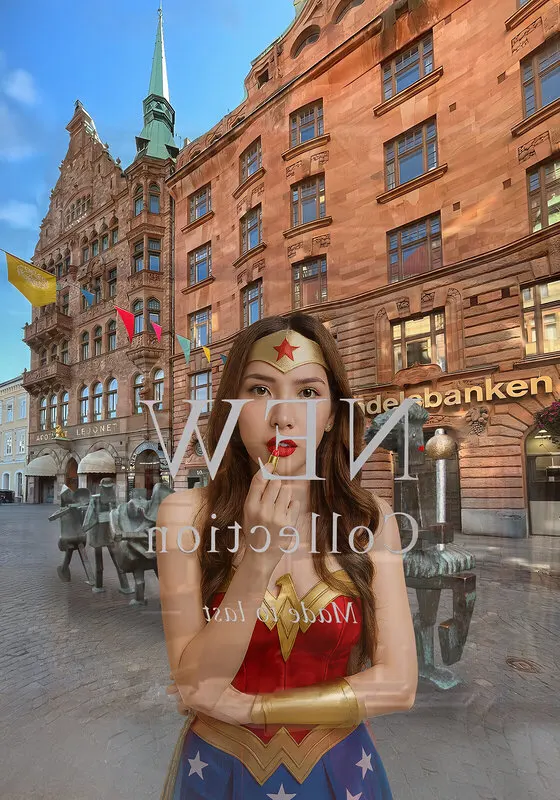
Doing Her Lips, 2025
Digital
50 x 70 cm
3 200 kr
Doing Her Lips
This is not merely a tale of colour. It’s a narrative of power, protest, performance, and the delicate red line between seduction and subversion. Lipstick, with its silent glide across a mouth, serves as a captivating storyteller. It whispers secrets in bathrooms, bellows across barricades, and etches its mark on the collars of emperors and clowns alike.
And sometimes… it bleeds into crime scenes.
Because even the gentlest of acts, like a kiss, can be perilous. Especially when it’s inscribed in lipstick.
Ask the baton-wielding matriarch leading the Optimist Band at Stortorget in Malmö. She never intended to take sides. Yet, someone unexpectedly left a crimson kiss on her cheek. You may call it vandalism, or a signature, or perhaps just another message in the long, bright history of a legacy that stretches from ancient civilisations to modern-day revolutions, where lips refuse to stay silent.
Click the link below to delve into my analysis and accompanying visuals.
https://www.konst.se/jorgen-thornberg
”Lipstick Confession
It wasn’t love, but it left a trace –
a whisper in red on a starch-white place.
Not a letter, not a vow,
just a sigh that said: she knows now.
A collar turned crime scene,
a kiss that couldn’t lie.
He sold her promises at noon,
and wore her silence home at five.
But lips don’t forget.
And rouge remembers.
In every shade of scandal,
and every burn that lingers.
She paints them not to please,
but to declare –
I am the mark you can’t erase.
I am the war you didn’t prepare for.
And Wonder Woman? She needs no looking glass.
The city grants her dozens per pass –
shopfronts, train doors, rearview chrome,
a mirror in every quarter to call her own.
With every pane she passes by,
she reclaims the gaze, she lifts her chin.
No damsel. No disguise.
Just battle-ready, crimson-grinned.”
Malmö, June 2025
A love story in wax and fire
She doesn't need a mirror; the shopfront glass is sufficient. There she stands, Wonder Woman, framed by the sky-lit glass of an exclusive home furniture shop at the corner of Stortorget, according to me, the best location in town. Behind her, the merry musicians play on. Malmö’s bronze quartet, ’Optimistorkestern’ (The Optimist Band), is eternally mid-tune, where Södergatan exhales into the square. She raises the lipstick like a relic, a ritual gesture echoed through time.
Women once leaned over onyx bowls filled with water, where dark stone and sunlight merged into mirrors. Others smeared red across their mouths by riverbanks, using only the shimmer of still water. And now, under the gaze of marble lions and blind vitrines, she does what they did: she readies her mouth like a weapon, like a memory, steeped in the rich historical context of femininity.
Not to kiss, not yet, but to meet the world, painted, precise, and gloriously composed, exuding a powerful beauty that commands attention and respect.
If you look closely at the sculpture group, you’ll notice that one of the figures-the one farthest to the left as you descend Södergatan—carries herself like an exaggerated drum major, though without the baton. She stands wide-legged, cheerfully tilted forward, chin raised, hips pushed ahead as if she’s about to burst into a solo—or command an entire regiment to march in rhythm.
The figure is androgynous, but within the context of this image, the statue becomes a “she” in a skirt—a baton-wielding matriarch, a kind of parodic forerunner to Wonder Woman. A bronze figure that’s stood there since 1985, unknowingly backing up our heroine with musical discipline and accidental swagger. And someone-a modern imp, a midnight vandal, a lipstick revolutionary-has left a bright red kiss on the cheek of the drum major herself. What rascals!
It begins, as most enduring obsessions do, in ancient dust and with a flicker of vanity. Lipstick—equal parts ritual, rebellion, seduction, and science—is more than a cosmetic. It’s a cultural artefact, a tangible object that reflects the beliefs, values, and practices of a particular culture or society, smeared across five millennia of human history. Made primarily from waxes and oils, and tinted with anything from crushed gemstones to powdered insects, its allure is as enduring as its palette, captivating generations with its cultural significance.
Lipstick on Your Collar
Not all messages are spoken; some are worn on one's sleeve. A smear of red on a starched collar – the most silent of betrayals, the clearest of clues. Lipstick, with its unique ability to linger where it shouldn’t, doesn’t just vanish into kisses; it remains. On coffee cups, on cigarette butts, on skin. And, yes – on shirts. It's a silent communicator, a powerful storyteller.
In mid-century love songs and gossip columns, lipstick on your collar became shorthand for infidelity. A mark of guilt, or at least suspicion, it told stories better left untold. Connie Francis sang about it in 1959:
“Lipstick on your collar / told a tale on you…”
The line was catchy, and the warning was clear.
No wonder lipstick became both a weapon and a witness, a forensic flash of colour that didn’t just decorate – it testified. It's a silent witness, a vibrant flash of colour that speaks volumes.
And who could forget Mad Men? In the smoke-filled offices of 1960s Madison Avenue, lipstick wasn't just a product – it was a strategy, a trap, a ticking clock on a crumbling marriage. More than once, Don Draper returned home with a faint red smear betraying more than he cared to explain, and more than once, Betty noticed.
In one early episode, a single kiss mark on a collar – almost invisible – says everything. It's not just makeup; it's evidence. In a world built on polished surfaces, lipstick becomes the crack —the imperfection that reveals the truth beneath the façade.
What Mad Men understood so well was this: lipstick can sell a dream, a vision of beauty and allure, but it can also reveal the lie underneath-the deceit and betrayal that often accompany such visions.
But what a kiss it is. But let’s go back in time and see how it all started.
From Cleopatra’s carmine-smeared lips to Taylor Swift’s signature scarlet pout, this humble wax stick has been everything from status symbol to scandal. It has sparked desires, outraged puritans, provoked lawmakers, and launched a thousand shades of controversy. Red lips don’t whisper—they declare power and rebellion, inspiring and empowering those who wear them. They are not just a cosmetic, but a statement of strength and defiance —a transformative power that has resonated throughout history, inspiring us with its evolution.
The birth of colour: ancient beginnings
It was the Sumerians who, five thousand years ago, first thought to crush gemstones—not to decorate palaces, but to adorn their faces. Men and women alike painted their lips and eyes, leaving the earliest archaeological traces of beauty as ritual. The ancient origins of lipstick's history are both enlightening and intriguing, revealing its deep roots in human culture.
Meanwhile, in Egypt, where cosmetics were religion-adjacent, Cleopatra crushed cochineal bugs to produce a crimson worthy of royalty. But it came with a price—some red dyes contained bromine, mannite, and iodine, a combination that painted lips but poisoned slowly. In this world, lipstick wasn’t gendered; it was a badge of power, a symbol or token that signifies a person's status or authority. The shimmer some Egyptians preferred came courtesy of fish scales—mother-of-pearl from the Nile, glinting in the sun like a flirtation. This 'badge of power' was not just a symbol of status, but also a means of self-expression and identity in a society where appearance was highly valued, a role that has shaped its historical evolution and our understanding of it.
China, always ahead of the curve, introduced beeswax-based lipsticks a millennium ago, not merely for beauty but for protection. During the Tang dynasty (618–907 CE), perfumed oils transformed lipstick into something more than mere adornment—it became a rich sensory experience. The oils were meticulously selected and blended to create a unique fragrance that enhanced the wearer's experience. In Australia, Aboriginal girls painted their lips red with ochre to signify puberty, highlighting that lips speak even when silent.
If ancient women painted their lips by the light of temple fires and in bronze mirrors, then European nobility transformed rouge into spectacle. In Elizabethan England, makeup was more than mere vanity—it was a strategy. During the reign of Queen Elizabeth I, bright red lips and chalk-white skin weren’t just fashionable; they were armour. With a face powdered in ceruse, a blend of white lead and vinegar, and lips tinted with beeswax and plant-based dyes, the Virgin Queen crafted an image that hovered between sacred icon and spectral monarch. She wasn’t merely a ruler—she was a painting in motion, untouchable, eternally composed. Her courage to use makeup as a strategic tool is genuinely inspiring.
However, this theatrical command of appearance was reserved for the few. For centuries, makeup in Europe was either associated with the court or considered a shameful practice. There was no respectable middle ground. Cosmetics were worn by aristocrats, by actors, and by those who sold more than theatre tickets. A decent woman, particularly in Victorian Britain, might have had a discreet rouge pot tucked away in a drawer, but she would never be seen applying it in daylight. Lipstick was an offence to decency. A smear of colour was a smear on one’s reputation.
Yet, in Paris, where scandal and elegance have always danced in step, something began to stir. Around 1870, Maison Guerlain, a pioneering beauty house, began experimenting with solid lip colour, wrapping it in silk paper, much like a confection. Its ingredients included deer tallow, castor oil, and beeswax. It was not yet mainstream, but it existed. The breakthrough, according to legend, came from a chance encounter: a Guerlain employee passed by a candlemaker’s shop and noticed the wax, the pigments, the glimmer of potential. Inspiration struck. If candles could be coloured and solid, why not cosmetics? By 1884, Guerlain had begun manufacturing lipstick on a larger scale, and for the first time, women could purchase their pout in portable, premade form. This innovation by Maison Guerlain marked a significant shift in the beauty industry, making lipstick more accessible and changing the way women approached cosmetics.
Sarah Bernhardt, the actress who made tragedy a lifestyle, helped move lipstick from backstage to the boulevard. She didn’t wait for privacy. She applied her lipstick in public, in carriages, on park benches, without apology. Her bold use of carmine, extracted from crushed cochineal insects, shocked the conservative and thrilled the curious. At the time, lipstick was available in paper tubes or small pots and applied with a brush. Bernhardt did it with panache. She made lipstick perform.
By the 1890s, carmine was being mixed with wax and oil, resulting in a more natural-looking sheen for the lips. The effect was softer, more wearable, and crucially, more acceptable. Lipsticks were no longer confined to actresses. They began to appear in shops. The Sears Roebuck catalogue in America started selling rouge for both lips and cheeks by the end of that decade. This marked a significant shift, liberating women and empowering them to express themselves more freely.
In 1915, Maurice Levy designed a metal push-up tube with a tiny side lever. Women could now slide the colour upward with a flick of the fingernail. That little mechanical flourish changed everything. Lipstick was suddenly not just usable, but portable and elegant. Applying it became a ritual of control. By 1923, in Nashville, Tennessee, James Bruce Mason Jr. patented the first swivel-up tube, the kind we still recognise today. This design not only made lipstick more convenient but also added a touch of luxury to its use.
As lipstick entered its golden age, especially in America, it no longer whispered from the shadows. It spoke plainly. Women wore it to work, to lunch, to the cinema. They applied it in public with increasing ease. But constantly, beneath the fashion, something deeper stirred—lipstick was still a message. A painted mouth said, I am here. I am not ashamed. I will be seen.
By 1921, respectable London women could finally stroll down Oxford Street with painted lips without being mistaken for fallen angels. Something had shifted. The First World War had unsettled the entire moral fabric of Edwardian society. Women had entered factories, driven ambulances, buried the dead, and read the headlines. In doing so, they had earned not only the vote but also a new relationship with visibility. And lipstick—portable, potent, defiantly unnecessary—was part of this new visibility.
London salons, such as Selfridges, began to display lipstick as a legitimate purchase, no longer something to be requested in a whisper behind the counter. A woman could now buy a tube of colour and carry it in her handbag like a key, like a cigarette case, like something private yet performative. The act of applying lipstick in public still raised some eyebrows, but it no longer prompted a call to the police. It had moved from taboo to trend.
Meanwhile, in Paris, things were already further along. Lipstick wasn’t just tolerated—it was woven into the couture of the city itself. French women wore red not as a symbol of rebellion, but as a routine. Fashion houses aligned with cosmetic firms, and women stepping out of Chanel or Lanvin might very well do so with a carefully coordinated lip. Beauty in Paris was both business and pleasure. And red—always red—remained the anchor—bold, classic, unapologetic.
Yet lipstick in both cities still retained an edge. It was never just about colour; it was code. In London, a bright lip could signal everything from social aspiration to quiet defiance, while in Paris, it was a mix of charm and calculation. The mouth was the first gesture, the unspoken message, and that message was evolving.
There were, of course, women who still whispered about it in private, who wiped it off before dinner, and concealed their tubes in coat pockets like guilty pleasures. But there were also women—young, working, widowed, bold—who began to wear it as a statement. Not loud, just certain. The war had shifted what women understood they could endure; a little carmine no longer felt dangerous.
But even before lipstick became fashionable in broad daylight, it had already taken on political significance. In both London and Paris, the suffragette movements were gaining momentum, and some women, quite intentionally, reached for red. Not for vanity, but for provocation. In the early 1900s, British suffragettes began to recognise the power of image—how a single detail, a gesture, or a mouth could disrupt.
Elizabeth Arden, the American cosmetics pioneer, is said to have handed out tubes of red lipstick to suffragettes marching down Fifth Avenue in New York in 1912. Whether apocryphal or not, the story captures something genuine: lipstick as a form of resistance. In London, too, suffragettes learned to use appearance strategically. A bold red mouth beneath a suffrage sash was not an accident. It was a declaration. “I am not your ornament. I am not your angel in the house. I am painted—and I vote.”
Lipstick was wielded to unsettle the codes of femininity. Where makeup had once marked the actress or the courtesan, it now found itself in the hands of women who chained themselves to railings, smashed windows, and endured force-feeding. The scarlet lip, once associated with sin, now smouldered with defiance. A face in red could no longer be easily categorised. It could be dangerous. It could be political. It could demand change.
For women marching through smoke-blackened streets, through jeers and police barricades, lipstick was armour. Small. Vivid. Rebellious. It made the lips not just visible but unignorable. And it turned the very act of being seen into a form of protest.
So yes, by the early 1920s, London had softened. Paris had already shrugged. But neither city had arrived at painted lips through fashion alone. The colour came smeared with meaning, carried forward by women who refused to remain silent—and who knew precisely what a well-aimed mouth could achieve.
In America, the 1920s opened like a shaken bottle of champagne—bubbly, volatile, irrepressible. The war was over, the corset was dead, and the flapper was born. She smoked. She drank. She bobbed her hair. And she painted her lips in a Cupid’s bow so sharp it could slice the past in half.
Inspired by silent film stars like Clara Bow, the "It Girl" of the decade, women began shaping their lips into tiny, exaggerated hearts. This look suggested both innocence and provocation. It wasn’t just a style; it was an attitude. Red lipstick was no longer something to be hidden or whispered about. It was worn boldly, almost cartoonishly, as a badge of rebellion. A well-defined mouth was the new headline.
Lipstick became part of the performance of modern womanhood. It was sold in chemists, displayed in department store windows, and carried in shiny metal tubes engraved with floral motifs. No longer just the accessory of actresses, it was now found in the handbags of stenographers, shop girls, telephone operators—women who worked, danced, flirted, and refused to apologise.
The rules had changed. In earlier decades, applying lipstick in public would have branded a woman as vulgar. But now? It was a flourish—a gesture. Women pulled out compacts in cafés, dabbed at their lips during lunch, and reapplied in taxi cabs and theatre queues. It was theatre—but it was also ownership.
Of course, not everyone was amused. Newspapers warned that painted lips were a sign of moral decay. Mothers scolded daughters. Preachers gave sermons. But lipstick, once it had left the boudoir, never quite went back. It was now part of the face the modern woman showed to the world.
In truth, the flapper didn’t invent red lipstick. But she gave it a new job description. It was no longer only seductive, no longer simply defiant. It was ironic. Joyous. Flirtatious with a hint of mockery. A red mouth could say: I’m serious, or I’m playing—or both.
And always, always, it said: I chose this.
As the 1930s dawned, lipstick, still predominantly red, found itself at the centre of a societal struggle. The Great Depression cast a sombre shadow over the once-vibrant nightlife. While some women continued to paint their lips as a symbol of defiance, society's whispers about decency grew louder. Teenage girls who admired the flapper’s discarded lipstick were swiftly corrected—now, a painted mouth no longer symbolised liberation, but hinted at questionable morality.
Newspaper columns and etiquette books warned that cosmetics could destroy a girl’s future. Lipstick became associated with poor judgment and a lack of respectability. Parents, especially in the United States, viewed it as a moral threat. A 1937 survey revealed that over half of American teenage girls had argued with their parents over lipstick. For many young women, the tube itself became a battlefield between childhood and adulthood, obedience and autonomy.
Simultaneously, cosmetic companies began to grasp a crucial insight: the lipstick palette needed to expand. Elizabeth Arden led the way with the introduction of new shades—coral, pink, raspberry, and burgundy—transforming lipstick from a mere symbol of femininity into a reflection of personality. Suddenly, there was a colour for every woman, every mood, every season. Rouge was no longer just red—it was uniquely yours.
And yet, the adult world tried to reassert control. Teenage magazines and self-help books warned girls not to look too “painted”—men, it was claimed, preferred natural beauty. Too much makeup could scare away a husband, close career doors, and brand you as “that kind of girl.” Lipstick was no longer just forbidden—it was dangerous.
Despite societal norms, the tubes continued to sell. In bathrooms and school corridors, in workplaces and powder rooms, the quiet struggle persisted. Girls began to opt for softer shades—light pink, peach, lavender—not because they preferred them, but because they could conform. Red was for adults. Red was for women who knew what they wanted. This resilience in the face of societal pressures, this determination to express themselves despite the odds, is genuinely inspiring.
However, the real breakthrough—the remarkable renaissance of the red lip—would come shortly after, carried by a few names Hollywood would never forget. The role of Hollywood in redefining beauty standards and shaping the cultural evolution of lipstick is a fascinating aspect that piques our curiosity and invites us to delve deeper.
During the Second World War, a tube of lipstick carried a weight of symbolic value that rivalled a rifle. As the world turned grey and uniforms replaced evening gowns, red lipstick emerged as a poignant reminder of humanity, identity, and something to cling to amidst the chaos.
In factories, where women stepped into men’s roles and greased gears instead of lips, makeup became a form of resistance. The British government encouraged women to continue wearing cosmetics to maintain morale. “Beauty is your duty,” declared the posters. In the United States, special lipstick shades were even developed for women in uniform, such as Elizabeth Arden’s “Victory Red,” created in collaboration with the U.S. military.
There were practical problems, of course. Metal tubes were substituted with paper and plastic. Ingredients like petroleum and castor oil became difficult to obtain. Lipstick grew scarce, but it wasn’t abandoned. It was no accident that women recruited into scientific and technical roles continued to paint their lips, not to please men, but to remind themselves of who they were before the world had been upended.
In the harvest of postwar peace, as the light returned, two names stepped out of the cinema’s shadows and directly into the history of cosmetics: Marilyn Monroe and Elizabeth Taylor. They didn’t simply wear lipstick—they defined it. Monroe with her impossibly precise Cupid’s bow, always glossy, always inviting. Taylor, with her dramatic features, her diamond eyes, and her wine-red mouth like a verdict. They were the new generals of beauty. Red lips had transitioned from protest to icon, a powerful testament to the transformative power of time and culture.
A 1951 survey showed that two-thirds of American teenage girls now wore lipstick. It had shifted from something to hide to something to begin with. From sin to standard. And while advertising teased with slogans like “stays on you… not on him,” it was chemist Hazel Bishop who made it real—she invented the first long-lasting, kiss-proof lipstick.
By the 1950s, lipstick was no longer merely an accessory. It had become an alphabet. And every woman chose her spelling.
When the 1960s arrived, it was as though someone had turned down the saturation. After the sensual reds and Hollywood glamour of the ’50s, a new aesthetic crept in through teenage bedrooms and girl group idols—pale, powdered, pastel. White lipstick—first a sheer layer over pink, then pure opaque white—became a key trend among young women keen to show they were not their mothers.
Pop groups like The Ronettes and The Shirelles popularised the look in the mainstream with their matching dresses, thick eyeliner, and lips so pale that they seemed to erase the mouth rather than emphasise it. Parents sighed—first at the red, then at the white. But young women had discovered something: makeup could be just as much a statement in silence as in shouting. A bleached smile signified, “I’m not here to please you.” This was a direct response to societal norms and expectations that dictated women's appearance and behaviour in the 1960s, a powerful symbol of rebellion and empowerment.
And then came the colours: pink, lavender, peach. Sometimes even green or blue for the bold. Revlon launched “Conga Lime,” a frosted lime green lipstick, and Biba followed with “Metallic Grandma”,—a glittering navy blue that glowed like a spaceship under nightclub lights. It was play, it was art, it was rebellion in a tube.
But the ’60s carried fear, too. Articles whispered that women who didn’t wear lipstick might be unstable—or worse, lesbians. Once again, the painted mouth became a norm to adhere to—either to blend in or to mark oneself as deliberately outside.
Beneath it all simmered contradictions: be natural, but made-up. Be wild, but respectable. Be young, but not promiscuous. Lipstick stood at the crossroads. To some, it was a playful accessory. To others, it was a dangerous sign, a symbol of defiance and independence that challenged the societal norms of the time.
And it was far from over. In the next decade, colours would darken again. A new kind of quiet rage settled in the shape of the lips. And it would be called black.
In the twilight of the 1970s, lipstick crept into other rooms. The glossy pastels and flirty frosts of the previous decade faded. Darkness entered instead: the sharp black of punk, the theatrical sorrow of goth, the shimmering overstatement of glam rock. Once again, lipstick changed sides—from accessory to weapon. In these subcultures, lipstick was not just a cosmetic but a symbol of rebellion and individuality.
Black lipstick became a signal, not of seduction, but of distance. It didn’t say “come closer”; it said “stay away, or prepare to meet my inner storm.” In horror films, especially those centred on women, actresses began to wear black or deep plum lipstick. It carried a charge of danger, of something uncontainable. What was once a symbol of flirtation was now associated with transgression, fury, and sexuality that refused to perform for others. These historical references to lipstick in crime and literature add a layer of intrigue to its symbolism.
Alongside the darkness, colour exploded in rainbows, metallics, and neon. In Japan, Kanebo released an iridescent light blue lipstick. In London, Biba’s glittering black-blue was available for those who dared. Was it fashion? Yes. But it was also something more: a refusal to make the mouth beautiful to make it powerful, a rejection of the traditional beauty standards that equated beauty with attractiveness and instead, an assertion of beauty as a form of self-expression and empowerment.
By the time the 1980s arrived, dancing across a mirror-slick surface of synthpop and shoulder pads, lipstick returned in both extremity and irony. It reappeared as “mood lipstick”—colour-shifting products that claimed to reflect your emotional state through body chemistry. This trend marked a significant intersection of technology and beauty in the evolution of lipstick.
What had once been a child’s toy was now being marketed to grown women. Lipstick could be blue when you woke up, pink on your commute, and plum for after work—all from the same tube. Brands like Smashbox and Stila began experimenting with the same pH-reactive technology in glosses and blushes. The consumer became a chemist in her bathroom.
But perhaps the most defining feature of the ’80s was the turn toward brown. Shows like Friends and other pop culture landmarks set the tone: lipstick became earthy, rusty, muted—almost anonymous. It was still there, but it whispered instead of shouting. This shift towards brown lipstick in the '80s was a significant departure from the bold and vibrant colors of the previous decades. It reflected a cultural shift towards a more understated and natural beauty aesthetic, evoking a sense of nostalgia and connection to the past.
It was Madonna who brought red back. First, through a collaboration with MAC Cosmetics, the now-iconic shade “Russian Red” quickly became a bestseller, and later with Make Up For Ever’s “Iconic Red” for her MDNA tour. But her red wasn’t Marilyn’s. It was sharp-edged, decisive, and uncompromising. It wasn’t there to look pretty. It was there to rule the stage, to command an empire.
In the 1990s, lipstick took on an almost enchanted quality. It shimmered with pearl and light reflection, yet it was also a decade of paradox. While trends leaned toward the “natural,” beauty standards grew harsher. Everything had to look effortless, but required microscopic control. Lipstick played a pivotal role in this evolution of beauty standards, reflecting and shaping the cultural narrative. It was a tool for women to navigate the paradox of the '90s beauty standards, providing a means to achieve the desired 'effortless' look while demanding a grown woman's discipline.
The market exploded with glosses, lip shimmers, and so-called plumpers promising fuller lips in seconds. These were lipsticks that said nothing at all—and yet somehow whispered: you’re alive, as long as you look like it.
It was also a decade when the concept of “natural beauty” began to morph into the illusion of perfection. Nude tones ruled the catwalk and television, while other women began reclaiming colour, not as decoration, but as confirmation of strength, self-awareness, and space. Red lipstick returned—not as flirtation, but as force. It was a choice, not an accident—a mark, not an echo.
At the same time, technology was undergoing a shift. Liquid lipstick began to conquer bathroom shelves. It was colour in motion, a formula that carried itself. Infused with silicones, oils, and pigments, it coated the lips like a painting rather than an ornament. It didn’t smudge. It stayed. For many, liquid lipstick became a kind of practical poetry—a tool for women in motion, in negotiation, in constant translation between roles.
When the millennium arrived, things became even more layered. The influence of digital culture coincided with a renewed reverence for classic beauty ideals. Collections launched with names like “Neon Velvet” and “Cyber Red”—nods to a dual hunger for the future and nostalgia. Natural and vegan alternatives took over the shelves, but amid this biological purity, the red lip remained resolute, eternal.
And then came the pandemic—a global rehearsal in silence and facelessness. With masks over mouths, lipstick lost its most visible terrain—the public sphere. It became a secret, a quiet act. Something was done anyway, even if no one could see it. For some, it was a gesture of self-respect. For others, a dormant ritual. The pandemic has redefined the role of lipstick, turning it into a personal statement of self-respect and a means of maintaining personal rituals in a time of global upheaval. And there, in the masked hush, perhaps a new aesthetic was born: colour worn for its own sake—an expression not for others’ eyes, but for the mirror of the self.
Today, lipstick is no longer just one choice among others. It is an act of empowerment. In a world where women no longer accept beauty as something defined from the outside, lipstick has become both a tool and a means of empowerment. A way to speak rather than be seen. Every red or deep pink mouth doesn’t just say “I’m here”—it says “I decide.”
And every time someone strikes colour across their lips, it may not be to be beautiful in anyone else’s eyes. Perhaps it is a way of saying, 'I am my mirror.' And I refuse to be silent. Lipstick is a tool of self-expression, a way to assert one's individuality and refuse to conform.
And the future? It’s neither red nor pink—it’s kaleidoscopic. Lipstick has shed its past association with being a female-only accessory. It no longer belongs solely to her—it belongs to anyone who has something to say with their mouth. In queer cultures, among drag performers, trans individuals, non-binary expressions, and new masculinities, lipstick has become a tool for transformation, for play, for revenge—a way to conceal and reveal at once.
The red mouth, once a symbol of sin and seduction, is now also a symbol of belonging. For Pride parades. For young queer individuals applying lipstick in the bathroom before stepping out into the world. For men who wear colour without smiling. For women who smile without apology.
In an age where AI filters our faces and apps can apply lipstick for us, the physical act of using real lipstick carries new weight. It's no longer a given to apply makeup "for real." Which is why the gesture becomes more meaningful than ever. To use colour on your own body—with your hand, with feeling, with control—is an act of presence—a bodily signature in a digital world.
And while the market expands with holographic pigments, microbiological formulas, and shades coded to our DNA, one thing remains unchanged: lipstick’s nearness to the desire to express. It’s not always a shout. Sometimes it’s a whisper. Sometimes a promise. Sometimes a curse. But always a voice.
So what do the lips of the future say? Perhaps they say: I’m not here to please—I’m here to be understood.
Or: I’m beautiful, but that’s my problem, not yours. Or: I’m here. Silence is not my language.
Because every time a lipstick is twisted up, no matter the shade, the lips, or the room, it begins a message. A statement. A manifesto.
And in that moment, colour stops being surface. It becomes a story. Yours.
Lipstick and Crime
Consider the power of a cyanide kiss. Lipstick, a seemingly innocuous cosmetic, has inspired titles in both literature and film. One such example is the 1976 thriller ‘Lipstick’, featuring Margaux Hemingway. This brutal narrative transforms the lipstick on a model’s face into a haunting symbol, a sign of violated power. While the film may not have achieved classic status, its thematic resonance with the #MeToo movement —a contemporary social revolution —is a testament to the lasting power of its symbolism.
In literature, titles like ‘The Lipstick Murders: A Faye-Lynn Johnson Mystery’ present killers who leave traces of lipstick at crime scenes or on their victims, turning a beauty product into a chilling signature of violence. The cultural impact of lipstick in crime literature offers a fascinating exploration of the power of symbolism.
But the most chilling real-life case is arguably that of William Heirens, infamously known as “The Lipstick Killer.” In 1945, after murdering a young woman named Frances Brown in Chicago, he left a desperate message on her apartment wall—scrawled in red lipstick: “For heaven’s sake, catch me before I kill more—I cannot control myself.” At the time of his death, Heirens was reportedly Illinois’ longest-serving prisoner, having spent 65 years behind bars.
The media frenzy that followed turned lipstick into a symbol of terror. His story loosely inspired the 1956 film noir ‘While the City Sleeps’, where lipstick becomes a haunting motif echoing the real-life crime.
There’s no widely documented case of someone poisoning others via lipstick—cyanide or any other deadly toxin in the lipstick itself remains a fictional fantasy. But the idea has haunted thrillers and urban legends, often with ironic twists where the poison returns to the sender.
Still, makeup has indeed been weaponised in other, more sinister ways, a fact that may surprise many:
In the 17th century, Italian poisoner Giulia Tofana distributed ‘Aqua Tofana’, a deadly cosmetic-like liquid (said to contain arsenic, lead, and belladonna) to women seeking to eliminate abusive husbands, often disguised as perfume or face lotion.
In fiction and rumour, the “poisoned lipstick” is a recurring trope. Even Catherine de Medici was rumoured to have sent a deadly lipstick to one of Henry III’s lovers, though historians believe that tale belongs more to legend than fact.
While the cyanide-laced lipstick remains mostly myth, the use of cosmetics as weapons, both metaphorically and literally, is deeply rooted in history. The use of lipstick, often with tragic irony for both victim and perpetrator, serves as a stark reminder of the power of symbolism —a reality that cannot be overlooked.
3 200 kr

Jörgen Thornberg
Malmö
Lite om bilder och mig. Translation in English at the end.
Jag är en nyfiken person som ser allt i bilder, även det jag fäster i ord, gärna tillsammans för bakom alla mina bilder finns en berättelse. Till vissa bilder hör en kortare eller längre novell som följer med bilden.
Bilder berättar historier. Jag omges av naturlig skönhet, intressanta människor och historia var jag än går. Jag använder min kamera för att dokumentera världen och blanda det jag ser med vad jag känner för att fånga den dolda magin.
Mina bilder berättar mina historier. Genom mina bilder, tryck och berättelser. Jag bjuder in dig att ta del av dessa berättelser, in i ditt liv och hem och dela min mycket personliga syn på vår värld. Mer än vad ögat ser. Jag tänker i bilder, drömmer och skriver och pratar om dem; följaktligen måste jag också skapa bilder. De blir vad jag ser, inte nödvändigtvis begränsade till verkligheten. Det finns en bild runt varje hörn. Jag hoppas att du kommer att se vad jag såg och gilla det.
Jag är också en skrivande person och till många bilder hör en kortare eller längre essay. Den följer med tavlan, tryckt på fint papper och med en personlig hälsning från mig.
Flertalet bilder startar sin resa i min kamera. Enkelt förklarat beskriver jag bilden jag ser i mitt inre, upplevd eller fantiserad. Bilden uppstår inom mig redan innan jag fått okularet till ögat. På bråkdelen av ett ögonblick ser jag vad jag vill ha och vad som kan göras med bilden. Här skall jag stoppa in en giraff, stålmannen, Titanic eller vad det är min fantasi finner ut. Ännu märkligare är att jag kommer ihåg minnesbilden långt efteråt när det blir tid att skapa verket. Om jag lyckas eller inte, är upp till betraktaren, oftast präglat av en stråk av svart humor – meningen är att man skall bli underhållen. Mina bilder blir ofta en snackis där de hänger.
Jag föredrar bilder som förmedlar ett budskap i flera lager. Vid första anblicken fylld av feel-good, en vacker utsikt, fint väder, solen skiner, blommor på ängen eller vattnet som ligger förrädiskt spegelblankt. I en sådan bild kan jag gömma min egentliga berättelse, mitt förakt för förtryckare och våldsverkare, rasister och fördomsfulla människor - ett gärna återkommande motiv mer eller mindre dolt i det vackra motivet. Jag försöker förena dem i ett gemensamt narrativ.
Bild och formgivning har löpt som en röd tråd genom livet. Fotokonst känns som en värdig final som jag gärna delar med mig.
Min genre är vid som framgår av mina bilder, temat en blandning av pop- och gatukonst i kollage som kan bestå av hundratals lager. Vissa bilder kan ta veckor, andra någon dag innan det är dags att överlämna resultatet till printverkstaden. Fine Art Prints är digitala fotocollage. I dessa kollage sker rivandet, klippandet, pusslandet, målandet, ritandet och sprayningen digitalt. Det jag monterar in kan vara hundratals år gamla bilder som jag omsorgsfullt frilägger så att de ser ut att vara en del av tavlan men också bilder skapade av mig själv efter min egen fantasi. Därefter besöks printstudion och för vissa bilder numrera en limiterad upplaga (oftast 7 exemplar) och signera för hand. Vissa bilder kan köpas i olika format. Det är bara att fråga efter vilka. Gillar man en bild som är 70x100 men inte har plats på väggen, går den kanske att få i 50x70 cm istället. Frågan är fri.
Metoden Giclée eller Fine Art Print som det också kallas är det moderna sättet för framställning av grafisk konst. Villkoret för denna typ av utskrifter är att en högkvalitativ storformatskrivare används med åldersbeständigt färgpigment och konstnärspapper eller i förekommande fall på duk. Pappret som används möter de krav på livslängd som ställs av museer och gallerier. Normalt säljer jag mina bilder oinramade så att den nya ägaren själv kan bestämma hur de skall se ut, med eller utan passepartout färg på ram, med eller utan glas etc..
Under många år ställde jag bara ut på nätet, i valda grupper och på min egen Facebooksida - https://www.facebook.com/jorgen.thornberg.9
Jag finns också på en egen hemsida som tyvärr inte alltid är uppdaterad – https://www.jth.life/ Där kan du också läsa en del av de berättelser som följer med bilden.
UTSTÄLLNINGAR
Luftkastellet, oktober 2022
Konst i Lund, november 2022
Luftkastellet, mars 2023
Engleson Galleri Caroli, april 2023
Hydra, Greece June 2023
Engleson Galleri Caroli, oktober 2023
Toppen, Höllviken december 2023
Luftkastellet, mars 2024
Torups Galleri, mars 2024
Venice, May 2024
Luftkastellet, oktober 2024
Konst i Advent, December 2024
Galleri Engleson, Caroli December 2024
Jäger & Jansson Galleri, april 2025
A bit about pictures and me.
I'm a curious person who sees everything in pictures, even what I express in words, often combining them, for behind all my pictures lies a story. These narratives, some as short as a single image and others as long as a novel, are the heart and soul of my work.
Pictures tell stories. Wherever I go, I'm surrounded by natural beauty, exciting people, and history. I use my camera to document the world and blend what I see with what I feel to capture the hidden magic.
My images tell my stories. Through my pictures, prints, and narratives, I invite you to partake in these stories in your life and home and share my deeply personal perspective of our world. More than meets the eye. I think in pictures, dream, write, and talk about them; consequently, I must create images too. They become what I see, not necessarily confined to reality. There's a picture around every corner. I hope you'll see what I saw and enjoy it.
I'm also a writer, and many images come with a shorter or longer essay. It accompanies the painting, printed on fine paper with my personal greeting.
Many pictures start their journey on my camera. Simply put, I describe the image I see in my mind, experienced or imagined. The image arises within me even before I bring the eyepiece to my eye. In a fraction of a moment, I see what I want and what can be done with the picture. Here, I'll insert a giraffe, Superman, the Titanic, or whatever my imagination conjures up. Even stranger is that I remember the mental image long after it's time to create the work. Whether I succeed is up to the observer, often imbued with a streak of black humour – the aim is to entertain. My pictures usually become a talking point wherever they hang.
I prefer pictures that convey a message in multiple layers. At first glance, they're filled with feel-good vibes, a beautiful view, lovely weather, the sun shining, flowers in the meadow, or the water lying deceptively calm. But beneath this surface beauty, I often conceal a deeper story, a narrative that challenges societal norms or explores the human condition. I invite you to delve into these hidden narratives and discover the layers of meaning within my work.
Picture and design have been a thread running through my life. Photographic art feels like a fitting finale, and I'm happy to share it.
My genre is varied, as seen in my pictures; the theme is a blend of pop and street art in collages that can consist of hundreds of layers. Some images can take weeks, others just a day before it's time to hand over the result to the print workshop. Fine Art Prints are digital photo collages. In these collages, tearing, cutting, puzzling, painting, drawing, and spraying happen digitally. What I insert can be images hundreds of years old that I carefully extract so they appear to be part of the painting, but also images created by myself, now also generated from my imagination. Next, visit the print studio and, for certain images, number a limited edition (usually 7 copies) and sign them by hand. Some images may be available in other formats. Just ask which ones. If you like an image that's 70x100 but doesn't have space on the wall, you might be able to get it in 50x70 cm instead. The question is open.
The Giclée method, or Fine Art Print as it's also called, is the modern way of producing graphic art. This method ensures the highest quality and longevity of the artwork, using a high-quality large-format printer with archival pigment inks and artist paper or, in some cases, canvas. The paper used meets the longevity requirements set by museums and galleries. I sell my pictures unframed, allowing the new owner to personalise their artwork, confident in the lasting value and quality of the piece.
For many years, I only exhibited online, in selected groups, and on my Facebook page - https://www.facebook.com/jorgen.thornberg.9. I also have my website, which unfortunately is not constantly updated - https://www.jth.life/. You can also read some of the stories accompanying the pictures there.
EXHIBITIONS
Luftkastellet, October 2022
Art in Lund, November 2022
Luftkastellet, March 2023
Engleson Gallery Caroli, April 2023
Hydra, Greece June 2023
Engleson Gallery Caroli, October 2023
Toppen, Höllviken December 2023
Luftkastellet, March 2024
Torup Gallery, March 2024
Venice, May 2024
UTSTÄLLNINGAR
Luftkastellet, oktober 2022
Konst i Lund, november 2022
Luftkastellet, mars 2023
Engleson Galleri Caroli, april 2023
Hydra, Greece June 2023
Engleson Galleri Caroli, oktober 2023
Toppen, Höllviken december 2023
Luftkastellet, mars 2024
Torups Galleri, mars 2024
Venice, May 2024
Luftkastellet, October 2024
Konst i Advent, December 2024
Galleri Engleson, Caroli December 2024
Jäger & Jansson Galleri, April 2025
Utbildning
Autodidakt
Medlem i konstnärsförening
Öppna Sinnen
Med i konstrunda
Konstrundan i Skåne
Utställningar
Luftkastellet, October 2022
Art in Lund, November 2022
Luftkastellet, March 2023
Engleson Gallery Caroli, April 2023
Hydra, Greece June 2023
Engleson Gallery Caroli, October 2023
Toppen, Höllviken December 2023
Luftkastellet, March 2024
Torup Gallery, March 2024
Venice, May 2024