Vi använder cookies för att ge dig bästa möjliga upplevelse. Välj vilka cookies du tillåter.
Läs mer i vår integritetspolicy
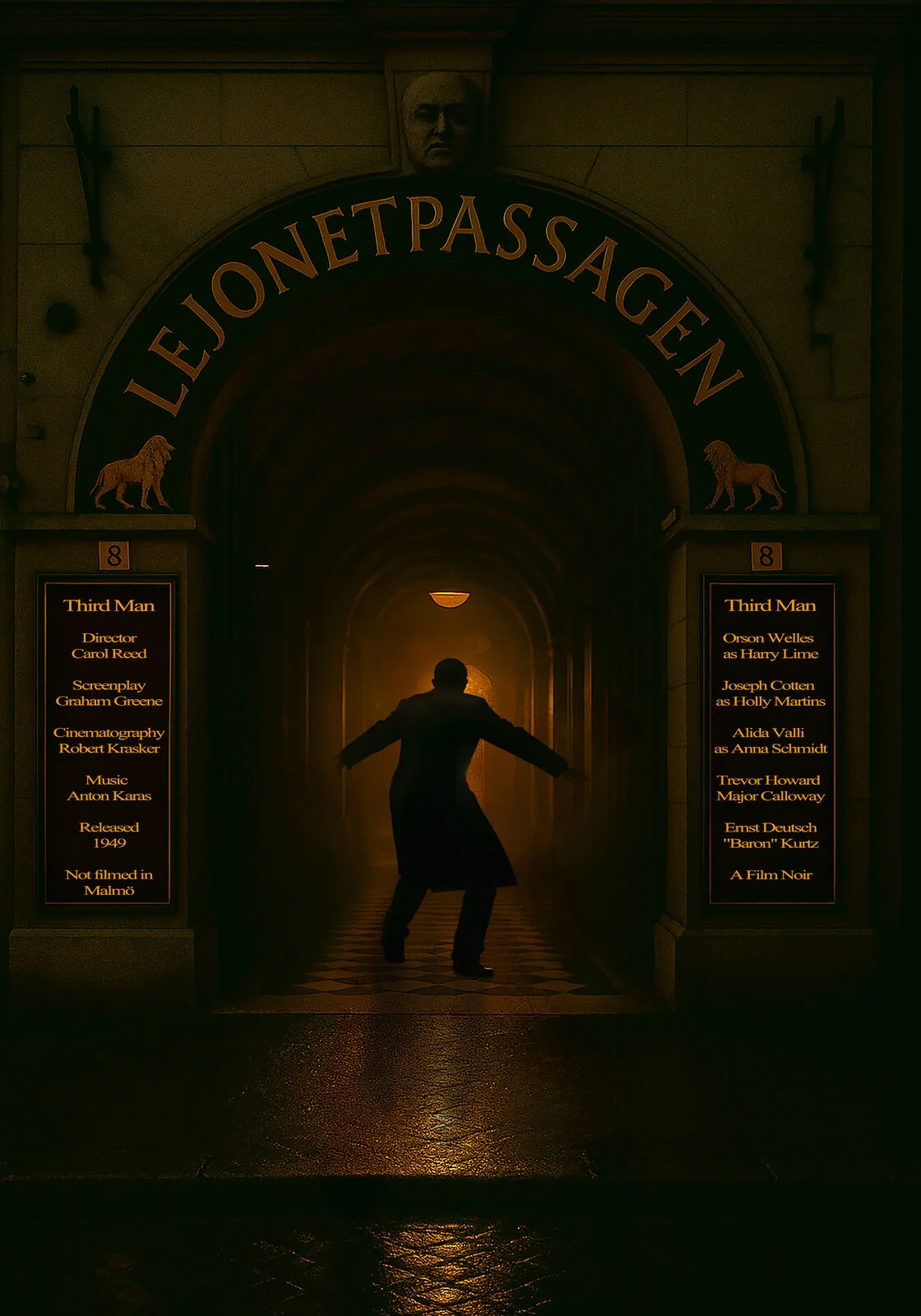
Jörgen Thornberg
The Third Man, 2025
Digital
50 x 70 cm
3 200 kr
The Third Man
This is not merely a film. It is a shadow cast across cobblestones slick with rain, a story told in reflections, absences, and sudden silences. The Third Man (1949), directed by Carol Reed and scripted by Graham Greene, transcends a postwar thriller—it is a profound study in moral erosion, a noir elegy, a city symphony composed in a minor key.
Set in a Vienna divided into zones of occupation and moral ambiguity, the film follows an American writer, Holly Martins, as he stumbles into the mystery of his friend Harry Lime’s death—and eventually, his life. The plot revolves around Holly's investigation into Harry's death, which leads him to discover the darker side of post-war Vienna. But beneath the plot’s surface lies something more profound: the scars of war, the shadow economies that thrive in collapse, and the uneasy marriages between idealism and complicity.
This text does not seek to retell the film. Instead, it traces its movements, its ideas, its textures. From the damp glint of wet cobblestones to the zither’s ironic laughter, from the metaphysics of shadow to the machinery of postwar filmmaking, The Third Man is examined not as a closed narrative but as an open wound—one that continues to seep meaning, a testament to its enduring impact, more than seventy years after the final shot fades.
Let us, then, descend into the sewers of Vienna—not only to chase the phantom of Harry Lime but to understand what he represents. And what we might find, flickering in the dark.
Explore how this classic work, 'The Third Man', continues to resonate with the complexities of our modern lives, bridging the gap between past and present, and inviting us to reflect on the enduring relevance of its themes.
“Harry Lime
a zither in minor key)
He walks like fog beneath a lamp,
a grin carved deep in shadow’s stamp.
A ghost who tiptoes over trust,
with penicillin, thin as dust.
He sells you health, he buys your doubt,
he knows the streets, the ways, the routes.
He plays Vienna like a maze—
a war-torn stage for darker plays.
Not quite a devil, more a dare,
with murder laced in savoir-faire.
He’s charming with poison in the seams,
a nursery rhyme in broken dreams.
He jokes about clocks and brotherhood,
then vanishes beneath the wood.
No creed, no flag, no holy name—
just ticking silence in his frame.
He’s not the man you meet by chance—
He’s consequence in tailored pants.
A myth that flickers, full of flaws—
The third man, slipping through the laws.
And when he runs—oh, how he runs—
beneath the city, past the guns.
His shadow stretches, tall and proud,
but fades at last beneath a shroud.
A bullet sings. The zither dies.
No final prayer. No alibis.
Just sewer water, starlight dim—
and all that’s left is Harry Lime.”
Malmö, June 2025
Echoes in the Rubble
In post-war Vienna, a city divided among four occupying powers and ravaged by corruption and ruin, American pulp novelist Holly Martins arrives to meet his old friend, Harry Lime. However, Lime is dead—killed in a mysterious car accident just days before Holly’s arrival.
As Holly attempts to make sense of Harry’s death, he discovers that the official story doesn’t add up. A porter at Harry’s apartment mentions a 'third man' at the scene of the accident, someone who helped carry Lime’s body but whose identity has been quietly erased. Holly’s curiosity turns into obsession as he is drawn into a dark web of deception, black-market dealings, and postwar desperation. The more he learns, the more he realises the complexity of Harry Lime's character, a man who defies simple labels, and the moral ambiguity and betrayal that underpin his actions, subverting the traditional narrative resolutions and leaving the audience surprised and intrigued.
The British military police, led by Major Calloway, gradually reveal that Harry was not the victim of injustice but a cynical profiteer selling diluted penicillin, resulting in the deaths and maiming of children. Holly is shaken yet still torn, primarily because of his growing affection for Anna, Harry’s lover, who refuses to betray him even in death.
Then comes the twist: Harry Lime is alive. He faked his death with the help of accomplices and now moves like a ghost through the sewers of Vienna. This revelation adds a new layer of complexity to the narrative, as Holly, caught between loyalty to a friend and moral responsibility, must make a difficult choice.
The film reaches its peak in a dramatic chase through the city’s underground canals. Lime is shot and dies for real this time, and Holly, hardened and disillusioned, waits alone in a bitterly iconic closing shot as Anna silently walks past him without a word.
A Pinnacle of Film Noir
The Third Man is widely regarded as one of the finest achievements in the film noir tradition—a genre that blends crime, moral ambiguity, stark lighting contrasts, and a pervasive sense of fatalism. While its roots can be traced back to the hardboiled detective stories of the 1930s and early gangster films, film noir flourished in the 1940s, shaped by the trauma of war and the ensuing disillusionment.
Often shot in black and white, noir films thrived on deep shadows, urban decay, and ambiguous characters. Yet, more than a style, noir represented a state of mind—paranoid, disillusioned, and morally blurred. The traditional Hollywood resolution—order restored, love secured—was frequently subverted or denied altogether, leaving the audience surprised and intrigued by the unexpected twists and turns that followed.
In many of the most iconic noir films, the endings are far from happy. The hero might die (Double Indemnity, Out of the Past), the femme fatale might be destroyed (Gilda, The Postman Always Rings Twice), or the central romance might dissolve into silence and loss. In Casablanca (1942), for instance, Rick and Ilsa do not end up together. The film deliberately leaves their love unresolved, choosing moral duty over personal happiness. This deliberate choice invites the audience to complete the emotional arc themselves, making them feel uniquely involved and connected to the story.
The Third Man occupies this lineage, yet infuses a uniquely European dimension: war-ravaged Vienna replaces the neon-lit streets of Los Angeles, and betrayal is not merely personal but political. The film's setting in post-war Vienna, a city divided among four occupying powers and ravaged by corruption and ruin, serves as a powerful metaphor for the moral and political ambiguities of the time. Alongside The Maltese Falcon (1941), Laura (1944), Casablanca (1942), and The Big Sleep (1946), it stands as a pillar of the genre.
The noir spirit continued into the 1950s with films like The Big Heat (1953) and Touch of Evil (1958), before evolving into neo-noir classics such as Chinatown (1974), Blade Runner (1982), and L.A. Confidential (1997). 'The Third Man' played a significant role in shaping the noir genre, influencing numerous films, including many others. But the essence remained: flawed heroes, elusive truths, and the unsettling knowledge that happy endings are, more often than not, a lie.
The Third Man – Beneath the Plotline
‘The Third Man’ delves beneath its surface narrative to explore a darker current—a layered examination of the world's struggles during the shattered years following World War II. The story unfolds in a fragmented Vienna, divided among the occupying Allied powers, a city where allegiances crackle like broken glass beneath one's feet. This tension is not explicitly stated but subtly seeps through the seams of small encounters: when Anna’s identity papers are seized, or when a weary Austrian landlady hurls accusations at the international police. These scenes are not political speeches—they are symptoms. The city itself is unwell. Bombed. Bitter. Depleted. And, above all, distrustful.
It is into this crumbling landscape that the unsuspecting American pulp writer Holly Martins arrives, dragging behind him his idealism and outdated notions of friendship. He’s come in search of Harry Lime. But Lime is—apparently—dead. When Holly begins to unravel the mystery behind his friend's death, the story sheds its outer shell and becomes something else entirely: a meditation on moral collapse.
Harry Lime, it turns out, has faked his death. He is not only alive but thriving—selling diluted penicillin on the black market, a trade that leaves children brain-damaged and dying. He is not simply a villain in the shadows, but something far more disturbing: a charming, elusive anti-hero. Graham Greene, the screenwriter, admired characters like Pepe le Moko—the French gangster whose charisma masks corruption. But where ‘Pepe le Moko’ keeps its central figure enigmatic, ‘The Third Man’ exposes Lime fully, laying bare his twisted logic.
That logic is given voice in one of cinema’s most chilling monologues, delivered atop the Vienna Ferris wheel. Looking down at the crowd below, Lime muses: “Would you feel any pity if one of those dots stopped moving forever? If I offered you twenty thousand pounds for every dot that stopped, would you really, old man, tell me to keep my money—or would you calculate how many dots you could afford to spare?”
It’s not just callousness. It’s a worldview shaped by war, by a century that had witnessed mass death, mechanised killing, and the disappearance of ethical certainties. Lime embodies the postwar predator: urbane, ironic, untouchable. In the end, Holly chooses to reject this nihilism and kills the man who was once his friend. But even this feels less like redemption than resignation. It’s a hollow victory. The corruption remains. The war has ended, but Vienna—and Holly—are still lost in its aftermath.
That ending—quiet, ambiguous, emotionally unresolved—is pure ‘poetic realism’, more French than British, and certainly far removed from the clean conclusions of Hollywood. Yet the story is only part of what makes ‘The Third Man’ a masterpiece. Its cultural weight also rests in its form: in the cinematography, the sound, and the very texture of its shadows.
The Architecture of Light and Shadow
While ‘The Third Man’ explores the postwar psyche in narrative terms, it is equally a case study in cinematic technique, particularly the visual language of film noir. The film’s Oscar-winning cinematography is as crucial to its meaning as the plot itself. Shot almost entirely on location in Vienna, Reed and cinematographer Robert Krasker crafted an urban labyrinth where shadow becomes character and light becomes motive.
The hallmark of noir lighting—low-key illumination, with stark contrasts and pools of darkness—is everywhere. It doesn’t merely set a mood; it articulates the emotional truth of the scene. In a world where trust is dead and moral clarity has eroded, the lighting doesn’t fill in the blanks—it leaves them. Deep shadows replace exposition. Ambiguity is built into the frame.
One of the most memorable examples is the now-legendary reappearance of Harry Lime. The man we’ve been told is dead steps from the shadows midway through the film. First, we see only his feet, standing in an arched doorway, as a cat brushes against him. Holly, in frustration, shouts into the night, and from a window above, someone flicks on a light. In that instant, the shadows part—and Harry Lime's face appears. Half-amused, half-haunted.
It’s not just a dramatic entrance—it’s a cinematic revelation. Reed doesn’t simply use light to show; he employs it to transform. What was hidden becomes real, and the viewer, along with Holly, is forced to accept what they see. But the magic doesn’t end there. As Lime flees, his shadow continues the performance: cast impossibly large against Vienna’s decaying walls, chasing Holly down narrow alleys. In truth, that shadow isn’t Lime’s at all—it’s a double, jogging in place before a massive spotlight. A technical workaround, yes—but also a perfect metaphor. Harry Lime is larger than life, even when he’s out of frame.
The idea that shadows follow characters—not just physically, but morally—is a defining trait of noir. In ‘The Maltese Falcon’, Brigid is marked as the archetypal femme fatale by the shadow crossing her face as police lead her away. In ‘The Third Man’, shadows cling to Lime like a second skin. His silhouette becomes his identity.
But this ambitious visual style wasn’t easy to execute. Most of the film was shot at night, and Vienna, still recovering from the war, couldn’t provide the electricity needed for such a production. There were only four suitable high-powered lights in all of England, and these had to be shipped to Vienna, hauled across the city, and powered by mobile generators. The solution? Reed’s team sprayed the cobblestone streets with water to create reflective surfaces, transforming darkness into texture. Every shimmering puddle became an extra light source. Nearly every night scene uses this trick: the streets gleam like wet ink, each corner a potential hiding place, each glint a memory.
The lighting in ‘The Third Man’ isn’t decorative—it’s integral. It shapes not only how we see Vienna but also what we believe about it. The shadows are not merely visual; they are moral. In a film about betrayal, ghosts, and blurred loyalties, it is fitting that the brightest insights emerge from the darkest spaces.
Vienna as Wound and Witness
Few films have used a real city as effectively—and as brutally—as The Third Man. Vienna is not just a location; it serves as the film’s memory and conscience. Everywhere you look: bombed-out buildings, shattered staircases, facades that sag like broken teeth. Carol Reed's insistence on shooting on location not only gave the film realism but also imbued it with a sense of history. The city is not just a backdrop; it's a character in its own right, bleeding, and we are made to witness it.
The opening moments of the film feature Reed himself as narrator, introducing postwar Vienna in a semi-documentary montage. It’s efficient, even cheeky, but it lays the foundation. After that, the exposition fades away. The rest of the film shows rather than tells what war leaves behind. There are no preachy speeches, no grand declarations. Only the worn-out faces of the locals, the glint of rubble in the background, and the fatigue that saturates every stone.
This approach owes much to Italian Neorealism, particularly to Bicycle Thieves (1948), released just a year earlier. That film, like The Third Man, uses non-actors, real locations, and the debris of everyday life to build authenticity. In Reed’s Vienna, many of the extras are not extras at all—they are Viennese civilians, pulled from the streets and folded into the mise-en-scène. Most of the Austrian actors didn’t speak English and had to memorise lines phonetically—or improvise, untranslated.
And it shows. These individuals carry the war in their posture. Their weariness cannot be faked.
However, The Third Man diverges from neorealism in one crucial way: its plot. While Bicycle Thieves follows a simple, almost mundane tragedy, The Third Man constructs a labyrinth of intrigue, doubling back on itself like a snake swallowing its tail. Unlike the unobtrusive camera of De Sica, Reed's camera pushes the frame: wide angles exaggerate the scale of the ruins; stairs seem to crush the characters beneath them; alleyways curve like trapdoors, adding a layer of suspense and mystery to the narrative.
In one sequence, Holly and Anna descend a fractured staircase; the camera closes in, and the lens is wide. The stairs dominate the frame, echoing the disorientation of a city that no longer leads anywhere. In another, Holly hides in the skeletal remains of a bombed-out car, the roof gone, the doors useless. There is no shelter, only the illusion of it.
Reed approached his shots with a dual purpose: aesthetic clarity and narrative necessity. If a shot didn’t serve the story, he cut it. But within the shots that remained, he wove in Vienna’s history. The city is telling its story, too. Sometimes, it even overshadows the human drama. The plot leads us from the heights of the famous Ferris wheel to the putrid sewers below—and in doing so, maps the psychological topography of a civilisation in moral freefall. Vienna's history is not just a backdrop, but an integral part of the narrative, shaping the characters and their actions, and adding depth and resonance to the film's emotional impact.
Filming The Third Man was no easy feat. Reed had to divide his team into three units—day, night, and sewer—to race against the approaching winter. He directed all three himself, often working without sleep. But the result is a film saturated with urgency, the cold breath visible in the night air, the stones of Vienna echoing each footstep. This is not a re-creation. It is a capture, a testament to the dedication and determination of the filmmaking team.
The Third Man became the first British feature to be almost entirely shot on location. In doing so, it transformed from a postwar thriller into a document—a relic of Europe’s wounded heart.
The Voice of the Zither
No discussion of The Third Man is complete without mentioning its soundtrack—one of the most unexpected, ironic, and hauntingly memorable in film history. Instead of swelling strings or moody orchestral passages, we get one singular, unassuming instrument: the zither, a key player in shaping the film's tone.
Director Carol Reed discovered the Viennese musician Anton Karas by chance at a party shortly after arriving in the city. Reed was immediately struck by the strange brightness of the instrument’s sound—playful, foreign, and oddly persistent-so much so that he scrapped all previous plans for a traditional score. The zither would do more than provide a soundtrack; it would become a character in the film, shaping the narrative and the audience's emotional experience.
And it does.
The very first frame of the film is not of a city, a face, or even a title card—it is a close-up of the zither itself. From the outset, Reed tells us: This is not your ordinary postwar thriller. What follows is the “Third Man Theme,” a deceptively cheerful, endlessly looping melody that not only became a hit in its own right, selling half a million records in just three months, but also contributed significantly to the film's commercial success.
But beneath its sprightly bounce lies something else. The zither’s lightness does not reflect the film’s content. It works against it, acting as a kind of ironic commentary. While children lie dying in overcrowded hospitals, while friendships dissolve in betrayal and sewers fill with fleeing shadows, the zither plays on. Carefree. Detached. Almost amused.
It’s as if the zither belongs to Harry Lime himself—gliding above the wreckage, unconcerned. When Lime is off-screen, the music still carries his presence. It becomes his theme, his ghost, his signature. Even in scenes where no one speaks of him, the zither hints that he is there, just around the corner, just beneath the street.
But the instrument is not without range. When it slows, it captures the melancholic beauty of Anna Schmidt or the aimless sorrow of Holly Martins. It can become mournful, almost tragic. It can rattle with tension, mirroring the characters' emotions. In one of the film’s most desperate moments—when Lime is cornered in the sewers and ultimately shot—the zither falls silent. The music dies with him, echoing the characters' loss.
This silence is telling. The zither, like Lime, had a kind of charm that made even horror seem seductive. In the absence of both, we are left with nothing but moral wreckage.
Reed’s decision to use this score was a gamble, but it paid off—not just commercially, but artistically. The zither becomes more than just a soundtrack; it becomes the voice of the film, telling a different story than the images do. Sometimes it mocks them, and sometimes it mourns them. Yet, it always reminds us that in a world shattered by war, even innocence can sound like betrayal, drawing the audience into the film's narrative.
Art and Interference: The Transatlantic Tug-of-War
If The Third Man feels at times like a film pulled between competing forces, that’s because it was—literally and structurally—a product of transatlantic compromise. The film exists thanks to a funding agreement struck between two very different producers: Britain’s Alexander Korda and America’s David O. Selznick. Korda brought the European vision, while Selznick provided the funding and the memos.
In exchange for co-financing the film and supplying American actors, Selznick secured the rights to distribute it in the United States. However, his involvement quickly escalated from financial to obsessive. Selznick was notorious for micromanagement, and soon Carol Reed and Graham Greene found themselves on the receiving end of a deluge of notes.
One of Selznick’s earliest objections was the casting of Orson Welles as Harry Lime, as he feared Welles would be box-office poison. Later, he took issue with the character of Holly Martins, arguing that the protagonist needed to be more traditionally heroic. Scenes where Holly stumbles drunkenly or fumbles naively through the European wreckage made him seem, in Selznick’s view, weak. Worse still was Alida Valli’s wardrobe; Selznick wanted glamour, while Reed delivered realism.
There was also the matter of control. While Selznick pushed for a more commercial film—one that conformed to the American sensibility of clarity, redemption, and romantic resolution—Reed came from a background steeped in documentary realism, informed by his service in the British Army’s film unit. For him, moral murkiness wasn’t a problem to be solved; it was the point.
Despite their differences, not all of Selznick’s interventions were misguided. He championed the zither score when others were unsure and fought to retain the now-iconic final shot, where Anna walks past Holly in silence—a closing moment that defies the happy-ending formula. Still, the friction between Hollywood gloss and European grit never entirely disappeared.
Selznick, unsatisfied with Reed’s final cut, commissioned his American edit for U.S. audiences—restructured, re-narrated, softened. However, over time, it was Reed’s version that endured. Film historians and cinephiles have almost unanimously embraced it as the definitive edition, with Selznick’s cut, while historically interesting, relegated to a footnote.
This behind-the-scenes tug-of-war mirrors the film’s tensions: between American idealism and European disillusionment, between commerce and conscience, between fantasy and rubble. In the end, the film’s brilliance may lie not despite these tensions, but because of them. The Third Man is what occurs when a story is compelled to answer to multiple masters, and still manages to tell its truth in the process.
A Monument in the Rubble: The Significance of 'The Third Man'
The Third Man endures not because it excels in one aspect, but because it encompasses everything, and does so with a peculiar and haunted elegance. The film is simultaneously a postwar thriller, a film noir, a political ghost story, and an accidental love letter to the ruins of Europe. It serves as a reminder of what occurs when craft, constraint, and chaos collide.
Its greatness lies not only in its plot, though that alone would suffice for study, but also in its form: in the angular compositions, in the gleam of wet cobblestones, in the silence that follows the music. The film does not merely show us what the world resembled after the war; it conveys how it felt. Paranoia manifested in the shape of a stairwell. Despair resonating in the sound of a zither. Betrayal captured in the slant of a shadow.
Carol Reed’s direction balances necessity and invention at every turn. Whether elongating a staircase into an emotional abyss or spraying down Vienna’s streets to manipulate light, every technical decision serves a moral purpose. The film is sculpted by constraints—scarcity of light, budget, and time—but it transforms those limitations into texture and metaphor.
Yet, it is never heavy-handed. Reed sidesteps didacticism; Greene's dialogue dances rather than lectures; even the political allegory remains blurred at the edges. This is not propaganda. It is poetry born from collapse. The world has come apart, and The Third Man offers no solution. Only questions. And a closing shot that refuses to blink.
That final scene—Anna walking past Holly without a word—is now etched in cinema history. It is not a romantic ending. It is not even closure. It is an echo. And within that echo resides the film’s enduring power, a power that continues to captivate and provoke thought long after the credits have rolled.
It's no surprise that the British Film Institute named it the finest British film of all time. It's not a national film in the narrow sense, but a European elegy, played in the key of modernity’s failures. In its characters, we observe the exhaustion of ideals. In its city, we detect the scars of history. And in its zither, we perceive something dangerously close to charm, a charm that resonates with the audience.
The Third Man is not merely a story. It is an atmosphere, a palpable sense of unease and mystery that permeates every frame. A question mark adorned in a trench coat with a gun. A shadow that moves even after the lights go out.
The Clock, the Lie, and the Line
And then there is that line. You know the one. Harry Lime, high above Vienna in the still-turning Ferris wheel, delivers it with languid cruelty:
“In Italy, for thirty years under the Borgias, they had warfare, terror, murder and bloodshed—but they produced Michelangelo, Leonardo da Vinci and the Renaissance. In Switzerland, they had brotherly love, five hundred years of democracy and peace... and what did that produce? The cuckoo clock.”
It is witty, devastating—and entirely fabricated.
Graham Greene, ever the professional, noted that the line was not his. In a footnote to the published script, he credits Orson Welles with its inclusion, and in a letter, he elaborated: during filming, they realised a scene needed one more line for timing. Welles, never one to resist an opportunity to improvise history, offered up the line. He later claimed to have lifted it from "an old Hungarian play," though the actual source seems to be more complex—and more mischievous.
The idea had been circulating long before Welles. In an 1885 lecture later published as Ten O’Clock, the American painter James Abbott McNeill Whistler mocked the Swiss with surgical disdain:
“They have mountains, valleys and blue sky. And what have they produced? The cuckoo clock!”
For Whistler, the clock was not a quaint artefact—it was a punchline—a symbol of the triumph of engineering over imagination.
Decades later, American painter Theodore Wores recalled attempting to convince Whistler that San Francisco might one day rival Paris as a cultural centre. Whistler dismissed him. Environment, he asserted, guarantees nothing. “Consider Switzerland.”
It’s possible Welles knew Whistler’s line. It’s equally likely he drew upon Geoffrey Household’s Rogue Male (1939), wherein the Swiss are described—perhaps with a wink—as “a people of quite extraordinary stupidity and immorality.” Welles, after all, had a taste for the baroque and the disreputable.
And yet, when the film premiered, the Swiss politely pointed out that the joke was geographically inaccurate. The cuckoo clock, as it turns out, wasn’t even Swiss—it was invented in Germany’s Black Forest. History, like Lime, lies with confidence.
Writer John McPhee later added another twist: when the Borgias ruled with poison and passion, Switzerland was hardly the peaceful, fondue-simmering haven of modern myth. It had, in fact, the most feared military in Europe.
But facts, as Welles understood better than most, are rarely the heart of great cinema. It’s the gesture that lingers. The glib aphorism, the half-smile in the shadows, the sense that beneath the moral certainty of nations and men, ticks a much smaller, more mechanical rhythm. A cuckoo clock, perhaps.
And so the line remains, not because it is true, but because—like Harry Lime—it sounds too good to doubt.
Jörgen Thornberg
The Third Man, 2025
Digital
50 x 70 cm
3 200 kr
The Third Man
This is not merely a film. It is a shadow cast across cobblestones slick with rain, a story told in reflections, absences, and sudden silences. The Third Man (1949), directed by Carol Reed and scripted by Graham Greene, transcends a postwar thriller—it is a profound study in moral erosion, a noir elegy, a city symphony composed in a minor key.
Set in a Vienna divided into zones of occupation and moral ambiguity, the film follows an American writer, Holly Martins, as he stumbles into the mystery of his friend Harry Lime’s death—and eventually, his life. The plot revolves around Holly's investigation into Harry's death, which leads him to discover the darker side of post-war Vienna. But beneath the plot’s surface lies something more profound: the scars of war, the shadow economies that thrive in collapse, and the uneasy marriages between idealism and complicity.
This text does not seek to retell the film. Instead, it traces its movements, its ideas, its textures. From the damp glint of wet cobblestones to the zither’s ironic laughter, from the metaphysics of shadow to the machinery of postwar filmmaking, The Third Man is examined not as a closed narrative but as an open wound—one that continues to seep meaning, a testament to its enduring impact, more than seventy years after the final shot fades.
Let us, then, descend into the sewers of Vienna—not only to chase the phantom of Harry Lime but to understand what he represents. And what we might find, flickering in the dark.
Explore how this classic work, 'The Third Man', continues to resonate with the complexities of our modern lives, bridging the gap between past and present, and inviting us to reflect on the enduring relevance of its themes.
“Harry Lime
a zither in minor key)
He walks like fog beneath a lamp,
a grin carved deep in shadow’s stamp.
A ghost who tiptoes over trust,
with penicillin, thin as dust.
He sells you health, he buys your doubt,
he knows the streets, the ways, the routes.
He plays Vienna like a maze—
a war-torn stage for darker plays.
Not quite a devil, more a dare,
with murder laced in savoir-faire.
He’s charming with poison in the seams,
a nursery rhyme in broken dreams.
He jokes about clocks and brotherhood,
then vanishes beneath the wood.
No creed, no flag, no holy name—
just ticking silence in his frame.
He’s not the man you meet by chance—
He’s consequence in tailored pants.
A myth that flickers, full of flaws—
The third man, slipping through the laws.
And when he runs—oh, how he runs—
beneath the city, past the guns.
His shadow stretches, tall and proud,
but fades at last beneath a shroud.
A bullet sings. The zither dies.
No final prayer. No alibis.
Just sewer water, starlight dim—
and all that’s left is Harry Lime.”
Malmö, June 2025
Echoes in the Rubble
In post-war Vienna, a city divided among four occupying powers and ravaged by corruption and ruin, American pulp novelist Holly Martins arrives to meet his old friend, Harry Lime. However, Lime is dead—killed in a mysterious car accident just days before Holly’s arrival.
As Holly attempts to make sense of Harry’s death, he discovers that the official story doesn’t add up. A porter at Harry’s apartment mentions a 'third man' at the scene of the accident, someone who helped carry Lime’s body but whose identity has been quietly erased. Holly’s curiosity turns into obsession as he is drawn into a dark web of deception, black-market dealings, and postwar desperation. The more he learns, the more he realises the complexity of Harry Lime's character, a man who defies simple labels, and the moral ambiguity and betrayal that underpin his actions, subverting the traditional narrative resolutions and leaving the audience surprised and intrigued.
The British military police, led by Major Calloway, gradually reveal that Harry was not the victim of injustice but a cynical profiteer selling diluted penicillin, resulting in the deaths and maiming of children. Holly is shaken yet still torn, primarily because of his growing affection for Anna, Harry’s lover, who refuses to betray him even in death.
Then comes the twist: Harry Lime is alive. He faked his death with the help of accomplices and now moves like a ghost through the sewers of Vienna. This revelation adds a new layer of complexity to the narrative, as Holly, caught between loyalty to a friend and moral responsibility, must make a difficult choice.
The film reaches its peak in a dramatic chase through the city’s underground canals. Lime is shot and dies for real this time, and Holly, hardened and disillusioned, waits alone in a bitterly iconic closing shot as Anna silently walks past him without a word.
A Pinnacle of Film Noir
The Third Man is widely regarded as one of the finest achievements in the film noir tradition—a genre that blends crime, moral ambiguity, stark lighting contrasts, and a pervasive sense of fatalism. While its roots can be traced back to the hardboiled detective stories of the 1930s and early gangster films, film noir flourished in the 1940s, shaped by the trauma of war and the ensuing disillusionment.
Often shot in black and white, noir films thrived on deep shadows, urban decay, and ambiguous characters. Yet, more than a style, noir represented a state of mind—paranoid, disillusioned, and morally blurred. The traditional Hollywood resolution—order restored, love secured—was frequently subverted or denied altogether, leaving the audience surprised and intrigued by the unexpected twists and turns that followed.
In many of the most iconic noir films, the endings are far from happy. The hero might die (Double Indemnity, Out of the Past), the femme fatale might be destroyed (Gilda, The Postman Always Rings Twice), or the central romance might dissolve into silence and loss. In Casablanca (1942), for instance, Rick and Ilsa do not end up together. The film deliberately leaves their love unresolved, choosing moral duty over personal happiness. This deliberate choice invites the audience to complete the emotional arc themselves, making them feel uniquely involved and connected to the story.
The Third Man occupies this lineage, yet infuses a uniquely European dimension: war-ravaged Vienna replaces the neon-lit streets of Los Angeles, and betrayal is not merely personal but political. The film's setting in post-war Vienna, a city divided among four occupying powers and ravaged by corruption and ruin, serves as a powerful metaphor for the moral and political ambiguities of the time. Alongside The Maltese Falcon (1941), Laura (1944), Casablanca (1942), and The Big Sleep (1946), it stands as a pillar of the genre.
The noir spirit continued into the 1950s with films like The Big Heat (1953) and Touch of Evil (1958), before evolving into neo-noir classics such as Chinatown (1974), Blade Runner (1982), and L.A. Confidential (1997). 'The Third Man' played a significant role in shaping the noir genre, influencing numerous films, including many others. But the essence remained: flawed heroes, elusive truths, and the unsettling knowledge that happy endings are, more often than not, a lie.
The Third Man – Beneath the Plotline
‘The Third Man’ delves beneath its surface narrative to explore a darker current—a layered examination of the world's struggles during the shattered years following World War II. The story unfolds in a fragmented Vienna, divided among the occupying Allied powers, a city where allegiances crackle like broken glass beneath one's feet. This tension is not explicitly stated but subtly seeps through the seams of small encounters: when Anna’s identity papers are seized, or when a weary Austrian landlady hurls accusations at the international police. These scenes are not political speeches—they are symptoms. The city itself is unwell. Bombed. Bitter. Depleted. And, above all, distrustful.
It is into this crumbling landscape that the unsuspecting American pulp writer Holly Martins arrives, dragging behind him his idealism and outdated notions of friendship. He’s come in search of Harry Lime. But Lime is—apparently—dead. When Holly begins to unravel the mystery behind his friend's death, the story sheds its outer shell and becomes something else entirely: a meditation on moral collapse.
Harry Lime, it turns out, has faked his death. He is not only alive but thriving—selling diluted penicillin on the black market, a trade that leaves children brain-damaged and dying. He is not simply a villain in the shadows, but something far more disturbing: a charming, elusive anti-hero. Graham Greene, the screenwriter, admired characters like Pepe le Moko—the French gangster whose charisma masks corruption. But where ‘Pepe le Moko’ keeps its central figure enigmatic, ‘The Third Man’ exposes Lime fully, laying bare his twisted logic.
That logic is given voice in one of cinema’s most chilling monologues, delivered atop the Vienna Ferris wheel. Looking down at the crowd below, Lime muses: “Would you feel any pity if one of those dots stopped moving forever? If I offered you twenty thousand pounds for every dot that stopped, would you really, old man, tell me to keep my money—or would you calculate how many dots you could afford to spare?”
It’s not just callousness. It’s a worldview shaped by war, by a century that had witnessed mass death, mechanised killing, and the disappearance of ethical certainties. Lime embodies the postwar predator: urbane, ironic, untouchable. In the end, Holly chooses to reject this nihilism and kills the man who was once his friend. But even this feels less like redemption than resignation. It’s a hollow victory. The corruption remains. The war has ended, but Vienna—and Holly—are still lost in its aftermath.
That ending—quiet, ambiguous, emotionally unresolved—is pure ‘poetic realism’, more French than British, and certainly far removed from the clean conclusions of Hollywood. Yet the story is only part of what makes ‘The Third Man’ a masterpiece. Its cultural weight also rests in its form: in the cinematography, the sound, and the very texture of its shadows.
The Architecture of Light and Shadow
While ‘The Third Man’ explores the postwar psyche in narrative terms, it is equally a case study in cinematic technique, particularly the visual language of film noir. The film’s Oscar-winning cinematography is as crucial to its meaning as the plot itself. Shot almost entirely on location in Vienna, Reed and cinematographer Robert Krasker crafted an urban labyrinth where shadow becomes character and light becomes motive.
The hallmark of noir lighting—low-key illumination, with stark contrasts and pools of darkness—is everywhere. It doesn’t merely set a mood; it articulates the emotional truth of the scene. In a world where trust is dead and moral clarity has eroded, the lighting doesn’t fill in the blanks—it leaves them. Deep shadows replace exposition. Ambiguity is built into the frame.
One of the most memorable examples is the now-legendary reappearance of Harry Lime. The man we’ve been told is dead steps from the shadows midway through the film. First, we see only his feet, standing in an arched doorway, as a cat brushes against him. Holly, in frustration, shouts into the night, and from a window above, someone flicks on a light. In that instant, the shadows part—and Harry Lime's face appears. Half-amused, half-haunted.
It’s not just a dramatic entrance—it’s a cinematic revelation. Reed doesn’t simply use light to show; he employs it to transform. What was hidden becomes real, and the viewer, along with Holly, is forced to accept what they see. But the magic doesn’t end there. As Lime flees, his shadow continues the performance: cast impossibly large against Vienna’s decaying walls, chasing Holly down narrow alleys. In truth, that shadow isn’t Lime’s at all—it’s a double, jogging in place before a massive spotlight. A technical workaround, yes—but also a perfect metaphor. Harry Lime is larger than life, even when he’s out of frame.
The idea that shadows follow characters—not just physically, but morally—is a defining trait of noir. In ‘The Maltese Falcon’, Brigid is marked as the archetypal femme fatale by the shadow crossing her face as police lead her away. In ‘The Third Man’, shadows cling to Lime like a second skin. His silhouette becomes his identity.
But this ambitious visual style wasn’t easy to execute. Most of the film was shot at night, and Vienna, still recovering from the war, couldn’t provide the electricity needed for such a production. There were only four suitable high-powered lights in all of England, and these had to be shipped to Vienna, hauled across the city, and powered by mobile generators. The solution? Reed’s team sprayed the cobblestone streets with water to create reflective surfaces, transforming darkness into texture. Every shimmering puddle became an extra light source. Nearly every night scene uses this trick: the streets gleam like wet ink, each corner a potential hiding place, each glint a memory.
The lighting in ‘The Third Man’ isn’t decorative—it’s integral. It shapes not only how we see Vienna but also what we believe about it. The shadows are not merely visual; they are moral. In a film about betrayal, ghosts, and blurred loyalties, it is fitting that the brightest insights emerge from the darkest spaces.
Vienna as Wound and Witness
Few films have used a real city as effectively—and as brutally—as The Third Man. Vienna is not just a location; it serves as the film’s memory and conscience. Everywhere you look: bombed-out buildings, shattered staircases, facades that sag like broken teeth. Carol Reed's insistence on shooting on location not only gave the film realism but also imbued it with a sense of history. The city is not just a backdrop; it's a character in its own right, bleeding, and we are made to witness it.
The opening moments of the film feature Reed himself as narrator, introducing postwar Vienna in a semi-documentary montage. It’s efficient, even cheeky, but it lays the foundation. After that, the exposition fades away. The rest of the film shows rather than tells what war leaves behind. There are no preachy speeches, no grand declarations. Only the worn-out faces of the locals, the glint of rubble in the background, and the fatigue that saturates every stone.
This approach owes much to Italian Neorealism, particularly to Bicycle Thieves (1948), released just a year earlier. That film, like The Third Man, uses non-actors, real locations, and the debris of everyday life to build authenticity. In Reed’s Vienna, many of the extras are not extras at all—they are Viennese civilians, pulled from the streets and folded into the mise-en-scène. Most of the Austrian actors didn’t speak English and had to memorise lines phonetically—or improvise, untranslated.
And it shows. These individuals carry the war in their posture. Their weariness cannot be faked.
However, The Third Man diverges from neorealism in one crucial way: its plot. While Bicycle Thieves follows a simple, almost mundane tragedy, The Third Man constructs a labyrinth of intrigue, doubling back on itself like a snake swallowing its tail. Unlike the unobtrusive camera of De Sica, Reed's camera pushes the frame: wide angles exaggerate the scale of the ruins; stairs seem to crush the characters beneath them; alleyways curve like trapdoors, adding a layer of suspense and mystery to the narrative.
In one sequence, Holly and Anna descend a fractured staircase; the camera closes in, and the lens is wide. The stairs dominate the frame, echoing the disorientation of a city that no longer leads anywhere. In another, Holly hides in the skeletal remains of a bombed-out car, the roof gone, the doors useless. There is no shelter, only the illusion of it.
Reed approached his shots with a dual purpose: aesthetic clarity and narrative necessity. If a shot didn’t serve the story, he cut it. But within the shots that remained, he wove in Vienna’s history. The city is telling its story, too. Sometimes, it even overshadows the human drama. The plot leads us from the heights of the famous Ferris wheel to the putrid sewers below—and in doing so, maps the psychological topography of a civilisation in moral freefall. Vienna's history is not just a backdrop, but an integral part of the narrative, shaping the characters and their actions, and adding depth and resonance to the film's emotional impact.
Filming The Third Man was no easy feat. Reed had to divide his team into three units—day, night, and sewer—to race against the approaching winter. He directed all three himself, often working without sleep. But the result is a film saturated with urgency, the cold breath visible in the night air, the stones of Vienna echoing each footstep. This is not a re-creation. It is a capture, a testament to the dedication and determination of the filmmaking team.
The Third Man became the first British feature to be almost entirely shot on location. In doing so, it transformed from a postwar thriller into a document—a relic of Europe’s wounded heart.
The Voice of the Zither
No discussion of The Third Man is complete without mentioning its soundtrack—one of the most unexpected, ironic, and hauntingly memorable in film history. Instead of swelling strings or moody orchestral passages, we get one singular, unassuming instrument: the zither, a key player in shaping the film's tone.
Director Carol Reed discovered the Viennese musician Anton Karas by chance at a party shortly after arriving in the city. Reed was immediately struck by the strange brightness of the instrument’s sound—playful, foreign, and oddly persistent-so much so that he scrapped all previous plans for a traditional score. The zither would do more than provide a soundtrack; it would become a character in the film, shaping the narrative and the audience's emotional experience.
And it does.
The very first frame of the film is not of a city, a face, or even a title card—it is a close-up of the zither itself. From the outset, Reed tells us: This is not your ordinary postwar thriller. What follows is the “Third Man Theme,” a deceptively cheerful, endlessly looping melody that not only became a hit in its own right, selling half a million records in just three months, but also contributed significantly to the film's commercial success.
But beneath its sprightly bounce lies something else. The zither’s lightness does not reflect the film’s content. It works against it, acting as a kind of ironic commentary. While children lie dying in overcrowded hospitals, while friendships dissolve in betrayal and sewers fill with fleeing shadows, the zither plays on. Carefree. Detached. Almost amused.
It’s as if the zither belongs to Harry Lime himself—gliding above the wreckage, unconcerned. When Lime is off-screen, the music still carries his presence. It becomes his theme, his ghost, his signature. Even in scenes where no one speaks of him, the zither hints that he is there, just around the corner, just beneath the street.
But the instrument is not without range. When it slows, it captures the melancholic beauty of Anna Schmidt or the aimless sorrow of Holly Martins. It can become mournful, almost tragic. It can rattle with tension, mirroring the characters' emotions. In one of the film’s most desperate moments—when Lime is cornered in the sewers and ultimately shot—the zither falls silent. The music dies with him, echoing the characters' loss.
This silence is telling. The zither, like Lime, had a kind of charm that made even horror seem seductive. In the absence of both, we are left with nothing but moral wreckage.
Reed’s decision to use this score was a gamble, but it paid off—not just commercially, but artistically. The zither becomes more than just a soundtrack; it becomes the voice of the film, telling a different story than the images do. Sometimes it mocks them, and sometimes it mourns them. Yet, it always reminds us that in a world shattered by war, even innocence can sound like betrayal, drawing the audience into the film's narrative.
Art and Interference: The Transatlantic Tug-of-War
If The Third Man feels at times like a film pulled between competing forces, that’s because it was—literally and structurally—a product of transatlantic compromise. The film exists thanks to a funding agreement struck between two very different producers: Britain’s Alexander Korda and America’s David O. Selznick. Korda brought the European vision, while Selznick provided the funding and the memos.
In exchange for co-financing the film and supplying American actors, Selznick secured the rights to distribute it in the United States. However, his involvement quickly escalated from financial to obsessive. Selznick was notorious for micromanagement, and soon Carol Reed and Graham Greene found themselves on the receiving end of a deluge of notes.
One of Selznick’s earliest objections was the casting of Orson Welles as Harry Lime, as he feared Welles would be box-office poison. Later, he took issue with the character of Holly Martins, arguing that the protagonist needed to be more traditionally heroic. Scenes where Holly stumbles drunkenly or fumbles naively through the European wreckage made him seem, in Selznick’s view, weak. Worse still was Alida Valli’s wardrobe; Selznick wanted glamour, while Reed delivered realism.
There was also the matter of control. While Selznick pushed for a more commercial film—one that conformed to the American sensibility of clarity, redemption, and romantic resolution—Reed came from a background steeped in documentary realism, informed by his service in the British Army’s film unit. For him, moral murkiness wasn’t a problem to be solved; it was the point.
Despite their differences, not all of Selznick’s interventions were misguided. He championed the zither score when others were unsure and fought to retain the now-iconic final shot, where Anna walks past Holly in silence—a closing moment that defies the happy-ending formula. Still, the friction between Hollywood gloss and European grit never entirely disappeared.
Selznick, unsatisfied with Reed’s final cut, commissioned his American edit for U.S. audiences—restructured, re-narrated, softened. However, over time, it was Reed’s version that endured. Film historians and cinephiles have almost unanimously embraced it as the definitive edition, with Selznick’s cut, while historically interesting, relegated to a footnote.
This behind-the-scenes tug-of-war mirrors the film’s tensions: between American idealism and European disillusionment, between commerce and conscience, between fantasy and rubble. In the end, the film’s brilliance may lie not despite these tensions, but because of them. The Third Man is what occurs when a story is compelled to answer to multiple masters, and still manages to tell its truth in the process.
A Monument in the Rubble: The Significance of 'The Third Man'
The Third Man endures not because it excels in one aspect, but because it encompasses everything, and does so with a peculiar and haunted elegance. The film is simultaneously a postwar thriller, a film noir, a political ghost story, and an accidental love letter to the ruins of Europe. It serves as a reminder of what occurs when craft, constraint, and chaos collide.
Its greatness lies not only in its plot, though that alone would suffice for study, but also in its form: in the angular compositions, in the gleam of wet cobblestones, in the silence that follows the music. The film does not merely show us what the world resembled after the war; it conveys how it felt. Paranoia manifested in the shape of a stairwell. Despair resonating in the sound of a zither. Betrayal captured in the slant of a shadow.
Carol Reed’s direction balances necessity and invention at every turn. Whether elongating a staircase into an emotional abyss or spraying down Vienna’s streets to manipulate light, every technical decision serves a moral purpose. The film is sculpted by constraints—scarcity of light, budget, and time—but it transforms those limitations into texture and metaphor.
Yet, it is never heavy-handed. Reed sidesteps didacticism; Greene's dialogue dances rather than lectures; even the political allegory remains blurred at the edges. This is not propaganda. It is poetry born from collapse. The world has come apart, and The Third Man offers no solution. Only questions. And a closing shot that refuses to blink.
That final scene—Anna walking past Holly without a word—is now etched in cinema history. It is not a romantic ending. It is not even closure. It is an echo. And within that echo resides the film’s enduring power, a power that continues to captivate and provoke thought long after the credits have rolled.
It's no surprise that the British Film Institute named it the finest British film of all time. It's not a national film in the narrow sense, but a European elegy, played in the key of modernity’s failures. In its characters, we observe the exhaustion of ideals. In its city, we detect the scars of history. And in its zither, we perceive something dangerously close to charm, a charm that resonates with the audience.
The Third Man is not merely a story. It is an atmosphere, a palpable sense of unease and mystery that permeates every frame. A question mark adorned in a trench coat with a gun. A shadow that moves even after the lights go out.
The Clock, the Lie, and the Line
And then there is that line. You know the one. Harry Lime, high above Vienna in the still-turning Ferris wheel, delivers it with languid cruelty:
“In Italy, for thirty years under the Borgias, they had warfare, terror, murder and bloodshed—but they produced Michelangelo, Leonardo da Vinci and the Renaissance. In Switzerland, they had brotherly love, five hundred years of democracy and peace... and what did that produce? The cuckoo clock.”
It is witty, devastating—and entirely fabricated.
Graham Greene, ever the professional, noted that the line was not his. In a footnote to the published script, he credits Orson Welles with its inclusion, and in a letter, he elaborated: during filming, they realised a scene needed one more line for timing. Welles, never one to resist an opportunity to improvise history, offered up the line. He later claimed to have lifted it from "an old Hungarian play," though the actual source seems to be more complex—and more mischievous.
The idea had been circulating long before Welles. In an 1885 lecture later published as Ten O’Clock, the American painter James Abbott McNeill Whistler mocked the Swiss with surgical disdain:
“They have mountains, valleys and blue sky. And what have they produced? The cuckoo clock!”
For Whistler, the clock was not a quaint artefact—it was a punchline—a symbol of the triumph of engineering over imagination.
Decades later, American painter Theodore Wores recalled attempting to convince Whistler that San Francisco might one day rival Paris as a cultural centre. Whistler dismissed him. Environment, he asserted, guarantees nothing. “Consider Switzerland.”
It’s possible Welles knew Whistler’s line. It’s equally likely he drew upon Geoffrey Household’s Rogue Male (1939), wherein the Swiss are described—perhaps with a wink—as “a people of quite extraordinary stupidity and immorality.” Welles, after all, had a taste for the baroque and the disreputable.
And yet, when the film premiered, the Swiss politely pointed out that the joke was geographically inaccurate. The cuckoo clock, as it turns out, wasn’t even Swiss—it was invented in Germany’s Black Forest. History, like Lime, lies with confidence.
Writer John McPhee later added another twist: when the Borgias ruled with poison and passion, Switzerland was hardly the peaceful, fondue-simmering haven of modern myth. It had, in fact, the most feared military in Europe.
But facts, as Welles understood better than most, are rarely the heart of great cinema. It’s the gesture that lingers. The glib aphorism, the half-smile in the shadows, the sense that beneath the moral certainty of nations and men, ticks a much smaller, more mechanical rhythm. A cuckoo clock, perhaps.
And so the line remains, not because it is true, but because—like Harry Lime—it sounds too good to doubt.
3 200 kr

Jörgen Thornberg
Malmö
Lite om bilder och mig. Translation in English at the end.
Jag är en nyfiken person som ser allt i bilder, även det jag fäster i ord, gärna tillsammans för bakom alla mina bilder finns en berättelse. Till vissa bilder hör en kortare eller längre novell som följer med bilden.
Bilder berättar historier. Jag omges av naturlig skönhet, intressanta människor och historia var jag än går. Jag använder min kamera för att dokumentera världen och blanda det jag ser med vad jag känner för att fånga den dolda magin.
Mina bilder berättar mina historier. Genom mina bilder, tryck och berättelser. Jag bjuder in dig att ta del av dessa berättelser, in i ditt liv och hem och dela min mycket personliga syn på vår värld. Mer än vad ögat ser. Jag tänker i bilder, drömmer och skriver och pratar om dem; följaktligen måste jag också skapa bilder. De blir vad jag ser, inte nödvändigtvis begränsade till verkligheten. Det finns en bild runt varje hörn. Jag hoppas att du kommer att se vad jag såg och gilla det.
Jag är också en skrivande person och till många bilder hör en kortare eller längre essay. Den följer med tavlan, tryckt på fint papper och med en personlig hälsning från mig.
Flertalet bilder startar sin resa i min kamera. Enkelt förklarat beskriver jag bilden jag ser i mitt inre, upplevd eller fantiserad. Bilden uppstår inom mig redan innan jag fått okularet till ögat. På bråkdelen av ett ögonblick ser jag vad jag vill ha och vad som kan göras med bilden. Här skall jag stoppa in en giraff, stålmannen, Titanic eller vad det är min fantasi finner ut. Ännu märkligare är att jag kommer ihåg minnesbilden långt efteråt när det blir tid att skapa verket. Om jag lyckas eller inte, är upp till betraktaren, oftast präglat av en stråk av svart humor – meningen är att man skall bli underhållen. Mina bilder blir ofta en snackis där de hänger.
Jag föredrar bilder som förmedlar ett budskap i flera lager. Vid första anblicken fylld av feel-good, en vacker utsikt, fint väder, solen skiner, blommor på ängen eller vattnet som ligger förrädiskt spegelblankt. I en sådan bild kan jag gömma min egentliga berättelse, mitt förakt för förtryckare och våldsverkare, rasister och fördomsfulla människor - ett gärna återkommande motiv mer eller mindre dolt i det vackra motivet. Jag försöker förena dem i ett gemensamt narrativ.
Bild och formgivning har löpt som en röd tråd genom livet. Fotokonst känns som en värdig final som jag gärna delar med mig.
Min genre är vid som framgår av mina bilder, temat en blandning av pop- och gatukonst i kollage som kan bestå av hundratals lager. Vissa bilder kan ta veckor, andra någon dag innan det är dags att överlämna resultatet till printverkstaden. Fine Art Prints är digitala fotocollage. I dessa kollage sker rivandet, klippandet, pusslandet, målandet, ritandet och sprayningen digitalt. Det jag monterar in kan vara hundratals år gamla bilder som jag omsorgsfullt frilägger så att de ser ut att vara en del av tavlan men också bilder skapade av mig själv efter min egen fantasi. Därefter besöks printstudion och för vissa bilder numrera en limiterad upplaga (oftast 7 exemplar) och signera för hand. Vissa bilder kan köpas i olika format. Det är bara att fråga efter vilka. Gillar man en bild som är 70x100 men inte har plats på väggen, går den kanske att få i 50x70 cm istället. Frågan är fri.
Metoden Giclée eller Fine Art Print som det också kallas är det moderna sättet för framställning av grafisk konst. Villkoret för denna typ av utskrifter är att en högkvalitativ storformatskrivare används med åldersbeständigt färgpigment och konstnärspapper eller i förekommande fall på duk. Pappret som används möter de krav på livslängd som ställs av museer och gallerier. Normalt säljer jag mina bilder oinramade så att den nya ägaren själv kan bestämma hur de skall se ut, med eller utan passepartout färg på ram, med eller utan glas etc..
Under många år ställde jag bara ut på nätet, i valda grupper och på min egen Facebooksida - https://www.facebook.com/jorgen.thornberg.9
Jag finns också på en egen hemsida som tyvärr inte alltid är uppdaterad – https://www.jth.life/ Där kan du också läsa en del av de berättelser som följer med bilden.
UTSTÄLLNINGAR
Luftkastellet, oktober 2022
Konst i Lund, november 2022
Luftkastellet, mars 2023
Engleson Galleri Caroli, april 2023
Hydra, Greece June 2023
Engleson Galleri Caroli, oktober 2023
Toppen, Höllviken december 2023
Luftkastellet, mars 2024
Torups Galleri, mars 2024
Venice, May 2024
Luftkastellet, oktober 2024
Konst i Advent, December 2024
Galleri Engleson, Caroli December 2024
Jäger & Jansson Galleri, april 2025
A bit about pictures and me.
I'm a curious person who sees everything in pictures, even what I express in words, often combining them, for behind all my pictures lies a story. These narratives, some as short as a single image and others as long as a novel, are the heart and soul of my work.
Pictures tell stories. Wherever I go, I'm surrounded by natural beauty, exciting people, and history. I use my camera to document the world and blend what I see with what I feel to capture the hidden magic.
My images tell my stories. Through my pictures, prints, and narratives, I invite you to partake in these stories in your life and home and share my deeply personal perspective of our world. More than meets the eye. I think in pictures, dream, write, and talk about them; consequently, I must create images too. They become what I see, not necessarily confined to reality. There's a picture around every corner. I hope you'll see what I saw and enjoy it.
I'm also a writer, and many images come with a shorter or longer essay. It accompanies the painting, printed on fine paper with my personal greeting.
Many pictures start their journey on my camera. Simply put, I describe the image I see in my mind, experienced or imagined. The image arises within me even before I bring the eyepiece to my eye. In a fraction of a moment, I see what I want and what can be done with the picture. Here, I'll insert a giraffe, Superman, the Titanic, or whatever my imagination conjures up. Even stranger is that I remember the mental image long after it's time to create the work. Whether I succeed is up to the observer, often imbued with a streak of black humour – the aim is to entertain. My pictures usually become a talking point wherever they hang.
I prefer pictures that convey a message in multiple layers. At first glance, they're filled with feel-good vibes, a beautiful view, lovely weather, the sun shining, flowers in the meadow, or the water lying deceptively calm. But beneath this surface beauty, I often conceal a deeper story, a narrative that challenges societal norms or explores the human condition. I invite you to delve into these hidden narratives and discover the layers of meaning within my work.
Picture and design have been a thread running through my life. Photographic art feels like a fitting finale, and I'm happy to share it.
My genre is varied, as seen in my pictures; the theme is a blend of pop and street art in collages that can consist of hundreds of layers. Some images can take weeks, others just a day before it's time to hand over the result to the print workshop. Fine Art Prints are digital photo collages. In these collages, tearing, cutting, puzzling, painting, drawing, and spraying happen digitally. What I insert can be images hundreds of years old that I carefully extract so they appear to be part of the painting, but also images created by myself, now also generated from my imagination. Next, visit the print studio and, for certain images, number a limited edition (usually 7 copies) and sign them by hand. Some images may be available in other formats. Just ask which ones. If you like an image that's 70x100 but doesn't have space on the wall, you might be able to get it in 50x70 cm instead. The question is open.
The Giclée method, or Fine Art Print as it's also called, is the modern way of producing graphic art. This method ensures the highest quality and longevity of the artwork, using a high-quality large-format printer with archival pigment inks and artist paper or, in some cases, canvas. The paper used meets the longevity requirements set by museums and galleries. I sell my pictures unframed, allowing the new owner to personalise their artwork, confident in the lasting value and quality of the piece.
For many years, I only exhibited online, in selected groups, and on my Facebook page - https://www.facebook.com/jorgen.thornberg.9. I also have my website, which unfortunately is not constantly updated - https://www.jth.life/. You can also read some of the stories accompanying the pictures there.
EXHIBITIONS
Luftkastellet, October 2022
Art in Lund, November 2022
Luftkastellet, March 2023
Engleson Gallery Caroli, April 2023
Hydra, Greece June 2023
Engleson Gallery Caroli, October 2023
Toppen, Höllviken December 2023
Luftkastellet, March 2024
Torup Gallery, March 2024
Venice, May 2024
UTSTÄLLNINGAR
Luftkastellet, oktober 2022
Konst i Lund, november 2022
Luftkastellet, mars 2023
Engleson Galleri Caroli, april 2023
Hydra, Greece June 2023
Engleson Galleri Caroli, oktober 2023
Toppen, Höllviken december 2023
Luftkastellet, mars 2024
Torups Galleri, mars 2024
Venice, May 2024
Luftkastellet, October 2024
Konst i Advent, December 2024
Galleri Engleson, Caroli December 2024
Jäger & Jansson Galleri, April 2025
Utbildning
Autodidakt
Medlem i konstnärsförening
Öppna Sinnen
Med i konstrunda
Konstrundan i Skåne
Utställningar
Luftkastellet, October 2022
Art in Lund, November 2022
Luftkastellet, March 2023
Engleson Gallery Caroli, April 2023
Hydra, Greece June 2023
Engleson Gallery Caroli, October 2023
Toppen, Höllviken December 2023
Luftkastellet, March 2024
Torup Gallery, March 2024
Venice, May 2024