Vi använder cookies för att ge dig bästa möjliga upplevelse. Välj vilka cookies du tillåter.
Läs mer i vår integritetspolicy
Jörgen Thornberg
Summer Pink Paper, 2025
Digital
50 x 70 cm
3 200 kr
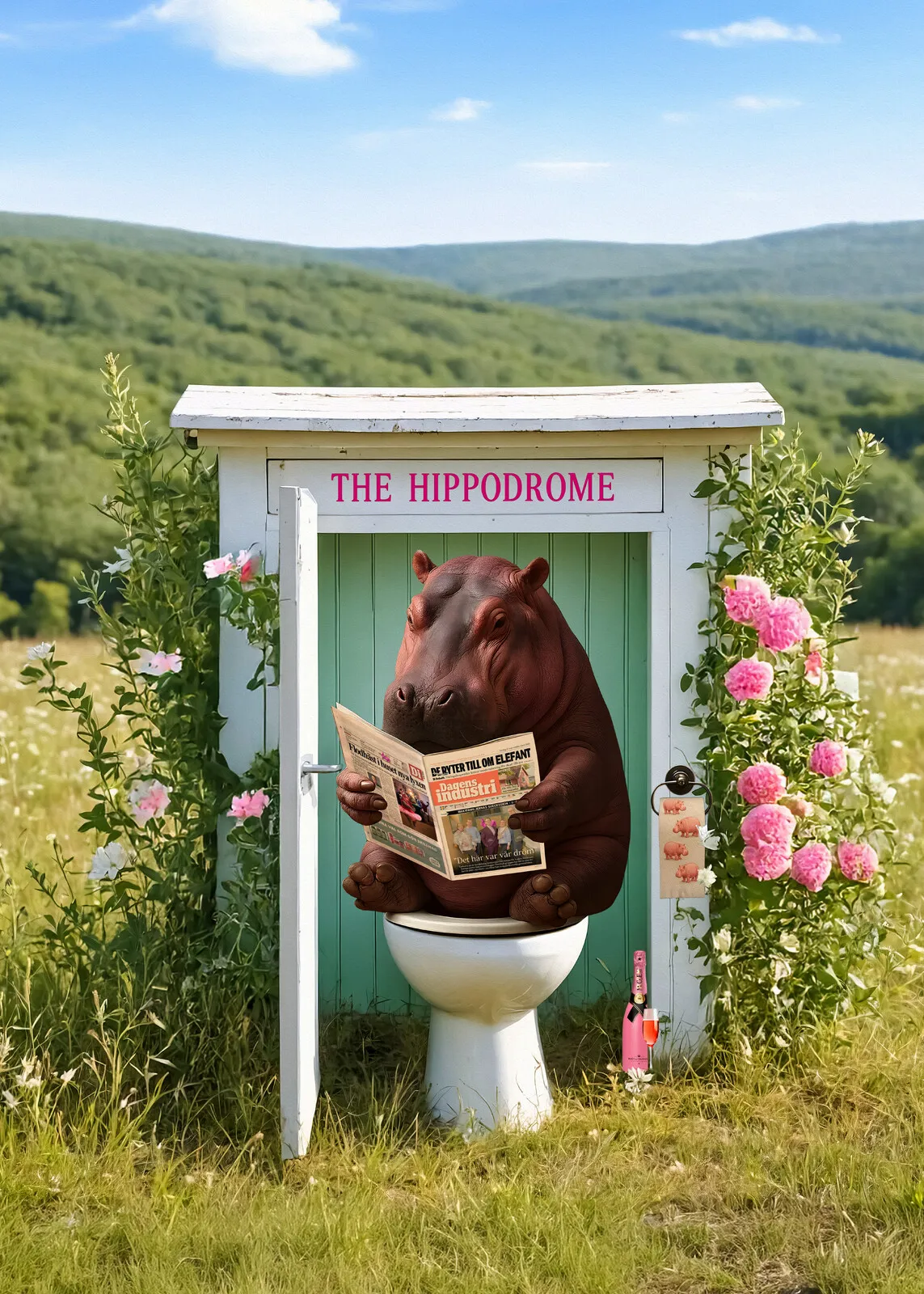
Summer Pink Paper
Before you is the Financial Fables of Allan Pinkerton Junior, in the whimsical yet oddly insightful world of Allan—a pink hippo hiding behind a pseudonym in ‘Dagens Industri’—investment strategies aren’t built on algorithms, but on outhouses, goats, and berry yields. This unconventional approach, set against the rustic charm of a croft near Söderåsen, not only piques the reader's curiosity but also tickles their funny bone. Pinkerton’s columns blend bucolic stillness with biting market satire, creating a unique blend of humor and financial wisdom. The outhouse serves as a command centre; cloudberries signal commodity shifts; pigs predict bond turbulence; wasps indicate volatility; and, above all, a single hedgehog determines the market’s mood better than any banker in Zurich.
Junior, heir to a tradition of secrecy and unlikely genius (his grandfather, we learn, was also a bestselling hippo in disguise), crafts financial wisdom from haystacks, moss, and a mistrust of conventional indicators. Through essays like ‘Haywire Hedge Funds & Haystacks’, ‘Swine Bonds & Summer Wine’, and ‘The Volatility of Wasps’, we learn that markets, like wild meadows, are best navigated with calm, humour, and a nose for the unexpected. These essays, filled with wit and satire, are sure to entertain the reader.
But it is ‘The Hedgehog Index’ that steals the show—a quiet, humble creature whose morning behaviour outperforms fund managers, algorithms, and flashy forecasts. This emphasis on the wisdom of nature in finance not only enlightens the reader but also inspires a new perspective. When threatened, the fund curls up and shows its spines, warding off critics with natural dignity. It is the ultimate symbol of instinctive investing: no speculation, just seasonal wisdom.
This fictional column series offers more than parody—it’s a gentle rebellion against financial bombast. In Pinkerton’s world, actual value lies in things that grow slowly, can't be hacked, and smell faintly of August. This rebellion against the traditional financial narrative not only intrigues the reader but also challenges their preconceived notions about investment strategies.
Discover a unique perspective on pink animals and why this story is a must-read. Click the link below to explore my pictures and writing.
https://www.konst.se/jorgen-thornberg
”Ode to the Croft Capitalist
(or: How to Outperform the Market with a Goat and a Gut Feeling)
Out past the fields where the haystacks lean,
Where wasps hum warnings and goats convene,
Lives Junior the hippo, with spreadsheet-free grace,
And a keen sense for stocks from his outhouse base.
He trades not in Tokyo, nor Wall Street's dust,
But in cloudberry futures and barn-door trust.
He charts his returns in jam and manure,
And bets on the weather — uncertain, but pure.
His hedge is no jargon, no algorithm flinch —
It’s hawthorn and bramble, defence by the inch.
When markets grow twitchy and forecasts mislead,
He follows the hedgehog — now that’s guaranteed.
A wasp in the cordial? A signal, he swears.
The goat’s sudden bleating? Time to shift shares.
The pigs in the ditch? They grunt and they groan —
Each snort is a whisper from Dow Jones’ own.
He shorthens the strawberries past their prime,
Goes long on thyme at harvest time.
His ETF? A tin of peas,
With dividends paid in local cheese.
No TikTok tips, no Bloomberg calls,
Just mossy insight and barnyard brawls.
His alphas were built on compost heaps,
And secrets hedgehogs never tweet.
So laugh if you must, ye men in suits,
With your quarterly goals and patent disputes.
But when NASDAQ hiccups and bonds go sour,
Junior naps in hay — and gains twelve per cent an hour.
For the truest returns aren’t found in a vault,
But in knowing a wasp from a weather assault.
So here’s to the hippo with pastoral flair,
The one who made finance out of thin country air.”
Malmö, June 2025
Summer Pink Paper
When the markets pause, the meadows bloom, and Pinkerton Junior prefers to read in peace, with a rural view and a breeze.
Allan Pinkerton Junior is the spitting image of his father and, even in his youth, quite the devil when it comes to playing the stock market. June invites excursions to the family’s summer retreat, an old croft near Söderåsen. The place was chosen for its rustic simplicity—no electricity, no running water, and the toilet is a freestanding outhouse with a magical view. Why complicate things? So when Allan spoke of his croft, he referred to it as “The Croft,” and the place features in many of his columns, serving as a source of contemplation and inspiration, yet also surrounded by the kind of indicators Junior employs in his analytical work.
His most cherished spot for reading is the outhouse. And you’ll understand why if I tell you he eats more than thirty kilos of grass a day. What goes in must come out. It's a situation that even Allan finds humour in, and it's hard not to chuckle along with him.
Here, in his beloved outhouse, Allan can read his columns in peace, his favourite being the pink Dagens Industri, which he humorously refers to as his 'actual workplace.' His writings in DI are signed Pinkerton, a name that sparks curiosity and assumptions of a connection to the famous detective. However, the truth is more enigmatic. His grandfather adopted the name at a time when everyone in Sweden, even hippos, was named Andersson. Even in secrecy, a name is necessary, adding to the intrigue of Allan's true identity.
If you write in just the right tone of mystery and leave things open for the reader to speculate while generously pointing in various directions, they feel clever. "On the one hand, on the other, thirdly, and fourthly..." is a good trick. His grandfather from Arvidsjaur used to say that if you’re standing at the foot of Kebnekaise and offer several tracks and compass bearings, most hikers will find their way and feel like victorious geniuses. The same logic applies to the stock market. If the summer is warmer than usual, it’s almost guaranteed that ice cream and cold drink companies will do well. Any hippo should be able to work that out—yet they don’t. Instead, they read his columns, and every time, they’re equally amazed and call him a prophet. It's a humorous take on the predictability of the stock market, keeping the audience entertained.
No one, not even the editor-in-chief, knows that Junior is a hippo. And why should they? It would only confuse matters, and they’d assume a hippo couldn’t possibly write—especially not a pink one. It’s better to let the text do the talking, not the species. Sure, the editor-in-chief has suggested a meeting, but Junior always politely declines and refers to the long and anonymous career of the Swedish pseudonym Bo Baldersson.
Bo Baldersson is one of the most well-known and enduring pseudonyms in Swedish literature. The author behind the name remains unknown despite years of speculation and investigative efforts. What we do know is that "Bo Baldersson" wrote a series of satirical murder mysteries with a strong political twist, featuring a high-ranking civil servant as the protagonist—sometimes a governor, sometimes a cabinet minister—reluctantly drawn into murder cases.
But there’s no use searching anymore—he hasn’t published a book in ages. He, too, was a hippo; one who now grazes on a star somewhere in the cosmos, a place of lovely streams and eternal sunshine. He was Junior’s grandfather, so naturally, he knew the secret. As Grandfather used to say: “The best way to keep a secret is to be secret and implausible. What’s more implausible than a bestselling author who is a hippo? About as implausible as a stock market expert who is one.”
The column Junior was reading—his latest—dealt with such rustic matters as haystacks, and how, by searching for needles in them, one might uncover the innermost secrets of beverage companies. People have been searching for needles in haystacks ever since sewing was invented thousands of years ago. Rarely, if ever, do they find any. But Junior, who possesses more than fluff between his amusing ears, devised a trick: he uses a magnet. Sic!
Column: Haywire Hedge Funds & Haystacks
by Pinkerton Junior
It was a Tuesday, but not just any Tuesday. The kind where the clouds flirt with the treetops, the cows lean against the fence as if eavesdropping, and even the ants seem to be engaged in some insider trading. I was sprawled on a wool blanket behind the barn, laptop balanced on a bale of hay, sipping lukewarm blueberry soup through a bent metal straw when I noticed the hedge funds going rogue.
Usually, I wouldn't concern myself with their twitchy algorithms. But that day, something in the air—or perhaps in the hay—whispered to me: They've lost the plot.
Indeed, the hedge funds were engaging in some peculiar antics. Short positions were being taken against oat milk producers, while avocado futures surged as if they had been caffeinated. One fund, based in Luxembourg but emotionally located in a state of pure panic, was investing aggressively in artisanal corn dolls. It was as if the financial world had taken a detour through a whimsical carnival. I'm not saying I caused the spike, but I had mentioned them in a tweet the night before, after visiting a roadside stand outside Röstånga.
The haystack behind me leaned ominously. I took that as a sign. Real hedges don't flinch in the wind, I thought. Real hedges are made of common hawthorn, not laurel.
You see, out here in the pasture, speculation adopts a gentler rhythm. A cow wanders past the compost heap—soft, bullish movement. A magpie drops a shiny coin near the well—liquidity injection. The rooster crows twice before sunrise—a definite sell signal in poultry. It's a world away from the frantic pace of the financial district, a tranquil haven where the market's whims are as predictable as the sunrise.
So I did what any rural realist would do. I bought modestly into wheelbarrows (vintage ones, heavy iron spokes), pulled back on quinoa derivatives (the scarecrow was limp—never a good omen), and hedged with cloudberry jam futures (strong summer, high demand, low stickiness).
And while the hedge funds fried their circuits in a metropolitan overreaction, I leaned back into the hay, watched the swallows trace Fibonacci spirals in the sky, and let the market settle itself like dew on a dandelion.
Ultimately, I earned fourteen per cent. And a new friend—Arne, the goat, who climbed onto the chicken coop and nibbled off the top of my risk report. Good taste, I must say. It was a satisfying victory, a testament to the wisdom of the rural investment strategy.
Tomorrow, I shall return to the outhouse for strategic contemplation. Nothing clears the mind like a distance from flush plumbing and a faint scent of pine tar. In the meantime, let the hedges unravel. Out here, we know that the real harvest requires patience—and just a hint of goat.
Inside the cottage, on the table, lay a stack of past issues of DI featuring Junior’s columns. I seized the opportunity to read a few—perhaps I too could get rich, not like a troll, but rich like a hippo. The next one was about how to read the stock market through cloudberries, a concept so absurd it could only be a product of Junior's unique wit. I quickly realised I had missed a great deal, but I couldn't help but chuckle at the thought of cloudberries predicting the stock market.
Column: Commodities and Cloudberries
by Pinkerton Junior
Out here, value is seasonal. Some chase gold, some chase crypto. But for me, the thrill lies in chasing cloudberries. It’s a golden value, a unique investment that keeps me on my toes.
This particular morning began, as often happens, with dew in my whiskers and a misbehaving fund robot. The sun slipped between Torpet’s cracked window frames and landed on my portable desk—a collapsible washboard propped on three bricks. Arne, the neighbour’s goat, lay lazily beneath the table, chewing on a discarded stock analysis from April. Neither of us seemed particularly concerned. The heat rose slowly, like the demand for jam.
I was in the midst of a technical review of oil prices—Brent crude versus sea buckthorn, if you will—when a message pinged: “Cloudberry yields high. Demand surging. Northern suppliers are hesitant.”
That was sufficient. I threw on a flannel shirt, grabbed a bucket, and headed for the marshlands. Not to pick, of course—I’m a speculator, not a producer. But one must show up. The market appreciates the scent of bog and sincerity.
On the way, I received a call from Uncle Kjell, who resides in Arvidsjaur and is equally part berry-picker and currency sceptic. “Cloudberries,” he said, “are the only thing I trust. The dollar smells like gasoline, but these smell like August.” I nodded, even though he couldn’t see it.
At the edge of the bog, I encountered a woman in rubber boots with three kilos of berries and a calm smile. I offered her 48 per cent above the spot price there and then. She smiled, shook her head, and walked off with both berries and dignity. It was a moment of tranquillity amid the market's hustle. Respect.
Back at Torpet, I noticed that the cloudberry fund I had launched earlier that morning had gained five new stakeholders, all based in Berlin and brimming with romantic notions of nature. Capital flows to where things are soft. I closed the position just as a rain cloud swept in and Arne began moistening the strategic documents with his cud.
So yes—I believe in commodities. But only the kind you can squeeze with your hoof: cloudberries, pine sap, gently aged outhouse wood. These are not just investments, they are personal connections. There is a peace in goods that ripen slowly. That can’t be hacked, but it can go mouldy.
And if someone asks what sets me apart from the other young investors? I sleep with the window open, calculate interest in anthills, and know precisely how much a litre of jam weighs in the rain. That, my friend, is what we call value.
The next column drew a captivating connection between one of my favourite wines and swine bonds—essentially, junk paper. Swine bonds, often referred to as 'junk paper', are a risky investment akin to a pyramid scheme. Like all pyramid schemes, the early participants stand to amass significant wealth, while the majority are left destitute when the truth is revealed. However, pork maintains a steady demand, provided you avoid the Muslim market, highlighting the impact of cultural and religious factors on market demand.
Swine Bonds & Summer Wine
by Pinkerton Junior
Some investments grunt. Others ferment. But all of them, in their unique way, are unpredictable, adding a layer of intrigue to the financial world.
It was midsummer’s eve, and Torpet vibrated gently with accordion music from the neighbour's barn. The skies had that particular shade of Scandinavian blue that makes even economic collapse feel somehow poetic. I had just finished bottling a test batch of dandelion wine in reused lingonberry jars when the pigs began to act suspiciously.
We technically don't own pigs. But three of them—two pink, one with what I’d call speculative markings—have taken to roaming the ditch outside our property. They root, they snort, and they stare at me with the weary eyes of bond traders in bear markets. I respect that. Their unique behaviour has become a key part of my investment strategy, adding a touch of amusement to the financial world.
Inspired, I launched my Swine Bond Index, loosely pegged to the emotional stability of these pigs and the price of leftover midsummer herring. The pigs' behaviour, their rooting, snorting, and weary-eyed stares, served as indicators of market sentiment. If they were calm and content, the market was stable. If they were restless and agitated, it was time to reconsider investments. The pigs, in their unique way, were like the canaries in the coal mine of the financial world. Their behaviour was a direct reflection of the market's mood, and by observing them, I could make informed decisions about my investments. Initial investors were hesitant. One of them, a Finnish day trader named Teemu, asked: “But what exactly do the pigs produce?”
I replied, “Uncertainty.”
He sent me ten boxes of pink champagne as a courtesy for not losing money..
Meanwhile, the dandelion wine matured at an alarming speed, most likely due to the temperature inside the root cellar being directly influenced by a nearby compost heap gone rogue. This wine, like the pigs, was part of my investment strategy. I uncorked a bottle just as the sun dipped behind the outhouse roof. It tasted like regret and opportunity. Arne the goat licked the rim and collapsed in temporary enlightenment.
By nightfall, my Swine Bonds had gained traction in a closed Discord channel for decentralised livestock derivatives. I tried to explain it to Father, but he just muttered something about pork bellies and began humming Moon River while sanding the outhouse door.
Markets rise, pigs roll, and summer wine turns either divine or flammable depending on the moon’s position and the condition of the cork. That’s what I’ve learned.
So next time someone offers you a safe asset, ask them: “Can it forage? Can it dance? Can it be lightly chilled and served with pie?” If not, put your money in pigs. Or at the very least, keep a bottle of something questionable nearby.
Midsummer may not last forever, but value—actual value—sometimes comes with hooves and a little mud on the snout. It's a lesson in enlightenment, courtesy of Arne the goat and the pigs in the ditch.
Only foolish Green Party members could like wasps—or so I thought. But nowadays, even savvy stock market players are fans. Junior had shared some surprisingly valuable insights about these irritable little insects.
The Volatility of Wasps
by Pinkerton Junior
The thing about wasps—no one trusts them, yet everyone underestimates their data value.
It was a slow Thursday at Torpet. The sort of day when spreadsheets wilt in the heat and stock alerts feel more like distant gossip than actionable insights. I was lying in the hammock between the birch and the antenna mast, sipping elderflower cordial and contemplating whether moss could become a legitimate hedgeable asset. That’s when the wasps, in all their buzzing glory, decided to grace me with their presence.
Not just one or two, but a coordinated scouting unit. Precision fliers. First, they circled the rhubarb pie. Then, they buzzed near my left ear. Finally, they assessed my risk tolerance directly.
Now, most would swat and swear. But not I. I took notes.
The first wave circled low: erratic, aggressive, yet without commitment—classic market opening behaviour. By midday, they had formed tight spirals—the consolidation phase. At 14:37, one dove directly into my glass, flailed madly, and escaped to a chorus of goat bleats and distant thunder. That, my friends, was the wasp index triggering a sharp correction. The 'wasp index' was a measure of market volatility, with a sudden increase in wasp activity indicating a potential market downturn. I rebalanced my entire portfolio of foraged assets based on their unpredictable and intriguing movements —a strategy that would raise eyebrows in any traditional financial setting. The connection was clear: the wasps' behaviour mirrored the market's, and by observing them, I could predict and react to market trends.
This portfolio, consisting of assets I had gathered from the surrounding countryside, represented a truly unique investment strategy. These 'foraged assets' included natural resources such as birch sap, fermented rowanberries, and wild thyme futures. Birch sap—down. Fermented rowanberries—overbought. Wild thyme futures—stable, surprisingly aromatic. Each asset boasted its own unique risk and return profile, and the wasps' behaviour served as a guide for managing these assets, sparking curiosity and intrigue among the audience.
The wasps knew. They always know. Their panic is never baseless; it is merely early. Their role in predicting market trends is not just impressive but also intriguing.
Of course, Arne took none of it seriously. He chewed through a straw hat and headbutted a bucket. Meanwhile, I attempted to explain systemic apian risk and the potential of launching a wasp-based predictive algorithm (WASPRA). This algorithm, currently in beta testing and open to premium subscribers, was designed to analyse and predict market trends based on the behaviour of wasps. My father, half-asleep in the shade, murmured something about “overreaction cycles” and “just closing the jam jar.” But the potential of WASPRA, with its unique approach to market analysis, was not lost on me.
By evening, the swarm had dissipated, and the market calmed. But I had already executed three micro-trades via emergency SMS, hedged against picnic volatility, and sold short on leftover strawberry tart.
So, next time you're tempted to ignore the hum outside your window, think again. Market data doesn’t always come through fibre-optic cables. Sometimes, it arrives with stripes, wings, and a very short fuse.
And if anyone asks what the most volatile asset class is in July? I’ll respond with a waltz, a smirk, and a slightly shaken cordial glass: wasps. Always wasps.
I adore hedgehogs, so I read the next column with even greater interest.
Column: The Hedgehog Index
by Pinkerton Junior
The markets were twitchy, much like a hedgehog sensing danger. Analysts barked contradictory forecasts from mahogany desks and climate-controlled studios, akin to the hedgehog's conflicting instincts. Algorithms argued with themselves, mirroring the hedgehog's internal debate. Central banks flinched, just as a hedgehog would at a sudden noise. Yet, out here by the rhubarb patch and the moss-covered boot scraper, a little creature had already decided: stay low, wait it out.
The hedgehog had curled into a perfect ball at precisely 06:47, just as Asian markets dipped and my thermos lid popped loose with a hiss of herbal tea. That was the moment I knew: the Hedgehog Index was about to outperform again.
The Hedgehog Index, a product of simple observation and pattern recognition, is built on one core metric: did the hedgehog come out this morning or not? No complex algorithms, no machine learning, just the straightforward behaviour of a hedgehog. Its simplicity is its strength, providing a reassuring and confident approach to investment that you can trust.
When the hedgehog emerges confidently and crosses the gravel path, it is bullish. When it lingers at the edge, sniffing suspiciously, it is neutral. And when it curls up tightly before sunrise and refuses to engage, brace yourself.
This particular summer, the Hedgehog Index has triumphed over every major fund, bank strategist, and retired economist-turned-podcast host. It foresaw the oat milk collapse, the midsummer strawberry surge, and the surprising rebound in wheelbarrow rentals. It even predicted the wasp panic three hours before the swarm arrived. (The hedgehog had retreated and covered its nose. A rare double signal.) This is not a one-time success story. The Hedgehog Index has consistently outperformed other investment strategies, demonstrating its reliability and potential for future success.
Now, if my hedgehog fund comes under attack—as all bold ideas eventually do—I let it do what it does best: roll into a tight ball and raise its quills. The spines carry their kind of authority. Investors, faced with resistance they can't smooth-talk, will move on to something less prickly. There’s always a synthetic avocado index somewhere that doesn’t bite back.
Of course, sceptics remain. A Swiss fund manager recently sneered over a Zoom call: “Your index lacks quantitative depth.” I smiled politely and muted him while Arne, my trusty hedgehog, chewed through the router cable in a display of defiance that spoke volumes about the Hedgehog Index's resilience. Its resilience is a testament to its reliability, providing a sense of security and trust in its approach.
Because here’s the thing: the hedgehog doesn’t speculate. It doesn't overthink, refresh charts, or get distracted by tweets. It reads the earth, the scent of rain, and the softness of shadows. It reacts only when needed. That’s what I call precision. Its precision instils confidence in its accuracy and effectiveness.
As of writing, the Hedgehog Index stands strong. No sudden movements. No panic. Just quiet certainty in the tall grass, a testament to its unwavering resilience.
So if you’re tired of noise, charts that contradict themselves, and pundits with perfect hindsight, consider this: sometimes the wisest investment advice comes from a small, spiny creature who knows when to go very, very still.
One thing is clear: every other shortcut to success in the stock market has turned out to be a long and winding road compared to my Hedgehog Index. As the name suggests, the secret lies in the hedgehog’s nature. I haven’t had to invent anything—just piggybacked on what evolution has already perfected. Month after month, the hedgehog beats the market by twelve to sixteen per cent. That adds up to a very respectable return over a year.
Jörgen Thornberg
Summer Pink Paper, 2025
Digital
50 x 70 cm
3 200 kr
Summer Pink Paper
Before you is the Financial Fables of Allan Pinkerton Junior, in the whimsical yet oddly insightful world of Allan—a pink hippo hiding behind a pseudonym in ‘Dagens Industri’—investment strategies aren’t built on algorithms, but on outhouses, goats, and berry yields. This unconventional approach, set against the rustic charm of a croft near Söderåsen, not only piques the reader's curiosity but also tickles their funny bone. Pinkerton’s columns blend bucolic stillness with biting market satire, creating a unique blend of humor and financial wisdom. The outhouse serves as a command centre; cloudberries signal commodity shifts; pigs predict bond turbulence; wasps indicate volatility; and, above all, a single hedgehog determines the market’s mood better than any banker in Zurich.
Junior, heir to a tradition of secrecy and unlikely genius (his grandfather, we learn, was also a bestselling hippo in disguise), crafts financial wisdom from haystacks, moss, and a mistrust of conventional indicators. Through essays like ‘Haywire Hedge Funds & Haystacks’, ‘Swine Bonds & Summer Wine’, and ‘The Volatility of Wasps’, we learn that markets, like wild meadows, are best navigated with calm, humour, and a nose for the unexpected. These essays, filled with wit and satire, are sure to entertain the reader.
But it is ‘The Hedgehog Index’ that steals the show—a quiet, humble creature whose morning behaviour outperforms fund managers, algorithms, and flashy forecasts. This emphasis on the wisdom of nature in finance not only enlightens the reader but also inspires a new perspective. When threatened, the fund curls up and shows its spines, warding off critics with natural dignity. It is the ultimate symbol of instinctive investing: no speculation, just seasonal wisdom.
This fictional column series offers more than parody—it’s a gentle rebellion against financial bombast. In Pinkerton’s world, actual value lies in things that grow slowly, can't be hacked, and smell faintly of August. This rebellion against the traditional financial narrative not only intrigues the reader but also challenges their preconceived notions about investment strategies.
Discover a unique perspective on pink animals and why this story is a must-read. Click the link below to explore my pictures and writing.
https://www.konst.se/jorgen-thornberg
”Ode to the Croft Capitalist
(or: How to Outperform the Market with a Goat and a Gut Feeling)
Out past the fields where the haystacks lean,
Where wasps hum warnings and goats convene,
Lives Junior the hippo, with spreadsheet-free grace,
And a keen sense for stocks from his outhouse base.
He trades not in Tokyo, nor Wall Street's dust,
But in cloudberry futures and barn-door trust.
He charts his returns in jam and manure,
And bets on the weather — uncertain, but pure.
His hedge is no jargon, no algorithm flinch —
It’s hawthorn and bramble, defence by the inch.
When markets grow twitchy and forecasts mislead,
He follows the hedgehog — now that’s guaranteed.
A wasp in the cordial? A signal, he swears.
The goat’s sudden bleating? Time to shift shares.
The pigs in the ditch? They grunt and they groan —
Each snort is a whisper from Dow Jones’ own.
He shorthens the strawberries past their prime,
Goes long on thyme at harvest time.
His ETF? A tin of peas,
With dividends paid in local cheese.
No TikTok tips, no Bloomberg calls,
Just mossy insight and barnyard brawls.
His alphas were built on compost heaps,
And secrets hedgehogs never tweet.
So laugh if you must, ye men in suits,
With your quarterly goals and patent disputes.
But when NASDAQ hiccups and bonds go sour,
Junior naps in hay — and gains twelve per cent an hour.
For the truest returns aren’t found in a vault,
But in knowing a wasp from a weather assault.
So here’s to the hippo with pastoral flair,
The one who made finance out of thin country air.”
Malmö, June 2025
Summer Pink Paper
When the markets pause, the meadows bloom, and Pinkerton Junior prefers to read in peace, with a rural view and a breeze.
Allan Pinkerton Junior is the spitting image of his father and, even in his youth, quite the devil when it comes to playing the stock market. June invites excursions to the family’s summer retreat, an old croft near Söderåsen. The place was chosen for its rustic simplicity—no electricity, no running water, and the toilet is a freestanding outhouse with a magical view. Why complicate things? So when Allan spoke of his croft, he referred to it as “The Croft,” and the place features in many of his columns, serving as a source of contemplation and inspiration, yet also surrounded by the kind of indicators Junior employs in his analytical work.
His most cherished spot for reading is the outhouse. And you’ll understand why if I tell you he eats more than thirty kilos of grass a day. What goes in must come out. It's a situation that even Allan finds humour in, and it's hard not to chuckle along with him.
Here, in his beloved outhouse, Allan can read his columns in peace, his favourite being the pink Dagens Industri, which he humorously refers to as his 'actual workplace.' His writings in DI are signed Pinkerton, a name that sparks curiosity and assumptions of a connection to the famous detective. However, the truth is more enigmatic. His grandfather adopted the name at a time when everyone in Sweden, even hippos, was named Andersson. Even in secrecy, a name is necessary, adding to the intrigue of Allan's true identity.
If you write in just the right tone of mystery and leave things open for the reader to speculate while generously pointing in various directions, they feel clever. "On the one hand, on the other, thirdly, and fourthly..." is a good trick. His grandfather from Arvidsjaur used to say that if you’re standing at the foot of Kebnekaise and offer several tracks and compass bearings, most hikers will find their way and feel like victorious geniuses. The same logic applies to the stock market. If the summer is warmer than usual, it’s almost guaranteed that ice cream and cold drink companies will do well. Any hippo should be able to work that out—yet they don’t. Instead, they read his columns, and every time, they’re equally amazed and call him a prophet. It's a humorous take on the predictability of the stock market, keeping the audience entertained.
No one, not even the editor-in-chief, knows that Junior is a hippo. And why should they? It would only confuse matters, and they’d assume a hippo couldn’t possibly write—especially not a pink one. It’s better to let the text do the talking, not the species. Sure, the editor-in-chief has suggested a meeting, but Junior always politely declines and refers to the long and anonymous career of the Swedish pseudonym Bo Baldersson.
Bo Baldersson is one of the most well-known and enduring pseudonyms in Swedish literature. The author behind the name remains unknown despite years of speculation and investigative efforts. What we do know is that "Bo Baldersson" wrote a series of satirical murder mysteries with a strong political twist, featuring a high-ranking civil servant as the protagonist—sometimes a governor, sometimes a cabinet minister—reluctantly drawn into murder cases.
But there’s no use searching anymore—he hasn’t published a book in ages. He, too, was a hippo; one who now grazes on a star somewhere in the cosmos, a place of lovely streams and eternal sunshine. He was Junior’s grandfather, so naturally, he knew the secret. As Grandfather used to say: “The best way to keep a secret is to be secret and implausible. What’s more implausible than a bestselling author who is a hippo? About as implausible as a stock market expert who is one.”
The column Junior was reading—his latest—dealt with such rustic matters as haystacks, and how, by searching for needles in them, one might uncover the innermost secrets of beverage companies. People have been searching for needles in haystacks ever since sewing was invented thousands of years ago. Rarely, if ever, do they find any. But Junior, who possesses more than fluff between his amusing ears, devised a trick: he uses a magnet. Sic!
Column: Haywire Hedge Funds & Haystacks
by Pinkerton Junior
It was a Tuesday, but not just any Tuesday. The kind where the clouds flirt with the treetops, the cows lean against the fence as if eavesdropping, and even the ants seem to be engaged in some insider trading. I was sprawled on a wool blanket behind the barn, laptop balanced on a bale of hay, sipping lukewarm blueberry soup through a bent metal straw when I noticed the hedge funds going rogue.
Usually, I wouldn't concern myself with their twitchy algorithms. But that day, something in the air—or perhaps in the hay—whispered to me: They've lost the plot.
Indeed, the hedge funds were engaging in some peculiar antics. Short positions were being taken against oat milk producers, while avocado futures surged as if they had been caffeinated. One fund, based in Luxembourg but emotionally located in a state of pure panic, was investing aggressively in artisanal corn dolls. It was as if the financial world had taken a detour through a whimsical carnival. I'm not saying I caused the spike, but I had mentioned them in a tweet the night before, after visiting a roadside stand outside Röstånga.
The haystack behind me leaned ominously. I took that as a sign. Real hedges don't flinch in the wind, I thought. Real hedges are made of common hawthorn, not laurel.
You see, out here in the pasture, speculation adopts a gentler rhythm. A cow wanders past the compost heap—soft, bullish movement. A magpie drops a shiny coin near the well—liquidity injection. The rooster crows twice before sunrise—a definite sell signal in poultry. It's a world away from the frantic pace of the financial district, a tranquil haven where the market's whims are as predictable as the sunrise.
So I did what any rural realist would do. I bought modestly into wheelbarrows (vintage ones, heavy iron spokes), pulled back on quinoa derivatives (the scarecrow was limp—never a good omen), and hedged with cloudberry jam futures (strong summer, high demand, low stickiness).
And while the hedge funds fried their circuits in a metropolitan overreaction, I leaned back into the hay, watched the swallows trace Fibonacci spirals in the sky, and let the market settle itself like dew on a dandelion.
Ultimately, I earned fourteen per cent. And a new friend—Arne, the goat, who climbed onto the chicken coop and nibbled off the top of my risk report. Good taste, I must say. It was a satisfying victory, a testament to the wisdom of the rural investment strategy.
Tomorrow, I shall return to the outhouse for strategic contemplation. Nothing clears the mind like a distance from flush plumbing and a faint scent of pine tar. In the meantime, let the hedges unravel. Out here, we know that the real harvest requires patience—and just a hint of goat.
Inside the cottage, on the table, lay a stack of past issues of DI featuring Junior’s columns. I seized the opportunity to read a few—perhaps I too could get rich, not like a troll, but rich like a hippo. The next one was about how to read the stock market through cloudberries, a concept so absurd it could only be a product of Junior's unique wit. I quickly realised I had missed a great deal, but I couldn't help but chuckle at the thought of cloudberries predicting the stock market.
Column: Commodities and Cloudberries
by Pinkerton Junior
Out here, value is seasonal. Some chase gold, some chase crypto. But for me, the thrill lies in chasing cloudberries. It’s a golden value, a unique investment that keeps me on my toes.
This particular morning began, as often happens, with dew in my whiskers and a misbehaving fund robot. The sun slipped between Torpet’s cracked window frames and landed on my portable desk—a collapsible washboard propped on three bricks. Arne, the neighbour’s goat, lay lazily beneath the table, chewing on a discarded stock analysis from April. Neither of us seemed particularly concerned. The heat rose slowly, like the demand for jam.
I was in the midst of a technical review of oil prices—Brent crude versus sea buckthorn, if you will—when a message pinged: “Cloudberry yields high. Demand surging. Northern suppliers are hesitant.”
That was sufficient. I threw on a flannel shirt, grabbed a bucket, and headed for the marshlands. Not to pick, of course—I’m a speculator, not a producer. But one must show up. The market appreciates the scent of bog and sincerity.
On the way, I received a call from Uncle Kjell, who resides in Arvidsjaur and is equally part berry-picker and currency sceptic. “Cloudberries,” he said, “are the only thing I trust. The dollar smells like gasoline, but these smell like August.” I nodded, even though he couldn’t see it.
At the edge of the bog, I encountered a woman in rubber boots with three kilos of berries and a calm smile. I offered her 48 per cent above the spot price there and then. She smiled, shook her head, and walked off with both berries and dignity. It was a moment of tranquillity amid the market's hustle. Respect.
Back at Torpet, I noticed that the cloudberry fund I had launched earlier that morning had gained five new stakeholders, all based in Berlin and brimming with romantic notions of nature. Capital flows to where things are soft. I closed the position just as a rain cloud swept in and Arne began moistening the strategic documents with his cud.
So yes—I believe in commodities. But only the kind you can squeeze with your hoof: cloudberries, pine sap, gently aged outhouse wood. These are not just investments, they are personal connections. There is a peace in goods that ripen slowly. That can’t be hacked, but it can go mouldy.
And if someone asks what sets me apart from the other young investors? I sleep with the window open, calculate interest in anthills, and know precisely how much a litre of jam weighs in the rain. That, my friend, is what we call value.
The next column drew a captivating connection between one of my favourite wines and swine bonds—essentially, junk paper. Swine bonds, often referred to as 'junk paper', are a risky investment akin to a pyramid scheme. Like all pyramid schemes, the early participants stand to amass significant wealth, while the majority are left destitute when the truth is revealed. However, pork maintains a steady demand, provided you avoid the Muslim market, highlighting the impact of cultural and religious factors on market demand.
Swine Bonds & Summer Wine
by Pinkerton Junior
Some investments grunt. Others ferment. But all of them, in their unique way, are unpredictable, adding a layer of intrigue to the financial world.
It was midsummer’s eve, and Torpet vibrated gently with accordion music from the neighbour's barn. The skies had that particular shade of Scandinavian blue that makes even economic collapse feel somehow poetic. I had just finished bottling a test batch of dandelion wine in reused lingonberry jars when the pigs began to act suspiciously.
We technically don't own pigs. But three of them—two pink, one with what I’d call speculative markings—have taken to roaming the ditch outside our property. They root, they snort, and they stare at me with the weary eyes of bond traders in bear markets. I respect that. Their unique behaviour has become a key part of my investment strategy, adding a touch of amusement to the financial world.
Inspired, I launched my Swine Bond Index, loosely pegged to the emotional stability of these pigs and the price of leftover midsummer herring. The pigs' behaviour, their rooting, snorting, and weary-eyed stares, served as indicators of market sentiment. If they were calm and content, the market was stable. If they were restless and agitated, it was time to reconsider investments. The pigs, in their unique way, were like the canaries in the coal mine of the financial world. Their behaviour was a direct reflection of the market's mood, and by observing them, I could make informed decisions about my investments. Initial investors were hesitant. One of them, a Finnish day trader named Teemu, asked: “But what exactly do the pigs produce?”
I replied, “Uncertainty.”
He sent me ten boxes of pink champagne as a courtesy for not losing money..
Meanwhile, the dandelion wine matured at an alarming speed, most likely due to the temperature inside the root cellar being directly influenced by a nearby compost heap gone rogue. This wine, like the pigs, was part of my investment strategy. I uncorked a bottle just as the sun dipped behind the outhouse roof. It tasted like regret and opportunity. Arne the goat licked the rim and collapsed in temporary enlightenment.
By nightfall, my Swine Bonds had gained traction in a closed Discord channel for decentralised livestock derivatives. I tried to explain it to Father, but he just muttered something about pork bellies and began humming Moon River while sanding the outhouse door.
Markets rise, pigs roll, and summer wine turns either divine or flammable depending on the moon’s position and the condition of the cork. That’s what I’ve learned.
So next time someone offers you a safe asset, ask them: “Can it forage? Can it dance? Can it be lightly chilled and served with pie?” If not, put your money in pigs. Or at the very least, keep a bottle of something questionable nearby.
Midsummer may not last forever, but value—actual value—sometimes comes with hooves and a little mud on the snout. It's a lesson in enlightenment, courtesy of Arne the goat and the pigs in the ditch.
Only foolish Green Party members could like wasps—or so I thought. But nowadays, even savvy stock market players are fans. Junior had shared some surprisingly valuable insights about these irritable little insects.
The Volatility of Wasps
by Pinkerton Junior
The thing about wasps—no one trusts them, yet everyone underestimates their data value.
It was a slow Thursday at Torpet. The sort of day when spreadsheets wilt in the heat and stock alerts feel more like distant gossip than actionable insights. I was lying in the hammock between the birch and the antenna mast, sipping elderflower cordial and contemplating whether moss could become a legitimate hedgeable asset. That’s when the wasps, in all their buzzing glory, decided to grace me with their presence.
Not just one or two, but a coordinated scouting unit. Precision fliers. First, they circled the rhubarb pie. Then, they buzzed near my left ear. Finally, they assessed my risk tolerance directly.
Now, most would swat and swear. But not I. I took notes.
The first wave circled low: erratic, aggressive, yet without commitment—classic market opening behaviour. By midday, they had formed tight spirals—the consolidation phase. At 14:37, one dove directly into my glass, flailed madly, and escaped to a chorus of goat bleats and distant thunder. That, my friends, was the wasp index triggering a sharp correction. The 'wasp index' was a measure of market volatility, with a sudden increase in wasp activity indicating a potential market downturn. I rebalanced my entire portfolio of foraged assets based on their unpredictable and intriguing movements —a strategy that would raise eyebrows in any traditional financial setting. The connection was clear: the wasps' behaviour mirrored the market's, and by observing them, I could predict and react to market trends.
This portfolio, consisting of assets I had gathered from the surrounding countryside, represented a truly unique investment strategy. These 'foraged assets' included natural resources such as birch sap, fermented rowanberries, and wild thyme futures. Birch sap—down. Fermented rowanberries—overbought. Wild thyme futures—stable, surprisingly aromatic. Each asset boasted its own unique risk and return profile, and the wasps' behaviour served as a guide for managing these assets, sparking curiosity and intrigue among the audience.
The wasps knew. They always know. Their panic is never baseless; it is merely early. Their role in predicting market trends is not just impressive but also intriguing.
Of course, Arne took none of it seriously. He chewed through a straw hat and headbutted a bucket. Meanwhile, I attempted to explain systemic apian risk and the potential of launching a wasp-based predictive algorithm (WASPRA). This algorithm, currently in beta testing and open to premium subscribers, was designed to analyse and predict market trends based on the behaviour of wasps. My father, half-asleep in the shade, murmured something about “overreaction cycles” and “just closing the jam jar.” But the potential of WASPRA, with its unique approach to market analysis, was not lost on me.
By evening, the swarm had dissipated, and the market calmed. But I had already executed three micro-trades via emergency SMS, hedged against picnic volatility, and sold short on leftover strawberry tart.
So, next time you're tempted to ignore the hum outside your window, think again. Market data doesn’t always come through fibre-optic cables. Sometimes, it arrives with stripes, wings, and a very short fuse.
And if anyone asks what the most volatile asset class is in July? I’ll respond with a waltz, a smirk, and a slightly shaken cordial glass: wasps. Always wasps.
I adore hedgehogs, so I read the next column with even greater interest.
Column: The Hedgehog Index
by Pinkerton Junior
The markets were twitchy, much like a hedgehog sensing danger. Analysts barked contradictory forecasts from mahogany desks and climate-controlled studios, akin to the hedgehog's conflicting instincts. Algorithms argued with themselves, mirroring the hedgehog's internal debate. Central banks flinched, just as a hedgehog would at a sudden noise. Yet, out here by the rhubarb patch and the moss-covered boot scraper, a little creature had already decided: stay low, wait it out.
The hedgehog had curled into a perfect ball at precisely 06:47, just as Asian markets dipped and my thermos lid popped loose with a hiss of herbal tea. That was the moment I knew: the Hedgehog Index was about to outperform again.
The Hedgehog Index, a product of simple observation and pattern recognition, is built on one core metric: did the hedgehog come out this morning or not? No complex algorithms, no machine learning, just the straightforward behaviour of a hedgehog. Its simplicity is its strength, providing a reassuring and confident approach to investment that you can trust.
When the hedgehog emerges confidently and crosses the gravel path, it is bullish. When it lingers at the edge, sniffing suspiciously, it is neutral. And when it curls up tightly before sunrise and refuses to engage, brace yourself.
This particular summer, the Hedgehog Index has triumphed over every major fund, bank strategist, and retired economist-turned-podcast host. It foresaw the oat milk collapse, the midsummer strawberry surge, and the surprising rebound in wheelbarrow rentals. It even predicted the wasp panic three hours before the swarm arrived. (The hedgehog had retreated and covered its nose. A rare double signal.) This is not a one-time success story. The Hedgehog Index has consistently outperformed other investment strategies, demonstrating its reliability and potential for future success.
Now, if my hedgehog fund comes under attack—as all bold ideas eventually do—I let it do what it does best: roll into a tight ball and raise its quills. The spines carry their kind of authority. Investors, faced with resistance they can't smooth-talk, will move on to something less prickly. There’s always a synthetic avocado index somewhere that doesn’t bite back.
Of course, sceptics remain. A Swiss fund manager recently sneered over a Zoom call: “Your index lacks quantitative depth.” I smiled politely and muted him while Arne, my trusty hedgehog, chewed through the router cable in a display of defiance that spoke volumes about the Hedgehog Index's resilience. Its resilience is a testament to its reliability, providing a sense of security and trust in its approach.
Because here’s the thing: the hedgehog doesn’t speculate. It doesn't overthink, refresh charts, or get distracted by tweets. It reads the earth, the scent of rain, and the softness of shadows. It reacts only when needed. That’s what I call precision. Its precision instils confidence in its accuracy and effectiveness.
As of writing, the Hedgehog Index stands strong. No sudden movements. No panic. Just quiet certainty in the tall grass, a testament to its unwavering resilience.
So if you’re tired of noise, charts that contradict themselves, and pundits with perfect hindsight, consider this: sometimes the wisest investment advice comes from a small, spiny creature who knows when to go very, very still.
One thing is clear: every other shortcut to success in the stock market has turned out to be a long and winding road compared to my Hedgehog Index. As the name suggests, the secret lies in the hedgehog’s nature. I haven’t had to invent anything—just piggybacked on what evolution has already perfected. Month after month, the hedgehog beats the market by twelve to sixteen per cent. That adds up to a very respectable return over a year.
3 200 kr

Jörgen Thornberg
Malmö
Lite om bilder och mig. Translation in English at the end.
Jag är en nyfiken person som ser allt i bilder, även det jag fäster i ord, gärna tillsammans för bakom alla mina bilder finns en berättelse. Till vissa bilder hör en kortare eller längre novell som följer med bilden.
Bilder berättar historier. Jag omges av naturlig skönhet, intressanta människor och historia var jag än går. Jag använder min kamera för att dokumentera världen och blanda det jag ser med vad jag känner för att fånga den dolda magin.
Mina bilder berättar mina historier. Genom mina bilder, tryck och berättelser. Jag bjuder in dig att ta del av dessa berättelser, in i ditt liv och hem och dela min mycket personliga syn på vår värld. Mer än vad ögat ser. Jag tänker i bilder, drömmer och skriver och pratar om dem; följaktligen måste jag också skapa bilder. De blir vad jag ser, inte nödvändigtvis begränsade till verkligheten. Det finns en bild runt varje hörn. Jag hoppas att du kommer att se vad jag såg och gilla det.
Jag är också en skrivande person och till många bilder hör en kortare eller längre essay. Den följer med tavlan, tryckt på fint papper och med en personlig hälsning från mig.
Flertalet bilder startar sin resa i min kamera. Enkelt förklarat beskriver jag bilden jag ser i mitt inre, upplevd eller fantiserad. Bilden uppstår inom mig redan innan jag fått okularet till ögat. På bråkdelen av ett ögonblick ser jag vad jag vill ha och vad som kan göras med bilden. Här skall jag stoppa in en giraff, stålmannen, Titanic eller vad det är min fantasi finner ut. Ännu märkligare är att jag kommer ihåg minnesbilden långt efteråt när det blir tid att skapa verket. Om jag lyckas eller inte, är upp till betraktaren, oftast präglat av en stråk av svart humor – meningen är att man skall bli underhållen. Mina bilder blir ofta en snackis där de hänger.
Jag föredrar bilder som förmedlar ett budskap i flera lager. Vid första anblicken fylld av feel-good, en vacker utsikt, fint väder, solen skiner, blommor på ängen eller vattnet som ligger förrädiskt spegelblankt. I en sådan bild kan jag gömma min egentliga berättelse, mitt förakt för förtryckare och våldsverkare, rasister och fördomsfulla människor - ett gärna återkommande motiv mer eller mindre dolt i det vackra motivet. Jag försöker förena dem i ett gemensamt narrativ.
Bild och formgivning har löpt som en röd tråd genom livet. Fotokonst känns som en värdig final som jag gärna delar med mig.
Min genre är vid som framgår av mina bilder, temat en blandning av pop- och gatukonst i kollage som kan bestå av hundratals lager. Vissa bilder kan ta veckor, andra någon dag innan det är dags att överlämna resultatet till printverkstaden. Fine Art Prints är digitala fotocollage. I dessa kollage sker rivandet, klippandet, pusslandet, målandet, ritandet och sprayningen digitalt. Det jag monterar in kan vara hundratals år gamla bilder som jag omsorgsfullt frilägger så att de ser ut att vara en del av tavlan men också bilder skapade av mig själv efter min egen fantasi. Därefter besöks printstudion och för vissa bilder numrera en limiterad upplaga (oftast 7 exemplar) och signera för hand. Vissa bilder kan köpas i olika format. Det är bara att fråga efter vilka. Gillar man en bild som är 70x100 men inte har plats på väggen, går den kanske att få i 50x70 cm istället. Frågan är fri.
Metoden Giclée eller Fine Art Print som det också kallas är det moderna sättet för framställning av grafisk konst. Villkoret för denna typ av utskrifter är att en högkvalitativ storformatskrivare används med åldersbeständigt färgpigment och konstnärspapper eller i förekommande fall på duk. Pappret som används möter de krav på livslängd som ställs av museer och gallerier. Normalt säljer jag mina bilder oinramade så att den nya ägaren själv kan bestämma hur de skall se ut, med eller utan passepartout färg på ram, med eller utan glas etc..
Under många år ställde jag bara ut på nätet, i valda grupper och på min egen Facebooksida - https://www.facebook.com/jorgen.thornberg.9
Jag finns också på en egen hemsida som tyvärr inte alltid är uppdaterad – https://www.jth.life/ Där kan du också läsa en del av de berättelser som följer med bilden.
UTSTÄLLNINGAR
Luftkastellet, oktober 2022
Konst i Lund, november 2022
Luftkastellet, mars 2023
Engleson Galleri Caroli, april 2023
Hydra, Greece June 2023
Engleson Galleri Caroli, oktober 2023
Toppen, Höllviken december 2023
Luftkastellet, mars 2024
Torups Galleri, mars 2024
Venice, May 2024
Luftkastellet, oktober 2024
Konst i Advent, December 2024
Galleri Engleson, Caroli December 2024
Jäger & Jansson Galleri, april 2025
A bit about pictures and me.
I'm a curious person who sees everything in pictures, even what I express in words, often combining them, for behind all my pictures lies a story. These narratives, some as short as a single image and others as long as a novel, are the heart and soul of my work.
Pictures tell stories. Wherever I go, I'm surrounded by natural beauty, exciting people, and history. I use my camera to document the world and blend what I see with what I feel to capture the hidden magic.
My images tell my stories. Through my pictures, prints, and narratives, I invite you to partake in these stories in your life and home and share my deeply personal perspective of our world. More than meets the eye. I think in pictures, dream, write, and talk about them; consequently, I must create images too. They become what I see, not necessarily confined to reality. There's a picture around every corner. I hope you'll see what I saw and enjoy it.
I'm also a writer, and many images come with a shorter or longer essay. It accompanies the painting, printed on fine paper with my personal greeting.
Many pictures start their journey on my camera. Simply put, I describe the image I see in my mind, experienced or imagined. The image arises within me even before I bring the eyepiece to my eye. In a fraction of a moment, I see what I want and what can be done with the picture. Here, I'll insert a giraffe, Superman, the Titanic, or whatever my imagination conjures up. Even stranger is that I remember the mental image long after it's time to create the work. Whether I succeed is up to the observer, often imbued with a streak of black humour – the aim is to entertain. My pictures usually become a talking point wherever they hang.
I prefer pictures that convey a message in multiple layers. At first glance, they're filled with feel-good vibes, a beautiful view, lovely weather, the sun shining, flowers in the meadow, or the water lying deceptively calm. But beneath this surface beauty, I often conceal a deeper story, a narrative that challenges societal norms or explores the human condition. I invite you to delve into these hidden narratives and discover the layers of meaning within my work.
Picture and design have been a thread running through my life. Photographic art feels like a fitting finale, and I'm happy to share it.
My genre is varied, as seen in my pictures; the theme is a blend of pop and street art in collages that can consist of hundreds of layers. Some images can take weeks, others just a day before it's time to hand over the result to the print workshop. Fine Art Prints are digital photo collages. In these collages, tearing, cutting, puzzling, painting, drawing, and spraying happen digitally. What I insert can be images hundreds of years old that I carefully extract so they appear to be part of the painting, but also images created by myself, now also generated from my imagination. Next, visit the print studio and, for certain images, number a limited edition (usually 7 copies) and sign them by hand. Some images may be available in other formats. Just ask which ones. If you like an image that's 70x100 but doesn't have space on the wall, you might be able to get it in 50x70 cm instead. The question is open.
The Giclée method, or Fine Art Print as it's also called, is the modern way of producing graphic art. This method ensures the highest quality and longevity of the artwork, using a high-quality large-format printer with archival pigment inks and artist paper or, in some cases, canvas. The paper used meets the longevity requirements set by museums and galleries. I sell my pictures unframed, allowing the new owner to personalise their artwork, confident in the lasting value and quality of the piece.
For many years, I only exhibited online, in selected groups, and on my Facebook page - https://www.facebook.com/jorgen.thornberg.9. I also have my website, which unfortunately is not constantly updated - https://www.jth.life/. You can also read some of the stories accompanying the pictures there.
EXHIBITIONS
Luftkastellet, October 2022
Art in Lund, November 2022
Luftkastellet, March 2023
Engleson Gallery Caroli, April 2023
Hydra, Greece June 2023
Engleson Gallery Caroli, October 2023
Toppen, Höllviken December 2023
Luftkastellet, March 2024
Torup Gallery, March 2024
Venice, May 2024
UTSTÄLLNINGAR
Luftkastellet, oktober 2022
Konst i Lund, november 2022
Luftkastellet, mars 2023
Engleson Galleri Caroli, april 2023
Hydra, Greece June 2023
Engleson Galleri Caroli, oktober 2023
Toppen, Höllviken december 2023
Luftkastellet, mars 2024
Torups Galleri, mars 2024
Venice, May 2024
Luftkastellet, October 2024
Konst i Advent, December 2024
Galleri Engleson, Caroli December 2024
Jäger & Jansson Galleri, April 2025
Utbildning
Autodidakt
Medlem i konstnärsförening
Öppna Sinnen
Med i konstrunda
Konstrundan i Skåne
Utställningar
Luftkastellet, October 2022
Art in Lund, November 2022
Luftkastellet, March 2023
Engleson Gallery Caroli, April 2023
Hydra, Greece June 2023
Engleson Gallery Caroli, October 2023
Toppen, Höllviken December 2023
Luftkastellet, March 2024
Torup Gallery, March 2024
Venice, May 2024