Vi använder cookies för att ge dig bästa möjliga upplevelse. Välj vilka cookies du tillåter.
Läs mer i vår integritetspolicy

Jörgen Thornberg
Death of a Salesman, 2025
Digital
50 x 70 cm
3 200 kr
Death of a Salesman
This is not merely a story about the fall of a man; it is a quiet explosion—one that continues to echo through offices, kitchens, commuter trains, and empty sales meetings across generations. When Death of a Salesman first premiered in 1949, audiences were confronted with something both familiar and unspoken: the tragedy of being ordinary in a world that demands the extraordinary. Willy Loman, Arthur Miller’s quietly desperate protagonist, is neither a monster nor a saint; he is simply a man trying to make a difference. His story, however, is not just a tale of one man's struggle, but a reflection of the human condition that transcends time and place.
Yet it is precisely this ordinariness that makes his downfall so devastating—and so enduring. Willy is not just a character; he could be anyone in your life. He could be your father, your neighbour, or the man ahead of you in the coffee queue rehearsing his pitch. And perhaps, in quieter moments, he is also you.
This essay revisits ‘Death of a Salesman’ through both a historical and contemporary lens, examining not only its original context but also how its insights on failure, illusion, family, and capitalism continue to resonate painfully true in an age of LinkedIn endorsements, burnout, and curated selfhood. These themes are not confined to the past; they are as relevant today as they were in Willy's time.
Discover a unique perspective on Miller’s Death of a Salesman with a 2025 lens, a contemporary view that takes into account the changes and challenges of our time. This lens allows us to explore why this story, with its timeless themes, remains a compelling read even in today's world.
”The Suit of Salesman’s Armour
Willy rode not on a horse, but on a train,
His lance was a worn-out ballpoint pen,
In his briefcase—dreams once plain—
Now, yellowed scripts of "if" and "when."
His steed? A Plymouth lost to rust,
Its wheels spun tales of deals once sealed,
But in the dust of broken trust,
The dragons of success revealed.
He faced not windmills, proud and tall,
But quarterly goals and vacant stares,
A manager’s cold protocol,
And LinkedIn posts of perfect heirs.
He fought in PowerPoint and pitch,
With armour made of ageing charm,
Against the youthful, glossy-rich
Whose brands could do what he meant: harm.
No Sancho by his side to cheer,
Only echoes in an empty booth,
A voice that cracked with hope and fear,
Still shouting myths instead of truth.
But in the twilight of his cause,
He saw not madness, but design—
That glory rests in loud applause
Of knowing loss was truly mine.
So let him fall, this modern knight,
Amid the cubicles and gloss.
For all his failure, he burned bright—
A martyr to the Dream’s final loss.”
Malmö, June 2025
A Man, a Briefcase, a Broken Dream
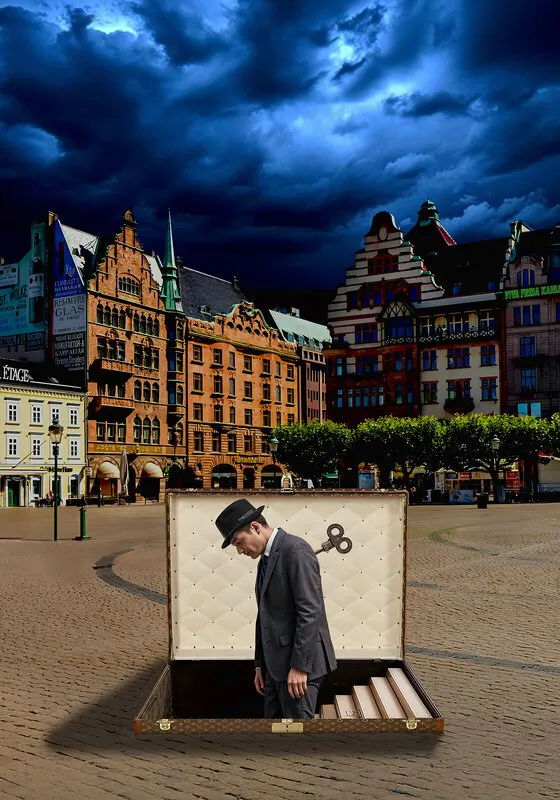
The image captures the essence of ’Death of a Salesman’ in a contemporary context. The bowed man and his suitcase in Stortorget, Malmö—with a wind-up key in his back and storm clouds gathering overhead—serve as a visual metaphor for the entire story of a man attempting to fit into a system that ceased to care long ago. The suitcase is both office and coffin, representing working life and the final destination. The staircase descends, not towards career advancement, but towards disappearance.
His presence in Malmö also resonates with what is stated in the epilogue: Willy Loman could just as easily have lived here. And Stortorget itself—with its blend of Jugendstil and bourgeois Baroque, nouveau-riche façades and modern glass storefronts—perfectly reflects the tension between old ideals and new economic realities.
The fact that the play has been staged three times at Malmö Stadsteater, first in 1950 and most recently in 2019, underscores its enduring global relevance and the universality of its themes.
Summary and Background
Arthur Miller’s ‘Death of a Salesman’, first staged in 1949, stands as a cornerstone of modern American drama, both for its stylistic innovation and its unflinching dissection of national ideals. At the centre is Willy Loman, a sixty-three-year-old travelling salesman who has spent his life chasing success, only to find himself worn down, directionless, and largely forgotten. The play unfolds through a fluid structure that shifts between the present and fragmented memories, revealing not only Willy’s past but also the psychological terrain of disappointment, self-delusion, and longing that he inhabits.
From its premiere, the play has been hailed not just as a personal tragedy but as a profound critique of American society. Miller crafted Death of a Salesman at a time when the United States, emerging victorious from World War II, was redefining its identity around consumer capitalism and suburban expansion. The salesman became both a symbol of promise and a cautionary figure—a man whose worth was measured not by character, but by charisma, earnings, and connections. Willy Loman, who believes wholeheartedly in these values, is ultimately crushed by them.
Unlike earlier dramatic heroes of aristocratic birth, Willy is an ordinary man, an everyman. His tragedy is not that of kings and princes, but of a typical worker who cannot reconcile the vast distance between his dreams and his actual life. This marked a radical redefinition of the tragic form, one that Miller argued for explicitly in his famous 1949 essay “Tragedy and the Common Man”. In this context, the play not only questions American myths of meritocracy and success but also reimagines classical tragedy for a modern, democratic audience. This critique of American myths invites us to reconsider our societal values and the true nature of success.
The cultural context is crucial. In postwar America, the economy was booming, but so was anxiety. Men like Willy were supposed to thrive in a society that promised upward mobility through hard work and likability. But for many, those promises proved hollow. The tension between appearance and substance, between public performance and private despair, defines both Willy’s life and the cultural moment Miller portrays. This reflection on the cultural moment invites us to empathise with Willy's struggle and understand the societal pressures that contributed to his tragic end.
In ‘Death of a Salesman’, Miller holds up a mirror to a society intoxicated by its rhetoric of success. The result is a deeply human drama that remains startlingly relevant in an age still grappling with precarity, image culture, and the cost of ambition. By placing a man like Willy Loman at the centre of a tragic narrative, Miller democratised pathos—and issued a lasting challenge to American exceptionalism. This enduring relevance invites us to reflect on our societal values and the human cost of our relentless pursuit of success.
The Modern Tragic Hero
Willy Loman is neither king nor warrior, yet Arthur Miller insists he is tragic. In doing so, Miller challenges the Aristotelian definition of tragedy, which traditionally centres on nobility brought low by a fatal flaw (hamartia). Instead, Death of a Salesman positions an ordinary man at the heart of a mythic fall, not because he commits a grand error, but because the very structure of the world he inhabits is built on illusions. Miller's argument—articulated both dramatically and in his essay “Tragedy and the Common Man”—is that the commoner is as apt a subject for tragedy as any Oedipus or Hamlet, especially in a modern society where dreams have become institutionalised and mass-produced.
Willy’s tragedy lies not merely in his personal and professional failure, but in his absolute devotion to a false narrative of success. He clings to outdated ideals—charisma, likability, networking—as sufficient for prosperity. This illusion, inherited from the sales culture of early 20th-century America, is no longer sustainable in the world he inhabits. His slow psychological unravelling is painful to watch because it is not marked by melodrama but by the accumulation of missed cues, alienated sons, half-remembered boasts, and self-deception. Willy cannot accept the quiet dignity of being “liked but not well-liked,” nor can he see his worth outside the context of commerce. In this sense, his tragedy is both spiritual and social in nature.
Willy Loman, in many ways, is the archetype for the modern burnout figure: overworked, undervalued, and displaced in a system that no longer needs him. His spiritual descendants can be seen across contemporary culture, making his struggle a universal one. One notable example is in Joshua Ferris’ Then We Came to the End (2007), a novel that paints a darkly comic portrait of white-collar burnout in a failing advertising agency, where workers cling to rituals and office furniture with the same desperate hope as Willy clings to his smile. Another is Walter White from Breaking Bad, who, after years of being overlooked and underpaid as a high school chemistry teacher, turns to crime, justifying his moral descent as a belated act of masculine self-assertion. Though very different in tone, Walter and Willy share the same core wound: an inability to accept powerlessness in a system built to discard them.
In theatre, Stephen Sondheim’s Company (1970) and, more recently, Dear Evan Hansen (2015) echo Miller’s concern with personal identity amid social expectations. While not tragic in the classical sense, these musicals delve into the psychological toll of performance—social, emotional, and professional—and the loneliness that often accompanies it. In cinema, one might compare Willy to Lester Burnham in ’American Beauty ’(1999), a man who realises too late that his suburban life has been a hollow performance. His rebellion is short-lived and ends in death, suggesting again that disillusionment may come too late to heal what is broken.
Even the figure of the washed-up entertainer in Darren Aronofsky’s ’The Wrestler ’(2008) carries the Loman legacy: Randy “The Ram” Robinson is a man whose identity has been consumed by a role he can no longer perform. Like Willy, he chooses the illusion over the quiet survival that might have saved him. Their shared tragedy lies in this refusal to adapt.
What all these figures share with Willy Loman is not just exhaustion, but a desperate need for meaning in a world that rewards appearance over substance. Their arcs are cautionary tales—not just of ambition, but of cultural misalignment, of people whose inner narratives no longer align with the social scripts, societal norms, and expectations they are expected to follow.
Willy Loman’s tragedy is not a dated one, but a prescient one. He is the canary in the capitalist coal mine, singing until he collapses under the weight of a dream that was never designed to include him. His story, despite being set in a specific time and place, resonates with the struggles of individuals in any era, making his tragedy a timeless one.
In today's world, Willy Loman would not simply bear the burden of outdated ideals; he would also be locked in a relentless battle for relevance across social platforms. The pressure to perform has multiplied. On LinkedIn, workers curate professional personas that must exude confidence, innovation, and tireless ambition. On Instagram and Facebook, they are expected to showcase lifestyles that affirm their success: not just hard-working, but fulfilled, aesthetically pleasing, and well-travelled. For younger generations, TikTok adds another layer: rapid-fire content creation, where personality, trend awareness, and likability determine not only social capital but also real-world opportunities. These platforms encourage constant self-branding, turning individuals into products in an unceasing attention economy.
And as if the pressure from other humans were not enough, the newest competitor is no longer across the street, but across the circuit board. Artificial intelligence is rapidly entering white-collar fields, not only mimicking but often outperforming human capacity in writing, image creation, data analysis, and decision-making. These systems do not tire, do not age, and do not ask for weekends. The anxiety of being replaced is no longer confined to factory floors; it now reaches the desks of copywriters, designers, financial analysts, and yes, even salespeople.
In such a landscape, the ghosts of missed opportunities would not just haunt Willy Loman, but also an algorithm that never forgets, never falters, and never sleeps. The tragedy is not only that humans fail to meet societal expectations, but that inhuman standards increasingly shape these expectations.
Family Dynamics and Generational Conflict
These plays, despite being written in different cultural and temporal contexts, serve as a study of generational tension and familial disappointment that is still relevant today. The characters' struggles with societal expectations and their impact on family dynamics are issues that continue to resonate with audiences. The play also serves as a study of generational tension and familial disappointment. Willy's relationships with his sons, Biff and Happy, are steeped in projection and misunderstanding. Biff, once the golden boy, has grown disillusioned with the capitalist script his father endeavoured to impose on him. His failure to become "something big" is interpreted by Willy as betrayal, while Biff views it as a form of liberation. Linda, Willy's wife, functions as both caregiver and silent witness, caught between loyalty and helplessness. The family's conversations often descend into chaos, mirroring the fragmented nature of Willy's mind. Miller employs domestic space as a battleground for broader social anxieties, illustrating how dreams, expectations, and delusions are passed down and either inherited or rejected.
The domestic settings in both plays serve as a microcosm of the societal pressures and generational conflicts the characters face. In Willy Loman's modest home, we see the struggle to uphold the American Dream, while in Lars Norén's play, the middle-class home becomes a battleground for emotional and psychological turmoil. These settings are not just backdrops, but integral to the exploration of the plays' themes. This domestic battlefield finds a Nordic counterpart in ’Natten är dagens mor ’(Night Is the Mother of Day), a 1982 play by Swedish dramatist Lars Norén. In Norén’s semi-autobiographical family drama, we encounter a father in psychological and social decline—an alcoholic, embittered patriarch unable to nurture, provide, or lead. Like Willy, Norén’s father figure is trapped in a version of manhood that has lost its meaning. Both plays unfold in modest middle-class homes, where the family's emotional economy collapses in tandem with the father's failing authority.
In both works, the sons represent different reactions to a crumbling paternal myth: one rejects it, while the other cynically adapts to it. In both cases, the mothers are stoic, suffering figures, protecting what little remains of the family’s dignity. Silence carries equal weight in both plays—pregnant, accusatory, and more revealing than any argument.
While Miller portrays the American Dream as the corrosive ideal haunting the Loman household, Norén’s characters navigate a more abstract existential landscape, marked by emotional estrangement and repressed trauma. Yet the core remains the same: fathers who fall and sons who must choose whether to bear the ruins or walk away. These plays are not just about individual family dynamics, but about the larger societal issues that shape them, such as the pressure to conform to societal expectations and the struggle to find meaning in a changing world.
The American Dream – A Deconstructed Myth
At the heart of ‘Death of a Salesman’ lies a powerful critique of the American Dream. Willy Loman embodies the most seductive yet ultimately toxic promises: that anyone, regardless of background, can succeed through sheer charm, perseverance, and likability. However, Miller presents us with a man crumbling under the weight of those ideals. Willy’s unwavering belief in a meritocratic dream blinds him to the realities of structural inequality, economic brutality, and shifting cultural tides. He is not merely a failed man but rather a victim of a failed mythology.
What makes this deconstruction even more poignant is how the American Dream, since Miller’s time, has metastasised far beyond the borders of postwar America. It has become a global export—adopted, rebranded, and then questioned in societies across the West. In countries like Sweden and Denmark, where social security and collectivist ideals once seemed immune, the dream of individual triumph through hard work has seeped in, often contradicting existing values. Even there, the salesman archetype has infiltrated offices, classrooms, and living rooms.
By the 1970s, the cracks in the Dream had become too glaring to ignore. The Vietnam War, televised into the heart of the middle class, eroded blind faith in authority. The student revolts of ’68 and the broader rise of the New Left awakened a generation to the cost of conformity. For the traditional patriarch, once the unchallenged provider and moral authority, this was a period of deep identity crisis. In progressive circles, he was now expected to reinvent himself as a more nurturing, emotionally available figure. Thus emerged the “velour man,” or ‘velourpappa’ in Sweden—a man who swapped his briefcase for childcare duties, his masculinity for plush tracksuits. The very term “velour dad” carried an undertone of ridicule, implying softness where once there was steel.
This cultural shift placed the modern man in a double bind. While professional life still demanded productivity, resilience, and results, private life now called for vulnerability, empathy, and presence. The burden of embodying both archetypes—provider and nurturer—created a psychological whiplash that many never resolved. Miller’s Willy Loman, though rooted in the 1940s, can be seen as a prophetic figure: the forerunner of the exhausted, overextended modern male, who tries and fails to meet expectations from all directions.
Willy’s tragedy, then, is not an isolated American parable but a cautionary tale for any society that values performance over personhood. His downfall embodies a larger cultural betrayal—a system that seduces with hope, exploits with silence, and discards with indifference.
Themes, Style, and Symbolism
‘Death of a Salesman’ is a masterclass in how style and symbolism can be employed to illuminate psychological depth and social critique. Arthur Miller blends realism with expressionist techniques to externalise the inner life of his protagonist. Through fragmented timelines, hallucinated dialogue, and dreamlike sequences, the audience is immersed in Willy Loman’s deteriorating consciousness. Time bends, memories blur into present action, and the past intrudes upon the present—not to clarify, but to haunt. In this disjointed temporal structure, Miller invites us not merely to observe Willy’s descent, but to inhabit it.
Symbolism, too, plays a central role. The seeds that Willy plants in the barren backyard are a desperate metaphor for legacy—his need to nurture something that will outlast him, despite knowing the soil is infertile. The new tape recorder, which he cannot operate, serves as a modern intrusion—a sleek, impersonal object that exposes Willy’s irrelevance in a world racing ahead of him. It is not merely a plot device but a symbol of technological estrangement. Willy’s failure to master the machine represents his failure to navigate the present. In a culture increasingly defined by its gadgets and innovations, he is a man out of time.
This motif is uncannily prescient. In today’s world, the generational divide is no longer solely about values or culture, but about competence with digital tools. Many modern fathers and grandfathers find themselves reliant on their children, not for financial support, but for tech support. From streaming services to app passwords, social media etiquette to cloud storage, the older generation is often relegated to a subordinate position, requiring constant assistance from younger, more agile “digital natives.” This shift subtly erodes traditional authority structures. It also breeds new forms of quiet humiliation, as the dinner table transforms into a scene of reversed expertise. And the struggle doesn’t end at home: father and son now also meet—awkwardly—on platforms like Facebook, LinkedIn, or even WhatsApp, where misused emojis or all-caps texts become small but telling signals of generational dislocation.
Willy’s symbolic entrapment resonates anew in this context. His inability to operate the tape recorder feels eerily familiar in a time when machines seem to evolve faster than humans can adapt. The symbolism has only grown sharper with time—what was once a tape recorder is now an algorithm, a crypto wallet, or a videoconferencing platform. The struggle to be relevant continues, but the tools have changed.
Thematically, the play conceives identity, memory, masculinity, failure, and death. It interrogates what happens when a man’s value is tethered entirely to his ability to produce and provide. It examines the fragility of male self-esteem when it is built upon a foundation of economic worth. Willy’s death is not simply tragic because of its finality—it is sad because he never discovers an identity beyond his job title.
‘Death of a Salesman’ remains a searing critique of a world that confuses achievement with meaning and visibility with value. Through its rich stylistic layers and enduring symbols, the play continues to pose the question: What do we owe each other, and what do we lose when society forgets to answer? Its themes of identity, memory, masculinity, failure, and death remain as relevant today as they were when Miller first penned them.
Legacy, Adaptations, and Reception
Since its premiere in 1949, ‘Death of a Salesman’ has not only become one of the most frequently revived and adapted plays in modern theatre history, but it has also maintained its relevance in contemporary society. From Broadway revivals to televised productions and cinematic interpretations—including the 1985 film with Dustin Hoffman and the acclaimed 2022 Broadway production featuring Wendell Pierce as Willy—Arthur Miller's text continues to attract actors, directors, and audiences drawn to its emotional and thematic depth. The play has transcended its original context, evolving into a universal story of failure, identity, and economic fragility that still resonates today.
Willy Loman has entered the cultural lexicon as the quintessential everyman—an emblem of all those who believed in the promise of success only to be crushed under the weight of its contradictions. In this sense, ‘Death of a Salesman’ anticipated the language of burnout, of impostor syndrome, and emotional bankruptcy in the face of corporate culture. His reception has been overwhelmingly respectful, though at times critical of what some see as Miller’s moral earnestness or emotional manipulation. Still, few deny the play’s power or its central role in shaping postwar drama. Willy Loman's character is not just a literary figure, but a reflection of our struggles and aspirations.
In recent decades, new figures have emerged in literature, film, and television that echo or reinterpret the Loman archetype. Don Draper from ‘Mad Men’ is perhaps the most obvious spiritual descendant—a man who achieves success while concealing a hollow core, alienated from the very life he appears to have mastered. In Noah Baumbach’s ‘The Squid and the Whale’, the father character, Bernard, represents another crumbling patriarch: once brilliant, now pitiful and inept, losing both relevance and dignity in a changing world. Even characters like BoJack Horseman, the animated washed-up sitcom star, carry the Loman torch in new, surreal forms: depressed, self-sabotaging, and trapped by outdated scripts of fame and success.
These figures, like Willy, are not heroic in the traditional sense. They are tragic not because of their greatness, but due to their ordinariness. They fall from modest heights, yet their descent illuminates broader systemic problems—economic precarity, masculine obsolescence, and generational disillusionment. If anything, modern media has embraced the Loman prototype even more explicitly than mid-century drama once dared. The consensus seems to be: it is still, and perhaps even more so today, poor old Willy.
Moreover, the character’s symbolic weight has evolved with the times. In the 1950s, Willy embodied a failed American Dream. Today, he may represent algorithmic irrelevance, the ageing worker in a tech-startup world that fetishises youth and disruption. He could now be the Uber driver with back pain, the call centre worker with a philosophy degree, or the middle manager pushed out by AI. In each of these incarnations, Willy endures—not just as a character, but as a reflection of the dreams that capitalism promotes and the human wreckage it too often leaves behind.
Arthur Miller once wrote that a tragic hero is someone “who is ready to lay down his life, if need be, to secure one thing—his sense of personal dignity.” Willy Loman may have died chasing a delusion, but his struggle for dignity still resonates—and his silhouette continues to cast a long shadow across our cultural landscape.
Epilogue: Willy Loman in Our Time
Very little would need to change to transplant Willy Loman into the present day. He could just as easily reside in Malmö or Copenhagen, commuting to a co-working hub in Hyllie, selling mobile phone subscriptions or working in “customer relations” at a tech firm. He might wear a headset and stand at a height-adjustable desk, sit through Monday morning meetings filled with PowerPoint visions of “growth” and “customer journeys.” Perhaps he would maintain a LinkedIn profile with a strained smile for a profile picture and receive automated congratulations for the tenth anniversary of a job he no longer takes pride in. Most notably, a new competitor has emerged: women. Not only does he still compete with his male colleagues, but he now also contends with women who are often better educated and more socially adept.
It’s easy to assume that the type of salesman Willy once was is a relic of the past. Today's salespeople use different tools and speak a different language—CRM platforms instead of shoe-polish smiles and business cards. But the pressure remains. The targets, the demands, the expectations—they’ve migrated into spreadsheets and KPI dashboards. What has changed is that nearly every profession today contains elements of sales. Not necessarily the sale of goods, but of the self.
In a working world where nearly everything has become “service,” it’s no longer enough to do your job—you must also market a version of yourself. It doesn’t matter whether you're a psychologist, a university lecturer, a nurse assistant or an IT consultant—everyone is expected to be presentable, accessible, and solution-oriented. The patient is now a client. The student is a client. The care recipient is a client. And the client is always right—even when you’re the one burning out.
This necessitates constant vigilance. You must stay sharp, keep your game face on, present your best self—even when you're exhausted, even when you're fifty-five and your manager is thirty, even when algorithms rank how many smiles you've logged this week. It's a professional culture that rewards what is marketable and youthful. Ageing, slowness, and life experience easily lose value in an economy that speaks more fluently about innovation than wisdom.
So, Willy Loman is not merely a man of postwar 1940s America. He is our neighbour, our colleague—perhaps even our mirror image. His tragedy is not confined to his era; it is universal. In a world of work where the human being is increasingly reduced to a product, Willy’s story becomes all the more relevant. His experiences are not unique, but shared by many in today's society, making his story a powerful reflection of the collective struggles of our time.
Final Reflections
In the end, Death of a Salesman is not just a story about one man’s downfall—it is a mirror held up to a society that builds dreams it cannot sustain. Willy Loman’s life may have unravelled in 1949, but the threads of his despair stretch well into the 21st century. His longing to be seen, valued, and remembered echoes in the algorithms that now shape our worth, in the metrics that measure performance rather than personhood. Perhaps what makes the play endure is not its historical specificity but its quiet, insistent reminder: that behind every spreadsheet, slogan, and sales pitch, there is still a human being aching to be enough.
Jörgen Thornberg
Death of a Salesman, 2025
Digital
50 x 70 cm
3 200 kr
Death of a Salesman
This is not merely a story about the fall of a man; it is a quiet explosion—one that continues to echo through offices, kitchens, commuter trains, and empty sales meetings across generations. When Death of a Salesman first premiered in 1949, audiences were confronted with something both familiar and unspoken: the tragedy of being ordinary in a world that demands the extraordinary. Willy Loman, Arthur Miller’s quietly desperate protagonist, is neither a monster nor a saint; he is simply a man trying to make a difference. His story, however, is not just a tale of one man's struggle, but a reflection of the human condition that transcends time and place.
Yet it is precisely this ordinariness that makes his downfall so devastating—and so enduring. Willy is not just a character; he could be anyone in your life. He could be your father, your neighbour, or the man ahead of you in the coffee queue rehearsing his pitch. And perhaps, in quieter moments, he is also you.
This essay revisits ‘Death of a Salesman’ through both a historical and contemporary lens, examining not only its original context but also how its insights on failure, illusion, family, and capitalism continue to resonate painfully true in an age of LinkedIn endorsements, burnout, and curated selfhood. These themes are not confined to the past; they are as relevant today as they were in Willy's time.
Discover a unique perspective on Miller’s Death of a Salesman with a 2025 lens, a contemporary view that takes into account the changes and challenges of our time. This lens allows us to explore why this story, with its timeless themes, remains a compelling read even in today's world.
”The Suit of Salesman’s Armour
Willy rode not on a horse, but on a train,
His lance was a worn-out ballpoint pen,
In his briefcase—dreams once plain—
Now, yellowed scripts of "if" and "when."
His steed? A Plymouth lost to rust,
Its wheels spun tales of deals once sealed,
But in the dust of broken trust,
The dragons of success revealed.
He faced not windmills, proud and tall,
But quarterly goals and vacant stares,
A manager’s cold protocol,
And LinkedIn posts of perfect heirs.
He fought in PowerPoint and pitch,
With armour made of ageing charm,
Against the youthful, glossy-rich
Whose brands could do what he meant: harm.
No Sancho by his side to cheer,
Only echoes in an empty booth,
A voice that cracked with hope and fear,
Still shouting myths instead of truth.
But in the twilight of his cause,
He saw not madness, but design—
That glory rests in loud applause
Of knowing loss was truly mine.
So let him fall, this modern knight,
Amid the cubicles and gloss.
For all his failure, he burned bright—
A martyr to the Dream’s final loss.”
Malmö, June 2025
A Man, a Briefcase, a Broken Dream
The image captures the essence of ’Death of a Salesman’ in a contemporary context. The bowed man and his suitcase in Stortorget, Malmö—with a wind-up key in his back and storm clouds gathering overhead—serve as a visual metaphor for the entire story of a man attempting to fit into a system that ceased to care long ago. The suitcase is both office and coffin, representing working life and the final destination. The staircase descends, not towards career advancement, but towards disappearance.
His presence in Malmö also resonates with what is stated in the epilogue: Willy Loman could just as easily have lived here. And Stortorget itself—with its blend of Jugendstil and bourgeois Baroque, nouveau-riche façades and modern glass storefronts—perfectly reflects the tension between old ideals and new economic realities.
The fact that the play has been staged three times at Malmö Stadsteater, first in 1950 and most recently in 2019, underscores its enduring global relevance and the universality of its themes.
Summary and Background
Arthur Miller’s ‘Death of a Salesman’, first staged in 1949, stands as a cornerstone of modern American drama, both for its stylistic innovation and its unflinching dissection of national ideals. At the centre is Willy Loman, a sixty-three-year-old travelling salesman who has spent his life chasing success, only to find himself worn down, directionless, and largely forgotten. The play unfolds through a fluid structure that shifts between the present and fragmented memories, revealing not only Willy’s past but also the psychological terrain of disappointment, self-delusion, and longing that he inhabits.
From its premiere, the play has been hailed not just as a personal tragedy but as a profound critique of American society. Miller crafted Death of a Salesman at a time when the United States, emerging victorious from World War II, was redefining its identity around consumer capitalism and suburban expansion. The salesman became both a symbol of promise and a cautionary figure—a man whose worth was measured not by character, but by charisma, earnings, and connections. Willy Loman, who believes wholeheartedly in these values, is ultimately crushed by them.
Unlike earlier dramatic heroes of aristocratic birth, Willy is an ordinary man, an everyman. His tragedy is not that of kings and princes, but of a typical worker who cannot reconcile the vast distance between his dreams and his actual life. This marked a radical redefinition of the tragic form, one that Miller argued for explicitly in his famous 1949 essay “Tragedy and the Common Man”. In this context, the play not only questions American myths of meritocracy and success but also reimagines classical tragedy for a modern, democratic audience. This critique of American myths invites us to reconsider our societal values and the true nature of success.
The cultural context is crucial. In postwar America, the economy was booming, but so was anxiety. Men like Willy were supposed to thrive in a society that promised upward mobility through hard work and likability. But for many, those promises proved hollow. The tension between appearance and substance, between public performance and private despair, defines both Willy’s life and the cultural moment Miller portrays. This reflection on the cultural moment invites us to empathise with Willy's struggle and understand the societal pressures that contributed to his tragic end.
In ‘Death of a Salesman’, Miller holds up a mirror to a society intoxicated by its rhetoric of success. The result is a deeply human drama that remains startlingly relevant in an age still grappling with precarity, image culture, and the cost of ambition. By placing a man like Willy Loman at the centre of a tragic narrative, Miller democratised pathos—and issued a lasting challenge to American exceptionalism. This enduring relevance invites us to reflect on our societal values and the human cost of our relentless pursuit of success.
The Modern Tragic Hero
Willy Loman is neither king nor warrior, yet Arthur Miller insists he is tragic. In doing so, Miller challenges the Aristotelian definition of tragedy, which traditionally centres on nobility brought low by a fatal flaw (hamartia). Instead, Death of a Salesman positions an ordinary man at the heart of a mythic fall, not because he commits a grand error, but because the very structure of the world he inhabits is built on illusions. Miller's argument—articulated both dramatically and in his essay “Tragedy and the Common Man”—is that the commoner is as apt a subject for tragedy as any Oedipus or Hamlet, especially in a modern society where dreams have become institutionalised and mass-produced.
Willy’s tragedy lies not merely in his personal and professional failure, but in his absolute devotion to a false narrative of success. He clings to outdated ideals—charisma, likability, networking—as sufficient for prosperity. This illusion, inherited from the sales culture of early 20th-century America, is no longer sustainable in the world he inhabits. His slow psychological unravelling is painful to watch because it is not marked by melodrama but by the accumulation of missed cues, alienated sons, half-remembered boasts, and self-deception. Willy cannot accept the quiet dignity of being “liked but not well-liked,” nor can he see his worth outside the context of commerce. In this sense, his tragedy is both spiritual and social in nature.
Willy Loman, in many ways, is the archetype for the modern burnout figure: overworked, undervalued, and displaced in a system that no longer needs him. His spiritual descendants can be seen across contemporary culture, making his struggle a universal one. One notable example is in Joshua Ferris’ Then We Came to the End (2007), a novel that paints a darkly comic portrait of white-collar burnout in a failing advertising agency, where workers cling to rituals and office furniture with the same desperate hope as Willy clings to his smile. Another is Walter White from Breaking Bad, who, after years of being overlooked and underpaid as a high school chemistry teacher, turns to crime, justifying his moral descent as a belated act of masculine self-assertion. Though very different in tone, Walter and Willy share the same core wound: an inability to accept powerlessness in a system built to discard them.
In theatre, Stephen Sondheim’s Company (1970) and, more recently, Dear Evan Hansen (2015) echo Miller’s concern with personal identity amid social expectations. While not tragic in the classical sense, these musicals delve into the psychological toll of performance—social, emotional, and professional—and the loneliness that often accompanies it. In cinema, one might compare Willy to Lester Burnham in ’American Beauty ’(1999), a man who realises too late that his suburban life has been a hollow performance. His rebellion is short-lived and ends in death, suggesting again that disillusionment may come too late to heal what is broken.
Even the figure of the washed-up entertainer in Darren Aronofsky’s ’The Wrestler ’(2008) carries the Loman legacy: Randy “The Ram” Robinson is a man whose identity has been consumed by a role he can no longer perform. Like Willy, he chooses the illusion over the quiet survival that might have saved him. Their shared tragedy lies in this refusal to adapt.
What all these figures share with Willy Loman is not just exhaustion, but a desperate need for meaning in a world that rewards appearance over substance. Their arcs are cautionary tales—not just of ambition, but of cultural misalignment, of people whose inner narratives no longer align with the social scripts, societal norms, and expectations they are expected to follow.
Willy Loman’s tragedy is not a dated one, but a prescient one. He is the canary in the capitalist coal mine, singing until he collapses under the weight of a dream that was never designed to include him. His story, despite being set in a specific time and place, resonates with the struggles of individuals in any era, making his tragedy a timeless one.
In today's world, Willy Loman would not simply bear the burden of outdated ideals; he would also be locked in a relentless battle for relevance across social platforms. The pressure to perform has multiplied. On LinkedIn, workers curate professional personas that must exude confidence, innovation, and tireless ambition. On Instagram and Facebook, they are expected to showcase lifestyles that affirm their success: not just hard-working, but fulfilled, aesthetically pleasing, and well-travelled. For younger generations, TikTok adds another layer: rapid-fire content creation, where personality, trend awareness, and likability determine not only social capital but also real-world opportunities. These platforms encourage constant self-branding, turning individuals into products in an unceasing attention economy.
And as if the pressure from other humans were not enough, the newest competitor is no longer across the street, but across the circuit board. Artificial intelligence is rapidly entering white-collar fields, not only mimicking but often outperforming human capacity in writing, image creation, data analysis, and decision-making. These systems do not tire, do not age, and do not ask for weekends. The anxiety of being replaced is no longer confined to factory floors; it now reaches the desks of copywriters, designers, financial analysts, and yes, even salespeople.
In such a landscape, the ghosts of missed opportunities would not just haunt Willy Loman, but also an algorithm that never forgets, never falters, and never sleeps. The tragedy is not only that humans fail to meet societal expectations, but that inhuman standards increasingly shape these expectations.
Family Dynamics and Generational Conflict
These plays, despite being written in different cultural and temporal contexts, serve as a study of generational tension and familial disappointment that is still relevant today. The characters' struggles with societal expectations and their impact on family dynamics are issues that continue to resonate with audiences. The play also serves as a study of generational tension and familial disappointment. Willy's relationships with his sons, Biff and Happy, are steeped in projection and misunderstanding. Biff, once the golden boy, has grown disillusioned with the capitalist script his father endeavoured to impose on him. His failure to become "something big" is interpreted by Willy as betrayal, while Biff views it as a form of liberation. Linda, Willy's wife, functions as both caregiver and silent witness, caught between loyalty and helplessness. The family's conversations often descend into chaos, mirroring the fragmented nature of Willy's mind. Miller employs domestic space as a battleground for broader social anxieties, illustrating how dreams, expectations, and delusions are passed down and either inherited or rejected.
The domestic settings in both plays serve as a microcosm of the societal pressures and generational conflicts the characters face. In Willy Loman's modest home, we see the struggle to uphold the American Dream, while in Lars Norén's play, the middle-class home becomes a battleground for emotional and psychological turmoil. These settings are not just backdrops, but integral to the exploration of the plays' themes. This domestic battlefield finds a Nordic counterpart in ’Natten är dagens mor ’(Night Is the Mother of Day), a 1982 play by Swedish dramatist Lars Norén. In Norén’s semi-autobiographical family drama, we encounter a father in psychological and social decline—an alcoholic, embittered patriarch unable to nurture, provide, or lead. Like Willy, Norén’s father figure is trapped in a version of manhood that has lost its meaning. Both plays unfold in modest middle-class homes, where the family's emotional economy collapses in tandem with the father's failing authority.
In both works, the sons represent different reactions to a crumbling paternal myth: one rejects it, while the other cynically adapts to it. In both cases, the mothers are stoic, suffering figures, protecting what little remains of the family’s dignity. Silence carries equal weight in both plays—pregnant, accusatory, and more revealing than any argument.
While Miller portrays the American Dream as the corrosive ideal haunting the Loman household, Norén’s characters navigate a more abstract existential landscape, marked by emotional estrangement and repressed trauma. Yet the core remains the same: fathers who fall and sons who must choose whether to bear the ruins or walk away. These plays are not just about individual family dynamics, but about the larger societal issues that shape them, such as the pressure to conform to societal expectations and the struggle to find meaning in a changing world.
The American Dream – A Deconstructed Myth
At the heart of ‘Death of a Salesman’ lies a powerful critique of the American Dream. Willy Loman embodies the most seductive yet ultimately toxic promises: that anyone, regardless of background, can succeed through sheer charm, perseverance, and likability. However, Miller presents us with a man crumbling under the weight of those ideals. Willy’s unwavering belief in a meritocratic dream blinds him to the realities of structural inequality, economic brutality, and shifting cultural tides. He is not merely a failed man but rather a victim of a failed mythology.
What makes this deconstruction even more poignant is how the American Dream, since Miller’s time, has metastasised far beyond the borders of postwar America. It has become a global export—adopted, rebranded, and then questioned in societies across the West. In countries like Sweden and Denmark, where social security and collectivist ideals once seemed immune, the dream of individual triumph through hard work has seeped in, often contradicting existing values. Even there, the salesman archetype has infiltrated offices, classrooms, and living rooms.
By the 1970s, the cracks in the Dream had become too glaring to ignore. The Vietnam War, televised into the heart of the middle class, eroded blind faith in authority. The student revolts of ’68 and the broader rise of the New Left awakened a generation to the cost of conformity. For the traditional patriarch, once the unchallenged provider and moral authority, this was a period of deep identity crisis. In progressive circles, he was now expected to reinvent himself as a more nurturing, emotionally available figure. Thus emerged the “velour man,” or ‘velourpappa’ in Sweden—a man who swapped his briefcase for childcare duties, his masculinity for plush tracksuits. The very term “velour dad” carried an undertone of ridicule, implying softness where once there was steel.
This cultural shift placed the modern man in a double bind. While professional life still demanded productivity, resilience, and results, private life now called for vulnerability, empathy, and presence. The burden of embodying both archetypes—provider and nurturer—created a psychological whiplash that many never resolved. Miller’s Willy Loman, though rooted in the 1940s, can be seen as a prophetic figure: the forerunner of the exhausted, overextended modern male, who tries and fails to meet expectations from all directions.
Willy’s tragedy, then, is not an isolated American parable but a cautionary tale for any society that values performance over personhood. His downfall embodies a larger cultural betrayal—a system that seduces with hope, exploits with silence, and discards with indifference.
Themes, Style, and Symbolism
‘Death of a Salesman’ is a masterclass in how style and symbolism can be employed to illuminate psychological depth and social critique. Arthur Miller blends realism with expressionist techniques to externalise the inner life of his protagonist. Through fragmented timelines, hallucinated dialogue, and dreamlike sequences, the audience is immersed in Willy Loman’s deteriorating consciousness. Time bends, memories blur into present action, and the past intrudes upon the present—not to clarify, but to haunt. In this disjointed temporal structure, Miller invites us not merely to observe Willy’s descent, but to inhabit it.
Symbolism, too, plays a central role. The seeds that Willy plants in the barren backyard are a desperate metaphor for legacy—his need to nurture something that will outlast him, despite knowing the soil is infertile. The new tape recorder, which he cannot operate, serves as a modern intrusion—a sleek, impersonal object that exposes Willy’s irrelevance in a world racing ahead of him. It is not merely a plot device but a symbol of technological estrangement. Willy’s failure to master the machine represents his failure to navigate the present. In a culture increasingly defined by its gadgets and innovations, he is a man out of time.
This motif is uncannily prescient. In today’s world, the generational divide is no longer solely about values or culture, but about competence with digital tools. Many modern fathers and grandfathers find themselves reliant on their children, not for financial support, but for tech support. From streaming services to app passwords, social media etiquette to cloud storage, the older generation is often relegated to a subordinate position, requiring constant assistance from younger, more agile “digital natives.” This shift subtly erodes traditional authority structures. It also breeds new forms of quiet humiliation, as the dinner table transforms into a scene of reversed expertise. And the struggle doesn’t end at home: father and son now also meet—awkwardly—on platforms like Facebook, LinkedIn, or even WhatsApp, where misused emojis or all-caps texts become small but telling signals of generational dislocation.
Willy’s symbolic entrapment resonates anew in this context. His inability to operate the tape recorder feels eerily familiar in a time when machines seem to evolve faster than humans can adapt. The symbolism has only grown sharper with time—what was once a tape recorder is now an algorithm, a crypto wallet, or a videoconferencing platform. The struggle to be relevant continues, but the tools have changed.
Thematically, the play conceives identity, memory, masculinity, failure, and death. It interrogates what happens when a man’s value is tethered entirely to his ability to produce and provide. It examines the fragility of male self-esteem when it is built upon a foundation of economic worth. Willy’s death is not simply tragic because of its finality—it is sad because he never discovers an identity beyond his job title.
‘Death of a Salesman’ remains a searing critique of a world that confuses achievement with meaning and visibility with value. Through its rich stylistic layers and enduring symbols, the play continues to pose the question: What do we owe each other, and what do we lose when society forgets to answer? Its themes of identity, memory, masculinity, failure, and death remain as relevant today as they were when Miller first penned them.
Legacy, Adaptations, and Reception
Since its premiere in 1949, ‘Death of a Salesman’ has not only become one of the most frequently revived and adapted plays in modern theatre history, but it has also maintained its relevance in contemporary society. From Broadway revivals to televised productions and cinematic interpretations—including the 1985 film with Dustin Hoffman and the acclaimed 2022 Broadway production featuring Wendell Pierce as Willy—Arthur Miller's text continues to attract actors, directors, and audiences drawn to its emotional and thematic depth. The play has transcended its original context, evolving into a universal story of failure, identity, and economic fragility that still resonates today.
Willy Loman has entered the cultural lexicon as the quintessential everyman—an emblem of all those who believed in the promise of success only to be crushed under the weight of its contradictions. In this sense, ‘Death of a Salesman’ anticipated the language of burnout, of impostor syndrome, and emotional bankruptcy in the face of corporate culture. His reception has been overwhelmingly respectful, though at times critical of what some see as Miller’s moral earnestness or emotional manipulation. Still, few deny the play’s power or its central role in shaping postwar drama. Willy Loman's character is not just a literary figure, but a reflection of our struggles and aspirations.
In recent decades, new figures have emerged in literature, film, and television that echo or reinterpret the Loman archetype. Don Draper from ‘Mad Men’ is perhaps the most obvious spiritual descendant—a man who achieves success while concealing a hollow core, alienated from the very life he appears to have mastered. In Noah Baumbach’s ‘The Squid and the Whale’, the father character, Bernard, represents another crumbling patriarch: once brilliant, now pitiful and inept, losing both relevance and dignity in a changing world. Even characters like BoJack Horseman, the animated washed-up sitcom star, carry the Loman torch in new, surreal forms: depressed, self-sabotaging, and trapped by outdated scripts of fame and success.
These figures, like Willy, are not heroic in the traditional sense. They are tragic not because of their greatness, but due to their ordinariness. They fall from modest heights, yet their descent illuminates broader systemic problems—economic precarity, masculine obsolescence, and generational disillusionment. If anything, modern media has embraced the Loman prototype even more explicitly than mid-century drama once dared. The consensus seems to be: it is still, and perhaps even more so today, poor old Willy.
Moreover, the character’s symbolic weight has evolved with the times. In the 1950s, Willy embodied a failed American Dream. Today, he may represent algorithmic irrelevance, the ageing worker in a tech-startup world that fetishises youth and disruption. He could now be the Uber driver with back pain, the call centre worker with a philosophy degree, or the middle manager pushed out by AI. In each of these incarnations, Willy endures—not just as a character, but as a reflection of the dreams that capitalism promotes and the human wreckage it too often leaves behind.
Arthur Miller once wrote that a tragic hero is someone “who is ready to lay down his life, if need be, to secure one thing—his sense of personal dignity.” Willy Loman may have died chasing a delusion, but his struggle for dignity still resonates—and his silhouette continues to cast a long shadow across our cultural landscape.
Epilogue: Willy Loman in Our Time
Very little would need to change to transplant Willy Loman into the present day. He could just as easily reside in Malmö or Copenhagen, commuting to a co-working hub in Hyllie, selling mobile phone subscriptions or working in “customer relations” at a tech firm. He might wear a headset and stand at a height-adjustable desk, sit through Monday morning meetings filled with PowerPoint visions of “growth” and “customer journeys.” Perhaps he would maintain a LinkedIn profile with a strained smile for a profile picture and receive automated congratulations for the tenth anniversary of a job he no longer takes pride in. Most notably, a new competitor has emerged: women. Not only does he still compete with his male colleagues, but he now also contends with women who are often better educated and more socially adept.
It’s easy to assume that the type of salesman Willy once was is a relic of the past. Today's salespeople use different tools and speak a different language—CRM platforms instead of shoe-polish smiles and business cards. But the pressure remains. The targets, the demands, the expectations—they’ve migrated into spreadsheets and KPI dashboards. What has changed is that nearly every profession today contains elements of sales. Not necessarily the sale of goods, but of the self.
In a working world where nearly everything has become “service,” it’s no longer enough to do your job—you must also market a version of yourself. It doesn’t matter whether you're a psychologist, a university lecturer, a nurse assistant or an IT consultant—everyone is expected to be presentable, accessible, and solution-oriented. The patient is now a client. The student is a client. The care recipient is a client. And the client is always right—even when you’re the one burning out.
This necessitates constant vigilance. You must stay sharp, keep your game face on, present your best self—even when you're exhausted, even when you're fifty-five and your manager is thirty, even when algorithms rank how many smiles you've logged this week. It's a professional culture that rewards what is marketable and youthful. Ageing, slowness, and life experience easily lose value in an economy that speaks more fluently about innovation than wisdom.
So, Willy Loman is not merely a man of postwar 1940s America. He is our neighbour, our colleague—perhaps even our mirror image. His tragedy is not confined to his era; it is universal. In a world of work where the human being is increasingly reduced to a product, Willy’s story becomes all the more relevant. His experiences are not unique, but shared by many in today's society, making his story a powerful reflection of the collective struggles of our time.
Final Reflections
In the end, Death of a Salesman is not just a story about one man’s downfall—it is a mirror held up to a society that builds dreams it cannot sustain. Willy Loman’s life may have unravelled in 1949, but the threads of his despair stretch well into the 21st century. His longing to be seen, valued, and remembered echoes in the algorithms that now shape our worth, in the metrics that measure performance rather than personhood. Perhaps what makes the play endure is not its historical specificity but its quiet, insistent reminder: that behind every spreadsheet, slogan, and sales pitch, there is still a human being aching to be enough.
3 200 kr

Jörgen Thornberg
Malmö
Lite om bilder och mig. Translation in English at the end.
Jag är en nyfiken person som ser allt i bilder, även det jag fäster i ord, gärna tillsammans för bakom alla mina bilder finns en berättelse. Till vissa bilder hör en kortare eller längre novell som följer med bilden.
Bilder berättar historier. Jag omges av naturlig skönhet, intressanta människor och historia var jag än går. Jag använder min kamera för att dokumentera världen och blanda det jag ser med vad jag känner för att fånga den dolda magin.
Mina bilder berättar mina historier. Genom mina bilder, tryck och berättelser. Jag bjuder in dig att ta del av dessa berättelser, in i ditt liv och hem och dela min mycket personliga syn på vår värld. Mer än vad ögat ser. Jag tänker i bilder, drömmer och skriver och pratar om dem; följaktligen måste jag också skapa bilder. De blir vad jag ser, inte nödvändigtvis begränsade till verkligheten. Det finns en bild runt varje hörn. Jag hoppas att du kommer att se vad jag såg och gilla det.
Jag är också en skrivande person och till många bilder hör en kortare eller längre essay. Den följer med tavlan, tryckt på fint papper och med en personlig hälsning från mig.
Flertalet bilder startar sin resa i min kamera. Enkelt förklarat beskriver jag bilden jag ser i mitt inre, upplevd eller fantiserad. Bilden uppstår inom mig redan innan jag fått okularet till ögat. På bråkdelen av ett ögonblick ser jag vad jag vill ha och vad som kan göras med bilden. Här skall jag stoppa in en giraff, stålmannen, Titanic eller vad det är min fantasi finner ut. Ännu märkligare är att jag kommer ihåg minnesbilden långt efteråt när det blir tid att skapa verket. Om jag lyckas eller inte, är upp till betraktaren, oftast präglat av en stråk av svart humor – meningen är att man skall bli underhållen. Mina bilder blir ofta en snackis där de hänger.
Jag föredrar bilder som förmedlar ett budskap i flera lager. Vid första anblicken fylld av feel-good, en vacker utsikt, fint väder, solen skiner, blommor på ängen eller vattnet som ligger förrädiskt spegelblankt. I en sådan bild kan jag gömma min egentliga berättelse, mitt förakt för förtryckare och våldsverkare, rasister och fördomsfulla människor - ett gärna återkommande motiv mer eller mindre dolt i det vackra motivet. Jag försöker förena dem i ett gemensamt narrativ.
Bild och formgivning har löpt som en röd tråd genom livet. Fotokonst känns som en värdig final som jag gärna delar med mig.
Min genre är vid som framgår av mina bilder, temat en blandning av pop- och gatukonst i kollage som kan bestå av hundratals lager. Vissa bilder kan ta veckor, andra någon dag innan det är dags att överlämna resultatet till printverkstaden. Fine Art Prints är digitala fotocollage. I dessa kollage sker rivandet, klippandet, pusslandet, målandet, ritandet och sprayningen digitalt. Det jag monterar in kan vara hundratals år gamla bilder som jag omsorgsfullt frilägger så att de ser ut att vara en del av tavlan men också bilder skapade av mig själv efter min egen fantasi. Därefter besöks printstudion och för vissa bilder numrera en limiterad upplaga (oftast 7 exemplar) och signera för hand. Vissa bilder kan köpas i olika format. Det är bara att fråga efter vilka. Gillar man en bild som är 70x100 men inte har plats på väggen, går den kanske att få i 50x70 cm istället. Frågan är fri.
Metoden Giclée eller Fine Art Print som det också kallas är det moderna sättet för framställning av grafisk konst. Villkoret för denna typ av utskrifter är att en högkvalitativ storformatskrivare används med åldersbeständigt färgpigment och konstnärspapper eller i förekommande fall på duk. Pappret som används möter de krav på livslängd som ställs av museer och gallerier. Normalt säljer jag mina bilder oinramade så att den nya ägaren själv kan bestämma hur de skall se ut, med eller utan passepartout färg på ram, med eller utan glas etc..
Under många år ställde jag bara ut på nätet, i valda grupper och på min egen Facebooksida - https://www.facebook.com/jorgen.thornberg.9
Jag finns också på en egen hemsida som tyvärr inte alltid är uppdaterad – https://www.jth.life/ Där kan du också läsa en del av de berättelser som följer med bilden.
UTSTÄLLNINGAR
Luftkastellet, oktober 2022
Konst i Lund, november 2022
Luftkastellet, mars 2023
Engleson Galleri Caroli, april 2023
Hydra, Greece June 2023
Engleson Galleri Caroli, oktober 2023
Toppen, Höllviken december 2023
Luftkastellet, mars 2024
Torups Galleri, mars 2024
Venice, May 2024
Luftkastellet, oktober 2024
Konst i Advent, December 2024
Galleri Engleson, Caroli December 2024
Jäger & Jansson Galleri, april 2025
A bit about pictures and me.
I'm a curious person who sees everything in pictures, even what I express in words, often combining them, for behind all my pictures lies a story. These narratives, some as short as a single image and others as long as a novel, are the heart and soul of my work.
Pictures tell stories. Wherever I go, I'm surrounded by natural beauty, exciting people, and history. I use my camera to document the world and blend what I see with what I feel to capture the hidden magic.
My images tell my stories. Through my pictures, prints, and narratives, I invite you to partake in these stories in your life and home and share my deeply personal perspective of our world. More than meets the eye. I think in pictures, dream, write, and talk about them; consequently, I must create images too. They become what I see, not necessarily confined to reality. There's a picture around every corner. I hope you'll see what I saw and enjoy it.
I'm also a writer, and many images come with a shorter or longer essay. It accompanies the painting, printed on fine paper with my personal greeting.
Many pictures start their journey on my camera. Simply put, I describe the image I see in my mind, experienced or imagined. The image arises within me even before I bring the eyepiece to my eye. In a fraction of a moment, I see what I want and what can be done with the picture. Here, I'll insert a giraffe, Superman, the Titanic, or whatever my imagination conjures up. Even stranger is that I remember the mental image long after it's time to create the work. Whether I succeed is up to the observer, often imbued with a streak of black humour – the aim is to entertain. My pictures usually become a talking point wherever they hang.
I prefer pictures that convey a message in multiple layers. At first glance, they're filled with feel-good vibes, a beautiful view, lovely weather, the sun shining, flowers in the meadow, or the water lying deceptively calm. But beneath this surface beauty, I often conceal a deeper story, a narrative that challenges societal norms or explores the human condition. I invite you to delve into these hidden narratives and discover the layers of meaning within my work.
Picture and design have been a thread running through my life. Photographic art feels like a fitting finale, and I'm happy to share it.
My genre is varied, as seen in my pictures; the theme is a blend of pop and street art in collages that can consist of hundreds of layers. Some images can take weeks, others just a day before it's time to hand over the result to the print workshop. Fine Art Prints are digital photo collages. In these collages, tearing, cutting, puzzling, painting, drawing, and spraying happen digitally. What I insert can be images hundreds of years old that I carefully extract so they appear to be part of the painting, but also images created by myself, now also generated from my imagination. Next, visit the print studio and, for certain images, number a limited edition (usually 7 copies) and sign them by hand. Some images may be available in other formats. Just ask which ones. If you like an image that's 70x100 but doesn't have space on the wall, you might be able to get it in 50x70 cm instead. The question is open.
The Giclée method, or Fine Art Print as it's also called, is the modern way of producing graphic art. This method ensures the highest quality and longevity of the artwork, using a high-quality large-format printer with archival pigment inks and artist paper or, in some cases, canvas. The paper used meets the longevity requirements set by museums and galleries. I sell my pictures unframed, allowing the new owner to personalise their artwork, confident in the lasting value and quality of the piece.
For many years, I only exhibited online, in selected groups, and on my Facebook page - https://www.facebook.com/jorgen.thornberg.9. I also have my website, which unfortunately is not constantly updated - https://www.jth.life/. You can also read some of the stories accompanying the pictures there.
EXHIBITIONS
Luftkastellet, October 2022
Art in Lund, November 2022
Luftkastellet, March 2023
Engleson Gallery Caroli, April 2023
Hydra, Greece June 2023
Engleson Gallery Caroli, October 2023
Toppen, Höllviken December 2023
Luftkastellet, March 2024
Torup Gallery, March 2024
Venice, May 2024
UTSTÄLLNINGAR
Luftkastellet, oktober 2022
Konst i Lund, november 2022
Luftkastellet, mars 2023
Engleson Galleri Caroli, april 2023
Hydra, Greece June 2023
Engleson Galleri Caroli, oktober 2023
Toppen, Höllviken december 2023
Luftkastellet, mars 2024
Torups Galleri, mars 2024
Venice, May 2024
Luftkastellet, October 2024
Konst i Advent, December 2024
Galleri Engleson, Caroli December 2024
Jäger & Jansson Galleri, April 2025
Utbildning
Autodidakt
Medlem i konstnärsförening
Öppna Sinnen
Med i konstrunda
Konstrundan i Skåne
Utställningar
Luftkastellet, October 2022
Art in Lund, November 2022
Luftkastellet, March 2023
Engleson Gallery Caroli, April 2023
Hydra, Greece June 2023
Engleson Gallery Caroli, October 2023
Toppen, Höllviken December 2023
Luftkastellet, March 2024
Torup Gallery, March 2024
Venice, May 2024