Vi använder cookies för att ge dig bästa möjliga upplevelse. Välj vilka cookies du tillåter.
Läs mer i vår integritetspolicy
Jörgen Thornberg
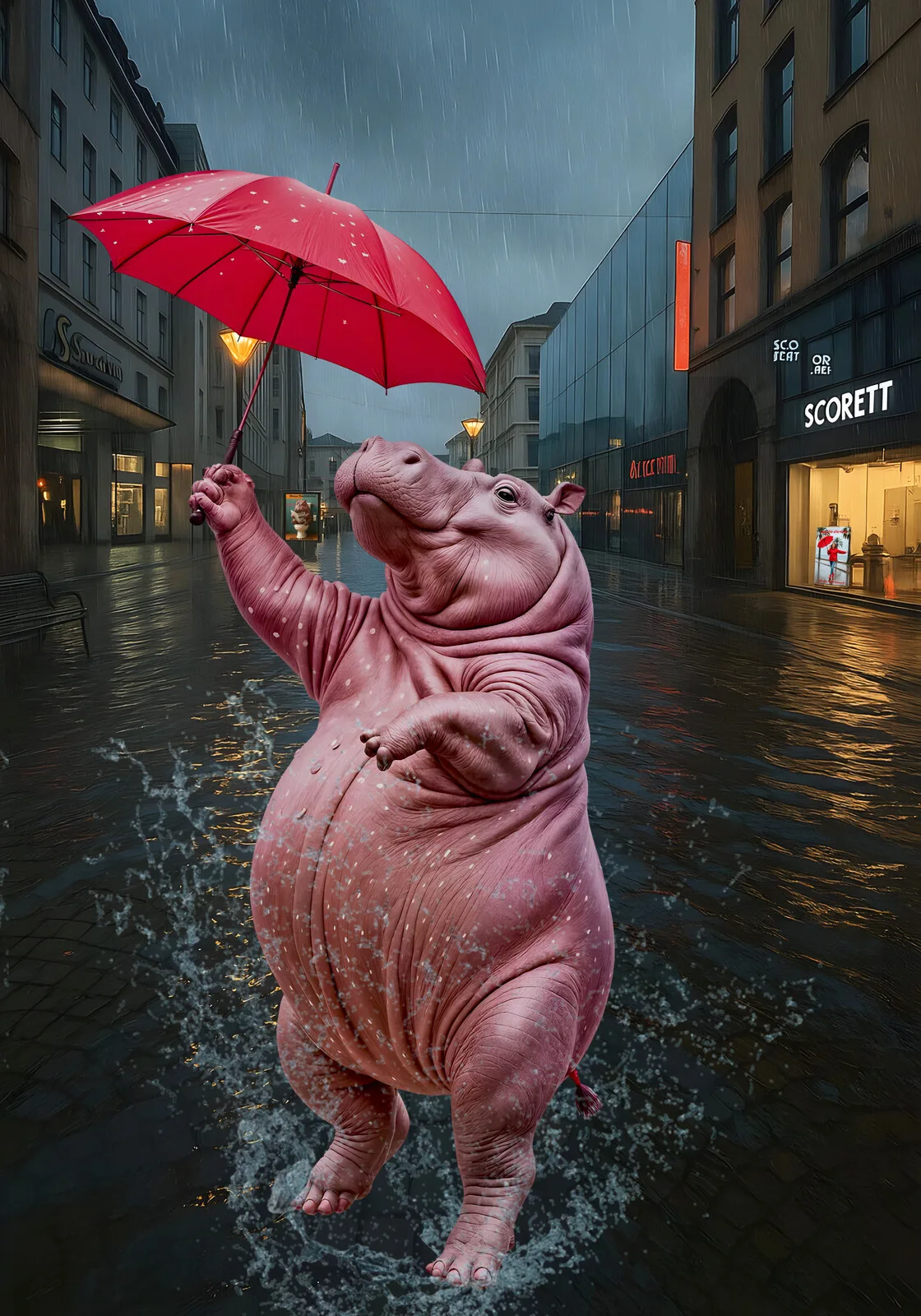
Pinkerton, the Hippo, 2025
Digital
50 x 70 cm
3 200 kr
Pinkerton, the Hippo
This is neither a scientific report on African species nor a strictly fairytale. It’s something in between—a slightly blurred snapshot taken through the rain-speckled lens of memory, imagination, and just a hint of alcohol. What follows is a curious stroll through zoology, hallucination, popular culture, and rainy city streets, where reality wobbles ever so gently and even the most unlikely creatures—like a pink hippopotamus with a red umbrella—might waltz into view. I invite you to suspend your disbelief, or at least tilt it slightly, as we explore the strange but oddly reasonable presence of Pinkerton the Hippo and his better-known but no less absurd cousins, the pink elephants.
Discover a unique perspective on pink animals and why this story is a must-read.
”Pinkerton, the hip Hippo
With a red umbrella and a swinging tail,
Pinkerton marches on puddle and trail.
From Gustav to Stortorget, through drizzle and gleam,
he hums through the raindrops, lost in a dream.
"Singin’ in the Rain" with a grin ear to ear,
he twirls on the cobblestones, light as a deer.
A hippo in rhythm, with flair and finesse,
a ballet of belly and joyous excess.
He splashes at bikers, startles a dove,
but beams like a star with an umbrella above.
A tiptoe pirouette by the crossing ahead,
then onward he dances with puddles to tread.
The crowd stares and chuckles; one woman gets soaked,
but Pinkerton spins—delighted, unyoked.
For when rain paints the city in silver and grey,
Pinkerton’s spirit floats all the way.
So next time the clouds roll in thick with refrain,
and Malmö turns the mirror in midsummer rain—
Look twice on the sidewalk, for joy knows no chain
when a pink hippo’s dancing and humming again.”
Malmö, June 2025
Pinkerton, the Hippo
The image may seem confusing, as few people have ever been drunk enough to experience what you’re seeing truly. But the fact is, it’s exactly what you think it is.
A hippopotamus, or more conveniently, a "hippo." They are recognisable by their barrel-shaped torsos, wide-opening mouths with large canine tusks, nearly hairless bodies, pillar-like legs, and their massive size. They look a bit comical, almost like circus clowns, but in truth, they are not particularly funny—in fact, they can be aggressive and dangerous to humans. Their skin is greyish-violet, mainly copper-brown, with darker shading along the top of the body. Around the eyes and ears, however, the skin has a pinkish hue. The hippo’s body appears naked but is sparsely covered with fine, short hairs. The species secretes a reddish fluid from glands in the skin. This liquid keeps the skin moist when the hippo is out of the water. In older stories, the red colour led people to believe that hippos "sweated blood." Perhaps that’s why, from a distance, they can appear pink—unlike elephants, which are always grey unless you're drunk, in which case they become pink. Pinkerton—the one in the picture—looks just like that, because photographs don’t lie. I don’t need to put myself at risk with excessive alcohol intake; a camera lens sees everything, and more.
Now, if hippos are more or less pink and elephants are not, why don’t we see pink hippos during intoxicated hallucinations?
It’s an excellent question—and quite a culturally charged one. Pink elephants have become a well-established figure in Western popular culture, particularly as a way to describe hallucinations brought on by alcohol. The expression first appeared in literature in the 1800s but gained popularity through Disney’s film ‘Dumbo’ (1941) in the surreal sequence “Pink Elephants on Parade.” There, they symbolise the absurd and frightening effects of intoxication. Since then, 'seeing pink elephants' has become a code for perceiving things that aren’t real, often with a humorous or tragicomic undertone. The unique cultural significance of pink elephants, primarily attributed to Walt Disney, has not only intrigued but also entertained audiences for generations.
But why not pink hippos?
The hippopotamus, unlike the elephant, is already an absurd creature by nature. It’s large, round, and almost cartoonish in appearance—but also one of Africa’s most dangerous animals. It carries a strange dual symbolism: cuteness and lethality. Making it pink risks turning it into something too cute or too silly, lacking the ironic dissonance that pink elephants are known for.
Moreover, the elephant carries a distinct cultural significance. It’s associated with wisdom, memory, and even religious symbolism (such as Ganesha in Hinduism), which makes its distortion into a pink hallucination more potent. The hippo, on the other hand, holds a different symbolic depth in African culture. It's often associated with water, fertility, and protection; in some African tribes, it's considered a symbol of strength and courage. The cultural significance of the hippo in Africa adds another layer of complexity to the question of why we don't see pink hippos in intoxicated hallucinations in Western culture. However, in Western culture, it has been portrayed more often in children’s books (‘Hungry Hungry Hippos’) or as a ballerina in the film ‘Fantasia’ (1940)—where they are indeed pink but dressed in tutus, presented as visual comedy rather than symbolic weight.
‘Fantasia’ is a Disney film and one of the most groundbreaking in the history of animated cinema. It premiered in 1940 and was something entirely new for its time: an animated feature built around classical music, with each segment illustrating a different piece, complete with unique stories, styles, and moods. It was Walt Disney’s prestige project—a mixture of art film, concert, and technical innovation, including the new “Fantasound” system, an early form of surround sound.
One of the most memorable sequences in ‘Fantasia’ features dancing hippos, along with crocodiles, elephants, and ostriches—all in tutus, pointe shoes, and lace. This part is set to Amilcare Ponchielli’s “Dance of the Hours” and combines classical ballet with slapstick comedy.
And yes, the hippos in the film are pink, making ‘Fantasia’ one of the earliest and most influential examples of pink hippos in popular culture. But unlike the pink elephants in the film about the flying elephant ‘Dumbo’ (who are hallucinations), the hippos in ‘Fantasia’ are real—within their absurd world. They are performers, ballet dancers, with every right to exist and steal the show.
Disney was behind both films—’ Dumbo’ with the drunken pink elephants and ‘Fantasia’ with the elegant pink hippos in tulle skirts. But only the elephants became a standard cultural reference. The hippos, with their unique blend of cuteness and lethality, are still waiting for their philosophical vindication. It's time we recognised the potential of the pink hippo in cultural symbolism. Let's open our minds to the idea of giving them their due. Should we give it to them?
Perhaps we should change that. It’s time to give the pink hippo its rightful place in the hall of surreal iconography. But before we do that, let's delve into the world of pink elephants. Imagine a surreal pink hippo dancing a waltz by moonlight on a savannah in Zimbabwe—wearing a straw hat, a gilded monocle, and burdened by a tragic past. The potential of pink hippos in surrealism can inspire a new wave of artistic interpretation.
Pink elephants and hippos, often depicted in popular culture as symbols of inebriation and clumsiness, actually represent a blend of myth, science, and symbolism. These symbols, deeply rooted in cultural perceptions, frequently present a stark contrast to the true nature of these animals in their natural habitats, a fact that may surprise and enlighten many.
Elephants, even pink ones, are inherently social, empathetic, and cautious creatures, particularly within their herds. They mourn their deceased, remember old companions, and can even display sympathy towards other species. However, provoke them—or get them drunk—and you’ll witness another side.
Numerous folk tales, predominantly from Africa and South Asia, recount stories of elephants getting drunk on fermented fruit, such as that from the marula tree in southern Africa. National Geographic and other outlets have explored this phenomenon. While popular culture may exaggerate the concept—it requires more fermented fruit than one might think to intoxicate an elephant truly—there have been noted changes in behaviour when elephants consume substantial quantities of fermented produce or alcohol-influenced waste like fruit pressings.
Here, the visual irony is stark: while “pink elephants” have been romanticised as a whimsical symbol of inebriated hallucination, a genuinely intoxicated herd of elephants is a slow-motion disaster. They are colossal, ponderous, and shed the inhibitions that typically keep them in check. Tragically, there have been incidents where villages have been trampled, particularly when elephants are already stressed due to drought, fires, or past conflicts with humans. This contrast between our cultural perception and the reality of intoxicated elephants is both striking and thought-provoking.
Thus, there is a sharp irony in the idea that pink elephants on the carpet at home are a sign of overindulgent partying. This reference to 'pink elephants' on the rug is a cultural metaphor for hallucinations experienced during severe intoxication. In contrast, intoxicated elephants are a primal vision of chaos. Our hallucinations are like a softer, safer reflection of something far more frightening.
My expression—that “the wobbling pink elephants on the carpet are preferable”—becomes a poignant comment on humanity’s relationship to reality, intoxication, and control. We love our absurd fantasies, as long as they are safe, indoors, and miniature. But give reality one sip of fermented marula, and it’ll bring the house down.
My pink hippo, Pinkerton, does not happen to live in Malmö’s pub-densest district, surrounded by temptations. A short, elephantine stone’s throw away lies Lilla Torg, full of late-night antics but already claimed by an entire herd of pink elephants. Instead, Pinkerton reigns over the stretch from Stortorget to Gustav Adolfs torg, the canal district, and then down Södra Förstadsgatan to Triangeln. The name 'Pinkerton' is a nod to the cultural association of the colour pink with femininity and the character Pinkerton from Puccini's opera 'Madama Butterfly'. When are you most likely to encounter him? Usually in the evening, and especially if it’s raining, when he’s a little tipsy. That’s when you need to be cautious.
Despite their seemingly clumsy and comical appearance, especially in popular culture, hippos are far from friendly. Their mild exterior is deceptive, hiding the fact that beneath the glossy skin lies one of Africa’s most unpredictable and dangerous creatures. This revelation should instil a sense of caution and respect in the audience.
One of the hippo’s most defining traits is its extreme territorial behaviour. In the water, its domain, it tolerates no intruders. Other animals, such as hippos, crocodiles, and humans, are all considered threats, and if one fails to heed the warning signs, the attack will be swift, silent, and brutal. It’s not uncommon for a seemingly calm river to explode into motion when a hippo bursts through the surface and capsizes a canoe with a force that surprises even seasoned local fishermen.
Their physical capacity contributes to this explosiveness. Despite their massive bulk—up to three tons—hippos can outrun a human over short distances. On land, they can reach speeds of up to 30 km/h, making escape impossible if you're too close. In the water, they are even more effective—not by swimming, but by bounding along the riverbed in rhythmic, silent bursts, making them nearly invisible until they strike. Pinkerton, when he’s in the mood, can cover the distance from Gustav Adolf's Torg to Stortorget—257 metres—in thirty seconds. Only Usain Bolt, the fastest man in the world, could keep ahead. Theoretically, he could navigate the slippery cobblestones in just under 25 seconds—but not if, as in the photo, it was pouring rain and he was drunk. Then he’d be finished.
The jaws are another part of the hippo’s destructive arsenal. They can open up to 150 degrees and exert a bite force greater than most predators, including lions. Their teeth—especially the canines—are knife-length and sharpened daily through use in defence and battle. They aren’t used for chewing grass but for defending territory, asserting dominance, and sometimes killing.
The hippo’s unpredictability is a key factor that heightens the danger they pose. Unlike predators, whose aggression often follows patterns of hunting behaviour, hippo attacks stem from sudden feelings of threat. This primal fear associated with a hippo attack is a stark reminder of the respect and caution we must have for these creatures.
The statistics speak for themselves: hippos kill more people in Africa each year than both lions and crocodiles. Yet in Western pop culture, they still carry an odd aura of gentleness—perhaps because their appearance is so challenging to interpret. We project laziness, roundness, and comedy onto them. But that’s a projection. The real hippo is a powerhouse of instinct and force—a reminder that nature rarely fits our categories.
So the next time you see a dancing hippo with a red umbrella, remember that behind the laughter lies respect. The hippopotamus is nature’s paradox: both lovable and lethal. Feel free to enjoy a few glasses of good red wine or frothy beer, but keep an eye on anything pink in the cityscape. Especially if it’s cheerfully singing Singin’ in the Rain, this caution is not to dampen your spirits but to ensure you respect the power and unpredictability of these pink creatures.
With no thought that over-enthusiastic pink hippos might misuse their song, the music was composed by Herb Brown and the lyrics by Arthur Freed in 1929, long before the famous 1952 film starring Gene Kelly. But it was the film that made the song immortal. The association of the song with the pink hippo in popular culture adds another layer of symbolism to these creatures.
The song first appeared in a musical revue that same year, ‘The Hollywood Revue’, where it was performed by Cliff Edwards (better known as "Ukulele Ike") alongside musical acts and dance numbers from various MGM stars, including a young Joan Crawford—who, of course, would go on to become a major star. Initially, the song was written to mark the transition from silent films to sound films, making it all the more fitting that it experienced a renaissance in a movie precisely about that very transition—the one featuring Gene Kelly and Debbie Reynolds.
Why is the song so powerful? Is it the rain?
The song, 'Singin' in the Rain', is a powerful expression of joy in the face of adversity. Its simplicity is striking, resonating both sincerely and ironically, depending on the context. In the film, it’s used as an exuberant act of freedom following a romantic turning point. Yet, in modern popular culture, it can just as easily be interpreted as black humour or defiance. This resilience in the face of challenges is what makes the song so inspiring and uplifting.
When Gene Kelly performed the song in ‘Singin’ in the Rain’ (1952), it became one of the most iconic moments in film history. His dancing in the pouring rain, twirling an umbrella, with a smile that practically bursts through the screen, is a testament to his unparalleled talent and dedication. The scene was filmed despite Kelly suffering from a fever of 102°F (39°C), and the rainwater was mixed with milk to enhance the studio lighting, further highlighting the extraordinary effort put into this iconic performance.
Interestingly, the idea for the film was built around the song’s title, rather than the other way around. Arthur Freed, by then a powerful producer at MGM, wanted to create a film using a selection of his old lyrics as a framework, and ‘Singin’ in the Rain’ became the centrepiece.
In the 1952 classic, Gene Kelly starred alongside three co-stars, each of whom contributed something essential to the film, helping it become one of the most beloved works in the history of the musical. Each brought their distinct qualities to the story and tone, ranging from youthful charm and physical comedy to biting satire.
Debbie Reynolds played Kathy Selden, a young woman with talent, integrity, and dreams of becoming a serious actress. Her character serves as the film’s heart, capable of both speaking and singing at a time when the shift to talking pictures demanded new skills from actors. Reynolds was only 19 during filming, while Gene Kelly, who not only starred but also choreographed much of the film, was 39. Despite the romantic chemistry on screen, the shoot was far from easy for Reynolds. Kelly was known for his perfectionism and, according to many accounts, could be challenging and demanding. Nevertheless, Reynolds delivered a performance brimming with energy and charm that has become iconic. One of the film’s most symbolically rich moments occurs when Kathy, hidden behind a curtain, provides the voice for Lina Lamont—a metaphor for the invisible labour women have often undertaken behind the scenes.
Donald O’Connor played Cosmo Brown, Kelly’s ever-present sidekick, pianist, and comic relief. With his quick wit, acrobatic dance, and physical humour, he was the perfect counterbalance to Kelly’s more romantic and dramatic performance. His number "Make ’Em Laugh" is one of the most physically gruelling comedic scenes ever filmed, leaving O’Connor so exhausted that he had to rest for several days afterwards. Already known as a gifted comedian, this became a high point in his career. Through Cosmo, he added a touch of joyful madness and musical brilliance that elevated the film’s overall tone.
Jean Hagen, who portrayed silent film diva Lina Lamont, emerged as the film’s hidden ace. With her shrill voice and inflated ego, her character symbolised everything old Hollywood sought to leave behind when sound arrived. She is also the story’s primary obstacle—her voice is so ill-suited to sound films that Kathy has to dub her. Hagen approached the role with such sharp satire that she received an Oscar nomination for Best Supporting Actress. Ironically, it’s Jean Hagen herself who dubs Reynolds in the scene where Reynolds is meant to be dubbing Hagen, creating an elegant meta-commentary on acting, illusion, and artifice.
Together, Reynolds, O’Connor, and Hagen formed a rich harmony for Kelly’s lead. Through humour, contrast, movement, and emotion, ‘Singin’ in the Rain’ became more than just a musical. It became a self-reflexive celebration of cinema itself—a glittering tribute to one of Hollywood’s most creative eras. This celebration of cinema's creativity is sure to make any film enthusiast feel proud and appreciative of the art of cinema.
And if anyone wonders how the wedding couple in the picture managed to dance in the middle of the street without music, the answer is simple. They did indeed have music. Among the crowd clapping in rhythm, one person had a good speaker connected via Bluetooth to his phone. That was all it took.
Jörgen Thornberg
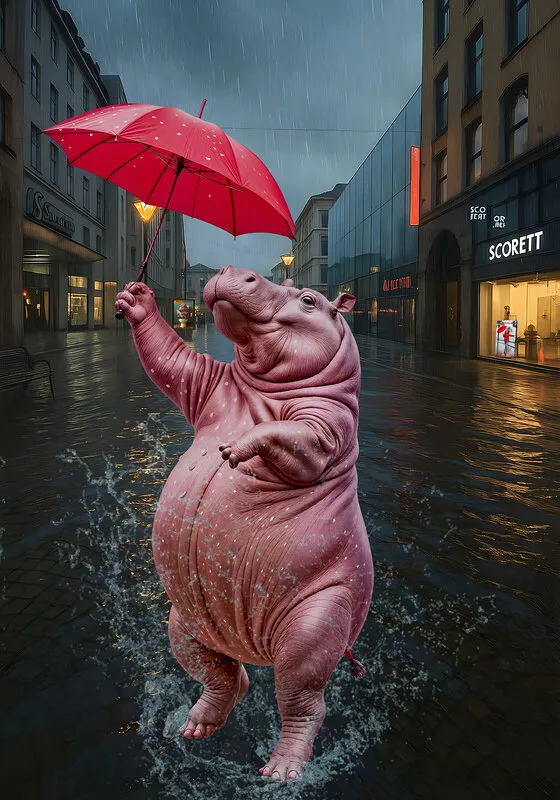
Pinkerton, the Hippo, 2025
Digital
50 x 70 cm
3 200 kr
Pinkerton, the Hippo
This is neither a scientific report on African species nor a strictly fairytale. It’s something in between—a slightly blurred snapshot taken through the rain-speckled lens of memory, imagination, and just a hint of alcohol. What follows is a curious stroll through zoology, hallucination, popular culture, and rainy city streets, where reality wobbles ever so gently and even the most unlikely creatures—like a pink hippopotamus with a red umbrella—might waltz into view. I invite you to suspend your disbelief, or at least tilt it slightly, as we explore the strange but oddly reasonable presence of Pinkerton the Hippo and his better-known but no less absurd cousins, the pink elephants.
Discover a unique perspective on pink animals and why this story is a must-read.
”Pinkerton, the hip Hippo
With a red umbrella and a swinging tail,
Pinkerton marches on puddle and trail.
From Gustav to Stortorget, through drizzle and gleam,
he hums through the raindrops, lost in a dream.
"Singin’ in the Rain" with a grin ear to ear,
he twirls on the cobblestones, light as a deer.
A hippo in rhythm, with flair and finesse,
a ballet of belly and joyous excess.
He splashes at bikers, startles a dove,
but beams like a star with an umbrella above.
A tiptoe pirouette by the crossing ahead,
then onward he dances with puddles to tread.
The crowd stares and chuckles; one woman gets soaked,
but Pinkerton spins—delighted, unyoked.
For when rain paints the city in silver and grey,
Pinkerton’s spirit floats all the way.
So next time the clouds roll in thick with refrain,
and Malmö turns the mirror in midsummer rain—
Look twice on the sidewalk, for joy knows no chain
when a pink hippo’s dancing and humming again.”
Malmö, June 2025
Pinkerton, the Hippo
The image may seem confusing, as few people have ever been drunk enough to experience what you’re seeing truly. But the fact is, it’s exactly what you think it is.
A hippopotamus, or more conveniently, a "hippo." They are recognisable by their barrel-shaped torsos, wide-opening mouths with large canine tusks, nearly hairless bodies, pillar-like legs, and their massive size. They look a bit comical, almost like circus clowns, but in truth, they are not particularly funny—in fact, they can be aggressive and dangerous to humans. Their skin is greyish-violet, mainly copper-brown, with darker shading along the top of the body. Around the eyes and ears, however, the skin has a pinkish hue. The hippo’s body appears naked but is sparsely covered with fine, short hairs. The species secretes a reddish fluid from glands in the skin. This liquid keeps the skin moist when the hippo is out of the water. In older stories, the red colour led people to believe that hippos "sweated blood." Perhaps that’s why, from a distance, they can appear pink—unlike elephants, which are always grey unless you're drunk, in which case they become pink. Pinkerton—the one in the picture—looks just like that, because photographs don’t lie. I don’t need to put myself at risk with excessive alcohol intake; a camera lens sees everything, and more.
Now, if hippos are more or less pink and elephants are not, why don’t we see pink hippos during intoxicated hallucinations?
It’s an excellent question—and quite a culturally charged one. Pink elephants have become a well-established figure in Western popular culture, particularly as a way to describe hallucinations brought on by alcohol. The expression first appeared in literature in the 1800s but gained popularity through Disney’s film ‘Dumbo’ (1941) in the surreal sequence “Pink Elephants on Parade.” There, they symbolise the absurd and frightening effects of intoxication. Since then, 'seeing pink elephants' has become a code for perceiving things that aren’t real, often with a humorous or tragicomic undertone. The unique cultural significance of pink elephants, primarily attributed to Walt Disney, has not only intrigued but also entertained audiences for generations.
But why not pink hippos?
The hippopotamus, unlike the elephant, is already an absurd creature by nature. It’s large, round, and almost cartoonish in appearance—but also one of Africa’s most dangerous animals. It carries a strange dual symbolism: cuteness and lethality. Making it pink risks turning it into something too cute or too silly, lacking the ironic dissonance that pink elephants are known for.
Moreover, the elephant carries a distinct cultural significance. It’s associated with wisdom, memory, and even religious symbolism (such as Ganesha in Hinduism), which makes its distortion into a pink hallucination more potent. The hippo, on the other hand, holds a different symbolic depth in African culture. It's often associated with water, fertility, and protection; in some African tribes, it's considered a symbol of strength and courage. The cultural significance of the hippo in Africa adds another layer of complexity to the question of why we don't see pink hippos in intoxicated hallucinations in Western culture. However, in Western culture, it has been portrayed more often in children’s books (‘Hungry Hungry Hippos’) or as a ballerina in the film ‘Fantasia’ (1940)—where they are indeed pink but dressed in tutus, presented as visual comedy rather than symbolic weight.
‘Fantasia’ is a Disney film and one of the most groundbreaking in the history of animated cinema. It premiered in 1940 and was something entirely new for its time: an animated feature built around classical music, with each segment illustrating a different piece, complete with unique stories, styles, and moods. It was Walt Disney’s prestige project—a mixture of art film, concert, and technical innovation, including the new “Fantasound” system, an early form of surround sound.
One of the most memorable sequences in ‘Fantasia’ features dancing hippos, along with crocodiles, elephants, and ostriches—all in tutus, pointe shoes, and lace. This part is set to Amilcare Ponchielli’s “Dance of the Hours” and combines classical ballet with slapstick comedy.
And yes, the hippos in the film are pink, making ‘Fantasia’ one of the earliest and most influential examples of pink hippos in popular culture. But unlike the pink elephants in the film about the flying elephant ‘Dumbo’ (who are hallucinations), the hippos in ‘Fantasia’ are real—within their absurd world. They are performers, ballet dancers, with every right to exist and steal the show.
Disney was behind both films—’ Dumbo’ with the drunken pink elephants and ‘Fantasia’ with the elegant pink hippos in tulle skirts. But only the elephants became a standard cultural reference. The hippos, with their unique blend of cuteness and lethality, are still waiting for their philosophical vindication. It's time we recognised the potential of the pink hippo in cultural symbolism. Let's open our minds to the idea of giving them their due. Should we give it to them?
Perhaps we should change that. It’s time to give the pink hippo its rightful place in the hall of surreal iconography. But before we do that, let's delve into the world of pink elephants. Imagine a surreal pink hippo dancing a waltz by moonlight on a savannah in Zimbabwe—wearing a straw hat, a gilded monocle, and burdened by a tragic past. The potential of pink hippos in surrealism can inspire a new wave of artistic interpretation.
Pink elephants and hippos, often depicted in popular culture as symbols of inebriation and clumsiness, actually represent a blend of myth, science, and symbolism. These symbols, deeply rooted in cultural perceptions, frequently present a stark contrast to the true nature of these animals in their natural habitats, a fact that may surprise and enlighten many.
Elephants, even pink ones, are inherently social, empathetic, and cautious creatures, particularly within their herds. They mourn their deceased, remember old companions, and can even display sympathy towards other species. However, provoke them—or get them drunk—and you’ll witness another side.
Numerous folk tales, predominantly from Africa and South Asia, recount stories of elephants getting drunk on fermented fruit, such as that from the marula tree in southern Africa. National Geographic and other outlets have explored this phenomenon. While popular culture may exaggerate the concept—it requires more fermented fruit than one might think to intoxicate an elephant truly—there have been noted changes in behaviour when elephants consume substantial quantities of fermented produce or alcohol-influenced waste like fruit pressings.
Here, the visual irony is stark: while “pink elephants” have been romanticised as a whimsical symbol of inebriated hallucination, a genuinely intoxicated herd of elephants is a slow-motion disaster. They are colossal, ponderous, and shed the inhibitions that typically keep them in check. Tragically, there have been incidents where villages have been trampled, particularly when elephants are already stressed due to drought, fires, or past conflicts with humans. This contrast between our cultural perception and the reality of intoxicated elephants is both striking and thought-provoking.
Thus, there is a sharp irony in the idea that pink elephants on the carpet at home are a sign of overindulgent partying. This reference to 'pink elephants' on the rug is a cultural metaphor for hallucinations experienced during severe intoxication. In contrast, intoxicated elephants are a primal vision of chaos. Our hallucinations are like a softer, safer reflection of something far more frightening.
My expression—that “the wobbling pink elephants on the carpet are preferable”—becomes a poignant comment on humanity’s relationship to reality, intoxication, and control. We love our absurd fantasies, as long as they are safe, indoors, and miniature. But give reality one sip of fermented marula, and it’ll bring the house down.
My pink hippo, Pinkerton, does not happen to live in Malmö’s pub-densest district, surrounded by temptations. A short, elephantine stone’s throw away lies Lilla Torg, full of late-night antics but already claimed by an entire herd of pink elephants. Instead, Pinkerton reigns over the stretch from Stortorget to Gustav Adolfs torg, the canal district, and then down Södra Förstadsgatan to Triangeln. The name 'Pinkerton' is a nod to the cultural association of the colour pink with femininity and the character Pinkerton from Puccini's opera 'Madama Butterfly'. When are you most likely to encounter him? Usually in the evening, and especially if it’s raining, when he’s a little tipsy. That’s when you need to be cautious.
Despite their seemingly clumsy and comical appearance, especially in popular culture, hippos are far from friendly. Their mild exterior is deceptive, hiding the fact that beneath the glossy skin lies one of Africa’s most unpredictable and dangerous creatures. This revelation should instil a sense of caution and respect in the audience.
One of the hippo’s most defining traits is its extreme territorial behaviour. In the water, its domain, it tolerates no intruders. Other animals, such as hippos, crocodiles, and humans, are all considered threats, and if one fails to heed the warning signs, the attack will be swift, silent, and brutal. It’s not uncommon for a seemingly calm river to explode into motion when a hippo bursts through the surface and capsizes a canoe with a force that surprises even seasoned local fishermen.
Their physical capacity contributes to this explosiveness. Despite their massive bulk—up to three tons—hippos can outrun a human over short distances. On land, they can reach speeds of up to 30 km/h, making escape impossible if you're too close. In the water, they are even more effective—not by swimming, but by bounding along the riverbed in rhythmic, silent bursts, making them nearly invisible until they strike. Pinkerton, when he’s in the mood, can cover the distance from Gustav Adolf's Torg to Stortorget—257 metres—in thirty seconds. Only Usain Bolt, the fastest man in the world, could keep ahead. Theoretically, he could navigate the slippery cobblestones in just under 25 seconds—but not if, as in the photo, it was pouring rain and he was drunk. Then he’d be finished.
The jaws are another part of the hippo’s destructive arsenal. They can open up to 150 degrees and exert a bite force greater than most predators, including lions. Their teeth—especially the canines—are knife-length and sharpened daily through use in defence and battle. They aren’t used for chewing grass but for defending territory, asserting dominance, and sometimes killing.
The hippo’s unpredictability is a key factor that heightens the danger they pose. Unlike predators, whose aggression often follows patterns of hunting behaviour, hippo attacks stem from sudden feelings of threat. This primal fear associated with a hippo attack is a stark reminder of the respect and caution we must have for these creatures.
The statistics speak for themselves: hippos kill more people in Africa each year than both lions and crocodiles. Yet in Western pop culture, they still carry an odd aura of gentleness—perhaps because their appearance is so challenging to interpret. We project laziness, roundness, and comedy onto them. But that’s a projection. The real hippo is a powerhouse of instinct and force—a reminder that nature rarely fits our categories.
So the next time you see a dancing hippo with a red umbrella, remember that behind the laughter lies respect. The hippopotamus is nature’s paradox: both lovable and lethal. Feel free to enjoy a few glasses of good red wine or frothy beer, but keep an eye on anything pink in the cityscape. Especially if it’s cheerfully singing Singin’ in the Rain, this caution is not to dampen your spirits but to ensure you respect the power and unpredictability of these pink creatures.
With no thought that over-enthusiastic pink hippos might misuse their song, the music was composed by Herb Brown and the lyrics by Arthur Freed in 1929, long before the famous 1952 film starring Gene Kelly. But it was the film that made the song immortal. The association of the song with the pink hippo in popular culture adds another layer of symbolism to these creatures.
The song first appeared in a musical revue that same year, ‘The Hollywood Revue’, where it was performed by Cliff Edwards (better known as "Ukulele Ike") alongside musical acts and dance numbers from various MGM stars, including a young Joan Crawford—who, of course, would go on to become a major star. Initially, the song was written to mark the transition from silent films to sound films, making it all the more fitting that it experienced a renaissance in a movie precisely about that very transition—the one featuring Gene Kelly and Debbie Reynolds.
Why is the song so powerful? Is it the rain?
The song, 'Singin' in the Rain', is a powerful expression of joy in the face of adversity. Its simplicity is striking, resonating both sincerely and ironically, depending on the context. In the film, it’s used as an exuberant act of freedom following a romantic turning point. Yet, in modern popular culture, it can just as easily be interpreted as black humour or defiance. This resilience in the face of challenges is what makes the song so inspiring and uplifting.
When Gene Kelly performed the song in ‘Singin’ in the Rain’ (1952), it became one of the most iconic moments in film history. His dancing in the pouring rain, twirling an umbrella, with a smile that practically bursts through the screen, is a testament to his unparalleled talent and dedication. The scene was filmed despite Kelly suffering from a fever of 102°F (39°C), and the rainwater was mixed with milk to enhance the studio lighting, further highlighting the extraordinary effort put into this iconic performance.
Interestingly, the idea for the film was built around the song’s title, rather than the other way around. Arthur Freed, by then a powerful producer at MGM, wanted to create a film using a selection of his old lyrics as a framework, and ‘Singin’ in the Rain’ became the centrepiece.
In the 1952 classic, Gene Kelly starred alongside three co-stars, each of whom contributed something essential to the film, helping it become one of the most beloved works in the history of the musical. Each brought their distinct qualities to the story and tone, ranging from youthful charm and physical comedy to biting satire.
Debbie Reynolds played Kathy Selden, a young woman with talent, integrity, and dreams of becoming a serious actress. Her character serves as the film’s heart, capable of both speaking and singing at a time when the shift to talking pictures demanded new skills from actors. Reynolds was only 19 during filming, while Gene Kelly, who not only starred but also choreographed much of the film, was 39. Despite the romantic chemistry on screen, the shoot was far from easy for Reynolds. Kelly was known for his perfectionism and, according to many accounts, could be challenging and demanding. Nevertheless, Reynolds delivered a performance brimming with energy and charm that has become iconic. One of the film’s most symbolically rich moments occurs when Kathy, hidden behind a curtain, provides the voice for Lina Lamont—a metaphor for the invisible labour women have often undertaken behind the scenes.
Donald O’Connor played Cosmo Brown, Kelly’s ever-present sidekick, pianist, and comic relief. With his quick wit, acrobatic dance, and physical humour, he was the perfect counterbalance to Kelly’s more romantic and dramatic performance. His number "Make ’Em Laugh" is one of the most physically gruelling comedic scenes ever filmed, leaving O’Connor so exhausted that he had to rest for several days afterwards. Already known as a gifted comedian, this became a high point in his career. Through Cosmo, he added a touch of joyful madness and musical brilliance that elevated the film’s overall tone.
Jean Hagen, who portrayed silent film diva Lina Lamont, emerged as the film’s hidden ace. With her shrill voice and inflated ego, her character symbolised everything old Hollywood sought to leave behind when sound arrived. She is also the story’s primary obstacle—her voice is so ill-suited to sound films that Kathy has to dub her. Hagen approached the role with such sharp satire that she received an Oscar nomination for Best Supporting Actress. Ironically, it’s Jean Hagen herself who dubs Reynolds in the scene where Reynolds is meant to be dubbing Hagen, creating an elegant meta-commentary on acting, illusion, and artifice.
Together, Reynolds, O’Connor, and Hagen formed a rich harmony for Kelly’s lead. Through humour, contrast, movement, and emotion, ‘Singin’ in the Rain’ became more than just a musical. It became a self-reflexive celebration of cinema itself—a glittering tribute to one of Hollywood’s most creative eras. This celebration of cinema's creativity is sure to make any film enthusiast feel proud and appreciative of the art of cinema.
And if anyone wonders how the wedding couple in the picture managed to dance in the middle of the street without music, the answer is simple. They did indeed have music. Among the crowd clapping in rhythm, one person had a good speaker connected via Bluetooth to his phone. That was all it took.
3 200 kr

Jörgen Thornberg
Malmö
Lite om bilder och mig. Translation in English at the end.
Jag är en nyfiken person som ser allt i bilder, även det jag fäster i ord, gärna tillsammans för bakom alla mina bilder finns en berättelse. Till vissa bilder hör en kortare eller längre novell som följer med bilden.
Bilder berättar historier. Jag omges av naturlig skönhet, intressanta människor och historia var jag än går. Jag använder min kamera för att dokumentera världen och blanda det jag ser med vad jag känner för att fånga den dolda magin.
Mina bilder berättar mina historier. Genom mina bilder, tryck och berättelser. Jag bjuder in dig att ta del av dessa berättelser, in i ditt liv och hem och dela min mycket personliga syn på vår värld. Mer än vad ögat ser. Jag tänker i bilder, drömmer och skriver och pratar om dem; följaktligen måste jag också skapa bilder. De blir vad jag ser, inte nödvändigtvis begränsade till verkligheten. Det finns en bild runt varje hörn. Jag hoppas att du kommer att se vad jag såg och gilla det.
Jag är också en skrivande person och till många bilder hör en kortare eller längre essay. Den följer med tavlan, tryckt på fint papper och med en personlig hälsning från mig.
Flertalet bilder startar sin resa i min kamera. Enkelt förklarat beskriver jag bilden jag ser i mitt inre, upplevd eller fantiserad. Bilden uppstår inom mig redan innan jag fått okularet till ögat. På bråkdelen av ett ögonblick ser jag vad jag vill ha och vad som kan göras med bilden. Här skall jag stoppa in en giraff, stålmannen, Titanic eller vad det är min fantasi finner ut. Ännu märkligare är att jag kommer ihåg minnesbilden långt efteråt när det blir tid att skapa verket. Om jag lyckas eller inte, är upp till betraktaren, oftast präglat av en stråk av svart humor – meningen är att man skall bli underhållen. Mina bilder blir ofta en snackis där de hänger.
Jag föredrar bilder som förmedlar ett budskap i flera lager. Vid första anblicken fylld av feel-good, en vacker utsikt, fint väder, solen skiner, blommor på ängen eller vattnet som ligger förrädiskt spegelblankt. I en sådan bild kan jag gömma min egentliga berättelse, mitt förakt för förtryckare och våldsverkare, rasister och fördomsfulla människor - ett gärna återkommande motiv mer eller mindre dolt i det vackra motivet. Jag försöker förena dem i ett gemensamt narrativ.
Bild och formgivning har löpt som en röd tråd genom livet. Fotokonst känns som en värdig final som jag gärna delar med mig.
Min genre är vid som framgår av mina bilder, temat en blandning av pop- och gatukonst i kollage som kan bestå av hundratals lager. Vissa bilder kan ta veckor, andra någon dag innan det är dags att överlämna resultatet till printverkstaden. Fine Art Prints är digitala fotocollage. I dessa kollage sker rivandet, klippandet, pusslandet, målandet, ritandet och sprayningen digitalt. Det jag monterar in kan vara hundratals år gamla bilder som jag omsorgsfullt frilägger så att de ser ut att vara en del av tavlan men också bilder skapade av mig själv efter min egen fantasi. Därefter besöks printstudion och för vissa bilder numrera en limiterad upplaga (oftast 7 exemplar) och signera för hand. Vissa bilder kan köpas i olika format. Det är bara att fråga efter vilka. Gillar man en bild som är 70x100 men inte har plats på väggen, går den kanske att få i 50x70 cm istället. Frågan är fri.
Metoden Giclée eller Fine Art Print som det också kallas är det moderna sättet för framställning av grafisk konst. Villkoret för denna typ av utskrifter är att en högkvalitativ storformatskrivare används med åldersbeständigt färgpigment och konstnärspapper eller i förekommande fall på duk. Pappret som används möter de krav på livslängd som ställs av museer och gallerier. Normalt säljer jag mina bilder oinramade så att den nya ägaren själv kan bestämma hur de skall se ut, med eller utan passepartout färg på ram, med eller utan glas etc..
Under många år ställde jag bara ut på nätet, i valda grupper och på min egen Facebooksida - https://www.facebook.com/jorgen.thornberg.9
Jag finns också på en egen hemsida som tyvärr inte alltid är uppdaterad – https://www.jth.life/ Där kan du också läsa en del av de berättelser som följer med bilden.
UTSTÄLLNINGAR
Luftkastellet, oktober 2022
Konst i Lund, november 2022
Luftkastellet, mars 2023
Engleson Galleri Caroli, april 2023
Hydra, Greece June 2023
Engleson Galleri Caroli, oktober 2023
Toppen, Höllviken december 2023
Luftkastellet, mars 2024
Torups Galleri, mars 2024
Venice, May 2024
Luftkastellet, oktober 2024
Konst i Advent, December 2024
Galleri Engleson, Caroli December 2024
Jäger & Jansson Galleri, april 2025
A bit about pictures and me.
I'm a curious person who sees everything in pictures, even what I express in words, often combining them, for behind all my pictures lies a story. These narratives, some as short as a single image and others as long as a novel, are the heart and soul of my work.
Pictures tell stories. Wherever I go, I'm surrounded by natural beauty, exciting people, and history. I use my camera to document the world and blend what I see with what I feel to capture the hidden magic.
My images tell my stories. Through my pictures, prints, and narratives, I invite you to partake in these stories in your life and home and share my deeply personal perspective of our world. More than meets the eye. I think in pictures, dream, write, and talk about them; consequently, I must create images too. They become what I see, not necessarily confined to reality. There's a picture around every corner. I hope you'll see what I saw and enjoy it.
I'm also a writer, and many images come with a shorter or longer essay. It accompanies the painting, printed on fine paper with my personal greeting.
Many pictures start their journey on my camera. Simply put, I describe the image I see in my mind, experienced or imagined. The image arises within me even before I bring the eyepiece to my eye. In a fraction of a moment, I see what I want and what can be done with the picture. Here, I'll insert a giraffe, Superman, the Titanic, or whatever my imagination conjures up. Even stranger is that I remember the mental image long after it's time to create the work. Whether I succeed is up to the observer, often imbued with a streak of black humour – the aim is to entertain. My pictures usually become a talking point wherever they hang.
I prefer pictures that convey a message in multiple layers. At first glance, they're filled with feel-good vibes, a beautiful view, lovely weather, the sun shining, flowers in the meadow, or the water lying deceptively calm. But beneath this surface beauty, I often conceal a deeper story, a narrative that challenges societal norms or explores the human condition. I invite you to delve into these hidden narratives and discover the layers of meaning within my work.
Picture and design have been a thread running through my life. Photographic art feels like a fitting finale, and I'm happy to share it.
My genre is varied, as seen in my pictures; the theme is a blend of pop and street art in collages that can consist of hundreds of layers. Some images can take weeks, others just a day before it's time to hand over the result to the print workshop. Fine Art Prints are digital photo collages. In these collages, tearing, cutting, puzzling, painting, drawing, and spraying happen digitally. What I insert can be images hundreds of years old that I carefully extract so they appear to be part of the painting, but also images created by myself, now also generated from my imagination. Next, visit the print studio and, for certain images, number a limited edition (usually 7 copies) and sign them by hand. Some images may be available in other formats. Just ask which ones. If you like an image that's 70x100 but doesn't have space on the wall, you might be able to get it in 50x70 cm instead. The question is open.
The Giclée method, or Fine Art Print as it's also called, is the modern way of producing graphic art. This method ensures the highest quality and longevity of the artwork, using a high-quality large-format printer with archival pigment inks and artist paper or, in some cases, canvas. The paper used meets the longevity requirements set by museums and galleries. I sell my pictures unframed, allowing the new owner to personalise their artwork, confident in the lasting value and quality of the piece.
For many years, I only exhibited online, in selected groups, and on my Facebook page - https://www.facebook.com/jorgen.thornberg.9. I also have my website, which unfortunately is not constantly updated - https://www.jth.life/. You can also read some of the stories accompanying the pictures there.
EXHIBITIONS
Luftkastellet, October 2022
Art in Lund, November 2022
Luftkastellet, March 2023
Engleson Gallery Caroli, April 2023
Hydra, Greece June 2023
Engleson Gallery Caroli, October 2023
Toppen, Höllviken December 2023
Luftkastellet, March 2024
Torup Gallery, March 2024
Venice, May 2024
UTSTÄLLNINGAR
Luftkastellet, oktober 2022
Konst i Lund, november 2022
Luftkastellet, mars 2023
Engleson Galleri Caroli, april 2023
Hydra, Greece June 2023
Engleson Galleri Caroli, oktober 2023
Toppen, Höllviken december 2023
Luftkastellet, mars 2024
Torups Galleri, mars 2024
Venice, May 2024
Luftkastellet, October 2024
Konst i Advent, December 2024
Galleri Engleson, Caroli December 2024
Jäger & Jansson Galleri, April 2025
Utbildning
Autodidakt
Medlem i konstnärsförening
Öppna Sinnen
Med i konstrunda
Konstrundan i Skåne
Utställningar
Luftkastellet, October 2022
Art in Lund, November 2022
Luftkastellet, March 2023
Engleson Gallery Caroli, April 2023
Hydra, Greece June 2023
Engleson Gallery Caroli, October 2023
Toppen, Höllviken December 2023
Luftkastellet, March 2024
Torup Gallery, March 2024
Venice, May 2024